
Crypto World
The Ethereum (ETH) Chart Everyone Is Watching Has a Problem: $1,475 May Never Come

Ethereum has declined by more than 2% over the past 24 hours, but still holds a small weekly gain. ETH is currently at $1,875, while many traders are waiting for a deeper flush to $1,475 before buying.
But the latest analysis by trader Nonzee indicates that such a move may not come, as the main shakeout already took place in June and July.
Final Trap
The leading altcoin swept below the range twice during that period and recovered within days, although the quiet moves did not look like a typical market bottom. The next move is expected to come in October, when ETH pulls back to $1,537. The market expert explained that this pullback will mark a retest and a higher low, not a new low.
According to Nonzee, ETH would move back above $2,203 and test the $2,872 range high. The 2027 target is $4,500, with a full measured target of $4,500 to $4,700. That makes the October dip a major buying opportunity, even though it would be about 15% above the $1,475 level many traders are waiting for.
Last week, Crypto Patel said Ethereum was showing one of its strongest high-timeframe bullish structures. The asset had reclaimed its long-term descending trendline after several failed attempts and was consolidating above it. The structure remained valid above $1,510 on daily closes. The analyst identified upside targets at $2,400, $3,000, $3,600, $4,200, and $5,000.
Beyond these targets, Crypto Patel also outlined a much bigger Ethereum move playing out through 2030. The analyst mapped a long-term roadmap that puts the ETH accumulation zone at $1,000-$1,600, followed by targets of $10,000 and eventually $20,000.
“If this HTF roadmap plays out, today’s ‘fear’ could look like the best entry of the decade.”
Mixed Picture
On the corporate side of things, Bitmine expanded its Ethereum holdings beyond 5.8 million tokens after acquiring another 7,391 ETH. Its total stash is now worth approximately $11.2 billion at the reported price. However, the accumulation pace has slowed compared with earlier purchases exceeding 27,000 and 42,000 units.
The company has also repurchased 19.1 million shares since July 1, while Bitmine Chairman Tom Lee remains optimistic about the asset’s long-term potential, even as he expressed disappointment that the CLARITY Act will not see a Senate vote before the August recess.
Meanwhile, US-based spot Ethereum ETFs saw $14.59 million in net withdrawals, ending a four-day streak of inflows. So far in August, these funds have attracted around $230 million in net investment.
The post The Ethereum (ETH) Chart Everyone Is Watching Has a Problem: $1,475 May Never Come appeared first on CryptoPotato.

eToro has agreed to acquire U.S.-focused brokerage TradeZero for up to $231 million as the trading platform pushes further into the American market while crypto activity among its users continues to fall.
Summary
- eToro agreed to acquire U.S. brokerage TradeZero for up to $231 million as it expands its presence in the American trading market.
- TradeZero generated about $80 million in revenue with an 81% gross margin during the 12 months ended June 30, 2026.
- eToro reported $1.34 billion in crypto revenue for the second quarter, down about 30% from $1.9 billion a year earlier.
- Crypto trading activity continued to fall, with July trades dropping 73% year over year to 1.4 million and the amount invested falling 50%.
- The TradeZero acquisition is expected to close in the first half of 2027, subject to regulatory approvals and customary closing conditions.
eToro said Tuesday that the cash-and-stock transaction would add TradeZero’s active-trader customer base and brokerage infrastructure to its U.S. operations, with the acquisition expected to close in the first half of 2027 after regulatory approvals and other customary closing conditions are met.
The company expects the purchase to increase adjusted earnings per share during the first year after completion. TradeZero generated about $80 million in revenue during the 12 months ended June 30, 2026, with an 81% gross margin, according to eToro.
Founded in 2015, TradeZero serves active traders in the United States and also operates in Canada and international markets. Its platforms provide trading in stocks and options alongside extended-hours access, short-selling tools, market scanners and other services geared toward frequent traders.
“Today’s announcement is an important step in building our US business,” eToro co-founder and CEO Yoni Assia said. He added that combining the companies would provide “a faster path to launching new products for US customers.”
TradeZero deal adds to eToro’s U.S. expansion
The acquisition would give eToro additional infrastructure in a market where the company has operated since launching its U.S. platform in 2019. Europe and the U.K. have historically accounted for much of eToro’s business, while the company has been expanding in the Americas and Asia-Pacific.
Under the transaction terms, eToro would pay cash and issue up to 2.5 million new Class A shares, with total consideration reaching as much as $231 million after customary purchase-price adjustments.
Jefferies is acting as eToro’s exclusive financial adviser, while Simpson Thacher & Bartlett is serving as its lead deal counsel. J.P. Morgan Securities is advising TradeZero, with Choate, Hall & Stewart serving as the brokerage’s lead counsel.
The deal was announced alongside eToro’s second-quarter results, when adjusted earnings reached $0.68 per share, above the $0.61 expected by analysts surveyed by LSEG. Net trading income from equities, commodities and currencies increased 24% year over year to $141.6 million, led mainly by equities trading.
Trading patterns among existing customers also changed during the quarter. More than 60% of users who had traded commodities during the previous two quarters went on to trade equities during the second quarter, according to the company.
Chief Financial Officer Meron Shani said nearly nine in ten of the users who moved from commodities into equities had also traded cryptocurrencies on eToro, showing significant overlap between customers using its different asset classes.
Crypto trading on eToro has continued to fall
Crypto activity remained much weaker than a year earlier despite eToro continuing to invest in digital-asset products.
The company reported $1.59 billion in total revenue for the second quarter, compared with about $2 billion during the corresponding period of 2025. Revenue reported from crypto assets fell to roughly $1.34 billion from $1.9 billion a year earlier.
Because eToro reports cryptoasset revenue on a gross basis, much of the figure is offset by the cost of acquiring the cryptoassets involved in customer transactions. Crypto-related cost of revenue reached about $1.35 billion during the quarter, while net income attributed to crypto assets was $19.7 million.
Total company net income stood at $53.4 million, while equities and commodities-related trading generated about $141 million in net trading income.
The decline followed weakness recorded earlier in the year. In May, crypto.news reported on eToro’s results showing that April crypto trades had fallen 32% from a year earlier to 2 million, while the amount invested per crypto trade dropped 22% to $207. The company nevertheless posted $82 million in first-quarter net income, up 37% year over year.
The drop accelerated into July. eToro recorded about 1.4 million cryptocurrency trades during the month, 73% fewer than a year earlier, while the amount invested in crypto fell 50%.
Earlier first-quarter figures showed the same pattern in crypto-related earnings. Crypto generated about $13 million in profit during Q1, down from $46 million in the same quarter of 2025, even as eToro’s overall net contribution increased to $258 million.
At the same time, assets under administration reached $17 billion at the end of March, up 15% year over year, while funded accounts increased 12% to 4.02 million. By April, assets under administration had increased further to $18.7 billion.
eToro is still building its crypto business
Lower crypto trading activity has not stopped eToro from adding products and infrastructure tied to digital assets.
On April 30, the company completed its acquisition of Zengo, a self-custodial crypto wallet provider that uses multi-party computation technology rather than conventional seed phrases. eToro said the purchase would help connect its traditional financial products with onchain infrastructure.
The company also activated its BitLicense earlier this year to begin offering cryptocurrency trading in New York. At the time, eToro had expanded its crypto offering to more than 150 assets globally, including more than 100 assets available to U.S. customers.
In July, eToro led a $12.5 million strategic investment in decentralized perpetual futures exchange Extended, with Jump Crypto also participating. As previously covered by crypto.news, the financing was accompanied by a partnership between Extended and Zengo to explore access to financial markets through onchain trading infrastructure.
Extended operates using StarkWare’s StarkEx technology and focuses on perpetual futures that can be traded through a self-custodial structure. The platform opened trading to all users in late 2024.
eToro has also pushed equities onto blockchain rails
eToro’s work around digital assets has included attempts to combine its equities business with blockchain-based settlement rather than relying only on cryptocurrency trading.
In July 2025, eToro announced plans to issue tokenized versions of U.S.-listed stocks on Ethereum, alongside 24/5 trading for 100 U.S. stocks and exchange-traded funds. The company also disclosed work with CME Group on spot-quoted futures.
Under the proposed tokenization model, users would be able to move supported stock tokens onto Ethereum and redeem them against underlying positions held through eToro. Assia said at the time that the company planned to start with stocks as part of its tokenization work.
The initiative followed eToro’s 2019 acquisition of Danish tokenization company Firmo and its subsequent introduction of tokenized gold, silver and fiat currencies. Its U.S. product expansion has since continued alongside those blockchain initiatives, including New York crypto trading, the Zengo purchase and the planned acquisition of TradeZero.


Russia’s central bank has proposed allowing Bitcoin, Ether and Tether’s USDT to trade on regulated exchanges as the country prepares to open its new crypto market framework to investors.
Summary
- Russia’s central bank has proposed allowing Bitcoin, Ether and USDT to trade on regulated exchanges under the country’s new crypto rules.
- Non qualified investors would be limited to 300,000 rubles in annual crypto purchases through each intermediary and must pass a risk knowledge test.
- Qualified investors would face no purchase limits for crypto traded on exchanges or over the counter markets, although testing requirements would still apply.
- The proposal follows Russia’s new crypto law signed on Aug. 4, which gives the Bank of Russia authority to decide which digital currencies can enter organized trading.
- The central bank is accepting comments on the proposed list and related requirements until Aug. 24.
The Bank of Russia said Tuesday that the three crypto assets have been included in a proposed list of digital currencies that could qualify for organized trading, based on requirements covering market capitalization, trading activity and price history in overseas markets.
Bitcoin, Ether and USDT meet the regulator’s proposed criteria because they have sufficient market size, average daily trading volume and at least five years of trading history outside Russia. The list has not yet been finalized, with the central bank accepting public comments until Aug. 24.
The selection provides an early indication of which cryptocurrencies ordinary Russian investors may be able to buy once the country’s new digital asset law takes effect on Sept. 1. Under the rules, non-qualified investors will only be allowed to purchase cryptocurrencies that satisfy standards set by the central bank.
Bank of Russia crypto list starts with BTC, ETH and USDT
Access for retail investors will remain subject to a 300,000-ruble annual purchase limit through each intermediary, equivalent to about $3,650 at current exchange rates. The cap applies separately to purchases made through brokers, crypto exchange services and asset managers.
Before completing any transactions, investors will also have to pass a knowledge test covering crypto investing and its associated risks.
“Before making transactions, all investors, regardless of their status, will have to pass a test and familiarize themselves with the risks of investing in crypto assets,” the Bank of Russia said.
The regulator said restrictions on non-qualified investors are intended to limit their exposure to sharp and unpredictable crypto price movements. Qualified investors must also complete testing, although they will not face the same purchase ceiling when trading cryptocurrencies through exchanges or over-the-counter markets.
The proposed asset list follows President Vladimir Putin’s signing of Russia’s digital currency law on Aug. 4, which placed the Bank of Russia in charge of deciding which cryptocurrencies can trade through organized markets and how the venues will operate.
As previously covered by crypto.news, the legislation created regulated access to cryptocurrencies for both retail and qualified investors while keeping crypto payments for ordinary goods and services prohibited inside Russia. The law’s main provisions are scheduled to take effect on Sept. 1.
Under the same legislation, crypto exchange providers must enter a special registry, hold at least 15 million rubles in equity and join an approved financial-market self-regulatory organization. Existing exchange services have until July 1, 2027, to comply with the registration requirements.
Exchanges will operate under new central bank rules
Before the law was signed, the Bank of Russia had already begun setting operating standards for the institutions that will support organized crypto trading.
In late July, the regulator released draft operating rules covering cryptocurrency exchanges, digital depositories and providers of digital currency accounts. The proposals allow exchanges to establish their own trading procedures while calculating market prices and weighted average prices for listed assets.
Digital depositories, which will maintain records of customer cryptocurrency holdings and transactions, would face minimum equity requirements ranging from 50 million rubles to 250 million rubles depending on the services they provide. The central bank also proposed requiring the capital backing such businesses to remain liquid and consist of high-quality financial assets.
The new system gives the Bank of Russia authority to maintain official registers of approved crypto market participants and establish requirements covering custody, accounting, trading and investor access.
Russian lawmakers had been working on the framework for several months before Putin signed it into law. During the legislative process, non-qualified investors were consistently assigned a 300,000-ruble annual limit for purchases of cryptocurrencies classified as sufficiently liquid.
A revision approved in July also removed wallet disclosure requirements that would have forced investors to declare their crypto wallet addresses. Instead, users were expected to report balances and transaction volumes under the revised proposal.
The same version allowed cryptocurrency to be used to buy Russian securities and locally regulated digital financial assets, while some large transfers abroad or to third parties could be delayed for up to two days. State Duma Financial Market Committee Chairman Anatoly Aksakov did not specify the transaction threshold that would trigger such a freeze.
Russian banks prepare for regulated crypto trading
Major Russian financial institutions have already begun preparing products for the regulated market.
Alfa-Bank has been testing cryptocurrency trading inside its Alfa-Investments brokerage application with a small group of qualified investors, according to reported testing in July. Its test interface reportedly included Bitcoin, Ether, Tether, USD Coin, Solana, Litecoin and Zcash.
The bank also plans to build a digital depository and crypto-to-ruble exchange infrastructure during 2026. Wider customer access remains dependent on regulations issued by the Bank of Russia, with Alfa-Bank previously saying a retail rollout could come closer to the fourth quarter if the regulatory timetable permits.
Sberbank has been making similar preparations. As reported by crypto.news earlier, the bank has been working on a crypto wallet and digital asset depository, with its custody infrastructure targeted for Dec. 1. It has also considered providing access to foreign crypto exchanges depending on the final licensing requirements.
T-Bank has also discussed plans to offer buying, selling, storage and crypto balance tracking through its mobile applications, while seeking approval to operate a digital depository. VTB has considered similar services as Russian banks prepare their systems for the regulated market.
Crypto payments remain banned inside Russia
The opening of regulated trading does not remove Russia’s existing prohibition on using cryptocurrency as a domestic payment method.
Under the law signed Aug. 4, cryptocurrencies cannot be used to pay for goods, services, information or intellectual property within Russia. Advertising that presents crypto as an option for ordinary domestic payments is also prohibited.
Separate provisions permit cryptocurrencies to be used for certain cross-border settlements between Russian residents and foreign counterparties. Exporters and importers can use eligible digital assets for foreign trade without the retail transaction limits applied to investment purchases, either through intermediaries or directly through crypto wallets, according to the regulatory framework.
For domestic investors, the immediate regulatory process remains focused on determining which assets can enter organized trading. Bitcoin, Ether and USDT are the first cryptocurrencies named under the central bank’s proposed eligibility criteria, while comments on the list and related requirements can be submitted to the Bank of Russia through Aug. 24.




CeDeFi trading platform Grvt has partnered with Ondo Finance to build a position of up to $100 million in the tokenization firm’s yield-bearing USDY product over the next 12 months.
Summary
- Grvt plans to build a $100 million position in Ondo Finance’s USDY token over the next 12 months.
- USDY returns will feed into Grvt Earn’s base rate, allowing users to access the yield without buying or managing the token directly.
- At USDY’s current APY of about 3.5%, a fully deployed $100 million position would generate roughly $3.5 million in annualized gross yield.
- The planned allocation would equal about 4.6% of USDY’s current $2.14 billion in assets under management.
According to Grvt, USDY will be integrated into Grvt Earn, where the tokenized Treasury product will become another source of returns behind the platform’s existing base yield rather than an asset users need to buy or manage directly.
Grvt plans $100 million USDY position
Under the arrangement, Grvt will hold and manage USDY on its own balance sheet, while income generated by the position will feed into the single base rate offered through Grvt Earn. The structure is designed to give users access to returns from several sources through one balance.
USDY is a tokenized secured note issued by Ondo Finance and backed primarily by short-term U.S. Treasurys, shares in Treasury-focused exchange-traded funds and bank deposits. Data cited in the announcement puts USDY’s assets under management at about $2.14 billion, with approximately 15,626 holders.
At that size, a fully deployed $100 million Grvt position would account for about 4.6% of USDY’s current assets under management. With USDY currently offering an annual percentage yield of roughly 3.5%, the allocation could produce around $3.5 million in annualized gross yield if the full amount is deployed and the rate remains at that level.
USDY accrues yield daily, and Grvt plans to combine the returns with other income already supporting Grvt Earn. Existing sources include revenue generated by the trading platform and lending activity through Aave.
Grvt CEO Hong Yea said the company designed Grvt Earn so customers could keep their capital earning returns without managing the infrastructure behind individual yield sources.
“We built Grvt Earn so users can keep their capital productive without having to manage the financial plumbing underneath it,” Yea said. “Together, we are creating a model where one balance can draw from multiple financial markets while remaining ready to trade.”
Rather than distributing USDY directly to Earn users, Grvt will manage the token on its balance sheet and incorporate the resulting returns into the product’s base rate. Users can therefore retain a single balance on the platform while Grvt handles the underlying allocation.
Yea said Ondo provides Grvt with access to the U.S. Treasury market through a tokenized product and linked the planned allocation size to the company’s expectations for using such assets in onchain financial services.
“Our target of building a USDY position toward $100 million reflects the scale at which we believe tokenized assets can support everyday onchain financial products,” he said.
Ondo Finance has expanded Treasury products onchain
The agreement adds another distribution channel for Ondo Finance, which has built several products that bring traditional securities onto blockchain networks.
USDY has previously been introduced into other decentralized finance markets. In February 2025, crypto.news reported on a campaign between Ondo and NAVI Protocol on Sui that used USDY as part of a liquidity incentive program. Participants could supply liquidity and qualify for rewards distributed in NAVX and USDY.
Ondo also operates OUSG, its tokenized short-term U.S. government Treasury product. Unlike USDY, which is structured as a yield-bearing secured note, OUSG provides qualified investors with tokenized exposure to short-duration U.S. government securities.
In May, an institutional settlement test involving JPMorgan, Mastercard, Ripple and Ondo used OUSG for a cross-border redemption on the XRP Ledger. The test moved the tokenized Treasury asset through blockchain infrastructure while JPMorgan’s Kinexys network handled the dollar payment to Ripple’s bank account in Singapore.
Ondo had previously expanded OUSG to the XRP Ledger in June 2025, allowing qualified purchasers to mint and redeem the product around the clock using Ripple’s RLUSD stablecoin for settlement. At the time, OUSG had more than $670 million in total value locked across supported networks.
The company has since expanded beyond Treasury products. In June, Ondo brought a group of tokenized U.S. stocks and ETFs to Hyperliquid’s HyperEVM, initially supporting 35 securities including SPY, QQQ, Nvidia, Tesla, Alphabet and Netflix. Its Ondo Global Markets platform had accumulated more than $970 million in total value locked and nearly $18 billion in cumulative trading volume at the time.
Tokenized Treasurys have become a major RWA segment
Grvt’s planned USDY allocation comes as U.S. government debt has become one of the largest categories in the tokenized real-world asset market.
As previously covered by crypto.news, the value of tokenized real-world assets excluding stablecoins reached roughly $31 billion to $34 billion by May 2026, compared with about $5.4 billion at the start of 2025. Tokenized U.S. Treasurys accounted for approximately $15 billion, while Ethereum hosted about 60% of tokenized RWA value.
Several large financial firms now operate products in the segment. BlackRock’s BUIDL is a tokenized money market fund distributed through Securitize, while Franklin Templeton’s BENJI represents shares in its OnChain U.S. Government Money Fund.
Franklin Templeton has also continued adding distribution routes for BENJI. In May, Kraken parent Payward agreed to integrate the product into its platform for collateral and cash-management uses, allowing eligible clients to put idle dollar balances into an onchain yield product.
A month later, Franklin Templeton added BENJI to MoonPay Trade, enabling institutional customers to exchange stablecoins including USDC and USDT for the tokenized fund through MoonPay’s onchain trading infrastructure.
Grvt expands after $19 million funding round
For Grvt, the Ondo deal follows a capital raise that gave the platform additional funding to develop its hybrid trading infrastructure.
In September 2025, Grvt raised $19 million in a Series A round for its zero-knowledge-powered decentralized exchange. The platform operates on ZKsync and combines elements of centralized trading infrastructure with onchain settlement and self-custody.
Grvt has positioned its architecture around privacy, security, and scalability for onchain financial markets. The September financing followed the development of its exchange infrastructure and was intended to support continued expansion of the platform.
More recently, Grvt released its own token as it continued building products around its trading and yield services. Grvt Earn now sits alongside that exchange infrastructure, with platform revenue and Aave lending already supplying parts of its yield before the planned USDY allocation is fully deployed.

Anthropic has agreed to pay Riot Platforms $9.1 billion over 20 years for computing capacity at the miner’s Rockdale, Texas campus, according to people familiar with the matter who spoke to Bloomberg on Monday.
Riot’s stock jumped 24% in after-hours trading following the report, a sharp reversal after shares had already closed the regular session down more than 5%.
The Deal and the Market Reaction
Riot disclosed the agreement itself earlier Monday, describing a 20-year contract to supply 191 megawatts of capacity, enough to power roughly 143,000 homes at any given moment, to an unnamed “leading frontier AI” company.
Bloomberg’s sources, who asked not to be identified because the information is private, said that the company is Anthropic. Neither Riot nor Anthropic has confirmed the identity publicly.
The stock swing was dramatic even by Riot’s volatile standards. Shares closed regular trading at $19.40, down $1.12, before climbing to $24.13 in the after-hours session, a gain of $4.73 from the close. That put the after-hours price well above Monday’s intraday range of $19.13 to $20.46 and closer to the stock’s 52-week high of $30.32.
Volume topped 17.5 million shares against a daily average near 16.8 million, and Riot’s market cap stood at roughly $7.3 billion heading into the move.
The company’s latest earnings report also landed Monday, adding another variable for traders parsing the after-hours action. Total revenue went up 14% year-over-year to $174 million, while there was a GAAP net loss of $237 million, translating to $0.68 per diluted share.
Per the report, Riot mined 1,587 BTC in the quarter, each costing $49,912 to produce, bringing its holdings to 11,380 BTC valued at about $728 million at current rates.
Miners Have Been Funding AI Expansion With Bitcoin Sales
Riot’s move into AI hosting builds on a pattern that has been building for over a year. The company sold 3,778 BTC in the first quarter of 2026 alone, worth about $289.5 million, while continuing to mine and expand its high-performance computing footprint.
That selling has continued since. In early August, on-chain trackers flagged a 381 BTC deposit from Riot to an exchange, a move typically read as a precursor to a sale.
Riot isn’t alone. Analyst Shanaka Anslem Perera wrote in July that public miners, including MARA, CleanSpark, Cango, Core Scientific, and Bitdeer, sold more than 32,000 BTC combined in the first quarter and redirected that capital toward AI infrastructure contracts worth an estimated $70 billion across the industry.
Mining Bitcoin cost roughly $80,000 per unit for much of the year, well above the asset’s price, while AI hosting contracts offered several times that return. “They did what any business would,” Perera wrote.
The exodus briefly rattled Bitcoin’s network, pushing hash rate down about 4% and breaking a five-year streak of growth, before difficulty adjustments restored profitability for the miners who stayed, and the network kept producing blocks on schedule.
The post Bitcoin Miner Riot Stock Jumps 24% After $9.1B Anthropic AI Deal appeared first on CryptoPotato.
Riot Platforms’ $9.1 billion Anthropic lease sent RIOT and rival miner stocks sharply higher this week. But the rally points to a shift that could hurt Bitcoin (BTC) itself. Miners are increasingly funding AI buildouts by selling down the coin they mine.
The lease covers 191 megawatts at Riot’s Rockdale, Texas campus over 20 years, worth up to $16.1 billion with extensions. Rival miners TeraWulf, Cipher Mining, and Hut 8 rallied in sympathy the same day.
Miner Stocks Are Rallying On Power Contracts, Not Bitcoin
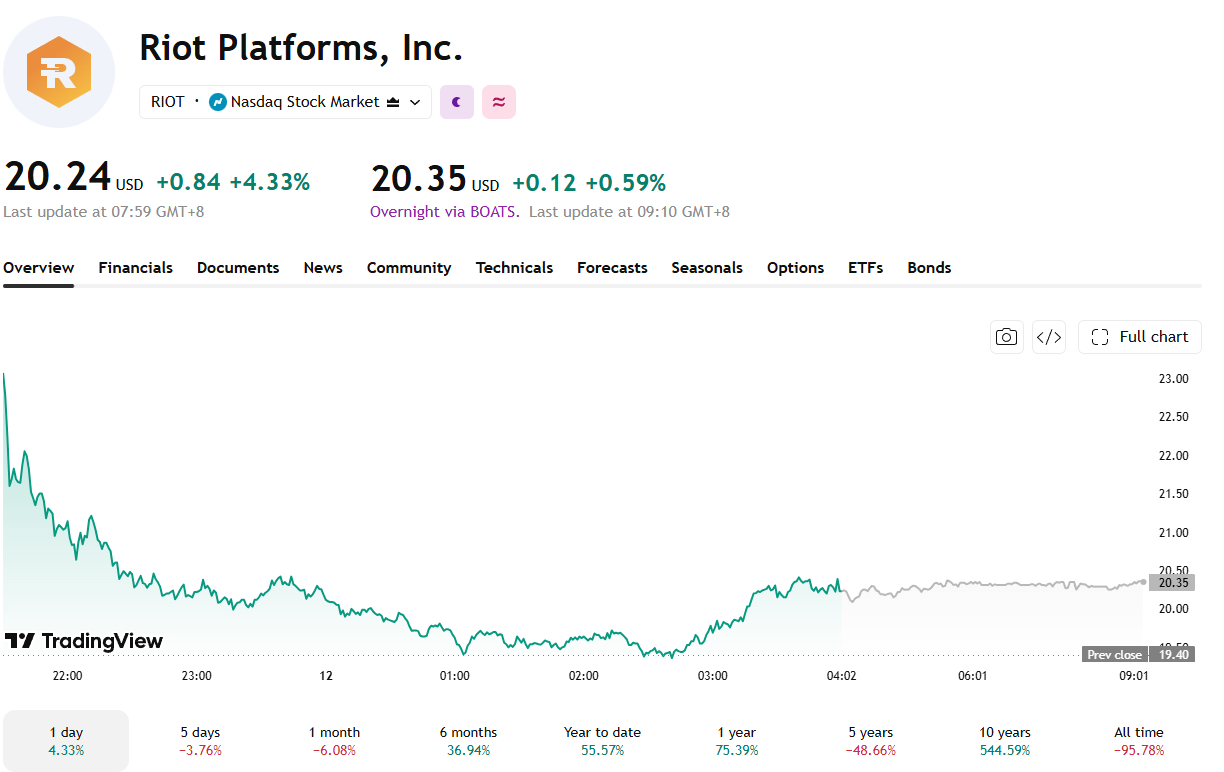
Riot closed Monday up 4.33%. Cipher Mining gained 5.39%, TeraWulf rose 3.40%, and Hut 8 added 3.39%. Bitcoin slipped 0.49% over the same stretch and has struggles to move beyond the $62,000 – $65,000 range. It is quite clear that the boost the these Bitcoin mining stocks has very little to do with BTC and thus is not helping the price of the underlying asset.

BeInCrypto tracked the same decoupling in July. TeraWulf, IREN, and Hut 8 surged then on AI leasing news, pulling further away from Bitcoin’s own price moves. Riot’s Anthropic deal extends that pattern.
Why The Same Shift Is A Headwind For Bitcoin
The AI pivot funding this rally is not free. Riot’s Bitcoin holdings fell from 15,680 BTC to 11,380 BTC in the second quarter, a drawdown of 4,300 coins. The company sold monthly output and treasury reserves to fund its AI buildout at Rockdale.
That pattern could matter more broadly. Miners that once held Bitcoin as a byproduct of their business are becoming net sellers of it. The proceeds are going into data center leases instead of new mining rigs.
Analysts have priced the stocks on the lease, not the ledger. Riot CEO Jason Les described the shift in the company’s second-quarter earnings statement.
“[Riot has] now executed leases totaling 241 megawatts of capacity, representing approximately $9.8 billion of long-term, contracted revenue with two of the most important companies in the AI ecosystem.”
That framing helps explain the market reaction. H.C. Wainwright raised its Riot price target to $40 from $25 on the Anthropic news. Needham lifted its target to $30. Both cited contracted megawatts rather than Bitcoin output.
It also flips the old trade of buying miner stocks for indirect Bitcoin exposure. Capital chasing Riot, TeraWulf, or Hut 8 is increasingly a bet on AI real estate. Part of that bet is funded by selling the asset those stocks used to track.
None of this means Bitcoin mining is disappearing. Riot’s mining revenue still reached $113.7 million in the second quarter even as leasing revenue grew. But the same deal that sent RIOT soaring came bundled with a steady drawdown in Bitcoin supply worth watching.
The post Riot’s Anthropic Deal Lifts Bitcoin Miner Stocks, But It’s Bad News For BTC appeared first on BeInCrypto.
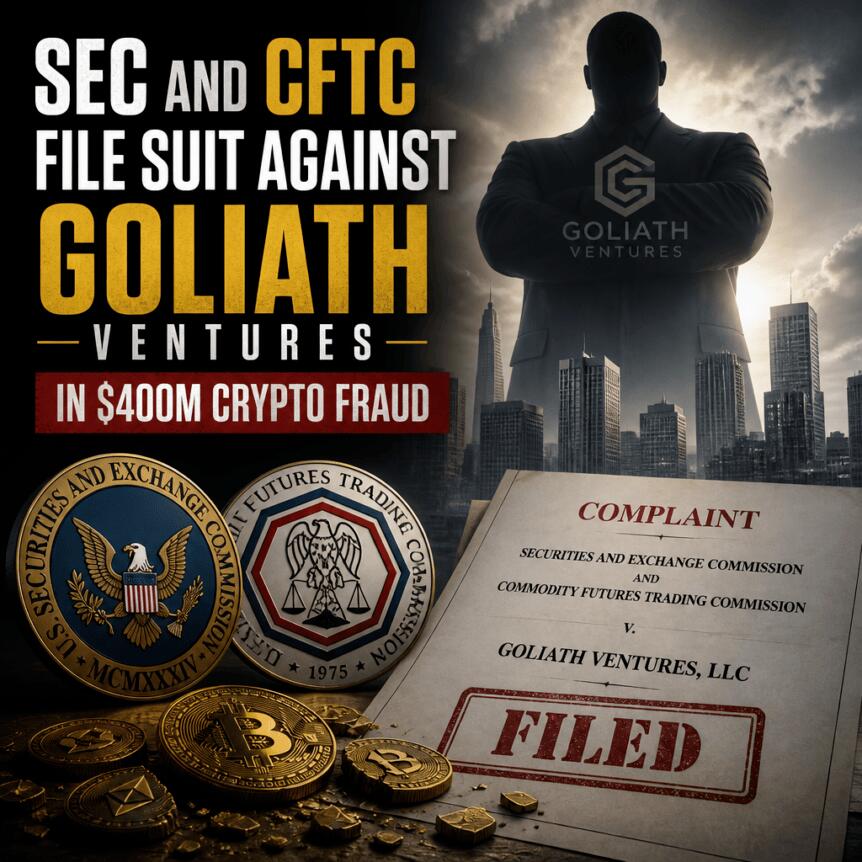
The U.S. Securities and Exchange Commission (SEC) and Commodity Futures Trading Commission (CFTC) have filed separate civil lawsuits targeting Goliath Ventures and its founder Christopher Delgado, alleging conduct consistent with a crypto Ponzi scheme that raised hundreds of millions of dollars from investors.
The SEC’s action focuses on an alleged unregistered securities offering totaling at least $425 million from more than 1,300 investors, while the CFTC says roughly 1,600 customers contributed about $397 million tied to solicitations for crypto trading in Bitcoin and Ether. The agencies are seeking remedies that include restitution, disgorgement, penalties, and permanent bans—expanding potential consequences beyond a parallel criminal case already moving through the courts.
Key takeaways
- The SEC alleges Goliath raised at least $425 million via an unregistered offering and that investor funds were not invested as promised.
- According to the SEC, Delgado allegedly diverted at least $51 million for personal use and allegedly fabricated account balances and performance reporting.
- The CFTC alleges about $397 million came from approximately 1,600 customers after solicitations connected to crypto trading in Bitcoin and Ether.
- Both civil suits add securities and commodities-law enforcement actions, potentially enabling broader investor compensation and market bans than the criminal plea alone.
- Delgado has agreed to a bifurcated settlement in the SEC case that would impose permanent bars, pending court approval and final determinations on financial penalties.
SEC: Alleged unregistered offering and diverted investor funds
In its complaint, the SEC said Goliath collected at least $425 million from more than 1,300 investors through what it characterized as an unregistered securities offering. The agency alleged that investors were told their money would be placed into crypto liquidity pools, but that “none” of the funds or crypto assets were actually invested in the manner represented.
The SEC further alleged that Delgado diverted at least $51 million for personal use. The SEC also said Goliath used funds and crypto assets from new and existing investors to make earlier payments—an arrangement the agency characterized as inconsistent with the investment strategy sold to participants.
According to the SEC, Goliath promised monthly returns ranging from 3% to 10% and guaranteed investor principal, claiming the returns were generated from fees paid by traders using its liquidity pools. The SEC alleges that, in reality, the company made payments by recycling investor money and fabricated account balances and performance metrics to support the scheme.
The SEC also alleged that commissions were paid to sales agents who recruited investors. The agency said the business eventually faltered after it could no longer raise funds quickly enough to meet obligations, stopped making monthly distributions, and collapsed—an outcome the SEC said came after the company’s operations turned unsustainable.
CFTC: Commodities-law claims tied to Bitcoin and Ether trading solicitations
Separately, the CFTC said Goliath solicited funds for crypto trading in Bitcoin and Ether, attracting approximately 1,600 customers and at least $397 million. The agency’s complaint positions the conduct within commodities and trading enforcement frameworks, seeking consequences aimed at restoring losses and preventing continued market participation.
In its civil action, the CFTC is seeking restitution, disgorgement, civil penalties, trading and registration bans, and a permanent injunction. While the SEC case centers on alleged unregistered securities and the handling of investor capital, the CFTC action reflects the regulator’s view that the underlying promotional and trading-related representations also triggered commodities-law concerns.
Delgado’s SEC settlement and what it does—and doesn’t—end
In the SEC matter, Delgado agreed to a bifurcated settlement, subject to court approval. The deal, as described by the SEC, would permanently bar him from violating the securities-law provisions charged in the complaint. It would also restrict him from participating in securities transactions outside personal-account activity and from associating with a broker or dealer.
The settlement leaves key financial components to be determined by the court, including disgorgement, prejudgment interest, and a civil penalty. In practice, this means the case can still produce significant financial exposure, even as certain legal and behavioral restrictions are agreed in principle.
Delgado is also tied to a criminal resolution. The article notes that he previously pleaded guilty to conspiracy to commit wire fraud, wire fraud, and money laundering. The U.S. Department of Justice has said that at least $400 million was paid to Goliath and that Delgado admitted causing at least $250 million in investor losses. The DOJ further stated that forfeiture was part of the agreement, covering properties, vehicles, luxury goods, bank accounts, and crypto wallets traceable to the scheme.
These developments underscore why the SEC and CFTC actions matter: civil proceedings can pursue investor-focused remedies and broader prohibitions that may not be fully addressed through a plea deal alone. Together, the cases give regulators additional tools to seek compensation, impose penalties, and limit future access to regulated markets.
Why the paired SEC and CFTC cases signal a tougher enforcement stance
Running parallel civil actions under two different federal agencies is notable because it reflects a broader pattern in crypto enforcement: regulators are increasingly willing to frame the same promotional conduct through multiple legal lenses—securities and commodities—depending on how the offering and trading-related representations are structured.
Here, the SEC’s allegations emphasize return guarantees, alleged principal protection, and promised placement into liquidity pools—elements the agency says were used to attract capital under an unregistered offering. The CFTC’s allegations, meanwhile, tie customer solicitations to Bitcoin and Ether trading, supporting its request for trading-specific bans and other restrictions.
For investors watching these cases, one practical takeaway is that “getting the money back” often depends on how quickly courts move on disgorgement, restitution, and related orders. Another is that criminal outcomes do not necessarily close the door to civil enforcement: as the regulators seek permanent injunctions and long-term participation restrictions, the civil cases can continue to shape who is barred from markets even after criminal resolution.
Next, investors and observers will likely focus on court approval of the SEC settlement terms and the final rulings on disgorgement, interest, and penalties, along with how the CFTC case progresses toward relief such as restitution and permanent bans.



Jim Cramer says investors do not need to track every market move to understand what is driving stocks. Instead, three questions can help investors read the market like a pro.
The “Mad Money” host built his framework on Tuesday around three checkpoints that sidestep noisy daily headlines. Where are bond yields headed? Where is oil trading? And, how is Nvidia performing? Cramer says these are the three main questions every investor should be asking as they look at the market.
Bonds and Oil Point to Rates and Risk
Cramer explained that when Treasury yields climb, bonds start competing harder with stocks for investor cash. That dynamic also pushes the Federal Reserve closer to tightening policy rather than easing it.
With the 30-year Treasury yield, a benchmark for long-term borrowing costs, hovering near 5.2%, Cramer said the number is too high for markets to shrug off.
“You must never forget that, as important as stocks are, the bond market is much larger and rules the roost.”
Jim Cramer, CNBC
He added that falling rates usually point to a healthier market, while rising rates tend to signal trouble ahead.
On oil, Cramer’s logic runs through inflation. Pricier crude tends to feed inflation readings, which in turn ripple into bond market pricing.
Oil has also become a gauge of geopolitical risk as investors watch the Iran conflict near the Strait of Hormuz. Still, he cautioned against overreacting to small daily swings, noting crude remains well below its recent highs.
Nvidia Is the Final Piece to Read the Market
Cramer’s final question is simple. How is Nvidia doing?
“The barometer for what might be as much as third to a half of the economy.”
Jim Cramer, CNBC
His logic ties back to artificial intelligence (AI) infrastructure spending. That capital no longer sits inside a handful of tech giants. It has fanned out across the broader economy, so Nvidia’s results now double as a read on that wider spending wave.
That shift has already helped push Wall Street records higher this year.
Cramer has repeatedly pointed investors toward simplified frameworks this earnings season. He recently flagged Eli Lilly’s stock rally using a similar approach. He favors a handful of durable signals over daily noise.
For traders overwhelmed by conflicting data, Cramer’s message is simple. Three checkpoints, not the full board, may offer the clearest read on where the market goes next.
The post Want to Read the Market Like Cramer? Ask These 3 Questions appeared first on BeInCrypto.
Cardano’s native token is among the top-performing cryptocurrencies on a monthly scale, with its price rallying by 15% within that period.
However, the bulls seem to have lost momentum, while popular analyst Ali Martinez outlined some important factors that could trigger a major short-term decline.
Going Down Again?
ADA started August on the right foot following the return of the large investors who scooped up more than 240 million coins in less than a week. Its price eventually pumped to almost $0.21 (the highest mark since early June) before retracing to the current $0.187 (per CoinGecko).
Meanwhile, Martinez believes a much more substantial plunge could be on the way. The analyst revealed that the number of whales holding between 1 million and 10 million ADA has fallen from 2,370 to 2,340, saying:
“This suggests some large holders may be taking profits or redistributing after the recent price increase.”
His second concerning signal is the formation of a death cross between Cardano’s MVRC ratio and its 7-day simple moving average. He claimed that the shift points to weakening momentum and raises the risk of a deeper correction. Last but not least, Martinez paid attention to ADA’s TD Sequential indicator, which has printed a sell signal on the asset’s daily chart.
“If these warning signs are confirmed, ADA could decline toward $0.17, the channel’s mid-range support. A further breakdown could expose the lower boundary near $0.144,” he concluded.
More Factors to Consider
Just a few days ago, the leading digital asset manager Grayscale withdrew its ETF filing for three altcoins, including Cardano’s native token. Bulls have long anticipated the launch of such a product, hoping it would boost demand and potentially lift the price, but it’s now clear they will have to wait even longer.
At the same time, there are some positive signals, too. Over the past several days, ADA exchange outflows have surpassed inflows, suggesting that investors have been shifting from centralized platforms toward self-custody, thereby reducing immediate selling pressure.

In addition, the asset’s Relative Strength Index (RSI) has dropped to 25, which means extreme oversold territory. Such levels are typically interpreted as buying opportunities, while anything above 70 is considered a warning of an incoming pullback.

The post ADA’s Rally Hits a Wall: Analyst Warns a 25% Drop Could Be Next appeared first on CryptoPotato.

Franklin Templeton Executive Drops a BOMBSHELL! This Means They See XRP Going to Double Digits! WOW!

10 popular baby names that are making a comeback this year

Beth Hammack says multiple rate hikes needed to fight US inflation


-

 Fashion4 days ago
Weekend Open Thread: Mattifying Sunscreen
-

 Fashion5 days ago
Frugal Friday’s Workwear Report: Cap-Sleeve Pointelle Crewneck Sweater
-

 Sports6 days ago
Jordan Coyle & Cordiamo take Laya Arena Stakes at RDS
-

 News Videos4 days ago
Can Astrology Help Find Gold and Silver Trends? A Financial Astrology Guide
-
 Business6 days ago
US stocks: Dow closes at record on Mideast optimism; SpaceX, AMD drag Nasdaq
-

 Politics6 days ago
Reform UK And Greens Sink To Lowest Favourability Ratings To Date
-

 Business6 days ago
Supply chain issues impact Ingredion
-

 Tech4 days ago
Rinn Pharma & Biopharma to join NordicPharmaTrain network
-

 Business3 days ago
How to Start a Cleaning Business: A Step-by-Step Guide
-

 Business3 days ago
BDC Weekly Review: Private BDC Q2 Numbers Are Strong
-

 Business3 days ago
Datadog: Best Of Breed For Multiple Reasons
-

 Business7 days ago
McDonald’s (MCD) Q2 2026 earnings
-
 NewsBeat4 hours ago
Communication cards help banking customers access services or report scams
-

 Fashion7 days ago
The Bright Side of Black and White
-

 Fashion6 days ago
Suit of the Week: Me + Em
-
Sports6 days ago
Spider-Man: Brand New Day ending explained: Is Peter Parker alive?
-

 Crypto World7 days ago
Robinhood files $200M second venture fund focused on YC startups
-
 Tech5 days ago
Price Hikes May Be Coming for PC Motherboards Next
-
 Fashion7 days ago
Birthstone pendant necklaces for women by ottomanhands – 18ct gold plated
-
 Crypto World6 days ago
Galaxy Digital Stock Slides 14% as Crypto Prices Hit Earnings
You must be logged in to post a comment Login