

Crypto World
The U.S. Bitcoin Reserve blueprint is due in July



It has been more than a year since President Trump signed the executive order establishing a Strategic Bitcoin Reserve on March 6, 2025, and the project is finally moving from rhetoric toward machinery.
Summary
- The U.S. already has a Strategic Bitcoin Reserve, but it mostly holds seized Bitcoin rather than newly purchased BTC.
- July matters because the White House blueprint and Congress could clarify whether the reserve can become an actual buying program.
- The BITCOIN Act pushes for aggressive accumulation, while ARMA favors a 20-year lockup and a more moderate path.
- The budget-neutral rule is the hidden constraint that could limit how much Bitcoin the U.S. can realistically buy.
A White House report in July 2025 laid out the policy blueprint. In May 2026, Patrick Witt of the President’s Council of Advisors for Digital Assets called the latest progress a “breakthrough” and signaled concrete announcements were close. Two competing bills now sit in Congress: Senator Cynthia Lummis’s BITCOIN Act, which would have the Treasury begin actual purchases as soon as Q4 2026, and Representative Nick Begich’s rebranded American Reserve Modernization Act, which quietly dropped the headline one-million-Bitcoin purchase target and added a 20-year lockup instead.
As the one-year mark of the blueprint approaches this July, the question is no longer whether the U.S. has a Bitcoin reserve. It already does, on paper. The question is whether July brings the thing that would make it real: a legal path to actually buy Bitcoin. This piece lays out what exists now, what is expected, and why the gap between the two is the whole story.
What already exists
The first thing to get straight is that the United States already has a Strategic Bitcoin Reserve. It has had one since March 2025. What it does not have is a reserve that does what the headlines implied.
The March 6, 2025 executive order created two things: a Strategic Bitcoin Reserve, capitalized with Bitcoin the government already owned through criminal and civil asset forfeiture, and a separate U.S. Digital Asset Stockpile for the non-Bitcoin crypto the Treasury had seized. The order made one commitment crystal clear. The Bitcoin in the reserve “shall not be sold and shall be maintained as reserve assets.” That is a directive to hold, full stop.
What the order did not do was authorize the government to buy any Bitcoin with public money. It instructed the Treasury and Commerce Secretaries to develop “budget-neutral” strategies for acquiring more, meaning any purchases would have to be funded without costing taxpayers a cent, through forfeiture proceeds or penalties rather than appropriated dollars. And Treasury Secretary Scott Bessent confirmed in August 2025 that the U.S. “won’t be buying” additional Bitcoin in the near term. So the reserve, as it actually exists, is a rebranding of coins the government already held, with a promise not to sell them.
That is why critics were unimpressed at the launch. Charles Edwards of Capriole Investments called the reserve “a pig in lipstick,” arguing it just renamed existing holdings without any plan for fresh purchases. The “digital Fort Knox” rhetoric from White House crypto figures collided with the operational reality: Fort Knox holds gold the government actively acquired, while the SBR holds Bitcoin the government happened to seize from criminals. The gap between those two things is exactly what the upcoming work is supposed to close.
What the July 2025 blueprint actually said
The blueprint people are now waiting to see built on came out on July 30, 2025, when the President’s Working Group on Digital Asset Markets released its report after a 180-day review.
The working group, with Treasury Secretary Bessent, Commerce Secretary Howard Lutnick, and SEC Chair Paul Atkins as key members, produced what Atkins described as a blueprint to make America “the crypto capital of the world.” On the reserve specifically, the report confirmed the hold-don’t-sell policy and the budget-neutral acquisition framework. It also went broader, recommending that the SEC and CFTC use their existing authorities to enable crypto trading at the federal level and that agencies relaunch efforts on bank crypto custody, stablecoin reserves, and tokenization.
The report also surfaced an uncomfortable detail that complicates the entire reserve concept. While the government officially owns forfeited assets, seized assets are often earmarked to compensate victims of the hacks and scams they came from, or to flow into the general Treasury, rather than being available to lock away in a permanent reserve. In other words, a chunk of the Bitcoin people assume sits in the reserve may be legally spoken for. That accounting problem is part of why Witt said the priority was to “get our own house in order” before disclosing the size of the government’s holdings.
So the July 2025 blueprint set the policy direction clearly. What it could not do, because an executive order and a working-group report cannot do it, is create the legal authority to hold Bitcoin permanently and buy more. That requires Congress.
The two bills that would make it real
This is where the live action is, and where July matters. Two pieces of legislation would convert the reserve from a holding directive into a genuine accumulation program, and they take very different approaches.
The BITCOIN Act, championed in the Senate by Cynthia Lummis, is the maximalist version. It is the bill that originally carried the headline target of the U.S. acquiring one million Bitcoin over time. If it passes, analysts estimate the Treasury could begin its first official Bitcoin purchase as soon as Q4 2026, which would make the United States the first sovereign nation to actively accumulate Bitcoin as a strategic reserve asset rather than simply holding what it seized. Lummis has been the most aggressive congressional voice for treating Bitcoin like a true strategic reserve on par with gold.
The American Reserve Modernization Act, or ARMA, is the House version, introduced by Nick Begich of Alaska with Democrat Jared Golden of Maine as co-lead. The rename from Begich’s earlier version was a deliberate move to broaden bipartisan appeal, and the substance shifted too. ARMA quietly dropped the one-million-Bitcoin purchase target that anchored the BITCOIN Act. In its place it added a hard 20-year lockup, requiring all Bitcoin deposited into the reserve to sit untouched for at least two decades, barring the government from “selling, swapping, auctioning, encumbering, or otherwise disposing of” it for any reason.
That difference is the whole debate in miniature. The BITCOIN Act says the point of a reserve is to aggressively accumulate a scarce asset before other nations do. ARMA says the point is to credibly commit to holding what we have for the long term, while staying quiet on aggressive buying to keep moderate lawmakers on board. Begich has said he is coordinating with Lummis to align the two chambers, which means the final shape of any law will likely be a negotiation between “buy a million” and “lock up what we have for 20 years.”
Why the budget-neutral rule is the hidden constraint
The single most important phrase in this entire effort is “budget-neutral,” and it is the reason the reserve has not done more.
Both the executive order and the serious legislative proposals insist that buying Bitcoin cannot cost taxpayers anything. The acquisition has to be funded through means that do not draw on appropriated federal dollars: forfeiture proceeds, penalties, revaluing the Treasury’s gold certificates to market price and using the paper gain, or similar accounting maneuvers. The political logic is obvious. Using public money to buy a volatile asset like Bitcoin would be a lightning rod, and the budget-neutral framing is what lets the administration pursue the reserve without owning the downside if Bitcoin falls.
But budget-neutral is also a serious constraint on scale. Forfeiture proceeds are lumpy and unpredictable. The gold-revaluation idea is clever but politically and operationally complicated. None of these sources can reliably fund the kind of sustained, large-scale buying that a one-million-Bitcoin target would require. So even if a bill passes authorizing purchases, the budget-neutral rule means the actual pace of accumulation could be slow and irregular rather than the steady sovereign bid that Bitcoin bulls imagine. The constraint that makes the reserve politically possible is the same one that limits how much it can actually buy.
This is the tension to watch in whatever emerges this July. A blueprint or bill that authorizes purchases sounds transformative. A blueprint that authorizes purchases only through narrow budget-neutral channels is a much smaller thing in practice, even if the headline reads the same.
How the U.S. compares to other governments
One reason this matters beyond U.S. borders is that several governments already hold significant Bitcoin, mostly through seizure, and the question of who moves first to formalize it is a genuine geopolitical race.
China is estimated to hold roughly 190,000 Bitcoin from various seizures, the largest sovereign stash, though its intentions are opaque and it has no stated reserve policy. The United Kingdom holds approximately 61,000 Bitcoin, also largely from seizures, and has periodically signaled it may sell rather than hold. El Salvador, the outlier, holds around 6,174 Bitcoin acquired deliberately as policy after adopting Bitcoin as legal tender in 2021, making it the clearest example of a government actively accumulating rather than passively holding seized coins.
The U.S. position is distinctive because it is the only major power that has formally committed, by executive order, not to sell its seized Bitcoin and has a serious legislative effort to start buying. If the BITCOIN Act or a version of it passes, the U.S. would leapfrog from “holds seized coins like everyone else” to “first major sovereign to actively accumulate as policy.” That first-mover status is the strategic argument Lummis and the bulls make: in a world where Bitcoin’s supply is fixed at 21 million, the nation that builds a real reserve first locks in an advantage that latecomers cannot easily replicate. Whether that argument moves enough moderate lawmakers to authorize actual purchases is the open question July may begin to answer.
What to realistically expect
Setting the hype aside, here is the honest range of what July and the months around it are likely to deliver.
The most probable near-term outcome is incremental, not transformative. Expect further clarity on the size and custody of existing holdings as the government “gets its house in order,” and continued legislative movement on the BITCOIN Act and ARMA without immediate passage. A formal blueprint refining how the reserve is administered, audited, and reported is plausible. Actual large-scale buying is the least likely near-term outcome, both because the legislation has not passed and because the budget-neutral constraint limits the pace even if it does.
The realistic bull scenario is that one of the bills, probably a negotiated blend of the BITCOIN Act’s accumulation ambition and ARMA’s bipartisan lockup framing, advances far enough that a first official purchase in Q4 2026 becomes credible. That would be genuinely historic, the first major sovereign actively buying Bitcoin as a reserve asset, even if the initial amounts are modest.
The realistic bear scenario is that the reserve stays what it is today: a rebranding of seized coins with a promise not to sell, dressed in “digital Fort Knox” language but never authorized to actually accumulate. In that case July’s blueprint is another policy document that sets direction without creating the legal machinery, and the “pig in lipstick” critique holds.
For Bitcoin holders watching this, the thing to track is narrow and specific: not the rhetoric, but whether Congress actually grants purchase authority and through what funding mechanism. A reserve that can buy is a structural new source of demand for a fixed-supply asset. A reserve that can only hold is a symbolic gesture with no market impact beyond the signaling. July will move the story forward. Whether it moves it to the point that matters, real purchase authority through a workable funding channel, is the only milestone worth watching for.
This article is for informational purposes and does not constitute financial or investment advice. Cryptocurrency markets are highly volatile. The figures and analysis described reflect data available as of June 2, 2026. Always do your own research and consult with qualified financial professionals before making investment decisions.

The company recently secured a key regulatory approval, which is vital for its operations in the European Union, while institutional interest in XRP remains solid.
Despite these positive developments, Ripple’s cross-border token hasn’t managed to rebound and is down nearly 70% from its all-time high registered last summer.
The License in Europe
Earlier this week, Ripple obtained preliminary approval for a Crypto Asset Service Provider (CASP) license from Luxembourg’s Commission de Surveillance du Secteur Financier under the European Union’s Markets in Crypto-Assets (MiCA) regulation.
It was granted through a Green Light Letter and remains subject to final conditions. If fully confirmed, it would enable the company to offer regulated cryptocurrency services across the entire EEA, which consists of 30 countries. Commenting on the matter was Cassie Craddock, Managing Director, UK & Europe at Ripple, who said:
“Financial market infrastructure is moving on-chain – from cross-border payments and settlement to collateral management and tokenized assets – and banks and fintechs are actively building the digital asset capabilities they need to remain competitive. With our growing European presence, regulatory track record and institutional-grade infrastructure, we’re ready to meet the moment and support that transition at scale.”
The ETF Front
Over the past several weeks, institutional investors have drastically reduced their exposure to Bitcoin (BTC) and Ethereum (ETH). However, this is not the case for Ripple’s native token, which continues to attract substantial capital.
SoSoValue’s data shows that inflows into spot XRP ETFs have surpassed outflows, with the last red day being March 6. The financial giants offering such products include Canary Capital, Bitwise, Franklin Templeton, 21Shares, and Grayscale, while the cumulative net inflow generated to date exceeds $1.45 billion.

XRP Price Outlook
The inflows into spot ETFs require the issuers of these investment vehicles to purchase real XRP on the market, which could positively impact the price.
Nonetheless, the asset remains heavily suppressed during the prolonged bear market and currently trades at around $1.10, representing a 20% decline on a monthly scale and a whopping 70% crash from the historic peak reached in 2025.
It’s worth noting that the steep decline hasn’t dampened the strong optimism shared by some analysts. A few days ago, X user Tom claimed that the token has formed a pattern similar to its 2024 run, which took the price from $0.50 to $3.30. This time, though, it could result in a major upswing to $8.42.
JAVON MARKS was even more bullish, arguing that “XRP’s breakout stands, which means the measured move target near $17 does as well.”
The post Ripple (XRP) News Today: June 24 appeared first on CryptoPotato.

TLDR
- Qualcomm confirmed its acquisition of AI infrastructure software provider Modular, with the transaction reportedly valued at approximately $4 billion according to Bloomberg.
- The acquisition brings software capabilities that enable AI model deployment across various hardware platforms, supporting Qualcomm’s data center ambitions.
- Modular’s valuation has surged significantly from $1.6 billion following a $250 million funding round completed nine months prior.
- Shares of QCOM gained 1.1% in premarket hours following an 8% decline Tuesday, with the stock posting 57% gains over the last three-month period.
- The acquisition announcement coincided with Qualcomm’s investor day Wednesday, where the company planned to reveal a major data center chip partnership and unveil next-gen processor details.
Qualcomm (QCOM) announced its agreement to purchase Modular, a company specializing in AI infrastructure software, in a transaction that Bloomberg sources estimate at roughly $4 billion. The chipmaker has not publicly disclosed the official acquisition price.
Shares of QCOM advanced 1.1% during premarket Wednesday trading, rebounding from an 8% slide in the previous session. The semiconductor company’s stock has surged 57% during the past three-month timeframe.
Established in 2022, Modular has secured $380 million in total capital, with its most recent financing being a $250 million investment round completed in September 2025. The company carried a $1.6 billion valuation following that funding round — meaning the reported $4 billion purchase price represents more than a 2.5-fold increase in less than twelve months.
Qualcomm indicated the transaction should finalize during the latter half of 2026.
Modular’s technology provides software infrastructure that allows developers and enterprises to deploy AI models with optimized performance across diverse hardware architectures. This cross-platform compatibility represents a strategic asset for Qualcomm’s broader objectives.
“The acquisition is expected to strengthen Qualcomm Technologies’ ability to deliver a more optimized AI compute layer across a broad range of platforms and use cases,” Qualcomm said in a statement.
The company added that it “deepens the software foundation for Qualcomm Technologies’ data center strategy.”
The chipmaker has intensified its data center expansion efforts as part of a strategy to diversify beyond the smartphone chip sector, which experiences significant market fluctuations.
What Analysts Are Saying
Patrick Moorhead, an analyst at Moor Insights & Strategy, provided commentary on the transaction, highlighting the difference between Qualcomm‘s existing strengths and Modular’s complementary capabilities.
“Qualcomm is very good at edge enabling software, but that’s not the same as data center software capability,” Moorhead said. “Strategically, this could help to better answer the data center question.”
The observation holds merit. While Qualcomm has established strong AI chip positioning in edge computing applications — including smartphones, personal computers, and automotive systems — the data center segment presents distinct challenges, and Modular’s technology addresses that capability gap.
Investor Day in Focus
Qualcomm’s investor day also took place Wednesday, an event drawing significant market attention as analysts anticipated the company would identify a major data center chip client.
Information regarding Qualcomm’s upcoming processor architecture was also expected to be shared, further heightening investor attention surrounding the stock.
In separate reporting, The Information indicated that Qualcomm is pursuing discussions to acquire AI chip developer Tenstorrent in a transaction estimated between $8 billion and $10 billion. Neither company has confirmed those negotiations.
Qualcomm has not publicly revealed the financial terms of the Modular acquisition, and company representatives declined to provide pricing details when approached by Barron’s.


The world’s largest crypto exchange has recently faced significant regulatory challenges that could ultimately force it to stop serving clients in the European Union.
Earlier this month, Reuters reported that the company’s application through Greece’s Hellenic Capital Market Commission (HCMC) is expected to fall short: a development that may strip Binance of the license it needs to stay in the bloc after the June 30 deadline.
The firm assured that it remains fully committed to securing the necessary MiCA approval. Speaking on the matter was CEO Richard Teng, who said:
“Binance is dedicated to Europe. We are committed to our European users and to operating under a clear, fair, and harmonized MiCA framework. We are dedicated to securing our MiCA license and remain ready to operate under a fair, predictable, and genuinely harmonized European framework. We will continue to keep users updated as we make progress.”
Just recently, Reuters revealed that the exchange will make a fresh push for permission to operate in the EU. Gillian Lynch, Binance’s head of Europe and the United Kingdom, reportedly said that the firm “may just have a different pathway to being authorized,” adding that “if it is not Greece, I’m looking at other alternatives.”
According to the media, Binance has already held talks with regulators in Ireland, Latvia, and Greece but has been rejected in all three nations due to concerns such as the company’s past penalties for money laundering and its complex international structure.
Lynch said the exchange had contacted several regulators in the European Union but made only one application, to Greece. She is unaware why the Greek authorities refused approval, arguing that Binance has no outstanding issues related to the filing.
The post Binance Makes a New Push to Secure EU Approval appeared first on CryptoPotato.


- KuCoin Pay expands crypto payments to Bangladesh, Mexico, and Zambia.
- Platform links stablecoins with local banks and mobile money rails.
- KuCoin targets real-world crypto use in high-growth emerging markets.
KuCoin Pay, the cryptocurrency payment platform developed by KuCoin, has expanded its transfer-based payment capabilities across Bangladesh, Mexico, and Zambia.
The move aims to connect digital assets with widely used local payment systems in high-growth markets.
The rollout integrates cryptocurrencies and stablecoins with established banking and payment networks across the three markets.
These include the bKash and Nagad mobile payment platforms in Bangladesh, SPEI-compatible bank transfer routes in Mexico, and mobile money services offered by MTN Group and Airtel Africa in Zambia.
The expansion reflects the growing role of local bank transfers and mobile money services in emerging economies, where consumers increasingly rely on these systems for salary payments, remittances, merchant transactions, and peer-to-peer transfers.
Integration with local financial infrastructure
KuCoin Pay said its platform is designed to integrate digital assets with familiar financial systems, reducing the complexity often associated with moving cryptocurrencies into everyday financial activity.
The company noted that its technology supports localized payment routing through deep integration with local banking and payment rails.
Rather than requiring users to navigate complex backend processes, the platform identifies appropriate payment routes through a unified technical interface.
According to the company, this approach allows digital asset transactions to function more like traditional e-wallets, mobile money services, or local bank transfer tools.
By connecting cryptocurrencies and stablecoins with existing financial infrastructure, KuCoin Pay aims to make digital assets more practical for real-world use cases while reducing friction and simplifying the transfer process.
Focus on practical crypto applications
KuCoin executives said payments represent one of the most important pathways for digital assets to gain broader utility within the real economy.
“Crypto is emerging as a new asset class with growing relevance in the real economy, and payments are one of the most important ways for this value to reach users,” said Alicia Kao, Managing Director of KuCoin.
“Through KuCoin Pay, we are building trusted and localized connections between digital assets and existing banking, mobile money and transfer rails. By integrating crypto with the financial systems people already use, we are helping digital assets move beyond holding and trading into practical financial activity, while supporting more inclusive and future-ready financial ecosystems in high-growth markets.”
The company said the expansion is intended to improve accessibility to digital assets by enabling users to interact with cryptocurrencies through payment systems they already use in their daily lives.
Further expansion planned
Looking ahead, KuCoin Pay said it plans to continue expanding compatibility with local banking and payment systems in additional markets.
The company also intends to improve technical response speeds and broaden practical cryptocurrency payment applications across supported regions worldwide.
The latest expansion underscores a broader industry trend toward integrating digital assets with existing financial infrastructure, particularly in emerging markets where mobile money and local transfer networks play an increasingly central role in everyday commerce and financial inclusion.


An Ethereum address linked to the HashFlare cloud-mining fraud transferred 10,600 ETH worth about $18.5 million on Monday morning after sitting idle for roughly three and a half years. Blockchain investigator ZachXBT flagged the movement, the first activity tied to the address since the… Read the full story at The Defiant


“Binance.US has a CEO, Binance.com has two co-CEOs,” he said. “They almost never talk to each other. Actually, I don’t think they ever talk to each other. So, yes, two independent teams. Binance.US does license the product and technology from Binance Global, but they have a licensing agreement.”
CZ can’t see himself running the U.S. business, he said, adding that he did not think he was the best candidate to run a U.S. platform. “It needs to be somebody local; it needs to be somebody who’s on the ground,” he said.
The other companies CZ is heavily invested in — Giggle Academy and YZi Labs — are similarly independent, he said.
This independence extends to CZ’s personal life, he said. Yi He, one of Binance’s co-CEOs, is CZ’s partner, and the two share a home in the United Arab Emirates. Despite this, CZ said they do not talk about Binance at home, and the two keep their respective work lives separate.
“To be very frank, even when I was CEO of the company, she had a lot of strategic input into the company,” he said. “She was probably giving me more instructions even when I was CEO. So now, [after] stepping down, she’s running it. Our conversations at the max would be like ‘oh two days ago the bitcoin price dropped because of this policy,’ but we don’t even talk about that anymore.”
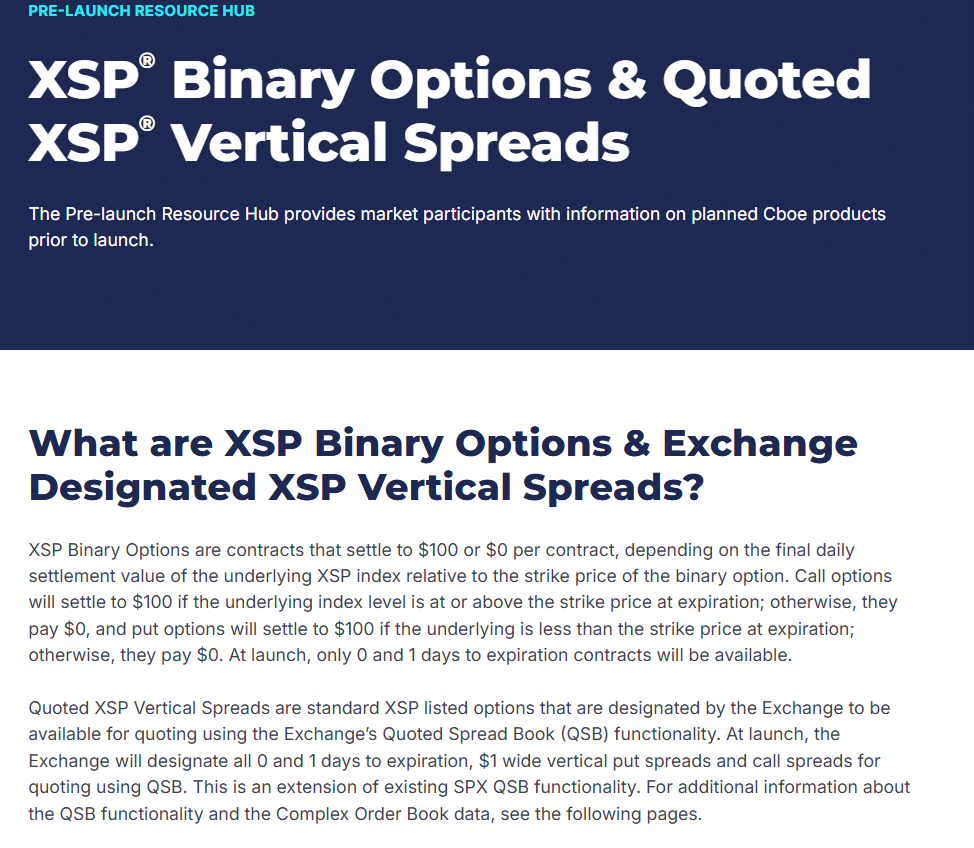
Market operator Cboe Global Markets has entered the prediction markets business with the launch of Cboe Predicts, a platform debuting with binary contracts tied to the S&P 500.
The contracts are now available through Interactive Brokers and are expected to launch at Charles Schwab and other retail brokerage platforms in the coming months, according to a Tuesday press release.
The contracts allow traders to take “yes” or “no” positions on whether the S&P 500 will close above or below a specified price level.
Cboe is the latest traditional finance firm to expand into prediction markets as investor interest in outcome-based contracts grows. The launch comes days after reports that Charles Schwab was seeking to enter the sector through a partnership with Cboe that would offer customers similar S&P 500-linked contracts.
Contracts tied to the S&P 500’s daily closing price are already available on prediction market platforms such as Polymarket and Kalshi.
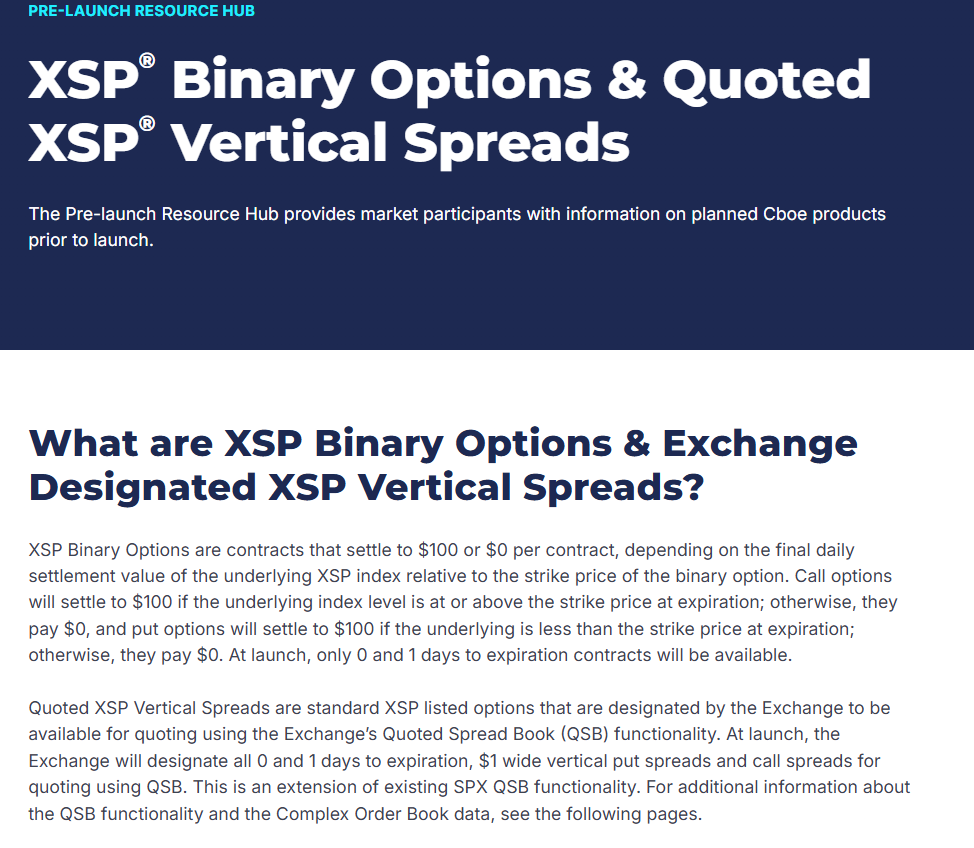
Cboe launches XSP Binary Options in prediction markets offering. Source: Cboe
Traders seek more binary event contracts
Cboe’s customers are showing more demand for shorter-dated, outcome-based trading opportunities, which led to the debut of the prediction market offering, according to JJ Kinahan, head of retail expansion and alternative investment products at Cboe.
Cboe’s new contracts are security options that will trade within the same regulatory framework as US-listed options, providing “institutional-grade liquidity” and transparency, Cboe said.
Related: Kalshi adds India to growing list of restricted jurisdictions
Meanwhile, prediction market platforms have drawn increased regulatory scrutiny over political betting and sports-related event contracts.
Kentucky was the latest state to sue five prediction market platforms, including Kalshi and Polymarket, accusing them of “operating unlicensed and illegal sports betting and gambling platforms,” as Cointelegraph reported on Thursday.
In January, US lawmakers proposed legislation aimed at restricting political prediction market trading by government officials after a Polymarket user netted over $400,000 on a contract related to the removal of then-Venezuelan President Nicolás Maduro, fueling insider trading concerns.
Magazine: Should users be allowed to bet on war and death in prediction markets?
Crypto World
Jaredfromsubway.eth, Ethereum's Most Active Sandwich Bot, Drained for $7.5M Over the Weekend


An attacker drained more than $7.5 million from jaredfromsubway.eth, the Ethereum address widely considered the single most-active sandwich-attack operator on the network, over the weekend. The loss is a rare public setback for an MEV bot that has run as one of Ethereum's largest priority-fee… Read the full story at The Defiant
A vulnerability in Cardano-based wallet SecondFi allowed attackers to drain user funds, resulting in major losses.
SecondFi on Wednesday confirmed it had identified the root cause of the exploit and is now engaging with Cardano ecosystem platforms and blockchain investigators to address the issue.
The company also said it triggered emergency measures that secured roughly 129 million ADA, which is being transferred to an independent third-party custodian and held for affected users pending verification.
The platform on Tuesday estimated that around 16 million ADA, or $2.4 million, was affected across 374 addresses.
Cardano founder Charles Hoskinson said SecondFi is not an Input Output Global product and stressed that there is no ownership, control, or business relationship between the wallet and IOG.
SecondFi traces exploit to an address-level issue
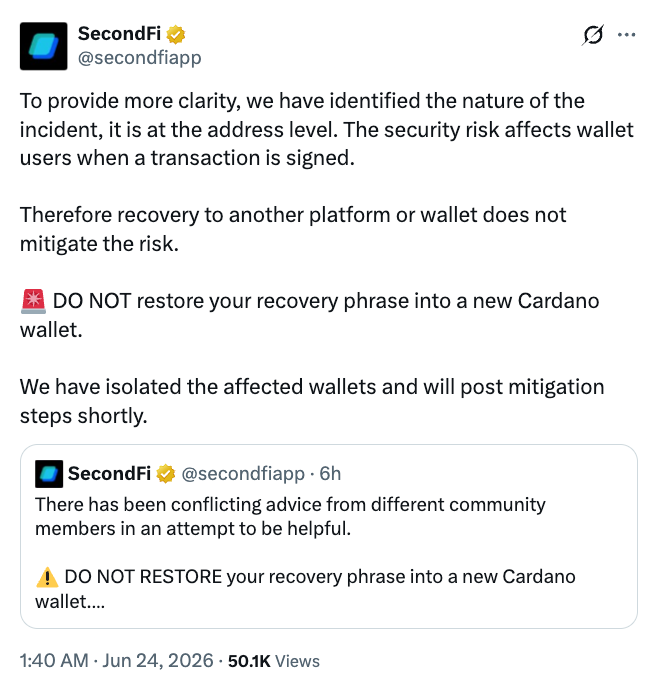
SecondFi has not released a comprehensive post-mortem as of publication, but has issued multiple statements confirming a security breach caused by a vulnerability in its Cardano web wallet generation software.
It said the root cause of the incident was an issue at the address level that affects users when they sign transactions.
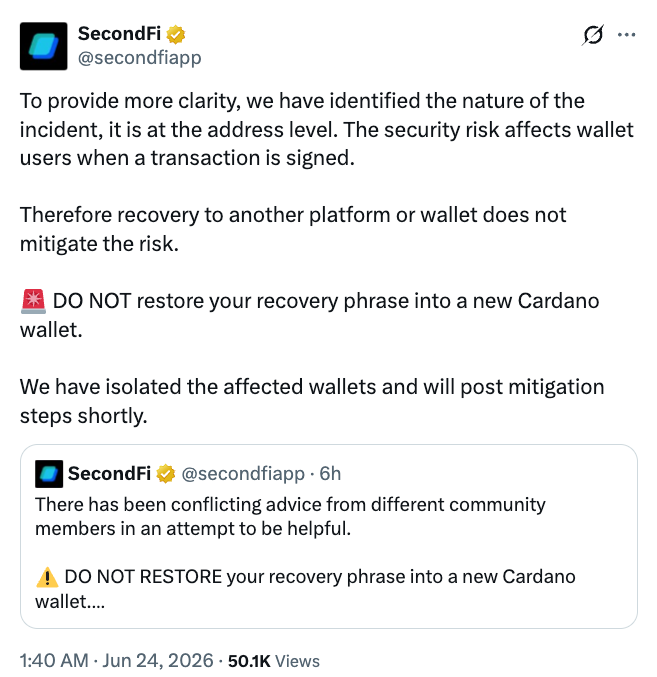
Source: SecondFi
“SecondFi’s wallet software exposed the private keys it generated,” Mitchell Amador, CEO of security company Immunefi, told Cointelegraph.
Amador said that while the blockchain remained secure, the code that generates the keys is the “part nobody audits like a contract.” He added that attackers have increasingly shifted focus toward infrastructure that creates or stores crypto keys rather than blockchain protocols.
Related: AI models led to a ‘vulnerability apocalypse’ in crypto security: Immunefi CEO
“Recovery to another platform or wallet does not mitigate the risk,” SecondFi said, advising users not to restore their recovery phrases into new Cardano wallets. The guidance differed from recommendations by some community members, who urged users to migrate affected wallets and move funds to newly created addresses.
“We didn’t write the code,” says Hoskinson
SecondFi is a self-custodial platform built on Cardano that rebranded from the Yoroi wallet in April 2026. Yoroi was developed by Emurgo, which describes itself as the “for-profit arm of Cardano,” and was launched as the first open-source light wallet for the Cardano blockchain.
Hoskinson said IOG’s incident response team has been in contact with SecondFi since Monday and that the platform requested an independent security audit.

Source: Charles Hoskinson
In a Tuesday video posted on X, Hoskinson stressed that IOG “is not Emurgo,” adding that the company has no influence over Emurgo and cannot speak on its behalf regarding the exploit.
“We didn’t write the code and we’re not connected to it,” he said.
Magazine: Japanese pension fund tips 1% in crypto, G7 urges action on NK hackers: Asia Express


Kendrick compared Aave to an automated, blockchain-based bank that operates without employees or discretionary decision-making. At its peak in October 2025, the protocol held roughly $75 billion in deposits, a level the analyst said would have ranked it among the 30 largest banks in the U.S.
Looking ahead, Kendrick expects the value of tokenized assets actively used within DeFi applications to increase 37-fold by the end of the decade. Because Aave’s revenue model is tied closely to lending activity and deposits, the bank anticipates the protocol’s growth to translate relatively directly into gains for the AAVE token.
The report also pointed to the potential restart of Aave’s token buyback program as a further catalyst. The protocol’s Horizon initiative, which is designed to support lending against tokenized real-world assets in a permissioned environment, could help attract traditional financial institutions and accelerate adoption.
Despite recent market weakness across digital assets, the broader backdrop for crypto prices is improving and Aave is expected to be among the beneficiaries as capital returns to DeFi, the report added.
Aave was 5.6% higher over the last 24 hours, trading around $76.
Read more: DeFi shaken by $292 million hack, but showing resilience, Standard Chartered says

Co-op destroyed in ATM ram raid theft before truck set on fire
Ripple (XRP) News Today: June 24

World Cup 2026: ‘Living statue’ of Lumumba joins DR Congo fans after quarantine


-

 Fashion5 days ago
Weekend Open Thread: Miami – Corporette.com
-

 Entertainment4 days ago
Renter of Home in Anne Heche Crash Denies Settlement With Son
-

 Tech2 days ago
Microsoft accidentally kills epic Outlook email threads
-
 Sports19 hours ago
Two goals and an assist by sheer aura: Cristiano Ronaldo just entered the World Cup chat
-

 Business4 days ago
Soccer-U.S. defends Iran World Cup travel restrictions, says discussions ongoing
-
Crypto World10 hours ago
Bitcoin (BTC) Dips Below $62K, Ethereum (ETH) Plunges 6% Daily: Market Watch
-

 Politics6 days ago
BBC Reporter Discusses Cross Party Criticism Of Trumps Iran Deal
-

 Crypto World7 hours ago
Securitize Wraps Roubini's SEC-Registered ETF as Dubai VARA Digital Security
-
Business13 hours ago
Entergy settles forward sale agreements, raises $672 million in cash proceeds
-
 Business4 days ago
Wall Street Week Ahead: Investors see Micron earnings as pulse check of AI rally momentum
-

 Politics4 days ago
Andy Burnham and the meaning of Makerfield
-

 Tech6 days ago
AWS enters the context layer race with a graph that learns from agents, not manual curation
-
 Crypto World4 days ago
Can Charles Hoskinson Really Rescue Cardano?
-

 Crypto World4 days ago
HIVE shares jump as $220M AI deal speeds Bitcoin mining pivot
-

 NewsBeat5 days ago
Keir Starmer Allies Question His Chances For No 10
-

 Crypto World4 days ago
Jake Chervinsky accuses CME of protecting derivatives monopoly
-

 Tech2 days ago
Nearly 7,000 fake Amazon domains registered ahead of Prime Day 2026, researchers warn
-
 Tech3 days ago
Signal’s Meredith Whittaker says AI chatbots ‘are not your friends’ and calls Copilot agents a backdoor
-

 Business6 days ago
Brexit cost 6% of UK economy, Bank of England company data suggests
-

 Sports6 days ago
FIFA World Cup 2026: Canada beat 9-men Qatar 6-0 to register first ever win | FIFA World Cup 2026
You must be logged in to post a comment Login