

Crypto World
Tokenized ETFs Surpass $430 Million in Onchain Market Cap, Led by Ondo Finance's IVVon



Tokenized ETFs have crossed $430 million in total onchain market cap, with Ondo Finance’s IVVon token surging 150% in the past month on Ethereum.


Business intelligence software giant, Strategy, announced that it has entered into privately negotiated agreements with certain holders of its outstanding 0% Convertible Senior Notes due 2029 to repurchase approximately $1.5 billion in aggregate principal amount of the notes.
The company said the estimated aggregate cash repurchase price is around $1.38 billion, although the final amount remains subject to adjustment based partly on the daily volume-weighted average price of Strategy’s Class A common stock during an agreed measurement period.
According to the official document released by the Michael Saylor-founded company, the actual cash amount paid could change depending on movements in the stock price during that period.
Strategy said it plans to fund the repurchases using available cash reserves, proceeds from sales of securities under its at-the-market offering program, and potentially proceeds from Bitcoin (BTC) sales.
The transactions are expected to settle on or around May 19th, subject to customary closing conditions.
Following completion of the repurchases, Strategy also revealed that it intends to cancel the repurchased notes. After the cancellation, around $1.5 billion aggregate principal amount of the 2029 convertible notes will remain outstanding.
The latest development comes days after Strategy reported a $12.5 billion first-quarter loss tied largely to Bitcoin’s price decline. Earlier this week, the company purchased another 535 BTC for $43 million. Its total holdings now stand at 818,869 BTC acquired for nearly $62 billion.
The post Strategy Plans Major Note Repurchase While Leaving Door Open to Bitcoin Sales appeared first on CryptoPotato.
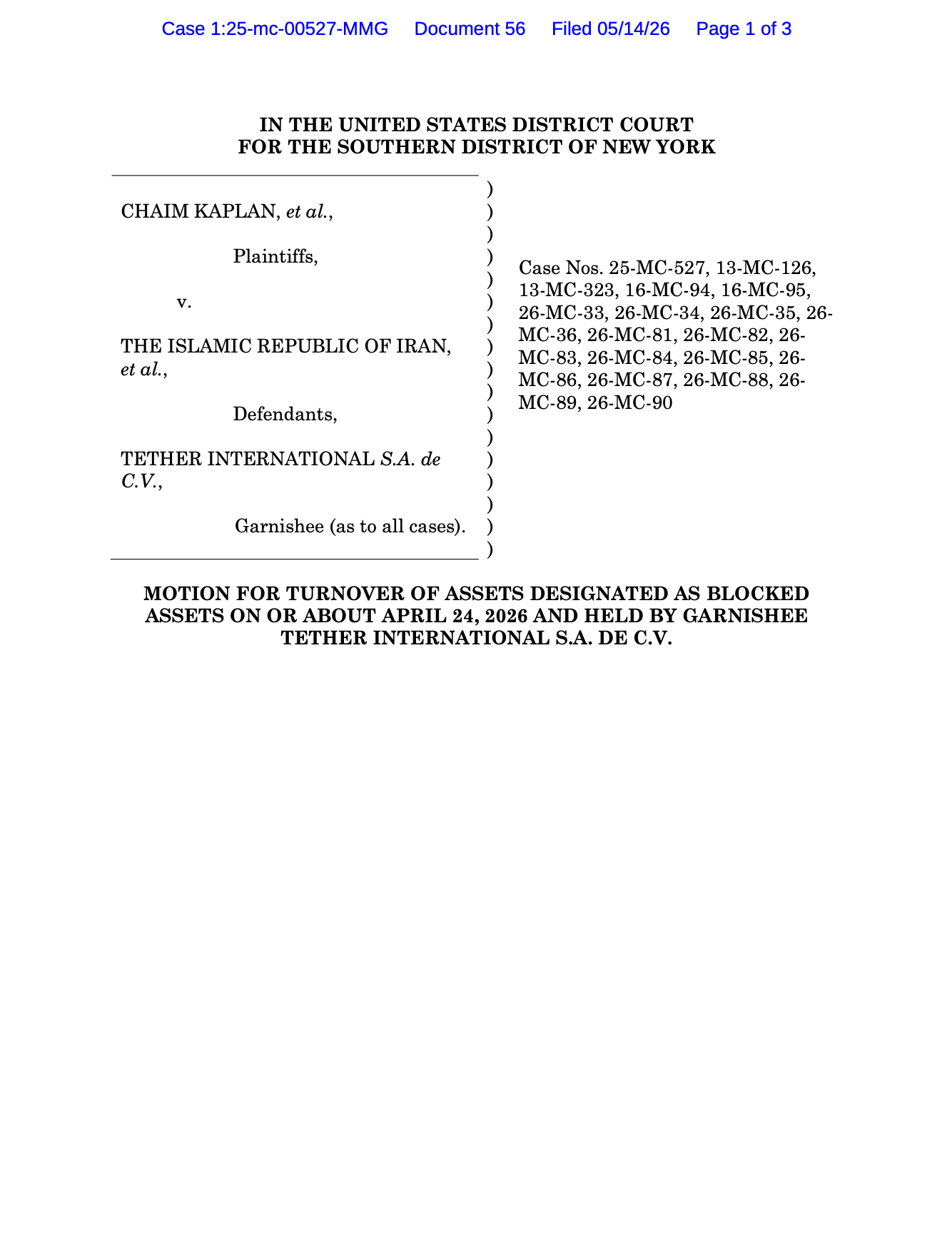
Law firm Gerstein Harrow LLP filed a new motion on Thursday in a miscellaneous enforcement lawsuit, asking the court to compel stablecoin company Tether to hand over more than $344 million in frozen USDt linked to Iranian entities.
The motion claims that the plaintiffs are owed more than $532 million in compensatory damages and more than $1.8 billion in punitive damages from acts of “terrorism committed or sponsored by Iran,” stretching back more than 25 years.
The latest filing is part of a broader lawsuit against North Korea (DPRK) and Iran, attempting to claim and redistribute digital assets as compensation for victims of various and unrelated judgments tied to state-sponsored violence, drawing criticism from the crypto community.
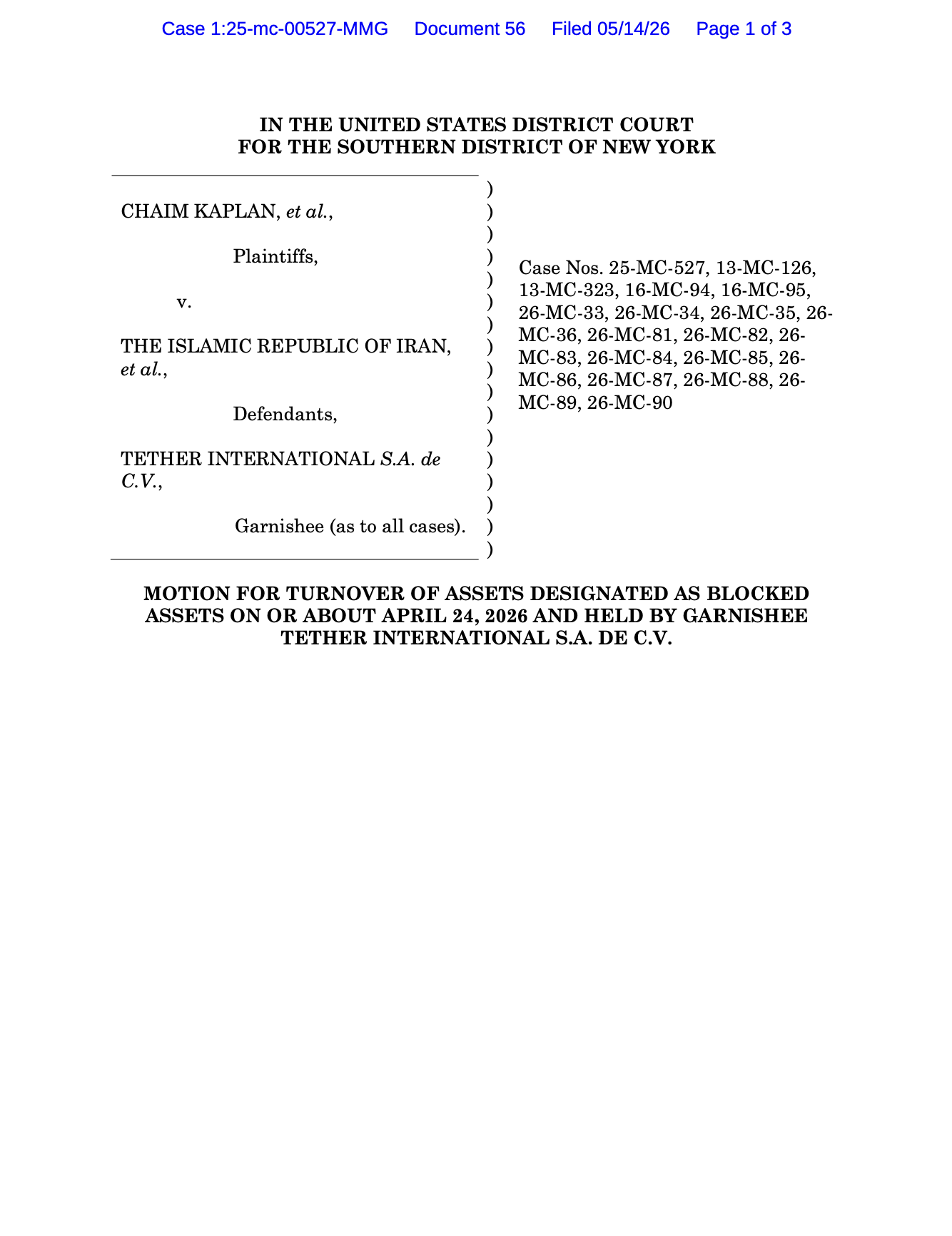
The motion to claim $344 million in frozen stablecoins linked to Iranian entities. Source: PACER
In May, the law firm filed a restraining notice against the Kelp decentralized autonomous organization (DAO), which manages the liquid staking platform, attempting to block the transfer of frozen Ether ( ETH) tied to the $293 million Kelp exploit in April.
The law firm’s tactics have drawn condemnation from the crypto community, with critics arguing that distributing funds owed to hack victims to satisfy unrelated judgments stretching back decades delays repayment for hack victims, who have a greater claim to the funds.
Related: Coinbase faces lawsuit over frozen funds from $55M crypto theft
ZachXBT slams Gerstein Harrow for crypto targeting strategy
Gerstein Harrow LLP has a long history of filing similar claims against cryptocurrency companies and platforms following hacks and cybersecurity exploits, including the Harmony protocol, the Bybit cryptocurrency exchange, and others, according to onchain sleuth ZachXBT.
“This is a predatory US law firm with a strategy that is pure evil,” he said in an X post from May 1, adding that the law firm used his cybersecurity research of various crypto hacking incidents to justify the claims.
“Whenever there’s a new Lazarus Group victim after an exploit and crypto assets get frozen, these clowns come in and say they have a claim for an alleged DPRK victim from 26 years ago that has zero relation to crypto or exploits/hacks,” he added.
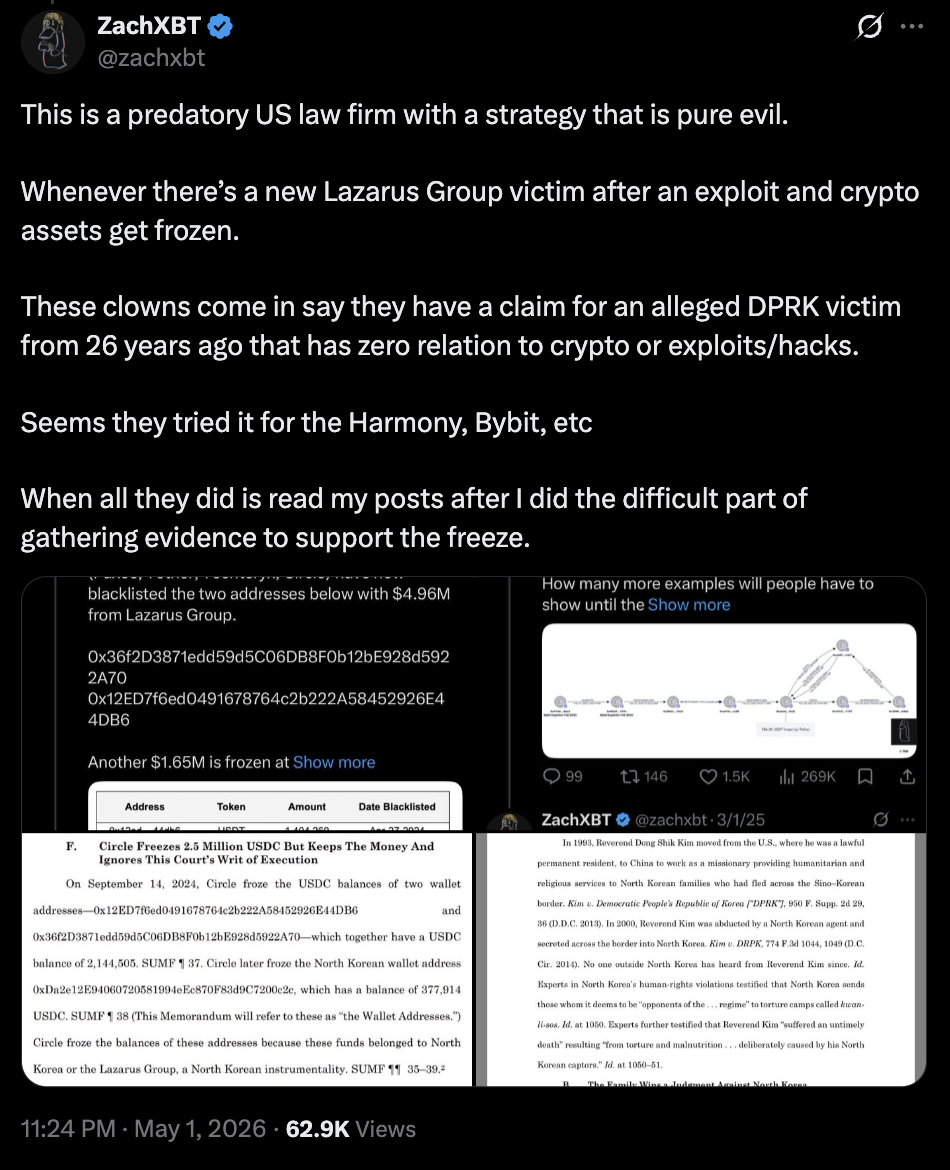
Source: ZachXBT
In April, the United States Office of Foreign Assets Control (OFAC) ordered Tether to freeze $344 million in stablecoins tied to Iranian entities.
The asset freeze also drew mixed reactions from the crypto community over the ethics of wallet freezes and the role of centralized crypto issuers in enforcing law enforcement requests.
Magazine: Are DeFi devs liable for the illegal activity of others on their platforms?

Myanmar’s military authorities have published the text of an Anti-Online Fraud Bill that would impose severe penalties on digital currency fraud and online scam operations. The draft statute, presented to the Pyidaungsu Hluttaw, frames online fraud as a threat to national sovereignty and stability and contemplates punishments ranging from long prison terms to the death penalty for certain offenses.
According to Cointelegraph, the proposed legislation sets out that individuals convicted of “digital currency fraud” or related online fraud could face a sentence of 10 years to life imprisonment, with the possibility of capital punishment in specified circumstances. The bill also delineates the death penalty for those implicated in the operation of scam centers or for actions that resulted in the death of a victim coerced or exploited into committing fraud. The government has underscored the aim of curbing organized online fraud networks that have proliferated in parts of Southeast Asia.
The seriousness of the penalties places Myanmar among the most draconian regimes globally for digital currency–related crime. The move comes as authorities in the region contend with what they describe as increasingly sophisticated scam infrastructure. In January, China reportedly ordered the execution of 11 people linked to Myanmar-based scam centers that trafficked Chinese nationals, underscoring cross-border law-enforcement stakes in tackling these operations. Source: Al Jazeera.
As part of its broader focus on combatting scam networks, international authorities have intensified cooperation to dismantle illicit operations that use schemes such as pig-butchering, romance scams, and fake investments to launder funds and traffic victims. The FBI noted in a report released in April that Americans suffered more than $11 billion in losses from crypto-related scams in 2025, with total online-fraud losses exceeding $20 billion. The agency cited a March executive order from the White House aimed at bolstering federal efforts to combat scam centers and cybercrime. FBI report (Cointelegraph summary), Executive action overview.
The Myanmar government has been under international scrutiny since the 2021 coup, after which parliamentary sessions were suspended for years and did not reconvene until March 2026 following elections described by the Council on Foreign Relations as “neither free nor fair.” A government notice published midweek indicated that lawmakers would reconvene in the first week of June, with the bill potentially on the agenda for consideration. CFR analysis.
Key takeaways
- Draconian penalties: The bill contemplates 10 years to life imprisonment for digital currency and online fraud offenses, including the potential for the death penalty in certain cases.
- Targeted offences: Provisions cover digital currency fraud and operations tied to scam centers, with enhanced penalties for those involved in coercing or exploiting victims to commit fraud.
- Policy rationale: Authorities frame the measure as essential to protecting sovereignty and stability amid widespread online fraud networks.
- Regional enforcement context: The move aligns with a broader Southeast Asian crackdown on scam centers, amid cross-border actions and international pressure to curb crypto-enabled crime.
- Regulatory landscape for crypto entities: The development has implications for crypto exchanges, banks, and service providers operating in or with Myanmar, underscoring heightened AML/KYC and licensing considerations in a volatile legal environment.
Myanmar’s bill in context: penalties, centers, and cross-border implications
The Anti-Online Fraud Bill sets a framework in which digital currency and online scams are treated as grave offenses with severe penalties. By tying the most extreme punishments to crimes related to scam centers and coercive manipulation, the proposal signals a hard-line stance against organized scams that authorities say exploit vulnerable individuals. The text and its language emphasize a governance objective—protecting sovereignty and stability—amid a political transition marked by controversy and international scrutiny.
International reporting underscores that this is not an isolated domestic policy move. The region has seen a surge in scam centers that traffic people and funds under crypto-enabled schemes, prompting a broader enforcement push. The China-based retaliation against Myanmar-linked scam operations—where authorities reportedly executed 11 individuals connected to trafficking networks—illustrates the potential for cross-border criminal activity to trigger parallel enforcement actions across jurisdictions. Such developments raise critical questions for compliance teams and financial institutions about screening, risk assessment, and the handling of cross-border payments and correspondent relationships in contexts where criminal enterprises leverage cryptocurrency and online platforms.
From a regulatory perspective, the Myanmar bill intersects with ongoing global efforts to constrain illicit crypto activity. In the United States, federal authorities have intensified investigations into crypto scams, with law-enforcement “strike forces” targeting leaders of scam networks, including cross-border actors linked to organized crime groups operating in Southeast Asia. The FBI’s findings, reported by Cointelegraph, highlight the ongoing risk of large-scale losses to consumers and the importance of robust AML/KYC programs for firms that facilitate or process crypto-related transactions. The White House’s March executive action reinforces the federal mandate to pursue cybercrime and predatory schemes, signaling a high-priority enforcement trajectory for the coming years. FBI report (Cointelegraph coverage), Executive action summary.
For institutions operating in or with Myanmar, the bill amplifies the regulatory risk calculus. Even if the measure advances slowly through the Pyidaungsu Hluttaw, the prospect of stringent penalties for crypto-related fraud signals a tightening of licensing expectations and compliance controls. Cross-border enforcement efforts and cooperation with international partners further complicate the landscape, as firms must navigate divergent regulatory regimes and potential sanctions in areas impacted by scam centers or illicit financial activity. In this context, regulators and compliance teams should monitor developments closely, assess exposure in customer onboarding and transaction monitoring, and prepare for potential licensing or reporting changes that could emerge from the new bill or subsequent implementing regulations.
Historical and policy backdrop shaping the debate
The bill’s emergence occurs against a backdrop of political upheaval and a shifting regional security–economic order. Myanmar’s 2021 coup disrupted normal legislative processes and delayed parliamentary action, with observers noting that subsequent elections did not meet commonly accepted standards for free and fair process. As authorities propose top-tier penalties for online crimes, analysts and policymakers are weighing the balance between deterrence, due process, and the implications for civil liberties within a fraught governance environment. The convergence of domestic security priorities with international pressure to combat trafficking, crypto-enabled scams, and cross-border crime underscores the challenge of implementing consistent, enforceable policies in a fragmented legal landscape.
Looking ahead, observers will be watching for the bill’s progress and for any implementing regulations that define how penalties would be applied, how scam centers would be identified and shut down, and how cooperation with foreign law-enforcement agencies would operate in practice. The interplay between national sovereignty claims and international AML/CFT standards will shape not only Myanmar’s regulatory posture but also the operational realities for crypto firms seeking to operate compliantly in a high-risk environment. As authorities stress sovereignty and stability, regulators and institutions alike must prepare for a period of intensified scrutiny and potential policy evolution.
In sum, the Anti-Online Fraud Bill represents a stark signal of regulatory posture: a willingness to wield severe penalties to deter crypto-enabled fraud and online scams, coupled with the likelihood of ongoing cross-border enforcement activity. For analysts and compliance professionals, the development underscores the necessity of robust risk assessment, vigilant KYC/AML controls, and clear governance around cross-border arrangements in a region where illicit networks continue to adapt their methods to exploit digital financial channels.
Closing perspective: While the bill’s passage remains to be seen, its introduction reinforces a policy trend toward aggressive anti-fraud regulation and heightened enforcement across Southeast Asia. Stakeholders should monitor parliamentary proceedings and any subsequent amendments that specify enforcement mechanisms, due-process safeguards, and the scope of regulatory oversight for digital assets and related services.


OKX’s planned move into the South Korean market would echo that of Binance, which completed its acquisition of Seoul-based Gopax last year.


There were low expectations for Drake’s new album Iceman, but one track released today underperformed even by crypto’s degenerate standards. In his new song “Dust,” Drake calls Sam Bankman-Fried (SBF) one of his guys and calls for his prison release.
“An FTX penthouse high-riser, yeah / Samuel Bankman, free all my guys up, yeah,” Drake raps on the album’s second track.
Drake’s “free all my guys” framing is a standard hip-hop convention as a solidarity shout-out. It also follows the storyline of “Dust” as an aggressive statement track, which follows the rap genre’s basic victory lap-and-diss sparkline.
The song isn’t complicated. Drake simply re-asserts examples of his dominance and successes while casting his rivals as washed-up, living off old plaques and memories. The chorus repeats the simple message, “Go blow the dust off your plaques.”
The music video also adds no more nuance, depicting a childish police car race from the fun-loving rapper.
Elsewhere, he also names himself a “BTC crypto big-timer,” demonstrating his obvious failure to understand how bitcoin (BTC) and crypto are distinct.
As evidence of his status, Drake references his globe-trotting lifestyle via Melbourne’s time zone, sold-out shows, and dubious references to the Bahamas where SBF stole FTX’s customer money: smoking luxury cigars at Graycliff, and a high‑rise penthouse.
SBF famously lived in one of the very few Bahamian high-rise penthouses, within the Albany neighborhood.
Drake calls for SBF prison release
Drake tries to use these examples to reinforce that he’s operating on a global, elite level, as well as cram in comments intended for the media within the limited timespan available.
SBF is serving a 25-year sentence at FCI Lompoc in California. A jury convicted him in November 2023 on seven counts of fraud and conspiracy. Judge Lewis Kaplan handed down the sentence in March 2024 and has denied his appeals.
In all, the total siphoned from FTX customers and routed into SBF’s private company Alameda Research came to roughly $8 billion, making it one of the largest financial frauds in US history.
Read more: Sam Bankman-Fried had a plan to get out of prison, and he’s following it
Because SBF has only one way out of prison, he has spent the last few months glazing Donald Trump on social media in a transparent effort for a presidential pardon.
“Dust,” released today on Drake’s ninth studio album, reinforces the Canadian rapper’s affinity for the criminal.
Stake.com, a crypto casino banned in the United Kingdom and barred from Twitch, pays Drake tens of millions of dollars per year to promote gambling. Indeed, the casino dominates his Instagram bio, sitting above his record label and fashion lines.
Got a tip? Send us an email securely via Protos Leaks. For more informed news and investigations, follow us on X, Bluesky, and Google News, or subscribe to our YouTube channel.
Crypto World
E-Estate Announces 1 Year Live: Washington DC Summit as Real Estate Tokenization Enters Its Next Phase


E Estate Group Inc. announced that it will host E-Estate 1 Year Live: Washington DC Summit on June 13, 2026, bringing together company leadership, agents, buyers, strategic partners, and guests interested in the future of blockchain-based real estate ownership.
The summit will take place at The Watergate Hotel in Washington, D.C. and will mark one year since the launch of the E-Estate platform.
The event is designed as a milestone gathering for the E-Estate ecosystem and a broader discussion on how real estate tokenization is moving from early adoption into structured infrastructure. The summit will focus on real assets, blockchain-based ownership models, Real World Assets, platform growth, and the next stage of digital property participation.
Over the past year, E-Estate has moved from launch phase to active market development. According to company data, E-Estate structured a tokenized real estate portfolio exceeding $100 million in 2025, while total EST sales across tokenized property offerings have now surpassed $32 million.
The company said the summit will provide a clear review of what has been built so far, what has been learned during the first year, and how E-Estate plans to continue expanding its infrastructure, property portfolio, and user access.
“Real estate tokenization is no longer only a concept,” said Brandon Stephenson, CEO and Co-Founder of E Estate Group Inc. “The next stage is about building infrastructure around real assets, legal structure, ownership records, user education, and operational discipline. That is what we are focused on at E-Estate.”
In 2026, E Estate Group Inc. filed a Form D notice with the U.S. Securities and Exchange Commission, which the company views as part of its broader effort to strengthen the legal foundation for activity connected to the U.S. market. E-Estate said this step reflects its long-term approach to building within a sector where regulation, compliance, and market standards are still developing.
The company’s model is based on using blockchain infrastructure to support digital participation in real estate assets. Rather than replacing traditional property fundamentals, E-Estate aims to create a more accessible ownership layer where real property, documentation, asset management, and digital records can work together.
The Washington DC Summit will also highlight the role of education and professional participation in the growth of tokenized real estate. E-Estate continues to develop its agent structure, buyer education, business account access, KYB processes, and future platform tools, including planned mobile access.
The program will include presentations from company leaders and selected speakers, recognition segments for top-performing participants, and discussions on the future direction of the platform.
“Real estate remains one of the most important asset classes in the world,” Stephenson added. “Blockchain gives the industry an opportunity to make ownership participation more transparent, more flexible, and more scalable. The companies that succeed will be the ones that connect technology with real assets and real execution.”
E-Estate said the summit will serve as both a first-year review and a forward-looking event, outlining the company’s next stage of growth as the tokenized real estate market continues to gain attention globally.
About E Estate Group Inc.
E Estate Group Inc. is a real estate tokenization company developing blockchain-based infrastructure for digital participation in real property assets. Through the E-Estate platform, the company focuses on connecting real estate, asset management, digital ownership records, buyer access, and agent education within one international ecosystem.
The post E-Estate Announces 1 Year Live: Washington DC Summit as Real Estate Tokenization Enters Its Next Phase appeared first on BeInCrypto.

Key Takeaways
- Pershing Square Capital Management revealed it purchased Microsoft shares while divesting its entire Alphabet holdings in Q1
- Bill Ackman described Microsoft’s current pricing as offering “highly compelling valuation” following recent market weakness
- Shares climbed as high as 4.1% during Friday trading, settling around 3.7% higher by midday ET as broader indexes declined 1.2%
- Hedge fund TCI dumped nearly all of its decade-old $8 billion Microsoft position due to concerns about AI competition
- Azure cloud services expanded 40% in the latest quarter; Copilot AI has secured 20 million paid subscribers from a potential 450 million business users
Microsoft (MSFT) shares surged on Friday following the revelation that hedge fund manager Bill Ackman’s investment firm, Pershing Square Capital Management, established a significant position in the tech giant as a “core holding” while simultaneously exiting its Alphabet investment.
Shares traded at $424.81 by midday ET, representing a 3.76% gain. The stock peaked at $426.44 during the session, marking a 4.1% intraday advance. Meanwhile, broader market indices moved in the opposite direction, with the S&P 500 sliding 1.2% and the Nasdaq declining 1.4%.
In an extensive 887-word social media post Friday morning, Ackman explained his rationale, describing Microsoft’s current valuation as “highly compelling” after sustained selling pressure that has pushed shares down 13% year-to-date in 2026 and 22% below their record high.
The investment represents a complete portfolio swap — Pershing liquidated its entire Alphabet stake to finance the Microsoft acquisition. Ackman highlighted the company’s cloud infrastructure operations and commanding presence in office productivity applications as fundamental pillars supporting his investment thesis.
Contrasting Views from Elite Hedge Funds
Ackman’s enthusiasm isn’t universally shared. TCI Fund Management, managed by Chris Hohn and recognized as among last year’s most successful hedge funds globally, discreetly liquidated the bulk of its $8 billion Microsoft position — an investment maintained for ten years.
TCI communicated its reasoning directly to investors: “We reduced our investment in Microsoft because the rapid progress in AI introduces uncertainty over Microsoft’s competitive position in the future.”
This situation presents two highly respected investment firms analyzing identical circumstances and arriving at diametrically opposed investment decisions. Financial analysts are keenly observing which perspective will prove accurate.
Microsoft CEO Satya Nadella appeared in an Oakland courtroom this week, providing testimony in Elon Musk’s litigation against OpenAI. Microsoft has channeled approximately $12 billion into OpenAI across seven years and currently maintains a 27% ownership stake valued near $230 billion. Musk’s lawsuit aims to dismantle this partnership, creating genuine strategic concerns for Microsoft’s artificial intelligence initiatives.
Copilot Penetration and AI Investment Returns
Regarding operational performance, Microsoft delivered adjusted earnings of $4.27 per share against revenue of $82.9 billion for its fiscal third quarter — surpassing analyst projections of $4.05 per share on $81.4 billion revenue. Azure cloud expansion reached 40%.
Microsoft’s infrastructure investments have escalated from $24 billion in fiscal 2021 to $88 billion in fiscal 2025, with projections indicating $190 billion for the current calendar year. These expenditures face intensifying examination as debates intensify regarding whether AI investments are translating into measurable customer returns.
The corporation presently counts 20 million paying subscribers for its premium Copilot AI product, representing a fraction of approximately 450 million total enterprise seats. Tigress Financial Partners maintains a Buy recommendation with a $680 price objective — significantly exceeding current market levels — pointing to triple-digit annual growth in paid Copilot subscriptions.
Nevertheless, the Wall Street Journal highlighted that certain clients have experienced confusion regarding Microsoft’s diverse AI product nomenclature, with some preferring Google’s Gemini alternative. Microsoft recently reorganized its AI division leadership.
Judson Althoff, who assumed control of commercial operations in October, dismissed these worries: “They don’t concern me, because I think the market is still trying to figure out AI.”
A research paper released by Microsoft Research this week introduced complexity to the AI optimism, determining that large language models “introduce sparse but severe errors that silently corrupt documents, compounding over long interaction.”
The paper’s three researchers are affiliated with Microsoft Research.


Justin Sun’s made-up country Liberland has given Ethereum founder Vitalik Buterin a star-shaped medal, “its highest state distinction,” for his technical blockchain achievements.
The “First Class Order of Merit of the Star of Liberland” was given to Buterin during ETHPrague 2026, where he attended a Network State event sponsored by the micronation.
Liberland said the medal recognizes Buterin’s “extraordinary technical achievements,” and, “his role in advancing new ideas about how societies can organize themselves.
Additionally, Buterin was praised for the attention he has given to “pop-up cities, decentralized societies, and network states.”

Read more: Justin Sun is now prime minister of Liberland, an entirely made-up country
The medal’s name appears to have been inspired by the Commonwealth’s Order of Merit, a 100-year-old award that recognises the distinguished services of people such as Florence Nightingale.
Someone who hasn’t received Liberland’s highest distinction is Tron founder Justin Sun. The crypto billionaire was, however, elected prime minister of the region back in October 2024.
Sun has been re-elected seven times.
When he first applied for the role, Sun emphasized the need to maintain a strong relationship with the US and boasted about his investments in Trump-linked crypto firm World Liberty Financial (WLFI).
He also praised US Middle East Envoy Steve Witkoff as an ally.
These statements haven’t aged well, however, as Witkoff’s son and WLFI co-founder, Zach Witkoff, is now claiming that Sun is attempting to “torch” the firm as WLFI and Sun launch lawsuits against each other.
Read more: WLFI investor offers to help Justin Sun to avoid ‘lengthy litigation’
Protos is also pretty sure that Sun hasn’t set foot in Liberland yet.
Other than courting crypto execs, Liberland has recently publicised how it wasn’t affected by a 4.1 magnitude earthquake that struck the Donbas region.
Its president, Vít Jedlička, noted, “Every structure we build in Liberland is designed with events like this in mind.”
These structures include a tent beach bar and a treehouse.
Got a tip? Send us an email securely via Protos Leaks. For more informed news and investigations, follow us on X, Bluesky, and Google News, or subscribe to our YouTube channel.

Myanmar’s military government released the text of an Anti-Online Fraud Bill, signaling a hardening stance against digital currency scams and other online-fraud schemes as regional crime networks continue to evolve. The measure would impose severe penalties on those convicted of online fraud and, in particular, “digital currency fraud,” underscoring the regime’s resolve to curb fintech-enabled crime.
The bill, made public this week, sets out lengthy prison terms for offenders—ranging from a minimum of ten years to life imprisonment—with the death penalty a possible outcome in certain circumstances. It also lays out conditions under which the death sentence could be applied, notably for those implicated in scam centers and for cases in which victims are coerced or exploited into participating in fraudulent activities.
According to a government notice, the Pyidaungsu Hluttaw, Myanmar’s parliament, could consider the draft law during its first session in June, following elections the authorities say will proceed under the current framework. The government’s notice indicates that lawmakers may take up the bill in the first week of June as part of broader security and sovereignty efforts. The development comes amid a broader context in which Myanmar’s political trajectory remains controversial after the 2021 coup, and observers have questioned the fairness of recent elections.
Key takeaways
- The Anti-Online Fraud Bill would punish digital currency fraud with 10 years to life in prison, and it allows the death penalty for particular offenses, including those tied to scam centers and harm to victims.
- The bill is slated for consideration in June by Myanmar’s Pyidaungsu Hluttaw, according to a government notice, as the country navigates a fragile political environment post-coup.
- The move sits within a broader regional and international push to dismantle scam centers that operate across Southeast Asia, including high-profile actions in China and the United States.
- An FBI report released in April found Americans lost more than $11 billion to crypto-related scams in 2025, with online fraud totaling more than $20 billion overall, highlighting rising cross-border crime risk for crypto users and platforms. The White House cited a March executive order aimed at combating cybercrime and scam centers.
Myanmar’s draft law and the fight against online crime
Advertisements, romance scams, and “pig butchering” schemes have exposed crackdowns across Southeast Asia, prompting authorities to pursue harsher legal tools. The proposed law frames digital currency fraud as a distinct offense within the broader category of online fraud, signaling an intent to target crypto-enabled scams as aggressively as traditional cybercrime.
Among the most consequential provisions is the potential for capital punishment in circumstances tied to scam centers or where victims are coerced into fraud activities. The bill’s wording also emphasizes accountability for those who operate or manage scam centers, placing responsibility on organizers who orchestrate online fraud operations and profit from them.
China’s reaction to Myanmar-linked scam activity has been recently stark. State media reports cited by outlets such as Al Jazeera indicate that Beijing ordered the execution of 11 individuals connected to Myanmar scam networks that had trafficked Chinese nationals. The case underscores the international dimension of scam-center operations and the intensified pressure on regional governments to dismantle such networks. For readers seeking contemporary coverage, see the report linked to by Al Jazeera.
Global crackdown context: how the world is responding
The Myanmar bill arrives amid a broad pattern of cross-border enforcement against crypto scams and scam centers. In the United States, a coordinated crackdown has featured prominently in policy discussions. An FBI report released in April documented that Americans’ losses from crypto-related scams had reached more than $11 billion in 2025, with total losses from online fraud exceeding $20 billion. The report also notes that a coordinated effort—described as the Scam Center Strike Force—focuses on dismantling the worst scam compounds in Southeast Asia and pursuing leaders, including Chinese-affiliated crime networks operating in Cambodia, Laos, and Burma.
The executive branch has signaled a willingness to empower law enforcement to pursue these threats more aggressively. In March, President Donald Trump issued an executive order directing federal agencies to intensify their efforts against scam centers and cybercrime, a move cited by the White House as part of a broader crackdown on fraud in the digital economy. Details of the order indicate a comprehensive mandate to strengthen investigations and penalties for cyber-enabled fraud.
Analysts note that the current wave of enforcement reflects a reshaped risk landscape for crypto users and for developers building compliant, security-minded platforms in Southeast Asia. As lawmakers in Yangon weigh the new bill, investors and operators will scrutinize how enforcement priorities align with consumer protection, due process, and the region’s evolving regulatory framework for digital assets.
Myanmar’s political backdrop and what it means for crypto policy
The political environment in Myanmar remains unsettled after the 2021 coup, with governance continuity and electoral legitimacy contested by many observers. A CFR assessment described the country’s elections as “neither free nor fair,” underscoring the fragile legitimacy of parliamentary steps taken by authorities. The government has indicated that the June session could consider the new anti-online-fraud legislation, signaling that the regime intends to push forward policy initiatives despite ongoing political tensions.
For market participants and developers, the key takeaway is that regulatory risk around online fraud and crypto-enabled crime is intensifying in the region. The bill’s passage would likely bolster penalties for digital-asset-related scams, potentially shaping compliance expectations for exchanges and wallet providers operating in or serving Myanmar and neighboring markets. It also highlights the need for robust identity verification, transaction monitoring, and cross-border information sharing to support enforcement efforts.
As the Pyidaungsu Hluttaw convenes in the coming weeks, observers will watch not only the bill’s text but how the government implements enforcement, safeguards due process, and coordinates with international partners to dismantle scam networks that routinely transcend borders. The interwoven nature of crypto fraud, trafficking, and cybercrime means policy developments in Myanmar will be read as part of a larger regional and global struggle to secure the digital economy from criminal exploitation.
Readers should stay tuned for updates on the bill’s advancement in June, as well as new data from enforcement agencies and regulators on cross-border crypto scams. The coming months are likely to reveal how much policy sentiment in Yangon has shifted toward punitive deterrence and how that shift might affect the broader crypto regulatory landscape in Southeast Asia.

Key Highlights
- Michael Pokorny, Chief Accounting Officer, offloaded approximately $3.5 million in shares; Director Necip Sayiner sold roughly $870,300 on May 8.
- Shares of SNDK have skyrocketed 465% throughout 2026, propelled by robust financial performance and surging AI infrastructure demand for NAND flash storage.
- Fiscal Q3 2026 saw revenue climb 251% compared to the same period last year, with adjusted earnings per share reaching $23.41.
- The memory maker is transitioning toward long-term supply contracts, securing guaranteed revenue streams from major hyperscale cloud providers.
- Executives project approximately $8 billion in Q4 revenue alongside an 80% gross profit margin.
Two senior executives at Sandisk offloaded a total of $4.4 million worth of company shares recently, capitalizing on what has become one of 2026’s most spectacular stock rallies.
Michael Pokorny, the company’s Chief Accounting Officer, divested 2,446 shares this past Tuesday at a price of $1,426.18 per share, generating proceeds of approximately $3.5 million. Following this transaction, Pokorny maintains direct ownership of 22,375 shares, currently valued at roughly $31 million using Thursday’s closing price of $1,382.72.
Meanwhile, Board Director Necip Sayiner disposed of 579 shares on May 8 at an average selling price of $1,503.11, totaling $870,300 in proceeds. Post-sale, Sayiner retains ownership of 2,900 shares worth approximately $4 million.
Sandisk stock has climbed an extraordinary 465% during 2026, and approximately 3,640% since its spinoff from Western Digital completed in February 2025 at an initial public offering price of $38.50. Shares currently hover around the $1,400 mark.
By comparison, the Nasdaq 100 has advanced just 15% during the identical timeframe, underscoring the magnitude of Sandisk’s outperformance.
Forces Powering the Explosive Growth
The primary catalyst behind this remarkable ascent is NAND flash memory technology. Sandisk’s storage solutions have become essential components for AI-focused data centers, where requirements for high-capacity, non-volatile memory have exploded as hyperscale operators rapidly expand their computational infrastructure.
Technology giants including Amazon, Microsoft, Alphabet, and Meta have collectively allocated approximately $700 billion toward infrastructure investments in 2026. Sandisk has positioned itself as a direct beneficiary of this unprecedented capital deployment.
The company’s fiscal Q3 2026 financial results mirrored this explosive demand. Revenue surged 97% from the previous quarter and jumped 251% year-over-year. Adjusted earnings per share reached $23.41, a substantial increase from $5.15 in the preceding quarter.
Revenue generated from data center customers specifically increased 233% during the quarter. Chief Executive David Goeckeler has characterized hyperscale operators as “higher-value customers,” representing a strategic evolution from the company’s historically diverse and fragmented client portfolio.
Industry-wide memory supply constraints have additionally driven pricing upward, creating a favorable pricing environment that complements strong volume expansion.
Strategic Shift in Commercial Approach
Sandisk has been pivoting from transactional spot market sales toward structured, multiyear supply commitments. The corporation executed three such agreements during Q3, with two additional contracts already secured in Q4. This framework ensures predictable revenue for Sandisk while guaranteeing critical storage capacity for major customers.
Looking toward Q4, company leadership projects revenue of approximately $8 billion—representing a 321% increase versus the prior year—coupled with an 80% gross margin, modestly exceeding the 78.4% achieved in Q3.
Industry competitors have similarly experienced strong performance this year. Western Digital, Seagate, and Micron have all witnessed share price appreciation exceeding 100% during 2026.
At present valuations, Sandisk trades at approximately 16 times trailing-twelve-month revenue, elevated from roughly 4.5x at the beginning of the year. This expanded valuation multiple increases the stock’s vulnerability to any disappointing developments, whether company-specific execution issues or broader macroeconomic headwinds.
These recent insider transactions represent the most current SEC-disclosed sales from Sandisk leadership as the stock continues trading near record levels.

X pledges quicker action on hate and terror content in the UK
Strategy Plans Major Note Repurchase While Leaving Door Open to Bitcoin Sales

McLaughlin: Why Many CFB Stadiums Need Better WiFi > Spencer talks with Tyler Wojciak about the challenges of keeping fans attending games

Manchester United reach agreement with Casemiro over contract clause amid transfer speculation

US brings back mandatory military draft registration

Steven Gerrard disagrees with Gary Neville over ‘shock’ Chelsea and Arsenal claim | Football

Stock Market, Money Making Secrets, Investment & Rich Life – Dinesh Thakkar | FO202 Raj Shamani

Bitcoin GOLD Market About To Move? Here’s What The Charts Show | 15 May | Bitcoin Live Trading

Financial Management Most Important Topic For CS Executive June 2026 #cssexam #pw
-

 Fashion4 days ago
Coffee Break: Travel Steam Iron
-

 Politics7 days ago
Politics Home Article | Starmer Enters The Danger Zone
-

 Fashion5 days ago
What to Know Before Buying a Curling Wand or Curling Iron
-

 Politics4 days ago
What to expect when you’re expecting a budget
-

 Tech6 days ago
Auto Enthusiast Carves Functional Two-Stroke Engine from Solid Metal
-
 Business6 days ago
Ignore market noise, India’s long-term story intact, say D-Street bulls Ramesh Damani and Sunil Singhania
-

 Tech5 days ago
GM Agrees To Pay $12.75 Million To Settle California Lawsuit Over Misuse Of Customers’ Driving Data
-

 Crypto World5 days ago
CZ says US crypto rivals tried to block Trump pardon
-

 Crypto World6 days ago
PROS explodes 48% as Upbit and Bithumb listings ignite demand
-

 Tech4 days ago
GM agrees to $12.75M California settlement over sale of drivers’ data
-

 Crypto World7 days ago
Kraken Parent Seeks OCC Charter, Signaling Regulated Banking Access
-
Crypto World3 days ago
Bitcoin Suisse expands with Digital Asset License and Investment Business Act Registration Approval in Bermuda
-

 Sports7 days ago
Why Nathan Mackinnon Remains the Hart Trophy Favourite over Connor McDavid and Nikita Kucherov | NHL
-

 Entertainment7 days ago
Bethenny Frankel Says She Loves ‘Torturing’ Men
-

 Sports7 days ago
After Waka Waka, Shakira now drops first teaser for FIFA WC 2026 song | FIFA World Cup 2022
-
 Crypto World7 days ago
Solana UFO Meme Coins Surge After Pentagon Reveals Alien Files
-

 Crypto World56 minutes ago
E-Estate Announces 1 Year Live: Washington DC Summit as Real Estate Tokenization Enters Its Next Phase
-

 Politics3 days ago
Pakistan to enter Chinese capital market as war inflation bites
-

 Entertainment7 days ago
Young and the Restless Next Week: Cane & Matt Both Arrested in Shocker!
-
 Crypto World7 days ago
Pi Network Hits 421K Mainnet Nodes Ahead of Protocol 23 Smart Contract Launch
You must be logged in to post a comment Login