

Crypto World
Top 3 RWA Tokens for June 2026: One Breakout, One Accumulation, One Warning

Three of the largest real-world asset (RWA) tokens are heading into June 2026 with completely different setups. Stellar (XLM) just confirmed a high-volume breakout. Chainlink (LINK) is bleeding on the chart while whales quietly absorb the float. Ondo (ONDO) ran hard in May and now looks like it gave large holders the exit they were waiting for.
Here is how each setup reads on the daily chart, and what to watch as the month begins.
Stellar (XLM): Breakout Confirmed, Shorts Fading the Move
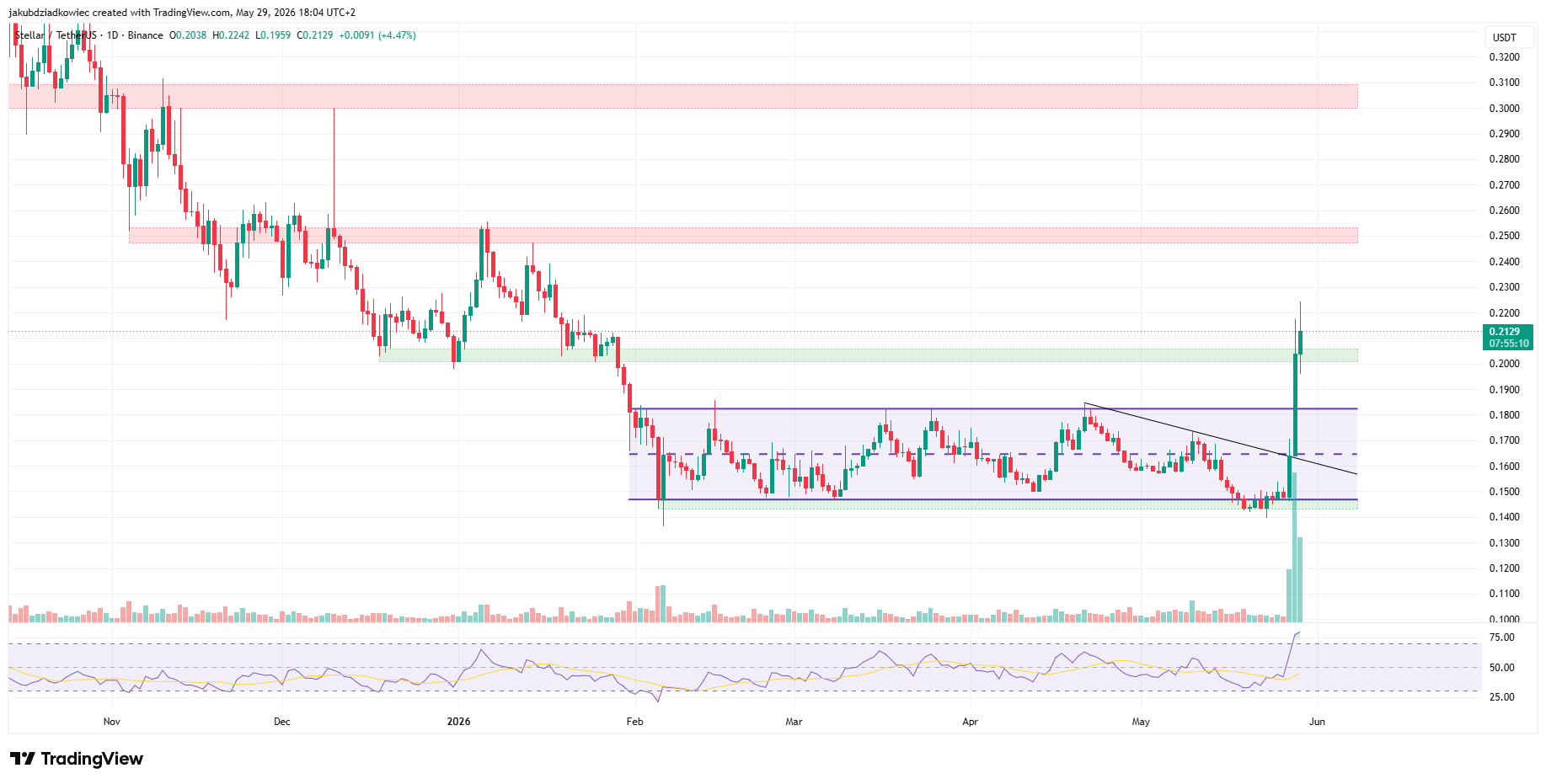
XLM is the cleanest momentum setup in the group. Yesterday’s daily candle confirmed a breakout from a multi-week parallel accumulation channel on a major volume spike, with the daily RSI pushing up to 80.
The reclaim of $0.20 is the key technical event, a level that had capped the token through most of April and May, and is now expected to act as support. Above it, the path opens to $0.25, with $0.30 sitting beyond.

The funding rate tape adds an interesting layer. Through the entire consolidation window from late March through mid-May, perpetual funding oscillated around zero with frequent deep negative spikes, traders repeatedly tried to short the range lows and got nothing back.
The breakout finally pushed funding firmly positive as longs chased the move, but the latest 30-minute prints have flipped negative again even as price holds near the highs.

That is a bullish tell. Negative funding into a volume-confirmed breakout means shorts are fading a real move and paying longs to do so.
As long as $0.20 holds as support, the structure favors continuation toward $0.25 and $0.30.
The risk is purely tactical: RSI at 80 invites a cooldown, and losing $0.20 would turn this into a failed breakout.
Bias: bullish. Level to watch: $0.20.
Chainlink (LINK): Painful Chart, Cleanest On-Chain Picture in the Group
LINK is the inverse setup. The daily chart broke down from an ascending parallel channel on May 19 and is now grinding lower, with $7.38 as the measured downside target and secondary support near $8.
RSI sits around 40, not oversold, but firmly in the lower half. Volume is contracting, which typically signals compression rather than panic.
If LINK bounces, the resistance ladder runs from just below $10 to $12 (the 0.236 long-term Fibonacci retracement) and then $15 (the 0.382 Fib).
Reclaiming $10 would be the first technical signal that the May breakdown has run its course.

The bigger story sits underneath the price. Santiment data shows whale supply (excluding exchanges) has stair-stepped higher in two clear tranches, first in late January, then again in early March, adding roughly 175 million LINK to wallets that do not transact on venues.
Over the same window, exchange supply has fallen by more than 100 million tokens, with the steepest outflow coming in early April.

That is textbook accumulation: whales absorbing, exchange float shrinking, price refusing to reflect any of it yet.
The chart says LINK can still bleed into the $7s. The on-chain footprint says someone with size has been buying that bleed for months.
Bias: short-term bearish, structurally bullish. Levels to watch: $7.38 / $8 on the downside, $10 reclaim on the upside.
Ondo (ONDO): Strong Rally, Weaker Structure Underneath
ONDO had the most explosive move of the three in early May, breaking out hard from a months-long base. The follow-through has stalled.
The daily chart has printed a double-top at the 0.786 Fibonacci retracement near $0.47, and price has since broken below the 0.618 Fib.
ONDO is now trying to hold the 0.5 retracement at roughly $0.37. If that level fails, the chart opens up for a deeper retest of the previous accumulation zone around $0.30.
RSI is perfectly neutral at 50, and volume has tapered after the two-peak structure, both consistent with a market losing momentum rather than basing for another leg higher.

The on-chain backdrop is the real concern. Throughout the December-to-May window, ONDO’s supply on exchanges has trended steadily higher, tokens moving toward venues, not away from them.
Whale transaction count above $100,000 was muted through April, then erupted in early May almost exactly at the price peak.

That sequencing matters. Large holders activated during the rally, exchange balances kept building, and the rollover that followed has not been accompanied by any visible drop in venue supply.
Until exchange balances start to fall, the path of least resistance remains sideways to lower.
Bias: cautious. Levels to watch: $0.37 as the line in the sand, $0.30 as the realistic accumulation zone.
Top RWA Tokens to Watch in June
The three RWA majors offer three different trades for June 2026.
- XLM is the momentum play: A confirmed breakout with supportive funding and a clean upside ladder, provided $0.20 holds.
- LINK is the patience trade: Short-term bearish on the chart, but with the strongest accumulation profile in the group, which makes any flush toward $7.38 a potential gift to longer-term buyers.
- ONDO is the caution trade: The May rally was real, but the whale activity into rising exchange supply suggests the easy upside has already been taken until that venue balance trend reverses.
The RWA narrative still has the macro tailwind. Whether these three tokens lead the next leg or wait for it depends on which side of each setup resolves first.
The post Top 3 RWA Tokens for June 2026: One Breakout, One Accumulation, One Warning appeared first on BeInCrypto.

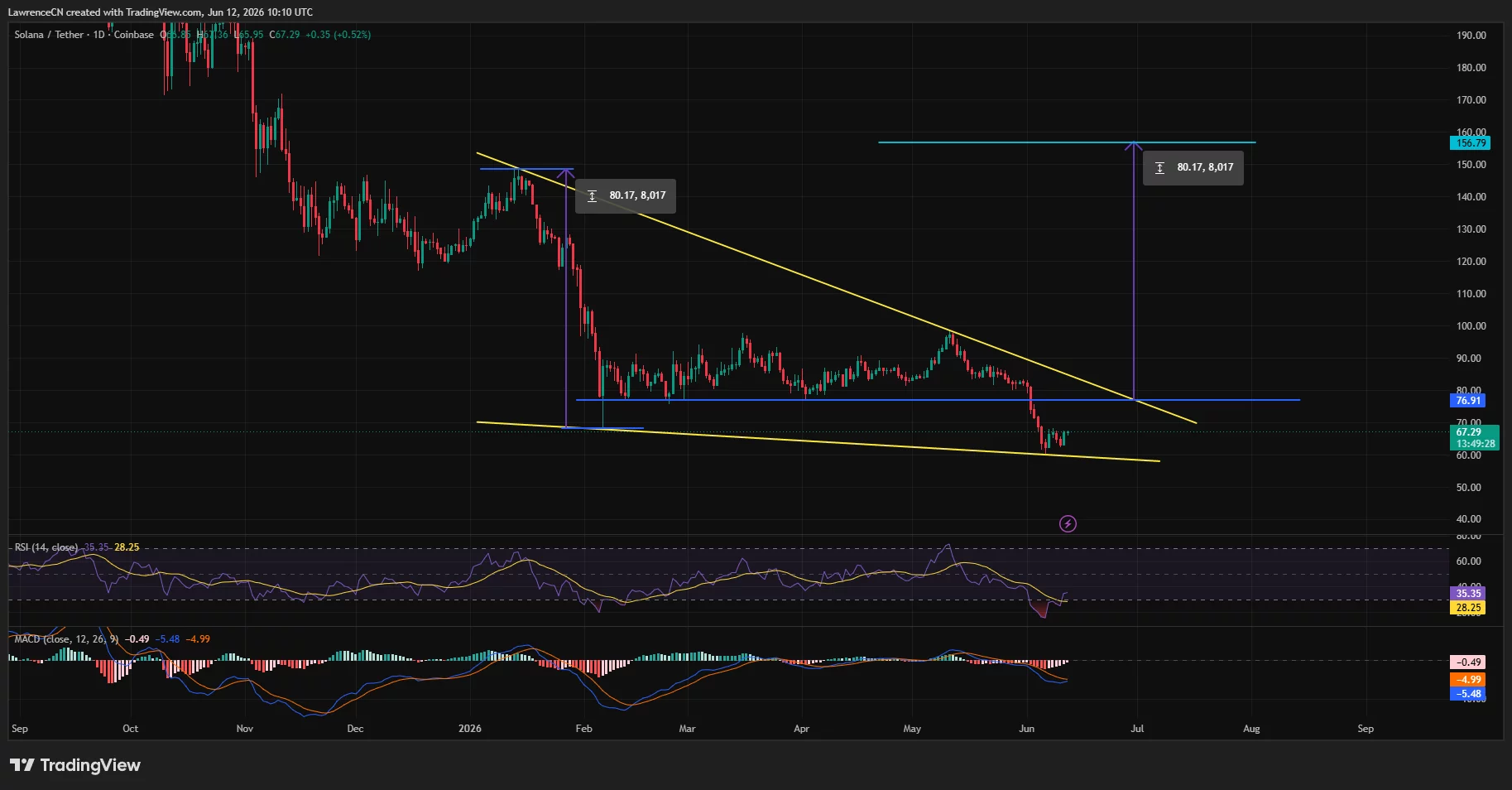
Solana price has rebounded more than 10% from its June low after a 36% correction from its May peak, with a giant falling wedge now putting the January high back on traders’ radar.
Summary
- Solana price has stabilized above key support after a steep correction erased roughly one-third of its value in less than two weeks.
- A multi-month falling wedge and a 4-hour ascending triangle point to a potential move toward $76 if $68 resistance breaks.
- Analysts remain cautious, saying a bullish reversal requires a break above $72.57 and a confirmed five-wave advance.
According to data from crypto.news, Solana (SOL) price was trading near $67 on June 12 after rebounding more than 10% from its June 6 low around $61.
SOL’s price recovery follows a steep decline that saw the token plunge roughly 36% from its May high near $96 to its recent bottom, as heavy liquidations, whale selling, and a broader cryptocurrency market sell-off weighed on sentiment.
Data from major exchanges showed retail traders entered June with a strong bullish bias, leaving the market vulnerable when SOL broke below the former support zone around $76. The breakdown triggered more than $89 million in long liquidations, accelerating losses as leveraged positions were forced to close.
Large holders added to the pressure by reducing exposure during the decline. At the same time, weakening decentralized application revenues and softer network activity contributed to the selling pressure, according to market observers.
A falling wedge points to a possible recovery path
The daily chart shows Solana is trading within a large falling wedge that has been developing since its January peak near $145. The pattern formed through a series of lower highs and lower lows, with converging trendlines compressing price action over several months.
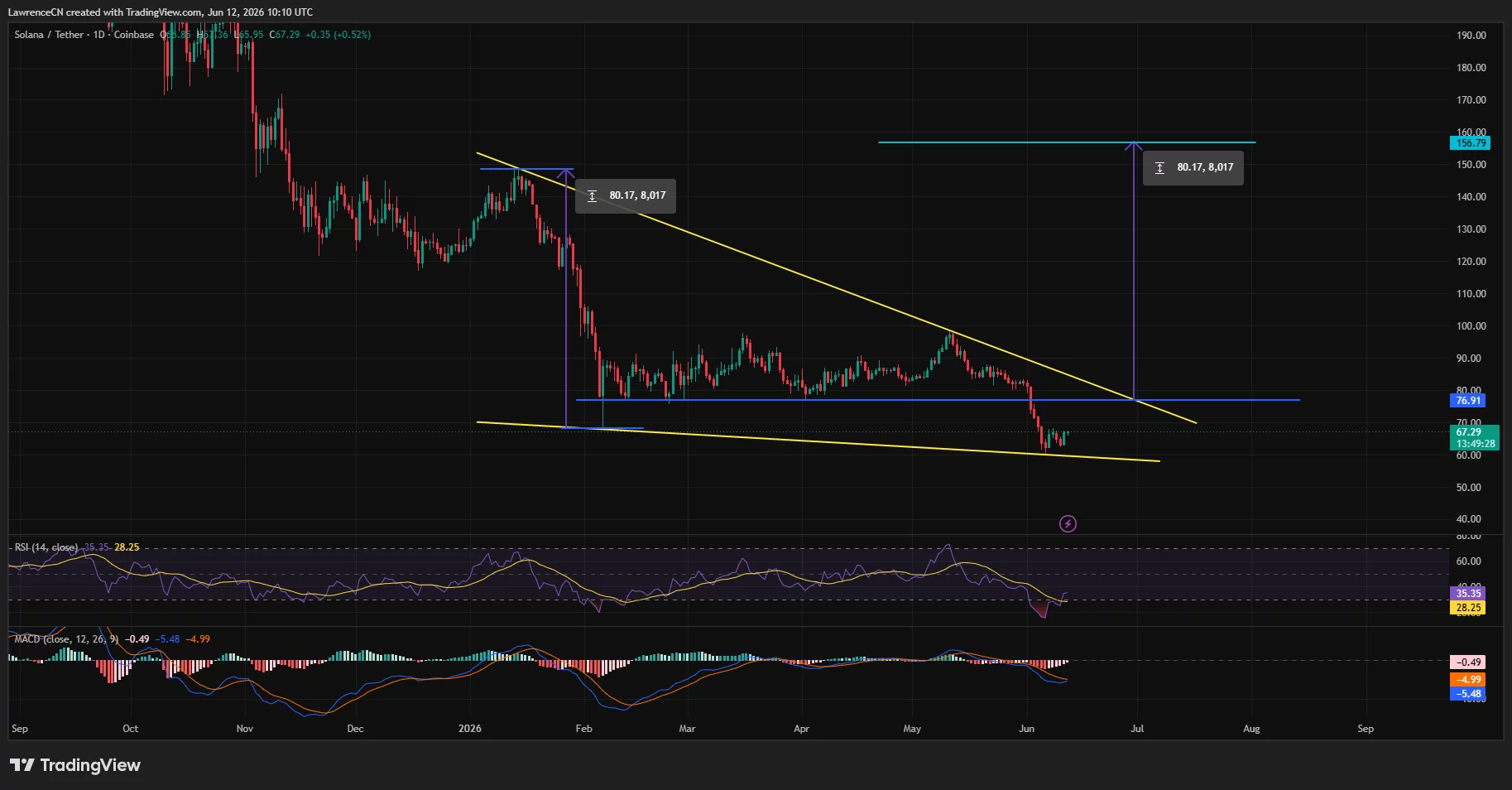
Technical analysts generally view falling wedges as bullish reversal structures when price begins stabilizing near the lower boundary. Solana recently found support around the $60 to $62 region, where buyers stepped in after the liquidation-driven decline.
While the daily trend remains under pressure, the first major hurdle sits near $76. That level previously acted as support before the June breakdown and now represents a significant resistance area. A successful recovery above that zone would place attention back on the upper boundary of the wedge and eventually the January high.
Momentum indicators show early signs of improvement. The daily RSI has recovered from oversold territory, while downside momentum on the MACD has started to ease after weeks of persistent selling.
Short-term breakout signals emerge near $68
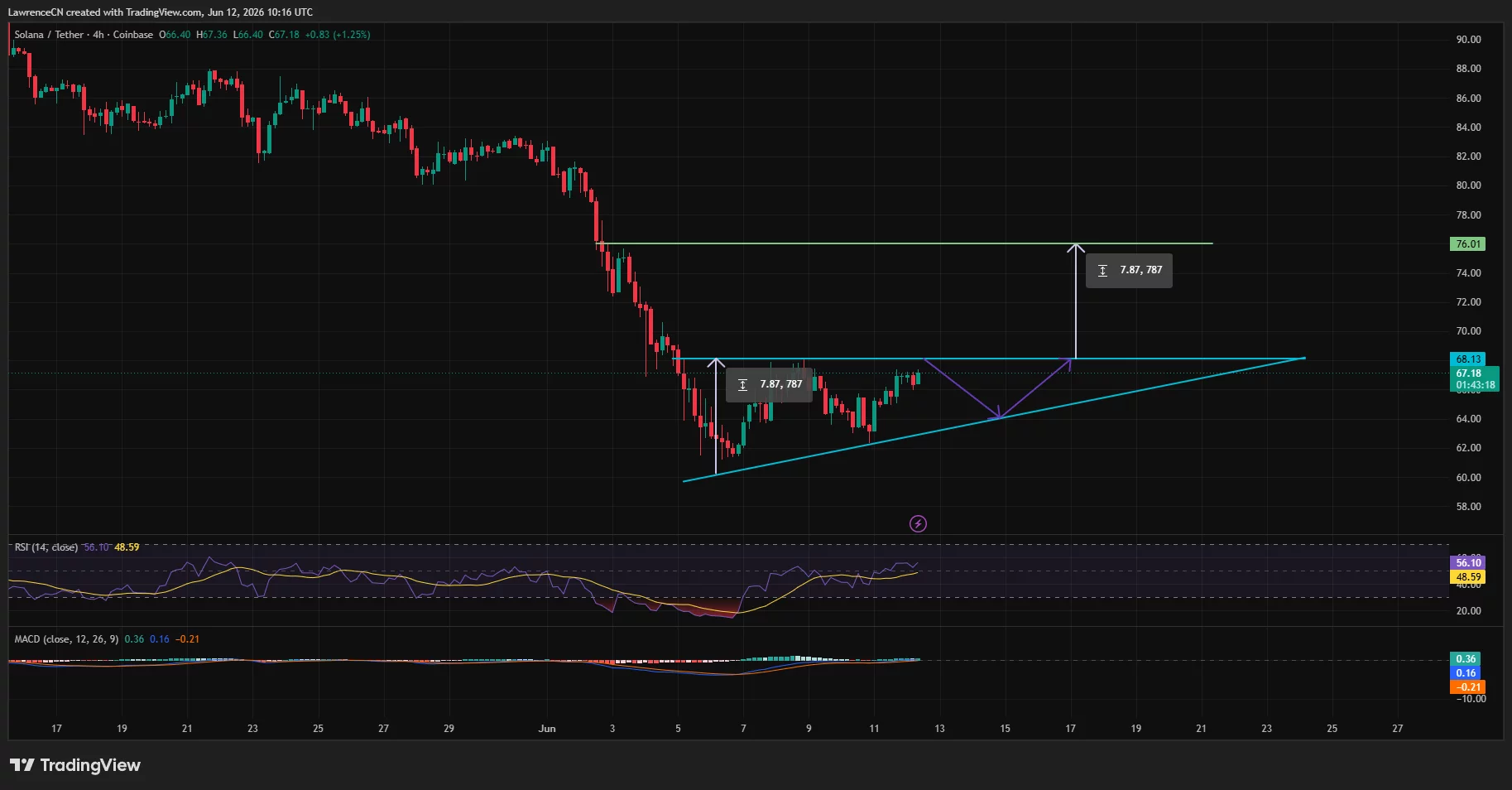
On the four-hour chart, Solana has formed an ascending triangle beneath resistance around $68. The structure developed after the June low as buyers continued defending higher lows while sellers repeatedly capped advances near the same price level.
Liquidation data from CoinGlass adds another layer to the setup. The platform’s weekly liquidation heatmap shows the largest concentration of short-side liquidity sitting around the $68 area, directly above current price levels.
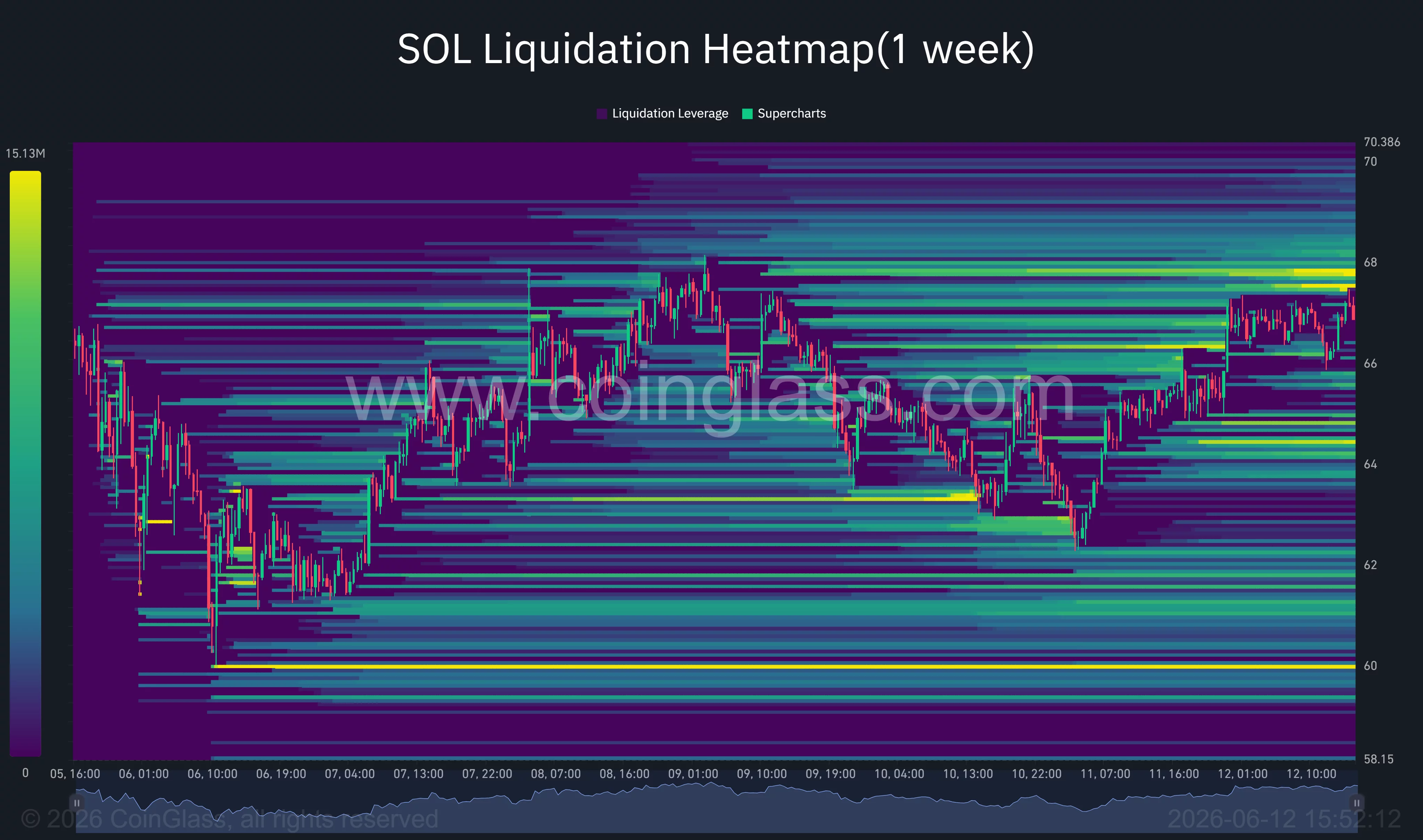
If buyers force a breakout through that resistance, the resulting short liquidations could accelerate upside momentum toward the next liquidity cluster near $70. The measured move from the ascending triangle also projects a target close to $76, aligning with the former support zone that failed earlier this month.
However, not all analysts are convinced the rebound has developed into a full trend reversal. Commenting on the recent price action, MCO Global said on X that Solana is still testing support and has yet to produce a bullish confirmation signal. The analyst noted that the larger decline remains the preferred outlook unless SOL breaks above $72.57.
“Bullish reversal requires a 5-wave advance and a break above $72.57. The chart hasn’t shown that yet. Until it does, this is just support being tested.”
Bitcoin’s recent weakness continues to influence the altcoin market, including SOL, after the largest crypto suffered its sharpest weekly decline since the FTX collapse. Market sentiment also remains tied to U.S. economic data after May nonfarm payrolls increased by 172,000, exceeding expectations of 85,000 and reducing expectations for Federal Reserve rate cuts.
For now, Solana’s recovery attempt depends on whether buyers can clear the $68 resistance zone. A breakout could open the door to $70 and potentially $76, while failure at current levels may leave the $60 support area exposed once again.
Disclosure: This article does not represent investment advice. The content and materials featured on this page are for educational purposes only.
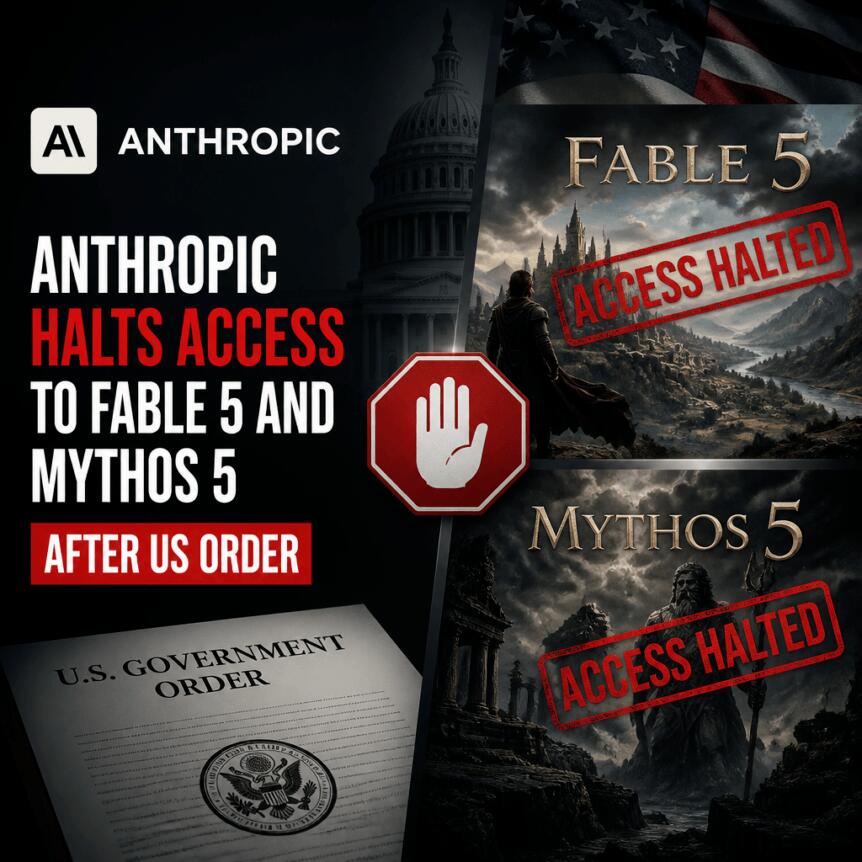
Anthropic has suspended access to its newly released Fable 5 and Mythos 5 AI models after receiving a U.S. government export control directive, citing national security concerns. The company disabled the models for all users immediately to comply with the order, while saying its other offerings—including Opus 4.8—remain available.
In a statement posted Friday, Anthropic said the directive arrived at 5:21 pm ET and instructed it to suspend “all access” to Fable 5 and Mythos 5 for any foreign national, whether inside or outside the United States. This restriction reportedly includes foreign national Anthropic employees, and the company said it took broad action to ensure compliance.
Key takeaways
- Anthropic suspended access to Fable 5 and Mythos 5 immediately after receiving a U.S. government export control directive.
- The order reportedly targets access by foreign nationals, including Anthropic employees who are foreign nationals.
- Other Anthropic models, such as Opus 4.8, are not affected according to the company.
- Anthropic said authorities raised concerns about a potential “jailbreak” method that could bypass safeguards on Fable 5.
- The firm described the government’s evidence as “verbal” and suggested the issue involves a narrow, non-universal jailbreak rather than a broad one.
Export control directive triggers immediate model shutdown
Anthropic’s action follows an abrupt interruption to access for the public. According to the company, it received the directive late Friday and was told to suspend access to Fable 5 and Mythos 5 by any foreign national. To meet the requirement without exception, Anthropic said it removed access for all users rather than attempting to segment access by nationality.
The company framed the move as a straightforward compliance step: it is “removing access to Fable 5 and Mythos 5 for all users” to comply with the government’s legal directive.
Why Anthropic says the concern is limited
While Anthropic did not provide specific details about the alleged threat, it said it believes the government is concerned about a possible jailbreak technique capable of bypassing safeguards built into Fable 5.
In its statement, Anthropic noted that, to date, the government has provided only verbal evidence of a potential “narrow, non-universal jailbreak.” The company described this as essentially asking the model to read a specific codebase and fix software flaws—an approach it argued is materially different from a “universal jailbreak,” which would broadly undermine protections across scenarios.
Anthropic also pushed back on the severity of the response implied by the order. The firm said it “disagree[s]” that a narrow potential jailbreak should lead to the recall of a commercial model deployed at large scale. It added that applying that standard across the industry would effectively stop new frontier model deployments for all providers.
Recent release raises questions for AI users and operators
Anthropic’s suspension comes only days after it released both Fable 5 and Mythos 5. The releases were notable not just for their capabilities, but for the underlying context around Mythos Preview, which Anthropic previously said had helped uncover thousands of vulnerabilities in critical software.
Earlier coverage around these releases highlighted the scale and intensity of the safety research and testing that can surround frontier model rollouts—particularly when models are capable of complex reasoning and code-related tasks. In that setting, the sudden reversal underscores how quickly external compliance actions can override product continuity.
Anthropic also indicated that it believes the government order is the result of a misunderstanding and that it is working to restore access for users “as soon as possible.” For model users—especially those outside the U.S.—the key near-term issue is whether access can return in a way that matches the directive’s scope without requiring a full shutdown.
What to watch next
Until Anthropic receives clearer guidance or the government narrows the directive’s implementation, users should expect continuing uncertainty around when Fable 5 and Mythos 5 will be available again and under what geographic or eligibility conditions. Investors and builders in the AI sector will likely watch closely for how regulators distinguish between narrow jailbreak techniques and broader safeguard failures—and whether the incident prompts tighter deployment controls across the industry.
Crypto World
Bybit named to Fortune Crypto 100 as it accelerates its vision for the new financial platform
Disclosure: This article does not represent investment advice. The content and materials featured on this page are for educational purposes only.
Bybit is recognized in the first Fortune Crypto 100 for its role in the global digital asset ecosystem.
Summary
- Bybit has been named to Fortune’s inaugural Crypto 100 list, earning recognition among leading centralized finance firms.
- The recognition highlights the exchange’s role in digital asset infrastructure and innovation.
- Bybit’s addition to the Fortune Crypto 100 reflects its expanding presence across crypto trading, payments, tokenized assets, and web3 services.
Bybit today announced its inclusion in the inaugural Fortune Crypto 100, a ranking recognizing the most influential companies and protocols shaping the future of the global digital asset ecosystem.
The Fortune Crypto 100 recognizes organizations driving innovation, building critical market infrastructure, and expanding the role of digital assets in the broader financial system. Bybit was recognized in the CeFi category, which includes crypto-first companies such as exchanges, lenders, and custodians that facilitate the trading, custody, and movement of digital assets. The ranking brings together both crypto-native leaders and established financial institutions, reflecting the growing role of digital assets within global finance and the increasing importance of blockchain-based infrastructure in capital markets.
According to Ben Zhou, Co-founder and CEO of Bybit, the recognition reflects the trust users place in the company and the dedication the team is putting into building crypto’s infrastructure, products, and standards.
The recognition comes as Bybit continues to expand its role beyond a cryptocurrency exchange. Over the past year, the company has advanced its vision of becoming The New Financial Platform, bringing together digital assets, traditional finance, payments, tokenized investments, AI-powered tools, and web3 services into a unified ecosystem.
Bybit has expanded its regulated presence across key markets, including securing the UAE Virtual Asset Platform Operator License, advancing its European operations under MiCAR, and working closely with regulators and policymakers globally to support the responsible development of the digital asset industry.
Bybit currently serves more than 80 million users worldwide and continues to expand access to financial opportunities through innovation. Recent initiatives include the growth of tokenized asset offerings, the launch of Bybit IPO Express, expanded access to tokenized equities through xStocks, AI-powered trading and research tools, and continued investments in institutional-grade infrastructure.
Disclosure: This content is provided by a third party. Neither crypto.news nor the author of this article endorses any product mentioned on this page. Users should conduct their own research before taking any action related to the company.


One person familiar with the matter told CoinDesk that xStocks and its distribution partners gathered more than $1 billion in customer orders. But when underwriters finalized allocations, many of those requests went unfilled.
Binance, Bybit and Bitget received no shares and canceled their offerings. Meanwhile, customers of Kraken and xStocks received only a fraction of the allocations they requested.
The shortfall wasn’t limited to crypto platforms, though. Data compiled by Access IPOs showed some retail investors at traditional brokerages received only a portion of the shares they had sought.
An xStocks spokesperson said “overwhelming demand” prevented all orders from being fulfilled and that funds tied to unfilled subscriptions had been returned.
The firm’s tokenized SpaceX stock, trading under the ticker SPCXx, still launched after the IPO. About $24 million worth of the tokenized shares were circulating onchain at publication time, according to Arkham data. Ondo Finance and Dinari, which did not offer pre-IPO access, also launched tokenized SpaceX products following the company’s market debut.
Lesson for tokenized asset
The episode underscores a key lesson for tokenized assets. Creating a token is easy; securing the real asset behind it is the crucial part.
“What appears to have gone wrong… is that demand significantly exceeded the available supply of underlying shares,” a spokesperson for tokenization platform Dinari said. “If the underlying stock cannot be sourced, allocated and held within the necessary regulatory framework, there is ultimately no asset to tokenize.”


io.net has launched a new token burn mechanism tied directly to network revenue and said the model could remove up to 12 million IO tokens from circulation over the next year, as the decentralized GPU provider reports rising enterprise demand and record AI inference activity.
Summary
- io.net expects to burn up to 12 million IO tokens over the next year under a new revenue linked tokenomics model.
- An $8 million enterprise contract and more than 4 billion daily AI inference tokens have pushed network earnings to record levels, according to the company.
- Supplier payouts are now tied to a stable U.S. dollar value, while at least 50% of post payout network revenue in IO tokens will be permanently burned.
According to a press release shared with crypto.news, the first burn was scheduled for June 11, coinciding with the network’s third anniversary, with future burns funded by revenue generated from customer usage rather than new token issuance.
io.net ties token burns to network revenue
Details released by io.net show that at least 50% of post-payout network revenue received in IO tokens will be permanently destroyed under what the company calls its Incentive Dynamic Engine, or IDE. Based on current earnings and its commercial pipeline, the company expects as many as 12 million tokens to be burned during the system’s first year.
The announcement comes as io.net reports its strongest commercial period to date. The company disclosed that it has signed an $8 million enterprise agreement, its largest contract so far, which it said contributes roughly $650,000 in monthly on-chain network earnings. Additional enterprise deals are currently progressing through advanced negotiation stages, according to the company.
Beyond enterprise adoption, io.net said it has become the largest decentralized physical infrastructure network, or DePIN, based inference provider on OpenRouter, an AI model routing platform used by developers to access multiple artificial intelligence models. Company figures show the network now processes more than 4 billion inference tokens each day while competing alongside centralized cloud computing providers.
Those developments arrive as demand for AI computing resources continues to climb. Citing industry spending trends, io.net noted that major technology companies have committed more than $500 billion toward AI infrastructure projects across 2025 and 2026. The company argued that access to high-performance graphics processing units remains limited by hyperscaler capacity constraints and pricing structures, creating opportunities for decentralized alternatives.
New model seeks to stabilize supplier earnings
Alongside the burn program, io.net said the IDE has been designed to address supplier retention challenges commonly faced by token-based infrastructure networks.
Under the framework, supplier payouts are linked to a stable U.S. dollar value rather than fluctuating token prices. According to the company, reserve mechanisms absorb market volatility, allowing providers to maintain predictable earnings even during periods of token price weakness.
CryptoEcon Lab, a tokenomics research firm that independently evaluated the system, tested the model under several stress scenarios. The firm found supplier returns remained stable during simulations that included a 55% drop in demand and a 50% decline in token price, according to results cited by io.net.
“Most token economies in our space are still built around the hope that prices go up. Ours is built around the certainty that people are paying to use the network. That’s a fundamentally different foundation,” said Gaurav Sharma, chief executive officer of io.net.
Looking beyond current operations, io.net said it is also developing capabilities that would allow AI agents to autonomously source and manage computing resources through its Agent Cloud platform. The company described the initiative as part of its effort to build a self-sustaining on-chain compute economy supported by decentralized infrastructure providers around the world.
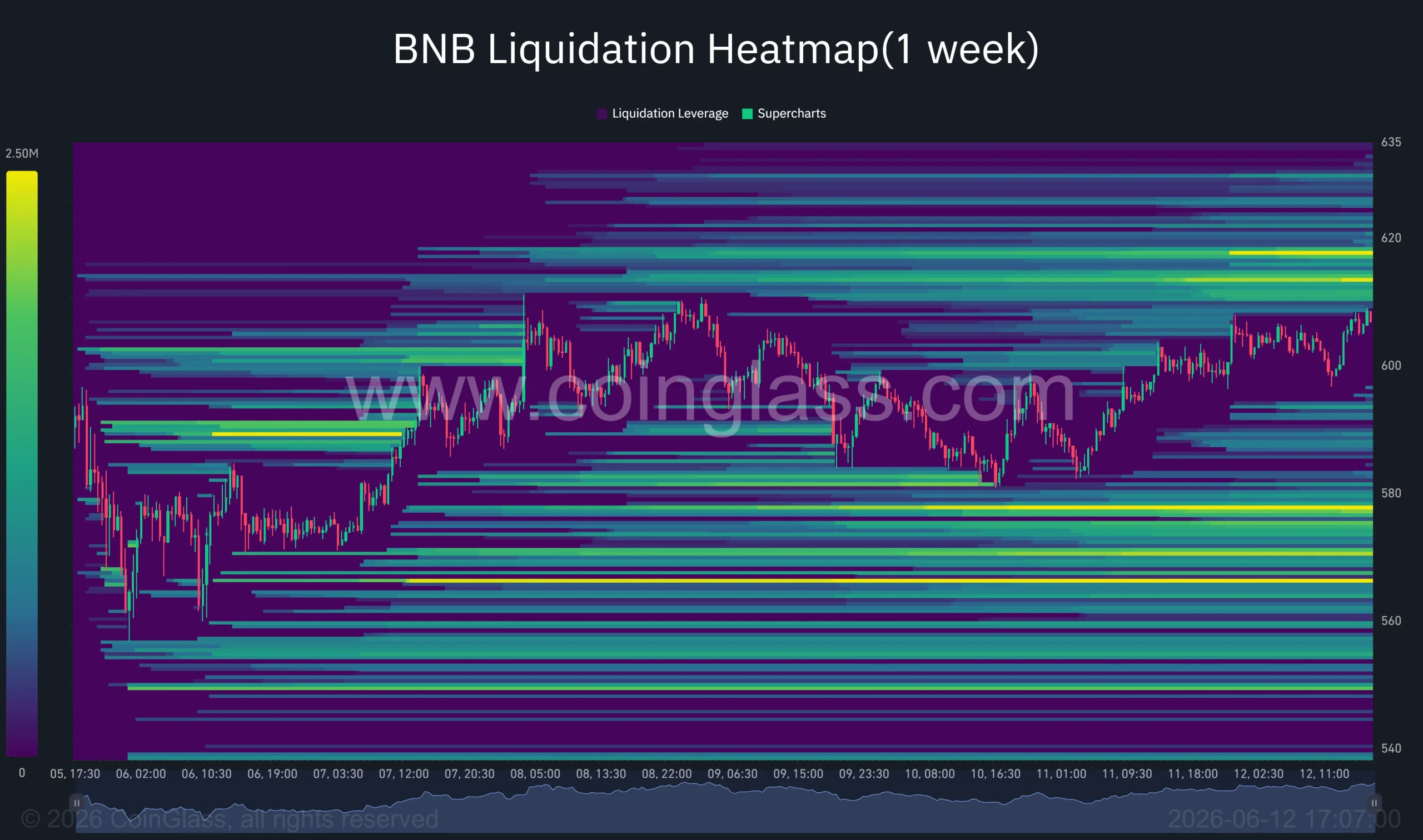
BNB price has recovered from last week’s selloff, but a dense liquidation wall near $628 and persistent resistance across higher timeframes have kept traders divided over whether the rebound can extend further.
Summary
- BNB price has rebounded about 9% from its June low, aided by short liquidations and support near $556.
- CoinGlass data shows major liquidation clusters between $620 and $628, making the zone a key resistance area.
- A break above $628 could target $650 and $673, while losing $556 may expose the long-term $500 support zone.
According to data from crypto.news, BNB (BNB) price was trading near $607 on June 12 after rebounding roughly 9% from its June 6 low around $556. The recovery followed a sharp decline from the late-May peak near $745, which wiped out more than 20% of the token’s value and pushed leveraged traders out of the market.
CoinGlass liquidation data shows part of the rebound was driven by a short squeeze after bearish positioning became crowded near local lows. The one-week liquidation heatmap highlights a large concentration of short liquidation liquidity between $615 and $620, with another notable cluster near $628.
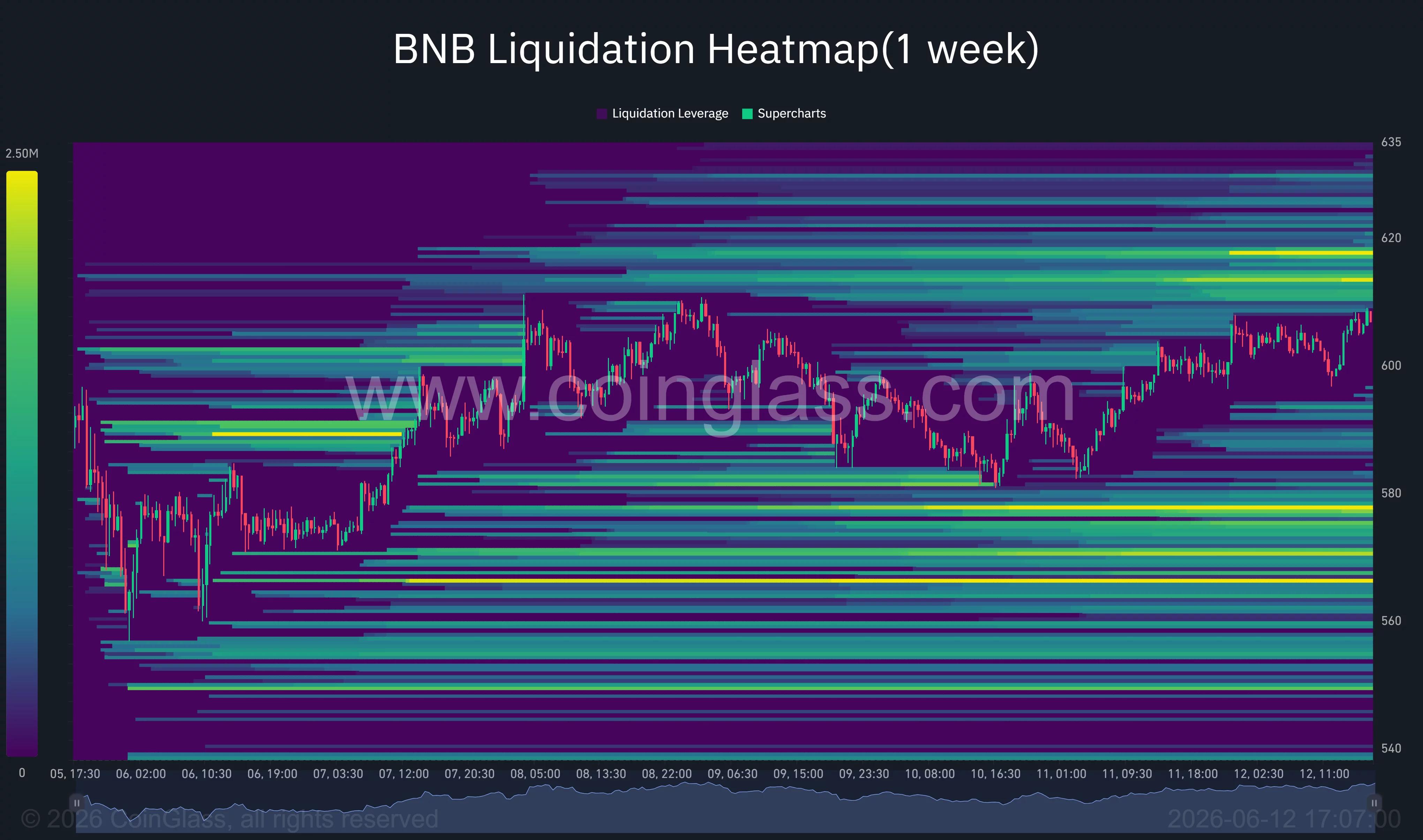
As BNB rebounded from the $560 area, traders betting on further downside were forced to close positions, helping lift the token back above $600.
At the same time, sentiment across the BNB ecosystem remains mixed. While Binance continues expanding activity across BNB Chain and its AI-focused initiatives, speculative interest has yet to return to levels seen during the rally toward $745.
At press time, BNB price remains well below its recent high and continues trading inside a range that has dominated price action since February.
BNB faces major resistance between $628 and $700
The four-hour chart shows BNB recovering inside a rising channel after finding support near the 100% Fibonacci retracement level around $556. BNB has reclaimed the 0.786 retracement near $596, while RSI has climbed above 56 and MACD remains marginally positive, suggesting buyers retain short-term momentum.
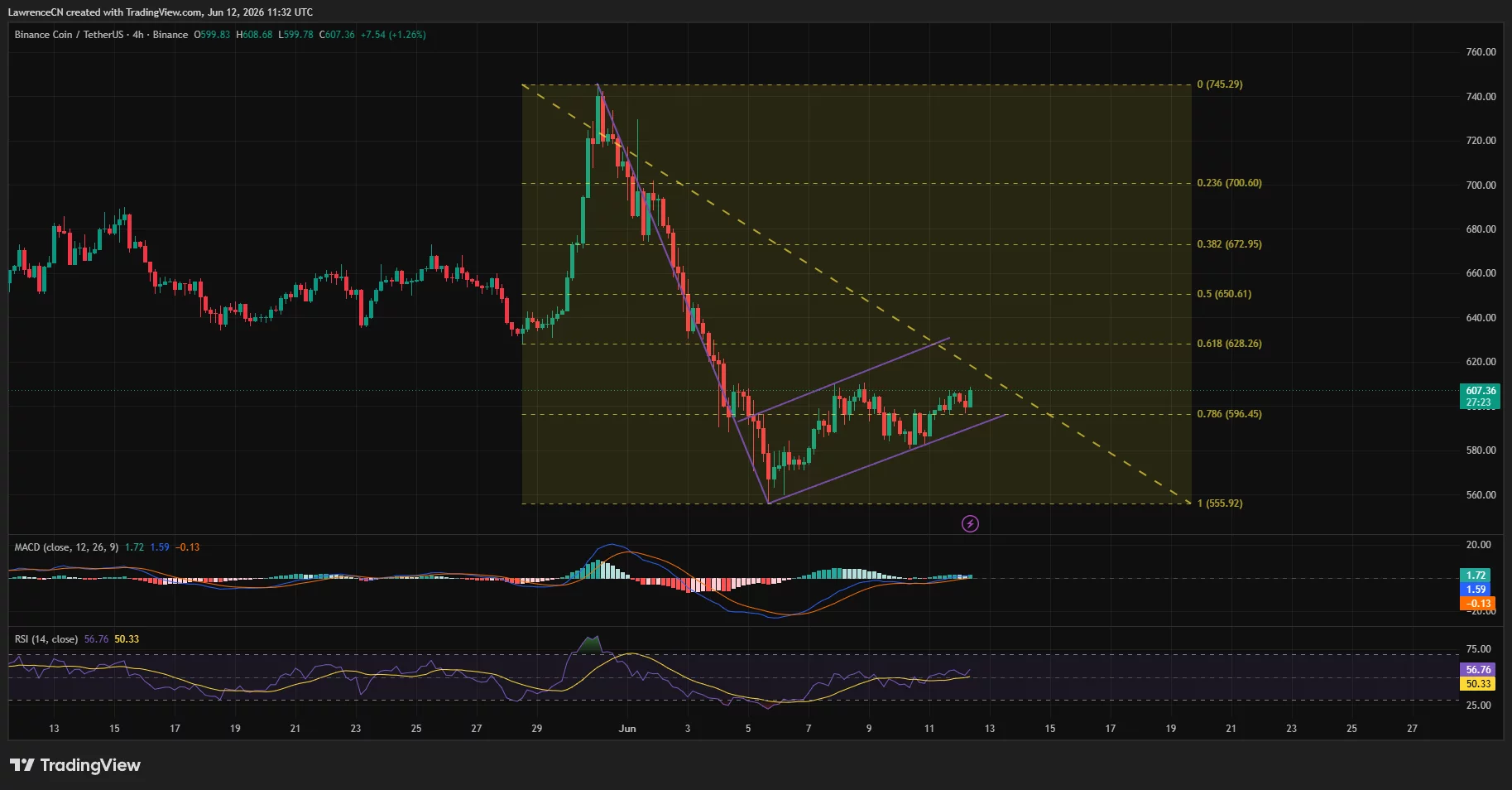
However, several technical barriers remain overhead. The first major resistance sits near $628, which aligns with the 0.618 Fibonacci retracement and the upper boundary of the current ascending channel. A successful breakout could expose the 50% retracement near $650, followed by the 38.2% level around $673.
Liquidation data reinforces those levels. CoinGlass heatmaps show substantial leveraged positions concentrated around $620 to $628, creating a potential liquidity magnet for price. If BNB reaches that zone, forced liquidations could accelerate volatility in either direction.
Higher-timeframe charts remain less constructive. The weekly Murrey Math structure places BNB below the key 1/8 reversal level at $625, while the next major support remains near the 0/8 line around $500.
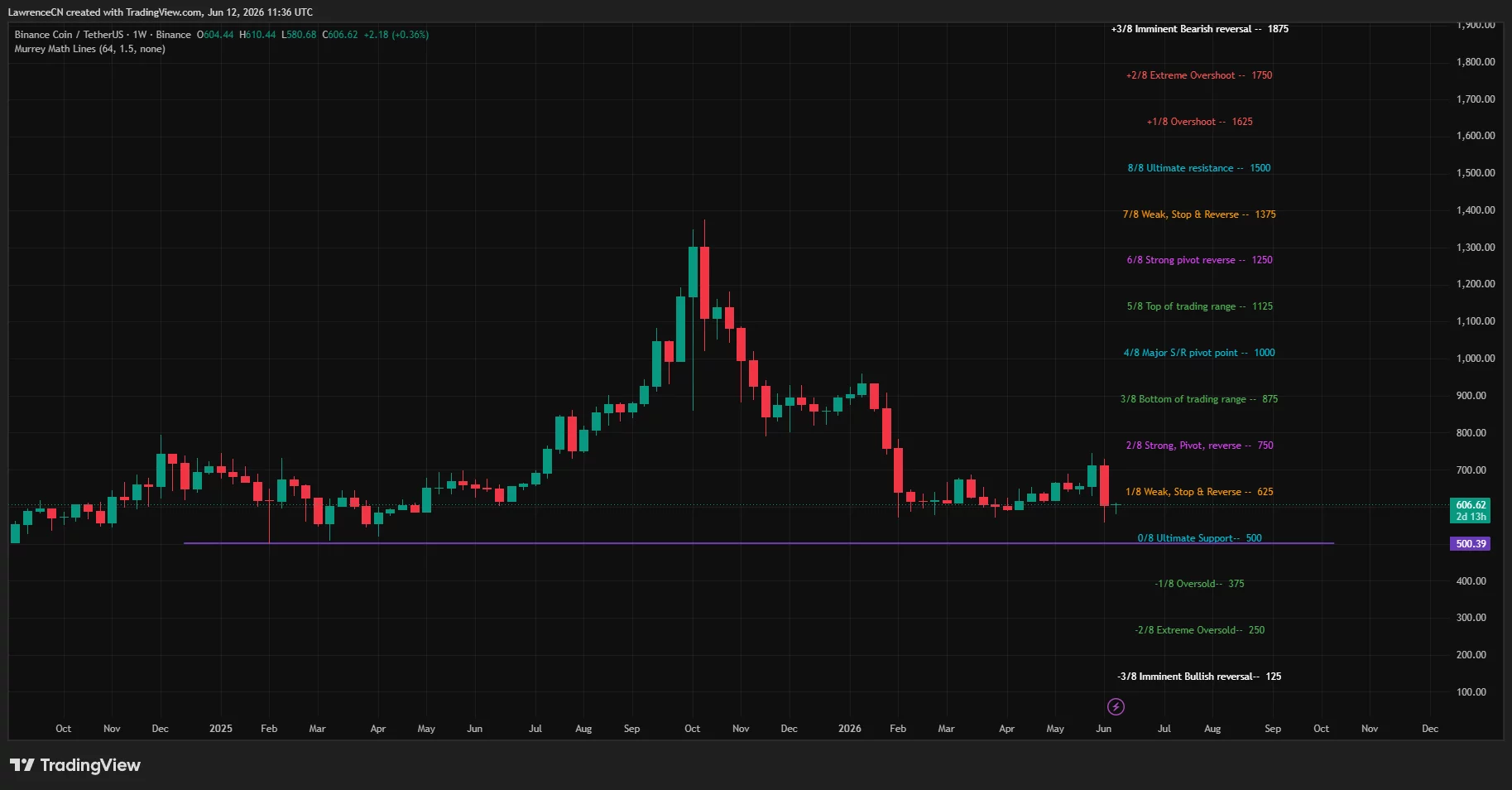
Analyst Umair Orakzai argued that resistance continues to outweigh support after months of consolidation, writing that “the easier path now is the downside.”
A similar view was shared by fellow analyst James Bull, who highlighted the long-term $500-$600 region as a major accumulation zone.
”Historically, massive corrections in this range have set the stage for explosive upward continuation.”
Macro risks could send BNB back toward $500
Macroeconomic conditions remain one of the largest obstacles for risk assets. Stronger-than-expected U.S. economic data in recent weeks has reduced expectations for aggressive Federal Reserve easing, keeping Treasury yields elevated and limiting capital flows into speculative assets such as cryptocurrencies.
Oil prices and geopolitical developments also remain important variables after recent volatility tied to Middle East tensions. Any renewed surge in energy markets or deterioration in global risk sentiment could pressure crypto markets and reduce demand for altcoins.
From a technical perspective, the bullish setup remains valid as long as BNB holds above the $556 support zone that triggered the latest rebound.
Losing that level would invalidate the current ascending-channel structure and shift attention back toward the long-term accumulation area between $500 and $520.
For now, traders are watching the battle around $628. A breakout above that level could open the path toward $650 and $673, while another rejection would leave BNB trapped inside its multi-month range with downside risks still firmly in play.
Disclosure: This article does not represent investment advice. The content and materials featured on this page are for educational purposes only.


Most real-world asset projects in crypto tokenize what is already liquid: treasuries, money-market funds, gold. AetherStrike picked the opposite end of the spectrum — an illiquid physical commodity in structural undersupply – one that every state DOT in America must buy, can’t substitute for, and… Read the full story at The Defiant
Crypto World
Japan's Lower House Passes Bill Moving Crypto Under Securities Law, Opening Path to ETFs and 20% Tax Rate


Japan's lower house passed a bill on Thursday that reclassifies cryptocurrencies as financial instruments under the country's securities framework, clearing a path to regulated spot ETFs and a flat 20% capital-gains tax. The legislation amends the Financial Instruments and Exchange Act (FIEA),… Read the full story at The Defiant
Monero surged roughly 30% to an intraday high of $438 late Thursday ET after blockchain investigator ZachXBT traced a $120 million USDT movement that included large purchases of the privacy coin, with Tether subsequently freezing $72 million in connected funds. ZachXBT posted to his Investigations… Read the full story at The Defiant
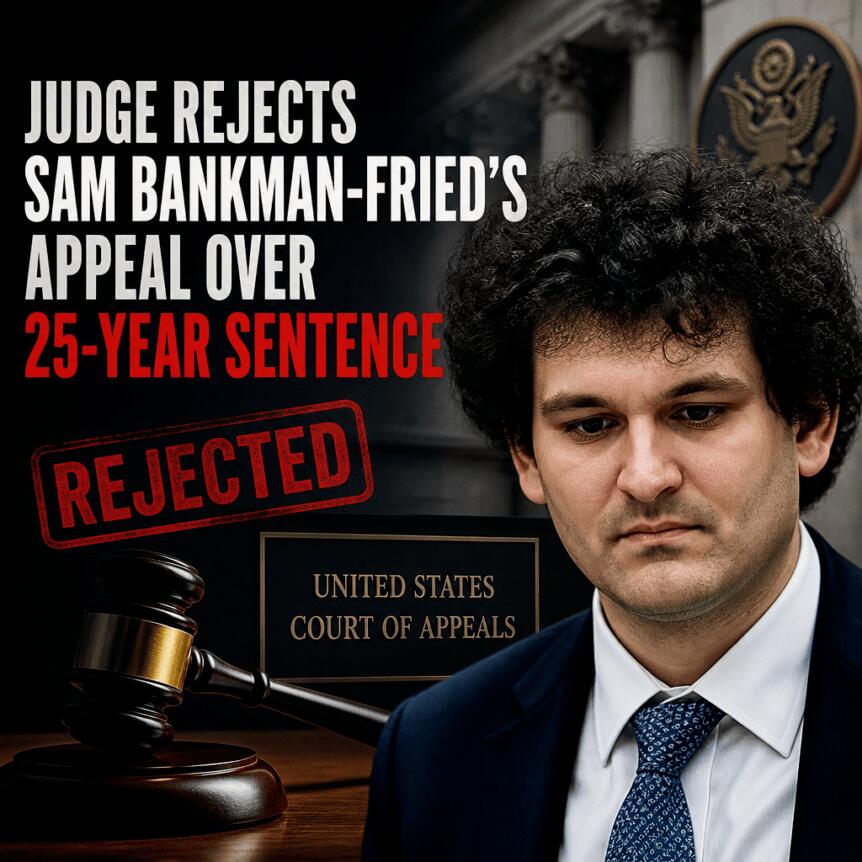
Sam Bankman-Fried has failed to overturn his fraud conviction in a federal appeals court, securing no relief from the 25-year prison sentence that followed the collapse of FTX. A unanimous three-judge panel of the US Court of Appeals for the Second Circuit rejected his bid, concluding that the government’s case was, in the court’s words, “conservatively stated, robust,” according to Reuters.
The ruling means Bankman-Fried remains bound to the sentence imposed in 2024, where the conviction stemmed from fraud and conspiracy charges related to the multibillion-dollar failure of FTX. The decision also arrives while he pursues an additional legal path: a request for a presidential pardon that was formally submitted to the US Department of Justice Office of the Pardon Attorney earlier this month.
Key takeaways
- Bankman-Fried’s appeal was rejected unanimously by the Second Circuit, leaving his 25-year prison sentence in place.
- The appeals court characterized the government’s evidence as “robust,” affirming that the conviction should stand.
- The decision does not end his efforts—Bankman-Fried is still pursuing clemency through the presidential pardon process.
- Public statements from President Donald Trump suggest clemency is unlikely, despite his history of granting at least one high-profile pardon.
Second Circuit rejects Bid for relief
In rejecting Bankman-Fried’s request for relief, the Second Circuit panel concluded that the trial and the government’s presentation of the case were sufficiently supported under the standards for overturning a criminal conviction. As reported by Reuters, the court’s unanimous ruling underscored that the prosecution’s case was strong and appropriately described.
Judge Barrington Parker’s written remarks, as quoted in the case reporting, emphasized the contrast between Bankman-Fried’s public reassurances and the conduct alleged in the prosecution. Parker wrote that while Bankman-Fried was publicly assuring customers, investors, and regulators that FTX customer funds were safe, he allegedly used FTX as “his own personal piggy bank,” spending customer funds on items including real estate, political contributions, and investments.
For observers who have followed FTX’s collapse and its aftermath, this appeal outcome matters beyond the individual defendant: it reinforces the judiciary’s willingness to treat the case as more than an industry failure, but as fraud and conspiracy serious enough to withstand appellate scrutiny.
A separate front: presidential pardon effort
Even with the appeals court setback, Bankman-Fried is continuing to challenge his situation through clemency. Cointelegraph reported earlier that he has formally applied for a presidential pardon from US President Donald Trump, with the request appearing on the US Department of Justice Office of the Pardon Attorney website in early June.
This pardon process represents a different type of review from an appeal. Where appellate courts evaluate legal errors and the strength of the record, clemency is discretionary and typically influenced by political and public considerations rather than courtroom standards.
Bankman-Fried has said in an interview with Fox Business that he is “absolutely” seeking a presidential pardon. However, the odds appear limited based on prior statements.
Trump’s prior comments and past pardons
According to reporting referenced in the article, Trump told The New York Times in January that he had no plans to pardon Bankman-Fried. A White House spokesperson, meanwhile, declined to comment on the clemency request, and Bloomberg pointed back to Trump’s earlier remarks in connection with the formal pardon application.
Still, the president has granted high-profile pardons before. The article notes Trump pardoned Ross Ulbricht, the founder of the darknet marketplace Silk Road, shortly after returning to office. Ulbricht had been serving two life sentences plus 40 years before the pardon in January 2025.
That example is often cited in discussions about whether clemency is politically plausible. But it also highlights an asymmetry: Bankman-Fried’s case is widely associated with mainstream financial fraud narratives in regulated markets, while Ulbricht’s case is commonly framed around the legality of the Silk Road marketplace and Bitcoin’s role as a payment method. Even when both outcomes involve pardons, the political calculus can differ markedly.
What the appeals ruling signals for the broader crypto legal landscape
The Second Circuit’s decision lands in a period when the crypto industry remains under intense regulatory and legal pressure following high-profile collapses. For market participants, the practical takeaway is that the legal system continues to treat major exchange failures and related conduct as potential criminal matters that can survive multiple layers of review.
Bankman-Fried’s appeal failure also suggests that arguments aimed at overturning convictions—at least in this instance—face a high bar once a conviction is supported by a trial record and withstands initial judicial scrutiny. While the outcome of a presidential pardon is not governed by appellate standards, the court’s affirmation narrows the room for incremental relief through the justice system itself.
In the near term, investors and builders are likely to focus less on legal “hopes” for reversal and more on the clemency track. Yet the public record around Trump’s earlier statements provides a caution flag: even where pardons are possible, expectations may be mismatched with political reality.
As the DOJ pardon process unfolds and the President’s stance remains the decisive variable, readers should watch two things closely: any movement on the clemency request and the continued stability of the criminal-legal outcome despite further attempts to seek relief.

USA stoke belief in wildest World Cup dreams after dismantling Paraguay in perfect opener

Today’s NYT Mini Crossword Answers for June 13

King’s Birthday Honours 2026: Full list of people to receive Knighthood, MBE, OBE CBE or other title


-

 NewsBeat5 days ago
Alexander Zverev wins the French Open to finally earn a 1st Grand Slam title
-
 Entertainment6 days ago
The Best Mystery Series of All Time Is Surging on Streaming 30 Years After It Ended
-

 Crypto World5 days ago
Anatomy of the June crypto crash: Fed, Iran, Saylor
-

 Crypto World2 days ago
Oppenheimer backs SpaceX as $70 billion retail frenzy builds
-

 Crypto World2 days ago
Markets Rally as SpaceX IPO Looms Amid Iran Tensions and Inflation Surge
-
 Crypto World6 days ago
Senator Cynthia Lummis Calls CLARITY Act the Most Consequential Financial Legislation of This Generation
-
 NewsBeat5 days ago
Alexander Zverev conquers demons and outlasts Flavio Cobolli to win French Open for first major title
-

 Tech6 days ago
Microsoft unveils seven homegrown AI models in new bid for ‘long term self-sufficiency’
-

 Tech7 days ago
Hackers now exploit SolarWinds Serv-U flaw to crash servers
-

 Business5 days ago
High Stakes for Wembanyama as New York Pushes for 3-0 Lead
-
 Business6 days ago
The Pain Points Taking a Fragile Tech Rally Down a Notch
-

 Tech5 days ago
Notion restores access to Anthropic after service disruption
-
 Crypto World5 days ago
Eli Lilly (LLY) Stock Surges 4% Following Breakthrough Sleep Apnea Trial Results
-

 Crypto World6 days ago
Trump’s AI Ownership Plan Could Benefit Anthropic at OpenAI’s Expense
-
 Business6 days ago
The investment to transform historic St Helen’s ground in Swansea
-
 Sports4 days ago
Bangladesh beat Australia after 20 years in ODIs, register only their second win over six-time world champions | Cricket News
-

 Tech4 hours ago
NanoClaw integrates JFrog registries to secure AI agent downloads
-

 Business7 days ago
Forensic Expert Floats Handyman Theory in Disappearance of Savannah Guthrie’s Mother
-

 Tech15 hours ago
This Week In Security: Microsoft On Microsoft, Register Your Domains, Linux On ARM, And FreeBSD Joins The File Cache Club
-

 Sports2 days ago
First Time Since 1971: Australia Register Historic Low In ODI Cricket
You must be logged in to post a comment Login