
Crypto World
Trump Is Sued Over Selling Early Access to Truth Social Posts Amid Backlash Against Scheme


Trump and other White House officials are listed as defendants but TMTG is not. (Trump holds the largest stake in TMTG through a revocable trust which owns around 41% of the company.)
TIME has reached out to the White House and TMTG for comment.
The legal challenge lands in the midst of mounting backlash over the data feed, as Democratic lawmakers have already called for probes into the service, citing concerns over potential market impacts.
Here’s what you need to know:
What exactly does the lawsuit say?
The complaint argues that the Truth Social early access service violates the First and Fifth Amendments of the U.S. Constitution.
“The First Amendment guarantees equal access to the President’s public announcements, and even content-neutral burdens on that access must be narrowly tailored to serve a significant government interest,” the lawsuit reads.
“Similarly, the Fifth Amendment prohibits charging unreasonable sums that cannot be justified to offset the cost of the government benefit, and granting preferential access to crucial government information for arbitrary and irrational reasons, as is the case here.”


Habba ultimately stepped down from the U.S. attorney post in December, after a federal court found that she had been unlawfully appointed. She thereafter moved into a role as Senior Advisor to then-Attorney General Pam Bondi.
Matthew Boyle
Matthew Boyle, the Washington bureau chief of conservative news outlet Breitbart, is also reported to be in the running.
Sources in and close to the Administration told the Post that Boyle, like Habba, is a frontrunner to replace Leavitt.
Boyle has never previously worked for Trump in either a private capacity or as part of his Administrations. He has conducted a number of interviews with him, however, including one in the Oval Office in June.
Scott Jennings
Scott Jennings, a Trump defender and MAGA political commentator who frequently spars with Democrats on CNN, is another name that is reportedly at the top of the list of potential contenders.
Sources with knowledge of the situation told the Daily Beast that Jennings is the current frontrunner to succeed Leavitt.
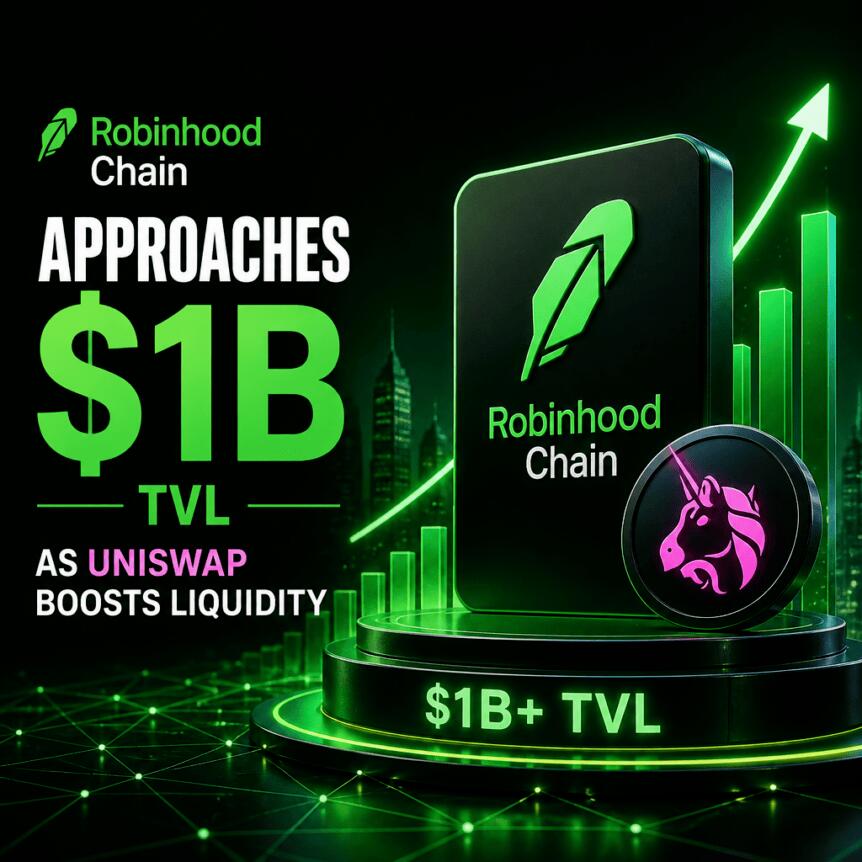
Robinhood’s newly launched blockchain, Robinhood Chain, is scaling its onchain activity with help from Uniswap, according to Standard Chartered—an integration that may reduce one of the biggest early hurdles for any fresh network: assembling sufficient liquidity quickly enough to support real demand.
In a research note cited by the bank’s analysts, Robinhood Chain is reported to have grown to nearly $1 billion in total value locked (TVL). Standard Chartered also says that virtually all of the chain’s liquidity requirements are being met via Uniswap’s existing decentralized exchange infrastructure (Uniswap V2, V3, and V4), potentially allowing Robinhood to focus on expansion rather than building liquidity plumbing from scratch.
Key takeaways
- Standard Chartered reports Robinhood Chain is close to $1 billion in total value locked, calling it the fastest TVL growth among blockchains by that metric.
- According to the note, Robinhood Chain’s liquidity needs are “virtually all” met through Uniswap V2, V3 and V4.
- Protocol fees attributed to Robinhood activity are now the largest driver of UNI token burns, Standard Chartered says.
- The UNI burn rate has reportedly accelerated after a Robinhood-linked fee switch activated on July 27, reaching an annualized pace of about $90 million.
- Robinhood’s broader push into tokenization and prediction markets is being closely watched on Wall Street, even as reported crypto trading volumes have softened.
Why Uniswap liquidity matters for a new chain
New networks typically struggle early with liquidity: without deep trading venues, users have less confidence that they can enter and exit positions efficiently. Standard Chartered’s assessment suggests Robinhood Chain is attempting to sidestep that problem by routing much of its liquidity demand to Uniswap rather than relying on nascent pools.
The bank’s note, attributed to analyst Geoffrey Kendrick, frames the approach as strategically important for Robinhood as it scales. By leaning on battle-tested decentralized finance infrastructure, Robinhood Chain can potentially improve execution quality for users while accelerating growth.
Earlier coverage highlighted that Robinhood Chain launched on July 1 with a focus on bringing real-world assets onchain, and adoption moved quickly after launch. Cointelegraph previously reported the chain reached 194,000 daily active users during its first week, reflecting strong initial engagement that would require reliable access to trading venues and liquidity.
From liquidity to UNI burns: the token-economics spillover
Standard Chartered also connects the integration to measurable changes inside Uniswap’s token economics. The bank says protocol fees generated through Robinhood are now the largest source of UNI token burns.
In the note, the UNI burn rate is described as having roughly doubled since a Robinhood-linked fee switch was activated on July 27. Standard Chartered estimates that this puts UNI burns on an annualized pace of about $90 million.
With UNI priced at roughly $3.50 per token at the time referenced in the report, Standard Chartered calculates that the annualized burn translates to about 25 million UNI tokens—just over 4% of UNI’s circulating supply—being removed each year.
For UNI holders and DeFi traders, the key question isn’t only whether Robinhood Chain is growing, but whether that growth sustains fee generation over time. A rapid early rise in burns can be encouraging, but the durability of activity on a new chain typically depends on its ability to retain users, deepen liquidity, and keep relevant applications running.
Robinhood’s broader crypto strategy: tokenization and prediction markets
Robinhood Chain is part of a larger corporate strategy to expand beyond traditional stock trading. The brokerage is pursuing crypto-related products alongside tokenization and prediction markets—initiatives that have attracted investor attention.
Cointelegraph previously reported that analysts at Bernstein raised their price target for Robinhood (HOOD) stock to $160 per share, citing tokenization and prediction markets as key growth drivers. That Wall Street framing matters because it ties Robinhood’s onchain activity to a wider narrative: using blockchain as distribution infrastructure for additional financial products.
At the same time, Standard Chartered’s liquidity thesis sits alongside mixed signals from Robinhood’s reported crypto business. Cointelegraph notes that Robinhood reported record revenue and earnings in its second quarter, while crypto trading volumes and revenues declined—an environment that can make it harder to interpret which developments are fundamentally strengthening the platform versus which are simply offsetting slowdowns elsewhere.
What to watch next on Robinhood Chain and Uniswap
For market participants, the immediate watchpoints are whether Robinhood Chain can keep liquidity demand flowing through Uniswap as the novelty of launch fades, and whether UNI burns remain elevated beyond the initial “fee switch” period described by Standard Chartered. Investors should also monitor how Robinhood’s tokenization and prediction-market efforts evolve, since the long-term value proposition for the blockchain will likely depend on sustained application usage rather than liquidity routing alone.
HTX’s situation has appeared increasingly precarious as both the European Union Council and the United Kingdom’s Foreign, Commonwealth, & Development Office have chosen to sanction the exchange.
Since then, it’s made some big changes to how it manages users’ reserves.
Its June proof of reserves report was the first that acknowledged that it had moved huge swaths of its reserves to an undisclosed “ThirdParty.”
Read more: HTX misrepresents Huobi Global S.A. after UK sanctions
HTX claims on its website that you can verify these balances by reaching out to the custodian; unfortunately, it doesn’t tell users who that custodian is. As a result, Protos has been unable to verify most of those balances.
Further complicating this, TRM Labs, a blockchain intelligence firm, released a report in which it detailed how HTX has begun churning through its wallets at a prodigious rate.
Ari Redboard, the global head of policy for TRM, described this behavior as an attempt “to stay a step ahead of screening built on static lists.”
Read more: ‘Someone’ is taking advantage of HTX’s reserves
HTX, for its part, previously claimed that this was totally normal cybersecurity behavior.
Since then, Protos was able to track a substantial portion of HTX’s staked ETH (stETH) through Poloniex addresses.
Now, we can add that various other HTX assets have also recently passed into Poloniex.
Read more: Justin Sun’s Poloniex and HTX withdraw huge amounts from AAVE
First, HTX distributes a tool that used to enable people to gain greater insight into its reserves, even including which addresses the reserves were held in.
We can use these past reports to determine where certain assets were claimed to be at a certain time and can use the blockchain transactions to follow some portion of the reserves as they move.
Consider 0x18709e89bd403f470088abdacebe86cc60dda12e, which was an address that HTX used to hold many of the Ethereum-based DeFi positions it maintained, for some reason.
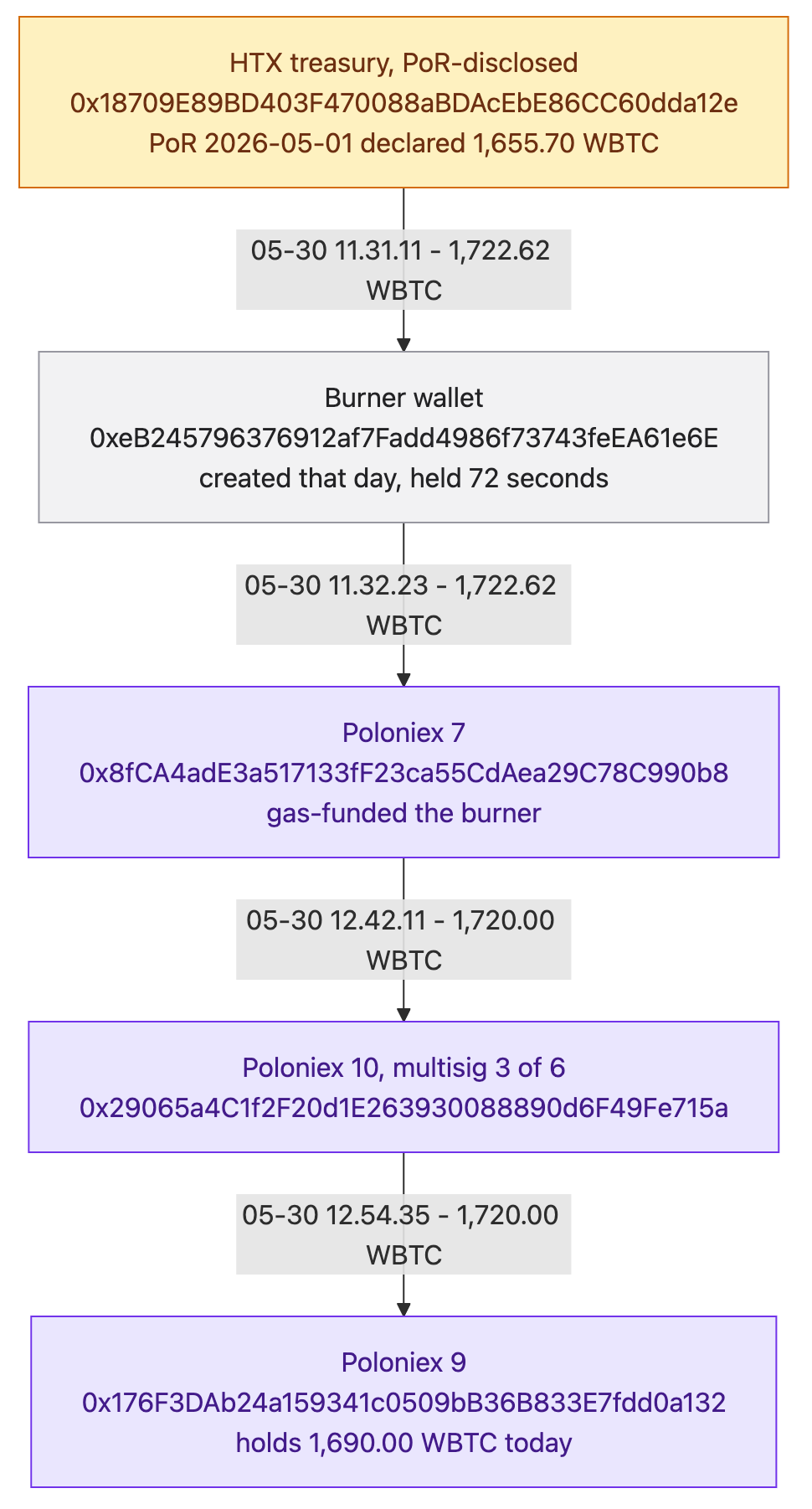
On May 30, immediately before we get the transition to ThirdParty, we can watch the Sun-advised wrapped BTC (WBTC) move from this HTX address to 0xeB245796376912af7Fadd4986f73743feEA61e6E.
These funds were then transferred to 0x8fCA4adE3a517133fF23ca55CdAea29C78C990b8, an address that Etherscan labels as Poloniex 7.
These funds were then quickly sent to 0x29065a4C1f2F20d1E263930088890d6F49Fe715a, an address that Etherscan labels as Poloniex 10.
Finally, this WBTC was sent to 0x176F3DAb24a159341c0509bB36B833E7fdd0a132, an address that Etherscan labels as Poloniex 9.
This WBTC which came from HTX, is still stored in this Poloniex address.
The HTX to Poloniex pattern repeats
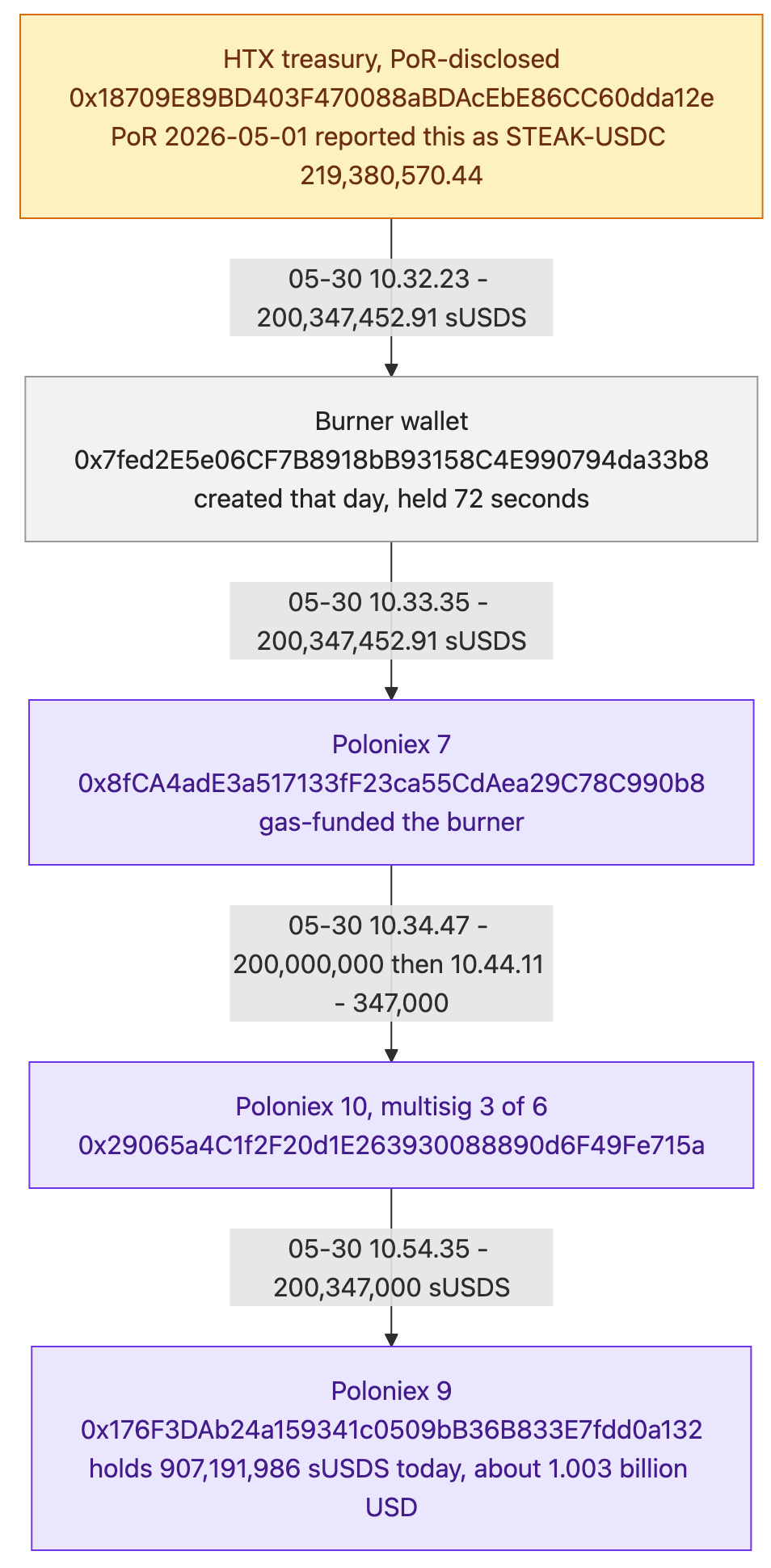
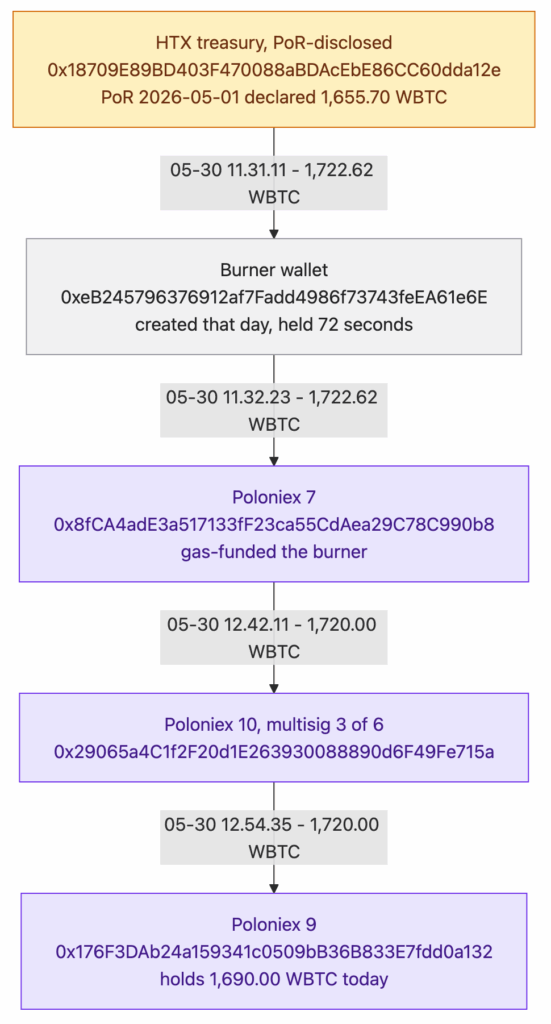
The May PoR for HTX had a problem. It claimed that it had a bunch of STEAK-USDC, but it was wrong; there was no STEAK-USDC in that address on that date.
However, there was a matching amount of Sky Savings USDS (sUSDS) in that address, suggesting that while HTX failed to accurately label its own reserves — troubling on its face — it did have another position that represented that value.
We start with approximately $200 million worth of sUSDS moving to 0x7fed2E5e06CF7B8918bB93158C4E990794da33b8.
These funds are then sent onward to Poloniex 7.
These were then forwarded in three transactions to Poloniex 10.
Finally, these funds were forwarded to Poloniex 9.
Similar patterns can also be observed for various Spark positions, some of which may have been since redeemed.
These related-party transactions, involving many hundreds of millions of dollars worth of value, raise serious questions about the internal controls and management of both of these Sun-owned exchanges.
They furthermore raise questions about Poloniex’s role in interacting with this repeatedly sanctioned entity.
Protos reached out to HTX with questions about these transfers, but it didn’t respond before publication.
Got a tip? Send us an email securely via Protos Leaks. For more informed news and investigations, follow us on X, Bluesky, and Google News, or subscribe to our YouTube channel.
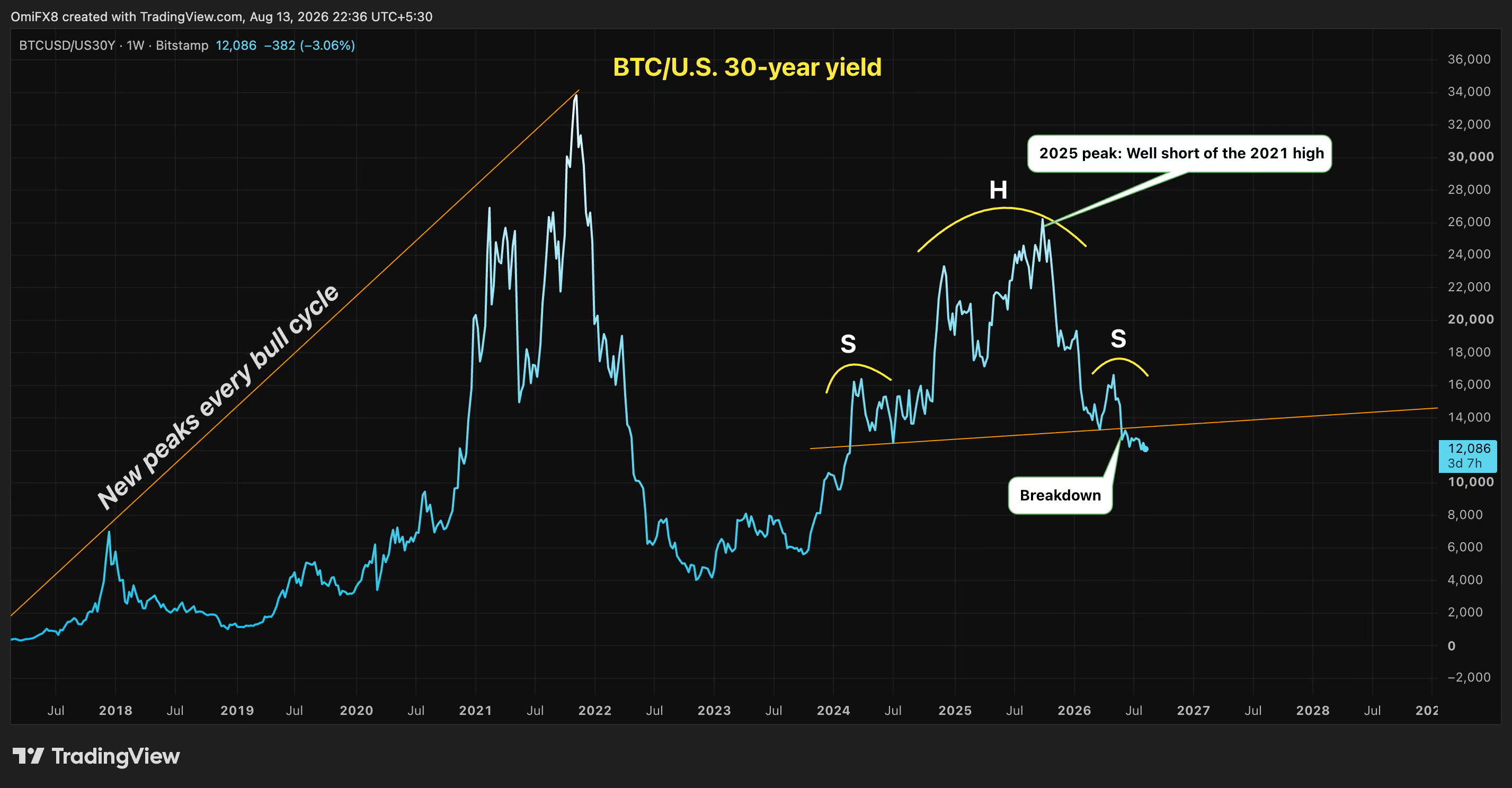
The 30-year Treasury yield cleared 5% this year and is sitting at its highest level since 2007. That means every dollar sitting in bitcoin or any non-yielding asset is a dollar not earning that 5%. Several analysts have pointed to these elevated bond yields as a direct drag on bitcoin’s upside recently.
The elevated cost of capital already hurt bitcoin during the 2025 bull cycle.
The evidence sits in the divergence between BTC’s dollar-denominated spot price and its price adjusted for the cost of long-duration capital, or the 30-year yield. Bitcoin’s spot price rose to $126,000 in 2025, well above the previous cycle’s high of nearly $70,000. But priced against the 30-year yield, it did something it had never done before: it fell well short of its 2021 high, breaking a pattern of setting a new peak, on this measure, every cycle since inception.

Additionally, that same ratio has now completed a head-and-shoulders breakdown, one of the more potent bearish patterns in technical analysis.
The pattern is defined by three peaks separated by pullbacks, with the middle peak the highest, loosely resembling the outline of a “head flanked by two shoulders.” A move below the line connecting the pullbacks between those peaks, the neckline, is what confirms the pattern. The BTC/30-year yield ratio has done exactly that.
Standard Chartered analyst Geoffrey Kendrick says his $100 UNI target for 2030 now looks too low. Six weeks of Robinhood Chain fees changed his math.
BeInCrypto checked his numbers against on-chain data. The core claim holds up. One supporting figure does not.
What Changed in 6 Weeks for the $100 UNI Target
In a June note, Standard Chartered projected a UNI price target of $100, implying a 37x upside fueled by expansion in decentralized finance (DeFi) assets. Analysts were split back then over the Uniswap fee switch debate and whether burns would ever matter.
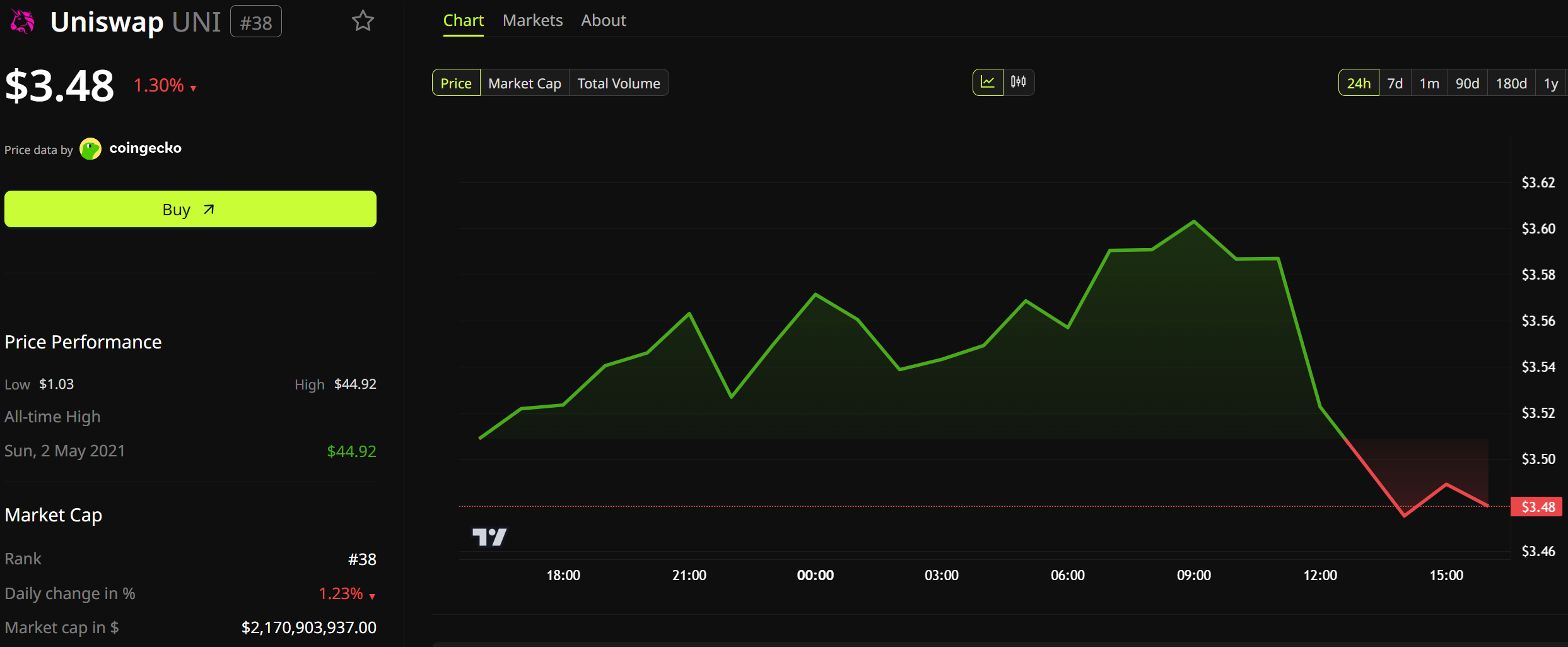
Large wallets have moved since. UNI whale accumulation hit a five-year high this month. UNI was trading near $3.48 on Thursday, down 1.3% in the last 24 hours.

Robinhood Chain went live on July 2. Kendrick wrote to clients exactly 42 days later. Uniswap now handles 76.5% of all trading on the chain, according to DefiLlama data. Its pools moved $409 million in a single day.
That trading throws off fees. Uniswap collected $1.81 million of the chain’s $2.28 million in daily fees, or 78.8%.

Those fees matter because of a change made in December 2025. Uniswap began using part of its revenue to buy and burn UNI, shrinking supply for good.
A second switch covering Robinhood Chain went live on July 27. Burns have doubled since, Kendrick wrote, running at $90 million a year.
That arithmetic holds up. At $3.48 per token, $90 million buys roughly 25.7 million UNI. Circulating supply is 624 million. So the burn rate is 4.1% per year.
The scale shows over time. UNI launched with 1 billion tokens, and about 109 million have been destroyed.
Kendrick called that pace unsustainable. Even at his end-2026 target of $6.50, the burn would still run near 2.2%.
“I fear my 2030 UNI target of USD100 is too low!” Geoffrey Kendrick, Global Head of Digital Assets Research at Standard Chartered, wrote in the latest note.
Follow us on X to get the latest news as it happens
One supporting claim does not check out. Kendrick put Robinhood Chain’s total value locked just under $1 billion.
DefiLlama counts $506.97 million working inside the chain’s apps. A wider measure of everything bridged onto the chain reaches $1.55 billion. His figure sits between the two.
The gap matters less than it looks. Fees come from trading, not from parked money.
Uniswap holds just 16.3% of the chain’s locked value, with lending vaults holding most of the rest. Yet it takes nearly four-fifths of the fees.

The Same 6 Weeks Brought a Fight Over That Volume
Uniswap launched Pools.trade on the same chain on August 5. It lets anyone create a token and send it straight into Uniswap pools.
Creators pick a four-hour bidding window or an instant launch. Uniswap charges no launchpad fee beyond a 0.25% cut for liquidity providers, while rivals typically take close to 1%.
That undercut drew a response. 0xDeployer, a pseudonymous developer, is building a competing launchpad with SushiSwap.
He accused Uniswap of trying to control the whole stack and is issuing a separate token to fund the effort.
However, the challenger starts far behind. SushiSwap handles 0.45% of Robinhood Chain trading, compared to Uniswap’s 76.5%.
Another developer, 0xbeans, disputed the technical complaint. Uniswap’s v4 code is under a license that blocks commercial copies until June 15, 2027, after which it opens fully.
Hooks, the add-on contracts that customize pools, were never restricted.
The pattern is old. SushiSwap itself launched in 2020 by copying Uniswap’s code and paying traders to move their liquidity over.
Early chain volume leans heavily toward meme coins on Robinhood, where launch venues compete hardest.
So six weeks delivered both the fee flow and a challenger for it. Kendrick’s burn math rests on volume Uniswap does not own.
It rents that volume from traders who can leave. Whether $100 proves too low depends on how long they stay.
The post Standard Chartered Rethinks Uniswap Price Target. “$100 is Too Low” appeared first on BeInCrypto.
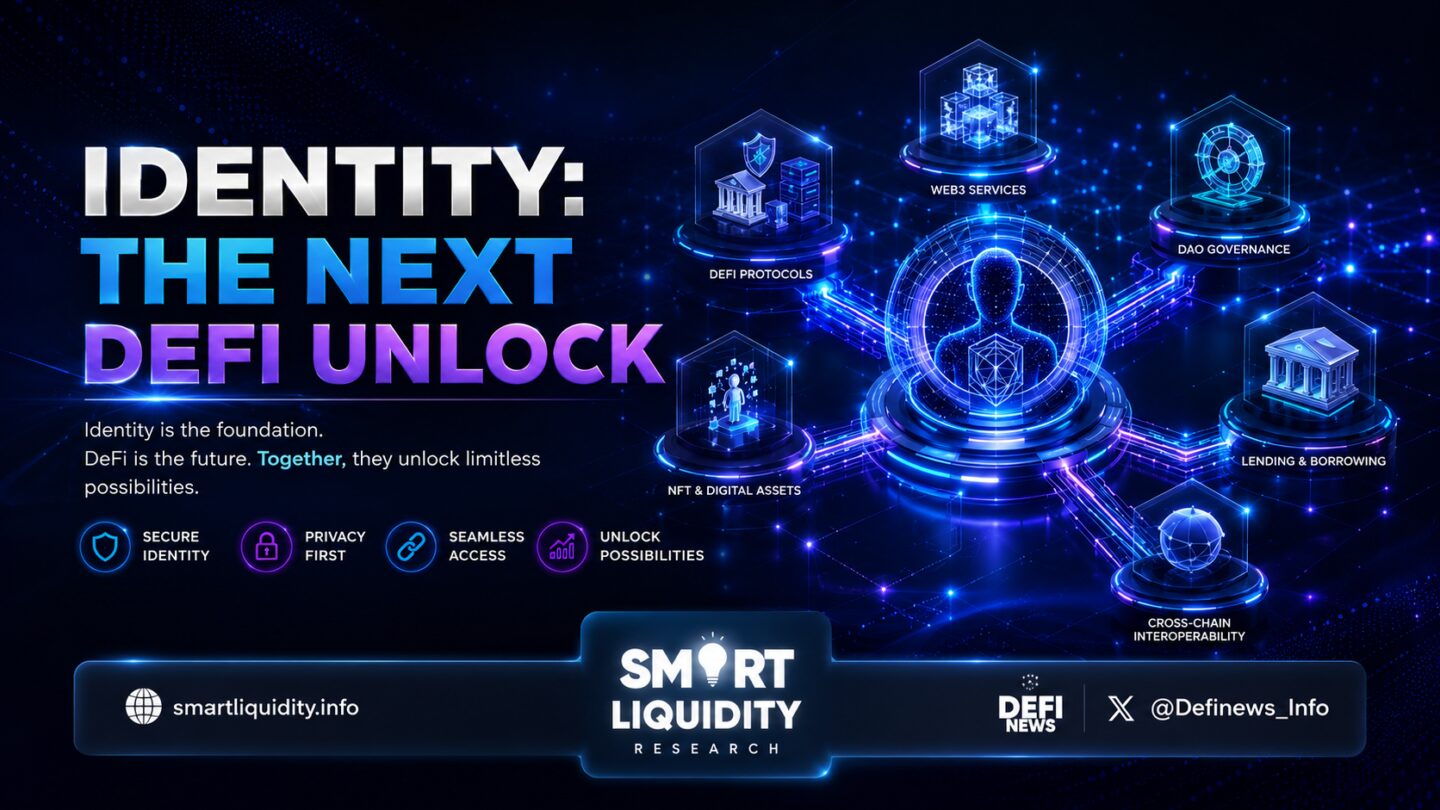
Decentralized finance has transformed how people trade, lend, borrow, and earn without relying on traditional financial intermediaries. Yet one major limitation remains: most DeFi applications know what a wallet owns, but not who or what is behind it. That could change—and identity may become the key to unlocking DeFi’s next major market.
Today, permissionless access is one of DeFi’s greatest strengths. However, it also creates challenges for credit, reputation, compliance, and institutional adoption. Without a reliable way to establish trust, many financial products remain overcollateralized or limited to users willing to operate entirely anonymously.
On-chain identity could introduce a new layer of financial context. Instead of simply evaluating a wallet based on its current assets, protocols could consider verifiable factors such as transaction history, repayment behavior, credentials, business activity, or reputation. Importantly, this does not necessarily mean exposing personal information publicly. Zero-knowledge proofs and privacy-preserving identity systems could allow users to prove specific facts without revealing unnecessary details.
This could create entirely new DeFi markets.
For example, undercollateralized lending could become more practical if borrowers can demonstrate a trustworthy financial history. Businesses could access decentralized credit based on verifiable performance rather than simply depositing large amounts of collateral. Insurance protocols could price risk more intelligently, while institutions could participate in on-chain markets with stronger compliance and identity frameworks.
The opportunity extends beyond lending. Tokenized real-world assets, payroll, decentralized credit scoring, private markets, and cross-border financial services could all benefit from portable digital identity.
The challenge is finding the right balance. DeFi was built around user control, openness, and censorship resistance. An identity layer that becomes invasive or centralized could undermine those principles.
The winning model may therefore be identity without unnecessary exposure: users control their credentials, protocols verify what matters, and sensitive information remains private.
If DeFi can combine permissionless infrastructure with privacy-preserving reputation and identity, the next wave may move beyond simply proving what you own toward proving why you can be trusted. That could dramatically expand the addressable market for decentralized finance.
REQUEST AN ARTICLE
Mad Money host Jim Cramer said the AI data center trade is reclaiming market leadership. He named six stocks leading the rally, and every one of them closed higher on Wednesday.
The group had trailed financials, healthcare, and retail for weeks. Cramer said a run of developments in recent days has restored his confidence in AI infrastructure names.

Why the AI Data Center Trade Stalled
Cramer said the once-hot AI infrastructure names began cooling in late June. The slide then ran through most of July.
“This group has languished while the financials, the healthcares and the retailers rocked,” he said.
Each of the six rallied sharply before the gains reversed, for some in early May and for others in June. All then trended lower through late July. CoreWeave (CRWV) dropped 56% across that span.
Super Micro Computer (SMCI) fell 53%, and Nebius (NBIS) lost 48%. Lumentum (LITE) shed 43%, and Intel (INTC) fell 42%. The Nasdaq 100 declined by just 11%.
The turn arrived with the forced unwind of Situational Awareness. Wednesday’s session is further proof of the regained strength.
Nebius led with a 34.14% gain. CoreWeave added 19.28% and Supermicro 19.02%. Lumentum rose 13.63%, Intel 3.32%, and Nvidia (NVDA) 3.03%.
“I cannot stress enough how important today’s session was,” Cramer added.
Follow us on X to get the latest news as it happens

What Restored Cramer’s Confidence
Cramer noted that prices still sit below their peaks but now “seem primed to go higher.” He pointed to a cluster of recent events that suggested the pressure had passed.
- Intel drew enough investor demand to lift its stock offering to $20 billion from $15 billion.
- He said Supermicro and Lumentum reported better-than-expected results, followed by Nebius. Worth noting that Supermicro missed revenue estimates.
- CoreWeave’s results, he said, offered evidence that older Nvidia GPUs hold value longer than skeptics expected
- Finally, Wednesday’s inflation print eased the rate pressure weighing on growth stocks.
How the 6 AI Data Center Stocks Have Performed in 2026
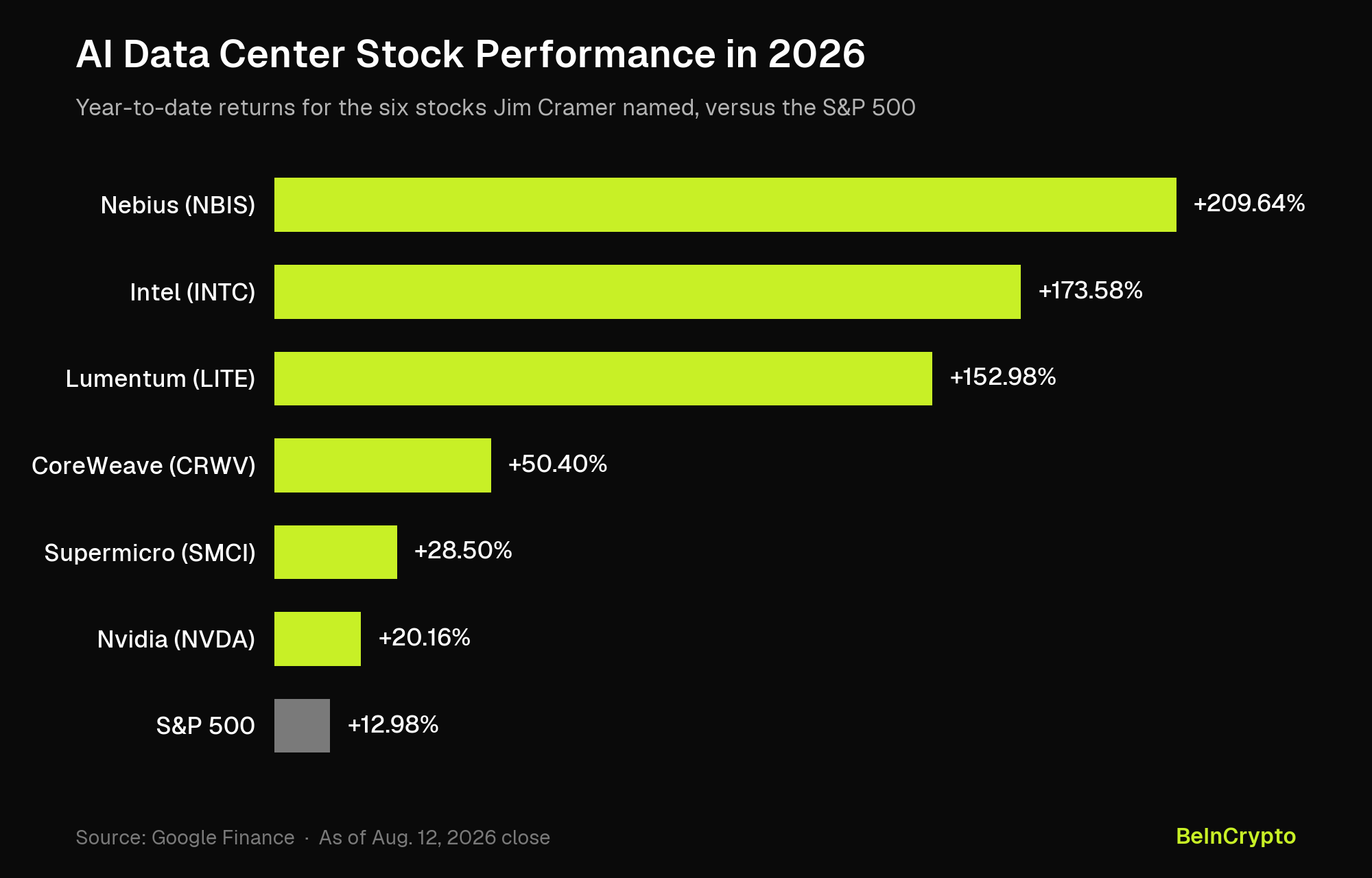
Notably, all six are beating the S&P 500 this year. The index has gained 12.98% year-to-date, according to Google Finance data.
Nebius leads the group at 209.64%, followed by Intel at 173.58% and Lumentum at 152.98%. CoreWeave is up 50.4%, Supermicro is up 28.5%, and Nvidia is up 20.16%.
“This morning, the rockets went off and the fabled six fighting bulls, Supermicro, Nvidia, Intel, Nebius, Lumentum, and CoreWeave, tore out of their pens and proceeded to trample the non-believers who didn’t realize that you’re taking your life in your hands when you bet against these companies,” Cramer said.
The question now is how long the run lasts and whether the six can reclaim their highs.
Subscribe to our YouTube channel to watch leaders and journalists provide expert insights
The post Mad Money’s Jim Cramer Says These 6 AI Stocks are Primed to Surge appeared first on BeInCrypto.

Bitcoin mining stocks have been on a run in 2026, with Riot Platforms, Hut 8, Bitfarms, and Core Scientific posting some of the group’s biggest year-to-date gains, according to a CryptoQuant chart analyst Maartunn shared on X covering trading from January through July.
The move has less to do with mining Bitcoin itself and more to do with miners repositioning as power and data center suppliers for AI companies, reflecting a change in how the market is pricing these stocks.
The Chart Behind the Rally
Maartunn’s chart put Riot’s year-to-date gain at 83% through late July, with Hut 8 up 72%, Bitfarms up 50%, and Core Scientific up 31% over the same stretch.
“It’s a race for power, grid access, and AI-ready infrastructure,” Maartunn wrote, arguing the sector has moved past pure hashrate competition.
That framing lines up with what’s happened since. On August 11, Bloomberg reported that Anthropic agreed to pay Riot $9.1 billion over 20 years for 191 megawatts of computing capacity at its Rockdale, Texas site, enough to power roughly 143,000 homes.
Riot’s shares jumped 24% in after-hours trading on the news, even after closing the regular session down more than 5% and posting a $237 million quarterly loss.
IREN, another miner chasing the same trend, climbed close to 10% this week after landing a $3.4 billion cloud contract with Nvidia, part of its own shift from mining into AI cloud services. Maartunn’s numbers only run through late July, though, while the market data available this week runs through August 12, and the two datasets don’t line up perfectly.
By that more recent close, Riot’s year-to-date gain had settled near 60%, still strong but down from the 83% cited in the July chart, with shares trading around $20. Hut 8 pushed further to a roughly 98% gain, near $91 a share. Core Scientific extended its climb too, up 43% year-to-date and trading near $21.
Others showed more modest upticks, including CleanSpark, which, at the time of writing, was around $12, up 20% this year, and IREN, whose shares were trading near $44, a 16% jump since the start of the year. MARA, the largest publicly traded miner, was about $10, with a much smaller 7% YTD gain.
But not everyone in the sector is celebrating, as data from Yahoo Finance shows Bitdeer, Argo Blockchain, and Canaan are down about 20%, 24%, and 71% in the same period when their counterparts printed green.
Where the Money for This Is Coming From
MARA’s results show why miners are looking elsewhere. In its August 6 shareholder letter, the company reported Q2 revenue of $174.9 million, down 27% year over year, and a $611.3 million net loss. It also sold 2,213 BTC during the quarter while continuing to invest in new infrastructure.
But that does not mean mining is disappearing, with analyst Shanaka Anslem Perera noting on July 6 that the network absorbed a large miner exit after public firms, including MARA, CleanSpark, Riot, Cango, Core Scientific, and Bitdeer, sold more than 32,000 BTC in the first quarter of 2026 and put that money into AI contracts worth an estimated $70 billion industry-wide.
The pivot briefly knocked Bitcoin’s network hash rate down about 4%, the first drop in six years, before difficulty adjustments restored profitability and the network kept producing blocks on schedule.
The post Bitcoin Mining Stocks Rise as Industry Chases AI Infrastructure appeared first on CryptoPotato.
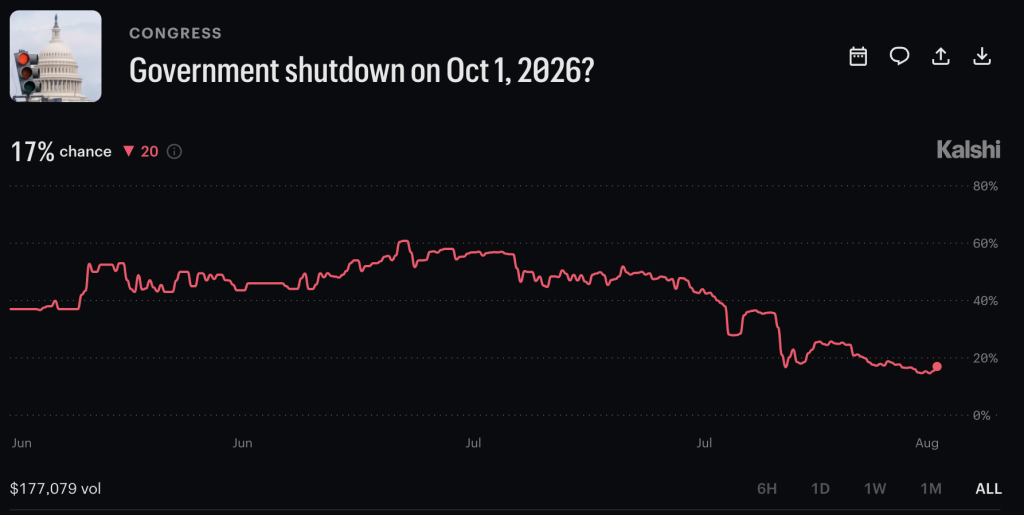
Kalshi’s contract on US government shutdown odds in 2026 priced YES at roughly 17% in early August; by October 1, 2026, it had dropped steeply from about 64% a month earlier.
That repricing arrived as Senate negotiators closed in on a stopgap funding deal. Since then, the Senate has gone further, passing its stopgap funding bill 90-6 on August 8 and extending its proposed funding runway through December 11.
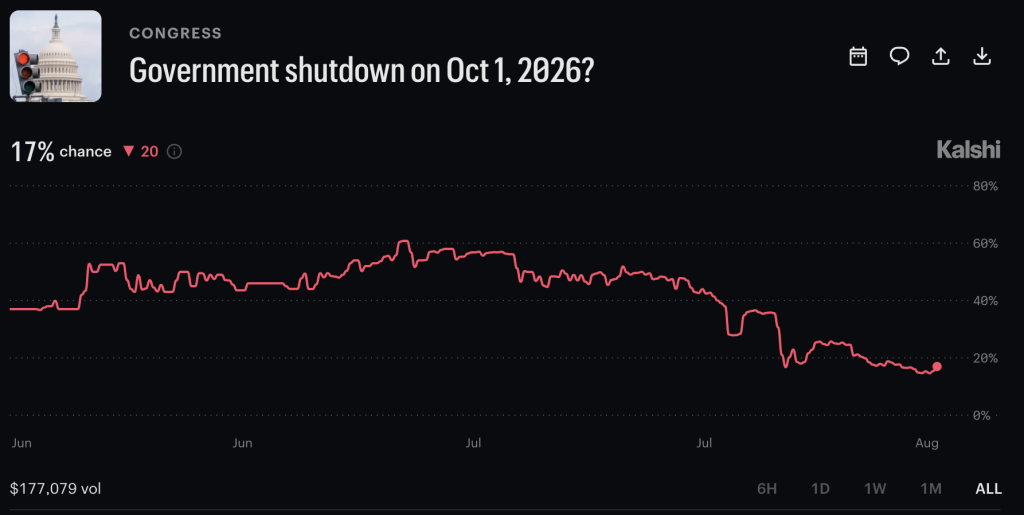
For traders running fiscal risk into crypto positioning, the question isn’t whether the earlier 25% reading was precisely right at any given hour. It’s whether the direction of travel, sharply lower odds of an imminent lapse, actually removes the macro overhang that Bitcoin desks have been pricing into risk-off scenarios, or simply pushes the same fight to a worse date on the calendar.
Discover: Everyone’s Got a Take. Join Kalshi and Get a Free $25 to Actually Trade Yours
US Government Shutdown Odds 2026: What Moved The Market
The catalyst was legislative, not speculative. Senate appropriators initially worked toward a continuing resolution that would fund the government beyond the September 30 deadline, while negotiating limits on a pending Office of Management and Budget rule that would let political appointees block already-approved spending.
Those negotiations have now produced legislation. The Senate approved a continuing resolution 90-6 that would fund federal agencies through December 11 at largely current levels while temporarily blocking the administration from finalizing the proposed OMB grants rule.

The House has already passed its own stopgap measure, but that version runs only through December 4. Because the chambers have approved different bills, the Senate legislation still needs House approval before it can reach President Trump.
Discover: Your Market Calls Are Worth Something. Start With Free $25 on Kalshi
Why The Price Keeps Disagreeing With Itself
The earlier Kalshi pricing reflected genuine uncertainty about how much weight to put on backroom progress versus confirmed legislative action. No passed Senate continuing resolution existed when the contract initially fell toward 17%.
That distinction matters more than the headline percentage. The Senate has now supplied a much stronger signal than negotiations alone: 90 senators voted for a stopgap extending funding beyond the midterms.
But the October shutdown is not formally off the table yet. The House and Senate have passed different versions, and Congress must still agree on a single measure before the September 30 funding deadline.
Fiscal risk of this kind doesn’t move Bitcoin in a straight line. There’s no direct evidence that the shutdown contract alone drove BTC price action in early August – the more accurate framing is that shutdown odds function as one input crypto desks monitor alongside Treasury bill spreads, dollar liquidity, and risk appetite more broadly, a pattern already visible in how traders position around other macro catalysts like CPI prints.
Don’t Miss Out on Our $1,000 USDT Airdrop on ByBit
The post Shutdown Odds Sink, but December Still Hangs Over Bitcoin appeared first on Cryptonews.

The entity behind the world’s largest stablecoin has announced that KPMG U.S. issued an unqualified audit opinion on the financial statements of Tether International, S.A. de C.V. for the year ended December 31, 2025. This is the first full financial statement audit in the history of the company behind USDT.
An unqualified opinion carries no reservations, exceptions, or caveats, and is the strongest conclusion an independent auditor can reach. This means KPMG examined the balance sheet, income statement, statement of changes in equity, and cash flow statement under US generally accepted accounting principles, with each area subject to independent substantive testing. The audited statements report reserves exceeding liabilities by $6.81 billion.
KPMG physically counted and inspected every individual gold bar Tether holds, verifying its existence and identifying information. Tether said the procedure went beyond the reports supplied by custodians and counterparties.
The Attestations And The Audit
Tether has provided regular independent attestations of its backing assets for years, but an attestation just checks reserves at a point in time, while the KPMG engagement covered the full financial statements.
Back in 2022, BDO Italia replaced MHA Cayman on the reserves reports, a move Tether called “the next step in the company’s path toward a complete audit.” BDO still prepares the quarterly reports, among them the Q1 2026 attestation showing a record $8.23 billion excess reserve buffer.
Tether had also completed a SOC 2 Type 1 examination covering IT and security controls in 2024, but that examination stopped at the controls and never reached the financial statements.
Moreover, those quarterly figures sit outside KPMG’s opinion. Tether’s most recent attestation covered the second quarter of 2026 and reported $1.5 billion in net operating profit, roughly $184.6 billion of USDT issued, and more than 146 tons of gold.
Tether’s Long History With Regulators
The Commodity Futures Trading Commission fined Tether $41 million in October 2021, finding the company held sufficient fiat reserves to back USDT in circulation for only 27.6% of the days in a 26-month sample from 2016 through 2018.
The order also found Tether had told customers and the market that every token was backed by an equivalent amount of corresponding fiat currency, while its reserves included unsecured receivables and non-fiat assets.
“For years, some detractors said an audit of Tether could not be completed. They said the Company refused to subject itself to the most rigorous scrutiny. We have once again proven them wrong. Completing our financial statement audit sets a new standard for the industry and reflects the leadership we’ve brought to this market from the start,” said Paolo Ardoino, Chief Executive Officer of Tether.
Tether announced signing with a Big Four auditor earlier this year and described the completed engagement as the largest inaugural financial audit in history.
The post Tether Clears First Full Audit as KPMG Issues Unqualified Opinion on 2025 Statements appeared first on CryptoPotato.

Who Might Replace Karoline Leavitt as Press Secretary?

Zeynep Sönmez Saves Match Point to Complete Comeback Against Kasatkina

The Painful Truth of Exactly How ICE’s New Shock Gloves Work


-

 Fashion6 days ago
Weekend Open Thread: Mattifying Sunscreen
-

 Fashion6 days ago
Frugal Friday’s Workwear Report: Cap-Sleeve Pointelle Crewneck Sweater
-

 News Videos5 days ago
Can Astrology Help Find Gold and Silver Trends? A Financial Astrology Guide
-

 Tech6 days ago
Rinn Pharma & Biopharma to join NordicPharmaTrain network
-

 Business5 days ago
How to Start a Cleaning Business: A Step-by-Step Guide
-

 Business4 days ago
Datadog: Best Of Breed For Multiple Reasons
-

 Business5 days ago
BDC Weekly Review: Private BDC Q2 Numbers Are Strong
-
 NewsBeat2 days ago
Communication cards help banking customers access services or report scams
-

 Tech7 days ago
Price Hikes May Be Coming for PC Motherboards Next
-

 Business7 days ago
Brightwater secures funding for WA-first dementia projects
-
 Business3 days ago
Oil Price Today (August 11): Crude oil rises to $88 after Trump’s compensation demand dents Hormuz opening. Here’s why
-

 Fashion6 days ago
Weekly News Update, 8.6.26 – Corporette.com
-

 Business7 days ago
Aussie shares lose steam to close record-breaking week
-
 Entertainment7 days ago
Brand New Day’ Characters, Ranked
-

 Fashion7 days ago
The Best Stores Like Ann Taylor
-

 Fashion6 days ago
Irina Shayk Wows in REVOLVE Los Angeles’ Summer Styles
-

 Entertainment7 days ago
Coastal House Media Can Disney Redeem Live Action Dragon Ball?
-

 Fashion6 days ago
Burberry Fall 2026 Takes On Commuter Style
-

 Politics5 days ago
Be quiet, Miriam! – spiked
-

 Fashion4 days ago
Amazon Sundays: Closet Care Before Fall
You must be logged in to post a comment Login