

Crypto World
Trump-Linked WLFI Platform Sues Justin Sun for Defamation

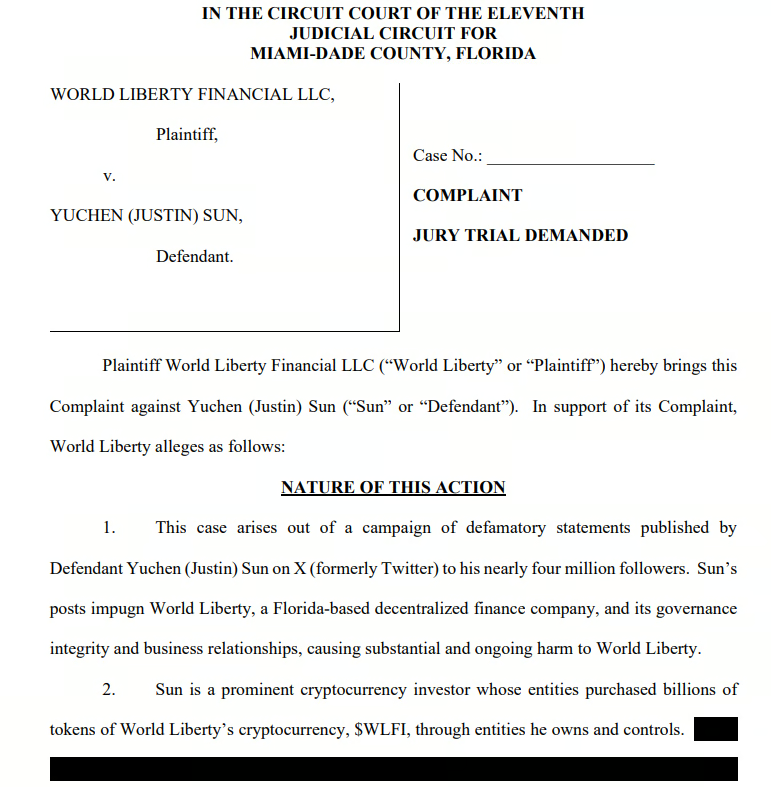
World Liberty Financial filed a defamation lawsuit against Tron founder Justin Sun in Florida, escalating a legal fight between the Trump family-linked crypto platform and one of its largest investors.
The lawsuit, filed Monday in the Eleventh Judicial Circuit Court for Miami-Dade County, accused Sun of making false public statements about World Liberty and violating WLFI token-sale terms through alleged prohibited transfers, short-selling and straw purchases.
The lawsuit also accused Sun of spreading defamatory statements surrounding the crypto platform, demanding a court-ordered retraction and compensation from the founder. Sun denied the allegations in a Monday post on X, calling the lawsuit a “meritless PR stunt” and saying he looked forward to defeating the case in court.
The lawsuit comes less than two weeks after Sun sued World Liberty over the freezing of his WLFI tokens, a dispute that has intensified scrutiny of the project’s token controls and governance structure.
The escalating legal battle follows a period of growing backlash towards the crypto platform, which came under scrutiny for a proposal seeking to add a further two-year lock-up period for early investors holding the WLFI token, Cointelegraph reported on April 16.
Sun called the proposal “one of the most absurd governance scams I have ever seen.”

WLFI court filing against Justin Sun. Source: World Liberty Financial / Businesswire
US President Donald Trump and his sons, Donald Trump Jr. and Eric Trump, are listed as the co-founders of the platform, according to World Liberty’s white paper.
Related: Justin Sun presses WLFI to identify wallets behind freeze powers
Sun was fully aware of WLFI’s token freezing rights, lawsuit claims
Sun’s WLFI token address was blacklisted in September 2025 after blockchain data platforms flagged it for a roughly $9 million transfer. Sun said his presale tokens were unreasonably frozen and urged the team to unlock his investment.
However, the lawsuit claims that Sun was “fully aware of World Liberty’s right to freeze user tokens to protect its token holders and its community” and that he agreed to it in the project’s Terms of Sale.
“Rather than acting in good faith, Justin Sun chose to defame World Liberty — repeatedly, publicly, and to millions of followers,” Tom Clare, attorney for World Liberty Financial, claimed, adding that the lawsuit was a “last resort” measure seeking to protect its tokenholders and employees.
The lawsuit claims that Sun previously agreed to WLFI’s “freezing authority” before publicly calling it a hidden “trap door” in a calculated effort to “harm World Liberty while potentially benefiting his own financial positions.”
The lawsuit adds to WLFI’s prior governance concerns, after a March vote showed that 76% of voting power came from 10 wallets. Sun called that an alarming sign of concentrated influence. WLFI clapped back and accused Sun of spreading baseless allegations to cover up his own misconduct and threatened legal action.

WLFI/USD, all-time chart. Source: CoinMarketCap
The WLFI token rose 5% in the 24 hours leading up to 1:43 p.m. UTC on Monday, but is down over 80% since launch, according to CoinMarketCap data.
Magazine: Quitting Trump’s top crypto job wasn’t easy: Bo Hines

The US dollar is holding on to its recently gained ground following a series of strong macroeconomic releases and a rise in US Treasury yields. Additional support for the greenback comes from resilient inflation readings, expectations that the Federal Reserve will maintain a restrictive policy stance, and cautious investor sentiment ahead of the release of the preliminary ADP employment report. At the same time, market participants continue to monitor oil price dynamics and other economic indicators that could alter perceptions of the health of the US economy.
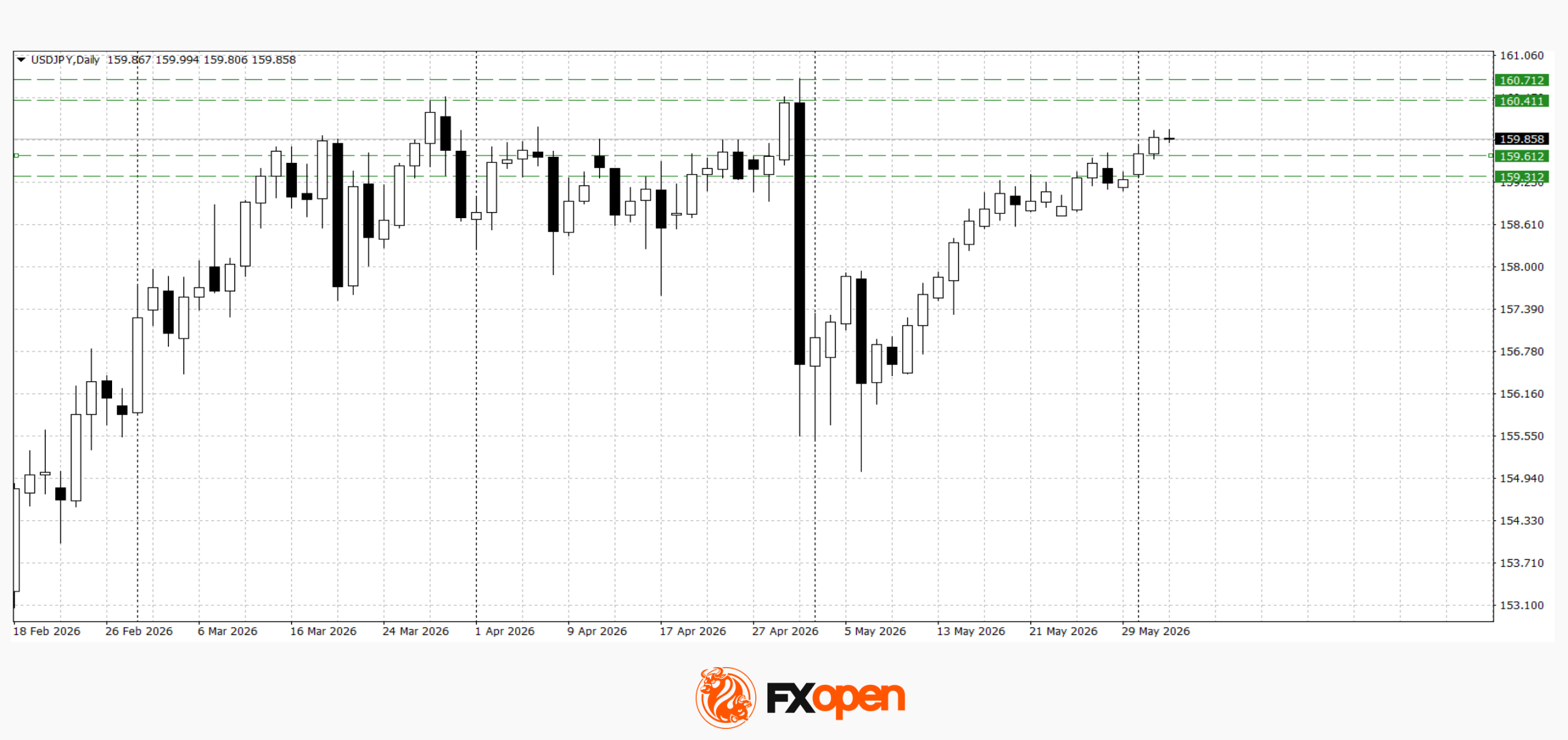
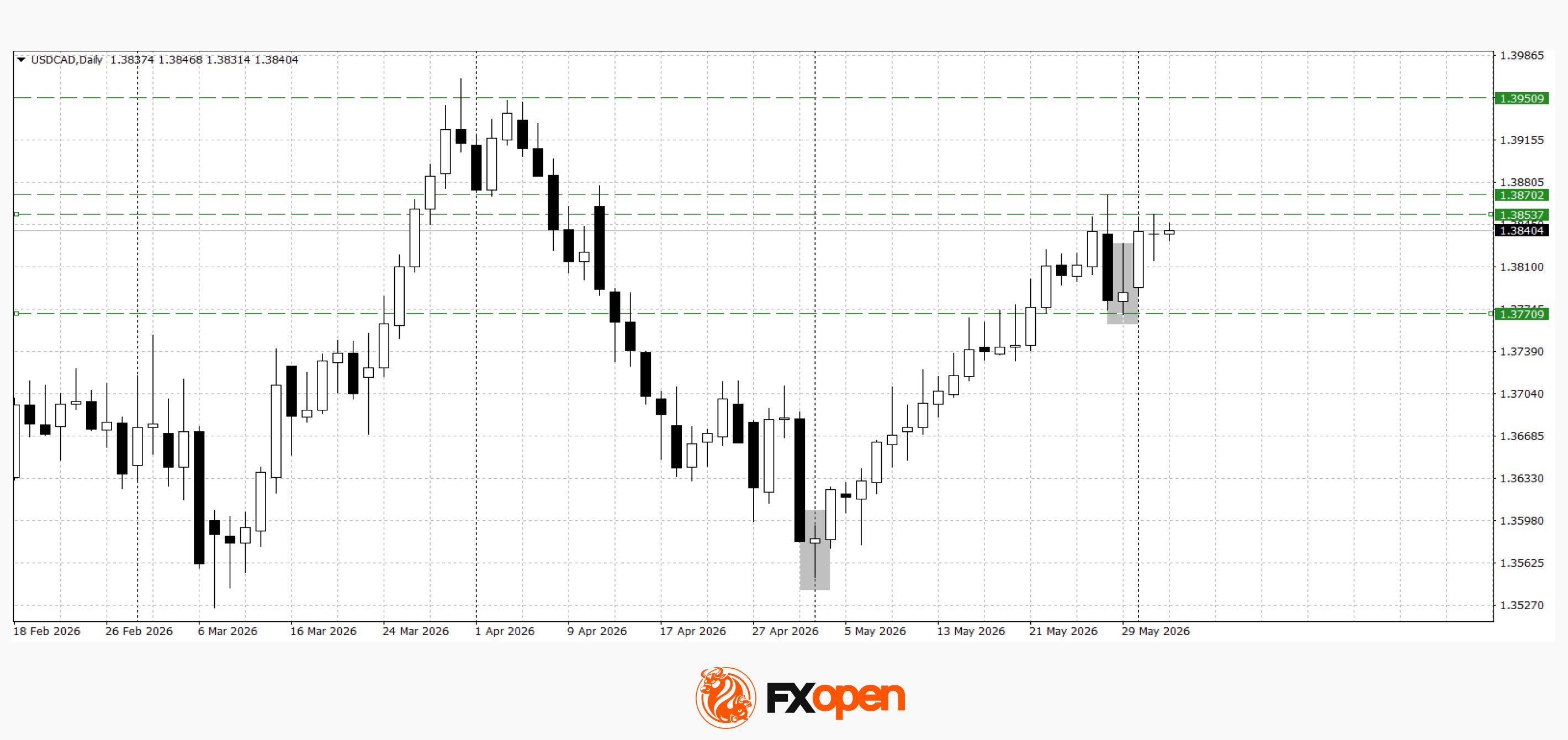
Despite continued demand for the dollar, the next directional move remains uncertain. Both USD/JPY and USD/CAD have reached important technical resistance levels, where either profit-taking and a local correction may emerge, or a fresh bullish impulse could develop if US labour market data come in stronger than expected.
USD/JPY
USD/JPY continues its upward move and has approached a strategic resistance zone near the highs of recent months. Following the recovery from April lows, buyers have almost fully reversed the previous decline; however, price has now entered an area where selling pressure has previously intensified.
Technical analysis of USD/JPY suggests the possibility of a test of the nearest resistance levels at 160.40–160.70. Should the pair establish itself below the 159.30–159.60 range, a broader downward correction may begin.
Key events for USD/JPY:
- today at 11:30 (GMT+3): speech by Bank of Japan Governor Kazuo Ueda;
- today at 15:15 (GMT+3): US ADP Non-Farm Employment Change;
- today at 16:00 (GMT+3): speech by Federal Reserve Vice Chair for Supervision Michael S. Barr.
USD/CAD
USD/CAD has recovered following a corrective decline towards 1.3770. Technical analysis of USD/CAD points to the possibility of a renewed test of the 1.3850–1.3870 area, as a series of bullish candlestick formations has developed on the daily timeframe. The bullish scenario would come into question if the pair were to establish itself decisively below 1.3770.
Key events for USD/CAD:
- today at 15:30 (GMT+3): Canadian labour productivity data;
- today at 17:00 (GMT+3): US ISM Services Purchasing Managers’ Index (PMI);
- today at 17:30 (GMT+3): US crude oil inventories.
Key takeaways
The dollar retains an advantage ahead of the release of preliminary US employment data; however, both USD/JPY and USD/CAD are already trading close to important technical resistance levels. The next directional move will depend on whether the incoming data can confirm the resilience of the US economy. Strong figures could provide the basis for a continuation of dollar strength and a test of fresh highs, while weaker-than-expected results may trigger a correction following the recent appreciation of the US currency.
Trade over 50 forex markets 24 hours a day with FXOpen. Take advantage of low commissions, deep liquidity, and spreads from 0.0 pips (additional fees may apply). Open your FXOpen account now or learn more about trading forex with FXOpen.
This article represents the opinion of the Companies operating under the FXOpen brand only. It is not to be construed as an offer, solicitation, or recommendation with respect to products and services provided by the Companies operating under the FXOpen brand, nor is it to be considered financial advice.

Key Takeaways
- British parliamentary report identifies Palantir dependency as an “unacceptable point of weakness” for national security
- Lawmakers highlight the £330 million ($444 million) NHS data platform agreement as creating dangerous vendor dependency
- Report references Peter Thiel’s political connections and Palantir’s defense sector involvement as incompatible with British principles
- Parliamentary committee recommends activating the 2027 contract exit provision and pursuing domestic alternatives
- Palantir’s British leadership dismissed cancellation calls as “frankly irresponsible”
British lawmakers have issued a sharp rebuke of Palantir’s expanding presence in UK government operations, expressing alarm that reliance on the American data analytics company creates vulnerabilities around sensitive public information.
Palantir Technologies Inc., PLTR
On Wednesday, the Commons Science, Innovation and Technology Committee released a comprehensive 70-page assessment that highlighted Palantir as a concerning case study of excessive dependence on a limited group of American technology vendors. The assessment characterized this dependency as an “unacceptable point of weakness.”
Shares of Palantir (PLTR) drew attention after the parliamentary report emerged, as market participants monitored potential implications from mounting political opposition in a strategically important overseas market.
Central to the committee’s concerns is Palantir’s seven-year National Health Service arrangement valued at £330 million. Secured in 2023, the agreement aims to consolidate healthcare information from throughout the NHS into a unified system enabling medical professionals to make more informed, timely decisions.
According to NHS officials, the partnership has produced “huge benefits for patients,” including accelerated cancer identification and the treatment of thousands of additional patients monthly.
Lawmakers Push for 2027 Contract Termination
Despite these reported advantages, the parliamentary committee is pressing the government to invoke a contractual exit provision available in 2027. The recommendation includes transitioning to a British-based solution or developing an internal capability.
Beyond technical considerations, MPs expressed concerns about aspects of Palantir’s profile and leadership. The assessment referenced co-founder Peter Thiel’s relationships with Donald Trump and his previous critiques of public healthcare systems. Additionally, the report noted Palantir’s contracts providing technology to American defense and immigration enforcement agencies.
The committee concluded these factors constitute a “clear mismatch with UK values” and cautioned that Britain’s digital modernization objectives could be “derailed at any time by a decision taken outside our shores.”
Committee chair Dame Chi Onwurah stated the UK faces serious exposure and advocated for technological independence in essential public service domains.
Company Defends NHS Partnership
Louis Mosley, Palantir’s UK chief executive, responded swiftly to the criticism. In a BBC radio interview, he noted the committee itself had recognized the NHS contract’s positive performance, making termination calls “frankly irresponsible.”
Mosley emphasized that Palantir secured the agreement through a transparent, competitive procurement procedure, and that NHS data governance remains entirely with the health service.
Foxglove, a British advocacy organization that has actively opposed Palantir’s NHS participation, praised the parliamentary findings and urged complete contract termination.
The committee’s assessment also criticized broader government digital initiatives, characterizing the administration’s £45 billion annual savings target through digitalization as “worryingly optimistic.”
Additional recommendations included designating a cabinet-level minister specifically responsible for overseeing digital transformation efforts.
The UK government’s Department of Health and Social Care had not issued a statement in response to the report at press time.

Mastercard has expanded its payment network to support stablecoin settlements across multiple blockchains and beyond traditional banking hours, adding support for six regulated dollar-backed tokens.
Summary
- Mastercard will enable card settlement using regulated stablecoins across multiple blockchain networks, including Ethereum, Solana, and XRP Ledger.
- The company said transactions can be settled during weekends, holidays, and throughout the day while existing payment processes remain in place.
According to a statement released by Mastercard on Wednesday, the company will enable card settlement using Circle’s USDC, Paxos-issued PYUSD, USDG and USDP, Ripple’s RLUSD, and SoFiUSD. The service will operate across Ethereum, Solana, Polygon, Base, Arbitrum, Canton, Tempo, and the XRP Ledger.
Under the rollout, issuers and acquirers will be able to settle transactions during weekends, holidays, and throughout the day instead of relying solely on standard banking schedules. Mastercard said the new functionality will work alongside existing settlement processes rather than replace them.
Among the first institutions expected to support the stablecoin settlement option are ARQ, formerly known as DolarApp, CBW Bank, Cross River, Lead Bank, and Nuvei. Mastercard said the initial deployment will cover parts of the United States and Latin America, with additional expansion planned through 2026.
In its statement, Mastercard said the framework is designed to maintain the same operational standards already used across its network. The company added that security controls, fraud protections, dispute handling procedures, and interoperability features will remain in place as stablecoin settlements are introduced.
Stablecoin strategy gains momentum
Arriving weeks after Mastercard obtained a BitLicense through its subsidiary Mastercard Transaction Services (U.S.) LLC, the latest rollout builds on the company’s effort to integrate regulated digital assets into its payments infrastructure.
As reported in May, the New York State Department of Financial Services granted the license, allowing Mastercard’s subsidiary to conduct virtual currency business activity in New York. Mastercard said at the time that the authorization would support services involving stablecoins and tokenized deposits while operating under the same compliance standards applied to its traditional payments business.
Further investment followed in March when Mastercard reached a definitive agreement to acquire stablecoin infrastructure provider BVNK for up to $1.8 billion. More recently, the company granted a Mastercard Principal Membership to stablecoin card issuer Rain, adding another piece to its digital asset payments strategy.
Elsewhere in the payments industry, competitors are also increasing activity around blockchain-based settlement systems. Visa has continued testing stablecoin-linked settlement programs across multiple blockchain networks, while MoneyGram recently launched its MGUSD stablecoin on Stellar to support its international payments operations.
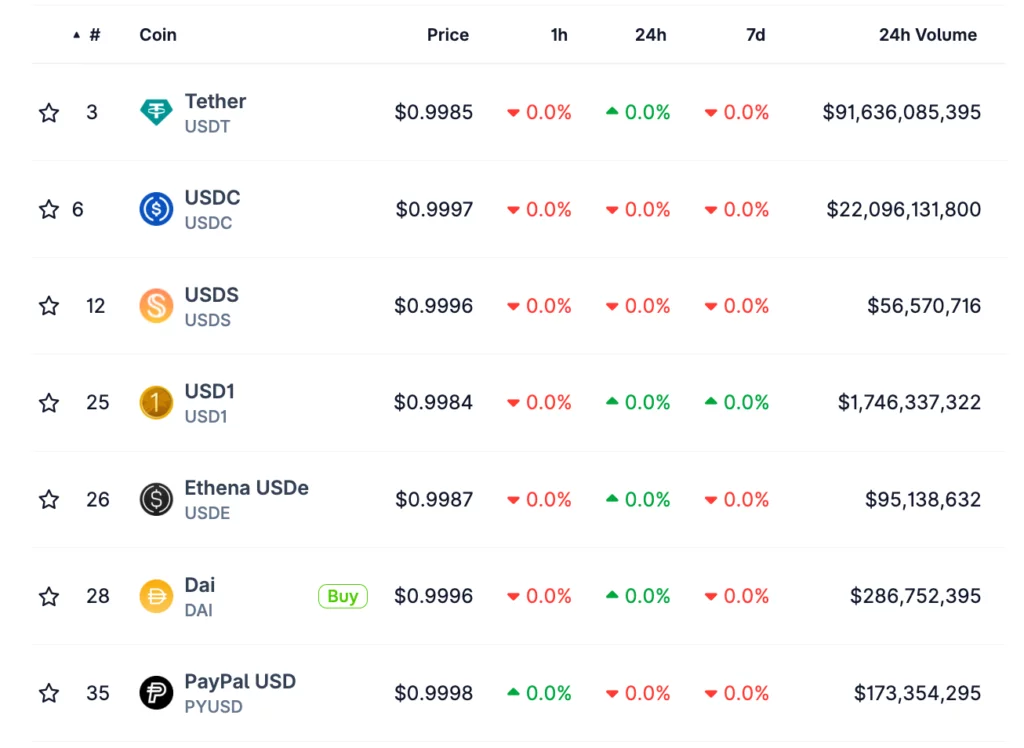
Data from CoinGecko shows the supply of dollar-backed stablecoins is approaching $300 billion.
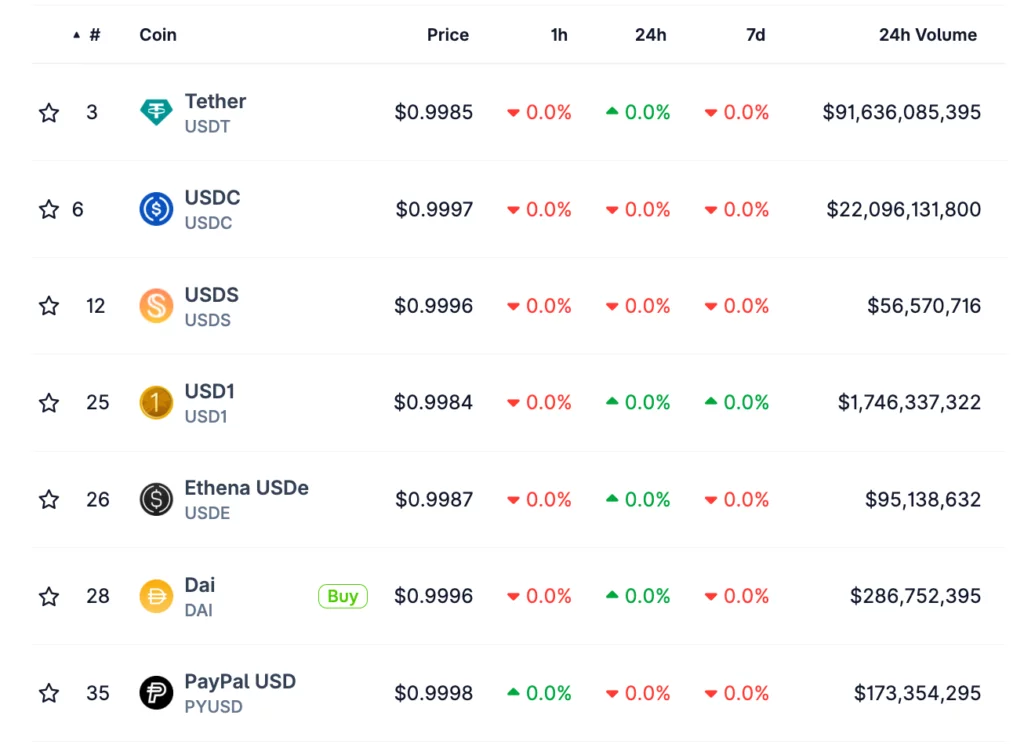
Tether’s USDT remains the largest stablecoin with roughly $188 billion in circulation, while Circle’s USDC follows with approximately $76 billion.
Crypto World
Why is Crypto Going Down? Iran Just Bombed Kuwait’s Airport and Struck the Strait of Hormuz, Bitcoin Is Crashing Toward Critical Support

Crypto crashed overnight as Iranian strikes on Kuwait’s international airport and escalating conflict in the Strait of Hormuz sent risk assets into freefall, with more than $700 million in leveraged long positions forcibly closed in a 12-hour window.
Bitcoin dropped sharply toward critical support levels, dragging the total crypto market cap to $2.31 trillion.
Traders asking why is crypto going down this hard got a brutal, two-part answer: a geopolitical shock and a leverage overhang that was already primed to blow.
The confluence of factors is not subtle. Elevated open interest across perpetual futures markets had been building for weeks, leaving the market structurally vulnerable.
UPDATE: (unconfirmed)
Newly surfaced open-source images and videos document severe damage, raging fires at the fuel depot, and structural interior collapses at Kuwait International Airport Terminal 1 following the recent Iranian drone wave. First responders remain heavily… pic.twitter.com/PslHM6gRMT— X-K (@ConflictRadarME) June 3, 2026
Then Iran bombing Kuwait airport, and the subsequent US military response targeting Qeshm Island in the Strait of Hormuz, provided the exogenous trigger that converted fragile positioning into a full liquidation cascade. Bitcoin had already been slumping on geopolitical tensions and leverage pressure in the sessions leading into this event. This was the match on the gasoline.
Discover: The Best Crypto to Diversify Your Portfolio
Why Is Crypto Going Down? Strait of Hormuz Tensions and Iran Kuwait Airport Bombing Drive Risk-Off Rotation
Iran’s drone strike on Kuwait’s international airport, causing significant building damage, injuries, and the suspension of air traffic on Wednesday morning, was the flashpoint.
Kuwait’s Ministry of Defence spokesman Brigadier General Saud Abdulaziz Al-Otaibi described it as “criminal Iranian aggression.” US Central Command responded with strikes on an Iranian military ground control station on Qeshm Island, deep inside the Strait of Hormuz.
The IRGC warned that “disrupting the security of the Strait of Hormuz will carry a heavy price for the aggressive US military.” Markets heard that threat and repriced risk immediately.
The Strait of Hormuz carries roughly 20–30% of the world’s seaborne oil trade. A sustained disruption there is not a regional story, it is a global energy price event. Oil surged on the escalation news, the US dollar strengthened into safe-haven demand, and Treasuries caught a bid.
That trifecta, higher oil, stronger dollar, bid for bonds, is the classic risk-off rotation that historically drains liquidity from speculative assets. Crypto, despite years of “digital gold” narrative, continues to trade as a high-beta risk asset in moments of genuine geopolitical stress.
The BTC-Nasdaq correlation dominated; the BTC-gold correlation was nowhere to be seen.
The US naval blockade of the Strait of Hormuz, which began on April 13, has already disabled six commercial vessels and redirected 122 others.
The blockade’s latest action, a Hellfire missile fired into the engine room of the Botswana-flagged M/T Lexie after its crew ignored 24 hours of warnings, signals Washington has no intention of backing down.
Ceasefire negotiations between the US and Iran stalled over the weekend, with Iran’s foreign ministry spokesman Esmail Baghaei accusing Washington of “constantly changing its views.” Secretary of State Marco Rubio told Congress bluntly: “The war is over”, but the strikes suggest otherwise.
This is not a de-escalation environment. That is not noise. That is a pattern. The fears of a broader crypto market crash 2026 scenario are not entirely irrational given this backdrop.
Discover: The Best Token Presales
Can Bitcoin Price Recover, or Does the $68,000 Zone Mark a Deeper Break?
The technical damage from this episode is real.
Bitcoin lost the Short-Term Holder Realized Price support, a level that historically marks the dividing line between healthy consolidation and sustained drawdowns.
The $70,000 psychological floor was cracked in the liquidation flush. Total crypto market cap is now testing $2 trillion, a threshold derivatives desks will defend aggressively but one that carries no guarantee.
If US-Iran back-channel talks resume meaningfully, Hormuz shipping risk premiums fade, and ETF inflows return within 48 to 72 hours, Bitcoin reclaims $70,000, shorts get squeezed, and price reprints toward $74,000 to $75,000. That scenario requires de-escalation signals that are not currently visible.
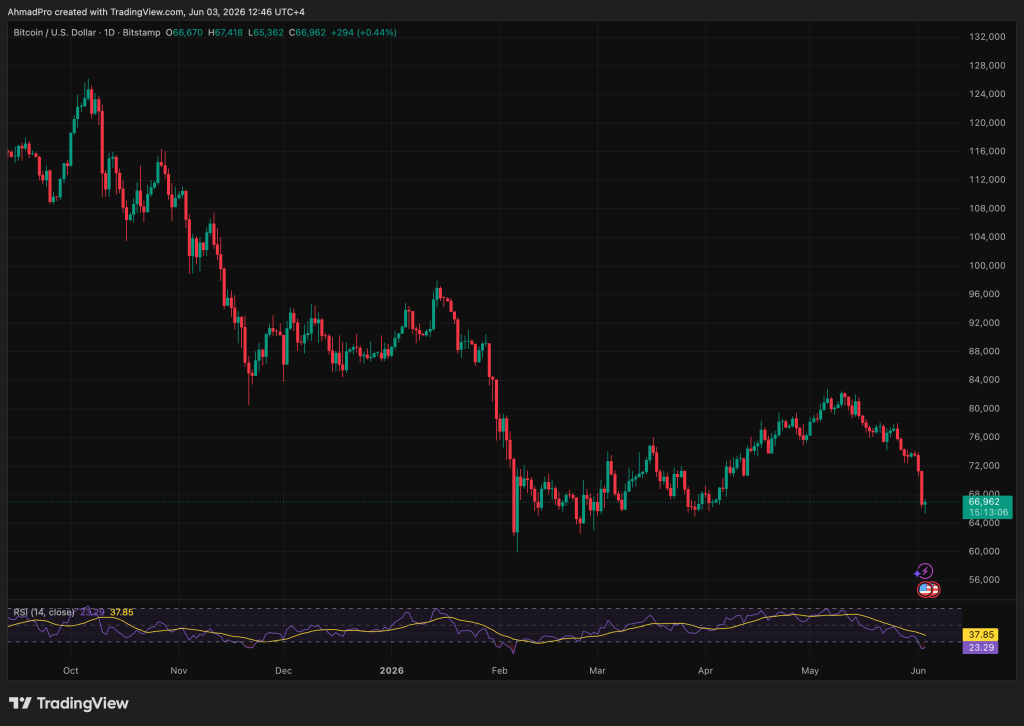
If geopolitical noise persists without further direct escalation, crypto consolidates in the $66,000 to $70,000 range as leveraged positioning resets and macro traders wait on the next US inflation print. The Fed’s higher-for-longer posture limits the upside ceiling even in that scenario.
Further Iranian strikes, a Hormuz shipping incident involving a major tanker, or another upside inflation surprise pushes BTC through $65,000. That breaks the range structure that has held since Q1 2026 and opens a move toward $60,000 to $62,000. This is the scenario traders are quietly stress-testing right now.
The structural read is bearish until $70,000 is reclaimed on a closing basis. Everything below that level is damage control territory.
The post Why is Crypto Going Down? Iran Just Bombed Kuwait’s Airport and Struck the Strait of Hormuz, Bitcoin Is Crashing Toward Critical Support appeared first on Cryptonews.

TLDR:
- Singapore Police Force blockchain analysis helped block over $4.2M in potential crypto scam losses in six weeks.
- Seven crypto exchanges including Coinbase, OKX, and Gemini supported the SPF’s second joint anti-scam operation.
- Officers conducted 145+ targeted interventions using Chainalysis and TRM Labs blockchain analytical tools.
- The operation covered government impersonation, investment, job, and love scam categories across Singapore.
The Singapore Police Force blockchain analysis operation has blocked over $4.2 million in potential scam losses. Running from April 16 to May 31, 2026, the six-week effort reached more than 145 victims across multiple scam categories.
The Anti-Scam Centre and Cyber Investigation Branch partnered with seven cryptocurrency exchanges. Advanced analytical tools from Chainalysis and TRM Labs powered the interventions.
The operation marks the second collaboration of its kind between the SPF and the private sector.
Exchanges and Tools Drive Faster Victim Identification
The second operation expanded on the foundation set by the first joint effort. That earlier campaign had protected $2.86 million and reached over 90 victims.
This time, the participating exchanges included Coinbase, Coinhako, Gemini, Independent Reserve, OKX, StraitsX, and Upbit. The broader consortium allowed officers to cast a wider net across the blockchain.
Chainalysis publicly acknowledged the growing impact of the partnership. “From $2.86M to the addition of $4.2M protected. From 90+ to 145+ victims reached,” the firm stated.
It added that when public-private partnerships are sustained and scaled, impact grows. The numbers reflect a measurable step forward in proactive crypto crime prevention.
Officers conducted more than 145 targeted interventions through phone calls and in-person visits. Exchanges facilitated this by providing timely customer data upon request.
The scam categories covered included government impersonation, investment fraud, job scams, and love scams.
The combination of investigative capability and exchange cooperation made early detection possible. Without the data-sharing agreements in place, officers would have had fewer entry points into victim identification. The operation showed how intelligence-led policing can work effectively within the crypto space.
Public Awareness Remains Central to the Anti-Scam Strategy
Beyond the technical operations, the SPF maintained its public education push throughout the campaign. The force continues to promote its “ACT” framework, which stands for Add, Check, and Tell. Each element targets a different stage of scam prevention for ordinary users.
Under the Add step, residents are encouraged to install the ScamShield app and activate two-factor authentication.
Setting transaction limits on banking and PayNow accounts also reduces exposure. These measures work as a first line of defense before a scam reaches a critical stage.
The Check step urges the public to pause before transferring money or sharing personal details. Verifying the legitimacy of requests and online listings can prevent losses before they occur. The rule of thumb remains straightforward: if it appears too good to be true, it probably is.
The Tell step involves reporting scam encounters to banks, ScamShield, or directly to police. Residents can call the ScamShield Helpline at 1799 or reach the Police Hotline at 1800-255-0000. Sharing information about active scams within communities also helps limit the reach of fraudsters.

Paris-based crypto data platform Kaiko acquired Amberdata, a US-focused digital asset data provider, as institutional investors demand broader market, derivatives and onchain analytics for digital assets.
Kaiko said the deal will expand its institutional data stack and help the combined company serve banks, asset managers, hedge funds, exchanges and trading firms that need cleaner data across fragmented crypto markets, according to an announcement shared with Cointelegraph.
The acquisition adds Amberdata’s derivatives analytics and artificial intelligence-powered research tools, including the GVOL options analytics platform, which Kaiko said had been one of the most requested capabilities from institutional clients.
The transaction was finalized on Monday, but the size and terms of the deal remain confidential, Ambre Soubiran, CEO of Kaiko, told Cointelegraph.
The deal marks Kaiko’s fifth acquisition and expands its effort to consolidate institutional-grade crypto market data, derivatives analytics and onchain infrastructure. Kaiko said the combined company will serve 250 institutional clients worldwide. Kaiko acquired onchain data infrastructure provider Cometh on May 20, which is licensed under the European Union’s Markets in Crypto-Assets Regulation (MiCA) as a crypto asset service provider.

Kaiko platform homepage. Source: Kaiko.com
In February, Bloomberg announced a collaboration with Kaiko to make Bloomberg’s licensed financial data accessible directly within blockchain-native environments, expanding from traditional offchain databases to address the challenge of inconsistent data across tokenized markets, Cointelegraph reported.
Reliable data is particularly important in markets linked to tokenized real-world assets to ensure that onchain assets mirror the pricing of the underlying financial instruments.
Related: NYSE parent ICE pushes ‘level playing field’ for 24/7 onchain perps
Crypto data firms need to adhere to TradFi standards: Kaiko CEO
Cryptocurrency data companies need to adhere to stricter TradFi-like standards to facilitate the growing institutional participation in the industry, Kaiko’s Soubiran told Cointelegraph, adding:
“The growing participation from banks, asset managers, and hedge funds accelerates the demand, and this acquisition is the completion of a strategy that has been underway since day one.”
Amberdata’s acquisition makes Kaiko the “only independent, globally regulated company that can serve every data need an institution has,” she added.
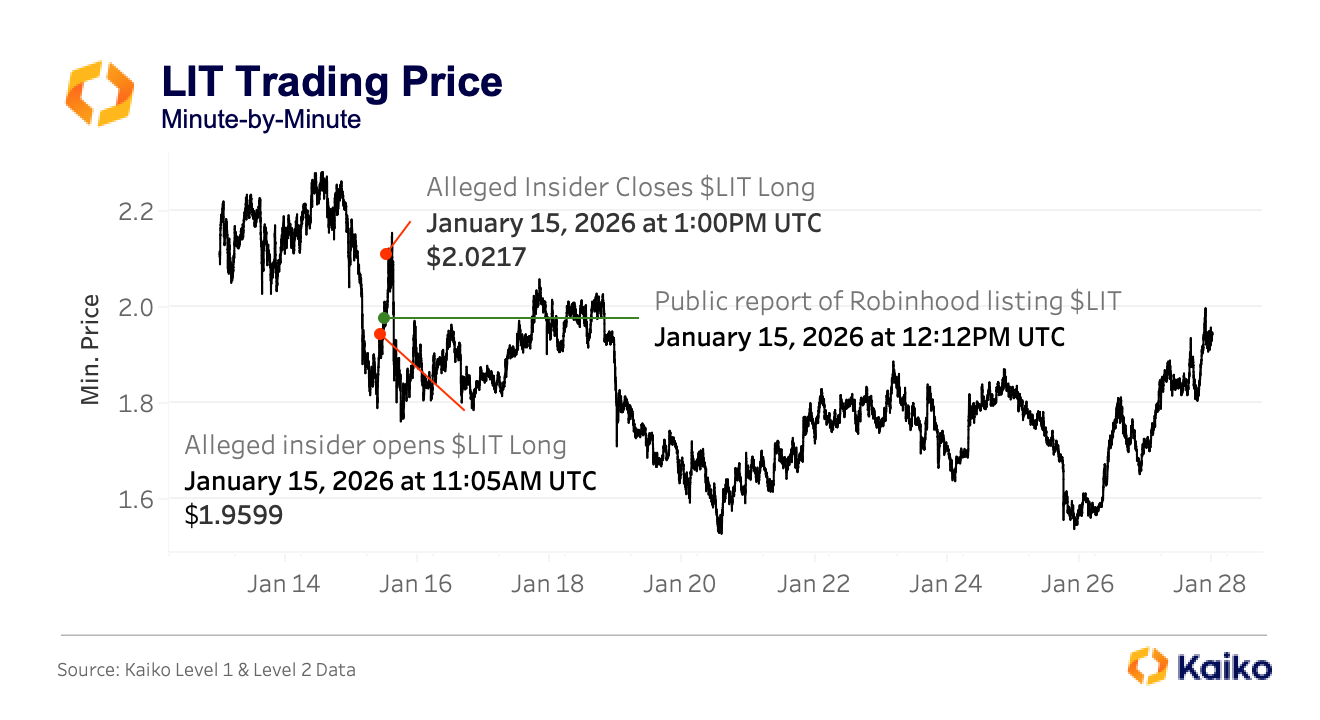
LIT trading price, listing time, minute-by-minute. Source: Kaiko
Earlier in May, Kaiko’s data platform flagged concerning trading patterns suggesting that some traders are frontrunning crypto listing announcements on Robinhood, raising concerns that some market participants have access to non-public listing information or an “exceptionally reliable front-running methodology built on public signals.”
Magazine: Polymarket seeks Japan entry, Harvard dumps entire ETH position: Hodler’s Digest, May 17 – 23


The UK Financial Conduct Authority has warned football clubs that sponsorship deals with unauthorised crypto firms could expose fans to financial harm while creating legal, money laundering and reputational risks for clubs.
Summary
- The FCA has warned Premier League clubs that sponsorship deals with unauthorised crypto firms could expose supporters to financial risks and leave clubs facing legal and reputational consequences.
- UK regulators have raised concerns that some crypto companies may be using football sponsorships to promote financial products without the required authorization.
- The warning comes as the FCA prepares a full crypto regulatory regime, with authorization applications opening in September 2026 and new rules due to take effect in 2027.
According to the FCA, it has written to Premier League clubs and other football organizations after identifying concerns that some crypto companies and trading platforms may be using sponsorship agreements to promote financial products in Britain without the required authorization.
The regulator said unauthorised firms could be breaching the UK’s financial promotion rules by gaining visibility through partnerships with high-profile football teams and using those relationships to reach large audiences of supporters.
Speaking on the issue, Lucy Castledine, director of consumer investments at the FCA, said millions of fans place trust in their clubs and should not be exposed to potentially unsafe financial products through sponsorship arrangements.
Castledine warned that unauthorised firms could seek to benefit from that loyalty while offering products that fall outside the UK’s regulatory safeguards.
Having already contacted clubs where concerns were identified, the FCA said it would take further action where necessary. The regulator added that customers using unregulated firms face the risk of losing all their money and are unlikely to have access to regulatory protections if something goes wrong.
Alongside consumer protection concerns, the warning also touches a growing source of revenue for football clubs.
According to Deloitte, commercial and sponsorship income has overtaken broadcasting revenue as the largest source of earnings for many clubs. Manchester City generated €408 million ($475 million) from commercial activities in 2025, exceeding its €332 million in broadcasting revenue, according to Deloitte’s figures.
Commenting on the issue, UK Sports Minister Stephanie Peacock said sponsorship revenue remains important for the football industry, but supporters deserve confidence that companies associated with their clubs are responsible, accountable and safe to use.
FCA steps up scrutiny as crypto rulebook takes shape
Elsewhere, the warning arrives as the FCA continues work on a wider framework for digital assets ahead of the UK’s planned crypto licensing regime.
Back in April, the regulator launched consultations covering stablecoins, crypto trading platforms, custody services and staking activities. The FCA said those proposals are intended to define how crypto businesses will operate under the future Financial Services and Markets Act framework and help firms prepare for upcoming authorization requirements.
Under the current timetable outlined by the FCA, crypto companies will be able to apply for authorization from September 30, 2026, while the full cryptoasset regime is scheduled to take effect on October 25, 2027. The regulator has repeatedly stated that it wants UK consumers to be served by authorised crypto firms and to have sufficient information to make informed decisions.
Crypto is losing its momentum-trade status as investors turn toward AI stocks, according to Bitwise chief investment officer Matt Hougan.
Summary
- Bitwise says crypto is shifting from momentum trading to contrarian investing as AI stocks dominate flows.
- Matt Hougan says investors still believe in crypto but now favor fundamentals over market hype.
- Bitcoin remains pressured by ETF outflows, equity rotation and weak market sentiment.
Hougan said the crypto market is under pressure because investors now have several fast-moving alternatives. In a June 2 market note, he pointed to AI stocks, robotics firms and SpaceX as assets drawing market attention away from digital assets.
“The crypto market is brutal right now,” Hougan wrote. He added that crypto is moving “from momentum trade to contrarian bet” as AI takes more investor attention.
The shift comes after AI-linked stocks gained strong demand following the public launch of ChatGPT in late 2022. Nvidia, a key AI chipmaker, has seen its shares rise sharply since then, making AI one of the main stories in public markets.
Hougan said this change does not mean crypto is disappearing. Instead, he said it changes the type of investor and project that the market rewards.
Fundamentals Replace Market Hype
Hougan said contrarian bets need patience and a focus on fundamentals. He said investors who still believe in crypto now look for clear revenue, strong use cases and projects with working business models.
“Investors still believe in crypto, but now that it’s a contrarian bet, they favor fundamentals over vibes,” Hougan wrote.
He said this explains why some smaller tokens have performed better than major assets. Hyperliquid, BNB, Zcash and Stellar posted gains in May, while Bitcoin, Ethereum and Solana remained under pressure.
According to Hougan, that rotation shows that the market is no longer rewarding broad crypto exposure in the same way. It is now rewarding assets with clearer stories and stronger data.
Bitcoin weakness reflects broader market rotation
As previously reported by crypto.news, Binance Research also linked Bitcoin’s recent weakness to capital moving into U.S. equities. The firm said AI, defense and energy stocks have pulled flows away from Bitcoin during the current quarter.
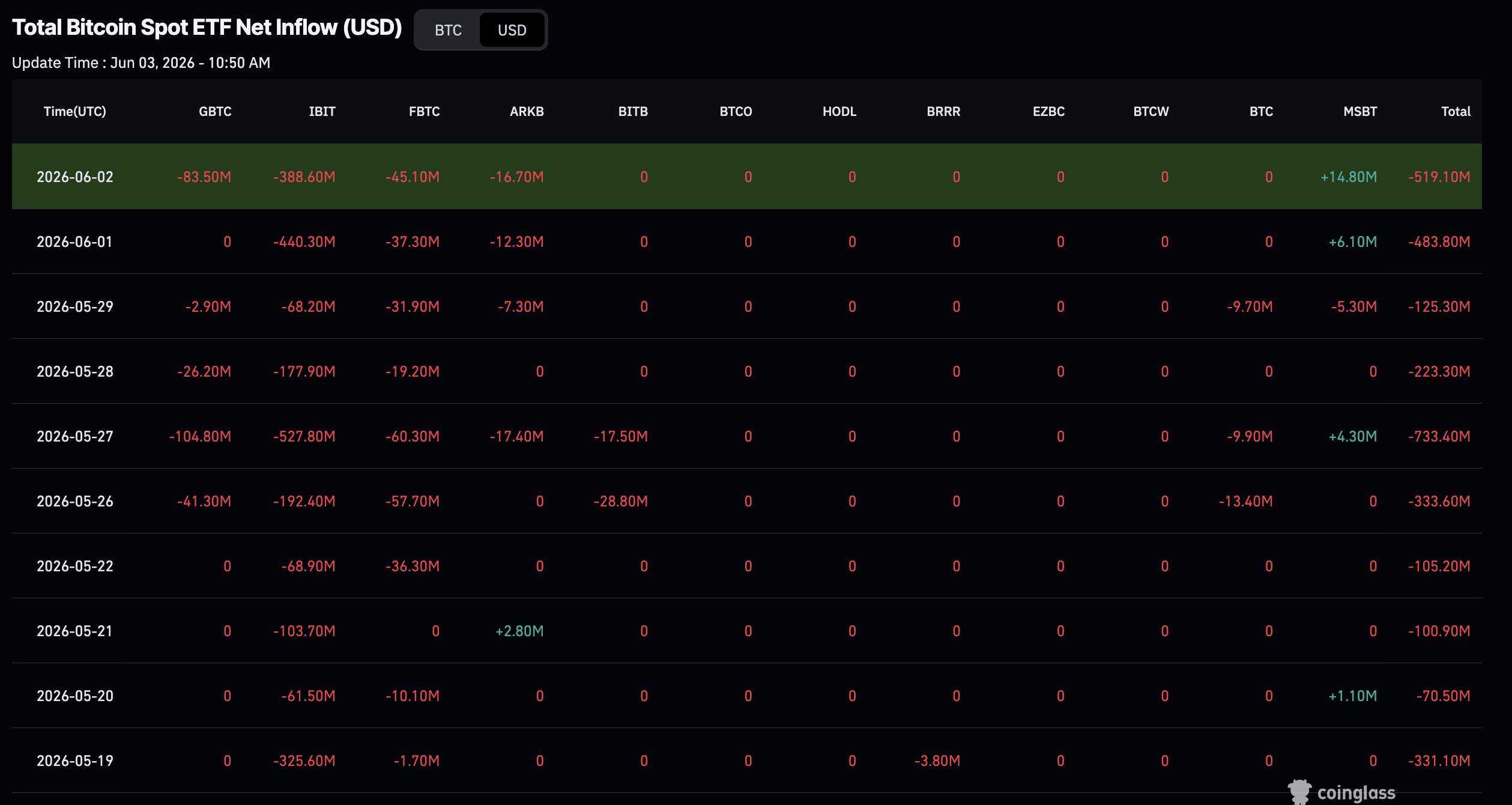
Bitcoin also fell below $70,000 after U.S. spot Bitcoin ETFs recorded $483 million in daily net outflows. Those withdrawals extended an 11-session outflow streak that topped $3.4 billion.
Crypto.news also reported that Mt. Gox-linked wallets moved 10,306 BTC worth about $739 million. No direct sale was confirmed, but the transfer added new concern about possible supply entering the market.
The market remains weak, but Hougan said green pockets in smaller assets may show that crypto is closer to the end of the downturn than the start. He said the next phase will likely depend on fundamentals, regulation and whether investors return after the AI trade cools.
Crypto World
Crypto News, June 3: BTC USD Evil Number at $66K, Peter Schiff Calls for $20K, Geopolitical Fear Porn Everywhere
The crypto market is getting hammered, BTC USD slips to the devilishly symbolic $66,000 level following fresh geopolitical turmoil in the Middle East. Right on cue, Peter Schiff has returned to tell everyone Bitcoin is doomed. Some things never change.
The latest selloff comes as US spot Bitcoin ETFs continue bleeding capital. Funds have recorded $1.67 billion in weekly outflows, with recent totals exceeding $4 billion over the past few weeks.
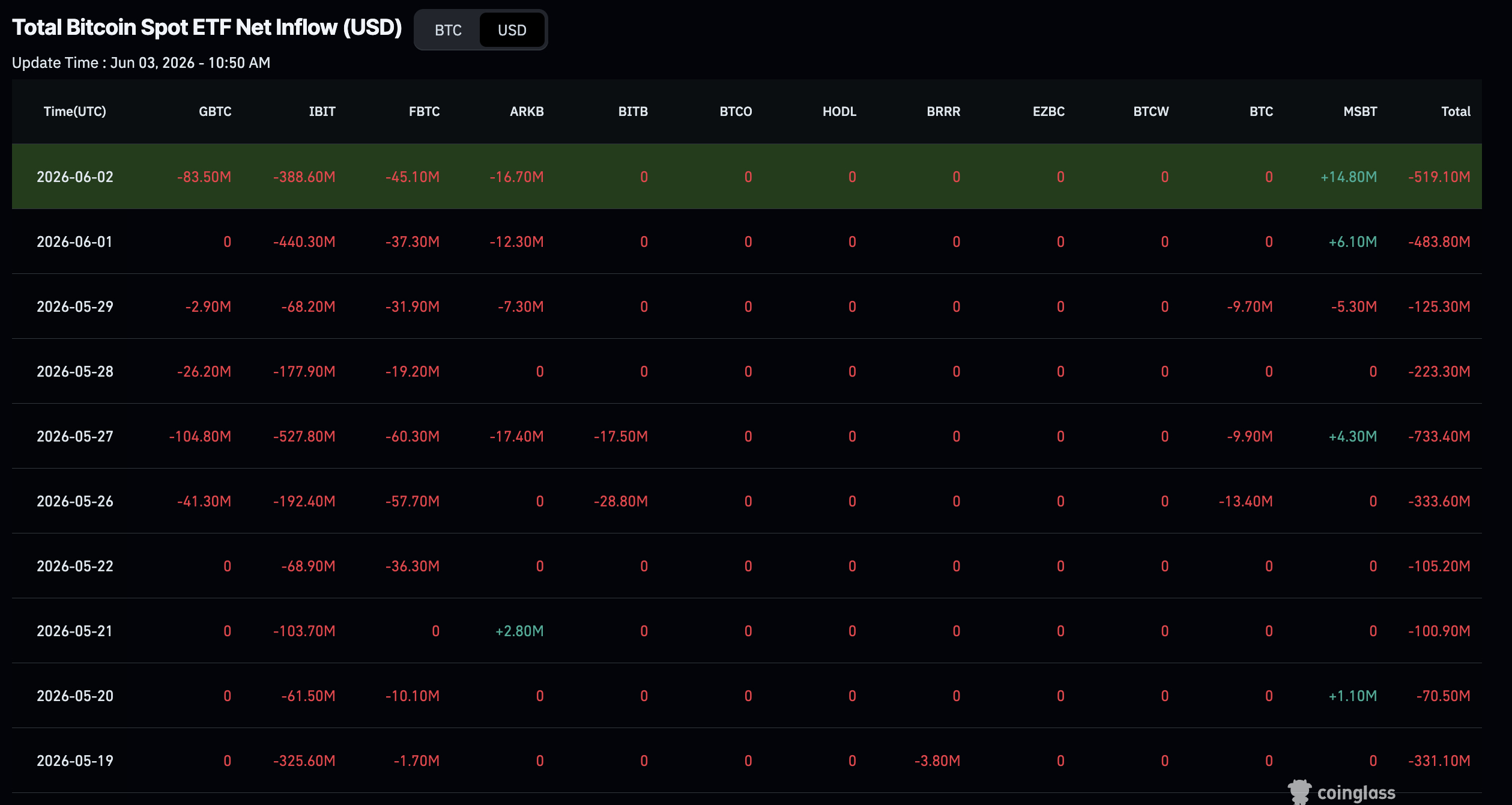
That’s becoming one of the biggest obstacles for BTC right now. Institutions appear to be rotating into AI stocks, defense names, energy plays, or simply parking cash in high-yield Treasuries while market uncertainty grows. Buffett himself said that he is sitting on a pile of cash, as markets are getting way closer to a casino environment.
Still, Bitcoin has visited the $66K region several times this year. Each previous test attracted buyers and was followed by a rebound toward $70,000 and beyond.

Discover: The best crypto to diversify your portfolio with
Iran Escalation Sends BTC USD to $66K, Peter Schiff A Happy Man
The decline accelerated after Iran reportedly launched missiles and drones toward targets in Kuwait and Bahrain, damaging infrastructure and disrupting flights. US Central Command intercepted part of the attack as tensions with Washington rose following the collapse of recent peace discussions.
Markets reacted exactly as expected. Oil moved higher, investors sought safety, and risk assets found themselves first in line for selling pressure.
Peter Schiff, Bitcoin’s longest-running critic, wasted little time making fresh bearish predictions. According to Schiff, a breakdown of major support could eventually send BTC below $50,000 and even under $20,000.
His warnings generate headlines every cycle, though critics point out he’s been calling for Bitcoin’s collapse for well over a decade while the asset has repeatedly recovered from far worse drawdowns.
In Contrast, Coinbase CEO Brian Armstrong has reportedly described the current selloff as temporary, maintaining his long-term bullish view that Bitcoin could eventually reach seven figures.
— Bitcoin professor (@Bitcoinprof0637) June 2, 2026
BREAKING: Coinbase CEO Brian Armstrong says people without at least 5% exposure to Bitcoin could “regret it” by the end of the decade.
He believes $BTC could reach $1,000,000 by 2030 as institutional adoption, ETFs, and global demand continue accelerating.
The biggest risk… pic.twitter.com/kbN0uFyNDM
Discover: The best crypto to diversify your portfolio with
Trump, Iran, and Market Uncertainty
Geopolitical tensions remain the dominant story. President Trump dismissed reports claiming the US and Iran have stopped communicating, calling them “fake news.”
Although the peace agreement that emerges remains unclear. If tensions continue to escalate, crypto could face additional volatility alongside equities and other risk assets. Even with stocks doing great, breaching all-time high after all-time high.
One noticeable trend during the latest panic has been increased demand for stablecoins and digital dollars as crypto holders seek shelter without fully leaving the crypto ecosystem.
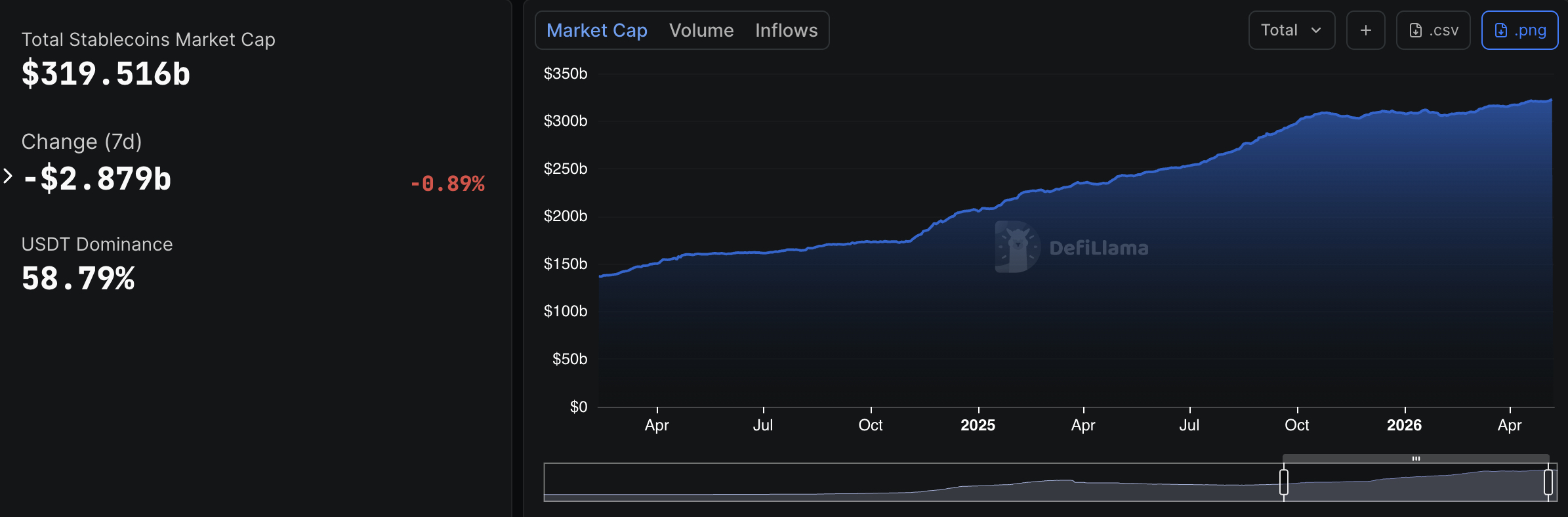
In reality, Bitcoin at $66K feels ugly. The markets are reminding everyone they’re markets.
ETF outflows, geopolitical risk, and recession fears are creating a difficult setup at the moment. But Bitcoin has survived wars, banking crises, exchange collapses, pandemics, and countless eulogies written by its critics.
The near-term outlook remains volatile, but Bitcoin continues attracting adoption faster than fear drives investors away. I’m bullish.
Discover: The best pre-launch token sales
The post Crypto News, June 3: BTC USD Evil Number at $66K, Peter Schiff Calls for $20K, Geopolitical Fear Porn Everywhere appeared first on Cryptonews.
Crypto World
Meta (META) Stock Falls After EU Court Confirms Messenger Must Comply with Gatekeeper Rules

Key Points
- Luxembourg’s General Court dismissed Meta’s appeal against the gatekeeper classification for its Messenger platform
- Judges determined Messenger functions as a critical access point for businesses seeking to connect with consumers under Digital Markets Act regulations
- In a partial victory for Meta, the court struck down the gatekeeper designation previously applied to Marketplace
- The company indicated it is “reviewing” the decision on Messenger and will “consider its options,” leaving room for further appeals
- META shares declined 0.47% following the announcement
Meta Platforms (META) experienced a modest decline of 0.47% on Wednesday following an unfavorable court decision in Europe concerning its Messenger application.
The General Court in Luxembourg determined that the European Commission acted appropriately when designating Messenger as a “gatekeeper” under the European Union’s Digital Markets Act (DMA). This regulatory framework, which took effect in 2023, establishes boundaries for major technology platforms’ operations.
According to the court’s assessment, “the Commission did not err in finding that Messenger individually is an important gateway” for commercial entities attempting to access end users.
Receiving gatekeeper status means accepting specific regulatory requirements. Meta contested this classification through legal channels, arguing the designation was unwarranted.
Wednesday’s ruling rejected that challenge, specifically regarding Messenger.
However, the decision wasn’t entirely unfavorable to Meta. In a separate component of the case, judges sided with Meta, removing the gatekeeper classification from the company’s Marketplace feature. The court determined the Commission hadn’t sufficiently justified that particular designation.
In reality, the Marketplace decision has minimal impact. The Commission had already withdrawn that label previously when Marketplace dropped beneath mandatory user thresholds.
Implications of the Court Decision for Meta
Meta recognized the divided outcome. “We welcome the Court’s judgment on Marketplace, which confirms that it should not have been designated in the first place,” a company representative stated.
Regarding Messenger, Meta adopted a more measured tone. “We are reviewing the Court’s finding on Messenger and will consider our options,” the representative continued.
Available options include escalating the matter to the Court of Justice of the European Union, the continent’s supreme judicial authority.
The official case designation is T-1078/23 Meta Platforms v Commission.
The DMA aims to create equitable conditions between dominant technology platforms and emerging competitors. Entities classified as gatekeepers must adhere to prescribed regulations covering interoperability standards, information accessibility, and equitable treatment of competing services.
Understanding the Digital Markets Act
The DMA entered into force in 2023, focusing on organizations the EU identifies as possessing substantial market influence. Gatekeeper classification applies when a platform represents a vital connection point between commercial entities and consumers.
Following gatekeeper designation, organizations must fulfill requirements including enabling third-party integration and avoiding preferential treatment of proprietary services in search rankings.
Meta isn’t alone in facing DMA oversight. Apple, Alphabet, and additional technology giants have received gatekeeper classifications under these regulations.
The Messenger decision strengthens the EU’s argument that the messaging service occupies a pivotal position in business-to-consumer communication across Meta’s ecosystem.
Meta stock closed down 0.47% on the day the ruling was announced.

‘Reform Friends of Israel’ account seemingly based in Israel

Take Control of Your Money: Track Your Spending and Find Your Gap | RFS 2026 Week 1

Henry Nowak latest: Police chief condemns violent clashes in Southampton as 11 officers and dog injured



-

 NewsBeat7 days ago
Israel says it has killed new Hamas military leader in Gaza City airstrikes
-

 Tech5 days ago
Waymo dominates autonomous vehicle registrations as Tesla trails behind
-

 News Videos5 days ago
This is BROKEN! INSANE 5x MONEY CAR WASH WEEK! The NEW GTA Online UPDATE Today! (GTA5 New Update)
-
 Tech4 days ago
SpaceX just won a second Golden Dome contract. This one is $4.16 billion.
-

 News Videos5 days ago
SHE IS KILLING XRP!!! WATCH URGENT AND ACT FAST
-
 NewsBeat4 days ago
FIRST NIGHT REVIEW: Take That bring the Circus back to life in spectacular sun-soaked style
-

 Business2 days ago
Jade Biosciences, Inc. (JBIO) Discusses Positive Interim Results From JADE101 Phase I Healthy Volunteer Study and Development Plans Transcript
-

 Tech7 days ago
The Samsung pay deal is the moment Korean unions changed register
-
Crypto World5 days ago
CFTC Has Approved the First Regulated Bitcoin Perpetual Contract in the U.S.
-
 Entertainment7 days ago
The Most Misunderstood Sci-Fi Horror Movie of the Last 10 Years Just Took Over Netflix
-
Crypto World7 days ago
SpaceX’s $2 Trillion IPO: Why Tech Giants Nvidia (NVDA), Apple (AAPL), and Microsoft (MSFT) May Face Pressure
-

 Business4 days ago
Is the Spurs Phenom Already Better Than Prime Diesel?
-
 NewsBeat5 days ago
Novak Djokovic v Joao Fonseca LIVE: French Open latest scores and results after Jannik Sinner’s shocking collapse
-
 Crypto World5 days ago
Snowflake (SNOW) Stock Rallies on Strong Q1 Results and AI Product Growth
-
 Entertainment4 days ago
Weak ‘Supergirl’ Box Office Tracking Amid Milly Alcock Backlash
-

 Business4 days ago
Demand Conditions Improve In Chemicals Sector In April 2026
-
 Crypto World5 days ago
MicroStrategy Moves $30 Million in BTC to Coinbase Prime: Is the Bitcoin Sell-Off Already Here?
-

 Politics4 days ago
The House | Inside Andy Burnham’s Makerfield Campaign: “Nobody Thinks This Is In The Bag”
-

 Tech5 days ago
This Week In Security: Ubiquiti Fixes, And FreeBSD Joins The Club You Don’t Want To Join
-

 Entertainment5 days ago
Maddox Jolie-Pitt Legally Requests to Drop Brad’s Surname
You must be logged in to post a comment Login