

Crypto World
Trump’s American Bitcoin Drops 8.4% Before Reverse Split to Stay Listed

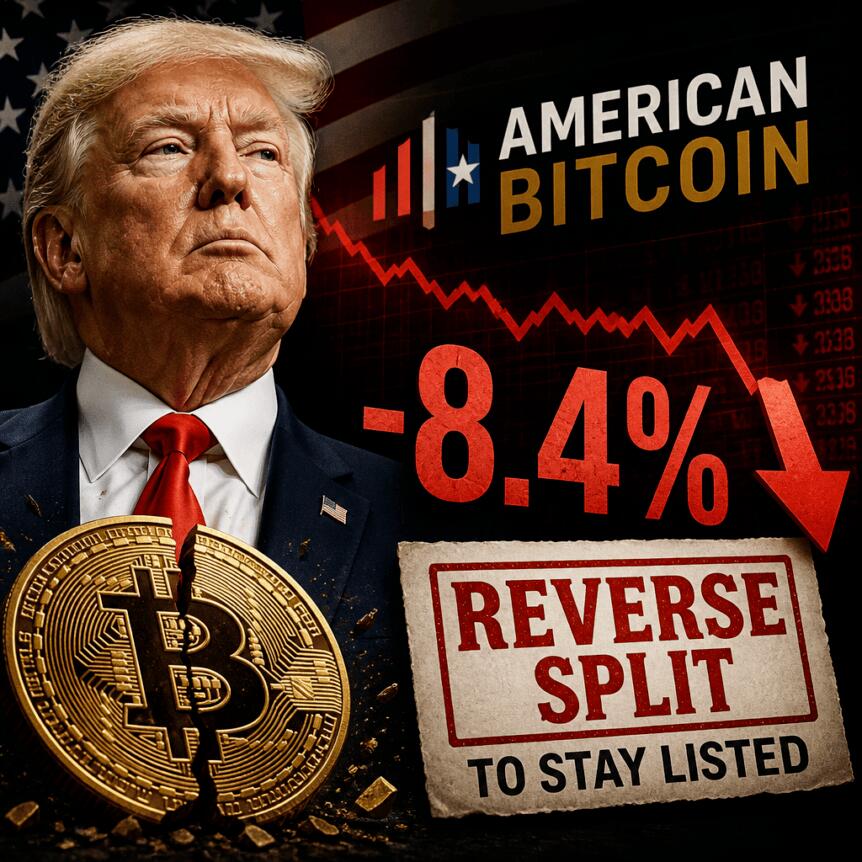
American Bitcoin (ABTC) is set to complete a 1-for-15 reverse stock split as it tries to remain listed on Nasdaq, a move that arrives as the company’s shares sink to fresh lows. The miner said the split becomes effective after the market closes on Thursday and will be reflected in trading on a split-adjusted basis when the market opens Monday, with the stock continuing to trade under the ABTC ticker.
Under the plan, every 15 shares of the company’s Class A and Class B common stock will be consolidated into a single share. American Bitcoin expects that its share count will fall from more than 1 billion outstanding shares to about 73 million. According to the company’s release, shareholders approved the reverse split on June 22, and the company now aims to satisfy Nasdaq’s minimum bid rules.
Key takeaways
- ABTC’s 1-for-15 reverse stock split takes effect after Thursday’s market close and begins trading on a split-adjusted basis on Monday.
- American Bitcoin expects its outstanding shares to drop from over 1 billion to roughly 73 million while keeping the ABTC ticker.
- The company’s stated reason is to maintain compliance with Nasdaq’s requirement that the stock not trade below $1 for 30 consecutive sessions.
- Shares fell to an all-time low of 62 cents on Wednesday, down nearly 8.4% on the day, before a modest after-hours rebound.
- The move reflects a broader pattern among crypto-related public companies using reverse splits to address prolonged weakness in share prices.
Reverse split scheduled to protect Nasdaq listing
Reverse stock splits are often viewed by investors as a sign that a company is struggling to keep its stock above exchange listing thresholds. In American Bitcoin’s case, the company explicitly tied the action to Nasdaq’s minimum bid requirements, which can lead to delisting if a stock closes below $1 for 30 consecutive trading days.
American Bitcoin said it is implementing the consolidation to support its share price and maintain compliance with those rules. The company also confirmed that it would continue trading under the ABTC ticker through the process.
Shares hit a record low as crypto equities remain under pressure
Wednesday’s trading brought another sharp decline for ABTC. Shares fell nearly 8.4% to close at an all-time low of 62 cents. After the close, the stock reportedly edged higher by about 4.5% to 65 cents in after-hours trading.
The stock’s broader performance has been weak. American Bitcoin is down more than 63% year-to-date and has fallen more than 92% since it began trading on Nasdaq on Sept. 3, when the company launched through a merger process involving a publicly listed crypto mining entity.
American Bitcoin was founded earlier this year by Donald Trump Jr. and Eric Trump, according to the company’s background described in the reporting. The business merged with Nasdaq-listed Gryphon Digital Mining to go public, with the Trump brothers and crypto miner Hut 8 together holding roughly 98% of the combined company.
Financial results and market turbulence weigh on the stock
American Bitcoin’s share weakness is unfolding amid a wider downturn affecting parts of the crypto market and the equities that trade as proxies for it. In May, the company reported that it lost $81.7 million in the first quarter, with the figure cited in earlier coverage from Cointelegraph.
Reverse splits can help companies avoid immediate delisting pressures, but they do not address underlying business fundamentals. For traders, that means investors may still be exposed to the same operational risks—especially in a sector where revenue can be influenced by factors such as mining economics, digital asset prices, and cost structures.
Bitcoin itself was trading around $60,000 in early Thursday trading, down 32% so far this year and more than halved from its October peak of above $126,000, according to CoinGecko.
Broader trend: crypto firms use reverse splits to stay listed
American Bitcoin is not alone in turning to reverse stock splits to manage listing compliance. Another example cited in the reporting is Bitcoin treasury company Nakamoto, which completed a 1-for-40 reverse stock split in May after its shares reached a low of 16 cents in April, also in an effort to remain on Nasdaq.
The pattern is notable because it highlights a recurring tension for crypto-linked equities: when digital assets or mining sentiment deteriorate, smaller-cap listed firms can quickly slip below exchange price floors. Reverse splits can temporarily alter the math of share price—though they leave investors’ proportional exposure unchanged in most cases—while companies work to stabilize operations or regain market confidence.
For ABTC holders, the immediate practical impact is timing. With the split scheduled to take effect after Thursday’s close and begin reflecting on Monday’s open, investors will want to watch how the market recalibrates around the new share count and whether trading volume or liquidity dynamics change after the adjustment.
Going forward, the key unknown is whether the company can sustain its share price long enough to satisfy Nasdaq’s ongoing $1 minimum-bid condition. The next few trading weeks will be the real test: the exchange compliance clock runs on consecutive closing prices, so investors should track ABTC’s daily closes after the effective date to see whether the reverse split achieves its intended listing protection.

Crypto World
Ethereum Institutional Launches as Independent Nonprofit to Court Banks and Asset Managers


Ethereum Institutional launched July 1 as an independent nonprofit positioning itself as "the dedicated institutional front door for the Ethereum ecosystem," according to a press release and a launch thread posted on X. The group consolidates roughly a year of institutional engagement work… Read the full story at The Defiant


“Historically, sustained transitions from net distribution to net accumulation have often emerged during periods of market weakness, as long-term investors gradually increase their holdings while shorter-term participants de-risk,” Glassnode said in its latest report.
Small wallets lead dip-buying
The signal gets more interesting when looking at the broader accumulation picture with the help of Glassnode’s Accumulation Trend Score. This indicator measures buying behavior across wallet sizes on a rolling 30-day basis on a scale from 0 to 1, and has shifted meaningfully higher over the past month, suggesting broad-based bargain hunting.
The strongest accumulation is currently showing up among the smallest holders (under 1 BTC), whose trend score appears near maximum at roughly 0.8-0.9, and mid-sized entities holding between 100 and 1,000 BTC, which are also reading close to that range. Wallets in the 1-10 BTC and 10-100 BTC cohorts show moderate accumulation at roughly 0.6-0.7, while larger wallets in the 1,000-10,000 BTC range have also turned net buyers, though at a moderate reading of around 0.5-0.6.
What stands out is the largest whale cohort, wallets holding more than 10,000 BTC, which still reads closer to neutral at roughly 0.4-0.5, suggesting the biggest players have yet to commit meaningfully to the accumulation trend.
Still, the synchronized accumulation across most wallet-size cohorts is significant and suggests that BTC at $60,000 is cheap enough to attract new demand from several corners of the market at once.
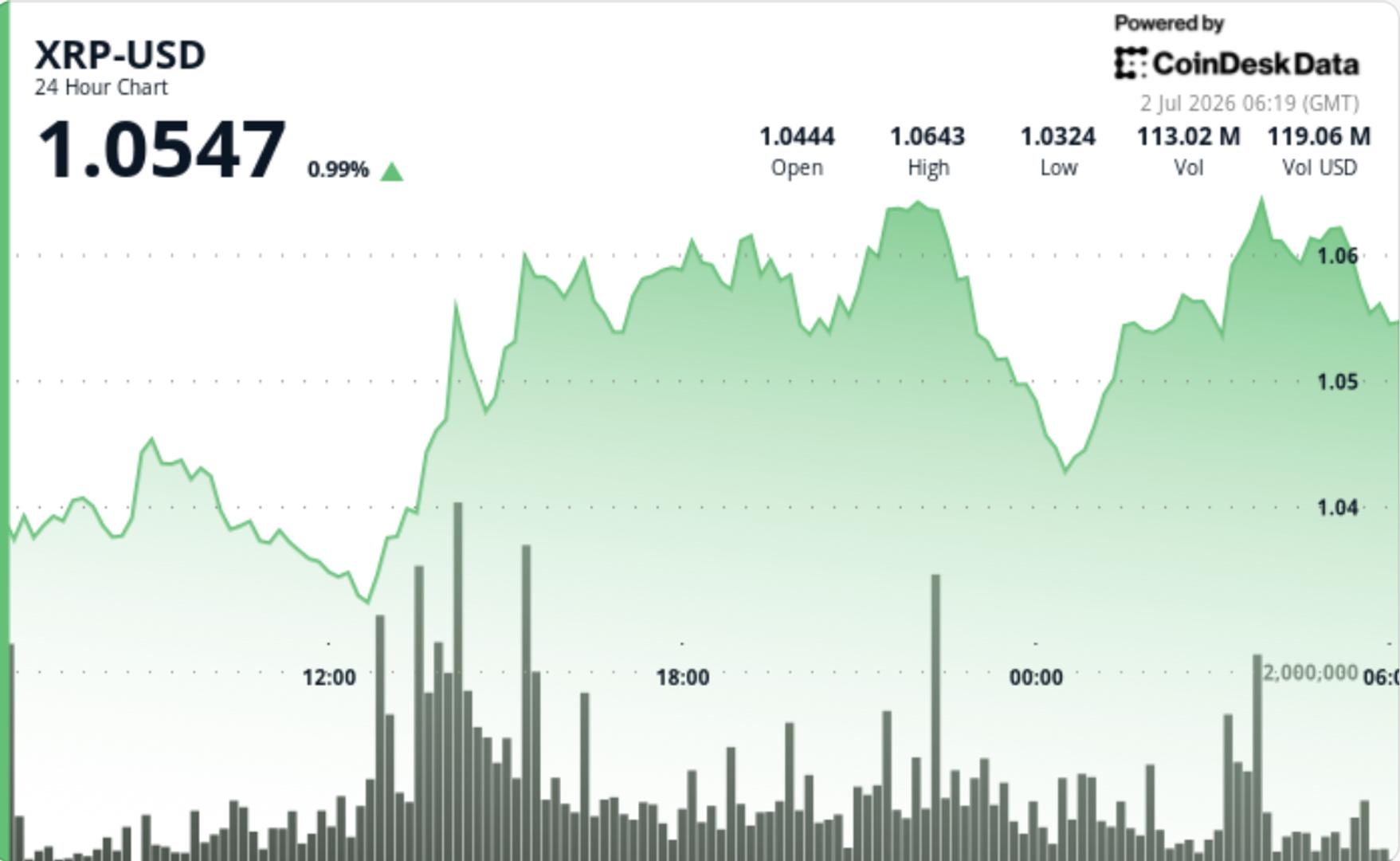
New wallet creation hit a three-month high and large-holder activity strengthened, but XRP still needs to reclaim $1.10 before the recovery looks convincing.


OpenAI has reportedly proposed giving the US government a 5% stake, a position valued at nearly $42.6 billion.
The Financial Times reported the story on Thursday. The administration’s appetite for the deal is unknown.
OpenAI Reportedly Offers Trump Administration 5% Stake
CEO Sam Altman raised the 5% figure during initial talks with President Donald Trump’s team, per the FT. According to him, allowing the public to hold a financial interest in the company is the best way to distribute the benefits created by AI.
Follow us on X to get the latest news as it happens
Based on OpenAI’s latest valuation, a 5% equity stake would be worth approximately $42.6 billion. The company secured a record funding round in March, pushing its post-money valuation to $852 billion.
OpenAI is also preparing for an initial public offering (IPO). It filed confidentially with the SEC in June but emphasized that timing remains flexible.
The proposal also calls for other US AI firms to transfer comparable equity stakes to the government. However, it remains uncertain whether the firms would adopt the plan.
The concept has a long paper trail. Altman first floated government ownership to Trump personally in early 2025, NOTUS reported. A source told CNBC in early June that the discussions had been in progress for over 12 months.
OpenAI and the White House did not immediately respond to BeInCrypto’s requests for comment sent outside regular business hours.
Subscribe to our YouTube channel to watch leaders and journalists provide expert insights
The post OpenAI Reportedly Floats Handing Washington a 5% Equity Slice appeared first on BeInCrypto.
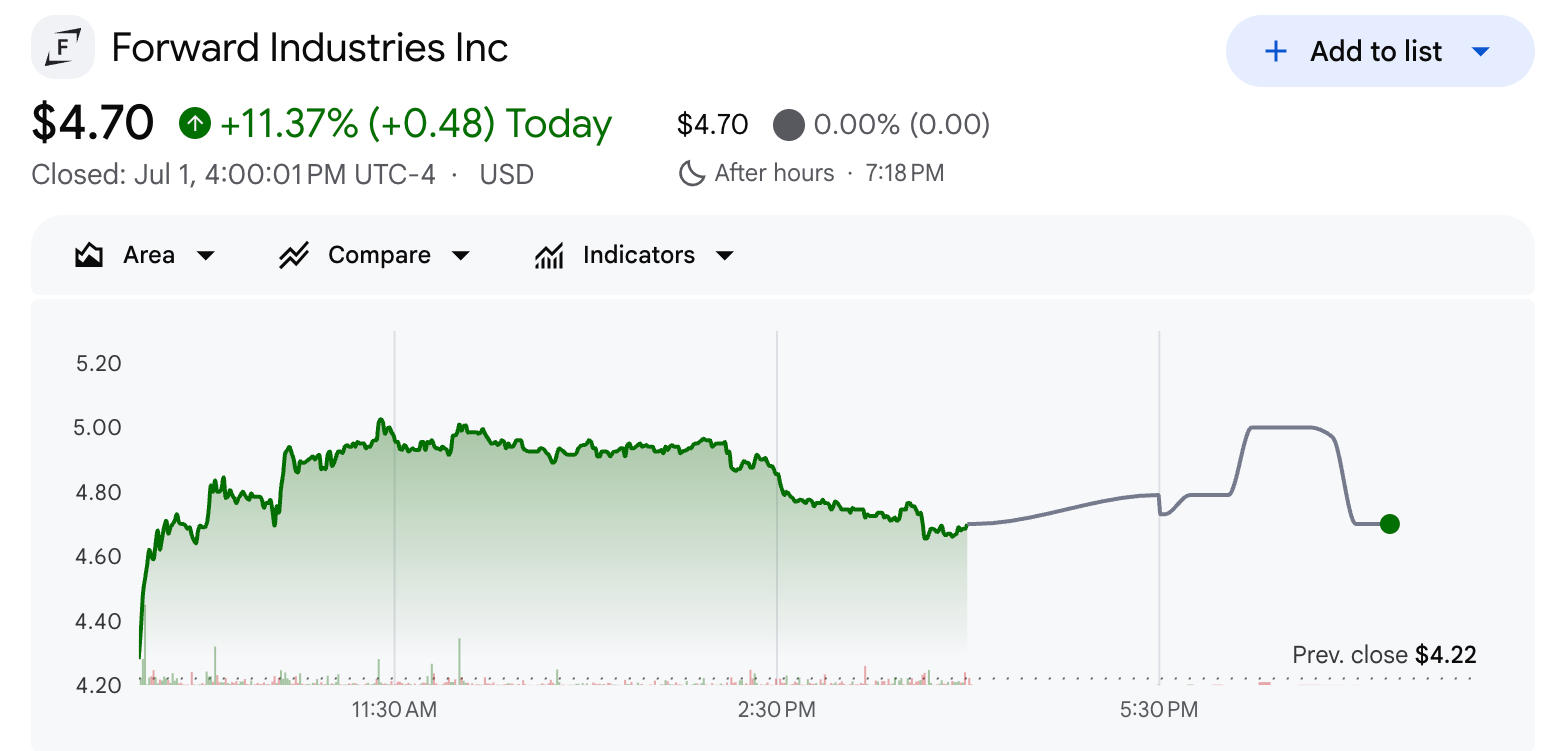
Forward Industries, the largest corporate Solana (SOL) holder, saw its share price rise by double-digits on Wednesday.
The uptick came after the company revealed it bought over 500,000 Solana (SOL) in fiscal Q3 2026.
Forward Industries SOL Treasury Tops 7.5M
FWDI closed at $4.70 on July 1, up 11.37%. The gain extended a rally that began in late June, when SOL started to recover. That rebound has offered relief to a stock weighed down by a broader 2026 downturn.
Follow us on X to get the latest news as it happens

According to the announcement, the firm acquired the tokens at an average price of about $79 each. Forward held 7.55 million SOL as of June 30, 2026.
SOL-per-fully diluted share rose to 0.0729 from 0.0669 in the prior quarter, a 36% annualized growth rate. Furthermore, shares outstanding fell to 73.85 million from 76.31 million.
Meanwhile, the company sold 93,642 shares through its at-the-market program during the quarter. Forward also cited its recent inclusion in the Russell 2000 and Russell 3000 indexes.
“By repurchasing shares when Forward trades at a discount to NAV and issuing equity when our shares trade at a premium, we dynamically allocate capital in a way that compounds SOL per share and enhances long-term intrinsic value,” CIO Ryan Navi said.
Losses Still Weigh on the Largest SOL Holder
The buying spree came after a painful stretch. Forward recorded a $283.1 million net loss for the quarter ended March 31, 2026, driven by fair-value markdowns on its SOL stack. Revenue still quadrupled year over year on staking rewards.
Market conditions have since turned more favorable. SOL gained over 15% over the past week on strong network activity, outperforming large-cap cryptocurrencies, BeInCrypto Markets data shows.

The coming months will test whether SOL’s recovery can hold, a swing that flows directly to Forward’s balance sheet as the largest SOL holder.
Subscribe to our YouTube channel to watch leaders and journalists provide expert insights
The post Forward Industries Shares Rise 11% as Solana Bet Grows to 7.5 Million appeared first on BeInCrypto.
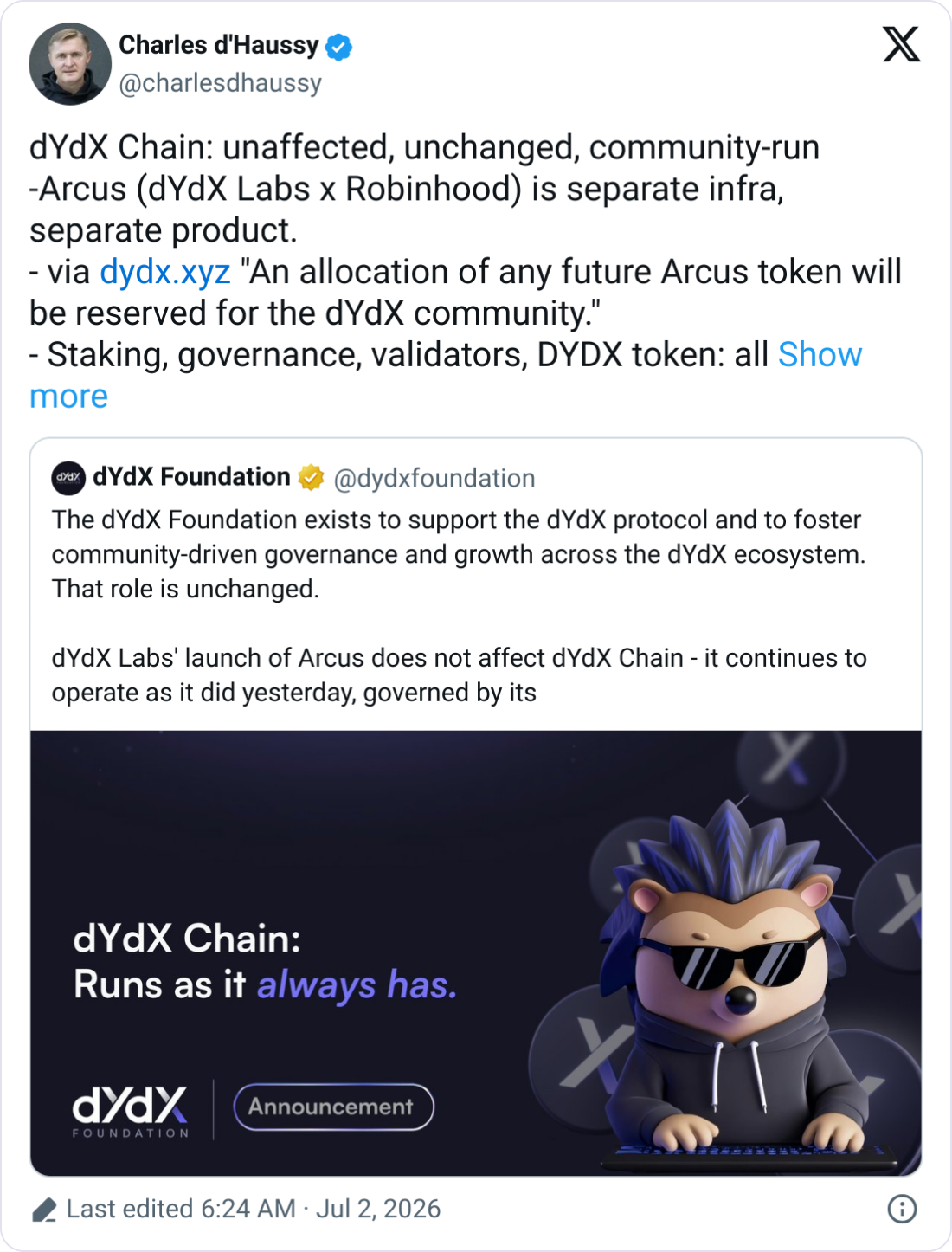
The company behind the dYdX decentralized exchange (DEX) has partnered with Robinhood to rebrand and launch the protocol as Arcus on the Robinhood Chain.
An X account for Arcus posted on Wednesday that “dYdX is now Arcus” and would launch on the Robinhood Chain, Robinhood’s Arbitrum-based layer 2 blockchain that went live the same day.
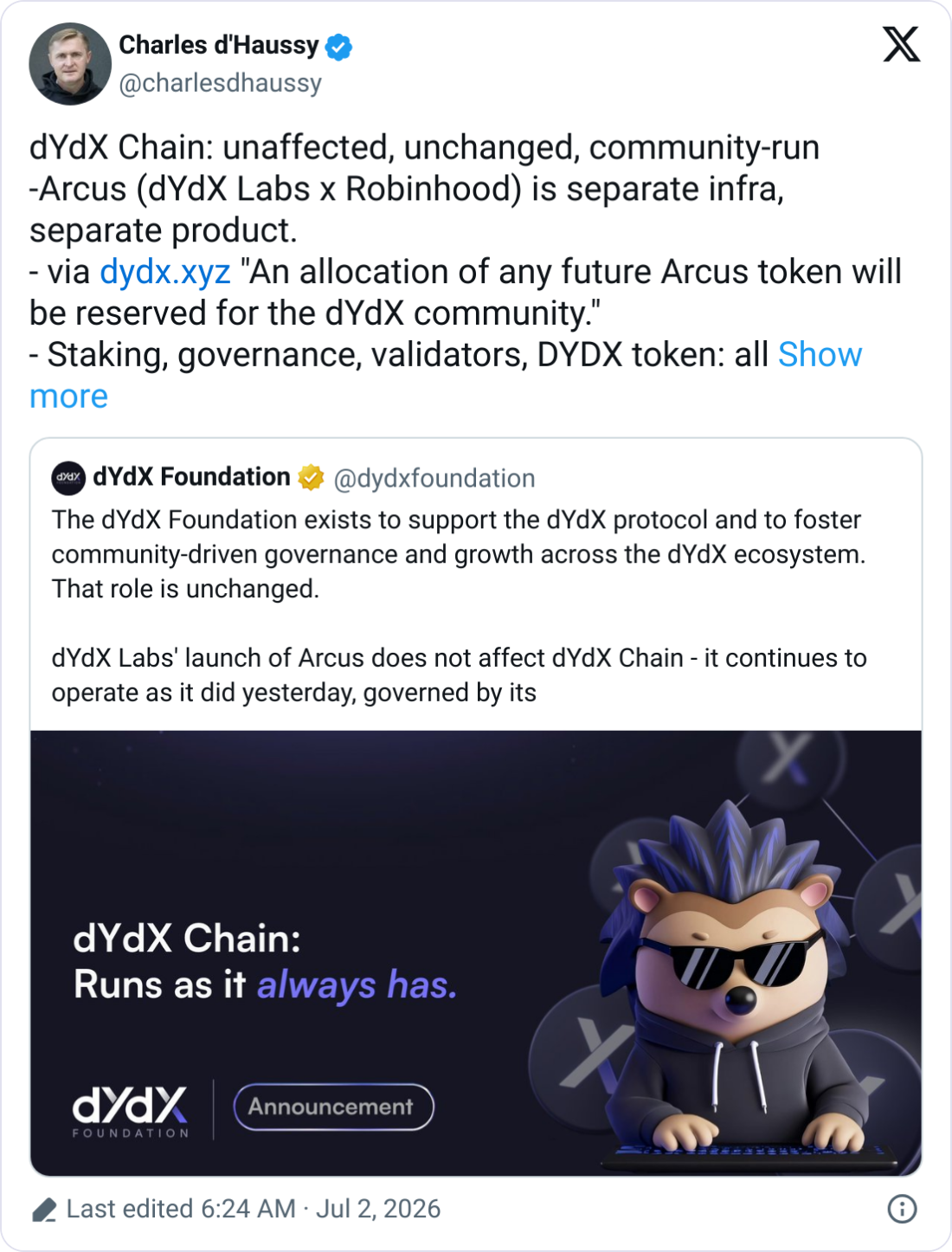
The dYdX Foundation said that dYdX Labs created Arcus “in partnership with Robinhood” and that the dYdX blockchain “is not affected by it in any way.” The platform is set to be blockchain’s “leading DEX” and will give users access to perpetual products and fee-free trading of 95 tokenized stocks.
Source: Charles d’Haussy
The DEX is part of Robinhood’s expanded push into tokenized assets and perpetual trading, two areas of crypto that have recently exploded in popularity as US regulators have shown interest in allowing the products to more easily come to market.
Robinhood’s embrace of perpetual trading comes as it looks to entice traders who have flocked to the crypto perpetual futures platform Hyperliquid, whose token has climbed nearly 150% so far this year as it has captured market share.
Arcus to offer tokenized stock, perps trading
“Until now, traders have been shut out of the most valuable markets on earth — US equities, commodities, and indices — because of where they live, market hours, and institutions restricting access,” Arcus said in a blog post. “We built Arcus to reduce these barriers.”
The protocol said that it will offer perpetuals and tokenized stock trading that will go live this month, allowing tokenized stocks to be used as collateral for perpetuals and providing access to pre-IPO markets.
Related: CFTC chair says perp trading not suitable for all assets it regulates
It added that Robinhood Crypto, the company’s crypto technology arm, made an investment in Arcus but did not disclose further details.
The dYdX Foundation said that Arcus “is a distinct, independent product built on separate infrastructure” and that the dYdX blockchain would continue to operate and be owned by its community.
Major retail-focused trading platforms have been moving to expand their offerings to remain competitive. Crypto exchange Coinbase has looked to rival Robinhood and become a full-service trading platform, having added access to thousands of stocks earlier this year.
Robinhood’s blockchain also follows a similar move from Coinbase in 2023, when the latter launched its Ethereum layer-2 blockchain Base that has grown to be the fifth-largest by value locked, according to DeFiLlama.
Meanwhile, Bitget Wallet, the self-custodial wallet from the Bitget crypto exchange, said on Wednesday that it partnered with Robinhood Crypto to integrate the company’s blockchain to allow its users to trade tokenized stocks.
The decentralized exchange 1inch also said on Wednesday that it would be among the first major swap platforms to support Robinhood Chain.
Big Questions: Do we really only need 2–5 cryptocurrencies?
Bitcoin traded above $60,700 on Thursday after a quick overnight reversal after Federal Reserve Chair Kevin Warsh said inflation risks had eased, giving a market that spent most of June grinding lower its first clear lift in weeks.
Speaking at the European Central Bank’s annual forum in Sintra, Portugal, on Wednesday, Warsh said “inflation risks have come down” while reaffirming the Fed’s commitment to returning inflation to 2%.
He declined to signal what the central bank will do at its meeting later this month, saying policymakers would weigh incoming data first. Bitcoin pared earlier losses and pushed back above $60,000 after the remarks, according to CoinDesk reporting.
Solana led the majors. The token rose about 4% on the day to around $78 and is up roughly 16% over the past week, per CoinDesk data, the only large token with a meaningful weekly gain. Ether traded near $1,630, up about 3% on the day, while XRP held at about $1.06. BNB, dogecoin and Tron were softer over the week.
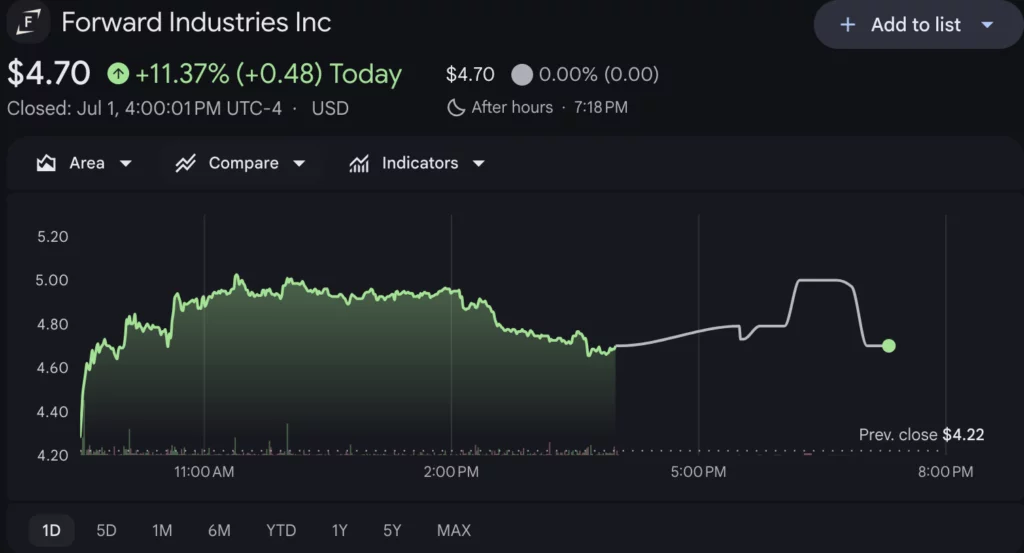
Forward Industries has expanded its Solana treasury after buying more than 500,000 SOL during fiscal Q3 2026.
Summary
- Forward Industries bought over 500,000 SOL, raising its treasury to 7.55M SOL by June 30.
- The company reported 36% annualized SOL-per-share growth while selling 93,642 shares during fiscal Q3 2026.
- Earlier losses show Solana treasury firms remain exposed to price swings and U.S. accounting rules.
The Nasdaq-listed company said its total holdings reached 7.55 million SOL as of June 30.
The company bought the tokens at an average price of about $79 per SOL. It also said SOL per fully diluted share rose to 0.0729 from 0.0669 at the end of the prior quarter.
Forward Industries stock recently traded at $4.70 on Nasdaq, up more than 10% in the past day, with an intraday high of $5.04 and volume above 3 million shares (per Google Finance data).
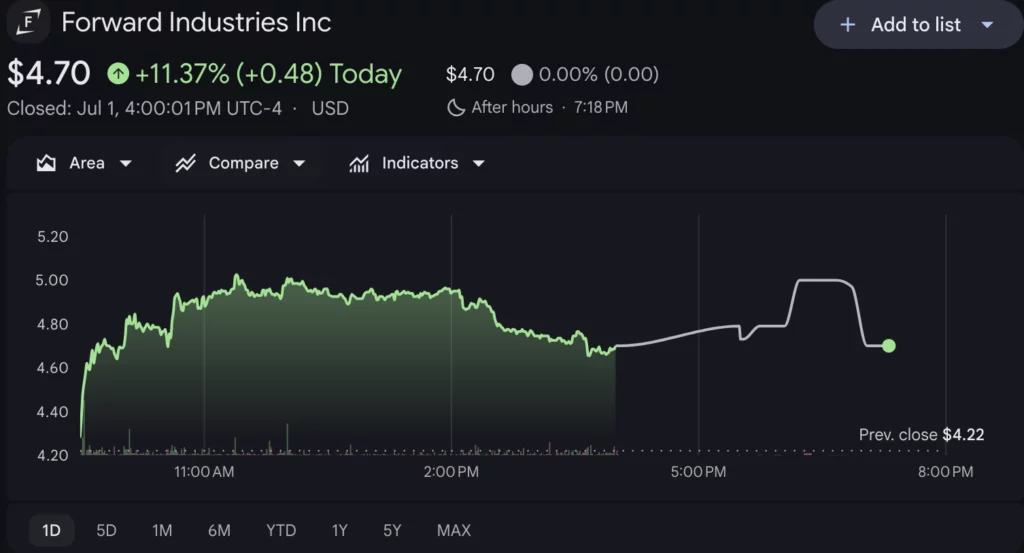
Forward Industries said the increase represented 36% annualized SOL-per-share growth. The update comes as the company continues to build its Solana treasury while earlier filings show how crypto price moves have shaped its reported results.
Forward Industries expands Solana holdings
In a July 1 company release, Forward Industries said it sold 93,642 common shares through its At The Market offering during fiscal Q3. The company said it used public market capital in a way that raised SOL per share for existing shareholders.
Forward described itself as the largest Solana treasury company. It said its recent inclusion in the Russell 2000 and Russell 3000 indexes gives it wider access to institutional investors when its shares trade above net asset value.
The company also said it can borrow against fwdSOL collateral through institutional partners. Forward said this lets it seek liquidity at a lower cost than its staking yield, which it placed between 6.4% and 7.3%.
Forward links strategy to SOL per share
“Our mandate is simple: maximize SOL per share and create long-term shareholder value,” said Chief Investment Officer Ryan Navi. He said the company uses several capital formation methods to add SOL in a way it views as accretive.
Navi added that Forward can repurchase shares when they trade below net asset value and issue equity when they trade above it. He said the Russell index additions could also widen the company’s investor base and help fund more SOL purchases.
Forward also pointed to Solana network activity in a separate X post. The post quoted SolanaFloor data saying daily, weekly, and monthly Solana transaction counts had reached record levels across measured timeframes.
Earlier losses remain part of the story
The latest purchase follows a period of reported losses tied to SOL price changes. As previously reported, Forward Industries neared a $1 billion Solana paper loss after the company reported a $585.6 million net loss for the quarter ended Dec. 31, 2025.
That earlier result included a $560.2 million loss on digital assets and a $33 million impairment under U.S. GAAP treatment. The company said the loss reflected fair-value accounting for its SOL holdings, not a direct cash outflow.
In addition, Forward also transferred 455,784 SOL to Coinbase Prime in June. That move drew attention because deposits to prime brokerage platforms can serve several purposes, including custody, liquidity management, collateral use, or asset sales.
Solana treasury model faces market test
Forward launched its Solana treasury strategy in September 2025 with backing from investors and partners including Galaxy Digital, Jump Crypto, and Multicoin Capital. The company says its strategy includes buying, holding, staking, trading, and investing in SOL-related assets and projects.
The broader digital asset treasury sector has faced pressure during crypto market declines. As crypto.news reported, treasury companies tied to Bitcoin, Ethereum, and Solana have carried large unrealized losses as token prices fell.
Forward’s Q3 update shows that the company is still adding SOL despite earlier losses. The central measure it is asking investors to watch is SOL per fully diluted share. That metric now sits higher than the prior quarter, while the value of the treasury still depends on SOL market prices, staking revenue, borrowing costs, and shareholder dilution.


Binance said its Direct Stocks product crossed $1 billion in U.S. equities acquired within 30 days of launch.
Summary
- Binance’s Direct Stocks crossed $1B in user-held U.S. equities within 30 days of launch globally.
- Emerging markets made up 73% of users, showing demand for app-based access to U.S. stocks.
- Stablecoins helped users buy fractional equities beside crypto without traditional brokerage and bank transfer barriers.
The product went live on June 1 and gives eligible users access to more than 7,000 U.S. stocks and ETFs in the same app they use for crypto.
The exchange said the product also processed close to $3 billion in trading volume during the same period. The 30-day window included 22 trading days, according to a Binance blog post.
Binance said about 73% of Direct Stocks users came from emerging markets. The company framed the data around demand from regions where brokerage accounts, bank wires, minimum balances, and foreign market access have often limited retail participation.
Binance stock access gains early demand
Direct Stocks lets users buy fractional U.S. stocks and ETFs with stablecoins and selected crypto balances. As previously reported, Binance opened U.S. stock trading access for eligible non-U.S. users in June, offering more than 7,000 equities and ETFs with purchases starting from $5.
The product places equities beside crypto balances in one interface. Binance said the setup removes some steps tied to traditional brokerage access, including separate bank transfers and new account flows. The company said users acquired more than $150 million in U.S. equities per day during the first 30 days.
Emerging markets drive the user base
Binance said emerging markets accounted for most Direct Stocks users. The company also said about one in seven visitors to its stock trading page registered an account, and nearly 90% of those new sign-ups placed a trade.
The data follows earlier Binance Research claims about broader demand for equity access through crypto exchanges. As reported by crypto.news, Binance Research projected that crypto exchanges could bring 300 million new equity investors and $2 trillion in new capital into global stock markets by 2031. The report linked that growth to stablecoins, crypto exchange reach, and users in underbanked regions.
Shunyet Jan, Binance’s Head of Spot and Derivatives Business, said, “A billion dollars in 30 days is a sign of the demand that’s been waiting decades for a door to walk through.” He added that Binance built the product for users who “never had a way in.”
Stock trading uses broker-linked rails
Binance does not custody the securities traded through Direct Stocks. Binance disclosed an Alpaca stake as its stock trading service expanded. Nest Trading acts as introducing broker, while Alpaca handles execution, clearing, settlement, custody, dividends, and corporate actions.
The model gives Binance exposure to traditional equities while keeping securities activity linked to regulated brokerage partners. Users fund stock purchases with stablecoins and supported crypto assets. Binance said the product targets eligible users outside the U.S.
Tokenized equity race widens
The direct stock rollout comes as exchanges add more equity-linked products. Crypto.news reported that Binance launched bStocks, letting eligible users convert supported U.S. stock holdings into tokenized assets that can trade around the clock.
Moreover, other exchanges are also moving into stock access. Bitget launched Stock+, allowing eligible users to buy real U.S. stocks with crypto converted into USDC through regulated brokers.
Binance said technology stocks made up the largest share of Direct Stocks holdings. It said the technology sector accounted for about 71% of holdings, while semiconductor names made up around 48%. The company also projected that Direct Stocks could exceed $10 billion by the end of 2026 if current growth continues, though it said the projection was illustrative and not a guarantee.
Crypto World
FBI Director Kash Patel caught sleeping on required disclosure of six-figure MSTR investment


FBI Director Kash Patel failed to timely disclose a six-figure purchase of stock in Strategy (MSTR), the world’s largest publicly-listed bitcoin holder, according to a report by nonpartisan news outlet NOTUS.
Patel supposedly purchased between $100,001 and $250,000 worth of MSTR on Nov. 21, but did not report the trade to regulators until May 26.
The reason for the delay? miscommunication. Patel informed the Office of Government Ethics that he “inadvertently omitted” the transaction due to an unspecified “miscommunication.”
According to the Stop Trading on Congressional Knowledge (STOCK) Act, high-ranking executive branch officials need to publicly disclose individual stock trades over $1,000 within 45 days from the transaction.
The trade has drawn intense scrutiny from government watchdogs due to Strategy’s BTC accumulation business and its previous business with federal agencies.
The company, which according to NOTUS has done millions of dollars in business over the years with the Justice Department, calls itself as a “Bitcoin Treasury Company,” and aggressively accumulates BTC as its primary reserve asset. Since 2020, the company has built a coin stash of 847,363 BTC, worth over $50 billion as of this writing.

Taylor Swift and Travis Kelce’s extravagant wedding rumours – could they shock the world?

Fed can afford to stay patient as inflation risks ease: Steve Englander

Ethereum Institutional Launches as Independent Nonprofit to Court Banks and Asset Managers


-

 Fashion6 days ago
Weekend Open Thread: Staud – Corporette.com
-

 Politics6 days ago
The House | Manchesterism won’t survive the painful trade-offs unless it gets citizens on board
-

 Crypto World2 days ago
Strategy authorizes up to $1.25B in Bitcoin sales under new capital plan
-

 Politics6 days ago
Potential 2028er World Cup attendee leaderboard
-

 Business6 days ago
Asia stock markets slide as tech shares slump
-

 News Videos3 days ago
MAJOR BITCOIN & MARKET UPDATE!!!! (MUST WATCH ASAP!!!)
-

 Tech6 days ago
A Look At A Gaggle Of Transputer Boards
-
 Crypto World7 days ago
Dell (DELL) Shares Tumble Over 5% Following Analyst Downgrade to Hold
-

 Crypto World5 days ago
Coinbase, Circle Deepen Crypto Stock Losses Despite Resilient S&P 500
-

 Business2 days ago
Australia treasurer says alleged access of prime minister’s bank data ’incredibly concerning’
-

 Crypto World5 days ago
Kraken's xStocks Opens Bending Spoons IPO Registration to EEA Retail
-

 Sports5 days ago
FIH Pro League: India defeat Pakistan 7-1, register biggest win of campaign | Other Sports News
-

 Crypto World6 days ago
Bitcoin Sparks $600M Hourly Liquidations With $65,000 Set To Become Resistance
-

 Tech4 days ago
Bluekit phishing kit adopts browser-in-the-middle for login theft
-

 Tech2 days ago
Anonymous researcher drops 0-day ‘exploitarium’ repo
-

 Tech5 days ago
Russian hackers now target Signal backup recovery keys
-
 Crypto World6 days ago
Hyperliquid Named on Singapore MAS Investor Alert Register
-

 Crypto World6 days ago
RTX holders must register wallets before token distribution begins
-

 Sports18 hours ago
Broncos roster: OL Ben Powers (No. 74) entering final year of contract
-
 Business3 days ago
The AI boom won’t burst all at once. It will pop in ‘rolling bubbles’: Macquarie
You must be logged in to post a comment Login