
Crypto World
U.S. Federal Prosecutors Reject Ex-Celsius CEO’s Motion to Vacate


Prosecutors in the Southern District of New York (SDNY) are urging a federal judge to reject Alex Mashinsky’s bid to overturn his 12-year prison sentence tied to Celsius’s collapse. In a Friday filing, SDNY attorneys James McDonald and Allison Nichols argued that Mashinsky’s petition lacks legal substance and should be denied without additional proceedings.
The dispute centers on a motion Mashinsky filed after telling the court in May that he would proceed pro se—representing himself. His petition to vacate the conviction and sentence includes claims that point to matters involving cryptocurrency exchange FTX and his former colleague, Celsius chief revenue officer Roni Cohen-Pavon.
Key takeaways
- SDNY prosecutors asked the court to deny Mashinsky’s motion to vacate, calling multiple arguments “without merit.”
- The government criticized the petition for relying on allegations that were not supported by a sworn declaration.
- Prosecutors disputed claims that Mashinsky received ineffective assistance of counsel.
- Mashinsky is serving a May 2025 sentence of 144 months after pleading guilty to commodities and securities fraud.
- Cohen-Pavon, who prosecutors described as providing “substantial assistance,” was sentenced to time served in May.
Prosecutors reject claims in Mashinsky’s petition
In their filing, prosecutors said Mashinsky failed to meet the threshold for relief. They argued that his motion is essentially a reprise of issues raised during sentencing, rather than a valid basis to undo the conviction or the punishment.
Prosecutors also pushed back on Mashinsky’s complaints about the performance of his legal team. While the filing indicates Mashinsky stops short of asserting factual innocence, it characterizes his approach as shifting blame to counsel for not pursuing certain arguments.
“Mashinsky has not even submitted a sworn declaration in support of these baseless allegations, and his petition should be denied without a hearing or further fact-finding,” prosecutors wrote, adding that the court should not revisit settled points based on unsworn claims.
What the court filing says about evidence and procedure
Mashinsky’s motion was filed after he announced he would take over his own representation. The government’s response suggests the petition’s evidentiary posture is a key weakness: prosecutors singled out the absence of a sworn declaration supporting the allegations.
That procedural detail matters because motions to vacate typically require more than generalized accusations; courts generally look for specific, substantiated grounds for relief. In the government’s view, Mashinsky’s filing did not meet that standard.
As of Tuesday, the judge overseeing the case had not issued a response to the government’s submission.
Background: Celsius collapse, guilty pleas, and sentencing
Mashinsky was sentenced in May 2025 to 144 months in prison after pleading guilty to commodities fraud and securities fraud connected to “manipulative and deceptive devices” at Celsius. The guilty plea followed a broader legal crackdown on Celsius after the platform filed for bankruptcy in 2022 amid a wider market downturn that began with the collapse of Terraform Labs.
Roni Cohen-Pavon—Celsius’s chief revenue officer—was also indicted in 2023 alongside Mashinsky and later pleaded guilty. According to prosecutors, Cohen-Pavon provided “substantial assistance” to the government’s case. In May, she was sentenced to time served.
At sentencing, Mashinsky was ordered to pay $48 million in forfeiture. He also agreed to pay $10 million as part of a separate settlement with the US Federal Trade Commission, alongside arrangements described as including a $47 billion judgment that was suspended.
Earlier coverage also noted related enforcement actions against Celsius leadership, including a separate FTC matter involving Celsius co-founders Leon Goldstein and another defendant, referenced in connection with the broader Celsius fallout.
Regulators still pursuing parallel cases
While the criminal case reached sentencing for Mashinsky and Cohen-Pavon, regulators continued to work through other legal tracks tied to Celsius leadership.
In June, the US Commodity Futures Trading Commission (CFTC) announced that Mashinsky was permanently banned from trading in markets under the CFTC’s authority. That action was described as among the last major resolutions tied to Mashinsky and Celsius following the 2022 collapse.
At the same time, a civil action by the US Securities and Exchange Commission (SEC) involving a co-founder was reported as ongoing even after the criminal case moved forward and the court issued judgment against the platform. As of July 30, the SEC said its attorneys and Mashinsky were “engaged in settlement discussions.” The SEC requested 60 days to file a status report, effectively pushing the next checkpoint toward the end of September.
For investors and market participants, these parallel processes underline a recurring reality in crypto enforcement: criminal cases can conclude on a timetable that differs from regulatory litigation. Even when one front reaches a sentencing milestone, other matters—whether commodities, securities, or consumer-protection—can continue to shape compliance expectations and potential liability.
Readers should watch whether the SDNY judge grants or denies Mashinsky’s request to vacate, and whether the court allows any additional fact-finding or hearings. At the same time, settlement dynamics in the SEC civil matter—and any further regulatory steps following the CFTC’s permanent trading ban—remain key to understanding what outcomes could still materially affect Celsius-related defendants and those watching closely for precedent in crypto enforcement.

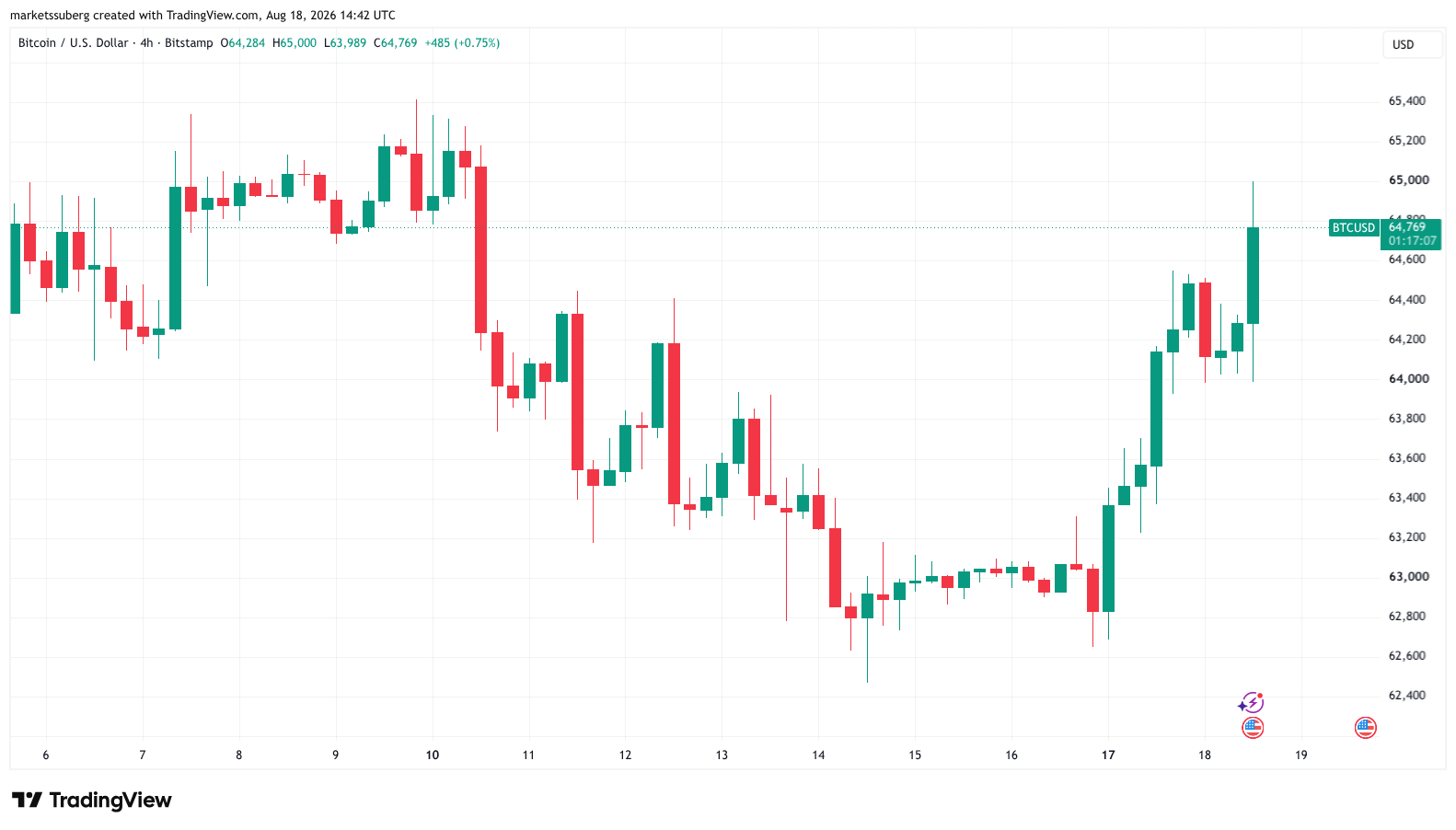
Bitcoin (BTC) hit $65,000 after Tuesday’s Wall Street open as US stocks rebounded in spite of geopolitical pressure.
Key points:
- Bitcoin reaches $65,000 for the first time since Aug. 10 as risk assets navigate fresh US-Iran signals.
- Analysis warns of surging US 30-year bond yields, which hit 29-year highs of 5.34%.
- BTC price analysis flags decision time on a head-and-shoulders bottoming structure.
Bitcoin diverges from US stocks as Trump says Strait of Hormuz “open”
Data from TradingView showed BTC/USD building on the week’s gains as the S&P 500 bounced from 7,696, its lowest level since Aug. 4.
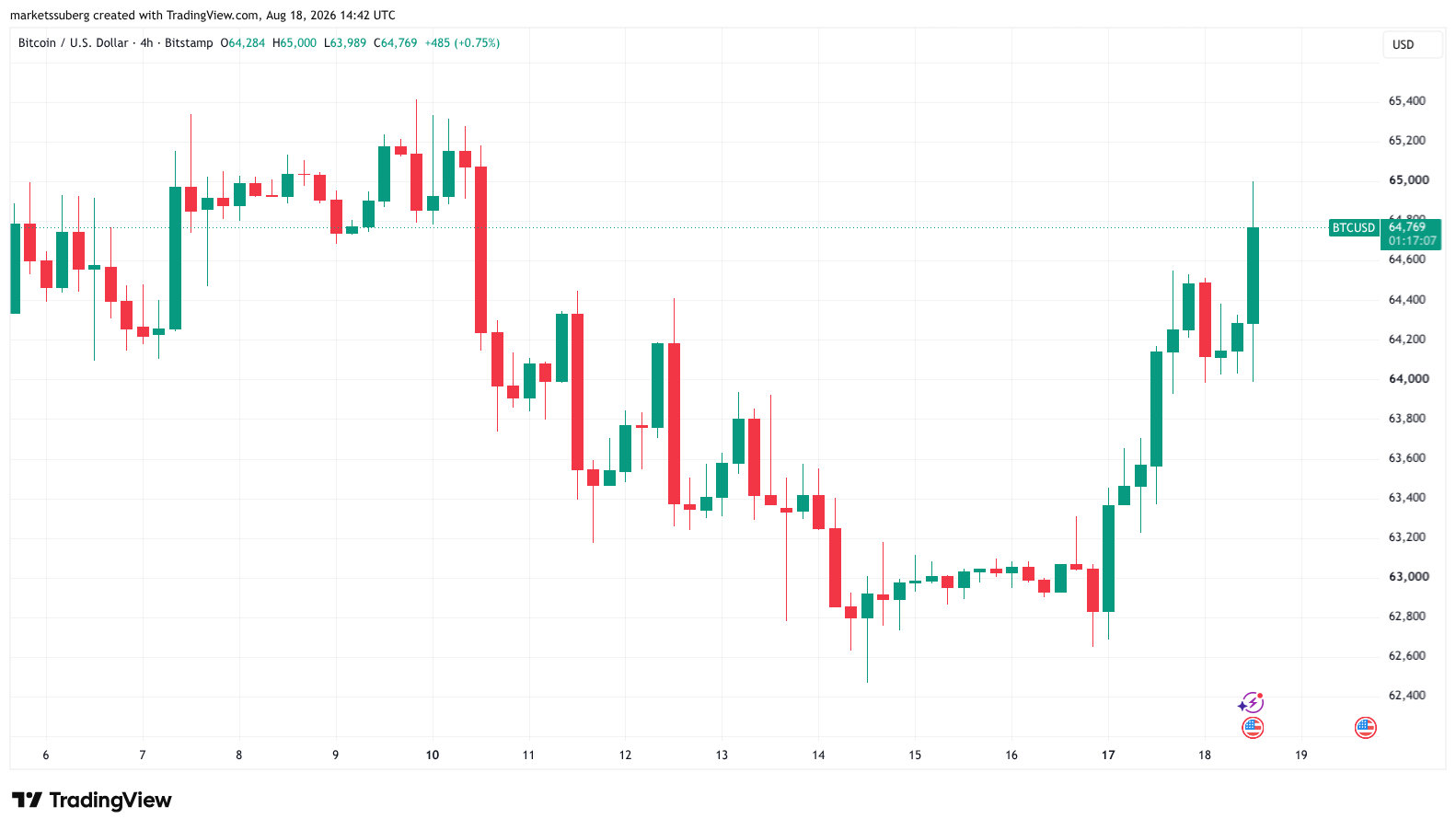
BTC/USD four-hour chart. Source: Cointelegraph/TradingView
This came after US president Donald Trump posted a map of the closed Strait of Hormuz oil route to Truth Social where it was labeled “new US territory.”
Both the US and Iran lay claim to control of Hormuz, with Trump threatening US ally Oman with military action over its plans to work with Iran on charging tolls to shipping traffic. In a subsequent post, Trump confirmed that further diplomacy with Iran was not on the agenda.
“There are no talks or conversations going on, or scheduled, with the Islamic Republic of Iran. The Naval Blockade remains in full force and effect. The Hormuz Strait is open and operating. All water mines have been removed or detonated,” he wrote.
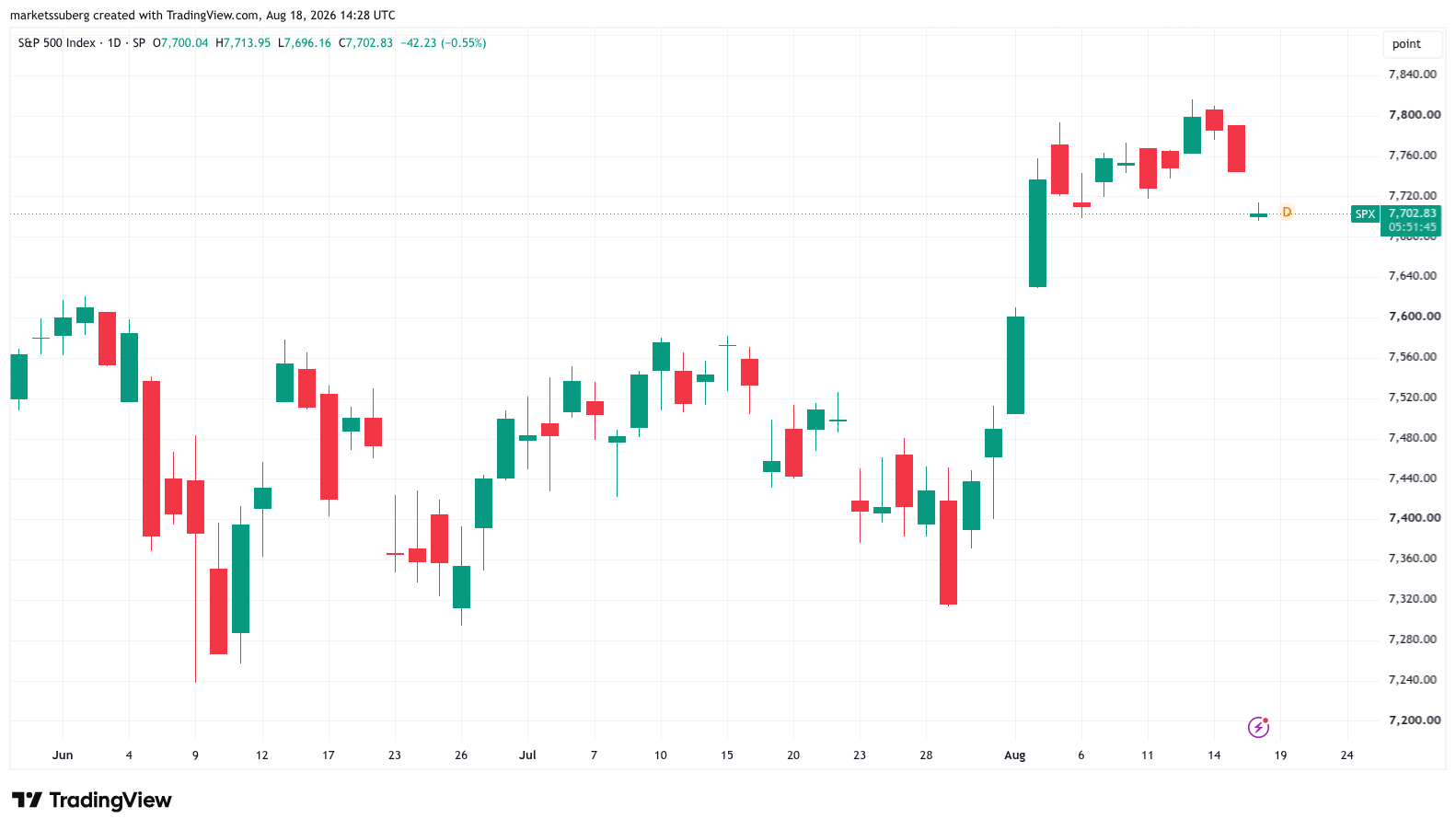
S&P 500 one-day chart. Source: Cointelegraph/TradingView
As on Monday, oil avoided major volatility, with WTI crude down 1% at the time of writing at $84 per barrel. US government bonds continued to show strain, with the 30-year yield hitting 5.34%, its highest since January 2007.
“Bond prices are sending warnings,” BNY Mellon analyst Geoff Yu wrote in a research note quoted by the New York Times. Yu said that the surge came as “investors demand more compensation for inflation risk,” while also attributing the upside to government borrowing.
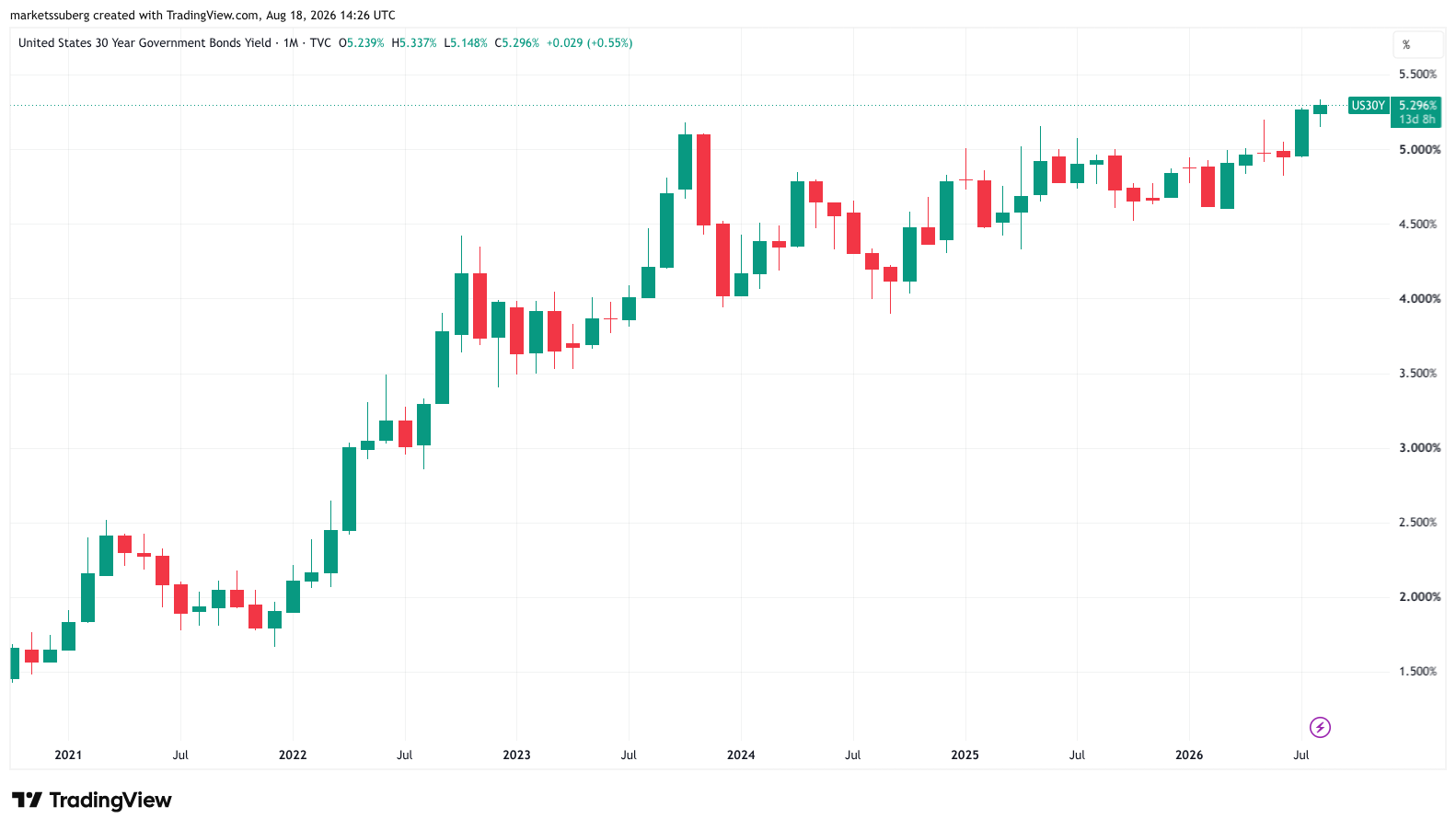
US 30-year bond yields one-month chart. Source: Cointelegraph/TradingView
BTC price faces crunch rebound test
Updating X followers on BTC/USD, trader and analyst Aksel Kibar eyed the culmination of a potential reverse head-and-shoulders pattern at $62,300.
Related: Bitcoin price spike to $64.5K was ‘low-volume liquidity trap’: Analysis
“If $BTCUSD is going to rebound, it has to come from here,” he argued on Monday.
Kibar offered a $53,000 target in the event of the head-and-shoulders structure failing, with $76,000 a potential upside target should the rebound sustain.
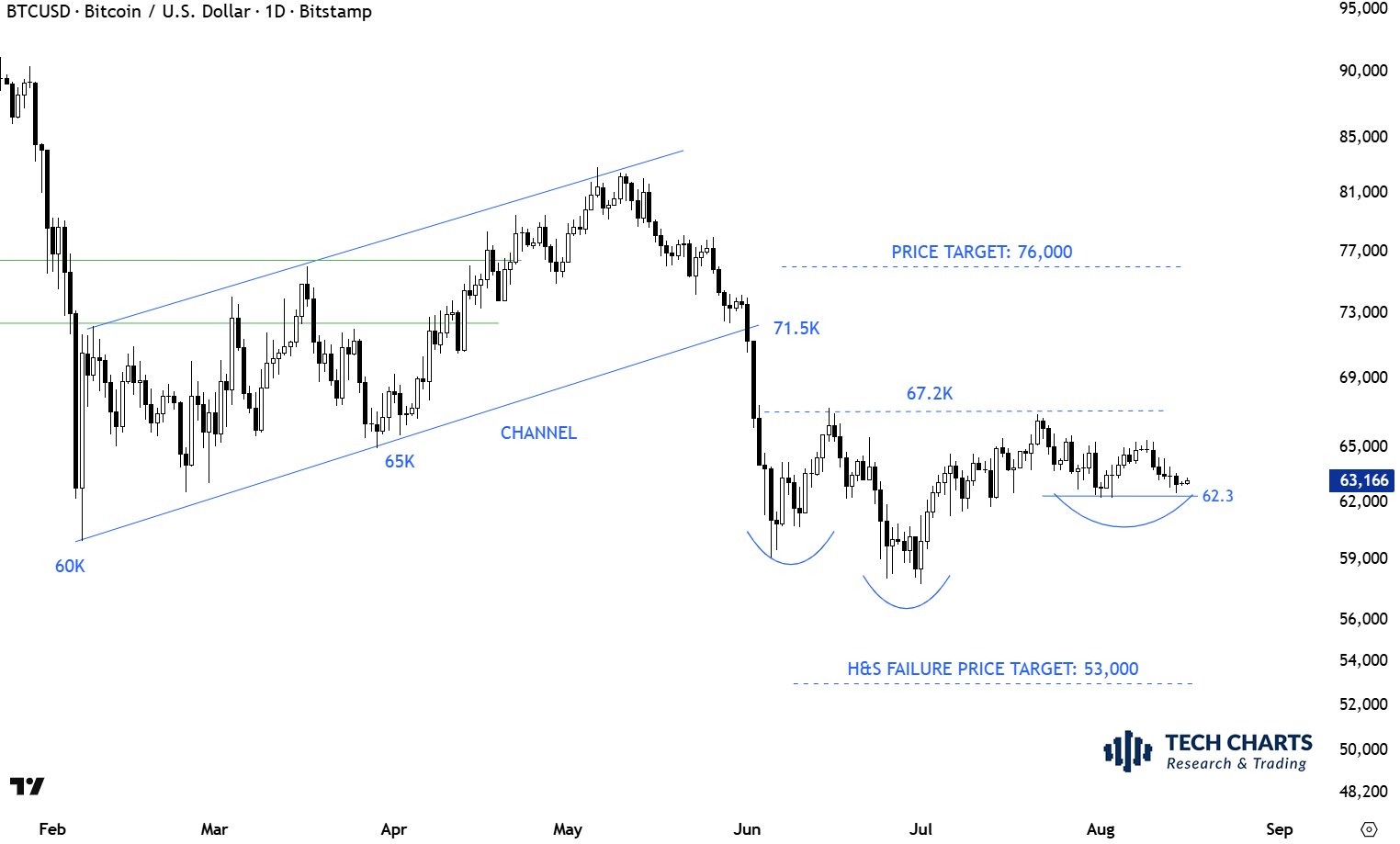
BTC/USD one-day chart. Source: Aksel Kibar on X.com
Previously, Cointelegraph reported that underwater investors were contributing to Bitcoin’s inability to break higher. Its rebound to $64,500 also stopped short of an overhead trend line, the 50-month exponential moving average (EMA). This moving average is now in place as resistance at $65,827.
Crypto World
Bitcoin’s next major move may be higher, but liquidity has yet to return: Bitfinex analysts


Bitcoin has held above its $63,200 median realized price as Bitfinex analysts identified $67,176 as the breakout level that could raise the chances of an upside volatility expansion.
Summary
- Bitcoin’s $63,200 median realized price has provided support during the past two weeks.
- A move above $67,176 would return recent buyers to profit and test overhead resistance.
- US spot Bitcoin ETFs recorded $385.2 million in weekly net outflows.
- Stablecoin supply has fallen 4.5% from its May peak to $300.7 billion.
- Bitfinex analysts said thin participation could amplify relatively small buying or selling flows.
Bitfinex analysts told crypto.news that Bitcoin’s prolonged defense of its median realized price has increased the probability that its next large move could favor buyers, although weak ETF demand and falling stablecoin supply have left the potential rally without fresh liquidity.
Bitcoin’s $63,200 support has held through repeated tests
Bitcoin (BTC) was trading near $64,500 at the time of writing after spending almost three months in a contracting range, according to Bitfinex analysts. The analysts identified $63,200 as the median realized price, an on-chain cost-basis level that has served as support during repeated tests over the past two weeks.
The level has acted as support during repeated tests over the past two weeks. Bitcoin finished the week ending Aug. 16 down 3.1% at $62,921, but it later recovered and returned to the $63,000–$64,000 range.
“Price has sustained over the Median Realised Price despite repeated tests and signals hinting at late bear market conditions,” the analysts said. “This combination suggests higher odds that volatility expansion breaks to the upside.”
At $67,176, the short-term holder realized price remains the main level Bitcoin must recover, according to the analysts. A move above it would return recent buyers to an average unrealized profit while placing BTC against the next area of overhead supply.
Failure to hold $63,200 would weaken that setup. Bitfinex identified $57,803, near Bitcoin’s June and bear-market lows, as the next major downside area if sellers break the median realized price. Farther below, the aggregate realized price at $52,699 represents the analysts’ long-term market floor, where the average holder base would approach an underwater position.
Bitcoin had already tested comparable support at the start of August. As crypto.news previously reported, BTC traded near $63,000 on Aug. 1 after US spot ETF outflows reached $265 million in one day. The daily chart placed the price close to its $63,150 Fibonacci support, while four-hour money flow remained negative.
Low Bitcoin activity could magnify the next move
Compressed volatility has coincided with exceptionally weak trading and network activity, according to the Bitfinex Alpha report. Coin-adjusted spot exchange volume has fallen to levels last recorded in early 2019 when measured across major platforms.
Binance-only volume, which removes some distortions caused by the exchange’s introduction of zero-fee trading in 2022, has approached depths associated with the 2023 bear market. Bitcoin transfer velocity has also reached a seven-year low, indicating that coins are changing hands less frequently.
“Minimal flows exert disproportionate influence on price action,” Bitfinex analysts said. “Modest bidding can spark a rally just as readily as minor selling triggers a breakdown.”
Depressed participation cannot establish the direction of the next move by itself. Instead, the analysts said the thin market allows limited capital to have an unusually large effect in either direction. A small return of spot demand could push BTC through resistance, while another round of selling could force the price below support.
Historical periods of low volume and extended volatility compression have often preceded sharp price moves, according to Bitfinex. In the current setup, the analysts give an upside break higher odds because Bitcoin has continued to recover from tests of its median realized price rather than accepting sustained trading below it.
Institutional demand has yet to support that outcome. US spot Bitcoin ETFs posted net outflows on four of the five sessions between Aug. 10 and Aug. 14, losing about $385.2 million for the week, according to Farside Investors data cited by Bitfinex.
Corporate treasury demand also turned negative after Strategy recorded a third consecutive week of divestment, including the sale of 1,690 BTC. Bitfinex’s “Two-Complex Spot Bid,” which tracks ETF and corporate treasury activity, produced its first fully negative reading as both groups became net sellers during the same week.
The weakness extends to a difficult period for US-listed Bitcoin funds. An Aug. 13 report on the institutional ETF rotation found that spot Bitcoin ETFs lost $5.4 billion during the first half of 2026. July brought $205 million in net inflows, ending the run of monthly losses but remaining well below the pace recorded during early 2025.
Crypto liquidity has not followed easier US conditions
July inflation data improved two conditions that Bitfinex considers supportive for crypto: lower expected interest rates and loose financial conditions. Fresh capital entering digital assets, the third condition in the analysts’ framework, has not followed.
US consumer prices increased 0.1% in July after falling 0.4% in June, leaving annual inflation at 3.4%, according to Bureau of Labor Statistics figures cited in the report. Core inflation, which excludes food and energy, rose 0.2% for the month and 2.5% from a year earlier.
Cooling inflation reduced the implied probability of a September Federal Reserve rate increase from about 52.2% before the consumer price report to 30.1% after the producer price release, Bitfinex said. Two-year Treasury yields fell from 4.25% on Aug. 10 to 4.15% on Aug. 13, while the 10-year yield declined from 4.70% to 4.64%.
US equities responded faster than Bitcoin. The S&P 500 closed at record highs on Aug. 12 and Aug. 13, while BTC ended the week lower. An earlier report on Bitcoin’s CPI reaction examined the same split after the 3.4% inflation reading failed to produce a sustained crypto rally.
Bitfinex attributed the difference to how each market processes monetary policy expectations. Lower expected rates can lift equity valuations because stocks price future cash flows, while crypto depends more heavily on capital that has actually entered spot funds, stablecoins or on-chain markets.
Financial conditions were already loose before the inflation releases. The Chicago Fed National Financial Conditions Index stood at minus 0.549 for the week ending Aug. 7, its fifth consecutive weekly decline and the loosest reading in the current run, according to the report.
Long-dated Treasury debt presented a less supportive signal. Although shorter maturities rallied, the 30-year yield closed at 5.21% on Aug. 13 after reaching 5.25% three days earlier. Bitfinex interpreted the steepening yield curve as evidence that investors remained concerned about fiscal and duration risk even as expectations for another Fed increase declined.
ETF inflows and stablecoin growth would confirm renewed demand
Stablecoin supply offers another measure of capital available within digital-asset markets. Bitfinex said total supply peaked at $315 billion in mid-May before falling about 4.5% to $300.7 billion.
The decline means easier US financial conditions have not yet produced an increase in capital held on-chain. July coverage of the stablecoin supply contraction found that the market had lost about $10 billion from its May record, including a $7.7 billion decline during June.
“The central question is therefore shifting from whether monetary conditions are improving to whether that improvement begins producing actual crypto inflows,” Bitfinex analysts said.
In their view, sustained spot Bitcoin ETF inflows combined with an expanding stablecoin supply would show that the link between easier financial conditions and crypto demand had resumed. Until both measures improve, the analysts consider the monetary setting increasingly supportive, but the potential Bitcoin rally “unfunded.”
Inflation relief has also remained uneven for US households. Bitfinex noted that July’s energy index fell 1.5%, led by a 2.9% drop in gasoline, while services inflation stayed firm. Producer prices for electronic components and accessories were 28% higher than a year earlier, and electronic computer prices rose 3% during July after eight months of little movement.
Consumer sentiment weakened at the same time. The University of Michigan’s preliminary August index fell 7.6% from July to 51, while one-year inflation expectations increased from 4.2% to 4.3%. Real average hourly earnings declined 0.2% between July 2025 and July 2026, according to labor data cited by Bitfinex.
The Federal Open Market Committee is scheduled to meet on Sept. 15–16 after receiving another round of employment and inflation figures. Bitfinex said its rate outlook would face a challenge if the implied probability of an increase returned above 60%, while two consecutive initial jobless claims readings above 230,000 would weaken its labor-market assessment.

Why are Mangione’s lawyers arguing that the state case should be dropped?
Mangione previously pleaded not guilty to all the federal and state charges levied against him, and his lawyers have not publicly disclosed why the 28-year-old chose to change his plea in the federal case. But after the hearing on Friday, his lawyers announced that they had filed the motion claiming double jeopardy.
“It was a single tragic event, yet he’s being prosecuted twice for the same conduct,” Karen Friedman Agnifilo, one of Mangione’s lawyers, told reporters on Friday.
In the motion, his lawyers argue that Mangione’s federal guilty plea “‘terminates’ the federal proceeding” and is now considered to be a “previous prosecution,” meaning that the New York state case would be a “second prosecution,” triggering double jeopardy.
His lawyers also allege in the filing that the Justice Department and Manhattan District Attorney’s Office coordinated their cases against Mangione so that the state would go to trial first “to ensure dual successive prosecutions, in order to attempt to avoid double jeopardy protections.” They allege that this effort was meant “to maximize the punitive effectiveness of the two cases at the expense of Mr. Mangione,” which in turn “undercuts the separate sovereign rationale of the federal double jeopardy jurisprudence.”


Kraken’s payment app, Krak, has launched a multi-asset debit card in the US, allowing customers to spend crypto and fiat while earning up to 2% cashback in dollars or Bitcoin (BTC).
The card supports more than 600 currencies and assets, with holdings converted into US dollars at point of sale. A single purchase can draw from multiple balances, with users setting the order in which assets are spent, according to an announcement Tuesday.
The card is issued by Lead Bank on Visa’s network and powered by Stripe Issuing, with physical and virtual versions available to eligible US customers. The company said cashback rates depend on average assets held across Krak, Kraken and Kraken Pro.
Krak is positioning the card as an alternative to credit-based rewards programs. A Morning Consult survey of 2,001 US adults commissioned by Krak found that 42% of credit card holders worry about paying off their monthly balance, while 60% of respondents said they would switch to a debit card offering rewards without taking on debt.
Kraken’s consumer money and payments app has issued more than 135,000 multi-asset cards across the UK and European Economic Area since launching there in December 2025, the company said.
Related: Kraken opens Jersey Mike’s IPO to retail investors through tokenized shares and direct allocations
Payward eyes broader financial services push
Payward has set its sights on expanding its financial services product line.
Co-CEO of Kraken’s parent company, Arjun Sethi, discussed the broader strategy Tuesday at the Wyoming Blockchain Symposium, including its push into additional asset classes and financial services.
“As you start expanding into multiple asset classes, you’re just generally gonna be less susceptible to very specific markets,” Sethi said.
He added that Payward now offers banking services and described tokenization as “a large part” of the company’s broader effort to expand its financial offerings.
He also compared the company’s ambitions with those of major traditional financial institutions, saying the company needs to build products and services “not too different to a JP Morgan or a financial institution.”
Sethi’s comments come as major crypto exchanges broaden their businesses beyond spot crypto trading, with Coinbase and others expanding into equities, derivatives, prediction markets, tokenized assets and pre-IPO products.
Separately, Kraken on Tuesday launched trading in more than 7,000 US-listed stocks for customers in the European Economic Area (EEA).
Magazine: ‘Fabricated rumors’ about BitMart founder, Binance bStocks dominate: Asia Express
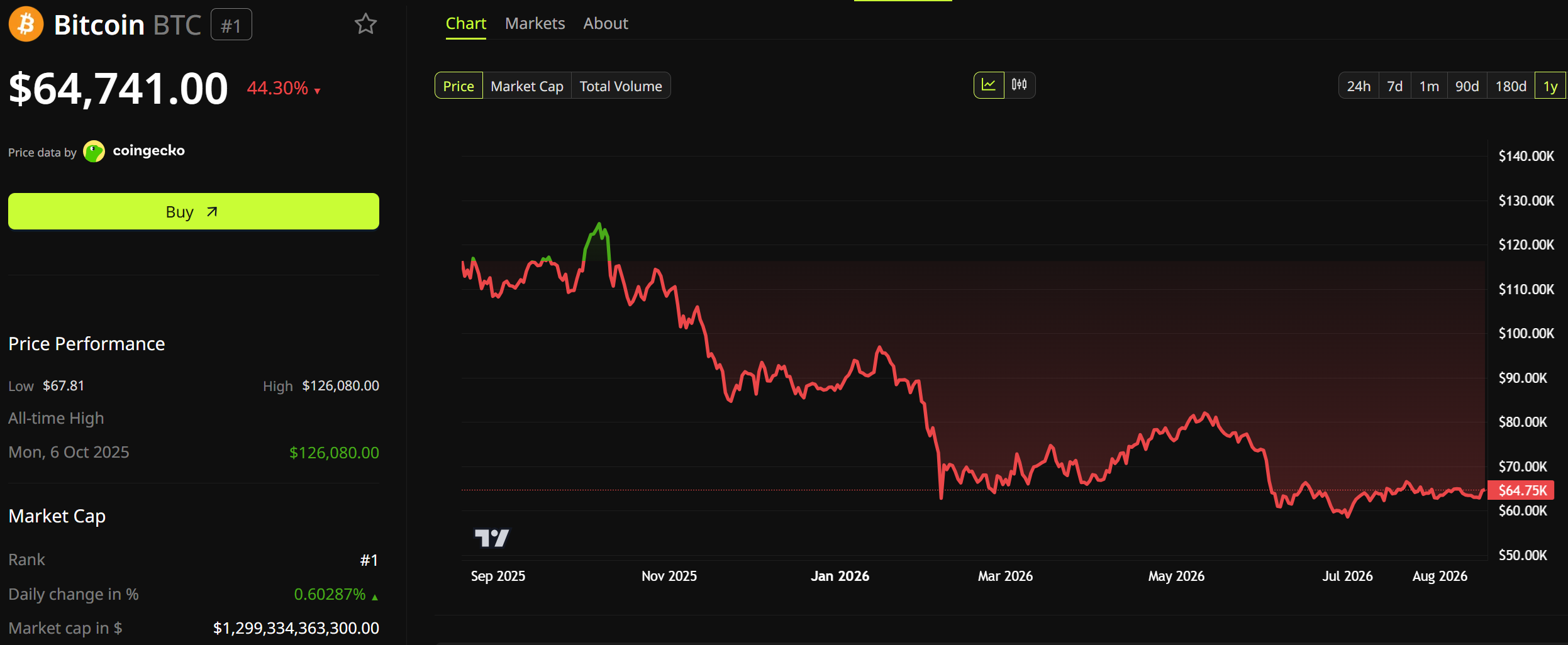
BlackRock and VanEck released back-to-back reports this week explaining why Wall Street’s arrival failed to prevent the 50% Bitcoin (BTC) crash. Both firms argue the same infrastructure that accelerated institutional adoption also amplified the sell-off.
BlackRock’s whitepaper blames extreme leverage and capital rotation into AI funds. VanEck’s latest ChainCheck counts 8 of 12 capitulation signals firing and suggests the correction may be entering its final months.

Leverage and Fund Flows Drove the Bitcoin Crash
BlackRock’s “Re-Underwriting Bitcoin” whitepaper describes a market that entered October 2025 dangerously stretched. Futures open interest topped $90 billion, and 80% of it sat in offshore perpetual contracts offering up to 125x leverage.
When Washington announced fresh China tariffs on October 10, forced liquidations wiped $20 billion of open interest in a single day. Equities recovered within weeks, but bitcoin kept sliding and broke below $60,000 by June.
Fund flows deepened the damage. Spot Bitcoin ETFs drew $60 billion between January 2024 and October 2025. They then bled more than $5 billion while AI-themed funds absorbed $46 billion.
BlackRock, however, frames the rotation as cyclical rather than a structural loss of demand.
Follow us on X to get the latest news as it happens
VanEck Sees the Sell-Off Entering Its Final Phase
VanEck’s mid-August ChainCheck reaches a similar verdict through on-chain data. Eight of 12 capitulation signals are active. The drawdown has also entered its 10th month, against a historical average of 11 to 13. That timeline mirrors analyst Benjamin Cowen’s call for an October cycle bottom.
The firm also expects a shallower trough than the 78% to 94% wipeouts of past cycles because no major lender has collapsed this time.
“We expect a shallower trough this cycle, and we would rather state that assumption plainly than hide it inside a threshold,” The VanEck research team, led by Head of Digital Assets Research Matthew Sigel, wrote in the report.
Meanwhile, with on-chain researchers arguing the market has entered an accumulation zone, neither firm, BlackRock nor VanEck, promises a quick rebound.
BlackRock still models a 1% to 2% allocation improving a 60/40 portfolio. VanEck, meanwhile, concedes capitulation buys have historically paid off only at the one-year mark.
The next few months will test whether Wall Street’s Bitcoin era can soften the bottom it could not prevent.
The post Wall Street Backed Bitcoin, Then Watched It Crash 50%, Two Reports Explain appeared first on BeInCrypto.
Asset manager Neuberger has launched its first tokenized fixed-income fund through Securitize, offering an actively managed high-yield strategy across four blockchains, Ethereum (ETH), Solana (SOL), Avalanche (AVAX) and Sui (SUI).
The Neuberger Securitize High Income Tokenized Fund (HINC) will invest primarily in high-yield bonds, with additional exposure to collateralized loan obligations and leveraged loans, according to an announcement Tuesday.
The launch comes as investors are demanding higher yields amid heated competition for corporate and government funding.
“The previous market regime rewarded investors for assuming that capital would remain cheap and plentiful,” Saxo chief investment strategist Charu Chanana said in a Tuesday client note. “The emerging regime may reward investors for recognising that capital has a price again.”
The new fund is available to qualified investors, with Securitize providing the infrastructure to issue and manage tokenized shares across the four blockchain networks.
Neuberger will serve as subadvisor to a tokenized fund for the first time. Its fixed-income platform manages more than $230 billion in assets, while the firm manages about $613 billion overall.
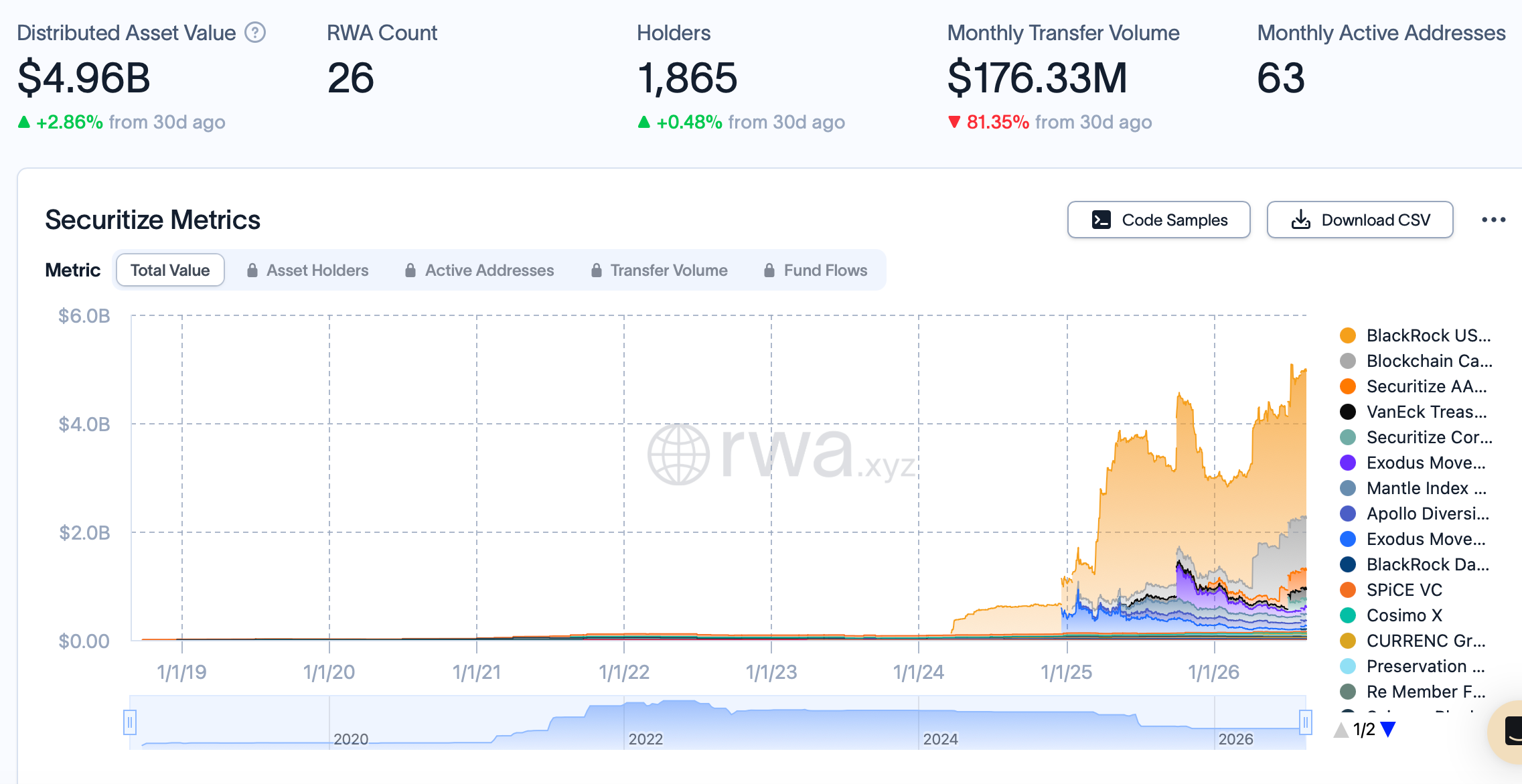
Securitize has about $4.96 billion in distributed asset value across 26 tokenized real-world assets, according to RWA.xyz data. Its products include BlackRock’s $2.7 billion BUIDL fund, a $355 million tokenized AAA CLO fund and a $95 million Apollo diversified credit fund.
The company’s shares rose around 5% in Tuesday morning trading, giving the company a market capitalization of about $838 million. Despite the gain, the stock remains down more than 50% from levels reached shortly after its public debut in July.
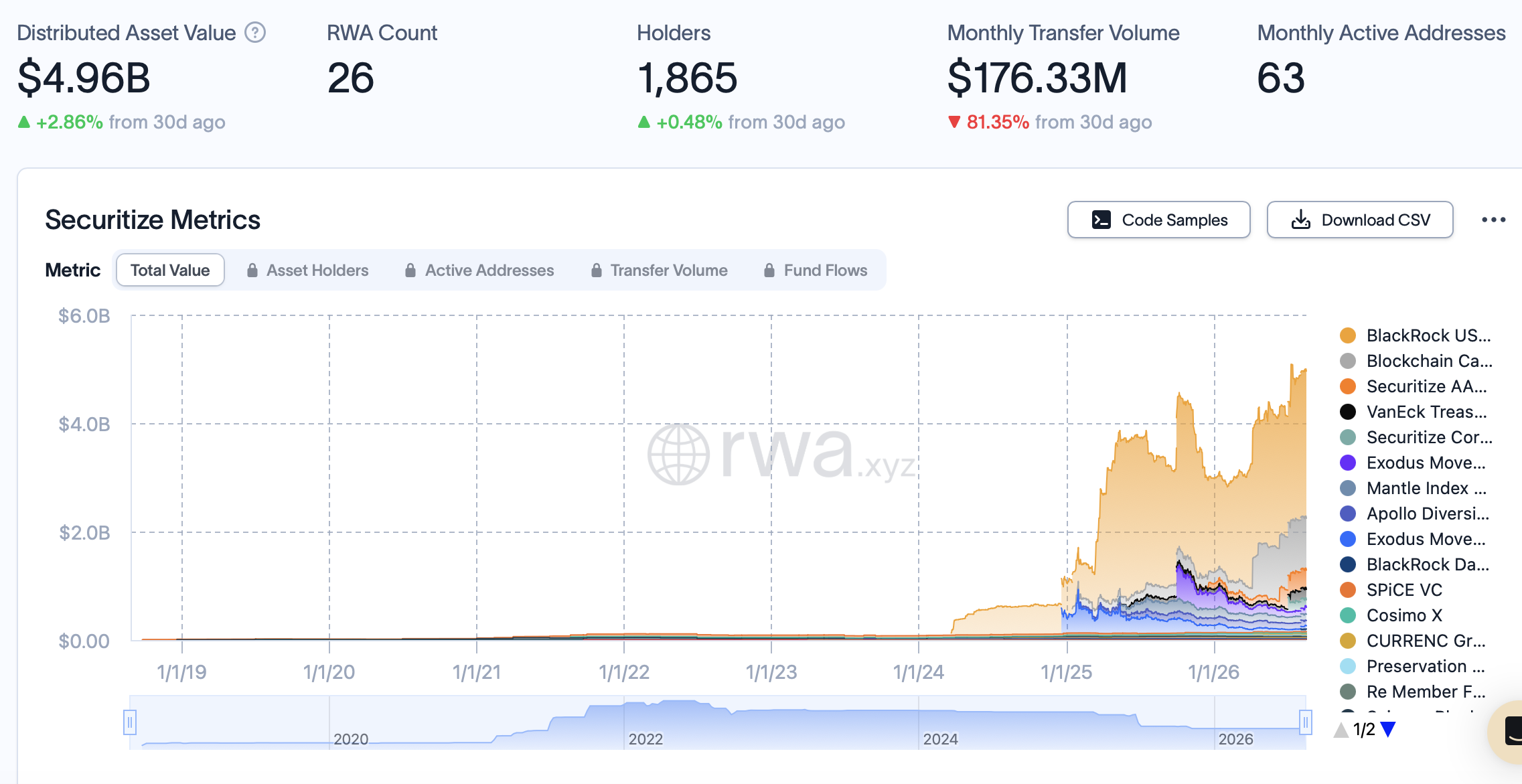
Securitize’s distributed asset value. Source: RWA.xyz
Magazine: ‘Fabricated rumors’ about BitMart founder, Binance bStocks dominate: Asia Express


Bitcoin’s price swings have hit a cycle low, squeezed by a market tug-of-war with no clear winner. The traders who once lived off its chaos have taken their risk appetite elsewhere.


An address associated with Justin Sun-owned exchange HTX is causing controversy on X after it sent out a variety of so-called “dust” transactions.
Purported users are claiming that transactions sent from 0xa03400E098F4421b34a3a44A1B4e571419517687 were sent to their deposit addresses on other exchanges, provoking review of their accounts.
These other exchanges are apparently reviewing these accounts because these transactions suggest links to the sanctioned HTX.
Read more: European Union sanctions Justin Sun’s HTX
The sanctions on HTX from both the United Kingdom Foreign, Commonwealth & Development Office and the European Union have led exchanges including Bybit, OKX, and Binance to announce that they will either no longer process transactions with HTX or will review accounts that do transact with HTX.
More recently, 0xa03400E098F4421b34a3a44A1B4e571419517687, which is labeled as “HTX 48” on Etherscan and is also included in the HTX proof of reserves, has been “dusting” various addresses.
The fact that it is included in HTX’s own proof of reserves means we can be absolutely confident that this is an HTX address.
Many of these small transactions are using USDT.
This has led users to claim that they’ve received additional scrutiny because of these transactions, something Sun denies.
Despite the fact that this address is included in HTX’s own proof of reserves according to a machine translation, X user “HTX_Molly,” who is verified as part of the HTX organization, has claimed:
“HTX’s official channels have not initiated any related transfers or testing activities. As for the specific sources and reasons behind these transfers, we’re conducting further verification and don’t rule out various possibilities such as address tagging, on-chain transfer source identification, and more. We will refrain from speculation until the facts are confirmed.”
It’s not clear what this explanation could possibly mean when HTX includes this address in its own disclosures.
Protos reached out to HTX for clarification, but it didn’t immediately respond.
Got a tip? Send us an email securely via Protos Leaks. For more informed news and investigations, follow us on X, Bluesky, and Google News, or subscribe to our YouTube channel.
Crypto World
Pfizer CEO Albert Bourla on Making Medicine in the U.S., Vaccines After COVID, and How He Gets Along With RFK Jr.

Coming out of COVID was a big comedown for Pfizer’s business. You’ve said that impacted you psychologically. What did you mean?
I’m a very, very high achiever. To go from the top performer to the bottom performer—although not in everything, but in stock price, for example—was something that I didn’t take lightly. And I know that my whole organization didn’t take it lightly. I needed to find the path and rally an organization behind it. I tried to explain to people, “You were the guys that saved the world when nobody thought that it could be saved. And you did it in ways that nobody thought it was possible. Guess what? We are going to do it again, with cancer this time.”
You seem to be behind some of your competitors when it comes to obesity. How do you think you’re going to catch up?
We aspire to bring into the market an obesity treatment that instead of weekly injections requires monthly injections. That’s a very big differentiation.
What’s your relationship like with Secretary of Health Robert F. Kennedy Jr.?
I told him that there are things that we have very different views [on]—vaccines, for example. If we select the areas that don’t have that big of a difference and try to work together to produce something good … that will create a bonding and will take away the trust issues, and then we can tackle the vaccines.
The Health Secretary has attacked a revolving door between Washington and the industry. You recently hired a top FDA official to be your chief medical officer. What went into that decision? The FDA official used to be a Pfizer employee before going to the FDA.
Is it possible for the U.S. to build a medical supply chain without China?
I don’t think it’s a good thing to have a reliance on the supply chain of China when it comes to medicines.
But can we build it here?
I think we can, but we need to provide market incentives. There was a reason why medicines that used to be manufactured in the U.S. moved out.
You’ve prioritized speed here at Pfizer. Are there any risks for a pharmaceutical company to be so focused on speed?
I think it is extremely important that we do things faster without cutting any -corners … We have a saying in Pfizer: “Time is life.” Bringing medicine for a cancer patient earlier makes all the difference in the world. If that medicine will allow someone to see the wedding of the son or the graduation of the daughter, there is nothing more important in their life, and speed is what will allow them to do it.


An effort by Alex Mashinsky, the former CEO of now-defunct cryptocurrency lending platform Celsius, to convince a federal court to vacate his 12-year sentence for fraud and market manipulation faces pushback from US prosecutors in the Southern District of New York (SDNY).
In a Friday filing, SDNY Attorney James McDonald and Assistant US Attorney Allison Nichols said that the court should deny Mashinsky’s petition to vacate his conviction and sentence, saying that many of his legal arguments were “without merit” and pushing back against claims of ineffective assistance of counsel.
The former Celsius CEO informed the court in May that he would be proceeding pro se — that is, representing himself in the case — and filed a motion to vacate, including claims about cryptocurrency exchange FTX and his former colleague, the company’s chief revenue officer Roni Cohen-Pavon.
“Mashinsky has not even submitted a sworn declaration in support of these baseless allegations, and his petition should be denied without a hearing or further fact-finding,” said prosecutors, adding:
“[…] He presents a litany of complaints, blaming others for problems at Celsius and rehashing the evidence presented at his sentencing hearing. Though Mashinsky stops short of claiming that he is factually innocent, he blames his lawyers for failing to press certain arguments on his behalf.”
As of Tuesday, the judge overseeing the case had not responded to the federal prosecutors’ filing. Mashinsky was sentenced in May 2025 to 144 months in prison, having pleaded guilty to commodities fraud and securities fraud related to “manipulative and deceptive devices” at Celsius. Cohen-Pavon, who according to the government provided “substantial assistance” to the prosecutors case again Mashinsky, was sentenced to time served in May.
Related: Celsius co-founders Leon, Goldstein to pay FTC over $6M
Celsius was one of a slew of crypto companies to file for bankruptcy in 2022 amid a market downturn starting with the collapse of Terraform Labs. Authorities indicted Mashinsky and Cohen-Pavon in 2023 and both subsequently pleaded guilty. The former CEO was ordered to pay $48 million in forfeiture at sentencing and agreed to pay $10 million as part of a separate settlement with the US Federal Trade Commission.
Mashinsky banned from commodities markets trading
The US Commodity Futures Trading Commission (CFTC) announced in June that the former Celsius CEO was permanently banned from trading in markets within the commodities regulator’s purview.
The CFTC case was one of the last against Mashinsky and Celsius to be resolved following the company’s collapse in 2022. However, the US Securities and Exchange Commission (SEC) civil action against the co-founder, first filed in 2023, was still ongoing despite the court reaching a judgment against the platform months after the initial complaint.
As of July 30, the SEC reported that its attorneys and Mashinsky were “engaged in settlement discussions.“ The regulator asked the court for 60 days to file a status report on the matter, pushing any potential resolution to the end of September.
Magazine: ‘Fabricated rumors’ about BitMart founder, Binance bStocks dominate: Asia Express

Bitcoin Price Volatility Sparks First Tap Of $65,000 Since Aug. 10

Aaron Wan-Bissaka: Aston Villa agree deal to sign West Ham defender

Microsoft Copilot reveals secret input that allowed it to be hacked

Weekend Open Thread – Corporette.com

Weekend Open Thread: Brooks Brothers

London Mayor Sadiq Khan handed a peerage by Keir Starmer alongside 15 other Labour figures… just days before the PM leaves No10

Explicando de forma sencilla las preguntas financieras que TODOS deben saber

What Is Cryptocurrency? Bitcoin, Blockchain & US Dollar Explained #Crypto #Bitcoin #Shorts

Did AI Find the $100 Million Bitcoin Bug #shorts #cybersecurity #crypto #bitcoin #ai #cryptocurrency
-

 Fashion4 days ago
Weekend Open Thread: Ann Taylor
-
 NewsBeat7 days ago
Communication cards help banking customers access services or report scams
-
 Sports5 days ago
This U.S. Amateur is a glimpse into golf’s future in more ways than you think
-

 Sports4 days ago
Birmingham 2026: Day 6 Timetable for Irish Athletes
-
 NewsBeat3 days ago
Myanmar says over 300,000 Rohingya refugees verified for repatriation as exodus enters ninth year
-

 Tech4 days ago
11 Ways to Rank Your Videos
-

 Politics3 days ago
SEQ Code: The Three Letter Boarding Pass Code That Could Give You The Worst Seat
-
 Entertainment6 days ago
Keke Palmer Subtly Hints At Sean Evans Drama With Cryptic Post
-

 Fashion7 days ago
Coffee Break: The Fonteyn Jane Flat
-

 Tech7 days ago
Zoom Screen-Sharing Bug Let People Fully Take Over Other Devices On A Call
-
 Crypto World7 days ago
XRP bridge drained after software mistook fake deposits for real ones
-

 Tech5 days ago
DeepSeek Harness launches as open source rival to Claude Code, alongside V4-Pro on API with higher prices
-

 Sports6 days ago
DeQuan Jones in ‘high spirits’ after successful leg surgery
-
 Crypto World6 days ago
Perplexity AI Predicts an XRP Scenario Few Analysts Are Discussing
-

 Tech7 days ago
SpaceXAI’s Grok Bot turns agents into persistent digital coworkers that can operate your apps for $120-per-month
-
 Entertainment6 days ago
2026’s Most Ambitious Fantasy Movie Officially Scores Sequel Update
-

 Politics6 days ago
How Average Are You In The UK?
-

 Business7 days ago
Evolv Technologies Holdings, Inc. (EVLV) Q2 2026 Earnings Call Transcript
-
 Tech7 days ago
A Zoom Screen-Sharing Bug Let Anyone Take Over Other Devices On a Call
-

 NewsBeat6 days ago
‘Regret is a major theme of my work’: Matt Haig on finding acceptance
You must be logged in to post a comment Login