
Crypto World
Bitcoin Price Volatility Sparks First Tap Of $65,000 Since Aug. 10

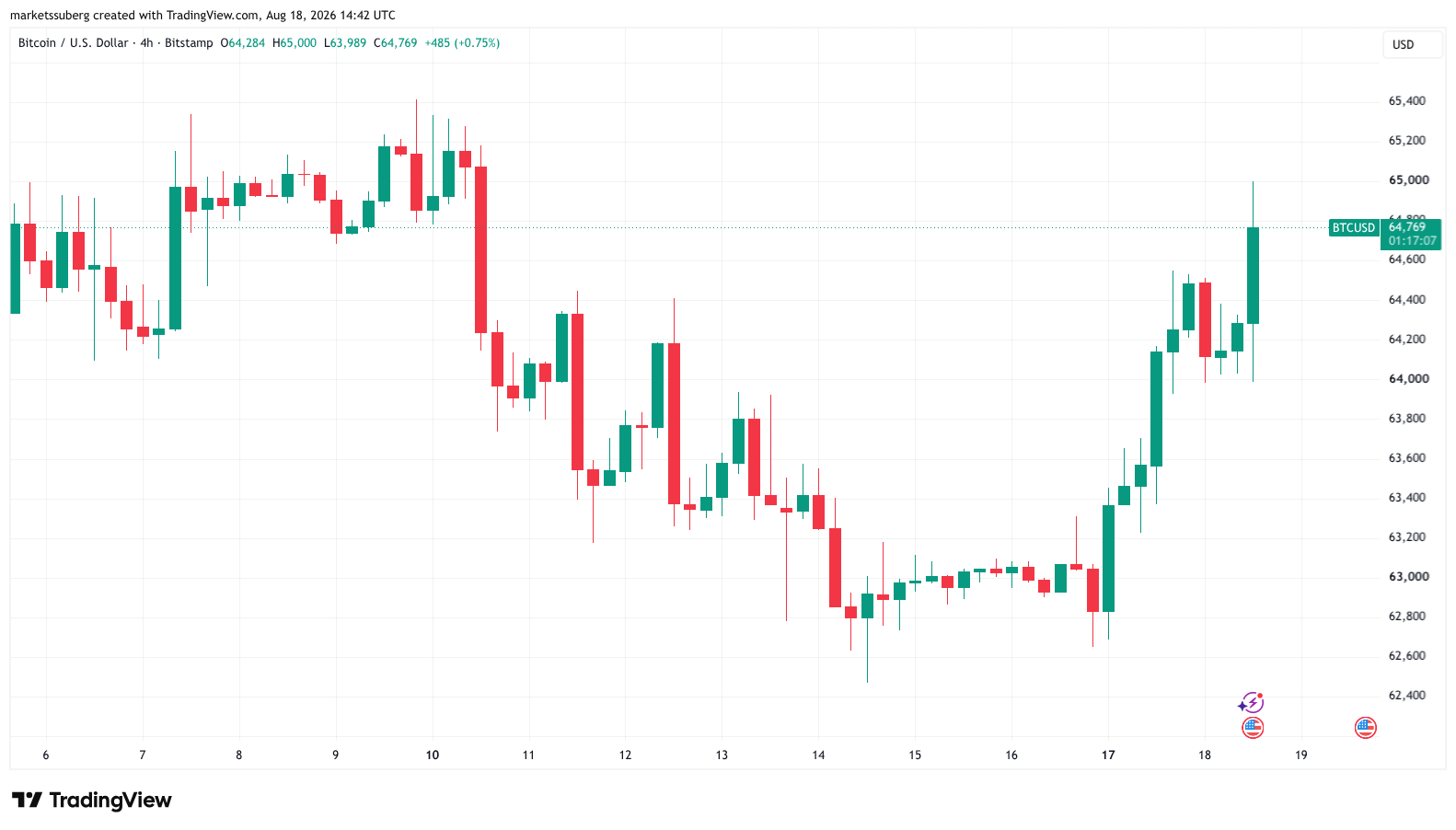
Bitcoin (BTC) hit $65,000 after Tuesday’s Wall Street open as US stocks rebounded in spite of geopolitical pressure.
Key points:
- Bitcoin reaches $65,000 for the first time since Aug. 10 as risk assets navigate fresh US-Iran signals.
- Analysis warns of surging US 30-year bond yields, which hit 29-year highs of 5.34%.
- BTC price analysis flags decision time on a head-and-shoulders bottoming structure.
Bitcoin diverges from US stocks as Trump says Strait of Hormuz “open”
Data from TradingView showed BTC/USD building on the week’s gains as the S&P 500 bounced from 7,696, its lowest level since Aug. 4.
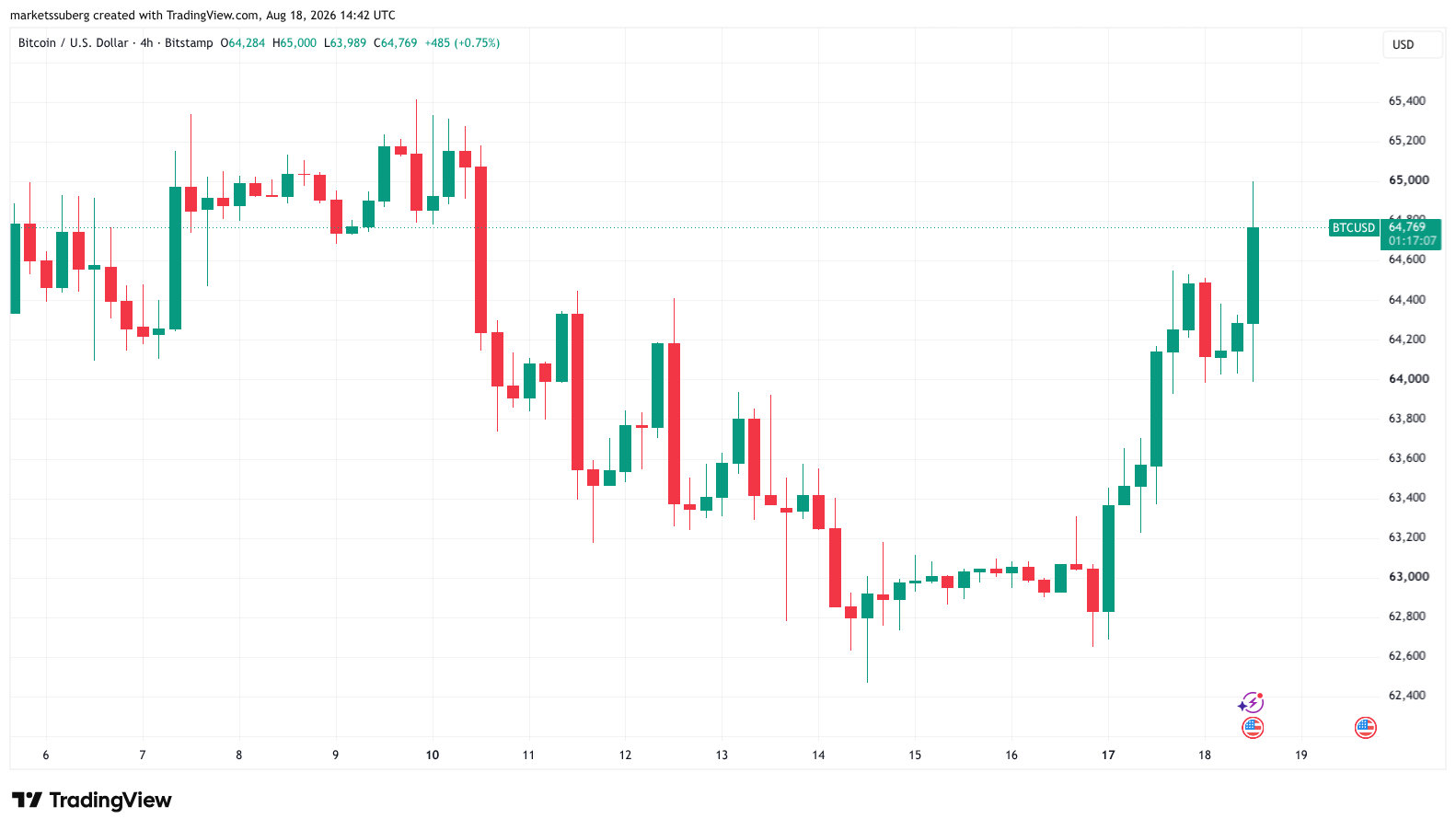
BTC/USD four-hour chart. Source: Cointelegraph/TradingView
This came after US president Donald Trump posted a map of the closed Strait of Hormuz oil route to Truth Social where it was labeled “new US territory.”
Both the US and Iran lay claim to control of Hormuz, with Trump threatening US ally Oman with military action over its plans to work with Iran on charging tolls to shipping traffic. In a subsequent post, Trump confirmed that further diplomacy with Iran was not on the agenda.
“There are no talks or conversations going on, or scheduled, with the Islamic Republic of Iran. The Naval Blockade remains in full force and effect. The Hormuz Strait is open and operating. All water mines have been removed or detonated,” he wrote.
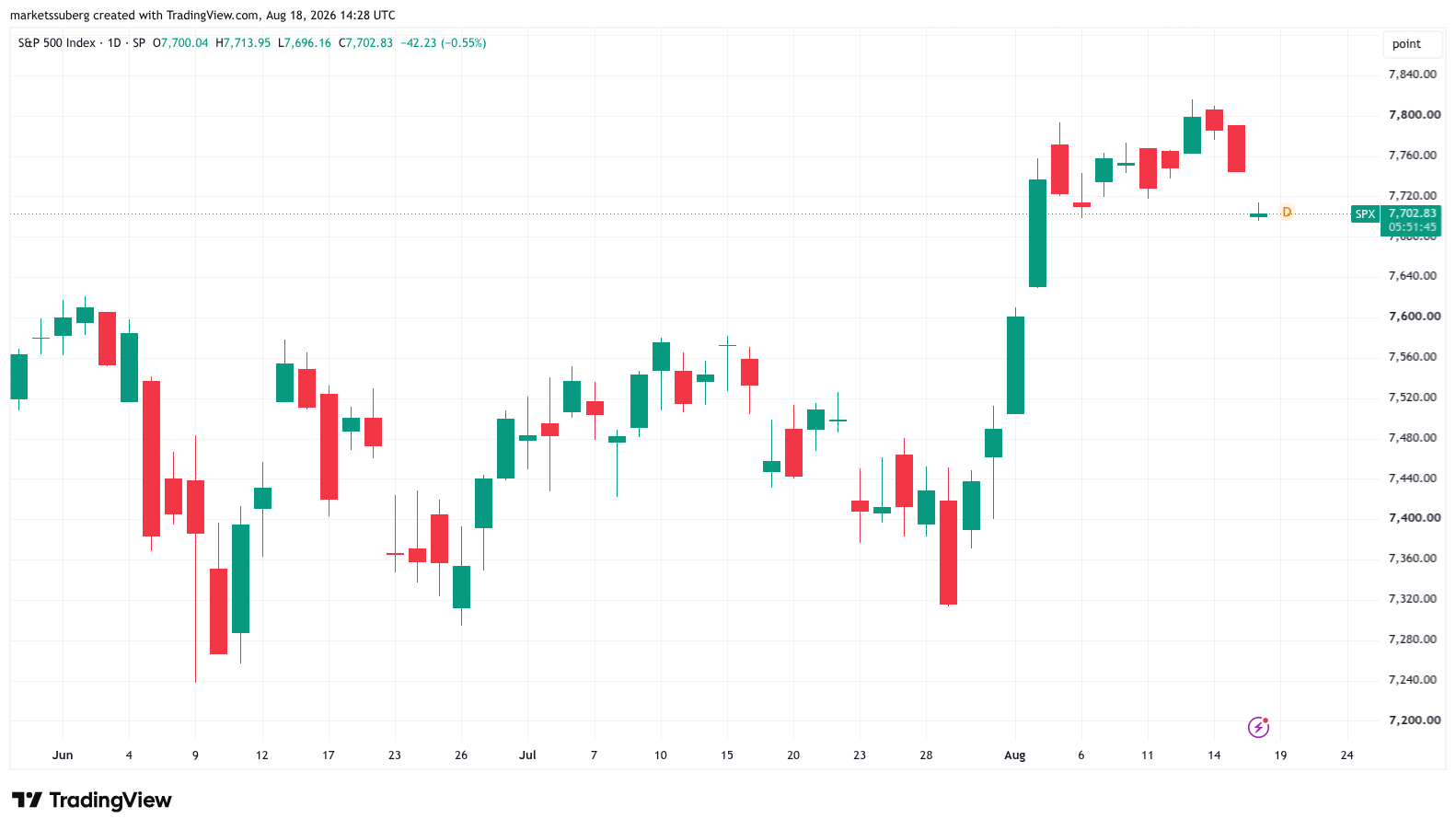
S&P 500 one-day chart. Source: Cointelegraph/TradingView
As on Monday, oil avoided major volatility, with WTI crude down 1% at the time of writing at $84 per barrel. US government bonds continued to show strain, with the 30-year yield hitting 5.34%, its highest since January 2007.
“Bond prices are sending warnings,” BNY Mellon analyst Geoff Yu wrote in a research note quoted by the New York Times. Yu said that the surge came as “investors demand more compensation for inflation risk,” while also attributing the upside to government borrowing.
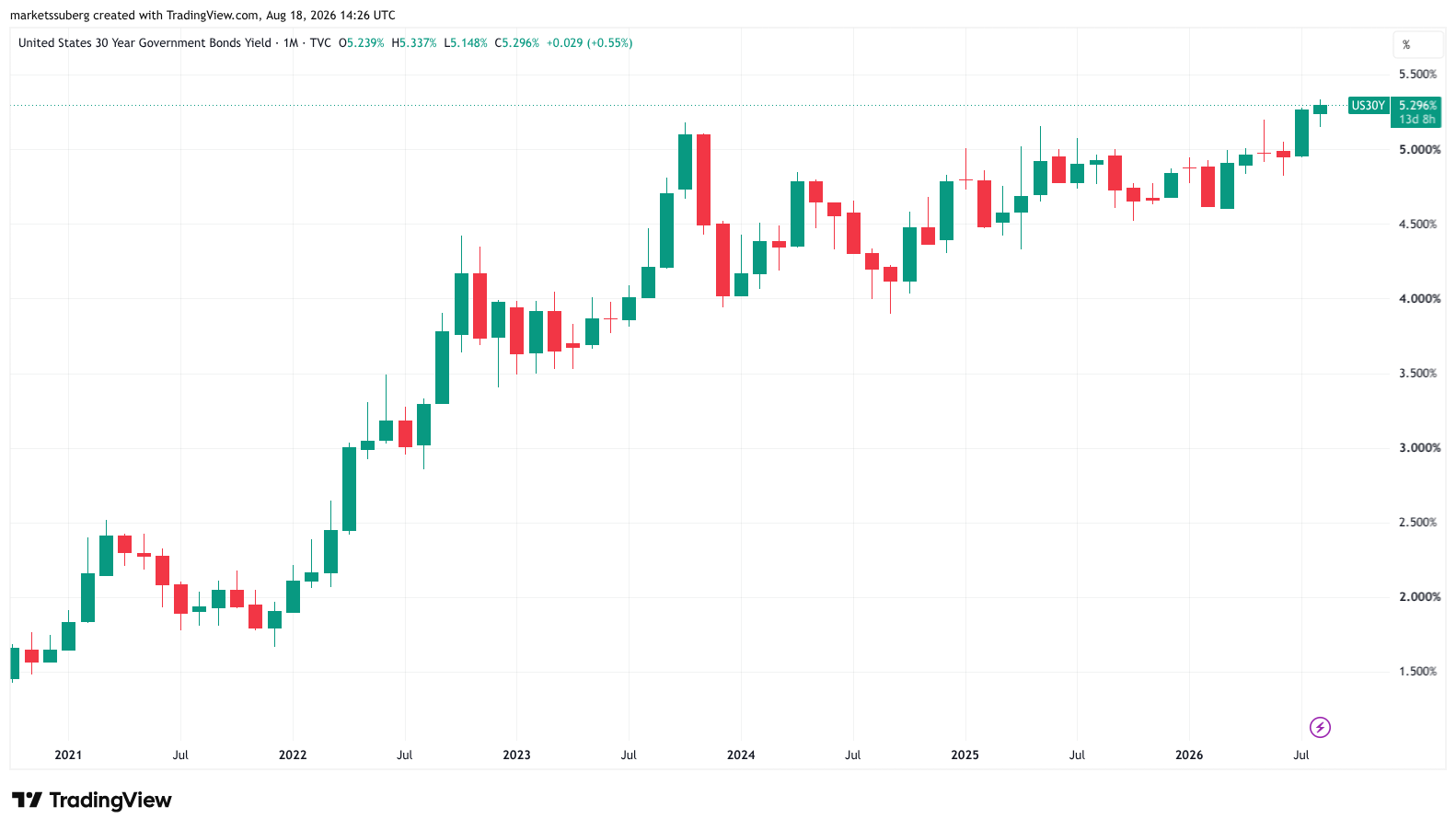
US 30-year bond yields one-month chart. Source: Cointelegraph/TradingView
BTC price faces crunch rebound test
Updating X followers on BTC/USD, trader and analyst Aksel Kibar eyed the culmination of a potential reverse head-and-shoulders pattern at $62,300.
Related: Bitcoin price spike to $64.5K was ‘low-volume liquidity trap’: Analysis
“If $BTCUSD is going to rebound, it has to come from here,” he argued on Monday.
Kibar offered a $53,000 target in the event of the head-and-shoulders structure failing, with $76,000 a potential upside target should the rebound sustain.
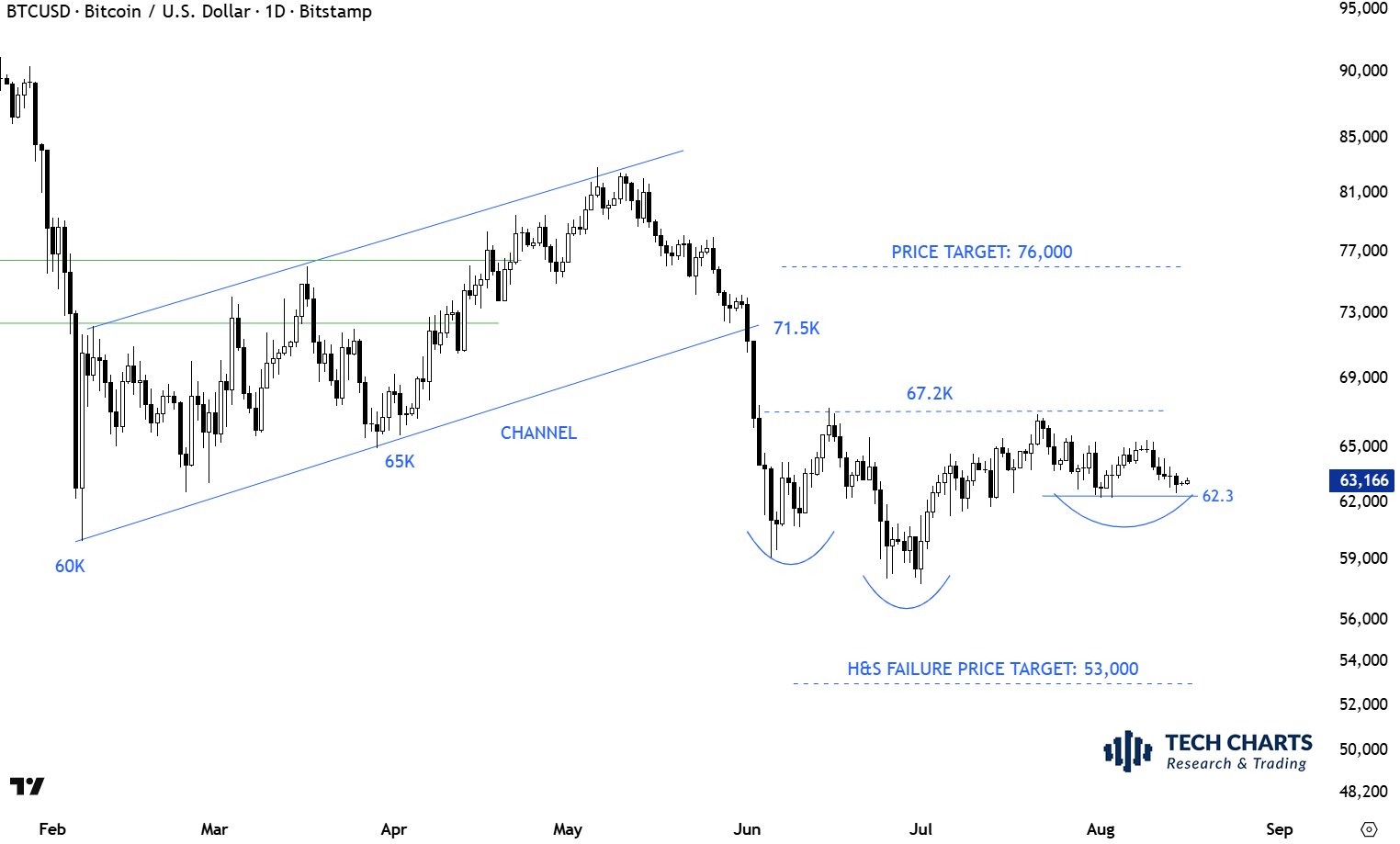
BTC/USD one-day chart. Source: Aksel Kibar on X.com
Previously, Cointelegraph reported that underwater investors were contributing to Bitcoin’s inability to break higher. Its rebound to $64,500 also stopped short of an overhead trend line, the 50-month exponential moving average (EMA). This moving average is now in place as resistance at $65,827.



MoonPay has integrated Cash App Pay as a payment option for cryptocurrency purchases, allowing eligible US customers to fund transactions using their Cash App balances.
The crypto payments company said in an announcement shared with Cointelegraph Tuesday that Cash App Pay is now available through MoonPay’s own checkout and with select partners, including Trust Wallet, Bitcoin.com, MetaMask, Moonshot, Ledger, BitPay, Uniswap, Tangem, LOBSTR and Edge.
The integration lets customers use their Cash App balance to buy crypto directly through MoonPay without switching between apps or completing a separate login.
MoonPay now supports payment integrations with Cash App, PayPal and Venmo, having added PayPal in 2024 before later expanding to Venmo.
Cash App, the mobile payments service operated by Jack Dorsey’s Block, already allows customers to buy and sell Bitcoin directly through its app. The MoonPay integration broadens that access to a wider range of cryptocurrencies. Cash App reported 59 million active users in June, according to Block’s second-quarter shareholder report.
“Cash App is where tens of millions of Americans already manage their money,” MoonPay co-founder and CEO Ivan Soto-Wright said. “This integration means that those users can access the digital asset ecosystem, funded instantly from an app they already know and trust.”
Expansion beyond crypto onramps
MoonPay is licensed by the New York State Department of Financial Services through a BitLicense and Limited Purpose Trust Charter, and is authorized under the European Union’s Markets in Crypto-Assets Regulation in the Netherlands.
Related: PayPal, MoonPay and M0 launch PYUSDx to let devs issue app-specific stablecoins
The company has spent much of 2026 on an acquisition spree as it expands beyond its traditional fiat-to-crypto onramp business. It acquired Solana trading infrastructure provider DFlow in May, following an April deal for crypto security firm Sodot as part of a broader push into institutional crypto services.
In July, it acquired cross-chain infrastructure startup Glide and launched PayBox, a vault that lets ChatGPT and Claude users authorize crypto transactions while keeping custody of their assets.
Asia Express: ‘Fabricated rumors’ about BitMart founder, Binance bStocks dominate
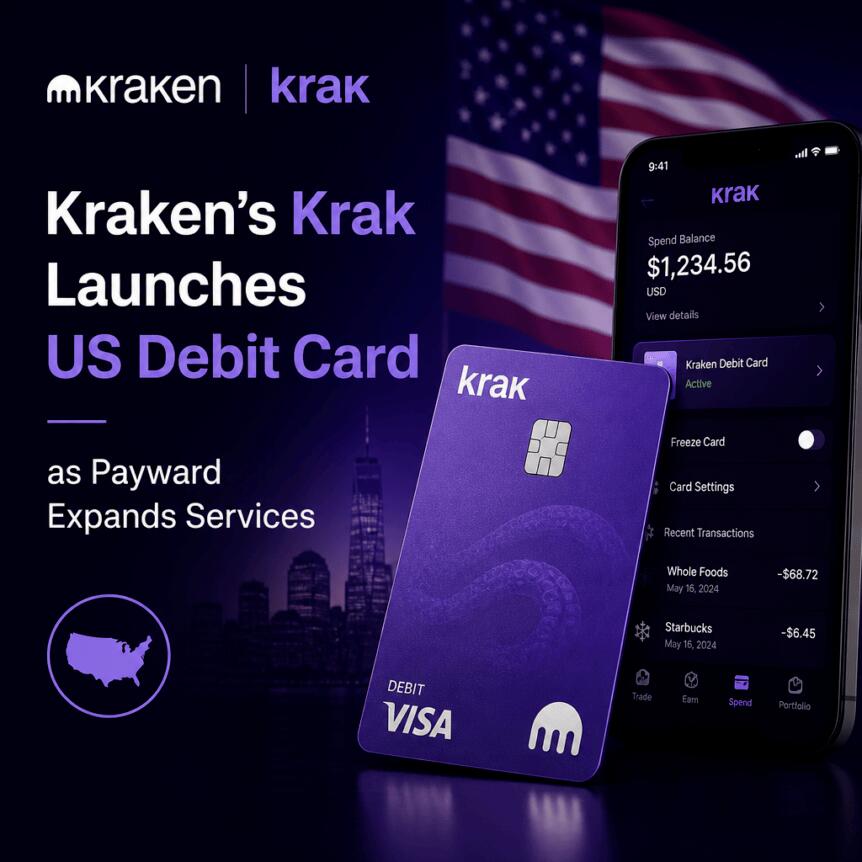
Kraken’s consumer payment app, Krak, has rolled out a multi-asset debit card in the United States, letting customers pay with crypto and fiat while earning cashback. The card supports spending from more than 600 assets and currencies, converting holdings into US dollars at the point of sale, according to an announcement on Tuesday.
The move expands Kraken’s push toward everyday finance products that sit alongside trading. It also positions a rewards model that depends on asset balances rather than credit-based payments—an angle aimed at consumers who are wary of accumulating monthly credit-card debt.
Key takeaways
- Krak launched a US multi-asset debit card that can draw from 600+ assets/currencies and converts them into USD at checkout.
- Users can choose the order in which balances are spent, allowing multiple holdings to contribute to a single purchase.
- Cashback can be earned up to 2%, paid in US dollars or Bitcoin, with rates tied to average assets held across Krak, Kraken, and Kraken Pro.
- The cards are issued by Lead Bank on Visa and powered by Stripe Issuing, with physical and virtual options for eligible US customers.
- Kraken says it has already issued 135,000 multi-asset cards in the UK and EEA since a December 2025 launch.
A debit card built for crypto and fiat spending
Krak’s new card is designed to work like a conventional debit instrument, but with a key difference: the funding sources can include both traditional currencies and crypto assets. When users make a purchase, holdings are converted into US dollars at the point of sale.
Rather than forcing customers to pick a single wallet or balance up front, the card can pull from multiple assets during one transaction. Krak says users will be able to set the order of assets that get spent first, giving customers control over how their portfolio is applied at checkout.
For investors and traders considering real-world utility, the practical takeaway is that Krak is trying to remove friction between “holding” and “spending.” Instead of treating crypto as a separate ecosystem from everyday commerce, the card aims to make it operationally comparable to a multi-currency payment tool—though users still need to understand that conversion happens at the moment of purchase.
Cashback up to 2%—but tied to average balances
Krak says the cashback program can reach 2% and is delivered either in dollars or Bitcoin. The determining factor is not simply transaction behavior; the company says cashback rates depend on the average assets held across Krak, Kraken, and Kraken Pro.
This structure mirrors a broader trend among crypto payment products: loyalty incentives increasingly target longer-term account engagement rather than short-term promotional activity. It also helps explain Krak’s emphasis on balances across multiple Kraken properties, effectively blending “payments” with “customer stickiness” across the ecosystem.
Krak is marketing the card as an alternative to rewards programs typically offered by credit cards. In a survey of 2,001 US adults commissioned by Krak via Morning Consult, 42% of credit card holders said they worry about paying off their monthly balance. In the same survey, 60% said they would switch to a debit card offering rewards without taking on debt.
While the survey does not prove how many people will actually adopt Krak’s card, it does clarify why the company believes the debit + rewards format can resonate in a market where credit-card interest costs remain a consumer concern.
How the card works: Visa issuance and Stripe Issuing
Operationally, Krak’s card is backed by established payment infrastructure. The card is issued by Lead Bank on the Visa network, and Krak says it is powered by Stripe Issuing. The company also indicates both physical and virtual versions are available to eligible customers in the United States.
For users, that combination typically matters for practical adoption—virtual cards can be used for online spending, while physical cards cover in-store purchases. For builders and partners watching the sector, it underscores how crypto-native finance products increasingly rely on mainstream rails to scale distribution and compliance workflows, even when the “wallet logic” remains crypto-specific.
From UK/EEA rollout to US expansion
Krak did not start from scratch in payments. Kraken says it has issued more than 135,000 multi-asset cards in the UK and European Economic Area (EEA) since launching there in December 2025.
That history matters because it frames the US card as an expansion of a live product rather than a brand-new concept. It also suggests Krak is carrying operational learnings from earlier markets—such as how customers choose spending order across assets and how cashback eligibility and conversion behavior work in practice.
Still, readers should watch how US users experience the same mechanics. The US rollout may face different consumer habits, regulatory requirements, and asset availability expectations compared with UK/EEA customers, even if the core product design is similar.
Kraken’s broader push beyond trading
The card launch fits into a wider strategy at Kraken’s parent company, Payward. In remarks at the Wyoming Blockchain Symposium, Payward co-CEO Arjun Sethi discussed plans to expand the firm’s financial services offering, including pushing into additional asset classes and more traditional financial products.
Sethi said diversification across multiple asset classes could reduce dependence on any single market cycle. He also described tokenization as “a large part” of the company’s effort to broaden its financial offerings, and compared the company’s target end state to major incumbent banks—arguing it needs products and services “not too different to a JP Morgan or a financial institution.”
That message lands at a time when several large exchanges are broadening their businesses beyond spot trading. Coinbase and others have expanded into areas such as equities, derivatives, prediction markets, tokenized assets, and pre-IPO products—signaling that the competitive battleground is shifting toward multi-vertical financial platforms.
Krak’s debit card adds a consumer-facing layer to that trend. Instead of asking users to interact with crypto primarily through trading screens, Kraken is moving toward everyday financial touchpoints—spending, rewards, and balance-based incentives—that could keep customers engaged even when they are not actively trading.
Kraken is also continuing to expand its regulated offerings. Separately, the company launched trading in more than 7,000 US-listed stocks for customers in the EEA earlier this week, reinforcing the pattern of “financial services first” expansion.
Next, investors and consumers should watch how Krak’s US rollout performs against its UK/EEA track record—particularly around card issuance eligibility, cashback mechanics, and how users manage multi-asset spending order in real transactions.


Aave, one of crypto’s largest lending and borrowing protocols, still hasn’t recovered from the April 18 hack of KelpDAO.
Indeed, the value of all crypto assets in its smart contracts is down 43% since the attack, and 67% below its 52-week high.
Despite KelpDAO users entrusting $26.4 billion to Aave just prior to the hack — already way down on the October 2025 peak of $45.9 billion — there’s a mere $14.9 billion worth of assets in the ecosystem today.
North Korean hackers looted KelpDAO in mid-April, and through its acceptance of KelpDAO tokens as collateral for loans, Aave was left nursing a nine-figure loss.
North Korea infected the industry
Despite Aave itself never being hacked, per its own report, its utility for lending cost it a long-held title as DeFi’s biggest platform. Four months later, depositors still have cold feet.
LayerZero, the KelpDAO bridge’s software provider, blamed North Korea within 48 hours — an early call that outside investigators later confirmed.
KelpDAO takes deposits of ETH, stakes on Ethereum’s blockchain for yield, and issues a tradeable receipt token called rsETH. The thieves parked stolen rsETH on Aave and borrowed real ETH against it, leaving Aave and fellow lender Compound with an estimated $246 million of combined bad debt.
Aave forcibly liquidated the attacker’s positions, industry allies rebuilt the missing collateral, and by late May, Aave had declared every market back to normal.
Nevertheless, the dollar value of its liquidity pools never recovered and Aave still sits about two-thirds below its October peak.
Read more: DeFi sector in $14B meltdown as $290M rsETH hack fallout burns Aave
Aave’s decline matters for DeFi
A non-custodial lending app, Aave ended 2025 with $55 billion in TVL, worth more than half of the DeFi lending sector’s TVL.
For a borrower, TVL isn’t an abstraction. It illustrates the dollar equivalent values of deposits and inventory that borrowers can draw on.
A pool worth 43% less has that much less to lend and much higher volatility.
According to investigators at Chainalysis, North Korea’s Lazarus Group was probably helping KelpDAO attackers while LayerZero’s own post-mortem attributed the operation to a North Korean-linked cluster going by TraderTraitor.
Protos has also reported alleged on-chain links to Bybit and BTC Turk hacks.
Aave never really recovered from KelpDAO
Aave fell about 20% over the day after the theft, from roughly $115 to below $92. The token trades near $89 today, still slightly below its pre-hack level.
Within two days of the hack, Aave’s deposits collapsed by more than $8 billion and its stablecoin pools hit 100% utilization, leaving billions of crypto dollars effectively frozen with no room for anyone else to withdraw stablecoins.
On April 27, Aave announced that a new coalition, DeFi United, had pledged enough ETH to restore rsETH’s full backing. It then liquidated the attacker’s positions on Ethereum and Arbitrum on May 6. Replacement collateral flowed into the bridge’s reserves in tranches through late May.
The panic hadn’t ended even by May. TVL kept draining into June, bottoming near $11.9 billion before partially recovering.
Aave now sits near $14.9 billion, down 43% from hack day.
According to its own report, Aave’s contracts, oracles and liquidation mechanics worked exactly as designed, yet North Korea was still able to withdraw money using phony collateral.
Got a tip? Send us an email securely via Protos Leaks. For more informed news and investigations, follow us on X, Bluesky, and Google News, or subscribe to our YouTube channel.


Securitize has launched a tokenized fixed-income fund managed with Neuberger that will invest mainly in high-yield bonds and issue interests across Avalanche, Ethereum, Solana, and Sui.
Summary
- HINC will invest primarily in high-yield bonds, alongside CLOs and leveraged loans.
- Neuberger will serve as subadvisor in its first engagement with a tokenized fund.
- Eligible accredited investors and qualified purchasers can access the fund after completing required compliance checks.
- Securitize affiliates will handle investment advice, distribution, tokenization, and fund administration.
Securitize said in an Aug. 18 announcement that the Neuberger Securitize High Income Tokenized Fund, trading under the ticker HINC, will seek risk-adjusted returns from a portfolio of income-producing fixed-income assets.
Along with high-yield bonds, the mandate permits investments in collateralized loan obligations and leveraged loans. Neuberger will manage the portfolio as subadvisor, drawing on a fixed-income business overseeing more than $230 billion in assets.
Securitize Capital LLC serves as the investment adviser, while Securitize Markets LLC will offer fund interests to eligible investors. Other affiliates of the tokenization company will handle administration and operational services.
HINC brings a high-yield strategy to four blockchains
HINC will issue tokenized interests on Avalanche, Ethereum, Solana, and Sui, giving eligible investors four networks through which to access the fund.
Although the fund’s interests are represented on public blockchains, participation will remain restricted. Investors must qualify as accredited investors or qualified purchasers and complete Securitize’s onboarding process, including know-your-customer and anti-money laundering checks.
Access will also depend on an investor’s jurisdiction and applicable securities laws. As a result, the tokens will not be freely available to every wallet user in the same way as an unrestricted cryptocurrency.
Carlos Domingo, co-founder and CEO of Securitize, said the fund places Neuberger’s fixed-income capabilities on public blockchains through the company’s regulated infrastructure.
“Launching HINC across Avalanche, Ethereum, Solana and Sui gives eligible investors access through four leading blockchain network.”
Neuberger’s role is limited to serving as the fund’s subadvisor, while Securitize’s entities retain the other advisory, distribution, and administrative duties outlined in the announcement.
For Neuberger, HINC represents its first role as subadvisor to a tokenized fund. The asset manager will apply its research and portfolio-management process to the underlying fixed-income investments rather than manage the blockchain infrastructure.
Neuberger will manage the underlying fixed-income portfolio
Neuberger manages approximately $613 billion across equities, fixed income, private markets, real estate, and hedge fund portfolios, based on company data as of June 30. Its fixed-income platform accounts for more than $230 billion of that total.
Anil Abraham, Neuberger’s head of product management, said the firm has developed its fixed-income operation through several market cycles using research-led and diversified strategies.
“We are pleased to work with Securitize to extend our process-driven, actively managed approach to qualified investors looking to access fixed income strategies on-chain,” Abraham said.
Tokenization changes how investors hold and transact in fund interests, but the announced investment mandate remains centered on conventional credit instruments. High-yield bonds generally refer to corporate debt carrying ratings below investment grade, while leveraged loans are commonly issued by companies with elevated debt levels.
Collateralized loan obligations, another permitted part of HINC’s portfolio, pool corporate loans and divide their cash flows among different groups of investors. The announcement did not state how much of HINC would be allocated to bonds, CLOs, or leveraged loans.
A comparable institutional product entered the market in July when Centrifuge and New York Life Investment Management introduced a tokenized U.S. high-yield corporate bond strategy. According to a report on NYLIM’s fund, subscriptions and redemptions for the HYB product settle in USDC, while NYLIM retains responsibility for portfolio management and risk controls.
Unlike that single-chain arrangement, Securitize has chosen four networks for HINC at launch. The release did not specify whether subscriptions and redemptions would settle in dollars, stablecoins or both.
Securitize expands its tokenized fund lineup
Securitize reported more than $4 billion in assets on its tokenization platform as of April. The company also works with asset managers including Apollo, BlackRock, BNY, Hamilton Lane, KKR, and VanEck.
Earlier in August, BlackRock launched two tokenized funds holding cash, short-term U.S. government debt, and Treasury-backed repurchase agreements. Securitize acts as a transfer agent and tokenization provider for the products, according to the coverage of the funds.
HINC differs from cash and Treasury products because it takes exposure to lower-rated corporate debt and other credit assets. The fund’s return profile and risk will therefore depend on the performance of its underlying portfolio rather than the blockchain used to record ownership.
Recent figures also point to rising use of blockchains for conventional financial assets. A May report based on InvestaX data placed the tokenized RWA market excluding stablecoins at about $29 billion at the end of March, following approximately 30% growth during the first quarter.
Alongside third-party funds, Securitize placed its own publicly traded shares on Solana and Avalanche when the company began trading on the New York Stock Exchange in July. The tokenized SECZ shares represent the same common stock as the exchange-listed securities rather than a separate share class, crypto.news reported at the time.
U.S. access remains subject to securities requirements
In the United States, Securitize Markets operates as a broker-dealer registered with the Securities and Exchange Commission and runs an alternative trading system. Securitize Transfer Agent is also registered with the SEC, while Securitize Capital operates as an exempt reporting adviser, according to the company.
Those entities divide the responsibilities connected to HINC. Securitize Capital advises the fund, Securitize Markets offers its interests, and affiliated businesses provide tokenization and administrative services.
The fund’s availability to accredited investors and qualified purchasers places eligibility checks before blockchain access. Prospective investors must also pass KYC and AML screening and meet any restrictions tied to where they live.
Outside the United States, Securitize operates through Securitize Europe Brokerage and Markets, an authorized investment firm that runs a trading and settlement system under the European Union’s DLT Pilot Regime.
Founded in 1939, Neuberger remains privately held and employee-owned, with no corporate parent or unaffiliated external shareholders. The investment manager employs about 3,000 people across 26 countries and manages portfolios for institutions, financial advisers, and individual clients.


0G Private Computer has processed more than 250 billion tokens across 17 million requests while expanding its private AI service to 28 models and adding U.S. dollar payments.
Summary
- 0G Private Computer has reached 15,000 users less than four months after its April launch.
- Users can now fund dollar balances by card through Stripe without buying a crypto token.
- Twenty of the platform’s 28 AI models offer verifiable execution through two TEE-based systems.
In an Aug. 18 press release shared with crypto.news, 0G Labs said that Private Computer had also produced 15 million Trusted Execution Environment attestation proofs since launching on April 27.
The platform began with seven models and now offers 28 through a web console and an application programming interface compatible with OpenAI’s API. Users can access text, image, audio, and video generation tools from one account.
According to the company, Private Computer does not retain user data. Prompts are processed in memory, are not stored after use, and are not added to model-training datasets. Usage figures and attestation activity are displayed through a public real-time dashboard.
0G Private Computer adds dollar and card payments
USD Mode is now generally available, giving users the option to maintain account balances in U.S. dollars and add funds by card through Stripe, the release said. Email sign-in and a guided first-deposit process have also been introduced.
Previously, interacting with decentralized AI infrastructure could require users to set up a crypto wallet, acquire a supported token, and complete an on-chain transaction. Under the updated process described by 0G Labs, customers can create an account with an email address and start using the service without buying a token.
For U.S. users, the main access change is the ability to pay in dollars through a familiar card-based checkout. The company did not announce a new U.S.-specific token, investment product, or securities offering as part of the update.
Each request lets users select a trust tier, with verifiable execution available on 20 of the 28 listed models. Payments can take place in dollars even when the selected model uses the platform’s decentralized verification infrastructure.
“Privacy should not require a crypto wallet,” 0G Labs co-founder and CEO Michael Heinrich said.
“With this upgrade anyone can pay for AI in dollars and still get hardware-verified privacy. Decentralized infrastructure goes mainstream by meeting people where they are, not by asking them to change how they pay.”
Twenty AI models support verifiable execution
Trusted Execution Environments are protected areas within computer hardware that isolate data and code while a task is being completed. Within Private Computer, the technology is used to process prompts without exposing them outside the protected environment, according to 0G Labs.
Of the platform’s 20 verifiable models, 15 use a system called TeeTLS for verified routing. Another five use TeeML, which keeps prompts inside a hardware enclave while a model generates its response.
Model pages display privacy labels so users can check the type of execution available before submitting a request. Eight of the 28 models do not currently carry the same verifiable-execution support, based on the figures supplied by the company.
TEE-based computing is also being tested elsewhere in the crypto and blockchain sector. A March report on Origins detailed an $8 million raise for a modular AI network that separates heavy model workloads from blockchain-based verification.
In April, crypto.news covered 0G’s Qianwen integration, which connected Alibaba’s large language model family to applications and AI agents built on 0G infrastructure. The integration was designed to let developers use Qianwen models within on-chain applications rather than rely only on conventional AI platforms.
Private Computer takes a consumer-facing approach to the same infrastructure. Instead of asking users to manage the blockchain layer directly, the service presents its models through an account dashboard and a standard API used by many AI developers.
Video generation expands the 0G model lineup
Hailuo 3, a video model developed by MiniMax, joined Private Computer on Aug. 3, according to the release. It supports both text-to-video generation and first-frame image-to-video generation through the platform’s browser interface.
The addition means customers can access video, image, text, and audio models without creating separate accounts for each format. Private Computer’s model count has quadrupled from seven at launch to 28, while 0G Labs reported reaching 15,000 users during the same period.
Model access can also be handled through the OpenAI-compatible API. Compatibility allows developers already using that API format to connect their applications without creating a completely different request structure for 0G’s service.
The company said users can choose between models and verification levels for individual requests. Its public dashboard records aggregate activity, including the reported 250 billion tokens, 17 million requests, and 15 million TEE proofs.
Private Computer connects to 0G’s blockchain stack
Private Computer operates as an access point for the other parts of 0G’s network, which include decentralized computing, distributed storage, data availability services, and an Ethereum Virtual Machine-compatible blockchain.
Known as Aristotle Mainnet, the blockchain was launched alongside the 0G token in September 2025. At the time, a report on its Kraken listing described 0G as a modular layer-1 network built to support decentralized AI applications.
The September report said the project had raised more than $350 million, including a $40 million seed round and a $250 million token purchase commitment obtained by the 0G Foundation. Investors named in the earlier funding included Hack VC, OKX Ventures, Delphi Ventures, Samsung Next, and Animoca Brands.
In its latest release, 0G Labs said its ecosystem has now raised more than $360 million and works with over 100 partners. The company listed Chainlink, Google Cloud, and Alibaba Cloud among the organizations connected to the ecosystem.
Crypto World
Bitcoin’s next major move may be higher, but liquidity has yet to return: Bitfinex analysts


Bitcoin has held above its $63,200 median realized price as Bitfinex analysts identified $67,176 as the breakout level that could raise the chances of an upside volatility expansion.
Summary
- Bitcoin’s $63,200 median realized price has provided support during the past two weeks.
- A move above $67,176 would return recent buyers to profit and test overhead resistance.
- US spot Bitcoin ETFs recorded $385.2 million in weekly net outflows.
- Stablecoin supply has fallen 4.5% from its May peak to $300.7 billion.
- Bitfinex analysts said thin participation could amplify relatively small buying or selling flows.
Bitfinex analysts told crypto.news that Bitcoin’s prolonged defense of its median realized price has increased the probability that its next large move could favor buyers, although weak ETF demand and falling stablecoin supply have left the potential rally without fresh liquidity.
Bitcoin’s $63,200 support has held through repeated tests
Bitcoin (BTC) was trading near $64,500 at the time of writing after spending almost three months in a contracting range, according to Bitfinex analysts. The analysts identified $63,200 as the median realized price, an on-chain cost-basis level that has served as support during repeated tests over the past two weeks.
The level has acted as support during repeated tests over the past two weeks. Bitcoin finished the week ending Aug. 16 down 3.1% at $62,921, but it later recovered and returned to the $63,000–$64,000 range.
“Price has sustained over the Median Realised Price despite repeated tests and signals hinting at late bear market conditions,” the analysts said. “This combination suggests higher odds that volatility expansion breaks to the upside.”
At $67,176, the short-term holder realized price remains the main level Bitcoin must recover, according to the analysts. A move above it would return recent buyers to an average unrealized profit while placing BTC against the next area of overhead supply.
Failure to hold $63,200 would weaken that setup. Bitfinex identified $57,803, near Bitcoin’s June and bear-market lows, as the next major downside area if sellers break the median realized price. Farther below, the aggregate realized price at $52,699 represents the analysts’ long-term market floor, where the average holder base would approach an underwater position.
Bitcoin had already tested comparable support at the start of August. As crypto.news previously reported, BTC traded near $63,000 on Aug. 1 after US spot ETF outflows reached $265 million in one day. The daily chart placed the price close to its $63,150 Fibonacci support, while four-hour money flow remained negative.
Low Bitcoin activity could magnify the next move
Compressed volatility has coincided with exceptionally weak trading and network activity, according to the Bitfinex Alpha report. Coin-adjusted spot exchange volume has fallen to levels last recorded in early 2019 when measured across major platforms.
Binance-only volume, which removes some distortions caused by the exchange’s introduction of zero-fee trading in 2022, has approached depths associated with the 2023 bear market. Bitcoin transfer velocity has also reached a seven-year low, indicating that coins are changing hands less frequently.
“Minimal flows exert disproportionate influence on price action,” Bitfinex analysts said. “Modest bidding can spark a rally just as readily as minor selling triggers a breakdown.”
Depressed participation cannot establish the direction of the next move by itself. Instead, the analysts said the thin market allows limited capital to have an unusually large effect in either direction. A small return of spot demand could push BTC through resistance, while another round of selling could force the price below support.
Historical periods of low volume and extended volatility compression have often preceded sharp price moves, according to Bitfinex. In the current setup, the analysts give an upside break higher odds because Bitcoin has continued to recover from tests of its median realized price rather than accepting sustained trading below it.
Institutional demand has yet to support that outcome. US spot Bitcoin ETFs posted net outflows on four of the five sessions between Aug. 10 and Aug. 14, losing about $385.2 million for the week, according to Farside Investors data cited by Bitfinex.
Corporate treasury demand also turned negative after Strategy recorded a third consecutive week of divestment, including the sale of 1,690 BTC. Bitfinex’s “Two-Complex Spot Bid,” which tracks ETF and corporate treasury activity, produced its first fully negative reading as both groups became net sellers during the same week.
The weakness extends to a difficult period for US-listed Bitcoin funds. An Aug. 13 report on the institutional ETF rotation found that spot Bitcoin ETFs lost $5.4 billion during the first half of 2026. July brought $205 million in net inflows, ending the run of monthly losses but remaining well below the pace recorded during early 2025.
Crypto liquidity has not followed easier US conditions
July inflation data improved two conditions that Bitfinex considers supportive for crypto: lower expected interest rates and loose financial conditions. Fresh capital entering digital assets, the third condition in the analysts’ framework, has not followed.
US consumer prices increased 0.1% in July after falling 0.4% in June, leaving annual inflation at 3.4%, according to Bureau of Labor Statistics figures cited in the report. Core inflation, which excludes food and energy, rose 0.2% for the month and 2.5% from a year earlier.
Cooling inflation reduced the implied probability of a September Federal Reserve rate increase from about 52.2% before the consumer price report to 30.1% after the producer price release, Bitfinex said. Two-year Treasury yields fell from 4.25% on Aug. 10 to 4.15% on Aug. 13, while the 10-year yield declined from 4.70% to 4.64%.
US equities responded faster than Bitcoin. The S&P 500 closed at record highs on Aug. 12 and Aug. 13, while BTC ended the week lower. An earlier report on Bitcoin’s CPI reaction examined the same split after the 3.4% inflation reading failed to produce a sustained crypto rally.
Bitfinex attributed the difference to how each market processes monetary policy expectations. Lower expected rates can lift equity valuations because stocks price future cash flows, while crypto depends more heavily on capital that has actually entered spot funds, stablecoins or on-chain markets.
Financial conditions were already loose before the inflation releases. The Chicago Fed National Financial Conditions Index stood at minus 0.549 for the week ending Aug. 7, its fifth consecutive weekly decline and the loosest reading in the current run, according to the report.
Long-dated Treasury debt presented a less supportive signal. Although shorter maturities rallied, the 30-year yield closed at 5.21% on Aug. 13 after reaching 5.25% three days earlier. Bitfinex interpreted the steepening yield curve as evidence that investors remained concerned about fiscal and duration risk even as expectations for another Fed increase declined.
ETF inflows and stablecoin growth would confirm renewed demand
Stablecoin supply offers another measure of capital available within digital-asset markets. Bitfinex said total supply peaked at $315 billion in mid-May before falling about 4.5% to $300.7 billion.
The decline means easier US financial conditions have not yet produced an increase in capital held on-chain. July coverage of the stablecoin supply contraction found that the market had lost about $10 billion from its May record, including a $7.7 billion decline during June.
“The central question is therefore shifting from whether monetary conditions are improving to whether that improvement begins producing actual crypto inflows,” Bitfinex analysts said.
In their view, sustained spot Bitcoin ETF inflows combined with an expanding stablecoin supply would show that the link between easier financial conditions and crypto demand had resumed. Until both measures improve, the analysts consider the monetary setting increasingly supportive, but the potential Bitcoin rally “unfunded.”
Inflation relief has also remained uneven for US households. Bitfinex noted that July’s energy index fell 1.5%, led by a 2.9% drop in gasoline, while services inflation stayed firm. Producer prices for electronic components and accessories were 28% higher than a year earlier, and electronic computer prices rose 3% during July after eight months of little movement.
Consumer sentiment weakened at the same time. The University of Michigan’s preliminary August index fell 7.6% from July to 51, while one-year inflation expectations increased from 4.2% to 4.3%. Real average hourly earnings declined 0.2% between July 2025 and July 2026, according to labor data cited by Bitfinex.
The Federal Open Market Committee is scheduled to meet on Sept. 15–16 after receiving another round of employment and inflation figures. Bitfinex said its rate outlook would face a challenge if the implied probability of an increase returned above 60%, while two consecutive initial jobless claims readings above 230,000 would weaken its labor-market assessment.

Why are Mangione’s lawyers arguing that the state case should be dropped?
Mangione previously pleaded not guilty to all the federal and state charges levied against him, and his lawyers have not publicly disclosed why the 28-year-old chose to change his plea in the federal case. But after the hearing on Friday, his lawyers announced that they had filed the motion claiming double jeopardy.
“It was a single tragic event, yet he’s being prosecuted twice for the same conduct,” Karen Friedman Agnifilo, one of Mangione’s lawyers, told reporters on Friday.
In the motion, his lawyers argue that Mangione’s federal guilty plea “‘terminates’ the federal proceeding” and is now considered to be a “previous prosecution,” meaning that the New York state case would be a “second prosecution,” triggering double jeopardy.
His lawyers also allege in the filing that the Justice Department and Manhattan District Attorney’s Office coordinated their cases against Mangione so that the state would go to trial first “to ensure dual successive prosecutions, in order to attempt to avoid double jeopardy protections.” They allege that this effort was meant “to maximize the punitive effectiveness of the two cases at the expense of Mr. Mangione,” which in turn “undercuts the separate sovereign rationale of the federal double jeopardy jurisprudence.”
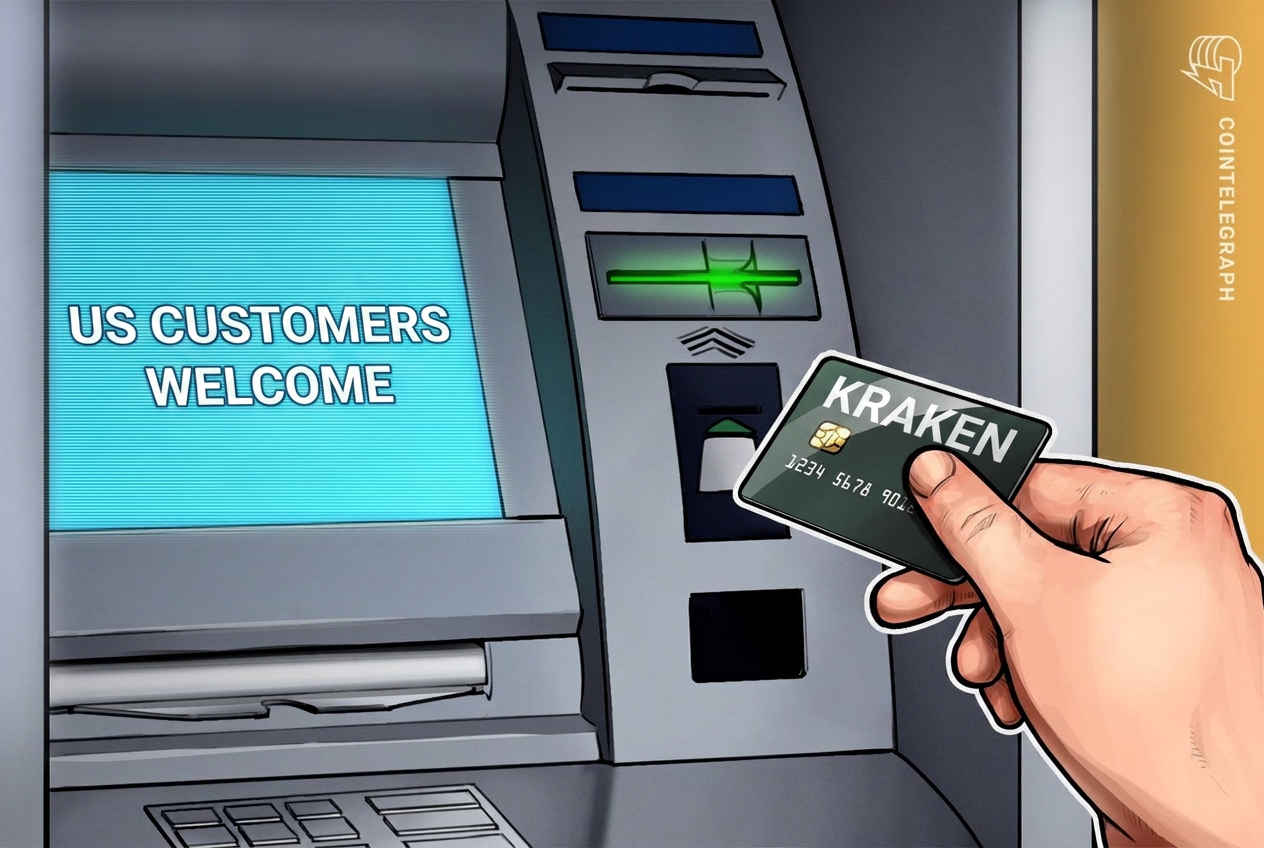
Kraken’s payment app, Krak, has launched a multi-asset debit card in the US, allowing customers to spend crypto and fiat while earning up to 2% cashback in dollars or Bitcoin (BTC).
The card supports more than 600 currencies and assets, with holdings converted into US dollars at point of sale. A single purchase can draw from multiple balances, with users setting the order in which assets are spent, according to an announcement Tuesday.
The card is issued by Lead Bank on Visa’s network and powered by Stripe Issuing, with physical and virtual versions available to eligible US customers. The company said cashback rates depend on average assets held across Krak, Kraken and Kraken Pro.
Krak is positioning the card as an alternative to credit-based rewards programs. A Morning Consult survey of 2,001 US adults commissioned by Krak found that 42% of credit card holders worry about paying off their monthly balance, while 60% of respondents said they would switch to a debit card offering rewards without taking on debt.
Kraken’s consumer money and payments app has issued more than 135,000 multi-asset cards across the UK and European Economic Area since launching there in December 2025, the company said.
Related: Kraken opens Jersey Mike’s IPO to retail investors through tokenized shares and direct allocations
Payward eyes broader financial services push
Payward has set its sights on expanding its financial services product line.
Co-CEO of Kraken’s parent company, Arjun Sethi, discussed the broader strategy Tuesday at the Wyoming Blockchain Symposium, including its push into additional asset classes and financial services.
“As you start expanding into multiple asset classes, you’re just generally gonna be less susceptible to very specific markets,” Sethi said.
He added that Payward now offers banking services and described tokenization as “a large part” of the company’s broader effort to expand its financial offerings.
He also compared the company’s ambitions with those of major traditional financial institutions, saying the company needs to build products and services “not too different to a JP Morgan or a financial institution.”
Sethi’s comments come as major crypto exchanges broaden their businesses beyond spot crypto trading, with Coinbase and others expanding into equities, derivatives, prediction markets, tokenized assets and pre-IPO products.
Separately, Kraken on Tuesday launched trading in more than 7,000 US-listed stocks for customers in the European Economic Area (EEA).
Magazine: ‘Fabricated rumors’ about BitMart founder, Binance bStocks dominate: Asia Express
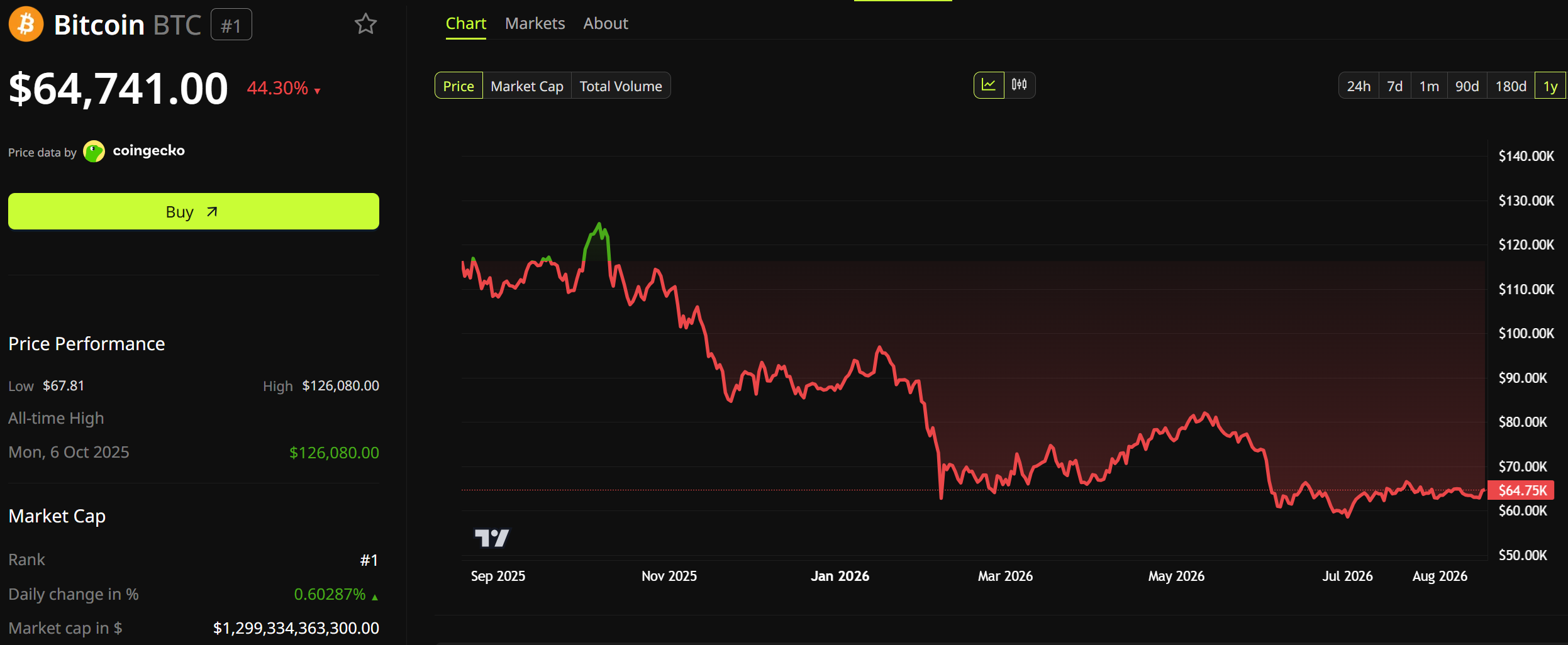
BlackRock and VanEck released back-to-back reports this week explaining why Wall Street’s arrival failed to prevent the 50% Bitcoin (BTC) crash. Both firms argue the same infrastructure that accelerated institutional adoption also amplified the sell-off.
BlackRock’s whitepaper blames extreme leverage and capital rotation into AI funds. VanEck’s latest ChainCheck counts 8 of 12 capitulation signals firing and suggests the correction may be entering its final months.

Leverage and Fund Flows Drove the Bitcoin Crash
BlackRock’s “Re-Underwriting Bitcoin” whitepaper describes a market that entered October 2025 dangerously stretched. Futures open interest topped $90 billion, and 80% of it sat in offshore perpetual contracts offering up to 125x leverage.
When Washington announced fresh China tariffs on October 10, forced liquidations wiped $20 billion of open interest in a single day. Equities recovered within weeks, but bitcoin kept sliding and broke below $60,000 by June.
Fund flows deepened the damage. Spot Bitcoin ETFs drew $60 billion between January 2024 and October 2025. They then bled more than $5 billion while AI-themed funds absorbed $46 billion.
BlackRock, however, frames the rotation as cyclical rather than a structural loss of demand.
Follow us on X to get the latest news as it happens
VanEck Sees the Sell-Off Entering Its Final Phase
VanEck’s mid-August ChainCheck reaches a similar verdict through on-chain data. Eight of 12 capitulation signals are active. The drawdown has also entered its 10th month, against a historical average of 11 to 13. That timeline mirrors analyst Benjamin Cowen’s call for an October cycle bottom.
The firm also expects a shallower trough than the 78% to 94% wipeouts of past cycles because no major lender has collapsed this time.
“We expect a shallower trough this cycle, and we would rather state that assumption plainly than hide it inside a threshold,” The VanEck research team, led by Head of Digital Assets Research Matthew Sigel, wrote in the report.
Meanwhile, with on-chain researchers arguing the market has entered an accumulation zone, neither firm, BlackRock nor VanEck, promises a quick rebound.
BlackRock still models a 1% to 2% allocation improving a 60/40 portfolio. VanEck, meanwhile, concedes capitulation buys have historically paid off only at the one-year mark.
The next few months will test whether Wall Street’s Bitcoin era can soften the bottom it could not prevent.
The post Wall Street Backed Bitcoin, Then Watched It Crash 50%, Two Reports Explain appeared first on BeInCrypto.

Prosecutors in the Southern District of New York (SDNY) are urging a federal judge to reject Alex Mashinsky’s bid to overturn his 12-year prison sentence tied to Celsius’s collapse. In a Friday filing, SDNY attorneys James McDonald and Allison Nichols argued that Mashinsky’s petition lacks legal substance and should be denied without additional proceedings.
The dispute centers on a motion Mashinsky filed after telling the court in May that he would proceed pro se—representing himself. His petition to vacate the conviction and sentence includes claims that point to matters involving cryptocurrency exchange FTX and his former colleague, Celsius chief revenue officer Roni Cohen-Pavon.
Key takeaways
- SDNY prosecutors asked the court to deny Mashinsky’s motion to vacate, calling multiple arguments “without merit.”
- The government criticized the petition for relying on allegations that were not supported by a sworn declaration.
- Prosecutors disputed claims that Mashinsky received ineffective assistance of counsel.
- Mashinsky is serving a May 2025 sentence of 144 months after pleading guilty to commodities and securities fraud.
- Cohen-Pavon, who prosecutors described as providing “substantial assistance,” was sentenced to time served in May.
Prosecutors reject claims in Mashinsky’s petition
In their filing, prosecutors said Mashinsky failed to meet the threshold for relief. They argued that his motion is essentially a reprise of issues raised during sentencing, rather than a valid basis to undo the conviction or the punishment.
Prosecutors also pushed back on Mashinsky’s complaints about the performance of his legal team. While the filing indicates Mashinsky stops short of asserting factual innocence, it characterizes his approach as shifting blame to counsel for not pursuing certain arguments.
“Mashinsky has not even submitted a sworn declaration in support of these baseless allegations, and his petition should be denied without a hearing or further fact-finding,” prosecutors wrote, adding that the court should not revisit settled points based on unsworn claims.
What the court filing says about evidence and procedure
Mashinsky’s motion was filed after he announced he would take over his own representation. The government’s response suggests the petition’s evidentiary posture is a key weakness: prosecutors singled out the absence of a sworn declaration supporting the allegations.
That procedural detail matters because motions to vacate typically require more than generalized accusations; courts generally look for specific, substantiated grounds for relief. In the government’s view, Mashinsky’s filing did not meet that standard.
As of Tuesday, the judge overseeing the case had not issued a response to the government’s submission.
Background: Celsius collapse, guilty pleas, and sentencing
Mashinsky was sentenced in May 2025 to 144 months in prison after pleading guilty to commodities fraud and securities fraud connected to “manipulative and deceptive devices” at Celsius. The guilty plea followed a broader legal crackdown on Celsius after the platform filed for bankruptcy in 2022 amid a wider market downturn that began with the collapse of Terraform Labs.
Roni Cohen-Pavon—Celsius’s chief revenue officer—was also indicted in 2023 alongside Mashinsky and later pleaded guilty. According to prosecutors, Cohen-Pavon provided “substantial assistance” to the government’s case. In May, she was sentenced to time served.
At sentencing, Mashinsky was ordered to pay $48 million in forfeiture. He also agreed to pay $10 million as part of a separate settlement with the US Federal Trade Commission, alongside arrangements described as including a $47 billion judgment that was suspended.
Earlier coverage also noted related enforcement actions against Celsius leadership, including a separate FTC matter involving Celsius co-founders Leon Goldstein and another defendant, referenced in connection with the broader Celsius fallout.
Regulators still pursuing parallel cases
While the criminal case reached sentencing for Mashinsky and Cohen-Pavon, regulators continued to work through other legal tracks tied to Celsius leadership.
In June, the US Commodity Futures Trading Commission (CFTC) announced that Mashinsky was permanently banned from trading in markets under the CFTC’s authority. That action was described as among the last major resolutions tied to Mashinsky and Celsius following the 2022 collapse.
At the same time, a civil action by the US Securities and Exchange Commission (SEC) involving a co-founder was reported as ongoing even after the criminal case moved forward and the court issued judgment against the platform. As of July 30, the SEC said its attorneys and Mashinsky were “engaged in settlement discussions.” The SEC requested 60 days to file a status report, effectively pushing the next checkpoint toward the end of September.
For investors and market participants, these parallel processes underline a recurring reality in crypto enforcement: criminal cases can conclude on a timetable that differs from regulatory litigation. Even when one front reaches a sentencing milestone, other matters—whether commodities, securities, or consumer-protection—can continue to shape compliance expectations and potential liability.
Readers should watch whether the SDNY judge grants or denies Mashinsky’s request to vacate, and whether the court allows any additional fact-finding or hearings. At the same time, settlement dynamics in the SEC civil matter—and any further regulatory steps following the CFTC’s permanent trading ban—remain key to understanding what outcomes could still materially affect Celsius-related defendants and those watching closely for precedent in crypto enforcement.
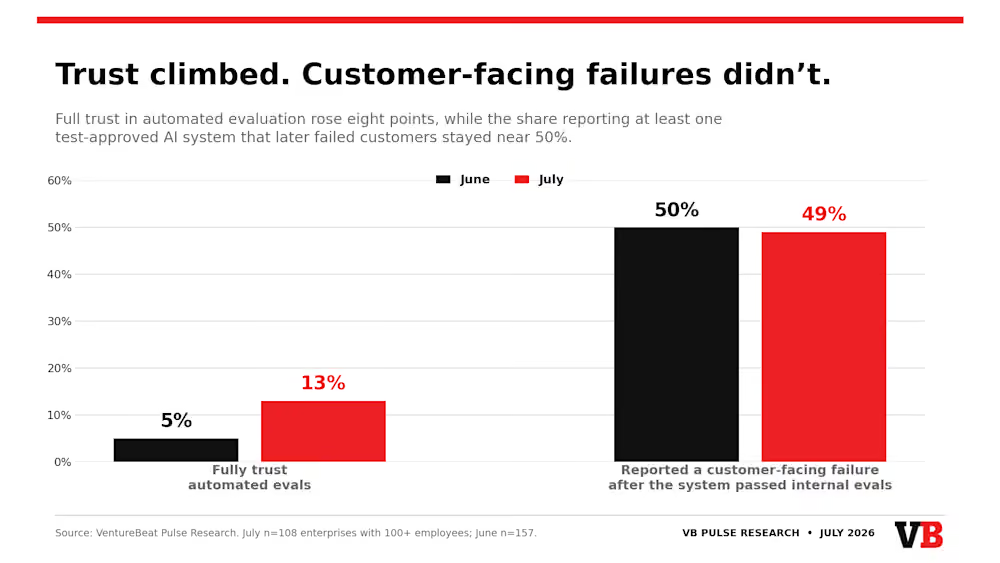
85% of companies burned by an AI mistake are racing to cut the humans who might catch the next one

Making Short Journeys More Efficient

MoonPay Adds Cash App Pay for Crypto Purchases in US





-

 Fashion4 days ago
Weekend Open Thread: Ann Taylor
-
 NewsBeat7 days ago
Communication cards help banking customers access services or report scams
-
 Sports5 days ago
This U.S. Amateur is a glimpse into golf’s future in more ways than you think
-

 Sports4 days ago
Birmingham 2026: Day 6 Timetable for Irish Athletes
-
 NewsBeat4 days ago
Myanmar says over 300,000 Rohingya refugees verified for repatriation as exodus enters ninth year
-

 Tech4 days ago
11 Ways to Rank Your Videos
-

 Politics3 days ago
SEQ Code: The Three Letter Boarding Pass Code That Could Give You The Worst Seat
-
 Entertainment6 days ago
Keke Palmer Subtly Hints At Sean Evans Drama With Cryptic Post
-

 Tech7 days ago
Zoom Screen-Sharing Bug Let People Fully Take Over Other Devices On A Call
-
 Crypto World7 days ago
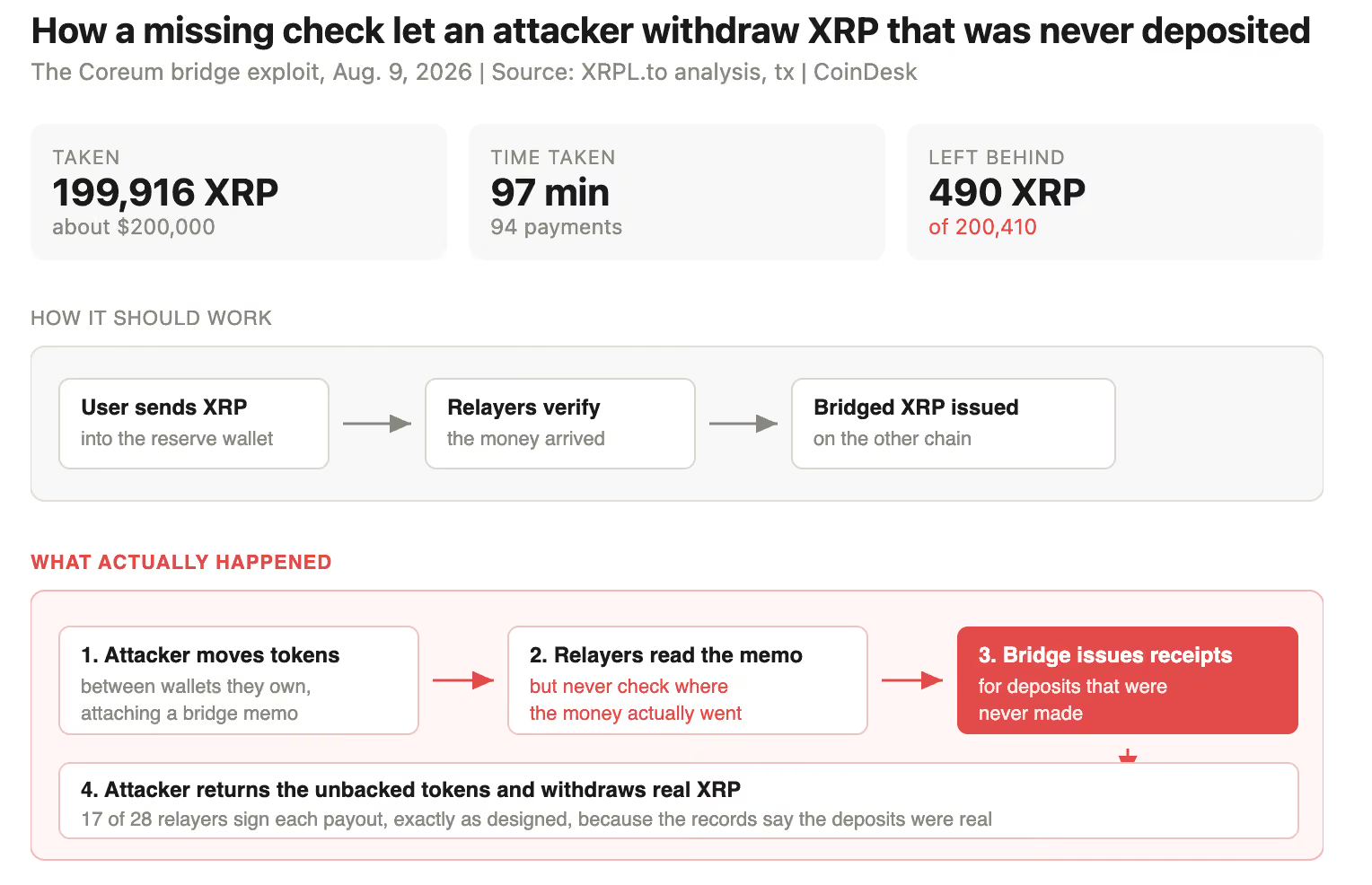
XRP bridge drained after software mistook fake deposits for real ones
-

 Tech5 days ago
DeepSeek Harness launches as open source rival to Claude Code, alongside V4-Pro on API with higher prices
-

 Sports6 days ago
DeQuan Jones in ‘high spirits’ after successful leg surgery
-
 Crypto World6 days ago
Perplexity AI Predicts an XRP Scenario Few Analysts Are Discussing
-

 Tech7 days ago
SpaceXAI’s Grok Bot turns agents into persistent digital coworkers that can operate your apps for $120-per-month
-
 Entertainment6 days ago
2026’s Most Ambitious Fantasy Movie Officially Scores Sequel Update
-

 Politics6 days ago
How Average Are You In The UK?
-

 Business7 days ago
Evolv Technologies Holdings, Inc. (EVLV) Q2 2026 Earnings Call Transcript
-

 Fashion6 days ago
The Details Do the Dressing
-
 Tech7 days ago
A Zoom Screen-Sharing Bug Let Anyone Take Over Other Devices On a Call
-

 NewsBeat6 days ago
‘Regret is a major theme of my work’: Matt Haig on finding acceptance
You must be logged in to post a comment Login