

Crypto World
U.S. Stock Futures Advance on Iran Diplomacy Progress and Bitcoin Rally to $76K

TLDR
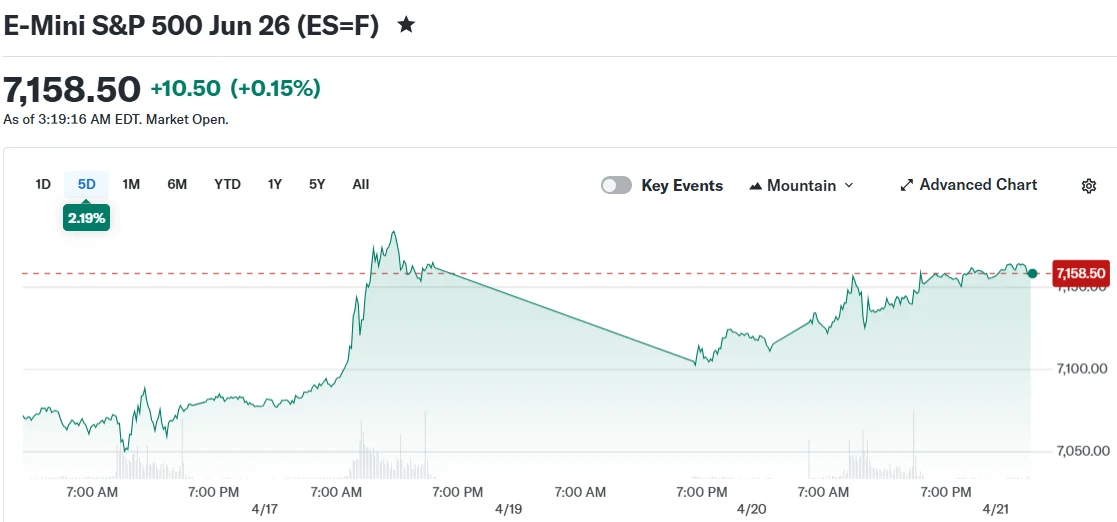
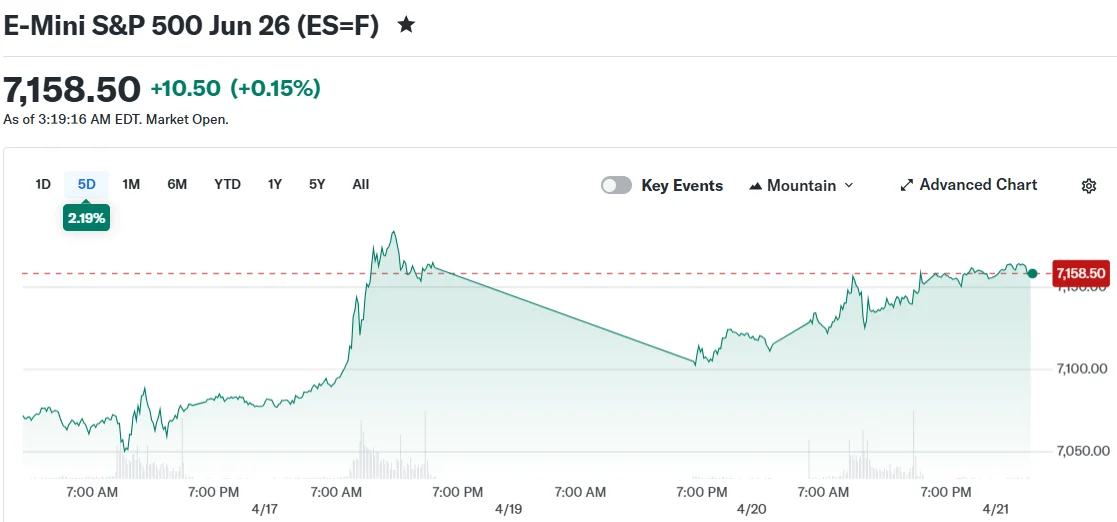
- Futures for the Dow advanced 301 points (0.6%), while S&P 500 and Nasdaq futures posted gains during early trading
- Current U.S.-Iran ceasefire set to conclude Wednesday; Tehran indicates possible diplomatic team deployment to Pakistan
- Apple announces Tim Cook’s departure as CEO, with hardware division leader John Ternus designated as successor
- Bitcoin advanced toward the $76,000 level, bolstered by substantial Strategy acquisition
- Federal Reserve chair nominee Kevin Warsh scheduled for Senate confirmation hearing Tuesday; explicit rate guidance unlikely
Equity futures posted solid gains Tuesday morning as market participants monitored progress in diplomatic negotiations between the United States and Iran while digesting significant leadership changes at Apple.
Futures tied to the Dow Jones Industrial Average advanced 301 points, representing a 0.6% increase. Futures linked to the S&P 500 climbed 0.3%, while Nasdaq 100 futures registered a 0.4% gain. These advances followed Monday’s session, which saw declines across all three major benchmarks, ending a robust recent uptrend.
The temporary ceasefire agreement between Washington and Tehran is scheduled to lapse late Wednesday evening. President Trump confirmed that American negotiators stand prepared to travel to Pakistan to continue diplomatic discussions. Iranian officials suggested they would dispatch a negotiating delegation, although formal confirmation remained pending as of Tuesday morning.
“The working assumption for most market participants is that we see an extension of the current ceasefire,” said Michael Brown, strategist at Pepperstone.
Oil prices retreated on growing optimism surrounding diplomatic progress. Brent crude declined 0.5% to reach $95.02 per barrel. West Texas Intermediate decreased 0.6% to settle at $86.87 per barrel. Reduced geopolitical tensions could alleviate concerns about supply chain disruptions affecting shipping routes through the Strait of Hormuz.
Gold retreated 0.6% to $4,801 per ounce. The U.S. dollar index registered a modest 0.1% increase against major trading currencies. The benchmark 10-year Treasury yield remained unchanged at 4.26%.
Apple Leadership Transition Impacts Shares
Apple announced Monday evening that Tim Cook would relinquish his position as chief executive. John Ternus, currently overseeing the company’s hardware engineering division, has been named as his replacement. Apple shares declined 0.5% during premarket activity following the revelation.
Market observers are simultaneously focused on Kevin Warsh, President Trump’s nominee for Federal Reserve chair. Warsh is scheduled to testify before the Senate Banking Committee Tuesday. His prepared testimony contained no definitive signals regarding monetary policy direction. Current market expectations favor no interest rate reductions throughout 2026.
March retail sales figures are scheduled for release later Tuesday, providing crucial insights into consumer expenditure patterns during the period of heightened Middle East tensions.
Bitcoin Advances Toward $76,000 Threshold
Bitcoin climbed toward the $76,000 mark Tuesday, receiving support from a substantial acquisition by Strategy, the business intelligence company recognized for its assertive Bitcoin accumulation approach. The transaction provided momentum across cryptocurrency markets more broadly.
United Airlines is scheduled to release quarterly earnings Tuesday. Financial analysts will scrutinize how elevated fuel expenses, stemming from Middle East instability, impacted the airline’s financial performance.
The Nasdaq ended its longest consecutive winning streak since 1992 during Monday’s trading session. Both the S&P 500 and Nasdaq Composite had recently established new record peaks before experiencing the recent downturn.
Warsh’s Senate testimony represents a significant market catalyst Tuesday, with investors seeking any indications regarding Federal Reserve policy direction under potential new leadership.




Metaplanet (3350), Japan’s largest corporate bitcoin holder and the world’s third-largest bitcoin treasury company holding 40,177 BTC on its balance sheet, has confirmed a delay in its planned preferred share listing.
CEO Simon Gerovich discussed the complexity of navigating Japan’s underdeveloped preferred equity market as the primary reason for the hold-up.
The company’s planned instrument would be only the seventh listed preferred in Japan, Gerovich said, and, notably, the first-ever perpetual preferred share in the market.
Metaplanet announced back in November a two-tier listed preferred share class, Mars and Mercury. The move came after Strategy launched its own preferred shares, with Stretch (STRC) among the most popular.
Two key obstacles have stood in the way of Metaplanet’s listing of preferred shares.
First, Japanese exchange rules require preferred dividends to be backed by sustainable, recurring cash flows assessed across multiple market conditions. Metaplanet must demonstrate that its Bitcoin Income Generation Business can produce stable returns even in adverse bitcoin environments, and has just a six-quarter operating track record.
Second, the company’s ambition to pay monthly dividends is far more frequent than Japan’s typical once or twice-yearly cadence, which requires building entirely new dividend infrastructure around record dates.
Gerovich concluded that the company is committed to delivering preferred shares to the market and highlighted Japan’s status as one of the world’s most yield-starved major capital markets.
On the earnings, the company delivered net sales of $19.5 million (¥3.08 billion, up 251% year-on-year) and operating income of $14.4 million (¥2.27 billion, up 283%). Meanwhile, bitcoin yield came in at 2.8% quarter-to-date.
Metaplanet shares are down 25% year to date.


Binance founder Zhao Changpeng (CZ) said he prefers investing in the underlying infrastructure powering artificial intelligence rather than AI applications themselves, framing the current boom as an “infrastructure-first” investment cycle.
Summary
- Binance founder Zhao Changpeng says he favors investing in AI infrastructure such as data centers and energy systems over AI applications.
- He highlights NVIDIA’s dominance in AI chips but expects more customized compute solutions to emerge over time.
- His investment firm still allocates 70%–80% of capital to Web3, keeping crypto as the core focus.
Speaking during a Binance online livestream, CZ described his preferred strategy as focusing on the “shovels” of AI — including data centers, power supply systems and large-scale computing infrastructure required to support model training and inference workloads.
His comments reflect a growing investor narrative that the AI economy is not just about algorithms or software, but about energy, hardware and compute availability at industrial scale.
AI infrastructure becomes the dominant investment layer
CZ noted that while NVIDIA currently dominates the AI chip market, the long-term landscape may shift toward more specialized and customized compute solutions tailored to different AI workloads.
This view aligns with a broader industry trend in which hyperscale data centers, energy infrastructure and semiconductor supply chains are becoming the primary bottlenecks in AI expansion rather than software innovation itself.
He also said he is monitoring developments in robotics, suggesting that AI-driven physical automation may become a major adjacent investment theme alongside compute infrastructure.
The “shovels in a gold rush” analogy has become increasingly common across venture capital and macro investing circles, where capital allocators prioritize foundational layers that benefit from multiple waves of adoption rather than single-product AI companies.
Web3 remains core as CZ keeps crypto allocation dominant
Despite growing interest in AI-related infrastructure, CZ emphasized that his investment firm YZi Labs continues to focus primarily on the crypto and blockchain sector, which still represents roughly 70% to 80% of its portfolio.
He also suggested that AI’s broader economic impact will extend into biotechnology and robotics, but said the firm does not plan to aggressively expand into large-scale biotech exposure at this stage.
Instead, the strategy remains centered on digital asset infrastructure, decentralized networks and blockchain-based financial systems, even as capital increasingly flows into adjacent high-growth sectors like AI compute and automation.
This positioning reflects a broader convergence theme across technology investing, where AI, energy, semiconductors and blockchain infrastructure are increasingly viewed as interconnected parts of a single computational economy.
Infrastructure-driven narrative spans AI, crypto and global markets
CZ’s comments arrive at a time when global markets are increasingly rewarding infrastructure-heavy plays across multiple sectors — from semiconductor manufacturing and defense systems to energy grids and cloud computing.
In a similar macro pattern, investors have been rotating toward companies and assets that provide foundational capacity rather than end-user applications, especially as demand for compute-intensive technologies accelerates.
This infrastructure-first mindset also overlaps with broader macro uncertainty, where capital is increasingly concentrated in tangible capacity providers during periods of geopolitical fragmentation and supply chain stress.
Within this context, crypto infrastructure remains positioned alongside AI and data center expansion as part of a wider digital-physical convergence cycle, where compute, energy and financial networks are becoming tightly linked investment themes.
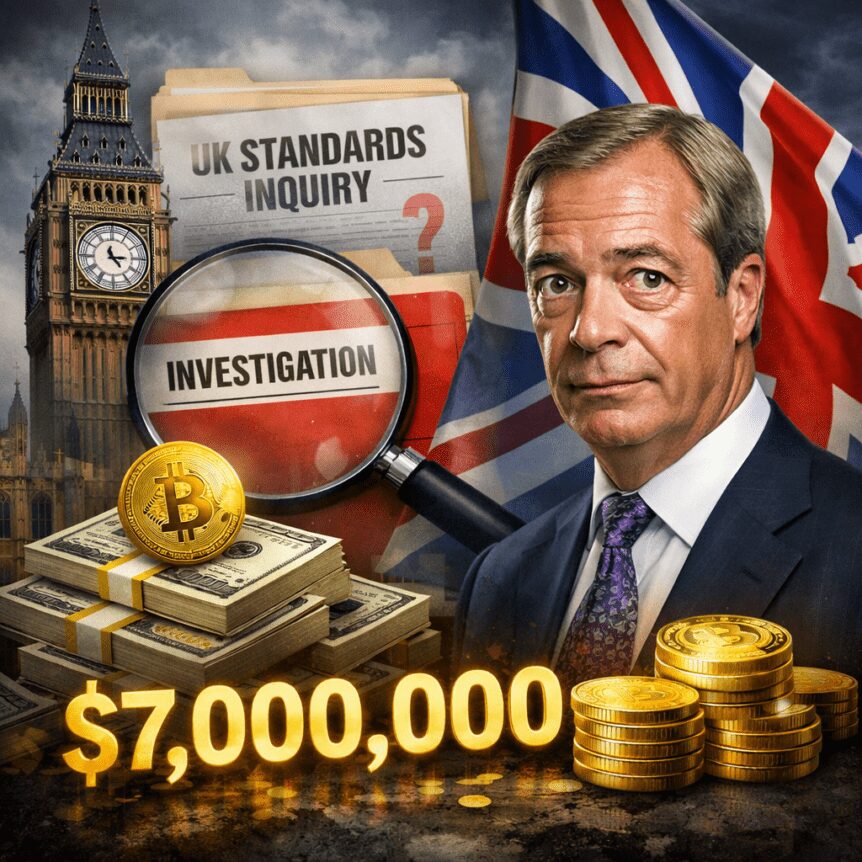
The UK Parliamentary Standards Commissioner has opened a formal inquiry into Nigel Farage, the Reform UK leader, over whether he breached House of Commons rules by failing to declare a £5 million gift from crypto-backed financier Christopher Harborne. The BBC reported the inquiry on Wednesday, underscoring a fresh wave of scrutiny surrounding political finance and crypto-linked contributions in the United Kingdom. Farage has argued there was no obligation to declare the payment, which he received before his election to Parliament in 2024. Critics contend that once he became a member of Parliament, registration obligations applied.
The Conservative Party has urged the parliamentary standards watchdog to investigate the matter, and the Electoral Commission is reportedly weighing whether to launch a formal probe into the donation. Together, these developments broaden the focus on how crypto-fueled funding intersects with political finance rules, amplifying regulatory attention on the sources and disclosure of money in UK politics.
The case sits within a broader regulatory backdrop as UK lawmakers and regulators deepen their examination of the role of digital-asset money in political life. The discourse has intensified in recent weeks after the UK Liberal Democrats urged the Financial Conduct Authority to investigate whether Farage breached market rules by featuring in a Stack BTC promotional video while holding a financial stake in the company. Farage had previously disclosed a $286,000 equity investment in Stack BTC after acquiring a 6.31% stake through his media vehicle Thorn In The Side in March.
Related: Liberal Democrats push FCA probe over Farage Stack BTC concerns
Key takeaways
- The Parliamentary Standards Commissioner has opened a probe into whether Farage breached House of Commons rules by not declaring a £5 million gift from Christopher Harborne, a crypto-linked financier, received before Farage’s 2024 election.
- The inquiry follows a Conservative push to initiate an official review and signals heightened regulatory interest in crypto-linked political financing and post-election disclosure obligations.
- The Electoral Commission is reportedly assessing whether to launch a formal investigation into the donation, adding a potential enforcement dimension to the case.
- UK political crypto donations are legal under current Electoral Commission guidance, but the issue has sparked calls for a moratorium and tighter governance, as lawmakers seek statutory guidance ahead of the next general election.
- The broader regulatory context includes scrutiny of Farage’s crypto exposure (including a disclosed Stack BTC investment) and ongoing debates over how crypto interests should be disclosed and regulated in political activities.
Regulatory proceedings and political-finance implications
According to BBC reporting, the Standards Commissioner’s inquiry centers on whether Farage failed to register a significant gift from a high-profile crypto backer. The rules governing registration are clear in principle, but the timing and filing requirements can become contested when gifts are received before a candidate attains parliamentary status or when individuals transition into public office. Critics say that post-election registerability should apply to large contributions or gifts connected to political activity, whereas proponents of Farage’s position argue there was no binding obligation to declare outside the usual framework.
In parallel, the Conservatives wrote to the parliamentary standards watchdog requesting a formal review, a move that aligns with broader questions about accountability and transparency in political financing. The Electoral Commission’s reported consideration of a formal investigation would add a separate layer of compliance scrutiny, potentially triggering procedural reviews of donor disclosure, donor verification, and the public reporting of electoral money. These developments arrive as UK authorities intensify oversight of how crypto wealth is used in political contexts, a trend that may shape future enforcement actions and guidance for political parties.
Crypto donations in UK politics: regulatory landscape and policy debates
Reform UK became notable for being the first major party to publicly accept cryptocurrency donations in 2025, reflecting a broader shift in fundraising practices among political movements. The party recently disclosed a £ million-level gift from Harborne in the fourth quarter of 2025, following a record donation in the prior quarter. While crypto donations are legal under current Electoral Commission guidance, the evolving nature of digital assets has driven calls from parliamentary committees for a temporary pause on crypto donations until the Commission issues statutory guidance ahead of the next general election, which is expected no later than 2029.
On March 18, the Joint Committee on the National Security Strategy urged the government to impose an immediate moratorium on crypto donations until formal guidance is in place. The committee also proposed structural reforms, including the creation of a Political Finance Enforcement Unit and a reduction of the declaration threshold for political donations—from approximately £12,000 (roughly $14,900) to around £500–£600 range—reflecting concern over foreign influence and the potential for strategic influence through digital assets. Earlier, Matt Western, the committee’s chair, urged a temporary ban on crypto donations to mitigate foreign interference risks and safeguard the integrity of political processes.
These policy discussions occur against a backdrop of ongoing regulatory exploration in the UK, including the use of digital assets within the financial system and the potential cross-border implications for governance and oversight. The evolving framework seeks to balance innovation and fundraising flexibility with robust disclosure, provenance, and anti-foreign interference safeguards, a tension that will shape the regulatory envelope for crypto-enabled political giving in years to come.
Farage, Stack BTC and compliance risk
Beyond the gift at the center of the standards inquiry, Farage’s crypto-related ties have drawn regulatory attention. Cointelegraph reported that the Liberal Democrats pressed the FCA to examine whether Farage violated market rules by appearing in a Stack BTC promotional video while holding a stake in the company. Separately, Farage disclosed a $286,000 equity position in Stack BTC after acquiring a 6.31% stake via Thorn In The Side in March, highlighting the potential for perceived conflicts of interest when political figures participate in or back crypto ventures. These disclosures intensify the compliance considerations for MPs engaging with crypto projects and the responsibilities associated with asset ownership, public representation, and disclosure obligations.
From a governance perspective, the juxtaposition of a high-profile political figure with crypto investments underscores the need for clear, enforceable rules around disclosure, voting conflicts, and political messaging tied to financial interests. For compliance professionals and institutional observers, the case highlights the importance of rigorous due diligence, transparent record-keeping, and consistent application of donor and asset disclosure requirements across party lines. It also illustrates the evolving nature of regulatory risk in an area where technology, finance, and politics intersect.
Related reporting has connected these debates to broader policy discussions about stablecoins and digital assets within the UK financial ecosystem, including indicators of how regulators might approach non-traditional fundraising tools in the future. For context, UK policymakers have already engaged with the topic through regulatory sandboxes and targeted inquiries into crypto-enabled finance, signaling a cautious but progressive stance toward normalization and oversight of crypto activities in public life.
Closing perspective
As parliamentary institutions sharpen their oversight of crypto-linked funding and asset ownership, the Farage inquiry illustrates the practical implications for compliance frameworks, donor governance, and political communication. The case could influence how political actors manage disclosures, how parties structure fundraising in digital assets, and how regulators align enforcement with evolving market practices. The next steps—whether the Electoral Commission formalizes an investigation, how the standards inquiry proceeds, and how policy proposals unfold—will shape the regulatory and political environment for crypto-related contributions in the UK.
Watch for further developments as committees, enforcing agencies, and political actors navigate the intersection of crypto money, disclosure rules, and public accountability.
Attribution: For broader context on related regulatory debates, Cointelegraph has reported on the Liberal Democrats’ push for FCA action and other UK crypto-political issues.
Crypto World
Fidelity International Debuts Digital Liquidity Fund With Blockchain Partners Sygnum and Chainlink

Key Highlights
- Fidelity International unveils FILQ, a blockchain-based liquidity fund developed alongside Sygnum and Chainlink
- The fund receives AAA-mf assessment from Moody’s, ensuring institutional-grade credit quality
- Chainlink infrastructure delivers real-time NAV data directly on blockchain networks
- Sygnum’s Desygnate platform enables regulated tokenization for Fidelity’s digital fund
- Major asset managers accelerate adoption of tokenized treasury products as market approaches $15 billion
Fidelity International has made its debut in the blockchain-based fund sector by unveiling a digital liquidity product created in collaboration with Sygnum Bank and Chainlink. This initiative represents a significant milestone in connecting conventional financial instruments with distributed ledger technology. The move demonstrates how established investment firms are increasingly exploring on-chain distribution channels for cash management solutions.
FILQ Digital Fund Goes Live Through Sygnum Partnership
The asset management firm introduced the Fidelity USD Digital Liquidity Fund—abbreviated as FILQ—via Sygnum Bank’s tokenization infrastructure. Moody’s Ratings awarded the fund its highest AAA-mf designation for money market instruments. This assessment reflects superior credit worthiness and robust liquidity characteristics for institutional cash products.
The offering creates a bridge between traditional regulatory frameworks and blockchain technology. It establishes the firm’s foothold in the rapidly growing tokenized investment vehicle sector. With approximately $1 trillion under management globally, Fidelity International brings substantial institutional credibility to digital asset markets.
Sygnum’s Desygnate technology handles the tokenization and issuance mechanics. This platform enables compliant investment vehicles to function within digital asset ecosystems. Consequently, the digital fund merges conventional fund governance with continuous blockchain settlement capabilities.
Real-Time Fund Metrics Powered by Chainlink Oracle Network
Chainlink’s decentralized oracle system will deliver on-chain net asset value calculations and distribution information for FILQ. This infrastructure allows investors to access current fund valuations and payout details with minimal delay. The arrangement enhances visibility for the digital fund while preserving its underlying regulatory framework.
JPMorgan serves as the authorized provider of daily NAV calculations for the product. Chainlink then transmits this verified data through blockchain channels. This configuration enables FILQ to share authenticated fund metrics within tokenized ecosystems.
The collaboration builds upon previous joint initiatives among the three organizations. During 2024, these partners explored on-chain NAV delivery mechanisms for digital securities. The current liquidity fund represents the evolution of that experimental work into a commercial application.
Blockchain-Based Money Market Products Experience Rapid Expansion
FIDILQ’s introduction coincides with tokenized government securities and money market vehicles nearing $15 billion in total value. Investment managers, trading platforms, stablecoin providers, and decentralized finance applications have collectively fueled this expansion. This environment provides favorable conditions for the new digital liquidity offering.
BlackRock and Franklin Templeton have previously introduced blockchain-based money market solutions. JPMorgan has submitted regulatory filings to establish a tokenized money market fund operating on Ethereum infrastructure. These developments indicate growing institutional appetite for yield-generating instruments on distributed networks.
Fidelity International’s entry through FILQ brings another prominent global institution into this space. The fund integrates Moody’s credit evaluation, Sygnum’s tokenization capabilities, Chainlink data distribution, and JPMorgan’s valuation services. This launch represents a meaningful advancement for regulated cash management products operating on blockchain technology.
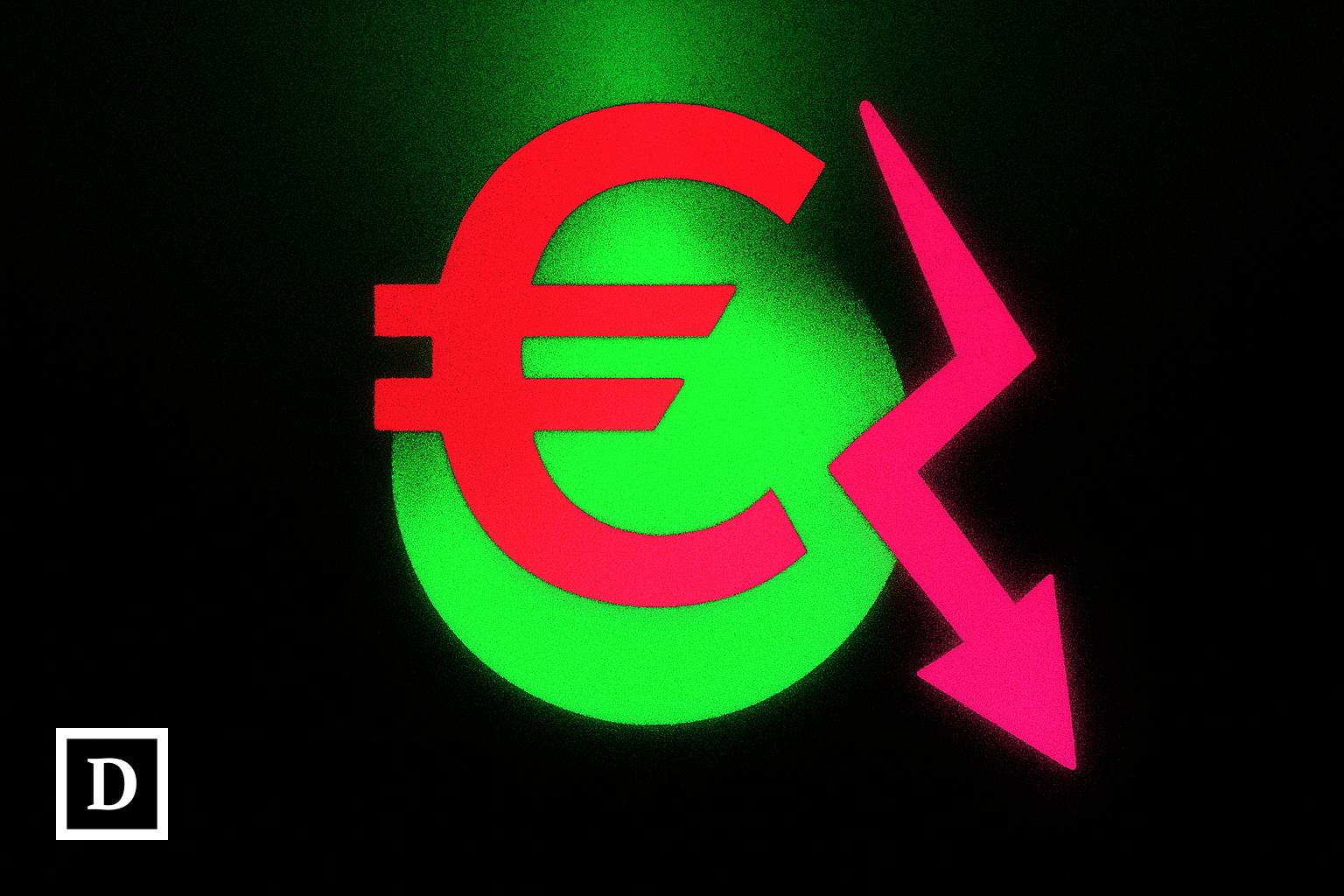
The onchain market cap of euro-denominated stablecoins reached a new record of $774.2 million, with Ethereum commanding two-thirds of the total supply.
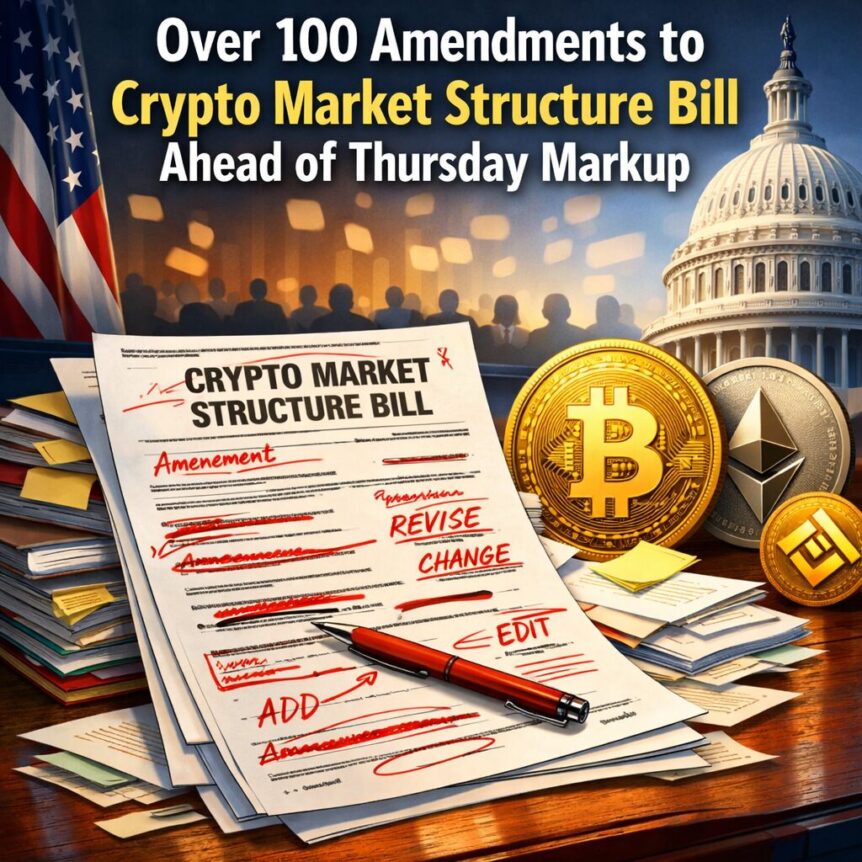
A leaked list has revealed over 100 amendments filed by the Senate Banking Committee members to a crypto bill set for a markup on Thursday.
The proposed changes are linked to stablecoins, software developers, and ethics.
Amendments Ahead of Markup
The list, obtained by Politico, reveals substantial proposed amendments. Democratic senators have proposed several changes, while Republican senators sought minor adjustments. Most amendments are centered around key issues that have been debated for months, including crypto software developer protections, ethics provisions, and stablecoin yield as the committee seeks to advance the bill to the Senate floor.
The leaked list shows an amendment introduced by Democratic senators Jack Reed and Tina Smith to strengthen interest yield prohibitions by using a substantially similar test instead of an equivalence test.
Another amendment by Democratic senator Chris Van Hollen introduces an ethics provision barring the President, Vice President, senior officials, members of Congress, and their families from promoting, owning, or being affiliated with crypto. The amendment has received support from Democrat and Republican lawmakers.
Democratic senator Catherine Cortez Masto plans to introduce an amendment protecting software developers. The proposal has garnered support from several crypto groups.
Other amendments deal with sanctions, institutions involved with crypto, and one to re-establish the Justice Department’s National Cryptocurrency Enforcement Team, dismantled last year.
Sharp Divisions
The crypto market structure bill defines how market regulators oversee crypto.
The House passed its version of the bill, called the CLARITY Act, in July.
However, crypto and banking industry executives failed to agree on key provisions related to stablecoins and the involvement of government officials in crypto.
Restrictions on stablecoin yield have also been a contentious issue, with no resolution despite months of negotiations.
A draft version of the bill released on Monday banned third-party platforms from offering stablecoin yield that mirrors traditional bank deposit interest.
The previous markup was indefinitely postponed in January after Coinbase withdrew support citing fatal flaws in the draft bill.
Republicans hold a majority in the Senate and the Senate Banking Committee.
However, some members have refused to support the market structure bill if certain provisions were not added.
Republicans also need Democratic support to pass the bill with a three-fifths majority and avoid a filibuster.
Disclaimer: This article is provided for informational purposes only. It is not offered or intended to be used as legal, tax, investment, financial, or other advice.


Sen. John Kennedy will vote yes on the Digital Asset Market CLARITY Act in Thursday’s Senate Banking Committee markup, locking in Republican support that clears the crypto market structure bill regardless of how Democrats vote.
The Louisiana Republican reportedly struck a deal with Chairman Tim Scott to add a fiduciary duty provision for people working in the crypto industry and to attach Sen. Elizabeth Warren’s Build Now Act housing bill to the package.
Bipartisan Deal Flips CLARITY Act Committee Math
The Senate Banking panel splits 13 Republicans to 11 Democrats. Every GOP vote was needed to advance the bill, and Kennedy had been the only holdout heading into Thursday’s session.
Chairman Scott released the 309-page legislative text Tuesday after months of negotiation over stablecoin yield rules. The bill passed the House 294 to 134 in July 2025 but stalled in the Senate over those disputes.
White House crypto director David Sacks framed the markup as a major win for U.S. competitiveness and thanked Senate staff for the compromises that produced the current text.
Follow us on X to get the latest news as it happens
Amendments and DeFi Pushback Loom
Senate Banking members filed more than 100 amendments before Wednesday’s deadline. Sens. Catherine Cortez Masto, Andy Kim, Chris Van Hollen, Warren and Jack Reed are pushing proposals that the DeFi Education Fund describes as anti-DeFi.
Those amendments target the Blockchain Regulatory Certainty Act, protections for non-controlling software developers, DeFi front-end interfaces and tokenization provisions.
Kennedy said he will hear Democratic amendments but signaled an ethics provision is unlikely to make committee.
Polymarket traders now price the bill’s 2026 passage odds at 73%, and recent polling shows a majority of voters back the framework.
A successful committee vote sends the legislation to the Senate floor before the Memorial Day recess.
The post Sen. Kennedy’s CLARITY Act Vote Locks In Senate Banking Committee Passage appeared first on BeInCrypto.
Coinbase CEO Brian Armstrong says crypto legislation is closer to passage, crediting Senate support and 3.7 million Stand With Crypto advocates.


Network News
“ALPENGLOW” UPGRADE LIVE FOR TESTING ON SOLANA: Solana developer Anza said that Alpenglow, the network’s biggest proposed consensus overhaul to date, is live on a community test cluster, marking a major step toward a potential mainnet rollout. The update means validator operators can now test software designed to move Solana from its current consensus system, which combines Proof-of-Stake with TowerBFT and Proof-of-History, toward a new architecture intended to dramatically reduce finality times and improve network responsiveness. “Alpenglow is live on the community test cluster,” Anza wrote on X. “The biggest consensus change in Solana’s history, now running on validator infrastructure ahead of mainnet.” Today, Solana relies on Proof-of-History, a cryptographic clock that timestamps transactions, alongside TowerBFT, a voting mechanism validators use to agree on the state of the blockchain. While the design has helped Solana achieve high throughput and low fees, some have pointed to outages and network instability during periods of heavy demand. — Margaux Nijkerk Read more.
LAYERZERO APOLOGY FOR KELP DAO INCIDENT: LayerZero said that it “made a mistake” allowing its own verification infrastructure to secure high-value crypto assets in a vulnerable configuration, marking a notable shift in tone after weeks of blaming developer Kelp DAO for a $292 million hack tied to North Korean attackers. The admission marks a notable shift after weeks of public finger-pointing between LayerZero and Kelp over responsibility for the April hack, which LayerZero had initially framed as an application-level configuration failure by Kelp. “First things first: an overdue apology,” LayerZero wrote in a blog. LayerZero initially blamed Kelp, arguing the protocol had chosen a risky “1-of-1” configuration in which only a single decentralized verifier network, or DVN, needed to approve cross-chain transfers, creating a single point of failure. A DVN is part of the infrastructure that verifies whether a transaction moving assets between blockchains is legitimate. “We made a mistake by allowing our DVN to act as a 1/1 DVN for high-value transactions,” the company said. “We didn’t police what our DVN was securing, which created a risk we simply didn’t see. We own that.” — Sam Reynolds Read more.
RONIN TO TRANSITION TO LAYER-2: Ronin, the gaming-centric blockchain once synonymous with the industry’s infamous $625 million exploit in 2022, is officially shedding its sidechain skin on May 12 to become an Ethereum layer 2 to improve security while maintaining throughput. Ronin, which announced the migration in April, will execute a hard fork at block 55,577,490, a process that will result in about 10 hours of downtime for users, the network said Monday on X. According to onchain data, the migration is expected to begin on Tuesday around 15:16 UTC. “Four years ago, we launched Ronin because Axie Infinity needed a faster and more efficient network,” Ronin said when announcing the migration. “It worked. Axie Infinity onboarded millions of gamers to crypto, and Pixels proved that it was possible to do it again.” The time has come to plug “back into the mothership.” While operating as an independent sidechain in mid-May 2022, Ronin suffered what is still today the largest DeFI bridge exploit in history. Layer 2 protocols benefit from tighter links to the underlying blockchain than sidechains, offering benefits that include greater security. — Olivier Acuna Read more.
ETHEREUM DEVELOPERS RELEASE “CLEAR SIGNING”: The Ethereum Foundation and a group of major crypto wallet developers are rolling out a new security standard designed to stop users from accidentally signing away their funds, a problem that has fueled some of the industry’s biggest hacks and scams. The initiative, called “Clear Signing,” aims to replace the confusing walls of code users currently see when approving Ethereum transactions with simple, human-readable explanations of what they’re actually agreeing to. The effort comes after years of phishing attacks and wallet drains that often boil down to the same issue: users unknowingly approving malicious transactions they don’t understand. The Ethereum Foundation pointed to incidents like the Bybit hack as examples of how attackers exploit “blind signing,” where users approve transactions filled with unreadable technical data. Right now, signing a crypto transaction can feel like clicking “accept” on a terms-of-service page written in another language. Wallets often display long strings of code that only highly technical users can decipher, leaving everyday traders vulnerable to fake apps, malicious links and compromised websites. — Margaux Nijkerk Read More.
In Other News
- Charles Schwab, the brokerage giant that manages around $12 trillion in client assets, began the rollout of its spot cryptocurrency trading service for retail customers in the U.S. An initial group of clients can now trade bitcoin and ether (ETH) on the Schwab Crypto platform, the company posted on X.In July last year, CEO Rick Wurster said the company planned to introduce crypto trading in the near future, with a timeframe of first-half 2026 confirmed last month. The Westlake, Texas-headquartered firm already offers crypto investments through exchange-traded funds (ETFs) and futures trading. — Jamie Crawley Read more.
- JPMorgan (JPM) is preparing to launch a tokenized money market fund, the latest sign that major financial institutions and Wall Street asset managers are speeding up efforts to move traditional assets onto blockchain rails. A filing with the U.S. Securities and Exchange Commission SEC) outlined plans for a blockchain-based money-market fund investing exclusively in short-term U.S. Treasuries, cash and overnight repo agreements backed by government securities. The fund, dubbed JPMorgan OnChain Liquidity-Token Money Market Fund (JLTXX), will maintain blockchain-based token balances tied to investors’ ownership records, allowing approved users to submit purchase, redemption and transfer requests through Ethereum, the filing said. The underlying blockchain infrastructure will be operated by Kinexys Digital Assets, JPMorgan’s blockchain unit formerly known as Onyx. — Kristzian Sandor Read more.
Regulatory and Policy
- The legislation that could fully insert the U.S. crypto industry into the regulated financial system has emerged in its latest form, with the Senate Banking Committee unveiling the market structure bill’s text just after midnight on Tuesday in advance of this week’s hearing that’s set to push the effort forward. The latest version wasn’t expected to offer many surprises for the crypto industry that’s already had a chance to dig through it privately, but it includes still-contentious language on stablecoin yield and it maintains legal protections for decentralized finance (DeFi) developers, keeping that corner of the crypto sector happy (so far). Industry insiders waited for the release late into the night, and they’ll still have to study the language to ensure their expectations were met. “This bill reflects serious, good-faith work across the committee and delivers the certainty, safeguards, and accountability Americans deserve,” committee Chairman Tim Scott said in a statement. “It puts consumers first, combats illicit finance, cracks down on criminals and foreign adversaries and keeps the future of finance here in the United States.” — Jesse Hamilton Read more.
- The Senate confirmed Kevin Warsh to the Federal Reserve Board of Governors on Tuesday, moving President Donald Trump’s pick one step closer to becoming the next chair of the U.S. central bank. Lawmakers approved Warsh in a 51-45 vote. Sen. John Fetterman (D-Pa.) was the only Democrat to support the nomination. Warsh still must win a separate Senate vote to become Fed chair, which is expected Wednesday. Governors serve 14-year terms while the chair serves a four-year term. If confirmed as chair, Warsh, 56, will replace Jerome Powell, whose eight-year term leading the Fed ends Friday. Powell, however, has said he plans to remain on the board until a federal probe into renovations at the Fed’s headquarters concludes. — Helene Braun Read more.
Calendar
- June 2-3, 2026: Proof of Talk, Paris
- June 4, 2026: Stable Summit, New York
- June 8-10, 2026: ETHConf, New York
- Sept. 29-Oct.1, 2026: Korea Blockchain Week, Seoul
- Oct. 7-8, 2026: Token2049, Singapore
- Nov. 3-6, 2026: Devcon, Mumbai
- Nov. 15-17, 2026: Solana Breakpoint, London
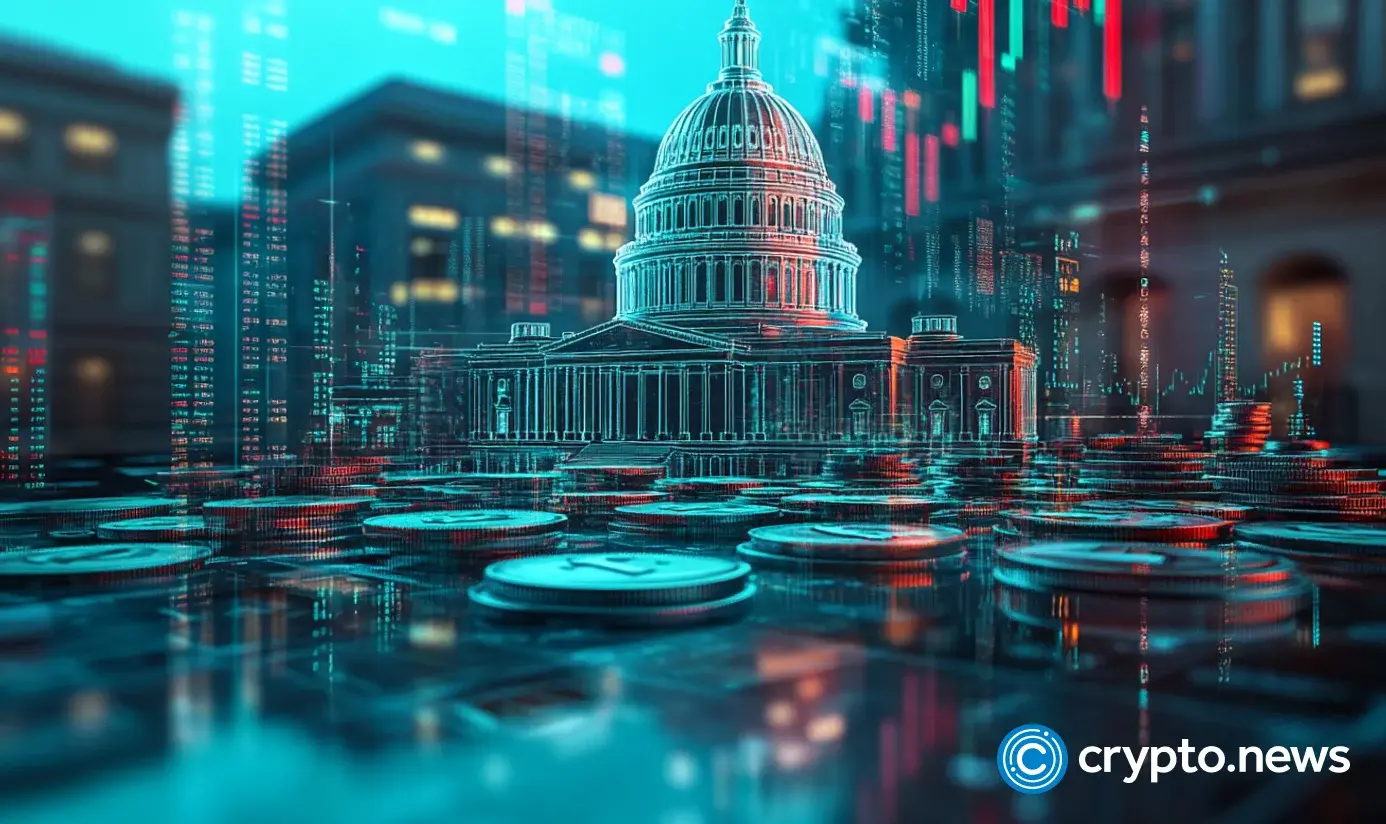
A stronger-than-expected U.S. inflation print has complicated the Federal Reserve’s policy outlook, with markets rapidly repricing the likelihood of rate cuts this year after April’s Producer Price Index (PPI) came in at 1.4%.
Summary
- April U.S. Producer Price Index (PPI) rose 1.4%, far above the 0.5% consensus forecast.
- Markets are now pricing more than a 30% probability of an interest rate hike before December.
- Traders increasingly expect the Federal Reserve to delay or avoid rate cuts amid sticky inflation trends.
A stronger-than-expected U.S. inflation print has complicated the Federal Reserve’s policy outlook, with markets rapidly repricing the likelihood of rate cuts this year after April’s Producer Price Index (PPI) came in at 1.4%, well above economist expectations of 0.5%, according to Jinshi reports.
The hotter reading suggests inflationary pressures remain more persistent than previously assumed, strengthening the argument that monetary policy will stay restrictive for longer. Market participants have reacted by pushing expectations toward a more hawkish trajectory, including a growing probability of interest rate hikes before December.
Inflation surprise shifts macro expectations
The PPI data has become a key inflection point for traders reassessing the Federal Reserve’s next move. Rather than signaling a path toward easing, the latest figures reinforce a “higher-for-longer” interest rate environment, where borrowing costs remain elevated to contain price pressures across the economy.
According to market pricing cited in the report, the probability of a rate hike before year-end has now risen above 30%, marking a notable shift from earlier expectations of gradual policy easing in the second half of the year.
The inflation surprise also underscores a broader challenge for policymakers: producer-level price pressures often filter into consumer prices with a lag, increasing the risk that inflation remains elevated even as growth moderates.
Markets forced into policy repricing cycle
Financial markets have responded by recalibrating expectations across risk assets, credit markets and interest-rate derivatives. Higher expected policy rates tend to tighten liquidity conditions, reduce speculative leverage and increase discount rates used in asset valuation models.
This repricing phase typically leads to heightened volatility, particularly in sectors sensitive to liquidity cycles and macroeconomic sentiment. Investors are now reassessing whether earlier optimism around policy easing was premature given the strength of recent inflation indicators.
In prior crypto.news coverage, similar inflation shocks have triggered broad risk-off moves across speculative markets as traders rapidly unwind leveraged positions and reposition toward defensive assets. For example, previous episodes of unexpected inflation prints have coincided with sharp increases in derivatives liquidations and funding rate volatility.
At the same time, equity markets have shown selective resilience, particularly in sectors tied to productivity gains and structural growth trends, even as broader monetary conditions tighten.
The current macro environment highlights a widening gap between growth expectations and inflation realities, leaving central bank policy as the dominant driver of market direction heading into the second half of the year.

IT specialist Zenzero moves into historic Leeds building Concordia Works

Metaplanet delays preferred share listing amid challenging Japanese market structure
Emma Roberts and Evan Peters reunite on stage 7 years after their split

Manchester United reach agreement with Casemiro over contract clause amid transfer speculation

US brings back mandatory military draft registration

Steven Gerrard disagrees with Gary Neville over ‘shock’ Chelsea and Arsenal claim | Football

![[The Financial Hub] EL CONSUMIDOR VS. EL MERCADO](https://wordupnews.com/wp-content/uploads/2026/05/1778694258_maxresdefault-80x80.jpg)

-
 Crypto World5 days ago
HarrisX Poll Found 52% of Registered Voters Support the CLARITY Act
-

 Fashion5 days ago
Weekend Open Thread: Marianne Dress
-

 Crypto World6 days ago
Upbit adds B3 Korean won pair as Base token gains Korea access
-
 NewsBeat6 days ago
NCP car park operator enters administration putting 340 UK sites at risk of closure
-

 Fashion2 days ago
Coffee Break: Travel Steam Iron
-

 Fashion3 days ago
What to Know Before Buying a Curling Wand or Curling Iron
-

 Tech3 days ago
Auto Enthusiast Carves Functional Two-Stroke Engine from Solid Metal
-

 Politics2 days ago
What to expect when you’re expecting a budget
-
 Business4 days ago
Ignore market noise, India’s long-term story intact, say D-Street bulls Ramesh Damani and Sunil Singhania
-

 Politics4 days ago
Politics Home Article | Starmer Enters The Danger Zone
-

 Tech2 days ago
GM Agrees To Pay $12.75 Million To Settle California Lawsuit Over Misuse Of Customers’ Driving Data
-

 Politics6 days ago
Simon Cowell Says He Was ‘Horrible’ To Susan Boyle During BGT Audition
-

 Entertainment7 days ago
Sarah Paulson Called Out For Met Gala ‘Hypocrisy’
-

 Entertainment6 days ago
General Hospital: Ric & Ava Bombshell – Ric’s Massive Secret Exposed!
-

 Crypto World7 days ago
Robinhood says Wall Street is building onchain
-

 Entertainment7 days ago
Bold and Beautiful Early Spoilers May 11-15: Steffy Revolted & Liam Overjoyed!
-

 Sports6 days ago
UEFA Champions League final schedule, teams, venue, live time and streaming | Football News
-

 Entertainment6 days ago
Why David Letterman Called CBS ‘Lying Weasels’
-

 Fashion7 days ago
The Best Work Pants for Women in 2026
-
 Sports6 days ago
Mike Tyson speaks out on status of Floyd Mayweather fight
You must be logged in to post a comment Login