

Crypto World
UK FCA Sets October 2027 Deadline for Crypto Firms in New Regulatory Framework


TL;DR
- UK FCA sets October 2027 deadline for crypto licensing.
- Existing AML registrations must be replaced with new approvals.
- Stablecoin rules eased after industry feedback.
- UK pushes toward a fully regulated crypto market.
Crypto companies operating in the United Kingdom now have a clear timeline to secure regulatory approval after the Financial Conduct Authority (FCA), which started the year with a crackdown on crypto companies, finalized its long-awaited crypto framework, setting October 25, 2027, as the date the new regime officially takes effect.
The announcement marks one of the country’s biggest regulatory overhauls for digital assets, bringing exchanges, custodians, stablecoin issuers, staking providers, and other crypto businesses under a unified licensing system. Firms currently registered under the UK’s anti-money laundering (AML) rules will not automatically qualify under the new framework and must submit entirely new applications if they wish to continue operating.
Firms Face Strict Authorization Timeline Under UK FCA
According to the FCA, the application window will open on September 30, 2026, and remain available until February 28, 2027. During that period, companies intending to provide regulated crypto services in the UK must either apply for a fresh license or amend their existing financial services permissions.
The regulator warned businesses not to delay their applications, noting that incomplete submissions or late filings could slow the approval process and potentially interrupt operations before the new rules become effective.
One notable revision concerns stablecoin issuers. The regulator reduced its proposed capital requirement from 2% of issued stablecoin value to 1%, acknowledging feedback that the original proposal was unnecessarily burdensome for businesses entering the market.
Despite the softer capital requirement, issuers will still be required to maintain adequate reserves, ensure timely redemption of tokens, and comply with strict operational standards.
The FCA also confirmed that sterling-backed stablecoins will fall under its direct supervision, while larger stablecoins considered systemically important may instead come under the oversight of the Bank of England.
Stronger Risk Controls for Crypto Businesses
Beyond licensing, the new framework introduces significantly tougher operational requirements for crypto companies.
Businesses will be expected to demonstrate that they can withstand severe market disruptions by maintaining sufficient capital against higher-risk assets and conducting annual stress tests that assess their financial resilience during periods of economic uncertainty.
Unlike major banks, which receive standardized stress-testing scenarios from the Bank of England, crypto firms will be allowed to design their own testing models based on their internal risk assessments before submitting the results to the FCA for review.
According to FCA Executive Director for Payments and Digital Finance David Geale, the framework applies the same regulatory principles already used across traditional financial services, ensuring firms manage comparable risks under comparable standards.
The FCA has also indicated that decentralized finance will remain a regulatory priority as the sector evolves.
As regulation gets tight around the world, future guidance is expected to distinguish between protocols that operate without any identifiable controlling entity and platforms that maintain centralized governance or management structures. Services with identifiable operators or controlled decentralized autonomous organizations (DAOs) are more likely to fall within the regulator’s supervisory scope.



Solana Company has entered a formal partnership aimed at building the blockchain and crypto infrastructure for Alatau City, Kazakhstan’s planned digital-first megacity. The Nasdaq-listed firm signed a memorandum of understanding (MOU) during the Alatau City Roadshow in Shenzhen and Hong Kong in June, according to the report that said the event yielded 30 cooperation agreements with a combined investment potential of more than $6 billion.
Solana Company chairman and CEO Joseph Chee said the parties plan to deepen their relationship and expand Solana’s ecosystem presence across the region. The agreement also adds to Kazakhstan’s growing exposure to Solana-related initiatives, including a Solana Economic Zone launched in Astana last year in cooperation with the Solana Foundation.
Key takeaways
- Solana Company signed an MOU to advise on Alatau City’s blockchain and crypto infrastructure during the June roadshow in Shenzhen and Hong Kong.
- The collaboration is framed around institutional adoption, infrastructure buildout, and Solana-aligned digital asset treasury capabilities.
- Kazakhstan’s earlier Solana Economic Zone in Astana and KASE’s Solana ETF launch help position the country as a recurring focus for Solana-related products and pilots.
- Alatau City remains in early planning, while reported constitutional and on-the-ground infrastructure hurdles raise questions about how quickly the crypto-focused vision can become real.
What Solana Company’s MOU covers
The MOU outlines four areas of cooperation between Solana Company and Alatau City’s authorities: digital asset treasury, blockchain infrastructure, accelerating institutional blockchain adoption, and platform development.
In addition, Alisher Abdykadyrov, CEO of the Alatau City Authority, said Solana Company will take part in creating an Alatau Crypto Cluster—a dedicated pilot zone and special economic area within the future city where crypto is intended to be used for everyday transactions.
Kazakhstan’s expanding Solana footprint
This is not Solana’s first attempt to formalize a presence in Kazakhstan. Last year, Kazakhstan reportedly launched Central Asia’s first Solana Economic Zone in Astana with the Solana Foundation. More recently, the Kazakhstan Stock Exchange (KASE) launched what was described as its first Solana ETF, providing a regulated channel for investors to gain exposure to Solana (SOL) through one of the region’s major exchanges.
Separately, the Solana Foundation also signed an MOU connected to Alatau City—this time specifically to develop blockchain capabilities—during the China roadshow. Taken together, the Solana-linked agreements suggest a multi-layer strategy: create policy and pilot environments, support infrastructure development, and wrap it in investment products that meet local regulatory expectations.
Why Alatau City matters to crypto markets
Megacity pilots have often been positioned as “real-world” testing grounds for blockchain infrastructure—especially where digital identity, payments, and regulated tokenization could be integrated into public services. In Alatau City’s case, the project is being marketed as a comprehensive smart-city build, including AI, digital identity, and blockchain technology from the outset, as noted by the Alatau City Authority during the Solana Summit Kazakhstan 2026, where a deputy CEO discussed the digital-economy concept.
For investors and builders, the question is less about whether a city plan sounds futuristic and more about whether it produces measurable adoption: working infrastructure, enforceable rules for crypto usage, and a path from pilots to scale. The emphasis on a crypto cluster and institutional adoption is particularly relevant because institutional participation tends to require clearer custody, compliance frameworks, and standards for how on-chain assets interact with the traditional financial system.
The project faces regulatory and practical constraints
While Alatau City is still largely in the early development and planning stage, multiple reports point to hurdles that could slow a crypto-forward rollout. In March, The Diplomat reported that Kazakhstan’s National Bank and the Financial Monitoring Agency had raised concerns about constitutional changes needed to support a crypto-based economy.
Other independent coverage has also suggested that day-to-day realities in the area may be lagging behind the megacity vision. Reports indicated residents were dealing with shortages including gas, water, electricity, and internet connectivity, implying the current state of infrastructure may be far from the “fully integrated” smart-city picture.
Cointelegraph reported reaching out to Alatau City for comment, but the underlying uncertainty remains: the next steps will likely depend on regulatory progress, infrastructure buildout, and how the crypto cluster is structured in practice.
Investors and builders watching this story should monitor how the MOU translates into concrete deliverables—such as the rollout timeline for the crypto cluster, regulatory outcomes tied to constitutional or compliance requirements, and whether Kazakhstan’s existing Solana pilots (including the economic zone and KASE ETF access) deepen into broader institutional infrastructure rather than staying limited to announcements.


On Pi2Day, Pi Network stopped talking about mobile mining and started talking about infrastructure, launching tools to sell its compute, identity, and verification to the outside world. It is a real strategic pivot toward the AI era. Whether it fixes Pi’s actual problem, a token down 96% with no demand, is the harder question.
Summary
- On June 28, 2026, Pi Network used its annual Pi2Day event to launch three products, SoloHost, Pi Sign-in, and PiVerify, reframing the project from a mobile-mining app into infrastructure for compute, identity, and AI.
- SoloHost turns Pi Desktop into a platform for local, privacy-first AI apps and, in time, distributed computing across Pi’s hundreds of thousands of user-run nodes, with node operators paid in Pi.
- Pi Sign-in offers a “sign in with Pi” identity login for third-party apps, and PiVerify opens Pi’s human-verification system, which has checked over 18 million users, to outside businesses that pay in Pi.
- The pivot is a credible attempt to monetize Pi’s genuine assets, a large verified user base and a node network, by targeting real demand for private AI, decentralized compute, and trusted digital identity.
- The harder problem is that none of it directly addresses Pi’s core issue: a token down roughly 96% from its peak, weighed down by daily unlocks and migration supply, with no tier-one exchange listing, and the price fell after the announcement.
On June 28, 2026, Pi Network used its annual Pi2Day celebration to make a statement about what it wants to become, and for once the statement was not about mining. The project that grew famous as a mobile app letting tens of millions of people tap a button each day to earn tokens launched three products, SoloHost, Pi Sign-in, and PiVerify, and framed them as a deliberate pivot: from a mining-centric community toward an infrastructure provider for the artificial-intelligence era, offering compute, identity, and verification services to the outside world. The pitch was explicit. Rather than relying only on growth inside its own walled ecosystem, Pi would begin selling its genuine assets, a verified user base of more than 18 million people, a network of hundreds of thousands of user-run nodes, and a hybrid human-verification system, to external developers and businesses.
It was, by the standards of a project often dismissed as a mobile mining curiosity, a substantive strategic statement, and several observers called it the most concrete attempt yet to give Pi real utility beyond its internal apps. The reception was telling, and it frames the question this article examines. The new products were widely covered and broadly seen as more serious than Pi’s usual announcements, yet the token’s price fell after the news, extending a long decline, and the community split between those who welcomed a focus on real infrastructure and those frustrated that, once again, there was no major price catalyst and no tier-one exchange listing. That split is the heart of the matter.
This piece works through what Pi actually announced and what each product does, the logic behind the pivot and why it could matter, the harder reasons it may not move the needle, the community’s divided reaction, the identity angle that may be Pi’s most distinctive asset, and what would have to happen for the pivot to become real. The analysis is information, not advice. The honest framing throughout is that Pi has made a genuine strategic turn toward a credible thesis, and that a strategic turn is not the same as a solution to the supply-and-demand problem that has defined the token’s brutal 2026.
What Pi actually launched
Begin with the products, because the substance matters more than the framing. The headline release is SoloHost, an open, permissionless framework built into Pi Desktop that lets developers build and list applications which users run locally on their own computers, rather than on remote servers. Its emphasis is privacy-focused local AI: the flagship example shipped alongside it, an open-source AI agent, runs and stores its data entirely on the user’s own device, so a person can use AI assistance while keeping their data off third-party servers. SoloHost effectively turns a Pioneer’s computer into their own server, accessible from their phone through the Pi Browser, which lowers the technical barrier to running self-hosted software.
Looking further ahead, SoloHost is positioned to support distributed computing: the network plans to let its node operators contribute computing power to AI tasks, turning the hundreds of thousands of user-run Pi nodes into a practical computing layer for AI workloads, with participating nodes compensated in Pi by the third-party clients that use them. That last detail matters, because it is a direct attempt to create external demand for the token. The other two products target identity and authentication. Pi Sign-in is an authentication service that lets people log into supported third-party websites and apps using their existing Pi account, much like the familiar option to sign in with a major technology provider’s account.
It gives outside developers access to Pi’s large, verified user base while offering users a password-free login, and it extends Pi’s reach beyond its own browser into the wider web. PiVerify is arguably the most strategically interesting of the three: it opens Pi’s identity-verification system to external businesses, letting them use Pi’s know-your-customer and human-verification infrastructure, with those businesses paying in Pi. This is built on a verification base of real scale, a hybrid system combining automated and human checks that has reportedly verified over 18 million users across more than 200 countries and regions. Taken together, the three products share a single thesis: compute through SoloHost and the node network, identity through PiVerify and Pi Sign-in, and privacy-preserving AI running through all of it.
Each is designed to let outside parties use Pi’s existing resources and, in several cases, to pay for that use in Pi. The substance is real, and it is a meaningful departure from the mobile-mining identity that has defined the project. For readers who need the older model first, Pi’s mining and consensus basics explain why the daily tap was never computational mining in the Bitcoin sense. Pi2Day’s message was that the project now wants the conversation to move from how people earned PI to what the network can sell.
The logic of the pivot
The strategy behind these launches is more coherent than Pi’s critics often allow, and it rests on a clear-eyed assessment of what Pi actually has. After years of operation, Pi’s genuine assets are not a sophisticated technology stack or a thriving decentralized-finance ecosystem; they are scale and identity. The project has tens of millions of registered users, more than 18 million of them verified through identity checks, and a network of hundreds of thousands of nodes run by ordinary people on their own computers. Those are unusual assets.
Few crypto projects have a verified human user base of that size, and few have a distributed network of that many participant-operated nodes. The pivot is an attempt to monetize precisely those assets by turning them into services the outside world might actually pay for: the node network becomes a compute layer, the verified user base becomes an identity and authentication resource, and the whole thing is pointed at the demand wave around artificial intelligence. The timing aligns with real trends, which is what gives the thesis its credibility. Three of the most sought-after capabilities in technology right now are privacy-focused local AI, in which computation happens on a user’s device rather than in a corporate cloud; decentralized compute, in which distributed networks provide processing power outside the big data centers; and trusted digital identity, which has become acutely valuable as AI-generated content and bots make it harder to know whether an online actor is human.
Pi’s three releases map directly onto those trends: SoloHost addresses local AI and decentralized compute, while PiVerify and Pi Sign-in address trusted identity. The deeper narrative Pi has leaned into is “human infrastructure for AI,” the idea that its validator network, which has processed enormous volumes of human-verification tasks, makes it a provider of proof-of-human services in an age when distinguishing people from machines is increasingly difficult and increasingly valuable. The founders made this case publicly at a major industry conference, signaling that the pivot is a considered repositioning instead of a one-off product drop. As a strategy, monetizing real scale against genuine demand trends is a reasonable plan, and a more credible one than waiting for an internal app ecosystem to spontaneously produce value.
Why it could matter
Give the bull case its full weight, because parts of it are sound. The first point is that Pi is, for the first time, attempting to create external demand for the token instead of relying solely on internal ecosystem growth. The mechanisms are concrete: businesses using PiVerify pay in Pi, third-party clients using node compute through SoloHost pay node operators in Pi, and external developers tapping Pi Sign-in bring their users into contact with the network. If any of these gains real traction, it would represent something Pi has never had, namely outside parties paying to use Pi’s resources, which is a far healthier source of token demand than speculation or mining rewards.
Genuine utility demand, money flowing in from external use, is exactly what a token needs to escape a purely speculative valuation, and the pivot is at least pointed at creating it. The second point is that Pi’s scale is real and hard to replicate. A verified user base in the tens of millions and a node network in the hundreds of thousands are assets that most projects pursuing identity or decentralized compute would envy, and if Pi can convert even a fraction of that scale into paying external usage, the numbers could be meaningful. The third point is that the trends Pi is targeting are not hype cycles likely to fade quickly; privacy-preserving AI, decentralized compute, and trusted identity are durable, structural demands that are growing as AI adoption accelerates, so Pi is aiming at expanding instead of shrinking markets.
The fourth point is signaling: the launch represents Pi’s most serious attempt yet to position its existing resources for real external use, and a project that ships substantive infrastructure and pitches it at conferences is behaving more like a builder than a promotional scheme, which has value for credibility even before adoption arrives. None of this guarantees success, but it confirms that the pivot is a real strategy aimed at real demand using real assets, which is more than the project’s harshest critics concede. The bull case is not empty. The key is that the bull case depends on usage showing up outside Pi’s own community, not simply on another announcement cycle.
That is also why the SoloHost compute model matters beyond Pi itself. In crypto terms, Pi is trying to move closer to a DePIN-style thesis, where users contribute hardware resources and receive token incentives when external demand pays for those resources. If Pi can turn its node network into a usable compute market, the token gains a clearer reason to circulate. If it cannot, SoloHost remains a credible feature without becoming a meaningful demand engine.
Why it might not move the needle
Now the hard part, because the bull case runs into a problem the new products do not directly solve. Pi’s central issue is not a lack of strategy; it is a brutal supply-and-demand imbalance that the pivot does not address head-on. The token trades near $0.12, down roughly 96% from its peak near $3 in early 2025, weighed down by a structural overhang: large daily unlocks add millions of new tokens to the sellable supply, and the ongoing migration of users from the app to the mainnet steadily converts previously locked balances into liquid, sellable tokens, all against demand that has so far been thin and unproven. On top of that, Pi still lacks a listing on a top-tier exchange, which limits the buying power and liquidity available to absorb the supply.
The new products, however credible as a long-term strategy, do nothing immediate about the daily unlocks, the migration overhang, or the absence of a major listing, which are the forces actually pressing on the price. That is why the supply overhang in detail matters more for the chart than the branding of the pivot. The timing problem compounds this. SoloHost, Pi Sign-in, and PiVerify are early, with the flagship compute framework in beta and the distributed-computing vision still ahead, so any external demand they generate will build slowly, if it builds at all, while the supply pressure is immediate and continuous.
Infrastructure adoption is a multiyear process measured in developers onboarded and businesses signed, not a catalyst that lifts a price in weeks, and the gap between a strategy being announced and that strategy producing measurable token demand can be very long. The market reflected exactly this skepticism: the price fell after the Pi2Day announcement instead of rising, because traders recognized that a credible long-term plan does not change the near-term arithmetic of supply exceeding demand. The sober reading is that the pivot, even if it eventually succeeds, is unlikely to reverse the token’s trajectory soon, because the thing weighing on Pi is a supply overhang that infrastructure announcements do not lift. A good strategy and a falling price can coexist for a long time when the supply side is the problem, and for Pi, the supply side is the problem.
The community split
The divided reaction to Pi2Day captures the project’s central tension, and it is worth understanding because it reflects two legitimate but incompatible expectations. On one side are community members who welcomed the announcements as exactly the kind of substantive, building-focused progress Pi needs, evidence that the team is constructing real infrastructure and pursuing genuine utility instead of chasing speculative attention. To this group, the pivot toward compute, identity, and AI is encouraging precisely because it is unglamorous and long-term, the unflashy work of turning a large community into a useful network. They read SoloHost and PiVerify as signs that Pi is maturing into something with a reason to exist beyond mining rewards, and they value that even though it does not immediately move the price.
On the other side are community members frustrated by the same announcement, for the same reason it pleased the first group: it shipped services instead of a price catalyst, and in particular it did not bring the tier-one exchange listing that much of the community has long anticipated. The days before Pi2Day were thick with speculation, including rumors of a major listing, and when the actual announcement delivered infrastructure instead, the disappointment showed up immediately in the price. This group experiences Pi’s slow, conditions-based pace as a recurring letdown, a pattern of significant events that produce features but not the liquidity and demand that would let holders realize value. The split between these camps is not really a disagreement about facts; it is a disagreement about what Pi should be optimizing for, long-term infrastructure or near-term price and liquidity, and Pi2Day satisfied the first while frustrating the second.
That tension, between the builders and the price-watchers, is structural to a project that has an enormous community sitting on tokens it mostly cannot yet sell at a price it likes, and it will persist until the pivot either produces real demand or it does not. The same tension appears in smaller ecosystem updates, including tools meant to improve app visibility and activity inside Pi’s own directory. Builders can see those as pieces of a broader utility stack, while traders see them as too indirect to absorb the supply hitting the market. Both reactions make sense because they are measuring different things.
The identity angle
Of everything Pi announced, the identity thesis may be its most distinctive and defensible asset, and it deserves a closer look because it is where the pivot is strongest. The problem PiVerify and Pi Sign-in address, verifying that an online actor is a real, unique human, has become one of the most pressing in technology as AI systems generate convincing text, images, and behavior at scale, making bots and fake accounts harder to detect. A network that can reliably attest to human identity has genuine value in that environment, and Pi has built exactly that: a hybrid automated-and-human verification system that has checked over 18 million users across more than 200 countries, producing a large base of verified human identities. Opening that system to external businesses through PiVerify, and offering identity-based login through Pi Sign-in, points Pi at a real and growing market, proof-of-human services for an age of AI bots, where its scale is a genuine competitive asset instead of a liability.
The honest caveats keep this from being a slam dunk. Pi is not alone in pursuing decentralized identity and proof-of-personhood; other projects have built reputations and technology in the same space, and some have more sophisticated cryptographic approaches, so Pi’s advantage is its scale instead of its novelty. Questions also remain about the robustness of Pi’s verification against determined fraud, the privacy implications of a large identity database, and whether external businesses will actually choose Pi’s system over established identity providers. But even with those caveats, the identity angle is the part of the pivot where Pi’s existing assets line up most cleanly with real, growing demand, and where its scale is most clearly an advantage.
If any piece of the AI-infrastructure thesis becomes a meaningful business for Pi, the identity layer is the most likely candidate, because it is the one where Pi already has something large and hard to replicate that the market increasingly needs. For an observer judging whether the pivot has substance, the identity angle is the most credible reason to take it seriously. It is also where the identity thesis Pi is chasing connects most directly to a wider crypto problem, not just a Pi-specific one. In an internet crowded with AI agents and synthetic users, verified human identity is not a niche use case; it is becoming basic infrastructure.
What would make the pivot real
In the end, the pivot will be judged not by its announcement but by whether it produces the one thing Pi has always lacked: real, external demand large enough to matter against the token’s supply. That requires a recognizable set of developments, and naming them is more useful than guessing at a price. The first and most direct is external businesses actually paying in Pi at scale, real companies using PiVerify for identity checks, real clients paying node operators for compute through SoloHost, real developers integrating Pi Sign-in, with the resulting token demand visible and growing instead of nominal. Adoption metrics, not announcements, are the proof.
The second is that this demand grows fast enough to outpace the supply pressure, the daily unlocks and the migration overhang, so that real usage absorbs the new tokens entering the market instead of being swamped by them. That is where why migration adds sell pressure becomes central to the investment case. The third is liquidity, which for Pi means a tier-one exchange listing that would bring the deep markets and buying power needed to support a higher valuation, the catalyst much of the community has awaited and that the infrastructure pivot does not by itself provide. The honest reading is that the bull case requires these together, real external demand, demand outpacing supply, and the liquidity to express it, not any one alone, and that none of them is presently in hand.
What Pi2Day delivered is a credible strategy and a set of early products pointed at genuine demand trends, which is necessary but not sufficient. A token cannot pay its bills with potential, and the supply weighing on Pi is immediate while the demand the pivot might create is prospective and slow. The realistic conclusion is that Pi has made a serious and arguably overdue strategic turn, that the identity and compute thesis is more credible than the project’s reputation suggests, and that whether it rescues the token depends entirely on execution that has not yet happened. The pivot is real; whether it works is the question the coming months, not the announcement, will answer.
Frequently asked questions
What did Pi Network announce on Pi2Day 2026?
On June 28, 2026, Pi Network launched three products framed as a pivot toward infrastructure for compute, identity, and AI. SoloHost is an open framework in Pi Desktop for running local, privacy-first AI apps and, in time, distributed computing across Pi’s node network, with node operators paid in Pi. Pi Sign-in is a “sign in with Pi” authentication service letting people log into third-party apps with their Pi account. PiVerify opens Pi’s identity-verification system, which has checked over 18 million users across more than 200 countries, to external businesses that pay in Pi. Together they reframe Pi from a mobile-mining app into a provider of compute, identity, and AI-related services to the outside world. The important point is that these products try to monetize resources Pi already has: a large verified user base and a large network of user-run nodes. That makes the pivot more substantive than a branding change, even if adoption remains unproven.
Is Pi Network pivoting away from mining?
In emphasis, yes. The Pi2Day launches mark a deliberate shift from a mobile-mining-centric identity toward positioning Pi as an infrastructure provider for the AI era, monetizing its genuine assets, a large verified user base and a node network, as external services. Mining and the broader migration process continue, but the strategic narrative has moved toward compute, identity, and AI. The logic is that Pi’s real assets are its scale and its verified human identities, not a sophisticated technology stack, so the path to value is turning that scale into services outside parties will pay for. Whether the pivot succeeds depends on actual external adoption, which has not yet been proven. The daily tap may still define how millions of users think about Pi, but it is no longer the most important part of the project’s pitch. The new pitch is that Pi can sell identity, verification, and compute to third parties.
Will the Pi2Day pivot raise Pi’s price?
Not directly or quickly, on the evidence so far. The price fell after the announcement, because the new products, however credible as long-term strategy, do not address Pi’s immediate problem: a supply overhang from large daily unlocks and ongoing migration converting locked tokens into sellable ones, against thin demand and no tier-one exchange listing. Infrastructure adoption builds slowly, over years of onboarding developers and businesses, while the supply pressure is continuous. The pivot could eventually create real token demand if external businesses pay to use Pi’s compute and identity services at scale, but that is prospective and gradual. The forces weighing on the price are present and ongoing. A good strategy and a falling price can coexist when supply is the problem. For Pi, the market is asking for proof that demand can absorb unlocks, not only proof that the team can ship products.
What is the “human infrastructure for AI” narrative?
It is Pi’s framing of its core thesis: that its network of verified human users and the validators who process identity checks make it a provider of proof-of-human services in an age when AI makes distinguishing people from bots increasingly difficult. Pi’s verification system has processed enormous volumes of human-verification tasks across a base of more than 18 million verified users in over 200 countries. The pivot leans on this, positioning Pi’s identity and verification resources, through PiVerify and Pi Sign-in, as infrastructure that businesses need as AI-generated content and bots proliferate. It is the most distinctive part of Pi’s strategy, because trusted digital identity is a real and growing demand, and Pi’s scale of verified humans is genuinely hard to replicate. The challenge is turning that verified base into a product outside businesses actually choose to use. Scale alone is not enough if the verification layer is not trusted, easy to integrate, and privacy-conscious. That is why PiVerify is strategically important: it is the bridge between Pi’s internal verification work and an external identity market.
Why is Pi’s price so low despite a large community?
Because supply has overwhelmed demand. Pi trades near $0.12, down roughly 96% from its early-2025 peak near $3, because large daily token unlocks and the ongoing migration of users to the mainnet keep converting locked tokens into sellable supply, while demand has been thin and there is no tier-one exchange listing to bring deep liquidity and buying power. Many users treat mined Pi as tokens to sell once they become transferable, and weak app adoption has meant little organic usage to absorb the supply. The community’s goals, faster migration and bigger listings, ironically increase the sellable supply. The result is a structural imbalance that ecosystem announcements, including the Pi2Day pivot, do not by themselves resolve. For the price to stabilize, usage demand has to become large enough to meet the supply entering the market. Until then, even good news can fail to move the token if holders use liquidity as an exit.
What would make Pi’s pivot succeed?
Real, external demand large enough to matter against the supply. Concretely, that means external businesses actually paying in Pi at scale: companies using PiVerify for identity checks, clients paying node operators for compute through SoloHost, developers integrating Pi Sign-in, with visible, growing token demand instead of nominal usage. It also means that demand growing fast enough to outpace the daily unlocks and migration overhang, so real usage absorbs the new supply. And it likely means a tier-one exchange listing to provide the liquidity and buying power a higher valuation requires. The bull case needs these together, not any one alone, and none is presently in hand. Adoption metrics, not announcements, will determine whether the pivot becomes real. Pi has made the strategic argument; now it has to prove that outside customers want what the network is selling.
This article is information, not financial or investment advice. Details of Pi Network’s Pi2Day releases, user and node figures, price levels, and supply dynamics reflect reporting available as of June 30, 2026, are point-in-time, and can change. Cryptocurrency is highly volatile and you can lose money. Nothing here is a recommendation about Pi or any asset. Do your own research and consult a qualified professional before making any decision.


The launch adds another blue-chip asset manager to Wall Street’s tokenization push. Firms including BlackRock, Franklin Templeton, Apollo and Janus Henderson have embraced onchain versions of traditional funds, betting the technology can modernize how assets are issued, transferred and settled. Supporters argue the technology can shorten settlement times, improve operational efficiency and allow assets to move more easily across blockchain-based financial applications.
For Centrifuge, the partnership adds another large asset manager to its platform. The company already tokenizes funds from Apollo, Janus Henderson, with those assets increasingly integrated into decentralized finance protocols such as Aave and Morpho. It is also the preferred tokenization partner of Coinbase, which made a strategic investment in the firm.
The tokenized real-world asset market has grown to more than $30 billion excluding stablecoins, according to rwa.xyz. Citi projects tokenized assets could reach $5.5 trillion by 2030, while Standard Chartered estimates the market could expand to $2 trillion by 2028 as blockchain-based finance gains wider adoption.
While early institutional efforts centered on tokenized U.S. Treasury funds, firms are increasingly expanding into other asset classes such as private credit, equities and corporate bonds.

On Tuesday, the Japanese yen fell to its weakest level against the US dollar since 1986.
That move has renewed debate over whether a weaker yen could encourage more capital to flow into digital assets or whether a possible intervention by Japanese authorities could trigger short-term volatility.
Crypto Traders Split Over What a Weaker Yen Means
The Japanese Yen dropped to its lowest level against the USD in nearly four decades, extending pressure from the widening gap between US and Japanese interest rates.
Following that, Spot On Chain analyst Hupzy argued that the currency move has direct implications for crypto markets, with prolonged yen weakness in the past encouraging some investors to view Bitcoin and stablecoins as a hedge against the declining purchasing power of their domestic currency.
In the market commentator’s opinion, the longer the Bank of Japan refrains from intervening, the stronger the trend could become. They also warned that any attempt by the country’s Ministry of Finance to defend the yen could quickly reverse those flows and potentially cause liquidations across risk assets, including cryptocurrencies.
“A sharp yen bounce on intervention could pressure BTC briefly, but the macro tailwind from currency depreciation persists until the rate differential narrows,” they explained.
Hupzy’s comments were made even as financial markets reacted positively to a cooling in geopolitical tensions earlier in the day, with the Nasdaq 100 climbing 2.3% after US President Donald Trump said the United States and Iran had agreed to stop strikes against each other and get back to the negotiating table.
BTC briefly hit the $60,000 level during Asian hours, then gave back some of those gains, trading closer to $59,000 at the time of writing.
But not everyone thinks Bitcoin is the right move for Japanese investors looking to cover themselves from the yen’s collapse, with economist Peter Schiff arguing that gold could offer better protection against currency depreciation.
Japan’s Crypto Reforms Add Another Layer to the Story
The yen’s weakness is also coming at a time when Japan is reshaping its rules on digital assets, with the country planning to move from the Payment Services Act to the Financial Instrument and Exchange Act.
According to CryptoQuant contributor XWIN Japan, the proposed framework will classify crypto as financial products and introduce stricter rules to address disclosure, market manipulation, and insider trading.
Earlier this month, lawmakers also passed a bill that could lower the country’s crypto tax rate and eventually allow for spot crypto ETFs.
However, for crypto investors, the immediate focus is on Japan’s next move. If policymakers allow the yen to remain under pressure, some believe BTC could continue to attract defensive capital, but if they implement interventions, markets may have to deal with another bout of short-term selling before a clearer direction emerges.
The post Japanese Yen Falls to 40-Year Low Against Dollar as Traders Weigh Bitcoin’s Next Move appeared first on CryptoPotato.


Bitcoin is trading in a narrow range between $59,000 and $60,000 for the fifth straight day, a quiet stretch that some analysts warn is more dangerous than it looks because of where it is happening.
The range itself is normal. Bitcoin spent much of 2024, from March to October, consolidating between $55,000 and $70,000 with occasional overshoots in both directions. What makes the current setup riskier is its location, said Alex Kuptsikevich, chief market analyst at FxPro, in an email to CoinDesk.
This band sits below the levels that sparked rebounds in February and early this month, as well as the 50-day and 200-day moving averages. Traders closely watch the two averages, and both are sloping downward right now, indicating a bearish bias.
And that is the signature of a downtrend rather than a market building a base to climb from.
“This is a rather dangerous consolidation for the bulls,” Kuptsikevich said, noting that the 2024 version formed in a rising market while this one is forming in a falling one. If the pattern breaks lower rather than resolving higher, he said, the next meaningful step down is around $40,000.
Some onchain indicators suggest the same. Pseudonymous CryptoQuant analyst Darkfost flagged signs that long-term holders are starting to capitulate, or selling at a loss. In past cycles, this phase has marked attractive entry points for buyers, even as it signals near-term pain.

Traders work at the New York Stock Exchange on June 26, 2026.
NYSE
Small-cap U.S. stocks are capping off one of their strongest first halves in decades. But this is not your ordinary small-cap boom led by traditional businesses linked to the economic cycle.
This run, like the one going on with their larger-cap peers, has been driven by the rapid buildout of AI infrastructure, as spending spreads beyond the largest technology companies to a broader network of suppliers.
Investors believe the small-stock rally can broaden out beyond tech and continue, as long as interest rates stay in check.
The Russell 2000 Index has surged more than 21% this year, putting the benchmark on track for its best first-half performance since 1991. The advance marks a sharp turnaround after years of underperformance versus large-cap peers.
“It’s both a valuation catch-up story and a fundamental story,” said Amy Zhang, portfolio manager at Alger. “The valuation gap was so wide that a truck can drive through it. At the same time, fundamentals are improving in small caps and I think that’s why it’s causing the broadening trade.”
Semiconductor and semiconductor-equipment companies have been the biggest winners, underscoring how the AI investment boom is rippling through the broader market. Chip-related companies account for 16 of the Russell 2000’s 50 best-performing stocks this year, including Aehr Test Systems, Ichor Holdings and MaxLinear, which have all rallied more than 400%.
Rather than competing directly with industry leaders like Nvidia, many of these smaller companies are benefiting from rising demand across the AI supply chain. As chipmakers and cloud providers ramp up spending on AI infrastructure, suppliers of semiconductor equipment, components and connectivity solutions are seeing the gains trickle down, amplifying revenue and earnings growth for companies with much smaller market capitalizations.
“I think a significant part of the small cap story is tied to AI,” Zhang said. “The impact of AI investment trickles down from large-cap leaders to small-cap companies. The effect will be more amplified for small-cap companies, in terms of revenue and probability growth.”
More Than Just AI
While AI has been a key driver of the rally, strategists say the small-cap rebound has been supported by a broader set of fundamental tailwinds and can continue.
“Small-cap leadership has been notable amid the mega-cap-driven bull market, although small caps have meaningful exposure to semiconductors and technology hardware,” said Adam Turnquist, chief technical strategist at LPL Financial. “Building fundamental strength has also helped offset headwinds from higher rates.”
Consensus forecasts for Russell 2000 companies’ 2026 earnings growth have climbed to 38% from about 23% at the start of the year, according to LPL, reflecting growing optimism that profit growth is broadening beyond the largest technology companies.

Russell 2000 year to date
Turnquist also pointed to several other catalysts that could continue to support the asset class, including small caps’ greater exposure to the U.S. economy, expectations for increased merger-and-acquisition activity — particularly in the pharmaceutical and biotechnology industries — and tax incentives designed to encourage capital investment.
Higher rates a threat?
The biggest threat to the small-cap rally may be the same force that held the group back for years: higher interest rates.
The Federal Reserve next meets July 28-29, with traders pricing in about a 30% chance of a rate increase, according to CME Group’s FedWatch tool. By September, markets see more than a 60% probability of at least one quarter-point hike.
Higher borrowing costs pose a particular challenge for smaller companies, which generally carry more floating-rate debt and face greater refinancing needs than their large-cap peers. Bank of America estimates that every additional 25-basis-point hike would reduce Russell 2000 operating earnings by about 2%.
“This could challenge the expected 4Q profits acceleration (and sentiment) in small caps, which have the most refi risk,” Bank of America strategists said in a note.
Even so, many investors believe the worst of the tightening cycle is over. The Fed raised interest rates by a cumulative 500 basis points between March 2022 and mid-2023, one of the most aggressive hiking campaigns in decades.
“We’re probably close to peak inflation and peak rates,” Zhang said. “We had significant headwind the last five years, and I think the headwind is going to abate and turning into a tailwind.”
—With reporting by Deena Zaidi
Crypto World
A Look Inside Saylor’s Bitcoin Monetization Program: Strategy Files to Sell $1.25B in BTC

Bitcoin News: Michael Saylor’s Strategy (Nasdaq: MSTR) filed on June 29 to sell up to $1.25 billion worth of Bitcoin, framing the potential liquidation as a “Bitcoin Monetization Program” designed to bolster its cash reserve, cover preferred stock dividends, and service interest obligations.
The filing marks the most explicit structural retreat yet from the accumulate-at-all-costs playbook Saylor spent years selling to institutional and retail investors alike.
The proximate trigger was June 27, when Strategy’s mNAV, the ratio of its enterprise value to its Bitcoin holdings, fell below 1 for the first time.
That number is not just an optics problem. The entire capital model depended on trading at a premium to net Bitcoin value, which let the company issue equity and preferred stock to buy more BTC at accretive prices. With mNAV at 0.99, that flywheel has stalled.
Strategy’s cash reserve currently stands at approximately $2.55 billion. The company said any Bitcoin sales would be executed “from time to time” depending on market conditions and capital needs, language that keeps the door open without committing to a specific timeline or tranche size.
It also authorized two separate share repurchase programs of up to $1 billion each: one for its Class A common stock and one for its Digital Credit Securities, which cover the preferred stock series including STRK, STRF, and STRD.
The preferred stack is where the pressure concentrates. STRK carries an 8% annual dividend on roughly $584 million raised. STRF pays 10%, compounding to 18% if payments are missed, on $711 million raised. STRD, the most recent series, generated approximately $979.7 million in net proceeds at a 10% non-cumulative rate.
Combined, the annual preferred dividend burden exceeds $700 million. When Bitcoin was trading near its late-2025 highs around $125,000 and mNAV was firmly above 1, issuing new equity to cover those costs was trivially easy. At $60,000 Bitcoin with a sub-1 mNAV, it is not.
This is also not the first time Strategy has touched its Bitcoin treasury. On June 1 the company sold 32 BTC for approximately $2.5 million, a small transaction explicitly tied to funding preferred stock distributions. The June 29 filing raises the potential scale by several orders of magnitude.

Bitcoin price action heading into the filing had already done significant damage. BTC retested $58,000 last week alongside a $3 billion market outflow and a concurrent crash in MSTR shares, compressing Strategy’s NAV coverage at exactly the moment it needed room.
Bitcoin has since recovered modestly to approximately $60,175, but remains well off levels where Strategy’s model operated without friction. Options market structure around the $60,000 range has kept price action choppy, with no clean technical resolution yet.
Peter Schiff, gold advocate and longtime Bitcoin critic, did not miss the moment. In a June 29 post, Schiff said Strategy was “now a Bitcoin seller”, a pointed description given Saylor’s years of public messaging that Bitcoin should never be sold. Following the June 1 transaction, Schiff had written, “What Saylor giveth, Saylor taketh away,” arguing that the company’s aggressive accumulation had helped push Bitcoin price higher before this year’s reversal. His framing is polemical, but the underlying structural point, that Strategy’s buying was itself a price support mechanism that runs in reverse when the model flips, is not wrong.
Strategy has pushed back on the capitulation narrative, maintaining publicly that Bitcoin remains its “primary treasury reserve asset” and that liquidity management does not represent a change in long-term conviction.
The board also adopted a policy requiring at least 12 months of reserve coverage for preferred dividends and interest obligations. That is a meaningful governance shift toward balance-sheet discipline, and an implicit acknowledgment that market access can no longer be assumed.
MSTR shares traded at $82.31 at time of writing, down 3.5% on the day, continuing a sharp decline from the stock’s highs when Bitcoin was approaching $125,000. The contrast between those two data points tells the whole story: MSTR was not just a Bitcoin proxy, it was a leveraged bet on mNAV staying above 1. That condition no longer holds.
Discover: The Best Token Presales
Bitcoin News: MSTR, Does the $90 Level Hold, or Is the Model Still Repricing?
At $92, MSTR is holding just above what has emerged as near-term psychological support around $90. A breach of that level on volume would likely accelerate selling from holders who bought into the company as a premium Bitcoin vehicle, because the premium is now gone, and the equity offers neither the purity of direct BTC exposure nor the safety of a company generating operating cash flow to backstop the position.
The two $1 billion repurchase programs give management a tool to defend both the common stock and the preferred series, which is not nothing. Buybacks at these levels could provide a technical floor if deployed aggressively.
But repurchase authorization and actual deployment are different things, and the company’s first obligation is covering those preferred dividend payments before it can return capital to common holders.

The most likely near-term outcome is continued range-bound choppiness in MSTR between $80 and $89, with direction determined almost entirely by whether Bitcoin can reclaim $63,000 and hold it.
A recovery through that level would push mNAV back above 1 and reopen the equity issuance window. A continuation lower toward $55,000 would force a materially larger Bitcoin sale than the $1.25 billion ceiling currently authorized, and that scenario would likely reprice the entire preferred stack.
El Salvador, by contrast, has continued accumulating Bitcoin under IMF scrutiny, underscoring that not every institutional BTC holder faces the same structural constraints Strategy does. The next signal worth tracking is whether Strategy executes any material BTC sale in the coming two weeks and how the preferred series trades in response.
Don’t Miss Out on Our $1,000 USDT Airdrop on ByBit
Don’t Miss Out on Our $1,000 USDT Airdrop on ByBit
The post A Look Inside Saylor’s Bitcoin Monetization Program: Strategy Files to Sell $1.25B in BTC appeared first on Cryptonews.
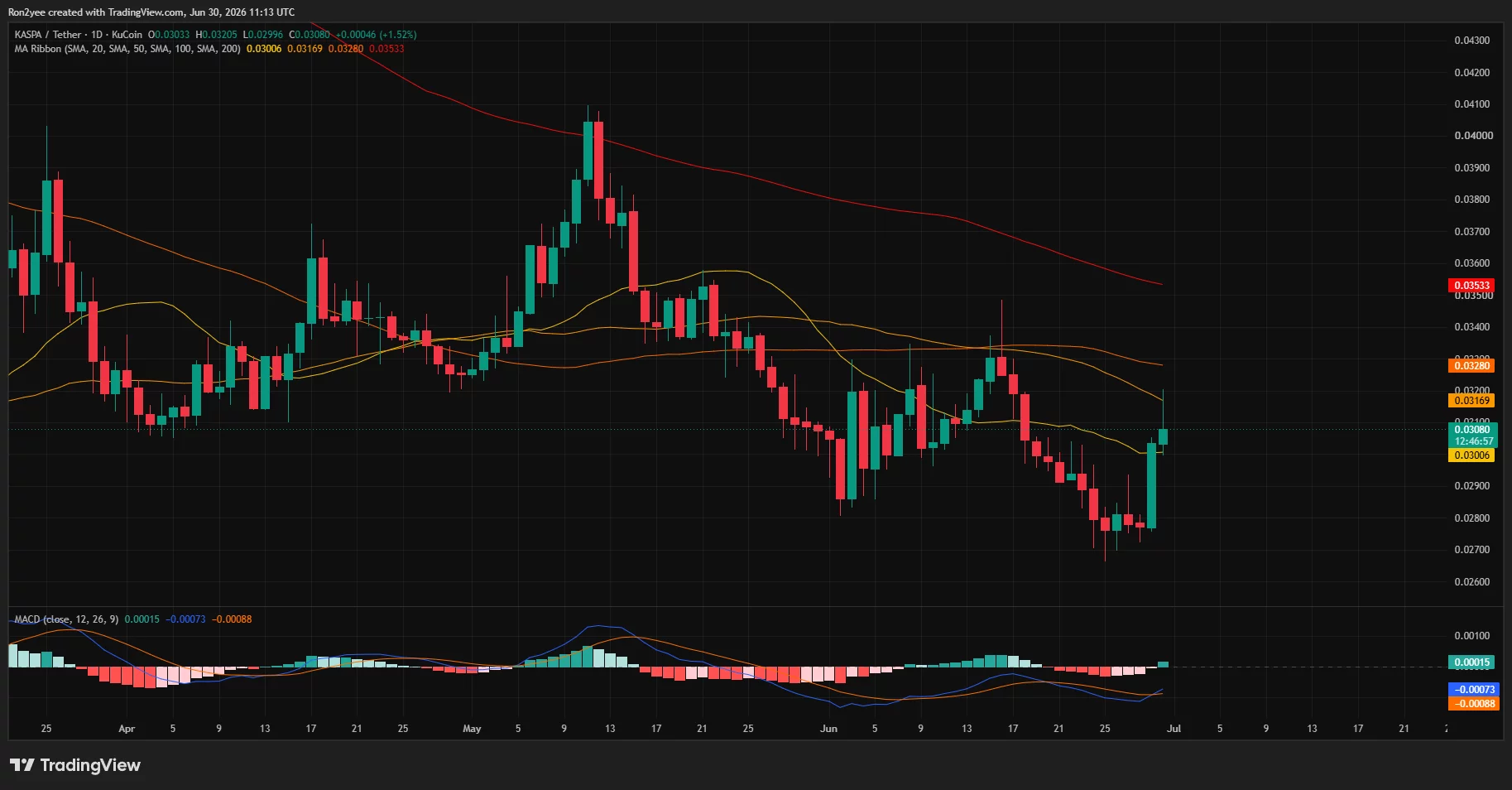
Kaspa price has surged about 15% over the past day as investors have positioned ahead of the network’s long-awaited Toccata hard fork despite continued weakness across the crypto market.
Summary
- Kaspa surged 15% as traders positioned ahead of the scheduled Toccata hard fork.
- Investors expect the upgrade to add smart contracts, KRC-20 tokens, and DeFi functionality.
- Technical buying and short covering helped KAS outperform a weak crypto market.
According to the Kaspa network, the Toccata hard fork is scheduled to activate on the mainnet at approximately 16:15 UTC on June 30. Exchanges including HTX temporarily suspended deposits and withdrawals ahead of the upgrade to support the transition.
The upgrade introduces native smart contract functionality through the SilverScript programming language, while also adding support for KRC-20 tokens, decentralized finance applications, and zero-knowledge privacy features.
Together, these additions remove one of the network’s biggest limitations by expanding Kaspa beyond its original role as a high-speed proof-of-work payment blockchain.
Toccata upgrade has changed Kaspa’s utility
With the hard fork approaching, trading activity has accelerated as investors position for higher on-chain activity. According to the Kaspa network, the upgrade is expected to enable developers to build decentralized applications directly on Kaspa by introducing native smart contract functionality, expanding the network beyond its traditional payment use case.
On-chain activity has also supported the bullish narrative. The network is approaching a cumulative milestone of roughly 2.35 billion transactions, demonstrating continued usage of its BlockDAG architecture even as new features are introduced. Supporters of the network have long argued that BlockDAG enables higher parallel transaction throughput than conventional blockchain designs, reducing congestion during periods of elevated demand.
The technical setup amplified the move. Before the hard fork, Kaspa had spent several months trading inside a prolonged consolidation range, with buyers repeatedly defending the $0.025-$0.030 area. The upgrade arrived while many derivatives traders remained positioned for further downside, creating conditions for a short squeeze as spot demand increased.
Forced liquidations of bearish positions added momentum to the rally once price broke above its recent trading range.
The daily chart also shows the recovery pushing KAS back above its 20-day simple moving average near $0.030 while testing resistance around the 50-day moving average near $0.0317. At the same time, the MACD has produced a bullish crossover with the histogram turning positive, indicating improving momentum.
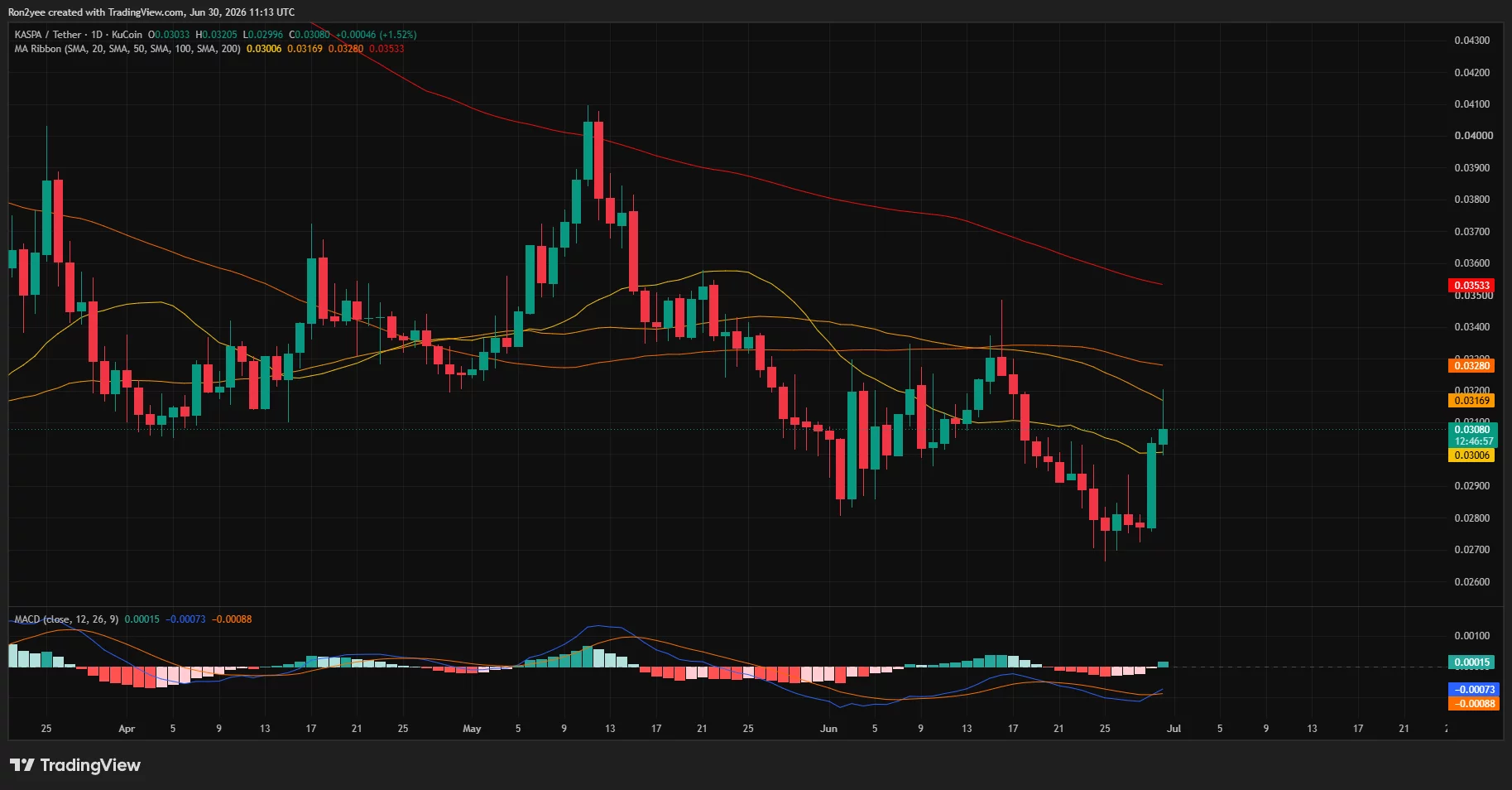
Still, the token trades below its declining 100-day and 200-day moving averages, suggesting that a sustained trend reversal would require additional buying pressure.
Technical buying has outweighed macro headwinds
Kaspa’s rally has unfolded while much of the cryptocurrency market continues to struggle under an unfavorable macro backdrop. A stronger-than-expected 4.1% U.S. Core PCE inflation reading and the Federal Reserve’s hawkish policy stance under Chair Kevin Warsh have pressured risk assets in recent days, contributing to an estimated $1.79 billion in cumulative outflows from U.S. spot Bitcoin exchange-traded funds.
Unlike many proof-of-stake networks, however, Kaspa operates on a proof-of-work model with approximately 95.4% of its maximum supply already in circulation. With new token issuance steadily declining over time, the introduction of smart contracts and execution fees through the Toccata upgrade has strengthened the network’s utility without materially increasing supply.
Those supply dynamics, combined with renewed developer opportunities and short-covering activity, have helped Kaspa outperform most major cryptocurrencies even as capital has continued flowing out of other digital assets.
Whether the rally extends from here may depend on whether buyers can reclaim resistance around the 50-day and 100-day moving averages before challenging the longer-term 200-day average near $0.0353.
Disclosure: This article does not represent investment advice. The content and materials featured on this page are for educational purposes only.
Crypto World
Institutional demand for BTC is below supply as ETF outflows, new coins flood market: Crypto Daily


Though BTC has recently stabilized around $60,000, the prospects for a meaningful recovery remain bleak because institutional demand is falling significantly short of soaking up supply.
The latest chart by Glassnode shows that bitcoin exchange-traded funds (ETFs) have sold off 71,600 BTC, worth over $4 billion, this month, the largest redemption on record. Meanwhile, corporate treasuries, or digital asset treasury firms, have snapped up just 7,500 BTC. Add to that the fresh coins mined each day, and the net figure comes to around -77,000 BTC ($4.4 billion).
In other words, more supply is hitting the market than the biggest players are absorbing, creating what analysts call a “supply overhang.” Big-money vehicles are actually adding to the selling pressure.
Against this backdrop, Strategy (MSTR), the largest bitcoin digital asset company, announced a BTC monetization plan on Monday, authorizing up to $1.25 billion in potential bitcoin sales, mainly to build a $2.55 billion U.S. dollar reserve to cover preferred dividends and interest expenses.
These developments suggest that any price bounce is likely to be short-lived, unless those flows flip positive and institutional demand returns. It’s a key signal for traders watching whether the recovery has real fuel or is just temporary.


Australia’s crypto travel rule comes into force on July 1, adding new data checks for users who send or receive digital assets through regulated exchanges.
Summary
- Australia’s crypto travel rule starts July 1, adding new data checks for exchange transfers.
- Exchanges must collect sender, receiver and wallet details before processing covered virtual asset transfers.
- Self-custody remains allowed, but transfers touching regulated platforms will face more user checks.
AUSTRAC’s transitional rules say some obligations for new virtual asset services were deferred until July 1, including travel rule obligations for virtual asset transfers.
The change affects virtual asset service providers with a link to Australia. AUSTRAC says covered services include crypto-to-fiat exchange, crypto-to-crypto exchange, safekeeping services, transfer services and certain services linked to token offers.
Exchanges must collect transfer details
Under AUSTRAC’s travel rule guidance, businesses that transfer money, virtual assets or property for customers must collect, verify and pass on key information about the transfer. AUSTRAC says the rule helps create transparency across the transfer chain and gives regulators and law enforcement access to needed data.
For virtual asset transfers, AUSTRAC says ordering institutions must check whether the receiving wallet is custodial or self-hosted. They must also carry out due diligence and pass on required information when the other institution is properly licensed or not required to be licensed.
Self-custody transfers face extra checks
Transfers to self-hosted wallets receive different treatment. AUSTRAC says a business does not need to send information to another business in the transfer chain when the transfer goes to a self-hosted wallet. However, the ordering institution must still collect and verify payer information and collect payee and tracing information.
This is the point drawing user concern online. Trader Greeny wrote on X that “crypto in Australia changes forever” and said small transfers would face the same data checks as larger transfers. Separate compliance summaries also state that Australia has no transaction threshold for the crypto travel rule, meaning the rule applies regardless of transfer size.
Users debate privacy and compliance
Reddit posts show mixed reactions from Australian crypto users. One user wrote, “you can forget about sending crypto anonymously,” while another said “the regulated platforms were never anonymous.” The comments reflect a split between users focused on privacy and others who view exchange reporting as expected under financial crime rules.
AUSTRAC has also updated broader reporting systems. The agency said it received more than 2 million threshold transaction reports and over 450,000 suspicious matter reports last year, and those figures may rise as more businesses fall under the framework from July 1.
Broader crypto rules are tightening
Australia’s travel rule arrives as the country moves toward broader crypto licensing. As reported by crypto.news, ASIC recently extended temporary licensing relief for crypto firms until Sept. 30, giving companies more time to apply for financial services licenses.
As previously reported by crypto.news, Australia’s Senate committee also backed a bill that would bring crypto exchanges and tokenized custody platforms under the country’s financial services licensing regime. That framework targets platforms that hold customer assets and requires governance, disclosure and custody standards.
The July 1 rule does not ban self-custody or crypto transfers. It changes how regulated platforms handle transfers when user assets enter or leave those platforms. For Australian users, the near-term change is practical: exchanges may ask for more details before processing deposits or withdrawals.

Charlotte Tilbury coming to Boots in Cambridgeshire shopping centre

This Space Stock Could Be a Takeover Target After Rocket Lab, Iridium Deal

Solana firm to support Kazakhstan’s $6B crypto megacity plan

No Jackpot Winner as $257 Million Prize Rolls Over to $269 Million Monday Draw

Renter of Home in Anne Heche Crash Denies Settlement With Son

Two goals and an assist by sheer aura: Cristiano Ronaldo just entered the World Cup chat

10 Powerful Money Habits That Can Change Your Financial Future | Smart Wealth Lessons Everyone

How To Earn Money Online 2026 | Learn This Skill Before Everyone Else | how to make money online

Crypto Gold Live Trading 29 JUNE | Market Trader | #goldtrading #cryptotrading #bitcoin
-
Sports7 days ago
Two goals and an assist by sheer aura: Cristiano Ronaldo just entered the World Cup chat
-

 Fashion4 days ago
Weekend Open Thread: Staud – Corporette.com
-

 Politics4 days ago
The House | Manchesterism won’t survive the painful trade-offs unless it gets citizens on board
-

 Politics4 days ago
Potential 2028er World Cup attendee leaderboard
-

 News Videos2 days ago
MAJOR BITCOIN & MARKET UPDATE!!!! (MUST WATCH ASAP!!!)
-

 Business4 days ago
Asia stock markets slide as tech shares slump
-

 Tech5 days ago
A Look At A Gaggle Of Transputer Boards
-

 Crypto World6 days ago
Securitize Wraps Roubini's SEC-Registered ETF as Dubai VARA Digital Security
-
Crypto World6 days ago
Bitcoin (BTC) Dips Below $62K, Ethereum (ETH) Plunges 6% Daily: Market Watch
-
 Crypto World5 days ago
Dell (DELL) Shares Tumble Over 5% Following Analyst Downgrade to Hold
-

 Crypto World3 days ago
Coinbase, Circle Deepen Crypto Stock Losses Despite Resilient S&P 500
-
Business6 days ago
Entergy settles forward sale agreements, raises $672 million in cash proceeds
-

 Crypto World3 days ago
Kraken's xStocks Opens Bending Spoons IPO Registration to EEA Retail
-

 Sports4 days ago
FIH Pro League: India defeat Pakistan 7-1, register biggest win of campaign | Other Sports News
-
 Crypto World4 days ago
Bitcoin Sparks $600M Hourly Liquidations With $65,000 Set To Become Resistance
-

 Tech2 days ago
Bluekit phishing kit adopts browser-in-the-middle for login theft
-

 Tech3 days ago
Russian hackers now target Signal backup recovery keys
-
Crypto World4 days ago
Hyperliquid Named on Singapore MAS Investor Alert Register
-

 Crypto World4 days ago
RTX holders must register wallets before token distribution begins
-
 Crypto World5 days ago
Ripple and SBI launch RLUSD in Japan after JFSA approval
You must be logged in to post a comment Login