
Crypto World
Umbra privacy protocol blocks front-end to deter Kelp exploiters


Privacy-preserving crypto protocol Umbra has pulled its front-end hosting offline in a bid to complicate misuse by hackers who have been moving funds from recent high-profile breaches. The move comes as Umbra disclosed that roughly $800,000 worth of stolen funds were routed through its protocol, a signal that attackers continue to exploit cross-chain bridges and related services despite ongoing security efforts.
In a post on X, Umbra said it had transitioned the hosted front end into maintenance mode and would bring it back online only when it can be done without disrupting recovery efforts. The team stressed that the decision was a precaution aimed at safeguarding the recovery process while acknowledging that the open-source nature of its front end means other implementations could still be used by malicious actors.
Key takeaways
- Umbra paused its hosted front end to hinder attacker use, citing approximately $800,000 in stolen funds moved through its protocol.
- The development follows a high-profile sequence of exploits, including the Kelp protocol breach that netted around $280 million, with investigators suspecting North Korean actors were involved.
- Despite the suspension, Umbra emphasized that on-chain activity and self-hosted or locally deployed interfaces remain possible, underscoring the limits of front-end restrictions.
- Analysts and commentators warn that front-end freezes alone may not satisfy regulators or prosecutors who view interface changes as indicative of broader control over a protocol.
- Ambiguity persists about how to balance privacy objectives with anti-fraud and sanctions enforcement in decentralized systems.
Umbra’s action in a shifting security landscape
Umbra’s decision to take its front end offline highlights a growing debate about defensible responses when breaches spill over into the tooling that users rely on most. The targeted move aims to reduce the surface area hackers can exploit for money movement tied to the latest breaches, according to Umbra’s statement. The project noted that the protocol “protects the identity of the receiver, not the sender,” a distinction it says does not assist hackers trying to conceal fund trails. It also stressed that every stolen fund routed through its contracts can be identified, and that it has been collaborating with security researchers involved in the investigation.
In parallel, security researchers and industry observers have repeatedly warned that the tokenized services bridging assets across networks remain a common vector for theft. The Kelp breach, which saw illicit gains reach hundreds of millions of dollars, has intensified scrutiny of cross-chain activity and the ways in which attackers pivot across networks to move funds. PeckShield and other monitoring outfits have flagged Umbra as a target of interest for opportunistic attackers attempting to bridge stolen Ether into Bitcoin and other assets, underscoring the ongoing liquidity risk within the bridge ecosystem.
The front end debate: is a UI pause enough?
Roman Storm, a co-founder of the crypto mixer Tornado Cash, has argued that a temporary freeze on the front end may not be sufficient to placate authorities or deter illicit use. Storm’s comments reference his own legal battles over sanctions-related charges, where prosecutors characterized control over a protocol as equivalent to controlling its operations. He has argued that limiting user interfaces may be read as exerting influence over a broader system, raising questions about what constitutes meaningful control in decentralized architectures.
Umbra’s own note touched on this tension, noting that the protocol’s core remains usable through smart contracts and, in many cases, through self-hosted front ends. The company asserted that even if the hosted front end goes offline, attackers could still access the open-source components if they choose to deploy their own interfaces or use local deployments. The broader implication is that while operators can reduce risk through UI changes, the core protocol’s code and governance remain the ultimate locus of control—and the primary determinant of how funds move once a user interacts with the protocol on-chain.
Privacy versus enforcement: what changes for users and investigators?
Umbra’s framing of its front-end pause as a protective measure for recovery efforts reflects a nuanced approach to privacy-preserving design. The project reiterated that its technology is intended to protect recipient anonymity, rather than to obscure the sender’s trail. In practice, this means that investigators and security researchers can, with cooperation and the right tools, trace flows of stolen funds even when they pass through privacy-centric constructs. Umbra’s statement that all stolen funds can be identified when appropriate signals and data are available is consistent with ongoing industry norms that seek a balance between user privacy and fraud prevention.
For investors and builders, the incident reinforces a persistent theme in crypto: even advanced privacy protocols operate within a broader ecosystem where law enforcement, sanctions regimes, and compliance expectations shape what is feasible in practice. The ongoing sanctions regime targeting North Korean cyber actors adds a layer of regulatory risk to the activity around cross-chain platforms and mixers, as authorities increasingly couple enforcement actions with industry-wide stances against funding networks linked to sanctioned entities.
What to watch next
As recovery efforts continue, observers will be watching for updates on when and how Umbra will restore front-end access without compromising investigators’ ability to trace and recover funds. The episode also raises questions about the durability of privacy-first designs in the face of coordinated enforcement and incident response. Other protocols with similar privacy-centric aims may reassess their own front-end exposure, governance processes, and incident-response playbooks in light of Umbra’s experience.
In the near term, market participants should monitor whether other bridges and privacy-focused contracts adjust their public interfaces or deploy additional mitigations to reduce exploit risk. Regulators and prosecutors will likely keep a close eye on how developers balance user privacy with the need to curb illicit finance, particularly as high-profile attacks continue to test the resilience of cross-chain ecosystems.
Ultimately, the event underscores a core dynamic in the crypto security landscape: improvements in on-chain privacy and usability must be matched by robust off-chain collaboration, transparent communications, and adaptable incident response plans if communities are to navigate the evolving threat environment without stifling innovation.
readers should stay tuned for further disclosures from Umbra and for subsequent analyses from security researchers detailing how such vulnerabilities are being addressed and what this portends for the broader privacy-centric segment of DeFi.

Crypto World
North Korean-backed hackers roll out new attack vector targeting crypto executives and firms


The North Korean state-run Lazarus Group is running a new campaign known as “Mach-O Man” that turns routine business communication into a direct path to credential theft and data loss, security experts warned Wednesday.
The collective, with cumulative loot estimated at $6.7 billion since 2017, is targeting fintech, cryptocurrency and other high-value executives and firms, Natalie Newson, a senior blockchain security researcher at CertiK, told CoinDesk on Wednesday.
In the past two weeks alone, the North Korean hackers have siphoned more than $500 million from the Drift and KelpDAO exploits in what appears to be a sustained campaign. The crypto industry needs to start viewing Lazarus the same way banks view nation-state cyber actors: “as a constant and well-funded threat, not just another news headline,” she said.
“What makes Lazarus especially dangerous right now is their activity level,” Newson said. “KelpDAO, Drift, and now a new macOS malware kit, all within the same month. This isn’t random hacking; it’s a state-directed financial operation running at a scale and speed typical of institutions.”
North Korea has turned crypto theft into a lucrative national industry, and Mach-O Man is just the latest product from that process, she said. While Lazarus created it, other cybercrime groups are also using it.
“It is a modular macOS malware kit created by Lazarus Group’s infamous Chollima division. It uses native Mach-O binaries tailored for Apple environments where crypto and fintech operate,” she said.
Newson said Mach-O Man uses a delivery method known as ClickFix. “It’s important to be clear because a lot of coverage is mixing up two separate things,” she noted. ClickFix is a social engineering technique where the victim is asked to paste a command into their terminal to fix a simulated connection issue.
It works by Lazarus sending executives an “urgent” meeting invite over Telegram for a Zoom, Microsoft Teams or Google Meet call, according to Mauro Eldritch, a security expert and founder of threat intelligence firm BCA Ltd.
The link leads to a fake, but convincing, website that instructs them to copy and paste one simple command into their Mac’s terminal to “fix a connection issue.” In doing so, the victims provide immediate access to corporate systems, SaaS platforms and financial resources. By the time they find out they were exploited, it is usually too late.
There are several variations of this attack, security threat researcher Vladimir S. said on X. There are already cases where Lazarus attackers have hijacked decentralized finance (DeFI) projects’ domains with this new malware by replacing their websites with a fake message from Cloudflare, asking them to enter a command to grant access.
“These fake ‘verification steps’ guide victims through keyboard shortcuts that run a harmful command,” said Certik’s Newson. “The page looks real, the instructions seem normal, and the victim initiates the action themselves — which is why traditional security controls often miss it.”
Most victims of this hack will not realize their security has been breached until the damage has been done, at which time, the malware will have already erased itself as well.
“They likely don’t know it yet,” she said. “If they do, they probably can’t identify which variant affected them.”

Bitcoin is showing short-term relief in price and sentiment metrics, but investors should stay wary of a potential relapse into the 2022 bear-market dynamics. New data from on-chain analytics firm CryptoQuant suggests that Bitcoin’s Bull Score Index (BSI) has moved into neutral territory for the first time in this bear market, even as BTC tries to push toward fresh highs. At the same time, broader market mood appears to be firming, with the Crypto Fear & Greed Index climbing back from extreme fear, hinting at a cautious but improving backdrop for traders and holders.
Key points:
- Bitcoin’s Bull Score Index has reached neutral territory (50) for the first time in this bear market, with BTC rallying toward $78,000.
- CryptoQuant cautions that the relief could be transient, echoing the pattern seen earlier in March 2022 when neutral readings preceded renewed price declines.
- The Crypto Fear & Greed Index has recovered to the 30s, marking the most bullish sentiment since January and signaling a shift, albeit from a still-fragile base.
Bitcoin Bull Score Index exits the “bearish” zone
CryptoQuant’s Bull Score Index, which aggregates nine price metrics to gauge overall momentum, shows Bitcoin entering neutral territory as the price tests the $78,000 level. This marks the first time the index has broken above the early-bear-market axis toward 50 since the downturn began. A CryptoQuant analyst highlighted the milestone in a recent post, noting that it represents a transition point rather than a signal of a lasting trend.
“First time in this bear market that the Bull Score Index enters neutral zone (50),” wrote Julio Moreno on X, underscoring that the shift is a notable, yet potentially fragile, moment. The caution mirrors a familiar pattern from the prior bear cycle, when the bull-score flickered into neutrality only to retreat as selling pressure resurfaced.
The historical context matters. In March 2022, the BSI briefly touched neutral territory for about a week before the price resumed its decline, reminding markets that a neutral reading does not guarantee sustained upside. As market participants monitor April’s monthly close, the key question remains whether BTC can sustain strength beyond a near-term range and break decisively out of a multi-month plateau noted by observers at times this year.
At present, traders are watching for catalysts that could lift the trajectory beyond the current range. CryptoQuant contributor Arab Chain described a balance in the near term, with price hovering around $74,000 and activity suggesting a tug-of-war between supply and demand. While the neutral reading of the BSI implies a more balanced dynamic than the steeply bearish readings of the past months, it does not remove the risk of renewed downside if demand cools or macro stress reasserts itself.
Sentiment steadies, though still cautious
Beyond on-chain momentum, sentiment indicators are painting a cautiously improving picture. The Crypto Fear & Greed Index has recovered to a reading of 32 out of 100, moving away from the previous week’s Extreme Fear readings near 23. Although still categorized in the Fear territory, this shift signals a softening of negative mood among market participants. The index has roughly tripled in a little more than a week, reflecting a notable swing in trader psychology amid the price action.
“This places the market in a transitional phase, as investors await new catalysts to determine the next direction.”
The Fear & Greed Index is a lagging measure that aggregates multiple factors to gauge overall investor mood. Its upward movement toward a neutral zone aligns with the improved technicals observed in the BSI and with reports that Bitcoin has regained some supply-demand balance in recent days. Still, the index remains below the level that would typically accompany strong bullish conditions, reinforcing the sense that a breakout remains uncertain and conditional on broader market drivers.
In addition to the fear-greed cycle, broader market commentary has cited the potential for renewed volatility tied to macro and sector-specific developments. Cointelegraph’s coverage this week highlighted the possibility of Bitcoin breaking out of a multi-month trading range, a development that would align with improving sentiment but could hinge on fresh liquidity, risk appetites, and systemic cues from traditional markets.
With BTC flirting with the $78,000 level and the BSI shifting into neutral territory, traders face a decision juncture. The immediate question is whether the balance between supply and demand can be maintained in the face of potential macro headwinds or if renewed selling pressure could reassert itself as the market digests upcoming catalysts.
Investors should pay particular attention to:
- April monthly close: A decisive move above or below key thresholds could recalibrate market expectations and alter positioning among traders who use the BSI and sentiment signals to time entries and exits.
- Resistance and liquidity dynamics: If the price breaks higher, traders will be watching for a sustained flow of bids and a shift in open interest that confirms conviction beyond a short-term squeeze.
- Correlation with broader risk assets: As global risk appetite evolves, Bitcoin’s performance often tracks or diverges from equities and macro risk proxies, potentially amplifying moves around upcoming data releases or policy signals.
The evolving picture is a reminder that a neutral or even bullish signal in one metric does not erase risk. The 2022 bear episode began with a period of moderation before renewed declines; today’s readings suggest a transitional phase rather than a clear, enduring uptrend. For investors, the prudent approach remains to balance on-chain signals with macro awareness and to watch how fresh catalysts influence both price and sentiment in the weeks ahead.
As the market weighs these readings, the next moves in Bitcoin will be closely watched by traders, institutions, and developers alike. Whether this neutral tilt is a prelude to a sustainable rally or a temporary pause before further volatility remains an open question, but the current data clearly signal a shift away from the most bearish extremes toward a more balanced, if fragile, footing.


Key takeaways
- Pepe extends gains on Wednesday, stretching its rally from the 50-day EMA.
- Derivatives data show heightened retail activity as risk-on sentiment returns to the market.
Pepe (PEPE) is experiencing a steady rally on Wednesday, trading in the green for the third consecutive day. The frog-themed meme coin is gaining traction as broader market sentiment improves, lifting retail demand for meme coins.
Market sentiment boosts meme coin demand
The broader market’s upside, despite ongoing geopolitical tensions surrounding the US-Iran blockade of the Strait of Hormuz and faltering peace talks, is boosting retail interest in meme coins.
According to CoinMarketCap, the Fear and Greed Index is at 62 on Wednesday, showing a consistent rise in risk appetite since the US-Iran ceasefire announcement.
On the derivatives side, the PEPE futures Open Interest (OI) stands at $213.25 million, with a 7% increase in the last 24 hours.
This surge in futures positions indicates growing participation from traders, aligning with the recovery in the spot price—further supporting a bullish outlook for PEPE.
Pepe tests breakout of key resistance level
The PEPE/USD 4-hour chart is bullish and efficient as Pepe’s short-term recovery remains intact, with a three-day rebound from the 50-day Exponential Moving Average (EMA) at $0.00000368.
However, PEPE is still trading below the 100-day and 200-day EMAs, which could cap the ongoing rally.
The Relative Strength Index (RSI) at 60 is edging higher from the midline, indicating mild positive momentum. Meanwhile, the Moving Average Convergence Divergence (MACD) remains above its signal line, keeping the histogram bars positive.
At press time, PEPE is trading at $0.00000393. If the rally should continue, PEPE must break above its descending trendline near $0.00000400, close to the 100-day EMA at $0.00000404.

A breakout above this level could pave the way for a rally toward the 200-day EMA around the $0.00000500 psychological resistance.
On the downside, the 50-day EMA at $0.00000368 provides immediate dynamic support, with further downside protection at the February 6 low of $0.00000311.
Bitcoin (BTC) could see further upside volatility as several technical indicators suggested the BTC price was due for a “powerful“ upward move.
Key takeaways:
-
Bitcoin’s Bollinger Bands indicator now sees the potential for a massive price breakout.
-
BTC price needs to overcome resistance at $80,000 for more upside.
Bollinger Bands suggest Bitcoin’s “bull run is next”
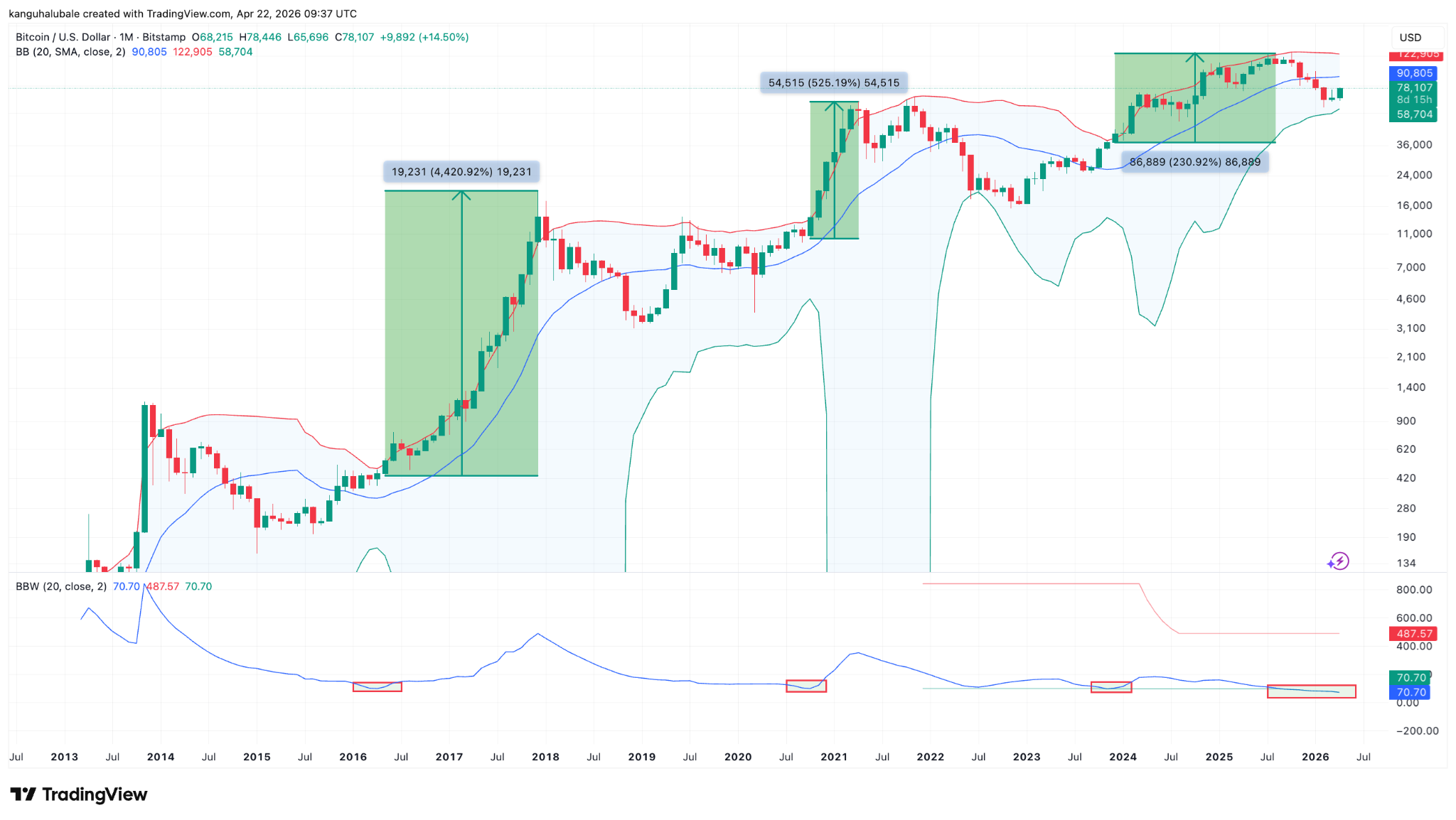
Bitcoin’s Bollinger Bands have reached their tightest point ever on the monthly time frame, signaling that volatility should be expected soon.
Related: Bitcoin ‘Bull Score’ hits six-month high as 2022 bear-market fears linger
Bollinger Bands (BB) is a technical indicator used by traders to assess momentum and volatility within a certain range.
The “tightest Bitcoin monthly Bollinger band squeeze, ever,” said analyst Cantonese Cat in an X post on Wednesday.
“This will lead to a very powerful move when it expands,” the analyst added.
The BTC/USD pair gained about 230% between December 2023 and August 2025 to its current all-time high of $126,000, after breaking above the upper boundary of the Bollinger Bands.
Similar occurrences in 2020 and 2016 triggered the previous bull runs that saw BTC price rally more than 520% and 4,400%, respectively.

Meanwhile, Coinvo Trading shared a chart showing that Bitcoin’s monthly RSI has dropped to its lowest level since late 2022.
This coincided with the BTC/USD drop to a multi-year support trend line, an occurrence that has previously marked Bitcoin’s macro bottoms.
The last time this happened was at the bottom of the 2022 bear market, preceding a 350% BTC price rally to its previous all-time high of $73,800, reached in March 2024.
“The same exact trendline, the same oversold RSI, the same outcome,” Coinvo Trading said, adding:
“Bull run is next in line.”

As Cointelegraph reported, several Bitcoin metrics, including a bullish MACD crossover on the weekly chart, suggest that a BTC price breakout is about to begin.
Bitcoin must reclaim $80,000 next
Bitcoin’s 6% rally over the last three days saw the BTC/USD pair fill the $74,000-$77,000 CME gap created over the weekend.
Traders are now looking at the next CME gap above $80,000, formed in early February.

MC Capital founder Michael van de Poppe said resistance at $79,000 could temporarily “stall” Bitcoin’s upward momentum
“Likely we’ll test it first, come back down for a little, find extra stamina, and then we’ll push through to $86K.”

Meanwhile, Bitcoin’s whale order book showed “heavy sell pressure” between $78,000-$80,000, reinforcing the significance of this resistance level.

As Cointelegraph reported, a close above the $76,000-$78,000 resistance zone would confirm that the buyers are in control, clearing the path for a potential rally to $84,000.
This article is produced in accordance with Cointelegraph’s Editorial Policy and is intended for informational purposes only. It does not constitute investment advice or recommendations. All investments and trades carry risk; readers are encouraged to conduct independent research before making any decisions. Cointelegraph makes no guarantees regarding the accuracy or completeness of the information presented, including forward-looking statements, and will not be liable for any loss or damage arising from reliance on this content.
Decentralized finance (DeFi) protocol Volo has disclosed a security breach that resulted in the loss of approximately $3.5 million in digital assets, marking the latest incident in a series of exploits targeting DeFi platforms.
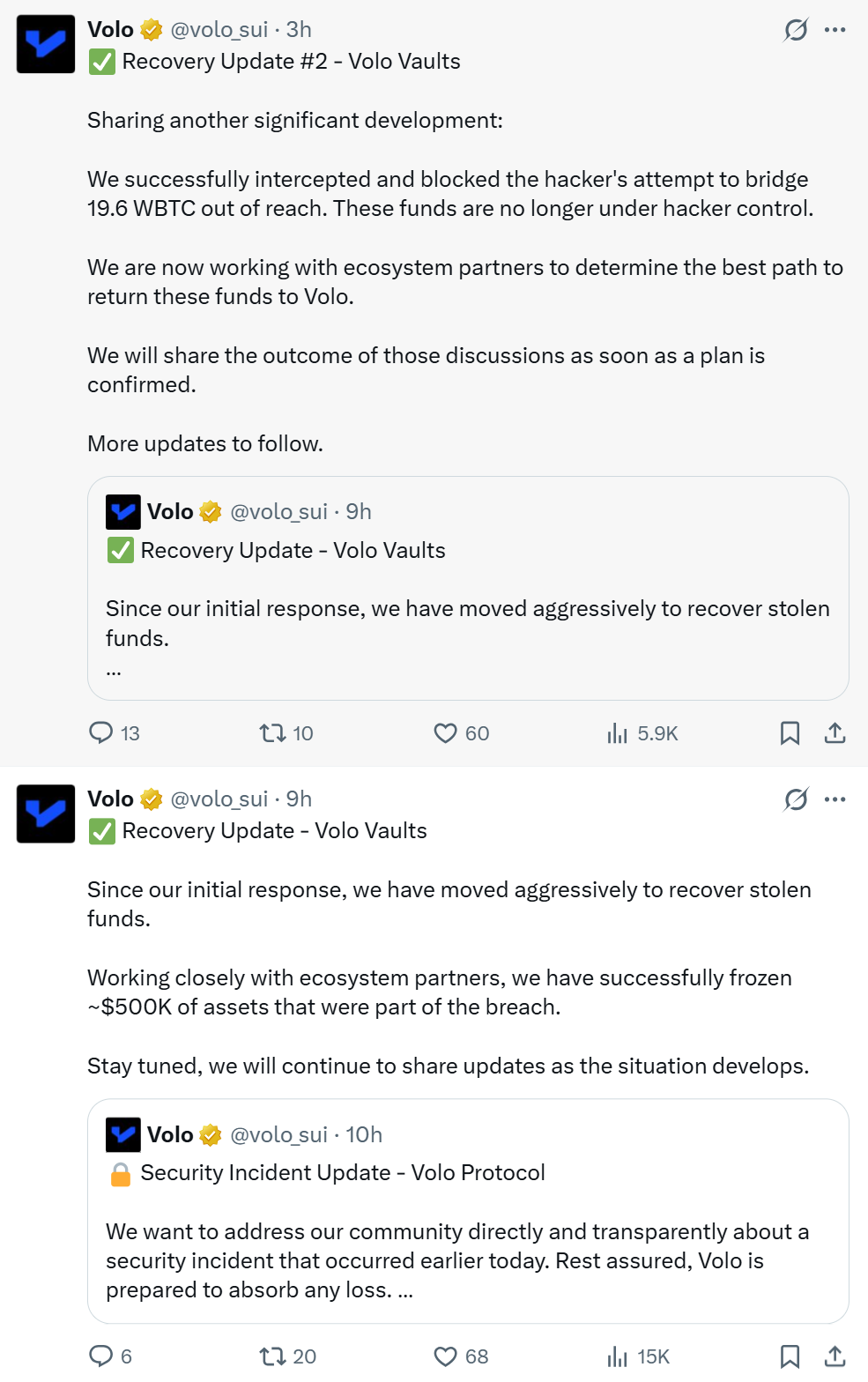
In a Wednesday post on X, the team said the attack affected select vaults and involved assets including Wrapped Bitcoin (WBTC), Matrixdock Gold XAUm and USDC (USDC). “We detected the attack, immediately notified the Sui Foundation and ecosystem partners to contain the damage, and froze the vaults to prevent any further exposure,” the team wrote.
The protocol added that around $28 million in total value locked across other vaults is safe, with the exploit limited to three isolated vaults and no shared vulnerability identified. It also revealed plans to absorb the losses rather than pass them on to users, though details of any remediation plan have yet to be finalized.
Volo is a liquid staking DeFi platform on the Sui blockchain, allowing users to stake their Sui (SUI) tokens and receive voloSUI (VSUI) in return. DeFi is already on edge, as the exploit comes as another liquid restaking protocol, Kelp, was hacked for approximately $293 million over the weekend, which has had a ripple effect across the broader ecosystem.
Related: Kelp DAO attacker moves $175M in Ether after exploit: Arkham
Volo freezes a portion of lost funds
In two separate updates, Volo said it has frozen or blocked roughly $2 million of the stolen funds so far. In the first update, the protocol said that roughly $500,000 linked to the breach has already been frozen. In a later update, the team claimed it had successfully blocked an attempt by the attacker to bridge 19.6 WBTC, effectively removing those funds from the hacker’s control.
“We are now working with ecosystem partners to determine the best path to return these funds to Volo,” the protocol wrote.

Crypto hacks claim $17 billion in 10 years
As Cointelegraph reported, more than $17 billion has been stolen in crypto over the past decade, with private key compromises identified as one of the major contributing attack vectors, according to DefiLlama.
Related: ZachXBT asks MemeCore to explain valuation and token supply
Roughly 22.3% of incidents are linked to brute-force key compromises, 18.2% to unknown methods and 10% to phishing attacks on multi-signature wallets. The findings show that many of the biggest losses stem from wallet security and user-side weaknesses rather than protocol bugs.
Magazine: 53 DeFi projects infiltrated, 50M NEO tokens could be ‘given back’: Asia Express
Crypto World
Tesla Reports Earnings After the Bell: Will Elon Musk’s AI Roadmap Trigger a Crypto Rally Before Midnight?
Tesla reports Q1 2026 earnings after market close today, and the AI roadmap update could move crypto markets before midnight.
The live Q&A webcast kicks off at 5:30 p.m. Eastern, with analysts watching every word on robotaxi expansion and Optimus progress.
Wall Street consensus sits at $0.30 EPS, a steep drop from Q4’s $0.50 beat, leaving the bar low enough that almost any positive AI catalyst could trigger a sharp move.
Cross-chain liquidity plays are already seeing elevated attention as institutional money rotates into infrastructure narratives ahead of the print.
Tesla’s April 2 production release confirmed 408,000+ vehicles built and 358,000+ delivered in Q1, alongside 8.8 GWh of energy storage deployed, steady numbers that kept the stock from collapsing pre-earnings.
The shareholder deck is expected to detail robotaxi expansion to nine cities in H1 2026, Cortex 2 compute buildout at the Texas Gigafactory, and a belated Optimus Gen 3 update after Q1’s promised unveil quietly didn’t happen.
A live earnings stream is already pulling significant viewer traffic ahead of the 4:30 p.m. CT call. The broader question isn’t whether Tesla beats — it’s whether the AI narrative holds up under analyst questioning. That answer will ripple well beyond TSLA.
Can TSLA’s AI Reveal Spark a Broader Risk Rally This Week?
With Q1 EPS projected at $0.30 against Q4’s actual $0.50 — a 25% beat over the $0.40 estimate, the year-over-year earnings compression is real.
The question is whether Tesla’s AI pipeline reframes the valuation story fast enough to matter. Robotaxi revenue is pre-commercial. Optimus is still pre-scale. Cortex 2 is burning capex. None of that is cheap.
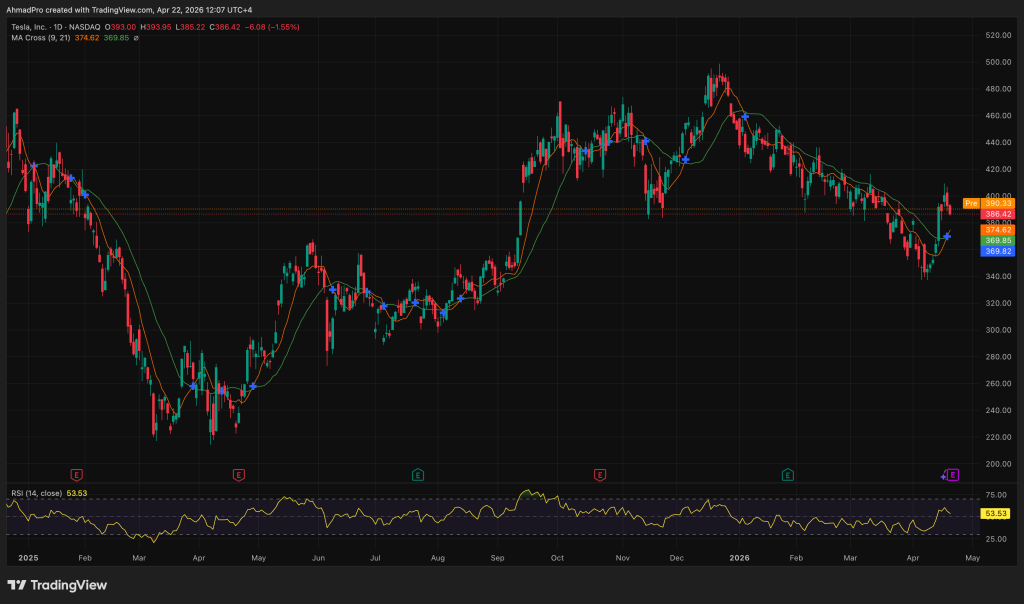
Technically, TSLA has been consolidating in a wide range ahead of the print, with momentum indicators suggesting indecision rather than conviction.
The bull case: a strong AI update, new robotaxi city timelines, Optimus production numbers, or Cortex 2 milestones, pushes sentiment into breakout territory and drags high-beta tech and crypto assets with it. Spot Bitcoin ETFs have already recorded $1B+ weekly inflows, signaling institutional appetite that a TSLA AI pop could amplify.
Base case: Tesla meets the $0.30 EPS print, management delivers cautious optimism on robotaxi rollout, and markets grind sideways into the weekend.
Bear case, and the genuine invalidation, is any hint that Full Self-Driving timelines are slipping further, Optimus production targets are being walked back, or Cortex 2 costs are running over. That scenario pressures AI-adjacent assets across the board. Three numbers to watch at 5:30 Eastern: gross margin, energy storage revenue, and any hard robotaxi fleet figure.
LiquidChain Targets Early-Mover Upside as TSLA Tests Key Catalyst Levels
Here’s the uncomfortable truth about chasing TSLA post-earnings: at any size, the asymmetric upside is gone before retail gets in.
The move happens in the first 90 seconds. On-chain liquidity signals are spiking ahead of tonight’s call, and that capital is increasingly looking for early-stage infrastructure plays where the entry point still exists.

LiquidChain ($LIQUID) is a Layer 3 infrastructure project built around a single proposition: fusing Bitcoin, Ethereum, and Solana liquidity into one unified execution environment. Developers deploy once, access all three ecosystems. The architecture includes a Unified Liquidity Layer, Single-Step Execution, Verifiable Settlement, and Deploy-Once infrastructure, targeting the fragmentation problem that costs DeFi protocols billions annually in lost efficiency.
The presale is currently priced at $0.01452, with $691,470.51 raised to date. That’s early by any measure.
Institutional narratives around BTC are accelerating, and a project merging BTC, ETH, and SOL liquidity rails is positioned directly inside that thesis. Risk is real — presales carry no liquidity guarantees, and token value is speculative until mainnet.
Research LiquidChain here before the next presale stage opens.
The post Tesla Reports Earnings After the Bell: Will Elon Musk’s AI Roadmap Trigger a Crypto Rally Before Midnight? appeared first on Cryptonews.

Disclosure: This article does not represent investment advice. The content and materials featured on this page are for educational purposes only.
Utility-driven new crypto coins gain momentum as investors target early-stage opportunities in 2026.
Summary
- DOGEBALL raised $200K+ in Stage 2, combining payments, gaming, and staking in one Layer 2 ecosystem.
- Built on DOGECHAIN, DOGEBALL enables crypto-to-fiat transfers with near-instant payments and zero FX fees.
- At $0.0004 presale price, DOGEBALL offers strong ROI potential before its planned $0.015 launch price.
The biggest winners in new crypto coins 2026 are emerging from projects that combine real-world utility with strong early-stage entry opportunities.
As innovation accelerates, investors are focusing on tokens that solve actual problems while offering measurable upside. This list highlights six projects shaping the next phase of blockchain adoption, including DOGEBALL, Celestia, Starknet, LayerZero, Sei, and zkSync.

Each of these coins brings a distinct advantage, from scaling infrastructure to enabling seamless global payments. Among them, DOGEBALL stands out with a live crypto presale that combines payments and gaming into a revenue-driven ecosystem. Let’s break down how these projects are positioning themselves for growth in 2026.
DOGEBALL presale gains momentum with $200k raised and real payment utility
DOGEBALL is a high-utility ecosystem built on its custom Ethereum Layer 2 called DOGECHAIN. It combines GameFi and PayFi to enable users to send crypto while recipients receive fiat directly into their bank accounts worldwide. With zero FX fees, no intermediaries, and near-instant transfers, DOGEPAY solves real problems in global remittances and digital payments.
Within the new crypto coins 2026 category, DOGEBALL stands out due to its direct link between usage and token demand. The DOGEBALL token powers transaction fees, gaming rewards, and staking, creating consistent buy pressure. The presale is currently in Stage 2 at $0.0004, with $200K+ already raised from 750+ participants, signaling strong early adoption ahead of its closing date on 2nd May 2026.
DOGEBALL crypto presale 2026 roi potential and bonus strategy
The DOGEBALL crypto presale 2026 offers a clear, data-driven entry point for investors. With a current price of $0.0004 and a confirmed launch price of $0.015, early buyers could see a potential ROI of 3650% within the 4-month presale period. This timeline started on 2nd January 2026 and creates a focused window to accumulate tokens before public listing.
Using the PAY35 bonus code gives an immediate 35% increase in token allocation, improving entry value from day one. On top of that, the Buyer of the Week competition adds another layer of incentive, where top buyers receive a 100% bonus on their weekly spend. The competition is intense, with last-minute buys of $2131 at 23:58 UTC and $2320 at 23:59 UTC securing the top spot, reinforcing urgency and strong demand.
Celestia expands modular blockchain adoption with new rollup integrations
Celestia is gaining attention for its modular blockchain design, which separates execution from consensus and data availability. This allows developers to deploy scalable rollups without building full blockchain stacks. Recent updates include enhanced data availability, sampling, and new integrations that make deployment faster and more cost-efficient.
This approach is attracting developers who want flexibility and scalability without high infrastructure costs. As more projects adopt modular architecture, Celestia is positioning itself as a foundational layer for the next generation of decentralized applications.
Starknet strengthens ZK rollup scaling with improved developer tools
Starknet continues to push forward as a leading ZK-rollup solution built on STARK proofs. Its ability to process high volumes of transactions while maintaining Ethereum-level security makes it a key scaling solution. Recent upgrades have focused on improving developer tools and reducing transaction costs.
Adoption is growing across DeFi and NFT ecosystems as projects look for scalable and secure infrastructure. Starknet’s continuous improvements are helping it maintain a strong position in the Layer 2 space.
LayerZero drives cross-chain growth with omnichain interoperability
LayerZero is solving the problem of blockchain fragmentation by enabling seamless communication across multiple networks. Its omnichain protocol allows assets and data to move without relying on centralized bridges, reducing risk and improving efficiency.
Recent partnerships and integrations have expanded its ecosystem, making it easier for developers to build cross-chain applications. This positions LayerZero as a critical infrastructure layer in a multi-chain future.
Sei Network accelerates trading with a high-speed execution architecture
Sei is designed specifically for trading applications, offering high-speed execution and low latency. Its parallelized architecture allows multiple transactions to be processed at the same time, making it ideal for DeFi trading platforms.
The network is seeing increased adoption from trading-focused projects and liquidity providers. Its performance-driven design gives it a competitive edge in sectors where speed and efficiency directly impact user experience.

zkSync enhances user adoption with low fees and seamless experience
zkSync is a Layer 2 solution that uses zero-knowledge proofs to scale Ethereum while keeping fees low. Its focus on user experience has led to improvements in onboarding, wallet integration, and transaction simplicity.
Developers are increasingly choosing zkSync for consumer-facing applications due to its balance of scalability and usability. Continued ecosystem growth is expected to drive further adoption in 2026.
Why DOGEBALL presale stands out among new crypto coins 2026
The new crypto coins 2026 list includes strong infrastructure projects, but DOGEBALL offers a unique advantage by combining real-world payments and gaming into a single ecosystem. Its ability to convert crypto to fiat instantly, eliminate fees, and enable global transactions gives it a practical use case that directly drives demand.
The DOGEBALL presale provides a limited 4-month opportunity to enter at $0.0004 before the expected $0.015 launch. With $200K+ already raised, strong competition for weekly bonuses, and the PAY35 code offering 35% extra tokens, the project presents a structured and high-potential entry point for investors seeking both utility and returns.
For more information, visit the official website, Telegram, and X.
FAQs for new crypto coins 2026
What are the top new crypto coins to invest in in 2026?
DOGEBALL, Celestia, Starknet, LayerZero, Sei, and zkSync are among the most promising projects due to their strong utility, scalability solutions, and growing ecosystems.
How does the DOGEBALL crypto presale 2026 work?
Investors can buy DOGEBALL at $0.0004 during the presale phase. The token is expected to launch at $0.015, offering significant ROI potential along with bonus incentives like PAY35 and weekly rewards.
Why do crypto presales offer high returns?
Crypto presales provide early access to tokens at lower prices before public listing. If the project gains traction and lists higher, early investors benefit from the price difference and additional incentives.
Disclosure: This content is provided by a third party. Neither crypto.news nor the author of this article endorses any product mentioned on this page. Users should conduct their own research before taking any action related to the company.


Strategy (formerly MicroStrategy) already pays 11.5% annualized dividends on its ultra-risky Stretch (STRC) but DeFi users are now adding risks and leverage to crank that up to 39%.
In finance, interest rates are often dictated by the risk of total loss. With very few exceptions, when someone offers a higher interest rate, it’s because they’re much more likely to not pay you back.
Unbothered, traders are now re-routing Strategy’s dividend payouts through multiple blockchain protocols to manufacture yields of double, triple, or more what STRC actually pays.
They add future obligations in exchange for near-term payouts, take advantage of temporary incentives for obscure DeFi protocols, and add exotic forms of leverage to amplify the notional exposure of an otherwise small investment.
In the curious underworld of tokenized STRC, there are at least five protocols offering the financial machinery for DeFi yield farmers, not to mention the risks of the custodians and technology providers involved with these protocols.
A daisy-chain of DeFi risks to amplify STRC
Apyx wraps roughly $136 million of STRC into a synthetic stablecoin-like token called apxUSD. Saturn packages approximately $85 million worth of STRC into its USDat product. Another tokenization protocol xStocks put approximately $53 million worth of STRC on-chain.
Meanwhile, Pendle Finance splits these STRC tokens and the dividends paid to STRC stockholders into separately tradable, fixed-rate and floating-rate components, and Morpho provides the loan-looping mechanism at the end to add even more financial leverage on these instruments.
Depositing assets to borrow these tokens, which trade under a variety of ticker symbols like STRCx, apyUSD, apxUSD, USADT, sUSADT, strcUSX, traders borrow tokens, re-deposit some portion of those loan proceeds to take out more loans, re-deposit some portion of those loan proceeds to take out more loans, and so on.
The more loops and the smaller the range of prices that a user collateralizes, the higher the probability that the protocol will forcibly liquidate the position.
Irresponsible dividends, amplified
The base yield of STRC with no tokenization whatsoever is already extreme. STRC pays 11.50% annualized, roughly 450 basis points above the average junk bond.
Indeed, Strategy has hiked its dividend rate seven times since launching STRC at 9% in July 2025.
Each hike tacitly admitted that demand at the prior rate was too weak to hold up STRC’s secondary trading on Nasdaq at its intended $100 per share.
Read more: We calculated the present value of STRC — it’s bad for MSTR
Rather than ease up on leverage in light of the thinning air, DeFi’s response has been to treat 11.5% as a stable case on which to construct even higher artifices.
Apyx Finance closed a $300 million valuation round in February as a self-described dividend-backed stablecoin protocol.
It issues apxUSD backed by STRC and a related preferred like Strive’s STRC-like SATA, with apyUSD as the yield-bearing version of the same claim. Saturn Credit raised $800,000 from Sora Ventures and Changpeng Zhao’s YZi Labs in January to run the same play through USDat and sUSDat.
Both of these STRC tokenizers wrap their resulting tokens into Pendle, where PT-apyUSD locks in fixed yields of roughly 14.84%.
Users then deposit those PT tokens on Defi protocol Morpho as collateral to borrow USDC at rates as low as 1.59%.
The arithmetic isn’t subtle. A 5x leverage loop landed on a 64% APY. A separate analyst account documented 39% APY.
Hoping and praying STRC never de-pegs for long
On April 14, STRC was approaching its monthly dividend snapshot date, going “ex-dividend” in the parlance of Wall Street, causing its price to decline. That sag dragged sUSDat’s exchange rate below the high-water mark Pendle uses to govern yield accrual for the Saturn token.
Pendle had to explain this basis phenomenon to its users. “Yield accrual on YT-sUSDat is currently paused due to STRC’s ex-dividend event on 14 April, which pushed the exchange rate below the watermark,” it said.
It reassured holders that “If STRC recovers to $100, the watermark is recaptured, yield accrual resumes, and your total earnings will be ultimately unaffected.”
As always, the conditional “if” is doing a lot of heavy lifting.
Indeed, if STRC trades near $100 and pays dividends near 11.5% forever, everything will work out wonderfully.
In fact, STRC fell to $90.52 on November 21, 2025, and to $93.10 in February 2026. That’s why the dividend rate is where it is. It shouldn’t be a mystery as to why Strategy needs to pay such as higher dividend rate.
Unfortunately for STRC traders in DeFi, neither is guaranteed. The quasi-peg has already failed twice in the last six months. Moreover, Strategy’s board of directors can cut the dividend at its discretion.
DeFi traders are also exposed to countless numbers of protocol, blockchain, smart contract, and custodian risks that multiply these risks even higher.
Got a tip? Send us an email securely via Protos Leaks. For more informed news, follow us on X, Bluesky, and Google News, or subscribe to our YouTube channel.
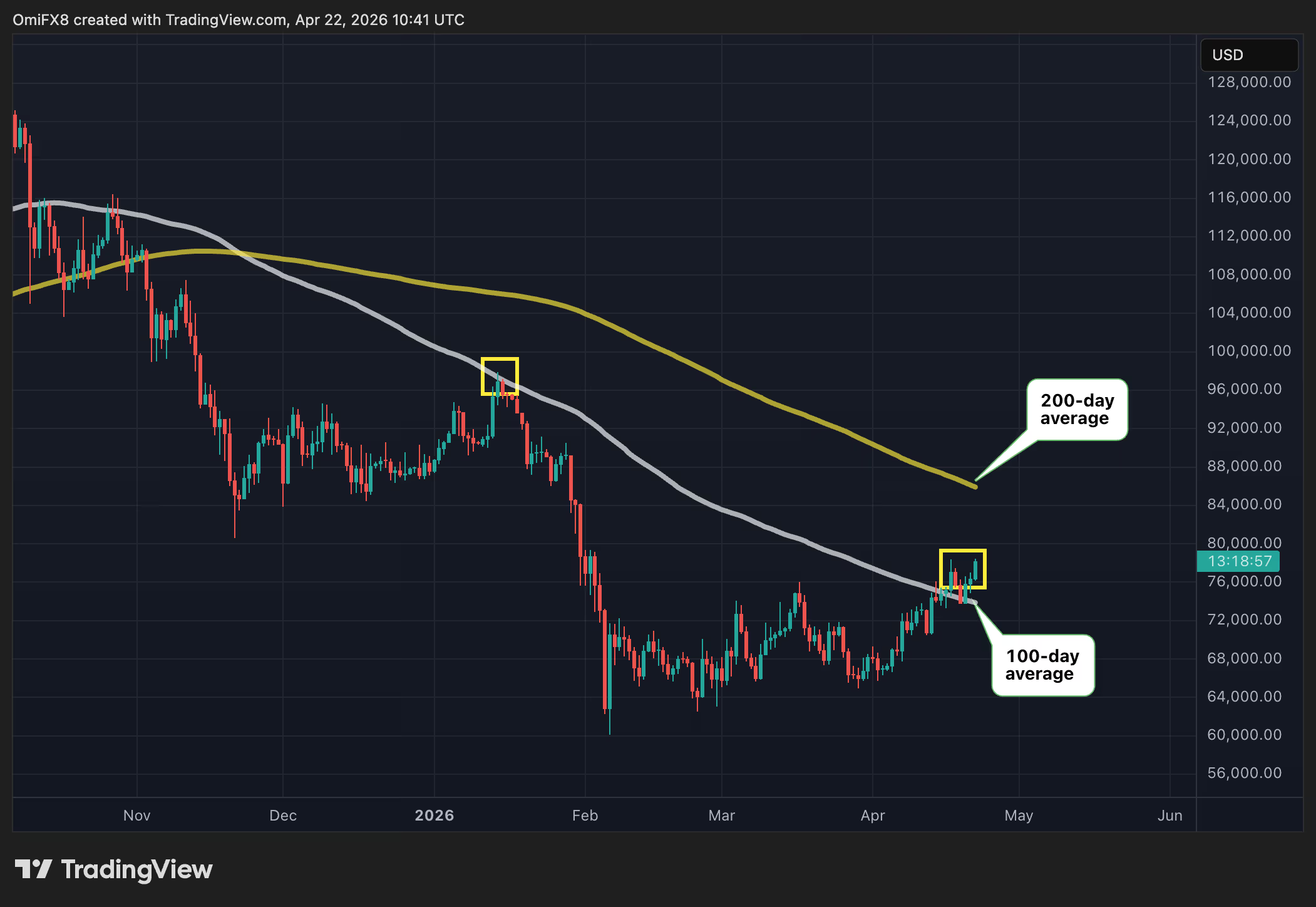
Bitcoin pushed above $78,000, lifting the broader crypto market. The move came as risk sentiment improved after U.S. President Donald Trump extended the ceasefire with Iran. Stock index futures also gained.
The cryptocurrency’s ascent ended the weeks of choppy trading between $65,000 and $75,000 that defined March and early April, finally giving momentum traders the green signal they had been waiting for.
Momentum traders buy when they see proof that an upward trend is underway. Bitcoin’s breakout is exactly that, and more buyers could pile in as a result, adding to the momentum. As the first law of motion says: An object in motion stays in motion until an outside force acts upon it, though Sir Isaac Newton may not have been thinking of financial markets at the time.
“The market spent months capped in the 65 to 75 box. Breaking out of that kind of range matters because it changes behavior. Sellers who were comfortable fading rallies above 74 now have to reassess. Momentum buyers who were waiting for confirmation finally have something to lean on,” analysts at Marex said.
Onchain indicators suggest the same. For instance, the number of coins held in wallets tied to centralized exchanges has dropped to a fresh multiyear low of 2.67 millon BTC, according to data source CryptoQuant. It points to continued investor accumulation, which could culminate in a supply shock.
“Bitcoin supply on exchanges continues to shrink, with fewer coins available to sell, more BTC moving to long-term holders, and liquidity tightening. Bitcoin is becoming increasingly scarce – supply down means volatility up,” Delta Exchange said on X.
Still, QCP Capital is urging caution, noting the persistent relative richness of bitcoin put options on Deribit. Puts are used as a hedge against potential price drops in the underlying asset. It added that crypto trends currently seem tied to the price of oil and the interest-rate outlook.
“The path forward remains anchored to oil and policy. A move lower in crude or clearer Fed signaling would support risk. Absent that, markets are likely to remain in a holding pattern, pricing uncertainty rather than resolution,” the Singapore-based firm said in a market update.
In traditional markets, WTI crude futures are trading around $90, having bounced from a low of $78 on Friday.
In the broader market, DeFi security risks remain an issue as hacks proliferate. Early today, the Sui-based Volo protocol was drained of over $3 million just days after the KelpDAO event that caused collateral damage across the sector. Stay alert!
Read more: For analysis of today’s activity in altcoins and derivatives, see Crypto Markets Today . For a comprehensive list of events this week, see CoinDesk’s “Crypto Week Ahead.”
What’s trending
This is an excerpt from CoinDesk newsletter ‘Daybook.’ Sign up here, if you haven’t already.
Today’s signal

The chart shows bitcoin’s daily price movements in candlestick format, with lines indicating the 100-day and 200-day average prices.
BTC’s price has established a firm foothold above the 100-day average, represented by the white line. This is pivotal because the 100-day average capped the bounce in January, following which sellers re-established control, leading to a deeper crash to nearly $60,000.
Now the price has pierced through, which typically signals a strengthening of bullish momentum, focus shifts to the 200-day average, currently positioned at $85,900.
Crypto World
WOJAK Crypto Meme Coin Pumps 87% as MAXI Targets $5M: Analyst Calls Most Obvious Trade of 2026
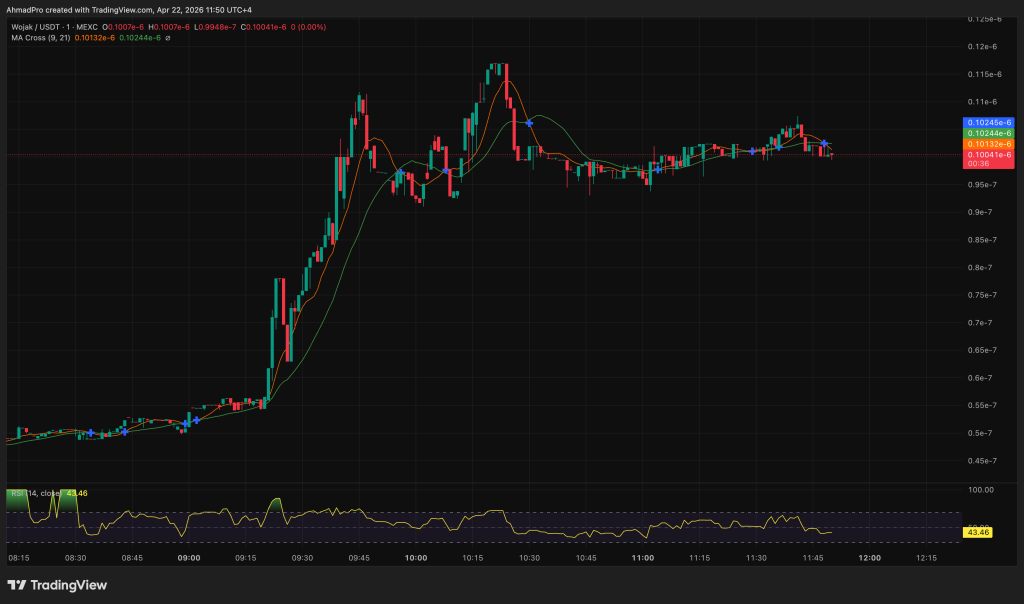
WOJAK crypto is moving again, and the meme coin faithful are paying attention. The original despair-fueled token surged as much as 87% in a 24-hour window, reigniting a sector that many had written off after months of sideways consolidation.
Whether this leg holds or fades fast is the question every trader is asking right now.
The rally appears supply-driven. On-chain data tracked by MEXC shows aggressive accumulation alongside a tightening circulating supply, with whale wallets absorbing selling pressure at key floor levels.
Volume spiked into the move, a distinction that separates genuine breakouts from low-liquidity noise. One chart making rounds on Crypto Twitter shows WOJAK printing its highest weekly close since its 2023 peak. That kind of structure demands a closer look.
The broader ETH memecoin sector is catching a bid at the same time, suggesting this isn’t an isolated pump. Ethereum-based meme tokens are drawing renewed capital as gas conditions improve and risk appetite expands, a context that matters when sizing any position here.
Can WOJAK Crypto Price Sustain Its Breakout or Is a Reversal Imminent?
WOJAK crypto is currently priced at approximately $0.0₆1021, sitting on a market cap of roughly $41.5M after the multi-day surge. That’s a meaningful number, small enough to move fast, large enough to attract institutional-grade meme traders who track this tier specifically.
The move here is not just a one-candle spike; it looks like sustained buying over a short window, with volume well above average, which usually signals real interest rather than a quick pump.
The structure is pretty clean when viewed in market-cap terms. Right now, the key resistance sits around $50M, and that is the level that decides whether this continues or stalls.
If it breaks above $50M with volume holding, that is where momentum can expand fast and open the path toward $100M as the next target, especially with traders chasing strength.
If it gets rejected there, the more realistic outcome is a cooldown, with price settling and accumulating around the $30M area while the market digests the move.
The risk is that it starts losing structure rather than consolidating, because once distribution kicks in, these moves unwind quickly.
And at this size, the further it runs without a reset, the worse the risk-reward gets, so anyone entering now is chasing momentum, not early positioning.
Maxi Doge Presale Nears $5M as WOJAK Traders Hunt Earlier-Stage Upside
WOJAK’s surge is validating the meme coin thesis — but at $21.5M market cap and already up 187%, the easy money has cleared the table (that’s just math). Traders who want the next WOJAK-style move, not the current one, are looking earlier in the funnel.
Maxi Doge ($MAXI) is currently the presale generating the most discussion in that context. Built on Ethereum as an ERC-20, the project has raised $4,748,137.43 at a current price of $0.0002814 — closing in hard on the $5M milestone.
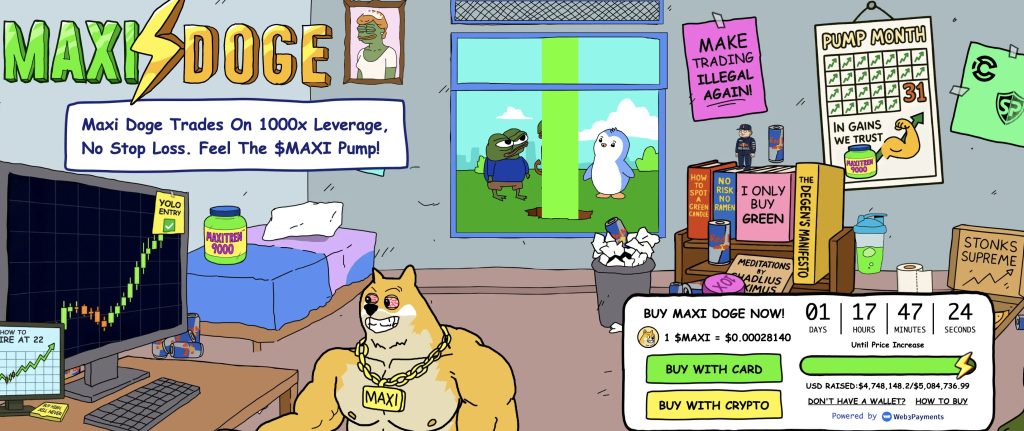
The concept is built around a 240-lb canine juggernaut embodying a 1000x leverage trading mentality: gym-bro energy meets aggressive market culture, packaged into holder-only trading competitions with leaderboard rewards and a Maxi Fund treasury backing liquidity and partnerships.
Recent coverage confirms the presale’s momentum toward that $5M threshold. Dynamic staking APY is live for current holders. The tagline, never skip leg-day, never skip a pump, is aggressively on-brand for the audience it’s targeting.
Presales carry real risk: no secondary market liquidity until launch, and meme projects live or die on community velocity. Do the work. But for traders who missed WOJAK’s entry, Maxi Doge is worth researching before that $5M milestone closes the current tier.
The post WOJAK Crypto Meme Coin Pumps 87% as MAXI Targets $5M: Analyst Calls Most Obvious Trade of 2026 appeared first on Cryptonews.

CRYPTO TRAP! They Are Lying To You About This Bitcoin Crash

FIFA Faces Slow Ticket Sales for USMNT World Cup Opener Against Paraguay at SoFi Stadium

North Korean-backed hackers roll out new attack vector targeting crypto executives and firms

Manchester United reach agreement with Casemiro over contract clause amid transfer speculation

Steven Gerrard disagrees with Gary Neville over ‘shock’ Chelsea and Arsenal claim | Football

US brings back mandatory military draft registration


-

 Fashion5 days ago
Weekend Open Thread: Theodora Dress
-

 Sports5 days ago
NWFL Suspends Two Players Over Post-Match Clash in Ado-Ekiti
-

 Politics5 days ago
Palestine barred from entering Canada for FIFA Congress
-
Entertainment3 days ago
NBA Analyst Charles Barkley Chimes in on Ice Spice McDonald’s Fiasco
-

 Business3 days ago
Powerball Result April 18, 2026: No Jackpot Winner in Powerball Draw: $75 Million Rolls Over
-

 Politics3 days ago
Zack Polanski demands ‘council homes not luxury flats for foreign investors’
-

 Crypto World5 days ago
Russia Pushes Bill to Criminalize Unregistered Crypto Services
-

 Tech3 days ago
Auto Enthusiast Scores Running Tesla Model 3 for Two Grand and Turns It Into Bare-Bones Go-Kart
-

 Politics2 days ago
Gary Stevenson delivers timely reminder to register to vote as deadline TODAY
-

 Tech6 days ago
‘Avatar: Aang, The Last Airbender’ Leaked Online. Some Fans Say Paramount Deserves the Fallout
-
 Business6 days ago
Creo Medical agree sale of its manufacturing operation
-

 Business2 hours ago
Rolls-Royce Voted UK’s Most Iconic Trade Mark as IPO Register Hits 150
-

 Crypto World5 days ago
Russia Introduces Bill To Criminalize Unregistered Crypto Services
-
 Crypto World3 days ago
Kelp DAO rsETH Bridge Hack Drains $292M as DeFi Losses Top $600M in Two Weeks
-

 Sports6 days ago
British climbers complete new route in Swiss Alps
-

 Tech6 days ago
Ford EV and tech chief leaving automaker
-

 Sports6 days ago
“Felt Much Better Today”: Josh Hazlewood Opens Up On His Recovery Win Over LSG
-

 Entertainment7 days ago
Ruby Rose Accuses Katy Perry Of Sexual Assault, Police React
-

 Business6 days ago
Cheaper Doritos and Lays helps PepsiCo win back struggling snackers
-
 Entertainment6 days ago
Clavicular Says Streaming May Not Work Without Substances
You must be logged in to post a comment Login