

Crypto World
US court rules AI ads make Meta liable for fraud



A US court has found that Meta’s AI ads tools materially developed fraudulent investment content, stripping Section 230 immunity and exposing the platform to securities fraud claims.
Summary
- In Bouck v. Meta, a Northern California federal court denied Section 230 immunity after finding that Meta’s AI ads tools materially shaped fraudulent investment content rather than passively hosting it.
- The ruling opens Meta and other platforms to securities fraud claims under Rule 10b-5, where a platform whose AI assembles ad content could be considered the legal “maker” of the fraudulent statement.
- Alphabet, Snap, TikTok, and X all deploy generative AI in their advertising products and face the same potential exposure under the Ninth Circuit’s material contribution test.
A US court found that Meta’s AI ads helped create fraudulent investment content, removing Section 230 protection from the platform.
Chief Judge Richard Seeborg of the Northern District of California denied a Section 230 dismissal in Bouck v. Meta Platforms, a penny-stock securities class action where plaintiffs alleged that Meta’s generative AI advertising tools had themselves “developed the ultimate content of the fraudulent ads,” making Meta a co-developer rather than a passive host.
The ruling follows a near-identical theory that survived dismissal in Forrest v. Meta, where Judge P. Casey Pitts found that Meta’s ad tools “mix and match” images, videos, text, and audio using generative AI, creating a genuine factual dispute over material contribution to illegal content.
Section 230 of the Communications Decency Act immunizes platforms from liability for third-party content. The line Seeborg drew is technically precise: targeting an audience is protected distribution. Transforming or generating ad content is not. That distinction has now survived at the dismissal stage in two separate cases in the same district.
The Rule 10b-5 question courts have not yet answered
Bloomberg Law legal commentary noted that the Bouck ruling opens a further, unresolved question under securities law. The Supreme Court’s “maker” doctrine in Janus Capital Group v. First Derivative Traders holds that the maker of a fraudulent statement is the entity with ultimate authority over the statement’s content and communication.
If a platform’s generative AI exercises that authority over an assembled investment solicitation, the platform may be the maker of the fraudulent statement under Rule 10b-5, primary securities fraud liability that has no Section 230 analog.
That argument has not yet been fully adjudicated. If it is, platforms whose AI systems assemble investment content could face securities fraud exposure with no Section 230 defense available.
Who else is exposed
The Ninth Circuit’s material contribution framework that survived in Bouck and Forrest applies to any platform whose AI tools actively shape ad content. Alphabet, Snap, TikTok, and X all deploy generative AI in their advertising systems.
As crypto.news reported, AI-driven fraud vectors are accelerating in 2026, with regulators and plaintiffs increasingly targeting the infrastructure layer rather than individual bad actors.
As crypto.news tracked, crypto platforms that use AI to assemble promotional content or investment-related communications could face similar exposure if this legal theory migrates from social media advertising into the digital asset context. Meta has said it will appeal both decisions.

Crypto World
Ethereum Price Prediction Eyes $7,500 as Bitmine Stacks 5.18 Million ETH While Pepeto Sails Past $9.86M
The Ethereum price prediction looks the strongest it has been all year after Bitmine Immersion Technologies revealed a 5.18 million ETH treasury worth $12.1 billion on May 4, the largest Ethereum stockpile any company holds in the world per PRNewswire.
When one firm pulls more ETH off the market than the entire daily mint produces, the supply side of the Ethereum price prediction shifts in a single direction.
While Bitmine locks ETH off the market, another Ethereum-based project is drawing smart money before listing, the Pepeto presale, which just sailed past $9.86 million at $0.0000001869 with a Binance listing approaching.
Bitmine MAVAN Staking Locks 4.36 Million ETH and Lifts the Ethereum Price Prediction
Bitmine confirmed it now has 4,362,757 ETH worth roughly $10.2 billion staked through its MAVAN platform, the institutional-grade rail it built for its own treasury and is now opening to outside investors per PRNewswire.
Tom Lee, the company’s chairman, projected $352 million in annual rewards once the full ETH balance runs through MAVAN. With one-third of all ETH already locked across the network and Ark Invest forecasting smart contract platforms above $6 trillion by 2030 per CoinMarketCap, the Ethereum price prediction lines up with a setup the market has not held at this scale before.
Pepeto Sails Past $9.86M as the Ethereum-Based Project Built for the Next Cycle
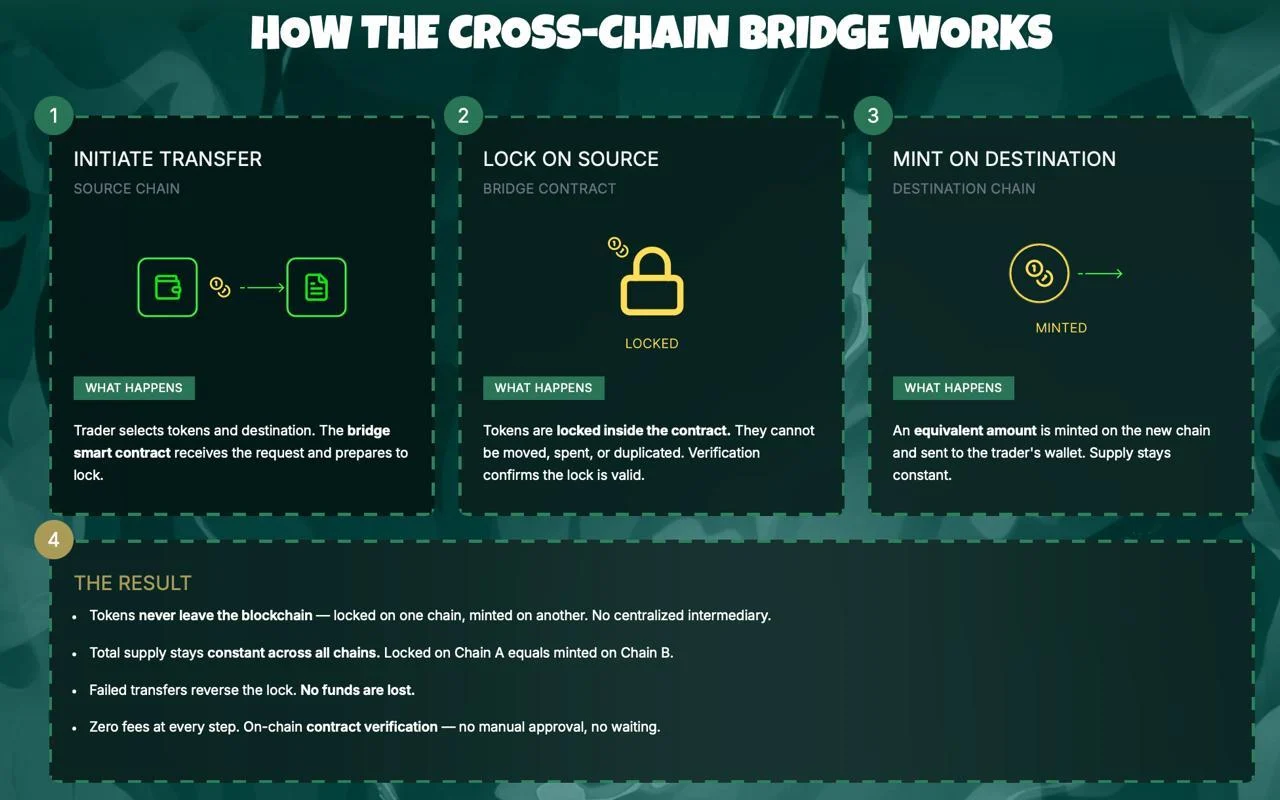
Pepeto runs on Ethereum exactly because every fresh dollar of institutional capital flows to assets on this chain, and Bitmine’s $12.1 billion treasury proves it. PepetoSwap settles every swap at zero fee while Uniswap and PancakeSwap still skim 0.3% per trade, and across a year of routing that gap saves thousands on the same volume.
That same exchange routes tokens across Ethereum, BNB Chain, and Solana at no gas charge, so size moves between networks without bleeding into bridge costs, while the contract scanner runs a risk score on every token before any swap goes through, catching the rug before money leaves the wallet. SolidProof verified the full code base, and the cofounder who scaled the original Pepe coin to $11 billion runs Pepeto with a senior Binance executive on the team.
The presale crossed $9.86 million at $0.0000001869 with 175% APY staking compounding daily, so a $5,000 entry produces around $8,750 in rewards over twelve months while holders wait for the listing.
The Ethereum price prediction targets a 100% climb into year end, yet ETH at a $283 billion cap doubling to $5,000 is the math of a top-two asset, not the math that turns small money into life-changing capital. Pepeto carries the same listing-day setup that lifted Shiba Inu from fractions of a cent to $0.00008 in one cycle, and the wallets stacking presale rounds today already see the same shape forming on this chart.
Ethereum (ETH) Price at $2,288 as Institutional Treasuries Compress Supply
Ethereum (ETH) trades at $2,288 on May 7 per CoinMarketCap, down 2.5% over 24 hours but up 4.5% on the week as institutional flows return. ETH support sits at $2,256 with resistance at $2,460, and a daily close above that level opens the path toward the April 17 high.
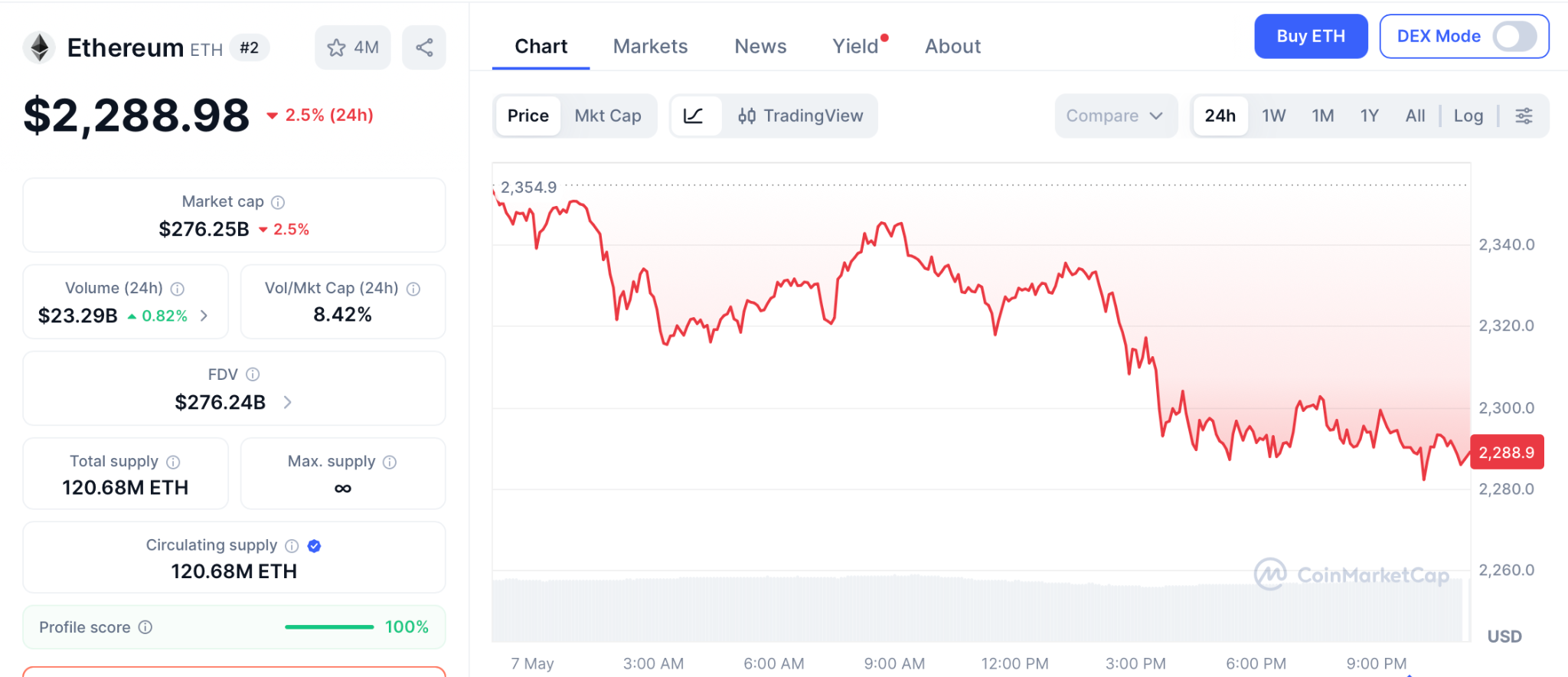
Bitmine alone holds 5.18 million ETH, more than the network mints in a full year. Standard Chartered keeps a $7,500 year-end target on Ethereum, and Ark Invest sees smart contract platforms above $6 trillion by 2030.
The Ethereum price prediction reads healthy for steady accumulation, but a presale at $0.0000001869 carries listing math that ETH at this cap cannot deliver in one event.
Conclusion
Every Ethereum that Bitmine pulls into its treasury tightens the supply behind the Ethereum price prediction, and no Ethereum-based presale sits in a cleaner spot than Pepeto right now with $9.86 million raised, the SolidProof audit verified, and the Binance listing approaching.
Traders who watched Shiba Inu climb from fractions of a cent to $0.00008 and told themselves they would catch the next one, who saw Solana under a dollar and waited a few weeks for a better entry that never came, who passed on the original Pepe at $0.0000005 because the chart looked too quiet, are looking at the same exact setup today.
Pepeto at $0.0000001869 is that entry, the presale stays open while the listing approaches, staking pays 175% APY compounding daily, and once trading goes live the price closes for good and the only door left becomes buying from holders who paid presale and have no reason to sell anywhere near cost.
Click To Visit Pepeto Website To Enter The Presale

FAQs
What is the Ethereum price prediction for 2026 after Bitmine’s 5.18 million ETH treasury announcement?
The Ethereum price prediction for 2026 targets $5,000 to $7,500 based on Standard Chartered’s year-end call and Ark Invest’s smart contract platform forecast. ETH trades at $2,288 with Bitmine confirming 5,180,131 ETH worth $12.1 billion as the largest Ethereum treasury globally per PRNewswire.
Why is Pepeto the best Ethereum-based presale in May 2026?
Pepeto is the best Ethereum-based presale because the project ships a live zero-fee exchange, cross-chain bridge, SolidProof audit, and a Binance listing on the calendar. The presale has raised $9.86 million at $0.0000001869 with 175% APY staking compounding daily.
Disclaimer: This is a Press Release provided by a third party who is responsible for the content. Please conduct your own research before taking any action based on the content.



The Pentagon released 162 UAP files on May 8, including NASA Apollo moon photos and 1965 astronaut audio
Summary
- The Department of War posted 162 UAP files on May 8 at war.gov/ufo, covering sightings from 1942 to 2025, with 108 of the files containing some redactions.
- The most notable documents include NASA transcripts and photographs from the Apollo 12 and 17 moon missions, with three unexplained lights visible above the lunar surface in the Apollo 17 image.
- Defense Secretary Pete Hegseth confirmed more files will follow in rolling tranches, with the Pentagon opening a formal investigation into the Apollo 17 photograph.
The Pentagon released 162 UAP files on May 8, including NASA Apollo moon photos and 1965 astronaut audio. The files were posted at war.gov/ufo under the Presidential Unsealing and Reporting System for UAP Encounters, or PURSUE, carrying out a directive from President Trump to declassify government records on unidentified anomalous phenomena.
Defense Secretary Pete Hegseth said in a statement: “These files, hidden behind classifications, have long fueled justified speculation — and it’s time the American people see it for themselves.” The release includes documents from the FBI, State Department, NASA, and the Department of Defense, spanning incidents from 1942 through 2025.
What the files contain
The highest-profile documents are NASA transcripts and photographs from the Apollo 12 and 17 moon missions. An Apollo 17 image shows three lights in a triangular formation above the lunar surface. New US government analysis suggests the feature may represent a physical object, and the Pentagon has opened a formal investigation, obtaining the original Apollo 17 film for full analysis.
Audio from 1965 includes astronaut Frank Borman reporting a “bogey at 10 o’clock high” from his Gemini VII capsule, and Apollo 17 Mission Commander Eugene Cernan describing a “flashing” object rotating in a rhythmic pattern several miles from his capsule. Both audio clips had circulated online for years. The original NASA transcripts appear to be new public releases.
The roughly 24 videos run 41 minutes total, showing infrared footage of objects making 90-degree turns at 80 mph over Greece in 2023, a football-shaped object near Japan, and semi-transparent shapes over Syria. Most show small white objects tracked by military cameras, with no explanatory conclusions drawn.
What the Pentagon says it is withholding
Of the 162 files, 108 contain redactions. The Pentagon confirmed no redactions were made to information about the nature or existence of any reported UAP encounter. Information withheld covers witness identities, government facility locations, and military site data unrelated to UAP.
New files will be released every few weeks on a rolling basis as materials are discovered and declassified. Former President Obama said earlier this week that the government is not hiding proof of aliens, clarifying prior comments that had circulated widely online.

A Manhattan federal judge has cleared a path for Arbitrum DAO to move $71 million worth of frozen Ether to Aave LLC as part of a broader DeFi recovery effort tied to a North Korea–linked exploit. The decision, while a procedural milestone, leaves intact the terrorism victims’ claims on the funds and requires careful navigation between off-chain governance and on-chain formalities before any transfer can be completed.
Judge Margaret Garnett of the Southern District of New York issued the order on Friday, modifying a restraining notice that had locked the assets inside Arbitrum DAO. The modification enables an on-chain governance vote to authorize transferring the funds to a wallet controlled by Aave LLC and explicitly protects participants in the transfer from violating the freeze.
Importantly, the court’s ruling does not grant unfettered access to the money. The terrorism victims’ legal claim remains, meaning Aave could still be forced to hand the funds over if the court ultimately rules in the victims’ favor. The decision thus splits the path between enabling a recovery mechanism and preserving the ongoing litigation that underpins the freeze.
Key takeaways
- The SDNY order allows a transfer of $71 million in frozen ETH from Arbitrum DAO to Aave LLC, by modifying the restraining notice governing the funds.
- An on-chain Arbitrum governance vote is still required to finalize any transfer, with the off-chain Snapshot vote serving as a signaling mechanism for broad support.
- Despite the green light for the transfer process, the court retains the terrorism victims’ claim on the funds, keeping a potential return of the assets on the table depending on future rulings.
- The development sits within the broader context of Aave’s recovery plan after the Kelp DAO exploit, a saga that has dragged on across court actions and DeFi governance debates.
- The Kelp exploit left rsETH backing materially strained, raising questions about how recovery assets affect pegged stablecoins and cross-chain collateral in DeFi ecosystems.
Judicial signal as DeFi recovers a frozen stake
The ruling marks a notable juncture in the ongoing effort to unwind the aftermath of the Kelp DAO event. By permitting a governance-led move of the frozen ETH, the court acknowledges a path for asset recovery that could help compensate victims while preserving the legal framework that attributes liability to the North Korea–linked actors in the case. The decision aligns with a broader trend of courts weighing asset freezes against the practical needs of victims and lenders seeking to salvage value from compromised protocols.
The order references an off-chain governance process that had demonstrated strong support for releasing the funds to support victims and recovery efforts. In particular, Arbitrum delegates engaged in a Snapshot vote that yielded a decisive endorsement for the move, even as a binding on-chain vote remains a prerequisite for actual transfers. For readers tracking governance mechanics, this distinction—off-chain consent versus on-chain execution—remains pivotal to whether the funds can ever leave the Arbitrum DAO treasury.
For context, the on-chain step is essential to authorize the movement of assets under the protocol’s formal governance framework. In parallel, the on-chain vote would bind participants to the outcome, reducing the risk of unilateral action outside the established process. Recent reporting noted the off-chain vote’s strong majority, but emphasized that the transfer would still require a subsequent on-chain vote to take effect. See earlier coverage outlining the off-chain approval trajectory and its implications for Aave’s recovery plan. Arbitrum vote to release $71M in frozen Kelp exploit ETH set to pass
Aave’s legal pivot and the recovery roadmap
Aave’s legal push to lift the restraining notice intensified last week with an emergency motion in New York seeking to vacate the freeze and allow transfers to proceed for victims of the Kelp DAO hack. The filing contends that while North Korea-linked actors are a potential source of attribution, using that as a basis for ownership of stolen property is legally tenuous and could chill future DeFi recovery efforts if upheld.
The motion, described in filings and subsequent reporting, suggests that a broad interpretive frame—one that recognizes theft as not equating to ownership—would be essential to prevent a chilling effect on future sanctioned recoveries across DeFi protocols. The filing underscores a tension between enforcing liability for sanctioned victims and maintaining a flexible, restorative approach that enables protocols to map recoveries in real time. Aave asks court to lift restraining notice on frozen Kelp exploit ether
In related context, the legal narrative includes activity from Gerstein Harrow LLP, representing families holding substantial terrorism judgments and arguing the funds belong to their clients because of the alleged theft during the April 18 attack. The firm previously pursued claims against other DeFi entities tied to North Korea–related hacks, illustrating the broader legal front on how to handle hacked or misappropriated assets when court-ordered freezes intersect with recovery efforts. Aave deposits fall by $15B as Kelp exploit sparks flight from DeFi lender
Kelp exploit and the stubborn rsETH shortfall
The Kelp DAO incident left a notable hole in rsETH backing. The event freed 116,500 rsETH on Ethereum without a corresponding burn on the supply side, leaving 40,373 rsETH backed against 152,577 rsETH in existence, a shortfall of roughly 76,127 rsETH. At current valuations, that gap equates to about $174.5 million. The freeze of 30,765 ETH by Arbitrum represents a meaningful step toward narrowing this gap and restoring confidence in rsETH’s collateral structure, according to proponents who argue that even partial restoration can stabilize conditions for users across Arbitrum and the broader DeFi ecosystem. Joint proposal to release 71m frozen by Arbitrum moves to first vote
The unfolding sequence underscores a broader tension in DeFi: recovering value after a breach while preserving the incentives and governance mechanisms that allow protocols to adapt quickly to post-attack realities. If the current effort—partially funded by escrowed assets—helps restore rsETH’s backing, it could provide a model for coordinated recoveries that other protocols may aspire to in the future.
What to watch next in Arbitrum’s recovery playbook
The immediate next milestone is the on-chain governance vote that would authorize transferring the frozen ETH to Aave’s controlled wallet. If the on-chain vote approves, the funds would move only under the safeguards that the SDNY order imposes and subject to any lasting court determinations about the terrorism claims. Investors and users will be watching not only the vote tally but also how the court handles the ongoing claims, which could shape future DeFi recovery operations and the legal risk calculus for similar rescue efforts.
Beyond the immediate dispute, the case highlights the evolving interface between courts, DeFi governance, and recovery planning. As the industry continues to navigate hacks, sanctions, and attribution debates, observers will look for clearer frameworks that balance remedial action with accountability. The coming weeks should clarify whether the on-chain vote can proceed as envisioned and whether the court will set further boundaries on how recovered assets are allocated during protracted litigation.
For readers following the arc of DeFi recovery, the key variable remains how swiftly the on-chain governance step can be completed and how the court interprets the terrorism-claims overlay on the released funds. The next developments will reveal how flexible enforcement can be in practice when an ecosystem seeks to recover value while honoring legal claims.
In the meantime, market observers will monitor the broader implications for DeFi asset recovery, governance signaling, and cross-protocol cooperation as a template for handling similar incidents in the future.
What to watch next: the on-chain vote outcome and any subsequent court ruling that could influence the fate of the frozen funds and the framework for DeFi-based recoveries.


Connecticut SB5 passed both chambers on May 1 and heads to the governor, making it one of the most comprehensive state AI laws in the US.
Summary
- Connecticut SB5 passed 131-17 in the House and 32-4 in the Senate on May 1, with Governor Lamont confirming he will sign the bill.
- The law covers AI companions, synthetic media transparency, automated employment decision tools, and frontier model developers, with staggered effective dates from October 2026.
- The law takes effect despite the Trump administration’s executive order urging states to avoid burdensome AI regulation, making Connecticut the latest state to defy federal pressure.
Connecticut SB5 passed on May 1, becoming one of the broadest state AI laws in the US. The House voted 131-17 in favor and the Senate passed it 32-4, with bipartisan support in both chambers. Governor Ned Lamont confirmed he will sign the bill, which is now formally titled the Connecticut Artificial Intelligence Responsibility and Transparency Act.
The law covers AI companions, automated employment decision tools, synthetic media provenance, and frontier model developers above defined thresholds.
First effective date is October 1, 2026. Most provisions become enforceable exclusively by the state Attorney General as unfair or deceptive trade practices, with no private right of action.
What the law requires
For employers, SB5 requires disclosure when automated tools are used in recruiting or hiring decisions and bars companies from using such tools as a defense against discrimination claims. Employment provisions take effect October 1, 2026.
AI companion rules, covering chatbots that foster emotional attachment, take effect January 2027. Generative AI systems above one million users must adopt C2PA-aligned provenance data standards.
Frontier developers must establish internal AI safety programs and protect employees who report safety concerns. As crypto.news reported, companion AI regulation has accelerated across US states in 2026 following lawsuits in Pennsylvania and Kentucky over chatbot harm.
Federal collision course
Connecticut joins California, Colorado, and others in passing AI-specific laws despite Trump’s executive order, which the White House says is intended to preempt state rules deemed burdensome.
SB5 includes a regulatory sandbox and working group, with the first meeting required by August 31, 2026, to shape implementation. As crypto.news tracked, federal agencies are simultaneously deploying AI tools to fill regulatory gaps, creating a layered enforcement environment for companies operating across state lines.
Attorney General William Tong said his February 2026 advisory to businesses signaled his office already views AI squarely within its remit. SB5 gives his office significantly expanded, purpose-built tools to act on that posture.
U.S.-listed spot Bitcoin ETFs recorded $277.5 million in net outflows on Thursday.
Summary
- Spot Bitcoin ETFs recorded $277.5 million in outflows, ending five days of strong inflows Thursday.
- Fidelity and BlackRock led redemptions as Bitcoin slipped below $80,000 during volatile intraday trading sessions.
- Morgan Stanley’s MSBT still attracted inflows, showing uneven demand across U.S. Bitcoin ETF products Thursday.
The move ended a five-day inflow streak worth nearly $1.7 billion, according to SoSoValue data.
The reversal came as Bitcoin fell below $80,000 after trading above $82,000 a day earlier. Current market data showed Bitcoin (BTC) near $80,000, after an intraday low of $79,250.
Fidelity and BlackRock lead outflows
Fidelity’s Wise Origin Bitcoin Fund led the daily redemptions with $129 million in outflows. BlackRock’s iShares Bitcoin Trust followed with $98 million in outflows, based on Farside figures.
The outflows showed a sharp change from the early May trend. Bitcoin ETFs had drawn strong demand as Bitcoin reclaimed the $80,000 area and investors returned to spot funds after April’s recovery.
Moreover, Morgan Stanley’s Bitcoin Trust ETF was one of the few funds to record inflows on the day. MSBT added $7.3 million and has not logged a daily outflow since launching on April 8, 2026.
The fund has accumulated 2,920 BTC, worth about $232.6 million. Grayscale’s Bitcoin Mini Trust was the only other Bitcoin fund to post inflows during the broader outflow day.
Ethereum ETFs and TCAN add context
Spot Ethereum ETFs also turned negative on May 7, with $104 million in net outflows. None of the ten Ethereum ETFs recorded inflows that day, according to SoSoValue data.
The ETF pullback came as 21Shares launched TCAN, the first U.S. ETF tied to Canton Coin. As previously reported by crypto.news, TCAN gives investors exposure to the Canton Network through a Nasdaq-listed product with a 0.50% gross expense ratio.
ETF demand cools after April rebound
The latest outflows followed a strong April for Bitcoin funds. Crypto.news recently reported that April closed with $2.44 billion in spot Bitcoin ETF net inflows, even after late-month outflow pressure.
The latest dip below $80,000 shows that ETF flows remain tied to price swings, profit-taking, and broader risk sentiment.
Market mood also weakened. The Crypto Fear & Greed Index moved back into “Fear” at 38 after briefly returning to “Neutral.” Bitcoin remained higher over the past 30 days, but the ETF outflow day showed that demand can fade quickly when volatility returns.

It’s like a few wars, rising inflation, and global uncertainty are not enough these days. Now, the world needs to pay attention to another health hazard that made the news in the past few weeks: the Hantavirus, and, more precisely, the Andes virus.
Aside from the potential threats it poses to human life (which we will explore later in the article), the question raised by some analysts is whether it will affect BTC as COVID did six years ago.
Will History Repeat?
For those of our readers who might not have been around the March 2020 developments, here’s a quick recap. BTC was coming out of a long bear market, but it had failed to stage a meaningful recovery in 2019, and all eyes were on 2020 as a halving year, which historically served as a major catalyst for future gains.
However, it all changed when the COVID-19 pandemic broke out, especially since it was categorized as a global hazard in March. Over a two-day trading session, BTC plummeted from over $8,000 to a multi-year low of $3,750.
Analysts such as Crypto Rover have now speculated on a similar calamity if the Hantavirus explodes. The analyst with over 1.5 million followers on X noted that the mortality rate for COVID was 1%, while the Hantavirus’s is at 40%, which could spell a lot more trouble for everyone.
WARNING: THE COVID-LIKE $BTC DUMP IS ABOUT TO REPEAT??
COVID mortality rate: ~1%
Hantavirus mortality rate: ~40%The WHO says this likely won’t become the next pandemic.
I don’t think so either.
But they said the same thing about COVID.
Eyes on Bitcoin. pic.twitter.com/F0Dar9gN0n
— Crypto Rover (@cryptorover) May 8, 2026
The Differences
The history of this version of the Hantavirus, according to National Geographic, shows that it stemmed from South America and caused significant harm on a Dutch cruise ship, including several deaths so far. It comes from the Hantaviridae family of viruses, carried by rodents. In most of its versions, it cannot be transferred human-to-human. However, this particular one, which the WHO called the Andes virus, is the only known hantavirus that can jump from human to human.
Some experts said its spread is “not particularly efficient,” unlike measles and COVID, which can be transferred by viruses lingering in the air after an infected person has left the room. Andes spreads only by close contact.
“So, when you have people sleeping in the same bed, or sex partners, or people sharing food, the virus can transmit that way. But it doesn’t transmit to huge groups of individuals,” said Steven Bradfute, an immunologist and hantavirus researcher at the University of New Mexico Health Sciences Center.
Nevertheless, Bradfute, alongside other experts, such as Dr. Emily Abdoler, believes this virus should not be a main concern for most people as its spread will not be anything like COVID.
“I’m doing these interviews as a public service to try to reassure people that this shouldn’t be on their top 100 list of worries,” said Dr. Abdoler.
Hopefully, that’s true. Because we have heard similar reassurances even with COVID, which was not supposed to become a global pandemic at first. But, even if they are true (again, hopefully it’s not such a big threat), that doesn’t guarantee that markets won’t panic and overblow the potential consequences, leading to another major BTC dip.
The post Bitcoin vs. The Hantavirus: Is BTC Bracing for Another ‘Black Swan’ Event? appeared first on CryptoPotato.


Coinbase x402 is now native to Amazon Bedrock AgentCore, letting AI agents pay for services in USDC without human input
Summary
- AWS launched Amazon Bedrock AgentCore Payments on May 7, with Coinbase x402 and wallet infrastructure embedded to give AI agents autonomous USDC payment capability.
- Agents settle transactions on Base in roughly 200 milliseconds at less than a fraction of a cent per transaction, with enterprise spending controls and compliance checks built in.
- The x402 protocol has processed more than 169 million payments across 590,000 buyers in its first year, and both AWS and Coinbase are founding members of the x402 Foundation.
Coinbase x402 is now native to Amazon Bedrock AgentCore, letting AI agents pay for services in USDC without human input. AWS announced Amazon Bedrock AgentCore Payments on May 7, describing it as the first time a major cloud provider has built crypto micropayments directly into an agent infrastructure platform.
Stripe is also integrated at preview, with agents able to choose between a Coinbase or Stripe wallet funded in stablecoins or fiat.
The system runs on x402, an open HTTP-native payment protocol that uses the “Payment Required” status code to allow machines to transact over standard web infrastructure.
Settlement happens on Base with USDC in about 200 milliseconds at less than a fraction of a cent per transaction. Agents never access private keys. A single API call handles wallet authentication, transaction signing, and payment execution.
What agents can actually pay for
Developers can connect agents to thousands of x402-enabled services through Coinbase’s MCP integration inside AgentCore Gateway. Supported providers at launch include Exa, Messari, and Browserbase, covering search, real-time data, evaluation runs, and backend setup tasks. Agents pay only for what they use, with no subscriptions or checkout flows.
Brian Foster, Head of Infrastructure Growth at Coinbase, said: “There will soon be more AI agents transacting than humans, and they need money that’s built for the internet — programmable, always on, and global.”
As crypto.news reported, BNB Chain surpassed 150,000 autonomous AI agent deployments in April, a 43,750% increase since January, establishing a parallel infrastructure race for AI agent commerce across blockchains.
Why x402 matters for crypto adoption
The x402 protocol has processed more than 169 million payments across 590,000 buyers and 100,000 sellers in its first year. AWS and Coinbase are both founding members of the x402 Foundation, alongside Cloudflare, which joined in September 2025.
As crypto.news tracked, Coinbase AgentKit has been building toward this integration for months, giving developers pre-built tools to equip AI agents with wallets and transaction capability across multiple blockchains.
Warner Bros. Discovery is already testing AgentCore and said it sees potential for agent-driven transactions covering live sports and major entertainment releases.
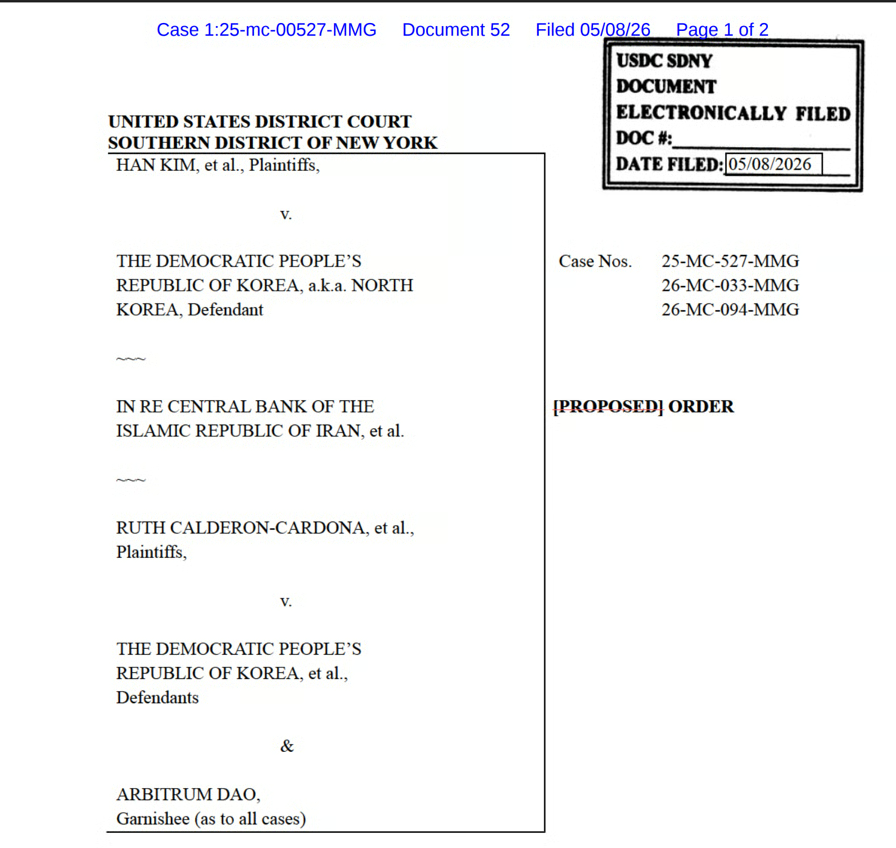
A Manhattan federal judge has allowed Arbitrum DAO to move $71 million in frozen Ether to Aave, clearing the path for the DeFi protocol’s recovery effort following a North Korea-linked exploit.
Judge Margaret Garnett of the Southern District of New York issued the order on Friday, modifying a restraining notice that had locked the assets inside Arbitrum DAO. The modification permits an onchain governance vote to send the funds to a wallet controlled by Aave LLC, and explicitly protects anyone who participates in the transfer from being held in violation of the freeze.
The order still keeps the terrorism victims’ legal claim on the funds, meaning Aave can’t use the funds freely and could be forced to hand them over if the court ultimately rules in the terrorism victims’ favor.

Judge allows Arbitrum to move funds to Aave. Source: Courtlistener
The decision came after Arbitrum delegates showed strong support for the move through an off-chain Snapshot vote as part of Aave’s broader recovery plan following last month’s North Korea-linked rsETH exploit. Any actual transfer still requires a separate binding onchain governance vote.
Related: Arbitrum vote to release $71M in frozen Kelp exploit ETH set to pass
Aave asks court to lift freeze on funds
Last week, Aave filed an emergency motion in a New York court seeking to vacate a restraining notice that had blocked Arbitrum DAO from transferring the funds to victims of the Kelp DAO exploit. The notice was served by Gerstein Harrow LLP, which represents families holding $877 million in unpaid terrorism judgments against North Korea and claims the funds belong to its clients because North Korean hackers stole them during the April 18 hack.
Aave pushed back hard, arguing that a thief doesn’t gain lawful ownership of stolen property and that attributing the hack to North Korea relies on little more than internet speculation. It also warned that if the court upholds the restraining notice, it could deter future DeFi recovery efforts and give bad actors a roadmap to exploit legal uncertainty following hacks.
Gerstein Harrow has previously pursued similar claims. In January, they sued Railgun DAO, alleging the privacy protocol was used to launder proceeds from prior North Korean hacks, including the $1.5 billion Bybit exploit.
Related: Aave deposits fall by $15B as Kelp exploit sparks flight from DeFi lender
Kelp exploit leaves $174 million hole in rsETH backing
The Kelp DAO exploit left rsETH’s backing with a significant shortfall. The hack caused 116,500 rsETH to be released on Ethereum without a corresponding burn on the source side, leaving only 40,373 rsETH in the adapter contract against confirmed backing for 152,577, a gap of roughly 76,127 rsETH, worth around $174.5 million at current prices.
The 30,765 ETH frozen by Arbitrum has been flagged as a meaningful step toward closing that gap, with proponents arguing that even partial restoration of rsETH’s backing would help stabilize conditions for users across Arbitrum and the wider DeFi ecosystem.
Magazine: 53 DeFi projects infiltrated, 50M NEO tokens could be ‘given back’: Asia Express


Upbit will add Pharos to its KRW, BTC, and USDT markets on May 8, giving Korean traders new spot access to PROS.
Summary
- PROS jumped 47.8% to $0.9457 after Upbit and Bithumb expanded Korean market access.
- Pharos trading volume rose 209.6% to $28.7 million as listing momentum boosted activity.
- CoinGecko ranked PROS at #255, with a $127.5 million market cap after the rally.
The exchange notice said trading support was scheduled for 8:30 p.m. Korea time.
Deposits and withdrawals are expected to open within one hour and 30 minutes after the notice. Upbit said users must send PROS through the Pharos network only, as deposits through unsupported networks may take longer to return.
Interestingly, CoinGecko data showed Pharos trading at $0.9457, up 47.8% over 24 hours. The token also gained 45.7% over seven days, placing it above the wider crypto market’s daily move.
Trading activity also increased. CoinGecko placed 24-hour PROS volume at $28.7 million, up 209.6% from the previous day. The token had a market cap of about $127.5 million and ranked #255 on CoinGecko.
The price move also came as Bithumb added Pharos to its Korean won market. That gave PROS another local listing on the same day and expanded access beyond Upbit
Early trading limits will apply
Upbit will apply normal trading controls after the listing opens. Buy orders will be restricted for about five minutes after trading starts. The exchange will also block sell orders priced more than 10% below the previous closing price for a short period.
For around two hours, Upbit will only allow limit orders. These controls are common during new listings, when liquidity is still forming and prices may move quickly.
Meanwhile, Pharos is an EVM-compatible Layer 1 blockchain that uses an asynchronous BFT-based proof-of-stake consensus model. The network also uses parallel processing and aims to support Web3 and real-world asset applications.
Messari describes Pharos as a modular Layer 1 built for real-world assets. Its report says the network targets 30,000 transactions per second and sub-second block times, while combining EVM and WASM under one runtime.
Korean exchange activity stays busy
The PROS listing follows recent Upbit market additions. Related crypto.news coverage said Upbit added B3 to its Korean won market on May 7, giving the Base-linked token direct local access.
Moreover, as crypto.news reported, Upbit listed Dogwifhat on KRW, BTC, and USDT markets on May 6. That report noted that new Upbit listings can draw fast retail attention, but may also bring sharp short-term price moves.
The listing comes as South Korea’s crypto sector faces tighter compliance pressure. Recent crypto.news coverage said local industry groups warned that planned AML changes could raise exchange reporting loads sharply.
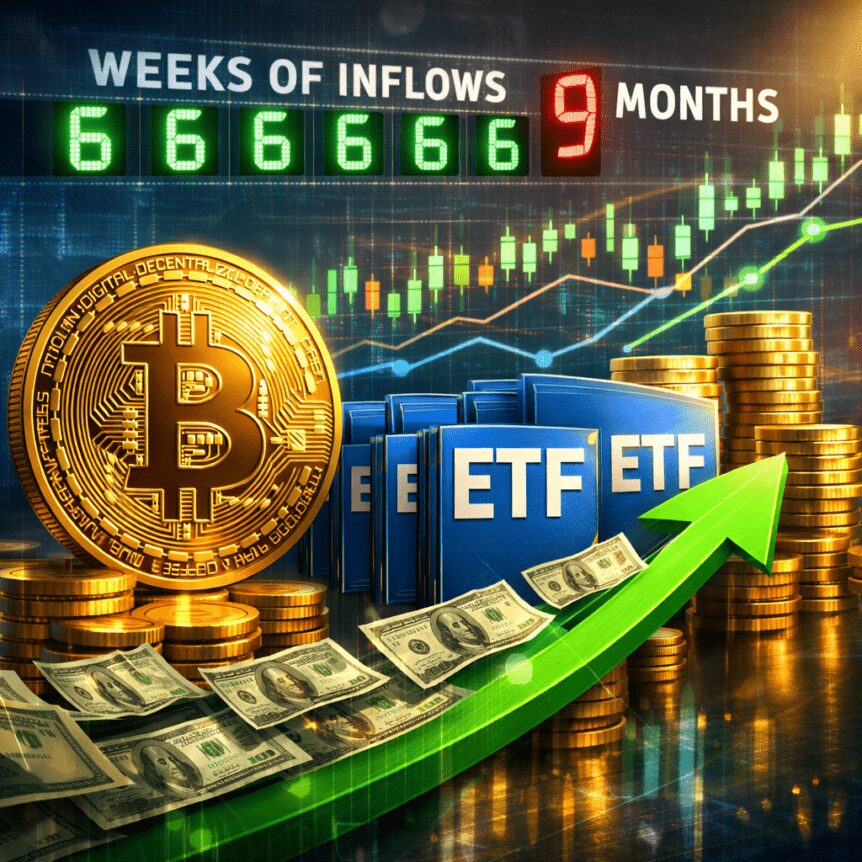
US spot Bitcoin exchange-traded funds (ETFs) extended their run of weekly inflows to a sixth straight week, marking the longest streak of net purchases since August 2025. Data tracked by SoSoValue shows a six-week accumulation totaling about $3.4 billion, underscoring renewed appetite from ETF investors for spot BTC exposure even as intraday price action remains choppy. The week of April 2 through the latest period saw inflows peak in mid-April, with the strongest week recording nearly $1 billion in new money, while the weakest week started with only about $22 million of inflows.
Specifically, the week of April 17 delivered the largest weekly intake at $996.38 million, and the most recent week logged $622.75 million. This six-week ascent stands as the longest such streak in more than nine months; the prior longer run stretched for seven weeks from June 13 to July 18, 2025, totaling roughly $7.57 billion in inflows, including $2.72 billion in the week of July 11 and $2.39 billion the following week.
But the latest cadence was not uniformly uplifting. The week ended with notable outflows—$277.50 million on Thursday and $145.65 million on Friday—before a strong start earlier in the week. Monday and Tuesday delivered $532.21 million and $467.35 million respectively, while Wednesday’s inflows slowed to $46.33 million, illustrating a market tug-of-war as participants weighed macro signals against price action in BTC.
Related: Bitcoin ETFs Extend Rally as Two-Day Inflows Near $1 Billion
Key takeaways
- Six consecutive weeks of net inflows into US spot BTC ETFs, totaling about $3.4 billion from early April through the latest week, according to SoSoValue data.
- The six-week sequence is the longest since August 2025, with the strongest weekly inflow at $996.38 million (week of April 17) and the weakest in the six-week sample at $22.34 million (week of April 2).
- Bitcoin ETF inflows have shown episodic strength despite intermittent late-week outflows, highlighting ongoing demand from institutional and accredited investors seeking direct BTC exposure via regulated vehicles.
- Ether ETFs turned positive for the week ending May 8, posting $70.49 million in net inflows after prior outflows, extending a broader rebound in mid-to-late April.
- The macro backdrop remains a source of ambiguity, with investors awaiting key US data and ongoing geopolitical considerations that influence risk sentiment and liquidity in crypto markets.
Ether ETFs rebound after a stretch of volatility
While Bitcoin-led products dominated headlines with persistent inflows, Ether ETFs also flipped back into positive territory for the week ending May 8, recording net inflows of $70.49 million. This followed a prior period in which Ether inflows flipped to outflows totaling $82.47 million.
The sector had demonstrated notable momentum earlier in April, supported by a three-week run from April 10 to April 24 that produced combined inflows of $617.91 million and peaked at $275.83 million in the week of April 17. That momentum appeared to waver in the week that followed, but the May 8 data point signaled a renewed interest in ether exposure among ETF participants.
From a daily perspective, Ether fluxes within the week showed some volatility: Thursday saw $103.52 million in outflows, a pressure point that nearly erased gains built earlier in the week; Monday and Tuesday brought $61.29 million and $97.57 million in inflows, respectively, while Wednesday posted a modest $11.57 million in inflows. Friday managed a slight recovery of $3.57 million, leaving the week in positive territory.
Magazine: Guide to the top and emerging global crypto hubs — Mid-2026
Context: what the latest inflows imply for the market
Taken together, the data points to a persistent, though nuanced, demand signal for regulated crypto access via ETFs. The Bitcoin inflow trajectory suggests that a broad cohort of investors views spot BTC exposure as a core hedge or diversification tool within a regulated framework, even as daily price moves and systemic liquidity conditions inject volatility into short-term performance figures.
Analysts have noted that the macro environment—especially labor market signals and geopolitical developments—will help determine the pace and durability of ETF inflows in the near term. As traders await key economic releases and policy cues, risk management and liquidity considerations remain central to positioning around BTC and ether ETF products. The broader takeaway is that while inflows are not a straight-line rally, the sustained buying interest in spot BTC ETFs points to growing mainstream acceptance of regulated crypto exposure as part of diversified portfolios.
Related: Cointelegraph coverage of ETF inflows
What traders should watch next
The coming weeks will likely hinge on domestic macro data and the evolving geopolitical backdrop, which jointly influence risk appetite and liquidity for crypto instruments. If the current inflow streak persists, ETF-backed BTC exposure could remain a meaningful driver of demand, particularly as institutions continue to explore regulated access. Conversely, back-end volatility and late-week reversals underscore the importance of disciplined risk management for ETF traders and market makers as they calibrate hedges and liquidity provision around volatile price levels.
Investors should also monitor Ether ETF flows for signs of a broader reset or renewed interest in ether exposure, especially given the mid-April surge and the subsequent rebound observed in early May. As always, the interplay between futures dynamics, spot liquidity, and regulatory developments will shape the path of both BTC and ether ETF products in the near term.
In the meantime, market watchers will want to keep an eye on the next batch of weekly ETF data, as well as daily price action around key support and resistance zones, to assess whether the current inflow pattern translates into more durable demand or remains a series of episodic, data-driven bursts.

Ethereum Price Prediction Eyes $7,500 as Bitmine Stacks 5.18 Million ETH While Pepeto Sails Past $9.86M

Port Adelaide Power vs Western Bulldogs Tips, Odds and Teams – AFL Round 9 2026

Bolton Labour names Councillor Akhtar Zaman as new leader

Manchester United reach agreement with Casemiro over contract clause amid transfer speculation

US brings back mandatory military draft registration

Steven Gerrard disagrees with Gary Neville over ‘shock’ Chelsea and Arsenal claim | Football


-
 Crypto World1 day ago
HarrisX Poll Found 52% of Registered Voters Support the CLARITY Act
-

 NewsBeat6 days ago
Channel 5 – All Creatures Great and Small series 7 new post
-

 Crypto World2 days ago
Upbit adds B3 Korean won pair as Base token gains Korea access
-

 Tech5 days ago
Image AI models now drive app growth, beating chatbot upgrades
-

 News Videos6 days ago
AP Dhillon – Old Money (Official Audio)
-
 NewsBeat2 days ago
NCP car park operator enters administration putting 340 UK sites at risk of closure
-

 Fashion19 hours ago
Weekend Open Thread: Marianne Dress
-

 Sports7 days ago
Five killed in Texas plane crash identified as Amarillo pickleball players
-
Entertainment7 days ago
New Netflix Movies in May 2026 — My Top 3 Picks to Stream
-
 Crypto World7 days ago
Pi Network Mandates Protocol 23 Upgrade for All Mainnet Nodes Before May 15 Deadline
-

 Entertainment6 days ago
Melissa Joan Hart and More Stars Attend 2026 Kentucky Derby
-
Entertainment6 days ago
Anna Nicole Smith’s Daughter Attends 2026 Kentucky Derby
-

 Crypto World6 days ago
Bitcoin mining equities rise in 2026 as BTC lags behind
-
Entertainment7 days ago
Venus Williams’ Best Met Gala Looks Over the Years
-

 Business6 days ago
Luka Doncic Injury Update: Doncic’s Hamstring Recovery Slows Lakers’ Hopes Against Thunder: Can He Run Yet?
-
Entertainment6 days ago
“Storage Wars” star Darrell Sheets' ex-wife breaks silence on his death
-

 Sports6 days ago
Is Man United v Liverpool on TV? Channel, streaming and how to watch Premier League fixture
-

 Business7 days ago
Kuwait International Airport Resumes Operations After Closure as Regional Tensions Ease in 2026
-
 Entertainment7 days ago
Netflix’s 10-Part Miniseries Based on a True Story Is a Perfect Weekend Binge
-
Crypto World7 days ago
Q1 2026 Tech Layoffs AI Wave Hits 81,747 as Firms Shift to AI Infrastructure
You must be logged in to post a comment Login