
Crypto World
VanEck Sees Bitcoin Reach $1M on ‘Mega Adoption’ Trend

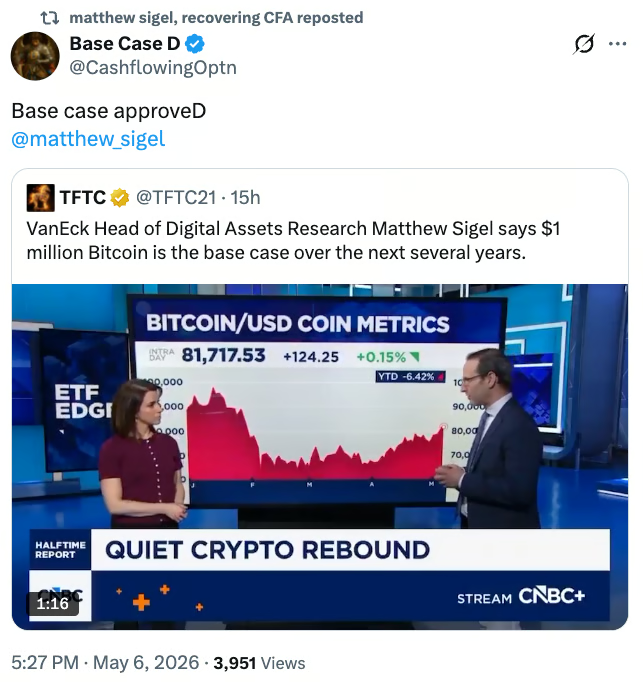
Matthew Sigel, head of digital assets research at investment manager VanEck, said he sees Bitcoin (BTC) reaching seven figures within the next five years.
“Bitcoin going up for us is the base case. We think this asset is going to reach a million dollars over the next several years,” Sigel said on CNBC’s Halftime Report on Wednesday.
Sigel later clarified that BTC is likely to reach that threshold in “half a decade,” comparing Bitcoin’s adoption to the video game industry’s, where usage has expanded across age groups after initially being limited to younger users.
“It’s going to be like the video game industry, where 30 years ago it was just kids playing video games, now Elon Musk plays video games,” he said.
Sigel’s latest projection aligns with VanEck’s base-case model, which estimates Bitcoin could reach $2.9 million by 2050, underscoring a longer-term bullish outlook despite periods of market volatility.
Bitcoin is a “mega trend,” but marked by volatility
Despite a highly bullish outlook, VanEck’s Sigel emphasized that Bitcoin is a “very cyclical asset,” saying its path toward $1 million would not be a steady upward move.
“There are no bailouts in Bitcoin, so it’s going to be cycles along the way,” Sigel said, hinting at the absence of a central authority to stabilize prices during market downturns.
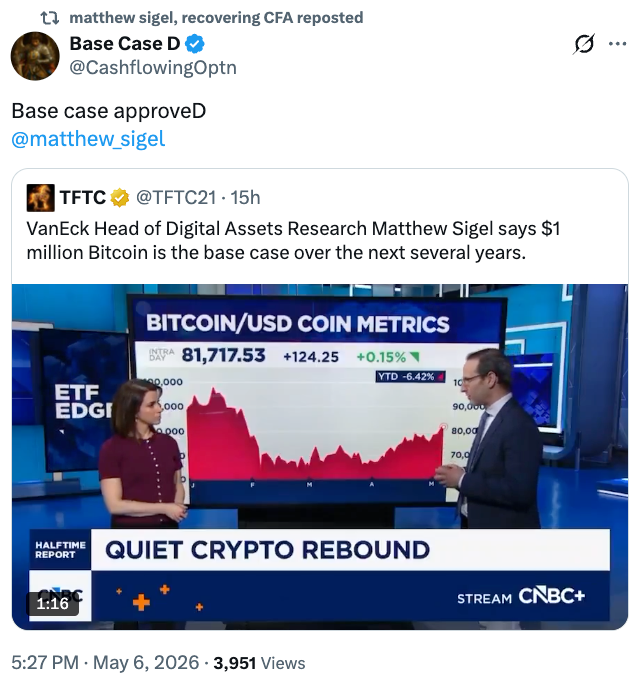
Source: Matthew Sigel
“We have the first central bank buying Bitcoin for its reserves, so this is a mega trend, but it will be very volatile along the way,” Sigel added.
Near-term market positioning is negative
Addressing Bitcoin’s near-term price action, Sigel pointed to the asset’s correlation with the Nasdaq reaching its highest level in five years, suggesting the current rally is largely driven by broader macroeconomic trends.
“What keeps us encouraged even at the current levels is that we’re not seeing the froth in the derivatives markets,” he said, adding that the move appears to be driven primarily by short covering, indicating that overall positioning remains relatively bearish.
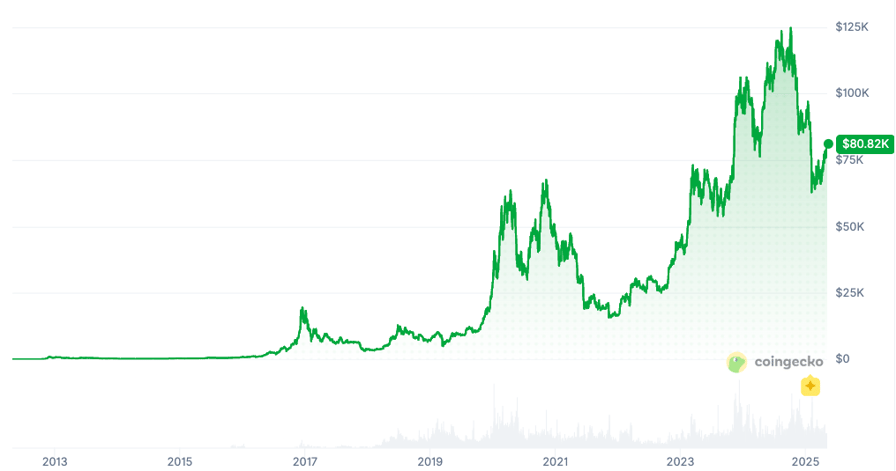
Bitcoin’s (BTC) all-time price chart. Source: CoinGecko
Sigel’s take joins several similar views on Bitcoin’s price trajectory in the coming years, including predictions from Bernstein, Bitwise chief investment officer Matt Hougan, Jan3 CEO Samson Mow and Twitter co-founder Jack Dorsey, among others.
Cathie Wood’s ARK Invest’s 2030 Bitcoin price targets range from about $300,000 in a bear case to $710,000 in a base case and $1.5 million in a bull case, according to its Big Ideas 2025 model.
Related: Bitmine’s Tom Lee says ‘crypto spring’ has already begun
Some investors are more skeptical about Bitcoin’s adoption, though. Ray Dalio has said Bitcoin could act as a store of value but questioned its ability to scale into a global reserve asset amid regulatory and sovereign currency risks. Others, including gold advocate Peter Schiff, have argued Bitcoin lacks intrinsic value and is unlikely to displace traditional safe-haven assets like gold, casting doubt on seven-figure price forecasts.
Magazine: Adam Back says current demand is ‘almost’ enough to send Bitcoin to $1M

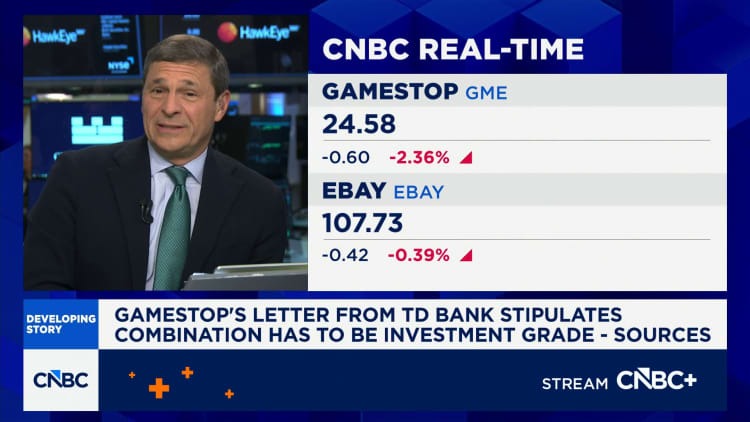

GameStop‘s mysterious financing letter underpinning its audacious $56 billion bid for eBay is emerging as a central issue in the proposed takeover, as questions mount over whether the deal is actually financeable.
The video game retailer said it has lined up a $20 billion financing commitment from TD Securities, part of TD Bank. But a key condition attached to this letter could ultimately make or break the deal: the combined company would need to maintain an investment-grade credit profile, CNBC’s David Faber reported, citing people who have seen the document.
Moody’s Ratings said Wednesday the proposed acquisition would be “credit negative” for eBay because of the substantial increase in leverage implied by the deal structure.
The ratings agency estimated leverage for the combined company could approach nine times debt to earnings before interest, taxes, depreciation and amortization before accounting for any cost-saving synergies.
That level of indebtedness would likely push the combined company below investment grade, potentially undermining a key condition attached to the TD financing package.
The proposed takeover has raised immediate questions about how GameStop could fund a deal of that size. The video game retailer’s market value of roughly $11 billion is only a fraction of the transaction’s implied value.
CEO Ryan Cohen offered limited clarity on the structure other than saying his company has the ability to issue additional stock in order to get the deal done.
EBay confirmed that it received the offer in a statement Monday, and said its board would review it.
Semafor reported on the mysterious letter Wednesday.


The deal is payable in cash and stock and values Payward at $20 billion.


Kalshi’s co-founder said the new capital will be used to accelerate that institutional adoption.
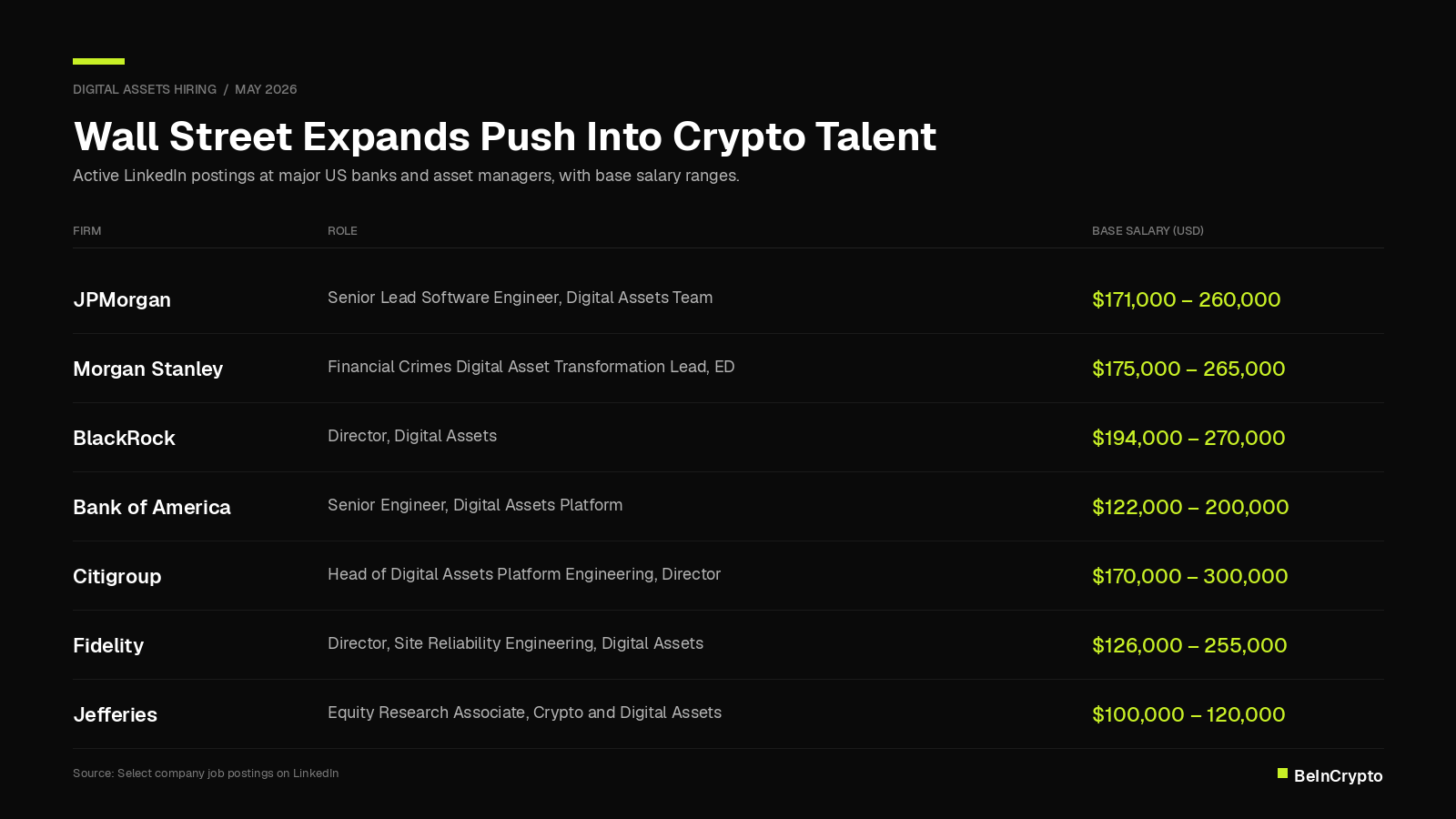
Wall Street firms have flooded LinkedIn with dozens of digital assets job postings, giving crypto professionals a TradFi escape hatch as native firms slash staff and the industry works through an extended downturn.
JPMorgan Chase, BlackRock, Citigroup, Morgan Stanley, Bank of America, Fidelity, and Jefferies have each opened senior crypto roles, with base salaries reaching $300,000 at the top end, according to a Bloomberg report published Thursday.
Wall Street’s Hybrid Talent Push
The catch for applicants is that pure crypto credentials no longer suffice. Banks and asset managers now want candidates who pair blockchain fluency with TradFi experience. The hybrid background covers compliance, risk, and regulated markets.

“It’s really about domain overlap,” Bloomberg reported, citing Paul Przybylski, JPMorgan Asset Management’s global head of product for digital and tokenized assets.
Follow us on X to get the latest news as it happens
Citigroup’s Head of Digital Assets Platform Engineering tops the table with a base of up to $300,000. Bank of America, Morgan Stanley, Fidelity, and Jefferies round out the board.
Their listings cover senior engineering, financial crimes transformation, site reliability, and crypto equity research roles.
A Bright Spot Against Crypto Layoffs
Bloomberg framed the hiring spree as a rare bright spot for an industry working through a protracted downturn. Coinbase Global has cut large portions of its workforce, and similar reductions have rolled across other crypto-native employers.
For workers leaving those firms, a stint at a regulated bank or asset manager has become a defensive résumé move. Total compensation packages at these firms include cash bonuses and equity grants. Combined, those layers often push roles well past their listed base ranges.
By contrast, crypto-native pay, often weighted with token allocations, has grown harder to value as token markets stay weak.
Wall Street’s cash-heavy structure now reads as a more predictable bet for senior engineers and product leaders.
“HELP WANTED: digital asset specialists at big boy financial cos. Must know crypto, blockchain, understand degens, but also have TradFi chops, fluent in Boomer-ese,” ETF analyst Eric Balchunas quipped.
The hiring board signals that institutional crypto integration is widening even as native firms retrench. Whether banks sustain the pace of postings over the coming weeks will determine the read.
A permanent digital assets bench-build looks different from a tactical talent grab.
The post TradFi Giants Offer Crypto Talent Stability and Prestige as Crypto Firms Cut Staff appeared first on BeInCrypto.
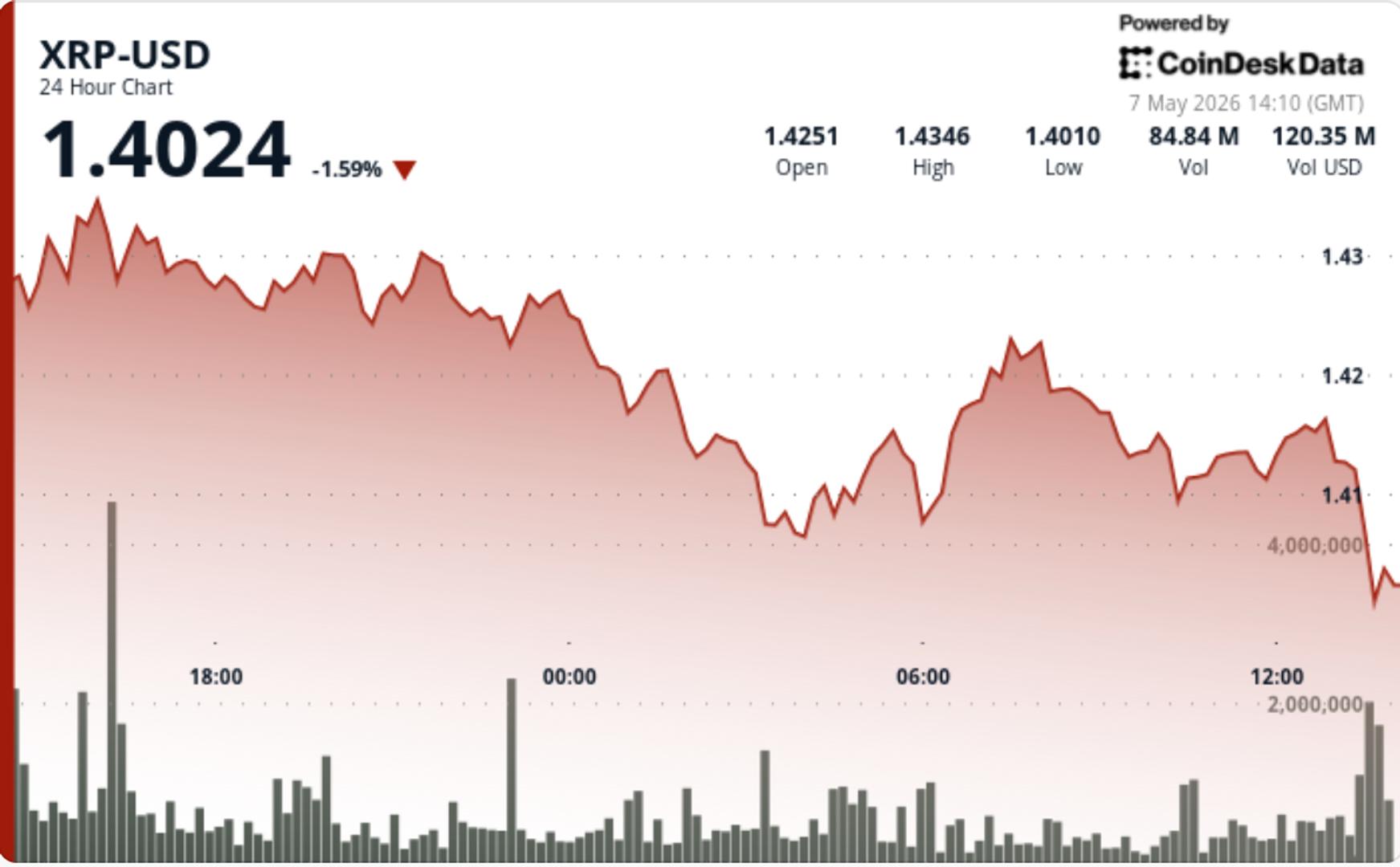
XRP gave back ground after failing to hold above $1.45, with the pullback coming even as Ripple pushed deeper into institutional finance through a cross-border tokenized Treasury settlement alongside JPMorgan and Mastercard. The move lower matters because XRP is now sitting back near the same breakout zone traders had been watching for confirmation only days earlier.
News Background
• Ripple, JPMorgan, Mastercard and Ondo Finance completed a near-real-time cross-border redemption of tokenized U.S. Treasuries on the XRP Ledger, with settlement finalized in under five seconds.
• The transaction routed through Mastercard’s Multi-Token Network before JPMorgan’s Kinexys platform delivered dollars to Ripple’s Singapore banking partner outside traditional banking hours.
• The pilot adds to growing institutional focus on tokenized finance infrastructure, with DTCC also preparing to launch its own tokenization platform later this year.
Price Action Summary
• XRP slipped from $1.4534 to $1.4137 over the 24-hour session, reversing after an earlier push toward $1.45.
• Heavy selling hit during the May 6 13:00 UTC session, when 131.28M in volume drove price through support at $1.4460.
• Price later stabilized around the $1.41 area after a sharp intraday recovery from session lows near $1.409.
Technical Analysis
• The rejection near $1.45 matters because that level has repeatedly capped upside attempts during the broader consolidation range.
• XRP is still holding above the broader $1.40 breakout zone, but momentum cooled sharply after the failed push higher.
• The market is now compressing between support near $1.41 and resistance between $1.45-$1.47, a range that increasingly looks unstable given thinning liquidity conditions.
• Analysts continue pointing to a larger bull flag structure on higher timeframes, though shorter-term charts still show distribution pressure on rallies.
What traders should watch
• $1.40-$1.41 is now the key support zone. Losing it would weaken the recent breakout structure.
• $1.45-$1.47 remains the level bulls need to reclaim to reopen momentum toward $1.60 and higher.
• Liquidity conditions remain thin, which raises the odds of sharper-than-normal moves once the range finally breaks.
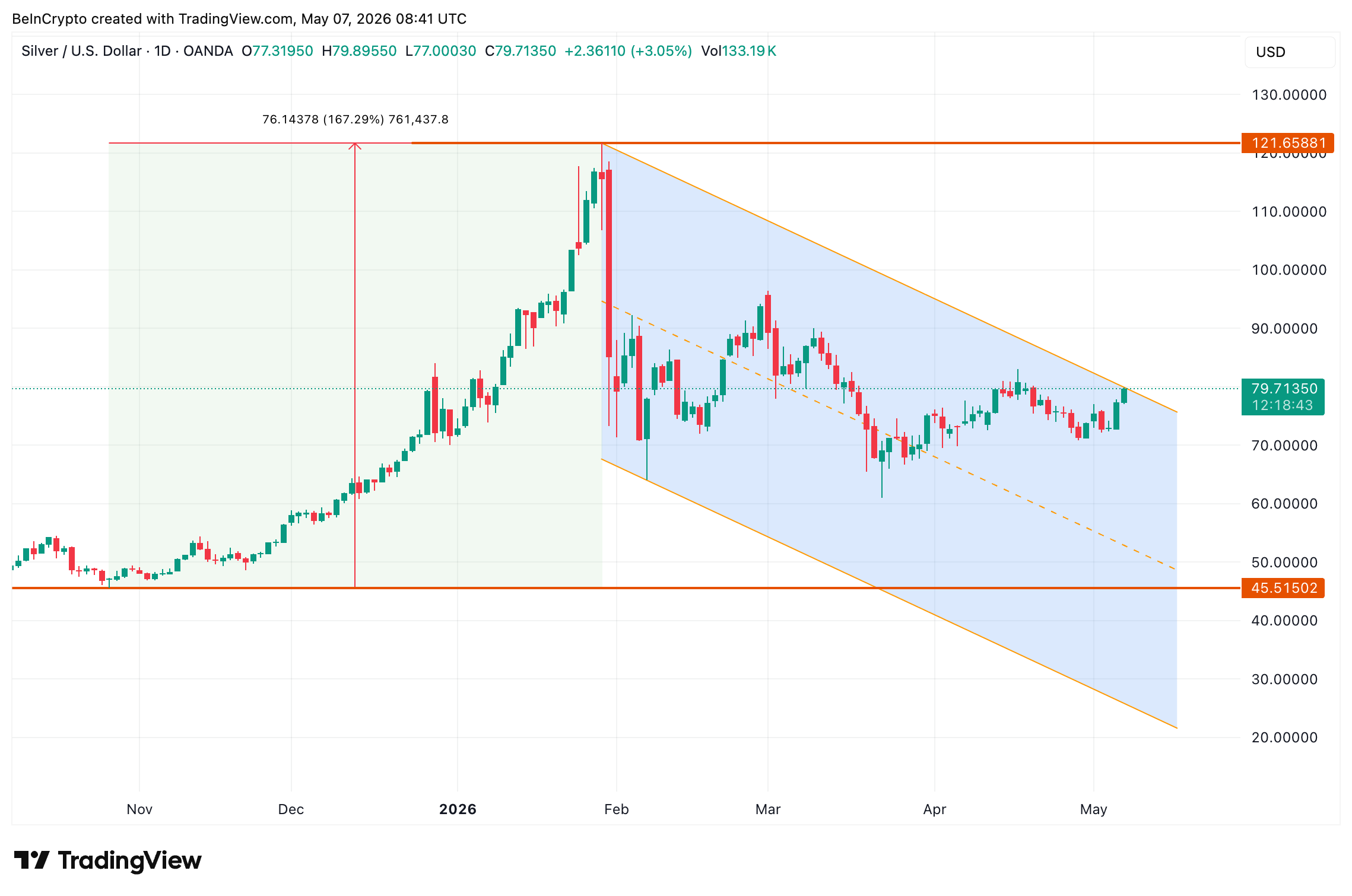
Silver (XAG/USD) trades near $79 after a 3% intraday jump cleared a multi-month resistance shelf, with the dollar simultaneously sliding inside its own falling channel.
The setup combines a structural pattern, an inverse macro driver weakening in lockstep, and a futures positioning read that hints at a quiet but persistent bullish lean. Whether silver can chase its $121.65 all-time high depends on which signal wins out.
Silver Builds Continuation Setup After 167% Surge
Silver surged 167% from its October 2025 low at $45 to an all-time high of $121 in late January. Since that peak, the metal has traded inside a falling channel, a structural pattern bounded by two parallel descending trendlines.
Want more insights like this? Sign up for Editor Harsh Notariya’s Daily Newsletter here.
Falling channels are not always bearish. When they form after an extended rally, they often resolve as continuation patterns. The structure marks a pause before the prior trend resumes.

Today’s session pushed silver about 3% higher to roughly $79. The move broke above a multi-month resistance shelf that had capped every prior rally attempt. The resistance shelf is revealed later in this piece. For now, the next hurdle would be the upper trendline of the channel. If that breaks, bullish continuation for Silver (XAG) can resume.
The breakout signal is technically clean, but a single-day move means little without macro support. The dollar’s path is the bigger driver.
Dollar Weakness Builds the Case for Higher Silver
The US Dollar Index (DXY) has been falling since early April. The index tracks the dollar against a basket of major currencies.
Silver and the dollar move inversely. A weaker dollar makes silver cheaper for foreign buyers and lifts emerging market demand. It also reduces the opportunity cost of holding a non-yielding asset.

The dollar’s slide has been reinforced by macro developments. On May 6, Brent and WTI crude oil prices dropped 7% to 8%. The selloff was driven by optimism around a US-Iran deal that could reopen the Strait of Hormuz.
A finalized agreement would reduce safe-haven dollar demand and accelerate DXY weakness. Also, if DXY weakens another 1.55%, the channel breakdown could help silver further.
Whether the dollar’s drop is being priced in, however, depends on positioning at the futures level.
COT Report Shows Cautious Deleveraging With Bullish Lean
The latest Commitments of Traders (COT) report from the Commodity Futures Trading Commission is dated April 28. It shows traders cutting silver exposure across the board.
Total open interest, the number of outstanding futures contracts, dropped by 14,187 to 101,275. Both longs and shorts were reduced, but shorts came off faster. Non-commercial speculators trimmed long positions by 1,919 contracts and short positions by 2,359 contracts. Shorts unwound roughly 23% faster than longs.

Net speculative positioning remains structurally long at a 4.4-to-1 long-to-short ratio (31,314 vs 7,154). Commercial hedgers stay heavily short at 69.2% of open interest. This is normal because they hedge physical inventory.
Traders are reducing risk, but the marginal flow is bullish. Shorts are exiting faster than longs. With the macro chain and positioning aligned, silver’s price ladder reveals the actual path to the all-time high.
Silver Price Levels: The Path Back to a $121 All-Time High
Silver just broke above $78, the 0.236 Fibonacci level. This level had been the multi-month resistance shelf.
A sustained reclaim opens $90 (0.382 Fibonacci), where the upper channel trendline breaks meaningfully. Above $90, the next test is $99 (0.5 Fibonacci). That marks a 24% climb from current price.
That $99 level is critical. Silver attempted multiple rallies after the late-January peak but failed to cross $99 on each attempt. Reclaiming it would mark the first decisive break of post-ATH structure.

Above $99, the path opens to $108 (0.618 Fib), $120 (0.786 Fib), and the all-time high at $121. That move represents a 53% climb from current price. However, this level surfacing in May depends on how the COT positioning and DXY move evolve through the month.
The downside ladder is narrower. Failure to hold $78 keeps silver in the channel. A slide toward $64 and $60, the channel’s lower band, becomes the next risk. A break below $60 would weaken the entire continuation thesis. For now, $99 separates a silver price run to $121 ATH from a slide to the $64.
The post Can Silver Reclaim Its $121 All-Time High Before May Ends? appeared first on BeInCrypto.
Strategy’s Q1 earnings call signaled a departure from Saylor’s “never sell” mantra, with Bitcoin slipping below $81,000 in the aftermath.
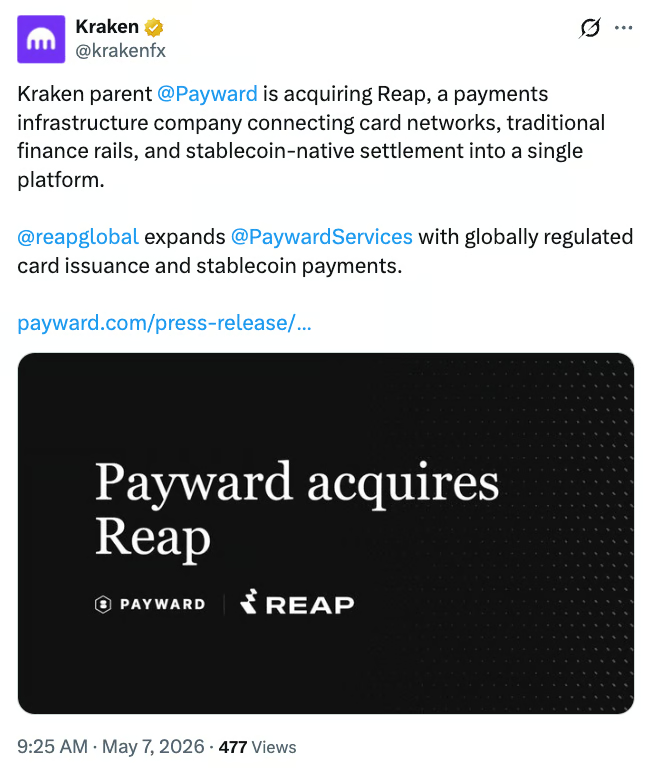
Kraken parent Payward agreed to acquire Hong Kong-based Reap Technologies for up to $600 million, expanding its push into stablecoin payments and business-to-business (B2B) financial infrastructure.
Payward has entered into a definitive agreement to acquire Reap for up to $600 million, the company announced Thursday. The deal is set to be paid in a mix of cash and Payward stock, in a transaction that values Payward’s equity at $20 billion. It would expand Payward Services, the company’s B2B infrastructure platform launched in March 2026.
The deal comes as crypto companies increasingly expand beyond trading services into payments infrastructure and stablecoin-related products as stablecoins gain traction among fintech firms and businesses.
In a statement on Thursday, Reap co-founders said the platform would continue operating as a standalone platform, adding that the transaction remains subject to customary regulatory approvals, expected to close in the second half of 2026.
Reap expands Payward Services into global cards and payments
Payward Services allows companies to integrate trading, payments, funding and digital asset services through one system.
The acquisition of Reap extends that platform into the global cards and payments space, allowing partners to embed card issuance, cross-border payments, and stablecoin treasury services alongside Payward’s existing capabilities.
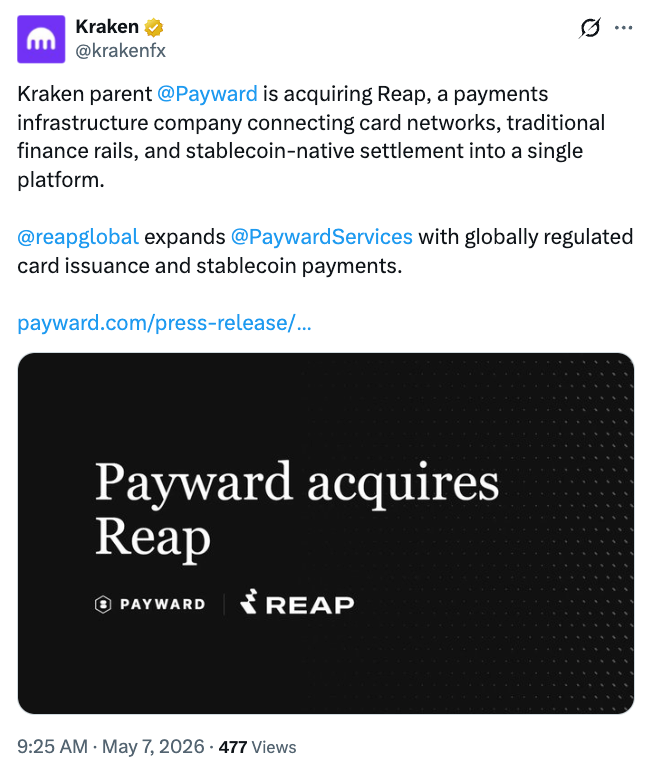
Source: Kraken
“Reap is the payments layer for what comes next. Card networks, banking rails, and blockchains on a single API, settling in stablecoins,” Payward and Kraken co-CEO Arjun Sethi said in the announcement.
Related: Kraken parent Payward closes Bitnomial deal to expand US crypto derivatives
The acquisition of Reap follows Payward’s acquisitions of Bitnomial exchange, futures broker NinjaTrader and xStocks issuer Backed, as the company continues expanding its platform through targeted acquisitions.
Reap deal deepens Asia push
Reap was founded in 2018 by Daren Guo, who previously worked for the Asia Pacific business at the payments firm Stripe, and former investment banker Kevin Kang, according to its website.
The company specializes in provisioning payment solutions to connect traditional financial systems with digital assets, aiming to enable cross-border money flows.
Sethi reportedly said that the deal marks Payward’s first infrastructure acquisition in Asia and one of its largest transactions to date.
“If you take Europe out, the fastest growing market is Asia, not just revenue but also asset-on-platform,” Sethi said, adding: “They have already done it in Asia. They can expand into the US overnight with us.”
Magazine: Guide to the top and emerging global crypto hubs: Mid-2026
The world’s largest corporate Bitcoin (BTC) holder, Strategy, yesterday released its Q1 2026 financial results, which show a net loss of $12.54 billion.
According to the report, this was mostly due to a $14.46 billion unrealized loss stemming from poor BTC prices during the first few months of 2026.
Losses Mount, But Accumulation Continues
Operating loss was $14.47 billion, compared with $ 5.92 billion in the prior year. Loss for the quarter attributable to common stockholders was $12.77 billion, or $38.25 per diluted share, whereas a year earlier, it was $4.23 billion.
However, if you strip out the Bitcoin accounting, the underlying software business held relatively steady, with total revenues growing 11.9% year-over-year to $124.3 million, while gross profit came in at $83.4 million.
Furthermore, the company’s actual BTC position kept growing through the quarter. Strategy bought 89,599 BTC in Q1, bringing its total holdings to 818,334 BTC, which is a 22% increase year to date.
The company has raised nearly $12 billion in capital markets activity so far in 2026, including $7.37 billion in Q1 alone through its at-the-market offering program spanning MSTR shares and its preferred stock instruments.
The preferred equity side of the business was a particular focus on the call. STRC, Strategy’s variable-rate preferred stock, has now scaled to $8.5 billion in notional value in just nine months, which the company described as the largest preferred stock by market cap in the world.
According to CFO Andrew Kang, the cumulative dividends declared and paid across all instruments have now crossed $693 million across 23 consecutive distributions.
The Bitcoin Sale Question
One of the biggest takeaways from the earnings call was Executive Chairman Michael Saylor’s suggestion that Strategy could sell some of its BTC stash to cover dividend obligations.
“We will probably sell some Bitcoin to pay a dividend just to inoculate the market and send the message that we did it,” he said.
The statement was notable because Saylor has spent years evangelizing BTC as an asset you never sell, and analyst Jeff Park, who participated in the call, flagged the comment as more material than the company’s previous discussions on the subject.
Park also pointed out that Strategy’s exposure to US interest rates is becoming more relevant given STRC’s nature as a floating instrument, especially when you consider the approaching tenure of Kevin Warsh as Federal Reserve chair and the prospect of rate cuts on the table.
A couple of weeks ago, Bitcoin skeptic Peter Schiff held a live X Space, where he called STRC “an obvious Ponzi scheme” and argued that the company had no meaningful income outside its software division and therefore funds dividend payouts by continuously issuing new STRC shares.
Strategy has pushed back on that characterization, pointing to its BTC holdings as a balance sheet backstop.
MSTR shares closed at around $187, down roughly 3.5% in after-hours trading following the earnings release. STRC, meanwhile, is trading just below $100 with an effective annualized yield of 11.5%, with Bitcoin itself holding at around $81,000 at the time of writing.
The post Strategy Posts $12.5B Q1 Loss as BTC Prices Weigh on Results appeared first on CryptoPotato.
In today’s newsletter, Andy Baehr from GSR examines how, beneath the stalled market, advisors are quietly building durable crypto allocations, moving beyond BTC and gaining more comfort in this asset class.
Then, in “Ask an Expert,” Patrick Velleman of Valdora offers commentary on how financial advisors can navigate the growing trend of durable crypto allocations.
Summer is coming. Build your core.
Crypto markets feel low-energy and ambivalent. But, beneath the surface, investors are searching for the right long-term home in crypto. It’s time to position for the next change of the season.
The question finds every crypto person, eventually. A friend, a relative, a client asks: ”I want to add some crypto. What should I actually own?”
Before answering, let’s be honest about the current environment.
Rallies with no booster rocket
The good news: crypto prices are drifting higher. The less-good news: they’re only drifting. Bitcoin has moved from the mid-$60,000s to the high $70,000s, ether (ETH) from around $1,800 toward $2,300, and Solana (SOL) in the mid-$80s. Movement without momentum. Progress without pulse — and more than a few sad-trombone rallies that faded before they could build on themselves.
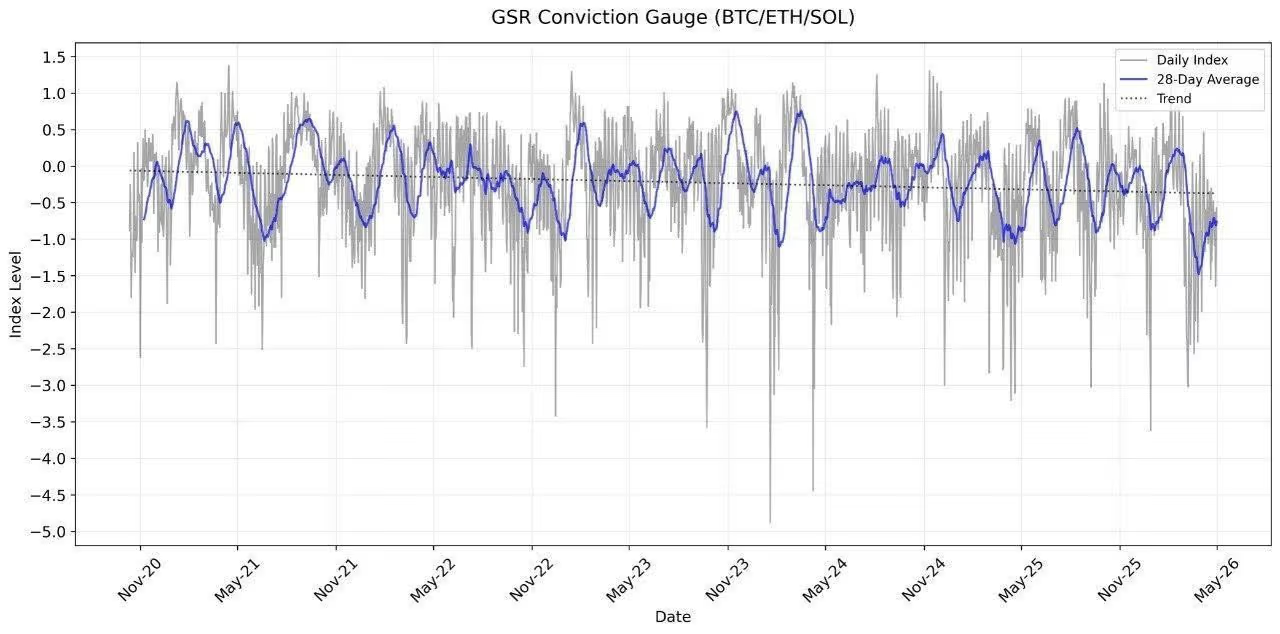
The feeling of … ambivalence ... was so palpable, we developed a Conviction/Ambivalence gauge. In Q1 2026, we hit maximum ambivalence. Other signals point the same way. Funding rates on perpetual futures, a clean read on leveraged appetite, have been persistently low or negative. DeFi borrow rates on Aave drifted toward 3% ahead of a recent exploit, versus 20%+ in the weeks after the 2024 election and 5–7% in more typical conditions. The fast money is elsewhere: oil, equities, prediction markets. Volatility is both a magnet and a product of hot markets, and right now, crypto has a shortage of both.

The Conviction Gauge measures an average ratio of weekly returns to daily returns. Source: GSR
That stands in stark contrast to last year’s Q2 and Q3 rally, which had velocity, power, and breadth. ETH led. SOL pushed hard in August and September. The GENIUS Act added fuel. That was a market with real conviction.
The slower shift that matters more
And yet beneath the surface, something more durable is happening: longer-term investors and their advisors are quietly getting more comfortable allocating to crypto. That shift doesn’t flood X the way a funding rate spike does. Nobody is posting charts about advisors quietly building allocations, but it’s the iceberg that matters. Over time, the effects will be felt, and they will be durable.
And for those allocators, BTC alone is no longer the answer. Its role has been clarified as the macro asset, something that may even behave defensively when markets contract. But advisors are being asked to go further. Clients want exposure to the blockchain growth story: tokenization, stablecoins, the layer-one infrastructure that’s now top-of-fold business news.
So what should the core actually be?
Our answer is straightforward: BTC, ETH and SOL. The power trio. The cycle survivors. Two distinct themes across three assets: BTC as the major macro asset, with ETH and SOL as the layer-ones on which blockchain’s growth story settles. Neck and neck, genuinely competing and we believe, likely to both win.
A solid core holding though, should do more than just sit there. Proof-of-stake assets like ETH and SOL can generate yield through staking, a return stream that passive holders often leave on the table. And you want a product that tilts toward the market: one that reads different environments and adjusts weights to seek excess return, rather than holding fixed weights through every regime.
That’s a lot to ask. So we launched an ETF to make it easy.
The GSR Crypto Core3 ETF (BESO) packages the core BTC, ETH and SOL, with staking rewards on ETH and SOL, and active, research-driven weekly rebalancing. Over time, investors will seek satellite holdings — sectors, themes and factors. But Core3 is designed to do the first job well: core crypto market beta, with staking and active management built in.
– Andy Baehr, managing director, Asset Management at GSR *
Ask an Expert
Q. How is digital asset investing and trading different from traditional assets?
The biggest practical difference is that everything happens on the blockchain. Holdings, transactions, strategies, even the behaviour of a protocol over time, all of it is visible. Anyone with a wallet address and a block explorer can see what you own and what you have done. That is a level of transparency traditional markets simply do not offer. This changes the information environment clients/users are operating in.
The second difference is that price discovery runs 24/7, which means volatility never takes a break either. Then there is self-custody. In traditional finance, custody is someone else’s problem and quite often insured. In digital assets, it’s going to be your problem whether you want it or not. That is empowering, because you genuinely own the asset and no intermediary can gate your access to it. It is also more dangerous because the responsibility for keys, backup and operational security falls on the holder. A lost phrase is a permanent loss and it’s one of the reasons people like CZ (Changpeng Zhao, former CEO of Binance) vouch for storing assets on centralized exchanges.
For advisors this means the conversation with clients is broader than allocation because it also covers custody setup, key management and operational risk in a way it never has before.
Q. How do vaults and onchain finance change the investing vs trading debate?
It is no longer a question of invest versus trade, what I see the market actually debating is which yields are real and which are not. After a few cycles of degen farming, triple-digit APYs and protocols that collapsed, most serious participants have moved on from the question of “how much can I earn” to “how durable is this.”
This is why vaults have been increasing in popularity. A well-designed vault lets capital stay in the market with less manual rotation. So if you deposit into a strategy, and the strategy runs, there is less movement, less clicking, less emotional decision-making. For someone who does not want to trade, that is a clear improvement over what was previously available on-chain, which was mostly either passive holding or active yield farming.
The other important piece is liquidity. A lot of traditional yield products lock your capital up. Private credit funds for example, have redemption windows that run anywhere from a week to a quarter. A vault that issues a liquid token against your deposit gives you something different. Your capital is earning, but you can still move if you need to. That is a real change in how long-term allocations can be structured.
The path this sets up is yield that is perhaps a bit more boring than what crypto has historically offered, but more sustainable. But at least boring doesn’t get you REKT.
Q. As automated vaults handle the technical ‘trading’ (rebalancing, compounding, liquidating), does an advisor’s value-add shift from ‘picking winners’ to ‘curating risk profiles’?
Yes, and a good one at that.
When the mechanics of a strategy are handled by a smart contract, the execution work is no longer where the advisor adds value. Rebalancing happens automatically and compounding happens automatically. Liquidation triggers run on their own logic where none of it needs a human in the loop.
What it does need is a human in the loop as the judgment layer on top. Someone has to look at what is actually available in the market, vet it and decide what is worth putting client capital into. That is more of a due diligence question. Who built this vault? What is the strategy doing underneath? What are the custody arrangements? How has it performed in stress? Is the team credible? Is the audit credible? What happens if a dependency breaks?
You then take the risk appetite of the client and adapt it to the risks the available vaults actually carry. A conservative client might want a tokenized Treasury vault and a stablecoin yield vault. A more adventurous client might accept a DeFi yield vault or an FX strategy vault. Curating risk is human in the loop work.
– Patrick Velleman, chief marketing officer, Valdora CMO
Keep Reading
* Risk Disclosure
Investors should consider the investment objectives, risks, charges and expenses carefully before investing. For a prospectus or summary prospectus with this and other information about the Fund, please call 888-999-5958 or visit our website at gsretps.io/etf/beso. Read the prospectus or summary prospectus carefully before investing.Investments involve risk. Principal loss is possible.
Crypto Currency Risk (Bitcoin (“BTC”), Ether (“ETH”), and Solana (“SOL”) (together, the “Reference Assets”)). The Reference Assets are relatively new innovations and are subject to unique and substantial risks. Crypto currencies are a subset of digital assets, representing blockchain-based tokens that function primarily as mediums of exchange, stores of value, or units of account, whereas digital assets more broadly include any electronically represented asset with economic value, such as tokens, stablecoins, and other distributed-ledger-based instruments.Digital Assets/Cryptocurrency Market Volatility Risk. The prices of the Reference Assets have historically been highly volatile. The value of the Fund’s exposure to the Reference Assets—and therefore the value of an investment in the Fund—could decline significantly and without warning, including to zero.
Market Beta Risk. The Fund seeks to provide core exposure to the cryptocurrency market (‘market beta’) through allocations to BTC, ETH, and SOL. As a result, the Fund’s performance may be significantly influenced by overall digital asset market movements, and the Fund may decline in value when the broader cryptocurrency market declines. The cryptocurrency market is highly volatile and subject to rapid changes.Staking and Validator Risk. When the Fund stakes Reference Assets that utilize proof-of-stake consensus (currently, Ethereum and Solana), the assets are subject to risks attendant to staking generally, such as illiquidity, reliance on third-party service providers, slashing, missed rewards, validator problems, and errors. Staking is the process of putting digital assets to work on a blockchain network to receive rewards and enhance protocol security. By helping the blockchain run more smoothly and securely, rewards are earned in the native blockchain token. Potential staking rewards are earned by the Trust and not issued directly to investors. Liquidity Risk. Unbonding periods for staked Reference Assets may range from several days to several weeks depending on network conditions. Concentration Risk. The Fund’s assets will be concentrated in the sector or sectors or industry or group of industries that are assigned to the Reference Assets, which will subject the Fund to the risk that economic, political or other conditions that have a negative effect on those sectors and/or industries may negatively impact the Fund to a greater extent than if the Fund’s assets were invested in a wider variety of sectors or industries. Foreign Securities Risk. To the extent the Fund invests in foreign securities they may be subject to additional risks not typically associated with investments in domestic securities.Indirect Investment Risk. None of the Reference ETFs or the Reference Assets are affiliated with the Trust, the Adviser, or any affiliates thereof and is not involved with this offering in any way, and has no obligation to consider the Fund in taking any corporate actions that might affect the value of the Fund.New Fund Risk. The Fund is a recently organized management investment company with no operating history. As a result, prospective investors do not have a track record or history on which to base their investment decisions.Non-Diversification Risk. Because the Fund is non-diversified, it may invest a greater percentage of its assets in the securities of a single issuer or a smaller number of issuers than if it was a diversified fund.
Foreside Fund Services, LLC (the “Distributor”)

What Employers Really Want from Designers in 2026

Ryan Cohen’s mysterious bank letter backing his eBay bid reveals a big issue

Starmer Pleads For ‘Total Transparency’ From Civil Servants

Manchester United reach agreement with Casemiro over contract clause amid transfer speculation

US brings back mandatory military draft registration

Steven Gerrard disagrees with Gary Neville over ‘shock’ Chelsea and Arsenal claim | Football


-

 NewsBeat4 days ago
Channel 5 – All Creatures Great and Small series 7 new post
-

 Crypto World7 hours ago
Upbit adds B3 Korean won pair as Base token gains Korea access
-
 Tech6 days ago
Trump’s 25% EU auto tariff breaches Turnberry Agreement that also covers semiconductors and digital trade
-
 NewsBeat9 hours ago
NCP car park operator enters administration putting 340 UK sites at risk of closure
-
 Sports6 days ago
Paul Scholes issues Marcus Rashford reality check as agreement emerges over Man United star
-

 Entertainment6 days ago
Met Gala 2026 Rumored Guest List Is Turning Heads
-

 Business6 days ago
Strait of Hormuz Blockade Persists Amid US-Iran Standoff, Sending Oil Prices Soaring
-
Entertainment6 days ago
New on Prime Video in May 2026 — Full List of Movies and Shows
-

 Sports6 days ago
Cavaliers vs. Raptors Game 6 live score, updates, highlights from 2026 NBA playoffs first-round series
-

 Entertainment6 days ago
Kylie Jenner Hit With Second Lawsuit From Ex-Housekeeper
-
 Sports6 days ago
David Benavidez responds to team Canelo saying the fight will never happen
-
Entertainment5 days ago
New Netflix Movies in May 2026 — My Top 3 Picks to Stream
-

 Tech6 days ago
Meta ends Sama contract after Kenyan workers report seeing intimate footage from Ray-Ban smart glasses users
-

 Entertainment6 days ago
Young and the Restless Next Week: Cane Arrested & Matt’s Deadly New Scheme!
-
 Sports6 days ago
IPL 2026: ‘Love you darling’- Hardik Pandya’s reaction to MS Dhoni steals the show |Watch | Cricket News
-

 Business4 days ago
Luka Doncic Injury Update: Doncic’s Hamstring Recovery Slows Lakers’ Hopes Against Thunder: Can He Run Yet?
-
 Crypto World5 days ago
Pi Network Mandates Protocol 23 Upgrade for All Mainnet Nodes Before May 15 Deadline
-

 Entertainment5 days ago
Melissa Joan Hart and More Stars Attend 2026 Kentucky Derby
-

 Sports6 days ago
Bayern won’t hand bottom side Heidenheim ‘gifts’ despite PSG game
-

 Sports6 days ago
What Preity Zinta Said After Punjab Kings’ First Defeat Of IPL 2026
You must be logged in to post a comment Login