
Crypto World
VARA and Securitize to Expand Tokenization Innovation in Dubai via MoU


Dubai’s regulator VARA (Virtual Assets Regulatory Authority) has signed a Memorandum of Understanding (MoU) with Securitize, a tokenization platform backed by BlackRock, in a move aimed at accelerating regulated tokenization activity in the United Arab Emirates.
According to a Thursday announcement shared with Cointelegraph, the MoU sets out a collaboration framework designed to support tokenization and digital asset infrastructure in Dubai, encourage institutional participation, and help shape how tokenized financial products can operate within the emirate’s regulatory environment.
Key takeaways
- VARA and Securitize have agreed to work together on a regulatory-and-industry collaboration framework for tokenization in Dubai.
- The MoU is positioned as a broad cooperation model rather than the announcement of a specific tokenized product or technology stack.
- Dubai continues to position tokenization as regulated financial infrastructure, with VARA pointing to its regulatory “perspective” as a key contribution.
- Demand for tokenized real-world assets (RWAs) has increased sharply in recent weeks, with RWA.xyz reporting rising holder counts and total tokenized asset value.
- Dubai’s efforts arrive as other market operators—such as the London Stock Exchange’s reported partnership with Kraken—push tokenized securities toward more established trading schedules.
VARA and Securitize target regulated tokenization in Dubai
Under the MoU, VARA and Securitize said they aim to support regulated tokenization initiatives across Dubai and the broader UAE. The agreement is also intended to cover tokenization projects initiated by VARA, with a specific focus on understanding how tokenized financial products should function inside Dubai’s existing regulatory framework.
When asked by Cointelegraph about the MoU’s infrastructure objectives, a VARA spokesperson said the effort is meant to establish a collaboration structure between the two organizations rather than to deliver a particular technical implementation or a named product.
“The intention is to combine VARA’s regulatory perspective with Securitize’s experience in institutional tokenisation to identify where collaboration can help support the development of trusted, regulated tokenised markets in Dubai.”
The spokesperson added that no concrete projects will be announced “at this stage.” Still, the agreement creates a formal channel for cooperation that VARA said is intended to “support relevant tokenisation initiatives in Dubai.”
Tokenization shifts from concept to “mainstream” infrastructure
Dubai’s push for tokenization is being framed not as an experimental niche, but as a step toward more conventional financial-market infrastructure. Carlos Domingo, co-founder and CEO of Securitize, described Dubai as among the most “forward-looking jurisdictions” for digital asset innovation and emphasized the importance of regulatory collaboration as tokenization matures.
Domingo’s remarks reflected a broader industry narrative: tokenization is increasingly discussed as a pathway for traditional finance to gain on-chain settlement and programmable workflows, but only if regulators can provide clear operating boundaries.
That theme is reinforced by VARA’s licensing activity. Earlier in July, VARA granted its 50th virtual asset service provider (VASP) license to Tribe Tokenisation FZE—an example of how the regulator has been expanding the number of licensed participants in the ecosystem. While the MoU with Securitize does not announce specific licensed activity, it suggests that regulators are looking to institutional-grade platforms as partners in building “trusted” markets.
Rising RWA adoption meets institutional platform scale
Beyond Dubai-specific policy developments, the MoU arrives amid a broader acceleration in tokenized real-world assets. Data provider RWA.xyz reports that the total number of RWA token holders rose 103% over the prior 30 days to 3.2 million. Over the same period, it said the total value of tokenized assets increased by 2% to $38.5 billion.
Those figures help explain why institutional platforms are increasingly positioning tokenization as a serious revenue and infrastructure layer rather than a purely experimental technology. Securitize is described in the announcement as the world’s largest tokenization platform by tokenized assets under management (AUM), with $4.9 billion. Ondo Finance is reported as second, with $3.5 billion.
For investors and market participants, the practical implication is that regulatory discussions are increasingly happening alongside measurable growth in both participation and capital in tokenized asset categories—particularly RWAs, where compliance and asset governance are central concerns.
Dubai’s move mirrors broader tokenized securities momentum
Dubai’s MoU also lands as tokenization continues to spread across market structures in other jurisdictions. Days earlier, Cointelegraph reported that the London Stock Exchange reportedly partnered with crypto exchange Kraken to launch tokenized stock trading on the operator’s night-time trading venue, aiming to offer 24/5 trading.
While the Dubai agreement is focused on regulated tokenization infrastructure and the operation of tokenized financial products under VARA’s oversight, the parallel is clear: both developments signal that tokenization is moving from issuance and experimentation toward distribution and market access—where regulatory fit, liquidity, and operational reliability become decisive.
As VARA and Securitize begin working under the MoU framework, the key next question for participants will be whether the collaboration produces specific pilot programs or licensing pathways—and how Dubai’s regulatory approach will translate tokenization activity into durable market infrastructure as demand for RWAs continues to grow.



Binance has denied that a system or pricing failure caused more than $5 million in alleged trader losses as the AKEUSDT perpetual contract surged from about $0.0076 to nearly $0.045 on Sept. 3.
Summary
- A trader claims that more than 30 funding-rate arbitrage positions lost over 5 million USDT.
- Binance says its pricing and liquidation systems operated normally during the AKE surge.
- The exchange uses external spot-market data because it does not list AKE for spot trading.
- The trader has requested transaction records, liquidation details and Binance’s risk-control logs.
Binance says AKE liquidations followed market volatility
X user xunlu alleged that more than 30 funding-rate arbitrage positions on Binance were liquidated within minutes at around 5:44 a.m. UTC+8 on Sept. 3.
The trader estimated the losses at more than 5 million USDT and alleged that the sudden move resulted from coordinated activity in the AKE market rather than ordinary trading.
Responding to the complaint, Binance Customer Support said AKE recorded large price swings across several exchanges and on-chain markets during the same period. The exchange attributed the liquidations to market conditions and rejected the claim that a technical problem on its platform caused the losses.
Binance also said an internal review found no fault in its pricing model, risk controls or liquidation engine. According to the exchange, its systems remained operational while the contract moved sharply, leaving leveraged positions exposed to an adverse price change.
The distinction matters because a liquidation can occur even when an exchange has not experienced an outage. Once the value of a trader’s collateral falls below the maintenance margin required for a position, the platform can close the trade automatically to prevent the account from building a larger deficit.
An August guide to margin calls published by crypto.news explained that automated crypto liquidations can move from a warning to forced closure within minutes. Unlike traditional markets, crypto derivatives trade around the clock, leaving traders with little time to add collateral during a fast price move.
AKEUSDT mark price relies on external spot markets
Binance does not offer AKE through its spot market, meaning the AKEUSDT perpetual contract cannot use an AKE price formed on Binance’s own spot order book. The exchange said it instead calculates the contract’s mark price from data gathered across several external spot venues.
A multi-market index is designed to reduce the effect of an abnormal print or short-lived price gap on a single exchange. Binance maintained that the index and mark-price process functioned as intended during the Sept. 3 volatility.
Perpetual futures do not represent ownership of the underlying token. Traders post collateral and take long or short exposure to a contract whose value tracks the asset, while recurring funding payments help keep the contract close to spot prices.
As a perpetual futures explainer noted in June, the mark price, rather than the last traded contract price, commonly determines when a leveraged position is liquidated. Exchanges generally calculate that mark from an index and a funding-related adjustment to limit liquidations caused by brief movements in the futures order book.
For AKEUSDT, the absence of a Binance spot pair makes the composition and behavior of the external index central to the disagreement. The trader has asked Binance to disclose the relevant trading records, liquidation data, and risk-control logs so the calculation can be examined.
Publicly available aggregated spot charts showed heavy volatility during the session. However, the highest combined spot reading was below the contract peak cited by the trader. The report said the gap could have resulted from price differences between the futures contract, external spot venues, or the index used to produce the mark price, but it did not establish which factor accounted for the difference.
Trader alleges AKE short squeeze hit arbitrage positions
The complainant described the affected trades as funding-rate arbitrage positions, a strategy that usually seeks to earn payments created by differences in perpetual-market positioning rather than profit from a token’s direction.
Funding-rate arbitrage commonly combines offsetting positions to reduce directional exposure. One version pairs a spot purchase with a short perpetual contract, allowing the trader to collect funding when short holders receive payments from longs. Other structures may spread positions across several exchanges or contracts.
Although such trades are often called market-neutral, they still carry execution, liquidity, collateral and exchange risks. A cash-and-carry guide published in August noted that an arbitrage position can face a margin call when its leveraged leg moves sharply, even if the combined trade is intended to limit exposure to price direction.
AKE’s reported rise from about $0.0076 to nearly $0.045 would amount to an increase of roughly 492%, or almost six times the starting price. A move of that size can rapidly reduce the margin supporting short futures positions, particularly when liquidity is thin and several trades share the same exposure.
The trader characterized the episode as a short squeeze, in which rising prices force short sellers to close their positions by buying back contracts. Such forced purchases can add to upward pressure and trigger further liquidations when nearby short positions breach their maintenance requirements.
During an unrelated market event in August, a $3 billion squeeze liquidated about $2.77 billion in short positions across major exchanges. Binance accounted for approximately $518 million of the total, while forced purchases pushed prices higher and activated more liquidations. The figures show how automated closures can accelerate an existing move, though they do not establish whether manipulation occurred in AKE.
Binance has attributed the Sept. 3 liquidations to the risks attached to leveraged trading and has not accepted the trader’s claim of coordinated market manipulation. No market regulator or independent investigator has publicly reached a finding on the allegation.
U.S. traders face a different perpetual futures market
For U.S. readers, the AKE dispute concerns an offshore Binance product that is not offered through Binance.US. American access to crypto derivatives remains subject to Commodity Futures Trading Commission rules, while offshore perpetual contracts have historically offered assets and leverage levels unavailable on regulated U.S. platforms.
Regulated perpetual futures began entering the U.S. market in 2026. The CFTC approved a Bitcoin perpetual contract from Kalshi in May, followed by contracts tied to other digital assets, while Coinbase secured another regulated path for domestic perpetual products.
U.S. platforms operate under different product approvals, leverage limits, and market-surveillance requirements. CME Group has challenged the CFTC’s treatment of perpetual futures, arguing that the products should fall under swap rules in the Dodd-Frank Act rather than be regulated as standard futures contracts.
In his complaint, the AKE trader also referred to an earlier TUT liquidation incident and said competing exchanges compensated some affected users. Binance has not agreed that the two events are comparable, maintaining that the AKE positions were closed because of market risk rather than an exchange pricing mistake.
Binance had acknowledged the complaint but had not announced compensation. The trader has requested the full transaction history, liquidation records, and risk-control logs related to the Sept. 3 session.

ChatGPT outage reports jumped from 5,000 to more than 22,000 in 10 minutes on Thursday morning. Claude, Grok and coding tool Cursor were already broken.
Three rival labs failed inside roughly 90 minutes, and no cloud provider declared a fault. Cardano founder Charles Hoskinson says it looked like a nation state, naming Gemini as the only exception as it uses its own TPUs.
How the AI Outage Happened
Grok and Claude users began reporting errors near 9 a.m. Eastern Time (ET). ChatGPT complaints spiked 90 minutes later, Downdetector data showed.
OpenAI was the only lab to confirm anything, logging elevated errors across ChatGPT and Codex, its coding agent.
Anthropic users hit a capacity wall instead.
“Due to unexpected capacity constraints, Claude is unable to respond to your message. Try again soon,” read Claude in-app error message.
xAI declared no incident, yet Grok told users its model was unavailable.

Follow us on X to get the latest news as it happens
Charles Hoskinson Floats a Nation-State Theory
The Cardano executive, who also co-founded Ethereum, says it looks like a nation state hit the three AI models at once, citing their reliance on Nvidia.
“It looks like a national state brought down Claude, ChatGPT, and Grok” Hoskinson wrote.
This means he thinks a government, not a hacker or a technical glitch, deliberately knocked the three chatbots offline.
Google logged no Gemini incident, yet users filed hundreds of reports and it flagged a fault serving new API keys. A shared chip supplier is not a shared failure path. Nvidia hardware in different buildings does not fail together.
The damage was uneven, with Claude and Grok peaking near 1,500 reports each while ChatGPT cleared 35,000.
No lab has reported an attack, but OpenAI listed 19 affected components and Anthropic blamed its Opus models.
The incident has turned it into a case for decentralized AI, one plugging Midnight, the privacy sidechain from Hoskinson’s Cardano ecosystem.
Shared Compute Draws Scrutiny
Attention turned to one building in Memphis. SpaceX merged with xAI in February, then rented Anthropic the full Colossus 1 compute capacity, built for Grok.
Anthropic draws over 300 megawatts across 220,000 Nvidia chips there, just under half of xAI’s roughly 500,000-GPU fleet.
Two of Thursday’s casualties sit on the same racks. However, neither firm has linked that to the failures.
“Grok, Claude, and ChatGPT all utilize significant portions of Colossus 1 in Memphis. That is the likely source of the outage… The question is whether it was accidental or sabotage,” one user posed.
A Cloudflare outage hit crypto platforms last November, with two AWS failures knocking services offline weeks earlier.
Anthropic went dark alone in a similar outage in March.
Concentration stays cheap until everything stops at once.
The outage comes as multiple AI models debut within days of each other.
The post Charles Hoskinson Has a Theory for AI Outage Affecting ChatGPT, Claude and Grok appeared first on BeInCrypto.
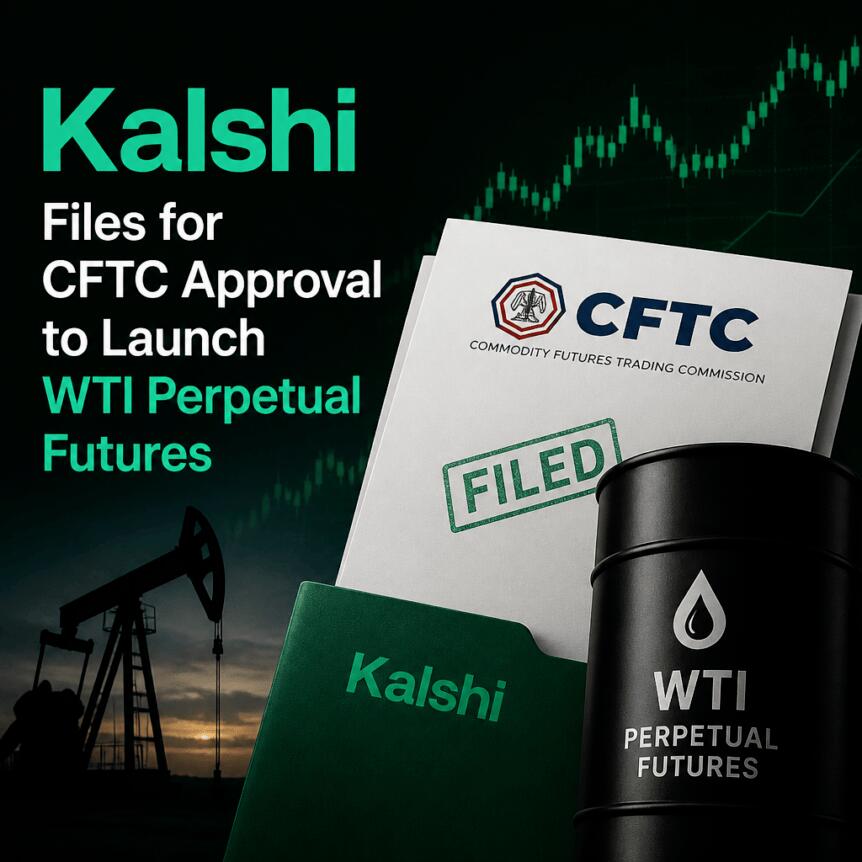
Prediction-market operator Kalshi is reportedly preparing to file with the US Commodity Futures Trading Commission (CFTC) for a new kind of energy derivative: a West Texas Intermediate (WTI) crude oil perpetual futures contract that would never expire. Bloomberg reports the filing could be made as soon as next week, while Reuters adds that the product would be available 24 hours a day, five days a week.
If regulators approve it, the contract would represent the first oil-linked perpetual futures offering to trade on a regulated US venue—an important test case for how the CFTC handles perpetual structures in markets traditionally built around fixed expiration dates.
Key takeaways
- Kalshi is reportedly seeking CFTC approval for a WTI crude oil perpetual futures contract with no expiration date.
- Bloomberg reports the CFTC filing could happen as soon as next week; Reuters says trading would run 24/5.
- The approval would mark the first oil-linked perpetual futures product to trade on a regulated US platform.
- The proposal arrives as the CFTC evaluates 24/7 trading expansion and whether perpetual contracts can be structured around physically delivered or storable energy commodities.
- Kalshi is also facing an ongoing jurisdictional fight over event contracts in state courts, creating additional regulatory friction beyond derivatives design.
A perpetual structure meets an oil market built on expiry dates
Perpetual futures—often called “perps”—differ from standard futures in that they do not have a set settlement or expiration date. In practice, this means traders can hold positions indefinitely without repeatedly rolling exposure into new contracts.
That structure is more familiar in some crypto derivatives markets, but it is still emerging in regulated commodity trading. Kalshi’s reported plan to attach the perpetual format to a benchmark like WTI is therefore notable not just for novelty, but for what it implies about regulatory comfort with perpetual mechanics in traditional commodities.
Bloomberg says Kalshi would file the contract with the CFTC, and Reuters reports it would trade 24 hours a day, five days a week. If approved, this could reshape how participants think about maintaining exposure to crude oil price risk—particularly for traders who prefer continuous participation instead of managing expiries and roll calendars.
CFTC groundwork: 24/7 trading and perpetual energy contracts
Kalshi’s oil perp push is happening against a backdrop of active CFTC consideration of market design. In June, the regulator sought public comments on extending standard futures contracts to 24/7 trading. The notice also touched on allowing perpetual contracts tied to physically delivered or storable energy commodities, including crude oil.
Later, in July, the CFTC halted the self-certified listing of a CME Group contract intended to bring 24/7 crude oil futures trading. The regulator said it was examining whether the product complied with federal commodities law, illustrating that expansions in trading hours and product structure face close scrutiny rather than automatic approval.
Now, with Kalshi reportedly pursuing a perpetual approach for WTI, the same core questions remain: how perpetual products fit within existing futures and commodities frameworks, and what guardrails are required for exchanges to operate these contracts legally.
Regulatory momentum doesn’t eliminate legal headwinds for Kalshi
While Kalshi’s derivatives ambitions focus on federal commodity regulation, the company also remains embroiled in separate legal disputes tied to its prediction-market business. Those disputes affect the operator’s broader business strategy and could influence how aggressively it expands into new asset classes or geographies.
On Tuesday, a Michigan state court issued a preliminary injunction barring Kalshi from offering sports-related event contracts in the state and requiring geofencing that blocks Michigan residents. Earlier this week, New Jersey asked the US Supreme Court to weigh in on a jurisdictional dispute after federal appeals courts reached conflicting decisions in cases involving New Jersey and Nevada. Reuters reported on the request, underscoring that the legal uncertainty is not confined to a single venue or state.
In other words, even if Kalshi secures regulatory traction in commodities derivatives, it is simultaneously managing uncertainty over whether federal commodities law preempts state gambling enforcement against event contracts traded on CFTC-regulated exchanges. That dual-track reality highlights how, for prediction-market operators, the compliance landscape can become broader than any single product filing.
Broader push for perpetual products: energy and beyond
Kalshi’s oil perpetual concept also reflects a wider industry interest in perpetual futures being brought “onshore” and aligned with US regulatory frameworks. In late August, Ondo Finance submitted comment letters to the SEC and CFTC urging regulators to bring perpetual futures tied to individual stocks onto regulated US venues.
Ondo argued that such products could potentially operate under the existing security futures framework without requiring entirely new rules. While Ondo’s proposal concerns stocks rather than crude oil, the underlying theme is consistent: market participants want perpetual-style trading to fit within established regulator-approved categories.
For investors and traders, this matters because product availability changes the mechanics of hedging, speculating, and managing liquidity. Perpetuals, if permitted and structured properly, can reduce the operational friction of rolling exposure, but they also raise regulatory expectations around risk controls, transparency, and the legal classification of these instruments.
For now, much hinges on what the CFTC decides to accept—and how it interprets the contract’s perpetual nature relative to commodities law. Readers should watch for whether Kalshi’s reported filing is submitted on schedule, how the agency responds, and whether any additional approvals or objections signal a broader shift toward perpetual derivatives for physical or storable commodities.

Dubai’s regulator VARA has signed a Memorandum of Understanding (MoU) with Securitize, a tokenization platform backed by BlackRock, aiming to deepen regulated tokenization capabilities across the United Arab Emirates. The agreement, announced on Thursday, sets out a collaborative framework rather than a single product rollout.
For investors and market participants, the practical value of the deal lies in what it’s trying to do: align institutional tokenization expertise with Dubai’s regulatory approach to help trusted tokenized markets emerge within a clear compliance environment.
Key takeaways
- VARA and Securitize signed an MoU to collaborate on regulated tokenization initiatives in Dubai.
- The framework is intended to combine VARA’s regulatory perspective with Securitize’s experience in institutional tokenization, without committing to a specific technology stack or launch.
- Dubai is also actively expanding its licensed ecosystem, including VARA’s recent milestone of issuing its 50th virtual asset service provider (VASP) license.
- Tokenized asset activity continues to grow across “real-world assets” (RWA), with RWA.xyz reporting rising holders and higher overall tokenized value in the past month.
- The MoU arrives as tokenization efforts are spreading into other regulated markets, including moves toward tokenized stock trading in the UK.
A regulator-to-institution framework for tokenization
Dubai’s Virtual Assets Regulatory Authority (VARA) and Securitize said their MoU is designed to support tokenization initiatives across Dubai and the broader UAE. In the announcement shared with Cointelegraph, the firms described the agreement as a collaborative structure intended to encourage institutional participation and strengthen the emirate’s digital asset ecosystem.
Crucially, VARA and Securitize framed the MoU as an arrangement that would help shape how tokenized financial products could operate under Dubai’s regulatory framework. That distinction matters because tokenization is still at an early stage in many jurisdictions: markets are moving quickly, but regulatory clarity often lags behind product innovation.
When asked about infrastructure goals, a VARA spokesperson told Cointelegraph that the MoU’s purpose is to establish a broad collaboration framework—aimed at identifying where each party’s strengths can support the development of “trusted, regulated tokenised markets” in Dubai. The spokesperson emphasized that the intent is to pair VARA’s regulatory perspective with Securitize’s institutional tokenization experience.
“The intention is to combine VARA’s regulatory perspective with Securitize’s experience in institutional tokenisation to identify where collaboration can help support the development of trusted, regulated tokenised markets in Dubai.”
At the same time, the spokesperson said there are no specific projects expected “at this stage.” That suggests the MoU is primarily about coordination and regulatory-integration work—potentially including planning, standards, and operational discussions—rather than immediate deployment of tokenized products.
Why Dubai’s licensing momentum is part of the story
Dubai has been trying to position itself as a hub for digital asset innovation, and VARA’s evolving licensing program is a key signal for the market. Earlier in July, VARA granted its 50th virtual asset service provider (VASP) license, this time to tokenization platform Tribe Tokenisation FZE.
That expansion provides context for the VARA–Securitize agreement. A growing number of licensed participants can make it easier for institutional projects to find compliant pathways, counterparties, and operational expectations. In other words, the MoU doesn’t just create a new relationship; it plugs into a broader regulatory-building effort already underway in Dubai.
Still, readers should note what remains uncertain: because no specific tokenized offerings were announced with the MoU, the market impact will depend on what collaboration outcomes follow—especially whether they translate into new product approvals, clearer operational guidance, or expanded institutional participation.
RWA demand continues to rise—measured in holders and value
The Dubai agreement is landing amid continued investor interest in tokenized assets, particularly real-world assets. According to data provider RWA.xyz, the number of RWA holders rose 103% over the prior 30 days to reach 3.2 million, while the total value of tokenized assets increased 2% to $38.5 billion in the same period.
Those figures help explain why institutional tokenization platforms and regulators are aligning now. Tokenization’s promise depends on liquidity, legal certainty, and scalable issuance and custody approaches—areas where regulation and institutional infrastructure can reinforce each other.
RWA.xyz also ranks tokenization platforms by assets under management (AUM). Securitize is listed as the largest tokenization platform with $4.9 billion in tokenized assets under management. Ondo Finance ranks second with $3.5 billion, according to the same data provider.
That competitive positioning is relevant: partnerships between regulators and the leading tokenization players may influence which standards become dominant—especially if regulators prefer structured, institution-ready approaches for tokenized financial products.
Tokenization is spreading beyond the UAE
Dubai’s push comes as tokenization efforts accelerate in other financial technology-focused jurisdictions. A few days before the VARA–Securitize announcement, Cointelegraph reported that the London Stock Exchange partnered with crypto exchange Kraken (via its parent) to launch tokenized stock trading on the operator’s night-time trading venue, with the goal of enabling 24/5 trading.
While the London initiative is focused on tokenized equities rather than RWA-focused tokenization, it reflects a broader trend: traditional market operators are experimenting with tokenized market structures to improve trading continuity and potentially widen access.
For participants, these developments collectively highlight a convergence: regulators and large financial institutions are increasingly treating tokenization as more than a technical experiment—something closer to mainstream market infrastructure.
What to watch next in Dubai
Because the MoU doesn’t include announced projects “at this stage,” the next sign of momentum will likely come from follow-on updates that clarify what the parties will collaborate on and how it maps to tokenized product launches under Dubai’s rules. Market participants should watch for any concrete initiatives that translate the agreement’s framework into regulated offerings—particularly as Dubai’s VASP licensing ecosystem continues to expand.
Bitcoin (BTC) rallied 5% during US trading hours, reaching $81,000.
Key points:
- Bitcoin rallies above $81,000 in US trading, having risen more than 5% over the past 24 hours.
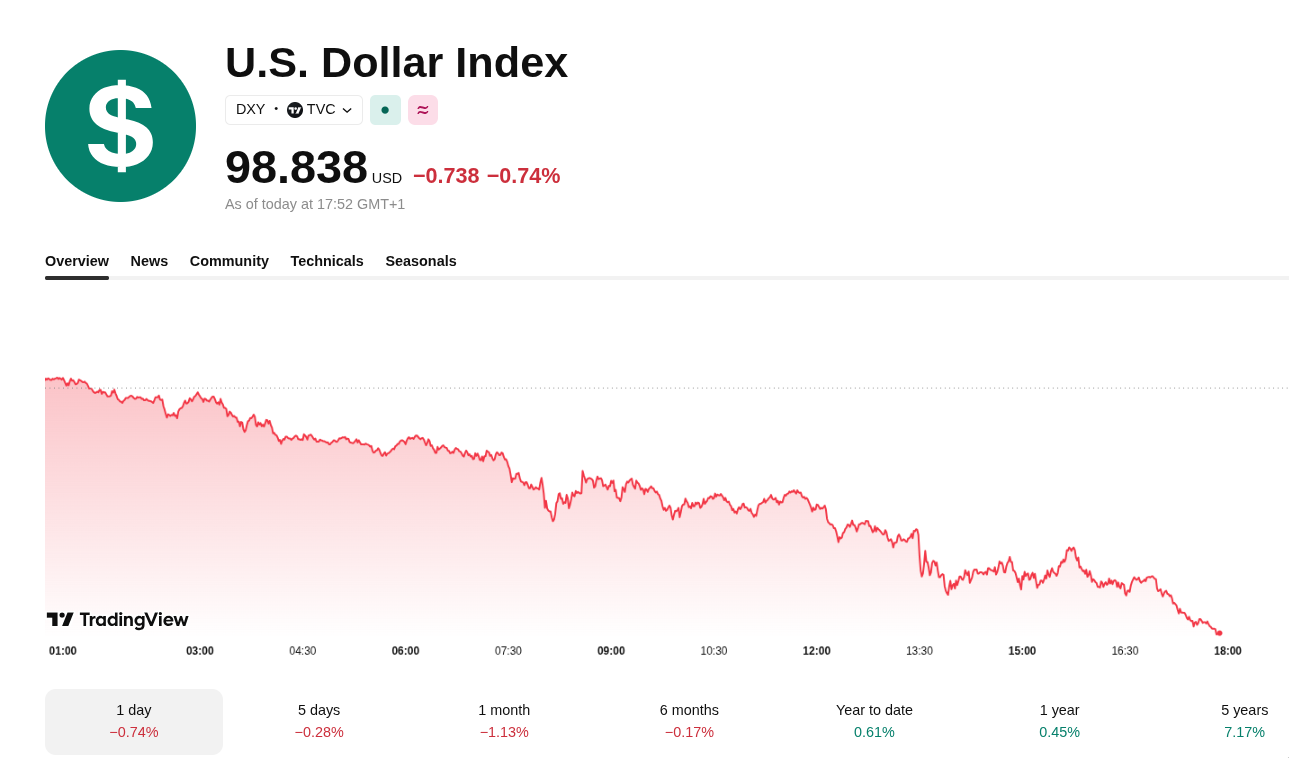
- USD/JPY drops to 155.4 amid suspected Bank of Japan (BOJ) intervention, dragging the US Dollar Index (DXY) down to 99.
- Polymarket odds for a BOJ rate hold collapse further from 12% to 1%, with a 98% probability now priced in for a 25-basis-point hike on Sept. 18.
Weaker dollar drags crypto higher
At the time of writing, BTC stands at $81,000, near the highs seen during last month’s surprise upside.
The move comes as the Japanese yen (JPY) continued to strengthen in a suspected central bank intervention, which Cointelegraph first reported on Wednesday. After dropping to 158.5 on Wednesday, the USD/JPY pair saw further downside to 155.4. This put pressure on the US dollar index (DXY), which fell to 99. Downside in the DXY has historically been positive for Bitcoin.
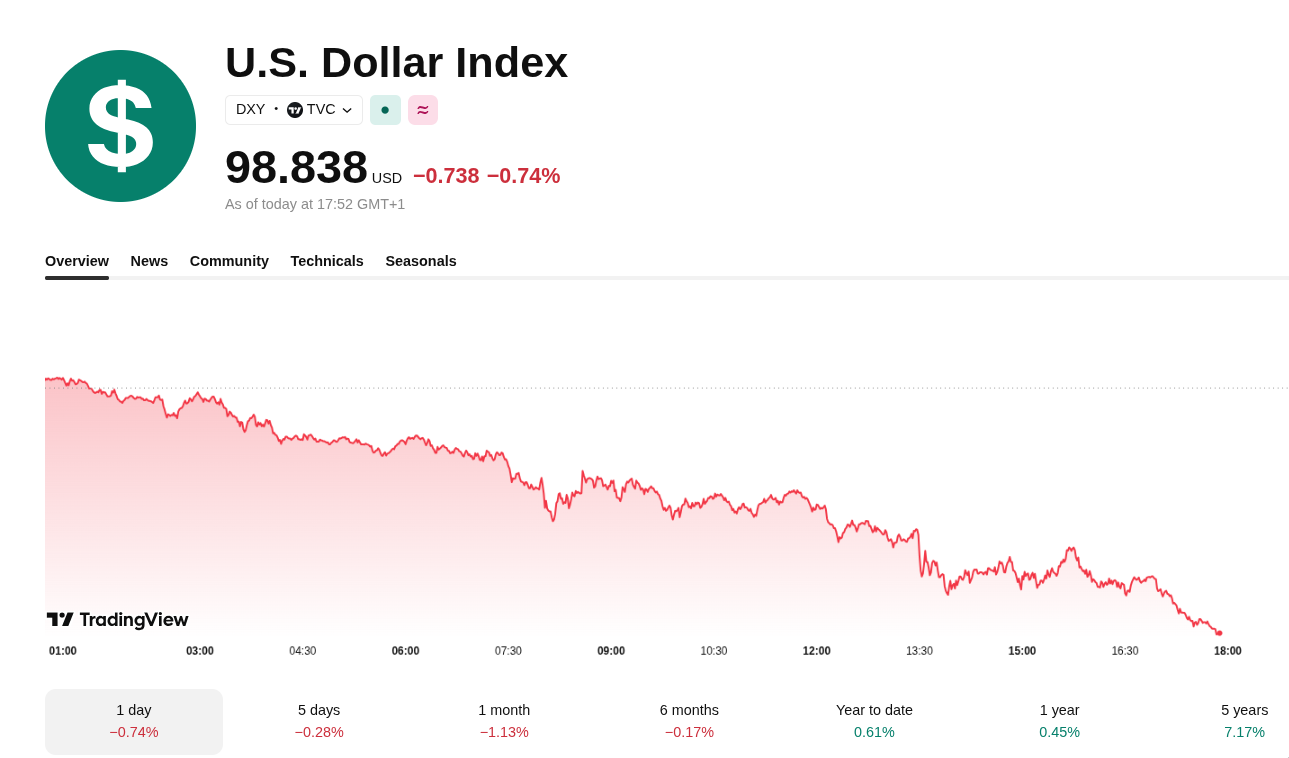
US Dollar Index 1-day chart. Source: TradingView
Shares of Michael Saylor’s Strategy (MSTR) participated in the rally and rose 8.6% on Wednesday. The stock is up 70% from its lows in late June, but still down roughly 10% year-to-date. Strategy’s perpetual preferred stock STRC, which had been frequently compared to a money market fund, is still trading below its par value of $100 and remains stuck at $97.80 at the time of writing.
Related: Strategy turns 1,690 BTC into $108.6M STRC buyback
Analysts divided on impact of yen intervention
The latest suspected intervention to support the yen, coupled with the prospect of a Bank of Japan rate hike later this month, has also revived fears of another carry-trade unwind. The Macro Paper commented on X:
“In the last 24 hours, USD/JPY has dropped almost 2.5%, which doesn’t happen without any major intervention. On top of that, BOJ is most likely expected to hike rates this month, with more rate hikes possible in Q4,” it wrote.
“This is the exact thing that happened in Q3 2024, when BOJ intervened and hiked rates together. The result was a $5 trillion wipeout from the global markets, and the VIX spiked to its highest level since the Covid crash.”
The Polymarket probabilities for a rate hold dropped from 12% to 1% Wednesday, cementing the prospect of a rate hike. The current market-implied probability of a 25-basis-point rise in the policy rate by the Bank of Japan (BOJ) in the upcoming meeting on September 18 is now 98%.
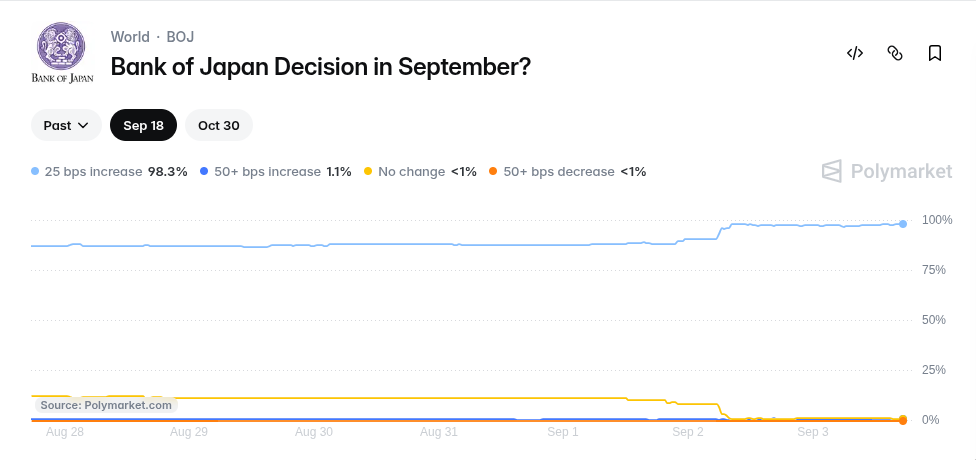
Polymarket probabilities for BOJ rate decision on Sept 18. Source: Polymarket
Some have also seen the currency intervention as liquidity-positive. Arthur Hayes, CIO of Maelstrom, has long held that the Foreign and International Monetary Authorities’ (FIMA) repo facility will provide Japan with dollar liquidity against Treasury collateral, easing global liquidity conditions. While no funds appear to have been drawn from this facility so far, Treasury Secretary Scott Bessent raised the prospect in late July.


AI models Claude, Grok, ChatGPT, and Gemini all appear to be experiencing outages today.
Across the board, AI users are claiming that they can’t get the models, run by Anthropic, X, OpenAI, and Google respectively, to work.
Fifteen different services offered by OpenAI are reportedly experiencing issues, which OpenAI is currently trying to fix.
Claude’s status tracker detailed how its Mythos, Fable, and Opus models were affected, and it now claims that its Opus 4.8 and Opus 5 models are experiencing problems.
The rest, it says, “have recovered to baseline error rate.”
Read more: Search engines fix Claude leak but Perplexity users’ files still online
X confirmed that Grok was experiencing issues and that it’s investigating, while Cursor claimed, “All Grok models, automations, cloud agents, Grok bot and review agents” are experiencing “service degradation.”
Google’s status page claims that there haven’t been any issues with Gemini. However, the outage analytics site Down Detector claims it’s had hundreds of reports across the last few hours that indicate it’s not working for some.
None of the AI models have addresed the outage on X at the time of writing.
Got a tip? Send us an email securely via Protos Leaks. For more informed news and investigations, follow us on X, Bluesky, and Google News, or subscribe to our YouTube channel.


Polymarket has launched perpetual futures across 10 crypto, equity, index, and commodity markets, allowing eligible international users to trade with leverage of up to 20 times.
Summary
- Polymarket Perps supports long and short positions across 10 initial markets.
- BTC, ETH, SOL, HYPE, gold, silver, oil, and two U.S. equity indices are available.
- Leverage reaches 20x, although access depends on each user’s jurisdiction.
- U.S. customers cannot access the international perps service under Polymarket’s current restrictions.
Polymarket Perps opens with 10 markets
Polymarket said in its launch announcement that the new service gives traders one interface for perpetual futures linked to cryptocurrencies, stocks, market indices, and commodities.
The first 10 markets cover Bitcoin, Ethereum, Solana and Hyperliquid’s HYPE token. Traders can also take positions linked to gold, silver, West Texas Intermediate oil, the S&P 500, and the Nasdaq 100.
SPCX, a contract tracking the price of SpaceX shares, completes the initial selection. Unlike buying shares through a stockbroker, an SPCX perpetual contract does not give its holder ownership, voting rights, or a claim on the company’s assets.
Users can open either long positions, which gain when the referenced price rises, or short positions, which gain when it falls. Polymarket has set the highest available leverage at 20x, but the precise limit can vary by contract, position size, and the platform’s margin rules.
Calling the product a venue with the “deepest liquidity, lowest fees,” the company did not provide comparative data in its announcement to support the claim. Polymarket also did not disclose full figures for trading volume, open interest, or deposited collateral at launch.
Perpetual futures differ from standard futures because they have no scheduled expiry date. Polymarket’s perps platform says a position can remain open while the trader continues to meet the required margin level.
Funding payments pass between long and short traders at regular intervals to keep each contract close to its reference price. When a perpetual contract trades above the underlying index, long traders generally pay short traders; the payment direction typically reverses when the contract trades below the index.
Leverage lets a user control a position worth more than the collateral posted. At 20x, each $1 of margin can support as much as $20 of exposure, magnifying both gains and losses. Polymarket states that positions remain active only while their margin requirements are met, meaning the platform can liquidate a trade after an adverse move reduces its available collateral.
The service takes Polymarket beyond event contracts
Adding perps gives Polymarket a second type of trading product alongside the event contracts on which it built its business. Prediction markets settle according to a defined outcome, while the new contracts track the changing price of an asset without an expiry date.
A Bitcoin event contract, for example, might ask whether BTC will trade above a specified level at a set time. Its payout depends on whether the stated condition occurs. A BTC perpetual future instead moves with Bitcoin’s reference price and remains open until the trader closes it or the platform liquidates the position.
The difference also applies to macroeconomic trading. Polymarket’s event markets may let users take positions on the result of a Federal Reserve meeting, while index, gold, or crypto perps let them trade the price movements that occur before and after the decision.
Offering both products gives users separate ways to express a market view, but the contracts carry different payout structures and risks. Event shares normally settle at a defined value after an outcome is confirmed, whereas a leveraged perp can generate ongoing gains or losses as its reference price moves.
Polymarket’s move follows similar product expansion by other trading companies. As crypto.news reported in September, Coinbase opened 23 crypto futures markets to eligible sophisticated and institutional investors in Canada, with leverage reaching 10x on supported contracts.
The Canadian service also includes products tied to gold, silver, oil, and the COIN50 crypto index. Coinbase provides the contracts through Coinbase Financial Markets, its U.S.-registered futures commission merchant, under an international exemption that does not open the products to Canadian retail traders.
Faster infrastructure supports heavier trading activity
Alongside the derivatives rollout, Polymarket has been working on changes intended to raise the number of orders its systems can process.
The company is targeting a capacity of 200,000 orders per second, according to earlier reporting on its trading infrastructure. The figure would represent about 15 times the platform’s previous throughput, while the underlying architecture is being prepared to eventually process more than 400,000 orders per second.
Tests cited in the report produced a 10- to 20-fold improvement in p99 latency, a measure that tracks the slowest group of transactions during periods of activity. Lower p99 latency can help an exchange process orders more consistently when trading volume rises, although Polymarket had not published a full independent performance assessment at the time of the report.
Execution and pricing controls carry added importance when a platform offers leveraged contracts. Small delays or short-lived price changes can affect margin calculations, liquidations and order execution, especially when a trader controls a position several times larger than the collateral supporting it.
In August, Polymarket changed the settlement method for its short-duration crypto event contracts after researchers examined activity around their final pricing windows. The platform adopted time-weighted prices following a study that identified 821 accounts with a combined $8.2 million in profits from settlement periods classified as likely manipulated.
Under the revised method, five-minute contracts use a 30-second price average, while 15-minute and four-hour markets use a 60-second average. Chainlink Data Streams supplies the pricing information, according to Polymarket’s August update.
U.S. access follows a separate regulatory route
Polymarket has limited its perps rollout to international users in locations where the service is legally available. American customers are not eligible to use the company’s international operation, including its leveraged perpetual futures interface.
The restriction stems from Polymarket’s 2022 settlement with the Commodity Futures Trading Commission. The regulator found that the company had offered event-based binary options without registering as a designated contract market or swap execution facility.
Polymarket agreed to pay a $1.4 million civil penalty and wind down markets that did not comply with U.S. law. Under the settlement, the company also had to prevent U.S. customers from accessing its international platform.
A separate regulated operation provides Polymarket’s route into the American market. Its U.S. venue operates under CFTC oversight, but a contract submitted through the regulator’s self-certification process does not receive an express CFTC endorsement.
Self-certification allows a registered exchange to state that a proposed product complies with the Commodity Exchange Act and CFTC rules. The commission can still examine a filing, request more information, or stop a contract from trading when it identifies regulatory concerns.
In June, the CFTC was preparing a new review framework for event contracts, including products tied to sports, political developments, and events involving war or violence. The proposed approach would let the agency examine certain contracts individually rather than relying only on restrictions covering an entire category.
State authorities have also challenged the treatment of some prediction products as federally regulated derivatives. Recent court disputes have focused mainly on sports contracts, with state regulators arguing that they resemble gambling products and therefore require state licenses.
By August, litigation over prediction markets involved 20 states, while Polymarket had generated more than $1 billion in revenue, according to a recent platform review. The company received approval to operate a U.S. designated contract market before opening general access to its American platform in May 2026.
The international perps interface remains separate from that U.S. venue. American users seeking leveraged derivatives must use products offered by CFTC-regulated exchanges and intermediaries, subject to the contracts, margin limits, and customer eligibility rules available through each registered provider.


Uniswap founder Hayden Adams has argued that correlated tokenized-asset pools could move automated market makers into global finance after 10 stock-SPY pools processed $33 million in 12 days.
Summary
- Ten tokenized stock pools against SPY recorded $33 million in volume from over 11,000 traders.
- Uniswap has processed more than $4.6 trillion since its launch in 2018.
- Adams says correlated assets can reduce inventory risk and lower market-making costs.
- U.S. regulators are considering rules for continuous trading and blockchain-based securities records.
Uniswap founder Hayden Adams, in an Aug. 18 blog post, said tokenization could change which trading pairs attract liquidity and who supplies the capital behind them.
Adams has spent nine years working in decentralized finance and created Uniswap in 2018. The protocol has operated through smart contracts since its launch and has processed more than $4.6 trillion in cumulative volume, according to his post.
During the same period, decentralized exchanges increased their share of centralized-exchange spot volume from below 1% to more than 20%, Adams said. He attributed part of that expansion to automated market makers opening markets for assets that could not attract professional trading firms.
Correlated pairs could reduce market-making risk
Unlike an order-book exchange, an automated market maker lets users place two assets into a shared pool. Traders swap against the pool, prices change according to its programmed rules, and liquidity providers collect part of the trading fees.
Adams said AMMs first found demand among small and less-traded tokens because issuers and early holders could create a pool without hiring a professional market maker. Stablecoin pools followed because assets such as USDC and USDT usually move closely together, limiting the inventory changes faced by passive liquidity providers.
According to Adams, onchain markets have since organized into clusters without a central party deciding their structure. Ethereum-based tokens commonly trade against ETH, Solana assets trade against SOL, and stablecoins form pools with other stablecoins.
“No one designed that. It emerged organically,” Adams wrote.
His argument rests on the relationship between the two assets in a liquidity pool. When their prices move in similar directions, liquidity providers face less risk from holding both sides of the pair. Adams said lower inventory risk can attract more capital, deepen liquidity, and reduce the performance advantage enjoyed by active trading firms.
Traditional market makers usually hedge price exposure through options or other instruments, which adds costs. Investors who already want to own both assets may not need the same hedge, allowing them to accept lower returns while continuing to provide liquidity, according to Adams.
Tokenized SPY pools create a bridge to individual stocks
Tokenized securities can allow stocks and funds to trade directly against each other on a shared blockchain rather than requiring every transaction to settle against dollars.
Using Nvidia as an example, Adams said an NVDA-SPY pool could replace part of the activity normally routed through NVDA-USD. SPY would then connect the stock pool to dollars through a separate SPY-USD market.
Under that model, the individual stock and the index fund would form the correlated pair, while SPY-USD would act as a bridge. Passive liquidity providers could serve pools holding related assets, while professional firms compete in the smaller number of bridge markets that carry concentrated trading volume.
Automatic routing would still let an investor enter or leave a position in dollars. The trade could move through more than one pool in the background without requiring the user to exchange each asset manually.
Adams pointed to 10 tokenized stocks trading against tokenized SPY through Uniswap pools on Robinhood Chain. During their first 12 days, the pools handled $33 million in volume from more than 11,000 traders, with part of the activity occurring while U.S. stock exchanges were closed.
Some transactions moved directly from one tokenized stock to another without using dollars, he added. Adams presented the activity as an early example of related assets forming direct markets once they share the same settlement network.
More unusual pools have also appeared. According to his post, some memecoins have been paired with stocks linked by a common theme, including Elon Musk-themed tokens against Tesla and hot dog-themed tokens against Costco. Adams cautioned that the price correlation in such pools remains uncertain.
Uniswap v4 expands how liquidity pools operate
Technical changes to Uniswap could determine whether passive pools can compete in markets that require more complex trading rules.
Uniswap v4 introduced hooks, which allow developers to add custom functions to a pool. Adams cited DualPool, a hook designed to place unused liquidity into lending markets between swaps, as one way to improve returns for liquidity providers.
Permissioned pools provide another route for tokenized assets that must enforce eligibility or transfer controls. Under such a structure, programmed checks can limit who trades a regulated asset while the pool continues to use an AMM for execution.
In July, Uniswap governance expanded its fee system to v4 pools across Ethereum, Arbitrum, Base, BNB Chain, Polygon, OP Mainnet, and Robinhood Chain. As crypto.news previously reported, the change raised daily protocol revenue from about $114,000 to $325,000.
The report found that Uniswap processed $27.6 billion in April 2026 volume and generated an estimated $845 million in annual fees across its versions and networks. Roughly one-sixth of those fees were being captured by the protocol through TokenJar contracts used for UNI purchases and burns.
Adams said correlated pairs represent only one part of the AMM model. Pool design, capital costs, and the ability to handle regulated assets will also affect whether automated liquidity can compete with firms that operate proprietary trading, hedging, and settlement systems.
U.S. rules will determine access to tokenized stocks
For American investors, a token that follows a stock price does not always provide direct ownership of the underlying share. The U.S. Securities and Exchange Commission said in January that tokenized securities can be issued by the company itself or created by an unrelated third party, with different legal structures attached to each model.
Issuer-backed tokens may update the company’s official shareholder record when the blockchain asset moves. A third-party token could instead provide an indirect claim, a custodial interest, or economic exposure that does not make its holder a registered shareholder.
The distinction affects voting rights, dividends, corporate actions, and claims during insolvency. In August, the SEC began preparing a limited route for 24/7 tokenized trading, although the commission has not finalized eligibility standards or an implementation date.
Nasdaq received SEC approval in March 2026 for a pilot covering eligible Russell 1000 shares and major index-linked exchange-traded funds. Under its approved structure, the tokenized and conventional forms carry the same rights and pricing within the national market system.
Ownership infrastructure remains another part of the U.S. regulatory work. In September, the SEC proposed a transfer-agent rule overhaul covering digital records, cybersecurity, business continuity, and the protection of investor assets.
Transfer agents maintain the official list of security owners and process changes involving dividends, stock splits, and other corporate actions. The SEC said firms are developing blockchain-based ownership systems, tokenized fund services and smart-contract processes, but described its proposal as technology-neutral.
Traditional market operators are also building systems for onchain securities. Intercontinental Exchange agreed in August to invest in tZERO and use its blockchain patents while developing an NYSE-affiliated platform. The ICE-tZERO partnership covers digital transfer-agent and broker-dealer infrastructure for issuing, trading, and settling public securities onchain.
ICE and tZERO did not disclose the investment amount, tZERO’s valuation, or a launch schedule. The proposed platform still requires regulatory approvals before it can offer continuous trading and blockchain settlement.

In the beginning, there was the famous story about the young journalist Gloria Steinem, going undercover in 1963 as a Playboy Bunny, all décolletage and rabbit ears, in order to expose a culture of degradation and misogyny. The Bunny episode is certainly the Steinem anecdote most often cited, but it’s such an early story that it’s just a canary, really, hinting only a little at what would become a lifelong commitment to feminism.
Steinem, who died Sept. 2 in her home in New York City at the age of 92, was an icon of second-wave feminism. As one of the co-founders, in 1971, of both Ms. magazine and, along with many other feminists, the National Women’s Political Caucus, Steinem advocated fiercely and vocally on behalf of women’s rights. She was also involved in the fight for the passage of the Equal Rights Amendment.
But she didn’t consider her life as an “active feminist” to have started until 1969, when in her mid-30s she attended an abortion speak-out in a church basement. Steinem was there as a reporter for New York magazine, but found herself struck by the stories the women told, and the truths that they were willing to reveal in front of other people. She had her own truth, which she came to share.

Some years ago, she personalized the story further, in the dedication of her 2015 book, My Life on the Road, which reads:
This book is dedicated to:
Dr. John Sharpe of London, who in 1957, a decade before physicians in England could legally perform an abortion for any reason other than the health of the woman, took the considerable risk of referring for an abortion a twenty-two-year-old American on her way to India.
Knowing only that she had broken an engagement at home to seek an unknown fate, he said, “You must promise me two things. First, you will not tell anyone my name. Second, you will do what you want to do with your life.”
Dear Dr. Sharpe, I believe you, who knew the law was unjust, would not mind if I say this so long after your death:
I’ve done the best I could with my life.
This book is for you.
What is it that makes these words so moving? There was always something real and approachable about Steinem, visible in this dedication as well as in the interviews she gave and the speeches she delivered. You felt you knew her, or you wished you did. You even imagined being her, just a little.
I definitely had feelings along those lines toward Steinem. As a teenager I watched my own mother, a writer who hadn’t been encouraged by her parents to explore her talents fully or go to college, become truly affected by the women’s movement, publishing her first novel in her mid-40s. We subscribed to Ms., and I became part of a consciousness-raising group in school. Though the term “consciousness raising” can feel outdated, I still remember those conversations the other girls and I had. Someone would bring over a container of Lipton’s onion dip and a bag of chips, and we would go around the room speaking about subjects that until then had been kept inside, connected with what we had thought of as privacy, but which in some instances was really shame.
Later on, I was excited to win the Ms. magazine college fiction contest; and still later the writer Mary Gordon invited me to attend Steinem’s 50th birthday party with her. In addition to being overstimulated and thrilled at seeing Steinem, I am pretty sure I also saw Carol Burnett, Sally Ride, and Rosa Parks—if that tells you anything about Steinem’s reach. Beyond that, it was so heady that I can’t tell you much of anything.
“In my old age—really old age, since I’m going to live past 100, I hope,” Steinem once said in an interview with New York magazine, “I would love to have a diner.” She envisioned it as having “blue gingham curtains” and being “by the side of the road,” and she went on to explain: “Diners are the most democratic places. Everyone goes—truck drivers go, people from the neighborhood, people in their tuxes after parties go… And in the back room,” she said, “we could have a little revolutionary meeting from time to time.”
Steinem never actually had a diner, although you could make the case that she did have a sort of symbolic one, because her life’s work involved bringing all kinds of people together to talk, often to touch on matters of radical societal change. She seemed to be everywhere, from the nightly news to a mention on The Mary Tyler Moore Show. The warmth and genuineness of her personality, as well as her convictions, breadth of knowledge and experience, and her talents both as a writer and speaker, helped make her a reliable figure over all the decades she spent working for women’s equality. In 2013, Barack Obama presented her with a Presidential Medal of Freedom.



The expression “the personal is political” easily comes to mind when thinking of Steinem, whose own origin story strongly shaped her inclination toward activism. Born on March 25, 1934 in Toledo, Ohio, Steinem lived with her mother Ruth after her parents’ divorce, becoming, at 10, the sole caretaker for her mother, who struggled with mental illness. Among Ruth’s many other challenges was keeping a job. Feminism was in Steinem’s DNA (her father’s mother was involved with women’s suffrage and was the first woman elected to the Toledo Board of Education), but Steinem later realized that witnessing the contempt and disregard that people in power expressed toward her mother—seeing how she was treated as invisible—became a formative social justice experience for her.
She took her percolating consciousness off to Smith College, the all-women’s school in Northampton, Mass., where she studied government. But Smith in the 1950s, while academically rigorous, was also sometimes described by its critics as a place where students went to get their “MRS” degrees. This, Steinem knew, was not something she wanted for herself. As she once told People magazine, “In the 1950s, once you married you became what your husband was, so it seemed like the last choice you’d ever have.” She added, “I’d already been the very small parent of a very big child, my mother. I didn’t want to end up taking care of someone else.” (Steinem did eventually marry, but not until her 60s.)
Being responsible for her mother not only molded her convictions about what she didn’t want, but also seems to have allowed her to figure out, earlier than other people, what she did want. And one thing she apparently wanted was experience. Steinem got that, traveling to India on a fellowship; then, later, at Ms., and as a journalist, mentor, and speaker to audiences around the world. Along the way, the glamorous Steinem had a well-documented love life that sometimes involved relationships with powerful men. Her stylishness––the signature aviator glasses and great hair––combined with her intelligence and political engagement, challenged retrograde and insulting ideas about graceless, unappealing feminists.
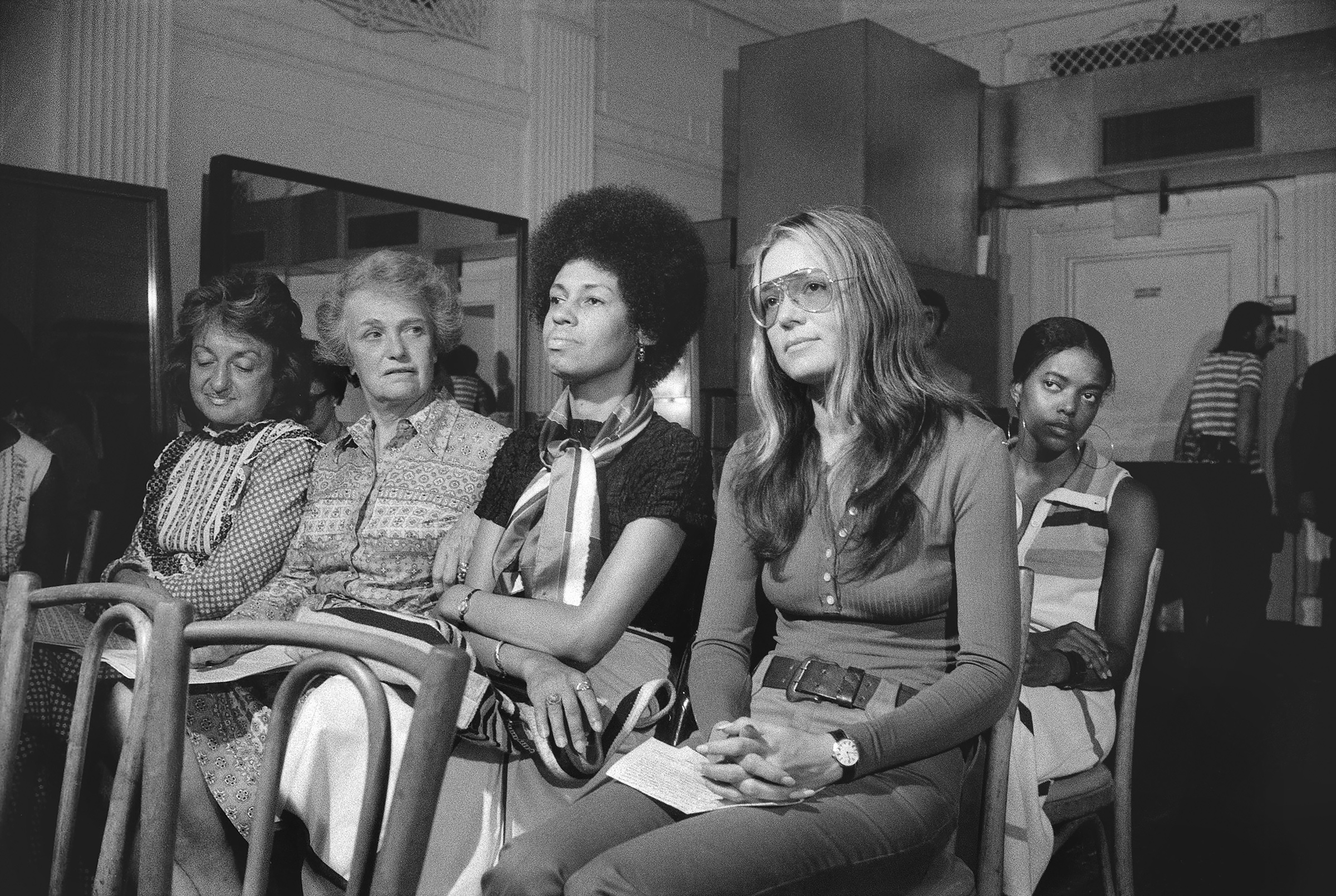


It would not be an overstatement to call Steinem the “face” of second-wave feminism, whether it was her preference or not to be known that way. Steinem believed that her personal formation as a feminist had been importantly shaped by Black women. “I thought that they invented the feminist movement,” she said in 2015. “I realize that things being what they are, the white, middle-class part of the movement got reported more.” Throughout her life, both personally and politically, she was sensitive to the needs of various groups whose interests had been sidelined.
Steinem seemed to capture the feminist imagination in profound ways across decades, often acting as a convener of women. She was known for the “talking circles” frequently held in her home. In 2009, I received an invitation to her house in New York City for a reception to celebrate the filmmaker Jane Campion. Various women in the arts had been invited, and Steinem went around and briefly described everyone’s work, one by one. I suppose “networking” took place that night, but that seems too corporate a term for what I experienced, which was a series of good conversations with women I admired, in the home of someone who mattered to us all. She somehow had time for all of this—more time, even as the clock sped up the way it seems to do as you get older, before it inevitably slows down, then stops.
I had cause to think of Steinem again some years ago when talking to a friend, the novelist J. Courtney Sullivan, who in fact I met for the first time that night at Steinem’s. Sullivan was a core member of the all-volunteer group Immigrant Families Together, which worked to reunite mothers and children who had been separated at the U.S.-Mexico border. In 2018 she sent out a mass email, looking for housing for immigrant women and their children. She told me she sent 50 emails, and at that point received only one response in which the person volunteered her own home. It was from Steinem, who told Sullivan, in effect: Any of those mothers and their children are welcome to stay in my house for as long as they need.
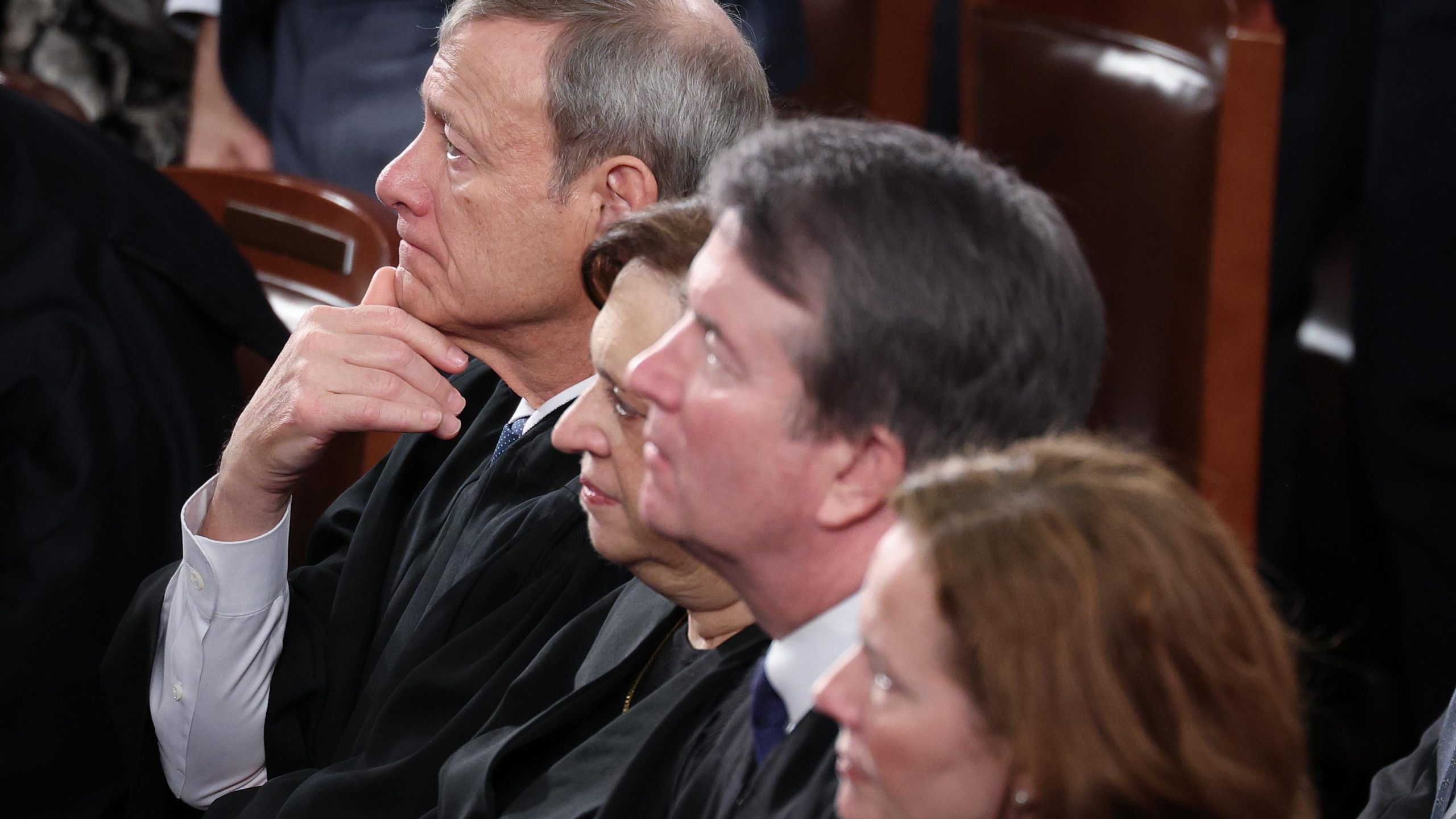
The conservative Justices have denied that the court’s decisions are politically motivated.
“I think, at a very basic level, people think we’re making policy decisions, we’re saying we think this is how things should be, as opposed to what the law provides,” said Chief Justice John Roberts at an event in May. “I think they view us as purely political actors, which I don’t think is an accurate understanding of what we do.”
The past few months have nonetheless seen Democratic lawmakers proposing other ways to revamp the court in an attempt to weed out partisan politics and rein in judicial powers. Here are some of those efforts:
Ongoing discussions over court size
The U.S. Constitution does not state how many Justices make up the Supreme Court, and the number of seats has changed over time, from as few as five Justices to as many as 10. Since 1869, however, the court has had nine authorized seats for Justices.

From Brokenness to Bill Gates: My Path to Happiness & Financial Freedom #shorts

Lindsay Clancy wheeled up to judge’s bench in extraordinary court moment as she waits for verdict: Live updates

70% stock surge ‘is the beginning of the momentum’





-

 Fashion6 days ago
Weekend Open Thread: Maeve – Corporette.com
-

 Crypto World7 days ago
Bitcoin’s 22% rally now needs real demand to outlast Treasury liquidity boost
-

 Business7 days ago
Apple Confirms September 9 Keynote and Reveals Its Full Pre-Order Schedule
-
 Crypto World19 hours ago
CLARITY Act could advance within weeks, Atkins says
-

 Business7 days ago
Salesforce Stock Soars 19% as Blowout Earnings and Agentforce AI Growth Silence Software Skeptics
-

 Business6 days ago
Onto Innovation Stock: AI’s Next Bottleneck Is Yield (NYSE:ONTO)
-

 Crypto World6 days ago
Bitcoin price tests $82K resistance as Brandt stays long
-
 Tech5 days ago
Hugging Face built a $4.5 billion empire on free AI models. Now Nvidia is buying it for $12.9 billion
-

 Business6 days ago
iPhone 18 Pro Pre-Orders Could Shift to Saturday as Apple Reportedly Avoids September 11 Anniversary
-

 Crypto World2 days ago
Elon Musk Says Grok 4.7 Lands in 10 Days and Will Beat Every Model
-

 Crypto World7 days ago
Truflation calls for Fed rate cut after PCE forecast
-
 Entertainment6 days ago
‘Adults’ Creators Break Down Season 2’s Most Shocking Moments and Tease a Potential Season 3
-

 Tech7 days ago
The fix for the AI agent that hijacked a company’s DNS: it can propose the change, but it can’t approve it
-
 News Videos4 days ago
Charlie Munger on Robinhood: No one should believe that Robinhood’s trades are free
-

 Tech6 days ago
PaperCut releases second emergency patch for exploited flaws
-

 Tech5 days ago
Tamagotchi Ring Takes the 30-Year Digital Pet and Places it on Your Finger
-

 Tech5 days ago
As the influencer economy drives retail sales, Seattle startup raises $22M to play matchmaker
-
 Crypto World2 days ago
Bitcoin slips below $77.5K as macro pressure offsets ETF inflows
-

 Crypto World15 hours ago
Kalshi seeks CFTC approval for WTI perpetual
-
 NewsBeat5 days ago
Trump posts AI video of ‘Lake America’ being protected by an army of bequiffed ‘Donald Ducks’
You must be logged in to post a comment Login