
Crypto World
Visa Partners With Upbit Group to Expand Stablecoin Payments and AI Commerce


Visa and Dunamu—best known as the parent company of South Korea’s Upbit crypto exchange—have announced a strategic partnership aimed at exploring how stablecoins could be used for payments, cross-border remittances, and settlement services, alongside AI-enabled commerce.
In a Friday announcement, Dunamu said the two firms plan to combine Dunamu’s digital asset technology with Visa’s global payments infrastructure to study product and service opportunities across major markets. The partnership also points to using artificial intelligence for “agentic commerce,” where AI agents can search for products or services and complete purchases and payments on behalf of users.
Key takeaways
- Visa and Dunamu will test stablecoin-based use cases spanning payments, remittances, and settlement, leveraging Visa’s existing network.
- The partnership frames stablecoins, tokenization, and AI as an interlinked trend reshaping finance and commerce.
- Dunamu said it is evaluating multiple stablecoin options rather than tying the initiative to a single project.
- Open Standard’s dollar-backed OUSD is among the stablecoin proposals being considered, according to Dunamu.
- The parties also plan to explore AI “agentic commerce” scenarios that connect AI-driven purchasing with stablecoin payment rails.
Why Visa and Dunamu are focusing on stablecoins
Dunamu’s announcement places stablecoins alongside tokenization and AI as key forces expected to “change how finance and commerce operate.” The stated goal is to connect digital asset capabilities with traditional finance, which is where Visa’s payments reach could become a critical complement.
Stablecoin-centered initiatives have increasingly targeted real-world payment and settlement pain points—particularly the frictions involved in moving value across borders. By pairing Visa’s network with Dunamu’s digital asset expertise, the partnership suggests an attempt to move beyond pilots and toward workable integration models, though the companies did not specify timelines or deployment details in the announcement.
OUSD enters the conversation, but Dunamu keeps options open
As part of the exploration, Dunamu and Visa said they are considering business models involving Open Standard’s proposed Open USD (OUSD), a dollar-backed stablecoin introduced in June. Open Standard said that more than 140 companies have signed up to use OUSD, naming Visa, Mastercard, Stripe, Coinbase, and BlackRock among them.
Dunamu, however, indicated that OUSD is only one of several stablecoin projects it is evaluating. It also said the partnership has not prioritized a specific stablecoin for the work, signaling that the effort is currently oriented around feasibility and structure rather than committing to a single asset design.
This matters for market participants because stablecoin partnerships often hinge on compliance expectations, issuer and reserve arrangements, and interoperability—factors that can differ significantly between proposals. Dunamu’s stance implies that the partnership could remain flexible as regulatory and technical requirements evolve.
Upbit clarification underscores the partnership’s scope
The news comes against a backdrop of earlier discussion about OUSD and Upbit. In July, Upbit said it was not participating in the issuance of OUSD after Dunamu was named as one of the businesses involved in Open Standard’s initiative.
That clarification indicates that being connected to a stablecoin roadmap through partnerships or infrastructure evaluation does not necessarily translate into direct issuance involvement by Upbit itself. For users and investors watching stablecoin rollouts, the distinction highlights how roles can vary—issuers, service providers, trading venues, and network integrators can all be present in different capacities without assuming identical responsibilities.
Agentic commerce: AI agents plus stablecoin rails
Beyond payments and remittances, Visa and Dunamu said they will also explore “agentic commerce.” In practical terms, this refers to AI agents that can identify products or services and execute transactions—potentially including searching, selecting, and paying—on a user’s behalf.
The companies will examine ways to combine AI with stablecoin-based payment and settlement infrastructure. While the announcement does not provide technical specifics, the direction is clear: stablecoins are being positioned not only as an alternative to traditional settlement mechanisms, but as part of an end-to-end stack that could enable automated purchasing workflows.
For developers and businesses, this raises questions about how AI decisioning, payment authorization, and compliance checks would be integrated. It also suggests that future implementations may focus on controlling risk (fraud and unauthorized spend) while maintaining the speed and global accessibility that stablecoin-based settlement can offer.
What to watch next
Visa and Dunamu’s partnership is an exploratory step, not a guarantee of an imminent stablecoin product launch. The next developments to track are whether the firms narrow down which stablecoin options they can realistically integrate, how they structure settlement and compliance workflows, and whether agentic commerce concepts move from planning into test implementations.

Crypto World
Solana’s (SOL) Strong Rally, The Latest Ethereum (ETH) Forecasts, and More: Bits Recap August 28
The broader cryptocurrency market has registered a solid uptick over the past week, with Solana (SOL) standing out as one of the biggest gainers.
Ethereum briefly climbed past $2,500, prompting analysts to turn even more bullish on the asset, while Bitcoin may not be out of the woods yet.
SOL’s Pump
Solana’s native token has soared by 40% over the past week, and earlier today (August 28), it jumped to almost $110, its highest level witnessed since January this year. As of this writing, it trades at around $105 (per CoinGecko), boasting a market capitalization of roughly $61 billion.
The improved condition of the crypto sector appears to be the main catalyst for the ascent, while rising institutional interest may also be a positive factor. According to SoSoValue, spot SOL ETFs have recorded eight consecutive green days; the last time this was observed was in May 2026. Another optimistic element is the return of the whales, some of whom spent millions of dollars to re-enter SOL’s ecosystem.
Analysts on X are predominantly bullish on the asset. Daan Crypto Trades claimed that everything “looks good” as long as the price remains above $98, whereas SKYLINE argued that it is only a matter of time before SOL rises beyond $150. X user Fuel is even more optimistic, envisioning an eventual explosion to $1,000.
Meanwhile, Sweep took a cautious tone, saying that a collapse to $70 remains possible. However, “after that, Solana will go parabolic,” he added. If you are curious to check additional SOL forecasts, take a look at our video here.
What’s Next for ETH?
Several hours ago, the second-largest cryptocurrency briefly surpassed $2,500 before slightly retreating below that level. That mark seems to be a major turning point, with X user Gerla suggesting that a clean break above could mark the beginning of a new bull run.
For his part, Ted claimed that a weekly close beyond $2,550 could be followed by a further pump to $3,000. The shrinking amount of ETH stored on exchanges supports the bullish outlook. According to Santiment, holders have withdrawn 1.4 million coins from centralized platforms since June, effectively decreasing immediate selling pressure.
Of course, there are some pessimists as well. X user Nonzee, who recently envisioned a short-term crash in BTC to $45,000, opined that ETH could nosedive to $1,500 before starting a fresh rally.
BTC in Danger
The primary cryptocurrency has been hovering in the $79,000-$81,000 range over the past few days, indicating a strong uptrend relative to levels at the beginning of the month.
Nonetheless, some market observers did not rule out a possible collapse ahead. Gerla believes that BTC must take a clean break above $82,000 or otherwise it risks falling below $60K. X user cyclop shared a similar thesis, claiming that if the asset fails to hold beyond $83,000, it could drop to $50,000 by November.
The analytics platform CryptoQuant is more optimistic, arguing that the current conditions may represent the early phase of a bull run. At the same time, the firm noted that the price needs a daily close above $83,000 for confirmation.
The post Solana’s (SOL) Strong Rally, The Latest Ethereum (ETH) Forecasts, and More: Bits Recap August 28 appeared first on CryptoPotato.

XRP is trading at $1.42 as one of its biggest institutional backers edges closer to a public listing despite some bearish price analysis. Evernorth confirmed on August 27 that the SEC declared its registration statement effective, clearing a major hurdle in its planned merger with Armada Acquisition Corp. II.
The company also announced that Armada II shareholders will vote on the combination on September 30, 2026, putting the XRP treasury vehicle within sight of a Nasdaq listing pending that vote and other closing conditions. CEO Asheesh Birla framed the move as a bet on-chain institutional finance, saying Evernorth is “designed to accelerate XRP’s role in that work.”
The timing matters. XRP has been fighting to escape a multi-month range, and institutional adoption headlines like this one typically function as tailwinds rather than triggers on their own.
Discover: The Best Token Presales
XRP Price Analysis: Hit $1.60 This Week?
XRP’s slide to $1.42 puts it back below the $1.50 zone that several August technical reports flagged as the level needed to “materially improve the longer-term technical picture.” Reclaiming it would also put the price back above the closely watched 200-day SMA near $1.36-$1.37.
XRP price remains technically pinned below all four daily moving averages, a structure that one analysis called a “bearish configuration” that has defined price action for weeks. Support sits first at $1.37, then the more critical $1.00-$1.03 band that multiple desks describe as the last line before psychological levels near $0.95-$0.90 come into play.

A close above $1.45 will flip the 200-day average and open a run toward $1.45-$1.50 resistance retest from above. A continued chop could also happen between $1.37 and $1.45 while the market digests the Evernorth vote timeline.
The bears will dominate if it breaks below $1.37, which will likely drag the price back toward the $1.00 floor, invalidating the recent bounce. Whale activity versus ETF inflows remains the swing factor worth watching into next week.
Trade XRP on Bybit and Get a Chance to Win Our $1,000 USDT Airdrop
Maxi Doge Targets Early Mover Upside as XRP Tests Key Levels
A price drop right after a Nasdaq-adjacent catalyst is the kind of thing that tests conviction. Holders who bought the mid-$1.30s bounce are still in profit, but anyone chasing the above $1.50 high is underwater today.
XRP’s market cap also means even a clean breakout likely delivers single-digit percentage moves, not multiples. That math is pushing traders toward earlier-stage plays with more room to run.
Maxi Doge ($MAXI) is an Ethereum-based meme token built around 1000x-leverage trading culture, think gym-bro humor meets degen trading floor. The presale has raised $4.8 million at a current price of $0.0002836, with dynamic APY staking live for holders.
Standout features include holder-only trading competitions with leaderboard rewards and a Maxi Fund treasury earmarked for liquidity and partnerships.
Research Maxi Doge directly before the presale window closes.
Discover: The Best Crypto to Diversify Your Portfolio
The post XRP Price Analysis: Treasury Giant One Step Away From NASDAQ appeared first on Cryptonews.
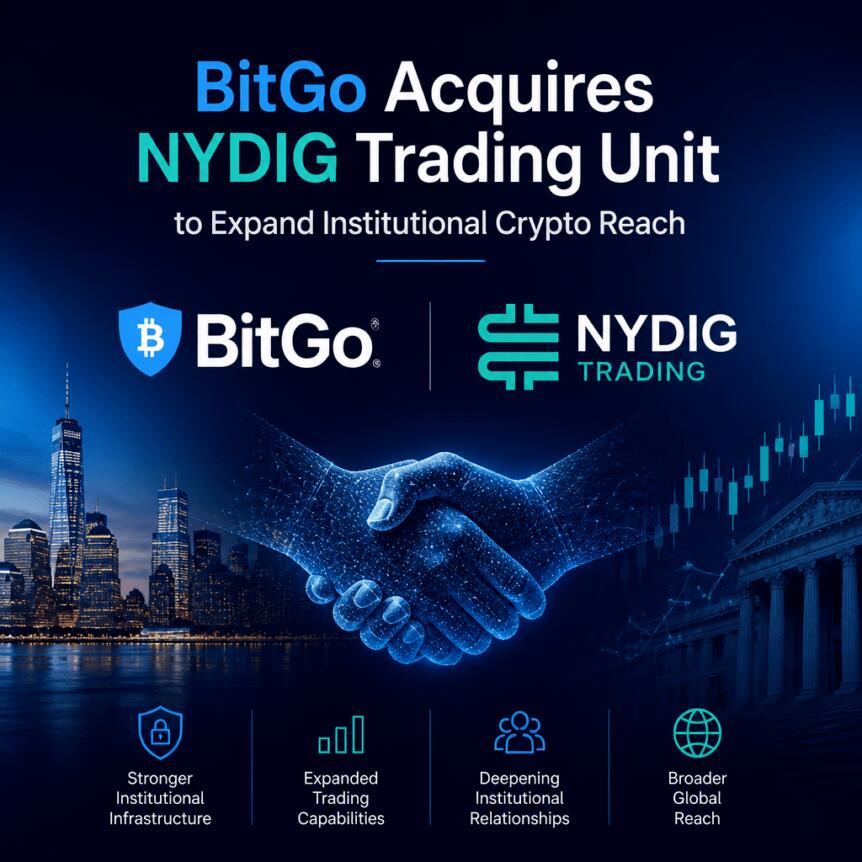
BitGo has agreed to expand its institutional offerings by acquiring the institutional trading business of NYDIG, a Bitcoin infrastructure provider. The deal adds derivatives and financing capabilities to BitGo’s existing platform as the company pushes deeper into capital markets services for professional crypto users.
According to a Business Wire announcement published Thursday, BitGo completed the acquisition under a definitive agreement. The transaction includes NYDIG’s institutional client trading relationships and approximately 30 employees, while financial terms were not disclosed.
Key takeaways
- BitGo says the NYDIG acquisition completed Thursday under a definitive agreement, including institutional client relationships and about 30 employees.
- The added business reportedly brings derivatives, structured products, financing, and capital markets services into BitGo’s institutional suite.
- BitGo intends to “meaningfully scale” its trading and infrastructure capabilities, positioning itself for a broader range of asset managers, hedge funds, and corporate clients.
- NYDIG said the sale enables it to focus resources on power generation, Bitcoin mining, and high-performance computing data centers.
What BitGo is buying
The acquisition centers on NYDIG’s institutional trading operations, which the companies describe as providing execution and related services for sophisticated market participants. In the announcement, BitGo outlines an expanded set of capabilities that includes derivatives and structured products, along with financing and capital markets services.
The target customer base includes asset managers, hedge funds, and companies—participants that typically require more than spot access, such as risk-managed exposure, structured payoff products, and trading workflows tied to institutional governance.
BitGo CEO Mike Belshe characterized the acquisition as a way to accelerate growth in its institutional offerings. The company said the deal will “meaningfully scale” BitGo’s trading and infrastructure capabilities and help it serve more institutional clients.
How institutional trading capabilities may change
For firms operating in crypto, the gap between retail access and true institutional trading often comes down to execution depth, product breadth, and financing options that fit balance-sheet and risk frameworks. By bringing in derivatives and structured products alongside financing and capital markets services, BitGo is effectively broadening the range of tools it can offer institutional clients through a single provider.
The practical significance is that more types of institutional strategies become easier to deploy—especially those that rely on structuring, hedging, or credit-linked financing rather than direct spot exposure alone. BitGo’s framing suggests it views the acquisition as both an expansion of product capabilities and an uplift in the infrastructure required to support them.
In remarks included in the announcement, Pete Janney, head of financial infrastructure at BitGo, said the transaction allows the combined team to continue delivering execution quality and solutions clients expect, now “backed by an even deeper set of resources.”
Why NYDIG is stepping back from trading
The deal is also described as a strategic reallocation of resources for NYDIG. Under the terms of the announcement, the sale will allow NYDIG to focus on areas tied to its infrastructure footprint—specifically power generation, Bitcoin mining, and high-performance computing data centers.
NYDIG’s development pipeline was cited as a key factor in that direction. The announcement states its development pipeline exceeds 3 gigawatts, including more than 1 GW of capacity expected to be delivered in 2027 and 2028.
That shift matters because it highlights how the institutional crypto sector is splitting strategic attention between market services and physical infrastructure. While BitGo is pulling further into trading and capital markets, NYDIG is leaning into the buildout of energy and computing capacity that supports mining and related infrastructure operations.
What to watch next
With the acquisition completed and staffing and client relationships moving to BitGo, the immediate question for the market is how quickly BitGo integrates the acquired trading capabilities into its broader institutional workflow. Investors and institutional clients may also look for any updates on product rollout—particularly around derivatives and structured offerings—and how BitGo positions its expanded services relative to the rest of the institutional trading ecosystem.


Cryptocurrency platform Bullish is extending a $100 million debt facility to USD.AI to finance GPU-backed loans for artificial intelligence infrastructure.


Yesterday, the SEC asked a federal court for injunctions against several crypto investment advisory firms who have displayed fake SEC certificates.
Naming crypto operators CryptoOrbit, Ftaexchange, Pinnacle, Quantum, RBH, and others, the SEC filed a total of 38 civil complaints over phony filings.
For example, the crypto-focused Quantum Financial Institute claimed it had registered investment advisor status that didn’t exist.
One of its incredible press releases pitched “a multi-dimensional intelligent investment system” and “courses” where students could learn about “bitcoin giveaways” and “the highest win-rate strategies, helping students understand the deep logic of the market.”
It even rendered a phony SEC certificate to dupe customers.
Commissioners are asking a federal court for injunctions to order civil penalties and to ban the defendants’ reporting exemption privileges for future advisory filings.
At the commission’s direction, FINRA has already removed non-compliant forms for these advisors from adviserinfo.sec.gov.
RBH Infinity Exchange Inc, Pinnacle Crypto Exchange Inc, THEVGPRO Ltd, Quantum Financial Institute Ltd, Ftaexchange Ltd, and other problematic crypto businesses are now defendants of US civil lawsuits.
SEC sues unregistered crypto advisors
Third-party, promotional write-ups of some of these crypto businesses falsely claimed that they carried valid SEC registration with numbers that precisely match yesterday’s SEC enforcement action.
Pinnacle, for example, marketed crypto swaps and its good standing with US regulators. THEVGPRO pitched a BTC backed “settlement security fund, enhancing global liquidity and payment efficiency” with registration numbers that the SEC never approved.
The SEC accuses these entities of making materially false statements on Form ADV, as well as failing to file disclosures.
Commissioners allege violations of Sections 204(a) and 207 of the Investment Advisers Act. They have not quantified investor losses in these initial complaints.
SEC staff attempted to contact many crypto advisors making false claims. Several phone numbers were disconnected or belonged to unrelated businesses. Postal mail was returned as undeliverable.
Read more: Who is Paul Atkins, Donald Trump’s pick for SEC chairman?
Disconnected phones, undeliverable addresses
Several unregistered investment advisors claimed to operate out of Colorado despite consistent use of Hong Kong IP addresses.
Apexium Securities Ltd, for example, allegedly used Hong Kong connections while listing a Colorado office where it had no presence.
Web3 University, another unregistered crypto operator, allegedly accessed FINRA’s filing system from the People’s Republic of China. It also used a disconnected phone number and listed an undeliverable Colorado Springs office.
CryptoOrbit, another defendant that commissioners sued yesterday, also claimed to possess SEC certificates that commissioners never issued.
An Ftaexchange crypto-focused press release touted digital asset trading and custody services with phony SEC registered investment adviser status as though it was in good standing.
A press release from RBH announced three health and intellectual-property-themed crypto tokens that are now worthless. It implored readers, “invest in the future — act now.” Hopefully they didn’t.
Pinnacle Crypto Exchange said it had completed SEC registration when it had not.
Absolutaris Base Limited was another defendant in yesterday’s SEC action.
The Better Business Bureau logged consumer complaints about this service, including worthless stock signals, a fake trading app, and advertisements about obviously unsustainable monthly returns of 20-60%.
Got a tip? Send us an email securely via Protos Leaks. For more informed news and investigations, follow us on X, Bluesky, and Google News, or subscribe to our YouTube channel.


Financials were not disclosed, though reports from earlier this year suggested Chelsea was targeting 65 million pounds a year ($88.3 million) for the sponsorship berth.
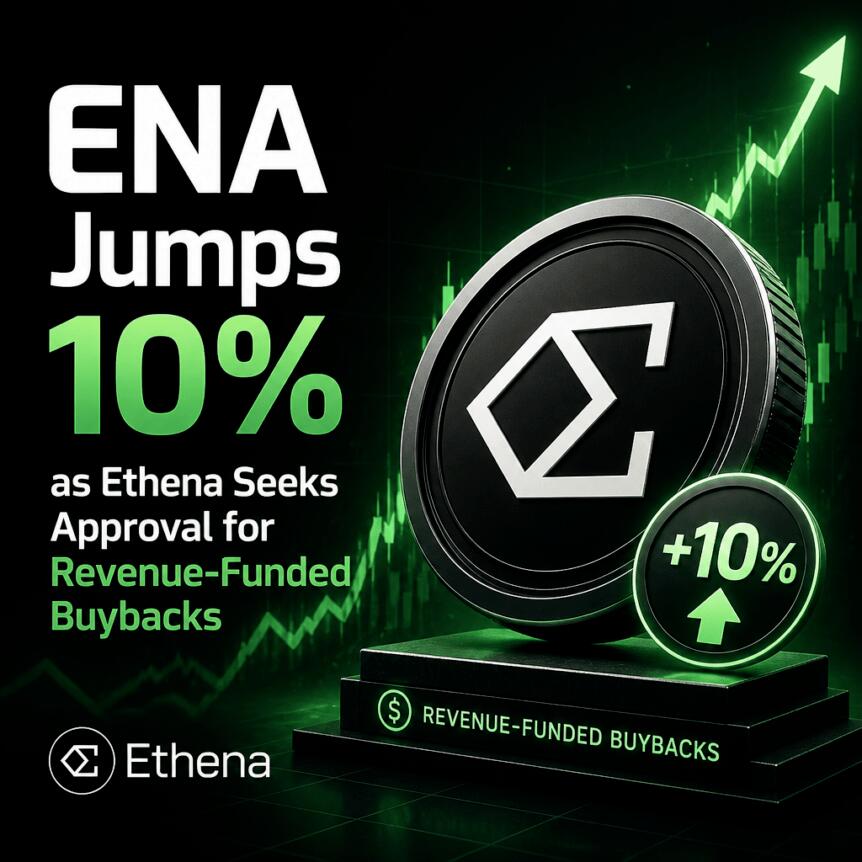
Ethena’s native token ENA surged after the Ethena Foundation announced a package of governance and treasury updates aimed at changing how the protocol’s revenue is handled and how certain investor token schedules unwind.
In an ecosystem update posted Thursday, the foundation detailed four changes, including a vote on a “fee-switch” mechanism that would direct a large share of net revenue toward ENA buybacks once Ethena’s synthetic dollar supply (USDe) reaches a specified milestone.
Key takeaways
- The Ethena Foundation opened a governance vote on a fee-switch proposal tied to USDe reaching a $7.5 billion milestone.
- Under the proposal, 95% of the foundation’s net revenue from Ethena’s core business lines would be used to buy ENA after the threshold is met.
- Tokenholders have until Sept. 2 to vote; at the time of publication, Snapshot showed 65 votes representing about 14.4 million ENA voting power, all in favor.
- The foundation also said it completed a buyout of locked ENA held by certain early investors and agreed to adjust remaining investor unlock timing to Oct. 5.
Fee-switch proposal links buybacks to USDe scale
The center of the announcement is a governance vote on whether to switch Ethena’s fee handling toward token repurchases. According to the Ethena Foundation’s blog post, 95% of the net revenue paid to the foundation from Ethena’s core business lines would be allocated to purchase ENA once the circulating supply of USDe reaches the first milestone of $7.5 billion.
Voting runs until Sept. 2. Data from Snapshot shows all cast votes so far have supported the proposal. At the time of writing, 65 votes accounting for roughly 14.4 million ENA in voting power were recorded, with every one of them in favor.
For ENA holders, the significance is practical: if implemented, the buyback program would effectively transform a portion of protocol revenue into recurring demand for the token—though the trigger is conditional on USDe growth, which means timing depends on how quickly supply climbs to the milestone.
ENA reacts as governance activity accelerates
Market pricing reflected the renewed focus on treasury policy. CoinGecko data shows ENA rose 10.7% over 24 hours and gained 27% over the past week, trading above $0.17 as of 8:11 am UTC on Friday.
Even without assuming the vote’s outcome, the governance framing itself can matter to traders: buyback mechanisms are often viewed as a direct link between protocol economics and token supply dynamics. Here, the foundation’s proposal is explicit about how revenue would be used after the USDe threshold is reached.
Locked token buyout and changes to investor unlock timing
Beyond the fee-switch idea, the Ethena Foundation outlined steps affecting locked ENA held by early participants. The foundation said it had bought locked ENA from certain major seed investors who reduced some holdings during the previous nine months.
In a separate development, the foundation stated it agreed with lead investors to release remaining unvested investor allocations on Oct. 5, replacing the existing monthly unlock schedule. The foundation emphasized that team tokens remain subject to their original vesting schedules.
Importantly, the change described in the update accelerates remaining investor unlocks rather than canceling the tokens. For market watchers, that distinction is notable: faster unlocks can increase near-term supply pressure if demand does not keep pace, even if buyback plans later aim to offset supply effects through repurchases.
Where Ethena’s stablecoin ranks and why it matters for ENA
Ethena’s synthetic dollar, USDe, is listed by DefiLlama as the sixth-largest stablecoin by market capitalization, with roughly $4 billion at the time referenced in the update. A protocol’s stablecoin scale can be consequential because governance proposals and revenue flows are often tied to activity that grows with circulating supply.
In this case, the foundation’s fee-switch vote is explicitly tied to USDe reaching $7.5 billion in circulating supply—meaning the token’s economics are positioned to change as the synthetic dollar expands. Investors should therefore track not only ENA’s price, but also USDe’s growth rate toward the milestone.
Strategic investor interest remains part of the backdrop
Ethena’s ecosystem update comes amid ongoing institutional attention. Earlier coverage cited an investment by M2 Capital, the investment arm of UAE-based M2 Holdings, which put $20 million into ENA as a strategic holding in September 2025 while total value locked neared $15 billion. The conglomerate had previously invested in the Sui Foundation.
While that investment does not determine the outcome of the new vote or the timing of unlocks, it underscores that ENA is being treated as a strategic position by at least some larger investors—precisely the group that is likely to weigh governance and supply-schedule changes closely.
With the fee-switch vote still open until Sept. 2 and the remaining unvested allocation timing now set for Oct. 5, the next key question for ENA holders is whether USDe’s path toward the $7.5 billion milestone keeps pace—while also monitoring how accelerated unlocks might affect supply in the interim.

Pi Network announced yesterday another expansion of SoloHost, adding OpenClaw and Atlassian MCP Server as featured applications available through the native Pi Desktop.
The two new additions were initially introduced alongside the recent Node 0.6.2 update, which we reported a few weeks ago, but are not being formally highlighted by the team as examples of how they intend to expand the utility of their Nodes beyond simply supporting the blockchain.
AI Push Expanded
The official blog post from the team highlighted the more broadly applicable addition called OpenClaw. It’s a locally run AI agent capable of assisting users with various tasks and operating using either a locally hosted AI model or external ones such as ChatGPT and Claude.
Its memory is stored locally on the user’s computer in either configuration, although requests sent to cloud models are still processed by the external providers.
The team explained that running OpenClaw through SoloHost places the agent inside a container that restricts its default access to unrelated files and resources on the user’s computer. Pi Desktop handles much of the technical setup automatically, reducing the need for Pioneers to manually configure servers, Docker environments, and other infrastructure.
OpenClaw joins Hermes, another local AI agent already available through SoloHost.
Second Addition
The Core Team outlined the second major change, Atlassian MCP Server, which targets a more specialized audience. It allows developers and professional teams to run their own local MCP server and connect compatible AI tools with Jira.
Pi Network said both of these new additions aim to transform its infrastructure into a practical computing platform. Recall that SoloHost saw the light of day on Pi2Day (June 28) and enables third-party devs to publish self-hosted applications that Pioneers can run through Pi Desktop.
In theory, this allows developers to access Pi’s network of over 420,000 claimed node operators, while providing Pioneers with additional uses for the computing resources they already operate.
Aside from the aforementioned additions, the Core Team recently introduced new pricing for its App Studio model, moving away from subsidized rates to reflect the actual AI service costs. The change went live on August 24.
The post Pi Network’s Major AI Change Is Now Live: Here’s What Pioneers Need to Know appeared first on CryptoPotato.
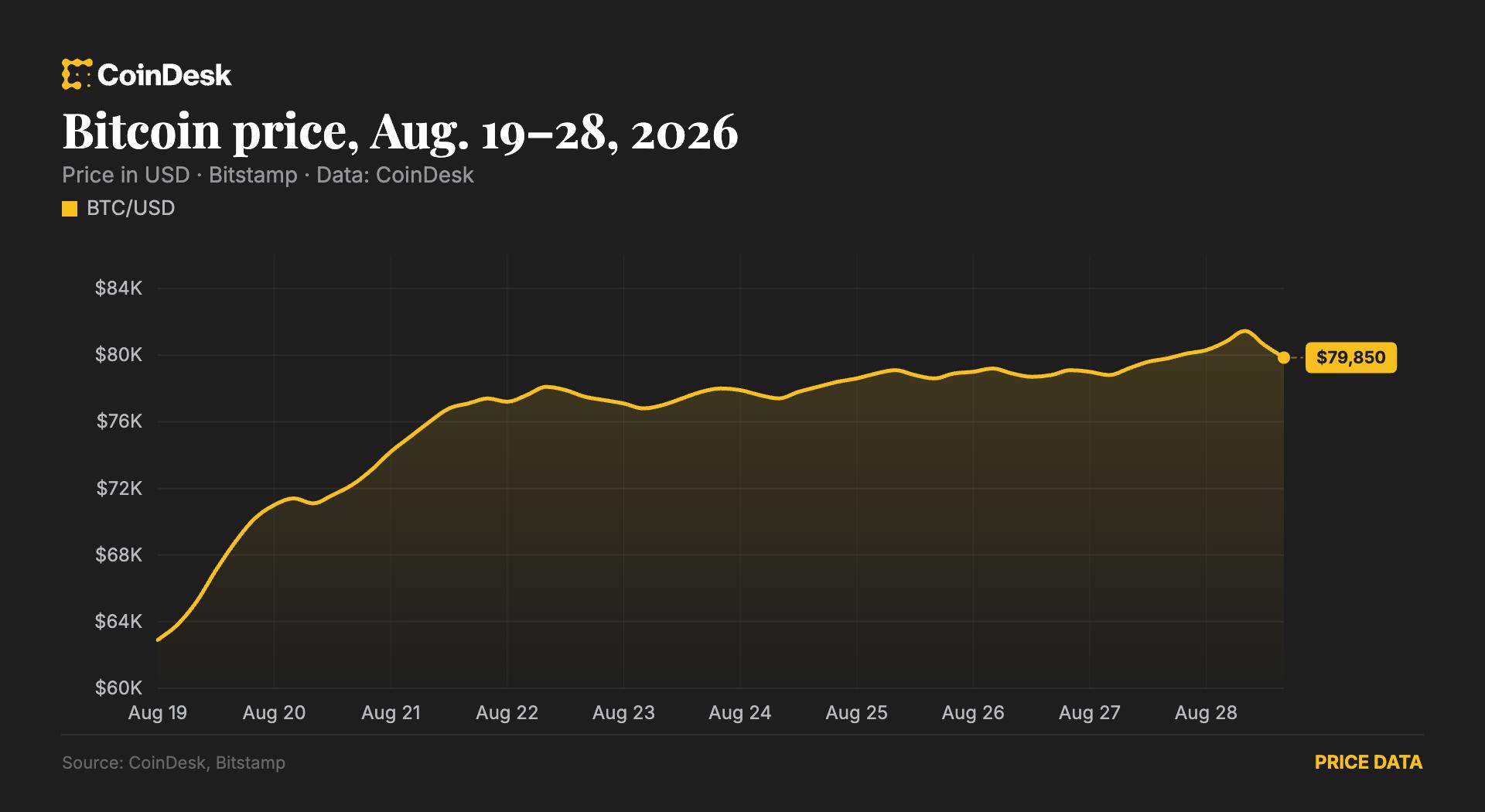
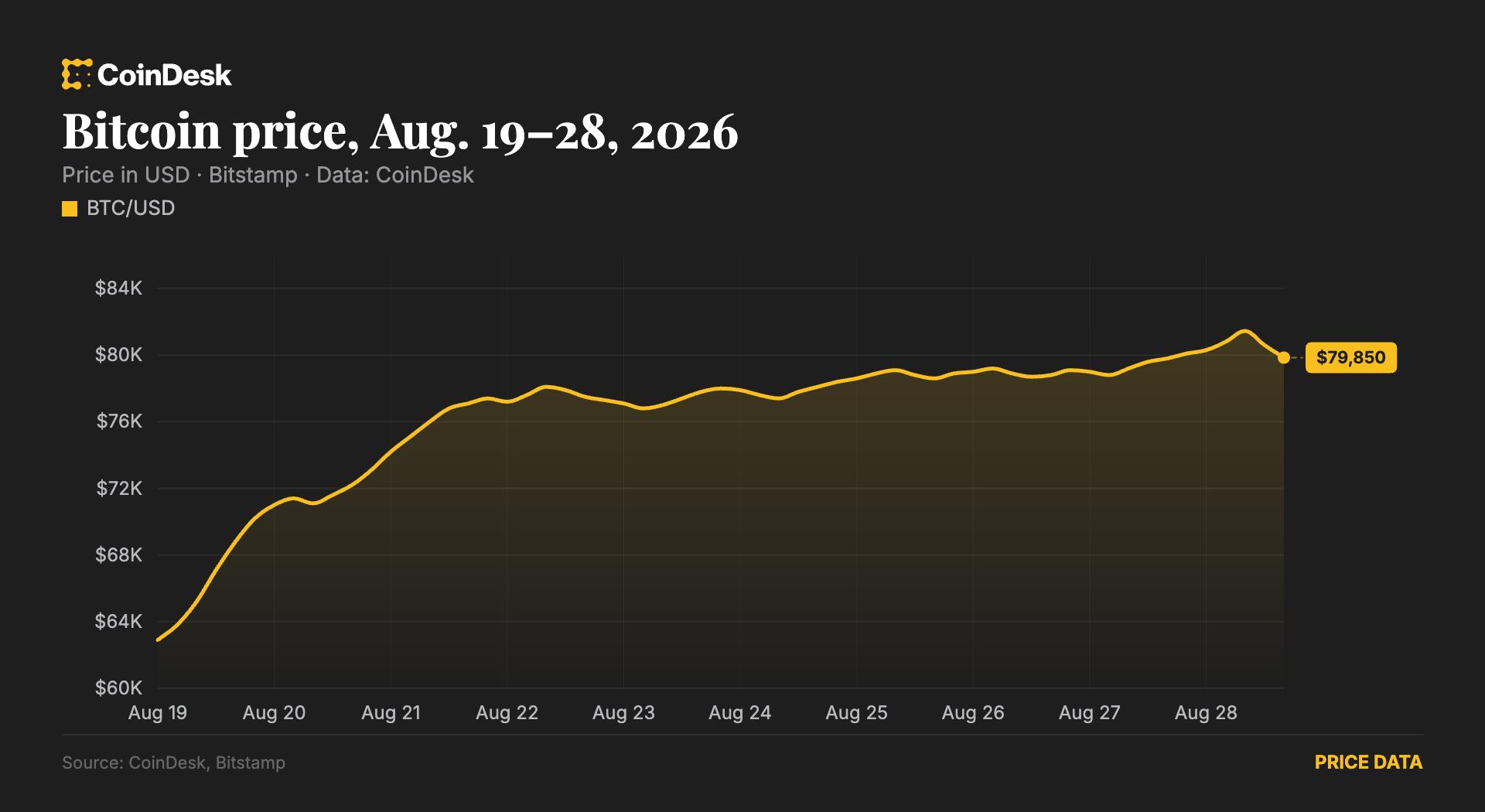
BTC briefly touched $81,455 overnight, its highest since May 15 as Nasdaq futures slipped and gold extended gains heading into the weekend.
On 26 August, the US Commerce Department released July data on the Personal Consumption Expenditures (PCE) index. Core PCE rose 0.2% month-on-month and 3.3% year-on-year, in line with market expectations. Ellen Zentner, Chief Economic Strategist at Morgan Stanley Wealth Management, noted that the modest upside surprise in inflation was not significant enough to shift the balance of expectations ahead of the Federal Reserve’s September meeting.
Earlier, on 19 August, minutes from the Fed’s July meeting showed that policymakers remained open to further rate increases if inflationary pressures persisted, with three committee members having already voted in favour of a hike. Against this backdrop, Treasury yields remain close to multi-year highs, keeping rate expectations tilted towards the possibility of further tightening.
Technical Analysis of Dow Jones
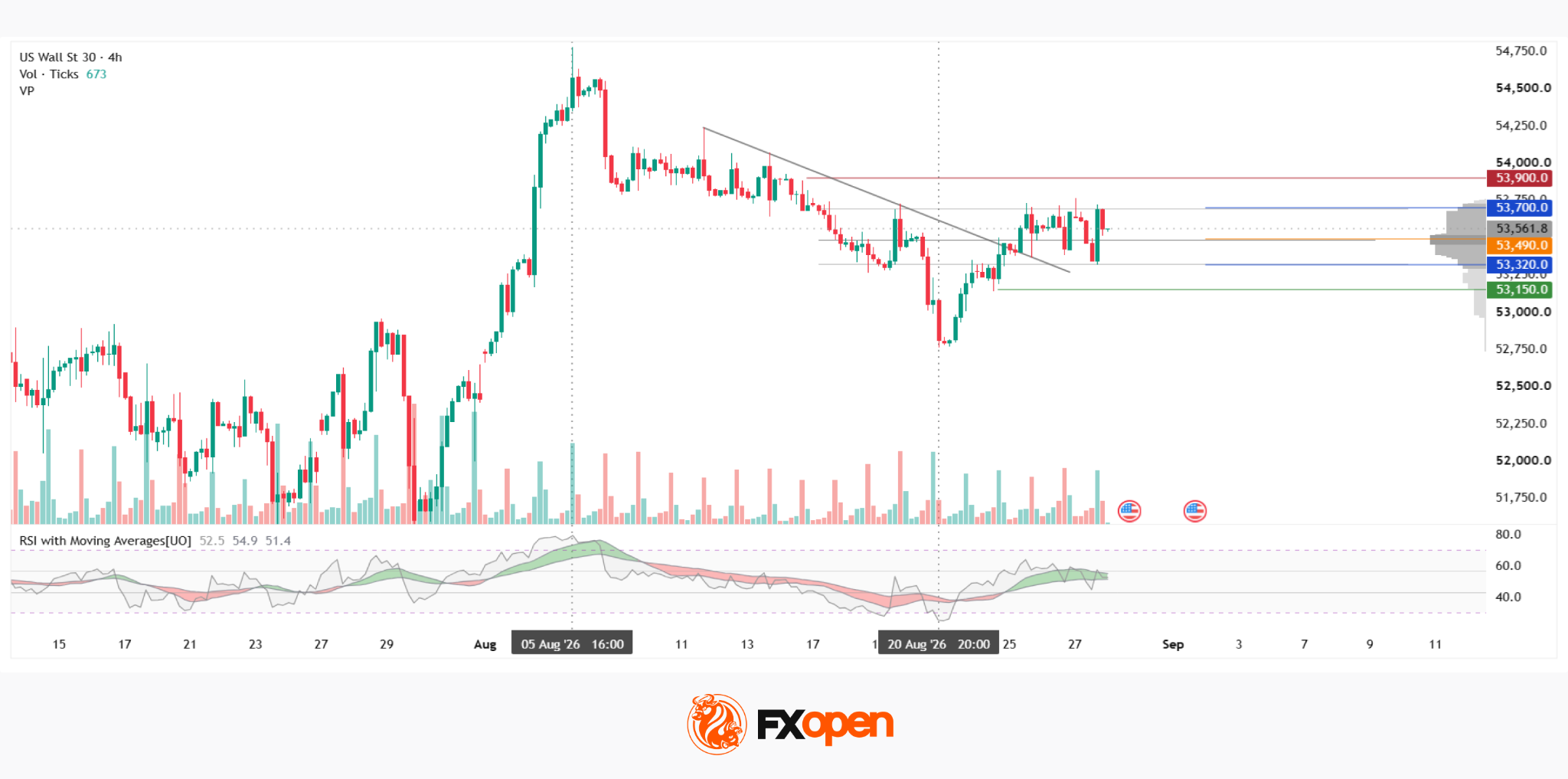
The four-hour Dow Jones chart (WS30m on FXOpen) shows a short-term downtrend, with prices steadily declining from a local peak around 54,700 and establishing a descending trendline in the process.
On 25 August, the index moved beyond the trendline and subsequently formed the current market profile. The index is now trading between the Point of Control (POC) at 53,490 and the upper boundary of the profile at 53,700.
If the breakout develops into a sustained advance, the next significant level to watch is the red resistance area around 53,900.
Conversely, if the trend breakout proves to be false and the decline resumes, the price would first need to move through the POC at 53,490 and then break below the lower profile boundary at 53,320. Only after clearing this area would the path towards the green support level around 53,150 become more open.
The RSI + MAs indicator currently shows readings of 52, 55 and 51. The oscillator and both moving averages remain within the neutral zone, although the moving averages are still displaying a bullish signal.
Key Takeaways
The attempted break above the descending trendline is taking place within a dense market-profile area, providing no clear confirmation of a sustained move in either direction.
The index’s next move could depend on whether the current divide in expectations surrounding the Fed’s September decision persists or whether incoming economic data shifts the balance decisively in one direction.
Trade global index CFDs with zero commission and tight spreads (additional fees may apply). Open your FXOpen account now or learn more about trading index CFDs with FXOpen.
This article represents the opinion of the Companies operating under the FXOpen brand only. It is not to be construed as an offer, solicitation, or recommendation with respect to products and services provided by the Companies operating under the FXOpen brand, nor is it to be considered financial advice.

Thunderstorm warning for Bolton which could lead to distruption

Why Imax hasn’t lured a buyer despite its box office boom
Solana’s (SOL) Strong Rally, The Latest Ethereum (ETH) Forecasts, and More: Bits Recap August 28





-

 Fashion7 days ago
Weekend Open Thread: Madewell – Corporette.com
-

 Crypto World3 days ago
SpaceX stock could rise 75% to $240, JPMorgan says
-

 Business6 days ago
Musk’s Tesla, SpaceX Confirm $16.8 Billion ‘Terafab’ Chip Plant as World’s Largest Building in Texas
-

 Crypto World6 days ago
anatomy of crypto’s biggest liquidation event since 2021
-

 Crypto World3 days ago
A $30 Billion AI Fund Implodes, Now the SEC Is Investigating Wall Street’s Role
-

 Politics6 days ago
6 months on, Irish renters crushed by effects of government housing bill
-

 Crypto World2 days ago
Did Trump Just Move SpaceX Stock With One Truth Social Post?
-

 Crypto World2 days ago
Warsh Jackson Hole keynote puts financial innovation first
-

 Business5 days ago
Mystery AI Model ‘Ox Alpha’ Draws Developers With Free Access as Chinese Lab Origins Remain Debated
-
 NewsBeat6 days ago
The ‘Lucky Dip Gang’ causing carnage for clicks: After five thugs were killed speeding in the wrong direction on a motorway, GUY ADAMS investigates a sick new trend… and why police aren’t even allowed to pursue them
-
 Crypto World7 days ago
Nvidia Stock Suffers Longest Losing Streak Since 2022: Will Q2 Earnings End It?
-

 Business2 days ago
Walmart takes aim at younger shoppers with new fashion brand
-

 Business4 days ago
Moderna CEO warns China is pouring state money into mRNA technology
-

 Business4 days ago
NVIDIA Stock Drops Nearly 2 Percent to $210 on Seventh Losing Day Ahead of Critical AI Earnings
-

 Tech7 days ago
Unitree’s New Superman Robot Claims to Outjump and Outrun Every Human, Usain Bolt Included
-

 Business6 days ago
Will Tesla Stock Be Higher or Lower a Year From Now? Here’s What Wall Street Analysts Are Saying
-

 Business7 days ago
UK firms in critical financial distress rise 9% to 53,756
-

 Sports5 days ago
Deshaun Watson fires back at Browns fans after being booed: ‘It’s a disrespectful thing’
-
 Crypto World4 days ago
$92 Billion Nvidia Earnings Could Make or Break the AI Trade
-
 Crypto World5 days ago
Google Gemini AI Predicts Ethereum Could Become the Trade Retail Misses in 2026
You must be logged in to post a comment Login