
Crypto World
What is a public key in crypto? Keys and signatures explained



A public key is the cryptographic counterpart to a private key. Together they let you prove ownership of cryptocurrency without revealing the secret that controls it.
Summary
- A public key is a large number derived mathematically from a private key using elliptic curve multiplication, a one-way function that is fast to compute forward but practically impossible to reverse.
- Bitcoin and Ethereum both use the secp256k1 elliptic curve, which produces 256-bit private keys and 512-bit uncompressed public keys (or 257-bit compressed public keys).
- A wallet address is not the same as a public key; the address is a shorter, hashed version of the public key designed to be easier to share and more resistant to certain theoretical attacks.
- The private key signs transactions, the public key verifies those signatures, and the address receives funds. Losing the private key means permanent loss of access; sharing the public key or address carries no risk to fund security.
- The July 2026 Coldcard firmware vulnerability, which exposed weak private key generation affecting $116 million in bitcoin, underscores why proper key generation and storage remain the most critical aspects of self-custody.
Public key cryptography is the foundation of every cryptocurrency transaction, yet most users never interact with their public key directly. They see wallet addresses, scan QR codes, and confirm transfers without understanding the mathematical layer that makes trustless ownership possible.
That layer matters because understanding it changes how you think about security. A public key is not a password. It is not a secret. It is a number that you can share with anyone, and from which no one can derive the private key that controls your funds. That asymmetry, easy to go one way but impossible to go back, is what allows strangers on the internet to send each other money without trusting a bank, a government, or each other.
How key pairs work
Every cryptocurrency wallet is built on a key pair: one private key and one public key. The private key is a randomly generated number, typically 256 bits long, which means it is one of roughly 10 to the power of 77 possible values. For context, the estimated number of atoms in the observable universe is around 10 to the power of 80. The keyspace is large enough that guessing a specific private key by brute force is not a practical concern with current or foreseeable technology.
The public key is derived from the private key through elliptic curve multiplication. Bitcoin and Ethereum both use a specific curve called secp256k1. The private key is multiplied by a fixed point on this curve called the generator point, and the result is another point on the curve. That result is the public key.
The critical property is that this multiplication is a one-way function. Given a private key, computing the public key takes a fraction of a second. Given only the public key, computing the private key requires solving the elliptic curve discrete logarithm problem, which has no known efficient solution. This asymmetry is the entire basis of cryptocurrency security.
Public key versus wallet address
A common misconception is that a wallet address and a public key are the same thing. They are not. The address is derived from the public key through one or more rounds of hashing, a process that shortens the output and adds an extra layer of security.
In Bitcoin, the process works as follows. The 512-bit uncompressed public key (or 257-bit compressed public key) is run through SHA-256, then through RIPEMD-160, producing a 160-bit hash. A version byte is prepended, a checksum is appended, and the result is encoded in Base58Check format. The final output is the familiar Bitcoin address starting with 1, 3, or bc1.
In Ethereum, the process is simpler. The 512-bit public key is run through Keccak-256 (a variant of SHA-3), and the last 20 bytes (160 bits) of the hash become the address. A “0x” prefix and an optional EIP-55 checksum are added to produce the familiar Ethereum address.
The reason for hashing the public key into an address is partly practical (shorter strings are easier to share) and partly defensive. If quantum computers ever become capable of breaking elliptic curve cryptography, they would need the public key, not the address, to derive the private key. Addresses that have never been used to send a transaction have never had their public key exposed on-chain, adding a theoretical layer of quantum resistance.
How digital signatures prove ownership
When you send cryptocurrency, you are not moving coins from one location to another. You are creating a message that says “I authorize the transfer of X amount from my address to this recipient” and signing that message with your private key. The signature proves that the person who created the message controls the private key associated with the sending address, without revealing the private key itself.
The verification process uses the public key. Anyone running a node on the network can take the transaction message, the digital signature, and the sender’s public key, and run a mathematical verification that confirms the signature was produced by the corresponding private key. If the verification passes, the transaction is valid. If it fails, the transaction is rejected.
This is why losing a private key is catastrophic. No private key means no ability to produce valid signatures, which means no ability to authorize transactions from that address. The funds remain on the blockchain, visible to everyone, but permanently inaccessible. There is no “forgot password” recovery mechanism because there is no central authority that holds a backup.
The key generation chain
In modern wallets, individual private keys are not generated independently. Instead, a single master seed produces all keys in the wallet through a deterministic process defined by BIP-32 (hierarchical deterministic wallets) and BIP-39 (mnemonic seed phrases).
The process begins with entropy, a source of randomness. The wallet software or hardware device generates a random number, typically 128 or 256 bits. This entropy is encoded as a mnemonic phrase of 12 or 24 words drawn from a standardized list of 2,048 words. The mnemonic phrase, combined with an optional passphrase, is run through a key derivation function (PBKDF2) to produce a 512-bit master seed.
From the master seed, a hierarchical tree of key pairs is derived. Each branch of the tree can generate billions of unique private keys and their corresponding public keys and addresses. This is why a single seed phrase can recover an entire wallet with all its addresses: the seed deterministically regenerates every key pair in the hierarchy.
The security implication is that the seed phrase is the root of all keys. Anyone who obtains the seed phrase can regenerate every private key, every public key, and every address the wallet has ever used or will ever use. Protecting the seed phrase is equivalent to protecting every key pair in the wallet simultaneously.
Compressed versus uncompressed public keys
Early Bitcoin software used uncompressed public keys, which include both the x and y coordinates of the point on the elliptic curve. An uncompressed public key is 65 bytes: a 1-byte prefix (0x04) followed by 32 bytes for the x coordinate and 32 bytes for the y coordinate.
Because the elliptic curve equation means that for any given x coordinate there are only two possible y values (one even, one odd), it is sufficient to store just the x coordinate and a single bit indicating whether y is even or odd. This produces a compressed public key of 33 bytes: a 1-byte prefix (0x02 for even y, 0x03 for odd y) followed by 32 bytes for the x coordinate.
Compressed keys save space in transactions, which reduces fees. Since 2012, most Bitcoin software defaults to compressed public keys. Ethereum uses uncompressed public keys internally but strips the prefix byte in address derivation, using only the 64-byte x and y values.
The distinction matters for compatibility. A compressed and uncompressed public key derived from the same private key produce different addresses in Bitcoin. Importing a private key into a wallet that uses a different compression format than the original wallet will generate a different address, which can cause confusion if funds were sent to the other format’s address.
Real world key security failures
The theory behind public key cryptography is sound, but implementation failures have caused significant losses.
In July 2026, researchers discovered that the Coldcard hardware wallet had been generating weak private keys for five years. A build flag in the firmware told the device to skip its dedicated hardware randomness chip, resulting in predictable entropy. An attacker reverse-engineered the weakness and began draining wallets on July 30, emptying approximately $116 million in bitcoin before the vulnerability was publicly disclosed.
The lesson is that the security of a key pair depends entirely on the quality of the randomness used to generate the private key. A theoretically unbreakable 256-bit key is worthless if the random number generator is flawed, biased, or predictable. This is why reputable hardware wallets use dedicated true random number generators and allow users to add their own entropy (such as dice rolls) as an additional safeguard.
Other historical incidents include the 2013 Android SecureRandom vulnerability, which caused multiple Bitcoin wallets to generate duplicate random numbers, allowing attackers to compute private keys from transaction signatures. The Profanity vanity address generator was exploited in September 2022 when researchers discovered that its key generation used a 32-bit seed, reducing the effective keyspace from 2 to the power of 256 down to 2 to the power of 32, roughly 4 billion possibilities that could be brute-forced in minutes.
Public keys and smart contracts
On smart contract platforms like Ethereum, public key cryptography serves a dual purpose. It secures externally owned accounts (EOAs), the standard user wallets controlled by private keys, and it authenticates messages signed by those accounts when they interact with smart contracts.
When a user calls a function on a smart contract, the transaction includes the digital signature produced by the user’s private key. The Ethereum Virtual Machine verifies this signature against the sender’s public key before executing the function. This is how a smart contract knows that the person calling “transfer 100 USDC to address X” is actually the owner of the tokens being transferred.
Smart contract wallets (account abstraction wallets introduced by ERC-4337) can modify this model. Instead of relying solely on a single private key, a smart contract wallet can require multiple signatures, biometric authentication, social recovery, or spending limits enforced by code. The public key remains part of the system, but the rules governing what constitutes a valid authorization become programmable.
Custodial versus self-custodial key management
On a centralized exchange, the exchange holds the private keys and users access their funds through traditional authentication (username, password, two-factor codes). The user never sees a public key or private key. The exchange signs transactions on the user’s behalf.
In self-custody, the user holds the private key (or the seed phrase that generates it) and is solely responsible for its security. The public key and address are derived locally, and no third party has access to the signing capability.
The tradeoff is clear. Custodial solutions are convenient but introduce counterparty risk: if the exchange is hacked, insolvent, or freezes withdrawals, the user’s funds are at risk. Self-custody eliminates counterparty risk but introduces operational risk: if the user loses the seed phrase, misstores it, or falls victim to phishing, the funds are gone permanently.
Multisignature setups split the difference by distributing key management across multiple parties or devices. A 2-of-3 multisig requires any two of three private keys to sign a transaction, so losing one key does not result in permanent loss and compromising one key does not give an attacker control.
What this article does not cover
This article does not cover post-quantum cryptography schemes such as lattice-based signatures, which are being researched as replacements for elliptic curve cryptography in the event that large-scale quantum computers become viable. It does not cover the mathematics of elliptic curves beyond the conceptual level. It does not cover specific wallet setup guides, as those vary by product and change frequently.
Practical checks for protecting your keys
Never share your private key or seed phrase. No legitimate service, support agent, or airdrop will ever ask for them. Any request for these credentials is a scam without exception.
Verify address format before sending. Clipboard malware can replace a copied address with an attacker’s address. Always visually confirm the first and last several characters of an address after pasting it.
Use hardware wallets for significant holdings. Hardware wallets generate and store private keys on a dedicated chip that never exposes them to the internet-connected device. Research the manufacturer’s track record with entropy generation before purchasing.
Add your own entropy when possible. Some hardware wallets allow users to supplement the device’s random number generator with manually entered randomness such as coin flips or dice rolls. This mitigates the risk of a flawed hardware random number generator.
Keep seed phrase backups in multiple secure locations. A single copy stored in one location is vulnerable to fire, flood, or theft. Metal seed phrase backups resist environmental damage better than paper.
What is a public key in cryptocurrency?
A public key is a large number derived from a private key using elliptic curve multiplication. It serves as the cryptographic identity that verifies transaction signatures without revealing the private key. Anyone can see a public key, and sharing it does not compromise fund security.
Is a public key the same as a wallet address?
No. A wallet address is derived from the public key through one or more rounds of cryptographic hashing. The address is shorter and easier to share. In Bitcoin, the same private key can produce different addresses depending on whether compressed or uncompressed public keys are used.
Can someone steal my crypto if they know my public key?
No. The public key is designed to be shared. Deriving the private key from the public key requires solving the elliptic curve discrete logarithm problem, which has no known efficient solution with current computing technology.
What happens if I lose my private key?
The funds associated with that key become permanently inaccessible. There is no recovery mechanism because cryptocurrency networks have no central authority that stores backups. This is why seed phrase backups are critical for self-custody wallets.
What is the difference between a public key and a private key?
The private key is a randomly generated secret number used to sign transactions. The public key is derived from the private key and is used to verify signatures. The private key must remain secret; the public key can be shared freely.
How does a seed phrase relate to public and private keys?
A seed phrase (12 or 24 words) encodes the master entropy from which all private keys in a wallet are deterministically derived. Each private key produces a corresponding public key and address. Protecting the seed phrase protects every key pair the wallet will ever generate.
What elliptic curve do Bitcoin and Ethereum use?
Both Bitcoin and Ethereum use the secp256k1 elliptic curve. It produces 256-bit private keys and 512-bit uncompressed public keys (or 257-bit compressed public keys). The curve was chosen for its efficiency and well-understood security properties.
Could quantum computers break public key cryptography?
Theoretically, a sufficiently powerful quantum computer running Shor’s algorithm could derive a private key from a public key. However, no such quantum computer exists as of 2026. Addresses that have never been used to send transactions have not exposed their public key on-chain, adding a layer of protection. Post-quantum signature schemes are being researched as future replacements.
Disclaimer: This article is for informational purposes only and does not constitute financial, investment, or security advice. Cryptocurrency self-custody carries inherent risks. Always conduct your own research and follow current security best practices. Published August 24, 2026.



The CFTC entered the criminal Polymarket case against U.S. Army soldier Gannon Ken Van Dyke on Aug. 24 after a federal judge granted the regulator permission to file an amicus brief.
Summary
- Judge Margaret Garnett allowed the CFTC to file its contested amicus brief on August 24.
- Van Dyke may answer new CFTC arguments through a ten-page filing due September 9, 2026.
- Prosecutors allege thirteen Polymarket wagers generated approximately $409,881 using classified information before Maduro’s capture.
- The defense argues geopolitical event contracts are bets rather than swaps governed by federal commodities law.
- CFTC civil proceedings remain stayed pending resolution of the related federal criminal prosecution in Manhattan.
Van Dyke’s lawyers had opposed the request. They argued that the CFTC was attempting to defend its regulatory authority through the criminal prosecution while its parallel civil lawsuit remained paused.
Judge Margaret Garnett rejected the request to exclude the brief but said the court would give the regulator’s arguments “appropriate weight.” Van Dyke has pleaded not guilty to charges arising from Polymarket wagers that allegedly generated $409,881.
CFTC can defend its Polymarket interpretation
The CFTC requested permission to address Van Dyke’s argument that the Venezuela-related Polymarket contracts were bets rather than swaps regulated under the Commodity Exchange Act.
The regulator argues that event contracts can qualify as swaps when their value depends on events carrying financial, economic or commercial consequences. The Maduro contracts could have related consequences for Venezuelan bonds, oil prices and the country’s currency, according to the CFTC’s civil complaint.
Van Dyke’s attorneys contend that this interpretation stretches the swap definition beyond its statutory limit. They say the contracts were straightforward geopolitical wagers with no underlying financial product or commercial exposure.
“The CFTC is no sheep ‘friend of the Court’ here,” the defense wrote, describing the regulator as a “regulatory wolf.” The language represents legal advocacy, not a court finding.
The defense also disputes whether CFTC Rule 180.1, which prohibits fraud connected with swaps, can support the commodities fraud charge under the circumstances alleged.
Judge gives Van Dyke until September 9
Garnett added the CFTC’s proposed amicus brief to the criminal record. The order does not decide whether the contracts qualify as swaps or whether the disputed charges will survive.
The judge gave prosecutors and Van Dyke until Sept. 9 to answer any CFTC argument not already addressed in their motion-to-dismiss filings. Each optional response may contain no more than 10 pages.
The deadline makes the regulator’s swap interpretation part of the court’s consideration before it rules on dismissal. A decision against the CFTC’s position could narrow how federal commodities law applies to prediction markets.
Van Dyke’s criminal trial remains tentatively scheduled for Dec. 7. A status conference is expected on Sept. 28, although disputes involving classified evidence or the dismissal motion could alter that schedule.
Soldier allegedly earned $409,881 from 13 bets
The Justice Department alleges that Van Dyke participated in planning and executing Operation Absolute Resolve, the U.S. military operation that captured former Venezuelan President Nicolás Maduro on Jan. 3.
According to the federal indictment, Van Dyke placed approximately $33,934 through 13 Polymarket trades between Dec. 27 and Jan. 2. The markets covered Maduro’s removal, U.S. forces entering Venezuela, a potential invasion and presidential war powers.
Prosecutors allege that the trades produced approximately $409,881 in profit after several contracts resolved in Van Dyke’s favor. They also accuse him of transferring proceeds through a foreign cryptocurrency vault and attempting to conceal accounts linked to the activity.
Those allegations remain unproven. Van Dyke faces charges including commodities fraud, wire fraud, misuse and theft of government information, and conducting a monetary transaction involving allegedly criminal proceeds.
Civil Polymarket case remains paused
The CFTC brought a parallel civil action on April 23, its first insider trading case involving prediction-market event contracts. The regulator is seeking restitution, disgorgement, financial penalties, trading bans and an injunction.
The agency’s complaint invokes the “Eddie Murphy Rule,” which prohibits certain uses of misappropriated government information when trading swaps.
A federal judge has paused the parallel CFTC lawsuit until the criminal proceeding ends. Van Dyke’s lawyers argue that the regulator should defend its legal interpretation in that lawsuit rather than enter the criminal matter.
The dispute reaches beyond one trader. In related coverage, the CFTC has been developing updated federal rules for prediction markets as courts consider whether event contracts fall under federal derivatives law or state gambling regimes.


Standard Chartered Bank Hong Kong became the first bank to distribute HKDAP on Aug. 24, giving eligible institutional clients and partners access to Hong Kong’s first live regulated local-currency stablecoin.
Summary
- Standard Chartered became HKDAP’s first bank distributor, extending access to eligible institutional clients and partners.
- Anchorpoint holds one of two stablecoin issuer licences granted by Hong Kong’s regulator in April.
- HKDAP launched through controlled beta access on Ethereum for institutions and professional investors this month.
- Standard Chartered plans tokenized money market fund subscription and settlement services during fourth quarter 2026.
- Anchorpoint reported 522,000 HKDAP circulating as of August 19 during the limited beta rollout period.
Anchorpoint Financial issues HKDAP, short for “HKD At Par,” under licence FRS01 from the Hong Kong Monetary Authority. Standard Chartered is Anchorpoint’s largest shareholder and established the company with HKT and Animoca Brands.
Hong Kong granted two stablecoin issuer licences in April, one to Anchorpoint and another to HSBC. That distinction is important: the regulator licensed two issuers, but HSBC had not publicly launched its stablecoin when Standard Chartered announced its distribution service.
Standard Chartered adds a bank channel for HKDAP
Standard Chartered joins HashKey Exchange and OSL as an authorized HKDAP distributor. HashKey and OSL began offering beta access earlier in August, before Standard Chartered became the first conventional bank to join the distribution network.
Eligible clients can use authorized distributors to convert Hong Kong dollars into HKDAP and redeem the tokens for fiat currency. Access remains limited to institutions, corporate customers and professional investors during the current phase.
As previously reported, Anchorpoint launched HKDAP through a phased institutional rollout. HashKey subsequently completed an initial minting and redemption transaction for approved clients.
HKDAP operates on Ethereum and is intended to maintain a value of HK$1 per token. Hong Kong’s Stablecoins Ordinance requires licensed issuers to maintain adequate reserves, segregate those assets and process redemptions at par.
Anchorpoint’s published figures showed 522,000 HKDAP in circulation as of Aug. 19. That limited supply reflects the project’s controlled beta status rather than broad consumer adoption.
HKDAP will target tokenized fund settlement
Standard Chartered plans to introduce subscription and settlement services for tokenized money market funds during the fourth quarter. The bank said it would work with international and Hong Kong asset managers.
A stablecoin can provide the cash side of a tokenized fund transaction on the same blockchain infrastructure used to record the fund units. This can reduce the timing gap between transferring an investment and completing its payment.
Standard Chartered said the service could support faster settlement, but the bank has not named participating managers or disclosed expected transaction volumes.
The project builds on the bank’s existing tokenization work. Standard Chartered already provides infrastructure for China Asset Management Hong Kong’s tokenized money market fund and previously tested tokenized deposit settlement through the HKMA’s Project Ensemble.
The bank will also test HKDAP for transfers between companies within its group. Further proposed applications include cross-border payments, treasury management and transfers outside conventional banking hours.
Those uses remain pilots or planned services. Standard Chartered has not announced a commercial launch date beyond the Q4 target for tokenized fund subscriptions and settlement.
Hong Kong licensed two stablecoin issuers
The HKMA awarded its first licences to Anchorpoint and HSBC on April 10 after receiving 36 applications. The regulator has said it will remain selective when considering further approvals.
Anchorpoint adopted a business-to-business-to-consumer distribution model. Instead of serving every holder directly, it works with regulated banks, exchanges and commercial partners that provide access and fiat conversion.
In related coverage, HashKey became an authorized distributor for institutional HKDAP access. OSL also provides distribution, liquidity and conversion services during the beta period.
The HKMA has warned investors about unrelated tokens using the HKDAP name. Its April warning said tokens carrying HKDAP or HSBC tickers were circulating without connections to the licensed issuers.
Users must therefore verify contract addresses and access the stablecoin through Anchorpoint’s authorized channels.
Independent review raises contract questions
Security researcher Yajin Zhou published an independent review of HKDAP’s Ethereum contract after its beta launch. The analysis questioned elements of its custom approval, upgrade and access-control architecture.
The review claimed some compliance controls did not operate as expected, but the findings were not an HKMA enforcement determination or confirmed exploit.
No theft or loss was identified in the review. Anchorpoint had not published a detailed public response to the findings at the time of writing.
The next measurable developments will be named asset-manager partnerships, actual fund settlement transactions and updated reserve disclosures. Anchorpoint has also said wider access, including a possible retail expansion, may arrive by the end of 2026, subject to market conditions and regulatory requirements.
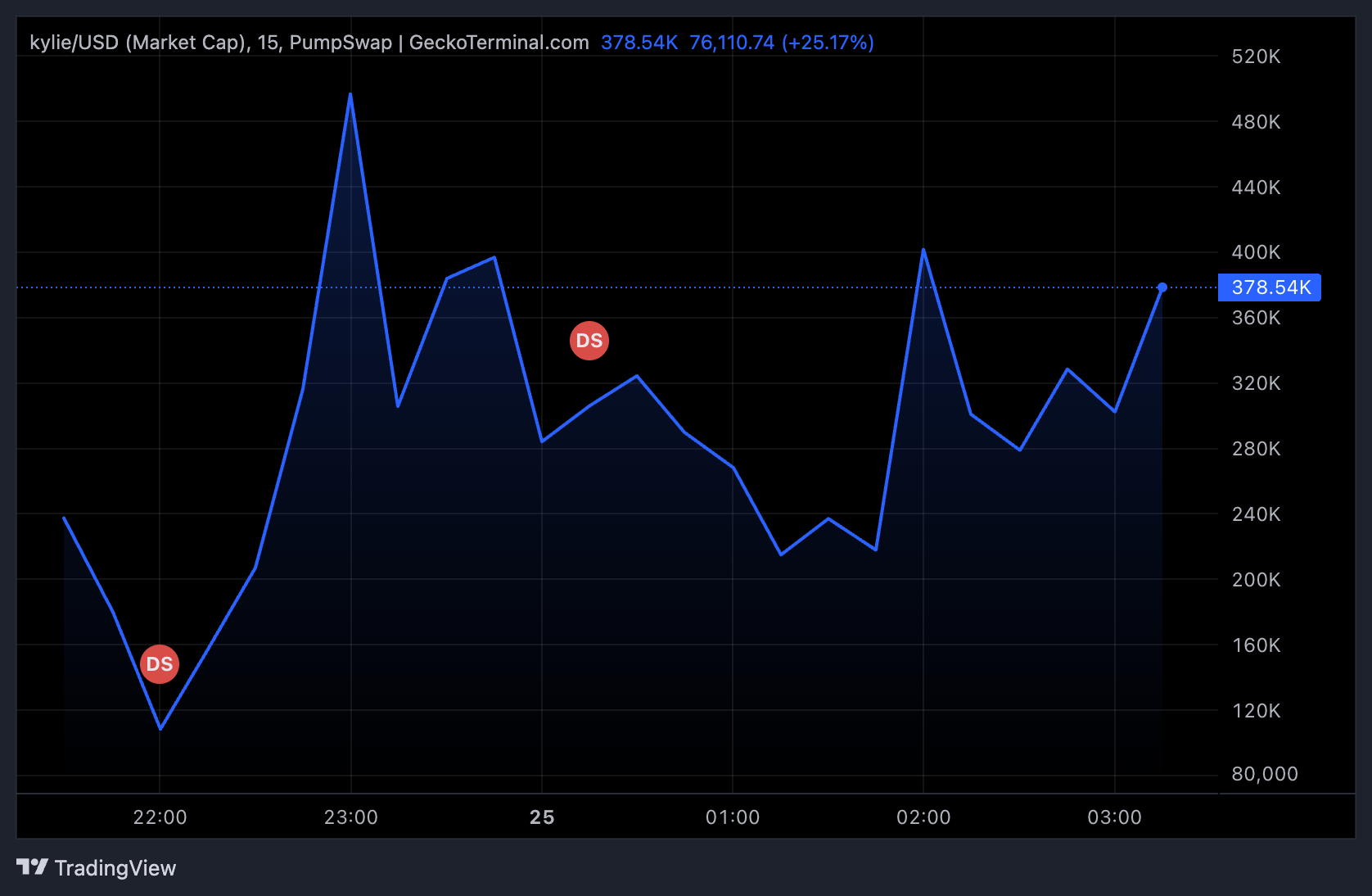
Kylie Jenner’s X account was reportedly hacked and used to promote a meme coin called kylie. The token’s market capitalization peaked at nearly $1.19 million before falling by roughly 68%.
The posts no longer appear on the account, which has 39.5 million followers. Several other kylie tokens are now trading on the Solana (SOL) network, each only a few hours old.
Deleted Posts Sent kylie Token Past $1 Million
The account first posted a casual message about trading, then pointed followers to a Pump.fun profile named cutekjenner. A second post carried the ticker and a contract address.
Follow us on X to get the latest news as it happens
The two posts drew roughly 50,000 and 33,000 views before deletion. Community accounts flagged the abrupt tone as a sign of compromise.
The token climbed to a $1.19 million market capitalization on PumpSwap, according to GeckoTerminal data.
At press time, its market cap stood near $378,500, with $6.1 million in 24-hour trading volume. Liquidity now sits near $58,900, held by roughly 3,700 holders.

Account Hacks Keep Turning Into Meme Coin Rug Pulls
The deleted posts left a trail of imitators behind them. Traders have minted a cluster of rival Kylie-themed tokens on Solana, most of them worth very little.
One rival kylie token, carrying the same profile image, reached a $1.04 million market cap on $6.72 million in trading volume. Others sit between $29,800 and $370,300. None had traded for longer than seven hours at the time of writing.

The playbook mirrors recent takeovers. Attackers used the SpaceX and Starlink accounts in July to push SCATMAN, netting around $125,000.
In late July, Robinhood CEO Vlad Tenev’s account was compromised, and the attacker cleared roughly $1.2 million through Vladhood.
Senator Cynthia Lummis’ compromised account then promoted a fake USA token, while actor Dean Norris disowned a DEAN coin in January 2025.
Subscribe to our YouTube channel to watch leaders and journalists provide expert insights
The post Kylie Jenner's X Account Reportedly Hacked to Push Meme Coin That Crashed 68% appeared first on BeInCrypto.

Strive, the Nasdaq-listed firm known for a corporate Bitcoin treasury program, bought 1,110 Bitcoin for roughly $81.5 million in the week of Aug. 17–Aug. 21, according to a filing with the US Securities and Exchange Commission. The purchases brought its total holdings to 21,356 BTC.
In the same filing, Strive said it paid an average of $73,409 per Bitcoin (including fees and expenses) for the tranche acquired during that period. Cash and cash equivalents increased by $17.1 million to $171.9 million, while its Class A shares outstanding rose by 3.65 million to 79.89 million.
Key takeaways
- Strive added 1,110 BTC between Aug. 17 and Aug. 21, lifting total holdings to 21,356 BTC.
- The company’s average purchase price was $73,409 per BTC (with fees/expenses), versus Bitcoin trading near the $79,000 level on Monday.
- Strive’s latest buying strengthens its position among public corporate Bitcoin holders, moving it into the top tier tracked by BitcoinTreasuries.NET.
- Strive also reported improvements in liquidity (cash up $17.1 million) alongside share growth during the same reporting window.
- Separately, Strive’s SATA preferred shares returned to the company’s $99–$101 target range after trading near $83.30 in late June.
Another tranche adds to Strive’s corporate Bitcoin stack
The latest treasury update underscores how Strive continues to pursue a steady acquisition cadence. The SEC filing details that Strive paid $73,409 per BTC on average for the 1,110 coins purchased between Aug. 17 and Aug. 21.
That average cost was below the approximate $79,000 Bitcoin price level referenced on Monday in the company’s disclosure context, meaning the new buys were made at a discount to the market price at the start of the week. While the filing does not frame the transactions as a hedging strategy, investors generally focus on the relationship between treasury purchase prices and the prevailing spot market as a signal of how aggressively a company is adding during different market regimes.
BitcoinTreasuries.NET ranks Strive among the largest publicly traded corporate holders. Based on that site’s data, Strive moved to the seventh-largest position behind Bullish and ahead of SpaceX.
Why investors track Strive alongside its asset management business
Strive’s corporate treasury is only one part of its broader footprint. The company operates a Bitcoin-focused treasury strategy alongside an asset management business that, according to its own overview page, manages nearly $3 billion across exchange-traded funds and a direct-indexing platform.
The combination matters because it ties the company’s market positioning to both Bitcoin holdings and recurring business activity in capital markets products. For public-market investors, that dual exposure can influence how the equity trades: sentiment about corporate Bitcoin accumulation can amplify interest, while performance expectations for the asset management segment can affect overall valuation.
In addition to Bitcoin, Strive reported holding 505,000 shares of Strategy’s STRC preferred stock valued at $48.6 million as of Aug. 21, reflecting the cross-ecosystem nature of corporate Bitcoin finance. The disclosure also offers a reminder that corporate Bitcoin holders often maintain diversified positions across preferred structures, not just spot-equivalent BTC exposure.
SATA preferred shares return to the $100 target band
Beyond Bitcoin purchases, Strive’s filing and market commentary also draw attention to SATA, the company’s variable-rate perpetual preferred stock. SATA closed at $100.01 on Friday, returning to management’s targeted $99-to-$101 trading range after having fallen as low as $83.30 in late June.
Strive previously narrowed the trading range from $95–$105 to $99–$101 in March. The company also stated that it would not issue SATA through at-the-market or follow-on offerings below $100, a term designed to limit dilution at lower price levels and to support the intended trading band.
The instrument launched in November 2025, initially selling 2 million shares at $80 each for $160 million in gross proceeds. SATA’s structure includes a stated amount and an initial liquidation preference of $100 per share.
Operationally, Strive positions SATA as an income-oriented product, with a variable dividend rate intended to help keep the shares near $100. In April, the firm raised the annualized dividend rate to 13% and began switching from monthly to daily dividend payments starting June 16, per Strive’s SEC filings.
On Monday, SATA performance suggested renewed stability after a period of weakness. That pattern is important for investors who treat preferred shares differently from common stock: preferreds typically attract buyers seeking income characteristics, but their market price still depends on interest-rate mechanics, dividend expectations, and confidence that the issuer will maintain the design guardrails.
Cross-comparison with Strategy’s STRC and its BTC pause
Because SATA is similar to STRC, the variable-rate perpetual preferred stock issued by Strategy, many traders compare their pricing and dividend behavior. Strategy’s STRC was trading near $97 on Monday, below Strategy’s $100 target, while Strategy reported no Bitcoin purchases for the week ended Aug. 23, according to earlier coverage.
That contrast highlights a potential asymmetry in corporate accumulation behavior: Strive continued buying into the Aug. 17–Aug. 21 window, while Strategy’s most recently reported week showed no purchases. Even without making assumptions about future timing, investors typically watch for whether pause periods broaden or remain temporary—especially because accumulation schedules can affect how markets price treasury companies’ future cash flows, dividend capacity, and balance-sheet momentum.
Strive’s SATA returning toward its target band adds another layer to those comparisons. When preferred instruments track toward their $100 reference points, it may reinforce confidence in the issuer’s dividend-setting framework, even as the underlying Bitcoin market fluctuates.
Looking ahead, investors should monitor two things closely: whether Strive’s BTC purchasing pace continues across the next reporting windows, and whether SATA sustains its return to the $99–$101 band as dividend mechanics respond to broader market conditions. The next few filings should also clarify if corporate accumulation and preferred-share stabilization remain aligned—or diverge.


BNB Smart Chain (BSC) activated its Pasteur hard fork on Tuesday, closing bridge verification and validator authorization gaps while introducing a new route intended to fit more transactions into each block.
In a Tuesday post, BNB Chain confirmed that Pasteur was live on the BSC mainnet. The team said the upgrade strengthens the network’s bridge, staking and governance security while giving blocks more capacity without changing its 450-millisecond block time.
The upgrade combines three BNB Evolution Proposals. BEP-682 rejects duplicate validator entries during cross-chain light-block verification, while BEP-695 tightens controls involving validator key rotation, slashing and governance voting. Furthermore, BEP-675 changes how specialist builders submit blocks to validators.
The upgrade prevents validators from being counted more than once in bridge approvals, removes authority from old validator keys and blocks restricted addresses from voting, while aiming to fit more transactions into blocks during busy periods.
Pasteur targets fuller blocks
Under BSC’s previous block-building route, a builder executed transactions before submitting a proposed block, and the validator executed them again before signing it. BNB Chain said the repeated work took time away from builders operating within the network’s 450-millisecond block window, sometimes leaving blocks underfilled.
BEP-675 allows builders to submit blocks they have already executed. Validators check the proposed block against consensus rules, sign and broadcast it, then complete full execution verification afterward. Builders can also continue using the previous route, under which validators execute transactions before signing.
Related: BNB Chain pursues legal action after ex-employee’s memecoin launch
In tests conducted on QANet, an internal environment designed to mirror BSC’s geographically distributed validators, the new route increased throughput by about 88%, from 1,237 to 2,324 transactions per second. Average gas used per block rose from 46.35 million to 84.15 million while the block interval and 100-million gas limit remained unchanged.
BNB Chain cautioned that the figures came from a controlled test workload and were not mainnet measurements.
Pasteur follows previous upgrades centered on reducing block times. BSC’s Maxwell hard fork reduced its average block time from 1.5 seconds to about 0.8 seconds in June 2025, while BNB Chain said the subsequent Fermi upgrade brought it down to 450 milliseconds.
Magazine: MiCA cracks down on USDT in Europe… but no one else cares


Blockchain Association asked five U.S. agencies to clarify that customer identification requirements under the GENIUS Act apply to direct issuer relationships, not independent peer-to-peer stablecoin transactions.
Summary
- Blockchain Association supports primary-market identity checks but opposes extending them to peer-to-peer stablecoin transfers downstream.
- Five federal agencies proposed joint identification standards for permitted payment stablecoin issuers in June 2026.
- Issuers would collect names, addresses, birth or formation dates and identification numbers from customers directly.
- Final rules would take effect twelve months after issuance under agencies’ proposed compliance timeline currently.
- GENIUS Act generally begins restricting unlicensed U.S. payment stablecoin issuance on January 18, 2027, nationwide.
The industry group filed its comments by the Aug. 21 deadline and summarized its position on Aug. 24. It supported the proposal’s main approach but requested clearer definitions, less duplicated compliance work and explicit flexibility for digital identity tools.
FinCEN, the Office of the Comptroller of the Currency, Federal Reserve, Federal Deposit Insurance Corporation and National Credit Union Administration jointly proposed the customer identification program in June.
Stablecoin identity checks focus on direct customers
The proposed rule would require a permitted payment stablecoin issuer to establish a written, risk-based customer identification program. The program would form part of the issuer’s wider anti-money laundering and counterterrorist financing controls.
An issuer would generally collect a customer’s name, address, date of birth or formation and identification number before opening an account. It would then use documentary or non-documentary methods to form a reasonable belief that it knows the customer’s identity.
Records containing the identification information would generally remain on file for five years after the account closes. Verification records would remain available for five years after their creation.
As previously reported, U.S. regulators proposed bank-style identification requirements for stablecoin issuers. The proposal follows the GENIUS Act’s decision to treat permitted issuers as financial institutions under the Bank Secrecy Act.
Blockchain Association wants a firm P2P boundary
Blockchain Association agreed that the program should apply when an issuer maintains a direct customer relationship. Examples include issuing, redeeming, converting, repurchasing or providing custody for a payment stablecoin.
The organization said the rule should not reach transactions between users when the issuer does not intermediate, facilitate or approve them.
“They should not extend to downstream, peer-to-peer stablecoin transactions,” the Association argued, although agencies have not finalized that boundary.
The agencies’ proposal largely follows that position. It says simply owning or controlling an issuer’s stablecoin does not establish an account. A transfer involving an issuer only through its smart contract would also generally fall outside the proposed definition.
The proposal calls these interactions secondary-market activity. Examples include transfers from self-hosted wallets, purchases from intermediaries, exchange trades and direct payments to vendors.
The agencies estimated that approximately 99% of stablecoin transaction activity occurs in secondary markets. They acknowledged that issuers have limited ability to obtain identities for people using tokens without interacting with them directly.
Digital identity and duplicate checks remain contested
Blockchain Association also asked regulators to preserve flexibility in how issuers collect and verify information. It specifically supported digital identity tools and interoperable verification technology.
The proposal already permits documentary and non-documentary verification. It asks whether the final text should explicitly address digital identities or verifiable credentials and seeks feedback about their benefits and risks.
The group also requested protection against duplicative compliance obligations. Stablecoin issuers frequently interact with banks, exchanges and other regulated institutions that already conduct customer checks.
Under the proposed rule, an issuer could rely on certain work performed by another federally regulated financial institution. That reliance must be reasonable, governed by a contract and supported by annual certification. The issuer would remain responsible for compliance.
Blockchain Association wants the final rule to clarify how this arrangement works across affiliates, intermediaries and state-regulated entities.
Agencies must now complete the GENIUS Act rules
The public comment period closed Aug. 21. Regulators will now review submissions and may modify the definitions of “account,” “customer” and “digital asset service provider” before issuing a final rule.
The proposal gives issuers 12 months after the final rule’s publication to comply. No final publication date has been announced.
The wider GENIUS Act framework is expected to begin restricting unlicensed payment stablecoin issuance in the U.S. on Jan. 18, 2027. In related coverage, regulators missed the law’s original rulemaking deadline, shortening the preparation period available before the licensing framework begins.
The final customer identification rule must still operate alongside separate proposals covering licensing, reserves, anti-money laundering programs, sanctions compliance and lawful orders. The treatment of direct redemptions, digital credentials and reliance on third parties will determine how much additional work issuers face.

Ethereum saw one of its biggest weekly moves in years after staging an impressive 30% rally. The altcoin crossed $2,500 briefly, then slipped back slightly below that level.
New data shared by crypto analyst Ali Martinez suggests that ETH could be on a path toward $5,000 if it clears a major resistance zone.
Growing Buying Pressure
On August 19, Ethereum’s MVRV Ratio formed a golden cross above its 160-day moving average. Martinez also pointed to stronger whale accumulation. The number of addresses holding more than 10,000 ETH has increased by 1.74%. In fact, 17 new whale addresses joined the network over the past week.
At the same time, the token supply is moving off exchanges. More than 180,764 ETH, which is worth about $440 million, has been withdrawn over the past week. Martinez said the trend supports the case for increasing buying pressure.
However, it still faces a major resistance zone between $2,722 and $2,970. URPD data shows that 16.70 million were previously acquired within this range, which makes it a major supply wall. If Ethereum breaks through the zone, the next major MVRV Pricing Band is near $5,363, at the 2.4 level. The analysts also noted that a rejection could first send the altcoin back toward the Realized Price near $2,235 before a potential move toward the 2.4 MVRV band.
Besides, Ethereum has once again reached its 200-week moving average, which happens to be the 11th such instance over the past five years, ‘The Long Investor’ found, who pointed to a repeated pattern in the crypto asset’s price history. Each time it has moved below the 200 WMA, it has later returned to the moving average.
The analyst therefore called any percentage below the level “free money” and said investors cannot lose.
Additionally, ETH’s 50-week and 200-week moving averages are now at the same level. This creates a confluence zone. If the asset turns that level into support, the analyst expects bulls to take it back to its all-time highs. ETH remains a buy.
ETFs Draw Fresh Capital
US spot Ethereum ETFs have attracted their biggest inflows since October 2025, as demand picked up sharply during the mid-week. Net inflows stood at $30.85 million on Monday and $71.47 million on Tuesday. The pace increased after Wednesday’s announcement from the US Treasury Department. The department said it would double the maximum size of liquidity-support buybacks for longer-dated government debt, lifting them from $2 billion to at least $4 billion per operation. Wednesday recorded a capital influx of $189.15 million.
The figure rose again to $220.77 million on Thursday, while Friday recorded another strong $185 million in net inflows.
The post $5,000 Ethereum? Analyst Identifies the Levels That Could Decide ETH’s Next Move appeared first on CryptoPotato.
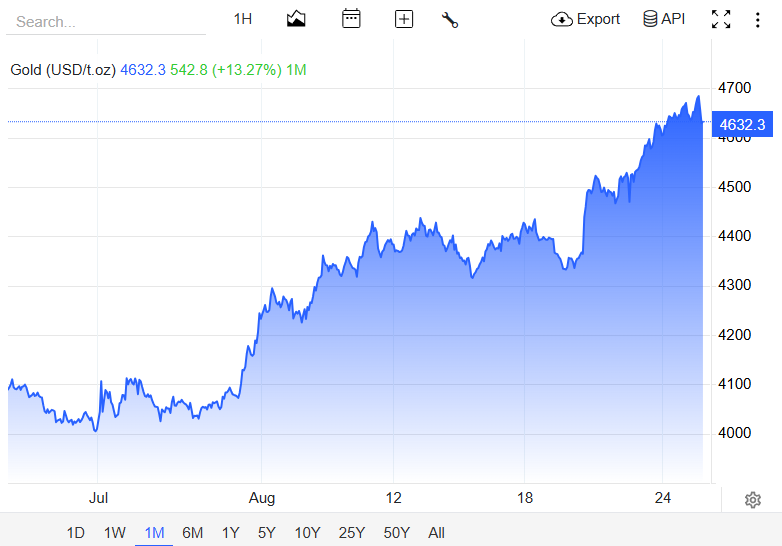
Bitcoin (BTC) climbed as high as $81,165 on Tuesday before easing to $80,792, up 4.5% in 24 hours, as gold pushed to its highest price in more than three months. Both assets are climbing on the same forces.
A weakening US dollar and falling bond yields are pulling money into both gold and Bitcoin at the same time. Investors are also watching for signals on where interest rates head next.
Gold Extends Its Rally Toward a 27-Year High
Spot gold gained 0.6% to $4,677.19 per ounce on Tuesday, its best level since mid-May, with the metal up around 13% so far this month. Gold futures also touched a three-month high near $4,720.

UOB analysts pegged the move as gold’s best monthly performance since 1999, based on data cited in the report. The last comparable monthly surge came in September 1999, when a group of European central banks agreed to cap their gold sales, ending a prolonged slide in prices.
This month’s rally has a different driver, with investors reacting to a weaker dollar and renewed concern over Fed independence rather than a central bank supply shock.
The Dollar and Yields Are Doing the Heavy Lifting
The US Dollar Index has fallen 0.8% this month, making dollar-priced gold cheaper for foreign buyers. Treasury yields have stayed elevated through most of August, but the government’s bond buyback plan has kept them roughly 3 basis points lower for the month, easing the opportunity cost of holding non-yielding bullion.
Bitcoin has moved in a similar direction. The asset briefly lost the $80,000 level last week as critics questioned the same Treasury buyback plan, before reclaiming it and pushing higher. A Strive executive recently pointed to Bitcoin’s breakout against gold as evidence the asset’s bear market has ended.

All eyes are now on Federal Reserve Chair Kevin Warsh, who speaks ahead of this week’s Jackson Hole symposium, an annual central bank gathering where officials often signal future policy direction.
A hawkish tone could stall both rallies. Citi analysts said a dovish surprise would instead push markets to refocus on the “debasement trade,” reflecting renewed concerns over Fed independence and US debt sustainability.
Bitcoin’s reaction to this week’s Fed signals remains an open question, given the asset’s history of diverging from traditional safe havens even when the macro setup looks aligned. Both markets are now pricing similar risks.
A softer dollar and capped yields have driven the rally so far, and the Fed’s next move could decide whether it extends or stalls.
The post Bitcoin Tops $81,000 as Gold Notches Its Best Month Since 1999 appeared first on BeInCrypto.


Bitcoin (BTC) just posted its strongest three-day rally since 2023, and two prominent investors now say the move reflects capital finally leaving an overheated artificial intelligence (AI) trade.
There has been much speculation about the role AI investing has played in Bitcoin’s own market. Now, with this rally, and concerns over an AI bubble, many are noting thw way the capital is rotating.
Big Names Now Confirm the Shift
Analysts have flagged this possible shift for months without confirming it was happening. Research firm K33 warned in June that Bitcoin was losing ground as institutions chased AI returns instead.
Investor Steve Eisman went further in July, saying he had sold his Google position to cut AI exposure, warning the entire market had become one crowded trade. Then, in late July, veteran macro investor Jordi Visser argued that AI’s easy-money phase was ending and that Bitcoin stood to benefit next.
Bill Miller IV, chairman and chief investment officer at Miller Value Partners, is now making the same case with fresh conviction. His comments this week, paired with Visser’s, mark two of the clearest signals yet from named, established investors that the rotation out of AI and into Bitcoin is actively underway, not just theorized.
He pointed to two forces behind the reversal. Growing doubt about AI capital expenditure returns is pushing “longdated thinkers” back toward crypto, he said.
At the same time, governments have intervened twice in quick succession. Japan and the US supported the yen in late July, and the US Treasury Department said last week it would double its long-dated bond buybacks, a move that eased pressure on yields and coincided with one of the largest short-liquidation waves crypto markets have seen.
A Rotation Play and a Hedge at Once
Miller argued Bitcoin is not just absorbing AI’s spillover capital. He framed it as a structural hedge against government debt, noting that this year’s $1.8 trillion US budget deficit alone exceeds Bitcoin’s entire market capitalization, a comparison meant to illustrate how much new currency is being created against Bitcoin’s fixed supply.
Miller said, arguing investors keep returning to harder, more transparent forms of money across market cycles.
That dual framing, tactical rotation target and long-term hedge, echoes recent reactions to the Treasury’s buyback plan from other prominent voices.
Robert Kiyosaki called the move another round of quantitative easing in disguise, while Arthur Hayes argued that suppressed yields are pushing capital out of fixed income and into scarce assets like Bitcoin and gold.
Whether the rotation holds depends on whether AI valuation concerns deepen from here or fade. Miller’s own view is that once governments start intervening to manage market stress, they rarely stop at one round.
The post Big Investors Admit Bitcoin Rally Signals Capital Fleeing an Overheated AI Trade appeared first on BeInCrypto.


Bernstein has maintained an Outperform rating and $140 price target on Circle Internet Group, implying about 59% upside after CRCL closed Friday at $87.98, as the brokerage expects USDC adoption to support the company even without passage of the CLARITY Act.
Summary
- Bernstein maintained its Outperform rating and $140 Circle price target, implying about 59% upside from Friday’s close.
- USDC supply increased by about $1.7 billion over the past week after nearly six months of largely flat growth.
- Adjusted stablecoin transaction volume is tracking at a $17 trillion annualized rate through July, according to Bernstein.
- Bernstein said Circle’s growth cycle can continue even if the CLARITY Act does not pass in September.
- Circle said more than 900 paid services use Agent Stack, with 99.3% of x402 agent payment volume settling in USDC.
Bernstein analysts led by Gautam Chhugani said in an Aug. 24 note that Circle’s next growth cycle does not depend on Congress passing the U.S. crypto market structure bill during the September session.
Circle shares gained more than 5% on Aug. 21 before closing at $87.98, according to Yahoo Finance data. The $140 target would put the stock about 59% above Friday’s closing price, although it remains below Bernstein’s previous $190 target from earlier this year.
Chhugani’s team tied its outlook to several sources of demand, including stablecoin payments, blockchain-based capital markets, tokenized assets and payments made by autonomous software agents.
The analysts also pointed to changes in global liquidity conditions. Bernstein said Bitcoin has benefited from demand for scarce assets while stablecoins have become another destination for dollars as the U.S. Treasury issues more short-term government debt.
USDC supply has started expanding again
After spending almost six months largely flat, USDC supply increased by about $1.7 billion during the past week, according to Bernstein.
The brokerage said USDC has become an important collateral asset across decentralized finance, tokenized equities, prediction markets and perpetual futures tied to real-world assets. Bernstein estimated that Circle’s stablecoin accounts for about 80% of decentralized exchange trading and finance volumes.
Stablecoin activity outside speculative trading is also expanding, according to the firm. Adjusted transaction volume, which Bernstein said excludes bots and high-frequency activity, reached about $11 trillion during 2025 and was running at an annualized pace of roughly $17 trillion through July 2026.
That pace represented an increase of about 60% from a year earlier, according to the brokerage.
Circle has also been expanding the institutional infrastructure through which businesses can use USDC. In July, crypto.news reported Circle received approval from the Office of the Comptroller of the Currency to establish Circle National Trust, a federally supervised national trust bank.
The approval allows the institution to provide digital asset custody services and could eventually place management of reserves backing USDC within the federally regulated entity, according to Circle.
Institutional access has expanded through banks and digital asset infrastructure providers as well. Circle said during its second-quarter results that Standard Chartered had introduced direct USDC minting and redemption access for institutional customers.
A separate July integration also brought USDC settlement through Fireblocks, allowing institutions to manage USDC balances across supported blockchains and route payments into local fiat currencies through Circle Payments Network.
Fireblocks said stablecoins accounted for 69% of transaction volume across its platform during the second quarter, while Circle said its Payments Network reached $14.7 billion in annualized transaction volume at the end of the quarter.
Circle sees agent payments as another USDC market
Machine-to-machine payments form another part of Bernstein’s Circle thesis, with the analysts pointing to USDC’s early lead in payments made through the x402 protocol.
Circle launched Agent Stack in May as infrastructure that allows software agents to hold assets, discover services and make programmable payments.
By the second quarter, Circle said the platform had more than 900 paid services, while 99.3% of x402 agent-payment volume was settling in USDC.
Independent data has also shown heavy USDC use in the category. A Keyrock report covered in May found that AI agents had settled $73 million across 176 million transactions over 12 months, with USDC handling 98.6% of those payments.
Circle has built Agent Wallets, an agent marketplace and nanopayment tools around the same use case. The company said Agent Stack lets developers set spending limits, allowlists and other controls while permitting agents to make USDC transactions without requiring a human to approve each payment.
For Bernstein, adoption of such services could create another source of stablecoin transaction demand outside cryptocurrency trading.
CLARITY Act outcome does not change Bernstein’s Circle thesis
Regulation remains one of the largest variables for Circle because U.S. lawmakers are still negotiating how stablecoin rewards and digital asset market structure should work.
Bernstein said the outcome of the CLARITY Act would not materially change its investment case.
“We believe, this growth cycle is independent of the Clarity Act passing in the September session,” the analysts wrote.
The brokerage said failure to secure Senate support during the expected Sept. 15 vote could prompt the Securities and Exchange Commission and Commodity Futures Trading Commission to take a larger role in providing regulatory guidance.
“We believe, the SEC/CFTC intervention would accelerate if the Senate does not support Clarity in the Sept. 15 vote,” Bernstein said.
Stablecoin rewards remain one of the contested parts of the legislation. Under the scenario outlined by Bernstein, failure of the bill would leave third-party reward programs operating under the existing model.
If the legislation passes, the analysts expect rewards to become more closely tied to customer activity instead of payments simply for holding an idle stablecoin balance.
Bernstein views either structure as workable for USDC.
Its view has remained consistent even as the language around stablecoin incentives has changed. In May, Bernstein backed Circle’s regulatory position after lawmakers advanced language that restricted deposit-like yield on passive stablecoin balances.
At the time, the brokerage said such restrictions could prevent stablecoin issuers from competing mainly by paying higher returns to token holders, reducing pressure on Circle to enter what the analysts described as an interest-rate competition.
Banking groups have since pushed lawmakers to tighten the rules further. Several U.S. banking organizations urged Senate leaders in July to revise provisions dealing with stablecoin rewards, arguing that some structures could still function like interest-bearing accounts.
Circle faces competition as payment infrastructure expands
Bernstein’s bullish call comes as Circle faces increased competition from other regulated stablecoin models.
Open USD has emerged as one challenge because its consortium structure distributes part of the reserve economics to participating companies, creating a different model from Circle’s approach of earning income from the assets backing USDC.
Mizuho downgraded Circle to Underperform in July and cut its target to $50, citing pressure that Open USD could place on Circle’s margins.
Circle President Heath Tarbert later defended the company’s position, arguing that USDC’s liquidity, existing integrations and regulatory infrastructure would be difficult for new competitors to reproduce quickly.
Circle has continued adding payment partners while competition develops. Its agreement with Japan’s JCB, announced in July, includes tests of USDC for corporate treasury transfers before possible use in merchant payments, while separate partnerships with Kakao and Toss are examining stablecoin settlement and programmable payments in South Korea.
USDC also entered BNY’s Digital Asset Custody platform in June, allowing institutional customers to mint, redeem, hold, and transfer the stablecoin through the bank.
Bernstein disclosed that Chhugani holds long positions in several cryptocurrencies and that the brokerage or its affiliates have maintained investment banking or other business relationships with Circle during the past 12 months.

CANVAS HiFi Expands BACCH 3D With Dolby Atmos Surround Ahead of IFA 2026

Daily horoscope August 25, 2026: Predictions for your star sign
Why is SK Hynix stock falling today?





-

 Fashion3 days ago
Weekend Open Thread: Madewell – Corporette.com
-

 Business3 days ago
Musk’s Tesla, SpaceX Confirm $16.8 Billion ‘Terafab’ Chip Plant as World’s Largest Building in Texas
-

 Crypto World3 days ago
anatomy of crypto’s biggest liquidation event since 2021
-

 Business7 days ago
SMA Solar Technology AG (SMTGY) Q2 2026 Earnings Call Transcript
-

 Politics3 days ago
6 months on, Irish renters crushed by effects of government housing bill
-
 NewsBeat3 days ago
The ‘Lucky Dip Gang’ causing carnage for clicks: After five thugs were killed speeding in the wrong direction on a motorway, GUY ADAMS investigates a sick new trend… and why police aren’t even allowed to pursue them
-

 Tech6 days ago
GLM-5.3 hits the API at $1.4/$4.4 per million tokens
-

 News Videos5 days ago
Don’t Leave Your Financial Future To Chance | August 19, 2026
-

 Business2 days ago
Mystery AI Model ‘Ox Alpha’ Draws Developers With Free Access as Chinese Lab Origins Remain Debated
-

 Tech7 days ago
Keychron K8 Ultra 8K review: a great value keyboard with comfort issues
-

 Business4 days ago
Five Below: Kids Discount Retailer Reaps Rich Rewards
-

 Business7 days ago
Stock Market Today: Tech Futures Slide As Treasury Yields Jump; Nvidia, Micron, Sandisk Sell Off
-

 Business5 days ago
Marvell Shares Jump 7% as Google Chip Deal Confirms Custom AI Silicon Partnership, Analysts
-

 Tech7 days ago
Ken Okuyama’s Kode89 Supercar Features Three Pedals and a Choice of V12s
-

 Politics7 days ago
The House Opinion Article | Security means more than military spending
-

 Tech7 days ago
Payments giant Stripe is about to drop over $7 billion to become a gateway to AI token sales
-
 Business7 days ago
Walmart, Target, Home Depot, Housing, Fed Minutes, and More
-

 Crypto World7 days ago
Compound approves $52M institutional DeFi program
-

 Politics7 days ago
Ricky Gervais Denies ‘Snubbing’ BBC’s The Office Anniversary Special
-

 Sports2 days ago
Deshaun Watson fires back at Browns fans after being booed: ‘It’s a disrespectful thing’
You must be logged in to post a comment Login