
Crypto World
What is Chainlink and how does the LINK oracle network work?

Summary
- Chainlink is a decentralized oracle network that feeds external data, such as asset prices, weather readings, and economic indicators, into blockchain smart contracts that cannot access that information on their own.
- The network secures approximately $33.1 billion in total value across 505 protocols, making it the dominant oracle provider by a wide margin over competitors such as Chronicle, RedStone, and Pyth.
- Chainlink’s Cross-Chain Interoperability Protocol (CCIP) connects more than 70 blockchains and has processed over $18 billion in cross-chain transfer volume, with adoption from Swift’s network of 11,500 member banks.
- The LINK token has a fixed supply of one billion, with roughly 700 million in circulation and over 45 million locked in staking pools where participants earn variable annual yields of approximately 4.3 to 4.75 percent.
- Beyond price feeds, Chainlink offers Verifiable Random Function (VRF) for provably fair randomness, Automation for scheduled contract execution, and Data Streams for low-latency market data used by onchain derivatives platforms.
Chainlink is often described as the bridge between blockchains and the outside world, but that framing understates what the network actually does. A bridge implies a passive structure. Chainlink is closer to an active verification layer that retrieves, validates, and delivers data to smart contracts that would otherwise operate in complete isolation from external reality.
A lending protocol needs to know the current price of ether before it can liquidate an undercollateralized loan. A parametric insurance contract needs to know whether a hurricane made landfall. A cross-chain token transfer needs cryptographic proof that the sending chain locked the funds. None of these operations are possible without an oracle, and Chainlink runs the largest oracle infrastructure in crypto by every available metric.
Why smart contracts need oracles
Blockchains are deterministic systems. Every node in the network must arrive at the same result when processing a transaction, which means the execution environment cannot tolerate ambiguity. If a smart contract on Ethereum tries to fetch a stock price from a web API, different validator nodes might receive different responses depending on timing, network latency, or API rate limits. The blockchain would fail to reach consensus because each node computed a different outcome. This fundamental constraint is what the industry calls the oracle problem.
The oracle problem is not simply a technical inconvenience. It represents a hard boundary on what blockchains can do without external help. A blockchain can track token balances, enforce transfer rules, and execute logic, but it cannot independently verify whether it is raining in Tokyo, whether a company reported earnings above estimates, or whether the price of gold crossed $2,500 per ounce.
Early attempts to solve the oracle problem relied on a single trusted data source, which merely shifted the point of failure from the blockchain to the data provider. If that one source went down, returned a stale price, or was compromised, every smart contract consuming the feed was exposed. The industry learned this lesson repeatedly through oracle-related exploits that drained hundreds of millions of dollars from DeFi protocols between 2020 and 2023.
Chainlink addresses the oracle problem by creating a decentralized network of independent node operators that each query external data sources, aggregate responses, and post a single consensus answer onchain. If one node returns a faulty price, the aggregation mechanism filters it out. The result is a data feed that inherits the trust properties of the blockchain itself rather than depending on a single data provider.
The practical significance is enormous. Without reliable oracles, the entire decentralized finance sector would lack the real-time price information it needs to function. Lending markets, derivatives platforms, stablecoin mechanisms, and automated market makers all depend on oracle-delivered price feeds to execute correctly. Beyond DeFi, any smart contract that needs to reference an event or measurement from the physical world requires an oracle to bring that information onchain in a format the contract can trust.
How Chainlink data feeds work
Chainlink data feeds operate through a request-and-response cycle, though the most widely used feeds run on a continuous update model. A price feed for ETH/USD, for example, updates whenever the price deviates by more than a set threshold, typically 0.5 percent for major pairs, or when a heartbeat timer expires.
The update process works as follows. A set of independent node operators, each running Chainlink software, queries multiple premium data providers such as CoinGecko, CoinMarketCap, Kaiko, and Amberdata. Each node signs its response and submits it to an onchain aggregator contract. The aggregator takes the median of all responses and posts the result. Consumers, meaning other smart contracts, read the latest answer from the aggregator.
This architecture means no single data source and no single node operator can corrupt a feed. The cost of manipulating a Chainlink price feed scales with the number of independent nodes and data sources involved, making economic attacks expensive relative to the value secured. Major price feeds such as ETH/USD and BTC/USD typically use 21 or more independent node operators, each pulling from multiple premium data aggregators.
Chainlink also introduced offchain reporting (OCR) to reduce the gas costs of keeping feeds current. Under the original model, every node submitted an individual onchain transaction for each update, which became prohibitively expensive during periods of high Ethereum gas prices. OCR allows nodes to aggregate their observations offchain, reach consensus on the median value, and submit a single transaction signed by a quorum of nodes. This reduced per-update gas costs by roughly 90 percent, making it economically viable to maintain hundreds of feeds across multiple chains.
As of mid-2026, Chainlink data feeds secure approximately $33.1 billion in total value across 505 protocols, according to DefiLlama oracle rankings. The next closest competitor, Chronicle, secures roughly $7.5 billion. RedStone and Pyth each secure around $3.1 to $3.6 billion. Chainlink has also received ISO 27001 certification and a SOC 2 Type 1 attestation for its feed infrastructure, a step toward meeting enterprise compliance requirements.
Beyond price feeds: VRF, Automation, and Data Streams
Chainlink has expanded well beyond its original price feed product into several distinct service lines.
Verifiable Random Function (VRF) generates provably fair random numbers onchain. Gaming protocols, NFT minting contracts, and lottery mechanisms use VRF to produce randomness that is cryptographically verifiable, meaning users can independently confirm that the result was not tampered with. Each VRF request produces a proof that is verified onchain before the random number is accepted.
Chainlink Automation (formerly called Keepers) provides decentralized contract execution. Smart contracts cannot trigger their own functions; they need an external caller. Automation nodes monitor predefined conditions and execute contract functions when those conditions are met. Common uses include harvesting yield, rebalancing portfolios, and triggering liquidations.
Data Streams deliver low-latency, pull-based market data designed for onchain derivatives and perpetual futures platforms. Unlike traditional push-based feeds that update on a heartbeat, Data Streams allow protocols to pull the latest price at the exact moment they need it, reducing frontrunning opportunities and improving execution quality.
Proof of Reserve provides onchain attestation that offchain or cross-chain assets backing a token actually exist. Wrapped bitcoin products, stablecoins, and real-world asset tokens use Proof of Reserve feeds to verify collateralization in real time. This product gained relevance after the collapse of FTX in 2022 exposed how centralized exchanges could misrepresent their reserves. Proof of Reserve does not eliminate custodial risk entirely, but it provides continuous, automated verification that is more transparent than periodic manual audits.
Functions allow smart contracts to connect to any external API through a serverless compute model. Developers write custom JavaScript that runs on Chainlink’s decentralized infrastructure, enabling use cases such as fetching sports scores, verifying identity credentials, or pulling data from proprietary enterprise systems that do not have a standard Chainlink feed.
CCIP and cross-chain interoperability
The Cross-Chain Interoperability Protocol (CCIP) represents Chainlink’s most ambitious product expansion. CCIP enables smart contracts on one blockchain to send messages and transfer tokens to contracts on another blockchain, with Chainlink’s oracle network providing the security layer.
CCIP connects more than 70 blockchains and processed over $18 billion in cross-chain transfer volume through the first quarter of 2026. The protocol uses a defense-in-depth security model with multiple independent layers. A risk management network, separate from the oracle network that processes transactions, independently monitors cross-chain activity and can halt suspicious transfers.
The most significant CCIP milestone to date is the Swift integration. In April 2026, Swift completed a production milestone enabling tokenized bond transactions across blockchains and traditional banking rails using CCIP as the messaging layer. Swift’s 11,500 member banks can now process tokenized asset transactions through their existing infrastructure, with CCIP carrying the cross-chain messages. Additional institutional adopters include ANZ, BNY Mellon, and the Abu Dhabi-based ADI Foundation.
Aave uses CCIP for cross-chain GHO stablecoin transfers and governance messaging through what it calls Aave Delivery Infrastructure. The Canton Network, a privacy-focused institutional blockchain, adopted CCIP alongside Chainlink Data Streams and Proof of Reserve for its tokenization infrastructure. In the crypto-native space, Lombard and other protocols have migrated from LayerZero to CCIP, with total migration volume surpassing $4 billion.
The security model deserves attention because cross-chain bridges have historically been among the most exploited components in crypto. CCIP separates the transaction processing layer from a dedicated risk management network that monitors for anomalies. The risk management network can freeze transfers independently if it detects suspicious patterns, adding a second line of defense that most competing bridges lack. This separation of concerns is part of what makes institutional adopters comfortable using CCIP for high-value asset transfers.
This institutional traction differentiates CCIP from competing cross-chain protocols. While bridges like Wormhole and LayerZero focus primarily on crypto-native users, CCIP is positioning itself as the interoperability standard for regulated financial institutions entering the tokenized asset space.
LINK token economics
LINK is an ERC-20 token on Ethereum with a fixed total supply of one billion tokens. Approximately 700 million are in circulation as of September 2026. The remaining tokens are held by Chainlink Labs for network development, ecosystem grants, and node operator incentives.
The token serves three primary functions within the network. First, node operators receive LINK as payment for delivering data to smart contracts. Second, node operators must stake LINK as collateral, creating a financial penalty for delivering inaccurate data. Third, LINK functions as the payment currency for CCIP cross-chain transactions.
Staking. Chainlink staking allows both node operators and community participants to lock LINK as economic security for the network. The community staking pool is currently capped at 45 million LINK, with stakers earning variable annual yields of approximately 4.3 to 4.75 percent. Node operators earn higher yields, targeting around 7 percent including delegated rewards. As of 2026, between 180 and 220 million LINK tokens participate in staking programs.
Chainlink Economics 2.0 introduced a fee-based reward model where stakers receive a portion of fees generated by actual network usage, replacing the earlier subsidy-based model. A reserve mechanism automatically directs a portion of protocol revenue toward buying back LINK from circulation. This creates a feedback loop where increased network adoption generates more fees, which increases staking rewards, which increases the amount of LINK locked, which reduces circulating supply.
The current LINK price sits around $11.20 with a market capitalization of approximately $8.5 billion. Standard Chartered initiated coverage in 2026 with a $200 price target for 2030, citing the network’s growing role in institutional tokenization.
Use cases and real-world adoption
Chainlink’s integration footprint spans over 1,900 projects across 27 blockchains. DeFi protocols represent the largest category at over 1,100 integrations, followed by NFT projects and gaming applications.
DeFi lending and borrowing. Aave, Compound, and Venus all rely on Chainlink price feeds to determine collateral values and trigger liquidations. Without accurate price data, these protocols could not safely process billions in loans.
Derivatives and perpetual futures. Platforms like GMX and Synthetix use Chainlink Data Streams and price feeds to settle trades, calculate funding rates, and manage risk. Low-latency data is critical for these applications because even small delays create arbitrage opportunities.
Real-world asset tokenization. Tokenized treasury bonds, real estate, and private credit products use Chainlink Proof of Reserve and price feeds to maintain onchain transparency about the underlying assets. The Canton Network and Swift integrations place Chainlink at the center of the institutional tokenization wave.
Insurance. Parametric insurance products use Chainlink oracles to trigger payouts based on external events. A crop insurance contract, for example, can automatically pay out when a Chainlink weather oracle confirms that rainfall fell below a specified threshold.
Gaming and NFTs. VRF powers random outcomes in blockchain games and fair distribution mechanics for NFT drops, ensuring that results are verifiable and not manipulable by developers or miners.
Government and economic data. In a notable 2026 development, the U.S. Commerce Department published second-quarter GDP data across nine blockchain networks, including Bitcoin, Ethereum, and Solana, using Chainlink’s infrastructure. This marked one of the first instances of a government agency delivering official economic statistics through a decentralized oracle network, pointing toward a future where onchain contracts can reference authoritative macroeconomic data directly.
Competitive landscape and limitations
Chainlink holds a commanding market share in oracle services, but the competitive landscape has shifted. Pyth Network focuses on high-frequency, pull-based price data and has gained traction with Solana-native DeFi protocols. Chronicle, spun out from MakerDAO, secures a significant share of value through its deep integration with the Maker ecosystem. RedStone offers a modular oracle design that appeals to newer chains seeking flexible integration options.
Each competitor targets a specific niche. Pyth emphasizes speed and first-party data from market makers and exchanges. Chronicle emphasizes its MakerDAO heritage and governance-aligned approach. RedStone emphasizes cost efficiency and developer experience.
Chainlink’s advantage lies in breadth. No competitor matches its combination of data feeds, VRF, Automation, CCIP, Proof of Reserve, and Data Streams under a single security umbrella. For protocols that need multiple oracle services, Chainlink offers a unified stack that reduces integration complexity.
However, that breadth creates its own challenges. Chainlink’s node operator costs are higher than leaner alternatives, which can make it less attractive for smaller or newer protocols operating on tight budgets. The network’s Ethereum-centric origins mean that integration on non-EVM chains sometimes lags behind natively built competitors. And the staking mechanism, while functional, remains capacity-constrained with the community pool capped at 45 million LINK, limiting broader participation.
Critics also point to the concentration of LINK tokens held by Chainlink Labs. With roughly 300 million tokens still controlled by the founding entity, questions about long-term decentralization and potential sell pressure remain part of the investment discussion. Chainlink Labs has periodically sold tokens from its reserves to fund operations, and while these sales have been relatively measured, they represent a persistent overhang that investors monitor closely.
What this does not cover
This article does not cover LINK price prediction analysis or investment recommendations. It does not provide a technical walkthrough of running a Chainlink node. It does not detail the specific smart contract code required to integrate Chainlink services into a decentralized application. It does not examine every blockchain network where Chainlink operates, nor does it evaluate the legal or regulatory status of the LINK token in any jurisdiction.
Practical checks
Verify oracle sources before trusting a protocol. Check whether a DeFi protocol uses Chainlink or another oracle provider by inspecting the protocol’s documentation or smart contract code. The oracle choice directly affects the security assumptions of any funds deposited.
Confirm data feed freshness. Chainlink data feeds display their last update timestamp onchain. Before executing a large trade that depends on oracle pricing, confirm that the feed has updated recently and has not stalled due to network congestion or other issues.
Understand staking lock-up terms. Chainlink staking pools have specific lock-up periods and capacity limits. Review the current staking parameters on the official Chainlink staking dashboard before committing tokens, and be aware that early withdrawal may result in forfeited rewards.
Check CCIP transfer status independently. When using CCIP for cross-chain transfers, use the Chainlink CCIP Explorer to track transaction status independently rather than relying solely on the sending application’s interface. Cross-chain transactions involve multiple confirmation steps that can take several minutes.
Evaluate oracle redundancy in protocols you use. Some protocols use multiple oracle sources as fallbacks. Understanding whether a protocol has oracle redundancy helps assess how it would handle a scenario where one oracle provider experienced downtime or delivered stale data.
What is the difference between Chainlink and a blockchain?
A blockchain is a distributed ledger that records transactions and executes smart contracts. Chainlink is a decentralized oracle network that feeds external data into those smart contracts. Chainlink does not process transactions or maintain its own ledger in the way that Ethereum or Solana does. It operates as a middleware layer that connects blockchains to the outside world.
How does Chainlink prevent oracle manipulation?
Chainlink uses decentralized aggregation across multiple independent node operators and multiple data sources. Each node signs its data submission, and the onchain aggregator takes the median response. Manipulating a feed would require corrupting a majority of nodes simultaneously, which becomes economically prohibitive as the number of nodes increases.
What is CCIP and why does it matter?
CCIP, or Cross-Chain Interoperability Protocol, allows smart contracts on different blockchains to communicate and transfer tokens securely. It matters because it provides a standardized, oracle-secured method for cross-chain operations, replacing fragmented bridge solutions. The Swift integration demonstrates that CCIP has potential to connect traditional finance with blockchain infrastructure.
How do node operators earn LINK?
Node operators earn LINK by delivering accurate data to smart contracts and by providing other Chainlink services such as VRF randomness and Automation execution. They are paid per job, with fees varying based on the service type and the gas costs of the destination chain. Operators also earn staking rewards when they stake LINK as collateral.
Is LINK inflationary?
No. LINK has a fixed total supply of one billion tokens with no minting function. The circulating supply increases only as tokens are released from Chainlink Labs reserves for ecosystem development and node operator incentives. There is no protocol-level inflation mechanism that creates new LINK tokens.
Can Chainlink work with non-Ethereum blockchains?
Yes. Chainlink operates on more than 27 blockchains, including Ethereum, Polygon, Arbitrum, Optimism, Avalanche, BNB Chain, Solana, and Base. CCIP connects over 70 networks. The network is blockchain-agnostic by design, though its deepest integrations and largest value secured remain on Ethereum and EVM-compatible chains.
What happens if Chainlink goes offline?
If a Chainlink data feed stops updating, consuming smart contracts are designed to detect stale data and can pause operations or switch to backup oracles. The decentralized architecture makes a complete network outage unlikely because node operators run independently across different infrastructure providers and geographic regions.
How is Chainlink different from Pyth or other oracle networks?
Chainlink offers the broadest product suite, including data feeds, VRF, Automation, CCIP, Proof of Reserve, and Data Streams. Pyth focuses on high-frequency, pull-based pricing with first-party data from exchanges. Chronicle is deeply tied to the MakerDAO ecosystem. Chainlink’s advantage is its all-in-one stack and institutional partnerships; competitors tend to specialize in narrower use cases or specific blockchain ecosystems.
Disclaimer: This article is for informational and educational purposes only and does not constitute financial, investment, or legal advice. Cryptocurrency investments carry significant risk. Always conduct your own research before making any investment decisions. Information is current as of September 2, 2026, and may become outdated.


Uber Technologies (UBER) is planning to lay off 10% of its workforce as part of a broader restructuring. Uber stock edged higher Wednesday morning following the news. The job cuts include about 3,300 roles. The cuts will focus on reducing management layers while reallocating spending toward Uber’s core business and initiatives like autonomous vehicles, as Chief Executive Dara Khosrowshahi described…
Copyright ©2026 Investor’s Business Daily, LLC. All rights reserved. 87990cbe856818d5eddac44c7b1cdeb8


We are still burying or cremating our dead. We are still searching for our missing people. We are still gasping at the emptiness where our homes stood.
And we know something: the furious deluge that came crashing down from a mountain peak in northern Nepal, like a scene from an apocalyptic movie, and tore through the valleys of the Rasuwa and Nuwakot districts of our country was not a freak accident.
It was a warning from the Himalayas. Our majestic mountains and their glaciers are warming because of climate change caused by greenhouse gas emissions from industrialized nations that have been burning fossil fuels since the Industrial Revolution. We, in Nepal, produce a mere 0.1% of global greenhouse gas emissions. And it is time for the industrialized nations to take responsibility for it.
On Monday, Nepal’s National Disaster Risk Reduction and Management Authority estimated that at least 1,050 people have died in the floods, 292 are injured and 3,916 are missing. More than 90,000 people have been affected. Around 600 of the missing people are foreign nationals from 39 countries.
The first reports, which pointed toward an earthquake setting off the glacial rage, were quickly reversed. What the seismometers registered was a warming glacier shearing off Langtang Lirung mountain peak and slamming into the valley floor with enough force to register a magnitude 5.2 shock, sending a wall of rock, ice, mud and water thundering down the Bhotekoshi-Trishuli River valley at a ferocious speed that gave communities along the riverbanks almost no warning.
Chinese monitors clocked just six to seven minutes between the collapse and the moment the surge hit Gyirong Port at the China-Nepal border. In Rasuwa district, officials recorded the Trishuli River rising as much as nine meters in 30 minutes.
Nepal is familiar with a pattern of extreme climate events induced by climate change. In July 2025, a smaller flood washed away the Friendship Bridge, which connected Rasuwagadhi in Nepal with Gyirong on the Chinese side of the border. In Aug. 2024, a glacial lake let go near Mount Everest, tearing through Thame village and destroying homes, a school and a health post overnight. These natural calamities are becoming more frequent and fiercer.
Nepalis are resilient. Every time a disaster hits, we mourn our dead, rebuild, and carry on. We call it karma, or fate, or the mountains doing what mountains do. But this isn’t karma. The climate is changing, and human activity is changing it. Our resilience becomes a quiet abandonment, a way for the rest of the world to admire how well we absorb losses it helped create.
A Himalayan warning
In Oct. 2023, UN Secretary-General Antonio Guterres stood near Mount Everest and pleaded, “I am here today to cry out from the rooftop of the world: stop the madness…The glaciers are retreating, but we cannot. We must end the fossil fuel age.”
The Hindu Kush Himalaya is warming faster than the global average. Go up to the mountains and you can see it: bare grey rock where there was snow and ice just a decade ago. The region is often called the “Third Pole” because it holds the largest volume of ice outside the two poles. It is also one of the planet’s most important water towers, feeding ten major river systems and sustaining nearly two billion people downstream.
In March, the International Centre for Integrated Mountain Development (ICIMOD), an intergovernmental group working in the Himalayan region, confirmed what mountain people already feel: glaciers across the Hindu Kush Himalaya are now losing ice at roughly twice the rate they did before 2000, and have disappeared 65% faster between 2011 and 2020 than in the preceding decade. Nepal alone holds more than 2,000 glacial lakes.
An assessment by the Nepal government and ICIMOD identified 21 glacial lakes across the Koshi, Gandaki and Karnali basins of the country as potentially dangerous and capable of producing a damaging outburst. In 2016, the government of Nepal and UNDP worked together to lower water levels in Imja Tsho, one of the largest and most closely watched glacial lakes in the Everest region. The initiative successfully drained Imja Tsho to a safer level and installed community-based early warning and response systems.
But new lakes keep forming, and old ones keep growing, faster than any single country can monitor them. Imja took years of international effort and millions of dollars to make it safe. Nepal has dozens of glacial lakes like it. We don’t have a fraction of the money required.
The arithmetic of climate injustice
And here is the arithmetic of the injustice: Nepal is one of the smallest contributors to global greenhouse gas emissions, yet its people, from remote villages to the Kathmandu Valley, keep paying the price for it. Nepal has grown its forest cover to nearly 46% of its land and draws around 90% of its electricity from clean hydropower. The climate disasters we face are the essence of climate injustice: those least responsible for the crisis are the first and worst affected, and too often the least equipped to recover.
Just as Nepal was turning a corner, under a reform-minded government promising good governance and attracting foreign investment, this disaster could set this part of the country back by about a decade. Our finance minister, Swarnim Wagle, estimates that rebuilding will cost between four and five billion dollars, close to a tenth of our entire economy, against a national budget of around $14 billion for the year.
Every major disaster forces the country to divert scarce resources away from education, healthcare, infrastructure and development and back into rebuilding what was lost. A country that spends its future paying for someone else’s emissions cannot develop. It can only tread water. Nepal doesn’t need another pledge recited at another international conference. We need the international community to move from symbolic gestures to real action.
We need climate finance that actually reaches Nepal. We need a Loss and Damage Fund that pays out when a village needs it, not years after the water has receded. Nepal also needs investment in early warning systems, continuous monitoring of glaciers and glacial lakes, and disaster preparedness that reaches the most remote mountain communities. Six minutes of warning is not a policy failure of Nepal’s alone; it is what underinvestment in mountain monitoring buys.
And finally, the people who live in these mountains and the billions who depend on the water flowing from them deserve a voice in climate policy. Nepal should be central to that conversation. We are not debating what climate change might do. We are already living it.
Nature has a way of reminding us just how interconnected and interdependent we are. A glacier destabilized in one country can, within minutes, devastate villages, infrastructure, and livelihoods in another, while the bodies of the dead are found hundreds of kilometers downstream in another country. Nepal, China, and India share not only mountains and rivers, but also a common exposure to the accelerating risks of climate change. We need more regional cooperation, and Nepal, sitting at the head of these shared watersheds, must play a central role.
Nepal’s mountains are our identity. They feed our rivers, our tourism, our sense of who we are. Now they are also ground zero for the climate emergency. The world needs to heed this warning: we need shared, urgent, and just action before more mountains give way.
Any TRON price prediction for September 2026 must start with a contradiction. Network usage sits at record highs, yet TRX just lost a trendline that held since February.
The token changed hands near $0.3225 on Wednesday, down 2.2% over 24 hours. Its market value stands at roughly $30.6 billion, ranking eighth among all crypto assets.
TRON Network Growth Keeps Setting Records
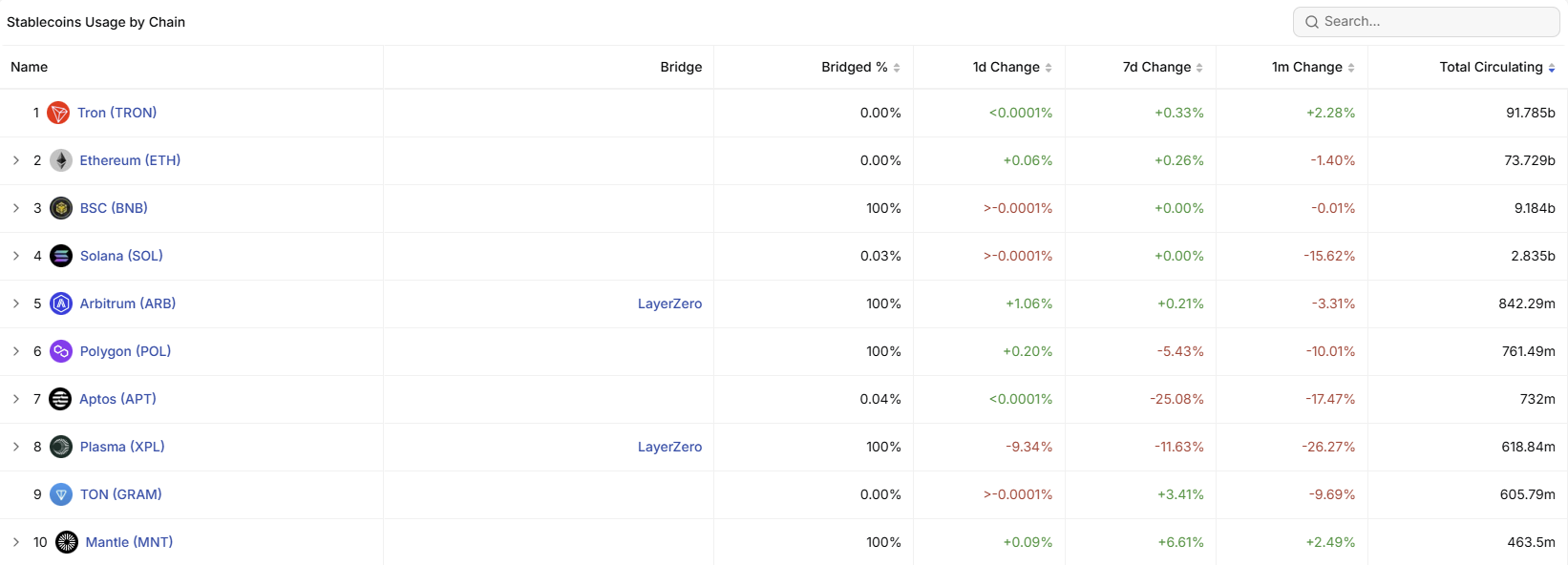
TRON settles more Tether (USDT) than any other blockchain. Data from DefiLlama shows $91.8 billion of the stablecoin on TRON, against $73.7 billion on Ethereum.

The gap is also widening. TRON’s USDT supply grew 2.28% over the past month, while Ethereum’s contracted 1.40%.
Account growth points the same way. Tronscan recorded 401 million total accounts on Aug. 29, six days after TRON DAO announced the 400 million milestone.
However, accounts measure cumulative sign-ups rather than live users. The pace of growth therefore matters more than the headline total, a point earlier analysis of TRON addresses also made.
TRON has separately targeted the third quarter for its quantum-resistant mainnet. Post-quantum signatures reached the Nile testnet in July, which leaves September as the deadline.
TRON Price Prediction Points Toward $0.307
The daily chart tells a harsher story. TRX peaked at $0.3775 in late May, then corrected into the 0.618 Fibonacci retracement at $0.3101.
Support held there through June. Price then built an ascending triangle and tested its rising support line six times (blue circles). That line runs back to the February low. Bulls were therefore defending a seven-month structure, not a summer pattern.
TRX broke above the triangle on Aug. 20, with a measured target of $0.3612. The advance stalled at $0.3518 and reversed. The failed breakout now works against buyers. TRX has lost the 0.382 retracement at $0.3359 and trades just under the 0.5 level at $0.3230.
A confirmed close below could open the way to $0.3067, roughly 5% lower. That level combines the 0.618 retracement, a visible demand zone, and the June low.

Volume reinforces the case. Buyers produced a genuine spike during the breakout attempt, but participation has contracted as the price slipped back through the pattern.
The Relative Strength Index (RSI) sits near 34, its weakest reading since mid-June (purple circle). That is not yet oversold, which leaves room for further weakness.
A reclaim of $0.3359 would invalidate the setup. Such a move could put $0.3518 and $0.3612 back in play.
The wider issue concerns value capture. TRON reduced transaction fees sharply in 2025, which cut the volume of TRX destroyed by network activity.
Circulating supply has since edged higher instead of shrinking. TRX also trades about 25% below its record $0.4313 from December 2024, despite record settlement volume.
September therefore looks less like a catalyst month and more like a test of $0.3067. Several other altcoins face similar decision points.
The post What to Expect From Tron (TRX) in September 2026 appeared first on BeInCrypto.

Dell Technologies (DELL) showed that the AI data center business is still hopping as it delivered a monster beat-and-raise earnings report. Dell stock jumped on the news. The Round Rock, Texas-based computer hardware firm late Tuesday trounced estimates for its fiscal second quarter ended July 31 and with its outlook for the current quarter and full year. Dell’s adjusted earnings…
Copyright ©2026 Investor’s Business Daily, LLC. All rights reserved. 87990cbe856818d5eddac44c7b1cdeb8

XRP price is at $1.32, down 3% on the day as it is sliding back toward the lower end of its recent range. But the real question is whether this dip is a buying window before a regulatory catalyst, or the start of something uglier.
The pullback follows a failed attempt to hold gains from August’s rally toward $1.70, with XRP now down 7% over the past week. Ripple released 1 billion XRP from escrow on schedule and returned 700 million XRP back into escrow shortly after, a routine supply event, but one that always draws trader attention when the price is already soft.
Meanwhile, XRP Ledger activity tells a different story: cumulative transactions crossed 3 billion, with a 200% surge in on-chain volume even as spot price cooled off.
The markets aren’t helping. Bitcoin slipped below $77,000, and Ethereum sits under $2,400 as fresh US-Iran tensions push oil prices higher and reinforce hawkish Fed expectations. That’s the macro backdrop XRP has to fight against heading into a month that could otherwise be its biggest regulatory moment yet.
Discover: The Best Crypto to Diversify Your Portfolio
Can XRP Price Hit $2 This Month?
XRP is consolidating in the $1.32–$1.35 zone after a sharp weekly retreat, with CoinGecko data showing a seven-day range between $1.31 and $1.47. Volume has thinned alongside the price action, and derivatives desks reportedly show no sign of FOMO building yet, which is a sign of a coiled spring.
Support sits at $1.31–$1.34; a clean break below opens room toward the low $1.20s. Resistance stacks up at $1.39, then $1.47, with the August high of $1.70 acting as the higher-timeframe ceiling.

The bull case hinges almost entirely on the CLARITY Act Senate vote expected around September 15. A pass could reprice XRP toward the $2 level analysts have floated, while a delay or failure likely keeps XRP pinned near current support levels. Standard Chartered’s $10 2026 target explicitly assumes regulatory clarity lands, without it, that number stays theoretical.
Trade XRP on Bybit and Get a Chance to Win Our $1,000 USDT Airdrop
Maxi Doge Targets Early Mover Upside as XRP Tests Key Levels
A 6.5% weekly drawdown on a top-10 asset stings, especially for traders who bought the August breakout expecting continuation. Legislative catalysts are notoriously unreliable on timing, and another delay wouldn’t be shocking given how many times CLARITY has already slipped.
For traders tired of waiting on Congress, capital is rotating toward assets with shorter, more controllable timelines, which is where presale plays like Maxi Doge ($MAXI) enter the conversation.
Maxi Doge leans into gym-bro meme culture and “1000x leverage” trading energy, built around holder-only trading competitions with leaderboard rewards and a treasury fund earmarked for liquidity and partnerships.
The token currently sits at $0.0002836 with $4.8 million raised so far, and staking offers a dynamic APY for early participants. It’s unapologetically meme-first, which is refreshing.
Research Maxi Doge before the presale window closes.
Discover: The Best Token Presales
The post Where Could XRP Price Go This September as CLARITY Act Nears? appeared first on Cryptonews.
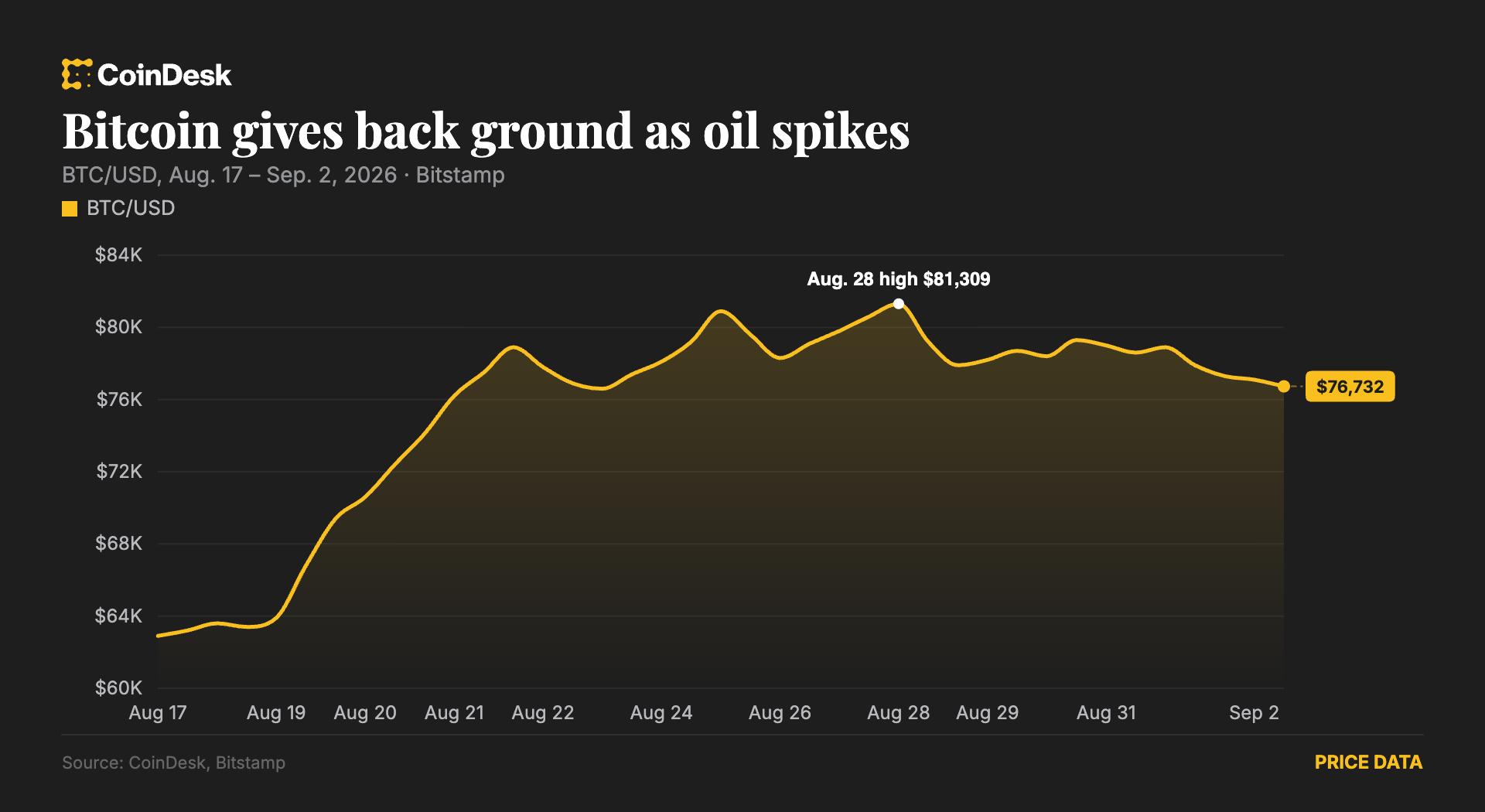
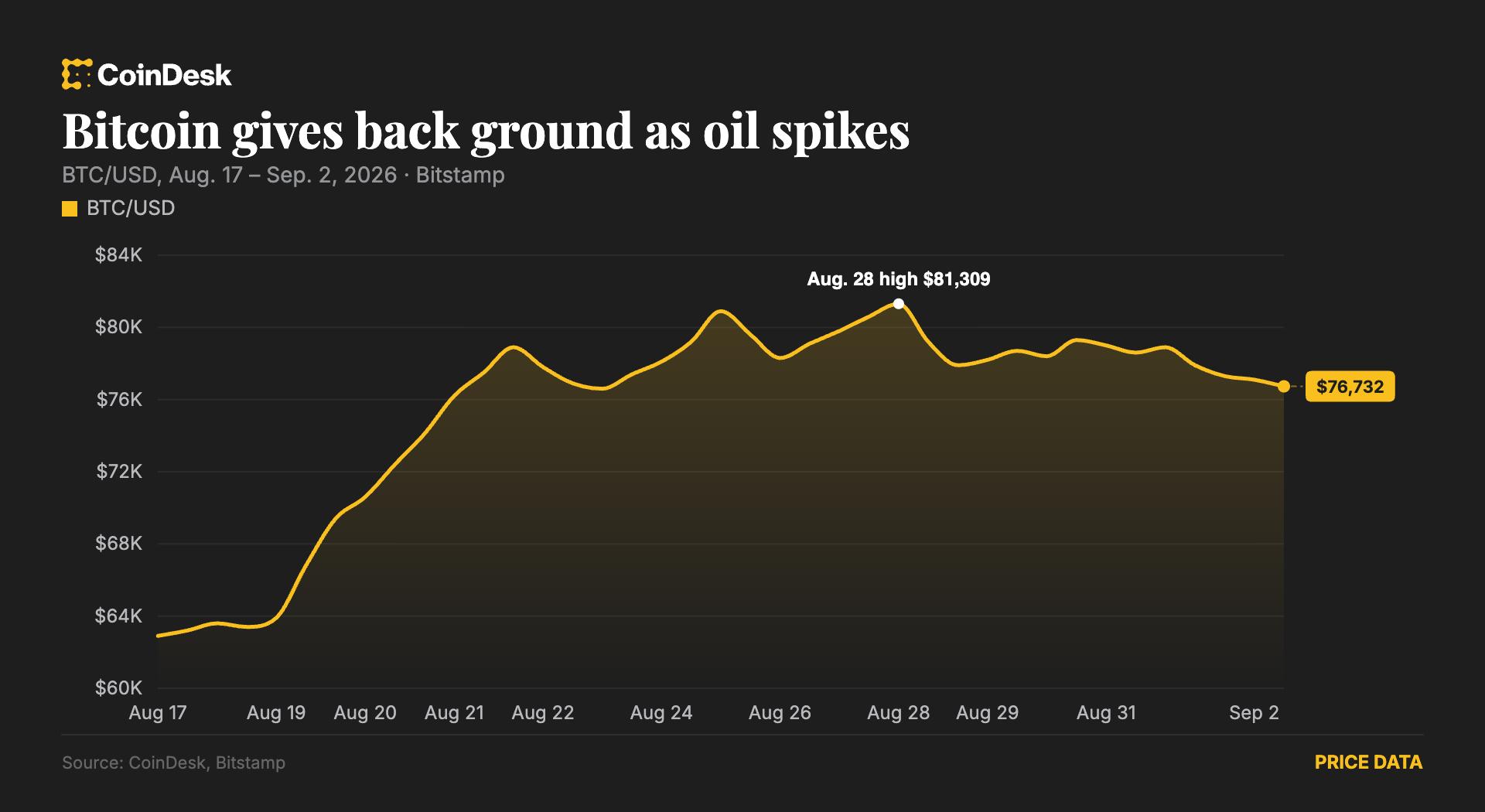
Bitcoin fell 1% since midnight as Brent jumped past $93 and Treasury yields climbed toward 4.8%.
[PRESS RELEASE – HONG KONG, HONG KONG, September 2nd, 2026]
New suite of standalone products gives institutions principal OTC dealing and LP connectivity alongside Liminal’s existing wallet and key-management infrastructure
Today, Liminal, a provider of institutional digital asset wallet and key-management infrastructure, announced the launch of Liminal Prime, an enterprise software suite designed to provide stablecoin liquidity connectivity. It is built exclusively to enable locally licensed exchanges, financial institutions, payment providers, fintechs, market makers, corporate treasuries and OTC trading desks to access principal-to-principal OTC dealing and LP connectivity alongside Liminal’s existing wallet and key-management infrastructure. Liminal’s technology is delivered strictly as a tech infrastructure solution to authorised entities responsible for their own local regulatory compliance.
As cross-border payments, tokenized assets and enterprise blockchain applications move from pilot projects into production deployments, financial institutions increasingly need trading and liquidity infrastructure designed to integrate with the governance and compliance controls institutions have already established. Liminal Prime has been built to address that gap precisely.
For many institutions, secure wallet infrastructure is no longer the primary challenge. As digital asset operations mature, attention is shifting toward trading, liquidity access, and operational efficiency. Liminal Prime has been developed to address this next phase of institutional adoption.
This launch marks the next phase of Liminal’s evolution as an institutional partner, expanding its core wallet and key-management offering with OTC and liquidity connectivity. Each product operates as an independent module, licensed and deployed separately, giving institutions the flexibility to adopt what fits their operational and regulatory requirements, without displacing existing infrastructure
Liminal Prime is built by the team behind Liminal’s institutional wallet infrastructure and key-management infrastructure, which has processed more than US$100 billion in on-chain transactions across more than 20 blockchain networks for institutions in over 12 countries.
The products have been shaped by direct engagement with the licensed exchanges, payment companies, financial institutions and digital asset businesses that form Liminal’s client base. What those clients identified consistently was a common operational gap: institutional-grade trading and liquidity access that works within, not alongside, their existing governance and compliance frameworks.
“What we keep hearing from institutions, across markets, is that the wallet question is largely settled. The conversation has moved on. They are now asking how they actually operationalise digital assets at scale — how they trade, how they manage liquidity, and how they do all of that without introducing new counterparty risk or compliance gaps. Liminal Prime is built to close that gap. We have the relationships and the trust already in place. This is a natural next step.” Rajesh Sabari, Chief Commercial Officer, Liminal
Liminal Prime comprises three products, each addressing a distinct institutional operating requirement:
White-Glove OTC supports high-value, complex, and time-sensitive block trades through a dedicated dealing desk. A desk reaches Liminal directly, gets a price, and confirms the trade; no automated flow, a human on the other end for every transaction. Where regulatory frameworks permit, Liminal acts as principal counterparty for its own account on every trade, buying and selling digital assets. Designed for licensed institutions where transaction size, confidentiality and tailored workflow requirements are paramount.
Electronic OTC (eOTC) provides GUI and API-driven access to streaming and firm quotes for organisations managing recurring, high- frequency digital asset transaction flows at scale. A GUI and API connection enables automated, always-on pricing; a web platform provides a self-serve, screen-based experience for systematic dealing without a manual conversation for every trade. Subject to applicable local licensing, Liminal acts as principal counterparty for its own account.
Bridge is a technology platform that gives institutions a single screen or API to request quotes from, and trade directly with, liquidity providers they have separately onboarded with and been approved by. Liminal is not the counterparty to the trade, does not operate an exchange, brokerage or trading venue, and takes no custody of assets. Liminal’s role is limited to routing quote requests, displaying prices and supporting communication between the two parties; the trade and its settlement happen directly between the institution and its chosen liquidity provider, off-platform, under their own bilateral agreement.
Across all three products, Liminal Prime delivers configurable reporting, audit-ready workflows and integration with Liminal’s wallet and key-management infrastructure. The products support multiple blockchain networks and major digital asset pairs, providing the transparency, governance and operational controls that institutions require.
“The time for discussing institutional digital assets in theory is over. Institutions now need practical solutions that can be deployed against real treasury, payment and liquidity requirements. Whether you are managing stablecoin flows, entering a new market or looking for more efficient execution, bring us the challenge. Liminal Prime is ready to help you put into action.” Clarence Leong, Senior Manager – Institutional Markets, Liminal
Liminal Prime is the first step in a broader infrastructure strategy. As institutional participation in digital asset markets deepens across tokenization, cross-border payment infrastructure and enterprise treasury management, Liminal will continue building out its product offering. The company’s objective is to serve as a trusted infrastructure partner for licensed institutions at every stage of their digital asset operations, from wallet and key-management infrastructure to OTC and liquidity connectivity solutions.
Important Notice
White-Glove OTC and Electronic OTC (eOTC) are restricted and unavailable to entities operating or residing in the UAE, India, Singapore and Taiwan, as well as any jurisdiction where local laws prohibit their use. Bridge is available subject to local regulatory requirements. Note: Users are solely responsible for ensuring compliance with all local regulations before attempting to access any of our services.
Communication Notice: The following Important Notice is an integral part of this release and must be reproduced in full wherever this release, or any substantial portion of it, is published or reproduced.
About Liminal Prime
Liminal Prime is a suite of institutional OTC and liquidity connectivity products comprising three distinct offerings: White-Glove OTC, Electronic OTC and Bridge. Where regulatory frameworks permit, White-Glove OTC and eOTC are principal-to-principal dealing products in which Liminal acts as counterparty for its own account. Bridge is a technology platform through which institutions can request quotes from, and trade directly with, approved and licensed liquidity providers of their choosing; the legal trade is formed and settled bilaterally between the institution and its chosen LP under their own agreements. Each product is operated and assessed independently and is designed to complement existing institutional infrastructure. Institutions may adopt individual products independently, based on their operational and regulatory requirements.
About Liminal
Liminal is an institutional digital asset infrastructure provider offering enterprise-grade wallet infrastructure, key management and governance solutions for exchanges, financial institutions, fintech companies, digital asset businesses and enterprises. Liminal has processed over US$100 billion in on-chain transaction volume across more than 20 blockchain networks for institutions in over 12 countries.
The post Liminal Launches Liminal Prime for Institutional OTC and Stablecoin Liquidity appeared first on CryptoPotato.
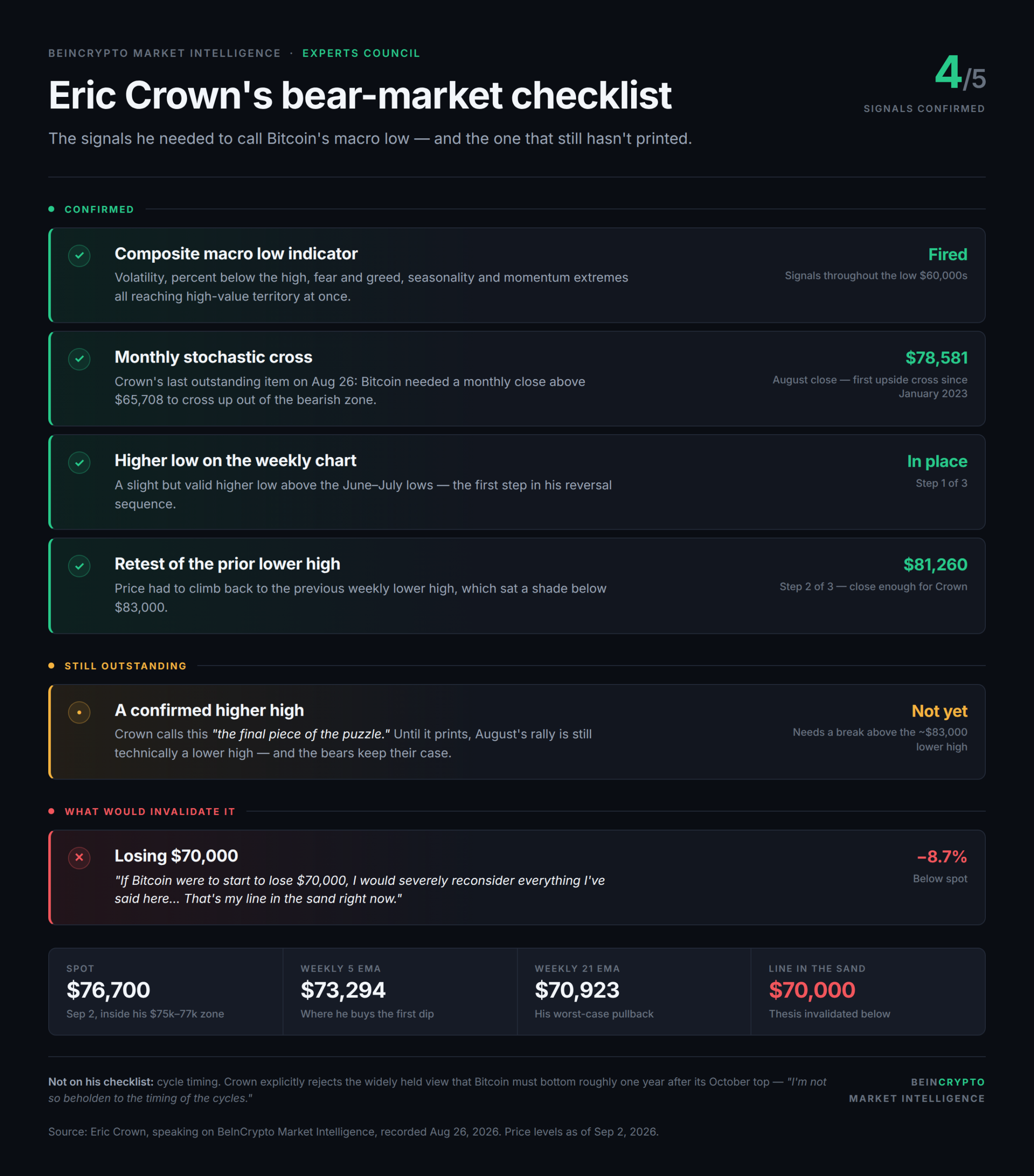
The Bitcoin bear market is over, technical analyst Eric Crown says. His final confirmation signal fired when Bitcoin closed August at $78,581, clearing his threshold by roughly $12,900.
September is next, and Crown does not expect much from it. He calls it a nothing month, with an early pullback likely before October takes over.
Crown’s Last Bitcoin Bear Market Signal Fired in August
In an interview with BeInCrypto recorded on Aug. 26, Crown said a single item remained on his macro reversal checklist.
He needed Bitcoin to finish the month above $65,708. That close would push the monthly stochastic oscillator up out of its bearish zone. The last such cross came in January 2023.
“I just need to see this month finish out above $65,700. And look, there’s going to be pullbacks along the way, of course, but I’m just generally looking for this mark to go sideways and up.”
Bitcoin settled the month at $78,581 on Binance. BTC traded near $77,341 at the time of writing, down 1.9% over 24 hours.

Crown’s broader macro indicator had already fired months earlier. It combines volatility, percent below the high, fear and greed readings, seasonality, and momentum extremes.
Those signals appeared throughout the low $60,000s, well before August’s rally. Crown frames the conclusion in probabilities rather than certainties.
“In my opinion, yes. I’ve seen what I need to see and everything always comes down to probabilities and for me the probability is greater that Bitcoin is going to be generally going up from here rather than down.”
Other market participants reached similar conclusions. Large holders, or whales, accumulated through the summer. Strive chief executive Matt Cole called the bottom in late August.

September Is a ‘Nothing Month’, Not a Crash
Crown pushed back hard on September’s reputation as Bitcoin’s worst month. On median monthly returns, it ranks third worst, behind August and December.
August carries a median loss of 7.5%, yet this August gained close to 25%. Strip out 2011 and 2014, both deep bear market years. September’s mean return then improves to a loss of just 0.1%.
The last three Septembers all closed green, at 4%, 7.4%, and 5.4%.
“Ultimately, what September is… it’s a nothing month. You really don’t see all that much. You see slight gain, slight loss here and there.”

The month does split in two, however. Historically, the first 16 days carry a median loss of 8.5%. Applied to August’s close, that points to roughly $71,900.
After the midpoint that median flips positive at 6.5%. Crown ties the turn to three events. The Federal Reserve meets, economic data lands, and the quad witching expiry hits. Earlier inflation prints have already moved BTC sharply this year.
Where Crown Buys the First Pullback
Crown expects early weakness to reconnect Bitcoin with its weekly five-period exponential moving average, or 5 EMA. That average now sits at $73,294, roughly 5% below spot.
Pullbacks following a large weekly candle usually run near 5%, he said. That is far shallower than the 10% to 15% many traders wait for. The bigger retracement typically lands about 60 days after the first major move up, which points to October.
Crown put the odds of BTC touching that average in any given week at 71.5%. More than two consecutive misses occur only about 14% of the time.

His stated worst case is the weekly 21 EMA at $70,923.
Three separate methods now converge on the same zone. The 21 EMA sits at $70,923, September’s first half median implies about $71,900, and Crown’s invalidation level is $70,000.
Crown said he intends to buy that first September dip. He plans to add to long-term positions rather than trade around it. Bitcoin’s strongest weekly close since 2024 in late August is what reset those averages.
Bitcoin Bear Market Is Over: What Would Break the Thesis
Crown’s case is not yet confirmed on the price structure. His reversal sequence requires a higher low, a retest of the previous high, then a higher high.
Bitcoin has the first two. August’s peak at $81,260 stopped just beneath the prior weekly lower high near $83,000.
“You are right right now. This is absolutely a lower high. Technically speaking, it is a slight lower high right there, but it is a lower high nonetheless.”
He also acknowledged the widely held view that Bitcoin should bottom roughly one year after its October top. He is not positioning for it.
Crown argues the asset now behaves differently. In his view Bitcoin trades like an exchange traded fund, consolidating in wide boxes before stepping higher. That regime weakens strict cycle timing.

Not every analyst agrees that the low is in. Benjamin Cowen told BeInCrypto that crypto sits 62% below fair value, the cheapest since 2010. He still expects the bottom nearer November.
“As long as Bitcoin is above more or less 70,000 bucks, all good. I have no issues with that at all. If Bitcoin were to start to lose 70,000 bucks, okay, I would severely reconsider everything that I’ve said here.”
His roadmap allows for a move toward the high $80,000s. A retracement of 10% to 15% would follow, taking BTC into the mid $70,000s before a steadier climb.
The year-end math is tighter than it first appears. Crown measures from the September low to the December close. That window closed positively nine times in 15 years, at a median gain of 33.5%.
Applied to current levels, the September low must hold above roughly $74,900 for six figures. A green third quarter needs BTC above about $58,000 at month end. That outcome has preceded a green fourth quarter six times in eight.
October remains his strongest seasonal argument. Its median return is 12.8%, with gains in 10 of the past 14 years.
The post Bitcoin Bear Market Is Over and September Is a ‘Nothing Month', Says Eric Crown appeared first on BeInCrypto.


Full Sail, a decentralized finance (DeFi) protocol on the Sui blockchain, plans to shut down after a security incident involving oracle provider Switchboard resulted in user losses.
Full Sail took to X on Tuesday to announce that the protocol is winding down, immediately disabling new deposits and liquidity provider (LP) reward claims. Regular pools will move to withdrawal-only mode after final security checks, with compensating users the protocol’s top priority, Full Sail said.
The decision follows a security incident last week that affected Full Sail’s automated vaults following a suspected compromise of Switchboard’s oracle infrastructure.
Full Sail first disclosed the incident on Saturday, saying it had confirmed a loss of funds and paused deposits and withdrawals while it investigated. Switchboard said in an X post on Saturday that it was investigating a potential compromise of its Move-based implementations and had halted its network on Aptos, Sui, IOTA and Movement.
Full Sail later said an attacker removed about $91,000 from three of its vaults. Virtue, a stablecoin lending protocol based on IOTA (IOTA), separately reported about $455,000 in losses and said the backing of its VUSD stablecoin had been impaired.
Full Sail said it will use its remaining protocol-owned liquidity to compensate users, while the team will cover any shortfall so community depositors are repaid first. The protocol expects to publish withdrawal and claim instructions within the coming days.
Related: More Markets lending reserve drained for $9.3M: Blockaid
Crypto World
Lawsuit challenges Tether for allegedly freezing $42.4 million USDT before U.S. warrant


The plaintiffs allege that Tether acted in response to an informal U.S. law-enforcement request more than three months before a seizure warrant was issued.

Microsoft Outlook Down Again? Thousands Report New Issues With Microsoft’s Email Service 3 Days In A Row

Uber Stock Climbs On 10% Layoff Plan

Zendaya’s Mom Says She Has Stepped Away From Social Media





-

 Fashion5 days ago
Weekend Open Thread: Maeve – Corporette.com
-

 Crypto World6 days ago
Bitcoin’s 22% rally now needs real demand to outlast Treasury liquidity boost
-

 Business6 days ago
Apple Confirms September 9 Keynote and Reveals Its Full Pre-Order Schedule
-

 Crypto World7 days ago
Elon Musk Grok Bot Promise: We Will Make You Whole if AI Loses Your Money
-

 Business6 days ago
Salesforce Stock Soars 19% as Blowout Earnings and Agentforce AI Growth Silence Software Skeptics
-

 Business5 days ago
Onto Innovation Stock: AI’s Next Bottleneck Is Yield (NYSE:ONTO)
-
 NewsBeat7 days ago
Lindsay Clancy jury braces for closing arguments as judge tells court: ‘You’ve heard all the evidence’ – Live updates
-
 Crypto World6 days ago
NVIDIA revenue hits $96.2B as AI demand doubles
-

 Crypto World5 days ago
Bitcoin price tests $82K resistance as Brandt stays long
-
 Crypto World7 days ago
Nvidia Q2 Earnings Reveal $96.2 Billion Beat, So Why Is NVDA Falling?
-
 Tech4 days ago
Hugging Face built a $4.5 billion empire on free AI models. Now Nvidia is buying it for $12.9 billion
-

 Business5 days ago
iPhone 18 Pro Pre-Orders Could Shift to Saturday as Apple Reportedly Avoids September 11 Anniversary
-
 Tech7 days ago
Claude Cowork gets its own browser that doesn’t touch your tabs, bookmarks, or saved passwords
-

 Crypto World6 days ago
Truflation calls for Fed rate cut after PCE forecast
-

 Crypto World7 days ago
GENIUS Act missed its deadline as OCC writes rules anyway
-

 Tech5 days ago
PaperCut releases second emergency patch for exploited flaws
-

 News Videos3 days ago
Charlie Munger on Robinhood: No one should believe that Robinhood’s trades are free
-

 Tech7 days ago
Apple’s iPhone 18 Pro event is on September 9
-

 Tech6 days ago
The fix for the AI agent that hijacked a company’s DNS: it can propose the change, but it can’t approve it
-

 Tech4 days ago
As the influencer economy drives retail sales, Seattle startup raises $22M to play matchmaker
You must be logged in to post a comment Login