
Crypto World
What next as bitcoin drifts under $64,000



Bitcoin started the week drifting near $64,000, sitting out a rally in Asian equities as the US and Iran moved closer to a lasting peace deal.
The token traded around $63,996 on Monday, down 0.4% over 24 hours and 2.2% on the week, per CoinDesk data. The rest of the market was mixed. Solana rose 3.7% on the week to $74 and tron added 2.2%, while ether held roughly flat at $1,733. The losses ran deeper down the board, with BNB off 4.2% on the week, XRP down 4.3% to $1.13 and dogecoin the weakest major, off 6.5%. Hyperliquid’s HYPE, the standout of early June, fell 5% on the day and has cooled to a 1.9% weekly gain.
The macro backdrop turned friendlier without pulling crypto along. The US and Iran agreed on a roadmap toward a final peace deal within 60 days, and Brent crude slid 1.7% to about $79 a barrel.
An MSCI gauge of Asian stocks rose 0.6%, led by a technology rally tied to continued optimism over artificial intelligence, while US futures were softer, with S&P 500 contracts down 0.5%.

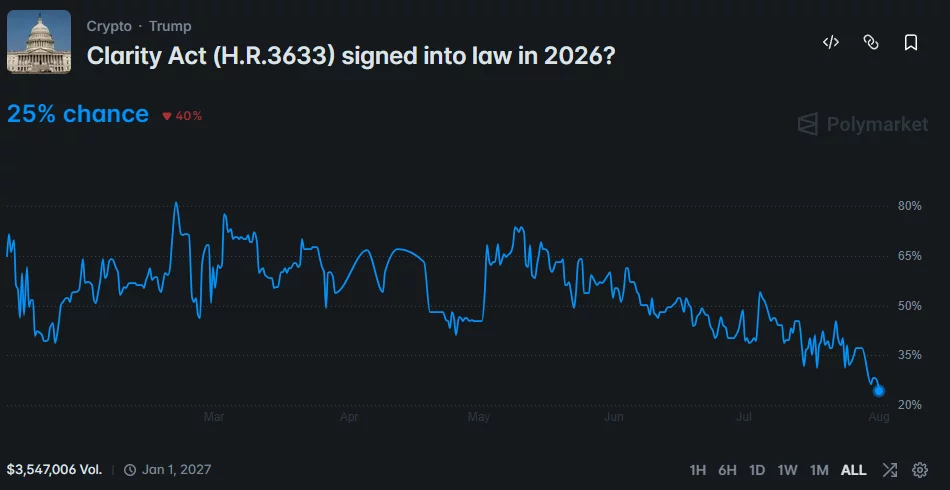
CLARITY Act passage odds have fallen to 25% as the White House reviews a bipartisan ethics proposal that could determine whether the Senate takes up the crypto market structure bill before its August recess.
Summary
- Polymarket traders give the CLARITY Act a 25% chance of becoming law in 2026.
- Anthony Scaramucci expects President Donald Trump to approve the bipartisan ethics proposal.
- Sens. Thom Tillis and Ruben Gallego reportedly submitted the compromise language to the White House.
- Senate leaders have not confirmed the timing of any floor action.
Scaramucci expects Trump to approve ethics deal
SkyBridge Capital founder Anthony Scaramucci said he expects Trump to accept the revised ethics language negotiated by Republican Sen. Thom Tillis and Democratic Sen. Ruben Gallego.
“If POTUS ultimately signs off, which I think he will, who will stand in the way of Clarity?” Scaramucci wrote on X. “If Dems (or GOPs in the pocket of bank lobby) stand in the way, they will regret it in November.”
Scaramucci’s statement represents his assessment of the negotiations. Neither Trump nor the White House has publicly confirmed acceptance of the proposal.
Tillis and Gallego reportedly sent the counterproposal to the White House on Thursday. The text has not been released publicly, but crypto journalist Eleanor Terrett reported that it would give state attorneys general a role in enforcing restrictions on federal officials’ digital-asset activities. Terrett’s report said the full scope of those state powers remained unclear.
Scaramucci also claimed in a now-deleted post that Trump’s children supported the compromise. That assertion has not been independently confirmed.
Ethics dispute remains central to CLARITY Act talks
Senate Democrats objected to an earlier Republican-backed ethics proposal because it reportedly placed enforcement authority solely with federal prosecutors.
The disputed language would restrict the president, vice president and other federal officials from issuing or sponsoring digital assets while in office. Democrats have sought stronger enforcement mechanisms and broader protections addressing conflicts of interest linked to officials’ crypto businesses.
Giving state attorneys general enforcement authority could help attract Democratic votes. It could also address concerns raised by Tillis, who had withheld support without changes to the ethics section.
However, an agreement on ethics would not guarantee passage. Senators remain divided over other provisions involving stablecoin rewards, protections for blockchain developers, and the division of regulatory authority between the Securities and Exchange Commission and Commodity Futures Trading Commission.
The House passed its version of the CLARITY Act by a 294–134 vote in July 2025, with 78 Democrats supporting it. Any amended Senate version would still need approval from both chambers before reaching Trump’s desk.
CLARITY Act odds fall to record-low 25%
Polymarket traders now assign a 25% probability that Trump will sign the CLARITY Act into law before the end of 2026, down from 30% earlier this week. The decline reflects uncertainty over both the remaining negotiations and the limited Senate calendar.
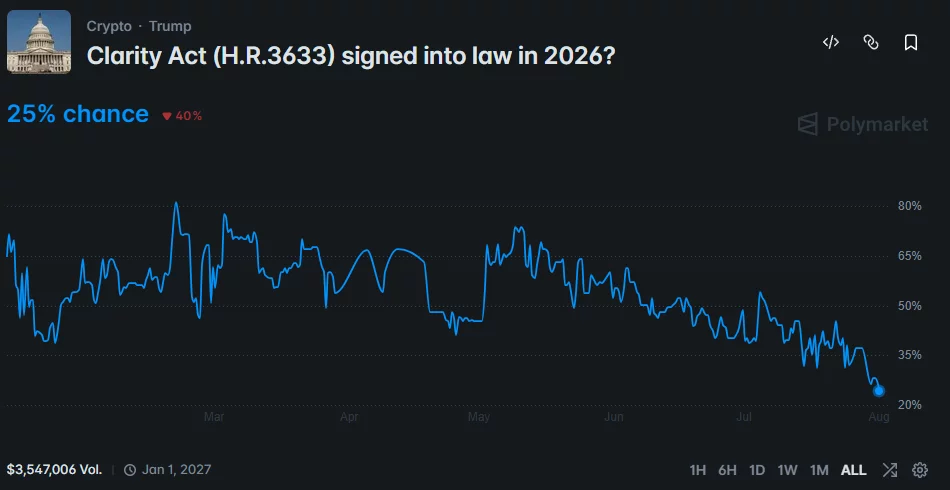
Prediction-market probabilities represent traders’ positions rather than a formal legislative forecast. The odds can change quickly if the White House accepts the ethics compromise or Senate Majority Leader John Thune schedules floor proceedings.
Industry groups are also pressing lawmakers to act. Digital Currency Group, the parent company of Grayscale, sent a letter to Thune and Senate Minority Leader Chuck Schumer requesting a vote before the recess. The company argued that continued regulatory uncertainty was driving US crypto investment and jobs overseas.
Treasury Secretary Scott Bessent issued a similar call this week, saying the Senate needed to vote on the legislation “now.”
Senate timetable remains uncertain
Sen. Cynthia Lummis said Thune has reserved space for the CLARITY Act on the Senate agenda and still intends to begin considering it before lawmakers leave Washington.
“Senator Thune has kept a place for the Clarity Act on the agenda before the August recess for many, many weeks now,” Lummis said. “I believe he does intend to go through with it.”
Still, no floor schedule has been confirmed. Nominations, government funding negotiations and votes concerning Iran and Russia-Ukraine sanctions are competing for the Senate’s remaining time. Lummis’ comments indicate that proceedings could begin within days, but they do not guarantee a final passage vote before the recess. Crypto.news previously reported that amendments and procedural votes could push final action into the post-recess calendar.
For US crypto companies and investors, the outcome will determine whether Congress advances a federal division of SEC and CFTC oversight this summer or leaves the regulatory framework unresolved heading into the November elections.
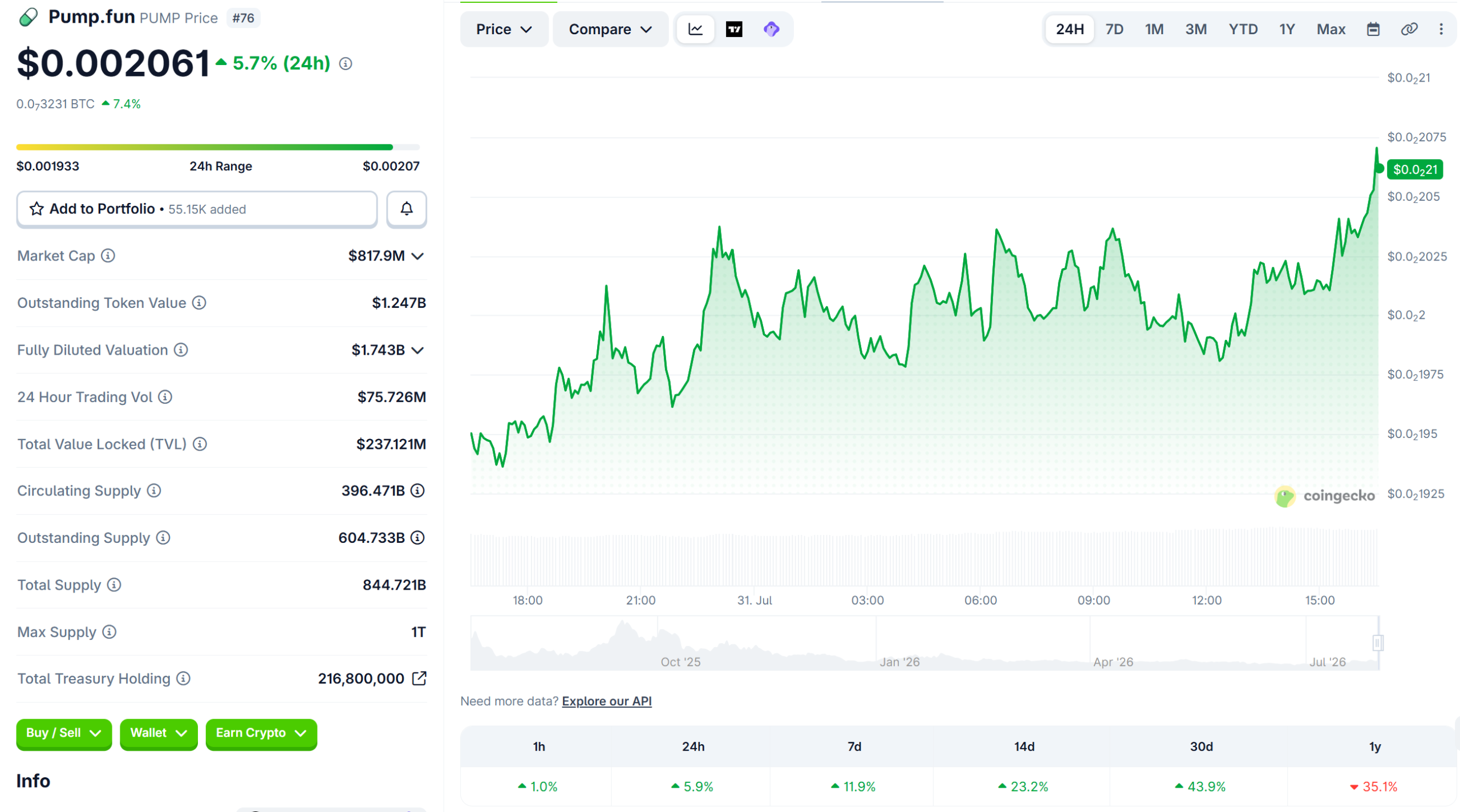
Former Pump.fun employees say they were dismissed two months before their PUMP tokens vested. Weeks after those dates passed, the team unlocked 50 billion tokens of its own.
An anonymous X (Twitter) account claiming to speak for more than 40 ex-staff began publishing termination emails this week. Pump.fun has not addressed the allegations publicly.
April Brought Layoffs and a $370 Million Burn
Sandmark reported that the Solana launchpad terminated contracts in early April. A quarter of each staff allocation was due to vest roughly two months later. Grant agreements had been signed in mid-June 2025, according to documents the outlet reviewed.
Co-founder Noah Tweedale attributed the cuts to a business that “grew too quickly” and could no longer move “fast and rough.” Severance ran to one week of salary for every month worked. One departing employee reportedly lost PUMP worth seven figures at current prices.

That same month, however, the platform destroyed $370 million of repurchased PUMP, wiping out roughly 36% of circulating supply. Co-founder Alon Cohen defended the April token burn at the time.
“Every dollar not burned is a dollar being put to work toward the same outcome”
Follow us on X to get the latest news as it happens
What the July 12 Cliff Released
The insider cliff expired on July 12, one year to the day after PUMP sold at $0.004 in its initial coin offering. Tokenomist data put the 82.5 billion token release at 50 billion for the team and 32.5 billion for existing investors.
At Friday’s price, the team slice alone is worth about $102 million. Measured against operations, that figure is striking.
Pump.fun booked $19.1 million of revenue in the 30 days to July 22, according to DefiLlama. That measure counts the platform’s cut of trade fees plus graduation and Mayhem fees. The team tranche therefore exceeds five months of it.

Revenue was also climbing rather than shrinking. DefiLlama logged $764,802 on July 22, a 22.6% rise month over month, against $1.07 billion earned since March 2024.
The Grievance Runs Through the Launchpad
Markets have not flinched. PUMP traded near $0.0020 on Friday, up almost 6% in a day. It still sits 77% under its September 2025 peak and 49% below the ICO price.
Verification remains thin. Sandmark could not confirm the second layoff wave, and the one public record that would settle headcount is late.
Baton Corporation Ltd is the UK entity behind Pump.fun. Its accounts for the period to 30 September 2025 were due at Companies House by 30 June. Those accounts disclose employee numbers, and they remain unfiled. The last set covers the year to March 2024.
Tweedale and Cohen are also personally named in a securities class action. Plaintiffs filed it in the Southern District of New York in January 2025.
Pump.fun did not immediately respond to BeInCrypto’s request for comment.
A billion dollars of tracked revenue sits behind this company, and one overdue filing sits in front of it. Until that document lands, April stays a matter of claim against claim.
The post Pump.fun Layoffs Spark Fury After Workers Miss Million-Dollar Token Payouts appeared first on BeInCrypto.


The largest tokenized securities platform cleared its SEC probe, secured FINRA authorization, and put BlackRock’s IVV onchain. Now it is shopping for a target worth up to half a billion dollars while the market it helped build outgrows it.
Summary
- Ondo Finance is exploring an acquisition valued between $250 million and $500 million to expand into wealthtech and adjacent financial sectors, though no formal advisers have been appointed and no target has been identified.
- The company’s SEC-registered broker-dealer subsidiary received additional FINRA authorizations in July 2026, covering tokenized corporate equities, ETFs, and other investment products.
- Ondo debuted the SEC’s third-party custodial tokenization model with BlackRock’s IVV ETF and Micron shares as the first securities tokenized under a domestic U.S. framework.
- The total real world asset market onchain has crossed $36 billion in 2026, with tokenized U.S. Treasuries alone reaching approximately $12.88 billion, up from roughly $5 billion in late 2024.
- Ondo abandoned its planned Layer 1 blockchain in favor of Ondo Network, a high speed execution layer pairing centralized exchange level speeds with non-custodial, onchain-verifiable settlement.
Ondo Finance spent the first half of 2026 clearing every regulatory hurdle that has historically killed tokenization platforms. It closed an SEC investigation without charges. It secured FINRA authorization for tokenized equities. It put BlackRock’s flagship ETF onchain under a framework the SEC itself endorsed. And now, with $2.5 billion in assets under management and a market that has tripled in eighteen months, it is looking to spend up to half a billion dollars on an acquisition that would transform it from a tokenization protocol into something closer to a financial conglomerate.
The acquisition report, first published by CoinDesk on July 30, described Ondo as exploring targets in wealthtech and adjacent sectors valued between $250 million and $500 million. The company’s response was carefully calibrated: “We are not in conversations with any party at this time.” The denial did not say the exploration was not happening. It said no specific target had been engaged. The ONDO token rose approximately 6% on the news, a move that valued the company’s circulating supply at roughly $1.5 billion.
The timing is not coincidental. Ondo has spent two years building infrastructure that most tokenization platforms never get close to completing. It has an SEC-registered broker-dealer. It has FINRA authorization. It has a custodial model that the SEC endorsed through formal guidance. What it does not have is the distribution network, advisory relationships, and client assets that a wealthtech acquisition would provide. The $250 million to $500 million price range suggests Ondo is looking at established platforms with existing customer bases, not early stage startups.
The regulatory clearance that changed everything
The most important development in Ondo’s 2026 was not a product launch. It was the closing of an SEC investigation that had been running since October 2023.
The probe, opened during Gary Gensler’s chairmanship, examined whether Ondo’s tokenized securities products constituted unregistered securities offerings. Under Chair Paul Atkins, the investigation was closed without enforcement action. The closure removed the single largest existential risk facing the company and cleared the path for everything that followed.
Within weeks of the probe closing, Ondo’s SEC-registered broker-dealer subsidiary, Oasis Pro Markets, received additional FINRA authorizations covering tokenized corporate equities, ETFs, and other investment products. The authorization expanded Oasis Pro’s permissions beyond its original scope, which had been limited to digital asset securities under Regulation D and Regulation S exemptions.
The FINRA authorization is significant because it addresses the distribution problem that has constrained every tokenization platform to date. Tokenizing a security is technically straightforward. Distributing that tokenized security to investors through regulated channels requires broker-dealer infrastructure that most crypto companies do not possess. Ondo now has that infrastructure at a level that only Securitize among its direct competitors can match.
The regulatory sequence matters. The SEC probe closure came first, establishing that Ondo’s existing products did not violate federal securities law. The FINRA authorization came second, expanding what Ondo could offer through regulated channels. The BlackRock IVV tokenization came third, providing the marquee product that validated the regulatory framework. Each step depended on the one before it. A company still under SEC investigation could not have received expanded FINRA authorization. A company without expanded authorization could not have tokenized a major ETF under the SEC’s endorsed model. The entire 2026 regulatory sequence was sequential by necessity, and Ondo executed it faster than any competitor.
Ondo also filed a confidential registration statement with the SEC for Ondo Global Markets, providing issuer-level disclosures for all investors. The confidential filing is a precursor to full public registration, a step that would make Ondo Global Markets subject to the same reporting requirements as traditional securities exchanges. No other tokenization platform has progressed this far toward full SEC registration for a tokenized securities marketplace.
On July 1, 2026, Ondo debuted what may be the most consequential product in the tokenization industry’s short history. It put BlackRock’s IVV ETF and Micron shares onchain under the SEC’s third-party custodial tokenization model. This was not an offshore workaround. It was not a synthetic exposure product. It was the actual security, tokenized under a framework the SEC had formally described in its January 2026 guidance. BlackRock’s IVV became the first major ETF to exist simultaneously in traditional brokerage accounts and on a blockchain, with identical investor protections and ownership rights in both formats.
The $36 billion market Ondo helped build
The market context for Ondo’s acquisition ambitions is a sector that has grown faster than almost anyone projected. Total real world assets onchain crossed $36 billion in 2026. Tokenized U.S. Treasuries alone reached approximately $12.88 billion, up from roughly $5 billion in late 2024. BCG projects the broader RWA market reaching $16 trillion by 2030, a figure that would make it one of the largest asset classes in financial services.
Ondo’s position within this market is both dominant and precarious. Its OUSG and USDY products, which provide onchain exposure to short-term U.S. government debt, have accumulated more than $2.5 billion in assets. That makes Ondo one of the largest tokenization providers by assets under management. But the market is attracting competitors with resources that dwarf Ondo’s.
The DTCC’s tokenization initiative launched in July 2026 with more than 50 participating firms, including BlackRock, JPMorgan, and Goldman Sachs. The initiative covers Russell 1000 equities, major index ETFs, and U.S. Treasuries. When the world’s largest securities depository begins tokenizing assets, the competitive landscape for standalone tokenization platforms changes fundamentally.
Ondo joined the DTCC consortium rather than competing against it, a strategic decision that acknowledges the reality of institutional finance. The company sits alongside the firms whose assets it tokenizes, a position that provides access to deal flow and legitimacy but also raises questions about differentiation. If BlackRock can tokenize its own ETFs through the DTCC framework, why does it need Ondo to do it?
The answer, for now, is speed and specialization. The DTCC’s tokenization service is designed for traditional market hours and settlement cycles. Ondo offers 24/7 trading access and near-instant settlement. The DTCC covers DTC-custodied assets. Ondo covers assets that exist outside traditional custody networks, including international equities and structured products. The two approaches are complementary today. Whether they remain complementary as the DTCC expands its scope is the central competitive question facing every tokenization platform.
Ondo Network and the infrastructure pivot
In one of the most underreported strategic shifts in crypto during 2026, Ondo abandoned its planned Layer 1 blockchain entirely. Instead, it launched Ondo Network, a high speed execution layer that pairs centralized exchange level performance with non-custodial, onchain-verifiable settlement.
The decision to drop the L1 plan reflects a maturation in how tokenization platforms think about infrastructure. Building a standalone blockchain creates a cold start problem. Liquidity, developers, and users must be attracted to a new chain from scratch. The costs are enormous and the failure rate is high. Ondo’s leadership concluded that the company’s competitive advantage lies in regulatory infrastructure and institutional relationships, not in consensus mechanisms and validator economics.
Ondo Network’s first application is Ondo Perps, a perpetual futures platform that uses tokenized assets as collateral. The product targets a specific gap in the derivatives market: the ability to post tokenized equities and Treasuries as margin for derivatives positions. If a trader holds $1 million in tokenized IVV, Ondo Perps would allow that position to serve as collateral for futures trades without liquidating the underlying holding.
The collateral use case is potentially transformative for tokenized assets. One of the persistent criticisms of tokenization has been that holding a tokenized security offers no practical advantage over holding it through a traditional broker. If tokenized assets can serve as collateral across DeFi and CeFi platforms simultaneously, the tokenized version becomes strictly superior to the traditional version. The asset earns yield in one protocol while securing positions in another, a form of capital efficiency that traditional finance cannot replicate.
The infrastructure pivot also positions Ondo to capture a revenue stream that does not depend on asset management fees. Ondo Network can charge execution fees on every trade processed through its matching engine, transaction fees on settlement, and licensing fees to third-party platforms that integrate its execution layer. This is the infrastructure-as-a-service model that traditional exchanges like Nasdaq and ICE have used to build durable revenue streams independent of trading volume cycles. If Ondo Network achieves meaningful adoption, it would diversify the company’s revenue beyond the management fees that currently drive its economics.
The partnership architecture
Ondo’s institutional partnership roster reads like a directory of the firms that control traditional financial infrastructure. Mastercard integrated Ondo into its Multi-Token Network for RWA settlement. Fidelity incorporated OUSG into tokenized fund strategies. PayPal established a $25 million facility connecting PYUSD with Ondo yield products. SBI partnered with Ondo to bring Japanese stocks onchain with the JPYSC stablecoin.
Each partnership represents a different distribution channel. Mastercard provides access to its merchant network for settlement use cases. Fidelity provides access to institutional asset allocators. PayPal provides access to its 400 million consumer accounts. SBI provides access to the Japanese market, the third largest equity market in the world.
The partnership strategy also reveals what Ondo is not. It is not a consumer facing platform. It is not competing with Coinbase or Robinhood for retail traders. It is building the infrastructure layer that sits between traditional financial institutions and blockchain networks, processing the tokenization, custody, and settlement that allows those institutions to offer blockchain based products to their own customers.
This positioning explains the acquisition interest. A wealthtech company would provide what Ondo’s current partnership model lacks: direct relationships with financial advisors and their clients. The $250 million to $500 million price range suggests targets with meaningful assets under advisory, likely platforms serving registered investment advisors or independent broker-dealers.
The partnership strategy also highlights the founder question that has hung over Ondo since the sudden death of Nathan Allman earlier in 2026. Allman, a former Goldman Sachs vice president who founded Ondo in 2021, had been the primary relationship holder with many of the company’s institutional partners. His absence creates both a leadership vacuum and a strategic opportunity. An acquisition that brings in experienced financial services executives could address the leadership gap while simultaneously expanding distribution. The company has not publicly named a permanent replacement, and the acquisition exploration may be partly motivated by the need to rebuild the institutional relationship infrastructure that Allman personally maintained.
The token question
The ONDO token presents one of the more complex value accrual questions in crypto. The company oversees $2.5 billion in tokenized assets. It has partnerships with the largest names in finance. It has regulatory clearances that no competitor can easily replicate. Yet the token trades at approximately $0.41, well below its historical highs, with a market capitalization of roughly $1.5 billion.
The disconnect between platform growth and token price reflects a structural issue common to many institutional crypto projects. Ondo’s revenue comes from management fees on tokenized products, not from onchain activity that directly benefits token holders. The ONDO token’s primary utility is governance. The Ondo DAO recently approved a burn of 100 million tokens, approximately 1% of the 10 billion total supply. The burn is a step toward aligning token economics with platform growth, but it does not create a direct revenue sharing mechanism.
The circulating supply of approximately 4.87 billion tokens, against a total supply of 10 billion, means significant dilution remains. Token unlocks have historically pressured the price during periods when market conditions provide no offsetting demand. The token rallied 6% on the acquisition news, but that move occurred from a base of $0.39, a level that represents a fraction of the implied valuation of the operating business.
The token’s performance through July illustrates the challenge. ONDO traded in the $0.31 to $0.33 range for much of the month before the acquisition report pushed it above $0.41. The rally was driven entirely by the prospect of corporate action, not by organic growth in onchain activity or fee generation. Compare this to the tokenized assets Ondo manages, which grew steadily throughout the same period regardless of token price movements. The platform’s fundamental metrics are on an upward trajectory that the token price does not reflect.
Part of the explanation is structural. Institutional investors who custody assets through Ondo’s tokenization platform have no need to hold the ONDO governance token. The token serves the DAO; the platform serves institutions. These are two separate constituencies with different incentive structures, and the market prices the token based on governance utility, not platform economics. Until Ondo creates a mechanism that directly links platform revenue to token value, this disconnect is likely to persist.
The acquisition could change this dynamic if the acquired company’s revenue streams are structured to flow through the ONDO token or the Ondo DAO. A wealthtech platform generating advisory fees could theoretically distribute those fees to token holders through a buy-and-burn or staking mechanism. Whether Ondo’s legal structure permits such a design under U.S. securities law is an open question that the SEC’s favorable disposition toward the company may help resolve.
The competitive landscape
Ondo operates in a market where the competitive dynamics are shifting quarterly. Securitize, backed by BlackRock, has its own FINRA-approved broker-dealer and has tokenized more than $2 billion in assets. Franklin Templeton’s BENJI token provides onchain Treasury exposure. Superstate offers tokenized Treasury funds. Each competitor has a slightly different regulatory posture and institutional backing.
The DTCC’s entry into tokenization in July 2026 changed the competitive calculus for all of these players. When the entity that settles virtually every U.S. equity trade begins tokenizing those same equities, standalone tokenization platforms must either integrate with the DTCC framework or carve out niches that the DTCC does not serve.
Ondo has chosen integration. Its membership in the DTCC consortium positions it as a technology provider to the traditional settlement infrastructure rather than a replacement for it. This is a pragmatic positioning that sacrifices the revolutionary narrative in favor of institutional relevance. The question is whether the market will reward pragmatism or whether a competitor willing to challenge the DTCC directly will capture the narrative premium.
The international dimension adds complexity. Ondo’s partnership with SBI for Japanese equities and its expansion into other Asian markets puts it ahead of most competitors in cross-border tokenization. The global opportunity is significantly larger than the U.S. domestic market alone. If tokenized securities can settle across borders in seconds rather than days, the efficiency gains for international investors are substantial enough to drive adoption regardless of what happens in the U.S. regulatory environment.
Ondo Global Markets, which launched with more than 100 tokenized U.S. stocks and ETFs offering 24/5 trading access, represents the company’s most aggressive competitive move. The platform provides non-U.S. investors with access to American equities outside of traditional market hours, a service that directly competes with the growing number of 24-hour trading venues that traditional exchanges are developing in response to crypto’s always-on culture.
The MyEtherWallet integration announced on July 28 extended this reach further. By listing Ondo’s tokenized stocks through one of the oldest and most widely used non-custodial wallets in the Ethereum ecosystem, Ondo made its tokenized equities accessible to millions of self-custody users who would never open a brokerage account. The integration is a distribution play that bypasses traditional financial intermediaries entirely, putting tokenized Apple and Tesla shares in the same interface where users already hold ETH and stablecoins.
The competitive map is further complicated by the entrance of traditional exchanges into tokenization. Nasdaq received SEC approval for its tokenized securities trading proposal in early 2026. The London Stock Exchange has announced plans for overnight trading sessions designed to compete with crypto’s 24-hour markets. These are not theoretical competitive threats. They are funded, regulated competitors with existing market infrastructure and client relationships that no crypto-native platform can match.
What to watch
- The acquisition target and structure. Whether Ondo pursues a wealthtech platform, a broker-dealer, or an advisory network will signal its strategic direction for the next several years. The $250 million to $500 million range suggests a meaningful operating business, not an acqui-hire.
- DTCC tokenization expansion timeline. The DTCC’s initial production trades began in July 2026, with a full launch planned for October. How quickly the DTCC expands asset coverage will determine how much room standalone tokenization platforms have to differentiate.
- Token unlock schedule and DAO governance. With approximately 5.13 billion tokens still locked, the pace and structure of future unlocks will significantly impact ONDO’s price trajectory. Watch for DAO proposals that create direct links between platform revenue and token value.
- International expansion pace. The SBI partnership for Japanese equities is a template. If Ondo replicates this model across additional Asian and European markets before competitors secure footholds, the first mover advantage in cross-border tokenization could prove durable.
- SEC regulatory posture. Ondo’s success depends on continued regulatory favorability. Any shift in SEC leadership or policy toward tokenized securities could affect the company’s operating model and competitive position.
Frequently asked questions
What acquisition is Ondo Finance considering?
CoinDesk reported on July 30 that Ondo Finance is exploring an acquisition valued between $250 million and $500 million, targeting wealthtech and adjacent financial sectors. No formal advisers have been appointed and no specific target has been identified. Ondo stated it is not currently in conversations with any party.
What FINRA authorization did Ondo receive?
Oasis Pro Markets, Ondo’s SEC-registered broker-dealer subsidiary, received additional FINRA authorizations on July 23, 2026, covering tokenized corporate equities, ETFs, and other investment products. This expands the subsidiary’s permissions beyond its original scope of digital asset securities under Regulation D and S exemptions.
How did Ondo tokenize BlackRock’s IVV ETF?
Ondo used the SEC’s third-party custodial tokenization model, which the SEC formally described in January 2026 guidance. BlackRock’s IVV ETF and Micron shares became the first securities tokenized under a domestic U.S. framework, providing identical investor protections and ownership rights as traditional holdings.
What is Ondo Network?
Ondo Network is a high speed execution layer that replaced Ondo’s earlier plans for a standalone Layer 1 blockchain. It pairs centralized exchange level performance with non-custodial, onchain-verifiable settlement. Its first application is Ondo Perps, a perpetual futures platform using tokenized assets as collateral.
How large is the tokenized asset market in 2026?
Total real world assets onchain crossed $36 billion in 2026. Tokenized U.S. Treasuries alone reached approximately $12.88 billion, up from roughly $5 billion in late 2024. BCG projects the broader RWA market reaching $16 trillion by 2030.
What happened with the SEC investigation into Ondo?
The SEC investigation, opened in October 2023 under Chair Gary Gensler, examined whether Ondo’s tokenized securities constituted unregistered offerings. Under Chair Paul Atkins, the probe was closed without enforcement action, removing the single largest regulatory risk facing the company.
What institutional partnerships does Ondo have?
Ondo’s partners include Mastercard (Multi-Token Network integration), Fidelity (tokenized fund strategies), PayPal ($25 million PYUSD facility), SBI (Japanese stocks onchain), and membership in the DTCC tokenization consortium alongside BlackRock, JPMorgan, and Goldman Sachs.
What is the ONDO token price and supply?
ONDO trades at approximately $0.41 with a market capitalization of roughly $1.5 billion. The circulating supply is approximately 4.87 billion of a 10 billion total supply. The Ondo DAO recently approved a burn of 100 million tokens, representing 1% of total supply.
Disclaimer: This article is for informational purposes only and does not constitute financial or investment advice. The information presented reflects publicly available data as of July 31, 2026. Readers should conduct their own research and consult qualified financial advisors before making investment decisions.


Uniswap has launched Earn, a self-custodial lending product that allows users to deposit USDC, USDT, and ETH into Morpho vaults without leaving its app.
Summary
- Earn is live on the Ethereum mainnet through the Uniswap Web App and Wallet.
- Deposits enter Morpho lending vaults curated by Gauntlet, where borrower interest generates user yield.
- Uniswap charges no additional Earn fee, although users must pay Ethereum network costs.
- UNI traded near $4.30, down about 2.8% over 24 hours but up 12% for the week.
Uniswap Earn supports USDC, USDT and ETH
Earn is available through the Uniswap Web App and Wallet, extending the platform beyond token swaps and liquidity provision into onchain lending.
Users can select a supported asset, choose an amount and authorize the deposit with one signature. Deposits then earn interest paid by borrowers across lending markets selected by the underlying vault.
USDC, USDT and ETH are supported at launch, with all three vaults operating on Ethereum mainnet. Users can withdraw at any time because the product has no mandatory lockup or cooldown period, according to Uniswap’s launch announcement.
Uniswap does not charge a separate fee for using Earn. However, depositors remain responsible for standard Ethereum transaction costs, which can make smaller positions less economical when network fees rise.
Deposits appear alongside users’ other assets in the Uniswap portfolio interface. The dashboard displays the amount deposited, the current yield rate and total earnings, while recording deposits and withdrawals in the account’s activity history.
Morpho and Gauntlet manage the lending infrastructure
Morpho supplies the permissionless lending infrastructure behind Earn, while Gauntlet curates the vaults and determines how deposits are distributed across eligible markets.
Vault curation can reduce the need for depositors to compare individual lending pools, collateral types, and utilization rates. Gauntlet can set exposure limits and rebalance capital as market conditions change, but depositors still carry the risks associated with those allocation decisions.
Morpho currently reports about $11.79 billion in deposits and $4.15 billion in active loans across its network. The protocol previously said deposits increased from $5 billion at the beginning of 2025 to $13 billion by the end of that year’s third quarter.
Active loans rose from $1.9 billion to $4.5 billion over the same period. Annualized interest paid to Morpho lenders reached $227 million in 2025, representing a 400% increase from 2024, according to Morpho’s annual review.
Earn broadens Uniswap beyond token swaps
Earn gives Uniswap another way to retain users between trades. Instead of transferring unused stablecoins or ETH to a separate lending protocol, users can now access lending vaults through the same interface used for swaps and portfolio tracking.
The integration places Uniswap in closer competition with established lending platforms such as Aave and Compound. Its main distribution advantage is an existing base of traders who can move from swapping to lending without navigating to another application.
For US users, Earn is an onchain lending service rather than a bank savings account. Deposits do not carry FDIC insurance, and self-custody does not remove smart contract, collateral, liquidity, or stablecoin risks.
Vault yields are also variable. Rates can fall when lender deposits grow faster than borrowing demand, meaning the displayed annual percentage yield is not guaranteed for the duration of a deposit.
UNI price shows limited reaction to Earn launch
UNI traded near $4.30 at the time of writing, declining approximately 2.8% over the previous 24 hours. The token remained up about 12% over seven days.
Its market capitalization stood near $2.68 billion, while 24-hour trading volume reached roughly $376 million. The latest move does not establish a direct link between the Earn announcement and UNI’s price performance.
Adoption will depend on the yields offered by the Gauntlet-curated vaults, Ethereum transaction costs, and users’ willingness to accept lending-market risks. Uniswap has not announced that Earn revenue will flow directly to UNI holders, making deposits and user retention the main metrics to watch initially.
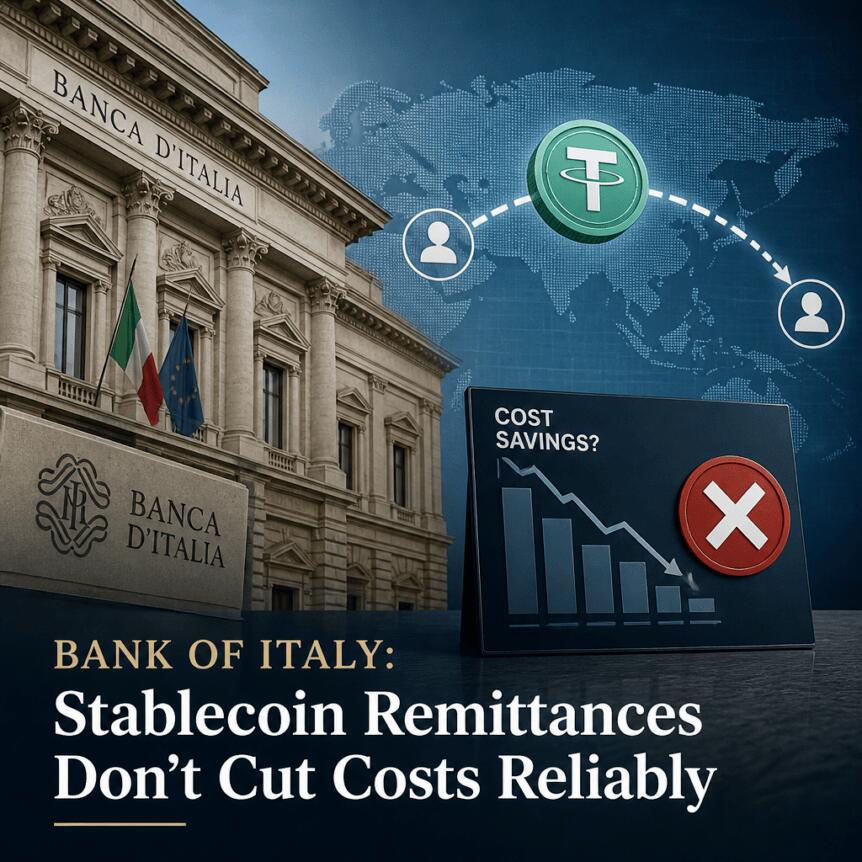
A new study from the Bank of Italy challenges a common assumption about stablecoins in cross-border payments: using stablecoin transfers for remittances may not automatically deliver better economics or faster delivery than established payment rails once the full cost chain is considered.
Researchers evaluated 200 remittances denominated in USDC across 10 bidirectional payment corridors connecting Italy with Brazil, Argentina, Japan, the United Arab Emirates and South Africa. They compared end-to-end fees and settlement times against traditional remittance services, concluding that most expenses and delays were driven by fiat on- and off-ramp frictions rather than by blockchain execution itself.
Key takeaways
- In the tested corridors, exchange and currency-conversion charges made up the majority of total remittance cost, while blockchain transaction fees were only a small portion.
- Total stablecoin remittance costs ranged from 0.3% to nearly 9%, depending on the corridor, while settlement time was typically under 20 minutes where instant payment systems were available.
- Compared with the World Bank’s global average remittance cost benchmark of 6.65%, stablecoin transfers were cheaper in most corridors—but were cheaper than Wise in only three out of seven comparable corridors.
- The study argues that improvements to domestic instant payment infrastructure and reduced reliance on reconversion into fiat are likely to matter more than blockchain technology alone.
- Regulatory design strongly influences where stablecoin users transact, with overly restrictive regimes potentially pushing activity toward offshore or unregulated channels.
Stablecoin remittances: where the cost really comes from
The Bank of Italy study tested 200 USDC remittance flows across 10 corridors, designed to capture realistic friction across payment paths between Italy and several major regions. The researchers focused on the full journey—from conversion and routing through the on- and off-ramps used to turn fiat into stablecoins and back again—then compared results to traditional remittance offerings.
According to the report, the largest share of costs came from exchange fees and currency conversion. Blockchain fees represented only a small fraction of the total remittance cost, undermining the idea that “using a blockchain” by itself will guarantee cheaper transfers. In other words, even if the stablecoin transfer settles quickly on-chain, the conversion steps required to deliver value in the recipient’s usable currency can dominate the bill.
On the cost range observed in the experiment, total stablecoin remittance costs varied sharply by corridor—from as low as 0.3% to nearly 9%. That variability matters for investors and payment operators because it suggests that stablecoin remittance performance is not uniform; it depends heavily on the local availability and pricing of payment infrastructure and conversion services.
Speed depends on local payment rails, not just settlement time
The study also measured settlement times end-to-end. For stablecoin remittances, transfer settlement was reported as less than 20 minutes in corridors where instant payment systems were available. In corridors without those systems, settlement took one to two business days.
This finding is consistent with the broader logic of cross-border payments: on-chain settlement can be quick, but delivery is constrained by the speed of off-chain steps—such as how quickly funds can be credited to accounts after the stablecoin leg is completed. For users, that means stablecoins may improve speed only when the surrounding payment ecosystem can match the speed of the blockchain component.
How stablecoins compare to global benchmarks and mainstream providers
To contextualize the results, the Bank of Italy report used the World Bank’s global average remittance cost of 6.65% as a reference point. Against that benchmark, the stablecoin corridors examined were cheaper in most cases. However, the study’s comparison to major providers was more nuanced.
The report found that stablecoin transfers were less expensive than Wise in only three of seven comparable corridors. That asymmetry is important: it indicates that stablecoin-based remittances may undercut some traditional options in certain routes, but they do not consistently outperform competitive incumbents across the board.
For traders and builders watching stablecoin adoption, the implication is clear: performance will likely be route-specific until the conversion and settlement ecosystem improves. Stablecoin rails can reduce certain types of friction, but in practice they must be integrated into efficient on- and off-ramp systems to translate into sustained advantage.
Infrastructure investment and spending stablecoins directly
While the study found that blockchain transaction fees were not the primary cost driver, it argued that strategic investment in domestic instant payment infrastructure could improve the competitiveness of stablecoin-based cross-border payments. The authors emphasized that settlement speed depended heavily on the quality of local payment rails—so improving the “last mile” (and the corresponding conversion processes) is likely to yield the biggest gains.
The report also highlighted a structural bottleneck: stablecoins currently often require reconversion into local fiat to be usable by recipients. It suggested that meaningful economic advantages would increase if stablecoins could be spent directly in the real economy.
If stablecoins could be spent directly in the real economy, for goods and services, rents, or school fees, without reconversion into local fiat currency, the economic advantages of stablecoin-based transfers would be substantially higher.
Regulation: efficiency can improve or unravel depending on design
Beyond infrastructure and market mechanics, the study argued that regulatory design shapes remittance efficiency. In the Bank of Italy’s framing, prohibitionist regimes have not eliminated stablecoin demand; instead, they can redirect usage toward offshore platforms and other unregulated channels. Conversely, overly restrictive frameworks may increase operational complexity for retail users, potentially offsetting any intended consumer protections.
The study arrives as major jurisdictions tighten or implement frameworks for crypto assets and stablecoins. The European Union has implemented its Markets in Crypto-Assets (MiCA) framework, and the United States enacted the GENIUS Act, which is intended to govern payment stablecoins. As these regimes take effect, the balance between compliance, accessibility, and the availability of regulated fiat on- and off-ramps may directly affect real-world remittance outcomes.
The broader stablecoin market context also matters. DefiLlama data cited in the article places stablecoin supply at about $307 billion, up roughly 16% over the past year. That growth underscores why policymakers and payment providers are focused on the operational and regulatory details—especially where remittances are concerned.
What to watch next is whether regulatory changes and domestic payment infrastructure upgrades reduce the conversion frictions that the Bank of Italy study identifies as the dominant cost and timing drivers. If stablecoin usage increasingly shifts toward corridors with strong instant payment rails and if more “spendable” pathways emerge, the potential for stablecoins to outperform traditional remittance services may become clearer—and more consistent across routes.
Cardano was up by 4% over the past 24 hours after a few choppy sessions earlier in the week. The crypto asset climbed from around $0.164 to above $0.17. The latest uptick has pushed its monthly gains to around 12%.
Amidst improving price structure, new data suggests that ADA may be entering a different phase.
Buyers Hold Their Ground
Pseudonymous analyst ‘The Boss’ said ADA may be moving from panic-driven selling toward a more constructive accumulation phase after an aggressive sell-off. The analysis pointed to higher lows in recent trading sessions rather than new breakdowns.
According to The Boss, buyers have continued to defend a major demand zone of $0.1064-$0.1503, while a short-term ascending trendline is keeping the recovery structure intact. The crypto asset is also compressing below overhead resistance, which indicates the market is looking for its next directional move rather than extending the earlier decline, the analyst explained.
Now the focus remains on whether the developing base can turn into a broader recovery. Holding current support and maintaining higher lows would strengthen the accumulation narrative and improve the overall market structure.
Further adding to the bullish case, whale activity has also picked up. CryptoPotato recently reported that large ADA holders increased their combined holdings to 25.6 billion tokens, which is nearly 70% of the circulating supply and the highest level since February 2023.
Retail exposure, meanwhile, declined, a mix that Santiment said could support the asset. Analyst Ali Martinez found that whales had accumulated 30 million ADA, which is worth more than $5 million, over the previous month. The renewed buying suggests larger investors may be positioning for another move higher.
Meanwhile, institutional interest also appears to be holding up. Recent data from Blockworks revealed that Cardano ETFs have now posted 16 straight months of net inflows.
Bigger Picture
For some market watchers, ADA’s historical performance remains a reason for worry. One market watcher highlighted the token’s poor long-term performance, while arguing that a $10,000 investment made at its all-time high five years ago would now be around $500.
The post also said that Cardano has fallen roughly 84% since Trump mentioned it in March 2025 as part of a proposed US Strategic Crypto Reserve. From its August 2021 all-time high, the token remains down about 95%.
Despite those numbers, Charles Hoskinson remains positive about the ecosystem’s future. The founder recently compared its approach to Anthropic’s rise in AI, and said that the company leapfrogged Google and OpenAI not by moving faster, but by having the “right mindset.”
Hoskinson said Cardano is seeing a similar shift, as developers and investors are placing greater importance on security and governance. He also pointed to recent DeFi incidents to highlight how quickly vulnerabilities can affect the wider ecosystem.
He said lasting stability requires clear governance, a strong software development process and a sustainable roadmap. While acknowledging Cardano’s past mistakes, Hoskinson said he is “happy” with where the ecosystem stands and expects strong growth over the next 12 to 24 months.
The post Is Cardano (ADA) Finally Shifting From Sell-Off to Accumulation? appeared first on CryptoPotato.
Crypto World
Trump Administration Amps Up Pressure On Senate To Confirm Todd Blanche As Attorney General
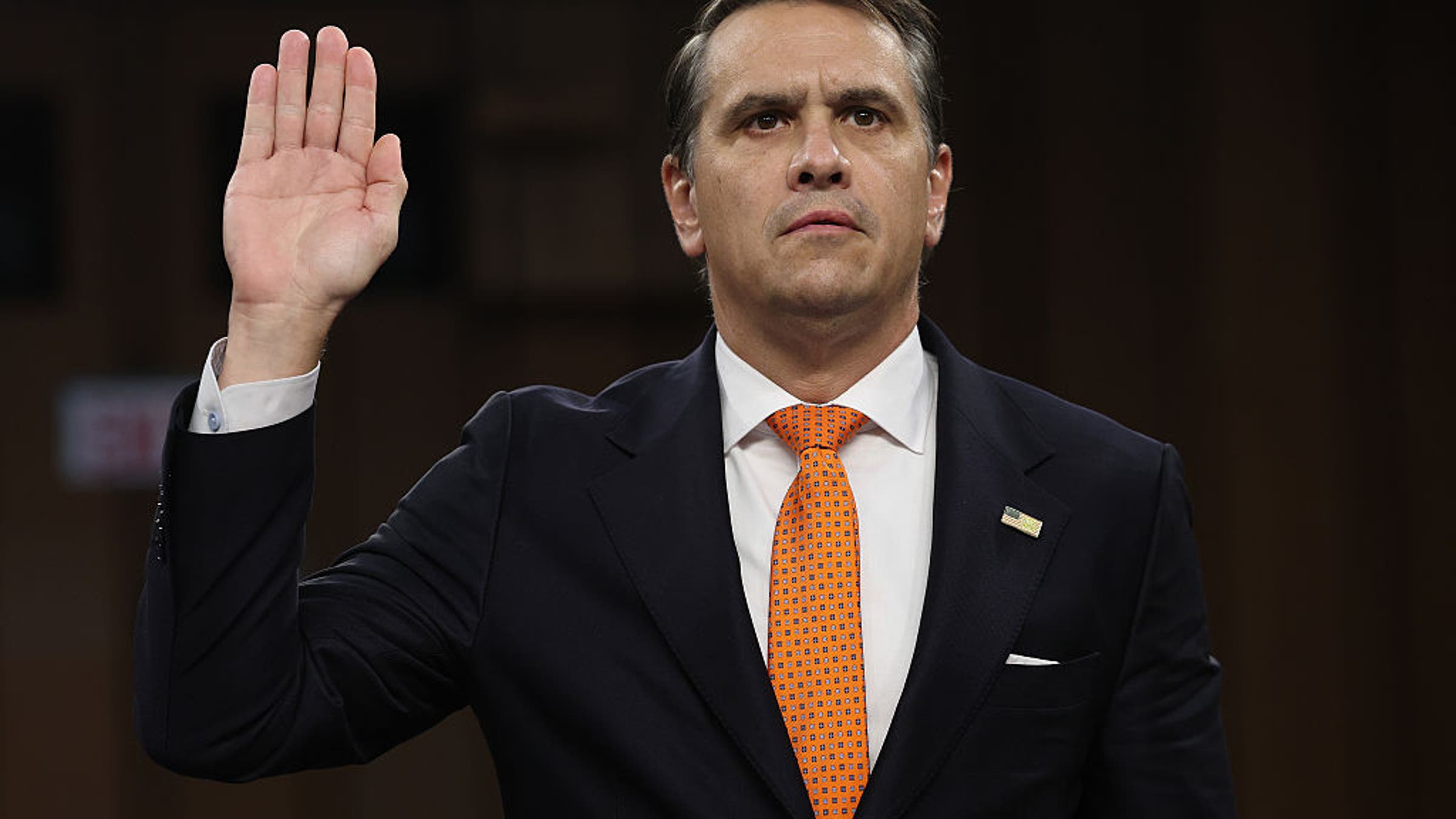
The Trump Administration’s renewed pressure on the Senate to push through Blanche’s confirmation comes a day after the President indicated he might pull the nomination.
“I have no objection to temporarily withdrawing Todd’s name, if they do not do the right thing, and putting him back after Cornyn and Tillis are out of office,” Trump said in a Truth Social post on Thursday, referring to the two Republican holdouts.
During his Cabinet meeting at Camp David on Friday, Trump said of Cornyn threatening to pull his support of Blanche: “I don’t really blame him, to be honest with you.”
“I endorsed his opponent,” Trump said. “The man that lost, the man that I didn’t endorse, has become very angry, and that’s ok.”
“I mean, I understand that,” he continued. “I probably would do the same thing.”
Crypto World
Roblox Stock Sinks Nearly 14% After-Hours as New Child Safety Measures Weigh on Outlook
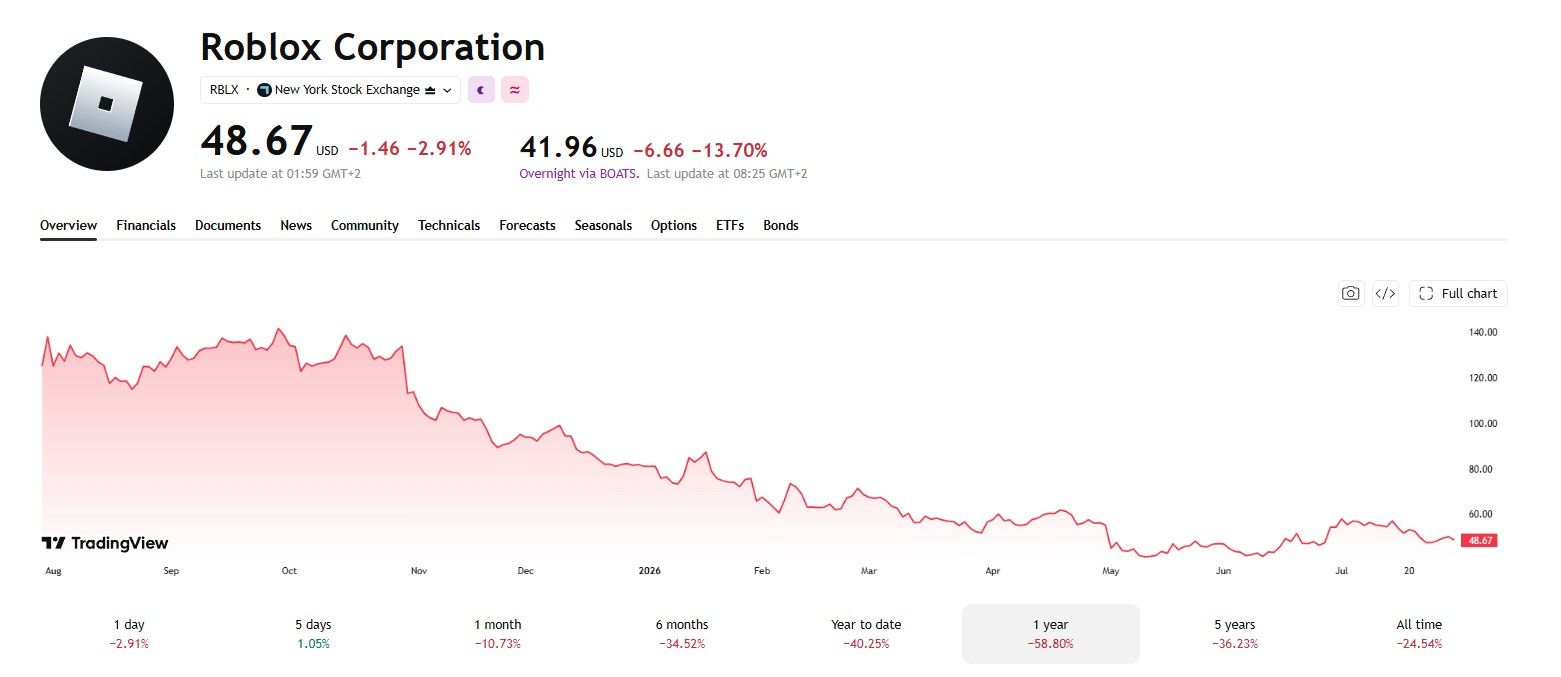
Roblox stock tumbled nearly 14% in after-hours trading on Thursday, sliding toward $41.80. The gaming platform missed Wall Street revenue targets and issued weak guidance for the third quarter.
The drop erased optimism from a 36% year-over-year revenue increase. Investors instead focused on slowing user growth and a bookings forecast far below consensus.
Child Safety Rules Slow Roblox’s Growth Engine
Roblox reported average daily active users of 123 million, up 10% year-over-year. That fell short of the roughly 128 million analysts expected. Average monthly unique payers reached 27 million, also up 15% year-over-year, per the company’s supplemental materials.

That payer growth marks a sharp deceleration, however. Monthly unique payer growth ran as high as 94% year-over-year just two quarters earlier.
Mandatory age verification and new parental control tiers have since taken hold. Average bookings per payer held steady near $19.25, so the slowdown shows up in new payer counts, not in existing spending habits.
Executives linked the slowdown directly to those safety changes. Age-check penetration reached 57% of users globally, with Australia near 80% and the United States and United Kingdom around 70%. The rollout coincided with a discovery algorithm shift that favors long-term retention over immediate spending. That change hit monetization hardest among players under 13.
The pattern mirrors a wider trend this year, as big tech selloffs periodically dragged crypto sentiment lower. Meanwhile, the Nasdaq’s rising correlation with risk assets keeps growing. A stumble at a platform this large rarely stays contained to one sector.

Weak Bookings Guidance Overshadows the Beat
Bookings, Roblox’s preferred spending measure, grew just 8% year-over-year to $1.6 billion. That growth rate ran as high as 63% just two quarters earlier and 70% the quarter before that. The deceleration landed bookings at the low end of guidance. For the third quarter, Roblox forecast bookings between $1.58 billion and $1.65 billion. That trails the roughly $1.87 billion analysts had modeled.

Adjusted losses of 26 cents per share nonetheless beat estimates, and free cash flow rose 66% to $294 million. Founder and chief executive David Baszucki framed the results as part of a longer transition.
We remain steadfast in our goal to capture 10% of the global gaming market.
Baszucki said on the earnings call.
Roblox’s report lands amid a broader wave of disappointing Big Tech guidance this earnings season. Meta stock tumbled sharply last quarter despite beating estimates, after its spending outlook rattled investors. Regulators are tightening the same age verification rules that pressured Roblox. The European Union is also closing a VPN age verification loophole that lets minors bypass similar checks elsewhere. Roblox now joins a growing list of earnings reports to watch this season as guidance cuts outweigh headline beats.
Whether Roblox’s safety-first bet pays off with steadier long-term monetization remains unclear. As a result, shareholders will watch the September quarter closely for signs that bookings have stopped sliding.
The post Roblox Stock Sinks Nearly 14% After-Hours as New Child Safety Measures Weigh on Outlook appeared first on BeInCrypto.
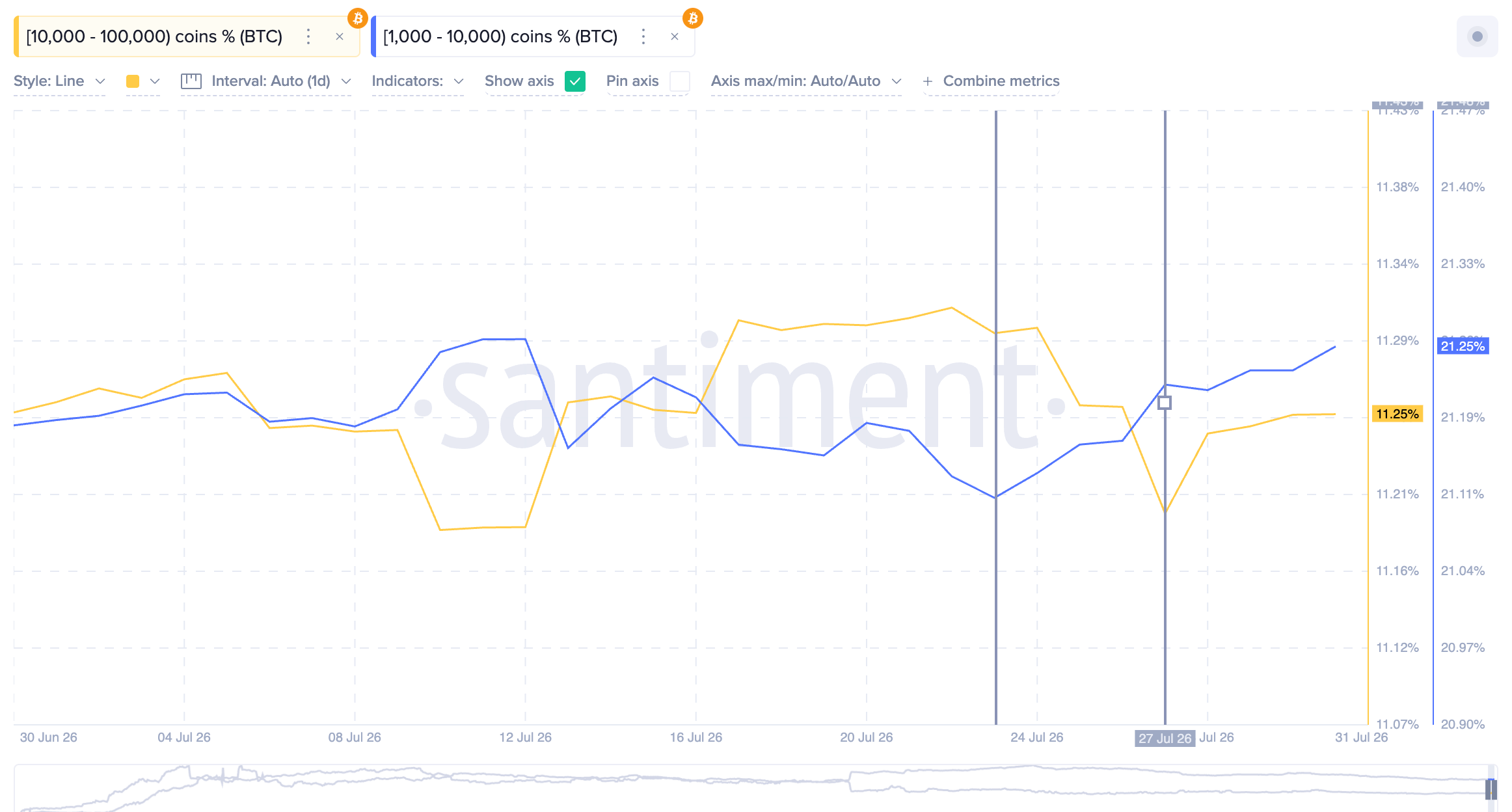
The largest BTC wallets, aka the Bitcoin whales, started buying in late July. And a $233 million institutional inflow followed days later, a sequence that put big money on the bid just as Bitcoin entered the weakest month on its calendar.
The turn stands out because August has closed red for four straight years. Whale wallets and exchange-traded fund desks are wading in anyway, and the timing of who moved first is the real story.
Bitcoin Whales Moved First, and the Timestamps Show It
Bitcoin (BTC) whales started adding before Wall Street did. Wallets holding 1,000 to 10,000 BTC lifted their share of supply from about 21.11% on July 23 to 21.25% by month-end, according to Santiment data supplied for this analysis.
Want more token insights like this? Sign up for Editor Harsh Notariya’s Daily Crypto Newsletter here.
The larger 10,000 to 100,000 BTC cohort had been trimming since July 22. It bottomed near 11.19% on July 27, then turned back up to 11.25% into the close of the month.

Those shifts read as small in percentage terms. Yet the combined 0.20% gain across both cohorts, applied to Bitcoin’s roughly 20.06 million circulating supply, works out to about 40,100 BTC, worth close to $2.6 billion.
Derivatives positioning leaned the same way, which gives more weight to Santiment’s data. A whale-retail divergence reading of +21.8 on the daily timeframe flagged large traders as far more tilted toward long exposure than retail, a setup the dashboard labeled bullish divergence. The score reflects Binance Futures positioning, so it signals conviction rather than confirmed spot buying.

If whales were the first movers, the open question was whether institutions would follow, and the ETF tape answered within days.
Then a $233 Million Institutional Day Followed
US spot Bitcoin ETFs had been bleeding. The funds posted four straight negative sessions, including outflows of $225.18 million on July 23 and $240.08 million on July 24, before flows turned modestly positive at $32.11 million on July 29.
Then July 30 delivered $233.13 million in net inflows. BlackRock’s IBIT accounted for $183.4 million of the total, or about 79% of the day. The single session pulled spot Bitcoin ETF demand back to life after a run of redemptions.

The size matters less than the timing. July 30 was the second-largest single-day inflow of the month, behind the $265.69 million recorded on July 6, and it landed at the very end of July. It also arrived while the market was still digesting a corporate bitcoin buying freeze among some large treasury holders.

Institutions did not lead this turn. They stepped in after the on-chain cohorts had already started buying. What makes that sequence uncomfortable is the calendar it runs into.
Into Bitcoin’s Worst Month on Record
August is the problem. It carries a median return near negative 8%, the weakest of any month, and it has closed red every year since 2022. That record anchors the cautious Bitcoin August price prediction now facing the market.
July, by contrast, is on track to close green for a third straight year, a rare streak. That makes the late-month buying a bet against strong seasonal odds rather than a confirmation of them. Big money is possibly positioning for a rebound, though the data cannot rule out hedging or short-dated trades.

Yet, the convergence is real. Whale cohorts, futures positioning, and ETF cash all turned higher at once, in that order. Whether that marks accumulation before a bounce or a crowded bet into Bitcoin’s cruelest month is the wager August will settle.
The post Bitcoin Whales Scooped 40,100 BTC Worth $2.6 Billion in Nine Days appeared first on BeInCrypto.
Pump.fun reportedly dismissed employees shortly before their PUMP token grants were scheduled to vest, leaving at least one former worker without an allocation now valued at seven figures.
Summary
- Employees were reportedly dismissed weeks before 25% of their PUMP grants vested.
- One former employee allegedly lost a token allocation now worth seven figures.
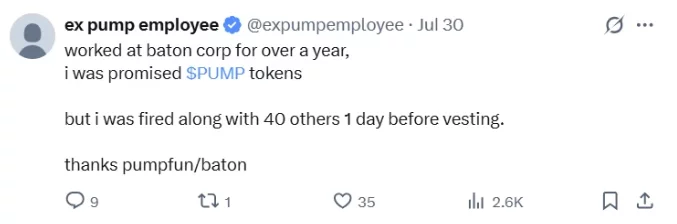
- Separate claims said 40 workers were cut one day before another vesting date.
- PUMP trades near $0.002, about 77% below its September 2025 peak.
Pump.fun layoffs preceded employee token vesting
Pump.fun reduced its workforce in late March and early April after rapidly expanding its operations, according to an investigation by Sandmark.
Documents, emails, and internal recordings reviewed by the publication showed that some employees lost their jobs shortly before their PUMP allocations were due to begin vesting. At least one former employee allegedly forfeited tokens now worth seven figures.
Workers had reportedly signed token grant agreements in June 2025. Under those arrangements, the first 25% of their allocations would vest after one year, followed by additional releases over time.
Sandmark obtained a termination email showing that Pump.fun head of talent Lloyd McCarthy called affected employees into a group meeting in late March. During the recorded meeting, co-founder Noah Tweedale said the company had “grew too quickly,” limiting its ability to operate “fast and rough.”
Contracts were terminated in early April, according to the report. Affected workers received severance payments based on how long they had worked for the company, but their unvested PUMP allocations were reportedly canceled.
Pump.fun has not publicly addressed the findings.
Former workers allege a second round of cuts
New allegations surfaced after former workers claimed that Baton Corp., the company behind Pump.fun, conducted another round of layoffs in mid-July.
A newly created X account named “ex pump employee” alleged that Baton dismissed about 40 employees one day before their PUMP grants were scheduled to vest. The account owner claimed to have worked for the company for more than a year.
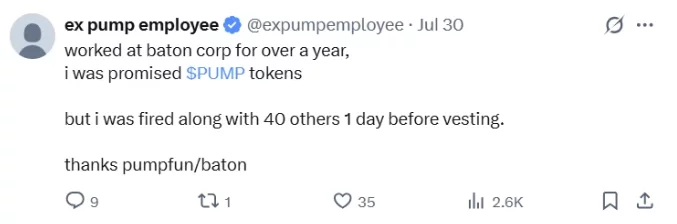
The account also alleged that Pump.fun never intended to conduct a public PUMP airdrop because the company opposed “giving free money” to users. Pump.fun has not responded publicly to that claim.
However, Sandmark said it could not independently verify the allegation that 40 workers were dismissed immediately before the July vesting event. The claim therefore remains based on the former employee’s account rather than independently reviewed employment records.
The dispute centers on employee compensation rather than tokens already held by public investors. Still, the allegations could increase scrutiny of how crypto companies structure token grants and whether employment termination clauses allow firms to cancel large allocations shortly before vesting.
PUMP distribution moved $86.49M to 121 wallets
The allegations follow Pump.fun’s first major team and investor token distribution after a one-year lockup expired.
As crypto.news previously reported, on-chain tracking showed that 57.279 billion PUMP tokens, valued at approximately $86.49 million at the time, moved to 121 wallets on July 15.
Wu Blockchain said the distribution marked the start of a three-year vesting period for team and investor allocations. The transfers made previously restricted tokens available to recipients, although wallet movements alone do not prove that any of the tokens were sold.
For US token holders, the employment allegations do not change their ownership rights. The broader concern is market-related: continued insider distributions could increase transferable supply and create selling pressure if recipients move tokens to exchanges.
PUMP remains 77% below its record high
PUMP traded around $0.002 at press time, gaining nearly 5% over the previous 24 hours, according to CoinGecko. Despite the daily rise, the token remained roughly 77% below its September 2025 all-time high.
The decline comes as Pump.fun continues to generate large numbers of short-lived meme coins. A June CoinGecko study examined 18.67 million tokens created through the launchpad between January 2024 and June 2026.
Researchers found that 12.8 million tokens, or 68.67%, recorded their final Pump.fun bonding-curve trade on the day they launched. Tokens that never traded were excluded because they had no measurable trading lifespan.
CoinGecko linked the high failure rate to the platform’s low barriers to token creation, which allow users to abandon launches quickly when early demand fails to appear.

CLARITY Act odds hit 25% as Trump weighs ethics deal

Twitch streamer Zoil allegedly artificially inflates Twitch subs by gifting himself anonymously, fans call situation “depressing”

NYT Strands hints and answers for Saturday, August 1 (game #881)


-
 Sports5 days ago
Commonwealth Games boxing: Jadumani Singh seals dominant 5-0 win over Pakistan’s Sumama Rehman to enter quarter-finals | Commonwealth Games News
-

 Business2 days ago
Why Trees Belong on the Risk Register
-

 Tech5 days ago
Intel is reversing course and bringing hyper-threading back to its server chips
-

 Fashion5 hours ago
Weekend Open Thread: Wit & Wisdom
-

 Politics2 hours ago
Meta enters AI-training agreement with far-right ‘propaganda rag’ Newsmax
-

 Crypto World6 days ago
Ripple bought a bank in pieces. The $4 billion audit
-

 Politics5 days ago
Luke Littler dismantles Gerwyn Price to retain title in Blackpool
-

 Politics4 days ago
The Part of the Electric Transition Nobody Wants to Discuss
-

 News Videos5 days ago
BITCOIN JUST ENTERED THIS CRITICAL ZONE…
-
 Entertainment3 days ago
‘Stargate’ Creator’s New Sci-Fi Series Returns for Season 3 Tomorrow
-

 Crypto World6 days ago
XRP Ledger adds $2.6B as RWA inflows rank second
-

 Business3 days ago
Major shareholder moves on Canyon
-

 Politics5 days ago
Spain sweeps the board at 2026 World Cup with individual awards
-

 News Videos1 day ago
Bitcoin Enters the 3rd Stage of the Bear Market
-

 Entertainment6 days ago
Sara Gilson Killed By Husband After Viral “Pedophile” TikTok Video
-

 Crypto World3 days ago
Kraken Enables Retail Access to Jersey Mike’s IPO via Tokenized Shares
-

 Tech7 days ago
Anthropic launches Claude Opus 5, a cheaper AI model for coding, agents and enterprise workflows
-

 Tech4 days ago
New macOS Sequoia & Sonoma security updates for older Macs
-

 News Videos3 days ago
Claude: Build Financial Dashboards in Minutes (2026)
-

 Politics1 day ago
Luke Littler’s dominance sparks GOAT debate
You must be logged in to post a comment Login