
Crypto World
Why is Bitcoin price down today?

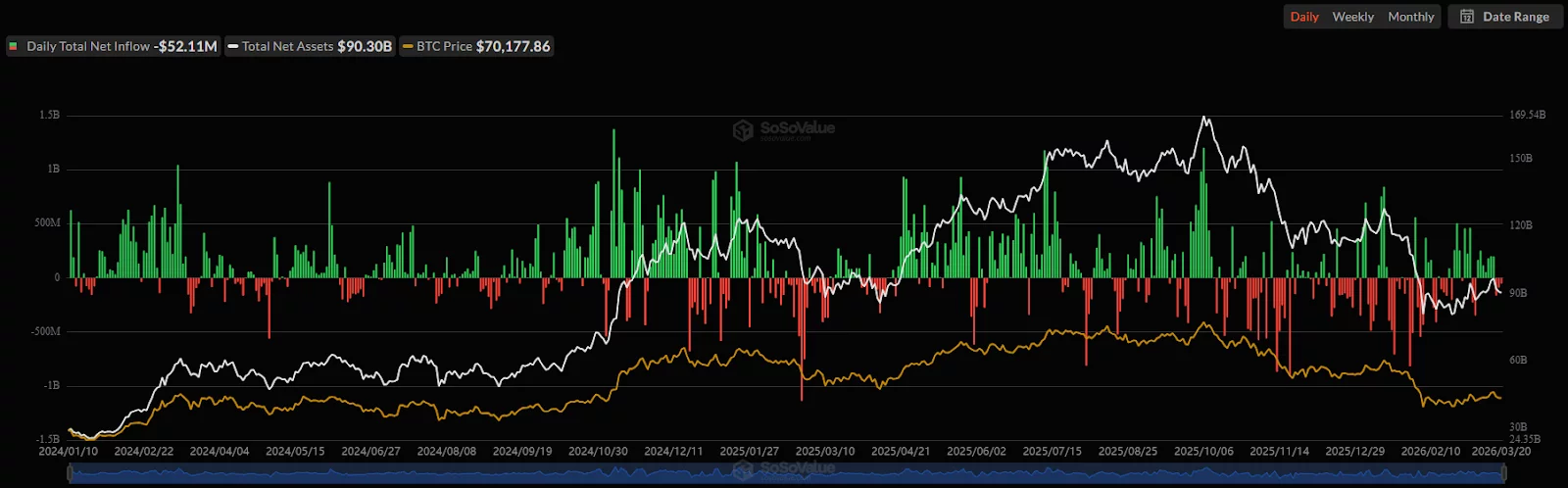
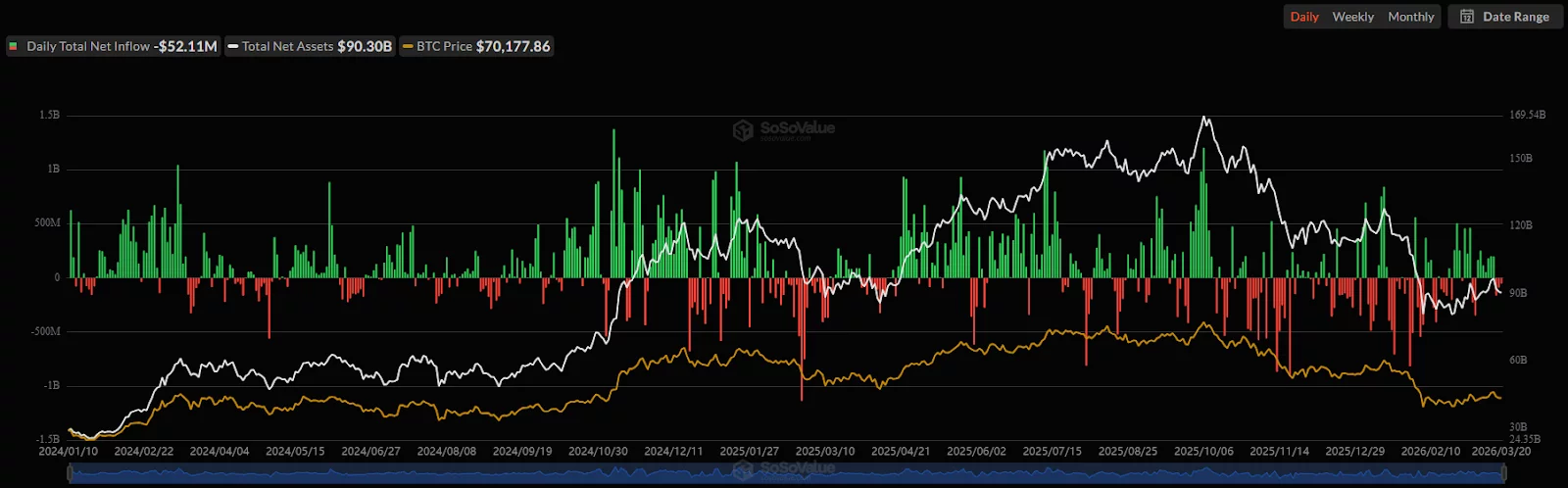
Bitcoin’s (BTC) price has recently slipped back toward $68,000, erasing some of its gains from the previous weeks.
Summary
- Bitcoin struggles at $68K due to macro factors, including the Fed’s stance and geopolitical tensions.
- Bitcoin ETFs saw a reversal, with $300M pulled out, contributing to the recent price decline.
- Geopolitical tensions and Fed’s comments on inflation pressure Bitcoin’s price, adding volatility.
Bitcoin’s price had previously surged to a six-week high of $76,000, recovering $13,000 since the escalation of the Middle East conflict. However, after reaching this peak, Bitcoin faced a sharp rejection and has since fallen by $8,000.
The price volatility is compounded by broader market trends, as Bitcoin now struggles to maintain its position above the $68,000 support level. The current trading range is marked by price fluctuations, with Bitcoin caught between support at $68,000 and resistance at $76,000.
Analysts, including Michaël van de Poppe, have noted that Bitcoin is stuck within a range, awaiting a breakout. Van de Poppe stated, “Nothing special so far for $BTC,” suggesting that Bitcoin’s movement remains largely dependent on reaching either the lower or upper bounds of the range, where traders may act on the volatility.
Macro factors and federal reserve’s influence
A major reason behind Bitcoin’s recent price decline can be traced to the Federal Reserve’s stance on interest rates. Despite expectations that no changes would be made during its latest meeting, Fed Chair Jerome Powell’s hawkish remarks about inflation concerns have added pressure on risk assets like Bitcoin. Powell indicated that rate cuts may not occur for over a year, leading to uncertainty in markets, including cryptocurrencies.
This outlook has contributed to a more cautious approach from investors, as market volatility tends to increase under such conditions. As predictions suggest that rate cuts could be delayed, Bitcoin’s price faces downward pressure, mirroring the broader downturn in risk assets.
In addition, geopolitical developments, particularly the escalating tensions in the Middle East, also played a role in Bitcoin’s price decline. A dramatic dip was observed after U.S. President Trump made threats regarding Iran, which caused a brief but sharp drop in Bitcoin’s price. These events highlight the sensitive nature of Bitcoin as a risk-on asset, reacting swiftly to global political unrest.
Bitcoin’s volatility is often exacerbated by such geopolitical tensions, as investors move funds into or out of assets like Bitcoin based on the prevailing market sentiment.
ETF reversal and capital outflows
Another factor contributing to Bitcoin’s price decline is the reversal in ETF inflows. Bitcoin ETFs had seen a strong seven-day streak of positive inflows, reaching $200 million on March 17.
However, in the days that followed, investors began pulling funds out, with more than $300 million in withdrawals over the course of three days. This sudden shift in ETF flows coincided with Bitcoin’s price correction, indicating that institutional sentiment may be cooling, adding to the overall market pressure.
Disclosure: This article does not represent investment advice. The content and materials featured on this page are for educational purposes only.

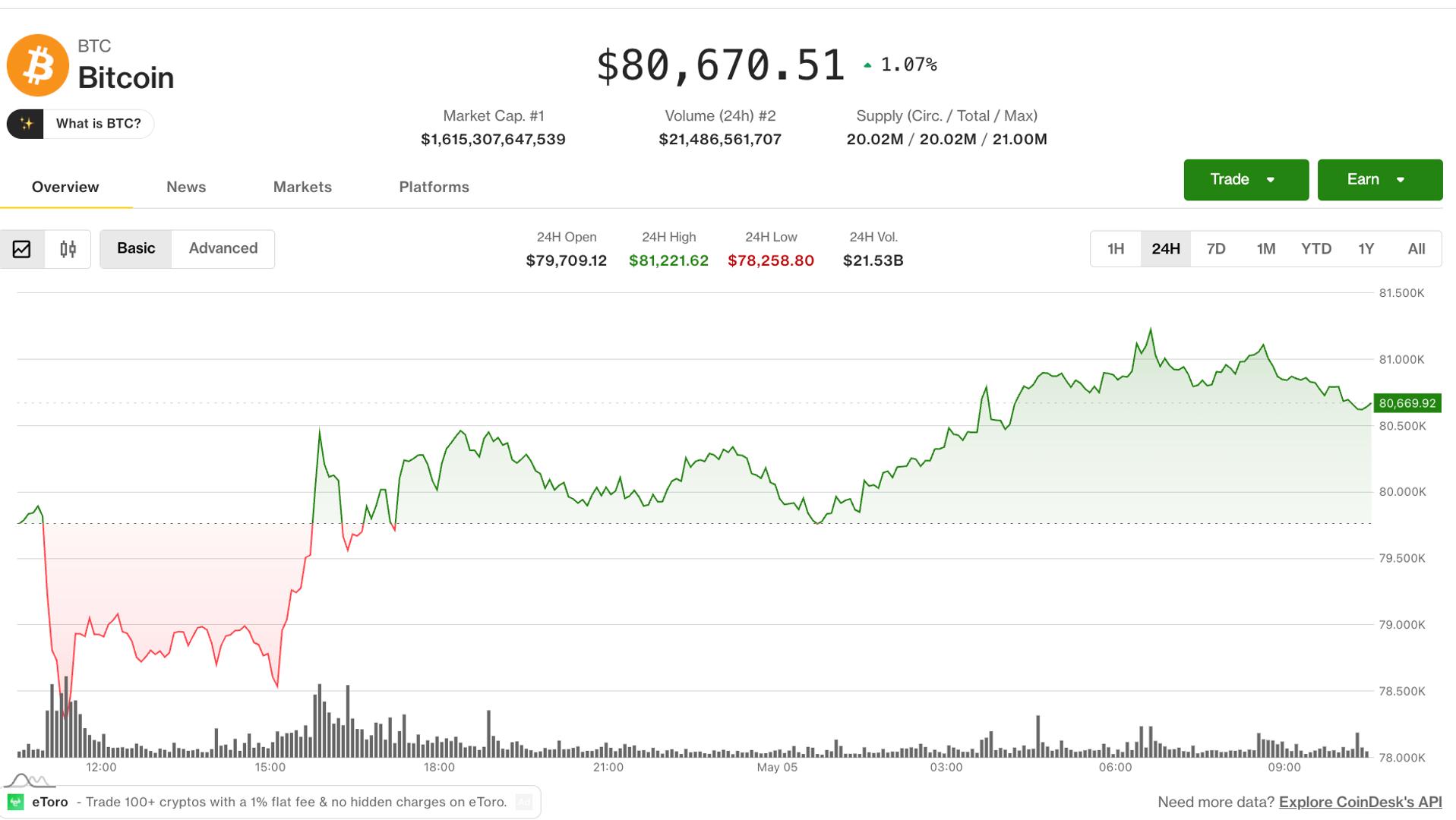
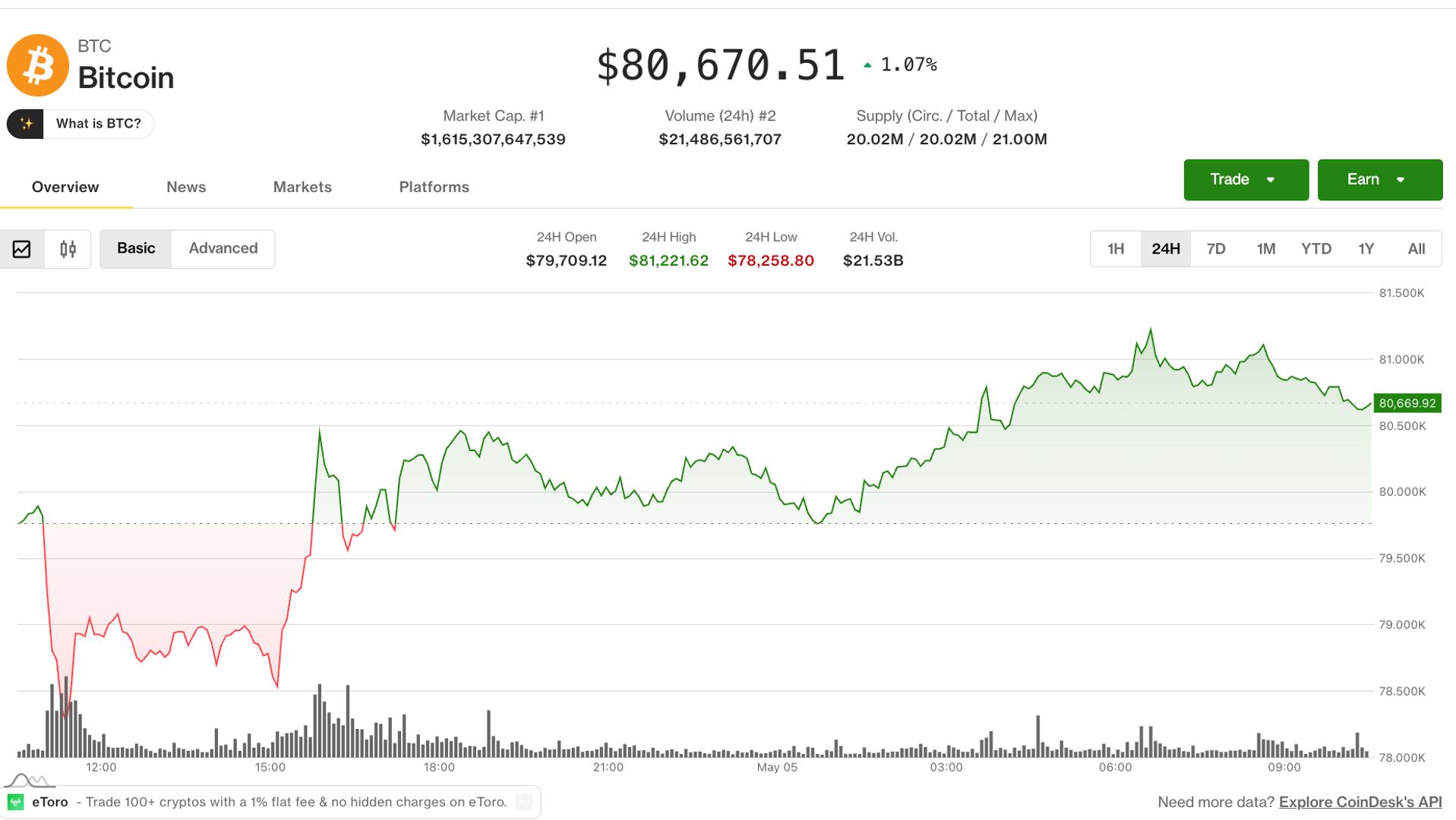
The crypto market is in a buoyant mood after bitcoin broke out above $80,000 during the Asian morning Tuesday.
BTC currently trades at $80,690 having risen by more than 1% since midnight UTC. Ether (ETH), meanwhile, is at $2,370 after it failed to break April’s high of $2,460.
U.S equities are up in pre-market trading, with Nasdaq 100 futures and S&P 500 futures increasing by 0.5% and 0.3% respectively on Tuesday, spurred by investors buying the dip after jitters on Monday in relation to the Strait of Hormuz.
Precious metals gold and silver also ticked higher on Tuesday but remain significantly lower than the speculative blow off top in early March.
Derivatives positioning
- Futures tied to Cardano’s ADA are seeing record participation. Open interest (OI), the total number of active futures contracts, has surged more than 18% to 2.17 billion tokens, surpassing the previous peak from January.
- Despite this buildup, positioning in ADA does not appear excessively overheated. Perpetual funding rates are running at an annualized 9%, which signals bullish sentiment but not extreme leverage. Meanwhile, ADA has posted one of the highest cumulative volume deltas (CVD) over the past 24 hours among major tokens. It means that buyers are driving trading activity by placing more market orders than sellers, rather than using passive limit orders.
- TON is another standout. Open interest has jumped 40% to a record 200.2 million tokens. It also shows the strongest CVD among the top 30 cryptocurrencies, pointing to aggressive buying pressure. However, funding rates remain slightly negative, an unusual combination. This suggests a more nuanced positioning: traders may be buying TON in the spot market while simultaneously shorting futures to hedge, rather than outright speculative long positioning.
- There is one broader caution signal. Despite bitcoin’s breakout above $80,000, the OI-adjusted 24-hour CVD is negative for bitcoin and most major tokens, with the exception of ADA, TON and M. This indicates that the rally is not being strongly supported by aggressive derivatives buying, raising the risk that price gains could lack follow-through if spot demand weakens.
- Looking more closely at bitcoin, its open interest has risen about 3% to 785,000 BTC, approaching the recent record near 800,000 BTC. In contrast, derivatives activity in ether, XRP and solana has been relatively muted over the past 24 hours, suggesting a more selective market rather than a broad-based altcoin expansion.
- Volatility is also starting to stir. Bitcoin’s 30-day implied volatility index (BVIV) jumped 5% on Monday to move back above 40%, the sharpest one-day increase since mid-March. This rebound from multi-month lows is worth watching closely. A continued rise in implied volatility can signal growing demand for hedging or expectations of larger price swings, and in some cases may coincide with risk aversion and unwinding of recent gains. Ether’s equivalent measure (EVIV), however, has yet to show a similar pickup.
- In traditional markets, there are also early signs of hedging demand. Social media chatter points to large purchases of call options on the VIX — Wall Street’s “fear gauge,” which typically moves inversely to the S&P 500.
- Otions markets on Deribit show that risk reversals for both bitcoin and ether remain skewed toward puts across maturities. This means downside protection is still priced at a premium relative to upside exposure. Rather than outright bearishness, this likely reflects a shift in market structure: institutions are playing a larger role, and they tend to systematically hedge downside risk or generate yield by selling calls. The result is a market that is less euphoric, more hedged than in previous crypto cycles.
Token talk
- CoinDesk’s DeFi Select Index (DFX) is the best performing benchmark on Tuesday, rising by 2.7% since midnight UTC after ethena (ENA) and ONDO surged by 6.8% and 3.7% respectively.
- The CoinDesk 5 (CD5) is the worst performer, notching a 0.5% gain as investors appear to be rotating into more speculative bets as opposed to crypto majors.
- CoinMarketCap’s altcoin season indicator is at 41/100 showing neutral but warming sentiment towards the sector following a multi-month downtrend.
- Toncoin (TON) is the top performing altcoin among the CoinDesk 100 (CD100), rallying by 8.1% since midnight UTC and 28% over the past 24 hours following an announcement from Telegram CEO Pavel Durov, who said that Telegram will replace the Ton Foundation as the driving force behind the network.

Key Highlights
-
ASST experiences pre-market gains following Strive’s addition of 444 BTC to corporate reserves.
-
Company’s Bitcoin reserves exceed 15,000 BTC milestone after $33.9M acquisition.
-
Average acquisition price reaches $76,307 per Bitcoin in recent treasury transaction.
-
Company announces 18.7% year-to-date BTC Yield amid ongoing treasury expansion.
-
SATA preferred stock issuance reinforces Bitcoin-centered capital allocation framework.
Shares of Strive Asset Management (ASST) experienced upward movement in pre-market hours following the company’s announcement of Bitcoin treasury expansion beyond the 15,000 BTC threshold. Trading at $16.54 during pre-market sessions, ASST registered a 1.13% increase from its previous closing price of $16.36. This acquisition reinforces Strive’s commitment to its Bitcoin-centered capital allocation approach.
Company Acquires 444 Bitcoin in Recent Treasury Expansion
Strive completed a purchase of 444 Bitcoin valued at approximately $33.9 million, based on recent SEC documentation. The transaction averaged $76,307 per Bitcoin. As a result, the firm’s aggregate Bitcoin reserves have crossed the 15,000 BTC threshold.
This acquisition comes on the heels of a significant April 24 disclosure, when Strive reported holdings of 14,557 BTC following a 789 Bitcoin purchase at $77,890 each. The recent transaction marks a continuation of the company’s sustained accumulation pattern over several months.
Strive now maintains one of the most substantial publicly held corporate Bitcoin treasuries. The estimated market value of its Bitcoin position approaches $1.2 billion, positioning the company among enterprises utilizing Bitcoin as a fundamental balance sheet component.
ASST Shares Advance Following Treasury Announcement
Following the Bitcoin treasury disclosure, ASST stock demonstrated positive momentum. Pre-market trading showed a 1.13% uptick after marginal gains in the prior session. The market response indicates heightened investor focus on Strive’s capital framework.
Current disclosures reveal 15,000 Bitcoin in reserves alongside a quarter-to-date BTC yield of 4.3%. The firm’s year-to-date BTC yield stands at 18.7%. SATA issuance for April 2026 totaled 584,730 shares, representing a 43% amplification ratio.
Management has centered its approach on Bitcoin per share metrics, which serve as the foundation for capital deployment and treasury development. Consequently, the company continues aligning balance sheet growth with Bitcoin acquisition and structured financing mechanisms.
Preferred Stock Instrument Reinforces Bitcoin Treasury Framework
Strive’s regulatory filings revealed $97.9 million in cash and cash equivalents. Additionally, the company disclosed a $50.4 million allocation in Variable Rate Series A Perpetual Stretch Preferred Stock, connecting Strive to Strategy-linked preferred equity instruments.
In January 2026, Strive completed a $225 million preferred stock raise that was significantly oversubscribed, with demand surpassing $600 million. The instrument offered an approximately 13% annualized yield. Furthermore, company statements indicated the product maintained its peg throughout a significant Bitcoin price correction.
The company bolstered its Bitcoin position through the January 2026 acquisition of Semler Scientific, which elevated Strive’s reported holdings to 12,798 BTC at that time. Subsequently, the firm has accumulated over 2,200 additional BTC, substantially enhancing its corporate treasury footprint.

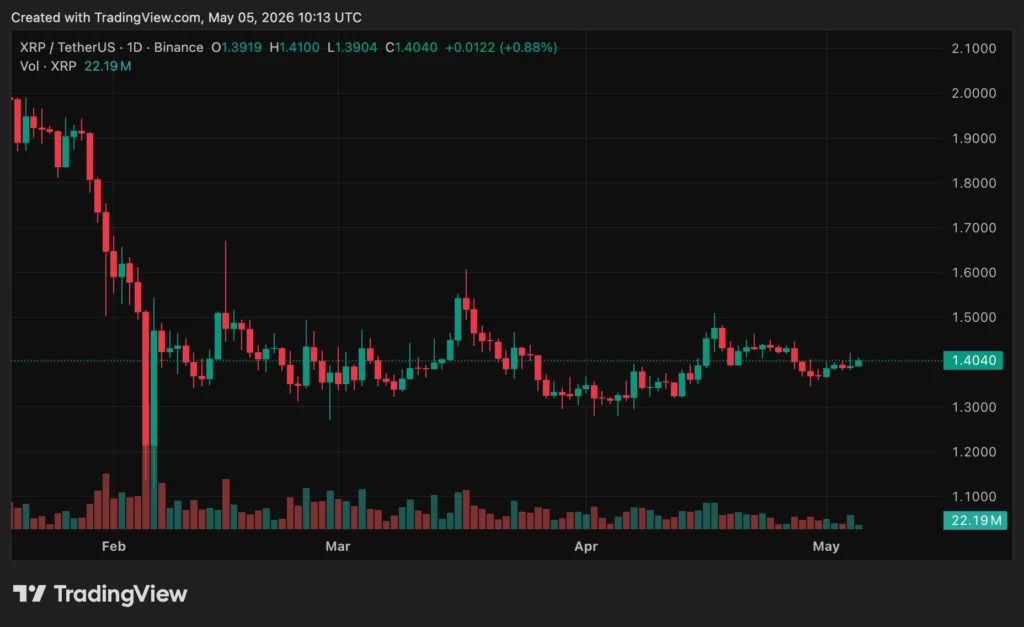
Ripple CTO Emeritus David Schwartz said on May 5, 2026, that his remaining crypto exposure is now almost fully tied to XRP and Ripple equity.
Summary
- David Schwartz said he has virtually no crypto exposure left beyond XRP and Ripple equity.
- Schwartz said his XRP-heavy position was not fully planned, despite his long role at Ripple.
- He also said diversification can be rational when investors cannot clearly identify future winners.
His comment came during a fresh online discussion about investment choices and XRP loyalty. Schwartz wrote: “Yeah, that’s true now. I have virtually no crypto exposure left except XRP and Ripple.” He also said the position was not fully planned, adding: “I’m not sure I really planned it that way, though.”
Despite his concentrated exposure, Schwartz did not present XRP-only investing as a general rule. He said diversification can make sense when an investor believes a sector may grow but cannot yet identify the clear winners.
“I think it’s rational to spread investment throughout a space if you think that space is likely to be successful in the future and don’t believe that you can personally pick the winners and the losers yet,” He wrote.
His comments place his personal portfolio apart from his broader market view. Schwartz said he now holds little crypto outside XRP, but his explanation showed that he still sees a case for spreading risk across a sector.
Recent XRP debates add context
The comment followed several recent debates involving Schwartz, XRP expectations and older public posts. As noted in our May 3 coverage, Schwartz denied claims that a gag order or non-disclosure agreement controls his comments about Ripple or XRP. He said no NDA forces him to mislead the XRP community.
Moreover, Schwartz also questioned extreme XRP price forecasts. He argued that if wealthy investors saw even a small chance of XRP reaching $10,000, they would likely push the price much higher today.
As outlined in our May 1 article, Schwartz said old XRP comments about liquidity were not a promise of future price levels. He said the debate was about market depth and transaction size, not a guaranteed target.
Old comments remain in focus
In our April 27 update, we covered Schwartz’s response to claims that he misled XRP holders with a 2017 discussion about XRP price and liquidity. He said the post explained how liquidity works when large transfers move through a market.
As highlighted in our April 24 article, Schwartz also rejected claims that XRP has hidden government or central bank deals. He said Ripple’s non-disclosure agreements relate to normal business activity, not secret XRP adoption plans.
At press time, Ripple’s native token (XRP) traded at around $1.4, up slightly in the past 24 hours and over 1% in the past 7 days (per crypto.news data)
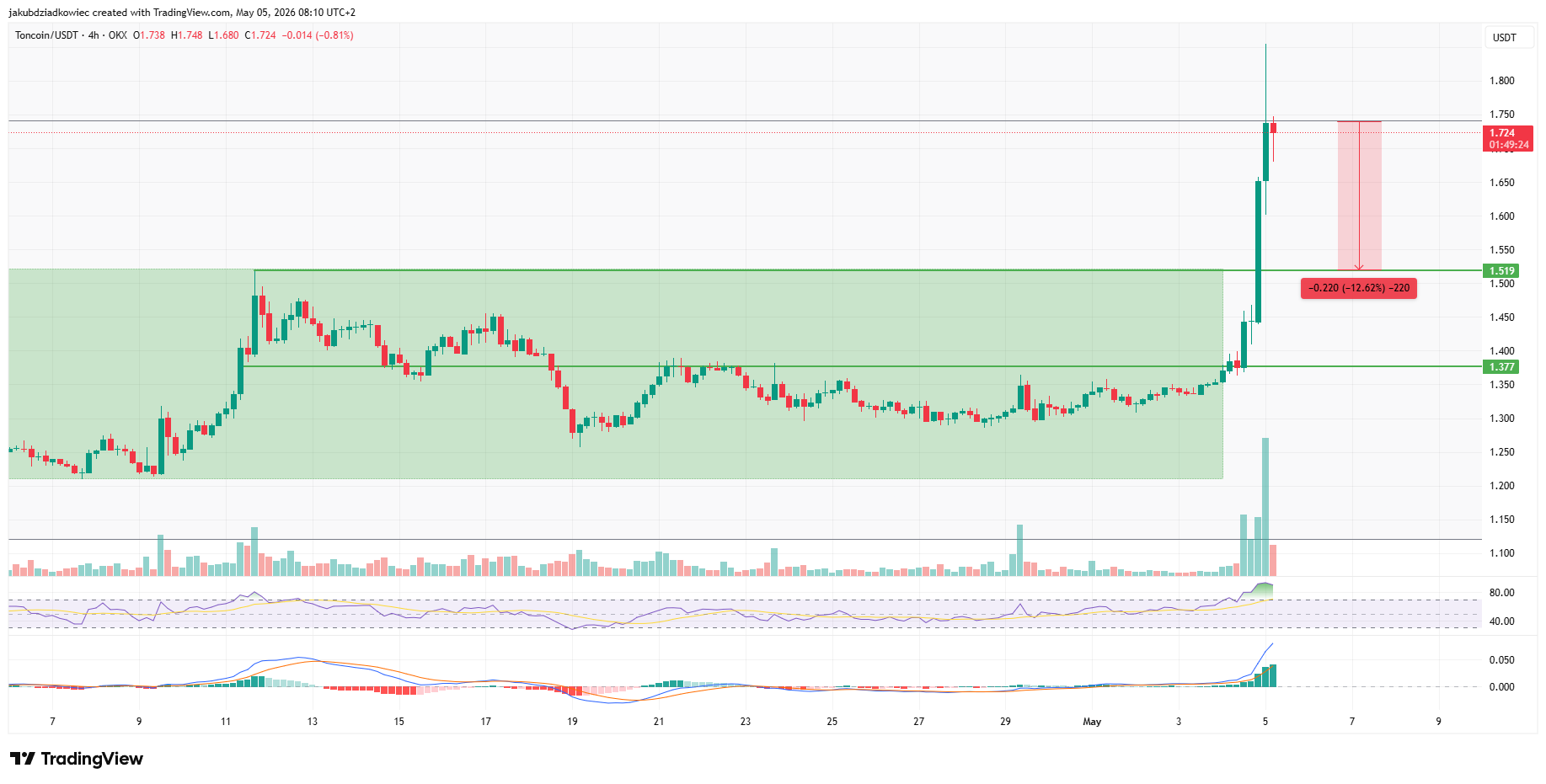
Toncoin (TON) price has broken out of a four-month accumulation zone, climbing above $1.74 on May 5. The move follows Telegram’s confirmation that it will replace the TON Foundation as the network’s largest validator.
The breakout tags the 0.236 Fibonacci retracement of the August 2025 to February 2026 decline. Daily volume printed its largest expansion in seven months.
Daily Chart Confirms Breakout From Long-Standing Range
The daily chart shows Toncoin inside a tight accumulation zone between $1.20 and $1.55 since the start of the year. That four-month consolidation followed a steep January selloff. Whales steadily added positions despite weak market sentiment.
The May 5 candle closed above the zone’s upper boundary and pushed the price to $1.74. That level corresponds to the 0.236 Fibonacci retracement of the August 2025 to February 2026 decline. The retracement spans from a $3.75 swing high down to the $1.26 February low.
Volume tells the story behind the move. Daily volume had been trending lower since October 2025. The breakout candle printed the largest green bar in roughly seven months. Such expansion typically validates a structural shift rather than a short squeeze.

The relative strength index on the daily timeframe pushed deep into overbought territory. It broke above 70 for the first time since February. Sustained RSI readings above 70 are common during early-stage breakouts and rarely resolve as immediate reversals.
Volatility is also expanding sharply. The Bollinger Band Width Percentile is printing extreme red readings. That signals compression has ended, and a directional move is underway.
Toncoin’s price action aligns with broader strength across the crypto market. Bitcoin posted a 3% session gain. TON’s 27% intraday move shows the altcoin outperforming peers.
Toncoin Price Prediction Points to $1.52 Retest Before $2.74 Target
The four-hour chart confirms the daily breakout with even sharper momentum signals. RSI on this timeframe sits near 90.
Such extreme readings historically resolve with a brief cooldown rather than an immediate reversal. The MACD histogram is printing taller green bars on each candle, indicating that momentum is still accelerating.
A pullback would not invalidate the bullish setup. The first support sits at $1.52, the upper boundary of the accumulation zone. Deeper support waits at $1.38, the mid-range from which the rally launched.
A successful retest of $1.52 would offer a higher-conviction entry than chasing the current move.
If buyers defend the breakout, the next upside target sits just below the 0.382 Fibonacci retracement at $2.12. The second target lies at the 0.618 Fibonacci retracement of $2.74, roughly 60% above the current price.

The fundamental backdrop supports continuation. Pavel Durov confirmed Telegram staked 2.2 million TON to become the network’s largest validator on April 30. A May 1 protocol upgrade slashed transaction fees roughly sixfold to about $0.0005.
Durov’s MTONGA roadmap aims to position TON as a near-feeless settlement layer for the messenger’s user base. That exclusivity gives traders a structural reason to view dips as buying opportunities rather than topping signals.
A close below $1.38 would invalidate the breakout thesis. Holding above that level keeps the path toward $2.74 open.
The post Toncoin Explodes 27% After Telegram Bets 2.2 Million TON on Itself appeared first on BeInCrypto.
Crypto World
Crypto platform Bullish to buy transfer agent Equiniti for $4.25 billion, building tokenized securities infrastructure
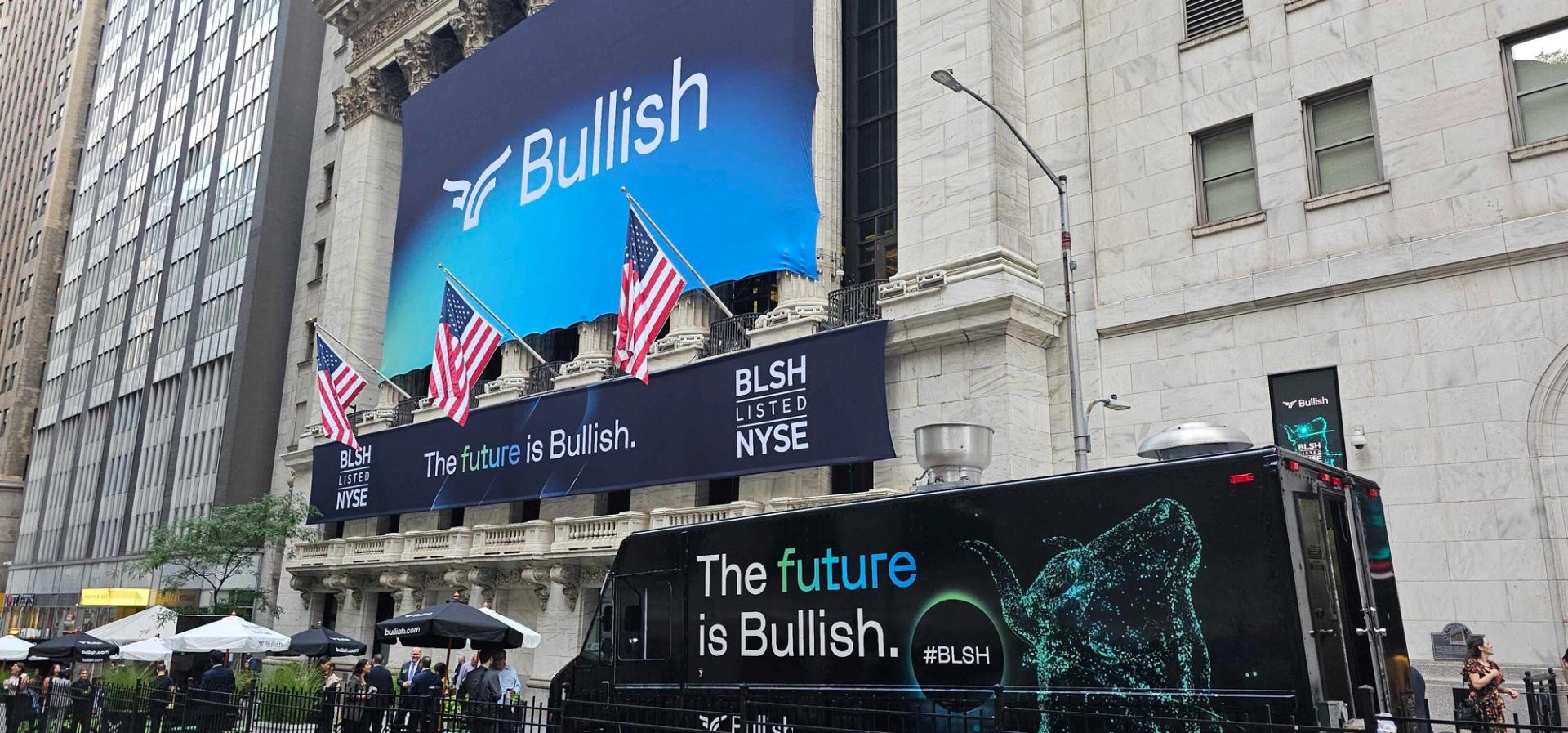
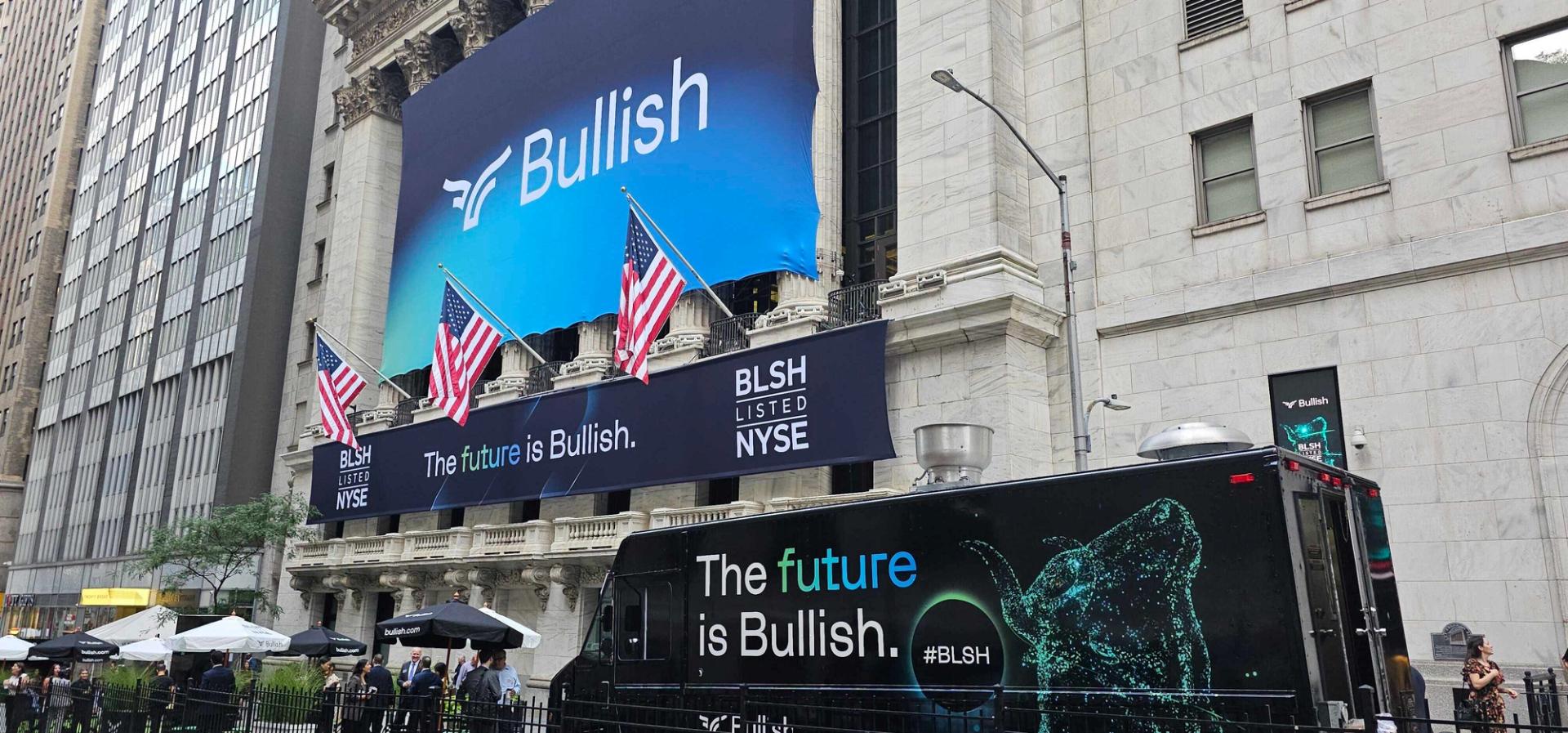
Bullish (BLSH) has agreed to acquire transfer agent and shareholder services firm Equiniti in a $4.25 billion deal that would fold a core piece of traditional market infrastructure into its digital asset platform, expanding its push into tokenized securities.
The transaction gives Bullish, CoinDesk’s parent company, a regulated transfer agent, a required function for public companies, alongside its existing tokenization, trading and market infrastructure capabilities.
Equiniti maintains records for more than 2,500 companies and 20 million shareholders and processes roughly $500 billion in annual payments, effectively acting as a system of record for equity ownership.
Combined, the companies aim to offer an end-to-end platform covering token design, issuance, compliance, registry and secondary trading, addressing what Bullish sees as a key gap in blockchain-based capital markets: the lack of a transfer agent built for tokenized assets.
“Tokenization is a once-in-a-generation shift in how capital markets operate, the defining infrastructure trend of the next 25 years,” said Tom Farley, CEO of Bullish, in the release.
“Broad adoption at institutional scale requires three things: end-to-end tokenization services, a single, unified ledger, and issuer relationships at scale. This combination delivers all three, and I believe it uniquely positions us to lead the transition to tokenized securities,” he added.
The deal comes as traditional financial services providers continue to push into tokenizing securities. Most recently, BlackRock-backed Securitize and Computershare said they plan to bring parts of the $70 trillion U.S. stock market onchain via tokenized equities, a move that pushes traditional infrastructure closer to blockchain rails.
M&A wave
Bullish’s acquisition of Equiniti also lands amid a broader wave of consolidation sweeping crypto, as firms race to build full-stack financial infrastructure.
After a lull in 2022–2023, mergers and acquisitions rebounded sharply in 2025, with more than 260 deals totaling about $8.6 billion, according to Pitchbook data. The amount is roughly four times the prior year, driven by clearer regulation and renewed institutional interest.
Companies are increasingly using acquisitions to fill capability gaps in areas like custody, payments, tokenization and derivatives, while larger players absorb smaller firms to scale distribution and compliance. High-profile transactions—from Kraken’s move into regulated derivatives to MoonPay’s push into payments infrastructure, underscore a shift away from speculative bets toward vertical integration and durable revenue models, a trend expected to continue into 2026.
The deal positions Bullish, which went public last year, to connect traditional equity infrastructure with blockchain rails, enabling features like real-time cap table visibility, automated corporate actions and faster settlement, while supporting liquidity in tokenized shares, particularly for non-U.S. investors.
At $4.25 billion, the Equiniti acquisition would rank among the largest crypto-linked deals ever, surpassing Coinbase’s $2.9 billion purchase of Deribit and Kraken’s $1.5 billion NinjaTrader deal. The size underscores how crypto M&A has moved beyond exchanges buying exchanges and into a land grab for regulated financial infrastructure.
Bullish’s last acquisition prior to the Equiniti deal was its 2023 purchase of CoinDesk from Digital Currency Group, marking its entry into media, data and index services alongside its trading business. In 2024, it also acquired data provider CCData, a U.K.-regulated benchmark administrator and one of the leading providers of digital asset data and index solutions.
The Equiniti acquisition is expected to close in early 2027, pending regulatory approvals.
Goldman Sachs served as the financial advisor to Bullish, while Evercore and FT Partners advised Siris Capital, a founding investor in Equiniti since 2021.
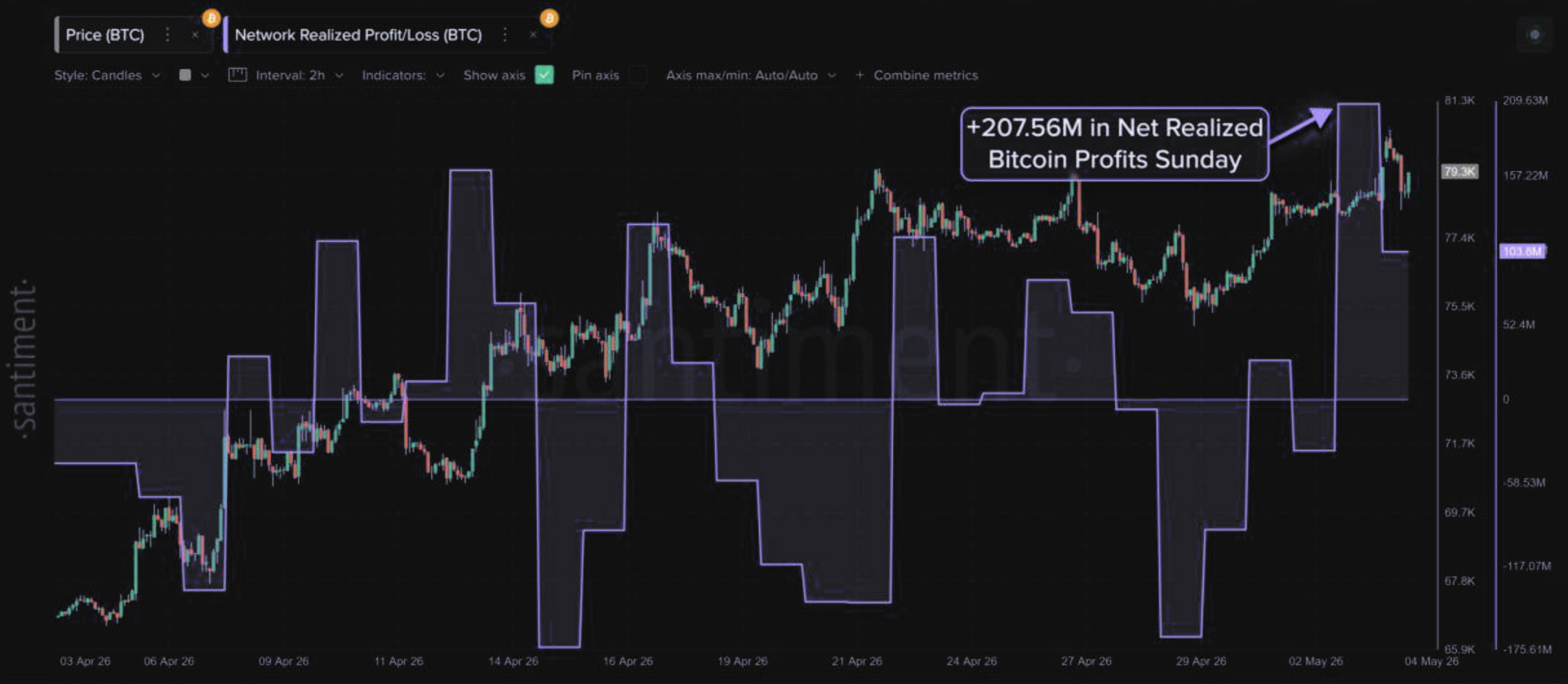
Bitcoin briefly surpassed $81,000 today, with net realized profits hitting $207.56 million, the highest single-month reading in this cycle.
Who is selling? ETF inflows and spot demand absorbed the early pressure, but if long-term holders above the 155-day band were the ones booking gains at $80K, the market signal changes.
Realized profit measures the aggregate gain locked in when coins move on-chain above their original acquisition price. According to Santiment, the $207.56 million reading on Sunday marks the highest amount for any single month in the current cycle. It was not an all-time high by any means, but a cycle-high reading at a psychologically loaded price level.

Coins purchased near $70,000 crossed into profit territory once Bitcoin cleared $80,000, and a portion of those holders sold. Santiment noted that “high profit-taking in a rising market may indicate that buyers have taken advantage of the supply,” while also flagging that Bitcoin “demonstrated active demand during the move as it surpassed $80K while holders locked in gains.”
The Spent Output Profit Ratio (SOPR) is trending toward levels historically associated with local tops in prior cycles. When SOPR runs hot at a major round number after a multi-month recovery rally, the historical pattern splits: in 2021, similar readings at resistance preceded a 20–30% retracement before continuation; in late 2023, they were absorbed, and the market pushed higher within weeks.
Discover: Best Crypto to Buy Right Now
Can Bitcoin Hold $80K and Turn It Into Support?
Analyst Michaël van de Poppe noted that Bitcoin’s lower-timeframe structure remains intact as long as price holds above the $73,000–$75,000 range, but the rejection near $80,000 is not a clean technical signal. The $81,000 level is where cycle-based models flag elevated risk.
Alphractal CEO Joao Wedson has publicly warned that losing Bitcoin can open the door to $65,500.
A weekly close above $81,000 that then holds as support on the first retest would shift the setup materially. The upside target in that scenario is the $86,000–$89,000 liquidity cluster, where short-term holder supply becomes the next friction point.
Failure below $80,700 flips the structure bearish and puts the $75,000 and $73,000 demand zones back in play. This is a functional setup, but confirmation comes from holding above $81K, not just breaking it.

BTC ETF Inflows to Absorb the Long-Term Holder Distribution
MicroStrategy’s continued accumulation posture and BlackRock and Fidelity ETF net positive inflows provide a structural bid that did not exist in prior cycles. Spot CVD surged 199.1% in the week preceding the $81K touch, showing high-conviction spot buying.
But Bitcoin ETF inflows have shown signs of stalling at zero net flows since the October peak, and the crypto market distribution dynamic becomes dangerous if that trend does not reverse. If $207 million in realized profit represents the start of sustained long-term holder selling into ETF demand, the inflows need to accelerate materially to prevent price compression.
Watch the 30-day Bitcoin ETF inflow average over the next two weeks. A return to net positive weekly flows above $500 million would confirm that institutional absorption is outpacing long-term holder distribution.
Discover: The best crypto to diversify your portfolio with
The post Bitcoin Hits $81K as Realized Profits Peak: Is a Sell-the-News Event Imminent? appeared first on Cryptonews.
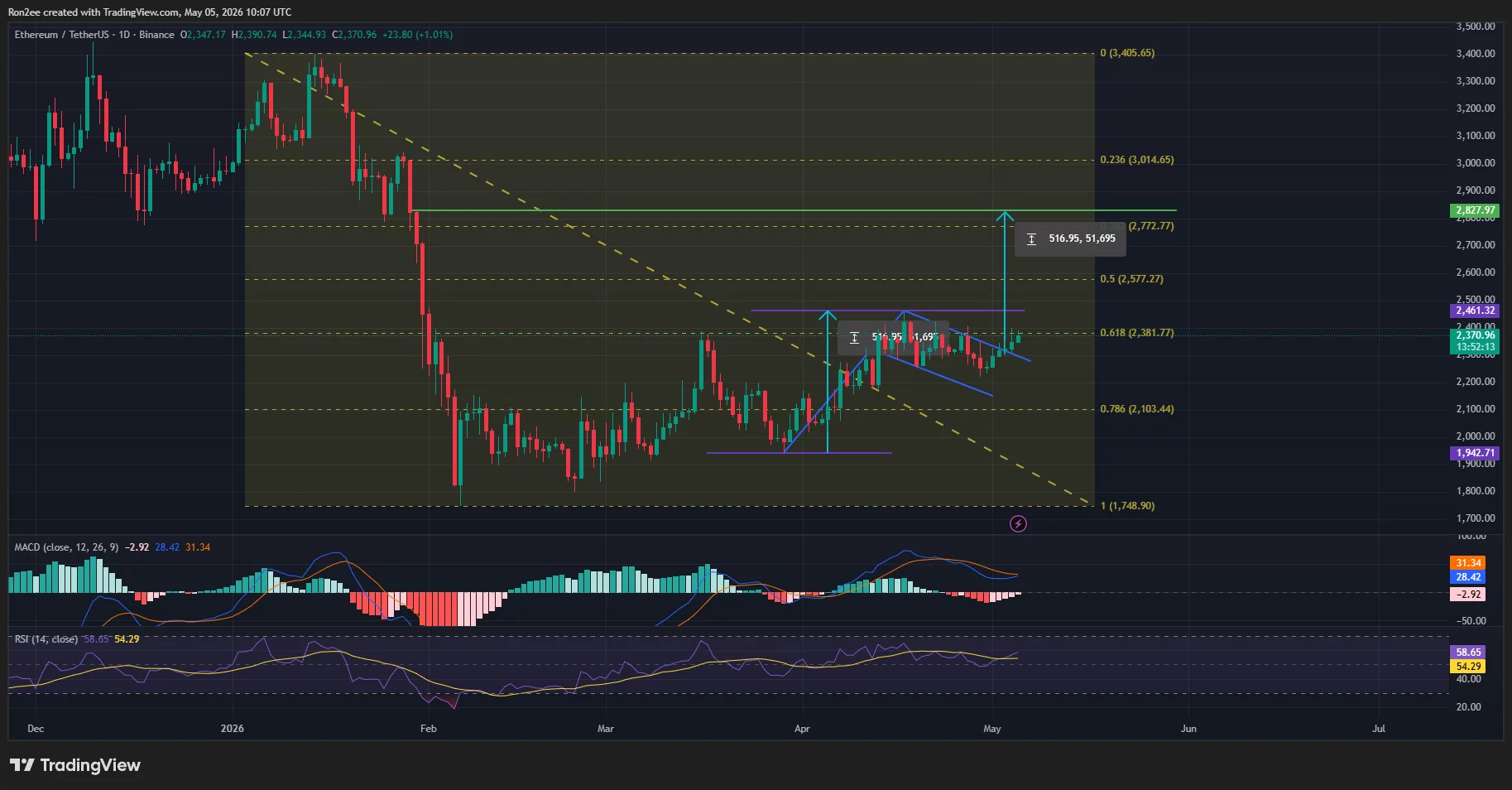
Ethereum price is showing early signs of a confirmed breakout after pushing above a short-term consolidation pattern that had capped gains over the past week.
Summary
- Ethereum price breaks out of a bull flag pattern near $2,370, signaling renewed upward momentum after recent consolidation.
- ETH price holds above key 61.8% Fibonacci support at $2,381; resistance seen at $2,400–$2,460 with higher targets at $2,577 and $2,772.
- Indicators turn bullish as MACD nears crossover and RSI stays above 50; upside projection extends toward $2,800–$3,000.
According to data from crypto.news, Ethereum (ETH) climbed around 1% over the past day, trading near $2,370 at press time. The token recently rebounded from lows near $2,300 and has started to build momentum after reclaiming the mid-range zone.
On the daily chart, Ethereum appears to have broken out of a bull flag pattern, typically considered a continuation setup that forms after a strong upward move followed by a period of consolidation. The breakout above the upper trendline suggests that buyers are regaining control after several sessions of sideways movement.
The move comes as ETH holds firmly above the 61.8% Fibonacci retracement level near $2,381, which has acted as a key support zone in recent sessions. Sustained strength above this level could reinforce the bullish structure and open the door for further upside.
If momentum continues, the next immediate resistance lies around the $2,400 to $2,460 region, which has repeatedly rejected price advances over the past few weeks. A clean break above this range could accelerate the move toward the 50% retracement level near $2,577, followed by the 38.2% level around $2,772.
Beyond that, the broader measured move from the flag structure points to a potential upside target near the $2,800 to $3,000 zone, aligning with a key psychological level that traders are closely watching.
Momentum indicators are also beginning to tilt in favor of the bulls. The MACD is approaching a bullish crossover on the daily timeframe, suggesting a possible shift toward upward momentum. Meanwhile, the RSI is trending higher and holding above the neutral 50 level, indicating strengthening buying pressure without yet entering overbought territory.
The broader structure also shows Ethereum trading within a larger descending channel, with the current breakout attempt pushing toward the upper boundary of that range. A decisive move above this long-term resistance could further validate the bullish outlook and signal a trend reversal.
While the setup points to growing upside potential, failure to hold above the $2,300 support zone could invalidate the breakout and bring ETH back into its previous consolidation range.
Disclosure: This article does not represent investment advice. The content and materials featured on this page are for educational purposes only.

Coinbase jumped 12% hours after Senator Cynthia Lummis announced a finalized bipartisan agreement on the Clarity Act stablecoin yield.
Senator Cynthia Lummis announced the bipartisan deal, resolving the most contentious provision in the Lummis-Gillibrand legislative framework: whether licensed entities can lawfully offer stablecoin yield to customers without triggering securities classification.
The deal establishes a compliant pathway for federal or state-chartered institutions to pass yield through to holders of fully reserved payment stablecoins, provided they meet strict transparency and reserve disclosure requirements.
Algorithmic stablecoins face tighter restrictions under the agreement. Fully reserved payment stablecoins, the category that includes Circle’s USDC, are the direct beneficiaries. It directly resolves the regulatory ambiguity that killed Coinbase Lend in 2021, when the SEC threatened to sue before the product launched.

The deal slots into a legislative timeline that has been building since early 2025, when Lummis and Senator Gillibrand introduced the Clarity for Payment Stablecoins Act, and accelerated in October when the House Financial Services Committee advanced a companion bill.
Circle CEO Jeremy Allaire stated last year that the deal “unlocks trillions in on-chain capital efficiency.” That framing captures the institutional read: stablecoin yield clarity is a revenue mechanism, and exchanges positioned to deliver compliant yield products at scale are the direct beneficiaries.
Discover: The best crypto to diversify your portfolio with
Crypto Winter Ending With Coinbase-backed Clarity Act Signed?
Coinbase’s interest income, driven substantially by its USDC partnership with Circle, is already a core component of its balance sheet. Legal clarity on stablecoin yield effectively green-lights the expansion of that revenue line from a grey-area product into a regulated financial service. That shift has direct implications for how institutional investors model Coinbase’s forward earnings.
The company’s institutional prime brokerage already serves hedge funds and family offices across 200+ crypto assets. Adding a compliant yield product to that infrastructure that does not carry SEC enforcement risk is an upgrade to the existing custody and lending offering.
As major crypto exchanges accelerate their push into institutional financial services, Coinbase’s regulatory positioning in the U.S. becomes a competitive moat for crypto.

The risk is legislative friction. The bipartisan agreement still requires committee markup, floor scheduling, and House-Senate reconciliation. But, President Trump already said that he will sign the Clarity Act as soon as it reaches his desk.
What to Watch?
Watch the Senate Banking Committee markup, expected by this month. A clean markup that preserves the yield-bearing pathway for fully reserved stablecoins is the single most important near-term variable for sustaining crypto legitimacy. Any amendment that reopens the algorithmic stablecoin boundary or federal oversight question is a direct headwind.
Discover: The best pre-launch token sales
The post Coinbase Surges 12% as Lummis Locks In Bipartisan Clarity Act Stablecoin Yield Deal appeared first on Cryptonews.

Haun Ventures has raised $1 billion to back crypto startups across early and late stages, marking a strategic expansion into artificial intelligence for the first time. The fund centers on three pillars—crypto financial infrastructure, tokenization, and AI agents—an approach founder Katie Haun calls part of the “new economy.”
In a blog post published on Monday, Haun, a former U.S. government prosecutor turned crypto executive, said this is the most dynamic period in technology and finance she has witnessed. “The foundations of capital, commerce and trust are undergoing meaningful structural changes,” she wrote, adding that founders who can see across all of it—and build accordingly—will define the entrepreneurs of this era.
Key takeaways
- Haun Ventures raises $1 billion to support crypto startups and expands into artificial intelligence for the first time, focusing on crypto infrastructure, tokenization, and AI agents.
- The firm frames these three areas as components of the “new economy,” signaling a broader cross‑disciplinary strategy.
- AI agents are already moving toward autonomous economic activity; analysts project a massive growth trajectory for related payments in the coming years.
- The funding environment for AI remains exceptionally strong, with venture capital for AI surpassing other sectors in early 2026 and signaling momentum for cross‑sector investments.
Haun’s cross-border bet on AI-enabled crypto infrastructure
Haun emphasized that AI agents—software that autonomously performs tasks—will increasingly conduct economic activity on users’ behalf. She argued that new products and services must be designed for a world where computers are the customers. As she put it, “Every supporting layer will need to be rearchitected for this world: fraud prevention, credit, insurance, identity, privacy, provenance, reputation, and verification all require native versions designed for how agents transact, and cryptographic tools will be important here.”
Haun also highlighted tokenization as a technology capable of rendering traditional assets—such as gold or oil—borderless, always on, and programmable. She described the shift in “the core plumbing of global finance” as moving toward an always-on digital world, with crypto-native layers playing a central role in enabling these capabilities.
Bloomberg reported Haun saying the fund would focus on the intersection of AI agents and crypto infrastructure, aiming to invest in “AI that is in our lane.”
Tokenization and AI agents at the core of the “new economy”
Identity, privacy, provenance and verification are among the domains Haun argues will need native, cryptographic solutions tailored for agent-driven transactions. The fund’s emphasis on AI agents follows a broader industry trend: software that autonomously acts in economic contexts, potentially redefining how value is created and exchanged.
Haun’s framing positions tokenization not merely as a way to tokenize securities or commodities, but as a foundational technology that could enable programmable, borderless access to a wide range of assets. The combination of AI agents with tokenized infrastructure may drive a new class of products and services designed for automated, machine-enabled commerce.
Market backdrop: AI funding surge shapes crypto investor strategy
The investment move arrives amid a striking shift in venture capital toward AI. Crunchbase data show AI companies attracted a record $242 billion in venture funding in the first quarter of 2026, accounting for roughly 80% of total global venture funding in the period, which totaled about $300 billion.
Analysts have projected dramatic growth for AI-enabled commerce. The Boston Consulting Group has suggested that payments managed by AI agents could reach around $2.4 trillion per year by 2029, illustrating the scale at which autonomous software could participate in economic activity. Haun has repeatedly stressed the importance of backing “AI that is in our lane”—AI aligned with crypto and financial-infrastructure expertise—as a driver of portfolio value.
Haun’s expansion into AI signals a broader trend among cryptocurrency-focused funds seeking to diversify into adjacent technologies that promise to reshape how finance and commerce operate. The coming quarters will reveal how quickly AI agents can integrate with tokenized rails and what regulators will permit as the technology matures.
Going forward, observers will watch regulatory clarity, security protocols, and cross‑chain interoperability as key factors shaping adoption. The convergence of AI agents with tokenized crypto infrastructure could redefine how value is created and moved across digital ecosystems, but real-world deployment will hinge on robust risk management and practical use cases.
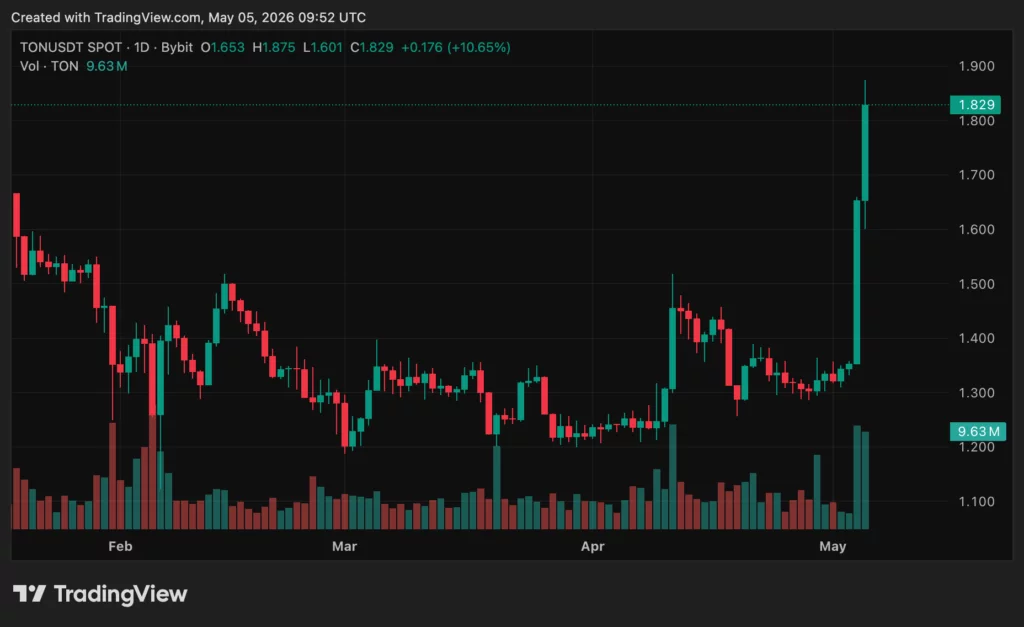
Telegram founder Pavel Durov said on May 4, 2026, that Telegram will replace the TON Foundation as the main force behind The Open Network.
Summary
- Durov said Telegram will replace TON Foundation as TON’s main force and largest network validator.
- TON rose about 28% in 24 hours, trading near $1.82 with $632.75 million daily volume.
- Telegram plans new TON developer tools, a website upgrade and performance improvements by late May.
He also said Telegram will become TON’s largest validator. Durov linked the move to lower network fees and a stronger technical roadmap. He wrote:
“Fees in TON have dropped 6× — to nearly zero.” He added that Telegram would shift TON’s focus to “tech superiority.”
Durov said TON should receive a new website, new developer tools and performance upgrades within “2-3 weeks.” That places the expected changes in late May 2026, based on the May 4 announcement.
The details remain limited. Telegram has not yet explained how its validator role will work. It has also not disclosed its planned validator stake or how the TON Foundation’s role will change after the shift.
Toncoin rallies after the announcement
Toncoin (TON) moved higher after Durov’s comments. TON climbed from about $1.35 to nearly $1.80 after the announcement, placing it among the top 25 crypto assets during the rally.
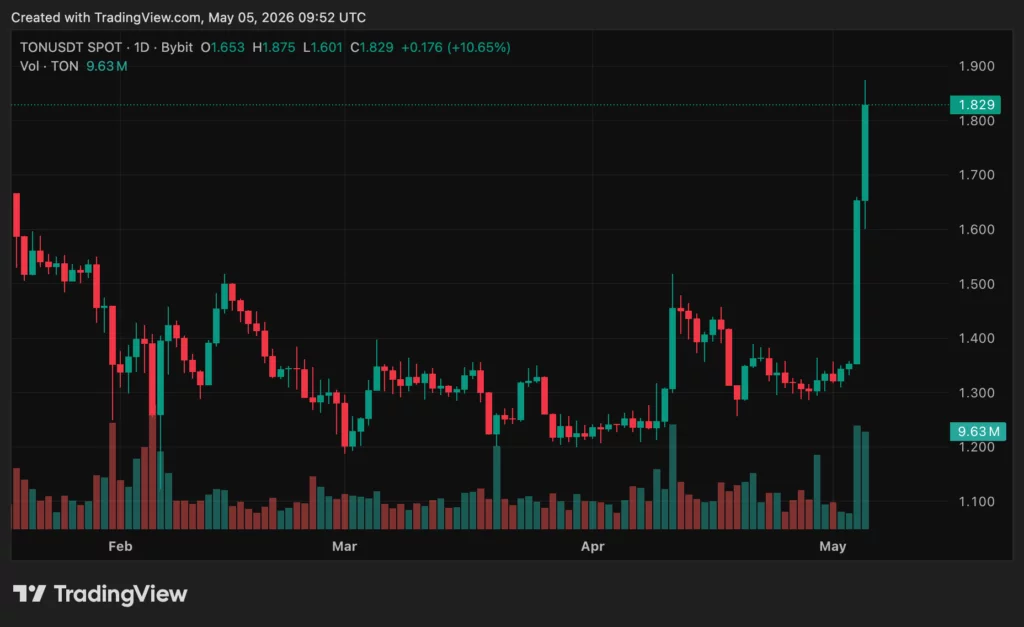
Crypto.news data showed TON trading near $1.82 at press time, with a 28.10% gain over 24 hours. The token also posted about $632.75 million in daily trading volume and a market cap near $4.8 billion.
Telegram links deepen around TON
The latest move follows Telegram’s wider push into TON-based products. As highlighted in our February 20, 2026 article, TON has used Telegram’s wallet, digital gifts and social NFT tools to support consumer use across the messaging app.
That report also said TON’s approach focuses on Telegram’s reach instead of only technical features. It noted that TON gives developers access to Telegram’s large user base through wallet features, payments, gifts and asset transfers.
As featured in our April coverage, Wallet in Telegram also added perpetual contract trading across metals, stocks, oil and crypto. The product used Lighter’s infrastructure and offered more than 50 markets inside Telegram.

Pride Of Jenni enters 2026 Hollindale Stakes in unexpected move

Apple wants a second source. Intel and Samsung want it to be them.

Static Banking & Financial Awareness (Lecture 11) – International Financial Organization – Part I

Manchester United reach agreement with Casemiro over contract clause amid transfer speculation

US brings back mandatory military draft registration

Steven Gerrard disagrees with Gary Neville over ‘shock’ Chelsea and Arsenal claim | Football


-

 Business7 days ago
Most Commercial Energy Audits Miss the Real Losses
-

 Fashion7 days ago
Kylie Jenner’s KHY Enters a New Era with ‘Born in LA’
-

 NewsBeat2 days ago
Channel 5 – All Creatures Great and Small series 7 new post
-
 Tech4 days ago
Trump’s 25% EU auto tariff breaches Turnberry Agreement that also covers semiconductors and digital trade
-
 Sports4 days ago
Paul Scholes issues Marcus Rashford reality check as agreement emerges over Man United star
-

 Crypto World7 days ago
CFTC’s AI will review U.S. crypto registration applications, chairman tells CoinDesk
-

 Business6 days ago
Barclay Brothers Avoid Bankruptcy: HSBC Drops High Court Petitions After IVA Deal
-
 Business6 days ago
Tesla Officially Registers Elon Musk’s Stock: What Investors Need to Know
-

 Tech7 days ago
Get Ready for More Brain-Scanning Consumer Gadgets
-

 Business5 days ago
Two Powerball Tickets Split $143 Million Jackpot in Indiana and Kansas
-

 Tech6 days ago
Texas Instruments made a new flagship graphing calculator: the TI-84 Evo
-
 Crypto World4 days ago
CoreWeave (CRWV) Stock Climbs 8% Despite $45M Insider Share Dump
-
Business2 days ago
Winning Numbers Drawn as Jackpot Resets to $20 Million
-
Crypto World6 days ago
Securitize and Computershare Enable Tokenized Equity Issuance for Over 25,000 U.S.-Listed Stocks
-

 Crypto World5 days ago
Gibraltar Proposes Tokenized Funds Regulation to Bolster Compliance
-

 Fashion2 days ago
Mary J. Blige Vegas Residency Looks: Crystal-Embellished Fjolla Haxhismajli, Todd Fisher, and More!
-

 Business6 days ago
Alexandria Real Estate Equities, Inc. (ARE) Q1 2026 Earnings Call Transcript
-

 Entertainment5 days ago
Celebrities Who Are Attending the 2026 Met Gala Event
-

 Tech5 days ago
Official SAP npm packages compromised to steal credentials
-

 Sports6 days ago
Antrim GAA: Hurlers cancel training as row with board deepens
You must be logged in to post a comment Login