
Crypto World
Why Perfectly Fair Crypto Transaction Ordering Isn’t Achievable


Today’s blockchains already treat consensus as a matter of two properties: nodes must agree on the same history (consistency) and the system must keep processing transactions (liveness). But that framing leaves a crucial gap—what users ultimately care about is not only whether transactions get confirmed, but whether their relative ordering is meaningfully fair when multiple parties submit transactions that can interact economically.
A new line of research is trying to formalize “transaction order fairness” and map out what is possible under real-world networking constraints. The core takeaway: perfect “first-come, first-served” ordering is mathematically out of reach in asynchronous distributed systems, even before considering adversaries. The practical question becomes how to approximate fairness while keeping liveness and minimizing opportunities for extractive behavior.
Key takeaways
- Perfect receive-order fairness (“first-seen, first-executed”) cannot be guaranteed on public networks because messages arrive at different times and there is no shared clock.
- Even when each node has a clear local arrival order, group preferences can conflict—captured by the Condorcet paradox—making a single linear order impossible to satisfy.
- Hashgraph’s fairness model uses a DAG of events with median timestamps to respect causal relationships while bounding how far adversarial influence can shift ordering.
- BOF-style protocols (from the Aequitas/Themis line of work) relax fairness by ordering transaction “batches” derived from Condorcet cycles, enabling stronger liveness guarantees.
Why “fair ordering” is harder than it sounds
In public blockchains, ordering isn’t just an implementation detail—it can decide who captures value and who pays. When privileged roles like block builders or sequencers determine execution order, they can potentially exploit that power through strategies that front-run, back-run, or sandwich transactions. Research on maximal extractable value (MEV) describes this as a direct consequence of who can influence ordering.
To counteract this, some proposals treat transaction ordering fairness as a third consensus objective alongside consistency and liveness. The general idea is to constrain the block producer’s ability to bias ordering beyond what the network conditions and protocol rules imply—making execution more predictable and less vulnerable to systematic exploitation.
But the most intuitive fairness notion runs into a structural limitation. In an asynchronous distributed system, there is no globally defined reception order because different nodes observe transaction messages at different times. Without a shared clock and with arbitrary message delays, no protocol can ensure that every node’s “arrival order” maps perfectly onto a single network-wide execution order.
The Condorcet paradox: why majority “first” can loop
The strongest form of fairness is often described as Receive-Order-Fairness (ROF): if most nodes receive transaction A before transaction B, then A should be processed before B. ROF sounds straightforward, but the network reality undermines it. Nodes see messages at different speeds, so different nodes can legitimately observe different pairwise “firsts.” Even if those local observations are consistent for each node, the collective can still become inconsistent.
This is where the Condorcet paradox comes in from voting theory, and it translates cleanly to distributed ordering. Even when each participant has an internal preference for which of two items comes first, the majority preference across multiple pairs can form a cycle:
- Most nodes see A before B
- Most nodes see B before C
- Most nodes see C before A
When that happens, there is no single linear ordering that satisfies all majority pairwise preferences. The implication for blockchain consensus is direct: if fairness is defined too strictly in terms of majority “first-seen” comparisons, the protocol may be unable to produce any ordering that matches the majority view across all pairs.
Because of this impossibility, systems aiming for “fairness” must adopt weaker—but more achievable—guarantees.
Hashgraph’s approach: DAG causality plus median timestamps
Hedera’s hashgraph algorithm tackles transaction ordering fairness through a leaderless, event-driven model. According to the described model, transactions are transformed into cryptographically linked events inside a directed acyclic graph (DAG). Consensus ordering then emerges from how nodes collectively observe and sign those events, rather than from a single proposer unilaterally choosing a sequence.
Operationally, when a node receives a transaction, it creates an event and gossips it to peers. Subsequent events record hashes of earlier events they have seen, and nodes digitally sign the result. This creates a provable causal structure: if one event is an ancestor (direct or indirect) of another, the protocol provides a cryptographic guarantee about which event was created first by some node.
The ordering logic then distinguishes between events with causal relationships and those that are concurrent. Events connected by DAG ancestry are ordered according to their causal dependencies. For concurrent events (those without ancestor relationships), the protocol resolves relative ordering using a “round-received” concept and then refines that using median timestamps.
Median timestamps, as described, are derived from a set of node-reported local receive times, but constrained by the hashgraph’s ancestry. That constraint matters: nodes cannot claim to have observed an event before its causal predecessors without creating detectable inconsistency in the DAG. Under the standard assumption used in Byzantine fault tolerance—fewer than one-third of nodes are Byzantine—the median timestamp should remain within a bounded range of honest timing reports, limiting adversarial ability to arbitrarily skew ordering.
However, hashgraph’s fairness is not infinite. The described research emphasizes that fairness is bounded by an adversarial “surface” where a node can still influence its gossip behavior: which events it relays first and whether it delays relaying. While the DAG cannot fabricate a false causal history, strategic propagation patterns can reshape the inputs that ultimately feed into median timestamp computation.
There is also the Condorcet paradox risk for concurrent events. The DAG eliminates ambiguity for causally linked events because the ancestry is fixed at creation. But concurrent events can still be observed in different orders by different nodes, leaving some ordering tension that is then handled by the protocol’s round and median mechanisms.
BOF protocols: fairness by collapsing Condorcet cycles
Another line of work frames fairness differently—by explicitly embracing cycles. BOF (Batch-based Order Fairness) protocols define “blocks” as sets of transactions that form a Condorcet cycle, then enforce fairness at the level of how those blocks relate, while allowing arbitrary internal ordering inside each block.
In the BOF formulation described, fairness is controlled by a parameter γ: if a sufficient fraction γ of nodes observe block b before block b′, then honest nodes cannot output b after b′. When fairness constraints induce a cyclic relation, the protocol collapses the strongly connected component (SCC) into a single batch/block, because no linear order can satisfy all the directed constraints simultaneously.
A key practical point is that this approach relaxes strict ROF requirements. When a cycle occurs, internal ordering becomes irrelevant to the fairness guarantee, since the protocol treats the entire cycle participation as atomic at the batch level. The research description notes that deterministic rules (such as a hash-based rule) may then sort transactions within the batch, but the fairness criterion does not attempt to make those internal orders correspond to any global first-seen preference.
The Aequitas protocol line is described as having weaker liveness: its strict fairness constraints require waiting for complete Condorcet cycles, and if cycles can chain indefinitely, finalization delays could grow without bound—creating a “freeze” risk.
Themis is introduced as a refinement intended to preserve γ-BOF while improving liveness. As described, Themis also builds a dependency graph and collapses SCCs during a “FairFinalize” stage, but it avoids waiting for the full cycle to close. Instead, it uses deferred ordering and “batch unspooling” so SCCs can be output incrementally while new transactions keep flowing. The result, as presented, upgrades Aequitas’ weak liveness into standard liveness with a delay bound.
Themis also addresses communication scaling concerns. In its basic form, participants exchange messages with most other nodes, leading to communication growth roughly proportional to the square of the network size. An optimized variant, SNARK-Themis, replaces much of that direct exchange with succinct cryptographic proofs, so verification can scale more efficiently as the node count increases.
Finally, the protocol design includes a mechanism to prevent denial-style manipulation. If a malicious proposer tries to exploit the system by proposing an empty block, Themis’s deferred ordering accepts a partially ordered batch and leaves exact finalization to a subsequent honest proposer, based on verifiable transaction relationships rather than discretionary choices by the current proposer. This is framed as a way to tie finalization to bounded network delay rather than arbitrary proposer behavior.
What to watch next
The central unresolved question across these approaches is how to balance fairness guarantees against the operational costs—especially complexity, communication overhead, and the practical handling of concurrency. As more consensus designs incorporate formal ordering fairness ideas, investors and builders should watch for implementations that demonstrate bounded delays in real network conditions while maintaining robustness against adversarial reordering.


Telegram founder Pavel Durov says Russian authorities have designated him a “terrorist” after he refused government demands for mass surveillance and censorship on the messaging platform. Durov posted his response publicly in a Telegram message published a day after Russia announced new criminal charges against him.
In that post, Durov claimed Russia also blocked him from “publishing information on the Internet,” adding that authorities appear to have “got confused about who can ban whom from the Internet.”
Key takeaways
- Durov’s latest statement follows Russia’s announcement of charges, after Russia’s security service accused him of facilitating terrorist activity.
- The Russian allegations center on Telegram’s alleged failure to remove channels tied to terrorist groups and Ukrainian intelligence services.
- Russia’s case builds on a criminal probe reportedly launched in February over alleged non-compliance with Russian rules on extremist and terrorism-related content.
- Durov is also facing separate legal scrutiny in France, and regulators in Australia have reportedly initiated court proceedings over terrorism-related content.
Russia escalates case with “terrorist” label
Russia’s Federal Security Service (FSB) accused Durov of facilitating terrorist activity, according to earlier coverage from Cointelegraph. The claim is that Telegram did not remove certain channels used by terrorist organizations as well as channels linked to Ukrainian intelligence services.
Durov’s rebuttal came through his own Telegram account the day after Russia made the allegations public. In addition to responding to the charges, he framed the dispute as a conflict over Telegram’s stance toward government demands, particularly around surveillance and content restrictions.
The message also suggests a broader disagreement about control of online speech and information access—Durov saying Russian authorities barred him from publishing information on the internet, while disputing the legitimacy of who can impose such restrictions.
February investigation tied to alleged content non-removal
Russia’s current push does not appear out of nowhere. Cointelegraph previously reported that a criminal investigation in February followed regulatory accusations that Telegram left nearly 155,000 channels, chats, and bots accessible despite Telegram’s alleged violations of Russian laws relating to extremist material, terrorism, drug trafficking, and other illicit categories.
That earlier context matters because it indicates that the case is tied to a longer-running compliance argument—how Telegram moderates content and how it responds to removal requests. For investors and platform users watching the regulatory risk landscape, these developments reinforce that messaging platforms can face escalating consequences when regulators argue they are not acting quickly or thoroughly enough to meet local legal standards.
At the same time, much remains uncertain: public allegations do not automatically translate into immediate changes on the ground, and the specifics of what was or wasn’t removed—and under what procedural thresholds—are not detailed in the statements referenced here.
Legal pressure extends beyond Russia
Durov’s legal situation has been international. Cointelegraph reported that he was arrested in France in August 2024 and has remained the subject of a judicial investigation over allegations that Telegram facilitated criminal activity, including by allegedly failing to moderate illegal content adequately and respond to law enforcement requests.
According to earlier coverage, Durov has denied wrongdoing, arguing that French authorities did not follow due process when seeking information from Telegram. His arrest was followed by a TON Community-backed campaign that collected more than 9 million signatures on an open letter urging French authorities to release him.
There have also been reported changes in travel conditions: French authorities initially allowed Durov to return temporarily to Dubai in March 2025 before lifting travel restrictions entirely later that year, as noted by Cointelegraph. The implication is that while legal pressure can be intense, authorities may adjust constraints over time depending on the status of the proceedings.
Meanwhile, Cointelegraph also reported that Australia has moved toward court proceedings, with regulators alleging Telegram failed to remove terrorism-related content. The platform’s exposure in multiple jurisdictions highlights a recurring regulatory theme worldwide: governments increasingly expect major communication platforms to take meaningful action against content they deem illegal, even when the platforms frame enforcement as complex, global, and constrained by legal standards.
Privacy, surveillance, and the EU debate
Beyond the courtroom, Durov has publicly positioned himself around digital privacy and free speech. In April, he warned that a proposed European Union age-verification app could open the door to broader online surveillance, according to Cointelegraph. The argument—tying age verification to a wider data-collection trajectory—signals how Durov views regulatory measures as potentially expanding monitoring rather than simply improving safety.
In the same period, Cointelegraph reported that Durov blamed alleged tax data leaks for an increase in crypto-related kidnappings in France. He said Telegram would leave the country rather than grant authorities access to users’ private messages, tying the debate back to the line between lawful access and what he frames as unacceptable intrusion into private communications.
Taken together with the Russia and France allegations, these public remarks suggest that Durov is consistent in his framing: that enforcement actions aimed at removing content or complying with requests can also become mechanisms for surveillance or compelled access to private data.
What to watch next is how each jurisdiction’s process unfolds—whether courts compel specific operational changes, whether regulators escalate further, and how Telegram responds in practice. For users, the key question is whether enforcement will lead to tangible moderation shifts; for the broader industry, it will be whether these cases set precedents for how governments can pressure encryption-adjacent communication platforms to cooperate with investigations.


Google is reportedly backing a proposed $15 billion financing package for an Anthropic-linked data center in Texas, extending an AI infrastructure boom that has also lifted Bitcoin miners expanding into high-performance computing.
Summary
- Nexus is in advanced talks to raise $15 billion for its Hubbard, Texas, data-center campus.
- Google would guarantee parts of Anthropic’s leases and receive an estimated 20% project stake.
- The campus includes an on-site natural-gas plant capable of generating 1.6 gigawatts.
- AI-focused mining stocks rallied Thursday, with IREN, Hut 8 and CleanSpark gaining more than 20%.
Google and Anthropic financing terms
A group of banks led by Morgan Stanley is discussing a financing package for Nexus Data Centers’ planned campus in Hubbard, Texas, according to a Wall Street Journal report cited by Reuters.
The proposed package includes a $14 billion bridge loan and a revolving credit facility. The report did not disclose the size of the revolving facility or identify the other lenders involved in the talks.
Google has reportedly agreed to guarantee billions of dollars in lease and power-payment obligations if Anthropic defaults. Its backing would apply to four data-center leases signed by the AI developer and related agreements to purchase electricity from an on-site power plant.
The guarantees remain limited to the minimum amount lenders require to complete the financing, according to the report. In exchange, Google is expected to receive an equity stake of around 20% in the combined data-center and power project.
Neither Nexus nor the banks have announced a completed transaction.
Texas campus includes a 1.6 GW power plant
Nexus plans to pair the data-center campus with a natural-gas-fired power plant capable of producing 1.6 GW of electricity. The on-site facility would allow the project to secure a large power supply without relying entirely on additional capacity from the Texas grid.
Access to electricity has become one of the main constraints on new US data centers. AI facilities require large and continuous power supplies, while new transmission lines, generation assets and grid connections can take years to approve and construct.
The Nexus structure resembles other AI projects using financially stronger technology companies to support the obligations of private AI developers. Google’s guarantee would improve the project’s credit profile and could help Nexus obtain financing on better terms than Anthropic could secure independently.
Anthropic plans to use tensor processing units co-designed by Google and Broadcom at the site. The chips would be financed separately under a vendor agreement between Anthropic and Broadcom, according to the Wall Street Journal.
Google’s participation would therefore cover several parts of the project: chips, credit guarantees and an expected equity position. The arrangement also gives Google a larger role in Anthropic’s infrastructure even as the AI developer buys processors from competing suppliers.
Bitcoin miners secure similar AI agreements
Nexus is competing for capital and AI tenants during a month marked by several multibillion-dollar agreements involving Bitcoin mining companies.
TeraWulf signed a 20-year lease with Anthropic on July 6 for its Justified Data campus in Hawesville, Kentucky. The contract covers about 401 MW of critical IT capacity and is expected to generate approximately $19 billion in revenue over its initial term.
CleanSpark followed with a $6.6 billion lease for its Sandersville campus in Georgia. The 20-year agreement covers 175 MW and could rise to $11.6 billion if the unidentified technology customer exercises its extension options.
Hut 8 signed a second 352 MW lease at its Beacon Point campus in Texas on July 20. The $9.8 billion contract brought the property’s total base-term lease value to $19.6 billion. Renewal options could increase the figure to $50.2 billion.
IREN announced $2.8 billion in multi-year AI cloud contracts on the same day. It raised its year-end annualized AI cloud revenue target above $4 billion, with about 85% of the target under contract.
Core Scientific then signed an agreement giving AMD access to up to 2.5 GW of data-center capacity. The initial phase will provide 500 MW of AI-ready infrastructure in 2027, although the companies did not disclose the contract’s value.
These companies accumulated power agreements and industrial sites for Bitcoin mining before AI demand raised the potential value of those assets. Their existing grid access can shorten development timelines, although AI facilities require more advanced cooling, networking and backup systems than mining operations.
AI-focused mining stocks rally
Shares of several miners with AI infrastructure exposure rose sharply on July 30, although the broader rally cannot be attributed solely to the Nexus report.
IREN closed approximately 30.7% higher at $38.26, while Hut 8 advanced 22.7% to $108.27. CleanSpark rose 21.1%, Core Scientific added 20.4% and TeraWulf gained 18.1%.
The moves extended an earlier market response to July’s AI contracts. Hut 8 had risen as much as 17% when it announced its second Beacon Point lease, while IREN climbed as much as 19% following its cloud-contract update.
Alphabet shares moved in the opposite direction Thursday, falling about 0.9% to $333.66. The decline came as investors continued assessing the cost of Google’s AI infrastructure expansion rather than signaling a clear response to the uncompleted Nexus financing.
What comes next for the Nexus project
The immediate catalyst will be whether Morgan Stanley and the other banks finalize the $15 billion package and disclose its maturity, interest costs and guarantee structure.
Confirmation of Google’s expected 20% stake would also clarify how much direct exposure the company is taking to Anthropic’s infrastructure obligations. Until financing closes, the loan, guarantees and equity arrangement remain proposed terms reported by people familiar with the discussions.
For US-listed miners, completion would provide another valuation benchmark for large power-backed AI campuses. It would also add a conventional data-center developer to the competition for the same tenants, lenders, chips and power supplies now driving miners’ expansion beyond Bitcoin.


The Bitcoin miner is using part of its treasury and a BTC-backed credit facility to fund an AI campus tied to a potential multi-billion-dollar infrastructure contract.
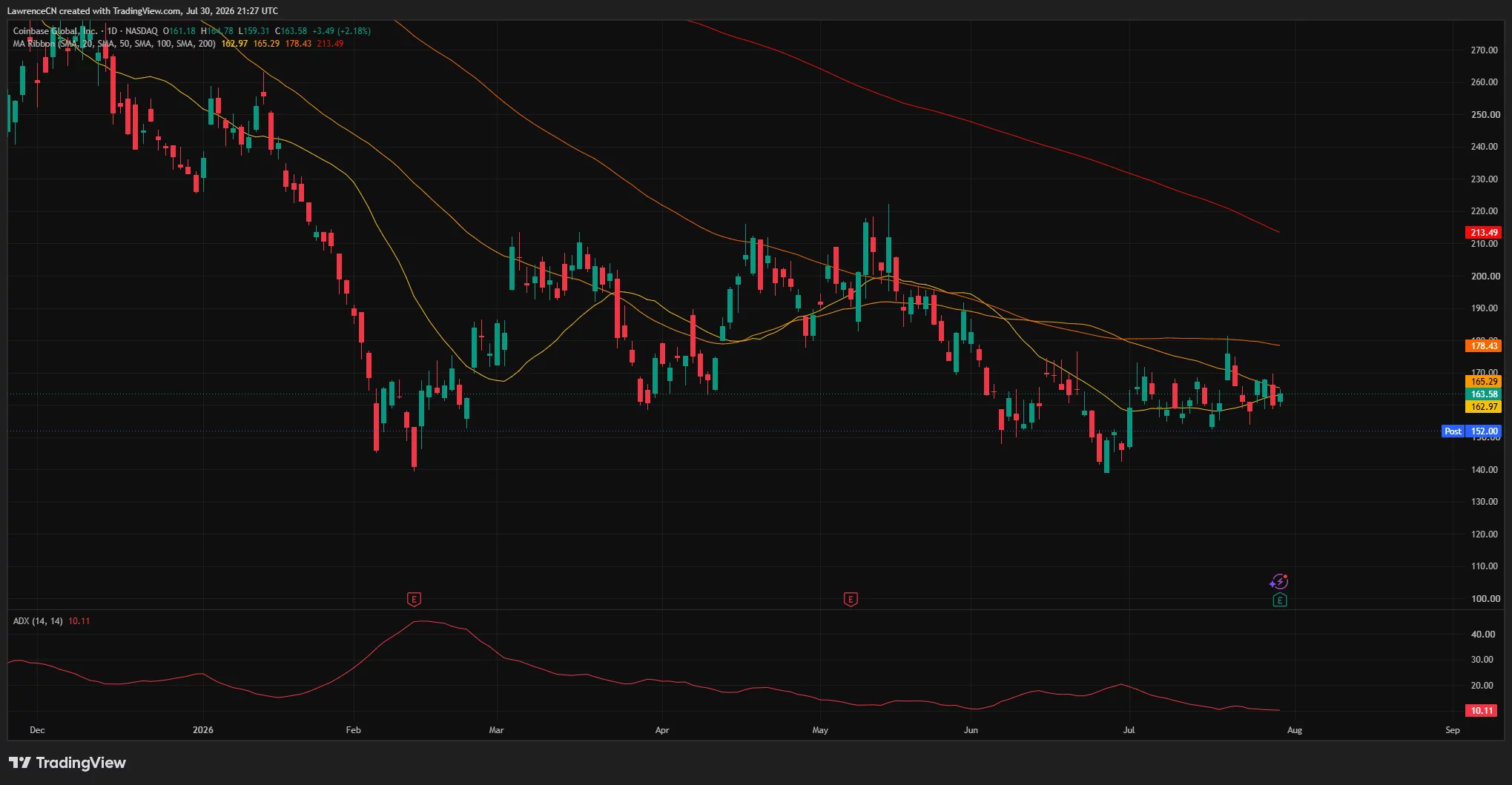
Coinbase shares fell in extended trading after the crypto exchange reported a second-quarter loss and lower revenue, overshadowing record market share and growth across stablecoins and derivatives.
Summary
- Coinbase reported a loss of $1.36 per share, reversing earnings of $5.14 a year earlier.
- Quarterly revenue fell to about $1.2 billion from $1.5 billion in the prior-year period.
- Coinbase captured a record 10.3% of global crypto trading volume during the quarter.
- COIN faced immediate support near $152, with the next downside level around $140.
Coinbase revenue falls as quarterly loss returns
Coinbase generated approximately $1.2 billion in second-quarter revenue, down 20% from $1.5 billion during the same period last year. The company posted a loss of $1.36 per share, compared with earnings of $5.14 per share a year earlier.
Shares initially closed regular trading at $163.58, up 2.18% for the session. However, the earnings report reversed that gain, sending the stock lower in after-hours trading.
The chart showed an extended-market price near $152, implying a decline of about 7% from the regular close. Earlier after-hours readings placed the drop closer to 5%, suggesting the stock remained volatile as investors assessed the report.
Lower revenue and the return to a quarterly loss weighed on sentiment despite several operating improvements. Coinbase also completed its 14th consecutive quarter of positive adjusted EBITDA and reduced its forecast for full-year adjusted expenses.
Coinbase reaches record 10.3% trading share
Weak financial results contrasted with Coinbase’s expanding presence in the global crypto market. Its share of worldwide crypto trading volume rose to a record 10.3% from 9.1% in the first quarter.
That marked the third consecutive quarter in which the US exchange increased its market share. The gain came even as overall crypto market volume declined by double digits.
Derivatives activity remained close to the record level reached during the previous quarter. Revenue and contracts tied to event markets increased 106% quarter over quarter, pushing the business above a $100 million annualized revenue rate.
Coinbase also continued reducing its reliance on Bitcoin spot trading fees. Revenue excluding Bitcoin spot activity accounted for 88% of net revenue, reflecting a broader shift toward subscriptions, stablecoins, payments and financial infrastructure.
Subscription and services revenue reached $555 million, compared with just $6 million in the second quarter of 2020. The segment generated 48% of net revenue, up from 29% in the fourth quarter of 2024.
USDC and Base activity support diversification
Stablecoins provided another area of growth. Average USDC balances held across Coinbase products reached a record $20 billion, representing more than 30% of the stablecoin’s circulating supply at quarter-end.
Coinbase reported that USDC and its partner stablecoins accounted for 79% of the more than $37 trillion in stablecoin transaction volume recorded during the year. Stablecoin volume on Base, the exchange’s Layer 2 network, increased sevenfold from a year earlier.
The figures show how Coinbase is expanding beyond transaction fees tied directly to crypto price cycles. This diversification could provide more recurring revenue, although the quarterly loss shows that growth in newer business lines has not fully offset weaker overall conditions.
For US investors, the results offer mixed signals. Coinbase remains a major publicly traded proxy for the domestic crypto industry, but its earnings continue to reflect trading activity, digital asset prices and regulatory conditions.
The company also reported gains from using artificial intelligence in its engineering work. Code changes processed per engineer increased 2.2 times year over year, while integration test coverage across core services rose 2.5 times over six months.
COIN price tests $152 support after earnings
COIN’s after-hours decline pushed the stock below several closely watched technical levels. The regular-session close of $163.58 sat just above the 20-day simple moving average at $162.97 but below the 50-day average at $165.29.
A move toward $152 would place the stock at immediate chart support. Failure to hold that level could expose the late-June low near $140.
On the upside, COIN must reclaim the 50-day average before testing the 100-day SMA near $178.43. The 200-day average at $213.49 remains a larger long-term resistance level.
The average directional index stood at 10.11 before the earnings reaction. A reading this low indicates weak trend strength, matching the stock’s recent sideways movement around the $160 region. The post-earnings gap may provide a stronger directional signal if trading volume remains elevated during the next regular session.
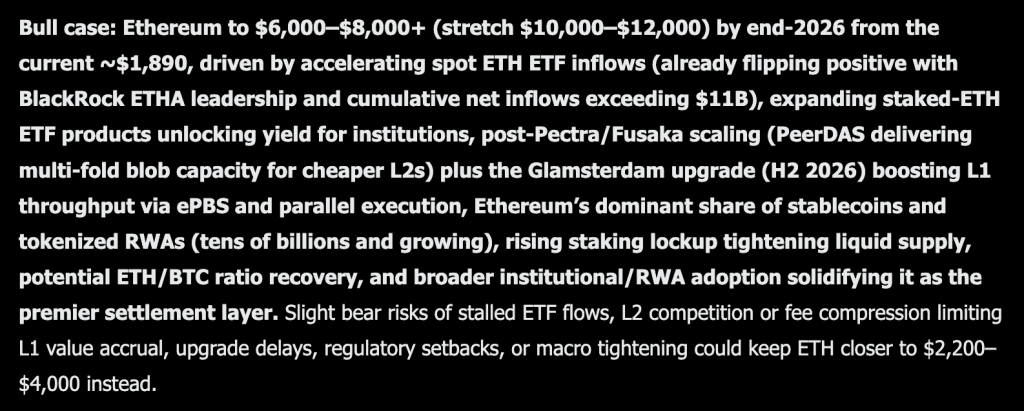
Grok AI predicts a massive breakout for Ethereum, and this price prediction sets the bar unusually high. The bull case runs to $6,000 to $8,000, with a stretch scenario reaching $10,000 to $12,000 by the end of 2026, up from roughly $1,890 today.
Accelerating spot ETH ETF inflows anchor the case. These are described as already flipping positive, with BlackRock’s ETHA taking the leadership position and cumulative net inflows exceeding $11 billion.
Expanding staked ETH ETF products are named as a second driver, unlocking yield for institutions in a way that turns simple price exposure into something closer to an income-bearing asset. That structural shift did not exist in any prior Ethereum cycle.

Post Pectra and Fusaka scaling adds real technical weight to the case. PeerDAS is expected to deliver a multi-fold increase in blob capacity, making Layer 2 networks meaningfully cheaper to operate, while the Glamsterdam upgrade in the second half of 2026 is set to boost Layer 1 throughput through ePBS and parallel execution.
Ethereum’s dominant share of stablecoins and tokenized real-world assets, estimated at tens of billions and still growing, forms the usage backbone underpinning the technical upgrades. Rising staking lockups are tightening liquid supply, a potential ETH-to-BTC ratio recovery is floated as a further tailwind, and broader institutional and RWA adoption is framed as solidifying Ethereum’s position as the premier settlement layer.
The bear case is treated as a real possibility rather than a footnote. Stalled ETF flows, Layer 2 competition or fee compression limiting how much value accrues to the base layer, upgrade delays, regulatory setbacks, or macro tightening could all keep Ethereum trading between $2,200 and $4,000 instead.

Ethereum Price Prediction: ETH Just Fell Back Below The Level It Spent Weeks Trying To Hold
Price closed at $1,877.71, down 2.20%, in a session ranging between $1,871.84 and $1,932.72. That red day breaks a run of gains that had briefly pushed Ethereum back above the $1,900 mark.
Zoom out, and the broader trend since September 2025 has been a long, uneven decline. Ethereum peaked near $4,950 that month, then broke down hard through January, gapping from above $3,000 to under $2,200 in a matter of weeks.
Since that crash, price has made two separate recovery attempts, one in April that stalled near $2,450, and another in June that also topped out near the same level before rolling back into a sharp flush to $1,540. The climb since that June low pushed price above $1,900 for the first time since the flush, but today’s drop pulls it right back under that mark.
Support sits at $1,850, then the June low near $1,540 if this pullback deepens. Resistance stacks at $1,930, then $2,200, then the heavier ceiling near $2,450 that has already rejected two separate rally attempts this year.
Momentum here has cooled sharply after weeks of steady gains, with today’s decline erasing some of the recent progress. For Grok’s bull case to gain any real traction, Ethereum first needs to reclaim $1,930 and then clear $2,450, the exact level that has stopped this chart twice before, rather than losing ground the way it did today.
Here is what Grok AI Predicts For LiquidChain’s Near Future
Every cycle has one moment when standing still costs more than moving. That moment is now.
Bitcoin, Ethereum, and XRP are all trapped under the same resistance they have tested for weeks. The macro catalyst is always one data point away. The institutional wave always lands next quarter. Large cap traders waiting for a breakout are lined up behind a decision that belongs entirely to someone else.
Grok AI has flagged what experienced cycle traders already understand instinctively. Capital that vanishes as statistical noise at Bitcoin’s scale can completely reshape the price of a small, undiscovered project. The asymmetry here is not complex. It exists in the gap between what something is genuinely worth and what the market currently believes it is worth. That gap collapses the instant it gets noticed. Right now, it remains fully open.
Cross-chain fragmentation has quietly extracted value from every DeFi participant since the first bridge went live. Bitcoin, Ethereum, and Solana were built independently, with no shared infrastructure and zero intention of communicating with each other. Every transaction crossing those boundaries pays for that decision in fees, failed execution, and slippage extracted before settlement even completes. Bridges were never the fix. They became a business built on top of the unsolved problem.
LiquidChain eliminates that business model entirely. All 3 networks merge into a single execution layer. One deployment reaches everything at once. Zero cross-chain tax on any interaction, anywhere.
Grok AI has flagged it as a coin worth watching. The presale sits at $0.01454 with just over $860,000 raised.
Execution is unproven. Adoption remains an open question. Established assets offer a smoother climb toward a ceiling the whole market can already see. LiquidChain is the entry point that disappears the moment the market catches on.
The post Elon Musk Grok AI Predicts Ethereum Will Hit This Price by End of 2026 appeared first on Cryptonews.

Elon Musk says 90% of Earth has a financial reason to move to Spain. He made the claim on Thursday, as thousands of people crossed from Morocco into the Spanish city of Ceuta.
It is an argument he has made many times before. Until now, he aimed it at the United States.
What Happened in Ceuta
Ceuta is a small Spanish city on the coast of North Africa. About 85,000 people live there. It sits right on the border with Morocco.
Thousands crossed over on Thursday. Most swam around the Tarajal seawall. At least nine people died.
Follow us on X to get the latest news as it happens
Rachid Sbihi runs the union for Ceuta’s border police. He described “absolute chaos” and said the border had “totally collapsed,” according to the Associated Press.
Local leader Juan Jesús Vivas asked Madrid to declare a national emergency and send the army. The Interior Ministry said no. It sent troops and extra police anyway. Spain and Morocco then agreed to speed up returns.
Prime Minister Pedro Sánchez said Spain was mobilizing all necessary resources. In January, his government gave legal status to about half a million undocumented workers.
“The Government of Spain is fully committed to providing an immediate response to the situation in Ceuta…working with Moroccan and international authorities, and preparing the necessary measures to restore normalcy as soon as possible… This is the moment to build solutions, with responsibility and cooperation,” wrote Sanchez.
Musk attacked that plan at the time. Sánchez told him “Mars can wait.” The clash fits a pattern in Musk’s European political commentary.
Where the ‘90% of Earth’ Line Comes From
The idea is simple. Musk says a country becomes a magnet when its benefits beat what most of the world lives on. That magnet then grows big enough to break the budget.
He made the same point in April about America. Free taxpayer money can beat the living standards of 90% of Earth, he wrote. That gives 90% of Earth a reason to move there.
A 2024 version used smaller numbers. America holds 4% of the world’s people. A shift of just 1% would crush essential services, he said. For Spain, he put the number at 7 billion.
Spain’s entire budget will be destroyed by illegal migrants. It’s basic math: if Spain offers free stuff to migrants that is above 90% of the living standard of Earth, they create a forcing function for 90% of Earth to move to Spain, which is around 7 billion people!” Musk explained.
Researchers see it differently. They find that jobs, distance, language, and family already living abroad matter more than benefits. That gap is why the line spreads fast, and why it gets attacked just as fast.
The post Elon Musk Says 90% of Earth Would Move to Spain: Is He Right? appeared first on BeInCrypto.

China Shipping containers are seen at the port of Oakland, as trade tensions continued over U.S. tariffs with China, in Oakland, California, U.S., May 12, 2025.
Carlos Barria | Reuters
BEIJING — One of the Chinese economy’s few growth drivers lost steam in July, according to the latest survey of businesses by China Beige Book.
“U.S.-bound shipments fell outright for the first time in several months,” the U.S.-based research firm said Friday. The findings are based on a survey of 1,436 Chinese businesses between July 20 and 28.
The last time China’s exports to the U.S. fell was in March, when they plunged more than 26% from a year ago, in line with the general trend of double-digit declines since trade tension escalated in April 2025, according to official data accessed via Wind Information.
Shipments to the U.S. rose by 14% in June, helping overall exports surge by 27% — the most in nearly five years. The growth came as businesses frontloaded shipments ahead of expected higher U.S. tariffs later in the summer. The rapid development of data centers to power AI has also driven demand for China-made parts.
The latest China Beige Book study found factory activity decelerated in July, with manufacturing seeing the worst performance in employment as all sectors surveyed saw job growth worsen from a year ago.
Retail sales also fell in July from the prior month and the year-ago period, the report said, noting travel and restaurants “saw a sharp on-year downturn.”
China’s top policymakers on Thursday emphasized the need to expand domestic demand and international trade cooperation, according to a state media readout. The statement underscored Beijing’s priority of achieving technological “breakthroughs.”
Trade data for July is due out Aug. 7, while retail sales and investment figures are expected on Aug. 17.

Bitcoin (BTC) and Ethereum (ETH) look set to finish July ahead of most major asset classes, with the former adding over 7% and the latter gaining almost 20% in the last 30 days.
The performance adds to a month of recovery for the two largest cryptocurrencies after a difficult first half of 2026, although historical data suggests August has been a much tougher month for BTC.
Bitcoin and Ethereum Lead July Returns
Data from CoinGlass at the time of writing showed that Ethereum had gained 19.5% during the month while Bitcoin had risen 7.37%. Meanwhile, a comparison by analyst Ash Crypto across major markets showed chip stocks fell 22% in the same period, with the Nasdaq 100 and the Russell 2000 slipping by 9% and 3%, respectively.
The S&P 500 also fell, but its decline was much smaller than that of its counterparts, at about 1%. Silver dropped by 2.64%, but gold was little changed, adding just 0.38% to its value over 30 days.
What makes the gains by the cryptocurrencies noteworthy is that before July, they had endured a rough 2026. CoinGlass data shows BTC fell more than 10% in January, as it continued a red run that had started in October 2025. That sequence continued into February, when the OG crypto lost almost 15%, before reprieves in March and April. May registered a -3.41% return and June recorded the worst drop of the year so far when the asset lost over 20% of its worth.
Ethereum’s first two quarterly performances were just as bad, with Q1 returns at -21.26% and those for Q2 at -25.28%.
Recall that BTC started July trading near $58,000 but gradually climbed the chart, hitting a monthly high near $67,000 last week before price action started cooling somewhat. It was pretty much the same with ETH, as CoinGecko data shows it kicking off the month near $1,500 and eventually ending up very close to $2,000 as July drew to a close.
At the time of writing, the world’s second-largest cryptocurrency was changing hands just above $1,900, having shed about 1% in the last seven days. However, despite the good monthly run, it’s still more than 50% lower than where it was a year ago and about 61% away from its August 2025 all-time high. Bitcoin, on its part, has settled near $64,000, which is almost half of its own ATH, after shrugging off the slight volatility that came with yesterday’s decision by the Fed to keep interest rates unchanged.
August Record Keeps Traders Cautious
While July brought relief for crypto investors, CoinGlass data points to a recurring seasonal pattern. Every August since 2022 has ended with Bitcoin posting a monthly loss, including declines of 6.49% in 2025, 8.6% in 2024, 11.29% in 2023 and 13.88% in 2022.
That backdrop has kept analysts divided on what comes next, with Ali Martinez forecasting that Bitcoin’s bear market could last until October, while traders Pepesso and Crypto Lens expect another move lower before a broader recovery begins in 2027.
The post Bitcoin, Ethereum Outperform Markets in July as Chip Stocks Plunge 22% appeared first on CryptoPotato.
Then the regulator stepped in. On June 22, the CFTC opened a request for comment on extending perpetual contracts to physically-delivered crude oil; 67 questions on reference prices, liquidity, position limits, and customer protection. And when the CME tried to self-certify its 24/7 oil contract in July, the CFTC stayed it, blocking the fast track and forcing a full review first.
This story – the market sprinting toward round-the-clock leveraged access to everything, and the rule-writers trying to decide how fast is safe – will keep repeating as the U.S. works to onshore derivatives flow and exchanges push for a level playing field with their offshore counterparts. When the biggest U.S. derivatives exchange is shrinking oil contracts for 24/7 retail access, and the U.S. derivatives regulator is drafting the rules for perpetual oil, you can stop debating whether the model won. It won.
So the interesting conversation isn’t “are perps spreading.” It’s three sharper questions: which asset classes get perpetuals next, where the leverage actually concentrates, and what breaks along the way.
On what’s next, follow the friction. Perps are most valuable precisely where the traditional market is most annoying, where it closes at night, gates you by geography, demands accreditation, or settles at a crawl. That’s why commodities, pre-IPO equities, and hard-to-reach foreign stocks got perpetuals first: enormous latent demand, hopelessly constrained access. The same logic points straight at private credit, carbon, freight, and the long tail of real-world assets coming onchain. Anything with a reference price and a frustrated audience is a candidate. The underlying almost doesn’t matter; the demand to trade it freely does.


MoonPay has launched PayBox, a noncustodial payment vault that lets users prepare and execute crypto transactions or online purchases through ChatGPT and Claude.
Summary
- PayBox connects with ChatGPT and Claude through custom connectors and natural-language commands.
- Users can buy, swap, bridge or deposit crypto and complete travel, dining and retail purchases.
- Passkey approvals and user-defined spending limits control what connected AI assistants can execute.
- MoonPay supports Solana and several EVM networks, including Ethereum, Base, Arbitrum and Polygon.
MoonPay PayBox turns AI conversations into transactions
PayBox allows users to connect a payment vault to ChatGPT or Anthropic’s Claude and describe a transaction in plain language. The AI assistant can then research available options, prepare the transaction, and execute it under permissions set by the user.
Supported crypto actions include buying digital assets with fiat currency, swapping tokens, moving assets between blockchains, and depositing funds into decentralized finance protocols. PayBox can also complete commercial transactions such as booking flights, reserving restaurant tables and purchasing goods from online retailers.
The launch extends AI assistants beyond research and transaction preparation by giving them limited authority to act on a user’s behalf. However, that authority depends on the security settings attached to the PayBox account.
MoonPay said the product is live through the PayBox website. Users must connect it to a supported AI platform through a custom connector before issuing payment instructions.
Passkeys and spending rules limit AI access
PayBox offers two authorization models. Under the “Always Ask” setting, every transaction requires the user to approve the action with a passkey. The approval applies to only one transaction and expires after use, preventing the AI from applying it to a different payment.
The “Autonomous” model allows the connected assistant to operate within spending limits and other rules chosen by the user. This option removes the need to approve each eligible transaction separately, but it does not give the assistant unrestricted control over the vault.
Any change to the permission model or transaction rules requires another passkey authorization. Users can therefore define how much the assistant can spend and the types of actions it can perform before enabling autonomous execution.
PayBox supports both crypto wallets and payment cards. For wallet transactions, private keys are divided using multiparty computation and stored across secure hardware environments. MoonPay said neither it nor the connected AI assistant can independently reconstruct the complete key or authorize an asset transfer.
Card payments use Visa’s agentic commerce protocol, allowing the assistant to complete approved purchases without receiving or storing the underlying card number.
PayBox supports Solana and major EVM networks
MoonPay has added support for Solana and several Ethereum Virtual Machine-compatible networks. The initial list includes Ethereum, Hyperliquid, Tempo, Base, Robinhood Chain, Arbitrum and Polygon.
The vault also integrates with x402, an open payment standard designed for services that accept transactions initiated by AI agents. MoonPay said its first x402 integrations cover travel bookings, restaurant reservations and purchases from major online retailers.
The network coverage lets users carry out several steps through one conversation. An assistant could, for example, help a user acquire an asset, bridge it to another blockchain and deposit it into a supported DeFi protocol, provided every step falls within the account’s permissions.
The product relies on security technology developed by Sodot, a key-management company MoonPay acquired earlier in 2026. MoonPay said Sodot’s infrastructure secures more than $50 billion in assets across over 10 million wallets.
MoonPay expands from institutional trading into AI payments
PayBox follows MoonPay’s recent expansion into tokenized financial products. As crypto.news reported in June, Franklin Templeton added its BENJI tokenized money market fund to MoonPay Trade.
That integration allows institutional users to exchange USDC, USDT and other stablecoins for BENJI through MoonPay’s on-chain trading platform. It also gives BENJI holders access to stablecoin liquidity and supports uses such as treasury management, portfolio rebalancing, collateral and liquidity provision.
PayBox targets a different part of the market by connecting consumer and crypto payments directly with conversational AI. MoonPay describes the vault as noncustodial because users retain control of their assets and neither MoonPay nor the AI provider can move funds alone.
For US users, PayBox’s use of Visa’s agentic commerce framework could make AI-assisted card payments more practical, while passkey controls may help address concerns over unauthorized purchases. Access to individual crypto assets, DeFi protocols, and payment services may still depend on location and the rules applied by each provider.

Jeeno Thitikul trying to ‘beat the course’ in hot Open start

Samsung Says It’s Launching Galaxy S26 FE and Tab S12 Later This Year

15 Minutes Story That will Change Your FINANCIAL LIFE !!


-

 Fashion6 days ago
Weekend Open Thread: Brooks Brothers
-
 Sports4 days ago
Commonwealth Games boxing: Jadumani Singh seals dominant 5-0 win over Pakistan’s Sumama Rehman to enter quarter-finals | Commonwealth Games News
-

 Business1 day ago
Why Trees Belong on the Risk Register
-

 Tech4 days ago
Intel is reversing course and bringing hyper-threading back to its server chips
-

 Crypto World5 days ago
Ripple bought a bank in pieces. The $4 billion audit
-

 Politics4 days ago
Luke Littler dismantles Gerwyn Price to retain title in Blackpool
-
 Entertainment6 days ago
A New Post-Apocalyptic Gundam Anime Series Blasts Into SDCC
-

 Politics3 days ago
The Part of the Electric Transition Nobody Wants to Discuss
-

 News Videos4 days ago
BITCOIN JUST ENTERED THIS CRITICAL ZONE…
-

 Fashion7 days ago
16 Dresses for the High Summer Event
-

 Sports7 days ago
2026 3M Open leaderboard: Scottie Scheffler finds putter in Round 1, sits three back
-

 Business2 days ago
Major shareholder moves on Canyon
-

 Crypto World5 days ago
XRP Ledger adds $2.6B as RWA inflows rank second
-

 Politics4 days ago
Spain sweeps the board at 2026 World Cup with individual awards
-

 News Videos12 hours ago
Bitcoin Enters the 3rd Stage of the Bear Market
-
 Entertainment2 days ago
‘Stargate’ Creator’s New Sci-Fi Series Returns for Season 3 Tomorrow
-

 Tech6 days ago
Anthropic launches Claude Opus 5, a cheaper AI model for coding, agents and enterprise workflows
-

 Crypto World2 days ago
Kraken Enables Retail Access to Jersey Mike’s IPO via Tokenized Shares
-

 Entertainment5 days ago
Sara Gilson Killed By Husband After Viral “Pedophile” TikTok Video
-

 News Videos2 days ago
Claude: Build Financial Dashboards in Minutes (2026)
You must be logged in to post a comment Login