
Crypto World
XRP Adds $900M as Tokenized Assets Reach $3.5B High


TLDR
- XRP added about $900 million in tokenized real-world assets within 24 hours.
- The total RWA value on the XRP Ledger reached $3.53 billion after the surge.
- Justoken’s JMWH product increased from $861 million to $1.763 billion on-chain.
- JMWH now accounts for nearly half of the total RWA value on XRPL.
- RWA.xyz data reflected the sudden rise in value on its public dashboard.
XRP recorded a sharp rise in tokenized real-world assets within 24 hours. The network added about $900 million in value, pushing total RWA holdings to $3.53 billion. Data from RWA.xyz shows that the increase came from an existing product on the XRP Ledger.
XRP Sees Rapid Growth in Tokenized Assets on XRPL
RWA.xyz reported that XRP Ledger held $2.616 billion in tokenized assets as of April 22. That figure included $491 million in stablecoins and showed steady growth since January. However, the total climbed to $3.53 billion within a day, reflecting a 35% increase.
The data shows that Justoken’s JMWH product drove the entire rise. JMWH increased from $861 million to $1.763 billion on-chain during the same period. As a result, JMWH now accounts for nearly 49.9% of total RWA value on XRPL.
RWA.xyz confirmed the updated figures on its public dashboard. The platform tracks represented and distributed real-world assets across major blockchain networks. The sudden jump marked one of the largest single-day changes recorded for XRP’s RWA ecosystem.
Justoken’s JMWH Product Drives XRP Ledger Expansion
Justoken, based in Buenos Aires, developed the JMWH digital energy token. Each JMWH token represents one real megawatt-hour of electricity backed by energy providers. The company deployed the product exclusively on the XRP Ledger.
The recent increase appears linked to a new deployment or value update. However, Justoken’s official platform still lists JMWH at about $860 million. The company has not yet confirmed the higher $1.763 billion valuation reflected on RWA.xyz.
Following the update, XRPL moved higher in global RWA rankings. The ledger now ranks third by represented real-world assets with about $2.5 billion recorded. XRP’s market share rose 71.78% over 30 days to 0.71%.
When including both represented and distributed assets, XRP ranks fifth globally. The network now hosts $3 billion in total RWA, excluding stablecoins. This marks a 60.33% rise over the past 30 days.
JMWH currently represents about 70% of the represented value on XRPL. The product remains the largest single tokenized asset hosted on the network. RWA.xyz continues to display the updated figures at press time.
Justoken has not issued a public statement regarding the change. Its website still reflects the earlier $860 million value. The discrepancy remains unresolved as of the latest available data.


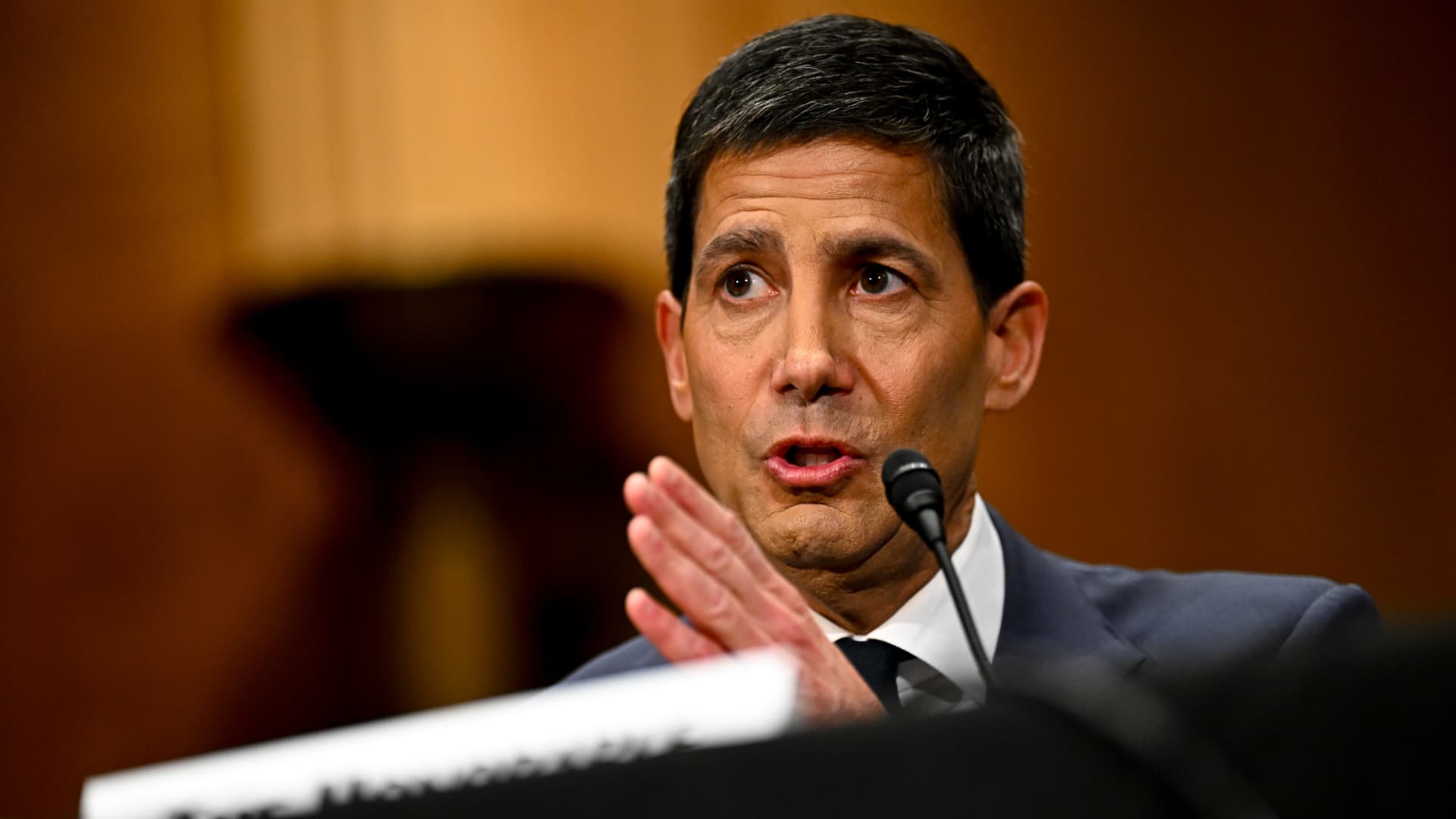
Kevin Warsh, chairman of the US Federal Reserve nominee for US President Donald Trump, during a Senate Banking, Housing, and Urban Affairs Committee confirmation hearing in Washington, DC, US, on Tuesday, April 21, 2026.
Graeme Sloan | Bloomberg | Getty Images
Odds that Kevin Warsh will be confirmed as chairman of the Federal Reserve in less than a month from now surged on prediction markets platform Kalshi after the Department of Justice said Friday it was dropping its inquiry into current Fed Chair Jerome Powell.
Bettors on the platform now see an 86% chance that Warsh’s nomination is approved by the U.S. Senate by May 15, and a more than 97% chance that happens by June 1.
Before the probe into Powell was dropped on Monday morning, bettors placed the chance of confirmation by May 15 at about 30% odds.
The end of the inquiry meets a key demand of Sen. Thom Thillis, a North Carolina Republican. While he said he supported Warsh for the role of Fed chair, he said he could not vote to advance the nomination until the criminal investigation into Powell ended.
Tillis sits on the Senate Banking Committee, which will need to vote to send Warsh’s nomination to the full Senate. If Tillis voted against advancing Warsh’s nomination, that would block his chances of making it to the Senate floor if all Democrats on the committee also opposed the selection by President Donald Trump.
While the probe ending today likely clears the path for Warsh’s candidacy to make it out of committee, Tillis has not made an official statement since the inquiry was dropped. CNBC has reached out to his office for comment.
Bettors, though, think the news is an all clear signal. On Polymarket, bettors now place a similar 81% chance Warsh is confirmed by May 15, and 98% chance by June 1.
Disclosure: CNBC and Kalshi have a commercial relationship that includes a CNBC minority investment.
Markets shift and headlines fade, but the core principles of building long-term wealth remain constant. Join us for our third CNBC Pro LIVE, where investors of all backgrounds – from financial professionals to everyday individuals – come together to cut through the noise and gain actionable strategies for smarter, more disciplined investing. No matter where you’re starting from, you’ll leave with clearer thinking, stronger strategies. Enter your email here to get a discount code


Paul Sztorc, the Bitcoin developer behind drivechains and Bitcoin Improvement Proposal 300 (BIP-300), has announced a new Bitcoin hard fork called eCash.
This project will apparently “be manually reassigning some” of Satoshi’s tokens on this fork to investors in this new project.
To justify this “controversial decision,” Sztorc has claimed that it was necessary to prevent the project from becoming a “zombie,” saying that without this way for “collaborators” to get involved, it will end up failing.
On his drivechain website, Sztorc has claimed that he “never launched an actual altcoin,” a claim that must now be updated
Drivechains
The announcement makes clear that the team behind this intends to launch with drivechains, claiming it has “7 in developement [sic].”
Drivechains, which are meant to facilitate Bitcoin scaling, are a type of sidechain — chains without native tokens that you can transfer your mainnet bitcoin (BTC) to.
Sztorc has claimed that this technology would facilitate an ability to onboard much more people to Bitcoin and use BTC in ways more familiar to DeFi.
Read more: Sztorc vs Gladstein: Can Lightning scale Bitcoin?
LayerTwoLabs, a firm that Sztorc is associated with, lists the possible uses for drivechains:
- Smart contracts
- Privacy-focused transactions
- Instant, low-cost payment channels
- DeFi applications
- Tokenization of assets and securities
Previous eCash projects
Other projects have previously used the name “eCash,” including, famously, David Chaum’s eCash, one of the first digital cash projects.
This project is often considered one of the precursors to Bitcoin.
Additionally, it’s a name that’s previously been used for cryptocurrencies, including, as acknowledged by Sztorc, “XEC” which launched in 2021.
Currently, the website for Sztorc’s new projects lists a launch in approximately 119 days.
Got a tip? Send us an email securely via Protos Leaks. For more informed news, follow us on X, Bluesky, and Google News, or subscribe to our YouTube channel.
The European Central Bank has moved to smooth the path for a potential digital euro by signing agreements with three European standards bodies to reuse existing open payment standards for digital euro transactions. The move, announced Friday, aims to reduce integration costs for banks, merchants, and payment service providers as Europe contemplates a common, cross-border digital tender.
The ECB said it struck partnerships with the European Card Payment Cooperation, Nexo standards, and the Berlin Group. The agreements will allow the central bank to apply standards covering contactless tap-to-pay, merchant-to-payment-provider connections, and alias-based payments (such as transactions initiated by a mobile phone number). In effect, the ECB hopes to sidestep the need to build a bespoke set of payment rails from scratch, at least at the outset, by leaning on established European open standards.
Using existing open standards is framed by the ECB as a cost-mitigation step designed to speed up market readiness and deliver a more uniform digital euro user experience across the euro area. Yet the central bank cautions that the arrangements are not a guarantee of inexpensive implementation. An earlier analysis cited by Reuters estimated that the digital euro could cost EU banks between 4 billion and 6 billion euros over a four-year horizon, underscoring the substantial work still required despite the standards collaboration.
The standards push is part of a broader effort to lower technical barriers ahead of any potential rollout. It addresses one facet of the costly, multi-year preparation that banks, merchants, and PSPs would face even if a decision to launch is ultimately taken.
The standards to be included. Source: ECB
Key takeaways
- The ECB has formalized agreements with the European Card Payment Cooperation, Nexo standards, and the Berlin Group to reuse open payment standards for digital euro transactions, covering tap-to-pay, merchant-to-PSP connections, and alias-based payments.
- The move is designed to cut adoption costs and promote a consistent user experience across the euro area, but it does not guarantee low implementation costs for banks and PSPs.
- Cost concerns remain significant: Reuters estimates EU banks could bear 4–6 billion euros in costs over four years related to a potential digital euro deployment.
- Technical standards are expected to be clarified ahead of a pilot, with the ECB targeting a summer unveiling of key standards and a 12-month pilot starting in the second half of 2027.
- PSPs will be actively recruited to participate in the pilot, which will involve a limited number of banks, merchants, and Eurosystem staff to test distribution and use cases.
Aligning standards with a possible rollout
The ECB’s coordinated approach reflects a shift toward leveraging established European payment frameworks rather than building a wholly new, closed system. By aligning with the European Card Payment Cooperation, Nexo standards, and the Berlin Group, the ECB aims to give banks and merchants a clearer, more interoperable path to integrating digital euro functionality into existing payment ecosystems. This could translate into smoother experiences for merchants accepting digital euro payments and for consumers using digital wallets or mobile devices for euro-denominated transactions.
Europe’s payment landscape has long been fragmented by proprietary rails and non-uniform protocols. The ECB’s emphasis on open standards seeks to reduce this fragmentation and promote a more consistent interface for end users. The central bank has emphasized that while standardization can ease technical onboarding, it does not eliminate all costs—particularly those tied to updating back-end systems, compliance, risk management, and staff training.
Setting the stage for a pilot
As part of its broader digital euro program, the ECB is moving toward a real-world test environment. In February, the central bank said the digital euro pilot will span 12 months and involve a limited set of payment service providers, merchants, and Eurosystem staff, with PSPs anticipated to play a central role in distribution. The pilot is planned to run in the latter half of 2027, contingent on progress in technical standardization and market readiness.
The ECB has previously signaled that a summer milestone would include concrete technical standards. In March, ECB Executive Board member Piero Cipollone indicated that key standards would be announced by the summer, providing banks and merchants with a clearer blueprint for their internal preparations. The ECB has also stressed the importance of a coordinated, phased approach—beginning with clear standards, followed by targeted pilots—to minimize disruption and encourage orderly adoption if a decision to launch is taken in the future.
The move to anchor the digital euro on open European standards dovetails with ongoing efforts to ensure the project remains technologically accessible to a broad swath of market participants. It also signals a recognition that the most stubborn barrier to wide-scale adoption may be compatibility with existing payment terminals, wallets, and settlement processes rather than the conceptual design of the digital euro itself.
As Europe builds out its own framework, observers will watch how these agreements translate into actual cost realizations, the speed with which standards are rolled out, and how merchants and PSPs adjust their systems. The balance between standardization and innovation will be important to track, as will the willingness of banks to participate in the pilot and commit resources to integration ahead of any formal decision on launch.
Analysts and market participants will also be looking for how the cost estimates evolve as banks begin to map integration milestones to open-standard adoption. If the ECB can demonstrate lower friction through interoperable interfaces, it could tilt the economics in favor of earlier and broader participation in a future digital euro ecosystem, even as total costs remain a consideration for financial institutions and policymakers alike.
In the near term, the headline from the ECB is one of pragmatic progress: aligning European payment standards to reduce one of the clearest technical barriers to a digital euro while keeping the door open for a methodical, evidence-based rollout. The coming months will reveal how quickly standards are adopted, how the pilot participants are selected, and what the actual cost profile looks like as banks begin to align their infrastructure with the new framework.
Readers should keep an eye on announcements anticipated this summer regarding the finalization of key technical standards and the ongoing process to recruit PSPs for the 2027 pilot. As the ECB’s plan unfolds, the compatibility of existing European payment rails with a digital euro and the real-world costs borne by banks will remain central to the feasibility discussion and investor interest alike.
Crypto World
Trump Just Confirmed He Will Speak at the TRUMP Memecoin Gala: Will His Words Move the Crypto Market?
Trump has confirmed. The speech is happening. And the crypto market is watching every word. The broader market holds its breath ahead of Saturday’s Mar-a-Lago gala, the most politically charged crypto event of the year.
What the president actually says could swing sentiment fast in either direction.
The White House confirmed via Reuters that Trump will deliver a keynote address at the exclusive TRUMP crypto memecoin holder gala luncheon at Mar-a-Lago on April 25.
Only the top 297 TRUMP token holders qualify to attend, the top 29 get a private reception with the president directly. Earlier this month, attendance wasn’t even guaranteed; the event terms explicitly noted Trump “may not be able to attend.”
That uncertainty is now resolved. What remains open: the substance of the remarks.
Lawmakers have flagged the event as a potential conflict of interest, given Trump’s direct financial stake in the TRUMP memecoin ecosystem. That political friction, layered over growing US government involvement in crypto infrastructure, makes this speech a genuine market catalyst — not just a media moment.
Can Bitcoin Price Break Out of Its Consolidation Range This Week?
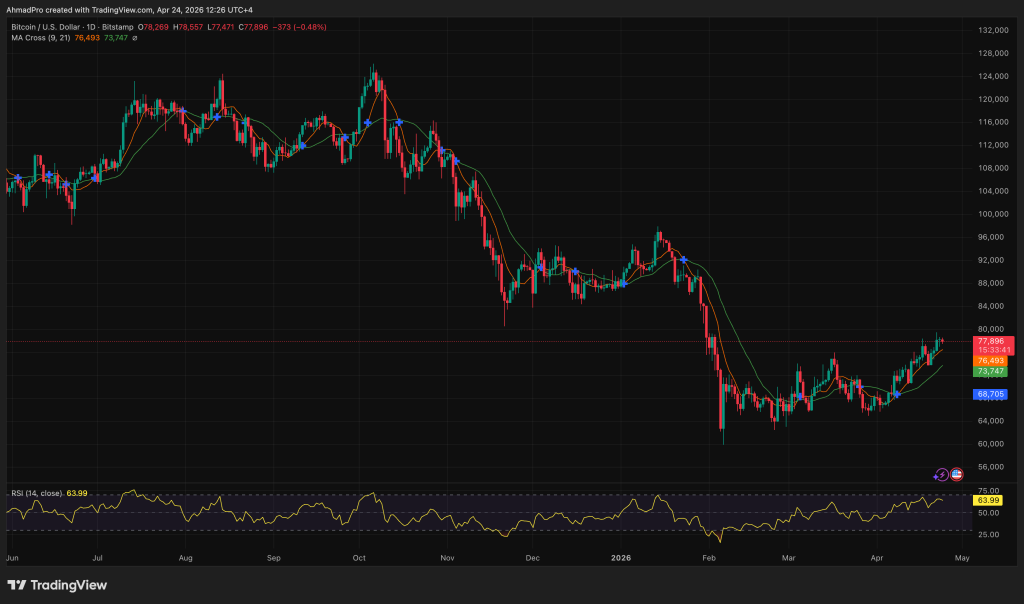
Bitcoin is compressing just under resistance, and this kind of tight range with fading volume usually does not last; it resolves with a move, not more sideways.
Right now, the setup is neutral. Moving averages are flattening, momentum is weak on both sides, and support is holding, but without strong conviction.
The upcoming speech could be a trigger.
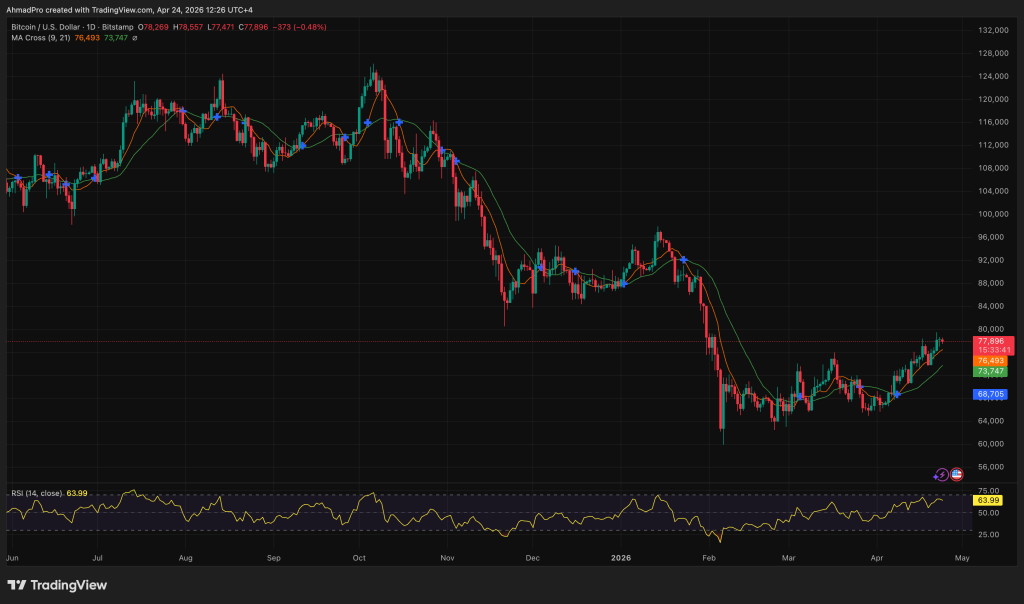
If it delivers real substance, something concrete on regulation or adoption, that is where BTC can break above $78K with volume and pull the market higher.
More likely, it is positive but vague, which leads to a quick pop and then back into the same range.
The risk is if sentiment flips negative around it, because with positioning already cautious, that can push price down fast and test support levels.
Is Bitcoin Hyper Going to Be The Highest Gainer Among Crypto Market Post Trump Speech?
The issue with chasing a Bitcoin breakout here is simple: the higher it goes, the harder it is to get outsized returns. By the time momentum is obvious, most of the move is already priced in.
That is why capital starts rotating earlier, especially into infrastructure plays tied to Bitcoin itself, where the upside is not fully captured yet.
Bitcoin Hyper is trying to position right in that gap, building a Layer 2 on Bitcoin with SVM integration to bring faster execution and smart contracts without leaving the Bitcoin ecosystem. The idea is to combine Bitcoin’s security with the kind of speed and flexibility usually seen elsewhere.
The presale is already showing strong traction, with over $32.5M raised and a current price around $0.013679, which points to steady accumulation rather than a one-off spike.
Early incentives like staking and the bridge design are aimed at making the ecosystem usable, not just speculative.
That said, it is still a presale, and that comes with real uncertainty around execution and liquidity once it launches.
So the setup is clear, Bitcoin is consolidating with limited upside in the short term, while projects building around it offer higher potential, but with higher risk.
The post Trump Just Confirmed He Will Speak at the TRUMP Memecoin Gala: Will His Words Move the Crypto Market? appeared first on Cryptonews.

Ethereum price is trading near $2,314, down roughly 1% in 24 hours, and yet one of Wall Street’s most-watched crypto bulls just endorsed a price target that would require a 100x move from here.
Fundstrat Global Advisors co-founder Tom Lee has thrown his weight behind a $250,000 ETH price target, and the thesis is more structured than it sounds. Whether the market timeline matches the model is a separate question entirely.
Lee’s backing follows a detailed report from Etherealize that reframes ETH not as a speculative token but as a yield-bearing monetary asset.
To me, this is a fresh and comprehensive take by @Etherealize_io on the importance of ethereum and how the $ETH coin will play an increasingly important role as a unit of exchange — Thomas (Tom) Lee (not drummer) FundstratDirect.com (@fundstrat) April 22, 2026
– the case for $250,000 ETH 
 https://t.co/0IEoNEmwRe pic.twitter.com/dGCWL40NHb
The core argument: Ethereum combines network utility with staking income, roughly 2% to 4% annually, in a way that neither gold nor Bitcoin does.
Applying that framework to a total addressable monetary premium of $31.5 trillion, spread across 121 million circulating ETH, produces the $250,000 figure.
Lee signaled agreement via his official account, amplifying a thesis that had already been circulating among institutional researchers. Notably, the report does not offer a near-term price target, this is explicitly a long-range valuation model. Full breakdown of the $250K framework here.
Meanwhile, spot ETH ETFs recorded $96 million in net inflows on Wednesday, the largest single-day figure in two months, suggesting institutional appetite hasn’t evaporated despite the price softness.

Discover: The best pre-launch token sales
Can Ethereum Price Reclaim $3,000 Before Bears Take Control?
Ethereum price is not trending right now, it is just stuck in a messy range, and even the price feeds do not fully agree, which tells you liquidity is fragmented and conviction is low.
Technically it is mixed. Momentum indicators lean slightly bullish, but trend strength is fading, so you get movement without follow-through. Price is holding above key medium-term averages, which keeps the structure alive, but still sitting under short-term resistance, so it cannot break out.
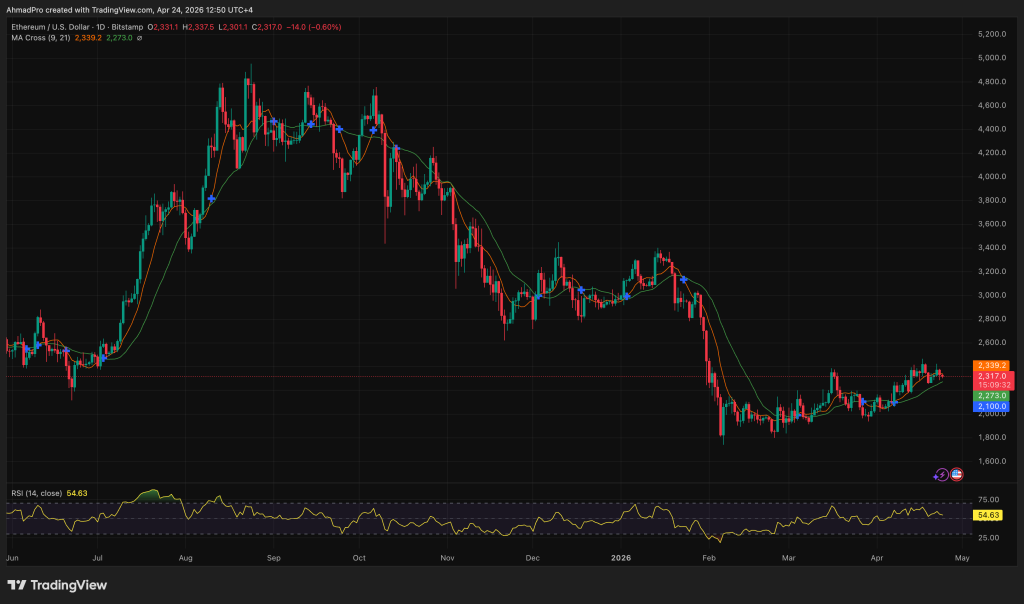
If ETH can push back above $2,500 and hold, that is where momentum builds again and opens the path toward $3,000.
More realistically, it keeps chopping between roughly $2,200 and $2,600 while the market waits for clearer macro direction.
The risk is $2,100, because if that breaks, the entire short-term bullish structure is gone and a deeper move lower becomes likely.
Discover: The best crypto to diversify your portfolio with
Other Coins That Could Go 100X? Bitcoin Hyper
The $250K ETH thesis is a long game, built on staking yield and monetary premium over years, not something that plays out quickly.
That is why attention is shifting toward earlier-stage infrastructure, especially around Bitcoin, where the upside is still forming.
Bitcoin Hyper is aiming right at that gap, building a Layer 2 on Bitcoin with SVM integration to bring speed and smart contracts without leaving the Bitcoin ecosystem. The pitch is simple, fix Bitcoin’s limitations while keeping its core strengths.
The presale has already pulled in over $32.5M at around $0.013679, which shows strong early demand, and features like staking and a native bridge are designed to make the system usable from day one.
But it is still a presale, and that matters. Liquidity is unproven, execution is not guaranteed, and early valuations can move fast in both directions.
So the trade-off is clear, ETH is a slower, long-term thesis, while something like Bitcoin Hyper offers earlier positioning with higher upside, but also higher risk.
The post Tom Lee Just Backed a $250,000 Ethereum Price Target: Is It Actually Possible? appeared first on Cryptonews.
Disclosure: This article does not represent investment advice. The content and materials featured on this page are for educational purposes only.
Little Pepe gains investor attention as presale nears final stages with over $28 million already raised.
Summary
- Little Pepe has raised $28M+ in presale, with Stage 13 priced at $0.0022 and Stage 14 at $0.0023.
- Built on a Layer 2 ecosystem, Little Pepe offers zero-tax trading, staking rewards, DAO governance, and anti-sniper protection.
- A giveaway campaign boosts demand for Little Pepe, offering $77,000 in tokens plus ETH rewards.
With time, the cryptocurrency industry is becoming more sophisticated, and therefore, there have been changes in the kinds of coins that traders seek to invest in. While traditional cryptos may yield constant value growth, it is always a combination of new startups and highly momentum-driven altcoins that yield impressive returns during bullish trends. However, picking such coins requires some level of foresight, and there are quite a few cryptocurrencies that are catching many people’s eyes.
Dogecoin (DOGE)
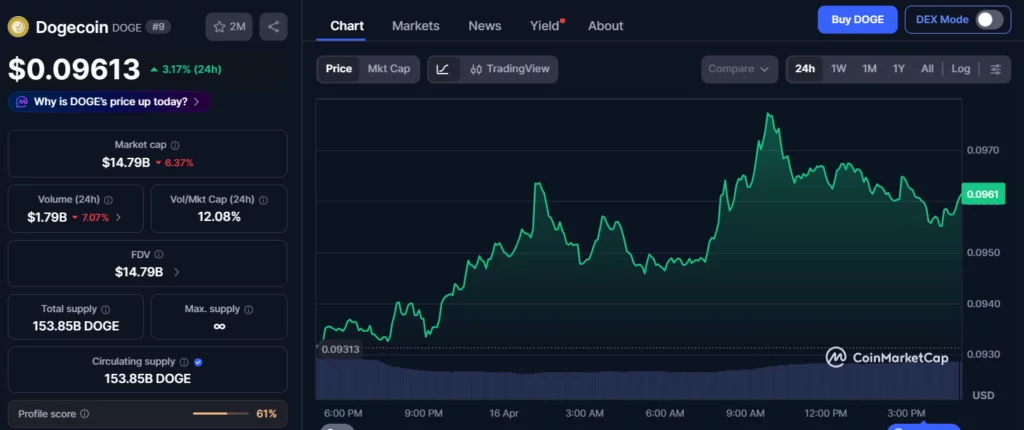
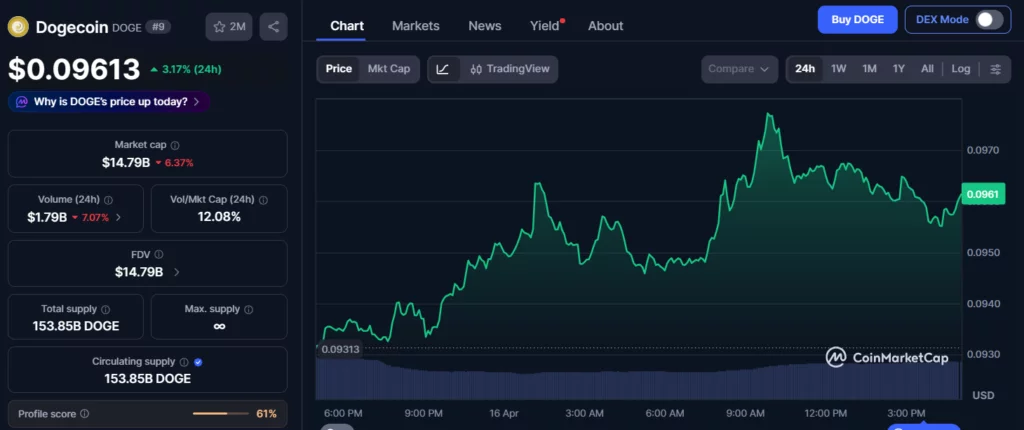
One of the most famous memecoins is Dogecoin. There are millions of followers of this coin. It also has very good liquidity all around the world. The coin is currently trading at $0.0980 and has a market cap of $14.79 billion. The 24-hour trading volume stands at $1.5 billion. Though it is a very old coin, there is no doubt that DOGE can surge quickly when there is an uptrend in the markets. Being a memecoin with huge gains, there is little chance that this coin will lose its relevance in the coming time.
TRON (TRX)
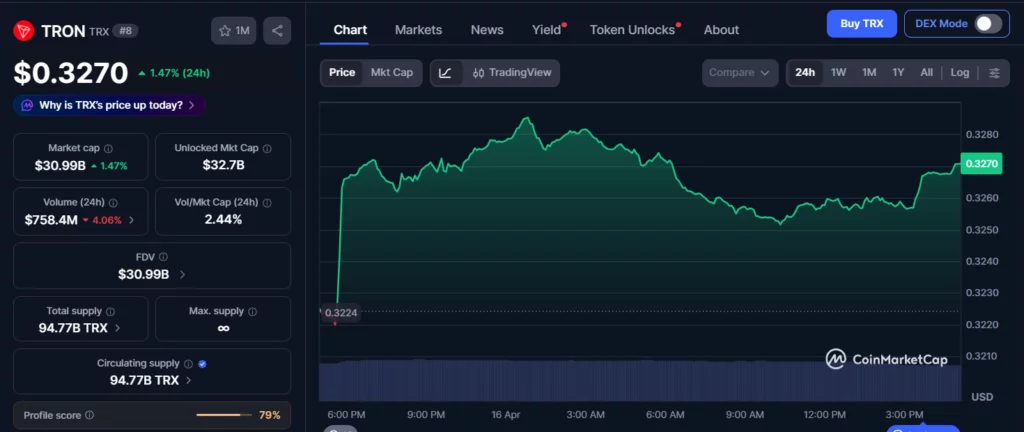
Though there has been no improvement in the price action of TRON, it remains the most-used cryptocurrency network in terms of total blockchain transactions with stablecoins and dApps built on top of it. The coin stands at $0.33 with a market cap of $30.87 billion as of the publishing. The trading volume is at $521.6 million. The high usage of the network will definitely generate profits with higher adoption.
Chainlink (LINK)
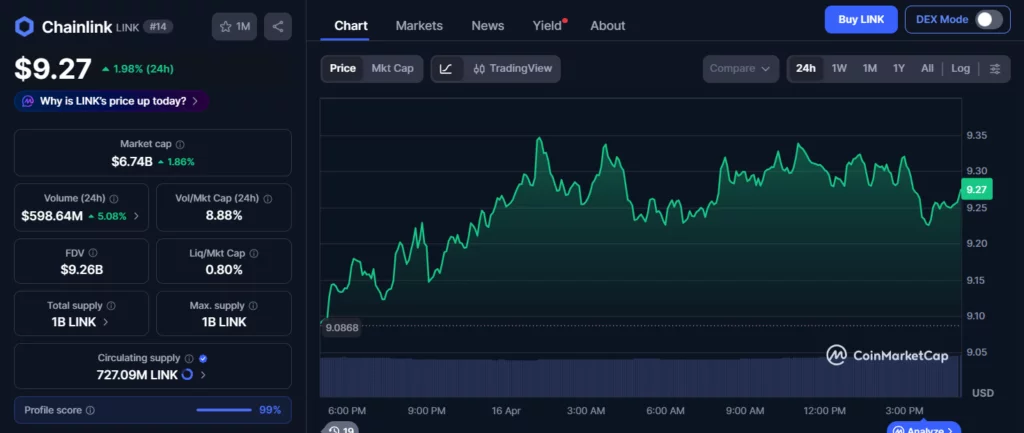
There are several aspects to consider when thinking about Chainlink, with one of the key elements being that Chainlink offers an opportunity for data interaction between blockchain technology and external data sources through the use of its oracle system.
LINK is now at $9.36 with a slight rise of 0.11% and a market cap of $6.81 billion. The trading volume is at $256.65 million. The increase in DeFi initiatives and other blockchain-powered services means that data feeds are more important than ever, making LINK a crucial part of Web3 infrastructure.
Hyperliquid (HYPE)
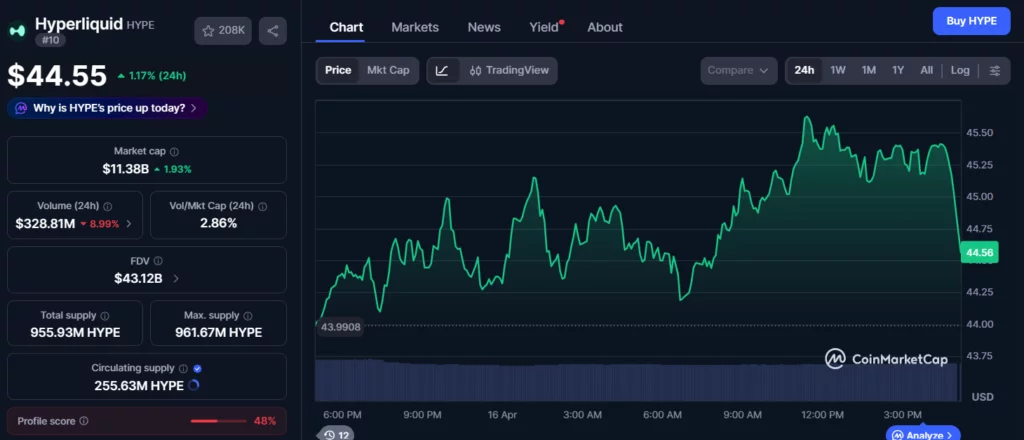
Hyperliquid is a developing force in the realm of decentralized trading. With the rise in the usage of derivatives and trading on blockchain, it has been garnering liquidity and attention from users very quickly. The token is at $41.16 with a market cap of $9.31 billion. The 24-hour trading volume is at $209.43 million. Considering the future potential of Decentralized Finance, Hyperliquid could grow significantly, thus offering investors with upside potential.
Little Pepe (LILPEPE)
However, Little Pepe ranks among these tokens because of its early position and great presale results. The project has raised over $28 million and is currently priced at $0.0022 in Stage 13 (Stage 14 is priced at $0.0023). This is close to the end of the presale stage, and this low price makes it an interesting investment to explore its possible 50x potential.
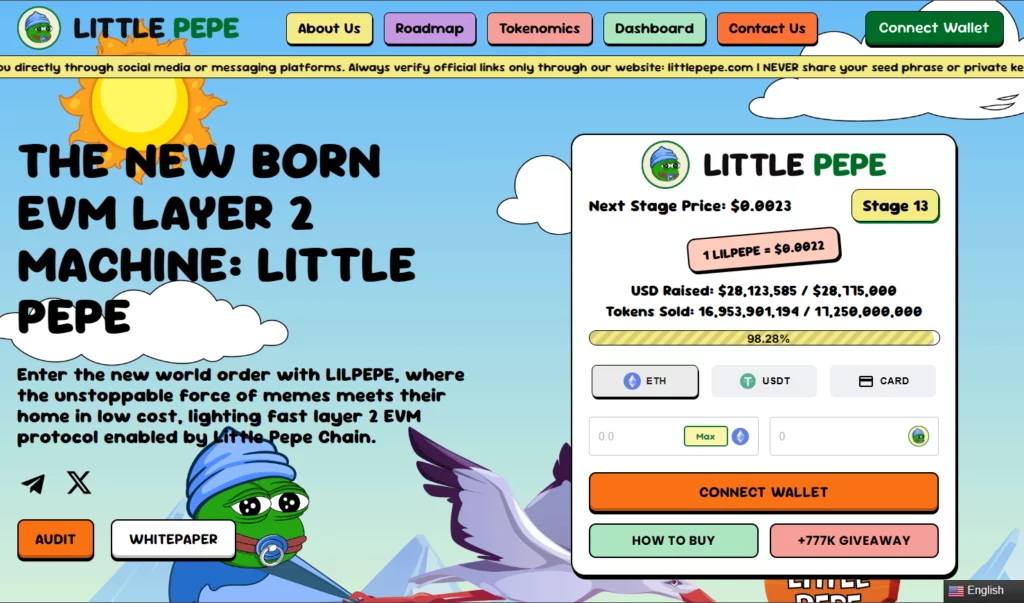
As a token of Layer 2 blockchain that guarantees quick transactions, low costs, and scalability, Little Pepe has such interesting perks as zero tax trading, anti-sniper bots, staking rewards, meme launchpad, and even DAO governance. Besides, the characteristics of the project go beyond just being an intriguing speculative meme coin, as they serve some purpose.
In addition to that, the current giveaway program, which promises ten participants to receive $77,000 worth of LILPEPE coins plus $15 or more of ETH for the top three buyers, adds to the appeal of the coin and successful presales.
Finding the balance between risk and reward
Even though earning 50x returns is not guaranteed with certainty, all of the above-mentioned investments have both advantages and opportunities. They are all quite different, yet all have growth drivers that may help achieve the desired result. The only problem is that assets like Little Pepe have much higher upside potential since their price points are lower and the demand for them keeps rising. This is what might become critical for making substantial money in the future.
For more information about Little Pepe, visit the official website, X, and Telegram.
Disclosure: This content is provided by a third party. Neither crypto.news nor the author of this article endorses any product mentioned on this page. Users should conduct their own research before taking any action related to the company.


Bitmine Immersion Technologies (BMNR) said it is purchasing 10,000 ether (ETH) from the Ethereum Foundation, adding to its growing position as the largest digital asset treasury firm after the bitcoin-centric Strategy (MSTR).
The terms of the over-the-counter transaction were finalized on Friday and is worth $23.87 million, the Ethereum Foundation said in an X post.
ETH currently trades at around $2,310, some 3% lower than the sale price in the transfer.
The proceeds will support the organization’s operations, including protocol research, ecosystem development and grants, the foundation said.
The transaction comes as Bitmine continues to accumulate ether at scale while most digital asset treasuries have slowed or halted buying over the past months.
The firm, helmed by Fundstrat CIO Thomas Lee, bought over 100,000 last week, bringing its holdings to 4.97 million ETH, according to its Monday report. Its total assets stood at $12.9 billion, making it the largest public holder of ether, and second-largest public digital asset treasury trailing.
Bitmine is trying to accumulate 5% of ETH’s supply, which would translate to roughly 6 million tokens, the company previously announced.
Read more: Ethereum Foundation stakes another $93 million ether, reaching its 70,000 ETH target


Jane Street asked a U.S. court to dismiss a lawsuit brought by the bankruptcy estate of Terraform Labs, rejecting claims that the trading firm helped trigger the 2022 collapse of the TerraUSD (UST) stablecoin and its sister token Luna.
In two filings submitted Thursday to the Southern District of New York, Jane Street and several employees said the case is an attempt to shift blame for the failure of the Terra ecosystem, which erased roughly $40 billion in value within days.
The firm urged the court to dismiss the complaint with prejudice, which would prevent Terraform from pursuing the same claims again.
“This case is an attempt by the estate of Terraform Labs to extract cash from Jane Street to foot the bill for a fraud that Terraform itself perpetrated on the market,” the defendants wrote.
Jane Street argued that the core issues behind Terra’s collapse have already been settled in court. It pointed to criminal and civil cases against Terraform founder Do Kwon, who pleaded guilty to conspiracy and wire fraud and is serving a 15-year prison sentence. A jury also found Kwon and Terraform liable for securities fraud. According to the filing, Kwon said he was “alone responsible for everyone’s pain.”
Terraform’s lawsuit, filed in January by administrator Todd Snyder, accuses Jane Street of insider trading that sped up the collapse. Snyder alleges the firm used nonpublic information from Terraform insiders to trade ahead of major moves, including large withdrawals from the Curve liquidity pool that preceded UST losing its dollar peg.
For example, the complaint claims Terraform withdrew 150 million UST on May 7, 2022, and that a wallet linked to Jane Street pulled 85 million UST minutes later, sparking market panic. Jane Street disputes that narrative and denies any role in the collapse.
Jane Street maintains that “Terraform’s fraud scheme — in which Jane Street had no involvement — has already been prosecuted, adjudicated, and punished.”
Terraform Labs, founded in 2018, filed for bankruptcy in January 2024. Its downfall rippled across the crypto sector, contributing to failures at several firms exposed to the project. The court’s decision on Jane Street’s motion could shape how responsibility for that collapse is assigned.


The US Department of Justice (DOJ) has dropped its criminal investigation of Federal Reserve Chair Jerome Powell, ending a case that had frozen Senate work on the Trump nominee set to replace him.
US Attorney Jeanine Pirro announced the decision Friday, effectively reversing her public stance from two days earlier, when she pledged to appeal a judge’s order blocking her office’s grand jury subpoenas.
Quick Reversal After Courts Pushed Back
The probe began in January. Pirro’s office opened a grand jury inquiry into Powell’s June 2025 Senate testimony about the Fed’s headquarters renovation.
Prosecutors asked whether Powell misled senators about the scope of work on the Eccles and East buildings in Washington.
Reported costs for the project climbed to roughly $2.5 billion, up from an earlier authorization near $1.9 billion.
Inflation, asbestos and lead remediation, and historic preservation requirements drove most of the overrun. No charges were filed.
Chief US District Judge James Boasberg quashed the DOJ’s subpoenas on March 13 and reaffirmed the ruling on April 3. He wrote that prosecutors produced “essentially zero evidence” of a crime.
The judge also said the subpoenas served a “pretextual” purpose aimed at pressuring Powell over interest rate decisions. Pirro rejected that framing and said on April 22 she would appeal.
Two days later, her office referred the cost overruns to the Fed’s inspector general, an internal watchdog with access to procurement records.
“I have directed my office to close our investigation as the IG undertakes this inquiry…I will not hesitate to restart a criminal investigation should the facts warrant doing so,” wrote Pirro in the Friday afternoon post.
Tillis Ultimatum Cleared Warsh’s Path
The closure removes a political block on Kevin Warsh, the Trump nominee to succeed Powell when the chair’s term ends May 15.
Sen. Thom Tillis of North Carolina, a Republican on the Senate Banking Committee, had withheld his vote until prosecutors walked away.
“I will oppose the confirmation of any Federal Reserve nominee, including for the position of Chairman, until the DOJ’s inquiry into Chairman Powell is fully and transparently resolved,” Tillis articulated in a late January post.
Tillis called the investigation “bogus” and “frivolous” during Warsh’s April 21 hearing. He said dropping it could be done in “five minutes.”
“If we want to get Mr. Warsh confirmed, we need to drop the investigation,” Tillis made the remark at Warsh’s hearing.
Warsh, a former Fed governor under George W. Bush, told senators he would not act as Trump’s “sock puppet.”
His confirmation would place a Trump ally atop the central bank weeks before the Federal Open Market Committee’s June meeting.
Powell had publicly described the probe as retaliation for Fed rate policy. His term as chair ends next month, though he can remain as a governor until 2028.
Former Fed officials and several market economists had flagged the case as a stress test for central bank independence.
The CLARITY Act Overlap
The decision reshapes the Senate Banking Committee’s near-term calendar. Tillis is also the lead Republican negotiator on stablecoin yield language in the Digital Asset Market CLARITY Act, the House-passed crypto bill now awaiting Senate markup.
He pushed the committee to delay the CLARITY markup from April to May, citing the need for more stakeholder input from banks.
The North Carolina Bankers Association had urged members to lobby his office for tighter restrictions on rewards tied to stablecoin balances.
Banks want a full ban on passive yield. Crypto firms want activity-based incentives preserved. A partial compromise allowing rewards tied to third-party platform usage has circulated but has not been finalized.
With Warsh’s confirmation no longer tethered to the DOJ case, committee bandwidth opens heading into the week of May 11, the earliest feasible window for the crypto markup.
Industry groups have warned that further slips could push meaningful market-structure reform into 2027, or worse, beyond 2030.
The Fed inspector general’s review and Warsh’s committee vote are the next pressure points. Whether the Powell case returns in any form may hinge on what the watchdog finds inside the renovation records.
The post DOJ Drops Powell Probe in Fast Reversal, Clearing Warsh Confirmation Path appeared first on BeInCrypto.
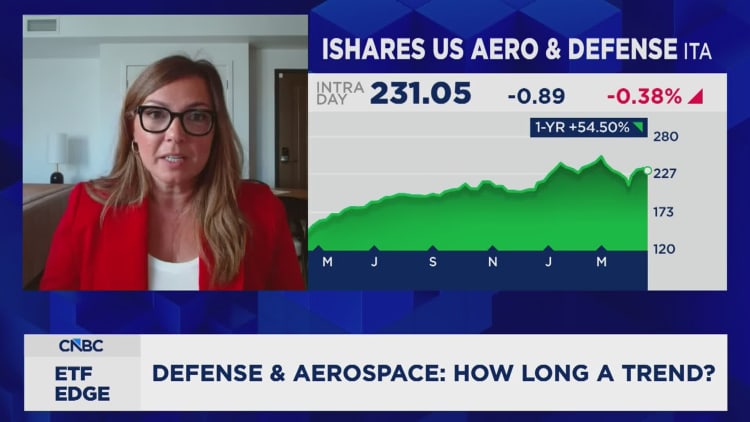

The aerospace and defense trade is taking investors deeper into space and exchange-traded funds want a part of it.
VettaFi’s Cinthia Murphy told CNBC’s “ETF Edge” this week there are now more ETFs tackling the space theme more directly — listing the Procure Space ETF (UFO) and Global X Defense Tech ETF (SHLD) as examples.
“They have the cybersecurity element: Satellites, communications, navigation. So, the defense theme is actually a very colorful theme nowadays. It has a lot of interesting names,” the firm’s director of research said. “It really isn’t just about Lockheed Martin and some of the traditional names that you find in ITA [iShares US Aerospace & Defense ETF].”
As of Thursday’s close, the Procure Space ETF is up almost 19% since the Iran War started on Feb. 28 while the Global X Defense Tech ETF is off 8%.
Meanwhile, the more traditional iShares US Aerospace & Defense ETF is down 10% in the same period. Its website lists the top holdings as GE Aerospace, RTX Corp and Boeing.
Murphy expects investor interest in aerospace and defense stocks to persist long after the Iran war is resolved.
“Any time you have geopolitical heat, it puts this kind of theme on the map,” said Murphy. “But it’s another big growth area because there’s so much new technology coming up and so much investment coming into this space. A lot of governments making commitments for much more investments in the next five to ten years.”
Murphy suggests historic interest in the SpaceX initial public offering, which his largely expected in June, is firing up even more interest in the space.
“One of the things we’ve spoken about the most this year is about space exploration and space investment given we’re about to see the SpaceX IPO,” added Murphy.
SS&C Technologies‘ Paul Baiocchi is also bullish on aerospace and defense names. He predicts a monster ramp up in defense budget around the world will generate solid returns for the group.
“All of these things are converging for the same limited scarce resources,” the financial technology firm’s head of fund sales and strategy said in the same interview. “Near-term, medium-term [and] long-term, commodities allocations, energy infrastructure [and] electrification infrastructure all stand to benefit from the massive amount of investment that’s coming from both the public and private sectors.”
Plus, he sees artificial intelligence playing a key role.
“The bottleneck for AI might be chips, but it’s also power and transmission and the raw materials that go into construction,” Baiocchi said. “If you look at defense, that’s also part of the constrain is the availability of the rare earths.”

Kalshi bettors see Warsh confirmed in May after DOJ drops Powell probe

Life On The Red Planet? Newly Discovered Mars Molecules

Chelsea’s Financial Situation Explained

Manchester United reach agreement with Casemiro over contract clause amid transfer speculation

US brings back mandatory military draft registration

Steven Gerrard disagrees with Gary Neville over ‘shock’ Chelsea and Arsenal claim | Football


-

 Fashion7 days ago
Weekend Open Thread: Theodora Dress
-

 Business5 days ago
Powerball Result April 18, 2026: No Jackpot Winner in Powerball Draw: $75 Million Rolls Over
-

 Politics7 days ago
Palestine barred from entering Canada for FIFA Congress
-
Entertainment5 days ago
NBA Analyst Charles Barkley Chimes in on Ice Spice McDonald’s Fiasco
-

 Tech6 days ago
Auto Enthusiast Scores Running Tesla Model 3 for Two Grand and Turns It Into Bare-Bones Go-Kart
-

 Politics5 days ago
Zack Polanski demands ‘council homes not luxury flats for foreign investors’
-

 Crypto World7 days ago
Russia Pushes Bill to Criminalize Unregistered Crypto Services
-

 Politics4 days ago
Gary Stevenson delivers timely reminder to register to vote as deadline TODAY
-

 Business2 days ago
Rolls-Royce Voted UK’s Most Iconic Trade Mark as IPO Register Hits 150
-

 Politics2 days ago
Disabled people challenge government SEND proposals over segregation concerns
-

 Politics2 days ago
Making troops accountable for war crimes threatens US alliance, ex-SAS colonel warns
-

 Crypto World7 days ago
Russia Introduces Bill To Criminalize Unregistered Crypto Services
-

 Politics2 days ago
Starmer handler McSweeney to be dragged from shadows by Foreign Affairs Committee
-
Politics2 days ago
Wings Over Scotland | How To Get Away With Crimes
-

 Politics2 days ago
Zack Polanski responds to home secretary’s taser threat
-
Crypto World6 days ago
Kelp DAO rsETH Bridge Hack Drains $292M as DeFi Losses Top $600M in Two Weeks
-

 Politics2 days ago
‘Iran is still a nuclear threat’
-

 Crypto World3 days ago
New York sues Coinbase, Gemini over prediction market offerings
-

 News Videos7 days ago
AP Politics, Buggana Analyzes Reasons For Financial Instability Due To Amaravati
-

 Business2 days ago
The Job Benefits Most Men Don’t Know to Negotiate
You must be logged in to post a comment Login