

Crypto World
XRP Faces Critical Test as Uganda Genomic Pilot Meets Binance Liquidity Drought

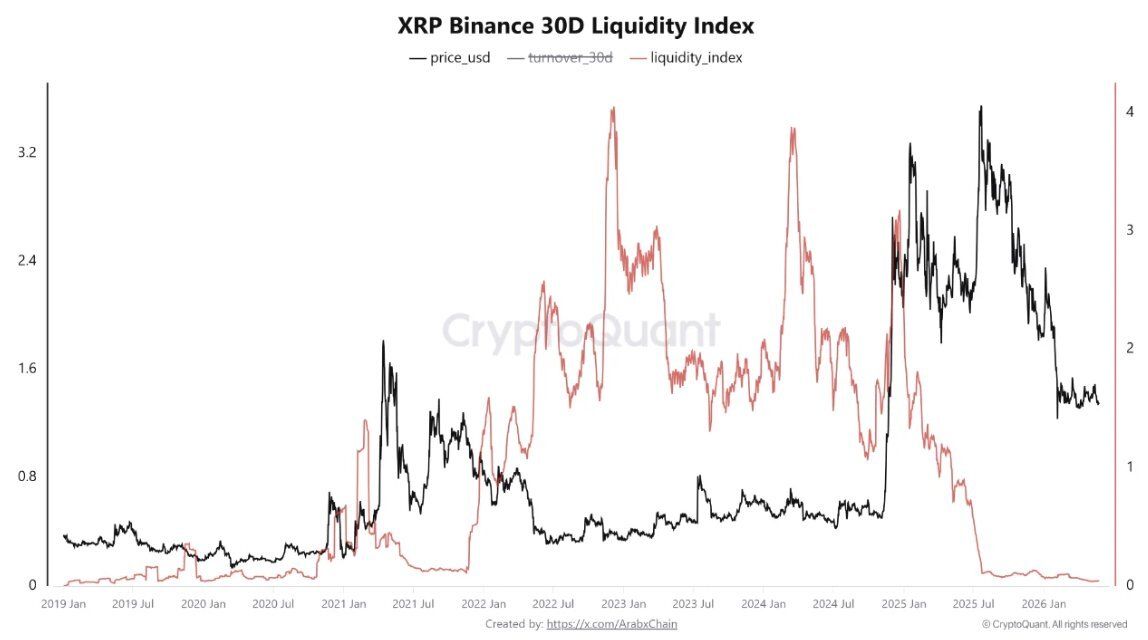
XRP faces a three-way test this week. An XRPL pilot in Uganda just launched, Binance spot liquidity hit a January 2020 low, and the daily chart now compresses inside a tightening symmetrical triangle near key support.
The altcoin traded near $1.33 on May 26, down 2.1% on the day. Price now tests the lower trendline of a symmetrical triangle, where adoption news and weakening market structure collide.
Uganda Pilot Pushes XRPL Into Genomic Identity
DNA Protocol confirmed on Tuesday that its Uganda pilots process genomic identity data from certified labs. The system generates zero-knowledge proofs and anchors them on the XRP Ledger Testnet.
DNA Protocol positions the design as a privacy-preserving way to validate genetic credentials without exposing the raw data. Uganda’s pilot routes lab outputs into proofs that any verifier can check on XRPL Testnet, the team said.
Mainnet deployment will run through a dual burn mechanism between XDNA and XRP, the project said on X. The XDNA token serves as the native unit for protocol fees, and the dual burn ties it directly to XRP supply mechanics.
The pilot aligns with a wider push to position the XRP Ledger as institutional infrastructure. Earlier work on institutional XRPL privacy already brought zero-knowledge payment rails to the testnet for developers.
Binance XRP Liquidity Sinks to a Five-Year Low
The 30-day liquidity index for XRP on Binance fell to roughly 0.043, according to CryptoQuant data. That marks the lowest reading since January 2020 and reflects a sharp drop in market depth on the exchange.
Between 2022 and 2024, the same index frequently ran above 3, and at times above 4. Heavier trading flows during that stretch coincided with the previous bull cycle and stronger speculative interest in XRP.
The drop toward zero began in early 2025 and has held for months. That trend parallels broader XRP liquidity concentration risks across major venues.
XRP’s price also reached new highs in 2025, while liquidity had already trended toward the floor. That divergence often precedes wider price swings once trading flows return.
CryptoQuant noted that thin order books amplify the impact of large orders. Periods of thin liquidity often coincide with sharper intraday wicks and weaker support absorption.
“Liquidity at these low levels could make the market more sensitive to sudden price movements, as large orders may have a greater impact on price.”

Triangle Compression Tilts Bearish Near $1.17 Support
The XRP/USDT daily chart on Binance shows a symmetrical triangle pattern that has guided price action since February 6. The upper trendline descends from a $1.70 swing high, and the lower trendline rises off the $1.17 February low.
Both bounds match Fibonacci retracements from the prior leg. The $1.7045 level marks the 0.618 retracement, while $1.1729 sits at the 0.786 retracement.
Price has just broken under the $1.40 zone that held since March. It now presses the lower triangle trendline near $1.33.

The Relative Strength Index sits in the mid-30s to low-40s, signaling fading momentum without oversold readings. Bollinger Band Width Percentile prints near multi-year lows, confirming the XRP volatility squeeze flagged in earlier sessions.
Daily volume has remained subdued during the recent slide. No clear capitulation candle has printed on the move below the $1.40 zone.
The current lean tilts breakout odds toward the downside. A confirmed daily close below $1.17 would open the path toward deeper retracement levels.
What to Watch Next for XRP
The setup combines drained liquidity, a coiled chart, and a fresh utility hook into a single decision point. Whether the Uganda pilot translates into network demand or the triangle breaks lower may shape the next leg.
The XRP May trajectory is likely to pivot on the next confirmed close above $1.40 or below $1.17.
The post XRP Faces Critical Test as Uganda Genomic Pilot Meets Binance Liquidity Drought appeared first on BeInCrypto.



Coinbase and CEO Brian Armstrong are bankrolling a rapidly expanding pro-crypto political machine, pouring tens of millions of dollars into Fairshake as Washington’s 2026 election fight over digital assets intensifies.
Summary
- Coinbase has given $24.5m to Fairshake, while Armstrong added $1m personally.
- Fairshake has raised $85m so far, with major backing from a16z, Ripple and others.
- The PAC aims to shape U.S. crypto rules as Congress battles over regulation and market structure.
Coinbase and Armstrong are helping assemble what they describe as an “8-figure political war chest” by routing $25.5 million into Fairshake, a crypto-focused super PAC backing pro-digital asset candidates in what the exchange calls the industry’s “most consequential” U.S. election yet. According to Fairshake spokesperson Josh Vlasto, Coinbase contributed $24.5 million while Armstrong personally donated another $1 million, putting the exchange and its chief executive behind roughly one-third of the PAC’s current $85 million haul.
Fairshake, which supports crypto-friendly candidates from both parties, has emerged as the central political vehicle for the sector, drawing contributions from exchanges, venture firms and token issuers as they scramble to influence how Washington sets the rules for stablecoins, market structure and digital asset custody. As one crypto trader reacting to the latest numbers put it on X, “they’re playing the long game,” arguing that “policy could shift everything for crypto.”
Coinbase cashes in on political clout
The U.S.-based exchange has quietly become Fairshake’s dominant patron, with its latest $24.5 million check making it the PAC’s largest single donor this cycle, ahead of other big names such as Ripple and venture backers. In addition to Armstrong’s $1 million personal contribution, Coinbase has previously acknowledged Fairshake support in a December blog post, casting the PAC as part of a broader push to secure “clear rules of the road” for digital assets in the U.S. market.
Fairshake and affiliated committees Protect Progress and Defend American Jobs have collectively raised more than $85 million since launch, according to public disclosures and reporting from outlets including Axios and Bloomberg. A16z has chipped in at least $20 million, Electric Capital added $500,000, while Ripple has committed more than $20 million in this cycle alone, on top of an earlier $20 million tranche disclosed in December.
That capital is already being deployed aggressively. Fairshake and its allies have spent around $20 million in recent primary races across Georgia, Kentucky and Alabama, targeting candidates seen as hostile to the sector and backing those prepared to support more permissive crypto policy.
Crypto’s regulatory endgame in Washington
The industry’s political spending spree comes as Congress moves closer to a comprehensive framework for digital assets, with measures like the Senate Agriculture Committee’s CLARITY Act and parallel House market structure bills threatening to harden the regulatory perimeter around trading platforms, stablecoin issuers and token projects. Fairshake’s stated mission is to “support candidates who want to get it right on digital assets,” a euphemism for lawmakers willing to back CFTC-led oversight, friendlier tax treatment and a path to mainstream status for assets like bitcoin, ether and leading stablecoins.
In a wide-ranging discussion about crypto’s next phase, Armstrong has framed 2025–2026 as the moment the asset class moves from “gray market to well‑lit establishment,” explicitly tying that shift to heavy lobbying, campaign donations and the outcome of this election cycle. From PACs like Fairshake to direct outreach to policymakers, crypto firms are betting that writing big checks now will buy them regulatory clarity later, a strategy that has already helped push more than 250 openly pro‑crypto candidates into Congress, according to prior reporting from crypto.news.
The escalation also underscores how tightly politics and markets have fused. In a recent crypto.news feature, Fairshake’s $85 million war chest was described as a “new phase” of engagement, one that can make or break Senate bids with eight‑figure ad blitzes. Another crypto.news analysis detailed how the PAC and its allied committees have since swelled to more than $116 million in cash and commitments for the 2026 midterms, putting crypto on spending par with some of the country’s largest corporate lobbies.
For now, Fairshake’s donors are signaling they are nowhere near done writing checks. Coinbase has already pledged an additional $25 million for 2026, Ripple is layering on fresh $25 million commitments, and a16z plans to add $23 million on top of prior cycles — numbers that suggest the U.S. crypto industry has accepted that its future will be decided not just in markets, but at the ballot box.


Bitcoin briefly reclaimed the $78,000 level in a violent short squeeze that added roughly $30 billion to its market capitalization within an hour, before volatility quickly returned.
Summary
- Bitcoin jumped around $1,400 in a single hour to trade back above $78,000
- Roughly $25 million in short positions were liquidated during the move
- Traders remain split on whether the spike marks a sustained breakout or another fake-out
Bitcoin (BTC) ripped roughly $1,400 higher in about an hour on Tuesday, spiking back above $78,000 as a wave of forced liquidations flushed out overleveraged shorts and briefly added around $30 billion to the asset’s market value, according to trader Bull Theory. The move pushed Bitcoin back into the upper end of its recent range, where it has oscillated between roughly $75,000 and $80,000 since early May while traders debate whether the next leg is a clean breakout or yet another squeeze-driven head fake.
Bitcoin rips higher, then whipsaws traders
In his post, Bull Theory wrote that “Bitcoin pumped +$1400 in 1 HOUR and back above $78,000 adding $30 BILLION in market cap,” adding that “over $25 MILLION shorts liquidated in the past hour.” That size of liquidations is modest compared to the $140 million-plus in forced flows seen during broader market squeezes over the past month, but concentrated in a one-hour window it is enough to drive a sharp, mechanical move in thin order books.
The broader backdrop remains one of elevated but cooling leverage after a series of squeezes pushed Bitcoin to and through key resistance levels this quarter, including a break above $80,000 earlier in May as ETF inflows and conference-driven hype collided at Consensus 2026 in Miami. Bitcoin’s live price page shows the asset still hovering near the top of its recent range with a market capitalization above $1.5 trillion, underscoring its outsized influence on the wider crypto complex.
Short squeeze mechanics and where price goes next
On derivatives venues, similar episodes of forced buying have repeatedly driven Bitcoin higher as negative funding and crowded short positioning flip into a cascade of liquidations that chase price up the order book. Previous squeezes this cycle wiped out hundreds of millions of dollars in bearish bets in a matter of hours as BTC ripped past $76,000 and then $79,000, before stalling near resistance bands just below $80,600. Crypto.news has documented how these dynamics often leave spot demand lagging behind derivatives-driven spikes, raising the risk that price retraces once the forced flows exhaust.
Reactions to the latest move were predictably split. One trader, MacroPulse, noted that “it just dumped right back down for some reason lol,” capturing the frustration of those whipsawed by 15-minute candles that “would cause anyone to quit,” as another user, Alan Bolton, put it. Others warned that this is “not a good time to leverage; most people fail,” arguing that sharp squeezes can quickly reverse once late longs pile in and market makers fade the move.
Short-squeeze psychology is hardly new to this cycle. Earlier reporting from crypto.news highlighted how Bitcoin’s reclaim of the $79,000 area in April coincided with rising open interest and negative funding rates that signaled “potential for another short squeeze,” with resistance stacked near $85,000 and support closer to $77,000. Another recap detailed how BTC “reclaims $68K amid short liquidations,” showing the same pattern of shorts forced to buy back into strength.
At the time of writing, Bitcoin’s price page on crypto.news shows BTC consolidating just below the intraday highs, with market dominance around 58% and capitalization north of $1.5 trillion. That positioning, combined with prior analyses of Bitcoin “stabilizing at $70K as open interest drops” and setting a base for the next move, suggests that as long as spot demand does not fully disappear, aggressive shorting into support zones may continue to be a risky strategy.
For now, the latest $1,400 rip looks like a textbook reminder that in a market where a few tens of millions of dollars in liquidations can add $30 billion in paper value within an hour, the real question is not whether Bitcoin can spike above $78,000 — it is whether anyone should trust that level to hold once the forced buyers are gone.
XRP trades near $1.39-$1.47 in late May 2026, down approximately 26% year-to-date and 34% year-on-year despite multiple institutional catalysts that historically would have driven significant price appreciation.
Summary
- XRP traded near $1.42 in May 2026 despite Ripple’s institutional deals and spot ETF launches.
- Ripple’s payment corridors largely use fiat and RLUSD instead of XRP as a bridge currency.
- The 2030 outlook ranged from $1 to $15, depending on CLARITY Act progress, ETF inflows, and direct XRP usage.
Five-spot (XRP) ETFs are now trading in the US with cumulative inflows of $1.53 billion since the November 2025 launch. Goldman Sachs disclosed a $153.8 million XRP ETF position. The Senate Banking Committee voted to advance the CLARITY Act on May 14, 2026 (15-9 bipartisan).
Ripple received conditional OCC approval for Ripple National Trust Bank in December 2025 and applied for a Federal Reserve master account. RLUSD stablecoin reached approximately $1.3 billion market cap after expanding to Ethereum Layer 2 networks. Ripple closed approximately 10 institutional deals in early 2026, including a tokenized Treasury pilot with J.P. Morgan, Mastercard, and Ondo Finance on XRPL. Standard Chartered targets $8 by year-end if the CLARITY Act passes the full Senate and ETF inflows reach $10 billion. Bitwise’s Juan Leon projects new all-time highs within 12-18 months.
Yet XRP price action has been disconnected from these catalysts. The reason matters: XRP price benefits from XRP usage and holding at scale, not from Ripple’s deal pipeline. Most Ripple institutional flow routes through fiat and RLUSD rather than XRP as a bridge currency. The price disconnect is structural rather than temporary. This piece walks through the actual mechanics, the bull case ($8-$15 by 2030), the base case ($3-$6), and the bear case ($1-$2.50), with the specific variables determining outcome.
Why XRP is at $1.42 right now
The current XRP price reflects a structural disconnect between Ripple’s institutional success and XRP token utility that competitor analyses keep missing.
The starting point: XRP reached approximately $3.65 in July 2025, driven by anticipation of CLARITY Act passage, spot XRP ETF launches, and broader institutional adoption. The subsequent decline to current $1.42 levels (60+% drawdown from peak) happened despite Ripple’s continued institutional success across multiple dimensions.
The Ripple institutional wins through 2026: spot XRP ETFs launched in November 2025, with cumulative inflows reaching $1.53 billion by May 2026. Goldman Sachs disclosed a $153.8 million XRP ETF position. Ripple received conditional OCC approval for Ripple National Trust Bank in December 2025. Application filed for Federal Reserve master account. RLUSD stablecoin reached a $1.3 billion market cap. Tokenized Treasury pilot with J.P. Morgan, Mastercard, and Ondo Finance on XRPL. Ripple secured a $200 million financing facility from Neuberger Specialty Finance for institutional brokerage. Approximately 10 institutional deals closed in early 2026.
The structural problem: most of this institutional activity does not generate sustained XRP demand at price-supporting scale. Ripple’s payment corridors largely route through fiat (USD, EUR) and RLUSD stablecoin rather than through XRP as a bridge currency. The institutional ETF flows ($1.53B cumulative) are meaningful, but a fraction of Bitcoin ETF flows ($120B+) that drove BTC’s institutional adoption. The Federal Reserve master account application, if approved, would let Ripple hold RLUSD reserves at the central bank but doesn’t directly create XRP demand.
The XRP utility gap: the original Ripple thesis depended on XRP serving as the universal bridge currency between fiat pairs in cross-border payments. Banks would need XRP to enable transactions, creating sustained institutional demand for the token. The actual deployment has been substantially different.
Banks have largely used Ripple’s payments network through fiat-to-fiat settlement or through stablecoin-mediated transactions rather than XRP-mediated transactions. The demand for XRP that would justify higher prices has not materialized in the way the original thesis required.
The RLUSD competitive dynamic: Ripple’s own RLUSD stablecoin has captured the institutional settlement role that XRP was supposed to serve. RLUSD provides the same cross-border settlement functionality without the volatility risk of XRP. Banks and institutional users prefer stablecoin settlement for accounting and risk management reasons. The result is that Ripple’s own product is fundamentally competing with XRP for the bridge currency use case.
The ETF dynamics: spot XRP ETFs launched with significant initial inflows, but the demand pattern has been more episodic than sustained. Weekly XRP ETF inflows fell from over $200 million in early 2026 to roughly $2 million by the end of March 2026, showing the lumpy and catalyst-dependent nature of institutional XRP demand. Without sustained ETF accumulation, the institutional capital that supports BTC and ETH prices doesn’t reach XRP at comparable scale.
The CLARITY Act dynamics: the bill passed the Senate Banking Committee 15-9 on May 14, 2026, providing the strongest legislative signal in years that XRP will be formally classified as a non-security. This is the most important near-term catalyst because it would remove the regulatory overhang that has constrained institutional XRP adoption since 2020. However, the bill still needs to pass the full Senate and be reconciled with the House version before becoming law. The path is plausible but not certain.
What the price action signals structurally: XRP responds to direct XRP demand (ETF inflows, on-chain activity, retail accumulation) rather than to Ripple’s enterprise success. The market has correctly recognized that Ripple’s institutional deals don’t necessarily translate to XRP demand. The current $1.42 price reflects this updated understanding. Future price appreciation requires catalysts that create direct XRP demand rather than just Ripple business success.
The bull case: $8-$15 by 2030
The bull case for XRP requires specific catalyst conditions that resolve the structural disconnect between Ripple’s success and XRP’s price.
The CLARITY Act passage: the bill must pass the full Senate (after the May 14 committee passage) and be reconciled with the House version, then signed into law. This would explicitly classify XRP as a non-security commodity, removing the regulatory overhang that has constrained institutional XRP adoption. The legal clarity would enable pension funds, insurance companies, and other compliance-restricted institutions to allocate to XRP for the first time since 2020.
The ETF flow scaling: current cumulative XRP ETF inflows are $1.53 billion. Standard Chartered’s bull case projection requires $10 billion+ in cumulative inflows. The 6-7x scaling would require sustained institutional accumulation at much higher rates than current episodic patterns. Bitcoin ETF accumulation provides the precedent: $120B+ in flows over 18+ months. XRP achieving even 25-30% of Bitcoin’s institutional ETF adoption would represent the required scaling.
The XRP-as-bridge-currency activation: the bull case requires Ripple’s payment corridors to actually route meaningful volume through XRP rather than through fiat or RLUSD. This is the hardest variable because it requires the original Ripple thesis to materialize after years of evidence suggesting it doesn’t. Specific paths: Federal Reserve master account approval enabling new bridge currency dynamics, regulatory changes incentivizing XRP usage for compliance reasons, technical advantages of XRP-mediated transactions becoming compelling versus alternatives, or specific large institutional users committing to XRP-based settlement.
The Federal Reserve master account: Ripple’s pending application for a direct Fed master account would enable RLUSD reserves to be held at the central bank, giving institutional-grade stablecoin infrastructure. Indirectly, this could create dynamics where XRP serves as the bridge between Fed-backed RLUSD and other crypto assets, generating sustained XRP demand. The approval is uncertain and likely depends on broader regulatory framework development.
The RLUSD market expansion: if RLUSD scales from its current $1.3B to a $10B+ market cap as the GENIUS Act stablecoin framework develops, the broader Ripple ecosystem expansion could create XRP demand through ecosystem fees, network effects, and bridge currency requirements for specific use cases. RLUSD success doesn’t automatically translate to XRP success, but creates ecosystem dynamics that could.
The institutional adoption beyond ETFs: institutional accumulation beyond ETF wrappers (direct XRP holdings by corporate treasuries, allocation to XRP by sovereign wealth funds, integration into prime brokerage offerings) would represent the demand the bull case requires. Goldman Sachs’s $153.8M ETF position is a positive signal but represents traditional asset manager allocation rather than corporate treasury or sovereign accumulation.
The XRPL ecosystem development: the XRP Ledger needs to become more than just a payments rail. The bull case assumes XRPL captures meaningful DeFi activity, becomes the settlement layer for tokenized real-world assets (the J.P. Morgan/Mastercard/Ondo pilot shows this potential), and develops the broader ecosystem that creates XRP demand for fees, governance, and network participation.
If all bull case conditions materialize, the price targets are:
2026 year-end: $4-7
2027 year-end: $6-10
2028 year-end: $7-12
2029 year-end: $8-14
2030 year-end: $8-15
The wide range reflects the multiple variables that must align. Standard Chartered’s $8 target for end-2026 represents the upper end of the bull case for that year. Reaching $15 by 2030 requires sustained execution across CLARITY Act passage, ETF scaling, XRPL ecosystem development, and ideally the XRP-as-bridge-currency thesis activating in ways that haven’t materialized over the past decade.
The base case: $3-$6 by 2030
The base case assumes the CLARITY Act eventually passes, but with delays, institutional adoption continues at the current pace, and the structural disconnect between Ripple’s success and XRP’s price partially resolves through gradual ecosystem development.
The CLARITY Act scenario: the bill passes the full Senate in late 2026 or 2027, gets reconciled with the House version, and becomes law in 2027. The delay vs immediate passage means institutional capital allocation takes longer to materialize. The legal clarity arrives, but the price impact is more gradual than the bull case envisions.
The ETF flow scenario: cumulative XRP ETF inflows reach $3-5 billion by the end of 2026, $5-8 billion by 2027, scaling to $8-15 billion by 2030. The growth is meaningful but slower than the bull case’s $10B+ by 2026 timeline. Institutional adoption follows the Bitcoin ETF trajectory at a smaller absolute scale.
The bridge currency scenario: XRP usage as bridge currency in Ripple’s payment corridors grows gradually as specific use cases emerge (CBDC interoperability, certain regulatory frameworks favoring XRP-mediated transactions, technical advantages in specific contexts). The growth is real, but represents 10-20% of Ripple’s total payment volume rather than the dominant share the original thesis envisioned.
The RLUSD continued dominance: RLUSD stays Ripple’s primary stablecoin product with a growing market cap ($3-5B by 2030 in base case). XRP serves a narrower bridge currency role rather than a universal bridge. The two products coexist with different use cases rather than RLUSD completely displacing XRP.
The Federal Reserve master account: approval comes in 2027-2028, but the broader institutional impact is gradual. Other major issuers (Circle, Tether) also receive similar arrangements, reducing Ripple’s competitive differentiation. The master account benefits Ripple business operations more than XRP price directly.
The XRPL ecosystem: develops meaningful but limited DeFi activity. Tokenized RWA settlement grows but represents a specialized use case rather than a dominant infrastructure. XRP demand from ecosystem fees grows, but doesn’t change price dynamics.
The competitive landscape: USDC, USDT, USD1, and other major stablecoins maintain a dominant position in the broader stablecoin market. RLUSD captures specific Ripple-ecosystem use cases without becoming dominant. XRP’s competitive position in bridge currency vs other crypto bridge solutions stays specialized.
Base case targets:
2026 year-end: $2-3
2027 year-end: $2.50-4
2028 year-end: $3-5
2029 year-end: $3-5.50
2030 year-end: $3-6
The base case represents moderate appreciation from current levels plus periodic volatility around catalyst developments. The structural floor is higher than pre-2025 levels because the regulatory clarity and institutional infrastructure have improved meaningfully, but the dramatic appreciation requires bull case conditions that may not materialize.
The bear case: $1-$2.50 by 2030
The bear case requires either specific XRP setbacks or broader market headwinds disrupting the institutional adoption thesis.
The CLARITY Act stall scenario: if the Senate Majority Leader doesn’t schedule full Senate floor vote before key recess windows, or if the floor vote fails to reach 60 votes for cloture, the bill could be shelved until the 2029-2030 congressional session. Standard Chartered’s $2.80 target for 2026 already assumes a delayed rather than failed passage. Complete failure would push targets significantly lower.
The ETF flow collapse: the episodic nature of XRP ETF flows (from $200M+ weekly to $2M weekly within months) could become structural. Without sustained accumulation, the institutional capital that supports prices doesn’t reach XRP at a meaningful scale. ETF flows could plateau or decline if institutional sentiment shifts away from XRP.
The bridge currency thesis failure: Ripple’s payment corridors continue routing through fiat and RLUSD rather than XRP. The structural disconnect between Ripple’s business success and XRP price persists or widens. The market continues to correctly price XRP for what the token actually does (limited bridge usage) rather than what the original thesis promised.
The RLUSD displacement: RLUSD or other stablecoins (USDC, USDT, USD1) capture all the institutional settlement use cases. XRP becomes a legacy asset with declining utility. The token’s primary value comes from speculative demand rather than structural utility.
The regulatory crackdown scenario: under different administration or shifting regulatory priorities, XRP could face renewed scrutiny. The SEC could pursue additional enforcement, the CFTC could impose restrictive frameworks on XRP-based products, or international jurisdictions could restrict XRP access. The regulatory uncertainty that constrained 2020-2024 could return.
The competitive disruption: alternative crypto bridge currencies (Stellar’s XLM, other payment-focused tokens, new entrants) capture institutional payment volume Ripple was supposed to serve. CBDCs replace cross-border crypto payment infrastructure entirely. The fundamental thesis for XRP utility could become obsolete.
The macro deterioration: broader crypto market weakness, recession dynamics, or other macro factors could disproportionately impact XRP as a higher-beta crypto asset. The institutional capital that has been supporting BTC and ETH could withdraw from XRP first as risk-off dynamics develop.
Bear case targets:
2026 year-end: $1.20-2
2027 year-end: $1-1.80
2028 year-end: $1-2
2029 year-end: $1-2.20
2030 year-end: $1-2.50
The bear case represents a significant downside from current levels but assumes XRP retains a meaningful market presence. Complete failure scenarios (price below $0.80) would require severe disruption to crypto markets generally or specific catastrophic events affecting Ripple or XRP specifically.
The five variables that determine outcome
Five specific variables determine which scenario materializes. Readers can monitor these directly rather than relying on price action alone.
Variable 1: CLARITY Act passage progress. The single most important variable. Senate Banking Committee passage (May 14, 2026) was step one. Required next steps: Senate floor vote, House reconciliation, presidential signing. Monitor: Senate calendar and scheduling decisions, key senator positions (Lummis, Gillibrand, Scott), House committee progress on companion legislation, White House signaling on signing intent.
Variable 2: XRP ETF inflow trajectory. Currently $1.53 billion cumulative since the November 2025 launch. Bull case requires scaling to $10B+ by the end of 2026. Base case assumes $3-5B by end-2026. Bear case assumes plateau at current levels. Monitor: weekly ETF flow data, large institutional positions disclosed in 13F filings, ETF product expansion (new issuers, additional product types), and competitive ETF dynamics.
Variable 3: XRP-as-bridge-currency activation. The hardest but most important variable for breaking the structural disconnect. Currently, most Ripple payment corridor volume routes through fiat or RLUSD. Monitor: Ripple’s quarterly transparency reports, ODL volume statistics, specific large institutional commitments to XRP-based settlement, and technical XRP usage metrics on XRPL.
Variable 4: Federal Reserve master account status. Ripple’s pending application would enable RLUSD reserves at the central bank. Approval timing and structure matter. Monitor: Federal Reserve regulatory announcements, OCC additional guidance on Ripple National Trust Bank, comparable arrangements for other stablecoin issuers, and broader Treasury Department policy on digital asset bank charters.
Variable 5: RLUSD market position and growth. Currently $1.3 billion market cap. RLUSD success indirectly affects XRP through ecosystem dynamics but also competes with XRP for bridge currency role.
Monitor: RLUSD market cap growth, exchange listing expansion, regulatory developments affecting stablecoin operations, and integration into major payment networks.
The five variables interact significantly. CLARITY Act passage would accelerate ETF flows. ETF flows would enable institutional accumulation that supports XRP-as-bridge-currency thesis. Federal Reserve master account would strengthen RLUSD, which could either compete with or complement XRP. The interconnections mean readers need to monitor all five variables to understand the full picture.
What this means for XRP holders and traders
For current XRP holders, the practical implication is that the asset’s price has decoupled from Ripple’s institutional success in ways that may persist. Holders should evaluate XRP based on direct XRP demand drivers (ETF flows, on-chain activity, regulatory clarity for direct XRP use) rather than Ripple’s enterprise deals. The five variables framework provides the relevant signals.
For potential XRP buyers, the practical implication is that entry at current $1.42 levels assumes meaningful catalysts (CLARITY Act passage, ETF flow scaling, bridge currency activation) will resolve favorably. The risk-reward calculation depends on the assessment of these catalysts rather than Ripple’s continued business success. The current price reflects what the token actually does, not what it might do if multiple catalysts align.
For traders specifically, the practical implication is XRP’s volatility is increasingly catalyst-driven rather than cycle-driven. CLARITY Act news, ETF flow data, and Ripple regulatory developments create episodic price movements. Between catalysts, XRP tends to range-trade with broader market dynamics. Trading strategies should focus on catalyst-driven moves rather than purely technical analysis.
For institutional investors evaluating XRP allocation, the practical implication is XRP offers a different risk-reward profile than other major cryptocurrencies. The regulatory clarity (likely arriving through the CLARITY Act) is the primary near-term catalyst. The institutional infrastructure (ETFs, Ripple banking, RLUSD ecosystem) is increasingly developed. The structural utility (XRP as bridge currency) remains uncertain. Allocation decisions depend on whether the regulatory and institutional catalysts will offset the utility uncertainty.
For the broader Ripple ecosystem, the practical implication is RLUSD’s success and XRP’s price are structurally complicated relationships. RLUSD could grow significantly without driving XRP appreciation if the stablecoin captures the use cases XRP was meant to serve. Ripple’s business strategy may need to address this dynamic explicitly through XRP-specific value capture mechanisms.
The honest bottom line
Ripple is winning. XRP is not. That’s the whole puzzle. Ten institutional deals closed in early 2026. Five spot ETFs are trading. Goldman holds $154 million in TDOG. Ripple got OCC trust approval and is waiting on a Fed master account. None of it has moved XRP off $1.42 because none of it routes meaningful volume through XRP itself. The bridge currency thesis the original Ripple pitch depended on has been quietly replaced by RLUSD and fiat rails.
The Ripple institutional success is real and continuing: 10+ institutional deals in early 2026, OCC trust approval, Federal Reserve master account application, RLUSD reaching $1.3B market cap, J.P. Morgan/Mastercard/Ondo tokenized treasury pilot, five spot ETFs trading. The business momentum is impressive by any standard.
The XRP price disconnect is also real and structural: XRP near $1.42 despite all of the above. The market has correctly recognized that Ripple’s deals largely route through fiat and RLUSD rather than XRP. The original bridge currency thesis has not materialized in ways that create sustained XRP demand at price-supporting scale.
The CLARITY Act passage is the most important near-term catalyst. The Senate Banking Committee’s 15-9 vote on May 14, 2026, was the strongest legislative signal in years. Full Senate passage, House reconciliation, and presidential signing would represent the most significant regulatory development for XRP since the SEC case began. The pathway is plausible but not certain.
The 2030 price range across scenarios is wide: $1-15, depending on how the structural variables resolve. The base case ($3-6) represents the most probable outcome assuming the CLARITY Act eventually passes with delays, ETF flows scale moderately, and the structural disconnect partially resolves. The bull case ($8-15) requires sustained execution across all variables. The bear case ($1-2.50) assumes adverse developments across multiple variables.
If you hold XRP, stop tracking Ripple press releases. They no longer move the token. ETF flows, on-chain XRP usage, regulatory clarity for XRP specifically, and bridge currency activation are what drive price. Ripple’s enterprise deals don’t translate to XRP demand unless they specifically route through XRP usage.
The CLARITY Act passage is the most important catalyst variable. Passage in 2026 would likely trigger sustained ETF accumulation, institutional capital allocation, and meaningful XRP appreciation. Delay beyond 2026 would extend the current price range. Failure would push targets significantly lower.
The bridge currency activation is the most important structural variable. The fundamental thesis for XRP utility requires demonstrated bridge currency usage at scale. Without this, XRP becomes increasingly dependent on speculative demand rather than utility demand. Watch for specific large institutional commitments to XRP-mediated settlement.
The RLUSD competitive dynamic is the most important downside risk variable. RLUSD success without corresponding XRP success would validate the bear case-specific concerns. RLUSD success plus XRP success would suggest broader ecosystem dynamics are creating XRP demand. The relationship between these two Ripple-affiliated assets will define the next phase of XRP’s evolution.
For 2026 specifically, expect XRP to trade in volatile ranges around $1.50-3.50, depending on CLARITY Act progress and ETF flow trajectory. The $1.30-2.50 range represents the setup if the CLARITY Act stalls. The $3-5 range becomes plausible if the CLARITY Act passes mid-year, plus sustained ETF flows.
For 2027-2030, the structural variables compound. Sustained execution across CLARITY passage, ETF scaling, and bridge currency activation produces the bull case trajectory. Deterioration across these variables produces the bear case. The base case assumes mixed outcomes producing moderate appreciation.
The XRP story is ultimately about whether the asset’s price can reconnect with Ripple’s institutional success. The early evidence is mixed. The regulatory pathway is improving. The institutional infrastructure is developing. The bridge currency activation stays elusive. The next 18-24 months will likely determine whether XRP achieves the institutional positioning the original thesis envisioned or remains a primarily speculative asset with limited utility-driven demand.
The disconnect between Ripple’s success and XRP’s price is the real question. The resolution determines which scenario plays out. The variables are observable. The outcomes are uncertain. The honest analysis requires holding both possibilities (resolution and continued disconnect) as live until specific evidence emerges to confirm one path.
Frequently Asked Questions
Why is XRP price low despite Ripple’s institutional success?
Ripple’s institutional deals largely route payment volume through fiat and RLUSD stablecoin rather than through XRP as bridge currency. The original XRP utility thesis required banks to use XRP for cross-border settlement, creating sustained institutional XRP demand. The actual deployment has used XRP minimally, breaking the connection between Ripple’s enterprise success and XRP’s price.
Can XRP reach $10 by 2030?
$10 is within the bull case range ($8-$15 by 2030). Required conditions: CLARITY Act passing full Senate and being signed into law, XRP ETF inflows scaling from current $1.53B to $10B+, Ripple’s payment corridors actually routing meaningful volume through XRP as bridge currency, Federal Reserve master account approval enabling new institutional dynamics, and sustained broader crypto market strength. The base case for 2030 is $3-$6.
What is the CLARITY Act’s specific impact on XRP?
The CLARITY Act would explicitly classify XRP as a digital commodity (non-security), removing the regulatory overhang that has constrained institutional XRP adoption since 2020. The classification would enable pension funds, insurance companies, and other compliance-restricted institutions to allocate to XRP. Standard Chartered projects $8 XRP by year-end 2026 if CLARITY passes full Senate and ETF inflows reach $10 billion.
How does RLUSD affect XRP’s price prediction?
RLUSD ($1.3B market cap as of May 2026) represents a structural competition with XRP for bridge currency role in Ripple’s payment corridors. RLUSD success can be neutral or negative for XRP if it captures use cases XRP was supposed to serve. RLUSD success can be positive for XRP if it expands Ripple’s ecosystem in ways that drive XRP demand. The relationship is complicated and depends on specific deployment.
Should I buy XRP now given the price disconnect?
This piece does not provide investment advice. The current $1.42 price reflects the market’s assessment of XRP’s actual utility versus Ripple’s broader business success. Buyers must evaluate whether the catalysts that would resolve the disconnect (CLARITY Act passage, ETF flow scaling, bridge currency activation) are likely to materialize. The five variables framework provides objective monitoring signals.
What are the main risks to the XRP bull case?
Six primary risks:
(1) CLARITY Act stalling beyond 2026 or failing entirely.
(2) XRP ETF flows plateauing rather than scaling to bull case levels.
(3) Bridge currency thesis continuing to fail to materialize.
(4) RLUSD or other stablecoins displacing XRP utility.
(5) Regulatory crackdown under shifting administration priorities.
(6) Competitive disruption from alternative payment-focused crypto assets or CBDCs replacing cross-border crypto infrastructure.
How does Goldman Sachs’s XRP ETF position affect the outlook?
Goldman Sachs’s $153.8 million XRP ETF position disclosed in 2026 represents the first major Wall Street institutional commitment to XRP. The position is significant for signaling but represents a tiny fraction of Goldman’s total assets under management. Sustained institutional accumulation would require expansion beyond Goldman to other major wealth managers, pension funds, and sovereign wealth funds.
What’s the difference between Ripple’s business success and XRP price?
Ripple is a private company that operates payment infrastructure, issues RLUSD stablecoin, holds OCC trust charter, and applied for Federal Reserve master account. XRP is a separate digital asset traded on public markets. Ripple uses XRP in some payment corridors but most institutional flow routes through fiat or RLUSD. Ripple’s success as a company does not automatically translate to XRP demand or price appreciation. This distinction is central to understanding XRP’s current price action.
This article is for informational purposes and does not make up financial or investment advice. Cryptocurrency markets are highly volatile and price predictions are inherently speculative. The figures and analysis described reflect data available as of late May 2026. Always do your own research and consult with qualified financial professionals before making investment decisions.
Crypto World
Bitcoin Treasury Drawdowns Accelerate With Latest BTC Transfers From Trump Media Company
Key Highlights
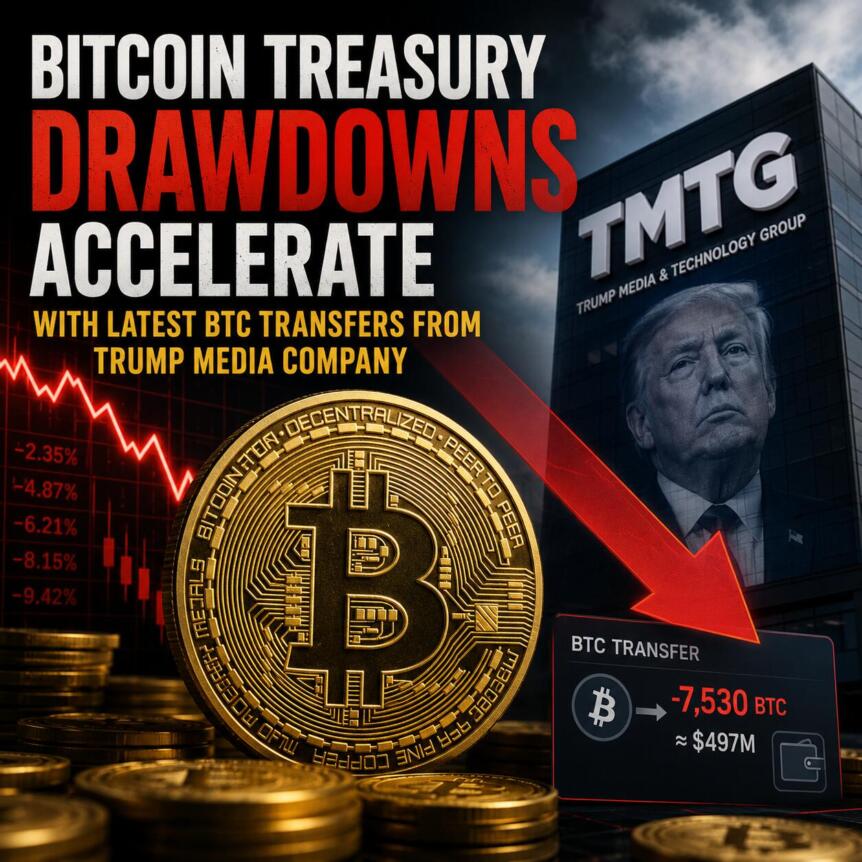
- A recent report suggests that Trump Media has transferred around 4,600 BTC to wallet addresses connected with Crypto.com
- The drawdowns associated with the company’s Bitcoin treasuries are reported at around $455 million
- Traders are closely watching exchange inflows for any large Bitcoin transfer activity
Trump Media BTC Moves Raise Market Speculations
The fears related to treasuries have risen after news that Trump Media & Technology Group conducted transfers of thousands of BTC within several trading sessions. Blockchain monitoring detected a second move of 2,650 BTC, about $205 million, with destination wallets allegedly connected to Crypto.com.
According to recent data, the number of recent Bitcoin moves linked to Trump Media reached more than 4,600 BTC. Exchange-linked transactions can raise increased interest from institutional investors since such movements may indicate the company’s desire to manage liquidity or conduct other operations.
As soon as news about the transfer became available, market experts debated the general picture. Although blockchain information cannot be considered conclusive evidence of a decision to sell, any transfer of treasury funds to exchange-linked wallets puts market participants on alert during times of heightened volatility.
At the same time, such transactions revived discussion about the dangers of having large BTC holdings on a public company’s balance sheet, especially when acquisitions were made during periods of high valuations.
Bitcoin Losses Not Realized Exceeding $455M
According to reports, Trump Media invested in about 11,542 Bitcoins, paying roughly $1.37 billion to acquire them. On average, the price per Bitcoin is estimated at about $118,522, putting the company in a difficult position as prices have fallen relative to that level.
The unrealized loss on its treasury is said to be near $455 million. The decrease in valuation shows the problems many companies face by holding significant amounts of Bitcoin during periods of macroeconomic and crypto-market volatility.
During a downturn, investors tend to question publicly traded companies’ decisions to hold Bitcoin. Concerns focus on liquidity risk, the soundness of the balance sheet, and treasury exposure, because losses can continue to grow.
The case also highlights the disparity between companies that were early adopters of treasury Bitcoin and firms that entered the market when valuations were relatively high.
Bitcoin Transfers To Exchanges Spark Trading Caution
When large Bitcoin transfers occur into exchanges, they usually affect short-term market psychology, as many people associate such transfers with selling activity or collateral adjustments. For this reason, blockchain trackers remain important for understanding institutional behavior and treasury management.
Trump Media’s Bitcoin treasury topic is also associated with politics: some visual representations of blockchain reports included Donald Trump next to figures of the company’s Bitcoin holdings, which raised further interest.
Institutional Bitcoin strategies now affect shareholders’ confidence, public opinion, and market narratives about corporate involvement with cryptocurrency. Public interest in treasury-based blockchain transactions has increased significantly compared with previous market cycles.
Although speculation has mounted, experts say transfers between wallets are common in corporate treasuries. Companies often move funds for security or operational reasons. Traders will continue to watch corporate wallet activity for confirmation of intent.
Bitcoin Treasury Policies Under Pressure
Recent trends highlight how quickly the bullish narrative around corporate Bitcoin holdings can turn into accounting concerns during turbulent markets. As more listed firms increase cryptocurrency holdings, strategies for managing these positions become more sensitive to investor sentiment and macro risks.
Market participants are watching for any new flows to exchanges in the coming weeks. Future blockchain transactions and any official company announcements will determine whether recent transfers were merely restructuring activities.


Cathie Wood has raised her long-term Bitcoin forecast to as high as $1.25 million, even as the cryptocurrency trades below key resistance levels during another period of macro uncertainty.
Summary
- Cathie Wood raised ARK Invest’s five-year Bitcoin target to $750,000 in its base case and $1.25 million in its bull-case scenario.
- ARK Invest’s Big Ideas 2026 report projected Bitcoin’s market capitalization could grow from $2 trillion to $16 trillion by 2030.
- Bitcoin traded near $77,000 as ETF outflows, Fed rate concerns, and U.S.-Iran tensions continued pressuring crypto markets.
Speaking in a recent interview with Fox Business, the ARK Invest chief executive said institutional demand continues to support the firm’s long-term outlook for Bitcoin. Wood stated that ARK Invest now sees a base-case Bitcoin target of $750,000 over the next five years, while its bull-case scenario projects prices climbing to $1.25 million.
According to Wood, pension funds, asset managers, and corporations are still in the early stages of allocating capital to Bitcoin. She described the cryptocurrency as a new asset class that institutional investors can no longer ignore if they want to improve long-term portfolio returns.
At the same time, Bitcoin remains stuck near the $77,000 range after several failed attempts to reclaim the $80,000 psychological level. Data from crypto.news showed Bitcoin (BTC) price was trading at roughly $77,149 on Tuesday, moving sideways over the past 24 hours. Intraday trading ranged between $76,451 and $77,998, while daily volume also slipped slightly.
Meanwhile, Wood argued that Bitcoin could continue taking market share from gold as younger investors inherit wealth over the coming decades. She also said the asset may gain traction in emerging economies where inflation, corruption, and currency instability continue to pressure local financial systems.
ARK Invest ties Bitcoin forecast to institutional adoption
As crypto.news reported earlier, fresh projections from ARK Invest’s Big Ideas 2026 report offer more detail behind the company’s aggressive Bitcoin outlook. According to figures cited by Forbes, the report estimates Bitcoin’s market capitalization could expand from roughly $2 trillion today to nearly $16 trillion by 2030.
The report also projects annual compound growth of about 63% during the remainder of the decade. ARK Invest attributed the forecast to several factors, including spot Bitcoin ETF demand, corporate treasury adoption, nation-state reserves, and Bitcoin’s use as settlement collateral across financial markets.
Beyond Bitcoin, ARK Invest predicted the wider digital asset sector could grow from around $2.8 trillion to nearly $28 trillion by 2030. The report named Bitcoin, Ethereum, and Solana as the dominant networks expected to capture most of that expansion.
Recent trading activity from ARK Invest has also reinforced the firm’s crypto-focused strategy. Earlier this month, the investment company purchased about $4.4 million worth of shares in Bullish after the exchange operator’s stock declined for five straight trading sessions before rebounding slightly.
Market reports showed ARK Invest added Bullish shares across its ARK Innovation ETF, ARK Next Generation Internet ETF, and ARK Fintech Innovation ETF products over two trading days.
Bitcoin faces pressure from geopolitics and Fed concerns
Despite Wood’s optimistic forecast, several market risks continue to weigh on Bitcoin in the short term. According to a May 26 report from The New York Times, investors remain cautious after the latest self-defense strikes linked to the ongoing U.S.-Iran conflict added fresh volatility across global markets.
Spot Bitcoin ETF outflows have also continued to pressure sentiment. At the same time, traders are closely watching the Federal Reserve after speculation grew that incoming Fed Chair Kevin Warsh could support additional rate hikes during his first policy meetings.
Elsewhere, some crypto investors continue to maintain longer-term bullish targets similar to Wood’s outlook. Public figures, including Robert Kiyosaki, Arthur Hayes, and Brian Armstrong, have previously discussed scenarios where Bitcoin could eventually reach the $1 million level during a future market cycle.
Meanwhile, Anthony Scaramucci recently told investors he still expects Bitcoin to rally later in 2026 if the traditional four-year crypto cycle remains intact.

TLDR
- The Digital Chamber rejected Sen. Elizabeth Warren’s claim that crypto trust charter approvals were improper.
- The group said Warren misread the National Bank Act and the OCC’s charter authority.
- Warren argued that firms like Ripple, Circle, Paxos, BitGo, Fidelity, and Coinbase face weaker standards.
- The Digital Chamber said federally regulated trust banks would not accept cash deposits or issue loans.
- Cody Carbone said the OCC should use its charter powers as Congress advances stablecoin regulation.
Crypto industry group The Digital Chamber has pushed back against Sen. Elizabeth Warren’s claim that digital asset firms received improper national trust charter approvals from the Office of the Comptroller of the Currency.
According to The Digital Chamber, Sen. Warren’s criticism misreads the National Bank Act and the OCC’s authority to approve national trust charters for crypto firms. The group made the argument in a Tuesday letter to Comptroller of the Currency Jonathan Gould.
The response followed Warren’s letter to the OCC last week, where she said approvals involving Ripple, Circle, Paxos, Fidelity Digital Assets, BitGo, and Coinbase appeared to violate the National Bank Act. Warren also argued that the firms were not being held to the same standards as traditional banks.
The Digital Chamber, which says it represents more than 250 crypto-related entities, rejected that view. In the letter, CEO Cody Carbone said Warren’s description of the approvals as “apparent violations” misread both the statute and the OCC’s long-running charter powers.
The Digital Chamber Defends OCC Charter Authority
Carbone told the OCC that national trust charters fall within the agency’s existing legal powers. According to The Digital Chamber, the approvals do not create full-service banks and do not allow the firms to take cash deposits or issue loans.
The group said the firms would instead operate as federally regulated trust banks if they receive final approval. Under that structure, they would be allowed to custody customer assets while remaining outside the business model of deposit-taking commercial banks.
Warren’s letter argued that the recently approved digital asset firms were attempting to use the charter process in a way that conflicts with the National Bank Act. She also said the companies appeared to have organized their applications after Congress passed stablecoin legislation last summer.
The law cited by Warren is the Guiding and Establishing National Innovation for U.S. Stablecoins Act, known as the GENIUS Act. According to Warren, that law does not change the requirements of the National Bank Act or remove the OCC’s duty to apply banking standards.
Carbone rejected that argument in his response. He said it would be inconsistent for Congress to create a federal framework for stablecoin issuers while the OCC refused to use its charter authority for firms seeking federal oversight.
Stablecoin Rules Add Pressure To Charter Debate
The dispute comes as crypto firms continue to seek federal recognition through the OCC. Ripple, Circle, BitGo, Fidelity Digital Assets, and Paxos received conditional approvals last year, according to the report.
Those approvals remain conditional, meaning the firms still need final clearance before operating under the trust-bank structure. If finalized, the charters would give the companies a federal pathway for custody services but would not place them in the same category as traditional banks that accept deposits and make loans.
Warren has framed the issue as a financial-stability concern. In her letter, she warned that the OCC’s approvals could expose the banking system to risks if crypto firms receive federal charters without meeting bank-like requirements.
The Digital Chamber framed the matter differently. The group said the OCC’s trust-charter process gives regulators direct oversight of digital asset firms instead of leaving them outside the federal banking framework.
At the same time, the charter dispute has unfolded alongside other points of tension between banks, lawmakers, and crypto firms. The treatment of stablecoin rewards was one of the issues debated during work on crypto legislation, though lawmakers later resolved that dispute as the bill advanced.

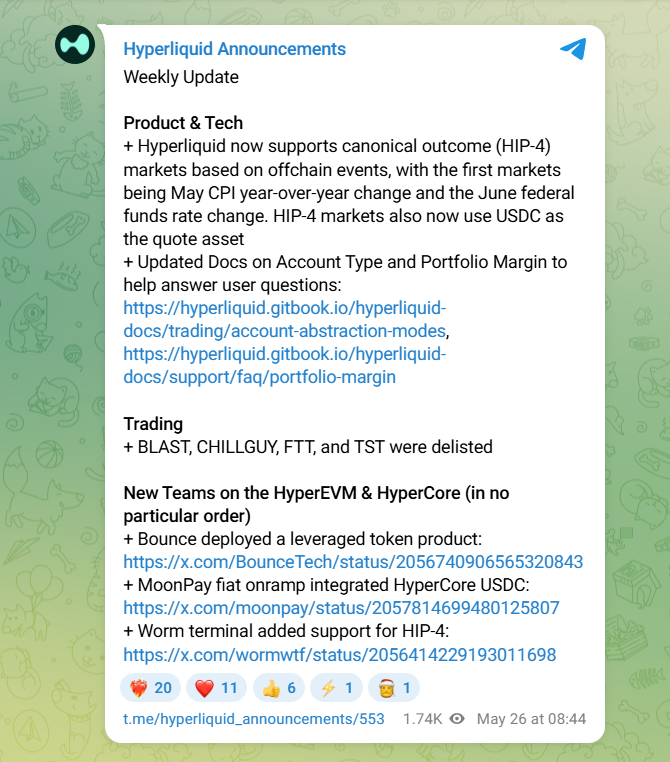
Decentralized exchange (DEX) Hyperliquid launched canonical prediction markets for offchain events, as the platform starts expanding beyond perpetual futures.
Validators run automated newsfeed software that publishes the markets and votes on deployment and settlement, Hyperliquid said in a Monday Telegram post.
The markets are built on Hyperliquid’s HIP-4 and use Circle’s USDC (USDC) as the quote asset. Hyperliquid said the first markets will open based on the May Consumer Price Index (CPI) year-over-year change and the June federal funds rate decision.
The launch puts prediction markets inside Hyperliquid’s existing trading stack, allowing users to trade event outcomes alongside spot and perpetual futures rather than moving collateral to a separate platform.
The rollout adds weight to a thesis advanced by Delphi Digital that Hyperliquid is evolving from a perp DEX into a broader onchain financial venue.
“What’s different now is that the stack is finally mature enough for true crypto superapps (aggregated giants) to exist without being limited to the wallet form factor,” Delphi said in a December research report.
The HYPE token’s price soared by 20% when Hyperliquid first announced plans to launch prediction market functionalities, Cointelegraph reported in February.
Hyperliquid announces the launch of canonical prediction markets. Source: Hyperliquid Telegram Channel
Is Hyperliquid crypto’s next “super-app”?
Hyperliquid’s expanding functionalities are making it the crypto industry’s next “super-app,” according to Matt Hougan, chief investment officer at crypto asset manager Bitwise. He wrote in a May 19 report:
“Hyperliquid has become the ‘super-app’ Atkins envisioned—a ‘non-SEC regulated platform’ offering investors exposure to “a variety of asset classes.”
Hougan added that the Hyperliquid (HYPE) token is “one of the most mispriced assets in crypto today,” despite outperforming the wider crypto market since the start of 2026. He argued that investors are mispricing it, valuing it only as a perp DEX rather than a financial “super-app.”
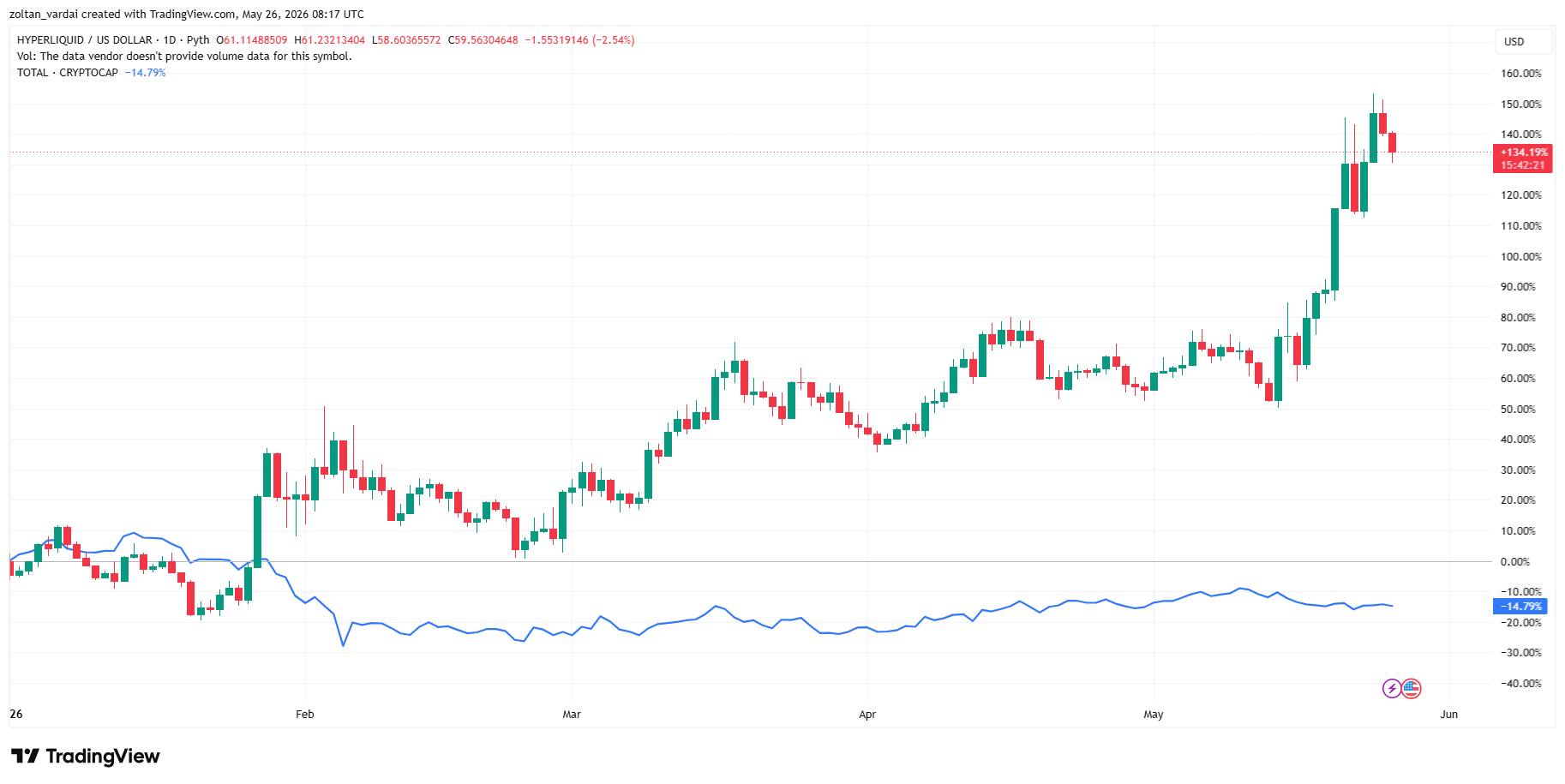
HYPE & Total Crypto Market Capitalization, year-to-date chart for 2026. Source: Cointelegraph/TradingView
Since the beginning of the year, the HYPE rose more than 134% while the total crypto market capitalization fell by around 14%, TradingView data shows.
Related: Polymarket team says user funds safe as exploit losses climb above $600K
Hyperliquid is currently the fifth-largest protocol by weekly fees and generated over $11 million in fees during the past week, according to DefiLlama data.
In the month leading up to May 10, Hyperliquid generated $50.95 million in revenue, all of which went directly to token holders with zero spent on incentives.
Magazine: The legal battle over who can claim DeFi’s stolen millions
Crypto World
Luffa secures strategic investment from GoFintech Quantum at US$220 million valuation, pioneering AI + fintech frontier

HONG KONG, May 26, 2026 — Luffa AI, a leading innovator at the intersection of Web3 and Artificial Intelligence, today announced a strategic equity investment from Hong Kong-listed GoFintech Quantum Innovation Limited (“GoFintech Quantum”, Stock Code: 00290.HK). The transaction values Luffa AI at US$220 million. The two parties will engage in deep strategic collaboration across artificial intelligence, quantum security, blockchain, and compliance fintech to jointly explore the new AI + Quantum Blockchain Fintech track.

The current internet is highly fragmented: identities are siloed and controlled by platforms, AI agents lack independent identities, wallets, and execution capabilities, value and payments are locked within closed ecosystems, and AI-generated content remains unverifiable with unclear compliance pathways. Luffa addresses these challenges through three core dimensions of super connectivity. In Community, it enables trusted DID-based self-sovereign identity, AI agent empowerment, and on-chain governance for true decentralized autonomy. In Content, channels become programmable and tradable value containers, supporting creator influence tokenization and multi-layered monetization. In Aggregation, the SuperBox open mini-app ecosystem, multi-chain wallets, LuffaPay intent-based payments, and multi-agent commercial protocols seamlessly connect applications across all scenarios. These three systems form a closed loop that bridges the critical gaps between users and identity, identity and assets, content and value, as well as online and offline experiences.
As of February 2026, Luffa’s ecosystem has achieved rapid growth, with over 3 million global downloads, 2 million registered users, and more than 150,000 daily active users. Its core products, Luffa Wallet and SuperBox Mini-App Platform, are now officially launched, with proven use cases in prediction markets, AI mini-games, RWA, creator economy, and community governance. In 2026, Luffa will focus on the AI-powered Web3 ecosystem to build a globally leading intelligent trading ecosystem.
This strategic investment represents a significant milestone for Luffa AI in advancing privacy-preserving infrastructure and intelligent interaction technologies. GoFintech Quantum has made multi-faceted deployments in quantum encryption algorithms and blockchain technology, with deep expertise in institutional financial services,GoFintech Quantum will provide strong technical backing for Luffa’s AI Agent infrastructure and privacy-secure communications, accelerating its global commercialization and ecosystem expansion.
Under the strategic cooperation framework, Luffa AI and GoFintech Quantum will collaborate globally in the following areas: joint research and development of AI-driven intelligent investment systems, on-chain financial automation platforms, and smart trading & risk management solutions; exploration of blockchain applications and digital asset compliance frameworks; development of RegTech solutions compliant with Hong Kong and international standards; advancement of quantum encryption for digital asset security and blockchain scenarios.
Michael Liu, CEO of Luffa AI, commented:
“Luffa is redefining interaction in entertainment, culture, and commerce, giving users genuine ownership, privacy, and direct governance over the platform. GoFintech Quantum’s profound capabilities in quantum financial security and cross-border compliance will provide a solid foundation for building the next generation of social and AI Agent infrastructure. Together, we are moving from imagining a better web to actively creating it.”
“We are thrilled to finalize our strategic investment in Luffa AI,” said Tianfu Yuan, CEO of GoFintech Quantum. “This is more than a milestone for our innovation-driven strategy; it is a pivotal step in exploring the convergence of quantum technology with AI and Web3. We look forward to working closely with the Luffa team to build a more secure and intelligent digital infrastructure.”
About Luffa
Luffa is a groundbreaking Web3 and AI super connector that integrates decentralized identity (DID), AI agents, Web3-native wallets, social features, and mini-programs into a unified ecosystem. It empowers users to create channels, mini-programs, and AI bots, delivering a seamless one-stop experience. Empowering individuals, communities, brands, and AI developers alike, Luffa offers a verifiable behavior system, programmable economic models, and a secure interaction environment, with support for agent-driven transactions, loyalty program deployment, and decentralized collaboration. Luffa is committed to turning attention into ownership and connections into business opportunities.
About GoFitech Quantum Innovation Limited (00290.HK)
GoFintech Quantum Innovation Limited (00290.HK) is a cross-border, cross-industry technology innovation investment platform based in Hong Kong, backed by the Greater Bay Area, and globally oriented. It holds SFC Type 1, 4, 6, 9 licenses and cross-border qualifications including QFII, CIBM, QDIE, QFLP, and Bond Connect. The Group has built a closed-loop ecosystem across four business segments: Technology Innovation, Finance, Art, and Trade. With strategic deployments in quantum technology and digital assets, it drives a model where investment powers investment banking and innovation feeds back into traditional businesses, aiming to become a global leader in quantum technology applications.
Media contact:


Swiss blockchain firm The Hashgraph Group has launched BrandBoost on Hedera, introducing tokenized loyalty rewards and real-time customer engagement tools for enterprises.
Summary
- The Hashgraph Group has launched BrandBoost on Hedera to help enterprises create tokenized loyalty rewards and real-time customer engagement systems.
- BrandBoost combines gamification, digital collectibles, self-custody wallets, and identity verification tools for sectors including sports, media, entertainment, and telecom.
According to an announcement shared with crypto.news, the new software-as-a-service platform targets enterprises looking to move beyond traditional loyalty systems built around static points and membership cards.
The company said BrandBoost combines gamification tools, tokenized incentives, digital collectibles, and AI-driven consumer analytics to create what it described as a more interactive loyalty experience.
At a time when brands are competing for repeat consumer attention across online platforms, retail stores, sports venues, entertainment events, and connected devices, The Hashgraph Group said businesses increasingly need systems that can respond to customer behaviour instantly instead of relying on delayed reward mechanisms after purchases are completed.
Data cited by the company from Deloitte’s 2025 customer loyalty research showed that 72% of consumers said loyalty programs make them more likely to spend with preferred brands, while 56% said such programs increase how much they spend.
Deloitte’s research also found that only 51% of respondents actively engage with more than one loyalty program, a figure The Hashgraph Group used to highlight competition among brands for sustained customer engagement.
THG expands Hedera enterprise products
Built on Hedera’s distributed ledger infrastructure, BrandBoost integrates THG’s AssetGuard wallet system and its IDTrust self-sovereign identity platform to support what the company described as secure and verifiable consumer interactions.
Through an integrated token studio, businesses can create branded loyalty tokens that users can earn, redeem, trade, or spend through self-custody wallets.
Stefan Deiss, co-founder and chief executive officer of The Hashgraph Group, said loyalty programs are moving toward live digital engagement systems rather than traditional points-based structures.
“Loyalty programs are no longer just about points and rewards, but about creating live engagement ecosystems where consumers interact with brands in ways that feel immediate, relevant, and personalised,” Deiss said in the announcement.
“With BrandBoost, we are enabling businesses to interact and transact with consumers in real-time, while unlocking new monetisation and revenue models through loyalty gamification models.”
The rollout adds to The Hashgraph Group’s growing portfolio of enterprise-focused Hedera products.
Back in September 2025, the company launched TransAct, a managed transaction gateway that allowed enterprises and government institutions to execute Hedera transactions without directly holding HBAR or managing crypto wallets.
At the time, Deiss said TransAct was designed to remove operational and compliance barriers that had slowed enterprise blockchain adoption by abstracting wallet management, gas fees, and crypto accounting requirements behind a traditional invoicing structure.
Separately, The Hashgraph Group also participated in Switzerland’s municipal blockchain biodiversity voucher initiative launched earlier this year in Muri bei Bern. The project introduced tokenized biodiversity reward vouchers on Hedera that residents could redeem for Swiss francs at local businesses after participating in environmental conservation work.
Within the BrandBoost launch, The Hashgraph Group said the platform can be deployed across sectors including sports, media, entertainment, and telecommunications, where companies are looking for tools to reduce subscriber churn and improve audience participation through tokenized incentives and real-time engagement systems.
Truesense partnership adds location verification layer
Alongside the platform launch, THG announced a strategic collaboration with Truesense to integrate ultra-wideband, or UWB, technology into BrandBoost. According to the company, the integration allows brands to verify physical attendance and user location with centimetre-level accuracy during events and gamified campaigns.
Armando Caltabiano, co-founder and chief executive officer of Truesense, said the partnership would support new monetization systems tied to consumer participation while also helping reduce fraud and account-sharing abuse.
The two companies said they recently completed a proof-of-concept deployment with a Latin American satellite television provider, where BrandBoost was tested alongside UWB-enabled USB-TV dongles developed by Truesense to support audience engagement and content monetization.
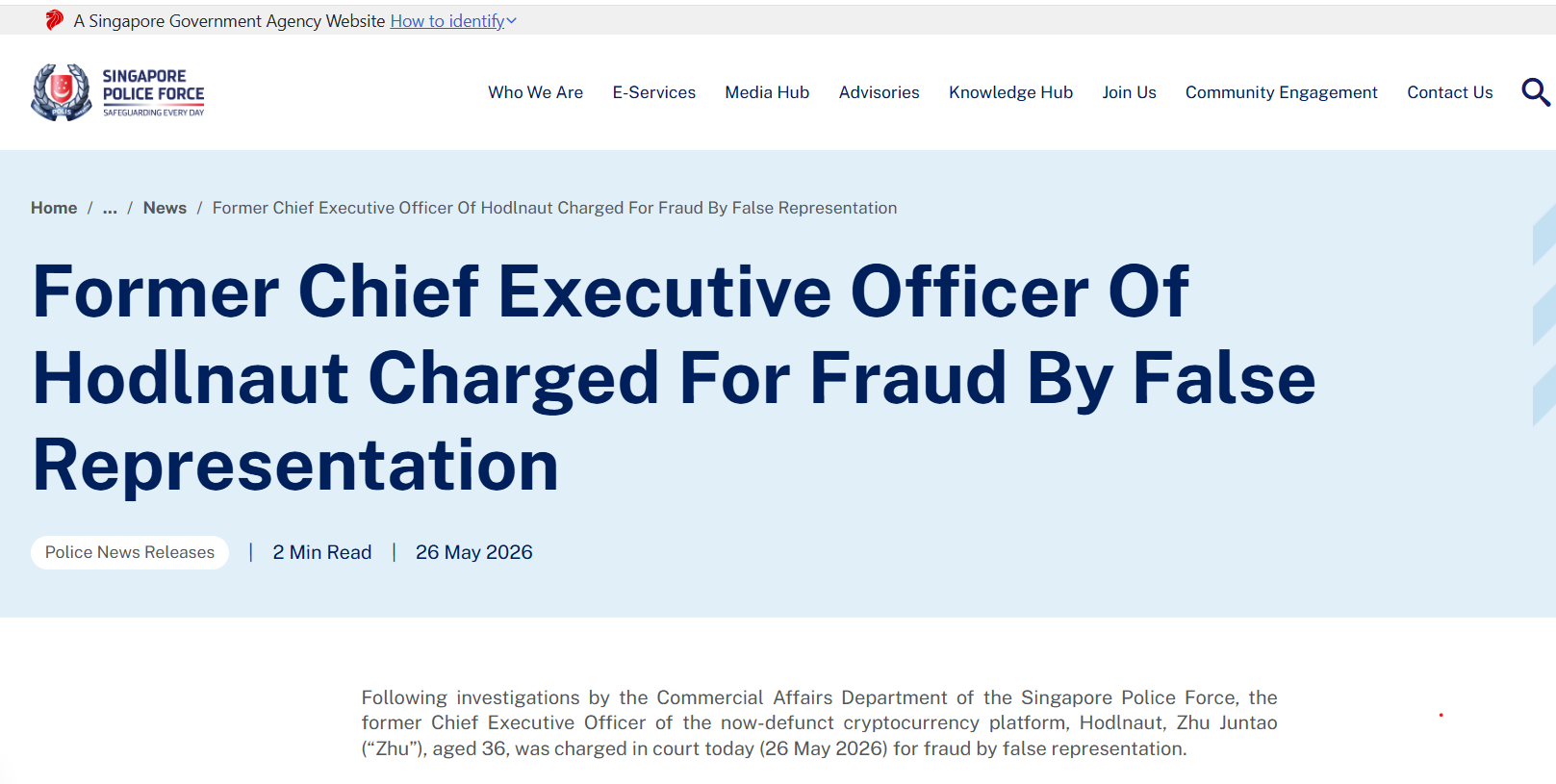
Former Hodlnaut CEO Zhu Juntao was charged in Singapore with six counts of fraud by false representation, in a case tied to statements Zhu and Hodlnaut employees allegedly made after the 2022 collapse of the Terra ecosystem.
Singapore Police said Zhu, 36, was charged following an investigation by the Commercial Affairs Department and faces three charges under Section 424A(1)(a) read with Section 424A(3) of the Penal Code 1871, as well as three further charges under the same provision read with Section 109.
The case centers on alleged false claims about Hodlnaut’s exposure to the TerraUSD (UST) crash, including accusations that Zhu directed staff to issue some of the statements.
Police said Zhu allegedly instigated Hodlnaut employees to make misleading statements in the company’s official Telegram group and in emails sent to some users between May and July 2022, asserting that the platform did not have direct exposure to UST and had not suffered losses from its crash.
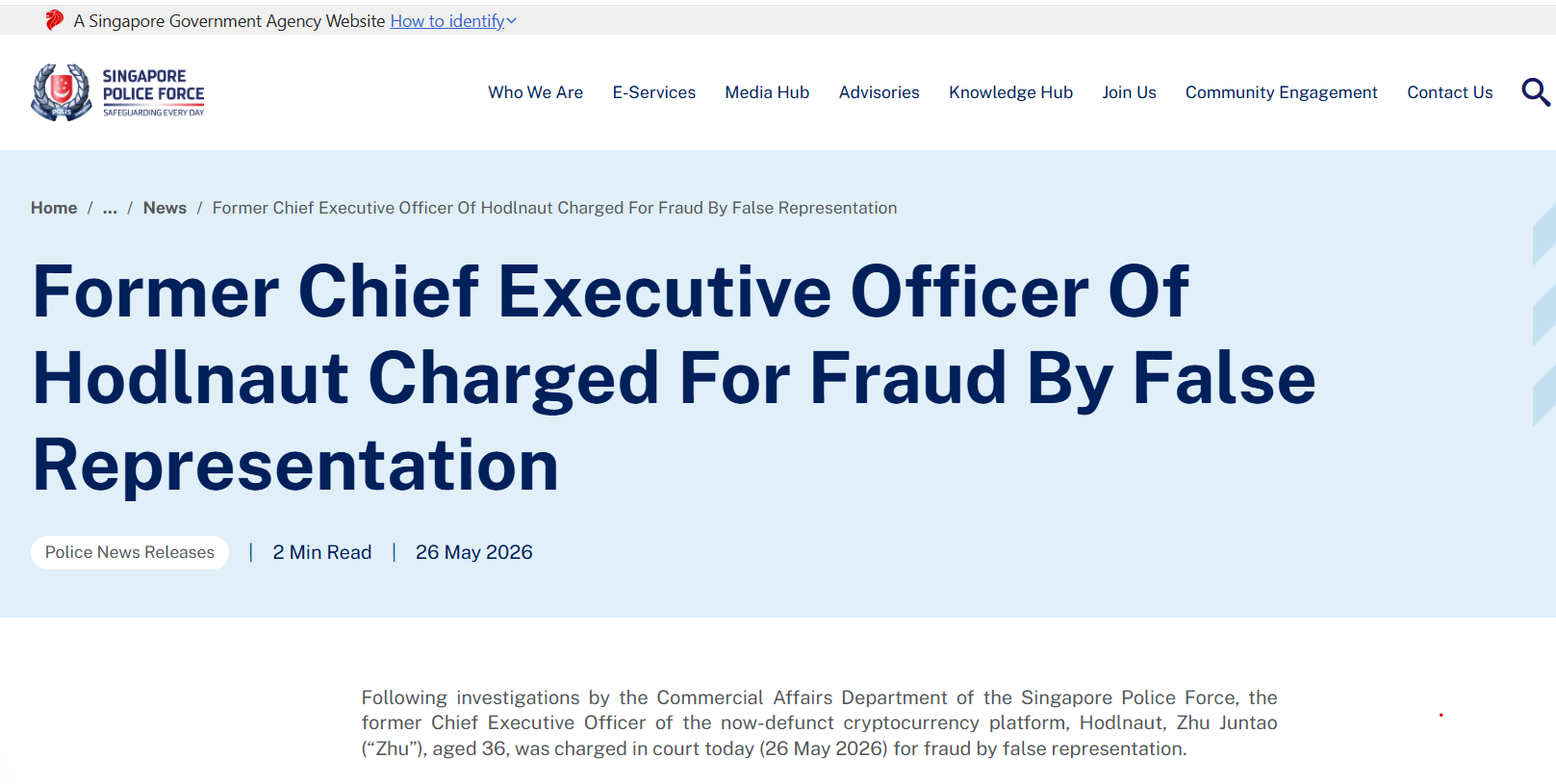
Singapore Police Force charges former Hodlnaut chief executive Zhu Juntao. Source: Singapore Police Force
The police statement also said Zhu published three similar posts on his personal Twitter account, now known as X, in June 2022. If convicted, he faces up to 20 years in prison, a fine, or both, on each charge.
Related: Singapore revokes crypto payment license of Bsquared over regulatory breaches
The charges revive scrutiny of one of the most damaging episodes in the 2022 digital asset market rout. The Terra ecosystem imploded in May 2022 when its algorithmic stablecoin UST lost its dollar peg, wiping out approximately $50 billion in market value and helping trigger broader failures across the crypto lending sector.
Hodlnaut’s collapse and liquidation
Hodlnaut, a Singapore-based crypto platform that allowed users to deposit tokens for yield, had more than 30,000 users worldwide before it became defunct in August 2022 due to financial difficulties, according to police.
The company halted withdrawals in August 2022, and its website now says its affairs, business and property are being managed by court-appointed liquidators.
Other crypto lenders, including Celsius Network and Voyager Digital, also fell into bankruptcy in 2022 amid the Terra fallout and a wider market slump, leaving hundreds of thousands of customers with frozen funds.
Celsius reported more than $10 billion in assets before its collapse, while Voyager’s Chapter 11 filing listed between $1 billion and $10 billion in assets and liabilities.
Cointelegraph reached out to Hodlnaut’s court-appointed liquidators, but they did not immediately respond to a request for comment.
Magazine: AI-driven hacks could kill DeFi — unless projects act now

Lancashire drugs gang caged for over 52 years

Diamond Hill International Fund Q1 2026 Commentary (DHIIX)

Coinbase, Armstrong help build $85m crypto election war chest


-

 Crypto World5 days ago
Blockchain.com files with SEC for U.S. IPO
-

 Fashion4 days ago
Holiday Weekend Open Thread – Corporette.com
-

 Business5 days ago
Dell Technologies DELL Stock Surges 15% on AI Server Momentum and Analyst Upgrades in 2026
-

 Crypto World5 days ago
Bitcoin Accumulation Weakens as BTC Realized Losses Hit $600M
-

 Crypto World4 days ago
Robinhood crypto COO Tanya Denisova exits
-

 Crypto World5 days ago
Space X IPO Is ‘Bad News’ for Tech Stocks: But What About Bitcoin?
-

 Politics4 days ago
Makerfield: a tale of two social-media histories
-

 Business2 days ago
NYT Strands Answers May 24 2026 Revealed for Puzzle No. 812 Theme Summer Essentials
-

 Tech2 days ago
Microsoft’s quiet Claude Code retreat and the real cost of enterprise AI
-
 Crypto World5 days ago
MicroStrategy’s Saylor Says Miners No Longer Set Bitcoin Price, Another Force Has Taken Over
-

 Tech5 days ago
WhatsApp ads could make Irish debut after discussions with DPC
-

 Crypto World5 days ago
AI infrastructure race heats up as IREN pitches full-stack strategy, WhiteFiber lands $160M deal
-
 Tech5 days ago
A 0.12% parameter add-on gives AI agents the working memory RAG can’t
-

 Tech5 days ago
You Can Now Add ChatGPT To PowerPoint
-
 Crypto World2 days ago
Nvidia (NVDA) CEO Calls on Super Micro to Strengthen Export Controls Amid Smuggling Probe
-
 NewsBeat6 days ago
Charity run by Reform leader Malcolm Offord accused of ‘law breaking’ over Scottish registration
-

 Business5 days ago
Trump Invests $1M-$5M in Kura Sushi USA Chain With 27 California Locations
-

 Tech2 days ago
Westone Audio and Etymotic Acquired by Fidelity Collective in Major IEM Market Move
-

 Sports5 days ago
2026 CJ Cup Byron Nelson leaderboard: Brooks Koepka finds putting stroke in Round 1
-

 Crypto World6 days ago
Exa Labs raises $250 million in funding led by a16z
You must be logged in to post a comment Login