
Crypto World
XRP Ledger order-book volume jumps 79% as traders fall



XRP Ledger order-book volume has increased 79% year over year in the second quarter of 2026, even as the number of daily trading accounts has fallen 40%, according to Evernorth.
Summary
- XRPL order-book volume averaged 3.57 million XRP per day, up 79% from Q2 2025.
- Daily order-book traders fell from 1,864 to 1,111, while average volume per account nearly tripled.
- Average RLUSD balances on XRPL rose 642% year over year to $539 million.
- Value held on the ledger reached a quarterly average of $4.26 billion.
Evernorth’s Q2 2026 XRP Liquidity Report showed that fewer accounts were responsible for heavier trading activity during the three months through June, creating a more concentrated market even as the amount of value held on the network continued to rise.
Order-book activity averaged 3.57 million XRP per day during the quarter, compared with about 1.99 million XRP a year earlier. Daily accounts initiating order-book trades declined from 1,864 to 1,111 over the same period, leaving each participating account to trade an average of 3,217 XRP per day.
A year earlier, the average account traded 1,072 XRP daily. Evernorth’s figures therefore put the increase in volume per trader at close to threefold, indicating that larger orders offset the drop in the number of active participants.
XRP Ledger trading has become more concentrated
Total decentralized exchange volume on the XRP Ledger averaged 4.42 million XRP per day in Q2, about 20% above the same quarter in 2025, the report said. Order books accounted for 81% of that activity, up from 54% a year earlier.
Compared with the first quarter of 2026, however, total trading volume decreased by 16%. Evernorth described Q1 as an unusually active period, making the yearly and quarterly comparisons important when assessing whether the second-quarter pace can continue.
Average daily trading accounts across the XRP Ledger DEX fell to about 2,435, while order-book accounts recorded a steeper 40% decline. The report did not identify individual traders or determine how much of the remaining activity came from institutions, market makers, or automated strategies.
Institution-focused infrastructure may have contributed to the concentration, according to Evernorth, after permissioned domains and permissioned trading features became available in February. Such tools allow approved participants to transact within controlled environments, although the report did not assign a specific portion of Q2 volume to those venues.
The reduced account count also extended beyond trading. Daily transacting accounts averaged 16,587, while new accounts averaged 2,783 per day, with both measures down about 25% year over year.
Evernorth compared the decline with weaker activity across other crypto networks. According to the report, on-chain exchange volume across seven major programmable networks fell 46% from the previous year, while transaction fees paid on Ethereum, BNB Chain, Base, Arbitrum, Polygon, Optimism and Avalanche collectively dropped 38%.
Account counts are among the report’s most retail-sensitive measures, Evernorth said. The simultaneous decline across multiple chains therefore placed XRPL’s lower participation within a marketwide contraction in trading rather than attributing it solely to conditions on the ledger.
RLUSD liquidity has accelerated on XRPL
Ripple USD activity produced one of the quarter’s largest yearly increases. Evernorth found that average RLUSD balances on the XRP Ledger reached $539 million, rising 642% from $73 million in Q2 2025.
Value moved through RLUSD increased 925% over the same period, while the XRP Ledger’s share of the stablecoin’s total supply grew from 20% to 34%. The report measured quarterly averages, meaning its $539 million balance figure differs from later point-in-time supply readings.
By the end of June, RLUSD supply on XRPL had reached about $676.9 million. The stablecoin continued expanding after the reporting period and passed $1 billion in circulating supply on the ledger on Aug. 28, when it represented about 82% of XRPL’s stablecoin market.
Ripple’s stablecoin also crossed $2 billion in total market value across supported networks in late August, less than two years after its December 2024 launch. As crypto.news previously reported, around $963 million was issued on XRPL, and approximately $1.05 billion was held on Ethereum when the total passed that level.
Because RLUSD seeks to maintain a value of $1, increases in its market capitalization mainly represent additional issuance rather than token price gains. Ripple reported $1.98 billion in reserve assets against $1.87 billion in circulation as of Aug. 20, with monthly independent attestations prepared by Deloitte.
Earlier in 2026, Evernorth reported that RLUSD pairs had generated more than $2.5 billion in XRPL trading activity since launch. The RLUSD/XRP pair contributed about $900 million over six months, while the stablecoin’s share of on-chain trading increased from below 1% to about 12%.
The earlier liquidity findings also placed monthly RLUSD trading transactions near 1 million. Each transfer or trade settling natively on XRPL requires network fees paid in XRP, although transaction activity does not automatically show how much lasting demand it creates for the token.
During Q2, RLUSD also expanded through Wormhole’s Native Token Transfers system to Base, Optimism, Ink, Unichain and the XRPL EVM sidechain. Ripple already supported the stablecoin natively on XRPL and Ethereum.
Value held on XRPL has reached a quarterly record
Average value held on the XRP Ledger rose to $4.26 billion during Q2, according to Evernorth, setting the highest quarterly reading in the report’s series. Six quarters earlier, the comparable figure stood at $99 million.
The measure increased in every quarter across that period, even when trading participation weakened. It includes value represented by issued assets on the ledger and is separate from XRP’s total market capitalization, which tracks the circulating token supply multiplied by its market price.
Tokenized assets and stablecoins contributed to the increase. A portion of a tokenized U.S. Treasury fund also completed its on-ledger asset settlement in under five seconds during the quarter, although the reported timing covered the blockchain leg rather than the entire banking and payment process.
RLUSD’s growth formed a large part of the asset increase, while XRP produced a strong market move after Q2 ended. The token gained about 37% in August, rising from a 2026 low of $0.9874 on Aug. 15 to a six-month high of $1.6963 on Aug. 22 before moving back into the $1.35 to $1.50 range near month-end.
U.S.-listed spot XRP exchange-traded funds recorded $110.49 million in net inflows during the week ending Aug. 28, their highest weekly total of 2026. Seven funds had accumulated more than $1.66 billion in net inflows by that point, while combined August trading volume reached $723 million.
Evernorth’s U.S. listing ties the data to public investors
Evernorth’s report also carries relevance for U.S. investors because the Ripple-backed company is seeking to become a publicly traded XRP treasury business through a merger with Armada Acquisition Corp. II.
Under an amended SEC registration, the proposed company expects to list on Nasdaq under the ticker XRPN if the transaction closes. Investor commitments exceed $1 billion and include Ripple, SBI Holdings, Pantera Capital, Kraken, and Arrington Capital.
Evernorth previously disclosed $387.1 million in XRP holdings, while Ripple contributed more than 126.7 million XRP to the treasury plan. The company has also said it plans to operate XRPL validators, use RLUSD in institutional decentralized finance services, and support tokenized real-world assets.
The SEC must declare the registration statement effective before Armada Acquisition Corp. II shareholders can vote on the business combination. The filing remained under SEC staff review, with the regulator providing comments on the proposed transaction.


Wyoming has moved Frontier Stable Token (FRNT) reserve reporting closer to real time, expanding its use of Chainlink infrastructure for onchain proof of reserves. The Wyoming Stable Token Commission said it adopted Chainlink Proof of Reserve to publish verified information about FRNT’s reserves and token supply on the blockchain.
Under the update, verified reserve data will be made available onchain using a setup that combines independent examinations by The Network Firm with Chainlink’s Proof of Reserve tooling, aiming to improve how quickly users can see changes in backing between reporting cycles.
Key takeaways
- Wyoming’s commission adopted Chainlink Proof of Reserve to publish verified FRNT reserve and supply data onchain in near real time.
- FRNT already had daily reserve attestations; the integration is designed to make changes in backing visible faster than periodic disclosures alone.
- Wyoming’s GENIUS Act framework still includes monthly disclosure requirements for reserve composition and outstanding supply.
- The commission is also working on Chainlink Secure Mint, which would gate new FRNT minting on verified reserves being at least equal to total supply.
From daily attestations to near-real-time proof
The Frontier Stable Token’s reserve transparency framework has been evolving alongside Wyoming’s regulatory requirements. The Wyoming Stable Token Commission said it already publishes daily reserve attestations for FRNT, while the GENIUS Act requires monthly disclosures covering reserve composition and outstanding stablecoin supply.
The new Chainlink Proof of Reserve integration is meant to tighten that feedback loop. By publishing verified reserve and supply information via Chainlink infrastructure, the commission expects more timely visibility into when the composition and size of FRNT’s backing changes between formal disclosure windows.
In the model described by the commission, independent examinations by The Network Firm are incorporated into the onchain reporting process through Chainlink’s system—an architecture intended to increase confidence that the onchain figures reflect underlying reserve verification rather than relying solely on issuer-provided updates.
Secure Mint on the roadmap
Beyond reporting, the commission also flagged a further step it is working toward: adopting Chainlink’s Secure Mint feature. In its described form, Secure Mint would require verified reserves to equal or exceed FRNT’s total supply before additional tokens can be minted.
For investors and integrators, that matters because it shifts reserve coverage from being an after-the-fact disclosure exercise toward a mechanism that can constrain issuance in real time. While Wyoming did not state a specific timeline for when Secure Mint would be activated for FRNT, the direction is clear: make reserve adequacy a condition for minting rather than only a periodic compliance metric.
How FRNT is backed—and what income supports
FRNT, launched in January, is described as being backed by US dollars and short-term US Treasurys. The commission also said interest income generated from the reserves is deposited into Wyoming’s School Foundation Program.
That structure is relevant to why “proof of reserve” is particularly consequential for this token: the backing is intended to be held in highly liquid instruments, and near-real-time visibility into reserve levels and supply can help stakeholders assess whether the backing remains aligned with outstanding FRNT as it changes.
Wyoming’s broader Chainlink rollout
This Proof of Reserve expansion arrives shortly after Wyoming completed FRNT’s migration from LayerZero to Chainlink’s Cross-Chain Interoperability Protocol (CCIP), with CCIP becoming FRNT’s exclusive cross-chain infrastructure.
According to the commission, the cross-chain infrastructure switch took place roughly two weeks before the Proof of Reserve announcement. Together, the changes point to a broader consolidation of FRNT’s operational stack around Chainlink—both for transparency (reserve verification onchain) and for interoperability (cross-chain messaging via CCIP).
Chainlink’s institutional momentum
The update also fits into a broader pattern of Chainlink integrations across tokenized assets and regulated market infrastructure. In recent months, Chainlink has been used as a pricing-data provider for tokenized equities, participated in banking-group initiatives focused on stablecoin-based atomic foreign exchange settlement, and been referenced in plans for tokenized collateral management platforms.
The article cited several examples of Chainlink involvement, including that Chainlink became a pricing-data provider for Coinbase’s B20 tokenized equities on Base after their August launch, and that Chainlink joined Project Pangea—an initiative involving European and South Korean banking groups exploring euro- and won-denominated stablecoins for atomic FX settlement.
In addition, the report referenced work connected to the Depository Trust and Clearing Corporation (DTCC) for a planned 24/7 platform to manage tokenized collateral, and noted a tokenized liquidity fund launched by Fidelity International using Chainlink and Sygnum infrastructure with daily net asset value data provided by JPMorgan for pricing.
Market participants are also watching LINK, the native token of the Chainlink network. CoinGecko data referenced in the source indicates LINK gained more than 34% over the past month, trading around $11.07 as of Wednesday.
Next, FRNT holders and integrators will likely look for whether Wyoming proceeds with Chainlink Secure Mint in practice and how quickly Proof of Reserve data updates compared with the existing daily attestations and monthly GENIUS Act disclosures. The key question is whether the “near-real-time” verification meaningfully reduces the gap between reserve changes and public visibility—especially during periods of rapid minting or redemption.
Related reading: Charles Schwab adda Solana, Avalanche and Chainlink to nascent crypto platform.


Federal law enforcement officials, working with cybersecurity technology company CrowdStrike, announced action against entities behind malware that enabled the theft of $150,000 in cryptocurrency.
In a Tuesday notice, the US Justice Department said it had disrupted the Sality botnet and malware in an international effort with Bulgarian, Hungarian and Romanian officials, as well as private sector partners CrowdStrike and the Shadowserver Foundation. US officials said that Sality was responsible for installing malware on compromised devices since 2003, resulting in crypto theft and cyberattacks.
CrowdStrike reported that in the previous eight years, the entities behind Sality used EggJagger, a “clipjacking tool that monitors the clipboard for cryptocurrency wallet addresses and silently replaces them with addresses controlled by the operator,” to steal at least 12.1 million rubles, or about $150,000, in cryptocurrency. According to the company, the value of the “never-spent” digital assets peaked at about $1.5 million in January 2025.
“When a victim copies a Bitcoin or Ethereum address to make a payment, the funds are redirected,” said CrowdStrike, explaining the technique behind the theft.
According to CrowdStrike, the criminals behind Sality “lost the ability to communicate with infected machines” as a result of authorities’ efforts to disrupt the network. US officials and the company said Sality was used to steal crypto, while about 15,000 infected computers formed part of a peer-to-peer botnet that checked whether its systems were online every 40 minutes.
Related: A fake crypto job interview nearly installed malware on my computer

Coinbase has expanded its Canadian offering by launching crypto derivatives trading, including perpetual and dated futures linked to major digital assets such as Bitcoin, Ether, and Solana. The move gives eligible users access to a broader range of structured trading products through Coinbase’s regulated futures operation.
The launch is being delivered via Coinbase Financial Markets, a futures commission merchant registered with the U.S. Commodity Futures Trading Commission and operating in Canada under foreign dealer and futures commission merchant exemptions. Coinbase said the program includes 23 crypto perpetual and dated futures, five commodity futures, and exposure to the Coinbase 50 Index.
Key takeaways
- Coinbase is adding crypto derivatives in Canada, including perpetual and dated futures tied to Bitcoin, Ether, Solana, and other assets.
- The products are offered through Coinbase Financial Markets, using its U.S.-registered futures commission merchant framework with Canadian exemptions.
- Trading access is restricted to eligible Canadian customers, including those meeting a $5 million net financial assets threshold or qualifying for certain adviser/dealer arrangements.
- The contracts use nano-sized positions and provide leverage of up to 10x, making risk management central for participants.
- Coinbase’s launch follows other U.S.-linked platforms expanding in Canada, even as regulators tighten rules around parts of the crypto market.
What Coinbase is launching in Canada
Coinbase’s derivatives entry centers on futures contracts that allow traders to take directional or hedging positions without holding the underlying assets. According to the company, the Canadian lineup comprises 23 crypto perpetual and dated futures as well as five commodity futures and the Coinbase 50 Index.
The platform positions the offering as a first for “major crypto-native” exchanges in Canada to provide direct, native crypto futures. For Canadian users, availability is limited to qualifying customers, including those with at least $5 million in net financial assets, or those connected through registered investment advisers and dealers.
Coinbase also outlined contract design and trading mechanics: the futures use nano-sized positions and offer leverage of up to 10x. For retail and smaller professional accounts, leverage limits the margin of error—small price moves can quickly translate into gains or losses depending on position sizing and liquidation terms. Traders considering the product are likely to focus on margin requirements, contract specifications, and risk controls before entering.
How Coinbase’s step fits into a broader Canada push by U.S. platforms
Coinbase’s Canadian derivatives rollout arrives amid growing competition from U.S.-facing trading platforms that are already serving Canadian customers with crypto services. On Monday, Webull expanded crypto trading for Canadian users, citing its use of Coinbase’s infrastructure for both trading and custody.
That expansion added digital assets alongside Webull’s existing stocks, ETFs, and options offerings. Webull pointed to rising crypto adoption in Canada and said, according to Ontario Securities Commission research, crypto ownership has increased to 25% this year from 10% in 2023. The implication for Coinbase is clear: demand for crypto exposure in Canada is broadening beyond spot exchanges into more advanced trading venues.
Earlier in the year, Robinhood also entered Canada after completing a $180 million acquisition of WonderFi. The deal gave Robinhood control of Canadian exchanges Bitbuy and Coinsquare, bringing approximately 300,000 funded customers and WonderFi’s Canadian licenses and regulatory approvals under the Robinhood umbrella.
Taken together, these developments show that Canada has become a more attractive geography for companies seeking scale in crypto trading—spanning retail-style apps to institutional-grade derivatives providers. Coinbase’s derivatives launch extends that trend from spot and brokerage-style access into futures markets that are often used for hedging, basis trading, and structured exposure.
Regulatory pressure and market structure in Canada
While major trading platforms push into Canadian crypto markets, the regulatory picture is also evolving. Coinbase’s launch comes as Ottawa moves to tighten oversight on other parts of the ecosystem.
In April, Canada proposed banning crypto ATMs, pointing to concerns about scams and money laundering. Lawmakers also advanced legislation aimed at prohibiting cryptocurrency donations to political parties and candidates.
This juxtaposition—more product variety from large trading brands alongside tougher rules in areas viewed as high-risk—highlights the direction of travel for Canadian crypto policy. For investors and traders, it matters because regulation can shape which services are expanded, which customer segments are targeted, and how compliance requirements affect availability and liquidity.
Why derivatives access matters for Canadian traders
For participants, futures products can change how crypto exposure is managed. Perpetual futures are typically used for ongoing directional positions and sometimes for hedging, while dated futures introduce fixed expiry cycles that can align with investment horizons or corporate hedging needs.
The addition of nano-sized positions may lower the barrier to expressing smaller trade sizes compared with larger contract units, though leverage up to 10x still requires careful attention to liquidation risk. The most immediate practical impact for Canadian users is the ability to obtain crypto exposure through regulated derivatives rather than only via spot holdings or third-party structured products.
However, this also raises expectations around market quality. Derivatives markets depend on liquidity, order book depth, and consistent risk management across market makers and participants. Traders who adopt Coinbase’s futures offering will likely be watching bid-ask spreads, funding or roll behavior for perpetual products, and how executions perform during volatile market conditions.
Looking ahead, Coinbase’s success in Canada will likely hinge on both user demand for derivatives and the regulatory environment governing access, leverage limits, and product permissions. With Webull, Robinhood, and now Coinbase all broadening their Canadian crypto presence, market participants should watch for how contract specifications, customer eligibility rules, and liquidity develop as trading activity grows.
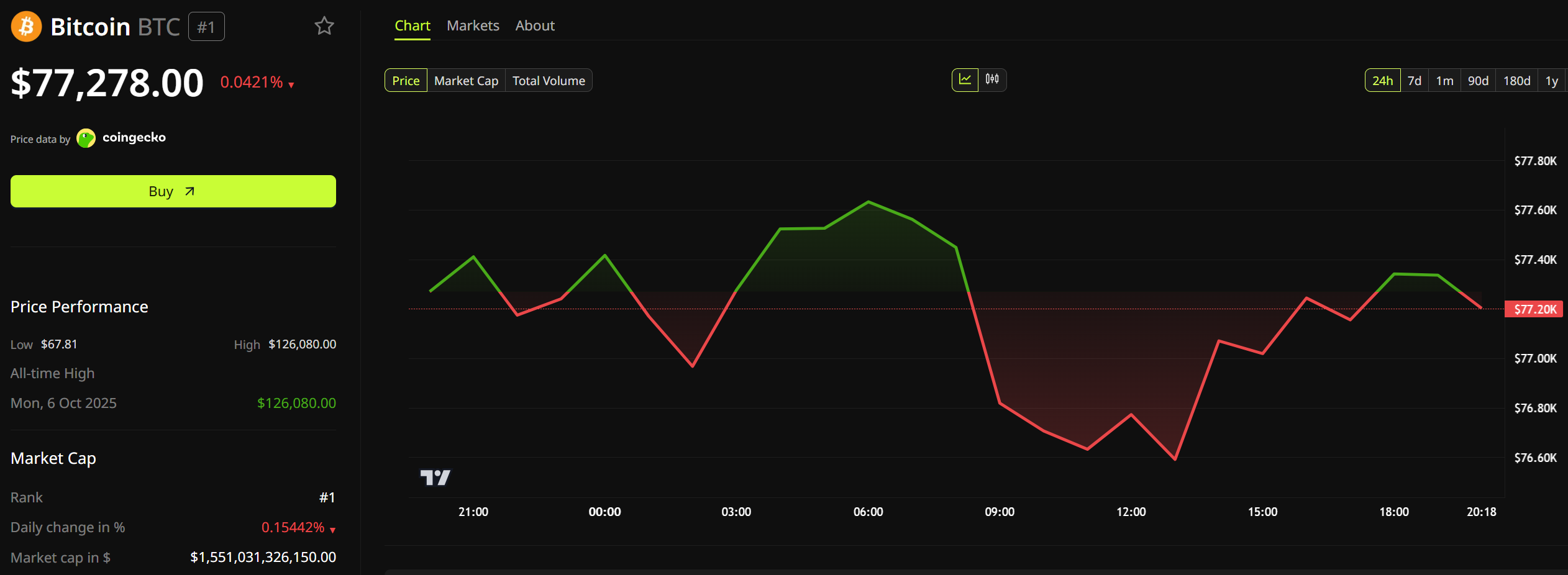
Binance founder Changpeng Zhao (CZ) said speculative capital is rotating back to crypto from artificial intelligence (AI) trades. Meanwhile, research firm River published a model putting Bitcoin (BTC) as high as $840,000 within five years.
That returning money meets a market Glassnode describes as boxed in. BTC trades near $77,278, down 0.04% over the past 24 hours, with heavy overhead supply still sitting above.

AI Money Rotating Back to Crypto Still Needs Rails
CZ framed the shift as a reminder rather than a victory lap. AI pulled speculative flows through 2026. However, he argued the money layer beneath those trades never went anywhere.
Follow us on X to get the latest news as it happens
The capital he describes is tourist money. It moves fast, chases the loudest narrative, and rarely stays for a full allocation cycle.
Advisors Hold 0.008% of Their Assets in Bitcoin
River published its case for a 10% Bitcoin allocation the same day. The report argues portfolios sit structurally underweight despite Wall Street guidance of 1% to 7%.
Investment advisors as a group hold 0.008% of assets in Bitcoin, River found. Meanwhile, 29 of the top 30 registered investment advisors already own some, echoing calls from advisors pushing larger allocations.

$840K is what could happen if just a fraction of investors allocate just a fraction of their capital to Bitcoin,” read an excerpt in the report, citing Sam Baker.
River models 20% to 40% of portfolios adding 2% to 4% weights against a $333 trillion asset base. That implies $1.3 trillion to $5.3 trillion of net inflows over three to five years, or roughly $250,000 to $840,000 per coin.
The $83,000 Supply Wall Decides Who Is Right
Glassnode works on a shorter clock. Its latest report places long-term holder supply between $83,000 and $86,000, with an accumulation floor at $62,000 to $65,000.

The August 19 short squeeze carried Bitcoin price action above $80,000 on August 27 before sellers turned it back toward $76,000. Supply in profit had climbed to 68% from 65% in May at the same nominal price.
Spot Bitcoin ETFs took in $290 million per day at peak, yet strong ETF inflows met secondary turnover near just $3 billion daily. The US 10-year Treasury yield has since returned to 4.8%.
Returning hot money hits the liquidation map long before it touches any allocation model. Whether long-term holders sell into that bid will decide if River’s math gets a down payment or another rejection.
The post CZ Says AI Money Is Rotating Back to Crypto as $840,000 Case Builds for Bitcoin appeared first on BeInCrypto.


FBI agents took control of domains and servers, specifically Alqassam.ps, to intercept donations and prevent further fundraising for the Al-Qassam Brigades.


Fairshake has entered the final stage of the 2026 U.S. election cycle with $122 million available after supporting nearly 50 winning candidates during the primaries.
Summary
- Fairshake has backed nearly 50 candidates who secured party nominations in the 2026 primaries.
- The super PAC has reserved $122 million for spending before the Nov. 3 general election.
- Prediction markets give four Fairshake-backed Republican Senate candidates at least a 94% chance of winning.
- Fairshake’s largest primary defeat came after it spent over $10 million against Juliana Stratton in Illinois.
Fairshake adds nearly 50 primary wins
According to reports on Wednesday, Fairshake supported nearly 50 successful primary candidates as the crypto industry-backed super PAC prepared to direct its remaining funds toward the November elections.
Among its latest wins, Democratic Representative Jake Auchincloss secured his party’s nomination in Massachusetts after receiving support from Protect Progress, Fairshake’s Democratic-focused affiliate. Protect Progress spent $189,527.60 on four mailers supporting the incumbent, according to Federal Election Commission disclosures cited in a recent crypto.news report on the Auchincloss primary win.
Although Auchincloss has voted for several pieces of crypto legislation, his record has not aligned with the industry on every issue. Stand With Crypto, the Coinbase-backed advocacy group, gives him a C grade, partly because he did not support the GENIUS Act stablecoin legislation last year.
His opponent, Jason Poulos, criticized the outside spending and alleged that some of the material used artificial intelligence. The FEC filing and materials released by Poulos did not show that Auchincloss or his campaign helped prepare the advertisements, while federal rules require super PAC expenditures to remain independent of the candidates they support.
Fairshake and its affiliates have also spent money defending seven members of Congress who have regularly supported digital asset legislation. At the same time, the network backed first-time candidates from both parties who could enter Congress next year.
In August, Fairshake affiliates added several Michigan and Washington victories after spending hundreds of thousands of dollars across the two states. Republican Representative Bill Huizenga received nearly $512,000 in support from Defend American Jobs, Fairshake’s Republican-focused affiliate, while Protect Progress backed Democratic Representatives Suzan DelBene, Kim Schrier and Marilyn Strickland.
Republican Senate candidates lead election odds
Fairshake’s most notable results have come from Republican Senate primaries, where it helped Barry Moore in Alabama, Andy Barr in Kentucky, Kevin Hern in Oklahoma, and Harriet Hageman in Wyoming secure their party nominations.
Hageman is running for the seat held by retiring Senator Cynthia Lummis, one of Congress’ most active supporters of cryptocurrency legislation. The Wyoming lawmaker has worked on digital asset tax, market structure, and Bitcoin-related proposals during her time in the Senate.
Prediction traders expect all four Fairshake-backed candidates to win in November. Polymarket contracts gave Moore a 99% probability of victory, Hern 97%, and Hageman 96% at the time of the report. A Kalshi market placed Barr’s odds near 94%.
Prediction-market prices represent traders’ expectations rather than guaranteed outcomes, and the figures can change as election conditions develop.
If elected, the four Republicans would arrive in the Senate while lawmakers are still working on the Digital Asset Market Clarity Act. The proposed legislation would divide oversight of parts of the U.S. digital asset market between the Securities and Exchange Commission and the Commodity Futures Trading Commission.
Control of Congress will also determine which lawmakers lead the House Financial Services, House Agriculture, Senate Banking, and Senate Agriculture committees. Each panel has jurisdiction over parts of U.S. crypto policy, including securities rules, commodities regulation, stablecoins, and market structure.
Fairshake spokesperson Geoff Vetter said the organization would continue its election activity after its primary results.
“With dozens of wins in House and Senate races across the country, and $122 million ready for the fall, we’re not slowing down.”
Most party nominees have already been selected, although primary contests remain in New Hampshire, Rhode Island, Delaware and Louisiana. The general election is scheduled for Nov. 3.
Illinois delivers Fairshake’s largest defeat
Despite its victories elsewhere, Fairshake failed to stop Illinois Lieutenant Governor Juliana Stratton from winning the Democratic nomination for the U.S. Senate.
The super PAC spent more than $10 million trying to defeat Stratton, making the Illinois contest its largest unsuccessful expenditure of the current election cycle. Stratton defeated a field that included Representatives Raja Krishnamoorthi and Robin Kelly in the race to succeed retiring Senator Dick Durbin.
Fairshake’s advertisements did not prevent Stratton from securing the nomination, and prediction models cited by the report expect her to enter the Senate next year. Illinois has consistently elected Democrats in statewide federal races, giving the party’s nominee an advantage over Republican nominee Don Tracy.
The result showed that high outside spending did not decide every primary. Consumer advocacy group Public Citizen previously calculated that crypto companies had contributed a record $189 million to the 2026 election cycle by the end of June, accounting for about 37% of corporate political contributions included in its analysis.
Public Citizen said Fairshake had spent more than $82 million during the cycle by that point. The organization’s network entered 2026 with approximately $193 million in cash, though the current $122 million figure represents funds available for the final election phase.
Coinbase, Ripple and Andreessen Horowitz remain the main financial supporters of Fairshake and its affiliated committees. The network divides much of its political work between Protect Progress, which supports Democrats, and Defend American Jobs, which concentrates on Republicans.
Rival crypto PACs trail Fairshake’s spending
Other digital asset-linked political groups have raised money during the election cycle but have not matched Fairshake’s activity.
Fellowship PAC, backed by Cantor Fitzgerald and Anchorage Digital, had previously indicated that it could spend $100 million. The committee received about $11 million, with most of the money coming from Cantor Fitzgerald.
The PAC supported a group made up mainly of Republicans and three Democrats, including Virginia Senator Mark Warner. Almost all its spending went to a political firm co-founded by Bo Hines, a former crypto adviser to President Donald Trump who later took charge of Tether’s U.S. operation.
Fellowship’s early connection to Tether created a campaign-finance issue because U.S. political committees cannot accept foreign funds. Rather than receiving money from the stablecoin issuer, the PAC obtained backing from Cantor Fitzgerald, the U.S. financial firm that manages part of Tether’s reserves. It remains unclear whether Fellowship will spend again during the general election.
Tyler and Cameron Winklevoss have separately backed the Digital Freedom Fund through a $21 million contribution from Winklevoss Capital. Kraken parent Payward added another $1 million, but the committee had not started supporting individual candidates at the time of the report.
Crypto World
MicroStrategy Reserve Capital Beats All S&P 500 Financials But Berkshire, MSTR Still Slips
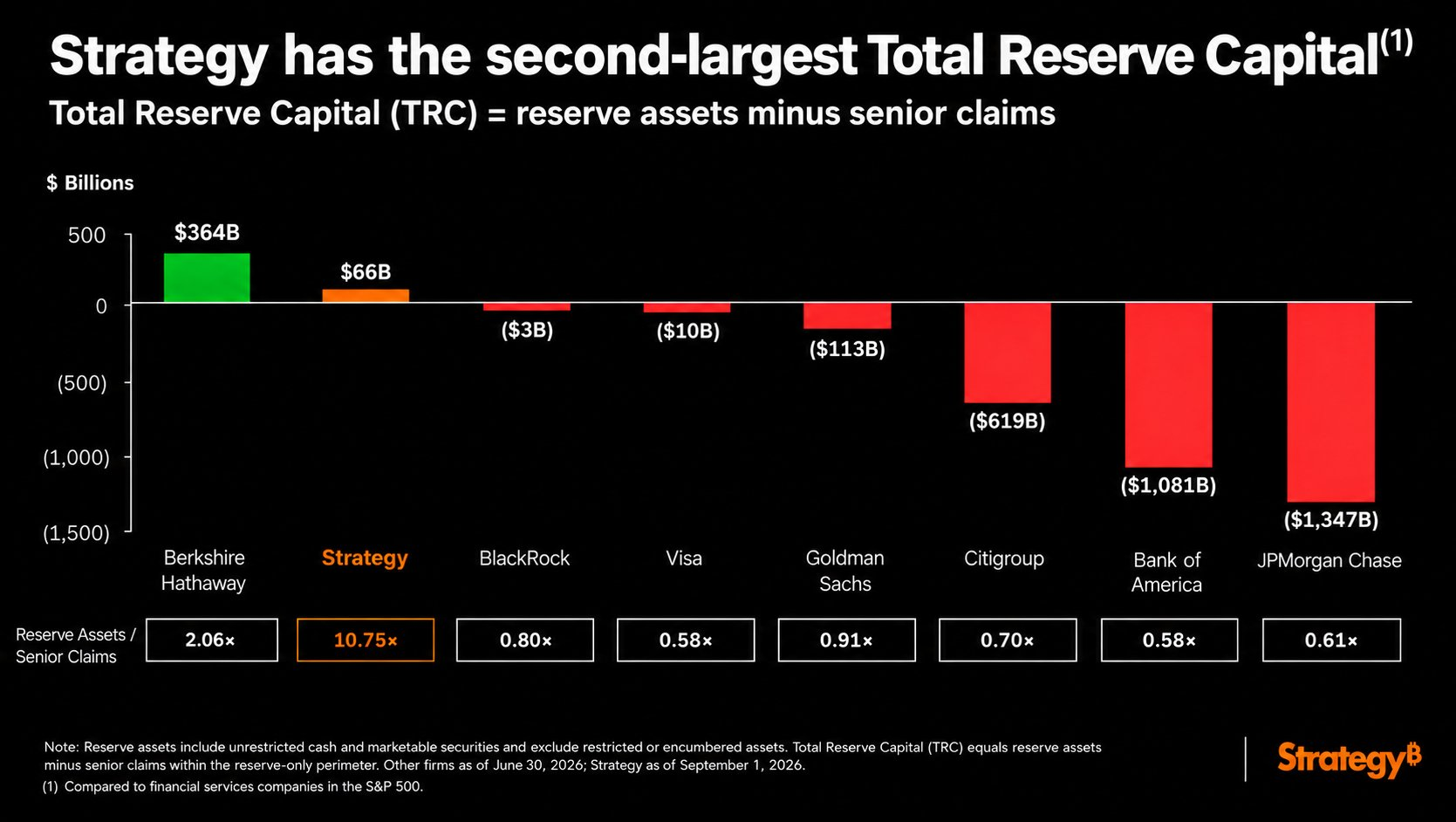
Michael Saylor says MicroStrategy now holds more reserve capital than every financial firm in the S&P 500 but one. Berkshire Hathaway is the exception.
The boast rests on a yardstick the company built itself. MicroStrategy’s own investor briefing lands on a number $15 billion smaller.
How MicroStrategy Got Here
MicroStrategy holds 845,050 BTC. Its first buy, in August 2020, was 21,454 coins for $250 million. That stack is now worth about $65.2 billion. It resumed buying on August 31, ending a 10-week pause with 4,603 coins for $370 million.
Add $6.7 billion in dollar assets and the reserve reaches $72.3 billion. Chief Executive Phong Le cited roughly $72 billion the same day, so the figure holds up.
Le also claimed zero net leverage. The briefing backs him. Dollar assets of $6.714 billion match total debt of $6.714 billion almost exactly, after the company built its dollar pools through August.

“Strategy now has more Total Reserve Capital than every financial services company in the S&P 500 except Berkshire Hathaway. $MSTR,” said Saylor.
Follow us on X to get the latest news as it happens
Bitcoin (BTC) hovers near $77,203, down 0.08% on the day as of this writing. MSTR traded near $122.30 on Wednesday, off 2.1%. The stock fell faster than the coin, as it tends to on soft tape.

Investors had rewarded the cash build in late August, lifting MSTR near $140.
The Metric Is MicroStrategy’s Own
Total Reserve Capital strips senior claims out of liquid reserves. Deposits count as senior claims for banks. That is why JPMorgan shows roughly negative $1.35 trillion.
The chart puts MicroStrategy at $66 billion. Its August 30 briefing counts $21.5 billion of senior claims, including $14.8 billion of preferred stock, and reports a net reserve of $50.7 billion. The $66 billion works only if that preferred stock is set aside. Bank deposits are not.
The same choice flatters the ratio. The chart shows reserves at 10.75 times senior claims. Count the preferred and it falls to 3.4.
MicroStrategy says as much itself. The briefing calls these supplemental measures with significant limitations, not accounting standards.
Berkshire’s filing shows $365.5 billion in cash and Treasury bills at June 30. That number is checkable. The ranking beneath it is not.
The post MicroStrategy Reserve Capital Beats All S&P 500 Financials But Berkshire, MSTR Still Slips appeared first on BeInCrypto.

Coinbase has launched crypto derivatives trading in Canada, giving eligible users access to perpetual and dated futures tied to Bitcoin (BTC), Ether (ETH), Solana (SOL) and other assets.
The products are offered through Coinbase Financial Markets, a futures commission merchant registered with the US Commodity Futures Trading Commission, which operates in Canada under foreign dealer and futures commission merchant exemptions.
Coinbase said Wednesday that the offering includes 23 crypto perpetual and dated futures, five commodity futures and the Coinbase 50 Index. The company said it is the first major crypto-native platform to offer direct native crypto futures in Canada.
Access is limited to eligible Canadian customers, including those with at least $5 million in net financial assets or registered investment advisers and dealers. The contracts use nano-sized positions and offer leverage of up to 10x.
Related: BlackRock launches 2 Canada ETFs, with one allocating 3% to Bitcoin
US trading platforms expand in Canada
The Coinbase launch comes as US trading platforms broaden their crypto offerings in Canada.
On Monday, US online brokerage Webull expanded crypto trading to Canadian customers using Coinbase’s infrastructure for trading and custody, adding digital assets alongside its existing stocks, ETFs and options offerings.
Webull cited rising adoption as one reason for the move, with crypto ownership in Canada climbing to 25% this year from 10% in 2023, according to Ontario Securities Commission research.
Robinhood entered the Canadian market in June through its $180 million acquisition of local crypto company WonderFi, gaining control of Canadian exchanges Bitbuy and Coinsquare. The deal also brought roughly 300,000 funded customers, along with WonderFi’s Canadian licenses and regulatory approvals, under Robinhood.

Robinhood entered Canada after completing its acquisition of WonderFi. Source: Vlad Tenev
The influx of trading platforms comes as Canada tightens oversight of other parts of the crypto market. In April, Ottawa proposed banning crypto ATMs over concerns about scams and money laundering, while lawmakers advanced legislation that would prohibit cryptocurrency donations to political parties and candidates.
Magazine: BTC will hit $1M by 2030… but Arthur Hayes is buying ETH instead


The crypto exchange operator, which confidentially filed for a U.S. listing last November, had already put its IPO plans on hold amid difficult market conditions.
The US state of Wyoming is adding near-real-time onchain reserve verification to its state-issued Frontier Stable Token through an expanded integration with blockchain oracle network Chainlink.
The Wyoming Stable Token Commission said Wednesday it adopted Chainlink Proof of Reserve to publish verified data on FRNT’s reserves and token supply onchain. The system combines independent examinations by The Network Firm with Chainlink’s infrastructure to make the data available in near real time.
Wyoming already publishes daily reserve attestations for FRNT, while the GENIUS Act requires monthly disclosures of reserve composition and outstanding stablecoin supply. The commission said the integration will provide more timely visibility into changes in FRNT’s backing between reporting periods.
The commission is also working to adopt Chainlink’s Secure Mint feature, which would require verified reserves to equal or exceed FRNT’s total supply before new tokens can be minted.
FRNT, launched in January, is backed by US dollars and short-term US Treasurys, with interest income generated from its reserves deposited into Wyoming’s School Foundation Program.
The move comes about two weeks after Wyoming fully migrated FRNT from LayerZero to Chainlink’s Cross-Chain Interoperability Protocol, making CCIP the token’s exclusive cross-chain infrastructure.
Related: Charles Schwab adda Solana, Avalanche and Chainlink to nascent crypto platform
Chainlink expands institutional footprint
Chainlink has picked up several integrations across tokenized equities, stablecoin settlement and traditional financial market infrastructure in recent months.
Most recently, Chainlink became the pricing-data provider for Coinbase’s B20 tokenized equities following their August launch on Base. The feeds cover stocks including Apple, Nvidia, Meta and Alphabet, allowing DeFi protocols to value the tokens for uses including lending, trading and collateral.
In June, Chainlink joined European and South Korean banking groups in Project Pangea, which is exploring the use of regulated euro- and won-denominated stablecoins for atomic foreign exchange settlement across the two regions.
Its push into traditional financial infrastructure has also included the Depository Trust and Clearing Corporation (DTCC), which said in May it would integrate Chainlink technology into a planned 24/7 platform for managing tokenized collateral. That month, Fidelity International also launched a tokenized liquidity fund using Chainlink and Sygnum infrastructure, with JPMorgan providing daily net asset value data for pricing.
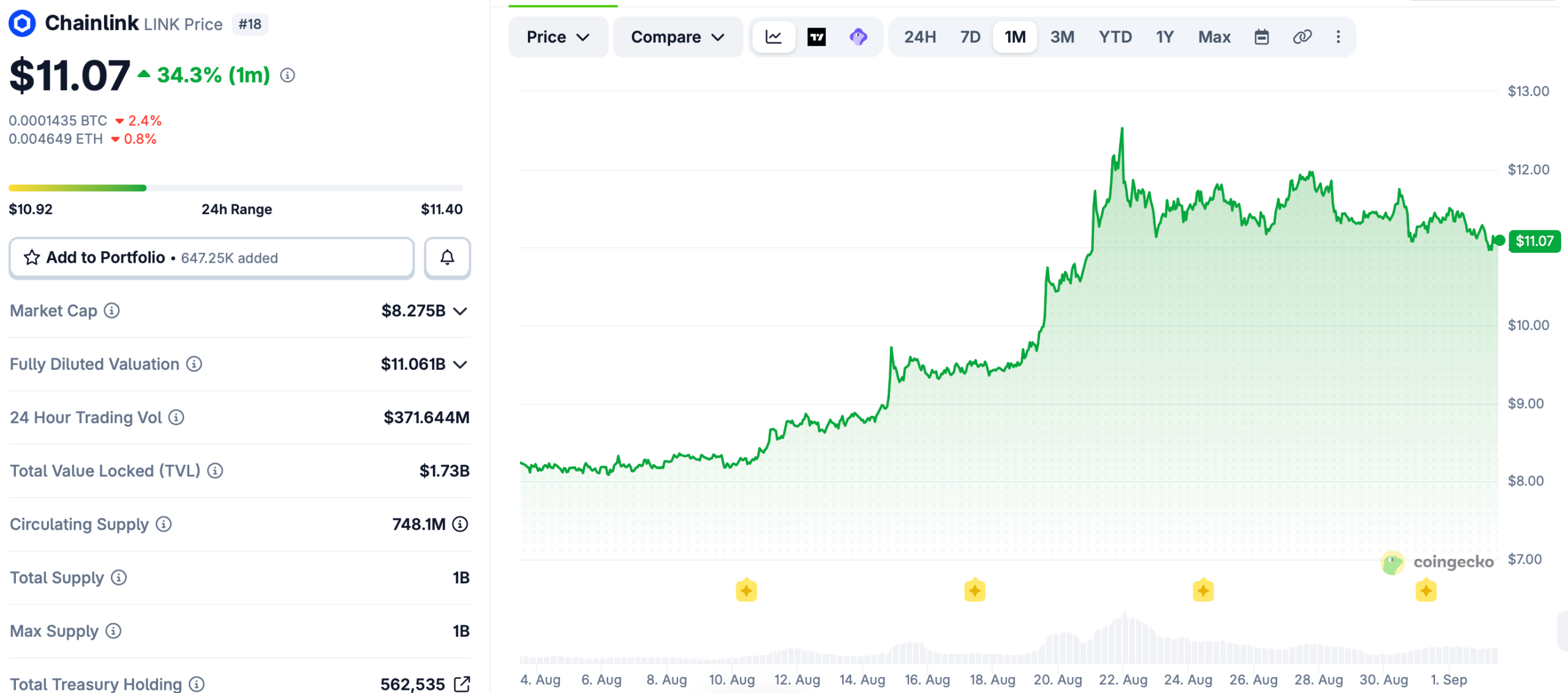
Chainlink’s LINK token has gained more than 34% over the past month, trading at around $11.07 on Wednesday, according to CoinGecko data.
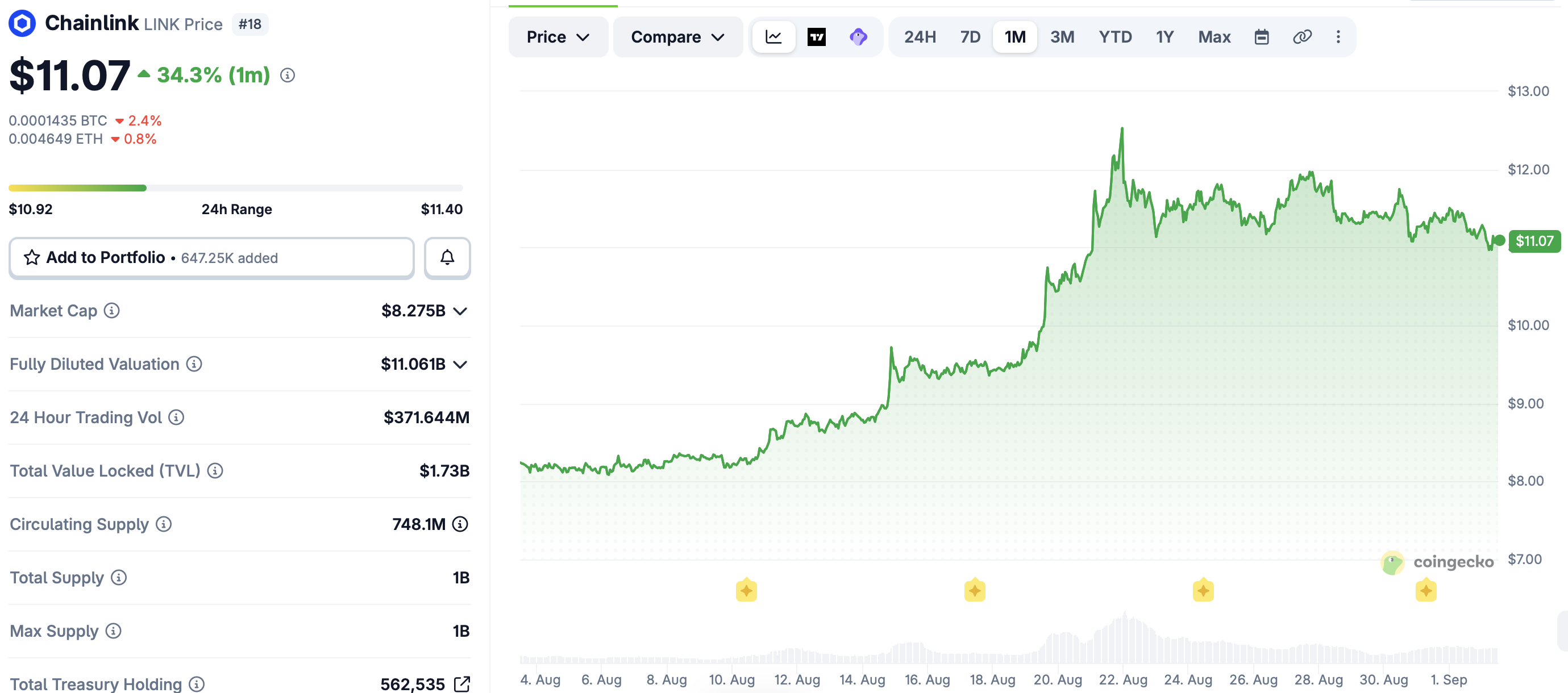
LINK has gained around 34% over the past month. Source: CoinGecko
Magazine: Does the Bitcoin rally mean we haven’t wasted our lives in crypto?

Meta settlement: Why Meta suddenly cares about kids

Man United signed three midfielders – but not the one Bruno Fernandes ‘really likes’

How Path of Exile 2 Built a Player Economy That Behaves Like a Real Market





-

 Fashion5 days ago
Weekend Open Thread: Maeve – Corporette.com
-

 Crypto World6 days ago
Bitcoin’s 22% rally now needs real demand to outlast Treasury liquidity boost
-

 Business6 days ago
Apple Confirms September 9 Keynote and Reveals Its Full Pre-Order Schedule
-

 Crypto World7 days ago
Elon Musk Grok Bot Promise: We Will Make You Whole if AI Loses Your Money
-

 Business6 days ago
Salesforce Stock Soars 19% as Blowout Earnings and Agentforce AI Growth Silence Software Skeptics
-

 Business5 days ago
Onto Innovation Stock: AI’s Next Bottleneck Is Yield (NYSE:ONTO)
-

 Crypto World7 days ago
NVIDIA revenue hits $96.2B as AI demand doubles
-

 Crypto World5 days ago
Bitcoin price tests $82K resistance as Brandt stays long
-
 Tech4 days ago
Hugging Face built a $4.5 billion empire on free AI models. Now Nvidia is buying it for $12.9 billion
-

 Business5 days ago
iPhone 18 Pro Pre-Orders Could Shift to Saturday as Apple Reportedly Avoids September 11 Anniversary
-

 Tech7 days ago
Claude Cowork gets its own browser that doesn’t touch your tabs, bookmarks, or saved passwords
-

 Crypto World6 days ago
Truflation calls for Fed rate cut after PCE forecast
-

 Crypto World7 days ago
GENIUS Act missed its deadline as OCC writes rules anyway
-

 Tech5 days ago
PaperCut releases second emergency patch for exploited flaws
-

 News Videos3 days ago
Charlie Munger on Robinhood: No one should believe that Robinhood’s trades are free
-

 Tech7 days ago
Apple’s iPhone 18 Pro event is on September 9
-

 Tech6 days ago
The fix for the AI agent that hijacked a company’s DNS: it can propose the change, but it can’t approve it
-
 Entertainment5 days ago
‘Adults’ Creators Break Down Season 2’s Most Shocking Moments and Tease a Potential Season 3
-

 Tech4 days ago
Tamagotchi Ring Takes the 30-Year Digital Pet and Places it on Your Finger
-

 Tech4 days ago
As the influencer economy drives retail sales, Seattle startup raises $22M to play matchmaker
You must be logged in to post a comment Login