

Crypto World
XRP pre-sale surpasses $10 million, XRP holders are paying close attention to SHRMiner’s free cloud mining service


Disclosure: This article does not represent investment advice. The content and materials featured on this page are for educational purposes only.
Regulatory progress and XRP growth fuel interest in cloud mining platforms like SHRMiner among crypto investors.
Summary
- Growing regulatory clarity around crypto is increasing interest in cloud mining platforms tied to digital asset ecosystems.
- SHRMiner has launched XRP-supported cloud mining contracts that allow users to participate without owning hardware.
- The platform says its AI-powered system can redirect mining power toward higher-yield assets and settle rewards daily.
According to CNBC, following months of negotiations regarding stablecoin yield rules and decentralized finance (DeFi) regulation, the Digital Asset Market Transparency Act was passed by the Senate Banking Committee on May 14.
Senators Ruben Gallego and Angela Alsobrooks, joined by all Republican members, championed the bill’s passage. Following the vote, the price of Bitcoin briefly surged to $81,965 but subsequently retreated amid macroeconomic headwinds; the bill still requires 60 votes in the Senate as well as passage by the House of Representatives.
This cryptocurrency market news highlights the trend toward a transition to regulated legitimacy; however, regulatory clarity alone does not tell retail investors where to find the greatest returns, and as the rules become increasingly clear, the window for early positioning is narrowing.

Regulatory uncertainty has historically caused even the most astute investors to adopt a wait-and-see approach. Today, with the advancement of the CLARITY Act, the central question has shifted from whether the market can grow to which specific projects will yield returns for early-moving investors.
Amidst an environment characterized by heightened price volatility and an abundance of short-term opportunities, regulated cloud mining platforms — such as SHRMiner — are emerging as the preferred choice for investors. Users need neither to own their own hardware nor possess technical expertise; they simply need to purchase computing power to participate in mining and earn daily returns, all while benefiting from the growth potential of the XRP ecosystem.
In this environment, investors are no longer merely asking:
“Will the price go up?”
But increasingly:
“How can I generate daily profits, even without engaging in active trading?”
Against this backdrop, SHRMiner has officially launched a cloud mining rewards contract that supports XRP payments. Users simply need to use XRP to activate computing power, requiring no additional hardware or complex procedures. The system automatically executes the mining operations and settles daily earnings, enabling otherwise idle XRP assets to achieve steady appreciation.
Why has cloud mining suddenly sparked such heated discussion?
SHRMiner is a UK-based cloud mining platform dedicated to providing secure, efficient, and scalable cloud mining services to over 5 million users across more than 180 countries. Users are not required to purchase mining hardware themselves, nor do they need to bear the complex costs associated with electricity, cooling, or maintenance; instead, they can participate in Bitcoin mining indirectly simply by purchasing the hash rate contracts offered by the platform. Compared to traditional individual mining methods, this model significantly lowers the barrier to entry while simultaneously making the allocation of hash rate resources more centralized and professional.
SHR Miner’s XRP cloud mining is now live
XRP has long been recognized for its pivotal role in cross-border payments and institutional finance; now, SHRMiner’s latest innovation — user-friendly cloud mining — propels XRP into a new era.
Users can choose to mine XRP directly or leverage SHRMiner’s intelligent AI engine, which automatically redirects mining power to the assets yielding the highest returns, including BTC, XRP, ETH, DOGE, USDC, and others. Earnings are paid out daily in a chosen cryptocurrency, providing a reliable source of income regardless of market fluctuations.
Whether someone is a beginner or an experienced investor, with the SHRMiner cloud mining platform, they can easily participate in mining without the need to purchase mining hardware or possess specialized technical skills. In just four simple steps, anyone can embark on their journey toward generating passive income from digital assets.
Here is how to join SHRMiner
1. Register an Account
Visit the official website or download the mobile app. Complete registration using an email address to instantly receive a $15 reward, plus a daily login bonus of $0.60. (Click here for one-click registration).
2. Select an Investment Plan
The platform offers various plans ranging from $100 to $200,000, varying in both duration and scale; users can select the plan that best suits their available funds and target returns.
3. Supported Cryptocurrency Deposits
Participate using a variety of supported cryptocurrencies, including XRP, BTC, ETH, and USDT. The system will automatically convert your deposited assets into cloud mining hash rate.
4. Activate the Contract and Earn Returns
Once the contract is activated, earnings will be automatically settled within 24 hours. Users have the option to withdraw their profits or reinvest them to capitalize on the power of compound interest.
The primary advantage of this model lies in its significantly lowered barrier to entry. Users are not required to research specific mining hardware models or hash rate configurations, nor do they need to set up their own system environments; they simply need to register an account, deposit assets, and select a mining plan to begin generating returns.
Examples of Common Contracts:
| Contract Name | price | profit | Days | Principal + Total Return |
| New User Experience Contract | $100 | $4 | 2 | $100+$8 |
| Bitdeer Sealminer A2 Pro | $500 | $6.25 | 5 | $500.00 + $31.25 |
| Litecoin Miner L9 | $1000.00 | $13.00 | 10 | $1000.00 + $130 |
| MICROBT WhatsMiner M73 | $8000.00 | $116.00 | 30 | $8000.00 + $3480 |
| Bitcoin Miner S21e XP Hyd | $10000.00 | $150.00 | 35 | $10000.00 + $5250 |
| ANTSPACE HK3 | $30000.00 | $510.00 | 40 | $30000.00 + $20400 |
After purchasing a contract, earnings will be automatically credited to an account within 24 hours. Upon the contract’s expiration, the principal will be returned in full. The principal can be withdrawn or reinvested to enjoy the benefits of compound interest. For further details regarding mining contracts, please click here to learn more.
SHRMiner Platform Advantages:
- Supports daily automatic settlement
- No additional electricity or maintenance costs required
- Utilizes advanced ASIC mining hardware, powered by renewable energy sources including hydropower, wind power, and solar power.
- Supports Multi-Currency Mining: Earn major cryptocurrencies such as BTC, XRP, ETH, DOGE, USDC, USDT, SOL, LTC, BCH, and more.
- Equipped with SSL encryption and DDoS protection, a real-time earnings dashboard for easy monitoring of mining performance
- 100% remote access, fully accessible via the SHRMiner application or browser without hardware requirements, and 24/7 online technical support.
- Affiliate Program: The Affiliate Program allows users to earn up to 4.5% commission by referring friends, with the opportunity to earn an additional bonus of up to 30,000.
Unimaginable money-making opportunities
What sets SHRMiner apart is its extraordinary daily passive income potential; users have the opportunity to earn $8,900 — or even more — every day, thereby realizing their dream of getting rich online. Imagine generating substantial income without the need for constant effort or complex setups — that is precisely what SHRMiner offers.
Conclusion
For those who are looking for ways to generate passive income, cloud mining is an excellent option. When utilized effectively, these opportunities can help effortlessly accumulate cryptocurrency wealth on “autopilot.” Market opportunities favor the swift; now is the ideal time to capitalize on the growth potential of XRP and secure stable daily returns through SHRMiner — a key to achieving sustainable wealth accumulation.
For more information, visit the official website.
Disclosure: This content is provided by a third party. Neither crypto.news nor the author of this article endorses any product mentioned on this page. Users should conduct their own research before taking any action related to the company.

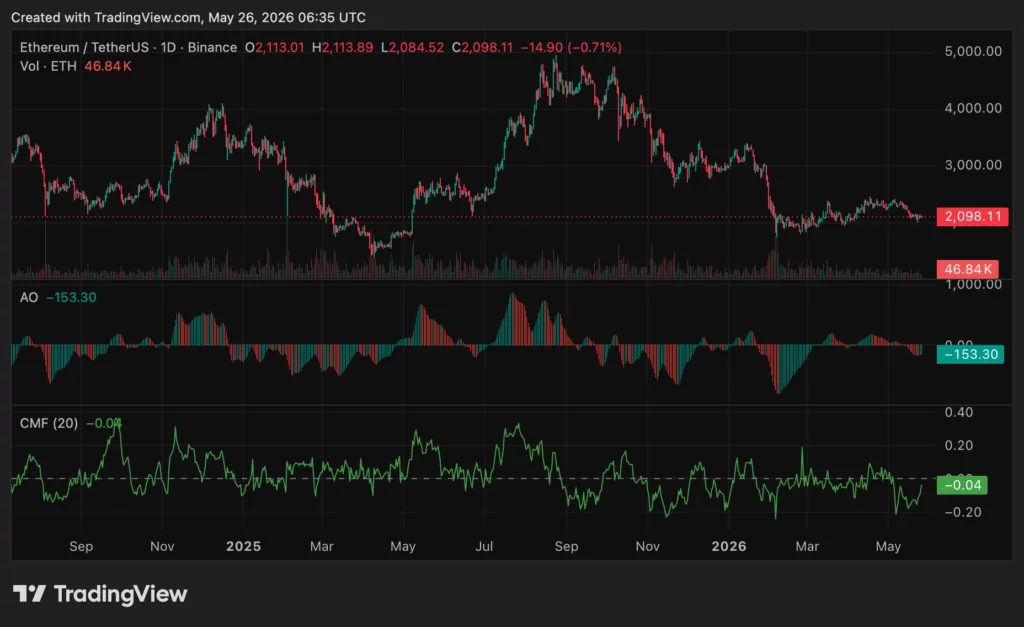
Ethereum traded near $2,100 on May 26, according to crypto.news price data.
Summary
- Ethereum hovered near $2,100 as traders watched $2,000 support and $2,400 resistance again this week.
- Vitalik Buterin said the Ethereum Foundation will sell less ETH under its leaner long-term plan.
- Ali Martinez warned a weekly close below $1,850 could open lower Ethereum accumulation tiers ahead.
Meanwhile, the token was down 0.12% over 24 hours and 1.7% over seven days. Its 24-hour trading volume stood at $9.72 billion, while market capitalization reached $253.25 billion.
The same data showed Ethereum moving between $2,080 and $2,140 during the day. That kept ETH close to the wider $2,000 to $2,100 support zone that traders have watched since the latest pullback.
Short-term indicators still show weak momentum. The Awesome Oscillator was negative at -153.30, meaning sellers still control the current trend. The Chaikin Money Flow was also slightly negative at -0.04, pointing to mild capital outflow rather than strong accumulation.
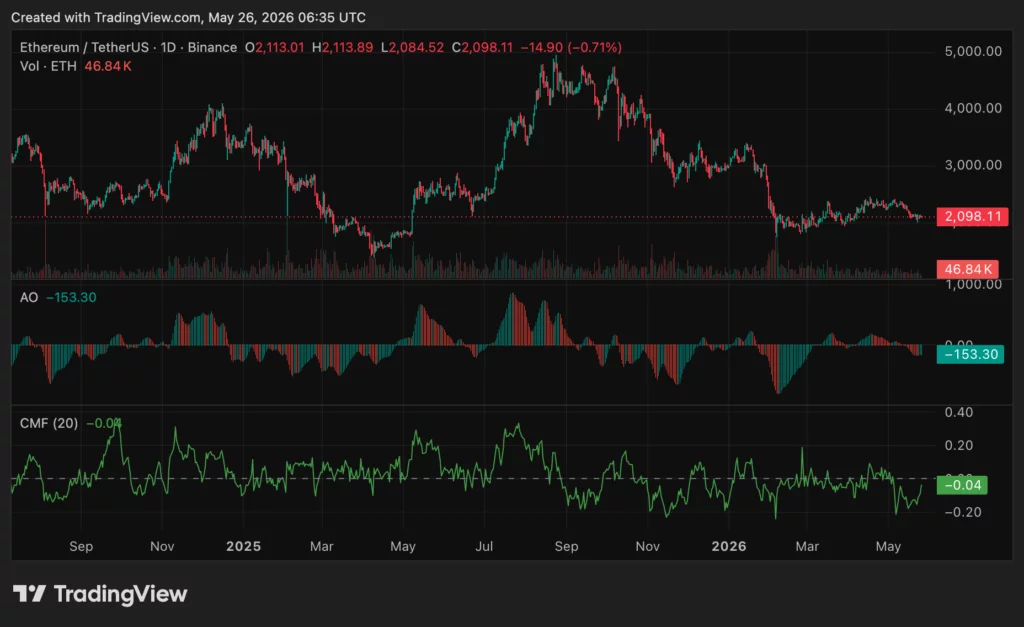
Volume stood near 46.84K on the chart, which looked moderate compared with earlier selloff spikes. That means the move lower has not yet shown clear panic selling. A recovery above $2,300 to $2,400 would improve the setup, while a loss of $2,000 would raise downside pressure.
Vitalik Buterin denies selling Ethereum
Ethereum co-founder Vitalik Buterin also became part of the market discussion after Ali Martinez posted a price analysis titled “I’m NOT selling Ethereum!” The post linked the price setup to Buterin’s comments about the Ethereum Foundation’s future role.
As previously reported by crypto.news, Buterin said the Ethereum Foundation will prioritize long-term survival over wider activity. He also said the foundation will sell less ETH as it narrows its work around privacy, security, openness, and core protocol goals.
Buterin said the foundation holds about 0.16% of the total ETH supply. He also described the Ethereum Foundation as one part of the wider Ethereum system, not the center of the network.
The message matters because Ethereum traders have watched foundation treasury moves closely throughout May. The foundation had withdrawn 21,270 ETH from Lido staking and sold 10,000 ETH to BitMine on May 1 at an average price of $2,292.
Analysts watch $1,850 support and $2,400 resistance
Ali Martinez said Ethereum has failed to reclaim the mid-range of a multi-year structure, which also aligned with the 200-week Simple Moving Average. In that view, the most important level is $1,850.
The analyst warned that a weekly close below $1,850 could open the way toward $1,560, followed by a deeper move near $1,070. Those levels were framed as potential accumulation zones, not as a reason to chase short positions.
Ali also linked $1,850 to the 0.8 MVRV pricing band. The analyst said Ethereum has not usually stayed below that band for long in past cycles. Based on that view, weakness below $1,850 could create a staged dollar-cost averaging setup.
The planned tiers included 20% allocation at $1,850, 20% at $1,560, 20% at $1,230, 30% at $1,080, and 10% at $830. The bullish invalidation levels were also clear: Ethereum would need to reclaim the 200-week SMA near $2,500, then break above the 50-week SMA around $3,100.
As reported by crypto.news, Ethereum also faced resistance near $2,400 earlier this month. That report said sell walls around $2,400 kept upside limited, while $2,200 remained a key downside area at the time.
Low volatility leaves ETH waiting for direction
CryptoQuant analyst Arab Chain said Ethereum’s 30-day volatility index on Binance had fallen near 0.30, its lowest level since 2023, while ETH traded near $2,100.
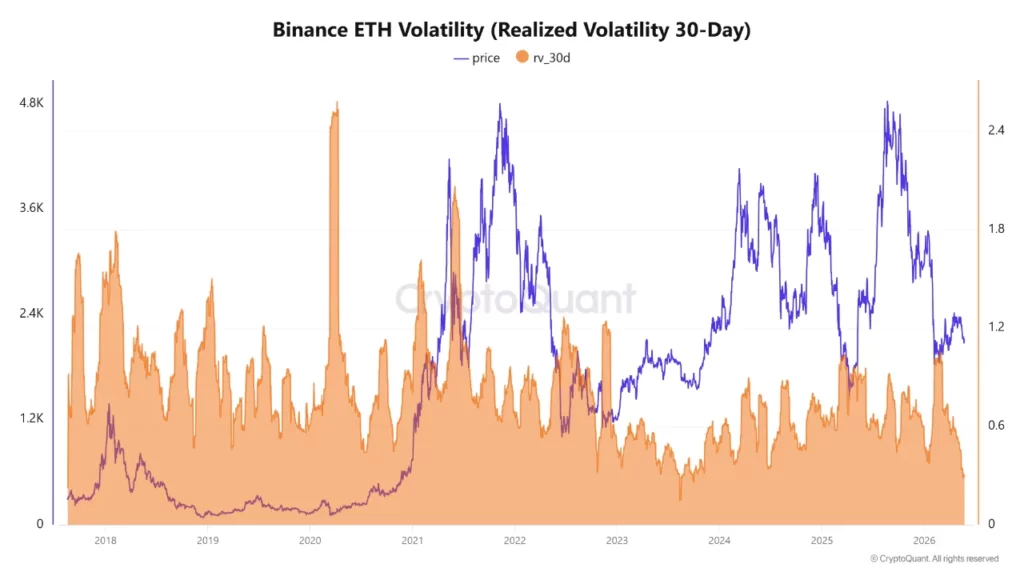
Low volatility does not confirm a bullish or bearish move. It often shows that traders are waiting for a clearer signal before adding risk. After long calm periods, stronger moves can return quickly when volume and liquidity rise again.
CW also said Coinbase whales had formed a short-term sell wall near $2,400. The analyst said those whales were applying pressure but were not actually selling. That keeps the $2,400 area important for any recovery attempt.
A clean move above $2,400 would weaken the sell-wall setup and bring $2,500 into focus. That would also match Ali Martinez’ first bullish trigger near the 200-week SMA.
If Ethereum loses $2,000, traders may shift attention back to $1,850. A weekly close below that level would strengthen the bearish technical case and bring lower accumulation tiers into view.
Disclosure: This article does not represent investment advice. The content and materials featured on this page are for educational purposes only.

Key Points
- Fraudulent Uniswap advertisements on Google Search successfully stole more than $400,000 from cryptocurrency investors
- Blockchain analysis revealed two suspicious wallet addresses containing approximately 146 ETH, valued at roughly $306,000
- SEAL (The Security Alliance) identified and blocked more than 356 dangerous ad links, with total losses reaching $1.27 million from March 13 through March 30
- Cybercriminals evade Google’s automatic screening by deploying authentic-appearing URLs combined with concealed iframes
- Malicious cryptocurrency advertisements have persisted as an ongoing threat for more than twelve months without meaningful reduction
Cybercriminals have orchestrated a sophisticated advertising campaign on Google Search that mimics Uniswap, a widely-used decentralized cryptocurrency platform. This fraudulent operation has successfully drained a minimum of $400,000 from unsuspecting victims who interacted with the deceptive advertisements.
Blockchain researcher known as “b-block” raised alarm bells on X, cautioning that a counterfeit Uniswap platform was systematically emptying funds from numerous digital wallets. Stacy Muur, who leads the Web3 marketing firm Green Dots, corroborated these findings and published evidence showing the fraudulent sponsored listing appearing prominently on Google.
“The fact that Google has allowed this problem to persist for years while fraudulent links consistently rank above legitimate ones and victims continue losing money is absolutely unacceptable,” Muur stated.
According to Etherscan records, two wallet addresses marked as suspicious contained approximately 146 ETH, representing about $306,000 in value when documented.
The Mechanics Behind the Fraud
The perpetrators employ one of two strategies: either purchasing Google Ads accounts outright or compromising existing legitimate advertiser profiles. They subsequently launch deceptive advertising campaigns that outbid authentic cryptocurrency platforms for premium positioning in the “Sponsored results” segment of Google Search.
These advertisements utilize convincing URLs designed to circumvent Google’s automated verification processes. An invisible secondary iframe subsequently loads the harmful code, which remains undetectable by Google’s monitoring infrastructure.
Upon clicking these advertisements, victims are redirected to meticulously crafted replicas of genuine crypto applications. Every network communication is covertly redirected through infrastructure controlled by the attackers, facilitating the theft of wallet contents.
DeFiLlama verified that fraudulent Google advertisements represent a prevalent phishing technique within cryptocurrency circles. SEAL (The Security Alliance), a nonprofit organization focused on crypto security, documented a significant surge in these attacks throughout March.
According to SEAL, they successfully blocked more than 356 malicious advertising links, characterizing it as “a consistent influx of attacker-deployed Google Ads weekly for over a year.” The organization emphasized that the offensive shows no indication of diminishing and that additional victims continue coming forward with reports.
During the period spanning March 13 to 30 exclusively, cumulative financial losses through these tactics amounted to $1.27 million.
The Threat Extends Beyond a Single Platform
This security challenge transcends any individual platform. During early May, threat actors leveraged Google Ads alongside shared conversations from Anthropic’s Claude AI assistant to execute a malvertising operation specifically designed to compromise Mac users.
Cybersecurity company Malwarebytes additionally identified Facebook as a significant distribution channel for fraudulent advertisements. In February, the firm documented scammers purchasing Facebook ad space to create convincing imitations of official Microsoft promotional materials.
Those unfortunate victims were directed to remarkably accurate duplicates of the Windows 11 download interface, where malicious software engineered to extract cryptocurrency assets and authentication credentials was deployed onto their systems.
This recurring pattern demonstrates that cybercriminals are exploiting major advertising networks to execute persuasive scams targeting both cryptocurrency enthusiasts and mainstream software consumers. Neither Google, Meta, nor other affected platforms have issued comprehensive public responses addressing the magnitude of these fraudulent campaigns.

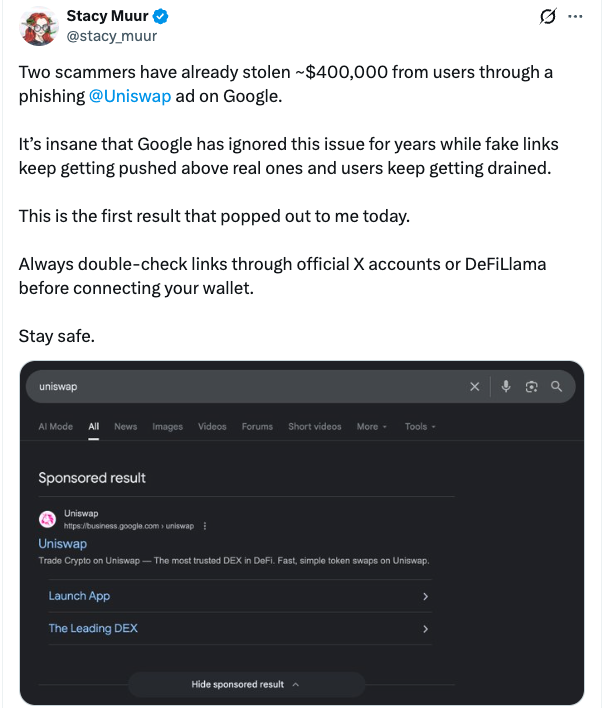
Scammers have been using Google to deploy malicious phishing advertisements impersonating the crypto protocol Uniswap, which has reportedly netted the attackers at least $400,000.
The on-chain analyst “b-block” posted to X on Monday that a website impersonating decentralized finance exchange Uniswap was draining funds from multiple wallets and the scammers were holding at least $400,000.
Stacy Muur, founder of Web3 marketing agency Green Dots, said that the scammers had stolen the funds from users through a phishing ad on Google that impersonated Uniswap, and shared a screenshot of a sponsored result from the search engine.
“It’s insane that Google has ignored this issue for years while fake links keep getting pushed above real ones and users keep getting drained,” she said.
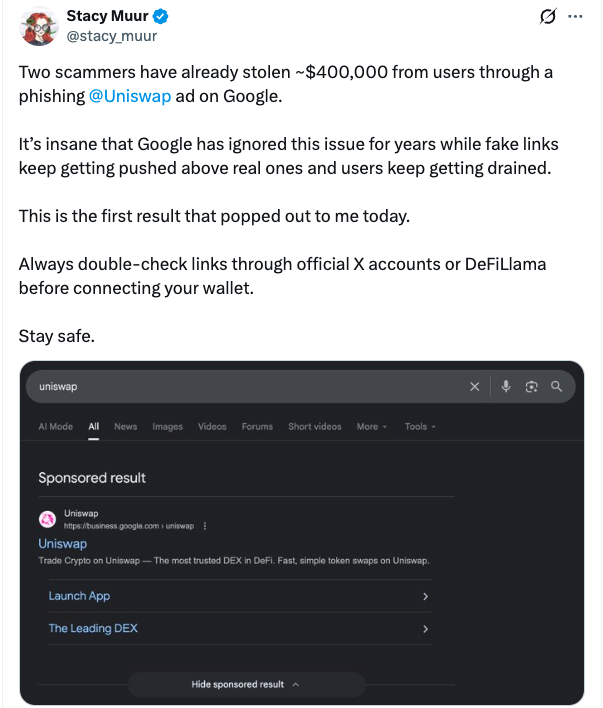
Source: Stacy Muur
The two flagged addresses held a combined 146 ETH worth around $306,000, at the time of writing, according to Etherscan.
DeFiLlama said that “fake ads on Google are a common source of phishing attacks.” The crypto non-profit group Security Alliance (SEAL) reported in April that there was a “significant uptick” in phishing activity on Google search in March.
SEAL said that attackers pay Google or hack legitimate advertiser accounts to run convincing fake ads impersonating popular crypto protocols to lure users. Threat actors outbid legitimate crypto exchanges and protocols to achieve a superior position within the “Sponsored results” section on Google Search.
SEAL blocked over 356 malicious advertisement links, a number which is “representative of a steady volume of attacker-deployed Google Ads each week for more than a year,” it added. “The campaign is not slowing down, and we are receiving more reports from affected users.”
Related: ‘TrapDoor’ malware targets crypto dev tools in supply chain attack
The phishing ads used legitimate-looking URLs to bypass Google’s automated checks, while a hidden secondary iframe loads the malicious payload, also invisible to Google’s detection.
Victims land on convincing clones of real crypto apps, with all network traffic secretly routed through attacker-controlled servers, explained SEAL, reporting that $1.27 million in total funds were stolen between March 13 and 30.
In early May, it was reported that attackers were abusing Google Ads and legitimate shared chats from AI chatbot Claude in an active “malvertising” campaign targeting Mac users.
Facebook is also a hotbed of fake ads and scams, according to Malwarebytes, which reported in February that scammers were running paid ads that looked like official Microsoft promotions.
Victims were directed to near-perfect clones of the Windows 11 download page, where malware designed to steal crypto and credentials was deployed.
Magazine: Polymarket seeks Japan entry, Harvard dumps entire ETH position: Hodler’s Digest


Decentralized platform Hyperliquid is now competing with established betting platforms such as Polymarket, but with a differentiated mechanism for resolving bets.
The leading decentralized exchange has expanded its HIP-4 outcome contracts beyond crypto price milestones into real-world events. This native prediction-market infrastructure allows users to trade macro contracts, such as inflation data and interest-rate decisions, directly alongside their standard crypto perpetuals out of a single account.
Outcome markets mark a notable expansion for the decentralized derivatives venue, which built its business around crypto perpetual futures and initially tested the product using price‑outcome contracts settled against its own market data.
Hyperliquid first tested the product on exchange‑native outcomes, such as whether bitcoin would trade above a specific level by a fixed time using Hyperliquid’s own reference prices. The latest rollout expands that model into real‑world macro events, or offchain outcomes, like U.S. inflation and Federal Reserve decisions, directly competing with prediction market platforms like Polymarket.
Native resolution
What sets it apart is that HIP‑4 brings dispute resolution and settlement in‑house, rather than depending on an external oracle network like Polymarket.
Here’s why it matters. Offchain events introduce a new problem: determining truth.
Polymarket handles this through UMA, an external oracle protocol that uses an optimistic dispute system. A proposed settlement stands unless challenged, at which point UMA tokenholders vote on the final result. That model has faced criticism following controversial resolutions, prompting accusations that large tokenholders could influence outcomes.
Hyperliquid uses a more vertically integrated model. Validators themselves ingest external information through automated newsfeed software, determine whether markets should launch, and vote on settlement outcomes.
Multi-purpose platform
The launch also fits into Hyperliquid’s broader effort to evolve into a multi‑asset trading venue. FalconX said in a recent report that the exchange’s expanding product stack could position it as a challenger not just to crypto‑native rivals but also to traditional exchanges.
“For example, you could pair a HIP‑3 perps position on NVDA with outcome markets that NVDA will miss or beat earnings,” CoinDesk previously reported.
Hyperliquid’s outcome markets are structured as fully collateralized contracts rather than leveraged bets, thereby limiting losses to the amount paid upfront. Traders buy “Yes” or “No” positions tied to a defined event, with contracts settling at either 1 USDC or zero USDC depending on the result. If a trader buys a “Yes” contract at 0.65 USDC, their maximum loss is limited to that upfront amount, unlike perpetual futures, where leverage can trigger liquidations.
That makes the product sit somewhere between a prediction market and a simplified binary options contract.
If Hyperliquid’s outcome markets gain traction, traders could eventually use the same venue to express directional crypto views, hedge macro risks, and speculate on event outcomes without moving collateral between platforms.
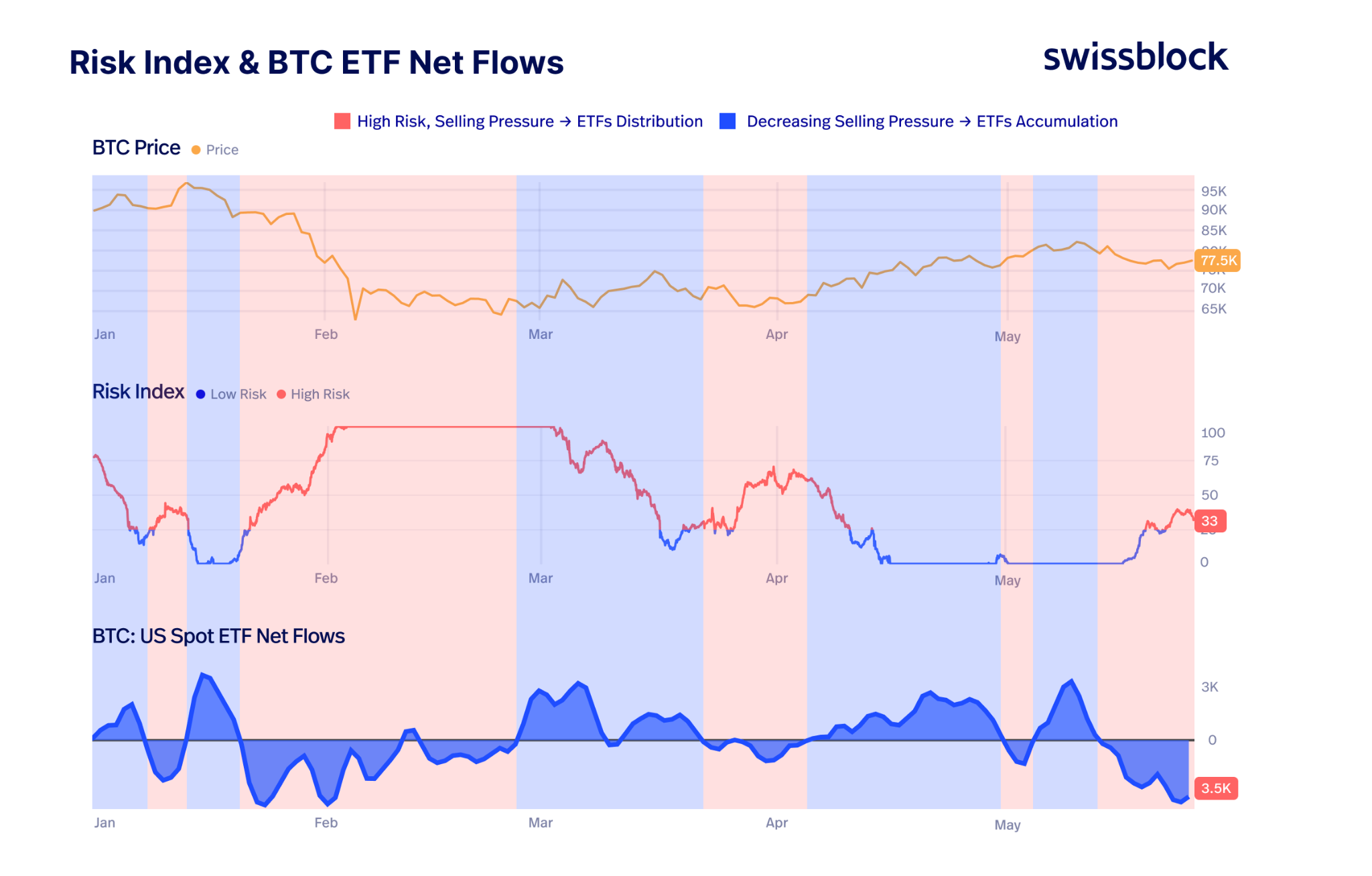
Bitcoin is sliding into a high-risk environment due to continued institutional selling, primarily from US spot exchange-traded funds, according to crypto analytics platform Swissblock.
Swissblock said on Tuesday that its Bitcoin risk index was at a high risk score of 33 out of 100, adding that “every time the Risk Index signals that selling pressure is structurally overwhelming the market, what sits underneath is institutional distribution.”
The platform’s proprietary risk index was developed to gauge the overall risk level in the Bitcoin market by measuring the relative balance between selling pressure and buying pressure, helping to assess how “risky” it currently is to buy or hold Bitcoin.
After strong accumulation in March and April, May has flipped back into distribution, and the risk index is now “moving into high-risk territory while ETF flows are deteriorating simultaneously,” said Swissblock.
It added that spot Bitcoin ETF demand is no longer absorbing selling pressure effectively, and without strong ETF support underneath, “the risk index can continue accelerating higher.”
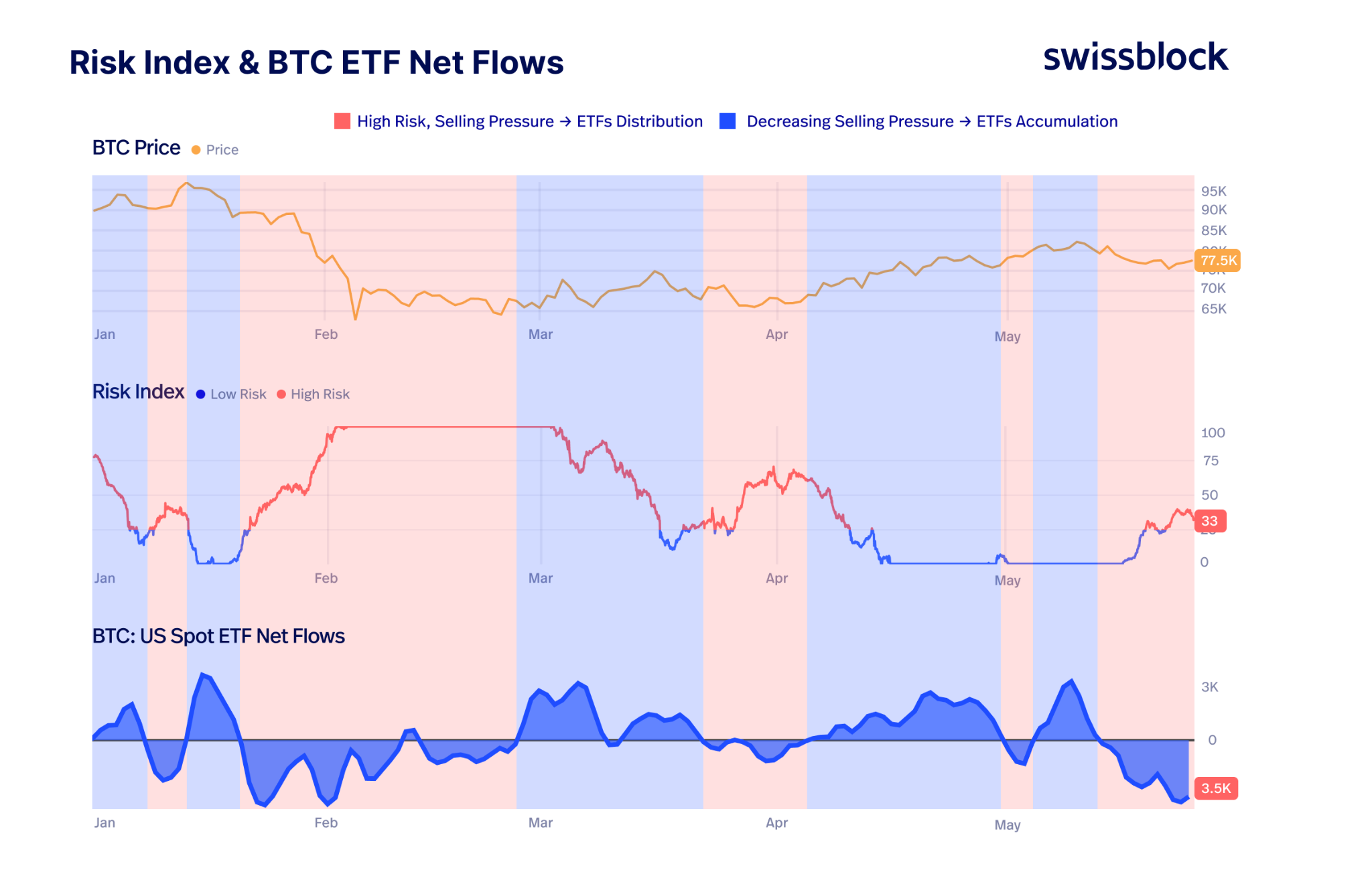
Bitcoin risk index accelerates with increasing ETF outflows. Source: Swissblock
Related: $1.26B Bitcoin ETF outflows spark ‘contrarian’ buy signal: Santiment
On-chain analytics provider Glassnode reported on Monday that US Bitcoin ETFs have recorded net outflows on nearly every trading day since May 7, showing “a persistent institutional sell signal now running for more than two weeks.”
“This steady drip of outflow continues to add to the supply side without a visible demand offset,” it said.
Jeff Ko, chief analyst at CoinEx, told Cointelegraph on Tuesday that the broader crypto market “remains in a holding pattern.”
“Spot ETF flows have posted more than $2 billion in outflows over the past two weeks, highlighting that institutional risk appetite is still sensitive at the margin,” he added.
Bitcoin dips as US strikes Iran
Risk was accelerated even further on Tuesday morning amid multiple reports that the US had launched fresh strikes on Iran despite the two countries recently making progress on a peace deal.
US Central Command said the strikes targeting Iranian missile sites and boats attempting to place mines were in “self-defense” and were to protect US troops from threats posed by Iranian forces.
Bitcoin reacted with a 1% decline, falling from over $77,000 to just below $76,500 on Coinbase, according to TradingView, but it has remained range-bound for almost four months.
Ko said that “despite Washington’s latest ‘self-defence’ operation, the very short-term market reaction may still lean risk-on, particularly as investors appear to be looking through the geopolitical noise and focusing on the possibility of a US-Iran peace deal.”
Magazine: Polymarket seeks Japan entry, Harvard dumps entire ETH position: Hodler’s Digest
Fundamental backdrop
In late April 2026, Japan’s Ministry of Finance moved from verbal warnings to direct action, carrying out a currency intervention worth roughly ¥5.5 trillion ($35 billion) — the first since July 2024. The move was triggered by the yen weakening beyond the psychologically significant level of 160 against the dollar.
Additional context comes from the divergence in monetary policy between the ECB and the Bank of Japan: the European regulator continues to leave the door open to tighter policy amid rising inflation expectations, while Tokyo maintains a cautious normalisation path without providing clear guidance on the timing of its next move.
Technical picture
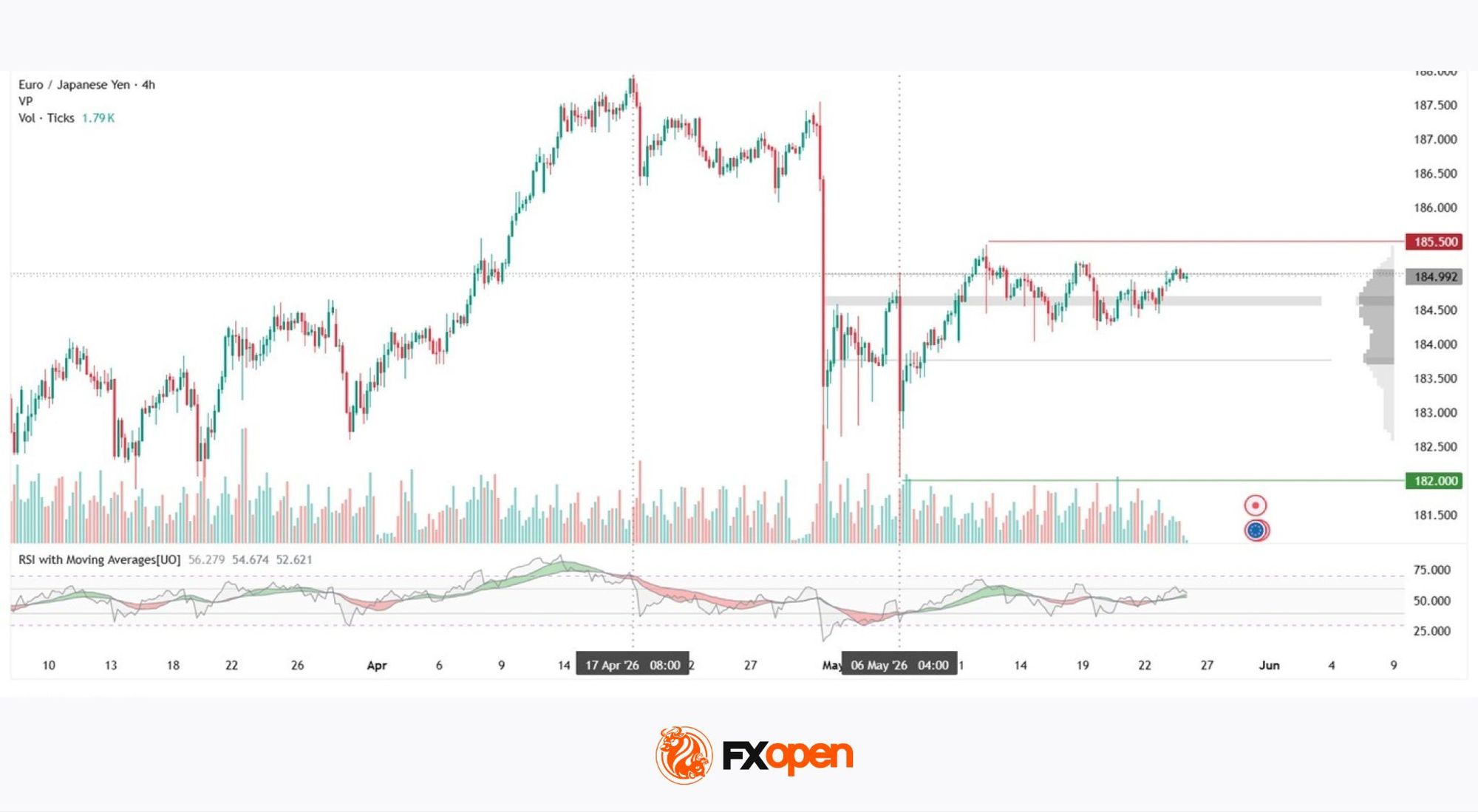
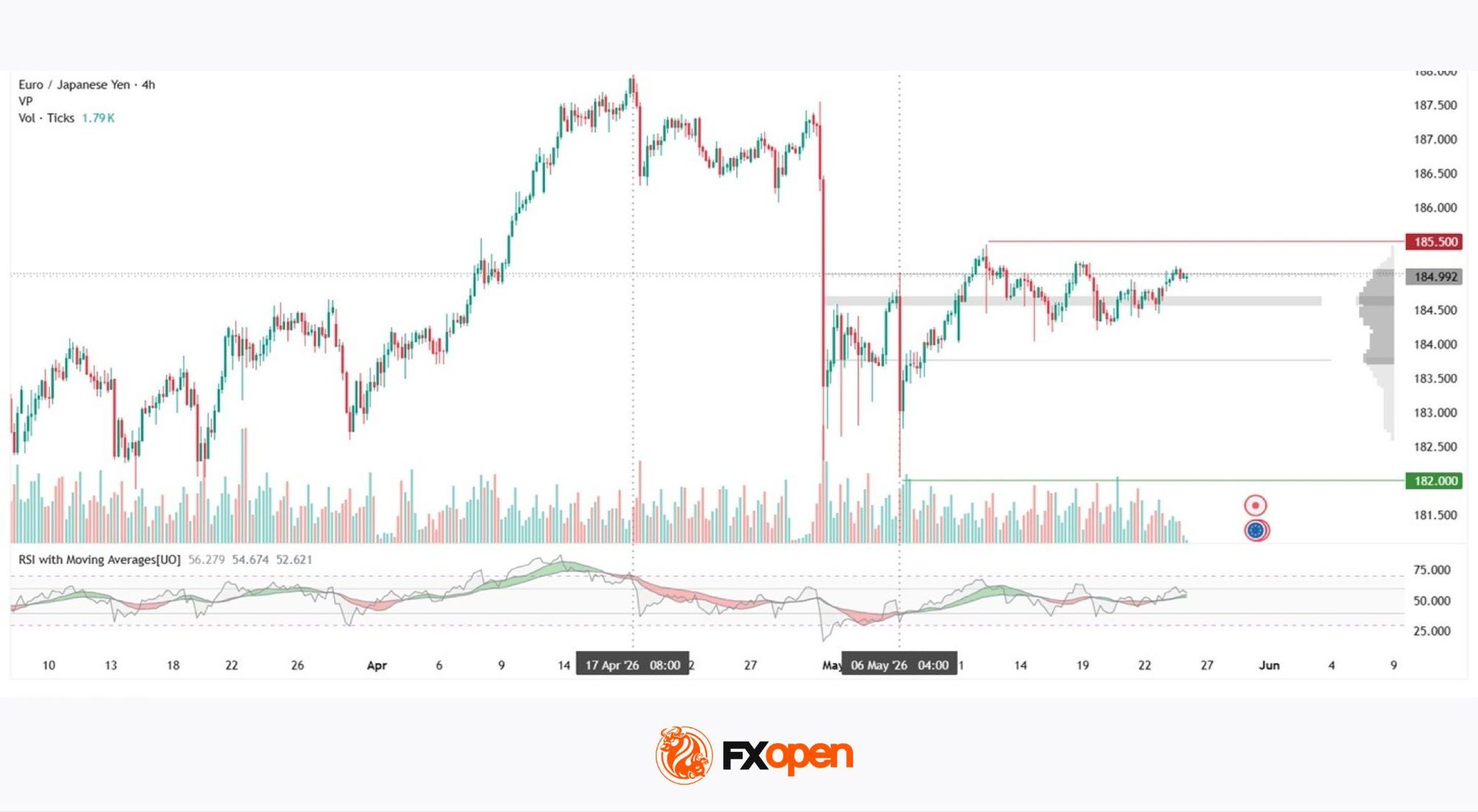
After reaching a local peak near 188 in mid-April, the EUR/JPY pair experienced two impulsive declines. The first occurred on 30 April, when the candlestick recorded an abnormal spike in vertical volume — a direct consequence of the Japanese Ministry of Finance intervention, which saw the yen strengthen by roughly 3% during the session. A second bout of sharp selling pressure followed in early May.
As a result, a horizontal profile formed with boundaries at 183.800–185.000, while the point of control is concentrated within the 184.50–184.70 range.
The price is now testing the upper boundary of the profile — an area where sellers have already shown activity on two separate occasions. The 182 region has held since February and could once again come into focus if pressure resumes: both May sell-offs reversed precisely from this zone, failing to break lower. Meanwhile, the 185.500 area could act as resistance should the current advance continue.
RSI + MA readings stand at 57 / 55 / 53 respectively — all three lines remain in neutral territory, with no clear signs of momentum.
Key takeaways
The current situation is shaped by the clash between interest-rate differentials and the willingness of the Japanese authorities to intervene again if necessary. For now, with RSI offering no directional impulse, the point of control and the profile boundaries remain the key reference levels for assessing the current trading range.
Trade over 50 forex markets 24 hours a day with FXOpen. Take advantage of low commissions, deep liquidity, and spreads from 0.0 pips (additional fees may apply). Open your FXOpen account now or learn more about trading forex with FXOpen.
This article represents the opinion of the Companies operating under the FXOpen brand only. It is not to be construed as an offer, solicitation, or recommendation with respect to products and services provided by the Companies operating under the FXOpen brand, nor is it to be considered financial advice.

Bitcoin prices slid back below $76,500 on Tuesday morning, down 1.5% from its intraday high of $77,700 on Monday.
The move followed reports that the United States had resumed strikes on Southern Iran, targeting missile sites and boats attempting to place mines.
The strikes were carried out “to protect our troops from threats posed by Iranian forces,” but the military was “using restraint during the ongoing ceasefire,” said US Central Command in a statement.
Deal or No Deal?
Just hours before, President Trump posted on Truth Social that negotiations with Iran are “proceeding nicely.”
“It will only be a Great Deal for all or no Deal at all — Back to the Battlefront and shooting, but bigger and stronger than ever before — And nobody wants that!”
Over the weekend, Trump claimed that a deal was “largely negotiated,” leading to hopes that it would be finalized this week.
Crude oil prices, which dipped below $90 for the first time this month on Monday, were back up around 2% as the conflict resumed.
Jeff Mei, chief operations officer at the BTSE exchange, remained optimistic. “We believe that if US attacks on Iran are limited, it’s unlikely that Bitcoin will fall lower than the $70k mark,” he said.
“However, if the conflict looks like it may be sustained over a longer period of time, Bitcoin could very well drop back to the $60k floor reached at the beginning of the conflict.”
Jeff Ko, chief analyst at CoinEx, agreed, telling CryptoPotato on Tuesday that technically, $70,000 remains the “next defended floor for Bitcoin,” while $65,000 would be the “next key stress level” if the macro or geopolitical backdrop deteriorates further.
“That said, I think Bitcoin’s ability to absorb recent macro shocks has actually been quite constructive,” he added.
“The asset has not broken down despite the geopolitical uncertainty, which suggests the market is consolidating rather than entering a full risk-off phase.”
Is BTC About to Fall Further?
Macro trader Jason Pizzino remained bearish, opining on X that Bitcoin looks to be getting ready to test the lows again, like it does every bear market.
“Falling volume, lack of social interest (search volume), and a structure reminiscent of further weakness,” he said.
Bitcoin looks to be getting ready to test the lows again like it does every bear market (or 4-year cycle).
Falling volume, lack of social interest (search volume), and a structure reminiscent of further weakness.
The perma bears will be calling lower and lower prices, while the… pic.twitter.com/KwowfhSWzb
— Jason Pizzino
(@jasonpizzino) May 26, 2026
BTC was trading at $76,480 at the time of writing, with further losses looking imminent.
The post Bitcoin Dips on Renewed US Strikes on Iran: Is the Peace Deal Off? appeared first on CryptoPotato.
Ether treasury company Bitmine Immersion Technologies has been included in a preliminary list for potential inclusion in the Russell 3000 index, a move that chairman Tom Lee hinted could provide tailwinds for the company’s stock.
FTSE Russell, a subsidiary of the London Stock Exchange Group, published a preliminary index inclusion list for the Russell 3000 on Friday, its index tracking the 3,000 largest companies in the US.
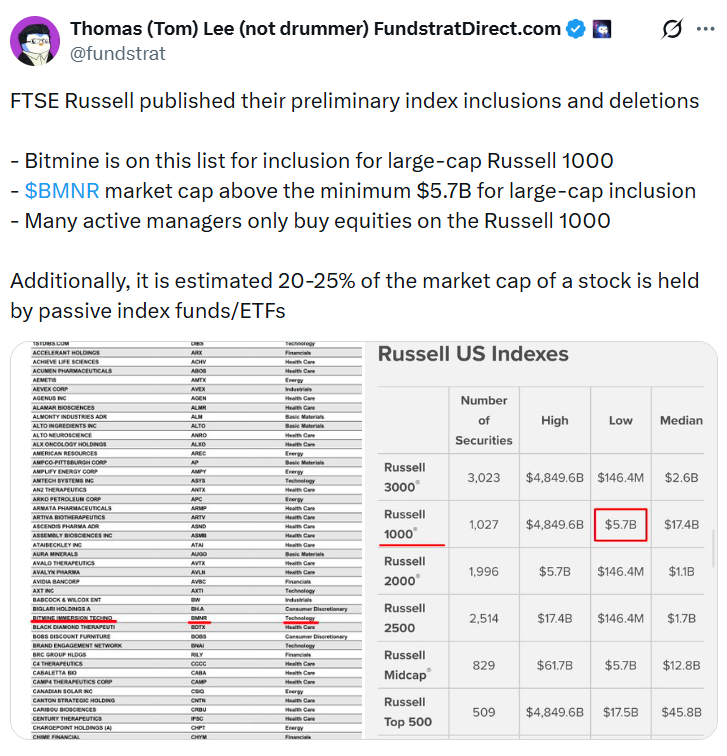
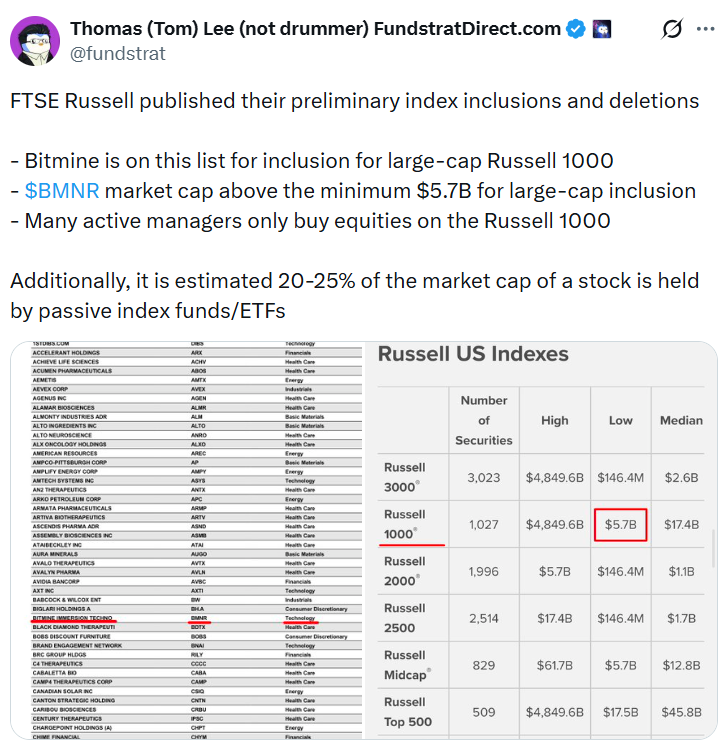
Lee said in an X post Saturday that Bitmine could be included in the Russell 1000, an index tracking the largest 1,000 US companies, due to the index’s minimum market capitalization threshold of $5.7 billion. Bitmine’s market cap was $10.15 billion as of market close on Friday.
Lee said that “many active managers only buy equities on the Russell 1000,” adding that it is estimated that up to 25% of the market cap of a stock included in the index is held by passive index funds or exchange-traded funds.
Source: Tom Lee
Bitmine’s inclusion in the Russell 1000 would place it in the same index as major US large-cap equities, including tech giants Nvidia Corporation, Microsoft, and Apple and could trigger automatic buying by passive funds, providing traditional investors with indirect exposure to its Ether holdings.
FTSE Russell will provide further list updates on, June 5, June 12 and June 18, and the newly reconstituted indexes take effect after the US market close on June 26.
Bitmine stock down 30% year to date
Shares in Bitmine Immersion Technologies (BMNR) are down over 30% year-to-date and closed trading on Friday at $18.88. The company announced plans to build an Ether treasury in July 2025. By July 3, its stock had spiked to more than $135. The company disclosed holdings of 163,142 Ether worth about $500 million on July 14 of the same year.
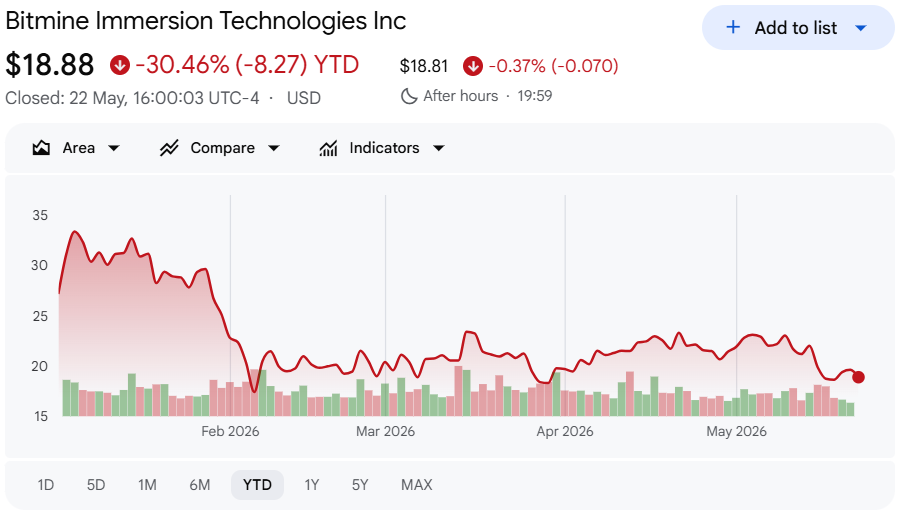
Bitmine’s stock is down over 30% year-to-date. Source: Google Finance
As of last week, Bitmine held 5.28 million Ether, or about 4.37% of Ethereum’s total supply, with the company’s ultimate goal to hold 5% of the token’s circulating supply of 120.7 million. To hit its target of over 6 million Ether, Bitmine needs around 756,538 more in its stash.
Related: Ether pullback was ‘attractive opportunity’ for 71,672 ETH buy: Bitmine’s Lee
Ether is down over 57% from its all-time high of $4,946, according to CoinGecko. BitMine also has an estimated $7.3 billion in paper losses due to the price drop.
However, Lee previously argued that Ether’s steep drawdown may offer another buying opportunity and said last Monday that the company has staked most of its stash, with annualized staking revenues of $289 million.
Magazine: Polymarket seeks Japan entry, Harvard dumps entire ETH position: Hodler’s Digest, May 17 – 23
XRP traded near $1.35 as Santiment’s sentiment ratio fell to 1.1, putting $1.30 support and a short-term rebound setup in focus.


Ondo Finance founder Nathan Allman has died, the company said in a post on X on Tuesday, without disclosing the cause.
“It is with profound sadness that we announce the unexpected passing of Nathan Allman, Ondo’s founder. Our hearts are with his family and loved ones,” the company said. “Nate’s brilliance, humility, and drive shaped every part of what Ondo is today. His belief in the power of technology to create a more open, accessible financial system lives on in everything we build.”
Ian De Bode, Ondo’s longtime president who has led strategy, product, and day-to-day operations for over two years, will serve as CEO. De Bode has the full confidence of the leadership team, the company said.
Allman, a Brown University graduate, founded Ondo in 2021 after working on Goldman Sachs’ digital assets team. Under his leadership, Ondo became a pioneer in tokenized real-world assets, growing total value locked to $3.5 billion.
Major products launched during his tenure include USDY, a yield-bearing stablecoin, OUSG, a tokenized U.S. Treasury fund, and tokenized equities through Ondo Global Markets.
The company said it would continue building what Allman started as the most meaningful way to honor him.

Wishaw drivers warned over number of road closures in coming weeks

Can Suzlon Energy shares rally up to 31% after Q4 results? Top brokerages weigh in

Ethereum at $2,100 as Vitalik denies selling: rebound next?

US brings back mandatory military draft registration

Steven Gerrard disagrees with Gary Neville over ‘shock’ Chelsea and Arsenal claim | Football

Register Renaming | Hackaday

How to Train Your Brain for Financial Success | 6 Steps to Become a Money Magnet#shorts #motivation
![Bitcoin Price Falling! More Pain Ahead For BTC & TradFi [Proof]](https://wordupnews.com/wp-content/uploads/2026/05/1779779423_maxresdefault-80x80.jpg)
Bitcoin Price Falling! More Pain Ahead For BTC & TradFi [Proof]

Is FD is safe ?? #ytshorts #finance #inverstment #dinvest #bank #education
-

 Crypto World5 days ago
Blockchain.com files with SEC for U.S. IPO
-

 Fashion4 days ago
Holiday Weekend Open Thread – Corporette.com
-

 Business4 days ago
Dell Technologies DELL Stock Surges 15% on AI Server Momentum and Analyst Upgrades in 2026
-

 Crypto World4 days ago
Bitcoin Accumulation Weakens as BTC Realized Losses Hit $600M
-

 Crypto World4 days ago
Space X IPO Is ‘Bad News’ for Tech Stocks: But What About Bitcoin?
-

 Politics4 days ago
Makerfield: a tale of two social-media histories
-

 Crypto World3 days ago
Robinhood crypto COO Tanya Denisova exits
-

 Crypto World4 days ago
MicroStrategy’s Saylor Says Miners No Longer Set Bitcoin Price, Another Force Has Taken Over
-

 Business2 days ago
NYT Strands Answers May 24 2026 Revealed for Puzzle No. 812 Theme Summer Essentials
-
 Tech4 days ago
A 0.12% parameter add-on gives AI agents the working memory RAG can’t
-

 Crypto World4 days ago
AI infrastructure race heats up as IREN pitches full-stack strategy, WhiteFiber lands $160M deal
-

 Tech4 days ago
WhatsApp ads could make Irish debut after discussions with DPC
-

 Tech4 days ago
You Can Now Add ChatGPT To PowerPoint
-

 Business4 days ago
Trump Invests $1M-$5M in Kura Sushi USA Chain With 27 California Locations
-
 NewsBeat5 days ago
Charity run by Reform leader Malcolm Offord accused of ‘law breaking’ over Scottish registration
-

 Sports4 days ago
2026 CJ Cup Byron Nelson leaderboard: Brooks Koepka finds putting stroke in Round 1
-

 Crypto World5 days ago
Exa Labs raises $250 million in funding led by a16z
-
Business4 days ago
Goldman Sachs reinstates Ageas stock coverage with neutral rating
-

 Crypto World4 days ago
Trump Media’s Bitcoin Stash Shrinks Again as 2,650 BTC Lands on Crypto.com
-
 Crypto World4 days ago
Verus Bridge Hacker Returns $8.5M ETH, Keeps $2.8M as Bounty
You must be logged in to post a comment Login