

Crypto World
XRP Price Falls Below $1.30, But Expert Says Something “Is Happening, The SEC is Doing it”


XRP price is falling, with more than 3% drop in a day as it is trading at $1.29. The $1.30 support zone, long treated as the floor of this corrective cycle, has cracked under sustained selling pressure. But at least one analyst thinks the real story isn’t on the XRP chart at all, it’s in Washington.
Finance expert Levi Rietveld went viral this week after posting on X: “I TOLD YOU XRP FAM!!!! ITS HAPPENING!!!! THE SEC IS DOING IT!!!,” attaching a video in which he argued the Federal Reserve is preparing to inject an initial $7 billion into the economy next week as the opening move of a quantitative easing cycle.
Rietveld contends that coordinated liquidity expansion across the U.S., China, and Europe would dramatically expand global M2 money supply, pushing capital into risk assets, including crypto. When more dollars circulate, investors chase yield further out on the risk curve.
Whether or not the Fed delivers, XRP’s price structure has deteriorated meaningfully over the past 48 hours.
Discover: The Best Crypto to Diversify Your Portfolio
Can XRP Price Reclaim $1.35?
The 89% bearish sentiment reading, paired with an Extreme Fear score of 25 on the Fear & Greed Index, captures the mood precisely. XRP has shed 10% over the last 2 weeks and sits a long way from its $3.65 peak.
Trading volume has jumped to above $2 billion, but mostly coming from sellers dumping the coin.
Technically, XRP has broken down from a triangle/pennant formation, lost the $1.35 pivot, and is now falling from the $1.30–$1.32 demand zone that previously launched a strong upside impulse. The 50-day moving average is declining, and the price is printing lower lows in a classic bearish market structure.

$1.30 is the neckline of a head-and-shoulders pattern, a close below that level could trigger an 18% measured move toward the $1.12–$1.20 area, and it’s now happening.
If today closes below $1.30, this would likely confirm a prolonged breakdown, opening downside targets at $1.20 and potentially $1.10 if selling accelerates.
Discover: The Best Token Presales
Bitcoin Hyper Attracts Rotation Capital
Watching a position bleed 10% in a month has a way of clarifying priorities. For traders reassessing exposure at current XRP levels, where upside to meaningful resistance at $1.60 is roughly 20% and downside risk to $1.10 is just as wide, the risk-reward calculus looks uncomfortably symmetrical.
That’s the moment early-stage infrastructure players start attracting attention. As XRP struggles to recover, capital is visibly rotating into higher-beta opportunities.
Bitcoin Hyper ($HYPER) is one presale drawing that flows. It positions itself as the first-ever Bitcoin Layer 2 with Solana Virtual Machine (SVM) integration, delivering sub-second finality and low-cost smart contract execution on top of Bitcoin’s security layer, targeting performance metrics that exceed Solana.
The presale has raised $32 million at a current token price of $0.0136, with a huge 36% APY staking rewards active for early participants. The Decentralized Canonical Bridge enables native BTC transfers into the ecosystem without wrapped-token counterparty risk.
Research Bitcoin Hyper before the current presale stage closes.
The post XRP Price Falls Below $1.30, But Expert Says Something “Is Happening, The SEC is Doing it” appeared first on Cryptonews.


OP Labs said exchange-owned chains built on the OP Stack generated more than $495 million in application revenue in the second half of 2025. The figure includes sequencer fees from transactions, revenue generated through applications embedded directly into exchange platforms, and assets that remained onchain.
According to the official press release shared with CryptoPotato, OP Labs said exchanges historically relied on third-party networks that captured much of the value generated from settlement activity, application fees, and broader onchain monetization linked to user activity.
OP Stack Onchain Revenue
Over the past year, however, applications running across exchange-owned chains built on the OP Stack have expanded rapidly. OP Labs highlighted that Morpho’s total value locked (TVL) on Coinbase-backed Base rose from $48 million at the beginning of 2025 to more than $960 million by the end of the year, representing nearly 20x growth. The company said the increase was driven mainly by lending products integrated directly into the Coinbase app rather than through wallet-based user acquisition.
Base has now become Morpho’s second-largest chain globally and accounted for 32% of Morpho’s application fees in H2 2025, which OP Labs said was 13 times that of Arbitrum and 60 times that of OP Mainnet.
Meanwhile, Kraken’s Ink chain added more than one million unique addresses since December 2024. OP Labs said fewer than 0.6% of those addresses had any prior onchain history with Kraken, while the remaining 99.4% represented net-new onchain wallets, which it described as evidence that exchange-owned chains are expanding the overall onchain market rather than merely shifting existing users between networks.
OP Labs further noted that Tydro, the Aave V3 white-label lending protocol launched on Ink in October 2025, reached $100 million in TVL within its first 24 hours and surpassed $500 million within 90 days. The company said comparable Aave deployments on neutral Layer 2 networks previously took between 142 and 721 days to reach similar milestones.
Optimism Foundation’s Chief Business Officer Kyle Jenke said the H2 figures showed a shift from the old system, where exchanges made money from trading while external networks captured the value generated thereafter. He added
“Exchanges now own the settlement, distribution, and application layers their users transact on. They’re doing it on a shared standard precisely so they don’t fragment from each other in the process.”
Ecosystem Record High
Across the wider ecosystem, OP Stack chains secured $16.33 billion in total value, held $6.8 billion in DeFi TVL, and processed 3.6 billion transactions during H2 2025. This was an all-time high across more than 50 live chains covering exchanges, consumer applications, financial infrastructure, and developer platforms.
Additionally, regulated companies are also choosing the OP Stack for institutional blockchain projects. Bitpanda’s Vision Chain uses the OP Stack for institutional finance aligned with Europe’s MiCA and MiFID II regulations, while Japan’s Mitsui & Co. Digital Commodities launched the regulated precious-metals-backed Zipangcoin on OP Mainnet.
The post Exchange-Owned OP Stack Chains Made Nearly $500M in Onchain Revenue, OP Labs Says appeared first on CryptoPotato.

Key Highlights
- Shares of Dollar Tree rallied 11% in premarket hours to approximately $106 following impressive Q1 results
- The company delivered adjusted EPS of $1.74, significantly surpassing the Street’s $1.53 expectation
- Total revenue increased 7.2% year-over-year to $4.98 billion, topping the $4.96 billion consensus
- Comparable store sales advanced 3.5%, exceeding analyst projections of 3.3%
- The discount retailer unveiled a strategic on-demand delivery collaboration with DoorDash
Dollar Tree delivered an impressive first fiscal quarter performance, propelling shares 11% higher to roughly $106 during Thursday’s premarket session.
The discount chain had experienced a 22% decline in 2026 prior to this earnings release — marking the first complete calendar year following the company’s divestiture of its Family Dollar division at a substantial loss during the previous summer.
On an adjusted basis, earnings per share reached $1.74, representing a jump from $1.26 in the same period last year and comfortably beating the analyst consensus of $1.53, based on FactSet data.
Top-line revenue expanded 7.2% to $4.98 billion, narrowly exceeding the Street’s projection of $4.96 billion.
Comparable store sales posted a 3.5% year-over-year gain, fueled by a 4.5% increase in average transaction value. Customer traffic declined 1%, though the elevated spending per visit successfully counterbalanced this softness.
CEO Mike Creedon characterized the performance as evidence of “continued progress across the business” and highlighted merchandise assortment enhancements, expense discipline, and store-level improvements as primary catalysts.
DoorDash Partnership Expands Delivery Capabilities
In a separate announcement Thursday morning, DoorDash revealed a new partnership with Dollar Tree that will enable on-demand delivery across the retailer’s entire U.S. store network.
Dollar Tree currently maintains delivery relationships with Uber Eats and Instacart for expedited fulfillment, making DoorDash the latest addition to its third-party platform ecosystem.
Company Lifts Full-Year Forecast
Looking to Q2, Dollar Tree provided adjusted EPS guidance of $1.00 to $1.15 on midpoint net sales of $4.85 billion. Wall Street had previously modeled $0.99 per share on $4.84 billion in revenue.
Second-quarter comparable sales are projected to climb 2.5% to 3.5%, compared to the consensus estimate of 2.8%.
Management increased its full-year EPS guidance range to $6.70–$7.10 per share, up from the previous target of $6.50–$6.90. This new range exceeds the current Street consensus of $6.67.
The retailer maintained its full-year net sales outlook at $20.5 billion to $20.7 billion, with comparable sales growth anticipated in the 3% to 4% range for fiscal 2025.


Polymarket has moved to ease a wave of regulatory uncertainty around its service by clarifying its stance on identity checks. The platform’s vice president of engineering, Josh Stevens, said there will be no mandatory KYC (Know Your Customer) requirements for the core Polymarket.com platform. Instead, a new beta product will require KYC access only during its early testing phase, after which no KYC will be required to use the main site.
The clarification follows a report from The Information that Polymarket had considered imposing user verification amid mounting regulatory scrutiny. Stevens reaffirmed the distinction: identity checks are tied specifically to early access for a separate beta product, not to the established prediction market that underpins Polymarket’s main offering.
Cointelegraph contacted Polymarket and Stevens for further comment but did not receive an immediate response. For context, the company has been navigating a broader regulatory landscape that has included widening geoblocking and cross-border access restrictions in several jurisdictions.
Key takeaways
- Polymarket states no KYC will be required for its main platform; KYC will only apply to a beta product during its early access phase.
- Stevens cautioned that this beta-related identity check is not an indicator of a broader shift away from pseudonymous trading on Polymarket’s core market.
- The clarification comes amid reporting that regulatory pressure has prompted discussions around user verification and platform access.
- Regulatory restrictions are expanding, with dozens of geographies outlined in Polymarket’s access controls and several jurisdictions taking action against prediction-market platforms.
- Policy and market dynamics point to a fragile balance between global access to prediction markets and the regulators’ focus on licensing and consumer protection.
KYC clarification amid regulatory pressures
The core message from Polymarket comes directly from Stevens’ X (formerly Twitter) posts, where he said the beta product would require KYC only for early access and that no KYC would be added to the existing Polymarket.com platform as part of this launch. He later emphasized that these identity checks are tied to a new beta product’s early access, not to a broader move away from pseudonymous participation on the main market.
The report from The Information had suggested that Polymarket had considered mandatory user verification in response to regulatory scrutiny. While multiple outlets have explored the regulatory implications for crypto-linked prediction markets, Polymarket’s stance here appears designed to prevent a blanket shift away from its current model while still enabling a controlled trial of a new product with identity checks.
Markets and users are watching how this will be implemented in practice. The beta will be accessible to a select group of users, with Stevens signaling that the approach is experimental and isolated from the platform’s ongoing, non-beta operations.
Geoblocking and the evolving regulatory backdrop
Polymarket’s stance arrives as the platform contends with expanding access restrictions in several jurisdictions. A Cointelegraph report noted that Polymarket had restricted access in dozens of jurisdictions, with some regions blocking new orders while others only permitting closing positions. The evolving geoblocking landscape underscores the tension between global reach and local regulatory regimes.
In April, Brazil moved to block Polymarket and other prediction platforms, among 27 services, in what authorities described as actions against unlicensed gambling activity. Spain’s gambling regulator followed suit in May, blocking local users from Polymarket and Kalshi as it pursued investigations into unlicensed gaming activity.
Despite these regulatory frictions, Polymarket has not halted expansion efforts. Reports from April suggested dialogue with the U.S. Commodity Futures Trading Commission (CFTC) about a broader relaunch in the United States, while May coverage indicated ongoing interest in entering Japan, despite the country’s strict gambling laws.
The dynamic illustrates a wider pattern in which prediction-market platforms face a patchwork of national rules, some of which permit limited participation while others impose outright bans or licensing requirements. For investors and users, the key question is whether access constraints—and any future KYC requirements—will erode liquidity or alter the platform’s competitive landscape.
Implications for users, investors, and builders
From a user perspective, the distinction between a beta-access KYC requirement and a non-KYC core platform matters. Beta participants may gain early exposure to new features or risk controls, but access will be limited. For the broader user base, Polymarket’s public, pseudonymous trading model remains a potential differentiator in a sector where regulators are increasingly scrutinizing online gambling and prediction-market activities.
For investors and platform builders, the situation highlights several critical considerations. First, regulatory alignment remains a moving target, with regional actions potentially changing the feasibility of cross-border participation. Second, any future product iterations that incorporate identity checks could set a precedent for other prediction-market operators seeking regulatory legitimacy, while simultaneously risking reduced user anonymity and participation in certain markets.
Finally, the ongoing talks and market rumors about a possible U.S. relaunch with regulatory clarity from the CFTC, alongside interest in markets such as Japan, signal a strategic pivot toward compliance-driven expansion. Yet the path remains uncertain, given the patchwork nature of global regulation and the persistent questions around licensing, consumer protection, and enforcement in different jurisdictions.
Analysts will be watching not only the technical rollout of the beta but also how Polymarket negotiates the balance between user privacy, regulatory expectations, and the demand for faster, more accessible forecasting markets. As jurisdictions continue to shape the boundaries of permissible activity, the platform’s ability to sustain liquidity and user trust will hinge on transparent governance and clear, enforceable rules.
Readers should monitor updates from Polymarket’s leadership, regulatory developments in key markets, and any formal statements about beta access criteria, licensing steps, or changes to the main platform’s KYC posture as the year progresses.


On March 4, 2026, the Sui blockchain launched USDsui, a US dollar stablecoin issued by Bridge (a Stripe-acquired firm) through its Open Issuance platform.
Summary
- USDsui routes reserve yield into SUI buybacks and DeFi liquidity instead of issuer-only revenue.
- Sui’s prior $1T stablecoin volume gives the model a real base to test adoption.
- Bridge’s Stripe-backed Open Issuance platform gives USDsui enterprise rails and cross-network potential.
- The model’s success depends on market share migration from USDC and USDT.
The launch was treated by most coverage as a routine product announcement. The structural reality is more consequential. USDsui is the first major Layer-1 native stablecoin where the reserve yield flows back to the underlying network rather than to the issuer. Sui processed over $1 trillion in cumulative stablecoin transfers before launching its own, including $111 billion in January 2026 alone. The yield generated on those reserves, under the traditional Circle and Tether model, would have gone to the issuer. Under USDsui, it goes to SUI token buybacks and DeFi liquidity. This is a structural shift in how blockchain economics work, and it may matter more than the launch headlines suggested.
What USDsui actually is
The Sui blockchain launched USDsui on March 4, 2026, after announcing the product in November 2025. The stablecoin is issued by Bridge, which Stripe acquired for $1.1 billion in February 2025. Bridge runs the Open Issuance platform, which launched September 30, 2025, and provides infrastructure for launching network-aligned stablecoins. The custodians for USDsui’s reserves are BlackRock, Fidelity, and Superstate. The underlying backing consists of US Treasury bonds and other liquid financial instruments.
In the simplest terms, USDsui is a dollar-pegged stablecoin like USDC, USDT, RLUSD, or PYUSD. The same basic mechanics apply: one USDsui equals one US dollar, the issuer holds reserves equal to the circulating supply, users can mint and redeem for dollars through approved channels, and the token works as a payment and trading instrument on the Sui blockchain.
What makes USDsui structurally different from the dominant stablecoin models is what happens to the reserve yield. The issuer holds the reserves in interest-bearing instruments (mostly short-term US Treasury bonds). Those instruments generate yield. Under the traditional model, that yield goes to the issuer as revenue. Under USDsui’s model, the yield flows back to the Sui network through two channels: SUI token buybacks and capital deployed into DeFi protocols and automated market makers.
This is the structural innovation. The yield that would have gone to Bridge as issuer revenue under a Circle or Tether model instead goes back to the network whose blockchain the stablecoin runs on. The arrangement is enabled by Bridge’s Open Issuance platform, specifically designed to support this kind of yield-sharing structure with networks rather than retain all reserve income for Bridge itself.
The result is a stablecoin where the economic incentives align with the underlying blockchain rather than against it. The more USDsui circulates on Sui, the more reserve income flows back to the Sui ecosystem. The arrangement creates a positive feedback loop that does not exist with USDC on Solana, USDT on Tron, or any other dominant stablecoin-blockchain pairing where the issuer captures all the economic upside.
Why this matters more than it looks
To understand why USDsui’s yield redistribution model is structurally significant, you need to understand the scale of money being captured by stablecoin issuers in the traditional model.
Tether, the largest stablecoin issuer, reportedly generated over $13 billion in profit in 2024 alone. The vast majority of that profit came from yield on the reserves backing USDT. Tether holds approximately $130 billion in reserves, mostly in short-term US Treasuries that yield around 4 to 5 percent annually. The math is straightforward: $130 billion at roughly 5 percent yield produces $6.5 billion in annual reserve income, before considering Tether’s other investments and trading activities.
Circle, the issuer of USDC, follows a similar model. Circle’s recent IPO disclosed that the company’s revenue is overwhelmingly driven by reserve yield, with management fees representing a relatively small portion of total revenue. The structure is the same: USDC circulates, Circle holds the reserves, the reserves generate yield, Circle keeps the yield.
The question USDsui asks is: why should the issuer capture all of that yield when the blockchain provides the rails that make the stablecoin usable?
Under the traditional model, the answer is “because the issuer takes on the regulatory and operational risk.” That answer is partially accurate. Stablecoin issuers do bear meaningful regulatory burdens, operational costs, and reputational risk. But the answer also obscures the reality the blockchain provides essential infrastructure (settlement, transaction processing, smart contract integration) that makes the stablecoin commercially valuable. Without the blockchain, the stablecoin would be a database entry with no utility.
Bridge’s Open Issuance platform, which Stripe inherited through its acquisition, is built around the premise this revenue split has been unbalanced. The platform offers networks the ability to launch stablecoins where the reserve yield is shared with the underlying network rather than retained entirely by the issuer. Sui is one of the first major networks to use this structure at scale, and USDsui is the proof of concept.
If the model works as designed, the implications are significant. Every Layer-1 blockchain that hosts substantial stablecoin volume would, in principle, prefer a native stablecoin arrangement where the network captures some of the reserve yield. The dominance of USDC and USDT across the industry would, over time, face structural pressure from native alternatives offering better economics to the underlying networks.
This is the broader competitive question USDsui raises. Whether the answer plays out in Sui’s favor depends on adoption, integration, and whether other networks follow with similar native stablecoin strategies.
The numbers that make Sui specifically a logical launch network
USDsui is not the first attempt at a network-aligned stablecoin. Earlier projects, including USDH on Hyperliquid, have tried similar structures with varying success. What makes Sui a particularly logical platform for this experiment is the scale of stablecoin activity the network was already supporting before USDsui launched.
Sui processed over $1 trillion in cumulative stablecoin transfers as of early 2026. In January 2026 alone, the network handled $111 billion in stablecoin transfer volume. Between August and September 2025, Sui processed a combined $412 billion in stablecoin transfers. These numbers, sourced from Sui’s own reporting, place the network among the larger stablecoin transfer venues globally.
The math implies meaningful potential yield capture. If even a fraction of that transfer activity flows through USDsui rather than USDC or USDT, the network captures yield that previously went to Circle or Tether. The exact percentage of yield that flows back to Sui under the USDsui structure has not been publicly disclosed in precise terms, but the general framework distributes a substantial share to the Sui ecosystem.
The activity is real and growing. The network’s stablecoin throughput has scaled materially over the past 18 months, driven by DeFi protocols (Suilend, NAVI, Bluefin, Scallop, Cetus, Turbos), decentralized exchange volume (DeepBook), and growing institutional integration. USDsui launches into an ecosystem that already has the stablecoin activity to justify the structure, rather than launching into a hypothetical future demand.
This is the practical reason Sui chose to move first on the native stablecoin strategy. The volume already exists. The yield capture is real. The question is whether USDsui can capture meaningful share from the dominant stablecoins now operating on the network.
How the yield loop actually works
The mechanics of USDsui’s yield redistribution are worth understanding in detail, because they determine whether the structural promise translates into operational reality.
When a user mints USDsui by depositing dollars, those dollars are sent to Bridge, which manages the reserves through its custodial relationships with BlackRock, Fidelity, and Superstate. Bridge invests the deposited dollars in US Treasury bonds and other liquid instruments that generate yield. The reserves are held one-to-one against circulating USDsui supply, ensuring the stablecoin can be redeemed at any time for the face value of one dollar.
The yield generated by the reserves accumulates as Bridge holds the Treasuries. Under the traditional model, this yield would flow to the issuer as revenue. Under the USDsui structure, the yield is redirected through Bridge’s Open Issuance platform back to the Sui Foundation, which then deploys it through two channels.
The first channel is SUI token buybacks. The yield is used to buy SUI from the open market, which reduces circulating supply and supports the token’s price through structural demand. This is similar to the buyback mechanism Hyperliquid runs with HYPE, though smaller in absolute scale because USDsui is newer and the reserve base is smaller than Hyperliquid’s protocol revenue.
The second channel is DeFi liquidity provision. The yield is deployed into automated market makers, lending protocols, and other DeFi infrastructure on Sui to deepen on-chain liquidity. This is meant to improve the trading experience on Sui-based DeFi, reduce slippage for users, and incentivize further DeFi development on the network.
Both channels are designed to create a positive feedback loop. More USDsui circulation produces more reserve yield. More reserve yield produces more SUI buybacks and deeper DeFi liquidity. Higher SUI price and better DeFi infrastructure attract more users and activity to Sui. More activity drives more USDsui adoption, which produces more reserve yield. The loop, if it holds, is self-reinforcing.
What the loop requires to hold is consistent USDsui adoption growing relative to other stablecoins on the network. If USDC keeps dominating Sui’s stablecoin activity, the yield captured by USDsui is limited to the share of activity that migrates to the native option. The faster USDsui captures market share from existing stablecoins on the network, the larger the yield loop becomes.
This is the operational question that will determine USDsui’s success. The structural framework is in place. The technical infrastructure works. The economic incentives align. Whether users, developers, and DeFi protocols actually migrate to USDsui in meaningful volume is the empirical question the next 12 to 18 months will answer.
The Stripe and Bridge connection
The infrastructure behind USDsui deserves more attention than it gets in most coverage. Bridge, the issuer, was acquired by Stripe for $1.1 billion in February 2025. The acquisition gave Stripe a foothold in stablecoin issuance infrastructure that complements its core payments business.
Stripe is one of the largest payment processors in the world, handling hundreds of billions of dollars in annual transaction volume across millions of businesses. The company has been gradually expanding into crypto-adjacent infrastructure, including stablecoin payments, on-chain settlement, and now stablecoin issuance through Bridge.
The strategic implications of Stripe-as-issuer are substantial. Stripe brings institutional credibility, regulatory relationships, payment processing infrastructure, and a global customer base traditional crypto-native stablecoin issuers cannot easily match. For USDsui specifically, Stripe’s involvement signals the product is being built to enterprise standards rather than as a crypto-experimental project.
Bridge’s Open Issuance platform, which launched September 30, 2025, is the technical infrastructure that makes the USDsui structure possible. The platform is designed to let networks like Sui launch custom stablecoins with yield-sharing arrangements traditional issuance models do not support. Open Issuance is, in effect, the productized version of the network-aligned stablecoin concept.
If Open Issuance proves successful with USDsui, the platform is positioned to launch similar native stablecoins for other major Layer-1 networks. The competitive implications extend beyond Sui. If networks like Avalanche, Aptos, NEAR, or others adopt similar native stablecoin strategies through Bridge’s platform, the broader market share calculus for USDC and USDT shifts. The question for Circle and Tether becomes whether they can match the yield-sharing terms network-native alternatives can offer.
The Bridge platform also brings regulatory compliance built into the structure. USDsui is compliant with the GENIUS Act, which President Trump signed into law on July 18, 2025. The legislation established the federal payment stablecoin framework, and Bridge’s infrastructure is designed to work within that framework from launch. This is a meaningful difference from earlier network-aligned stablecoin attempts that operated in regulatory gray areas.
What this means for other stablecoins on Sui
USDC, USDT, and other dominant stablecoins still run on Sui. The launch of USDsui does not eliminate them. The question is how the competitive dynamics play out over time.
For users, the differences between USDsui and other stablecoins on Sui are subtle. All major stablecoins maintain the one-to-one peg with the US dollar. All are usable for payments, trading, and DeFi participation. The user experience of holding USDsui versus USDC versus USDT is, at the transaction level, nearly identical.
The differences become more visible when you look at where the value flows. Using USDC on Sui generates reserve yield that goes to Circle. Using USDsui on Sui generates reserve yield that goes back to the Sui ecosystem. For sophisticated users who care about the broader economic implications of their stablecoin choices, USDsui offers a structural alignment the other options do not.
For DeFi protocols, the calculation is more direct. Protocols that build liquidity around USDsui benefit from the DeFi liquidity deployment channel in the yield loop. The Sui Foundation can deploy yield-generated capital into specific protocols that use USDsui as their primary stablecoin. This creates direct economic incentives for protocols to prioritize USDsui integration over competing stablecoins.
For institutional users, the choice depends on existing relationships, regulatory considerations, and operational preferences. Institutions that have built infrastructure around USDC will not switch easily. Institutions evaluating new digital asset infrastructure may consider USDsui as a structurally aligned option with strong regulatory framework support through Bridge’s GENIUS Act-compliant structure.
The realistic outcome is probably gradual market share migration rather than dramatic displacement. USDC and USDT are deeply entrenched, have first-mover advantage on most networks, and benefit from network effects in trading pair liquidity and exchange listings. USDsui starts at zero market share and needs to grow through organic adoption rather than network displacement.
The pace of that growth will determine whether USDsui becomes a significant player in Sui’s stablecoin landscape or stays a niche option with structural advantages that fail to translate into market dominance.
The competitive question for other Layer-1s
The most interesting implication of USDsui is not what it means for Sui specifically. It is what it means for every other major Layer-1 blockchain that hosts substantial stablecoin activity.
Solana processes more stablecoin transfer volume than Sui. Ethereum hosts the largest absolute stablecoin supply. Tron is the dominant network for USDT transfers globally. Each of these networks generates substantial stablecoin activity that produces reserve yield. Each of those reserve pools is captured by Tether, Circle, or other issuers rather than by the underlying networks.
Under the USDsui model, each of these networks would have economic incentive to launch native stablecoins that capture some of the reserve yield rather than ceding it entirely to external issuers. The infrastructure to do this (Bridge’s Open Issuance platform, or competing platforms that may emerge) is now available. The regulatory framework (GENIUS Act in the US, MiCA in the EU) provides structural clarity. The economic logic is straightforward.
The constraints are also real. Solana, Ethereum, and other major networks have deep integration with existing stablecoins that would be expensive and disruptive to migrate away from. Network effects in stablecoin liquidity make it difficult for new entrants to displace established players. The user experience switching costs are substantial. And Circle, Tether, and other issuers are not passive participants. They will compete aggressively to maintain their positions.
But the structural pressure USDsui creates is real. If the model proves successful on Sui, other networks face a choice: accept that they cede billions of dollars in potential annual yield to external stablecoin issuers, or pursue similar native stablecoin strategies. The first choice is the status quo. The second choice is a meaningful shift in how blockchain economics work.
This is the broader competitive question USDsui raises that goes beyond Sui specifically. The model may or may not succeed for Sui. The model existing and being operationally proven changes the strategic calculus for every other network that hosts substantial stablecoin activity.
For Tether and Circle, the structural threat is similar to the one the CLARITY Act’s stablecoin yield provisions create. Both developments push toward a world where the reserve yield captured by stablecoin issuers is increasingly shared with networks, exchanges, or end users rather than retained entirely by the issuer. The era of issuers capturing all the yield, which has produced extraordinary profits for Tether specifically, may be entering a structural decline.
What could go wrong
A fair assessment of USDsui has to name the conditions under which the strategy could fail.
The first risk is adoption. The yield loop only works if USDsui captures meaningful market share from existing stablecoins on Sui. If users and DeFi protocols keep defaulting to USDC and USDT despite the structural advantages of USDsui, the reserve base stays small and the yield loop is too modest to drive meaningful network effects. This is a real possibility because stablecoin adoption is sticky and the user experience differences between options are subtle.
The second risk is operational complexity. The yield-sharing arrangement between Bridge, the Sui Foundation, and the underlying SUI buyback and DeFi liquidity channels requires sophisticated coordination. Operational failures, accounting disputes, or governance disagreements over how the yield is deployed could undermine the structure’s credibility and adoption.
The third risk is regulatory. While USDsui is structured to comply with the GENIUS Act, the broader regulatory environment for yield-sharing stablecoin structures is still evolving. The CLARITY Act’s provisions on stablecoin yield and the ongoing fight between banking interests and crypto on this question create uncertainty about how regulators will treat USDsui’s structure long-term. A future regulatory change could require modifications that weaken the model.
The fourth risk is competitive response. Circle and Tether are not going to passively accept market share loss to network-aligned stablecoins. Both companies have substantial resources and could match USDsui’s yield-sharing structure for specific networks if they choose to do so. Circle’s banking license pursuit and operational scaling are partly defensive moves against exactly this kind of competitive threat. If Circle introduces a USDC variant with yield-sharing for major networks, USDsui’s structural advantage narrows.
The fifth risk is broader market conditions. USDsui’s yield loop depends on Treasury yields staying high enough to generate meaningful reserve income. If interest rates fall significantly, the absolute yield captured shrinks, and the buyback and DeFi liquidity channels become less impactful. The current rate environment is favorable. A return to near-zero rates would weaken the model.
None of these risks invalidate the structural innovation USDsui represents. They are the conditions under which the model could fail or be diluted. The honest read is that USDsui is a meaningful experiment in network-aligned stablecoin design whose success depends on factors largely outside Sui’s direct control.
What to watch over the next 12 months
For readers tracking USDsui’s progress and the broader native stablecoin question, three things are worth watching over the coming year.
The first is USDsui’s market share on Sui. If USDsui captures 20 to 30 percent of Sui’s stablecoin volume within a year, the model is working as designed and the yield loop becomes structurally meaningful. If USDsui stays under 10 percent, the model is struggling against network effects and user inertia.
The second is whether other Layer-1 networks follow with similar native stablecoin launches through Bridge’s Open Issuance platform or competing infrastructure. If Avalanche, Aptos, or NEAR launches a similar arrangement in 2026 or 2027, the structural shift toward network-aligned stablecoins becomes a sector-wide pattern rather than a Sui-specific experiment. If no major network follows, USDsui remains an isolated case study.
The third is competitive response from Circle and Tether. Both companies will likely respond to the structural threat in some form, whether through their own yield-sharing arrangements, aggressive partnership deals with major networks, or regulatory advocacy that constrains the network-aligned stablecoin model. The shape of that response will determine how much of the structural shift USDsui represents actually translates into broader market change.
The bottom line
USDsui is more interesting than it looks. The launch was treated as a routine product announcement by most coverage. The structural reality is USDsui represents one of the first serious attempts to break the dominant stablecoin business model where issuers capture all the reserve yield while networks provide the infrastructure that makes the stablecoin valuable.
The math is genuinely consequential. Tether generated over $13 billion in profit in 2024 from reserve yield. Circle’s revenue is overwhelmingly driven by the same source. The blockchains that provide the rails for these stablecoins captured none of that economic value. USDsui changes the equation by routing reserve yield back to the underlying network through SUI buybacks and DeFi liquidity deployment.
Whether the model succeeds depends on adoption, competitive dynamics, and regulatory evolution. The structural framework is in place. The infrastructure works. The economic incentives align. The empirical question is whether users, developers, and DeFi protocols actually migrate to USDsui in meaningful volume on the network, and whether other major Layer-1 networks follow with similar strategies.
For Sui specifically, USDsui is a long-term structural positive that supports the network’s positioning as a payments and DeFi platform. The yield captured will compound over time, supporting SUI’s price and the network’s DeFi infrastructure. The impact in the first 12 months will be modest. The impact over 24 to 36 months could be substantial if adoption follows the structural framework.
For the broader stablecoin market, USDsui is a meaningful test case. If the model proves successful, the structural pressure on Circle and Tether’s business models intensifies. If it fails, the dominant model goes unchallenged. The outcome will shape how stablecoin economics evolve across the industry for the rest of the decade.
For readers, the practical lesson is native stablecoins are no longer just a theoretical concept. USDsui is operational, regulated, backed by enterprise-grade infrastructure through Stripe’s Bridge, and integrated across Sui’s major DeFi protocols. The model is being tested in real conditions, with real adoption metrics that will tell us within 12 to 18 months whether the structural innovation translates into competitive market share.
The Stripe and Bridge backing matters because it brings institutional credibility purely crypto-native stablecoin alternatives have struggled to match. The Open Issuance platform matters because it productizes the network-aligned stablecoin model for replication across other networks. The Sui Foundation’s commitment matters because it shows major Layer-1 networks are willing to bet on this structural approach.
USDsui is not going to displace USDC or USDT in the next 12 months. The question is whether USDsui shows a different model is viable, and whether that demonstration changes the strategic calculus for every other major blockchain network that currently lets its stablecoin yield flow entirely to external issuers.
That is the bet Sui is making with USDsui. The bet is rational. The execution is in place. The outcome will be visible in the adoption metrics over the next year.
What this all comes down to is a simple question: should the reserve yield from blockchain stablecoin activity go to the issuer or to the network that provides the infrastructure? The traditional answer has been the issuer. USDsui is the first serious attempt to give a different answer at scale.
The answer to that question, however it plays out, will define a significant piece of how blockchain economics work for the next decade.
This article is for informational purposes and does not constitute financial or investment advice. Stablecoin structures and adoption metrics evolve quickly; the figures and milestones described reflect reporting available as of late May 2026. Always do your own research.
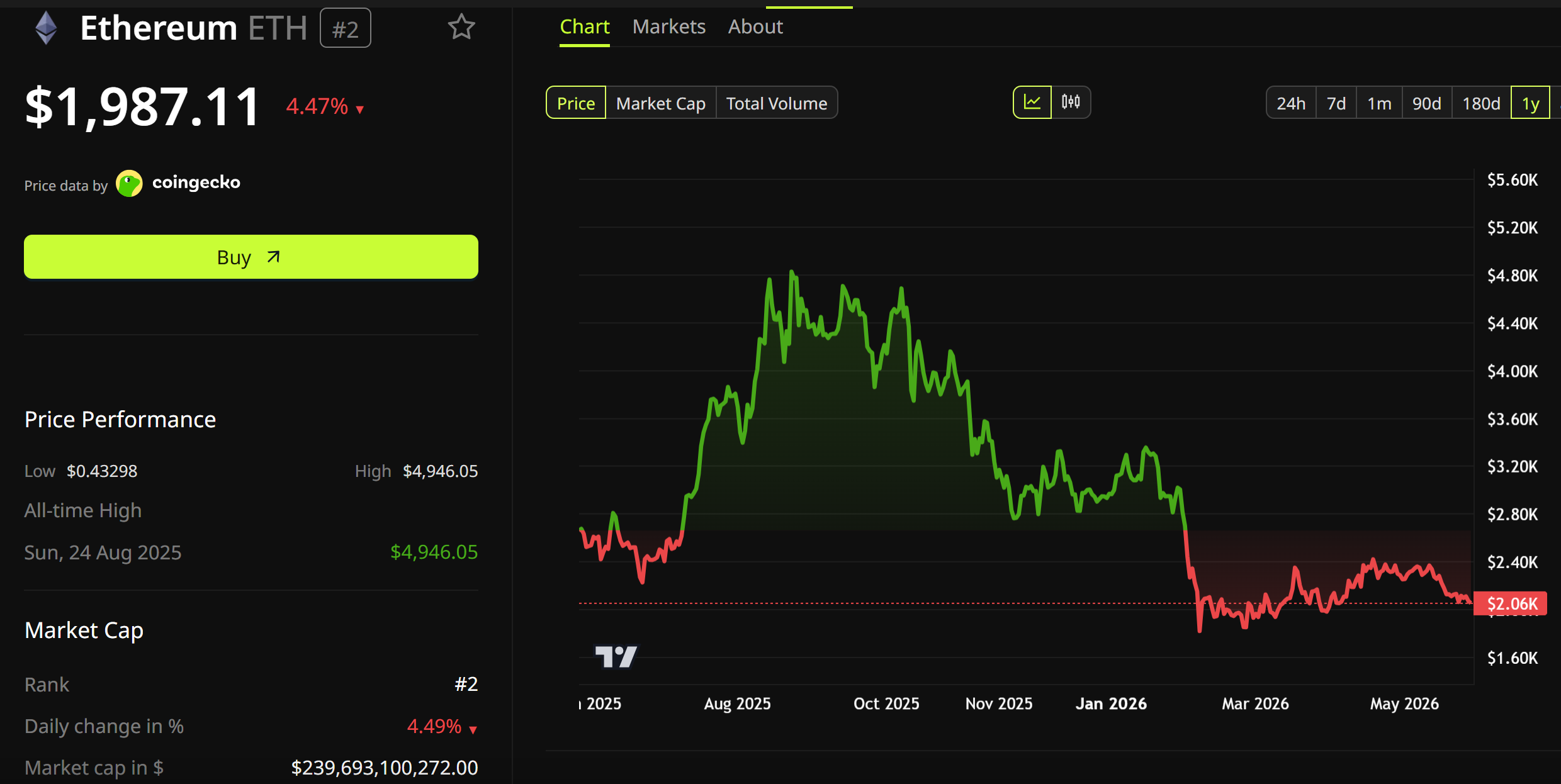
Standard Chartered reaffirmed its $40,000 Ethereum (ETH) target for end-2030, with the bank holding the call even as ETH slipped below $2,000 for the first time since late March.
Global Head of Digital Assets Research Geoff Kendrick compared Ethereum’s slump to Amazon during the 2001 dot-com bust. He argued the network’s internal metrics keep improving while its token price decouples.
Bezos Analogy and Long-Term Forecast
Kendrick reaffirmed targets of $4,000 for ETH by end-2026 and $40,000 by end-2030. He laid out the call in a research note circulated to clients.
Transaction counts and total value locked (TVL) sit near all-time highs in ETH terms, per the note. That contrasts with ETH below $2,000 today and a 57% drop from the August 2025 record of $4,946.

“I view ETH’s performance very much as Jeff Bezos described AMZN share price during the 2001 tech bubble burst,” Kendrick wrote.
The Standard Chartered executive framed the divergence with a 2018 Jeff Bezos speech about the 2001 Amazon stock crash.
The stock is not the company. And the company is not the stock. And so, as I watched the stock fall from $113 to $6, I was also watching all of our internal business metrics… every single thing about the business was getting better,” Bezos had said.
Follow us on X to get the latest news as it happens
He noted Amazon shares have multiplied roughly 1,000 times since 2001 once adjusted for splits.
Geoff Kendrick also projects stablecoin market capitalization will rise sixfold by end-2028.
Tokenized real-world assets could multiply fiftyfold over the same period, with Ethereum hosting 50% to 65% of both segments.
Retail Buys, Institutions Sell, Shorts Pile In
Even as the Ethereum price falls below $2,000, the ETH/BTC ratio dropped to a five-year low around 0.027.
Santiment data flagged a wave of retail “buy the dip” orders once the $2,000 level broke. Institutional flows moved the other way.
“Retail has erupted with “buy the dip” calls toward ETH as a result of this drop below a key psychological support level. This typically means the price may have a bit further to fall, due to the crowd (which usually gets calls wrong) being too optimistic,” Santiment analysts predicted.

The Polymarket prediction market now prices a 54% probability of ETH closing below $1,500 this year. That bet is backed by $6.4 million in trade volume.
Positioning, however, looks crowded on the short side. Rising open interest and positive funding rates create roughly $2 billion of short squeeze exposure.
That risk would mount if ETH reclaims the $2,000 level.
Whether Kendrick’s Amazon analogy holds may hinge on Ethereum’s ability to convert network usage into token-level value capture.
Longtime bulls like Bankless co-founder David Hoffman now argue value is accruing to apps and Layer 2s, not ETH itself.
The post Standard Chartered Says Ethereum Could 20X After ETH’s Brutal Crash Below $2,000 appeared first on BeInCrypto.
HYPE set a new record high, but this attracted sellers, pushing it into a pullback.
Hyperliquid (HYPE) Price Predictions: Analysis
Key support levels: $52
Key resistance levels: $63
Pullback Ongoing as Sellers Return
As soon as HYPE set a new record price just under $65, sellers returned, sending it into a pullback. At the time of this post, the price is around $57 and is likely to fall even lower, with key support at $52.
Even so, this cryptocurrency remains one of the best-performing assets of 2026, with its price doing a quick 3x since January. For that reason, a pullback here is normal and was expected. The question is if $52 will hold or not to maintain the uptrend intact.

Short Term Bearish, Long Term Bullish?
While the price may enter a correction in the short- to medium-term, the outlook on higher timeframes remains quite bullish. HYPE’s fundamentals are some of the strongest in crypto, and the recent HYPE ETFs bring additional buy volume which was not present in the past.
This is why a correction here could prove quite shallow, especially if the support at $52 holds. In that case, the uptrend remains very much intact and would open the way for the price to make new records later.

RSI Entered Danger Zone
One of the key signals that HYPE was getting overheated and overextended could be seen on the 3-day RSI where this indicator reached over 77 points, a level not seen since May 2025.
Whenever the RSI enters the overbought area (above 70 points) it’s always prudent to be careful since the price may show emotional buying which no longer offers an edge and could be a top. So far, this pullback seems to confirm that.

The post Why is the Hyperliquid (HYPE) Price Down Today? appeared first on CryptoPotato.

In the latest monthly list of new buys by the best mutual funds, top money managers did not put their chips on DraftKings (DKNG) or FanDuel parent Flutter (FLUT). But these savvy investors did scoop up shares of online betting platform Super Group (SGHC). The sports betting and online casino operator earns a spot in the IBD Live ready list…
Copyright ©2026 Investor’s Business Daily, LLC. All rights reserved. 87990cbe856818d5eddac44c7b1cdeb8
Decentralized finance (DeFi) protocols built for crypto assets are increasingly retooling themselves for Wall Street, and VanEck’s tokenized Treasury fund arriving on lending platform Euler is the latest example of that shift.
Securitize (CEPT), issuer and tokenization specialist behind VanEck’s VBILL Treasury fund, said Thursday that the product is now live on Euler lending markets.
The move allows investors to use tokenized U.S. Treasuries as collateral to borrow and deploy liquidity elsewhere onchain while maintaining compliance limits tied to the asset.
The move highlights how DeFi protocols are evolving as institutional investors push deeper into tokenized finance. Platforms that once centered around permissionless crypto assets are beginning to redesign their architecture for regulated products such as tokenized money market funds and private credit.
Tokenized U.S. Treasuries have become one of the fastest-growing sectors in crypto, topping $15 billion in assets swelling 150% in a year, according to RWA.xyz data. Global asset managers including BlackRock, Franklin Templeton and Janus Henderson have all launched blockchain-based Treasury and money-market products aimed at institutions seeking yield-bearing onchain collateral.
But that’s still a fraction of the potential how big asset tokenization could become. Standard Chartered projected $2 trillion in tokenized assets by 2028, while BCG and Ripple forecasted a $18.9 trillion market size by 2033.
Read more: Tokenization push could pull trillions of dollars into DeFi, StanChart says
“The really exciting thing is that there are protocols now that are excited to integrate permissioned assets,” Graham Ferguson, Securitize’s head of ecosystem, told CoinDesk. “This is something that previously had not been the case.”
Euler, which currently has over $320 million in assets on its platform, pivoted earlier this year toward institutional use cases after originally operating as a fully permissionless lending protocol. Rival platform Aave also launched Horizon, its real-world asset platform focused on institutional borrowers and tokenized collateral.
Euler integrated Securitize’s DS Protocol earlier this year, allowing tokenized securities to interact with lending markets while preserving investor eligibility requirements and transfer restrictions. Pricing data for VBILL is supplied through RedStone oracles.
The challenge for DeFi protocols, according to Securitize’s Ferguson, is balancing crypto’s open infrastructure with the compliance expectations of traditional finance firms.
“As more serious institutional investors are exploring the space, they need to have certain protections and permissions that they’re used to in traditional finance,” Ferguson said.
“DeFi Protocols are finally waking up to the fact that if they want to welcome in this capital, they’re going to have to change their ways,” he added.
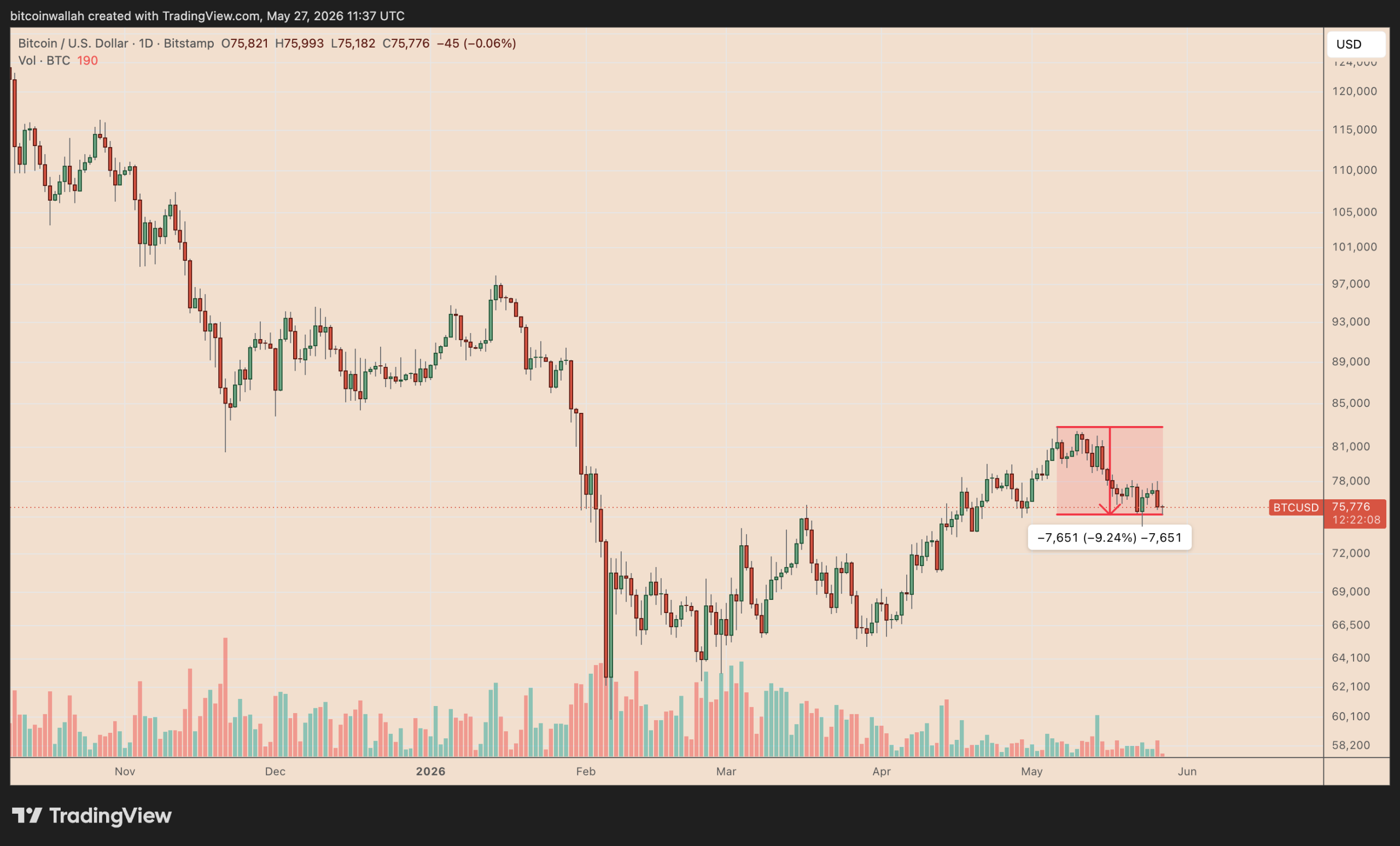
Bitcoin (BTC) may be flashing a “sell in May and go away” warning, with the price down roughly 10% after rejecting resistance near $83,000 and now on track for a negative monthly close.
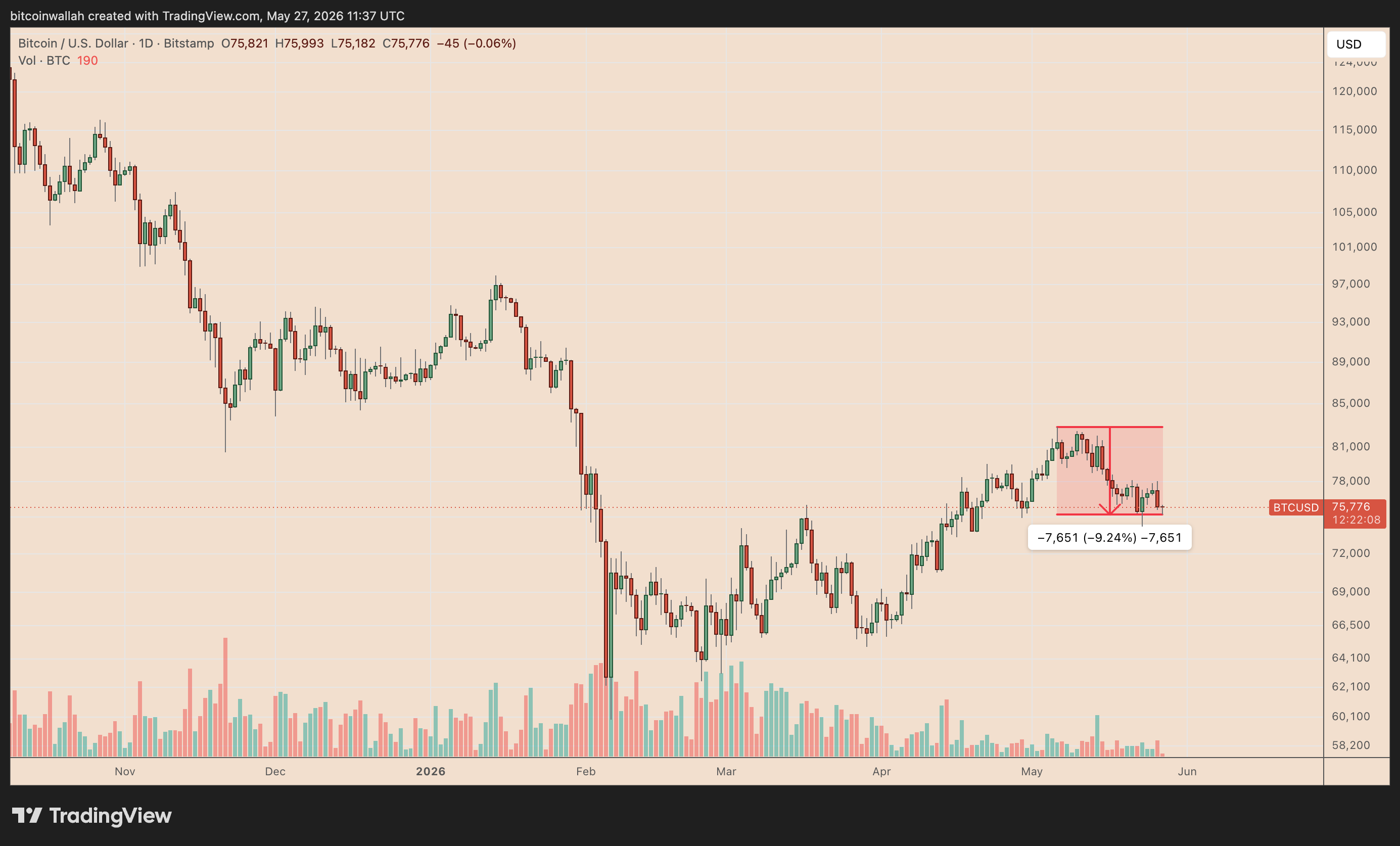
BTC/USD daily price chart. Source: TradingView
Key takeaways:
- BTC’s average returns a month after a red May are -10%
- Patient Bitcoin holders still generated positive returns over the longer term.
Bitcoin’s red May typically leads to weak summer returns
“Sell in May and go away” is a popular Wall Street saying based on the idea that stocks tend to perform better during the colder months than during the summer stretch.
For instance, the US benchmark index, S&P 500, averaged -0.24% one month and -2.25% three months after red Mays since 1990, before recovering to +1.22% after six months and +7.44% after 12 months.
Bitcoin’s own May history shows a similar short-term warning. BTC posted losses in May in 2013, 2015, 2018, 2021, 2022, and 2023. Its average returns one month later were -10.1%.
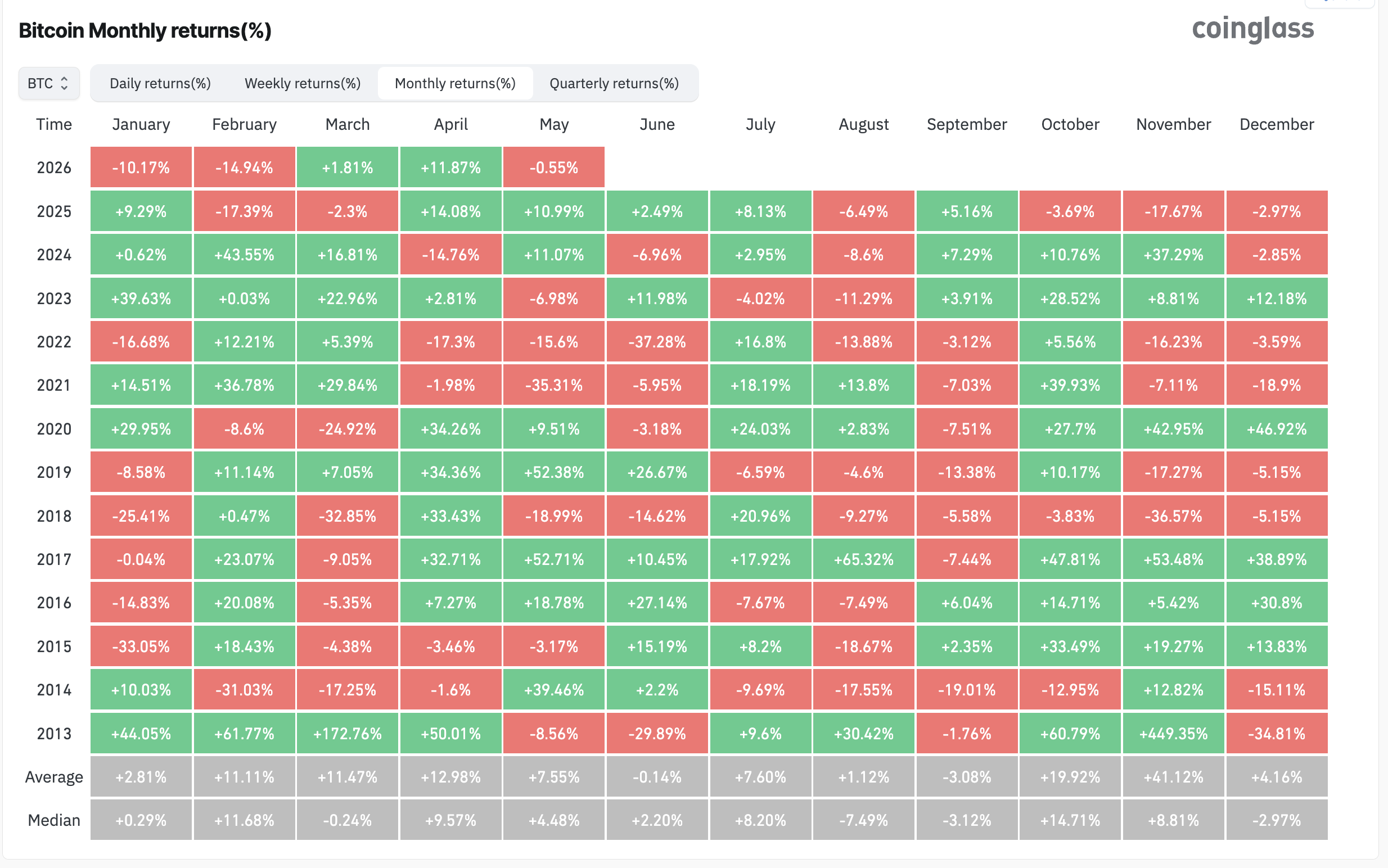
Bitcoin monthly returns. Source: CoinGlass
The three-month average return was also negative at around -3.3%. Therefore, BTC typically does not go through a significant recovery in the summer after dropping in May. That supports the idea that a red May can act as a short-term capitulation signal.
But, like US stocks, the longer-term picture is less bearish.
Six months after a negative May, BTC’s average return jumps to about +139%, largely because of 2013’s massive late-year rally. Excluding that outlier, the six-month average falls sharply to roughly +12.9%.
Based on Bitcoin’s current price near $75,850, its historical post-red-May averages imply a possible drop toward $68,200 by June and $73,350 by August.
The six-month average points to nearly $181,300 by November, though that figure is heavily distorted by 2013. Excluding that outlier, the six-month target falls to a more realistic $85,600.
Based on these historical signals alone, long-term Bitcoin investors have little reason to “sell in May and go away.”
The data points more to short-term weakness than a lasting breakdown in BTC’s broader upside trend.
Bear-market red Mays were more dangerous for Bitcoin
If Bitcoin closes the month below $76,000, the red May candle will be inside a bear-market structure.
In 2018 and 2022, May losses did not mark a quick bottom. Both years were already showing bear cycle signals, with BTC trading below major support and forming lower highs and lower lows.
After those red May closes, Bitcoin fell an average 26% one month later, 21.6% three months later, and roughly 46% six months later.
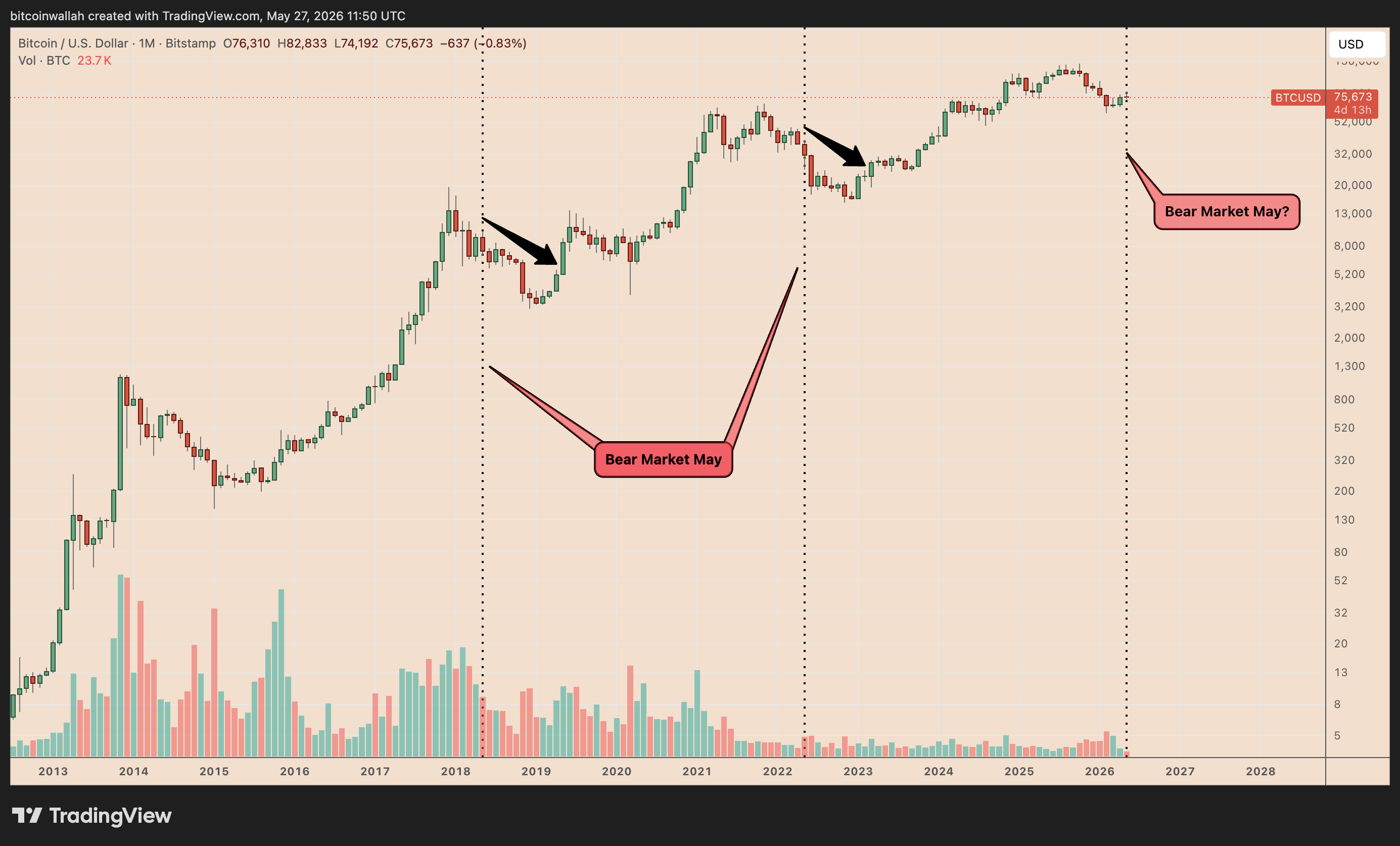
BTC/USD monthly chart. Source: TradingView
In normal or inter-cycle years, a negative May has usually pointed to short-term weakness, not a full trend breakdown. But in bear markets, the same signal has historically preceded deeper capitulation.
Related: Analyst says Bitcoin’s $60K bottom signals weaken bear-market forecast
So far, 2026 is not a fully confirmed Bitcoin bear-market year.
In prior bear markets, BTC first broke below major cycle support, around $6,000 in 2018 and $30,000–$32,000 in 2022, before capitulation deepened.
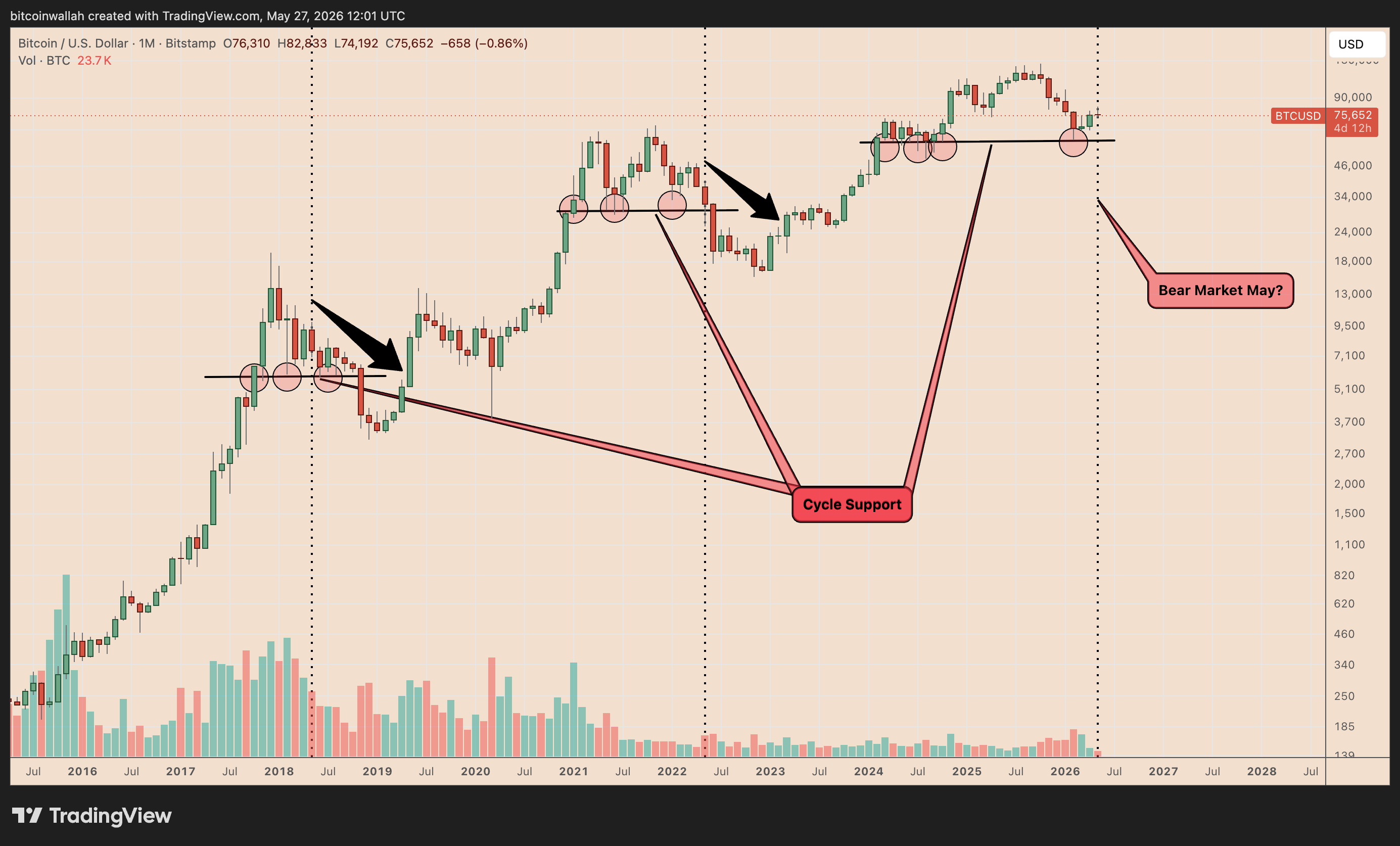
BTC/USD monthly chart. Source: TradingView
BTC still trades near $75,000, above its current cycle support near $60,000. A close below that zone would strengthen the bear-market case.
A monthly close below $70,000–$72,000 would also embolden the bears, while a deeper break below $60,000–$65,000 would make it harder to dismiss the current slump as a mere correction.

Decentralized Finance was never meant to feel polished.
Early DeFi was chaotic, experimental, anonymous, and wildly unpredictable. Traders aped into unaudited protocols at 3 AM. Governance forums looked like internet message boards. Anonymous developers launched billion-dollar ecosystems with anime profile pictures and zero formal oversight.
It was messy. It was risky. And for many, it represented the purest expression of crypto’s original ethos: open access, permissionless innovation, and financial freedom outside traditional institutions.
Fast forward to 2026, and DeFi is beginning to look very different.
Institutions are entering the space. Governments are tightening regulations. KYC requirements are appearing across protocols. Permissioned liquidity pools are becoming normalized. “Compliance-first DeFi” is no longer a contradiction — it is rapidly becoming a business model.
This raises a difficult question:
Is DeFi evolving… or is it slowly losing the culture that made it revolutionary in the first place?
The Early DeFi Era: Chaos as a Feature
The first major wave of DeFi between 2020 and 2022 was driven largely by retail users and crypto-native communities.
It was an era defined by:
- Anonymous founders
- Yield farming mania
- Meme governance
- Experimental tokenomics
- High-risk leverage
- Permissionless participation
Protocols competed aggressively for liquidity through token incentives. Users chased absurd APYs with little regard for sustainability. Rug pulls, exploits, and flash loan attacks became almost routine.
And yet, despite the chaos, early DeFi created something powerful: a financial system that anyone could access without asking permission.
No bank account.
No credit checks.
No geographic restrictions.
No institutional gatekeepers.
A trader in Manila had the same access as a hedge fund in New York.
That openness became DeFi’s cultural identity.
The “degen” culture — often mocked from the outside — represented more than speculation. It reflected a belief that financial experimentation should remain open to everyone, even if it came with risk.
The Institutional Shift
As billions flowed into DeFi, traditional financial institutions began to pay attention.
Banks, asset managers, fintech firms, and regulated exchanges realized that blockchain infrastructure could reduce settlement times, improve liquidity efficiency, and create new financial products.
But institutions brought something DeFi had long resisted: compliance requirements.
Large capital allocators cannot simply deposit funds into anonymous smart contracts operating outside legal frameworks. They require:
- Identity verification
- Risk controls
- Regulatory clarity
- Auditable counterparties
- Permissioned access environments
This institutional pressure is reshaping the ecosystem.
Today, many protocols are redesigning themselves to attract “safe” capital rather than purely crypto-native users.
The result is the rise of a new version of DeFi — one that increasingly resembles traditional finance wrapped in blockchain infrastructure.
KYC Pressure Is Growing
One of the biggest cultural shifts in DeFi is the growing normalization of KYC.
For years, permissionless access was considered sacred. The idea that anyone could interact with financial protocols anonymously was central to the movement.
Now, regulators worldwide are targeting DeFi platforms under anti-money laundering frameworks.
Some protocols are responding by introducing:
- Wallet screening
- Geo-blocking
- Identity verification layers
- Blacklists for sanctioned addresses
- Compliance middleware
Supporters argue this is necessary for mainstream adoption.
Critics argue it fundamentally changes what DeFi is supposed to be.
If users need approval to participate, many ask whether the system is still truly decentralized — or simply a blockchain-based version of traditional finance.
The philosophical divide is becoming harder to ignore.
Permissioned DeFi: The Middle Ground?
To solve this tension, a growing number of platforms are exploring “permissioned DeFi.”
Permissioned DeFi typically restricts participation to verified entities such as institutions, accredited investors, or regulated participants.
Examples include:
- Whitelisted liquidity pools
- Institutional lending markets
- Regulated tokenized assets
- Compliant stablecoin infrastructure
This model attempts to combine blockchain efficiency with traditional regulatory standards.
From a business perspective, it makes sense.
Institutions manage trillions of dollars. Even a small percentage entering on-chain markets could dramatically increase liquidity and accelerate adoption.
But culturally, permissioned DeFi represents a major departure from crypto’s original ideals.
Instead of open participation, access becomes conditional.
Instead of censorship resistance, compliance frameworks gain influence.
Instead of decentralization as a principle, decentralization becomes negotiable.
Institutional Liquidity Changes Market Behavior
Institutional participation also changes how DeFi markets behave.
Early DeFi markets were heavily community-driven. Governance was emotional, experimental, and often chaotic. Communities moved quickly, sometimes irrationally, but they shaped protocols collectively.
Institutional capital introduces different priorities:
- Stability over experimentation
- Predictable yields over explosive growth
- Risk minimization over innovation
- Regulatory compatibility with anonymity
This shift can make ecosystems more sustainable.
But it can also reduce the creativity and unpredictability that once defined crypto culture.
Some critics argue that DeFi is slowly becoming optimized for large capital instead of individual users.
The irony is difficult to ignore: a movement created to bypass financial gatekeepers is now redesigning itself to attract them.
Is Decentralization Being Softened for Adoption?
This is now one of the most important debates in crypto.
Supporters of institutional DeFi argue:
- Adoption requires compromise
- Regulations are inevitable
- Compliance attracts long-term capital
- Mature markets need accountability
- Institutional participation legitimizes the industry
Meanwhile, critics believe the industry is slowly abandoning its founding principles.
They argue that:
- KYC erodes financial privacy
- Permissioned systems recreate gatekeeping
- Compliance-heavy protocols increase centralization risks
- Institutional influence changes governance dynamics
- “Decentralization” is becoming more of a marketing term than a reality
In many ways, DeFi is facing the same challenge the internet faced decades ago.
Early internet culture valued openness, decentralization, and freedom from centralized control. Over time, convenience and scale led to the dominance of large platforms.
Some fear DeFi may be heading down a similar path.
The Reality: DeFi May Split Into Two Worlds
Rather than one side winning completely, DeFi may evolve into two parallel ecosystems.
The first will likely focus on institutional-grade compliance:
- Permissioned liquidity
- Regulated tokenization
- Enterprise blockchain infrastructure
- Identity-linked participation
The second may continue embracing crypto-native values:
- Permissionless protocols
- Privacy-preserving systems
- Anonymous participation
- Community-led experimentation
Both ecosystems could coexist.
One optimized for regulatory adoption.
The other is optimized for decentralization.
The tension between these models may ultimately define the next decade of crypto.
Conclusion
DeFi is no longer a niche playground for degens experimenting with internet money.
It is becoming part of the global financial infrastructure.
That evolution brings legitimacy, capital, and stability — but also difficult compromises.
The real question is not whether DeFi will change.
It already has.
The question is whether the industry can scale without abandoning the values that made it revolutionary in the first place.
As institutions continue entering crypto, the debate around decentralization, compliance, and cultural identity will only intensify.
And perhaps that tension itself is what defines DeFi’s next era.
REQUEST AN ARTICLE

Public Notice Portal adds consultation and archive services

US dealmaking weathers global M&A slowdown
Exchange-Owned OP Stack Chains Made Nearly $500M in Onchain Revenue, OP Labs Says


-

 Crypto World7 days ago
Blockchain.com files with SEC for U.S. IPO
-

 Fashion6 days ago
Holiday Weekend Open Thread – Corporette.com
-

 Politics3 days ago
Bridgerton Season 5: Cast, Release Date And Everything We Know So Far
-

 Crypto World6 days ago
Bitcoin Accumulation Weakens as BTC Realized Losses Hit $600M
-

 Tech3 days ago
Microsoft’s quiet Claude Code retreat and the real cost of enterprise AI
-

 Crypto World5 days ago
Robinhood crypto COO Tanya Denisova exits
-

 Business6 days ago
Dell Technologies DELL Stock Surges 15% on AI Server Momentum and Analyst Upgrades in 2026
-

 Business4 days ago
NYT Strands Answers May 24 2026 Revealed for Puzzle No. 812 Theme Summer Essentials
-

 Business6 days ago
Trump Invests $1M-$5M in Kura Sushi USA Chain With 27 California Locations
-

 Politics6 days ago
Makerfield: a tale of two social-media histories
-

 Crypto World6 days ago
Space X IPO Is ‘Bad News’ for Tech Stocks: But What About Bitcoin?
-

 Business1 day ago
Selena Gomez Reportedly Upset Over Benny Blanco’s Comments on Her ‘Terrible’ Diet
-

 Business3 days ago
BTS Sells Out Four Las Vegas Shows at Allegiant Stadium for ARIRANG World Tour
-

 Crypto World6 days ago
MicroStrategy’s Saylor Says Miners No Longer Set Bitcoin Price, Another Force Has Taken Over
-

 Tech7 days ago
WhatsApp ads could make Irish debut after discussions with DPC
-
Tech1 day ago
The Samsung pay deal is the moment Korean unions changed register
-
 Tech6 days ago
A 0.12% parameter add-on gives AI agents the working memory RAG can’t
-

 Crypto World6 days ago
AI infrastructure race heats up as IREN pitches full-stack strategy, WhiteFiber lands $160M deal
-

 Tech3 days ago
Westone Audio and Etymotic Acquired by Fidelity Collective in Major IEM Market Move
-
 Crypto World3 days ago
Nvidia (NVDA) CEO Calls on Super Micro to Strengthen Export Controls Amid Smuggling Probe
You must be logged in to post a comment Login