

Crypto World
XRP price slips 2% on profit taking

XRP price dropped 2% on May 18, sliding to $1.3865 as traders sold aggressively into the $1.42 resistance zone.
Summary
- XRP fell from $1.4138 to $1.3865 as 144.3 million in volume pushed the token down from the $1.42 area during the May 17 23:00 UTC session.
- The token remains inside a multi-month symmetrical triangle, with analysts warning the setup is compressing toward a decisive breakout point.
- Key support sits at $1.38, with a failure below that level opening a path toward $1.30, while a close above $1.42 would signal sellers are losing grip.
XRP fell as traders took profits aggressively after another failed push above $1.42, knocking the token back below $1.40 in the 24-hour session ending May 18.
The sharpest move came during the May 17 23:00 UTC session, when 144.3 million in volume pushed price from the $1.42 area to lows near $1.378. Buyers stepped in around $1.38 to limit the loss, and XRP recovered partially into the close.
The rejection is technically significant. As crypto.news reported, roughly 1.24 billion XRP tokens are held by investors who entered between $1.45 and $1.47, creating a structural supply wall that absorbs buying on every approach to that level.
XRP price locked in triangle compression
Analysts have pointed to a months-long symmetrical triangle compressing XRP’s price action, with the apex tightening toward a resolution in late May. The pattern is approaching a decisive breakout point, with sellers still controlling the $1.42 upper edge even as buyers defend $1.38 on each test.
Standard Chartered analyst Geoffrey Kendrick has projected that Senate Banking Committee advancement of the CLARITY Act could unlock $4 to $8 billion in additional XRP ETF inflows, making that vote the primary binary catalyst for any breakout above $1.45. As crypto.news documented, XRP ETFs recorded $81.63 million in net inflows in April, the best month of 2026, yet price failed to sustain momentum despite consistent institutional demand.
What happens if $1.38 breaks
A clean breakdown below $1.38 removes the floor under the current consolidation and opens the path toward $1.30. Traders who entered at higher levels have been the primary selling force on each recovery attempt. The crypto.news XRP price page shows the token trading at roughly a 62% discount to its July 2025 all-time high of $3.65.
A close above $1.42 would be the first signal that sellers are losing their grip on the upper range. Until then, the symmetrical triangle continues to compress toward a resolution that technical analysts warn could be sharp in either direction.



Shiba Inu saw billions of SHIB hit exchanges on May 18 as crypto market liquidations accelerated.
Summary
- Over 3 billion SHIB tokens were pushed onto exchanges on May 18, raising sell-side pressure as broader crypto market liquidations accelerated.
- CoinGlass data shows SHIB open interest at $61.2 million with $42,485 in futures positions liquidated in the 24-hour session ending May 18.
- SHIB was trading at $0.00000567 on May 18, down roughly 10% on the week and 54% over the past year.
On-chain exchange flow data tracked by CoinGlass shows SHIB open interest at $61.2 million on May 18, with $42,485 in futures positions liquidated in the 24-hour session. The inflow spike coincided with wider crypto market liquidations as leveraged long positions were unwound across multiple assets.
SHIB was trading at $0.00000567 at time of writing, down roughly 10% on the week. The token is 54% lower over the past 12 months and well below its all-time high of $0.00008616.
Exchange reserve data showed assets on Binance alone reaching 61.8 trillion tokens, a marked rise since March as profit-takers moved holdings onto platforms ahead of potential distribution.
Shiba Inu inflows signal rising sell pressure
Tokens moved onto exchanges are one step from the open market and available for immediate liquidation. The spike in SHIB inflows creates a mechanical increase in available sell-side supply, which typically suppresses price during periods of weak demand.
As crypto.news reported, institutional and whale-level SHIB transactions surged 111% earlier in 2026, indicating large holders are actively repositioning rather than holding passively.
Meme coins have faced persistent pressure throughout 2026. Bitcoin’s 22% decline in Q1 tightened conditions across speculative assets, with SHIB bearing the brunt alongside other high-beta tokens. The token’s 589 trillion circulating supply gives it limited leverage from burn activity, as individual whale distribution events can rapidly absorb months of supply reduction.
What SHIB needs to stabilise
Stabilisation requires demand to absorb incoming supply rather than sellers finding a thin order book. As crypto.news noted in its Shibarium upgrade analysis, on-chain adoption remains uneven and without acceleration in utility metrics, upside moves in SHIB continue to struggle.
A Fully Homomorphic Encryption upgrade planned for Q2 2026 through cryptography firm Zama could add a privacy dimension, but near-term price action depends on whether these exchange inflows reverse.
The broader context for meme coin behaviour in 2026 was covered by crypto.news in its analysis of how on-chain activity spikes often precede continued downside rather than reversals.


Aave has restored WETH loan-to-value ratios on Ethereum, Arbitrum, Base, Mantle, and Linea, re-enabling borrowing against the asset following a technical incident.
Crypto World
Digital Assets Security: BitGo Expert Outlines How Businesses Can Enter the Space Safely

TLDR:
- BitGo’s Deputy CISO says businesses must prioritize custody decisions before selecting any digital asset tools or wallets.
- Hot and cold wallet choices should align with a company’s liquidity needs and intended digital asset usage profiles.
- Governance frameworks covering people, process, and technology must be in place before any transactions begin.
- Business model alignment, not trend-chasing, should drive every company’s digital asset architecture and strategy decisions.
Digital assets security remains a top priority as businesses accelerate their move into the digital asset economy. BitGo Deputy CISO Manny Khan has outlined a structured approach for companies entering this space.
Writing in Forbes, Khan argues that businesses often get the process backwards. Most organizations start with tools rather than building the right foundation.
His framework centers on custody, governance, and architecture decisions tailored to each business model.
Custody and Wallet Architecture Must Come Before Anything Else
Custody is the first decision any business should make before entering the digital asset space. Khan stresses that organizations must honestly assess whether they are ready to hold digital assets internally.
Handing this responsibility to an IT team without proper preparation can lead to irreversible losses. History has shown that preventable mistakes in this area carry serious consequences.
For businesses handling meaningful value, partnering with a regulated, institutional-grade provider may be more appropriate. This does not mean all companies should follow the same path.
Each organization must weigh its internal maturity against external options realistically. Security and control are not mutually exclusive, but achieving both requires the right fiduciary relationships.
Wallet architecture decisions should also be driven by purpose, not convention. Hot wallets suit speed and operational availability, while cold wallets prioritize long-term asset protection.
Neither option is universally superior to the other. The right choice depends entirely on liquidity needs and intended usage.
Multi-sig and MPC technologies also carry real operational consequences. They affect accountability, transparency, and resilience across the organization.
Companies should categorize digital assets by usage and liquidity profiles. Forcing all use cases into one mold typically increases risk rather than reducing it.
Governance Frameworks and Business Model Alignment Drive Long-Term Success
Governance must be established before a company begins transacting in digital assets. Khan’s framework covers people, process, and technology, with disciplined vigilance at the center.
Teams need a clear understanding of the stakes involved at every level. Processes must define approvals, controls, and accountability from the start.
As Khan noted via BitGo’s official post: “Most businesses are approaching it backwards, starting with tools instead of building the right foundation first.” Digital asset readiness requires compliance, security, finance, and operational controls working together.
Treating it as a simple infrastructure project misses the real challenge entirely. Silos between departments create misalignment and increase exposure.
Business model alignment is equally critical when developing a digital asset strategy. A trading firm has different liquidity needs than a corporate treasury function.
A fintech business requires secure API integration, while a B2B2B provider may need shared-control models. Architecture decisions should always work backward from the customer profile and operating model.
Not every company requires the same level of urgency in adopting digital assets. Businesses operating locally or within narrow geographic footprints may not need immediate action.
However, cross-border activity and settlement friction are pushing global companies in this direction. Leaders must approach this space with clear eyes, sound controls, and architectures that fit their specific business.

Key takeaways:
- Aggressive Bitcoin buying by Strategy helped to offset the recent leveraged long liquidations.
- Rising bond yields and a heavy US government debt burden are driving investors toward scarce assets.
- A potential deal between the US and Iran could quickly restore traders’ risk appetite.
Bitcoin (BTC) faced a rejection following a failed attempt to break above $82,000 on Thursday. A subsequent retest of the $76,000 level on Monday triggered $400 million in liquidations for bullish Bitcoin positions over a four-day period. While traders’ confidence took a hit from the 7% price decline, the prospects for recovering the $80,000 mark remain valid.
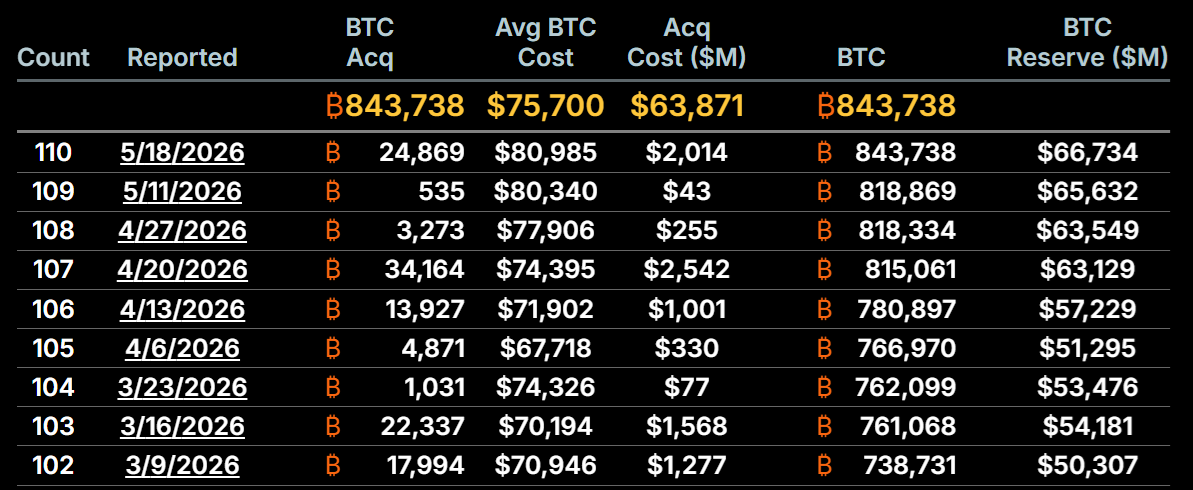
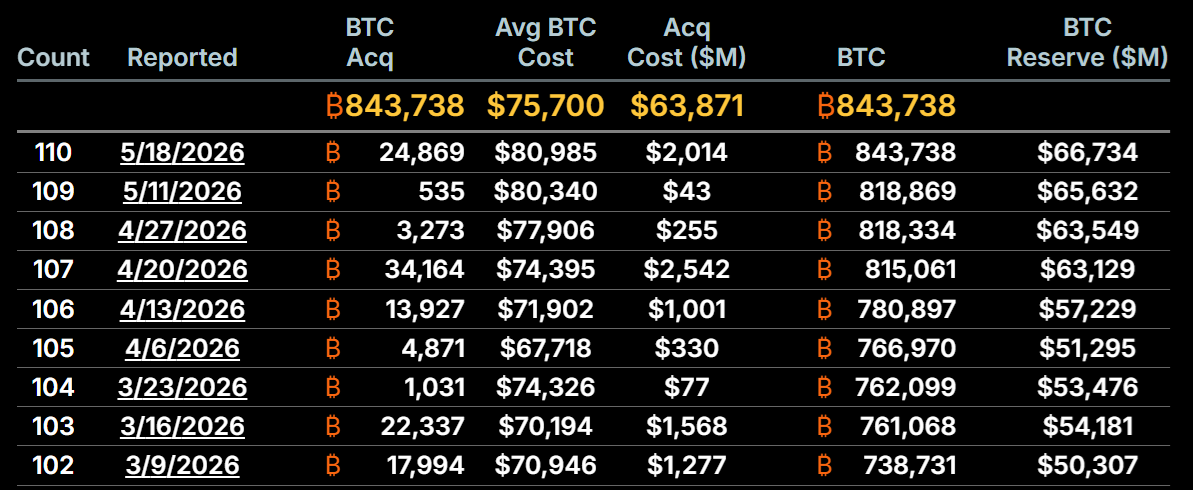
Bitcoin reserve accumulation by Strategy (MSTR US). Source: Strategy
US-listed Strategy (MSTR US) completed the acquisition of $2 billion in BTC over the past week alone. Spearheaded by Michael Saylor, the company continues to surprise investors by finding innovative ways to reduce the cost of capital and raise cash through equity issuance, whether via MSTR common stock or STRC preferred equity.
More importantly, Strategy proved the company can also capitalize on a weaker market by repurchasing $1.5 billion of its debt due in 2029. Retiring some of its senior convertible notes reduces potential future dilution for current MSTR holders. This move clears the runway for new share issuance and additional Bitcoin purchases.
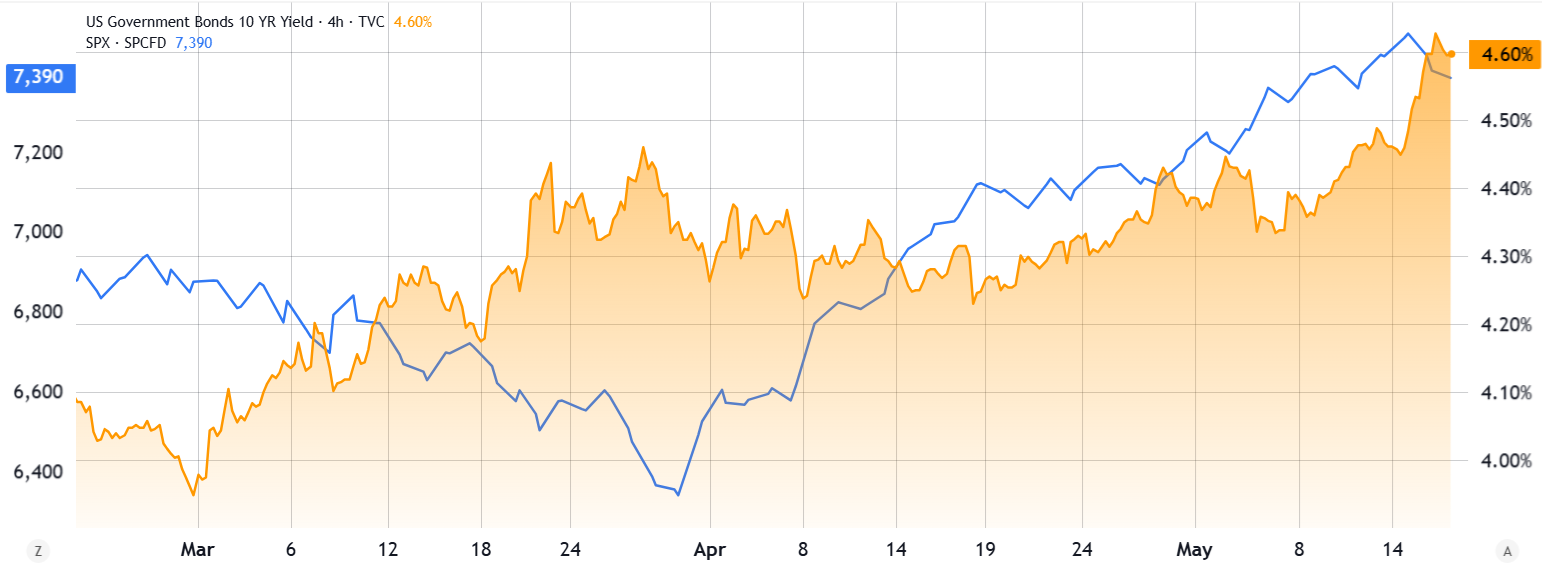
S&P 500 index (left) vs. US 10-year Treasury yield (right). Source: TradingView
From a macroeconomic perspective, the odds of a sustainable bullish momentum for Bitcoin improved as traders demanded higher returns to hold government bonds. Yields on the 10-year Treasury jumped to 4.60%, hitting their highest level in 16 months. Investors are gradually realizing the heavy burden on the US Treasury, especially with $2 trillion in long-term debt maturing in 2026.
US dollar weakness and a potential deal with Iran
The US Federal Reserve will likely need to continue accumulating bonds and Treasurys, a move that potentially weakens the US dollar. Typically, investors seek shelter in scarce assets when they lose confidence in the central bank’s ability to navigate a crisis without devaluing the currency. Even if gold acts as the primary beneficiary, the incentive to hold fixed-income assets drops significantly.
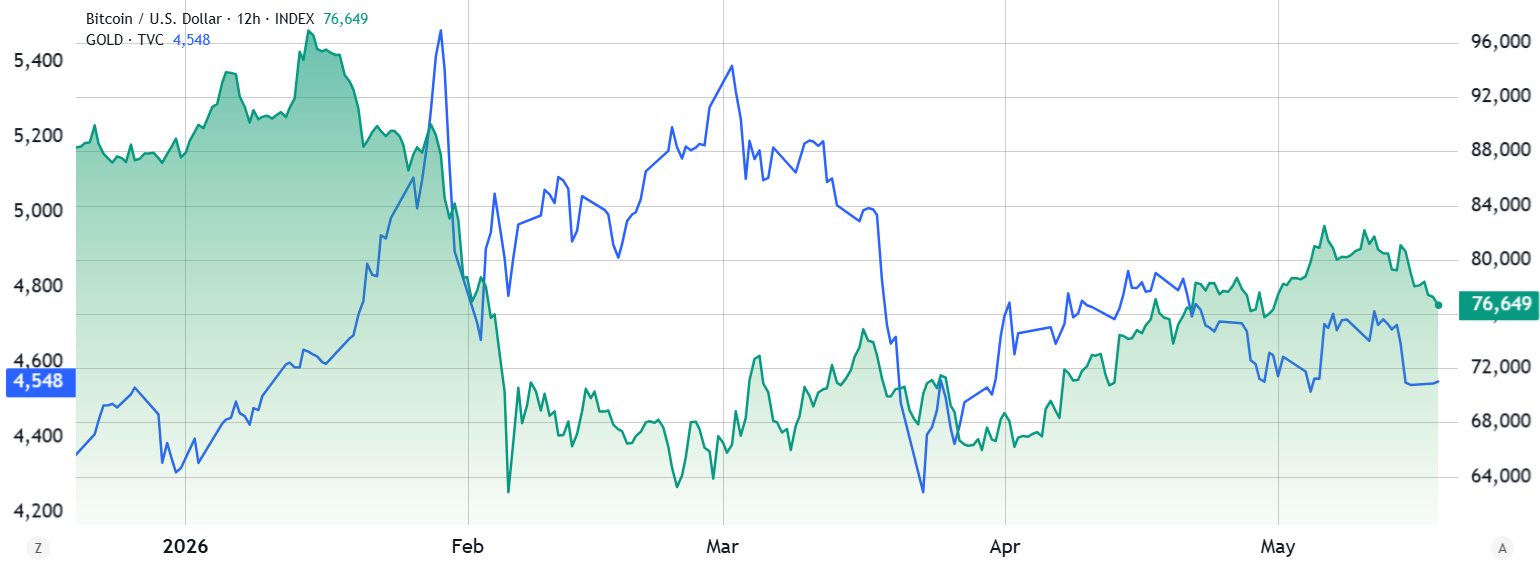
Gold/USD (left) vs. Bitcoin/USD (right). Source: TradingView
Gold prices surged in January after the US captured Venezuelan President Nicolas Maduro and President Trump’s global trade war escalated. However, gold retraced most of those gains over the next four months, while Bitcoin built strong bullish momentum, jumping to $76,500 from $65,000 in late February. These recent price moves hint at growing confidence in Bitcoin as a reliable hedge instrument.
Related: Analysts debate whether Bitcoin is in ‘sell in May’ bear market setup
Crude Brent oil prices jumped to $113 on Monday as negotiations to fully reopen the Strait of Hormuz backpedaled. Oil prices have surged more than 50% since the US and Israel attacked Iran in late February. President Trump’s administration also decided not to renew a waiver for Russian crude oil, further squeezing supply, according to Yahoo Finance.
A deal between the US and Iran, while not the baseline scenario, could trigger renewed risk appetite and catapult the Bitcoin price back above $80,000. Inflation has been pinned down by high energy prices, limiting the odds of expansionary monetary policies. Even so, the odds favor Bitcoin, as the US stock market is hovering near its all-time high while the cryptocurrency still sits 39% below its peak.
Crypto World
Hyperliquid's HYPE Token Rallies 7% as Trade.xyz Launches First Pre-IPO Perpetual Market for SpaceX


HYPE token gained 7% over 24 hours following the launch of a synthetic SpaceX pre-IPO perpetual contract on Hyperliquid, valuing the private aerospace company at $1.78 trillion.
The U.S. Securities and Exchange Commission is reportedly poised to release a major crypto proposal as it seeks to institute its digital assets agenda.
TLDR:
- Citi warns quantum computing could break Bitcoin encryption, with Q-Day set between 2030 and 2032.
- An estimated 6.7 to 7 million BTC in exposed wallets make Bitcoin a prime quantum attack target.
- Ethereum’s flexible governance positions it to adapt more readily against the quantum computing threat.
- Fireblocks CEO calls Bitcoin’s quantum risk a coordination issue and notes post-quantum tools exist.
Quantum computing poses a growing threat to the crypto sector, according to a new Citi research note. The report warns that Bitcoin faces far greater exposure than Ethereum.
That divide, analysts argue, comes down to governance rather than technology alone. Recent breakthroughs have pushed the estimated timeline for practical quantum attacks to as early as 2030.
With millions of Bitcoin already at risk, the industry is watching this closely. Analysts say the window for preparation is narrowing fast.
Bitcoin’s Structural Vulnerability to Quantum Attacks
Bitcoin transactions expose the sender’s public key to the network until they are confirmed. This creates a window where a quantum attacker could theoretically derive a private key.
From there, the attacker could redirect funds before the transaction is finalized. The exposure is brief but real, and it grows more dangerous as quantum computing hardware improves.
Google’s research suggests a 500,000-qubit machine could break Bitcoin’s encryption in minutes. No such machine currently exists, but the pace of progress is accelerating.
Google places its Q-Day estimate at 2032, while some researchers suggest 2030. Either way, the crypto industry has limited time to act.
The dormant wallet problem makes Bitcoin’s exposure more pressing. An estimated 6.7 to 7 million BTC sit in wallets with public keys already exposed. These wallets represent a concentrated and attractive target for any future quantum-capable actor.
Among those wallets, roughly 1 million Bitcoin believed to be mined by Satoshi Nakamoto remain untouched. These coins use early address formats that are particularly vulnerable to quantum attacks. At current prices, they carry an estimated value of around $82 billion.
Governance Gap Separates Bitcoin and Ethereum
Ethereum and other proof-of-stake networks are better positioned to adapt, Citi analysts said. Their more flexible governance allows for faster protocol changes when needed.
Ethereum also has a demonstrated history of regular protocol upgrades. That agility gives it a structural advantage against the quantum computing threat.
Bitcoin’s conservative, consensus-driven model is widely seen as central to its credibility. That same model, however, makes rapid protocol changes slow and contested.
Moving to quantum-resistant cryptography would likely require a hard fork, a notoriously difficult process. Broad network consensus would need to be achieved before any changes take effect.
Fireblocks CEO Michael Shaulov addressed this at the Financial Times Digital Asset Summit, arguing that the threat “is not actually a threat as people make it out to be.”
He described Bitcoin’s quantum challenge as “mostly a coordination issue” for the community rather than a technical one.
Shaulov further noted that “the entire internet industry needs to basically leapfrog and start using post-quantum encryption,” adding that “generally speaking, we have the available algorithm.” His remarks suggest that preparation, not the threat itself, remains the real challenge.
Citi’s analysts pointed to BIP-360 and BIP-361 as proposed Bitcoin upgrades worth monitoring. Ethereum, meanwhile, is not entirely immune to quantum threats either.
A quantum-enabled attacker could theoretically acquire enough private keys to control 33% of staked assets. This could allow disruption of block finality or broader network operations.


Bitwise will devote 10% of its HYPE ETF management fee to buying HYPE on its balance sheet.
Summary
- Bitwise announced it will devote 10% of its BHYP Hyperliquid ETF management fee to purchasing and holding HYPE tokens on its balance sheet.
- The BHYP ETF launched on NYSE on May 15 with a 0.34% sponsor fee, the first US product to offer in-house staking through Bitwise Onchain Solutions.
- Combined with 21Shares’ THYP product, the two Hyperliquid ETFs have accumulated over $5.6 million in net inflows since launching last week.
Bitwise Asset Management announced that it will devote 10% of the management fee from its Bitwise Hyperliquid ETF (NYSE: BHYP) to holding HYPE on its balance sheet. The firm said the move mirrors Hyperliquid’s own tokenomics, which routes roughly 99% of protocol revenue through its Assistance Fund to repurchase HYPE.
“Hyperliquid’s token is explicitly designed so that rising trading activity on the Hyperliquid platform directly benefits token holders,” said Matt Hougan, Chief Investment Officer of Bitwise. “This has translated into historically strong returns. We think it’s one of the most exciting assets in crypto.”
HYPE ETF structure and the buyback signal
BHYP launched on NYSE on May 15 with a 0.34% sponsor fee, waived for the first month on the fund’s first $500 million in assets. It is the only US-listed Hyperliquid product to stake HYPE through the issuer’s own infrastructure rather than a third party. As crypto.news reported, HYPE rebounded toward $46 following the launch and has recovered roughly 65% since the start of 2026.
The 10% fee commitment adds a second capital channel into HYPE beyond staking. Bitwise stakes the fund’s holdings through Bitwise Onchain Solutions, with rewards flowing back into the fund after a 15% fee. Adding balance sheet purchases from management fees means institutional capital flows into HYPE through two parallel mechanisms.
Competing with BHYP is 21Shares’ THYP product, which launched on Nasdaq earlier in the week and drew approximately $1.2 million in inflows on its first day. Together, the two HYPE ETFs have accumulated more than $5.6 million in total net inflows.
Why the fee model matters for HYPE
Hyperliquid saw $2.9 trillion in trading volume in 2025, up more than 400% year on year, and currently commands roughly 60% of all on-chain derivatives open interest globally. HYPE’s market cap stands above $11 billion, making it the tenth-largest crypto asset by market capitalisation.
As crypto.news documented in its April filing update, Bloomberg ETF analyst Eric Balchunas flagged the addition of the BHYP ticker and fee details as signs the fund was approaching launch.
The fee-to-buyback pledge aligns Bitwise’s incentives directly with Hyperliquid’s community-first model. Every dollar of management fee generates a fraction of HYPE that sits permanently on Bitwise’s balance sheet, creating a demand mechanism that scales with fund AUM alongside ETF inflow growth.

According to Bitmine Chairman Tom Lee, rising oil prices are the biggest reason Ethereum (ETH) has been struggling, and he says the inverse correlation between the two assets has hit the highest level ever recorded.
His observation has come at a time when ETH is trading near $2,100, down roughly 3% in 24 hours and 12% over the past month.
The Oil Connection
Lee laid out his thinking in a post on X on May 18, saying that as oil prices climbed over the past six weeks, ETH fell in step. “Rising oil prices is the biggest headwind,” he wrote, noting that the ETH-oil inverse correlation was at its “highest ever.” According to him, the implication is straightforward. Should oil reverse lower, ETH is likely to recover.
However, Lee was careful to frame this as short-term noise rather than a structural problem. The longer-term case, in his view, still rests on two things: tokenization of real-world assets and agentic AI.
“These structural drivers are in place,” he wrote. “Thus, we expect ETH prices to be stronger as we move through 2026.”
The timing of his comments matters. ETH has been grinding lower for weeks, and the drop accelerated on May 18 after fresh geopolitical pressure came from US President Donald Trump, who warned Iran that its “clock is ticking” in a Truth Social post.
BTC slid to around $76,700 in response, its lowest level since early May, while over $660 million in leveraged positions were liquidated across the market, with ETH accounting for $256 million of that wipeout, according to data from CoinGlass.
The sell-off on Binance and OKX was particularly aggressive, with figures shared by analyst Amr Taha showing that taker sell volume on Binance crossed $1.1 billion as ETH pushed toward $2,100.
A Market Cleared of Longs
What the liquidation data shows is a market that has been largely flushed of bullish leverage. According to market observer CW, only about $600 million in high-leverage ETH long positions remain, while short positions have reached $6.3 billion, more than ten times the size of the long side.
They also noted that a new CME gap has formed around $2,200 and that three unfilled CME gaps now sit between the current price and $3,200, removing a layer of downside technical risk.
Another trader, Crypto Ed, said both Bitcoin and Ethereum had entered what he described as “green box” support zones, though he still expected another leg lower before any sustained recovery. ETH hit a 10-month low against BTC over the weekend, with the ETH/BTC pair falling under 0.028, a level not seen since the middle of last year.
The post Tom Lee Links Ethereum Weakness to Rising Oil Prices appeared first on CryptoPotato.
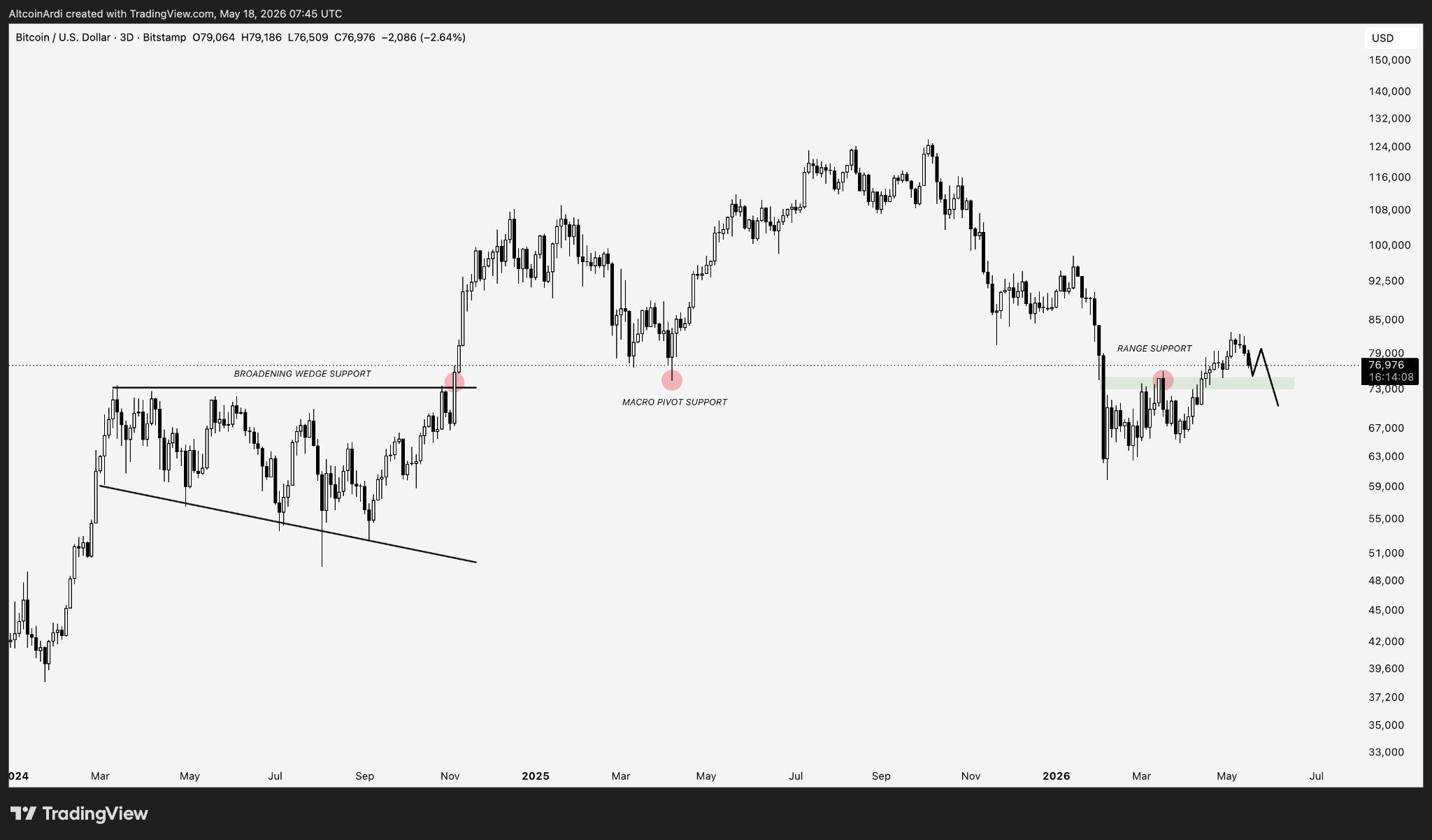
Bitcoin (BTC) lost its hold on the $80,000 level over the weekend, and data suggest that the cryptocurrency needs to trade above the $74,000-$75,000 range, as it has repeatedly served as key support over the last two years.
Crypto analyst Ardi said the next retest of the $74,000-$75,000 range could become the most important support test of the current bear market.
The analyst pointed to the role that the price range played during the last two years. In 2024, Bitcoin struggled to break above the range during a seven-month-long consolidation. In Q1 2025, the same area held as support before BTC rallied toward its cycle highs at $126,000.
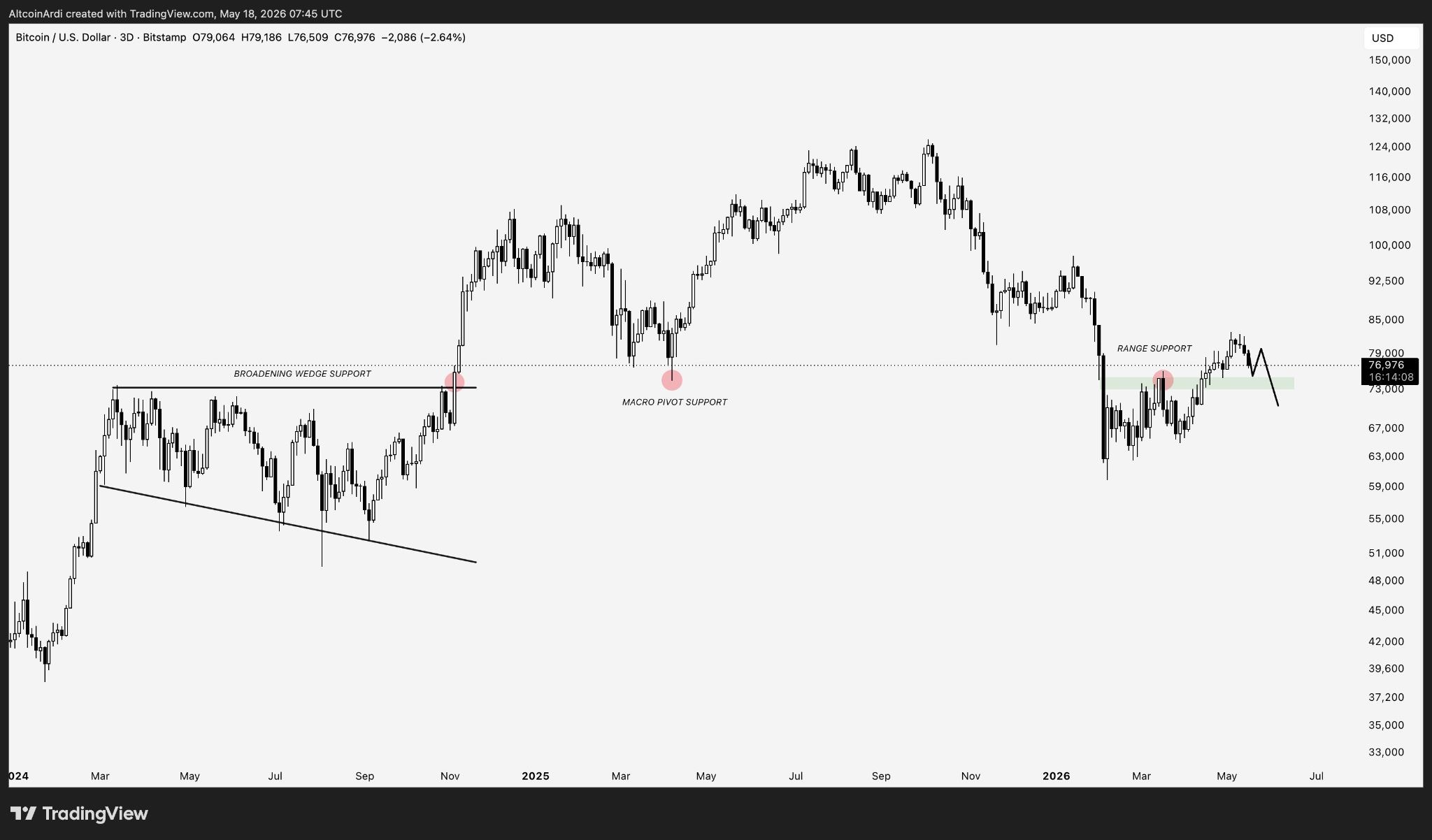
BTC/USD, one-day chart analysis by Ardi. Source: X
Bitcoin is now approaching this level after its 5.78% weekly correction to $77,900. Ardi said the zone carries added weight because several major price pivots formed at $74,000-$75,000 across multiple time frames.
Crypto trader Alex Wacy focused on the $70,000 level. Wacy said holding that area could support a move back toward $85,000-$90,000. Losing it could open the door to a larger decline toward the $50,000-$60,000 range.
Related: BTC price ‘bull trap’ at $76.5K? Five things to know in Bitcoin this week
Bitcoin market signal weakens again
Bitcoin researcher Axel Adler Jr. said the Bitcoin bull-bear structure index turned bearish again after BTC failed to stay above $82,000 earlier this month.
It tracks six indicators linked to exchange-traded fund (ETF) demand, trader activity, exchange flows, and short-term price momentum. A positive reading indicates buyers are in control, while a negative reading points to growing seller pressure.
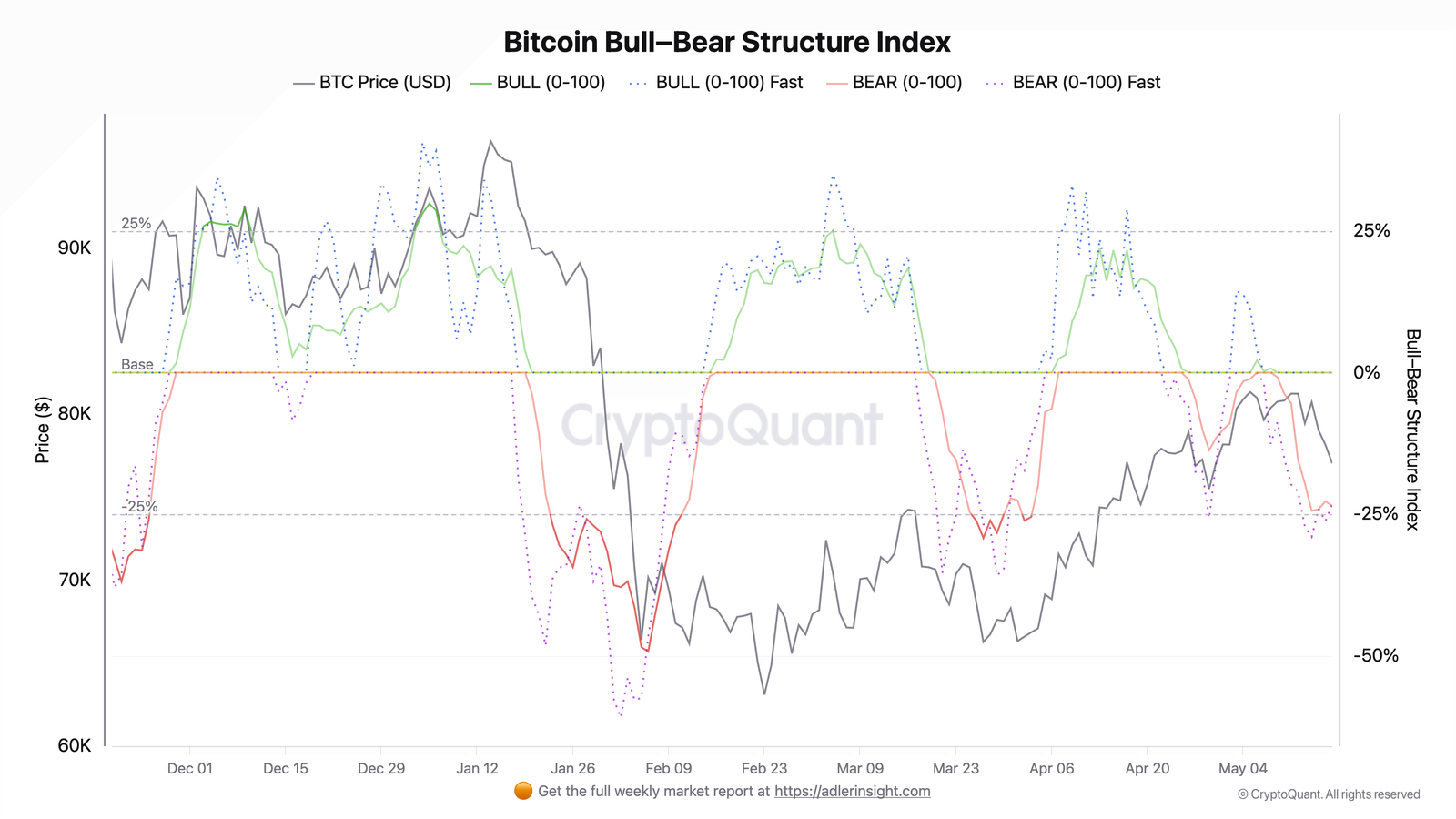
Bitcoin bull-bear structure index. Source: CryptoQuant
The bullish signal lasted less than three trading days. On May 6, the index briefly turned positive as Bitcoin climbed near $82,000. By May 17, the reading had dropped to -23.49, indicating that sellers quickly regained control.
Meanwhile, CryptoQuant data showed more Bitcoin moving onto exchanges from investors who bought BTC six to 12 months ago. The average buying price was around $110,851, meaning many are now sitting on large unrealized losses after the latest drop.
The share of older coins moving to exchanges also surged to 10.54%, far above its usual level below 1%, with market analyst Easy On Chain stating,
“Historically, this reflects investors locking in major losses and exiting the market, creating severe spot-market selling pressure.”
Related: Saylor’s Strategy scoops $2B Bitcoin, holdings reach 843,738 BTC

‘Has to be’: Jamie Carragher blasts referee decision amid Arsenal FC red card controversy

How to choose the right remote support solution for your business

‘Tracker’ Finally Revealed the Truth About Ashton Shaw’s Death

Manchester United reach agreement with Casemiro over contract clause amid transfer speculation

US brings back mandatory military draft registration

Steven Gerrard disagrees with Gary Neville over ‘shock’ Chelsea and Arsenal claim | Football


-

 Crypto World3 days ago
BloFin War of Whales 2026 Grand Prix opens registration for $5M trading championship
-

 Fashion3 days ago
Weekend Open Thread: Theory – Corporette.com
-

 Crypto World3 days ago
E-Estate Announces 1 Year Live: Washington DC Summit as Real Estate Tokenization Enters Its Next Phase
-

 Tech4 days ago
Tech Moves: Microsoft AI leader jumps to OpenAI; former AI2 exec joins Meta; and more
-
Crypto World6 days ago
Bitcoin Suisse expands with Digital Asset License and Investment Business Act Registration Approval in Bermuda
-

 Tech7 days ago
GM agrees to $12.75M California settlement over sale of drivers’ data
-

 Politics6 days ago
Pakistan to enter Chinese capital market as war inflation bites
-

 Crypto World6 days ago
Bitcoin Suisse expands with Digital Asset License and Investment Business Act Registration Approval in Bermuda
-
 Crypto World4 days ago
Google’s Gemini AI Predicts Incredible Solana Price by the End of 2026
-

 Business3 days ago
H&R Real Estate Investment Trust (HR.UN:CA) Q1 2026 Earnings Call Transcript
-

 Tech3 days ago
Google reimburses Register sources who were victims of API fraud
-

 Sports3 days ago
Napoleonic enters 2026 Doomben 10,000 field via Abounding withdrawal
-

 NewsBeat6 days ago
Comment on Keir Starmer surviving the day as Prime Minister like a turd that wont flush
-

 Politics7 days ago
The Board of Deputies just smeared Polanski to suck up to Farage
-

 Fashion6 days ago
The Best-Kept Makeup Secret for a More Defined Face
-
 Entertainment4 days ago
Zara Larsson Has Blunt Response To Chris Brown Diss
-

 Politics6 days ago
The Trial of Majid Freeman, Verdict
-
 Tech6 days ago
Why AI is making typography a boardroom conversation
-

 Politics6 days ago
Palestine’s flag becoming a regular sight at European football stadiums
-

 Crypto World6 days ago
Senate Approves Kevin Warsh to Federal Reserve Board Seat
You must be logged in to post a comment Login