

Crypto World
XRP Upbit volumes surge on Hana Bank deal

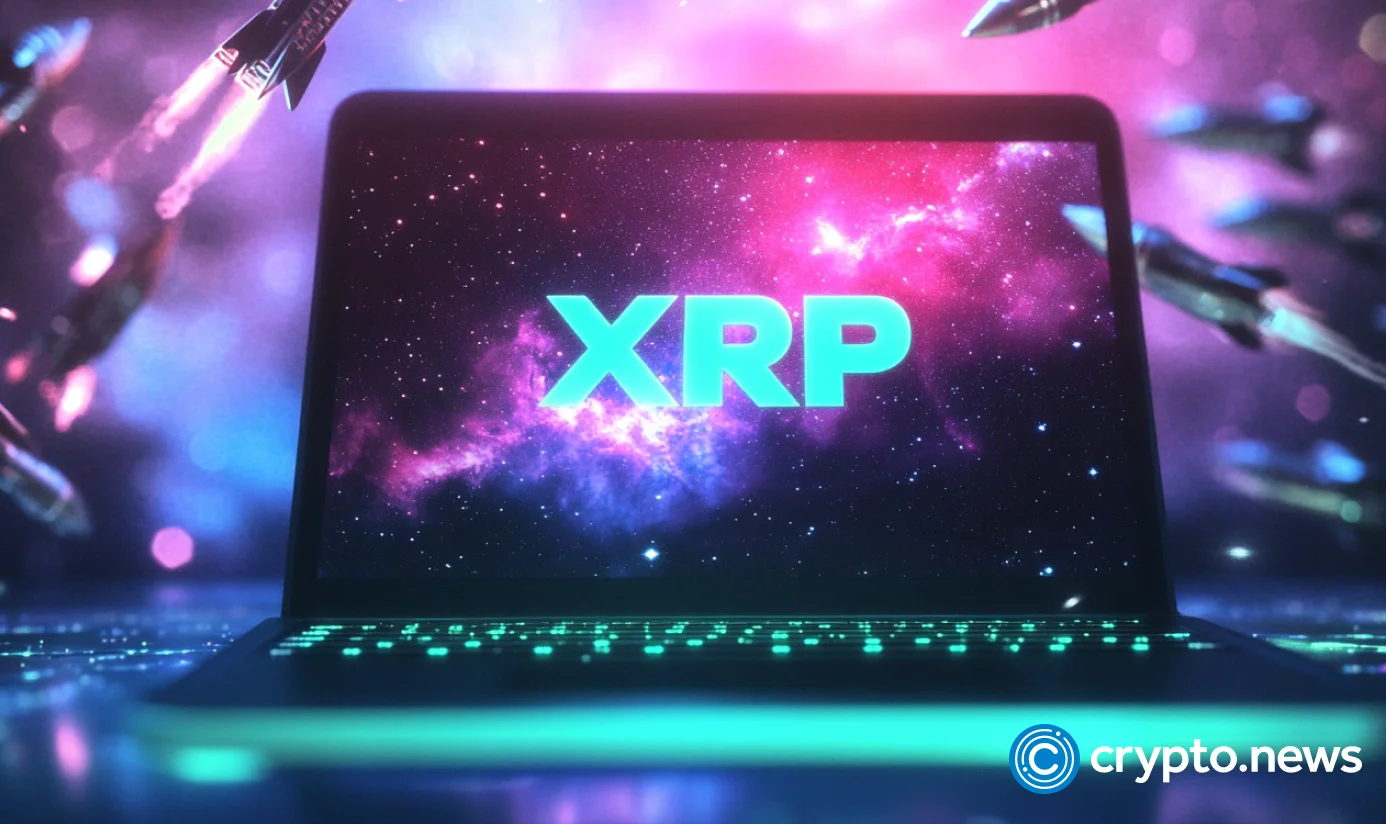
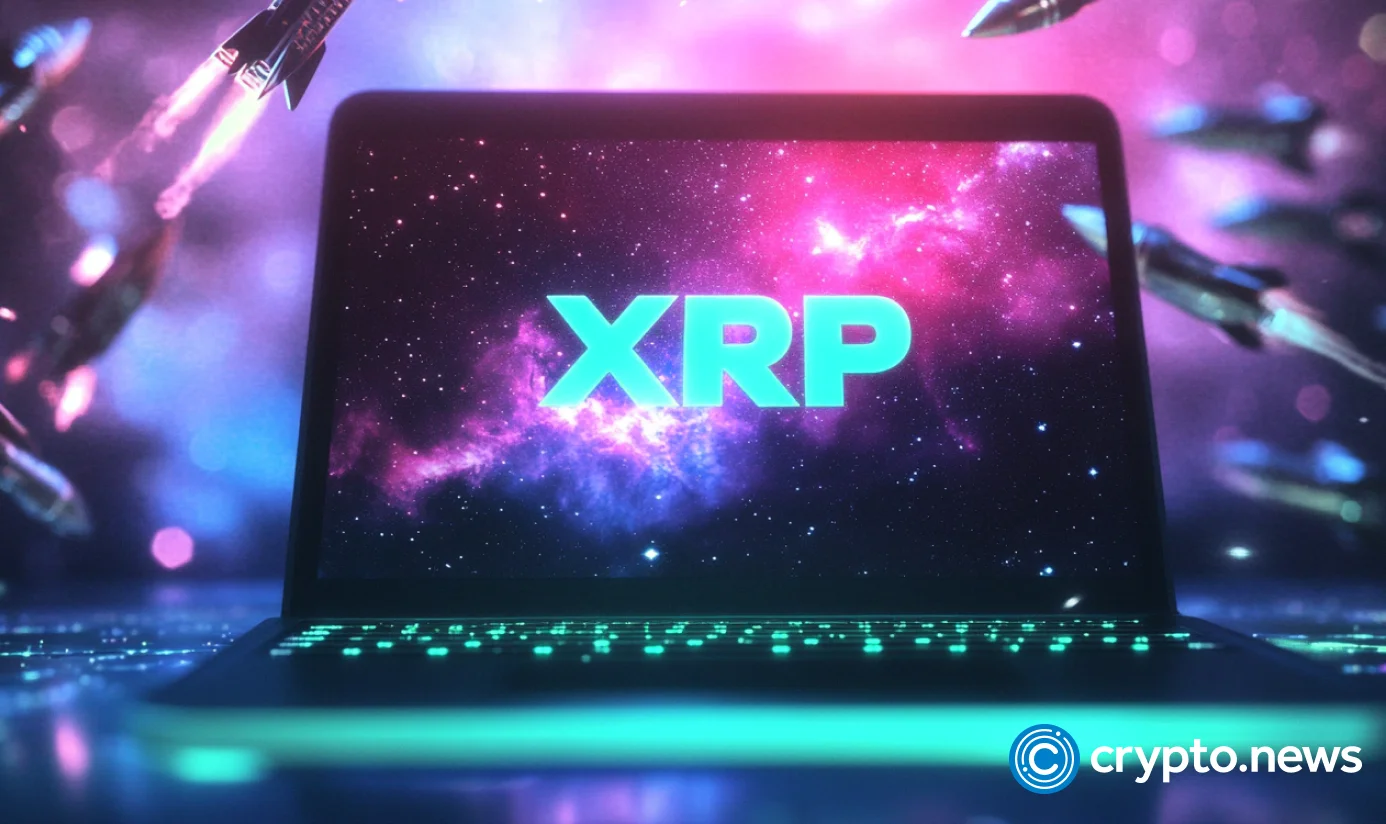
XRP Upbit volume surged to $330 million on May 15 after Hana Bank announced a $670 million Dunamu stake.
Summary
- XRP’s Korean won pair led Upbit with over $330 million in 24-hour trading volume, outpacing Bitcoin’s $217 million and Ethereum’s $109 million.
- South Korea’s Hana Bank agreed to buy a 1 trillion won stake in Dunamu, operator of Upbit, in the largest bank investment into a crypto exchange on record.
- XRP pulled back from a 24-hour high of $1.55 to $1.45 as options expiry pressure offset the volume surge, with trading activity up over 83% on the day.
XRP Upbit volumes surged on Friday after South Korea’s Hana Financial Group announced it will acquire a 1 trillion won ($670 million) stake in Dunamu, the operator of Upbit, through its subsidiary Hana Bank.
The XRP-KRW pair recorded over $330 million in 24-hour volume, outpacing Bitcoin’s $217 million and Ethereum’s $109 million on the same exchange.
The deal is expected to close on June 15, giving Hana Bank a 6.55% stake in Dunamu and making it the exchange’s fourth-largest shareholder. Hana Financial Group simultaneously signed a strategic agreement with Dunamu to build a “digital asset-based financial innovation” model linking traditional banking and crypto markets.
Hana Financial TI has already completed a proof-of-concept for a Korean won-backed stablecoin on the XRP Ledger.
South Korea’s deepening XRP footprint
The Dunamu deal is the latest in a series of Korean institutional moves tied to XRP. As crypto.news reported, Ripple signed a partnership with Kyobo Life Insurance in April to pilot the tokenization of South Korean government bonds using Ripple Custody, the first time a Tier-1 Korean insurer adopted on-chain bond infrastructure.
South Korean retail traders have consistently shown strong preference for XRP, a pattern crypto.news documented earlier this year when XRP emerged as the standout trade of the 2026 crypto rally.
XRP spot ETFs, whose combined US assets under management crossed $1.25 billion, have also been attracting record inflows, adding an institutional layer to what has traditionally been retail-driven Korean demand.
Despite the volume surge, XRP pulled back from $1.55 to $1.45 amid broader market weakness linked to the $2.6 billion options expiry and rising US Treasury yields. Analysts continue to watch the $1.50 level as the first meaningful resistance for any extended move higher.



Polymarket’s push to lift its CFTC ban is not just a venue story; it’s a fight over whether “reality markets” on war, pandemics and macro become a regulated US asset class or stay an offshore grey zone.
Summary
- Polymarket is in active talks with the CFTC to lift a four‑year US ban imposed after a 2022 enforcement action and $1.4 million settlement, aiming to re‑admit American users to its main on‑chain market.
- The plan is to weld Polymarket’s Polygon‑based stablecoin rails to QCX LLC, a CFTC‑registered exchange it bought for about $112 million in 2025, creating a regulated rival to Kalshi for event contracts.
- While Brazil moves to erase prediction platforms like Polymarket and Kalshi via ISP and payments blocks, Washington is trying to domesticate them, deciding if information itself becomes a surveilled derivatives product.
Polymarket is in active discussions with the US Commodity Futures Trading Commission (CFTC) to lift the four‑year ban that has kept American users off its main on‑chain prediction market since a 2022 enforcement action and $1.4 million settlement. If regulators sign off, this won’t just be “Polymarket comes home”; it will be the first concrete US blueprint for regulated, liquid markets that let people bet directly on war, pandemics, inflation prints, Fed cuts, Ethereum forks and ETF approvals — all under derivatives law rather than as a legal grey zone.
Polymarket’s attempt to lift its four‑year CFTC ban
Bloomberg reports that Polymarket has held multiple recent meetings with CFTC staff about removing its US ban, with any decision requiring a formal commission vote. Follow‑up coverage says the negotiations turn on contract design, KYC/AML, reporting, and the scope of “permissible” event markets after Polymarket previously blocked US users from its global site and half‑launched a domestic product that never scaled. The technical pivot is straightforward: Polymarket wants to merge its existing crypto‑native infrastructure — currently settling trades in stablecoins on Polygon — with the CFTC licenses of QCX LLC, a registered derivatives exchange it acquired for roughly $112 million in 2025, so that its main exchange can legally admit US traders and compete head‑on with Kalshi.
The market‑structure stakes are larger than one platform. In practice, prediction markets are already the venue where political operatives, energy desks and crypto whales leak and price private information on elections, wars, macro data and protocol events; US retail has simply been fenced out since the 2022 crackdown, or pushed into VPN gymnastics and offshore venues. A CFTC‑blessed Polymarket with US access would normalize those information markets: you’d have regulated, liquid contracts on CPI paths, FOMC decisions, Taiwan flashpoints, or Ethereum roadmap milestones, accessible to American retail and institutional money under the same basic futures logic that governs oil or interest‑rate swaps.
The under‑reported angle is political. Letting Polymarket back in is effectively Washington admitting that there will be markets that price empirical reality in real time, outside the polling industry and legacy media. Brazil is moving the opposite way: regulators there have ordered local ISPs and payment providers to block 27 prediction‑market platforms — explicitly including Kalshi and Polymarket — under Resolution No. 5,298, which bans event‑based contracts on sports, politics, entertainment and social events as illegal gambling, while allowing only economic‑indicator contracts under financial supervision. In other words, Brasília is trying to erase these markets from public view; the CFTC is trying to domesticate them.
Whatever framework the CFTC and Polymarket hammer out becomes the gravitational center for crypto‑native prediction markets. One path is convergence: front ends, oracles and settlement layers mimic CFTC constraints, whitelisting feeds and KYC’ing users so that there is a “clean,” surveilled prediction market stack alongside a shrinking perimeter of truly permissionless markets. The other path is divergence: Polymarket accepts a domesticated US enclave, while DeFi‑native markets fork away, double down on anonymity and explicitly brand themselves as the place you go to bet on war, elections or protocol failure without asking the state’s permission. The talks in Washington are about more than one exchange’s ban; they’re about whether information itself becomes just another regulated asset class, or remains one of the last domains where raw reality can still be traded outside official narratives.
Key Takeaways
- Senate Banking Committee greenlit the CLARITY Act with a bipartisan 15–9 vote, igniting optimism across crypto communities.
- Sentiment analysis from Santiment reveals 1.55 bullish posts for every bearish one, though the firm cautions against following the crowd.
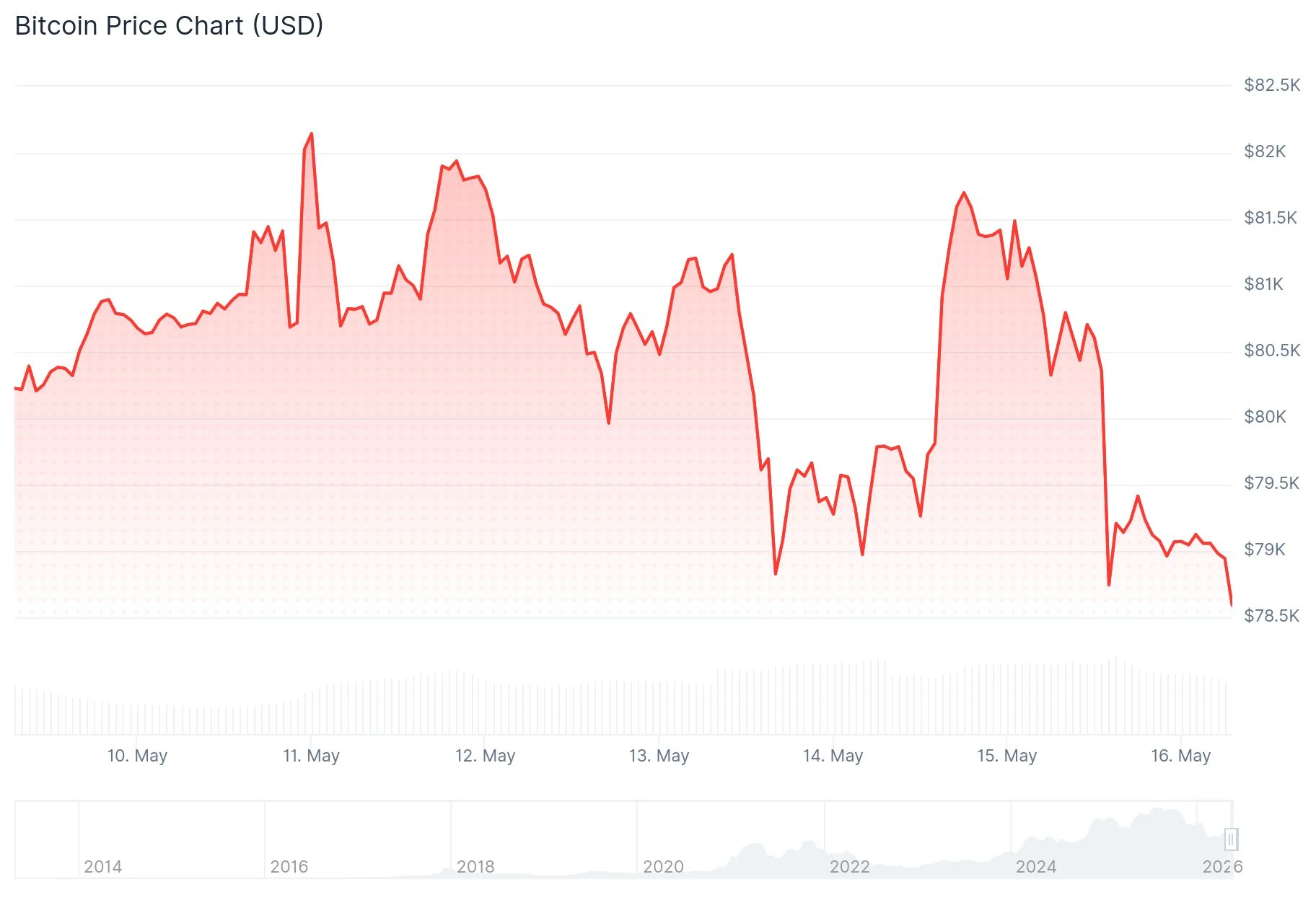
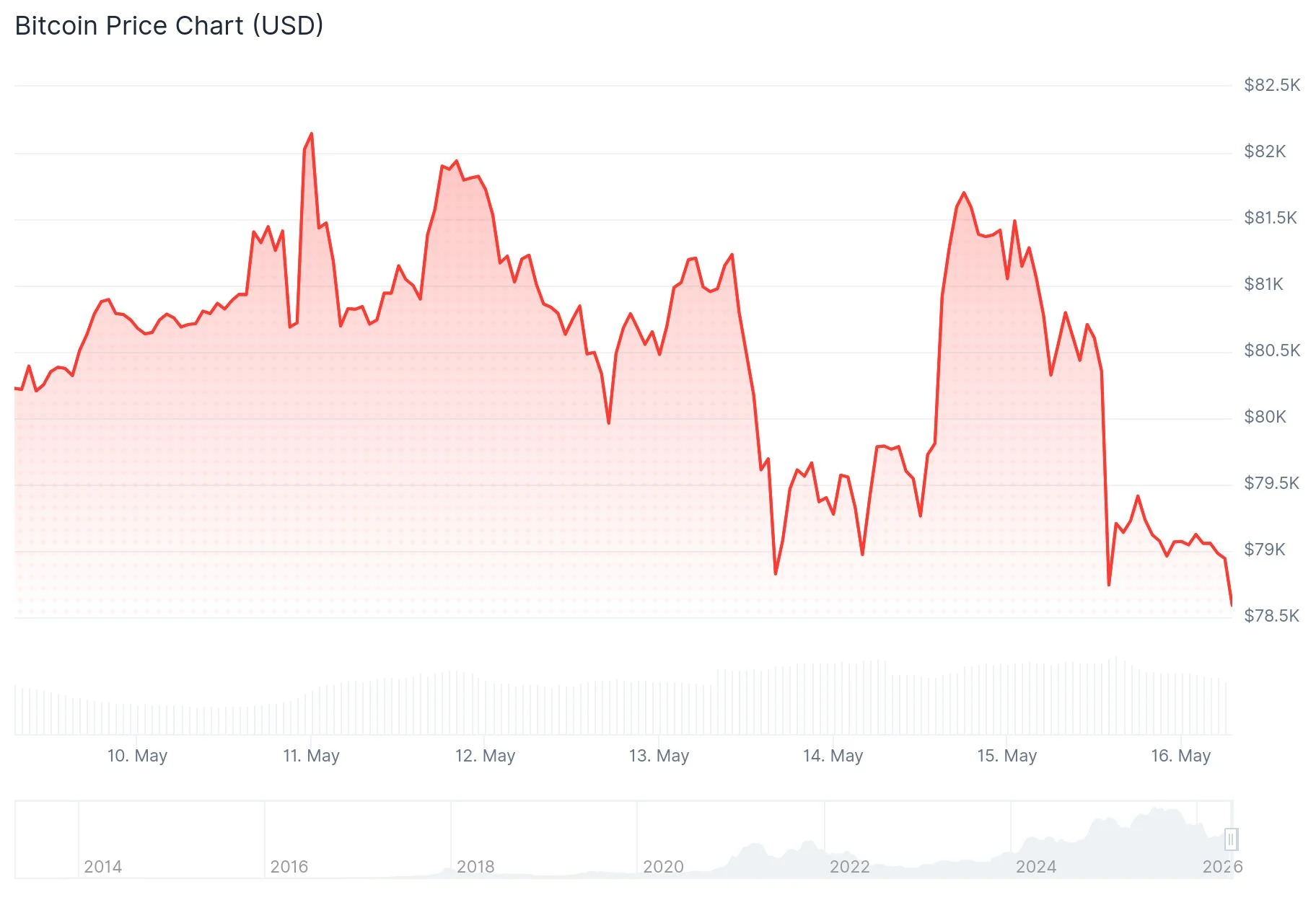
- BTC is currently trading between $79,000–$80,000, marking a 3% gain since early May but down approximately 23% year-over-year.
- The 10-year Treasury yield climbed above 4.55%, creating additional downward pressure on Bitcoin and other risk-sensitive assets.
- US spot Bitcoin ETFs experienced $290.4 million in net outflows on May 15, per CoinCentral data.
Bitcoin continues to trade in the vicinity of $80,000 as competing forces of regulatory advancement and macroeconomic challenges create a tug-of-war in the marketplace.
The primary catalyst driving market discussion this week centers on the Senate Banking Committee’s decision to move forward with the Digital Asset Market Clarity Act—commonly referred to as the CLARITY Act—by a 15–9 margin. The vote saw unanimous support from all 13 Republican committee members, with two Democrats crossing party lines. Nine Democrats opposed the measure.
Crypto analytics firm Santiment characterized the social media response as “a major spike of euphoria.” Their data indicates that optimistic Bitcoin commentary currently outpaces pessimistic takes by a ratio of 1.55 to 1.
Yet Santiment accompanied their findings with a note of caution. “We advise caution. Markets typically move opposite to the crowd’s expectations at all times,” the firm stated via X.
White House crypto counsel Patrick Witt offered measured commentary on the development. Witt acknowledged the committee vote represented “a major step forward” while emphasizing that “there’s more work to be done before this legislation is ready for prime time.”
Market analyst Michael van de Poppe from MN Trading Capital struck a more optimistic tone. He described the CLARITY Act as “the biggest, and historical, bill for the entire industry” in a Friday X post, suggesting it “can be a strong trigger for the upcoming bull market.”
Santiment further suggested that passage of the legislation might attract institutional capital that has remained inactive due to regulatory ambiguity. However, the analytics platform cautioned that current cryptocurrency valuations may already reflect anticipated passage before official enactment occurs.
Rising Yields and ETF Withdrawals Create Headwinds
From a macroeconomic perspective, conditions remain challenging. Friday saw the 10-year US Treasury yield pierce 4.55%—marking its peak since May 2025. The 30-year bond yield reached 5.12%, a level unseen since June 2007.
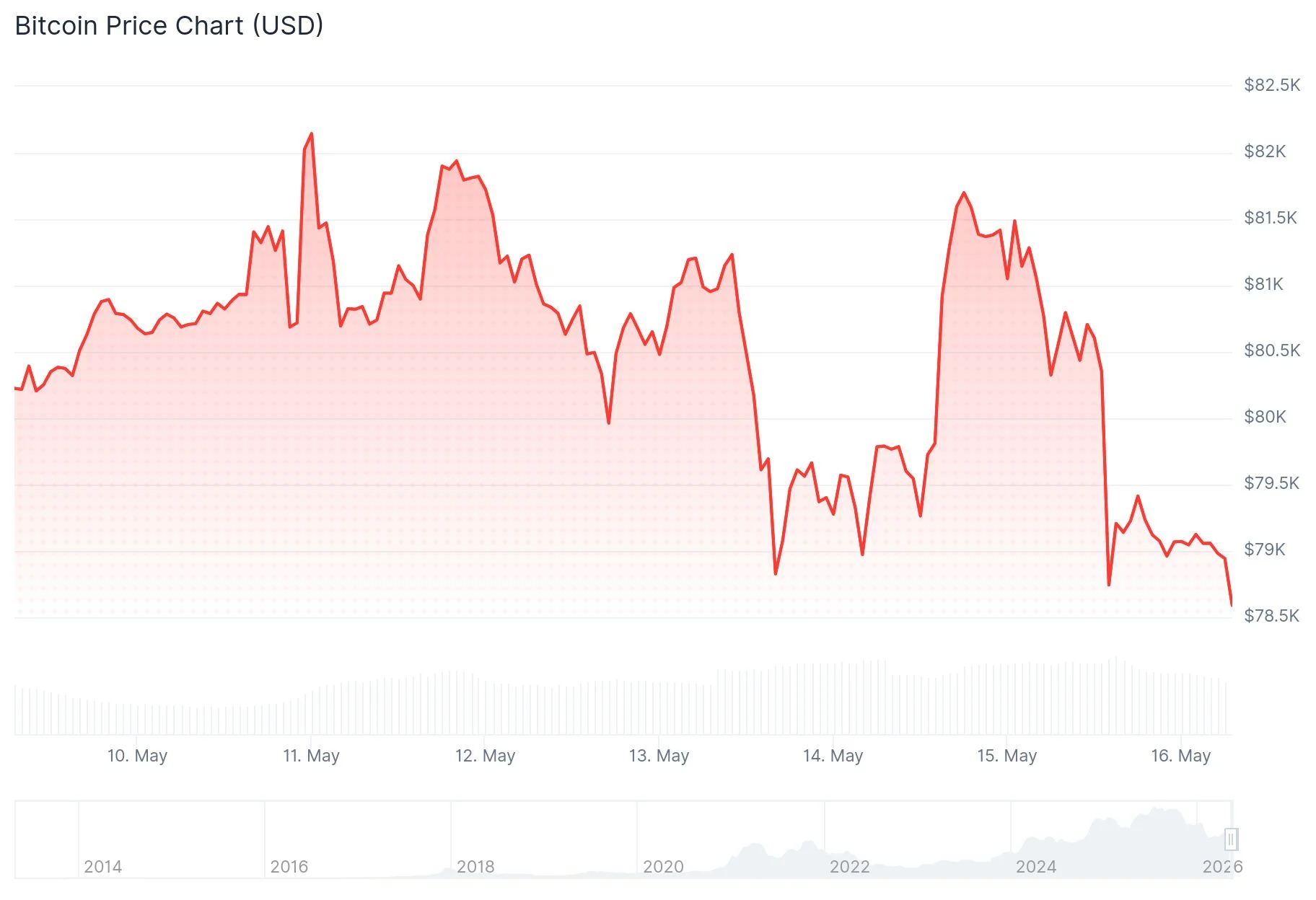
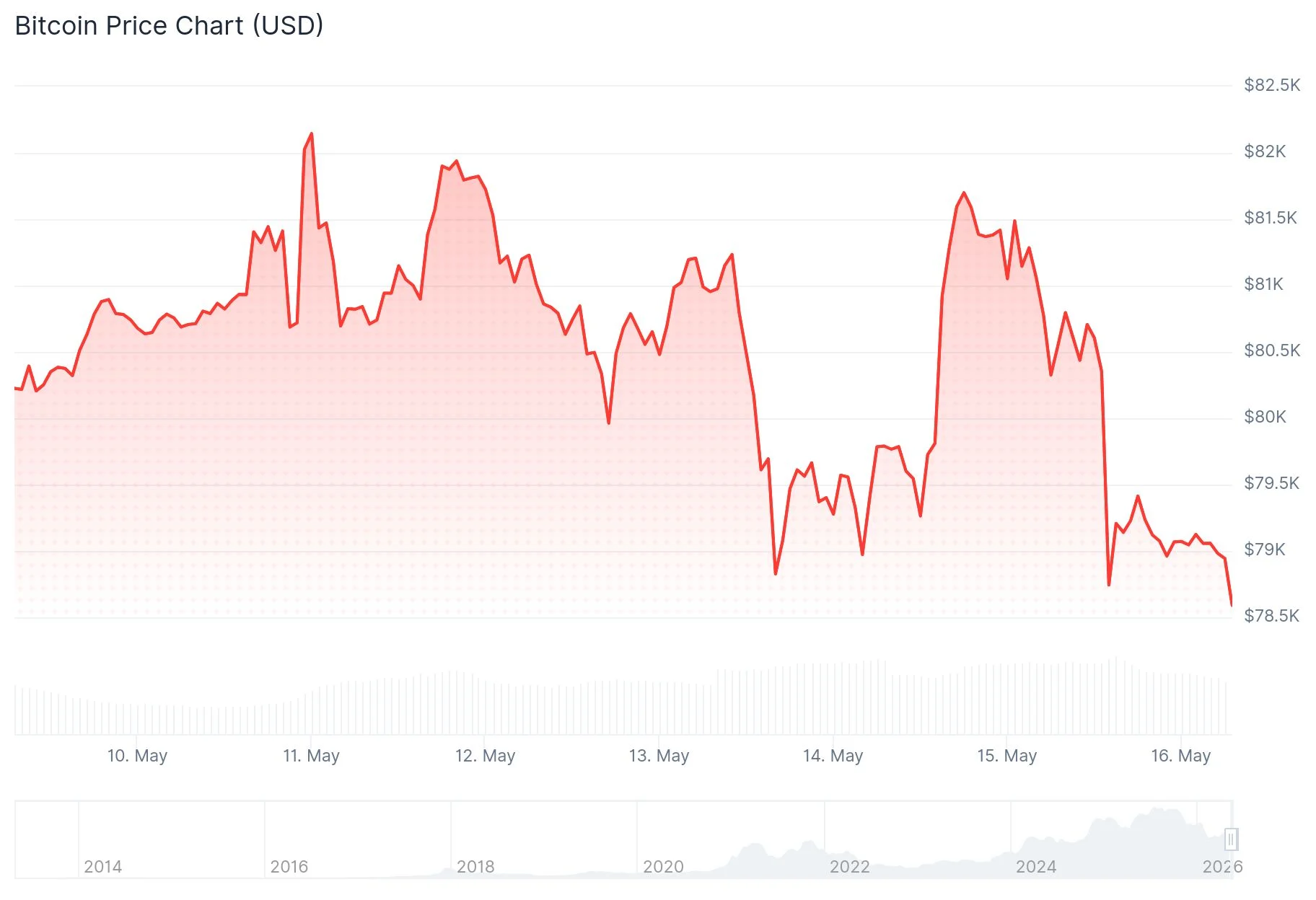
As bond yields climbed, Bitcoin retreated below the $80,000 threshold during New York trading hours, tracking movements in US equity markets. The S&P 500 similarly surrendered gains accumulated earlier in the week. Bitcoin’s 24-hour price movement showed declines ranging from 2.43% to 2.68% depending on the data provider.
Investment vehicle data painted a bearish picture for May 15. Bitcoin ETFs registered $290.4 million in net withdrawals. Ethereum ETFs saw $65.7 million exit the funds, while Solana ETFs remained neutral with zero net movement.
The Crypto Fear & Greed Index recorded a reading of 31 on Saturday, placing market sentiment firmly in “Fear” territory.
Technical Analyst Maintains Bullish Outlook for New Highs
Not all market observers are adopting a defensive stance. Analyst Kaleo pointed out on X that Bitcoin’s support floors have been progressively rising throughout the year. “Have you noticed throughout the year the figure they’re using for the lower end keeps climbing higher and higher?” he observed. “New all time highs are still on the table this year. Zoom out and keep stacking.”
Bitcoin’s 200-day exponential moving average currently stands at $82,941, a technical threshold that has repeatedly resisted price advances during the recent rebound phase.
BTC continues trading approximately 30% beneath its October 2025 all-time peak. As of this writing, Bitcoin is changing hands around $79,084, representing a 3.15% increase since the beginning of May.

Key Highlights
- Senate Banking Committee passed the CLARITY Act with bipartisan support (15-9), triggering widespread optimism across crypto social channels.
- Sentiment analysis from Santiment reveals bullish-to-bearish ratio of 1.55:1, though the platform cautions against following crowd psychology.
- BTC trades in the $79K-$80K range, showing a modest 3% gain since the start of May, yet remains down approximately 23% year-over-year.
- The 10-year US Treasury yield climbed above 4.55%, creating downward pressure on Bitcoin and broader risk assets.
- Spot Bitcoin ETFs experienced $290.4 million in net withdrawals on May 15, per CoinCentral data.
Bitcoin continues to consolidate around the $80,000 threshold as competing forces — positive regulatory developments and challenging macroeconomic conditions — create a tug-of-war in the marketplace.
The week’s headline development centers on the Senate Banking Committee’s advancement of the Digital Asset Market Clarity Act, commonly referred to as the CLARITY Act, which passed by a 15-9 margin. The measure received unanimous support from all 13 Republican committee members along with two Democrats, while nine Democrats opposed the bill.
Crypto analytics firm Santiment characterized the social media response as showing “a major spike of euphoria.” According to their metrics, positive commentary about Bitcoin currently outpaces negative sentiment by a ratio of 1.55 to 1.
Yet Santiment accompanied this observation with a cautionary note. “We advise caution. Markets typically move opposite to the crowd’s expectations at all times,” the company stated via their X platform.
White House digital asset advisor Patrick Witt offered measured commentary as well. Describing the committee’s decision as “a major step forward,” Witt emphasized via X that “there’s more work to be done before this legislation is ready for prime time.”
Conversely, Michael van de Poppe from MN Trading Capital struck an optimistic tone. In a Friday X post, he characterized the CLARITY Act as “the biggest, and historical, bill for the entire industry,” suggesting it “can be a strong trigger for the upcoming bull market.”
Santiment offered additional perspective, suggesting the bill’s passage could attract institutional capital that has remained dormant amid regulatory ambiguity. However, the firm also cautioned that significant cryptocurrency price movements may already be “baked in” ahead of any official legislation signing.
Macro Headwinds: Rising Yields and ETF Withdrawals
The broader financial landscape presents a more nuanced picture. Friday saw the 10-year US Treasury yield push beyond 4.55% — marking its peak since May 2025. Meanwhile, the 30-year bond yield reached 5.12%, a level not witnessed since June 2007.
As bond yields climbed, Bitcoin retreated below the $80,000 threshold during New York trading hours, tracking movements in US equity markets. The S&P 500 similarly surrendered its weekly gains. Bitcoin registered 24-hour losses ranging from 2.43% to 2.68% depending on the data provider.
Investment vehicle flows painted an additional bearish picture for May 15. Bitcoin ETFs collectively experienced $290.4 million in net redemptions. Ethereum ETFs saw $65.7 million in outflows, while Solana ETFs registered neutral activity with zero net movement.
The Crypto Fear & Greed Index registered 31 on Saturday, placing market sentiment firmly in “Fear” territory.
Technical Perspective Remains Constructive for Some
Not all market observers are adopting a defensive stance. Analyst Kaleo highlighted on X that Bitcoin’s support levels have been progressively rising throughout the year. “Have you noticed throughout the year the figure they’re using for the lower end keeps climbing higher and higher?” he observed. “New all time highs are still on the table this year. Zoom out and keep stacking.”
Bitcoin’s 200-day exponential moving average currently stands at $82,941, a technical level that has repeatedly rejected upward price attempts during the recent rally phase.
BTC trades approximately 30% beneath its October 2025 record high. As of this writing, Bitcoin is valued at roughly $79,084, representing a 3.15% increase since the beginning of May.
Disclosure: This article does not represent investment advice. The content and materials featured on this page are for educational purposes only.
Poly Truth and Meme Punch attract attention as crypto presale momentum builds in 2026 markets.
Summary
- Poly Truth and Meme Punch are gaining attention as early-stage crypto presales with AI and gaming utility.
- Poly Truth uses AI-powered prediction analysis, staking rewards, and audited tokenomics for presale buyers.
- Meme Punch turns meme coins into a play-to-earn battle game with rewards, skins, and in-game utility.
Crypto sentiment is starting to warm up again, and that usually puts presales in the spotlight. The best crypto presale picks tend to do their work in the quiet period before a token lists, which is exactly where we are right now.
Here we will look at two early-stage projects. Poly Truth (PTRUE) and Meme Punch (MEPU). Both in presale, both have something real behind them, and both fit the kind of profile that catches attention.
Best crypto presales this week
There are currently two presales to be aware of. One introduces AI to prediction markets. The other turns meme coins into a playable game.
1. Poly Truth (PTRUE)
One of the busiest areas of cryptocurrency is prediction markets, and Poly Truth is developing a tool to give players an advantage.
The concept is simple. Whether it’s a political contest, a sporting event, or a cryptocurrency price call, anyone can submit any active prediction event. The request is then processed by the platform using a three-step pipeline.
Scrapers gather information from all over the internet, an AI analyst verifies the sources and calculates the likelihood of each result, and a final report is produced in simple text that explains which result has the best case and why.
The tool can be accessed with the token PTRUE. Holders can stake during the presale to earn rewards before launch, and larger holders have deeper access.
A few points worth mentioning are:
- Audited by SolidProof and Coinsult, with both reports public
- Team tokens locked under a 12-month vest with a 3-month cliff
- 40% of supply allocated to presale buyers
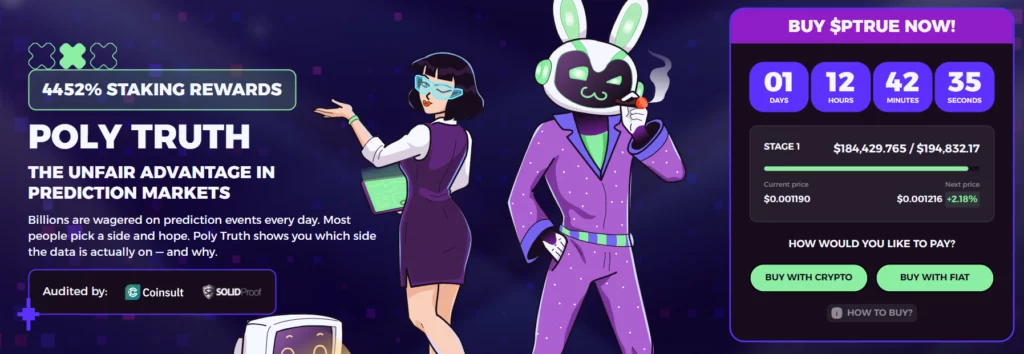
- Current price is $0.001190, with the next step at $0.001216
All information can be found on the website polytruth.io for the live price and staking APY.
2. Meme Punch (MEPU)
Hype is usually the only factor driving memecoins. Meme Punch is creating a real game based on the meme.
Five well-known characters – Pepe, Doge, Floki, Brett, and Pudgy Penguin – are present in the play-to-earn battle arena. Players choose a knight, engage in PvP-style combat with other players, and climb a leaderboard as each one appears in medieval armor. The token grants access to weapons, skins, and special powers within the game, and winners earn MEPU as in-game rewards.
This gives MEPU a job, something that most memecoins don’t have. It’s not just waiting for a pump in a wallet. It is the actual money used by players in a game.

A few important details for the project:
- Based on Ethereum, it has a 10 billion-unit supply.
- 40% goes to the presale, 14.5% goes to staking, and 9.5% goes to game rewards.
- The 16.5% marketing budget is high, but it makes sense for a project aiming to connect with gamers outside of the cryptocurrency bubble.
- Ethereum, BNB, SOL, USDT, USDC, and cards are all accepted forms of payment.
For the current presale price and staking APY, the information can be found on memepunch.io.
Why presales are worth paying attention to
Anyone can participate in presales before a token is released on exchanges. If the project succeeds, the early entry can be far more valuable than purchasing on launch day because the price is low and the supply is fresh.
The problem is that the majority of presales are unsuccessful. Some never get off the ground. Others perform well for a week before fading. Therefore, accepting every new one is not the aim.
Usually, that comes down to a few simple factors. Is it just a concept or is there an actual product? Has the contract been inspected? Are the team’s tokens locked, preventing them from being sold at launch? Does the distribution of supplies appear fair?
If the answers are good, the presale is worth a closer look. If not, it’s probably better to skip it.
What makes a good presale
Once what an investor is look for is known, sorting the good projects from the noise gets a lot easier. A few things to check:
- A real product or clear use case. The token should be tied to something, not just an idea on a roadmap.
- An audited contract. A public audit from a known firm is the bare minimum. No audit, no trust.
- Locked team tokens. Vesting and cliffs keep the team from cashing out at launch. It’s a sign they plan to stick around.
- Fair tokenomics. A big slice for the presale and a small one for insiders is what you want to see. The opposite is a red flag.
- An active community. Real people asking real questions, not just bots and giveaways.
Conclusion
The best crypto presales come with real risk, but they’re also where some of the best entries happen. Poly Truth (PTRUE) and Meme Punch (MEPU) stand out because both bring something useful. One brings AI to prediction markets. The other turns meme coins into a playable game.
Neither is a sure thing, and presale tokens move on their own timelines. Take a look at both, check the websites, and only put in what you’d be okay losing.
FAQ’s
What is the best presale crypto to buy?
There’s no single answer, but Poly Truth (PTRUE) and Meme Punch (MEPU) are two presales worth a closer look, since both have real products tied to their tokens.
Which crypto has 1000x potential?
1000x runs almost always come from small, early-stage tokens with something real behind them. That’s where presales like PTRUE and MEPU tend to come up in the conversation.
What is the biggest crypto presale ever?
EOS holds the record, raising around $4 billion across its year-long presale in 2017 and 2018. Most presales today are much smaller, which is part of why early entries like PTRUE and $MEPU can still offer real upside.
What crypto under $1 will explode?
No one can promise an explosion, but tokens priced well under a cent in presale, like PTRUE and MEPU, have the most room to grow if the market keeps warming up.
Disclosure: This content is provided by a third party. Neither crypto.news nor the author of this article endorses any product mentioned on this page. Users should conduct their own research before taking any action related to the company.


Augustus Bank CEO Ferdinand Dabitz says legacy clearing banks cannot fully rebuild their systems for AI and programmable money.
Summary
- Augustus received conditional OCC approval to form a full-service U.S. national bank for AI and stablecoin payments.
- CEO Ferdinand Dabitz says legacy clearing banks can upgrade systems but cannot rebuild their core models.
- The plan comes as JPMorgan and Circle expand tokenized liquidity products for stablecoin and payment use.
His comments came after Augustus received conditional approval from the Office of the Comptroller of the Currency to establish Augustus Bank, N.A. as a full-service U.S. national bank.
The bank has not launched yet. As previously reported, Augustus must meet pre-opening conditions and become fully licensed before it can add U.S. dollar clearing to its platform.
Stablecoins sit at the center
Augustus plans to build around AI-driven payments, stablecoin settlement and programmable clearing. The company says its bank will serve machine agents, global institutions and programmable dollar flows.
Dabitz said “replacing them” when asked whether Augustus could coexist with traditional clearing banks. He also described the current correspondent banking model as “broken,” pointing to weekend closures, old systems and slow settlement.
Moreover, Augustus wants to use AI for compliance, transaction monitoring, case handling and back-office work. Dabitz said the bank aims to cut some manual processes from “20 hours to 20 minutes,” with humans supervising the systems.
The model still faces questions. AI-led banking can raise concerns around model risk, compliance checks and operational failures. Dabitz said the company plans to work with regulators and banking leaders to keep proper controls around AI systems.
Stablecoin race grows wider
The Augustus plan comes as stablecoin payments gain more attention from banks and crypto firms. Crypto.news reported that stablecoin transaction volumes reached $33 trillion, with fourth-quarter volumes alone hitting $11 trillion.
Circle also reported that USDC processed $21.5 trillion in on-chain transaction volume during Q1, up 263% from one year earlier. Crypto.news noted that stablecoin regulation in the U.S. and Europe has supported adoption through clearer issuer rules.
JPMorgan expands tokenized liquidity
Large banks are not standing still. J.P. Morgan Asset Management launched its second tokenized money market fund on Ethereum this week, designed in part to support stablecoin issuers under the GENIUS Act.
The fund offers qualified U.S. investors token balances on a public blockchain and lets them subscribe or redeem through Morgan Money using cash or stablecoins through a third-party vendor. That shows the same market Augustus wants to enter is already drawing major bank activity.

Disclosure: This article does not represent investment advice. The content and materials featured on this page are for educational purposes only.
Poly Truth and Meme Punch presales gain attention as crypto markets search for next breakout projects in 2026.
Summary
- Crypto markets are heating up again, with five projects split between presales and listed tokens gaining attention.
- Poly Truth uses AI prediction analysis to turn events into probability-based reports using data scraping and AI.
- Meme Punch is a play-to-earn meme game where players battle, earn MEPU tokens, and use them for in-game upgrades.
Crypto markets are starting to warm up again, and the search for the next crypto to explode always picks up around the same time. The question is which projects actually have something behind them, and which are just running on noise.
This article looks at five picks worth knowing right now. Two are presales catching attention before they hit exchanges. The other three are already listed and moving on real catalysts. Different stages, different risk levels, but all five have a real reason to be on the list.
Next crypto to explode: Picks worth watching
Five projects worth knowing if you’re scanning for the next crypto to explode. Two are early entries from the best crypto presales right now, and three are already on exchanges and moving on real catalysts.
1. Poly Truth (PTRUE)
Poly Truth is a prediction market intelligence tool, not a trading bot. Instead of blindly picking a side on a sports match, a political race, or a crypto price call, users get AI-powered analysis showing which outcome the data actually supports, and why.
The platform runs on a three-character system. The Runners are automated bots that scrape data from across the internet on any active prediction event. The Starlet is an AI analyst that cross-references the sources, finds patterns, and works out the probability of each outcome. The Presenter delivers the final report in plain language.
A few things worth noting:
- Built on Ethereum, with a total supply of 11.5 billion PTRUE.
- 40% of the supply is allocated to the presale, with another 10% set aside for staking rewards.
- Audited by SolidProof and Coinsult, with both reports public.
- Team tokens locked under a 12-month vest with a 3-month cliff.
- Payment options cover ETH, BNB, SOL, USDT, USDC, card, and SEPA.

2. Meme Punch (MEPU)
Meme Punch is a play-to-earn game, not just a token. Instead of passively holding a memecoin and hoping for a pump, users actually play, and you earn real crypto for winning.
The game is built around three core mechanics:
- Choose your knight. Players pick from five meme-inspired characters – Pepe, Doge, Floki, Brett, and Pudgy Penguin, each one dressed in medieval armor and ready for combat.
- Fight in the arena. Battles are PvP-style. Win matches, climb the leaderboard, and earn MEPU as in-game rewards.
- Spend and grow. $MEPU is used inside the game to access weapons, skins, and special powers, which gives the token real utility beyond speculation.
The token basics:
- Built on Ethereum, with a total supply of 10 billion MEPU.
- Presale takes 40% of the supply, with another 14.5% set aside for staking and 9.5% for in-game rewards.
- Payment options cover ETH, BNB, SOL, USDT, USDC, and card.
3. Injective (INJ)
Injective is one of the strongest stories on exchanges right now. The Layer-1 chain is built for finance, with decentralized perpetuals, on-chain RWAs, and a network designed for high-speed trading.
The catalyst this week is real. On May 7, Circle launched native USDC and CCTP on Injective, which removes the need for wrapped USDC and pulls deep institutional liquidity onto the chain. A record buyback burn is also running this week, with U.S.-regulated futures live in the background.
The price action backs it up. INJ is currently trading around $5.14, with the market cap at roughly $515 million. The 24-hour move is small and slightly red, but the weekly picture is much stronger after a clear breakout earlier in the month. The token is still well below its all-time high of $52.75 from March 2024, which gives it more room to recover if the catalysts hold.
4. Toncoin (TON)
Toncoin is the native token of The Open Network, which is the blockchain tied to Telegram.
A few things have lined up in TON’s favor recently. Telegram has stepped up to become the largest validator on the network, which deepens the connection between the platform and the chain. There’s also been a 6x fee cut to make transactions more attractive, plus the MTONGA roadmap pushing further integrations.
The price action is starting to reflect it. TON is currently trading around $2.16, with the market cap at $5.82 billion and the chart turning back up after a long stretch of sideways and downward moves. It’s a long way off the $8 peak from mid-2024, so there’s real recovery room if Telegram continues pushing TON deeper into its product.
Out of all the picks on this list, TON has the biggest built-in user base. Telegram has hundreds of millions of users, and even a small share of them moving on-chain would be a big shift.
5. Bittensor (TAO)
Bittensor is the heavyweight of the AI crypto sector. The network is built around decentralized machine learning, with subnets where AI models compete to provide services and earn TAO based on how well they perform.
The story right now is momentum. TAO is currently trading at $305.62, up 3.92% on the day, with the market cap sitting at $3.33 billion and the volume jumping more than 28% in 24 hours. After a long stretch of sideways action, the chart is turning back up.
There’s also a hard cap of 21 million tokens, which puts TAO in the same supply category as Bitcoin. Only about 11 million are in circulation right now, so the scarcity story is real.
The catalysts ahead are stacking up too. Spot TAO ETF filings from Grayscale and Bitwise are still pending, and the network is working on expanding from 128 subnets to 256, which opens it to more AI use cases.
Why these picks are worth watching
Different stages, different stories, but all five deserve your attention.
Since Poly Truth and Meme Punch are still in presale, there is more space for expansion and lower entry costs. One is creating an AI research tool that offers traders in prediction markets a significant advantage. The other transforms a meme coin into a game that can be played and has real-world in-game features.
Injective just landed native USDC on its chain — a big step toward institutional liquidity. Toncoin has Telegram pushing deeper into its ecosystem, with hundreds of millions of users. Bittensor is the AI infrastructure pick with pending ETFs and a hard supply cap of 21 million.
Chasing the loudest one is not the goal. While the rest of the market catches up, it’s important to know which projects are succeeding and which need further investigation.
Disclosure: This content is provided by a third party. Neither crypto.news nor the author of this article endorses any product mentioned on this page. Users should conduct their own research before taking any action related to the company.

Solayer, a Layer-1 blockchain developer behind the infiniSVM framework, has unveiled a Visa-compatible physical card that lets users spend USDC balances directly in stores, online, and via contactless payments. The card integrates with Solayer Pay, the company’s digital wallet and payments platform, expanding the utility of stablecoins beyond on-chain transfers to everyday retail use.
According to Solayer Pay’s announcement, existing users can request the card at no cost, while new entrants are charged a $20 annual activation fee. The launch follows Solayer’s April 2025 rollout of Emerald Card, which reached about 40,000 users across more than 100 countries. The new physical card is designed to widen access to crypto-enabled spending by linking Solayer Pay accounts to the Visa payment network, enabling spending of USDC balances globally.
The card supports ATM withdrawals in regions where such services are supported and can be ordered directly through the Solayer Pay app. Solayer emphasizes that the card is built to bridge the gap between digital assets and traditional payment rails, allowing users to pay with stablecoins when converting on the fly at point-of-sale terminals.
In tandem with the card, Solayer highlights its broader platform, which already enables storing, transferring, and spending digital assets through Visa-linked payment infrastructure. The company also notes the existence of infiniSVM, a layer-1 network designed to run high-throughput on-chain applications while leveraging Solana (SOL) for gas fees.
Solayer’s push into physical cards sits within a wider industry trend: stablecoin-backed payment cards linked to major card networks like Visa and Mastercard are expanding rapidly as more issuers and processors participate in crypto-for-pay programs. The landscape includes several notable recent moves by other players in the space, underscoring shifting consumer and merchant attitudes toward digital assets in everyday commerce.
Key takeaways
- Solayer launches a Visa-enabled physical card tied to USDC through Solayer Pay, broadening access to on- and off-chain spend for holders of the stablecoin.
- Existing Solayer users can obtain the card for free, while new users incur a $20 annual activation fee.
- The card operates within Solayer’s Visa-linked payments ecosystem and supports ATM cash withdrawals in supported regions.
- Solayer also markets infiniSVM, its layer-1 network compatible with the Solana Virtual Machine, intended to support high-throughput on-chain applications with SOL used as gas fees.
- The move is part of a broader trend toward stablecoin payment cards, with major players expanding coverage and capabilities across networks and jurisdictions.
- DefiLlama data shows the stablecoin market growing to roughly $322.5 billion, up from about $243.3 billion in May 2025, highlighting growing demand for off-chain spend and cross-border payments.
- USDT remains the dominant stablecoin by market cap (about $189.7 billion, ~58.8% of the market), followed by USDC at around $76.7 billion, signaling continued concentration in the stablecoin sector.
Stablecoins and the card-ification of payments
The Solayer card arrives as a wave of stablecoin-linked cards gains momentum across the ecosystem. In January, OKX introduced a Mastercard-linked card for European users via regulated issuer Monavate, enabling spend of USDC and Paxos’ USDG. The following month, MetaMask expanded a Mastercard-backed crypto card across the United States, including New York, allowing self-custodial-wallet users to pay with digital assets directly at merchants. In March, Visa and Stripe-backed Bridge broadened a stablecoin card program to 18 countries and signaled plans to reach more than 100 countries by the end of 2026, while Mastercard moved to acquire BVNK, a stablecoin infrastructure company serving payments across more than 130 countries, in a deal valued at up to $1.8 billion.
Against this backdrop, DefiLlama’s stablecoins tracker shows the market expanding meaningfully, emphasizing why the card programs matter. The ecosystem’s scale gives issuers and processors a stronger business case to extend card-based access to stablecoins, potentially broadening merchant acceptance and improving cross-border spend efficiency for users who hold digital assets for daily transactions.
Solayer’s approach—combining a specialized layer-1 network with a Visa-enabled card—aims to deliver both high-throughput on-chain capabilities and familiar consumer checkout experiences. For developers building on infiniSVM, the promise of a compatible environment with Solana-inspired gas mechanics could reduce friction when deploying apps that require fast settlement and predictable costs, potentially widening the use cases for on-chain finance in everyday commerce.
Industry context and what comes next
The broader market backdrop offers several cues about the path ahead. The rapid uptake of stablecoin payment cards reflects ongoing demand for practical on/off-ramp solutions that blend crypto liquidity with conventional payment rails. As more issuers partner with established networks and processors, the geographic reach of these cards continues to grow, with regulatory frameworks gradually catching up to the technology and use cases.
Investors and users should watch how these programs address non-compliance risk, merchant onboarding, and settlement efficiency as card networks push to scale across more jurisdictions. The competition among issuers, networks, and infrastructure providers could shape the pace of adoption, as could shifts in stablecoin liquidity, on-chain fees, and cross-border payment dynamics.
Solayer’s dual approach—an on-chain, high-throughput L1 network and a consumer-facing payment card—adds another dimension to the conversation about stablecoins’ mainstream potential. If Solayer’s card and InfiniSVM ecosystem can deliver a reliable, low-friction user experience at scale, they may help accelerate merchant acceptance and user retention in a field where real-world spend is often the biggest hurdle to broader adoption.
As the market observes, the next milestones to watch include broader card issuance for Solayer Pay, expanded ATM coverage, and deeper integration with more card networks and fiat rails. Regulators’ guidance on stablecoins and electronic payments will likely shape how quickly and how widely these programs expand, but the current trajectory suggests that stablecoin-enabled cards are transitioning from novelty to a persistent feature of crypto finance.
Source data and market context referenced in this report include Solayer Pay’s official announcements and industry-wide coverage of stablecoin card initiatives, with DefiLlama providing sector-wide stablecoin metrics used to gauge overall market growth.
What remains uncertain is how rapidly merchants will embrace stablecoin payments at scale and how future regulatory developments will influence the design and feasibility of such cards. For now, Solayer’s entry adds a concrete example of how digital assets can be bridged to everyday transactions, signaling a continued push toward more practical, payment-ready crypto use cases.

Although Ripple’s cross-border token couldn’t continue its run that began on Thursday, it still managed to result in an impressive peak for the overall usage of the ecosystem’s network.
Meanwhile, analysts noted that certain investors are “quietly buying long positions,” as the asset remains below the key 100 EMA line.
Network Usage Rocketed as Price Tried to Break Out
XRP’s price went on an impressive run on Thursday, most likely propelled by the progress of the CLARITY Act in the US. As reported, the long-anticipated bill passed the Senate Banking Committee, which was considered a major step in the right direction for the legislation to be signed into law.
Ripple’s token could be among the biggest beneficiaries of the bill, given its controversial history with the SEC and the lawsuit about its status as a security (or not). Consequently, its price felt a substantial uptick once the bipartisan vote went in favor of the bill, with 15-9, and XRP jumped from $1.42 to $1.55. This became its highest price tag in approximately two months.
This substantial increase also impacted the XRP Ledger’s activity, according to Santiment Intelligence. The analysts said this surge was “enough to help the network erupt to its highest level of on-chain activity since March.” Both active addresses and network growth reached levels not seen since March.
The $XRP price surge above $1.54 for the first time in 2 months was enough to help the network erupt to its highest level of on-chain activity since March. The XRP Ledger just had its highest 24-hour period of:
Active Addresses (48,453: Highest Since March 30)
Network… pic.twitter.com/iInHHdei5P
— Santiment Intelligence (@SantimentData) May 15, 2026
It’s worth noting, though, that XRP was rejected almost immediately at $1.55 and dumped to its starting point, where it sits now as well. Santiment added that this activity spike is likely just general price FOMO, but explained that more transacting on a network is still a “key ingredient to mid- and long-term price growth.”
Someone Is Quietly Buying
Weighing in on XRP’s price movements, popular analyst CW said the “position delta value actually increased” as it appears that “someone is quietly buying long positions.” They even increased their positions at lower prices after the token dropped.
In a separate post, the analyst explained that XRP has not broken through the 100 EMA line, which appears as the first major obstacle ahead. If it does, then it will likely continue to the 200 EMA line, which is currently at $1.70. It’s worth noting that the token hasn’t reached such high levels in well over three months.
The post Massive XRP Network Surge Followed Price Rally to 2-Month Peak appeared first on CryptoPotato.
Crypto World
State Street’s tokenized fund servicing is the boring infrastructure shift that actually matters


State Street is wiring its Luxembourg fund stack so tokenized fund units run on the same custody, NAV and TA rails as traditional funds, turning RWAs from brochure‑ware into production infrastructure.
Summary
- By end‑2026, State Street will let clients issue and service “digitally native” fund structures from Luxembourg via its Digital Asset Platform, alongside conventional funds in one operating model.
- Tokenized fund shares will plug into existing NAV, custody, transfer‑agency and compliance workflows, closing a “glaring hole” that kept RWA pilots stuck in walled gardens with fuzzy legal settlement.
- If this works, European managers can launch tokenized share classes and feeders with full legal finality, while DeFi protocols interface with assets custodied by a systemically important bank, not a sidecar startup.
State Street is wiring its Luxembourg fund stack to treat tokenized fund units as first‑class citizens, not side projects, and that’s a much bigger deal than another “bank experiments with RWAs” headline suggests.
State Street heads into 2026 with a buzz
State Street Corporation has said it intends to deliver a “tokenized fund servicing capability” from Luxembourg by the end of 2026 through State Street Investment Services, extending its existing fund administration, custody and transfer‑agency services to “support digitally native fund structures alongside traditional funds within a single institutional operating model.” The new offering will be delivered via its Digital Asset Platform (DAP), launched earlier this year, and is designed to support the full lifecycle of tokenized fund issuance, administration and custody, with State Street Investment Management expected to be an early adopter.
Luxembourg is the key tell. In its press release, State Street says Luxembourg was selected “due to its established global funds ecosystem and legal frameworks that support digitally native fund structures,” making it the initial delivery location for the tokenization‑enabled service. This is where a huge chunk of Europe’s cross‑border UCITS and AIF infrastructure already sits; when a systemically important custodian adds tokenized fund shares to the same back‑office rails that handle trillions in traditional funds, you’ve moved RWAs from brochure‑ware to production infrastructure. Angus Fletcher, State Street’s global head of Digital Asset Solutions, spells it out: the goal is “building infrastructure that enables digital and traditional assets to operate together within a unified institutional framework,” with Investment Services “focused on delivering a production‑ready servicing capability” rather than pilots.
Structurally, this means tokenized fund units can live inside the same NAV‑calculation, custody, transfer‑agency and compliance workflows as conventional shares, all through a single client interface. Tokenizationinsight and other specialist outlets correctly point out that there has been “a glaring hole in the fund tokenization stack” — product managers love issuing tokenized feeders and side‑pockets, but without institutional‑grade operating infrastructure, those tokens stay stuck in walled gardens with ambiguous legal settlement. State Street’s move plugs that hole: its Digital Asset Platform is described as supporting tokenized products including money‑market funds, ETFs, tokenized assets, tokenized deposits and stablecoins, all under consistent governance and risk‑management frameworks.
Everyone likes to talk about RWAs as fintech porn — tokenized T‑bills, private credit, shiny dashboards. The real power is exactly this kind of boring plumbing: Luxembourg lawyers updating fund prospectuses, State Street ops teams wiring DAP into custody and TA systems, regulators signing off on “digitally native fund structures” that settle on chain but behave like any other regulated fund in their back office. If this works, mainstream European managers can launch tokenized share classes, feeders or side‑pockets out of Luxembourg with real legal settlement finality, and DeFi protocols that want to touch those assets won’t have to pretend they’re dealing with some exotic wrapper; they’ll be interfacing with assets that sit squarely inside TradFi’s legal superstructure, serviced by one of the world’s largest custodians.
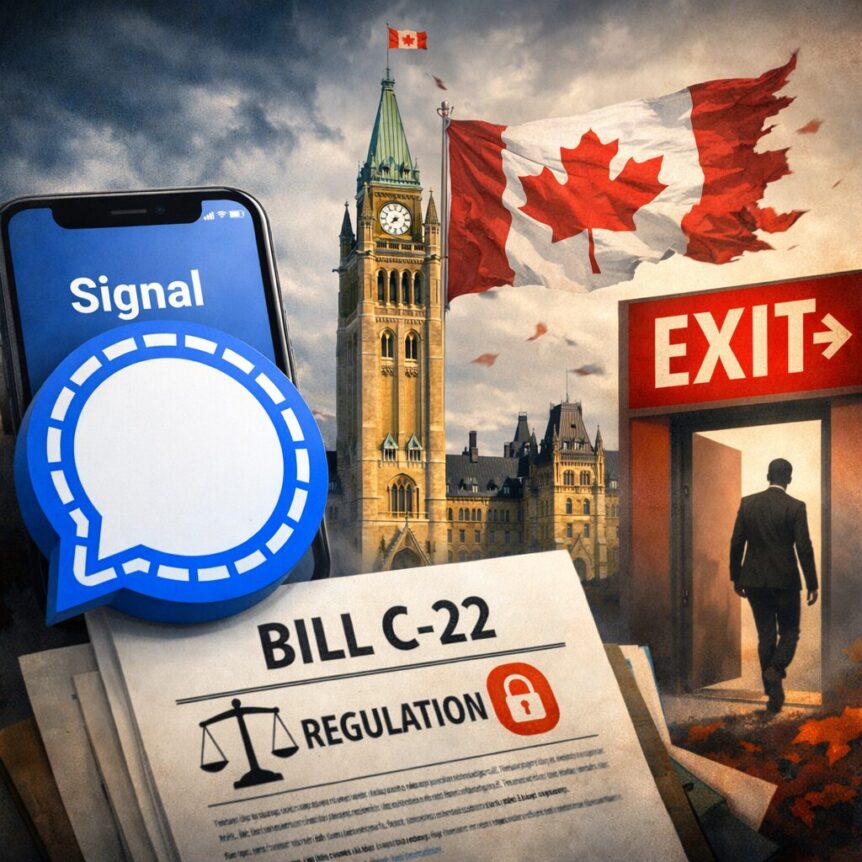
Signal May Exit Canada
Privacy-focused messaging app Signal has hinted it could exit the Canadian market if it is forced to comply with the proposed lawful access bill, Bill C-22.
According to the company’s vice president of strategy, the bill requires companies to build surveillance capabilities that could threaten end-to-end encryption.
Bill C-22 was introduced in March 2026 as part of a broader regulatory package. It requires electronic service providers to build surveillance capabilities and retain user metadata for up to a year, in an effort to help law enforcement agencies investigate serious crimes such as terrorism and child exploitation.
Udbhav Tiwari, Signal’s vice president of strategy and global affairs, said during an interview with The Globe and Mail that the lawful access bill threatens encryption and could expose private messaging apps to cybersecurity risks.
Bill C-22 could potentially allow hackers to exploit these very vulnerabilities engineered into electronic systems, with private messaging services serving as an ideal target for foreign adversaries.
Critics Warn of Implications to User Privacy
However, the bill has drawn substantial criticism due to implications for user privacy, drawing comparisons with the EU’s chat control proposal, which threatened encryption by pushing for client-side scanning of private conversations.
Jacob Mantle, a Canadian Conservative Party member of Parliament, claimed that every member of Parliament in Canada uses Signal because of its privacy features, arguing that the bill would give the government access to everyone’s messages.
Some companies, including Meta, have supported specific aspects of the bill, arguing that it gives law enforcement the necessary legal framework to obtain evidence and ensure public safety. However, they flagged concerns that some provisions of the bill negatively impact privacy and cybersecurity.
Privacy-Focused Companies under Pressure
Signal is not the only company opposed to the proposed bill. Windscribe, a VPN service provider, also said it could exit Canada if forced to comply with the legislation. The company argued the proposed legislation poses a significant threat to user privacy.
We won’t be far behind if C-22 passes. In its current state, VPNs would almost certainly require us to log identifying user data. Signal isn’t headquartered in Canada, so they can just shut off Canadian servers, but our HQ is. We pay an ungodly amount of taxes to this corrupt government, and in return, they want to destroy the entire essence of our service to basically spy on its own citizens.
Disclaimer: This article is provided for informational purposes only. It is not offered or intended to be used as legal, tax, investment, financial, or other advice.

Soccer-FIFA officials to meet Iranian FA to discuss World Cup on Saturday, says source

Polymarket’s CFTC talks are really about who gets to price reality in public

Rangers keen on Sunderland forward Finn Geragusian

Manchester United reach agreement with Casemiro over contract clause amid transfer speculation

US brings back mandatory military draft registration

Steven Gerrard disagrees with Gary Neville over ‘shock’ Chelsea and Arsenal claim | Football

A Prayer for Financial Stability #shortprayer #prayer #dailyprayer

#chicagocoin #antiquecoins #facts #thaibanknotes #duet #money #rarecoins #oldcoins #oldcoinshop

$4,300 CEO Is Bullish & Ripple SVP Explains How XRP Is At The Center Of It All
-

 Fashion5 days ago
Coffee Break: Travel Steam Iron
-

 Fashion13 hours ago
Weekend Open Thread: Theory – Corporette.com
-

 Fashion5 days ago
What to Know Before Buying a Curling Wand or Curling Iron
-

 Politics4 days ago
What to expect when you’re expecting a budget
-

 Tech6 days ago
Auto Enthusiast Carves Functional Two-Stroke Engine from Solid Metal
-

 Crypto World6 hours ago
BloFin War of Whales 2026 Grand Prix opens registration for $5M trading championship
-
 Business7 days ago
Ignore market noise, India’s long-term story intact, say D-Street bulls Ramesh Damani and Sunil Singhania
-

 Tech5 days ago
GM Agrees To Pay $12.75 Million To Settle California Lawsuit Over Misuse Of Customers’ Driving Data
-

 Tech1 day ago
Tech Moves: Microsoft AI leader jumps to OpenAI; former AI2 exec joins Meta; and more
-

 Crypto World7 days ago
PROS explodes 48% as Upbit and Bithumb listings ignite demand
-

 Crypto World6 days ago
CZ says US crypto rivals tried to block Trump pardon
-

 Tech4 days ago
GM agrees to $12.75M California settlement over sale of drivers’ data
-
Crypto World3 days ago
Bitcoin Suisse expands with Digital Asset License and Investment Business Act Registration Approval in Bermuda
-

 Crypto World13 hours ago
E-Estate Announces 1 Year Live: Washington DC Summit as Real Estate Tokenization Enters Its Next Phase
-

 Politics3 days ago
Pakistan to enter Chinese capital market as war inflation bites
-
 Crypto World2 days ago
Google’s Gemini AI Predicts Incredible Solana Price by the End of 2026
-

 Crypto World3 days ago
Bitcoin Suisse expands with Digital Asset License and Investment Business Act Registration Approval in Bermuda
-

 Politics6 days ago
Sky News Presenter Says Keir Starmer Is Not Waving But Drowning
-
Crypto World7 days ago
Hacker Drains $5.9M From Ethereum Liquidity Provider TrustedVolumes
-

 Fashion6 days ago
Amazon Sundays: Spring Glassware & Vases
You must be logged in to post a comment Login