
Crypto World
Zcash Sets Ironwood Network Upgrade for July 28


Zcash’s Ironwood network upgrade, the solution to an “infinity” bug discovered in May on the privacy-focused blockchain’s main private transaction pool, Orchard, is set to go live on July 28.
Announced in June, Ironwood closes the current Orchard pool, prevents new activity in it and sets up a new private pool. Funds leaving Orchard would have to pass through an accounting checkpoint before entering Ironwood, which could produce evidence about whether any counterfeit Zcash (ZEC) tokens were produced through the Orchard bug.
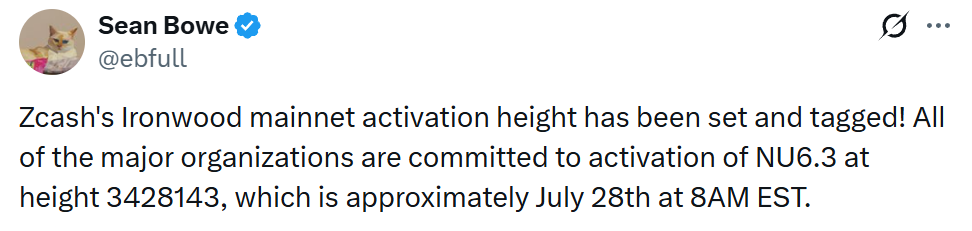
“Zcash’s Ironwood mainnet activation height has been set and tagged! All of the major organizations are committed to activation of NU6.3 at height 3428143, which is approximately July 28th at 8AM EST,” Zcash core developer Sean Bowe said on Thursday.
Source: Sean Bowe
Shielded Labs had floated delaying Zcash’s Ironwood upgrade, warning that ecosystem participants such as exchanges, mining pools and wallets would not have enough time to prepare their systems for a late-July mainnet activation. Bowe’s latest comment confirms the upgrade will go ahead one week later than its earlier target date of July 21.
Related: Anthropic’s Mythos AI finds no more ‘serious’ bugs in Zcash: Wilcox
In June, Shielded Labs said Ironwood may provide evidence about whether the Orchard vulnerability was ever exploited.
“As users migrate funds from the existing Orchard pool to the new pool, any hypothetical counterfeiter faces a choice: attempt to move counterfeit funds and risk exposing their existence, or leave them behind and risk being unable to move them in the future.”
ZEC plummeted 50% to $299.25 from $602.68 after the disclosure of the Orchard bug on June 3. The price of ZEC has made a partial recovery in the weeks following and is trading at $492.61 at the time of writing.
Zcash crossed a major monetary milestone this week, with more than 80% of its maximum 21 million ZEC supply now issued. A post from ruZCASH on Monday shows that there is now 16,806,723 ZEC in supply.
Magazine: Bitcoin’s quantum dilemma: Bigger blocks or STARK proofs?



Last week, hackers discovered a five-year-old bug in Coldcard software and used it to drain over 1,158 BTC worth over $72 million from over 2,600 addresses.
By Sunday, the tally rose to 1,359 BTC and continues to rise today.
A rudimentary dashboard is charting the rising number of thefts, with many security experts warning of additional waves of attacks.
The essence of the bug is that, despite claims by Coldcard’s manufacturer and documentation, many of its devices didn’t actually use a true random number generator (RNG) with sufficient entropy to protect users trusting the device to generate private keys and seed phrases.
Instead, the device used a fallback, a pseudo RNG, with far lower entropy.
Unfortunately, trivial amounts of computation can guess these low entropy seed phrases generated by Coldcard devices.
Once in possession of these private keys, a quick scan of the blockchain reveals associated public keys holding BTC, and hackers then steal those funds.
The bug has existed since March 2021, but security researchers only publicly discovered it last week. As theft transactions began, customers and members of the community began to track the horrifying timeline of events.
As brute-force attacks continue to crack private keys, here’s a summary of the series of events that led up to the ongoing catastrophe.
Read more: Crypto wallet seeds crackable with gaming PC via this security flaw
Timeline of the Coldcard hack
6 years ago
November 18, 2020, 19:19 UTC: There are disputed histories and allegations about Coldcard maker Coinkite’s motivation during this time to end its commitment to free and open source software (FOSS).
In any case, by late 2020, Coinkite announced its intention to restrict commercial use of its firmware (on-device software), and by early 2021, the company began migration to a new software license.
It would develop a proprietary library called “libNgU.”
5 years ago
March 1, 2021, 14:03 UTC: Coinkite commits code titled “First pass w/ libNgU,” its final step away from FOSS and moving Coldcard firmware (on-device sofware) onto its proprietary library, libNGU.
5 years ago
March 29, 2021, 19:27 UTC: Firmware 4.0.1 reaches owners as the first public build with the flaw. Coldcard devices shipping with or upgrading to this new firmware would begin generating insecure seed phrases.
The bug of pseudo RNG on versions 4.0.1 and later would persist on Coldcard software for over five years from March 29, 2021 through July 30, 2026.
5 days ago
July 30, 2026, 01:10 UTC: Bitcoin block 960,183 includes the first Coldcard hack transactions from a hacker.
4 days ago
July 30, 2026, 13:19 UTC: A user posts the first widely read account to Reddit, “Full panic — one of my wallets was drained.”
4 days ago
30 July 2026, 17:35 UTC: Kevin Loaec, a BTC security researcher, asks his followers to check their balances. “I’m hearing a potential issue with some Coldcard wallets being drained,” he wrote. “I will not FUD, but would like to get at least reports of trusted people.”
4 days ago
30 July 2026, 18:58 UTC: Less than 90 minutes later, Loaec drops the hedge. “Alright I’m convinced THIS IS NOT A DRILL.”
4 days ago
30 July 2026, 22:50 UTC: The official Coldcard social media account publishes a Mk3-only advisory that has since drawn more than two million views.
It would claim “Mk4, Q and Mk5 are not affected based on our early analysis,” which would later turn out to be false.
On its website, Coinkite formally discloses the vulnerability and quickly publishes a bug patch via firmware 4.2.0.
3 days ago
July 31, 2026, 01:49 UTC: A Block engineer circulates its independent analysis of the incident, which identifies the root cause.
“COLDCARD firmware contains an RNG integration error that causes ngu.random to use MicroPython’s deterministic Yasmarang fallback instead of the STM32 hardware RNG.”
3 days ago
July 31, 2026, 04:54 UTC: Block 960,345 inclues additional theft transactions, which would continue for another four hours.
3 days ago
July 31, 2026, 06:46 UTC: Coinkite posts a technical disclosure widening the scope to its Mk4, Mk5, and Q Coldcard devices.
3 days ago
July 31, 2026, 08:36 UTC: Block 960,369 carries another drain of funds alongside 250 others.
3 days ago
July 31, 2026, 13:19 UTC: Kevin Loaec, another security researcher, warns that more theft transactions are underway.
3 days ago
July 31, 2026, 13:43 UTC: Coinkite releases Mk3 firmware 4.2.0. It emphasizes that the update will fix new private key generations but cannot repair a past, compromised seed phrase.
3 days ago
July 31, 2026, 15:42 UTC: Coinkite co-founder and chief executive Rodolfo Novak apologizes in an open letter. “We take full accountability for the firmware bug and we offer our sincere apologies to those affected.”
3 days ago
July 31, 2026, 16:30 UTC: Bitcoin Core contributor Antoine Poinsot tells his followers the scope is wider than Coinkite initially admitted.
“Coldcard MK3, MK4, MK5 and Q are being drained. A bug lets attackers find your seed phrase without any action on your part.”
3 days ago
July 31, 2026, 16:39 UTC: Coinkite concedes that seed phrases from compromised firmware carry “about 72 bits of entropy rather than the expected 128 bits.”
3 days ago
July 31, 2026, 17:42 UTC: Block engineering lead Clay Garrett claims that an attacker queried source addresses through a paid account at a blockchain data provider, raising the possibility that customer records from the company might assist law enforcement.
“Their internal logs matched the suspected workflow with extraordinary specificity, including the number, timing and sequence of requests.”
4 days ago
July 31, 2026, 18:27 UTC: Chainalysis, a US government contractor and forensic blockchain service, said, “Our team is actively monitoring the exploiter wallet and a consolidation address.”
3 days ago
July 31, 2026, 23:17 UTC: A developer launches a vibe-coded webite as a free dashboard counting the drained BTC. The website is helpful yet incomplete.
2 days ago
August 1, 2026, 12:29 UTC: Security researcher Loaec confirms that hackers are draining newer models. “It’s happening. Mk4, Mk5, Q are now actively drained,” he notes while publishing a detailed incident analysis.
2 days ago
August 1, 2026 18:38 UTC: Galaxy Research estimates ongoing losses from the Coldcard hack exceed 1,367 BTC from 4,585 addresses.
Coldcard contained a true RNG generator that was never properly switched on, so its physical entropy didn’t actually matter for the majority of customers over five years.
Devices fell back to a pseudo RNG generator and produced seed phrases that merely appeared to be secure.
The largest consolidation address belonging to the hacker(s) holds 562 BTC and had not spent outputs. That’s the only good news due to the possibility of that inaction indicating a potential law enforcement apprehension of the perpetrator(s).
Many victims have filed police and FBI reports or similar law enforcement submissions around the globe.
Got a tip? Send us an email securely via Protos Leaks. For more informed news and investigations, follow us on X, Bluesky, and Google News, or subscribe to our YouTube channel.
FIFA President Gianni Infantino has reportedly asked the Trump administration to help him keep his job, arranging a call with Secretary of State Marco Rubio, the New York Post reported Monday.
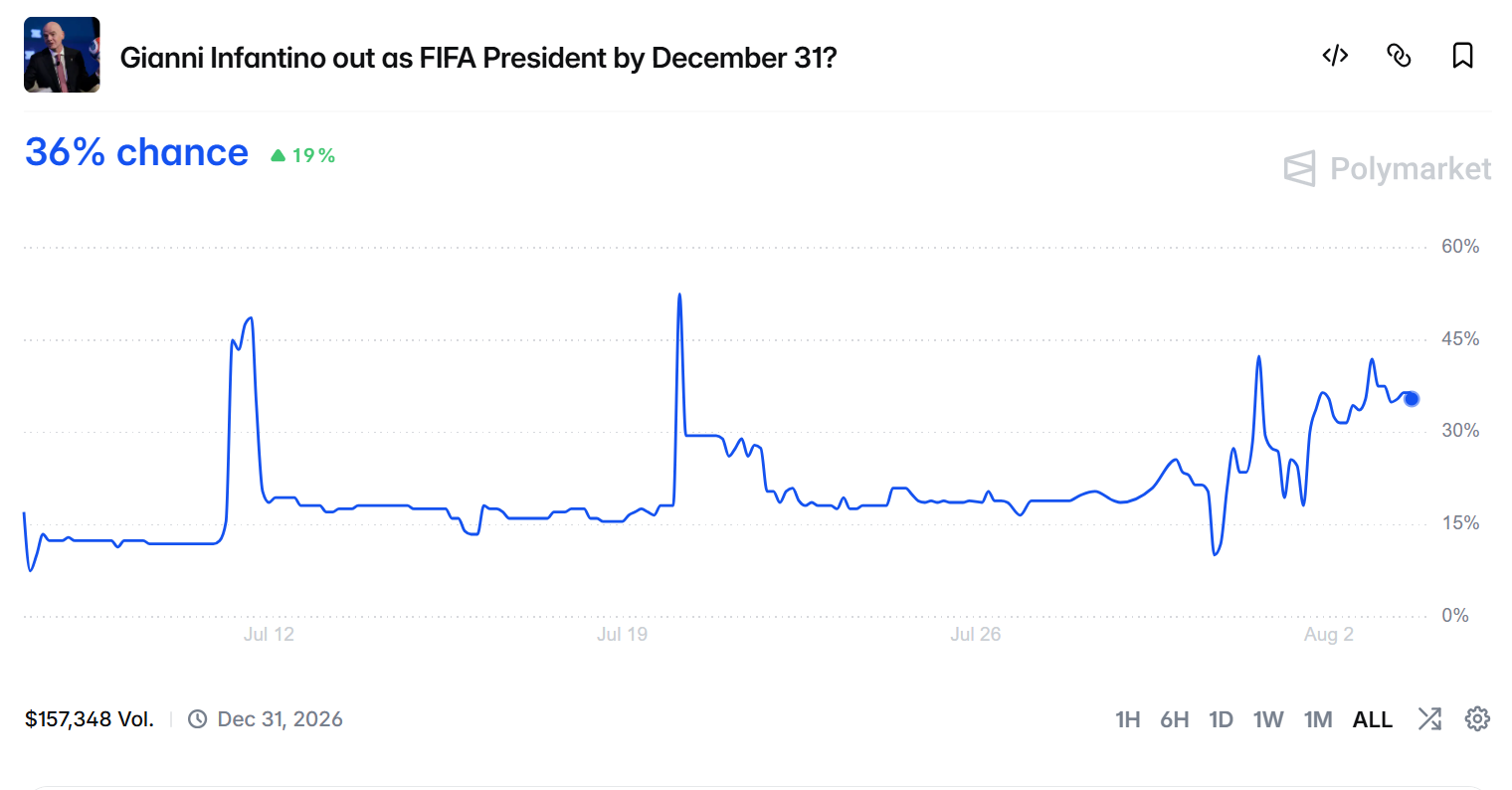
Polymarket traders price his exit by December 31 at 36.5%, up from roughly 19% a week ago. Almost all of the contract’s lifetime volume arrived in the past seven days.

Why Infantino Thinks Trump Owes FIFA a Favor
The reported ask lands four weeks after FIFA handed the White House a win. Its disciplinary committee cleared Folarin Balogun for Belgium, suspending the striker’s automatic red card ban on probation.
Trump had pushed for the reversal and claimed credit for it publicly.
“Thank you to FIFA for doing what was right, and reversing a great injustice!” Trump wrote on Truth Social.
Rubio is not a cold call. He sat in the Oval Office with Trump and Infantino last November. The occasion was a task force meeting on the World Cup.
FIFA’s bridge into that room is now gone. Carlos Cordeiro, the former Goldman Sachs banker who represented FIFA on the task force, resigned Friday over the sale plan. He had joined Infantino on repeated White House visits.
BeInCrypto could not independently verify the Rubio call, which the Post attributed to two people familiar with it.
Polymarket Traders Price the Fallout
The market read the revolt faster than the headlines did. It still traded near 20% on the afternoon of July 30. That was when all 55 UEFA member associations unanimously backed a boycott.
It broke above 40% the following day, once Infantino’s own executives turned on him. Chief operating officer Kevin Lamour told the Associated Press that staff had been deceived.
“It is the project of one person,” Kevin Lamour, chief operating officer of FIFA, in a statement to the Associated Press.
Follow us on X to get the latest news as it happens
Volume backs the repricing. The contract has handled $156,400 since it opened on July 6, and $151,700 of that traded in the past week. Open interest sits near $76,000.
The expiry date shapes how traders read it. The contract pays out only on a departure before December 31, while FIFA’s election falls next March. Challengers have until November 18 to declare, so the market is pricing resignation rather than defeat.
The asset in dispute is large. Cordeiro put FIFA’s revenue at $15 billion over the World Cup cycle. Josh Kushner’s fund offered $4.2 billion for 20% of a new FIFA subsidiary.
Crypto already has a claim on that value. The tournament drove $20 billion in World Cup prediction volume, Chainalysis found. FIFA’s own collectibles platform cleared at least $6 million in fees.
Whether Rubio’s call buys Infantino anything should show up in the odds before it shows up in a FIFA statement.
The post Infantino Wants to Collect on Trump’s World Cup Favor but Polymarket Says He’s 36% Out appeared first on BeInCrypto.

Miller’s previous controversies
Before being elected to the House in 2022, Miller spent six years in the Marine Corps Reserve. He also previously served in Trump’s first-term Administration, including as a senior advisor to the President.
Politico and the Washington Post have previously reported on Miller’s run-ins with the law as a young adult, including charges, which were later dismissed, for underage drinking, assault, disorderly conduct, and resisting arrest.
From 2019 to 2020, Miller dated Stephanie Grisham, a White House press secretary during Trump’s first-term Administration. Grisham has also accused Miller of abuse: she wrote in a 2021 op-ed for the Post and in a memoir the same year, without naming Miller, that her relationship with a White House staffer had “turned abusive” and that she had told Trump himself about her former partner who had “anger issues and a violent streak.”
The partner was later identified as Miller, who then sued Grisham for defamation, though he voluntarily dropped the suit in 2023 as part of a confidential settlement agreement.
BlackRock, the world’s largest asset manager, has expanded its tokenized cash platform, introducing a couple of new tokenized money market products, the firm said on Monday.
Back in May of this year, BlackRock filed for the new products with the U.S. Securities and Exchange Commission (SEC).
BlackRock is offering onchain shares of the BlackRock Select Treasury Based Liquidity Fund (BSTBL), a tokenized share class on Ethereum for an existing BlackRock money market fund. In addition, a new BlackRock Daily Reinvestment Stablecoin Reserve Vehicle (BRSRV) has also been unveiled with daily dividend reinvestment and access across multiple blockchains, said BlackRock in a press release.
Both funds intend to qualify as eligible reserve assets for permitted U.S. payment stablecoin issuers under the GENIUS Act, the asset manager said.
The move deepens BlackRock’s push into tokenized finance, blockchain-based representations of traditional financial assets such as funds, bonds or equities. Advocates say the technology can speed up settlement, enable round-the-clock trading and improve transparency.


Crypto exchange Bitget will stop accepting new registrations from Japanese users, announcing a phased exit that culminates in forced position closures by December 31, 2026.
The withdrawal comes as Japan tightens its licensing regime and grapples with severe currency turbulence.
The Timeline Japanese Users Now Face
The announcement, dated August 3, sets a clear timeline. Accounts flagged as potentially Japanese must complete that verification by November 1, 2026. Failure triggers restrictions. Users who miss the deadline face phased limitations from that date, with any remaining open positions forcibly closed by the end of December.
The exchange will email withdrawal instructions to affected users, framing the decision as part of its ongoing commitment to regulatory compliance.
The regulatory backdrop explains the move. Japan requires crypto service providers serving local residents to register with the Financial Services Agency under the Payment Services Act.
Follow us on X to get the latest news as it happens.
Enforcement risk is real for unregistered platforms. The agency issued warnings to Bitget and other overseas exchanges in November 2024. Consequences followed. Bitget’s app was later removed from Japan’s App Store, though web and Android access remained available to existing users.
Few jurisdictions demand more. Providers must meet capital, custody, consumer-protection, and anti-money-laundering standards to operate legally.
How Japan’s Yen Turmoil Compounds the Regulatory Burden
The timing coincides with acute currency pressure. The yen slid toward a 40-year low near 164 per dollar in late July, driven by rate differentials and carry-trade activity. Japan responded aggressively, with estimates suggesting authorities spent tens of billions of dollars buying yen to halt the decline.
“They have a weakening yen, and they wanted a little bit of help. And we’re always there for Japan,” US President Donald Trump told reporters on Sunday.
Washington then joined the effort. Both countries conducted a rare coordinated intervention, the first in 15 years, targeting excessive volatility and disorderly movements. The response was immediate, with the yen rebounding sharply and briefly reaching 155 per dollar.
Officials signaled more could follow. Finance Minister Satsuki Katayama and US Treasury Secretary Scott Bessent confirmed the operation and indicated readiness for further action.
The two pressures compound each other. Strict licensing raises fixed costs, while currency volatility complicates pricing and treasury management for offshore operators.
Bitget’s exit illustrates a broader pattern. Platforms must either invest heavily in registration or leave markets where regulatory barriers make operations uneconomical.
Japanese users still have room to act, with the transition window running until year-end before restrictions take full effect.
Subscribe to our YouTube channel to watch leaders and journalists provide expert insights.
The post Bitget Withdraws From Japan Amid Tightening Crypto Rules and Yen Turmoil appeared first on BeInCrypto.
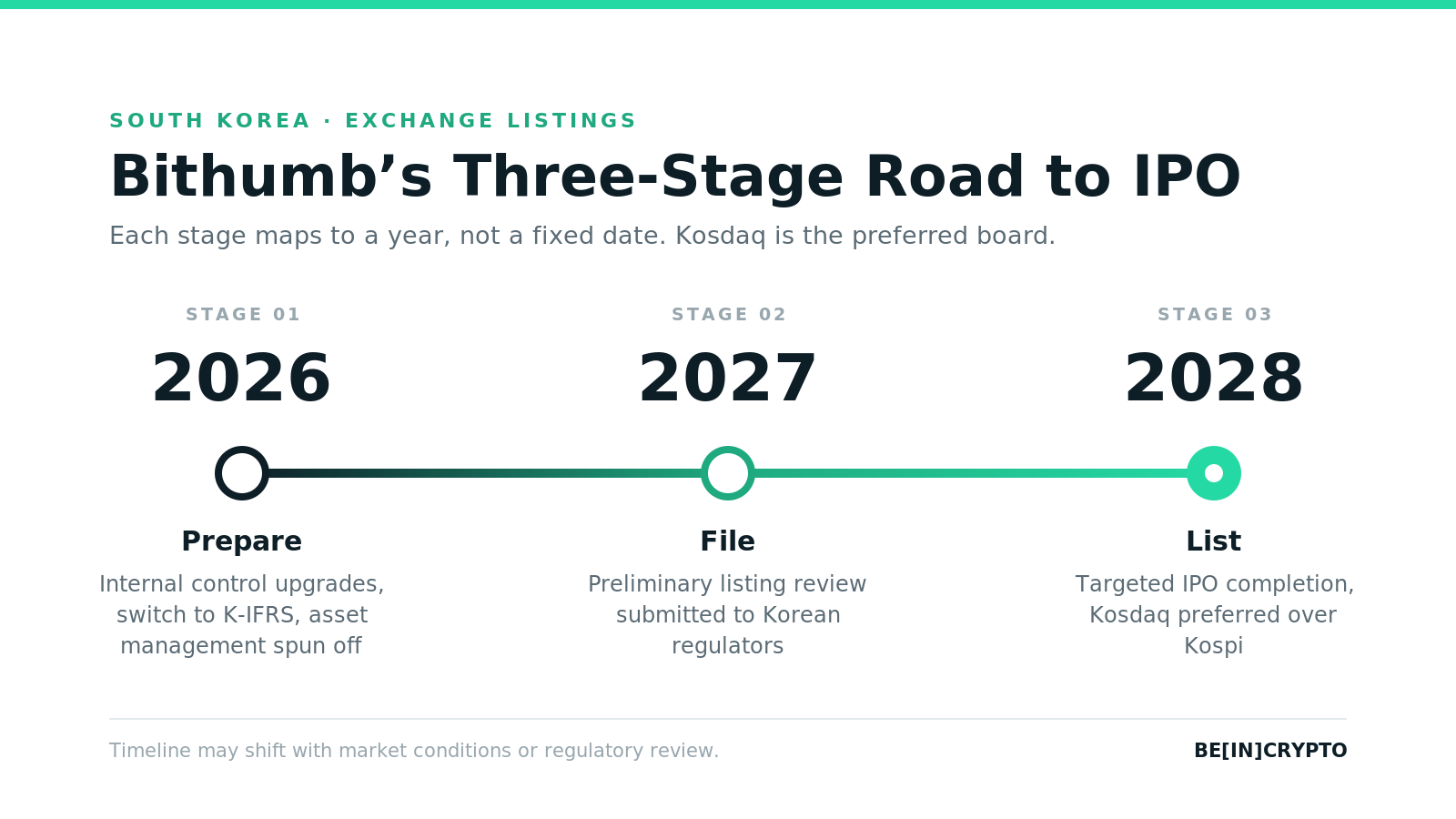
Bithumb has published a formal Bithumb IPO timeline. The plan targets a public listing by 2028.
South Korea’s second-largest exchange framed the listing as a trust-building step. Executives tied each phase to a specific governance target.
A Roadmap Shaped by Past Delays
Bithumb’s listing ambitions have shifted before. The exchange once targeted a debut in the second half of 2025. Management pushed that date back as new obligations piled up.
Shareholders backed CEO Lee Jae-won’s reappointment in March 2026. The vote came weeks after a Bitcoin (BTC) balance-display glitch drew a record fine.
The exchange also operates in a tougher home market. South Korean trading volume recently fell to a two-year low during a Kosdaq market crash. A new 22 percent crypto tax takes effect in 2027. That is the same year Bithumb plans to file its listing review.
The Bithumb IPO Timeline, Stage by Stage
The Bithumb IPO timeline runs in three stages. Each stage maps to a single year rather than a fixed date. Stage one covers 2026. It focuses on internal control upgrades and a shift from domestic accounting rules to the global K-IFRS standard.
Bithumb has also restructured internally, spinning off its asset management unit as a separate entity, Bithumb Asset. The company said the split separates responsibilities and reduces potential conflicts of interest ahead of a listing review.
Stage two opens in 2027. Bithumb plans to file for a preliminary listing review with Korean regulators that year. Stage three targets IPO completion in 2028. However, the notice cautions that the schedule could shift with market conditions or regulatory review timelines.
The exchange has indicated a preference for South Korea’s Kosdaq board. A listing on the larger Kospi market remains possible if conditions change.

The notice also spelled out promises to customers. Bithumb pledged a more transparent governance structure and stronger internal controls.
It also promised better investor protection, more frequent information disclosure, and a sustainable growth foundation as it moves toward institutional-level, global-standard management. The company said these steps aim to show it can operate like a listed company well before shares actually trade.
The plan lands as Japan and South Korea explore a broader digital asset framework. That regulatory shift could smooth Bithumb’s path toward institutional-grade compliance.
Meanwhile, the exchange keeps growing its trading business. Upbit and Bithumb listings sent one small-cap token up nearly 30% in July. That activity shows daily operations continuing alongside the listing push.
Whether Bithumb reaches 2028 on schedule may depend on more than internal readiness. It will also hinge on how regulators respond to a shrinking, more heavily taxed market in the years ahead.
The post Bithumb Lays Out a 3-Stage Path to Its South Korea IPO appeared first on BeInCrypto.
MicroStrategy added 37 bitcoin between May 26 and July 26. Last week it sold 1,638 in seven days. The company now holds less Bitcoin (BTC) than it did in spring.
Michael Saylor says Strategy expects to stay a net buyer. Its own filings show the buying stopped months ago.
The Stack Is Going Backwards
Strategy reported 843,738 BTC on May 26. Two months later, on July 26, it reported 843,775. That is a gain of 37 coins.
Then came Monday’s filing. It shows 842,138 BTC as of August 2.
The company is now 1,600 coins below where it stood in May. Ten weeks have passed with no net buying at all.
Saylor addressed the question directly on August 1, when he shut down a viral sale claim.
“We have never had a “never sell” policy. The program does not require any BTC sale, and we expect to remain a net buyer of Bitcoin over time,” the MicroStrategy chair stated.
Follow us on X to get the latest news as it happens
A $400 Million Dividend Bill
The MicroStrategy Bitcoin sale last week was not opportunistic. It paid a bill.
Strategy owes cash to holders of its preferred shares. Those pay a fixed dividend every quarter.
That cost reached $400.7 million in the second quarter. A year earlier it was $49.1 million. The bill is more than eight times larger.
Dividends and interest now run roughly $1.76 billion a year.
So the coins go out the door. Strategy sold $218.4 million of bitcoin this year through July 26. Last week added $104.7 million more.
Almost a third of the year’s selling happened in that one week.
Selling at a Loss to Buy at a Discount
Here is the trade. Strategy sold bitcoin at $63,957 a coin. Its average cost is $75,419. That is a loss of about $11,500 each.
It used half that cash to buy back 912,143 STRC shares. STRC is a Bitcoin-backed preferred share that pays 12% a year.
Each share is meant to be worth $100. Strategy paid $89.02.
So the company took a loss on bitcoin to capture an 11% discount on its own debt-like shares. Every share retired cuts the dividend bill for good.
It also sold 3,011,361 of its own ordinary shares, raising $290.6 million. Meanwhile a $1 billion approval to buy those shares back sits unused. That is the trade-off MSTR investors face.
“Strategy is evolving from one-way capital issuance to active capital management,” Phong Le, president and chief executive of Strategy, in the June 29 release
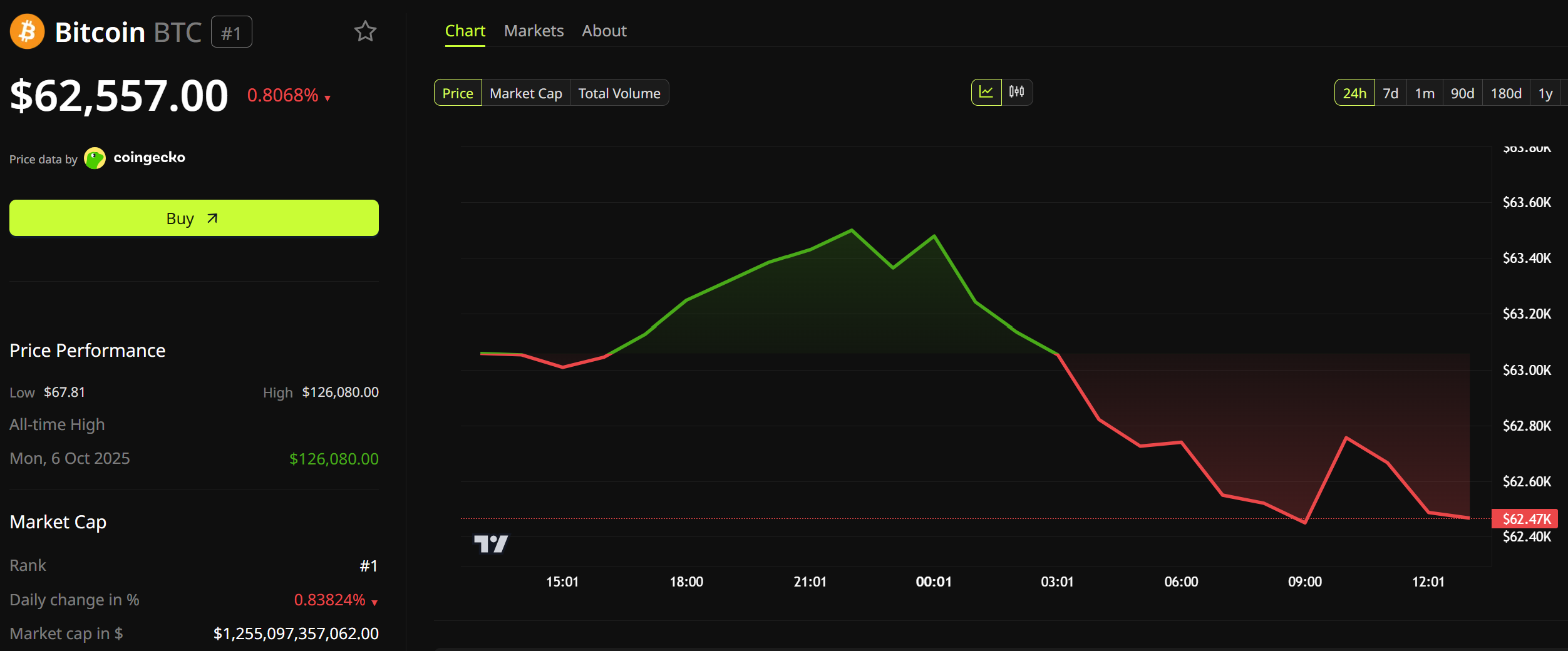
Bitcoin trades near $62,468, roughly half its October record. Strategy still owns more of it than any other company.

But the direction has changed. The next filing lands in a week.
The post MicroStrategy Added 37 Bitcoin in Two Months. Then It Sold 1,638 in One Week appeared first on BeInCrypto.
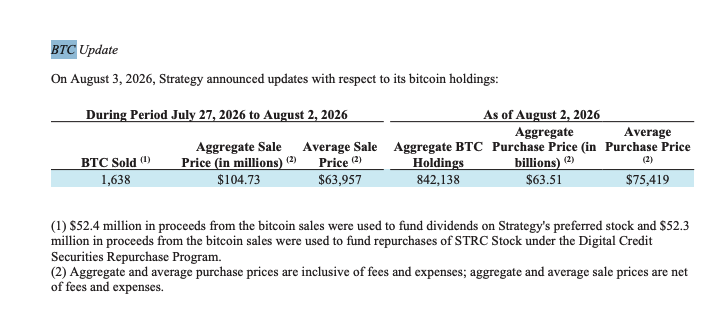
Michael Saylor’s Strategy sold 1,638 Bitcoin between July 27 and August 2, marking the year’s second-largest Bitcoin sale for the company.
Strategy sold 1,638 Bitcoin (BTC) at an average price of $63,957 for a total of $104.7 million, according to a Monday 8-K filing with the Securities and Exchange Commission. Of the proceeds, $52.4 million was used to fund dividend payments on Strategy’s STRC preferred stock, while another $52.3 million was used to repurchase STRC.
The company now holds 842,138 Bitcoin bought at an aggregate cost of $63.5 billion.
Strategy sold 3,588 Bitcoin for about $216 million on July 6. It also disclosed the sale of 32 Bitcoin in early June, its first reported Bitcoin sale since the 2022 tax-loss transaction.
Strategy bolsters USD reserve to $4 billion, repurchases STRC stock
Strategy also reported selling $290 million in MSTR shares during the same period. About $250 million of the proceeds was used to increase the USD Reserve to $4 billion, $28.9 million to fund additional repurchases of STRC stock and $11.7 million was added to Strategy’s cash balance.
In total, Strategy repurchased $81 million worth of STRC stock and increased its USD runway by 57 days to 2.3 years, announced Strategy founder and chairman Michael Saylor in a Monday X post.
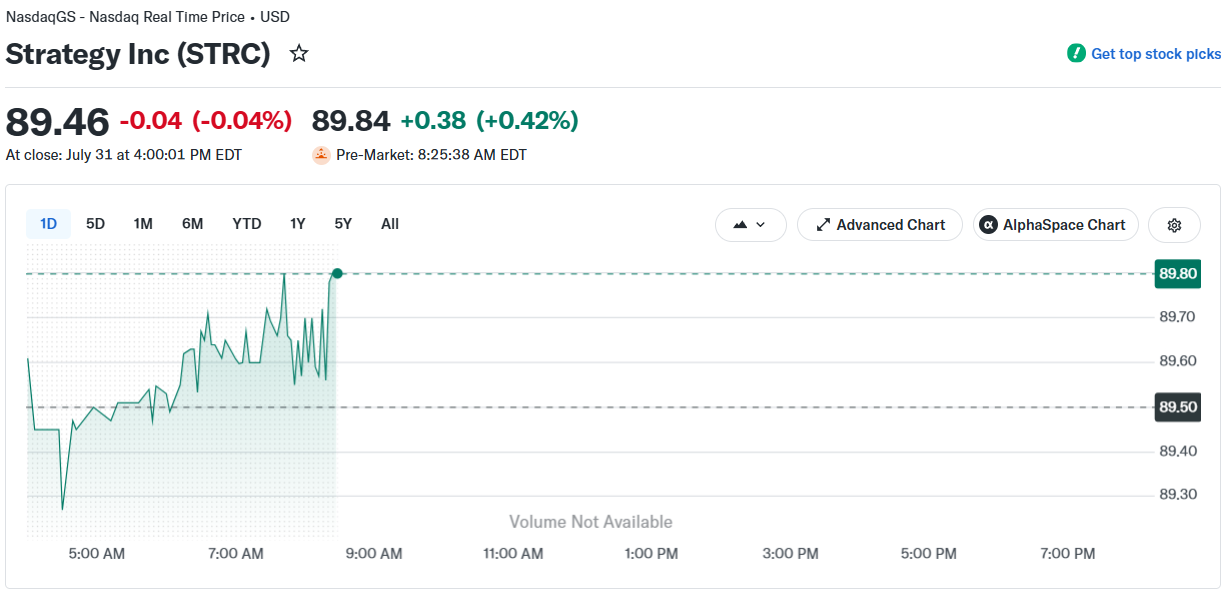
Strategy’s perpetual preferred stock, STRC, traded at $89.4, or 10.6% below its $100 intended par value, during Monday’s pre-market trading session, Yahoo Finance data shows. The company’s MSTR stock also declined 0.9% in pre-market trading on Monday.
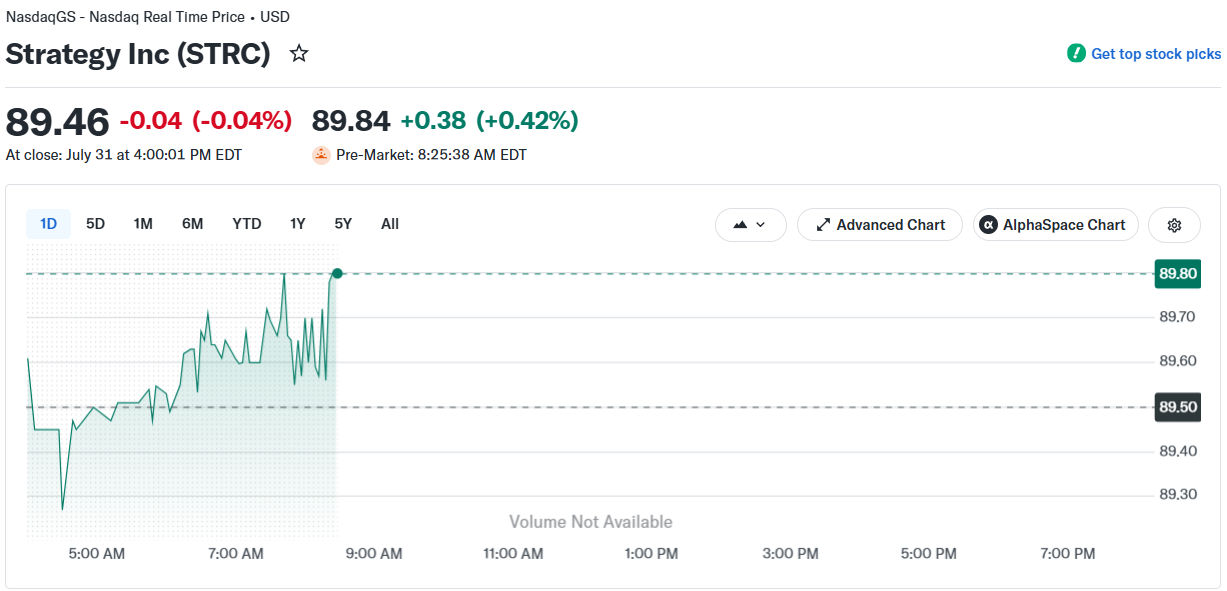
STRC stock price, 1-day chart. Source: Yahoo Finance
STRC is one of Strategy’s main mechanisms to fund its Bitcoin accumulation. Trading below par limits Strategy’s ability to raise funds through STRC sales. It may also force the company to further increase its nominal dividend rate to attract buyers and protect STRC’s price.
Related: CLARITY Act failure could send crypto valuations lower: Bernstein
On June 24, CryptoQuant CEO Ki Young Ju said that Strategy should pause Bitcoin purchases and replenish its cash reserve, after the company’s dividend coverage fell to 14 months from seven years.
“They should pause Bitcoin purchases, rebuild cash reserves, and adopt a systematic framework for purchase timing,” wrote Ju in a June 24 X post.
In its June 29 8-K filing, Strategy unveiled a capital framework allowing Bitcoin sales to fund dividends, increased the annual dividend rate on its STRC preferred stock to 12%, and disclosed that its US dollar reserve had grown to $2.55 billion.
Magazine: Bitcoin adoption metrics say one thing, price action says another
Strategy has increased its US dollar reserve and expanded its preferred-stock repurchases. The otherwise Bitcoin-focused company is moving to strengthen its balance sheet.
The firm added $250 million to its cash reserve, bringing the total to $4 billion. It also repurchased approximately $81 million worth of its Variable Rate Series A Perpetual Stretch Preferred Stock (STRC).
Strategy increased its USD Reserve by $250M and repurchased $81M of $STRC. This increased USD Duration by 57 days to 2.3 years and tightened STRC’s BTC Credit by 5 bps. As of 8/2/26, we hold ₿842,138 in our BTC Reserve and $4.0B in our USD Reserve. $MSTR https://t.co/t7bGZJ8Q3o
— Michael Saylor (@saylor) August 3, 2026
The transaction builds on the firm’s recently introduced Digital Credit Capital Framework. The company intends to use its dollar reserve primarily to cover preferred-stock dividends and debt interest, reducing the need to sell Bitcoin during periods of market stress.
What Saylor failed to mention in the tweet was that the firm also sold some 1,638 BTC for approximately $105 million between July 27 and August 2 at an average price of $63,957 – according to the official filing.
The post Strategy Sold Over $100 Million in Bitcoin, Buys Back More STRC appeared first on CryptoPotato.
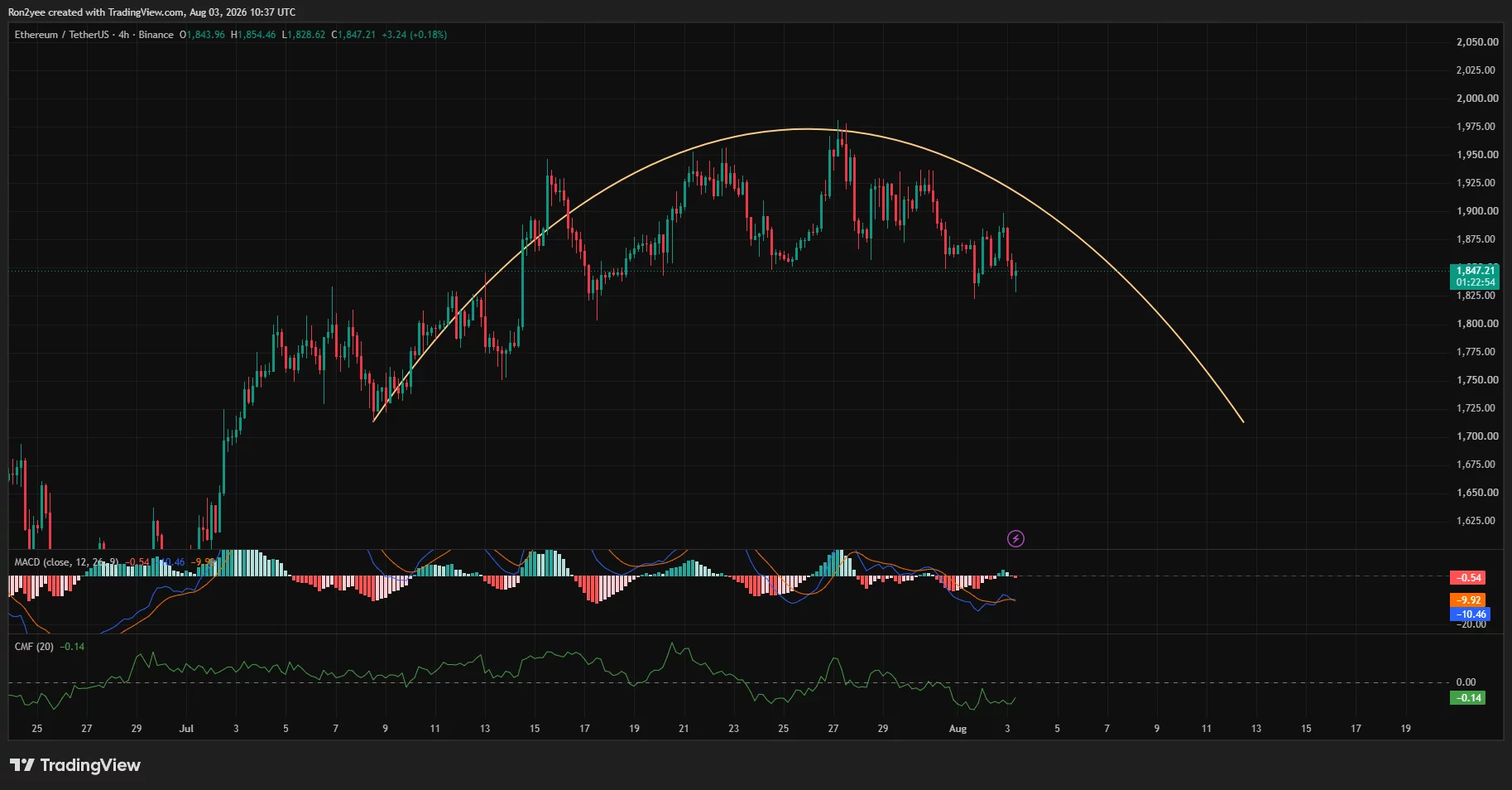
Ethereum price fell 2% to around $1,847 on Aug. 3 after another rejection near key moving averages left the $1,800 support zone exposed.
Summary
- Ethereum price fell 2.04%, reaching an intraday low of $1,828.
- ETH remains below its 50-day and 100-day moving averages at $1,889 and $1,927.
- 4-hour MACD and Chaikin Money Flow readings show weak momentum and continued selling pressure.
- A break below $1,800 could bring $1,785 and $1,700 into focus.
ETH slides after failing to reclaim $1,900
According to data from crypto.news, Ethereum (ETH) price traded at $1,847 at the time of writing, down 2.04% over the previous 24 hours. The token moved between an intraday high of $1,886 and a low of $1,829 on Binance.
The decline extended ETH’s retreat from its July 27 high near $1,975. Buyers have now failed several times to sustain a move above the resistance zone between $1,950 and $1,975.
ETH briefly rebounded after touching $1,828, but the recovery stalled around $1,850. That left the token near the lower end of its recent trading range and inside the closely watched $1,800–$1,850 support area.
The broader daily structure also remains defensive. Ethereum trades below its 50-day simple moving average at $1,889, its 100-day SMA at $1,927, and its 200-day SMA at $2,089.
Weak liquidity deepens Ethereum’s sell-off
The immediate pressure came from Ethereum’s failure to reclaim the moving-average resistance between $1,889 and $1,927. Sellers entered after the latest attempt faded, pushing ETH below $1,850 and toward its Aug. 3 low.
The 4-hour chart shows the price rolling over after forming a broad curved top below $1,975. Lower highs since late July suggest that buying demand has weakened, although ETH must still break below $1,800 to confirm a larger bearish continuation.
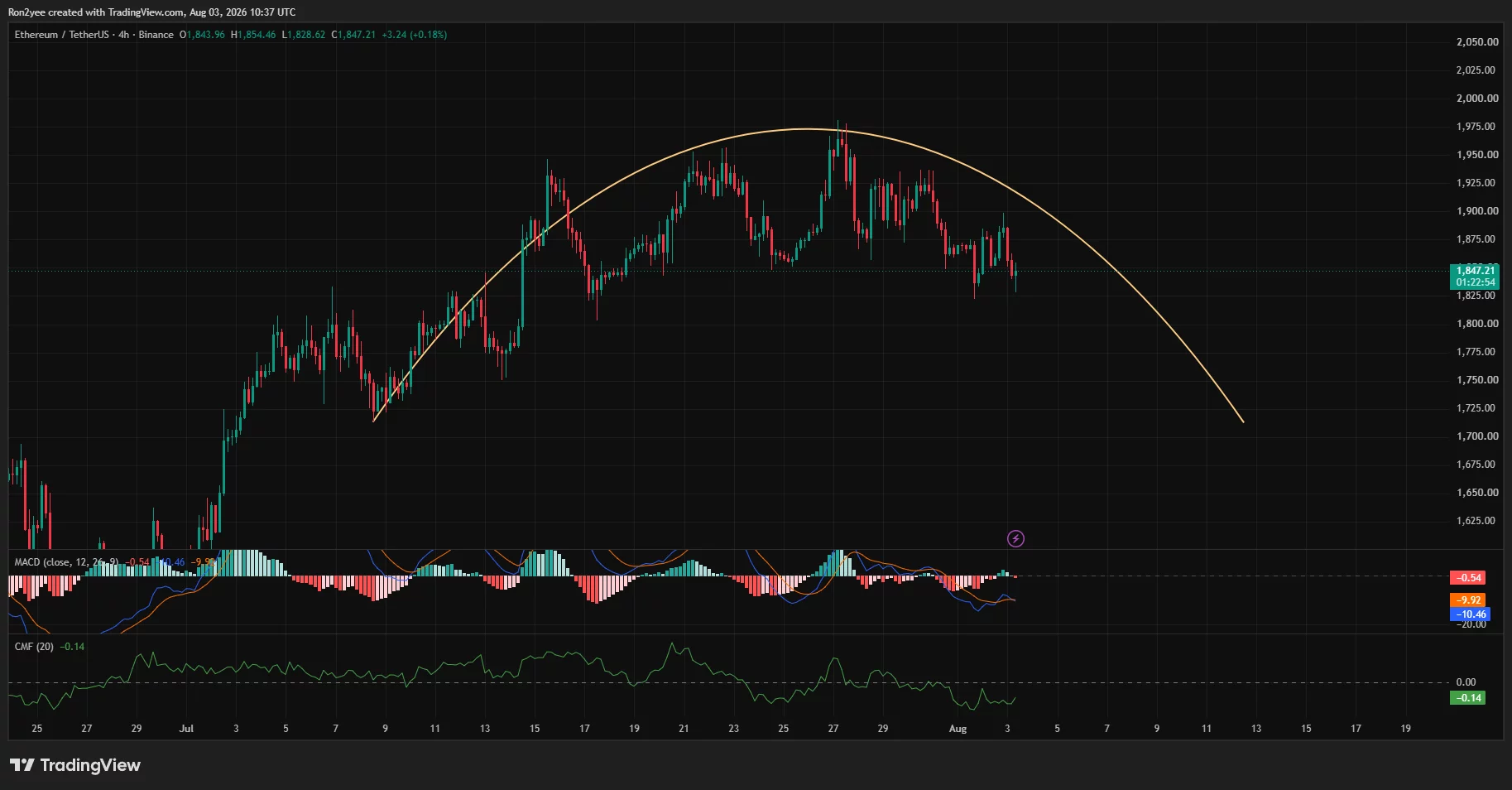
Momentum indicators support the cautious outlook. The 4-hour Moving Average Convergence Divergence remains below zero, with the MACD line near -10.46 and the signal line at about -9.92.
Chaikin Money Flow stands at -0.14. The negative reading indicates that selling volume has outweighed buying volume over the indicator’s measurement period.
Ethereum also faces broader liquidity pressure. A sharp weekly decline in Binance stablecoin netflows suggests less immediately available capital is entering the exchange, potentially reducing the buy-side liquidity available during market declines. However, exchange flows can change quickly and do not determine price direction alone.
Longer-term concerns include weaker institutional demand for Ethereum products relative to Bitcoin and lower mainnet fee revenue as activity shifts toward Layer-2 networks. These factors have weakened Ethereum’s investment narrative, but the current move remains primarily tied to the chart rejection and wider risk-off positioning.
Losing $1,800 could expose ETH to $1,700
The first support range sits between $1,828 and $1,800. ETH has already attracted buyers near the upper part of that zone, but repeated tests could weaken the remaining demand.
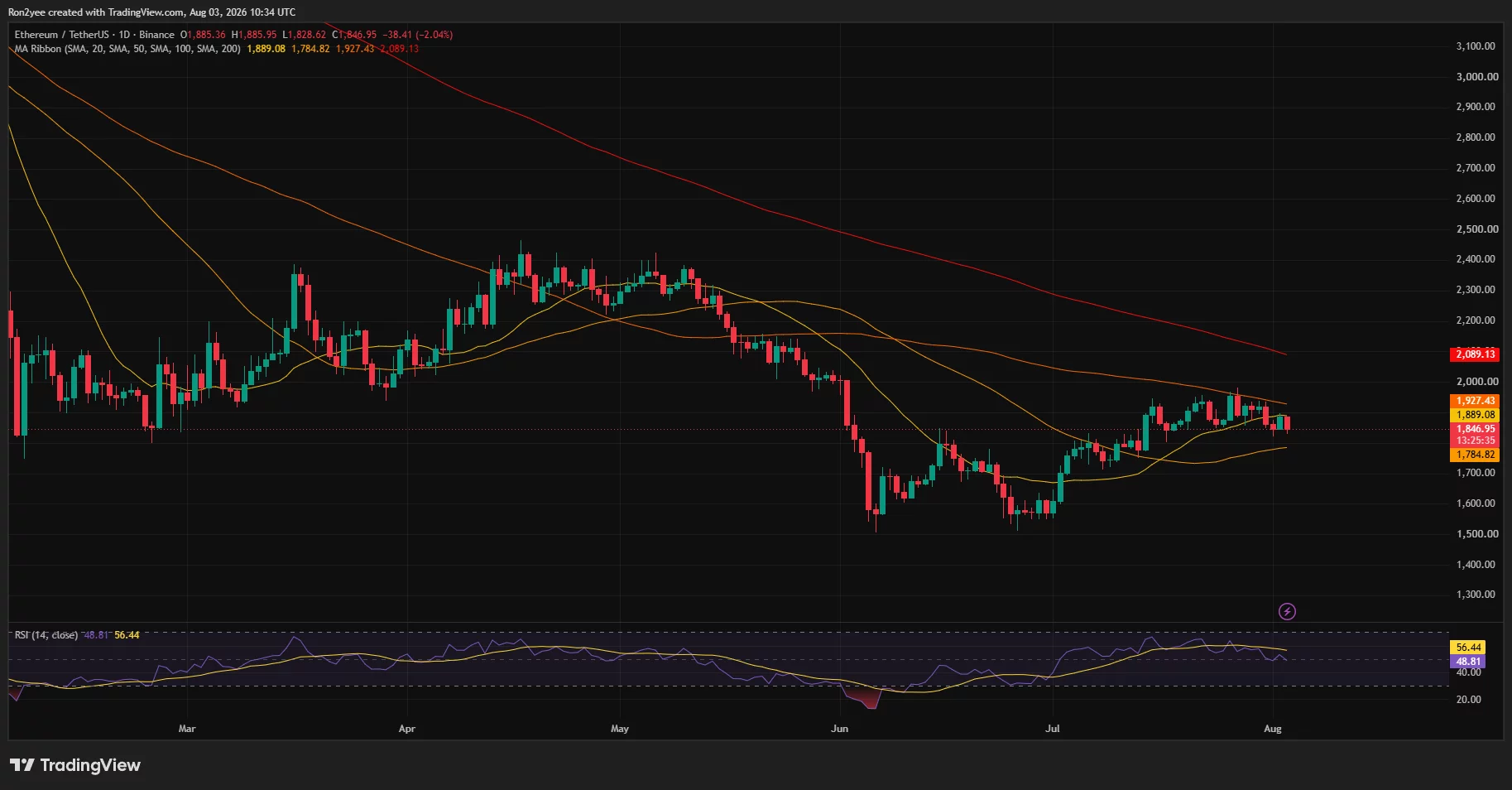
Ethereum’s lower daily moving-average ribbon stands near $1,785. A daily close below that level would strengthen the bearish setup and expose $1,700, followed by the June accumulation region around $1,550–$1,600.
CoinGlass’ 24-hour liquidation heatmap shows nearby leveraged-position clusters around $1,840, $1,820 and $1,810. A move through those levels could liquidate leveraged long positions and accelerate short-term volatility.
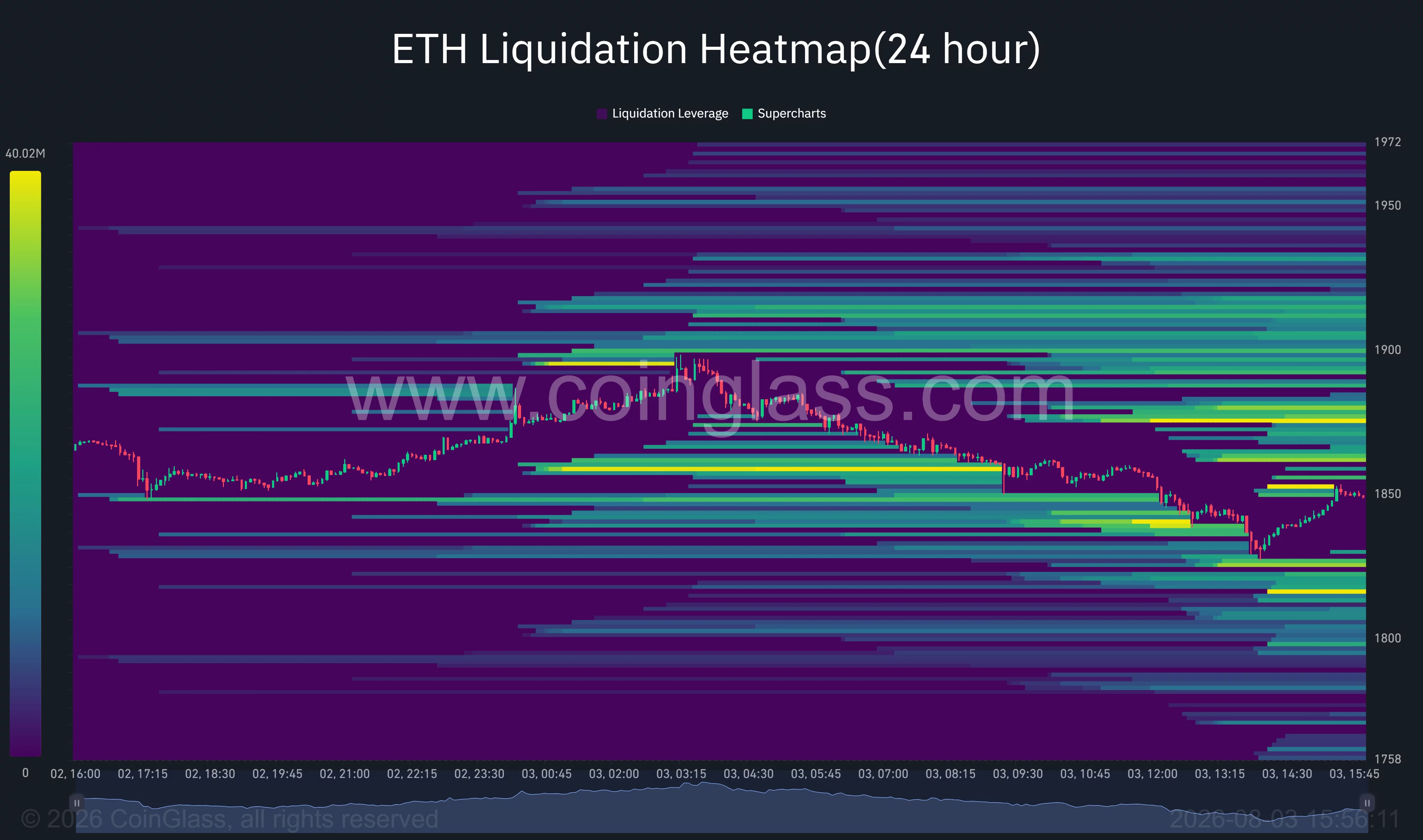
The map also shows overhead liquidity around $1,860–$1,875. If ETH rebounds above that range, short liquidations could help drive the price toward $1,890 and $1,920.
On the upside, Ethereum must first reclaim its 50-day SMA at $1,889. A daily close above the 100-day SMA at $1,927 would improve the setup, while a breakout above $1,975 would invalidate the current sequence of lower highs and place $2,000 back in focus.
The daily Relative Strength Index stands at 48.81, below its signal average of 56.44. The reading points to weakening momentum but remains well above oversold territory, leaving room for further selling if $1,800 fails.
Analyst sees Ethereum at a critical support zone
Crypto analyst Ted Pillows described the current support range as decisive for Ethereum’s next move.
“ETH is currently in the $1,800–$1,850 support level,” Pillows said. “This is very crucial for Ethereum to hold, or else it could drop towards $1,700.”
His chart presents two potential paths. Holding the current zone could allow ETH to recover toward $1,950 and then $2,050, while a confirmed breakdown could send the price toward $1,700.
The forecast aligns with the support levels visible on the daily chart, but the $1,700 target would require ETH to lose both the psychological $1,800 level and support near $1,785.
Fed outlook adds pressure on US crypto investors
Changing expectations for US monetary policy remain an additional risk for Ethereum and other speculative assets. Higher Treasury yields and a stronger dollar can reduce investor demand for crypto by increasing the relative appeal of dollar-denominated assets.
Slower-than-expected Federal Reserve rate cuts would keep financial conditions tighter and could limit institutional risk-taking. Ethereum may therefore remain sensitive to upcoming US inflation, employment and Fed policy signals.
For US investors, the near-term setup depends on whether ETH can defend $1,800 as macro liquidity remains constrained. A recovery above $1,927 would improve the technical outlook, but a daily close below $1,785 would shift attention toward $1,700.
Disclosure: This article does not represent investment advice. The content and materials featured on this page are for educational purposes only.

Practical Approaches to Faster Fulfillment and Better Stock Organization

A timeline of Coldcard’s $85M bitcoin theft

Social Mentions Klay Thompson W. Cooking


-

 Business5 days ago
Why Trees Belong on the Risk Register
-

 Fashion3 days ago
Weekend Open Thread: Wit & Wisdom
-

 Politics3 days ago
Meta enters AI-training agreement with far-right ‘propaganda rag’ Newsmax
-
 Entertainment6 days ago
‘Stargate’ Creator’s New Sci-Fi Series Returns for Season 3 Tomorrow
-

 Crypto World2 days ago
MicroStrategy Post-Earnings CLARITY Act Push Could Add New Catalyst for Its Stock
-

 Politics6 days ago
The Part of the Electric Transition Nobody Wants to Discuss
-

 Business5 days ago
Major shareholder moves on Canyon
-

 Crypto World2 days ago
XRP Ledger v3.3.0 brings five institutional features
-

 News Videos4 days ago
Bitcoin Enters the 3rd Stage of the Bear Market
-

 Crypto World6 days ago
Kraken Enables Retail Access to Jersey Mike’s IPO via Tokenized Shares
-

 Tech7 days ago
New macOS Sequoia & Sonoma security updates for older Macs
-

 Politics4 days ago
Luke Littler’s dominance sparks GOAT debate
-

 News Videos6 days ago
Claude: Build Financial Dashboards in Minutes (2026)
-

 Business6 days ago
Johnson & Johnson agrees to $5.5B settlement over talc cancer claims
-

 Sports4 days ago
Seema Kaliramna Wins Discus Throw Bronze, Takes India’s CWG Medals Tally To 17
-

 Crypto World1 day ago
Crypto PAC spending tops $2M in Michigan House race
-

 Business3 days ago
Trump Announces Hamas Disarmament Agreement as Iran Strikes Kuwait Air Base and US Attacks Pause Overnight
-

 Tech5 days ago
Gemini can now summarize the messiest comment threads in Google Docs
-

 Crypto World3 days ago
New York sues Kalshi over prediction market gambling
-

 Tech1 day ago
ESET tracks rise in malicious AI skills and adaptable malware
You must be logged in to post a comment Login