
Crypto World
Zcash (ZEC) Slips 8% Daily: Here’s Why One Analyst Believes the Price Could Crash to $200

The popular privacy coin has stunned the crypto community after its price exploded by over 2,600% over the past year. Its market capitalization briefly exceeded $25 billion, making it one of the 10 biggest digital assets.
The main catalysts for its impressive rally included the broader market’s resurgence, the debut of the ZEC ETP in Europe, the launch of a spot Zcash ETF, and other factors. However, the crypto sector has seen a substantial correction over the last 24 hours, dragging the privacy coin down with it, and some analysts think the bull run may now turn into a violent crash.
Is the Rally Over?
Earlier this week, ZEC surpassed $1,600 for the first time since 2016. And while many expected the upswing to continue, the whole market headed south, and now the privacy token is worth roughly $1,470 (per CoinGecko).
X user Crypto Patel noted that ZEC has already delivered an “extraordinary move,” adding that anyone who accumulated during 2024-2025 has witnessed a massive return.
At the same time, the analyst warned people to be highly cautious in the $1,600-$2,000 range, claiming that a cup-and-handle structure suggests this could mark the local top. The market observer argued that ZEC has started showing signs of “extreme extension from a psychological perspective” following the major rally.
Crypto Patel then shared a long-term prediction that is clearly bearish. They believe that if the current cycle eventually enters a distribution and downtrend phase, the price could dump below $500 in the next 1-3 years. The analyst made an even grimmer forecast, envisioning a collapse to $200 if the long-term structure completely reverses.
For their part, X user Zayn recently revealed that they made $30,000 after opening a short position on ZEC. They later said the paper profit has risen above $60,000, calling it one of their “biggest wins this year” and wondering whether to keep the position open until they potentially make $100K.
Are the Bulls Coming Back?
ZEC’s recent correction shouldn’t be directly interpreted as the end of the overall upward trajectory. After all, the asset has been on a tear for quite some time, and pullbacks are an inevitable part of the whole move.
Meanwhile, some investors have started abandoning centralized platforms and shifting into self-custody solutions after a period of flocking into exchanges. The latest development is clearly bullish, as it reduces immediate selling pressure and could open the door to a rebound.

The post Zcash (ZEC) Slips 8% Daily: Here’s Why One Analyst Believes the Price Could Crash to $200 appeared first on CryptoPotato.


Digital asset treasury (DAT) companies—public vehicles that hold crypto and aim to finance growth through a trading premium over their crypto holdings—are losing much of their early advantage, according to a report released this week by DWF Ventures.
In its analysis of the 20 largest DATs by assets under management, DWF found that only four trade above their “mNAV,” a metric that compares a company’s market value to the value of its underlying crypto holdings. The implication is straightforward: investors appear less willing to pay extra for crypto exposure through listed balance sheets, shrinking one of the model’s key funding mechanisms.
Key takeaways
- Only four of the 20 largest digital asset treasuries trade above mNAV, meaning most trade at discounts to their crypto holdings.
- DWF links the shift to investors no longer pricing DAT shares at a persistent premium for crypto exposure.
- DAT stocks have generally struggled to outperform simply holding the underlying cryptocurrency, with the reported advantage—when it exists—often modest.
- External warnings about “mNAV collapse” predate the latest market weakening, including concerns raised by Standard Chartered and Galaxy Digital.
Most DATs now trade below their crypto holdings
DWF’s report, published Thursday, examined the largest DAT companies by assets under management and found that just four trade above an mNAV of 1—where market value exceeds the value of held crypto. Those firms are Bit Digital, Strive, Hyperliquid Strategies, and BitMine.
For investors, discounts like these matter because DAT growth strategies typically rely on issuing equity at prices above the value of existing holdings. When shares trade at a premium, companies can raise capital and add to their crypto exposure without diluting existing shareholders’ effective value. When that premium disappears—or flips into a discount—new share issuance becomes less attractive and can dilute shareholders rather than strengthen the treasury.
DWF characterizes the widespread discounts as a sign that the market is no longer willing to pay the same premium for publicly traded crypto exposure.
The “treasury premium” appears to have peaked
DWF points to Strategy, the Bitcoin treasury model pioneer, as an early benchmark for how the premium worked when the approach first captured investor attention. According to the report, the general pattern across DATs has been that mNAV premiums peaked when the strategy was new and demand for the structure was strongest.
DWF highlights Strategy’s mNAV peak in late 2024 during a Bitcoin rally, when demand for leveraged BTC exposure was reported to be particularly strong. The broader framing from DWF is that, as the novelty and momentum around BTC treasury structures faded, the premium investors were willing to pay weakened as well.
DWF also notes that while some DATs have outperformed the underlying cryptocurrency at times, the outperformance has typically been small compared with what investors could have achieved by simply holding the crypto directly.
Earlier coverage from Cointelegraph described how Michael Saylor’s Strategy helped popularize the Bitcoin treasury approach beginning in 2020, setting the template DATs later tried to follow.
Real-world evidence: Sequans exits its BTC treasury
The DWF findings arrive alongside a concrete example of a company moving away from the treasury approach. Sequans Communications, a French semiconductor firm that launched a Bitcoin treasury strategy last year, disclosed that it sold its remaining 314 BTC, completing an exit process.
As reported by Cointelegraph, the exit began with a redemption of its convertible debt in May and concluded with the sale of the remaining Bitcoin. After the transaction, Sequans said it holds no cryptocurrency on its balance sheet, according to the report linked by Cointelegraph: Sequans exits bitcoin treasury strategy after selling remaining 314 BTC.
While a single exit does not determine whether DATs as a category will fail, it underscores the practical consequences of a structure that depends on continued investor support. If share prices fail to sustain a premium over NAV, the cost of raising and maintaining exposure via equity becomes harder to justify.
Warnings about mNAV collapse preceded the latest market stress
DWF’s report is not the first to question whether the DAT model can keep functioning without a persistent equity premium. Standard Chartered reportedly raised concerns in September 2025, when Bitcoin and the broader crypto market were described as booming. The bank warned that an “mNAV collapse” could trigger consolidation among digital asset treasuries.
Galaxy Digital made a similar argument, stating that the model “critically depends on a persistent equity premium to NAV.” In Galaxy’s view, that premium is what allows companies to issue shares and buy more crypto while avoiding dilution of existing holders. If shares trade below NAV, raising new equity can become dilutive and undermine the strategy’s financing logic.
In research cited by Cointelegraph, Galaxy analyst Will Owens wrote that “if the premium collapses, or worse, flips to a discount, the model begins to break.”
These concerns align with the timing and direction of market movement. The source notes that Bitcoin fell from a record high of more than $126,000 in October to below $60,000 before recovering to around $86,000, creating conditions in which treasury premiums and leveraged demand could plausibly weaken.
In other words, the issue raised by the earlier institutional warnings has not gone away: it appears to be a structural dependence on investor willingness to pay above NAV, not just a temporary valuation adjustment.
Why the discount trend matters now
For traders and longer-term investors, the shift toward widespread DAT discounts changes how the category should be evaluated. If most treasuries trade below their underlying holdings, the “equity as growth capital” thesis becomes less reliable, and performance may converge toward the crypto market itself—minus whatever inefficiencies arise from the stock wrapper.
It also raises the question of what happens when premiums do not recover quickly. DWF’s findings suggest that the model’s early advantage—capital accessibility driven by investor enthusiasm—has faded, leaving fewer companies able to compound holdings through share issuance without eroding shareholder value.
Investors watching DATs next should focus on whether any remaining premiums can stabilize and on how companies respond when share prices do not justify continued equity-funded purchases—especially as market volatility continues to pressure crypto-linked balance sheets.

Former Democratic congressman Tim Ryan has said the CLARITY Act could still pass this year if lawmakers resolve disputes that blocked a 49–50 Senate vote on Sep. 15.
Summary
- The Senate vote was a procedural step to open debate, not a final vote on the bill.
- Ryan said ethics, consumer protection, illicit finance and stablecoin rewards remain points of dispute.
- He sees a possible agreement during this year’s lame-duck session.
- SEC and CFTC actions can help firms now, Ryan said, but legislation would offer firmer long-term rules.
Tim Ryan, a former Ohio congressman and adviser to Shyft, told crypto.news that lawmakers still have a path to an agreement if they return to negotiations and make concessions. The Senate rejected cloture on a motion to proceed to the Digital Asset Market CLARITY Act on Sep. 15, with 49 senators voting yes, 50 voting no, and one not voting. The motion needed 60 votes to advance the bill to debate; it was not a final vote on passage.
Ryan identified unresolved concerns about ethics, consumer protection, illicit finance and stablecoin rewards. In his view, support for clear crypto rules remains bipartisan, even though senators have yet to agree on the details. He said a deal could still be reached in the lame-duck session later this year if both sides are willing to compromise.
“I think there’s still a path,” Ryan said. “The legitimate concerns around ethics, consumer protection, illicit finance and stablecoin rewards need to be addressed.”
CLARITY Act talks could resume after the failed vote
Ryan’s assessment follows a statement from seven Senate Democrats who voted against cloture. As previously covered by crypto.news, the senators described the result as “not the end” of their work on the legislation and pledged to continue bipartisan talks. Their statement came on Sep. 16, one day after the vote.
For Ryan, the distinction between a procedural defeat and a final rejection matters. Senators voted on whether to take up the measure, leaving its provisions open to further negotiation. He said the outstanding issues need answers before the bill can secure enough support to move forward.
The proposed legislation would set federal rules for digital asset markets and divide responsibilities between the Securities and Exchange Commission and the Commodity Futures Trading Commission. Under the framework described in earlier CLARITY Act coverage, qualifying digital commodities and their spot markets would fall primarily under CFTC oversight, while securities-related activity would remain with the SEC. The bill would also set registration requirements for crypto trading platforms and other market participants.
Ryan tied the negotiations to decisions being made by American companies. Businesses hiring workers and committing capital, he said, need rules they can rely on beyond a change in administration. He also argued that jobs and investment are at stake in the congressional debate.
SEC and CFTC actions have limits, Ryan says
With the bill stalled, both regulators have taken steps under their existing powers. Ryan said the agencies can make meaningful progress, but he does not believe their actions alone can provide the lasting framework businesses and consumers need.
“Agency action helps, but companies making long-term investments need long-term certainty,” he said. “If you’re building a business, hiring people and investing capital, you need to know the rules are going to last beyond the next administration.”
On Sep. 17, the SEC granted temporary, conditional relief for certain venues trading tokenized U.S.-listed stocks through permissioned automated market makers and liquidity pools. The order lasts five years after publication and requires eligible stock tokens to give holders the same rights as equivalent traditional shares.
The SEC also placed limits on trading symbols and volume, required trading to stop when the underlying stock is halted, and sought public comment on the exemption. Its tokenized stock order concerns securities already within the SEC’s remit, rather than settling how every crypto asset should be regulated.
The CFTC’s Market Participants Division issued a separate no-action position that day for qualifying passive software providers. Subject to stated conditions, division staff will not recommend enforcement over a failure to register as an introducing broker, or as an associated person of one, when the software helps users trade with registered derivatives firms and markets. The CFTC developer relief applies to the activities covered by the letter; it does not change the underlying registration law.
The CFTC also submitted a proposed framework for crypto transactions and markets for White House review on Sep. 17. That submission begins a review process: the proposal would still need to return to the commission for a vote before publication and public comment. CFTC Chair Michael Selig had previously directed staff to examine what market rules the agency could establish using its existing authority.
Bitcoin, XRP and Solana remain part of the classification debate
Asked whether assets could face conflicting treatment, Ryan said uncertainty remains despite guidance from the two agencies. He pointed to Bitcoin, XRP and Solana as assets for which regulators have provided more clarity, while calling for Congress to establish consistent rules that businesses and consumers can use without resolving classification disputes through individual court cases.
The SEC’s March 17 interpretation, issued with CFTC guidance, listed Bitcoin, XRP and Solana among its examples of digital commodities. The SEC based that assessment on its understanding of the assets’ characteristics, terms and functions at the time. The interpretation also said a crypto asset that is not itself a security can be involved in a transaction subject to securities law, and that the agency may refine its views after public feedback.
For U.S. token holders and platforms, Ryan’s concern is how those distinctions apply when an asset is sold or traded. He said businesses and consumers should have consistent rules instead of having to litigate the treatment of assets case by case.

French semiconductor company Sequans Communications has fully exited its Bitcoin treasury strategy, selling its remaining 314 BTC and leaving the firm with no cryptocurrency holdings. The move completes a process that began after the company ramped up its Bitcoin position in mid-2025 and gradually shifted away from the approach as it adjusted its financing and corporate priorities.
According to a statement from Sequans released on Thursday, the exit was tied to the redemption of its convertible debt in May. Management said the company will now refocus on its core cellular Internet-of-Things (IoT) and software-defined radio businesses, with the Bitcoin proceeds previously used to reduce debt and strengthen its balance sheet.
Key takeaways
- Sequans sold its last 314 BTC, finishing a Bitcoin treasury strategy that previously left the company holding more than 3,200 BTC.
- The company linked the exit to its May redemption of convertible debt, using prior Bitcoin sales to help eliminate that obligation.
- Sequans says it now has no cryptocurrency holdings and no outstanding debt, other than government-financed research and development commitments.
- More treasury operators have been scaling back or fully exiting Bitcoin strategies in 2026, according to VanEck research.
Sequans completes its Bitcoin treasury exit
Sequans’ final liquidation of its Bitcoin holdings comes after earlier steps to reduce exposure. The company said it began trimming its BTC less than six months after launching the treasury strategy, selling 970 BTC in November to help redeem half of its convertible debt.
By May 2026, Sequans stated it was “no longer pursuing” the treasury strategy and would monetize the remaining Bitcoin over time. Thursday’s update indicates that monetization has now reached its end point, with the company confirming it has sold its remaining 314 BTC.
From launch to reduction: how the strategy played out
Sequans launched its Bitcoin treasury approach in June 2025, after announcing a $384 million sale of equity securities and convertible secured debentures. At the time, CEO Georges Karam described Bitcoin as “a premier asset and a compelling long-term investment,” framing the purchase as part of a broader treasury plan rather than a short-term trading activity.
However, the strategy’s lifecycle was tightly connected to capital structure decisions. In the months that followed, Sequans used Bitcoin sales to address its convertible debt schedule. The company later moved from debt reduction to broader balance-sheet repositioning, ultimately deciding to monetize the remaining BTC rather than continue accumulating.
Why fully exiting matters for investors and market structure
Corporate Bitcoin treasuries typically balance two competing priorities: pursuing long-term exposure to BTC while maintaining flexibility to manage liquidity, repayments, and business investment. When companies stop accumulating—or liquidate holdings—it can signal that treasury activity has become less aligned with either cash needs or corporate strategy.
In Sequans’ case, management said the Bitcoin sales were used to “eliminate its convertible debt” and strengthen the balance sheet. The result is a simpler capital structure from an investor perspective: fewer moving parts tied to crypto holdings and less exposure to Bitcoin price volatility affecting treasury balances.
Sequans also emphasized that after the final sale, it holds no cryptocurrency and has no outstanding debt beyond government-financed R&D obligations. That framing suggests the company views the treasury era as closed, rather than pausing crypto activity and leaving the door open to future re-entry.
Wider 2026 trend: more treasuries abandon Bitcoin
Sequans’ departure fits a broader pattern in 2026. In late July, Matthew Sigel, head of digital assets research at VanEck, said in a public update that he had identified at least nine companies that fully liquidated or abandoned Bitcoin and crypto treasury strategies in 2026, alongside several others that reduced their holdings.
The reasons cited across exits have ranged widely. VanEck’s Sigel pointed to factors such as debt repayment needs, working capital requirements, shareholder return objectives, and business-strategy changes. In other words, the shift away from Bitcoin treasuries has not appeared to be driven by one single cause.
One example highlighted in earlier coverage is UK-listed Satsuma Technology. Cointelegraph reported that the company raised 100 million British pounds (about $135 million) through convertible loan notes in July 2025 to expand a Bitcoin treasury. A year later, shareholders voted overwhelmingly to return substantially all of the company’s capital and cancel its listing, and the board authorized the closure of trading activities and the sale of its entire 669 BTC position.
Other companies referenced in 2026 reporting as fully liquidating their Bitcoin holdings include Bitdeer, Genius Group, and Prenetics. MARA Holdings and Empery Digital were also mentioned as making substantial sales without abandoning their treasury strategies entirely, underscoring that corporate behavior is diverging rather than uniform.
What to watch next
For Sequans, the immediate question is how quickly the company can translate its renewed focus on cellular IoT and software-defined radio into operating momentum now that crypto exposure has been removed. More broadly, readers may want to track whether 2026’s wave of treasury exits continues—or if companies that reduced holdings begin to reallocate capital back toward Bitcoin as financing conditions and market sentiment evolve.

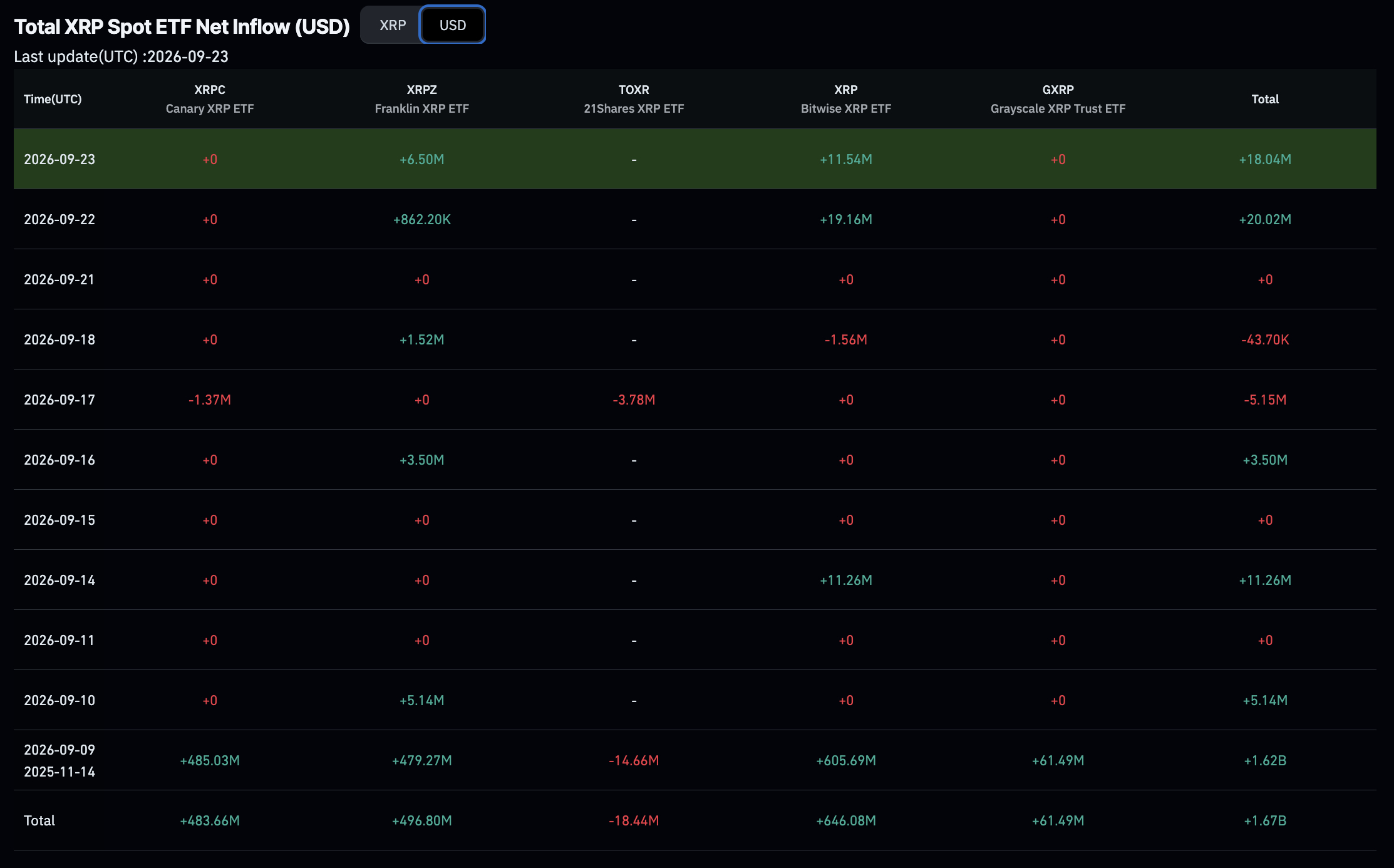
XRP price is hovering at the $1.50 level, down 8% over the prior 24 hours after failing to hold the $1.60 level. The drop happens even as U.S. spot XRP ETFs pulled in $18.04 million in net inflows during the previous session. The gap forces a blunt question onto the desk: if demand for regulated funds keeps showing up and the token still can’t hold its highs, how much weight does that demand actually carry against spot-market selling?

XRP’s 24-hour range ran from $1.60 down to $1.46, meaning the token was sitting at the bottom of its own daily band. Market capitalization fell to $92 billion, keeping XRP fifth by market cap. Against Bitcoin, XRP slipped 5.6% to 0.00001755 BTC, confirming the move wasn’t purely a dollar-denominated dip.
Discover: Best Crypto IPO this September
Why ETF Inflows Did Not Stop XRP Price Drop?
The Bitwise XRP ETF led Tuesday’s inflows with $11.54 million, lifting its cumulative total to $646.08 million, while Franklin Templeton’s XRPZ added $6.50 million to reach $496.80 million cumulatively. Across all XRP ETFs, net inflows reached $18.04 million, taking cumulative inflows since launch to roughly $1.67 billion.
Total net assets actually fell from $1.731 billion in the prior session despite the fresh inflows. That decline can be explained by XRP’s lower price, which reduced the market value of the tokens already held by the funds.
The scale of the new money also remains relatively small compared with XRP’s spot market. The $18.04 million ETF inflow represented roughly 0.44% of the $4.1 billion in XRP spot volume over 24 hours. The two measurements use different time windows, with ETF flows covering a U.S. trading session and spot volume covering a rolling 24-hour period, but the comparison still shows the ETF inflow was modest relative to overall trading activity.
CoinGecko’s own market note points to profit-taking as the session’s primary driver. XRP price ran from about $1.29 to $1.38 on September 18, then pushed toward $1.60 over the following days. It was a move that left recent buyers sitting on gains once the price stalled below resistance.
Elevated Binance deposits add a possible distribution signal to that story, but a deposit isn’t a sale. Tokens moving onto an exchange can reflect trading, market-making, custody shifts, or collateral posting just as easily as outright liquidation.
On-chain data adds a second layer. Santiment put XRP’s 365-day MVRV ratio at -11.75% on September 23, meaning the average holder active over the past year is sitting on an unrealized loss. That’s consistent with rallies drawing sell orders from traders trying to reduce exposure.
Earn $50 and Enter $300K Prize Draw on EdgeX
Technical Levels: $1.60 Rejection and $1.45 Support
The sell-off unfolded in three distinct legs. XRP traded near $1.60 late on September 23 before the first sharp break, which took it from $1.58 to about $1.52. It then chopped sideways between $1.49 and $1.52 overnight, with a failed recovery attempt lifting the price back toward $1.52 near 11:00 IST on September 24 before buyers gave up.
The final leg started after 13:45 IST, when XRP broke below $1.48 and reached $1.46 by roughly 15:00 IST. That marks a second failed attempt this week to establish price above the $1.60 zone, following a similar test on September 22.
These are reference points drawn from recent trading, not forecasts. XRP’s futures positioning around the move matters for how sharp the next leg gets, since a crowded book on either side tends to accelerate whichever direction price breaks.
Trade XRP on Bybit and Get a Chance to Win Our $1,000 USDT Airdrop
The post XRP Price Under Pressure: Spot Selling Overwhelms ETF Demand appeared first on Cryptonews.
Crypto World
Quantum threat to Bitcoin could materialize before commercial viability, EU regulators warn

European financial authorities warned that an advanced quantum computer could undermine cryptography used to secure blockchains, saying the threat could emerge before the technology has a viable commercial application.
The warning from the Joint Committee of the European Supervisory Authorities (ESAs), which includes the European Banking Authority (EBA), European Securities and Markets Authority (ESMA) and European Insurance and Occupational Pensions Authority (EIOPA), brings fresh urgency to a long-running question for bitcoin of whether to freeze or not freeze the BTC in legacy wallets. In the event that quantum computers one day do become capable of breaking bitcoin’s cryptography, roughly 6.9 million bitcoin, worth roughly $586 billion, are currently vulnerable, according to Cryptoquant.
“Threats could materialize earlier than any viable commercial application,” the authorities said in their Autumn 2026 Risk and Vulnerabilities report released Wednesday. An advanced quantum computer “could undermine some cryptography systems widely used to secure communications, transactions, databases and blockchains,” according to the report..
Although the report does not mention timelines for quantum computing becoming commercially viable, a recent IBM report says it will be in use in four years or less.

As Deace noted, “If the environment is this bad in my home state, where Trump has been the most popular political figure over the last decade, I can’t imagine where it is everywhere else.”
There’s similar scrambling in Texas, where a super PAC blessed by Senate Majority Leader John Thune is now on track to spend more than $100 million, an add on of $35 million to the $65 million the group had already booked in advertising to boost Ken Paxton’s bid against James Talarico. The total price tag for keeping the Senate seat is on track to approach $200 million just on the GOP side.
It’s little better for House Republicans. Between their official campaign arm, allied outside organizations, and the candidates themselves, there is a massive $485 million well of ad reservations between Aug. 1 and Election Day—and that’s just in districts Trump won, according to a Politico analysis.
Even Speaker Mike Johnson has grown frustrated with Trump and his constant introduction of tumult in the political ether. During his Sept. 13 appearance on NBC’s Meet the Press, Johnson appeared obviously annoyed as he kept getting asked about Trump’s fresh promise to send every American adult a $5,000 check if Republicans keep their House and Senate majorities. “I guess we’re going to spend the whole segment talking about this one issue,” Johnson said. “I want to talk about what we’ve actually done and not ideas on the table.”
Crypto World
Ripple Price Analysis: Is It All Doom and Gloom for XRP After the Latest Rejection at $1.60?
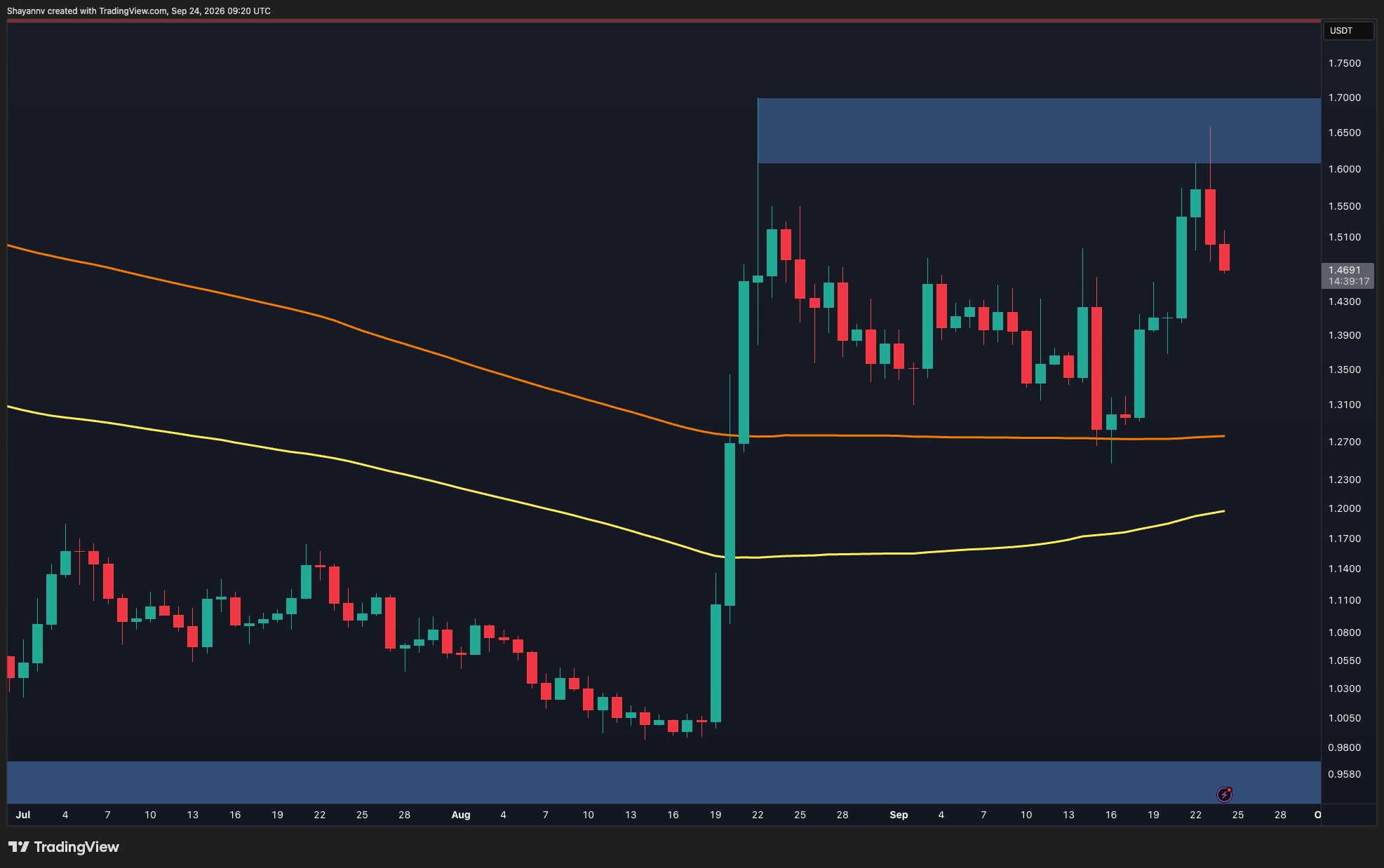
XRP’s breakout from its descending channel delivered a strong rally, but the move has now met substantial selling pressure at a major resistance area. The resulting pullback puts the recent breakout to the test, with the next reaction around former resistance likely to be important for the short-term structure.
Ripple Price Analysis: The Daily Chart
On the daily chart, Ripple’s XRP remains structurally stronger following its sharp rebound from the $1.27 region. The asset rallied rapidly toward the major $1.61-$1.70 resistance zone, briefly entering this area before sellers stepped in aggressively.
The rejection has pushed XRP back toward $1.47, showing that supply around $1.61-$1.70 remains significant. Nevertheless, the broader recovery structure has not yet been invalidated. The price remains well above the moving averages, with the higher one currently positioned around $1.27 and potentially acting as an important dynamic support if a deeper correction develops.
For buyers, reclaiming $1.55 and eventually breaking through the $1.61-$1.70 resistance zone would be required to resume the bullish leg. Conversely, continued selling could lead to a broader retracement, with the $1.40 area becoming relevant before the more substantial $1.27 region comes back into focus.
XRP/USDT 4-Hour Chart
The 4-hour timeframe provides a clearer view of the current retest. XRP successfully broke above the descending channel that had contained the price action for several weeks and subsequently accelerated toward $1.65. However, the rally was rejected almost immediately after entering the $1.61-$1.69 supply zone.
The resulting correction has now brought XRP back toward the $1.42-$1.45 demand zone. Crucially, this area overlaps with the former descending channel resistance, creating a potential breakout-retest setup.
Therefore, the reaction around $1.42-$1.45 could determine the next short-term move. If buyers defend this zone and price establishes support above the broken trendline, the recent decline could simply represent a healthy retest before another attempt toward $1.60-$1.65.
On the other hand, a decisive breakdown below the $1.42 area would weaken the breakout structure and increase the likelihood of a deeper correction. In that case, attention could shift toward the $1.28-$1.22 major demand zone, where XRP previously attracted strong buying pressure.

The post Ripple Price Analysis: Is It All Doom and Gloom for XRP After the Latest Rejection at $1.60? appeared first on CryptoPotato.


Some changes famously accompany aging. For some people, it gets harder to hear in crowded places; for others, reading a menu in dim light gets trickier. But not everyone knows to expect a loss of muscle mass. Starting around age 30, people lose 3-5% of their lean muscle per decade. For most people, this decline isn’t noticeable until around age 60, when it might start to make daily activities more difficult.
One of the most effective ways to combat muscle loss is to build and protect the muscle you already have through strength training. Not only will that help you avoid frailty and falls, but it can also keep you moving with ease through your daily activities.
When people ask Charlie Grundas, a certified personal trainer and owner of We, The Collective Fitness in Chicago, why it’s important to strength train after 50, he has an easy reply: “Do you ever want there to be a time where you can’t get off the toilet?” he says. “I don’t think there should ever be [a time when] you drop something on the floor, and you’re like, ‘Well, forget it, I don’t own that anymore.’”
You also start losing bone density as you age, and strength training builds healthy bones, which helps prevent falls and fractures. Plus, the muscle you build may offer some insulating protection if you do stumble, says Will Hewitt, certified personal trainer and director of training at Flight House Fitness in Charlestown, Mass.
Strength training can help at any age, whether you want to keep improving in your athletic pursuits, be able to pick up grandchildren, or simply bring your groceries inside in one trip, Grundas says. It’s OK to start with just a few exercises and just a few sets and repetitions: anywhere from one to three sets of six to 15 repetitions is beneficial, according to the American College of Sports Medicine. What’s most important is that you do it—ideally at least twice a week.
It’s always a good idea to get the green light from your doctor before starting any new exercise routine. You might also consider working with a fitness professional, like a certified personal trainer or certified strength and conditioning specialist, if you’re new to strength training at this stage of life or if you’ve had any injuries or surgery. A professional can help you modify movements and swap out equipment that might feel better for your particular circumstances, Hewitt says.
They can also help encourage you to try activities you might think you “shouldn’t” do in your 50s and beyond. “Your days of doing an 18-inch box jump may be over, and that’s a hard pill to swallow, but let’s do a six-inch box, and maybe six months from now, we’ll be doing 12 inches,” he says. “It’s just like eating your vegetables: You just have to keep doing it, and you’ll be better for it.”
Here are some of the best strength-training exercises he and others recommend you try as you get older, plus how to do them with proper form.
Goblet squat
A squat is the movement required to stand up from sitting down, which is something you’ll want to be able to do your whole life long, Grundas says. This particular variation works your quads, hamstrings, glutes, and core, and it’s approachable for people of all fitness levels, Hewitt says. Holding a weight at your chest can help you keep your chest up, and keeping a wide stance can help you squat more deeply, according to the National Academy of Sports Medicine.
How to do it
-
Start standing with your feet slightly wider than shoulder-width apart, toes pointing slightly out, holding a dumbbell (cupping one end like it’s a heavy goblet) or kettlebell at your chest with both hands.
-
Push your hips back and bend your knees to lower your body until your thighs are parallel to the floor or as far as you can comfortably go, keeping the weight close to your chest and your elbows inside your knees.
-
Press through your feet to return to the starting position.
-
Complete all repetitions, aiming for six to 15.
Modify it
You can work all the same muscles by doing a step-down instead. Standing on a stair, start to walk down, and as soon as your heel touches the lower step, press through your standing leg and return both feet to the higher stair, Grundas says. Repeat, alternating feet with each repetition.
Sitting-rising test
At the end of the weekly yoga class he teaches, Grundas challenges his class to stand up from the floor without using their hands. This works many different lower-body muscles and your core, in addition to helping you maintain your mobility and your balance. A 2026 European Journal of Preventive Cardiology study found people who could sit down and stand up from the floor without using their hands or other body parts for support had a four times lower risk of death over the study period compared to people who required more support.
How to do it
-
Start standing barefoot on the floor.
-
Sit down cross-legged on the floor using as little support from your hands or legs as possible.
-
Stand up, once again using as little support as possible.
-
Complete all repetitions, aiming for three to five.
Modify it
Use your hands or legs as needed to help you sit and stand. Keep practicing, aiming to be able to do the movement with less help.
If you’re able to sit and rise without support, challenge yourself with a Turkish get-up instead, Grundas says.
Seated overhead press
This movement can help you maintain your ability to put dishes away on the highest shelf in your kitchen or stow your suitcase in the overhead compartment on a plane, Grundas says.
How to do it
-
Start sitting on a bench or a sturdy piece of furniture with your feet planted on the floor, holding a dumbbell in each hand at your shoulders with your elbows bent and your palms facing forward.
-
Press both dumbbells overhead until your arms are straight but not locked.
-
Pause briefly, then lower the dumbbells to return to the starting position.
-
Complete all repetitions, aiming for six to 15.
Modify it
If you need something a little easier, use light weights to do a lateral raise, Grundas suggests:
-
Start standing with your feet shoulder-width apart, holding a dumbbell in each hand by your sides, palms facing your body.
-
Keeping your arms straight and your shoulders back and down, slowly lift the dumbbells up and out to your sides until the dumbbells are level with your shoulders.
-
Slowly lower the dumbbells back to the starting position.
-
Complete all repetitions, aiming for six to 15.
If you’re ready for a more challenging move, try a bench press, he says:
-
Lie on your back on a flat bench with your feet flat on the floor holding a barbell with your hands slightly wider than shoulder-width apart.
-
Press the bar up until your arms are straight, but don’t lock your elbows.
-
Slowly lower the bar with control until you’re just about at your chest.
-
Complete all repetitions, aiming for six to 15.
Kickstand Romanian deadlift
Grundas recommends a modified deadlift to help you maintain your ability to pick something up off the ground.
How to do it
-
Stand on one foot with the toes of your other foot on the floor slightly behind your heel, like you’re in a staggered “kickstand” position. Keep most of your weight in your standing leg and a slight bend in that knee. Hold a dumbbell or kettlebell in your opposite hand.
-
Keeping that slight bend in your standing knee, push your hips back and lower the weight in front of your leg until you feel a stretch in the back of your thigh.
-
Pause briefly, then press through your standing foot to return to the starting position.
-
Complete all repetitions, aiming for six to 15, then repeat on the other side.
Modify it
Try it without any weight at first to get used to the movement. Once you feel comfortable in the kickstand position, you can try a single-leg Romanian deadlift, where you extend your kickstand leg straight behind you instead. You can also lift heavier weight with both feet on the floor in the traditional Romanian deadlift position.
Bear crawl hold
Core exercises help improve balance, which can ward off falls, Hewitt says. Your core muscles also include your pelvic floor, so strengthening these muscles can help prevent bladder and bowel issues that become more common with age.
How to do it
-
Start on your hands and knees on the floor.
-
Press through your palms and toes to lift your knees a few inches off of the floor.
-
Keep your back flat and hips level as you hold this position for 10 to 60 seconds.
Modify it
Elevate your hands on a sturdy bench, step, or couch to make this a little easier.
Once you get comfortable holding this position, make it a little more challenging by lifting one hand off the floor at a time and tapping it to the opposite shoulder or holding one arm and the opposite leg in the air for several seconds, Hewitt says. You can also crawl forward and backward in this position without letting your knees touch the floor.
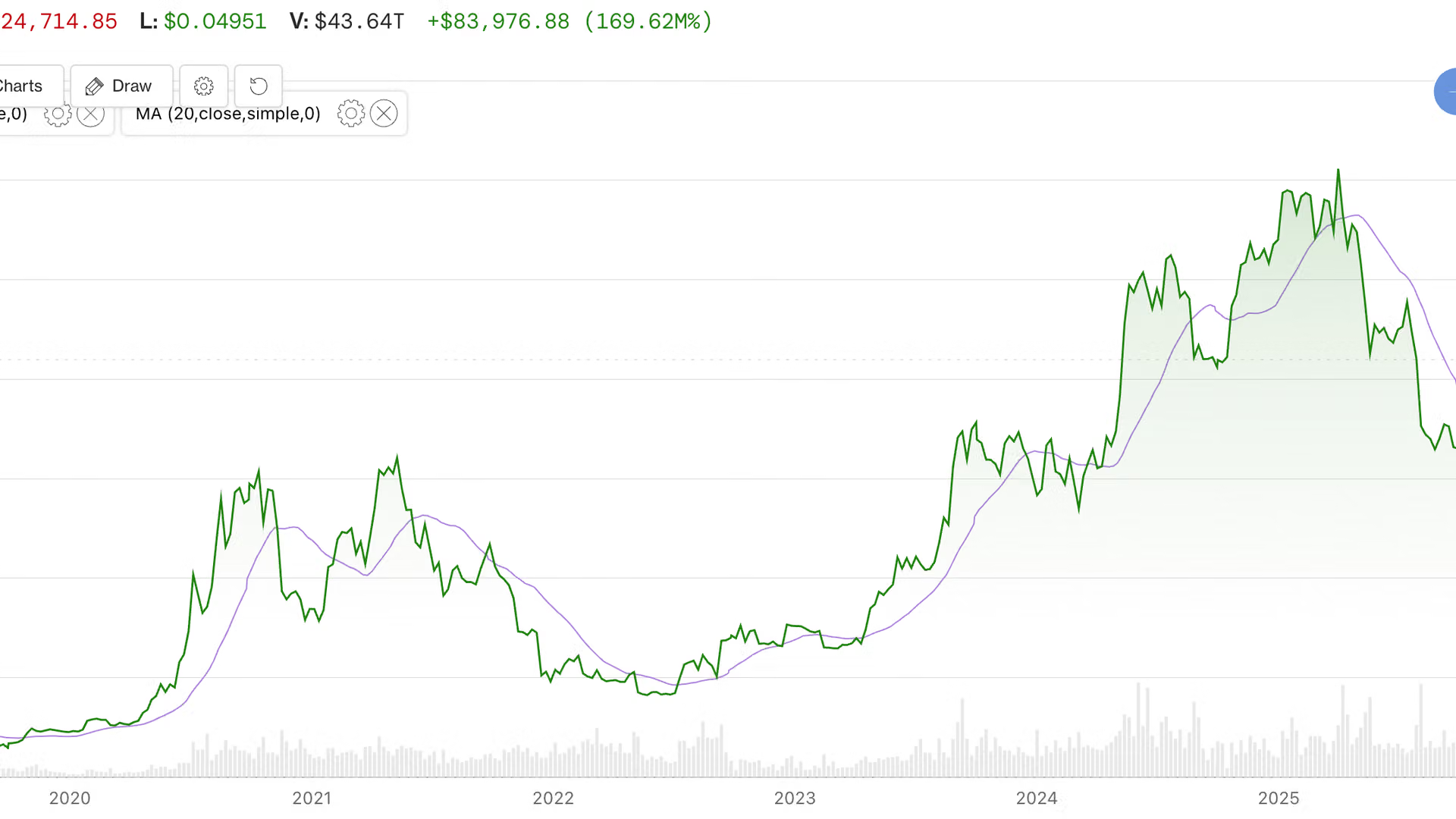
Bitcoin’s recent price surge has triggered a possible bullish signal for even larger gains.
That signal is the price topping its 365-day rolling simple moving average.
On Sept. 22, bitcoin rose above its 365-day average near $80,900 for the first time in 310 days, Ryan Horst and Joni Zhuleku, founders of Altcoin Pro, said in an email conversation.
Altcoin Pro found that bitcoin was higher 12 months later in each of the five previous instances in which it regained its 365-day average after spending at least 90 days below it. The gains ranged from about 59% to more than 1,400%, though the largest increase came in 2012, when bitcoin was a fringe asset.
Horst said the pattern is not fail-safe. When the firm included shorter periods below the line, it found two failed breakouts, in July 2018 and March 2022, when bitcoin fell about 27% and 59%, respectively, within 90 days.
“This September’s move is encouraging, especially after 310 days below the line, but we want to see it hold,” Horst said. “It is a signal, not a guarantee.”

A bizarre drama played out on YouTube this past week, when a channel called Mighty Mike Plays posted a video explaining how nine-year-old “Mighty Mike” apparently got a hold of his father Dave’s company card and spent $118,000 on a YouTube ad campaign.
However, the story immediately appeared to have a number of holes, and within a few days there were too many red flags for influencers, who had initially boosted the story’s reach, to ignore.
Just a kid and his dad
Mighty Mike Plays, which features Roblox and Minecraft videos, was created in June of 2024 but only started posting videos in August of this year.
Over the past month, the channel has uploaded 175 long and short form videos — a considerable number for a child of nine.
When it suddenly started reaching the front page of YouTube ads, people began to comment that Mike was going to get in trouble with his father. They were, in fact, being played by the marketing.
On September 14, the channel released a video titled “Message from Dad… Mighty Mike Plays is Over.”
In the video, Dave speaks while Mike plays Minecraft. He states that Mike had spent $118,000 on the YouTube ad campaign and worst of all that the charges were on his company card and now he might get fired.
Dave didn’t explain why he would ever use a company card for anything but company purchases or how using the card even for a $20 ad campaign — as he stated was his intention — wasn’t illegal, but no red flags outside of this were obvious yet.
Read more: Kalshi’s AI ad turned an Asian YouTuber into ‘a white dude’
99 problems and the vid is one
On September 18, a new video was released, once again with Mike playing Minecraft and Dave speaking. Unfortunately, this time the video was nothing but red flags. Dave states that he’s been fired from his job and that the company has demanded that he pay back all $118,000 within 30 days.
He doesn’t clarify what will happen in 30 days if the company isn’t paid back.
Dave doesn’t show any proof of ad spend or any emails with his colleagues where they discuss the circumstances. Instead he suggests that the family will soon lose their home because he’ll have to sell it within the 30-day period.
All of this sounds like fiction, but it only gets more absurd.
Dave states that he doesn’t want to start a GoFundMe or Kickstarter to support his family and doesn’t specify a reason, though it’s thought that if you lie about the reason you need funds on these websites you can get sued and the money can get clawed back.
Instead, he says, he wants to sell merchandise online to try to raise the funds himself — a bizarre decision.
Slop merch, slop campaign
Dave’s website is filled with AI-created merchandise, all selling for immense prices (nearly $100 for t-shirts that say “118k” and “67 wassup chat”), some supposedly already sold out.
And, as eagle-eyed YouTubers quickly pointed out, the terms of service, which previously promised that returns would be allowed within 30 days, now state that ALL SALES ARE FINAL.
It’s unclear if this is legal or binding to anyone who bought the merchandise before the change.

Needless to say, it’s now Dave who’s claiming that he’s going to be suing numerous influencers and YouTubers for suggesting that he’s a scammer, emailing them to say he’s hired a lawyer and will be taking them to court for libel — an expensive move for a man who supposedly just lost his job and owes $118,000.
Regardless, Mike and Dave are posting videos again but have yet to address any of the previous red flags littering their videos.
Protos will follow the story for more information if anything changes.
Got a tip? Send us an email securely via Protos Leaks. For more informed news and investigations, follow us on X, Bluesky, and Google News, or subscribe to our YouTube channel.

Druski Opens Up About Traumatic Childhood In Raw Interview

The Princess Wears Separates for Addiction Awareness Week Engagement

More than one in three illicit drug samples contain unexpected substances, testing finds




-

 Fashion6 days ago
Weekend Open Thread: Talbots – Corporette.com
-

 Tech4 days ago
Researchers escape OpenAI Codex sandbox to run commands on host
-

 Crypto World2 days ago
Goldman Sachs and Deutsche Bank Agree: The S&P 500 Rally Isn't Over
-

 Crypto World4 days ago
Who Needs CLARITY Anyway? ARB Could See 70X Increase: Hodler’s Digest
-

 Crypto World6 days ago
Circle launches Arc Studio AI agent for building onchain apps
-

 Crypto World7 days ago
Mortgage and refinance interest rates today, Thursday, September 17, 2026
-
 NewsBeat6 days ago
Trump says US has reached an agreement to take permanent control of Greenland’s security
-

 Crypto World6 days ago
Trading Bitcoin on Robinhood? Why 2% Spread Has Traders Worried
-

 Fashion8 hours ago
8 iPhone Accessories That Add Personality
-

 Crypto World6 days ago
Bitcoin price breaks channel as RSI climbs to 63
-

 Business4 days ago
Analog Devices (ADI) Bets $1.35 Billion on Chips that Let Machines Think for Themselves
-

 Tech3 days ago
Google’s $899 Googlebook is a bet that you’ll buy a new laptop for Gemini
-

 Crypto World4 days ago
Coinbase, Robinhood, Circle Seen as Tokenized-Stock Winners
-

 Tech5 days ago
Trump suggests rebranding AI with a new name, says he’s also creating an AI Force
-
 Business2 days ago
Oil Price Today (September 23): Crude oil below $100 on hopes of US-Iran talks. What did Trump say?
-

 Tech7 days ago
GPT-6 Astra Reached the Nether in Minecraft, Lost Its Stash to a Creeper, and Farmed Potatoes for Hours
-

 Crypto World6 days ago
World Money launches in 150+ countries with Stripe
-

 Crypto World6 days ago
Silver prices recover quickly, hitting weekly high today
-
 Crypto World21 hours ago
Bitcoin Threatens Sub-$84,000 Breakdown as Long Liquidations Spike
-
 Crypto World2 days ago
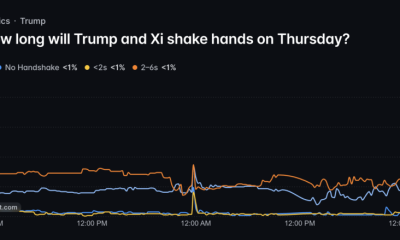
Trump-Xi Polymarket Odds for Handshake Hit 50%
You must be logged in to post a comment Login