

Crypto World
Zimbabwe Requires Crypto Businesses to Register Annually Under New FIU Regulations


TLDR:
- Zimbabwe’s Finance Minister has issued the country’s first dedicated regulations for virtual asset service providers.
- Crypto businesses must register annually with the FIU and pay a $500 fee or face criminal charges.
- Sub-Saharan Africa recorded over $205 billion in on-chain value between July 2024 and June 2025.
- Zimbabwe joins South Africa, Nigeria, Kenya, and Mauritius in formally regulating digital assets.
Zimbabwe’s government has introduced regulations requiring cryptocurrency businesses to register annually and pay fees, marking the country’s first formal legal framework for digital assets.
The Finance Minister issued the rules to bring an industry that has long operated underground under regulatory oversight.
Businesses involved in buying, selling, transferring, or safeguarding virtual assets must now register with the Financial Intelligence Unit (FIU), an anti-money laundering body within the central bank.
Zimbabwe’s Crypto Market Comes Out of the Shadows
The new rules set a $500 annual registration fee for all virtual asset service providers operating in the country. Operating without registration is now a criminal offence under the regulations. The FIU, which sits within the Reserve Bank of Zimbabwe, will oversee compliance across the sector.
Zimbabwe banned financial institutions from trading cryptocurrency in 2018, pushing activity onto peer-to-peer platforms and social media channels.
The market has since grown largely informally, with traders navigating legal grey areas for years. These new rules represent the government’s first direct attempt to bring that activity into a regulated space.
Traders on the ground have responded positively to the announcement. Jeffrey Mutambiranwa, a Harare-based crypto trader who has operated through informal channels, shared his reaction with Reuters. “This is a welcome development… It’s also good for traders that they don’t have to operate underground,” he said.
The regulations come as part of a broader global push to oversee digital asset markets following high-profile exchange collapses, fraud cases, and growing concerns over money laundering risks worldwide.
Historical Currency Crises Drove Zimbabweans to Crypto
Zimbabwe’s relationship with digital currencies is deeply tied to its economic history. Hyperinflation in the late 2000s wiped out savings and pension funds across the country.
Repeated currency changes further eroded public trust in the formal banking system, pushing many residents toward Bitcoin and other cryptocurrencies as alternative stores of value.
Remittances have also played a major role in driving crypto adoption. Banks remain the most expensive channel for sending money into the country, according to the World Bank’s Remittance Prices Worldwide report. Crypto offered a cheaper, faster alternative for Zimbabweans receiving funds from abroad.
Sub-Saharan Africa recorded more than $205 billion in on-chain transaction value between July 2024 and June 2025, a 52% year-on-year increase, according to the Chainalysis 2025 Global Crypto Adoption Index. That growth reflects how deeply digital assets have embedded themselves into regional financial activity.
Zimbabwe joins South Africa, Nigeria, Kenya, and Mauritius among African nations that have moved to regulate digital assets.
As crypto use rises across the continent, more governments are choosing formal oversight over outright bans. Zimbabwe’s new framework signals a shift in that same direction.




Anthropic has reportedly sent senior technical staff to Washington to meet White House officials and undo export controls that took its most powerful AI models, Fable 5 and Mythos 5, offline days after launch.
The trip comes amid a turbulent week that began with a Friday order barring foreign access to the models, forcing Anthropic to disable them for foreign nationals.
Follow us on X to get the latest news as it happens
Anthropic Races to Reverse Fable, Mythos Export Controls
The two sides have talked since Friday’s order. Anthropic technical staff have held virtual meetings with White House officials, a source close to the company told Axios.
The Wall Street Journal reported that Commerce Secretary Howard Lutnick and Cyber Director Sean Cairncross joined Saturday’s discussions. Anthropic co-founder and chief compute officer Tom Brown took part, alongside policy chief Sarah Heck.
Both parties want the models back online, though it is not clear yet what a fix would look like. Some officials view the pairing of Anthropic engineers with government security researchers as an early path toward compromise.
The standoff carries weight beyond AI policy. Anthropic has confidentially filed a confidential S-1 with the SEC, giving the company the flexibility to proceed with an IPO. A prolonged fight with Washington could shape how investors read that debut.
BeInCrypto has contacted the White House and Anthropic for comment.
Subscribe to our YouTube channel to watch leaders and journalists provide expert insights
The post Anthropic Races to Reverse Fable 5, Mythos 5 Export Controls appeared first on BeInCrypto.
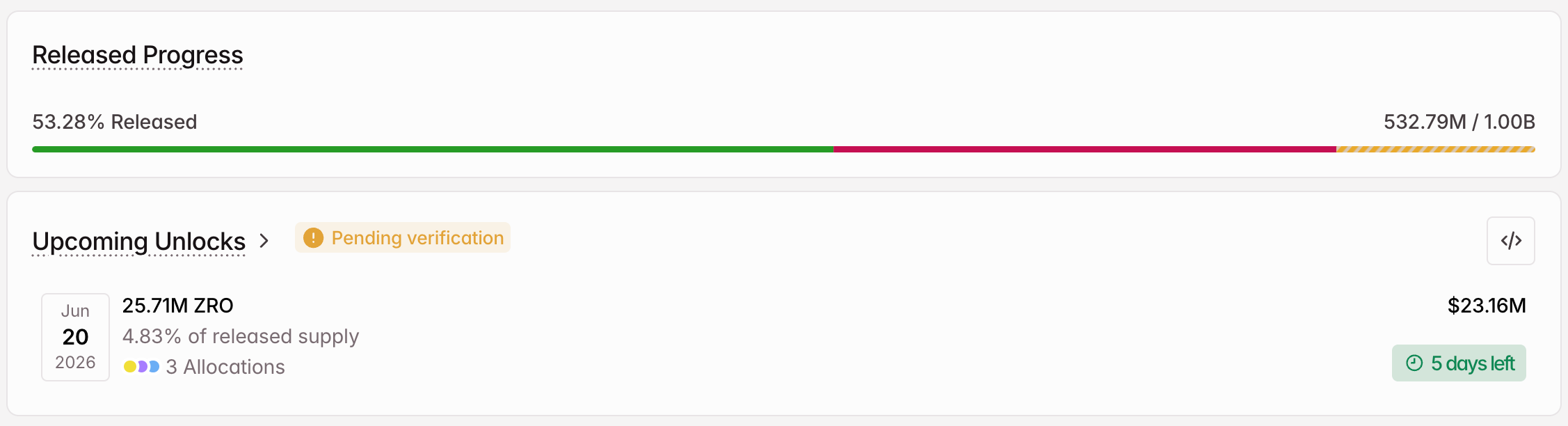
The crypto market will welcome tokens worth more than $670.7 million in the third week of June 2026. Major projects, including LayerZero (ZRO), Spark (SPK), and Kaito (KAITO), will release significant new token supplies.
These unlocks could introduce market volatility and influence short-term price movements. So, here’s a breakdown of what to watch.
1. LayerZero (ZRO)
- Unlock Date: June 20
- Number of Tokens to be Unlocked: 25.71 million ZRO
- Released Supply: 532.79 million ZRO
- Total Supply: 1 billion ZRO
LayerZero is an interoperability protocol that connects different blockchains. Its primary goal is to facilitate seamless cross-chain communication. Thus, it enables decentralized applications (dApps) to interact across multiple blockchains without relying on traditional bridging models.
The team will unlock 25.71 million tokens on June 20, representing 4.83% of the released supply. Moreover, the supply is worth approximately $23.16 million.

LayerZero will award 13.42 million altcoins to strategic partners. Core contributors will get 10.63 million ZRO. Lastly, 1.67 million ZRO are for tokens repurchased by the team.
2. Spark (SPK)
- Unlock Date: June 17
- Number of Tokens to be Unlocked: 900 million SPK
- Released Supply: 3.3 billion SPK
- Total Supply: 10 billion SPK
Spark is a DeFi protocol that acts as an on-chain capital allocator, deploying stablecoin liquidity across DeFi, CeFi, and real-world assets. SPK is its ERC-20 governance and staking token.
On June 17, Spark will unlock 900 million tokens into the market. The tokens are worth $17.8 million and represent 27.08% of the current released supply.

The network will direct 600 million SPK to the ecosystem. Moreover, the team will gain 300 million tokens.
3. Kaito (KAITO)
- Unlock Date: June 20
- Number of Tokens to be Unlocked: 17.6 million KAITO
- Released Supply: 391.88 million KAITO
- Total Supply: 1 billion KAITO
Kaito is an artificial intelligence (AI)-powered Web3 information platform that aggregates and analyzes cryptocurrency market data from diverse sources like social media, governance forums, news, and more. The KAITO token serves as a medium of exchange, governance tool, and incentive mechanism within the platform.
On June 20, the team will unlock 17.6 million tokens, representing 4.49% of the current released supply. The supply is worth approximately $7.4 million.

The foundation will receive 1.19 million tokens. Core contributions will get 6.94 million tokens. Furthermore, early backers will receive 2.31 million KAITO. Finally, the team will direct 7.16 million KAITO for ecosystem and network growth.
In addition to these, other prominent unlocks investors can look out for in the third week of June include Sei (SEI), Arbitrum (ARB), YZY (YZY), and more, which will contribute to the overall market-wide releases.
The post 3 Token Unlocks to Watch in the Third Week of June 2026 appeared first on BeInCrypto.


The US and Iran said they reached an interim agreement to end hostilities and reopen the Strait of Hormuz, with the deal to be signed in Switzerland on Friday.
The price of bitcoin has risen to $65,700, up 2% over the past 24 hours, and its highest level since the early June plunge.
The price of WTI crude oil has plunged nearly 5% to just under $81 per barrel, its softest level in about two months.
Nasdaq 100 futures are higher by 1.5% and S&P 500 futures are up 0.9%.
TLDR:
- Hyperscalers committed $725B in 2026 capex, up 77% from 2025’s record $410B set just a year prior.
- Non-USD bond issuance rose from zero in 2024 to 48% of hyperscaler funding by mid-2026.
- Alphabet set borrowing records in yen, CAD, CHF, and sterling within a single calendar year 2026.
- Global AI debt issuance is projected at $570B for 2026, nearly four times the 2022 total level.
Hyperscalers are reshaping global bond markets as their AI infrastructure spending reaches unprecedented levels. Amazon, Google, Microsoft, and Meta have committed $725 billion in capital expenditure for 2026 alone.
That figure is up 77% from the $410 billion record set in 2025. Goldman Sachs projects combined capex from 2026 through 2031 will reach $7.6 trillion. The scale of this spending has pushed tech giants into foreign currency debt markets at a record pace.
Non-Dollar Bond Issuance Surges Across Major Currencies
In 2024, hyperscalers issued zero bonds in non-USD currencies. By 2025, all new non-USD issuance was entirely fresh territory. Now, non-USD currencies account for 48% of hyperscaler bond funding in 2026.
The euro leads that slice at 52%, followed by the Japanese yen at 15%, the Canadian dollar at 14%, sterling at 12%, and the Swiss franc at 7%.
Bank of America confirmed that hyperscalers have doubled their non-dollar bond share to 30% of total issuance this year. As noted by Milk Road AI, this shift has moved so fast it has strained the American bond market’s capacity to absorb it. The U.S. market simply cannot accommodate the full volume of debt these companies now need to raise.
Individual deals reflect how quickly this trend has accelerated. In May, Alphabet issued ¥576.5 billion, roughly $3.6 billion, in yen-denominated bonds. That was the largest yen bond ever sold by a non-Japanese company, topping Berkshire Hathaway’s 2019 record.
Alphabet has now set borrowing records in yen, Canadian dollars, Swiss francs, and sterling within a single calendar year. That is a level of multi-currency debt activity rarely seen from any single corporate issuer at this pace.
AI Debt Issuance on Track to Quadruple 2022 Levels
Amazon entered Canada’s bond market in June with a C$14 billion issuance, the largest corporate bond ever sold in that market.
Investor orders reached nearly C$28 billion, almost double what was ultimately sold. That deal surpassed Alphabet’s own Canadian record of C$8.5 billion set just weeks earlier in May.
Morgan Stanley projects euro borrowing by hyperscalers will hit €50 billion in 2026. That would potentially make the United States the single largest source of corporate debt in the entire eurozone, ahead of France. The shift carries broad consequences for European fixed-income markets.
Global AI-related debt issuance is on track to reach $570 billion for the full year 2026, according to Morgan Stanley. That is more than double the pace recorded during the same period last year. It is also nearly four times the 2022 level.
Even companies holding over a trillion dollars in combined cash, including Apple, Microsoft, Alphabet, Amazon, and Meta, have concluded that self-funding this buildout is not feasible.
The AI infrastructure race has grown too capital-intensive for even the world’s most cash-rich firms to finance independently.
Crypto World
Ethereum Users Can Now Add Quantum-Resistant Account Protection for Just $0.07, Researchers Say
TLDR:
- Researchers say Ethereum users can secure accounts against quantum attacks today for as little as $0.07.
- SPHINCS- verifies post-quantum signatures on-chain at ~150,000 gas using Ethereum’s native KECCAK256 opcode.
- C11 and C12 variants support hardware wallet signing, tested at 390s and 47.5s on a Ledger secure element.
- Future leanSPHINCS variant targets STARK aggregation, cutting per-transaction verification to 3,000 gas.
Researchers say Ethereum users could add quantum-resistant account protection for as little as $0.07, without a hard fork.
A developer known as nicocsgy published SPHINCS-, a family of EVM-optimized post-quantum signature schemes derived from SPHINCS+.
The system verifies post-quantum signatures on-chain at around 150,000 gas using only existing Ethereum infrastructure. Formal proofs via Lean 4 with Verity are included, and additional audits are in progress.
Quantum Threat to Ethereum Accounts Is Closer Than Expected
Quantum computers capable of breaking ECDSA, the signature scheme securing Ethereum and Bitcoin, are no longer a distant concern. Recent resource estimates by Babbush et al. have brought attack timelines closer than previously projected.
This makes post-quantum alternatives at the execution layer increasingly urgent for wallet holders and institutions alike. SPHINCS- addresses that gap by enabling quantum-resistant verification on Ethereum today.
The researcher shared on X: “Ethereum can already start preparing accounts for a post-quantum world, without waiting for a hard fork. Today, it would be just $0.07.”
The core technical insight came from a conversation with Vitalik Buterin. Since SPHINCS+ is built entirely from hash functions, replacing the standard SHAKE256 with Ethereum’s native KECCAK256 opcode makes on-chain verification possible.
This substitution removes any dependency on new precompiles or protocol changes. Users and organizations can therefore deploy quantum-resistant account protection right now.
Parameter tuning drove the bulk of the gas optimization work. Extensive modeling under EIP-7623 and EIP-7976 floor pricing revealed that the Winternitz parameter w=8 produces the lowest real verification cost.
Short hash chains with more iterations proved cheaper than fewer but longer chains. That finding overturned assumptions from earlier calldata-only models.
Four Variants Cover Hardware Wallets to FIPS-Compliant Deployments
Researchers produced four main variants, each targeting a different signer profile and security requirement. The C13 variant uses WOTS+C and FORS+C compression, verifying at 127,000 gas with a 3,704-byte signature.
It suits laptop-class signers and requires around 4.3 million hash calls per signature. Organizations pursuing FIPS compliance can instead use SLH-DSA-SHA2-128-24, a standardized-style alternative.
C11 and C12 were tested on a Ledger Nano S+ ST33K1M5 secure element to assess hardware wallet viability. Signing times came in at 390 seconds and 47.5 seconds respectively, making hardware deployment realistic.
Both variants carry a reduced per-key signature budget compared to the NIST standard’s 2^64 limit. However, on-chain data shows the average active Ethereum address sends roughly 431 transactions per year, making smaller budgets sufficient.
The SLH-DSA Keccak twin cuts on-chain verification costs by around 34% against its FIPS-aligned counterpart. It trades bit-exact NIST compliance for meaningfully cheaper gas, which suits blockchain-native deployments.
Verifier contracts for all variants are publicly available on GitHub for audit and deployment. NIST is also developing smaller SLH-DSA parameter sets with a 2^24 signature budget, narrowing the gap further.
Future research targets ZK-friendly hash functions under the working name “leanSPHINCS.” That variant would support STARK-based aggregation, dropping verification to around 3,000 gas per transaction at the protocol level.
A companion post on JARDIN, expected soon, aims to cut hardware wallet signing time to three seconds. Together, these efforts position hash-based post-quantum signatures as a practical near-term path for Ethereum account security.

Donald Trump says the United States and Iran have finalized a peace deal, with a signing ceremony set for June 19 in Switzerland. The framework reopens the Strait of Hormuz while pushing the hardest nuclear questions into later talks.
The agreement works as a 60-day memorandum of understanding rather than a final treaty. It freezes the fighting, eases oil flows, and trades sanctions relief for Iranian compliance. Major disputes over enrichment and weapons stay open.
What the Trump Iran Deal Actually Contains
The memorandum runs for 60 days and can extend by mutual consent, according to a U.S. official cited by Axios. The structure favors quick de-escalation over a binding settlement.
It reopens the Strait of Hormuz with no tolls. Iran agrees to clear the naval mines it laid. The United States then lifts its blockade on Iranian ports in phases.
Temporary waivers let Iran sell oil again during the window. Frozen funds stay locked until a final, verified deal. Trump calls the principle “relief for performance.”
Tehran has pushed back on the schedule, fueling a disputed signing timeline that traders continue to watch closely.
Why the Nuclear Questions Stay Unresolved
The draft includes an Iranian pledge to never pursue nuclear weapons. It defers enrichment limits and stockpile removal to the 60-day negotiations.
That gap echoes the 2015 nuclear accord, the JCPOA, which Trump exited in 2018. This time, relief is meant to follow compliance rather than upfront commitments.
The two sides still disagree openly. Trump insists the deal allows no uranium enrichment. Iranian Foreign Minister Abbas Araghchi says otherwise.
“Enrichment in Iran, however, will continue with or without a deal.”
Ballistic missiles and proxy networks receive little immediate attention in the text.
What the Deal Defers and How Markets Reacted
Critics argue the framework buys roughly 60 days of calm, not a lasting settlement. Permanent enrichment caps, missiles, and regional proxies wait for a second round of talks.
Practical hurdles also remain. The Pentagon has warned that fully clearing Hormuz mines could take up to six months, slowing any return to prewar shipping.
Markets still moved on the announcement. A calmer geopolitical backdrop could keep supporting Bitcoin’s recovery if equities hold firm into the signing.
The June 19 ceremony will test whether the truce holds. The harder measure comes later, when negotiators decide if compliance can replace the upfront bargains that earlier deals relied on.
The post Trump Iran Deal: A Ceasefire That Solves Everything Except the Hard Parts appeared first on BeInCrypto.
TLDR:
- Binance recorded a 7-day average of $83M daily USDT inflows on Ethereum over the past two weeks
- USDT outflows on Tron averaged $101M daily, while Binance total stablecoin reserves fell just 1.3%
- The deposit-via-ETH, withdraw-via-TRX pattern points to whale and institutional cross-chain activity
- Capital exiting via Tron rails is likely heading to OTC desks or cold storage, not crypto purchases
Stablecoin bridge activity on Binance has drawn attention over the past two weeks. Large-scale opposing flows between Ethereum and Tron networks are being recorded.
USDT inflows on Ethereum are running at a 7-day average of $83 million daily. Meanwhile, USDT outflows on Tron are averaging $101 million per day. Despite these movements, Binance’s total stablecoin reserves have declined by only 1.3%.
Binance Becomes a Cross-Chain Liquidity Corridor
Market observers are watching a clear pattern take shape on Binance. Capital is entering the exchange via Ethereum-based USDT and exiting through Tron-based rails. This opposing flow dynamic effectively turns Binance into a cross-chain bridge for large players.
The scale of these movements points to whale and institutional involvement. Retail traders rarely move capital in volumes that register at $83 million in daily averages. The consistency of the flows over two weeks further rules out isolated or accidental transactions.
On-chain analytics platform CryptoOnchain flagged the trend earlier this week. The platform noted that Binance’s reserves remaining flat despite opposing flows of this magnitude is itself a telling data point. It confirms that inflows and outflows are nearly perfectly offsetting each other.
Historically, heavy ERC-20 stablecoin deposits into centralized exchanges have marked moments when large players step back from DeFi. These actors tend to seek centralized order books either to reallocate holdings or prepare for exits.
Tron’s Low-Fee Rails Attract Outbound Institutional Capital
The withdrawal side of this equation tells its own story. Capital leaving Binance via TRC-20 USDT is not staying on the exchange to purchase crypto assets. Instead, it appears to be heading toward OTC desks, cold storage, or alternative settlement venues.
Tron has long been the preferred network for high-volume, low-cost stablecoin transfers. Its fee structure makes it practical for moving large sums without incurring the gas costs associated with Ethereum. Institutions and OTC operations favor this rail for exactly that reason.
This “deposit via ETH, withdraw via TRX” pattern has appeared before periods of reduced activity in Ethereum-based DeFi markets.
When purchasing power migrates away from Ethereum’s native layer, organic spot accumulation on that network tends to slow.
Total market liquidity, however, remains intact for now. The stablecoin supply itself has not shrunk — it has simply shifted settlement rails.
Markets will need to see these opposing flows neutralize before a clear resumption of Ethereum-based accumulation can be confirmed.
TLDR:
- SpaceX priced its IPO at $135 per share, raising a record $75 billion on its first day of trading.
- SPCX closed nearly 19% higher at $161, pushing the company’s market valuation above $2 trillion
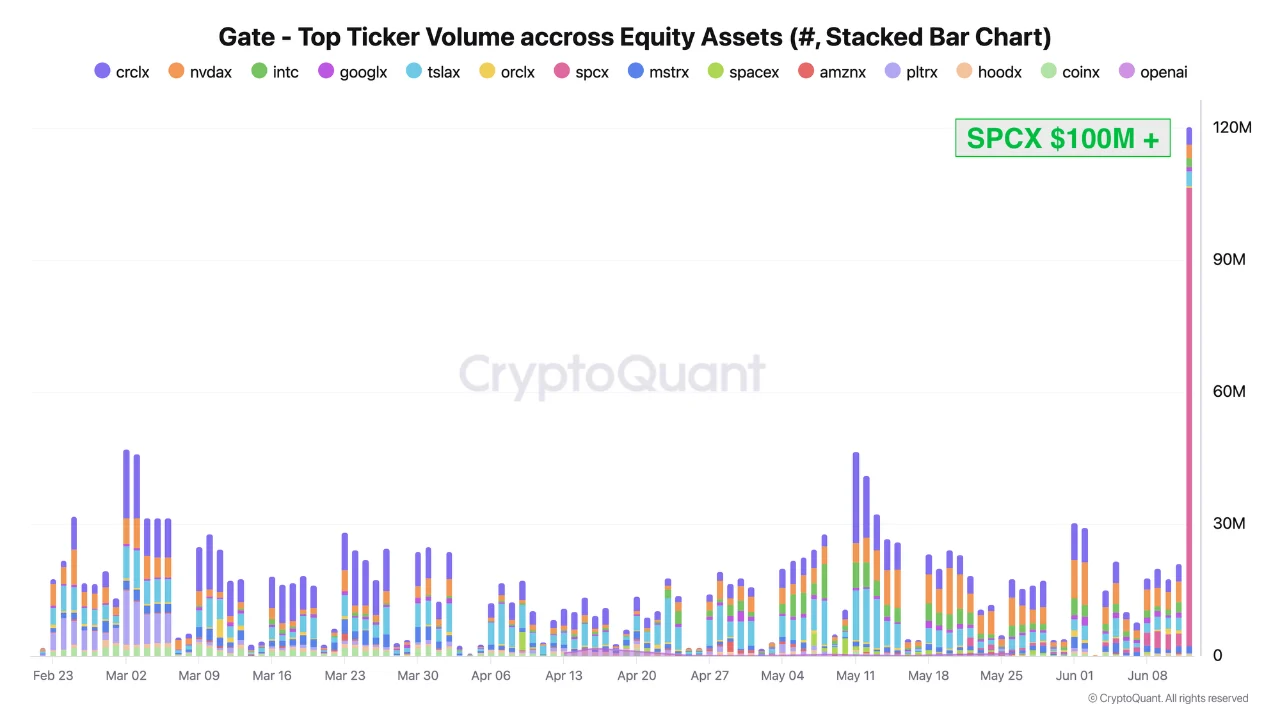
- Gate.io recorded over $100 million in SPCX trading volume on day one, far ahead of other tickers.
- Vanda Research noted SPCX retail purchases surpassed Nvidia by more than 3.5 times on debut day.
SpaceX made its long-awaited Nasdaq debut on June 12, 2026, under the ticker SPCX. The company priced its IPO at $135 per share, raising a record $75 billion. Shares opened at $150 and closed nearly 19% higher at around $161.
The listing pushed SpaceX’s market valuation above $2 trillion on day one. Crypto markets responded just as strongly, with tokenized equity platforms recording notable trading volumes tied to the new stock.
Record Retail Demand Greets SPCX on Wall Street
SpaceX’s public debut drew immediate and widespread interest from retail investors. According to Vanda Research, SPCX became the most purchased stock among retail investors on its first trading day. Net retail purchases surpassed those of Nvidia by more than 3.5 times, a remarkable gap for any new listing.
More than 490 million shares changed hands during the session alone. That level of activity placed SPCX among the most actively traded stocks in recent memory.
The strong opening reflected years of pent-up demand from investors who had tracked SpaceX as a private company.
The stock rose as high as $176.52 during intraday trading before paring some gains into the close. Even after the pullback, shares settled around $161, holding well above the IPO price. Post-market activity added further momentum, with shares rising another 3.5% after the closing bell.
SpaceX COO Gwynne Shotwell rang the opening bell alongside company leadership at the Nasdaq MarketSite in Times Square.
The ceremony also took place simultaneously at SpaceX’s Starbase facility in Texas. The dual celebration reflected the scale of the occasion for the 24-year-old aerospace company.
Crypto Platforms Bridge the Gap Between Equities and Digital Assets
Crypto investors did not wait for traditional brokerage accounts to gain exposure to SPCX. Platforms offering tokenized equity products saw strong demand from the moment the stock went live. On Gate.io, SPCX trading volume crossed $100 million on its first day of listing.
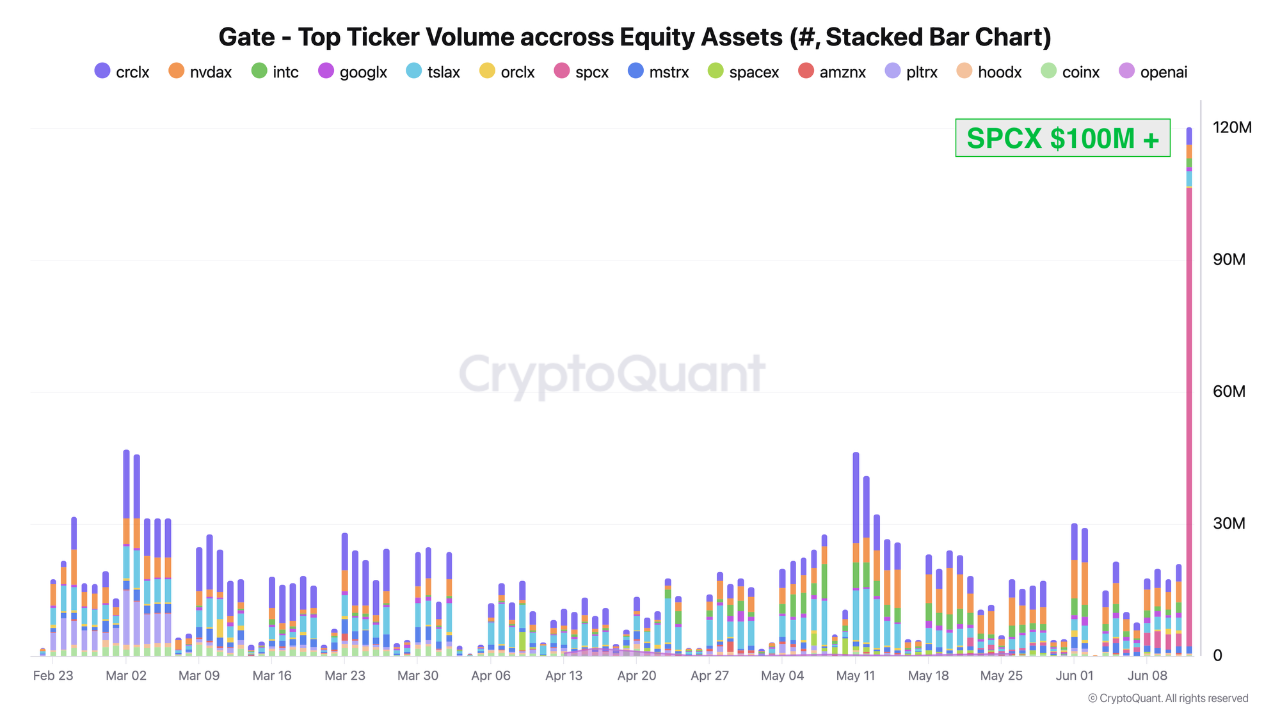
That figure stood out sharply against other equity tickers on the same platform. Circle and Tesla recorded trading volumes of $4 million and $3.5 million respectively on the same day. The gap between SPCX and those assets reflects the level of retail enthusiasm surrounding the SpaceX listing.
Broader equity-related trading on Gate.io typically generates between $10 million and $25 million in daily volume across listed assets.
SPCX surpassed that range by a wide margin within hours of becoming available. That pace pointed to genuine demand from crypto-native investors seeking equity exposure.
Perpetual futures contracts tied to SPCX on Hyperliquid also recorded strong activity ahead of and during the IPO. The SPCX-USDC perpetual contract traded around $176, roughly 30% above the IPO price.
Over $233 million in volume changed hands in those contracts within 24 hours, with open interest climbing above $263 million.
Crypto World
VersaBank Names Ethereum, Algorand, and Stellar for Tokenized Bank Deposits in SEC Filing
TLDR:
- VersaBank’s SEC filing names Ethereum, Algorand, and Stellar for its tokenized deposit initiative
- RBTDs represent actual CAD$1 or US$1 demand deposit liabilities, not stablecoin-backed instruments.
- Proposed use cases for RBTDs cover payments, settlement, digital asset custody, and mainstream finance
- VersaBank’s multi-network approach signals banks are actively choosing public blockchain infrastructure.
VersaBank has named Ethereum, Algorand, and Stellar in a recent SEC filing related to its Digital Meteor initiative. The filing covers Real Bank Tokenized Deposits, or RBTDs, formerly called Digital Deposit Receipts.
These instruments represent actual demand deposit liabilities of the bank. This development marks a notable step in regulated banking’s engagement with public blockchain infrastructure.
VersaBank Tokenized Deposits Differ From Stablecoins
VersaBank tokenized deposits are not stablecoins. Each RBTD represents either a CAD$1 or US$1 demand deposit liability of the bank.
The deposits remain direct liabilities of VersaBank or VersaBank USA throughout their lifecycle. That structural difference sets them apart from privately issued stablecoin products.
Stablecoins are typically backed by reserve assets held by private companies. Tokenized deposits, by contrast, originate directly from a regulated banking institution.
in the industry view this distinction as important for compliance and financial stability. It positions RBTDs closer to traditional banking products than crypto-native instruments.
Analyst Marco Salzmann noted the filing on X, describing it as potentially one of the most important blockchain adoption stories of the decade.
He credited researcher algerstmehn for the original discovery of the SEC document. The filing was dated June 3, 2026. It marked a formal update to regulators on the bank’s Digital Meteor initiative.
The proposed use cases for RBTDs span payments, settlement, digital asset custody, and mainstream financial applications.
These are practical, infrastructure-level functions rather than speculative or investment-oriented ones. The bank appears to be targeting real operational workflows rather than retail crypto markets.
Three Blockchain Networks Enter the Conversation
The choice of Ethereum, Algorand, and Stellar in the same filing increased observation of how banks are evaluating public networks. Ethereum remains the largest smart contract ecosystem by adoption and developer activity.
Algorand has built a track record in institutional tokenization projects. Stellar has established itself in cross-border payments and tokenized asset transfers.
Referencing all three in a single regulatory filing suggests VersaBank is not locked into one network. The bank appears to be assessing which infrastructure best fits different product requirements.
This multi-network approach reflects broader trends among financial institutions exploring blockchain deployment. It avoids over-reliance on any single ecosystem.
The shift toward tokenizing deposits themselves marks a different phase compared to tokenizing bonds or real estate funds.
Those earlier use cases involved external assets. Tokenized deposits represent the bank’s own liabilities moving on-chain. That is a structurally deeper form of blockchain integration for traditional finance.
Whether VersaBank brings RBTDs to commercial scale remains an open question. However, the SEC filing confirms that regulated institutions are moving from observation to active evaluation. Public blockchain networks are now part of formal banking conversations at the regulatory level.

Historically, the crypto market has been fueled by hype, retail fear of missing out (FOMO),
leveraged trading and bull runs. The introduction of US spot Bitcoin ETFs has changed that.
Institutional investors now drive the market. Registered investment advisors, hedge funds,
asset managers, pension funds and sovereign wealth entities are the big players in spot crypto
today. Through the ETF structure, they gain Bitcoin exposure without dealing with the
counterparty and technical risks that come with holding the asset directly. That is a major
reason why net inflows have remained strong even during periods when retail interest has
This institutional presence is also reshaping how retail traders participate. Instead of relying
on fragmented crypto-only exchanges, many everyday investors are moving toward regulated
like OANDA, for example, sits within a wider trading ecosystem that combines crypto with
traditional markets, built-in analysis tools and smoother execution. The result is that retail
and institutional capital are increasingly flowing through the same regulated channels, which
is adding stability to a market that was once driven almost entirely by speculation.
In early May, the spot Bitcoin ETFs had nearly $1 billion in weekly inflows, according to data
from SoSoValue. The total net assets across spot Bitcoin ETFs crossed $101 billion, while daily
trading volume neared $4.8 billion. This broad market uptick indicates an acceleration of
capital that is not accidental but rather the result of institutional-grade catalysts aligning at
The Securities and Exchange Commission paved the way for spot ETFs in 2024. Since then, the
SEC’s regulations have evolved, providing federal oversight frameworks for consumers. For
years, the largest roadblock for institutional capital was a lack of clear guidelines. In 2026,
institutional players now have the official stamp of validation with established compliance

Anthropic Races to Reverse Fable 5, Mythos 5 Export Controls

JD and Usha Vance Share Success of Their Interfaith Marriage

Tyson Fury vs Anthony Joshua announcement LIVE as Dana White reveals all


-

 Crypto World7 days ago
Anatomy of the June crypto crash: Fed, Iran, Saylor
-

 Crypto World3 days ago
Oppenheimer backs SpaceX as $70 billion retail frenzy builds
-

 Crypto World3 days ago
Markets Rally as SpaceX IPO Looms Amid Iran Tensions and Inflation Surge
-

 Business12 hours ago
No Jackpot Winner as $257 Million Prize Rolls Over to $269 Million Monday Draw
-

 Sports6 days ago
FIFA WC 2026 Group C: Morocco, Scotland challenge Brazil’s hunt for glory | FIFA World Cup 2022
-

 Fashion2 days ago
Weekend Open Thread: Tuckernuck – Corporette.com
-

 Business7 days ago
High Stakes for Wembanyama as New York Pushes for 3-0 Lead
-
 Crypto World7 days ago
Eli Lilly (LLY) Stock Surges 4% Following Breakthrough Sleep Apnea Trial Results
-
 Sports5 days ago
Bangladesh beat Australia after 20 years in ODIs, register only their second win over six-time world champions | Cricket News
-

 Tech2 days ago
NanoClaw integrates JFrog registries to secure AI agent downloads
-

 Crypto World2 days ago
Bitget enters Argentina’s regulated crypto market through PSAV registration
-

 Tech3 days ago
This Week In Security: Microsoft On Microsoft, Register Your Domains, Linux On ARM, And FreeBSD Joins The File Cache Club
-

 Politics4 days ago
Politics Home | Healey Resignation Is “Colossal Failure Of Government”, Says Former Labour Defence Secretary
-

 Sports4 days ago
First Time Since 1971: Australia Register Historic Low In ODI Cricket
-
 Entertainment3 days ago
Donnie Wahlberg & More Heat Up Las Vegas at Circa’s Barry’s Downtown Prime
-

 Entertainment6 days ago
The Ryan Gosling True Crime Thriller On Netflix That Gets Even Stranger, Stream It Now
-
 Tech3 days ago
Opendoor Ends India Operations, Fueling a Bigger Conversation About AI and Outsourcing
-

 Tech5 days ago
‘This is Seattle’s position on AI’: City Council votes unanimously to pause big new data centers
-

 Tech7 days ago
Nvidia and Hyundai deepen their robotics push around Atlas
-

 Politics4 days ago
Belfast burns, while Met chief points finger at Iran and Russia
You must be logged in to post a comment Login