
Entertainment
10 American Sitcoms Where Every Season Is Perfect

When a sitcom can sustain a high level of quality over multiple seasons, it’s nothing short of amazing. Producing a half-hour comedy show is hard work, challenging even the brightest team of writers and performers to create a high volume of self-contained stories that are also genuinely funny.
Many sitcoms find their way around the second season, while others start strong and fizzle out, but a select few shows come out strong and leave on a high note. The following comedies can all claim such an accomplishment, boasting the television equivalent of pitching a perfect game. Listed in no particular order, here are 10 sitcoms with zero weak seasons.
1
’30 Rock’ (2006–2013)

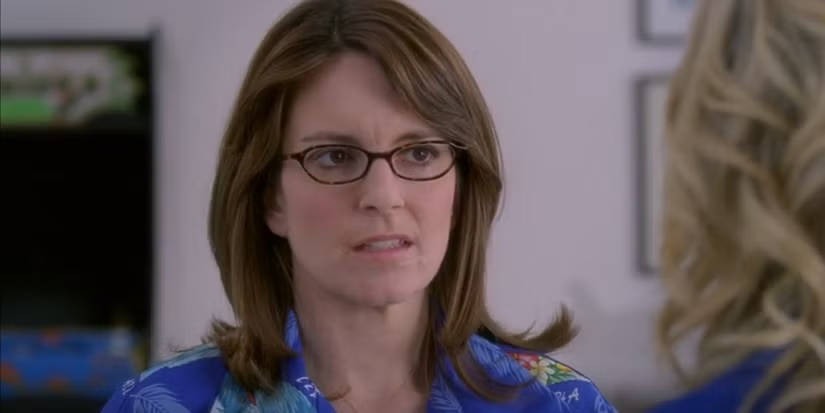
The chaotic struggle to produce a live sketch comedy series is the focus of the NBC sitcom 30 Rock. Tina Fey stars as Liz Lemon, the head writer of a fictional sketch show, whose life is disrupted (even further) by the arrival of new NBC executive Jack Donaghy (Alec Baldwin). His first order of business is to add controversial comedian Tracy Jordan (Tracey Morgan) to the show, a move Liz hates until she sees the results.
30 Rock episodes moved at a relentless, breakneck speed, packing as many clever jokes as possible into every moment. 30 Rock was frequently on the bubble of cancellation, but those who watched did so with a fanaticism that allowed them to remember every inside joke or callback to an obscure reference. The humor of 30 Rock was unafraid to be weird or ultra-specific to a niche group, and that spirit remained until the last episode of the show.
2
‘Frasier’ (1993–2004)

Although the sitcom Frasier was a spin-off of the highly acclaimed Cheers, the high quality of the writing and acting made viewers immediately forget about Boston. The series followed Dr. Frasier Crane (Kelsey Grammer) as he moved from Boston back to his hometown of Seattle to host a radio call-in show. When his estranged father, Martin (John Mahoney), injures himself, the two men get an accelerated reunion after Frasier reluctantly takes him on as a roommate.
It’s somewhat inconceivable that Frasier could regularly produce hilarious episodes that resembled mini-farcical stage plays that were intricate comedies of errors. A distinctly different style and tone from Cheers allowed Frasier to avoid comparison and a chance to explore Dr. Crane from new perspectives. Grammer knew his character inside out by the time his spin-off started, but characters like his tightly-wound brother Niles (David Hyde Pierce) or his blue-collar father Martin allowed Frasier new opportunities for growth.
3
‘The Golden Girls’ (1985–1992)

A witty and smart sitcom that never had a weak season is The Golden Girls. The NBC sitcom followed the lives of four older women, Dorothy (Bea Arthur), Rose (Betty White), Blanche (Rue McClanahan), and Dorothy’s mother, Sophia (Estelle Getty), who lived together in a Miami home. Their initial arrangement is done out of necessity, but the roommates quickly become a found family to draw support from as they enjoy their retirement years.
Where many sitcoms begin to decline after numerous years of being on the air, later seasons of The Golden Girls increased in quality. The chemistry between the cast was so strong, and they each played their part with such a high level of expertise, that any topic could have been introduced to the quartet, and they would have spun it into a must-watch episode. The spin-off series, The Golden Palace, didn’t hold the same magic for viewers, but it had little impact on diminishing the memory of the seven-season hit.
4
‘The Fresh Prince of Bel-Air’ (1990–1996)

The sitcom that introduced many to future superstar Will Smith still holds up decades later. The Fresh Prince of Bel-Air followed Will (Smith), a charismatic teen from Philadelphia who is sent to live with his aunt and uncle in the affluent neighborhood of Bel-Air for the chance at a better life. His upbringing immediately introduces a culture clash to his extended family’s household, but they soon learn from each other and grow close bonds.
Even in the first episodes where the chemistry of the cast was forming, Smith’s dynamic presence carried the show along as the sitcom found its footing. The Fresh Prince of Bel-Air boasts one of the strongest casts of a ’90s sitcom, with everyone on stage from Uncle Phil (James Avery) to cousin Hilary (Karyn Parsons) contributing in a meaningful way. There have been sitcoms built around less than the odd couple chemistry between Will and his cousin Carlton (Alfonso Ribeiro), so it’s no surprise the show ended on a high note after six seasons.
5
‘The Larry Sanders Show’ (1992–1998)

Years before shows like The Studio were satirizing the business of Hollywood, HBO’s The Larry Sanders Show was pulling back the curtain on late-night television. Garry Shandling starred as late-night talk show host Larry Sanders, a man unable to enjoy his accomplishments from behind a mountain of insecurities. Always available to tell Larry what he wanted to hear were his producer Artie (Rip Torn) and his on-air sidekick Hank (Jeffrey Tambor).
The Larry Sanders Show aimed its comedy at the specific peculiarities of the entertainment business, with a long line of guest stars playing themselves, but the heart of the show was the complicated relationships between Larry and his co-workers/friends. Predating mainstream hits like The Sopranos or Sex and the City, The Larry Sanders Show was an early example of HBO cultivating its reputation as a destination for quality storytelling.
6
‘Everybody Loves Raymond’ (1996–2005)

Ray Romano transitioned from a respected stand-up comedian to sitcom star when Everybody Loves Raymond debuted on CBS. The series followed the lives of Ray (Romano) and his wife Debra (Patricia Heaton) as they raised their children in a quiet Long Island suburb. At least, it would be quiet if Ray’s parents, Marie (Doris Roberts) and Frank (Peter Boyle), weren’t living across the street with his older brother Robert (Brad Garrett).
Everybody Loves Raymond was a traditional family sitcom executed perfectly, mining humor from the relatable occurrences of life with a voice that felt familiar and honest. The show was a reliable ratings draw for CBS, but series creator Phil Rosenthal decided to conclude Everybody Loves Raymond after nine seasons, wishing to end on a high note. The goal was accomplished, as Everybody Loves Raymond remains a timeless piece of comedy.
7
‘The Mary Tyler Moore Show’ (1970–1977)

The Mary Tyler Moore Show is one of the greatest sitcoms of all time, delivering a near-flawless run of comedy. Mary Tyler Moore starred as Mary Reynolds, a woman who moves to Minneapolis looking for a fresh start after a broken engagement. There, she finds a job as an associate producer for a local news station and friends who will become her new family.
The Mary Tyler Moore Show is frequently cited for its progressive approach to focusing a series on a single woman who was focused on an independent, career-oriented life. While the sitcom was groundbreaking for television, those accomplishments wouldn’t be remembered as well if the show had not been incredibly funny. One-liners were thrown out with ease, but it was the relationships between the characters that drove the humor and kept The Mary Tyler Moore Show a fan favorite until its iconic finale at the end of Season 7.
8
‘Sanford and Son’ (1972–1977)

Sanford and Son is one of the most influential sitcoms that remained a staple of the NBC lineup until reaching its unexpected finale. The sitcom followed the day-to-day lives of Fred Sanford (Redd Foxx) and his son Lamont (Demond Wilson) as they ran a junkyard in Los Angeles. The father and son duo were prone to extended bickering, but they always came together to work an angle for a big payday or look out for each other.
Although Sanford and Son was based on the long-running British sitcom Steptoe and Son, Foxx and Wilson were able to make the show their own by modeling the series to their specific personality traits. Sanford and Son, along with All in the Family, helped usher in a new form of edgy comedy that reflected a more realistic depiction of the world viewers knew. Sanford and Son ended after Foxx accepted an offer to host a variety show on ABC, and when Wilson didn’t want to continue without Foxx, one of America’s best sitcoms ended without a proper finale.
9
‘Cheers’ (1982–1993)

Set in the bar where everyone knew your name, Cheers set a high standard for comedic brilliance. The series followed the staff and regulars of the Boston-located bar Cheers, run by ex-professional baseball player Sam Malone (Ted Danson). Episodes would explore the characters’ love lives, professional worries, and occasionally, both at the same time.
Cheers’ ability to maintain a funny and engaging sitcom for 11 seasons is a testament to the talent of the cast and crew. It may not have been planned by the show’s creators, but new cast members such as Woody Harrelson as new bartender Woody and Kelsey Grammer as Frasier Crane kept Cheers feeling energized without disrupting the show’s momentum. After a slow build to drawing viewers, Cheers became a top 10 series for a majority of its run and would take home 28 Emmy wins from 117 nominations.
10
‘Veep’ (2012–2019)

Every day in political office is a new opportunity for a crisis in Veep. The series followed the day-to-day mishaps of Selina Meyer (Julia Louis-Dreyfus), the Vice President of the United States, and the members of her staff. Stuck in an office she feels is beneath her, Selina will navigate the petty political landscape to become the Commander in Chief while trying not to humiliate herself in the process.
There might never be another show that can have its characters string together insults in such a comedically poetic fashion as Veep did. The show never dipped into a complacent lull during its run by constantly keeping the story fluid; characters came and went in a ruthless cycle of demand for excellence, and Selina’s changing job title kept things fresh. The seventh and final season took darker turns when wrapping up the series, but it was also the perfect way to send off an unapologetically selfish Selina.


Continue Reading
:max_bytes(150000):strip_icc():format(jpeg)/Julie-Andrews-Anne-Hathaway-THE-PRINCESS-DIARIES-080326-834135cd3cee4494b74e7ad65597fe59.jpg)
Since Mia Thermopolis became a princess 25 years ago, Anne Hathaway has gone on to become the queen of Ithaca.
Us Weekly has affiliate partnerships. We receive compensation when you click on a link and make a purchase. Learn more!
You’d think after staring at chic summer clothes all day — and successfully restraining ourselves — we’d be strong enough to resist Zara’s magnetic pull. Well, we’re not. But this time is different; after discovering Amazon’s late-summer selection, we’re ditching our Zara carts (well, for now at least). These summer-to-fall staples are just as polished, and start at only $6!
If you ask Us, you can’t tell the difference between the two elevated styles. These dresses, blouses, pants and more have all the signature signs of the cool-girl label. We’re talking about crisp fabrics, clean lines and billowy silhouettes. Boho and sophisticated, our favorites whisper ‘old money’ from across the room. Scroll on to see the 17 lookalike pieces that’ll make you do a double take!
17 Zara-Style Amazon Pieces — From $6
Zara-Style Dresses
1. Our Favorite: Nothing says ‘put together’ like a striped shirtdress. This midi number is a complete outfit with simple white sneakers and a tote.
2. Runner-Up: Polka dots are everywhere this season, and this mock-neck maxi dress nails the aesthetic.
3. Flattering Find: By balancing loose and structured elements, this button-front midi creates the illusion of an hourglass figure. No shapewear required!
4. Cottagecore Cute: Let this be your sign to snag a trendy gingham-print sundress. This Amazon Essentials find pairs equally well with summer flip-flops and fall booties.
5. Everyday Outfit: Calling comfort connoisseurs! This tank-style midi dress is made with stretchy fabric that truly feels like loungewear.

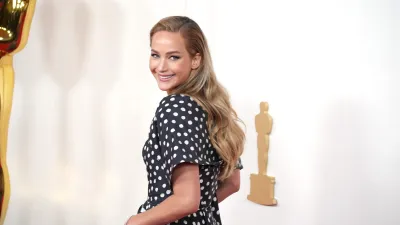
Jennifer Lawrence sure loves to wear airport-friendly loungewear, but the style can feel more relaxed than put together. At least, that’s what we thought until we saw the actress carrying around a luxe bag style while wearing a tee and sweatpants. The whole travel look appeared elevated and chic, so we went on a hunt […]
Zara-Style Tops
7. Our Favorite: Ruffles, pleats, crochet! This flowy babydoll top looks much more expensive than it is.
8. Runner-Up: This sleeveless sweater, otherwise known as a knit tank top, bridges the gap between warm and brisk weather like a champ.
6. Mock-Neck Maven: Sassy, stunning and secretly airy, this dressy mock-neck blouse checks every box and more.
9. Elevated Tee: Ribbed-knit material takes this comfy tee from casual to polished, so you can wear it with jeans, skirts and dress pants alike.
Zara-Style Pants and Skirts
10. Our Favorite: Silky satin fabric and polka dots come together in one epic skirt. This classy pick is a number one bestseller for a reason.
11. Runner-Up: Wide-leg pants has its merits, but rich moms reach for these straight-leg jeans for a more tailored look. We love that they come in petite sizes, too.
12. Secretly Stretchy: An elasticized back waistband makes these wide-leg dress pants as comfortable as they are professional.
13. Corporate Queen: Something between a skirt and trousers, this office-friendly pick belongs in any workwear rotation. It just dropped and is destined to sell out!
14. Trendy Trousers: When buttons feel like too much, opt for these breezy palazzo pants that deliver all of the style and none of the squeeze.
Zara-Style Cardigans and Layers
15. Our Favorite: Cool nights and chilly mornings call for this cropped utility jacket. It keeps you temperate without adding bulk.
16. Runner-Up: Swap your go-to cardigan for this classy blazer and feel like a CEO without even trying. According to shoppers, the fabric is exceptionally silky.
17. Nearly Half Off: This refined, ultra-lightweight cardigan is essential for grocery runs and in-office days. At only $20, we’re grabbing two colors.

As a fashion writer, this isn’t the first time I’ve covered the Nordstrom Anniversary Sale. However, it is the first time my jaw dropped to the floor when I saw these dresses from Reformation, Farm Rio, Treasure & Bond and more marked down to Black Friday-level lows. The Nordstrom Anniversary Sale is still going strong with […]
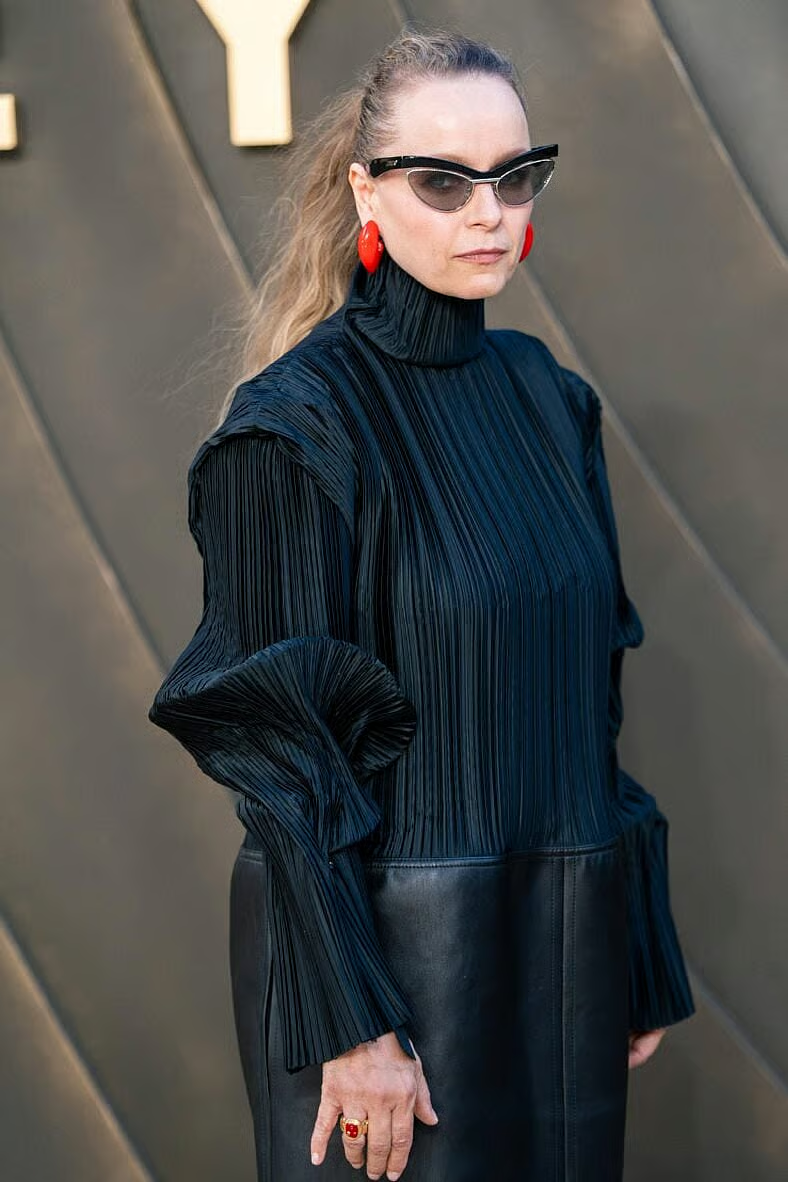
Samantha Morton‘s journey to the top was not smooth sailing!
The actress recently recalled the rough paths she went through from her younger days, with experiences that shaped the strong woman she is today. Her journey, leading up to landing the hit role on “The Odyssey,” has been an experience of a lifetime.
Samantha Morton was not born with a silver spoon, but through hard work, dedication, and experience, she has made a name for herself despite her background.

Morton revealed that her childhood was far from a bed of roses. The actress got candid about her parents’ struggles with different vices, which in turn affected her life as a child. The entertainer’s mother, Pamela, who died in 2017 from lung cancer, struggled with mental health issues.
Her father, Peter, who, on the other hand, passed away last year, battled with alcoholism. The combined effect of her parents’ issues landed Morton in the system. “I went pillar to post with foster families, homeless hostels, sleeping by the bins at the back of the Co-op,” she disclosed.
The state of affairs also had a personal effect on the English actress, shaping how she viewed life. “I have made choices that have always been about survival, because I watched my mum trying to survive and I watched my dad trying to survive,” Morton told The Sunday Times.
The 49-year-old movie star shared that she was described as “resilient” when she was younger, an attribute she gained from her life. To Morton, it was a no-brainer: you had to be resilient “because if you are not, you’re dead.”
The Actress Spent Her Teenage Years Being The Life Of The Party

Over a decade ago, the actress who plays the sorceress Circe in “The Odyssey” got candid about her upbringing, sharing that she lived between her parents’ separate homes until the age of eight, when she was placed as a “ward of court.” Her mom was a factory worker while her dad was a coal miner.
Being a ward of court means that a person is placed under the legal guardianship of the U.K. Court of Protection. Morton shared that she was abused as a child “by various people,” which made her form the view that “violence is irrational.”
The TV personality told The Guardian at the time that she moved between several foster parents and care homes before leaving school at the age of 13 to lead a different lifestyle.
The actress disclosed that she spent most of her early teenage years “raving, taking ecstasy and hallucinogenics with older children and young adults, lawless and lost.”
Morton revealed that she was homeless for almost a year as a young teen. She got by spending nights in bus shelters or at friends’ houses.
Samantha Morton Said Landing Circe In ‘The Odyssey’ Was A ‘Dream Job’

Morton is no newbie to screens and acting, but she has rarely been offered projects on the scale of the 2026 action-fantasy hit. She previously disclosed the surge of emotions she experienced when Christopher Nolan reached out to her about the part. “I got a phone call saying that Sir Christopher Nolan wanted to meet and I actually wept,” she shared.
After landing the role, the English actress decided not to research what Homer scholars have written about Circe over the years, but rather to get into character by living in the moment on set. Morton drew inspiration from the filming location and her Scottish roots.
Another key aspect of her personal life that seeped into the role was her experience with magic. Raised in the English foster-care system, Morton joined a drama group for working-class teens and even spent a summer as a magician’s assistant.
According to the Central Oregon Daily News, she was excited when she learned that Nolan would use practical effects such as puppetry and prosthetics during Circe’s spellbinding sequence. “It’s proper movie magic. It’s all in camera; what you see is real. So this was a dream job for me; I got to do all the things that I love,” Morton explained.
The TV Personality Continues To Work On Her Craft

Morton, in a recent interview with PEOPLE, shared that the opportunity to work with one of Hollywood’s giants changed her life. She praised Nolan for being a master of his craft, adding that even at her age, she feels privileged to learn from him and improve at her job.
“It was incredible, and for Christopher to give me that opportunity; I’m 49, and you don’t know that those roles are ever going to come your way again,” she said, expressing gratitude to the director for giving her the part. The iconic actress also added that the whole experience has become one stamped in her mind, which she would hold on to for the rest of her life.
For Nolan, Morton was not a choice but the choice. It was a classic case of opportunity meeting talent. The Oscar-winning filmmaker previously disclosed that he wanted Morton because of her talents and limitless performance. To ensure she was part of the project, he even built a filming schedule around her availability.
Inside Samantha Morton’s Trail To ‘The Odyssey’

The mom of three joined the Central Junior Television Workshop at 13 and made her first TV appearance in the 1991 series “Soldier Soldier”. She continued acting in a number of television series, such as “Band of Gold,” in which she starred as Tracy Richards from 1995 to 1996, and the miniseries “The History of Tom Jones, a Foundling.”
Morton voiced Ruby on the series “Max and Ruby” for over a decade, from 2002 to 2013, and has starred in several movies. She played the leading role, Iris, in the independent drama “Under the Skin,” which was on the list of British Best Films from 1984 to 2009.
The actress made her directorial debut in 2009 with “The Unloved” and won a BAFTA TV Award. She won a Golden Globe Award in 2008 and has been nominated for a Primetime Emmy Award. Having started as a young homeless teenager, Morton has risen to success and now has a net worth of $10 million, according to Celebrity Net Worth.
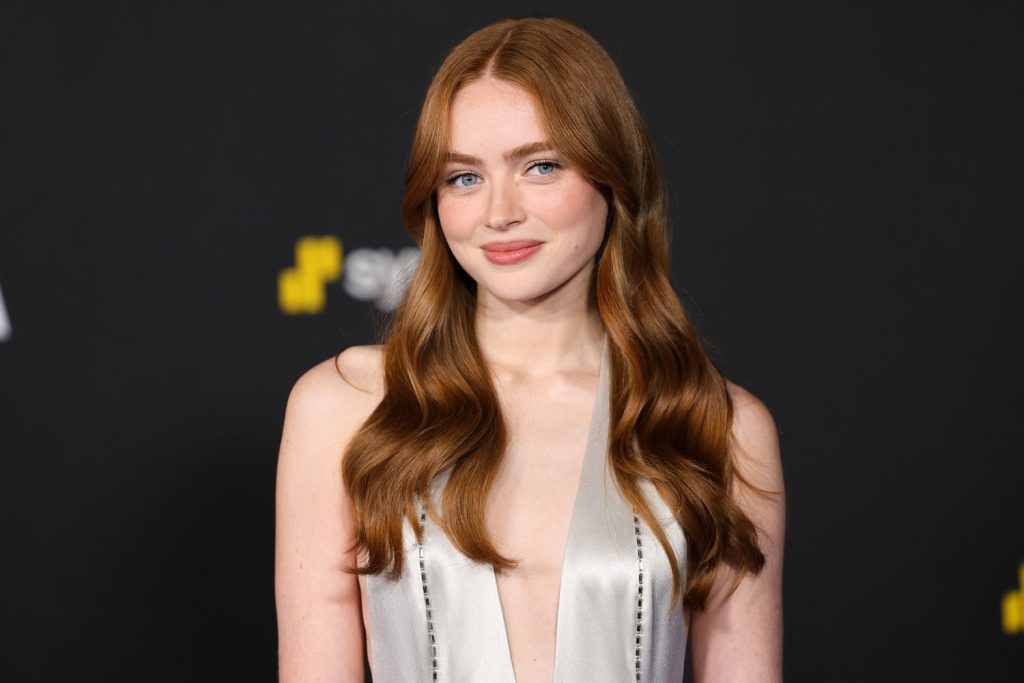
Spider-Man: Brand New Day has officially cemented its place in the history books.
After a record-breaking opening day, the latest Marvel Studios and Sony Pictures collaboration has delivered an astonishing $355 million domestic opening weekend, making it the second biggest opening weekend of all time, trailing only Avengers: Endgame‘s $357 million debut. Worldwide, the film has already soared to an incredible $927 million, instantly becoming the biggest launch of 2026.
The film’s massive debut is another milestone for Tom Holland, whose fourth solo Spider-Man outing has exceeded even the phenomenal opening of Spider-Man: No Way Home. It also reinforces Spider-Man’s status as one of Hollywood’s most reliable box office franchises during a time when many recent superhero films have struggled to attract audiences.

Credit : Brianna Bryson/WireImage
Directed by Destin Daniel Cretton, Brand New Day picks up after the events of No Way Home, following Peter Parker as he embraces life as a truly anonymous, street-level Spider-Man. The film also stars Zendaya, Sadie Sink, Jacob Batalon, Jon Bernthal, Mark Ruffalo, Michael Mando, and Tramell Tillman.
Internationally, the film has proven just as dominant. It earned $572 million overseas, including an impressive $121 million in China, where it posted the country’s biggest superhero opening in years.

Spider-Man: Brand New Day [credit: Marvel Studios]
The historic opening is especially significant given recent questions surrounding the superhero genre’s staying power. While several comic book films have underperformed over the past few years, Spider-Man: Brand New Day has demonstrated that audiences will still turn out in massive numbers when excitement, strong word of mouth, and a beloved character come together.
With overwhelmingly positive audience reactions and one of the strongest starts in cinematic history, the film is now positioned to become one of the highest-grossing movies of all time if it maintains momentum over the coming weeks.
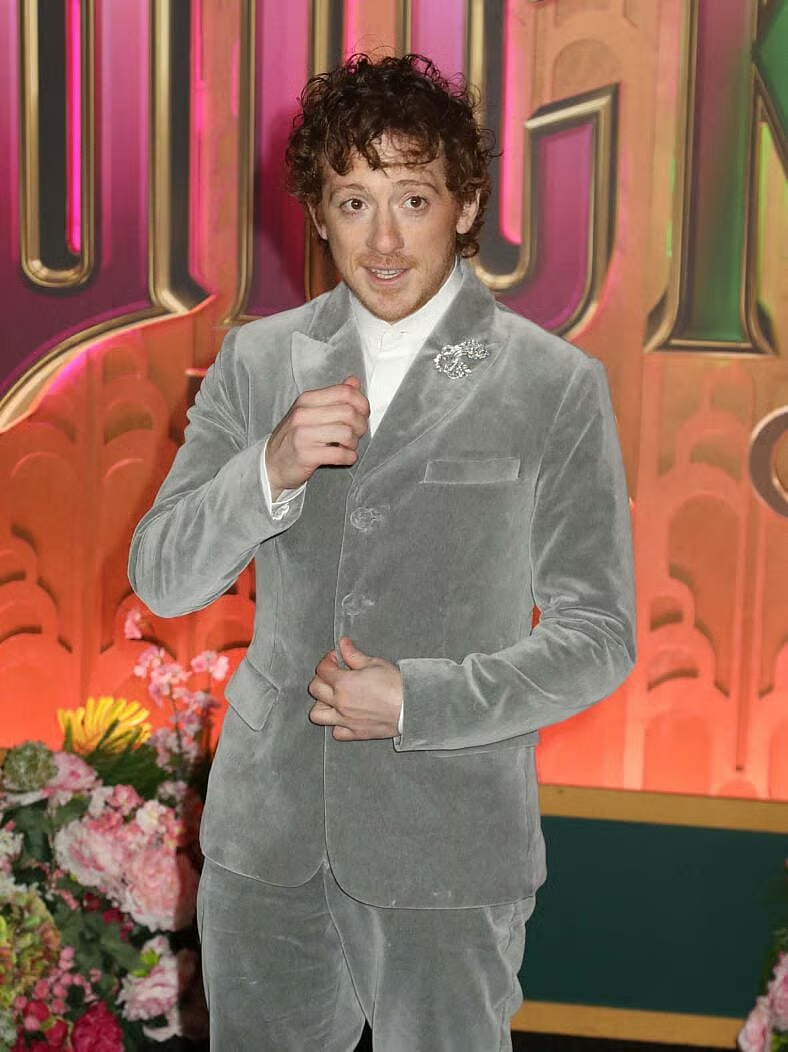
Ethan Slater’s breakup with Ariana Grande will not lead him back to his ex-wife, Lilly Jay, despite recent speculation surrounding their relationship. A source close to Jay has shut down rumors that the former spouses could be heading toward a romantic reconciliation following Slater’s split from his “Wicked” co-star. While Ethan Slater and Lilly Jay remain connected through their child, the insider emphasized that their current relationship is focused entirely on raising their family.

A source close to Jay told TMZ that she and Slater are “absolutely not” getting back together. The insider also denied that Slater is attempting to revive his marriage to the clinical psychologist following the end of his nearly three-year relationship with Grande. Instead, the former couple’s relationship is reportedly “strictly about coparenting.”
Slater and Jay were together for 11 years and married for nearly five before their relationship ended. Their divorce attracted considerable public attention after news of his romance with Grande emerged. The Broadway actor and pop star met while working together on the movie adaptation of “Wicked” in 2022.
Their relationship became public in July 2023, shortly after both stars separated from their respective spouses. Grande had previously been married to real estate agent Dalton Gomez.
Ariana Grande Reportedly Reconciles With Ricky Alvarez

The denial surrounding Slater and Jay comes shortly after reports that Grande has rekindled her romance with former boyfriend Ricky Alvarez.
Grande and Alvarez initially began dating after meeting in 2015, when he was working as a backup dancer during her Honeymoon Tour. Their original relationship lasted approximately one year.
The singer reportedly revealed that they had reconnected by changing lyrics and giving Alvarez affectionate shoutouts during performances of “Thank U, Next” on her current concert tour.
Ariana Grande Has Pushed Back Against Public Scrutiny

Grande’s relationships have remained the subject of intense interest throughout her career, something she directly confronted through her 2024 single “Yes, And?” In the song, the former Nickelodeon star pushed back against strangers commenting on her body and questioning her private relationships.
Grande has repeatedly made it clear that she does not believe the public is entitled to speculate about her appearance, health, or romantic choices simply because she has spent much of her life in the spotlight. That scrutiny intensified following the July 31 release of “Petal” and its accompanying music video.
Although the project generated attention for Grande’s music, some of the online conversation shifted toward her appearance and prompted unsupported speculation about her health. No diagnosis or medical information supporting those theories has been publicly disclosed.

Some social media users made extreme comparisons between Grande and deceased musicians Amy Winehouse and Karen Carpenter.
Meghan McCain joined the discussion on X by comparing the public reaction surrounding Grande to the scrutiny Winehouse received before her death in 2011. Another user shared an image of Carpenter alongside Grande and wrote, “This is singer Karen Carpenter, a month before she DIED of anorexia at only 32 years old.”
Carpenter died in 1983 at age 32 following complications associated with anorexia nervosa. However, comparing Grande’s appearance to Carpenter’s does not establish anything about Grande’s health.
Ariana Grande Plans To Step Away From The Spotlight

As the comments continue, one of Grande’s representatives told PEOPLE that the singer intends to reduce her public presence after completing her “Eternal Sunshine Tour.” Grande’s team framed the decision as a response to years of relentless attention surrounding her appearance and personal life. The “Wicked” star will be “taking a step back from visibility after she completes the Eternal Sunshine Tour,” her representative said.
“She looks forward to finishing the tour and ending it on a high note, both healthily and happily, and then taking a much-deserved break from public-facing work and appearances, which has led to endless, ongoing public scrutiny,” the rep added. “This tour has been a beautiful experience for her. She loves her fans and has loved every minute of this tour so much.”
The statement did not disclose any health diagnosis or indicate that Grande’s planned break was caused by a medical issue.
Spider-Man: Brand New Day has officially cemented its place in the history books.
After a record-breaking opening day, the latest Marvel Studios and Sony Pictures collaboration has delivered an astonishing $355 million domestic opening weekend, making it the second biggest opening weekend of all time, trailing only Avengers: Endgame‘s $357 million debut. Worldwide, the film has already soared to an incredible $927 million, instantly becoming the biggest launch of 2026.
The film’s massive debut is another milestone for Tom Holland, whose fourth solo Spider-Man outing has exceeded even the phenomenal opening of Spider-Man: No Way Home. It also reinforces Spider-Man’s status as one of Hollywood’s most reliable box office franchises during a time when many recent superhero films have struggled to attract audiences.
Credit : Brianna Bryson/WireImage
Directed by Destin Daniel Cretton, Brand New Day picks up after the events of No Way Home, following Peter Parker as he embraces life as a truly anonymous, street-level Spider-Man. The film also stars Zendaya, Sadie Sink, Jacob Batalon, Jon Bernthal, Mark Ruffalo, Michael Mando, and Tramell Tillman.
Internationally, the film has proven just as dominant. It earned $572 million overseas, including an impressive $121 million in China, where it posted the country’s biggest superhero opening in years.
Spider-Man: Brand New Day [credit: Marvel Studios]
The historic opening is especially significant given recent questions surrounding the superhero genre’s staying power. While several comic book films have underperformed over the past few years, Spider-Man: Brand New Day has demonstrated that audiences will still turn out in massive numbers when excitement, strong word of mouth, and a beloved character come together.
With overwhelmingly positive audience reactions and one of the strongest starts in cinematic history, the film is now positioned to become one of the highest-grossing movies of all time if it maintains momentum over the coming weeks.
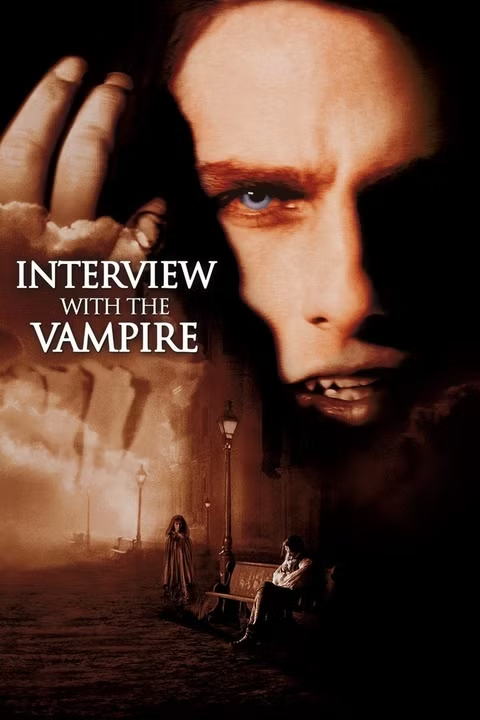
It’s hard for many people to remember that, before he was Tom Cruise, the President of Movies and Action Icon, he was actually Tom Cruise, character actor. Yes, it’s true, Cruise often took roles because of their depth and complexity, similar to those taken on by the likes of Leonardo DiCaprio or Timothée Chalamet and one of those roles is proving to be as immortal as the haunting vampire Lestat de Lioncourt himself, with a return to that world imminent.
Warner Bros. Home Entertainment has officially announced that Interview with the Vampire will receive a brand-new 4K Ultra HD Blu-ray release on September 22, complete with a standard edition and a limited-edition SteelBook. The release features a new 4K restoration, Dolby Vision HDR, Dolby Atmos audio, and a collection of brand-new bonus features celebrating the beloved gothic horror classic.
The film, which was directed by Neil Jordan and adapted from the bestselling novel by Anne Rice, follows a wealthy plantation owner, Louis de Pointe du Lac, in 18th century Louisiana who is transformed into a vampire by Lestat but, unable to come to terms with the fact he now has to feast on humans to survive, spends centuries dealing with his guilt while Lestat… doesn’t. So to keep Louis from bailing, Lestat turns a dying young girl named Claudia into a vampire and, although she remains physically a child forever, her mind grows up, which creates a truly horrific dynamic.
The new 4K edition includes two newly produced featurettes, Eternal Night and Deadly Light and Interview with the Vampire: Creating the World, alongside Neil Jordan’s audio commentary, the In the Shadow of the Vampire documentary, deleted scenes, and more.
Who Stars in ‘Interview With The Vampire’?
Alongside Cruise, the movie stars Brad Pitt (F1) as Louis de Pointe du Lac, Christian Slater (Mr. Robot) as Daniel Molloy, a scene stealing and immensely precocious Kirsten Dunst (Civil War) as Claudia, Antonio Banderas (Babygirl) as Armand and Stephen Rea (The Crying Game) as Santiago.
The film was an immense commercial success, grossing $223.7 million worldwide against a budget of around $60 million. It became one of Warner Bros.’ biggest hits of 1994 and was among the highest-grossing horror films of its era. Critically, the response was more mixed, with Rotten Tomatoes listing a score of 63% from critics, while audience satisfaction was somewhat higher at 86%. Over the years, however, its reputation has grown considerably, as it’s now widely regarded as one of the defining vampire films of the modern era and one of the strongest literary adaptations of Anne Rice’s work.
Interview with the Vampire arrives on 4K Ultra HD Blu-ray and limited-edition SteelBook on September 22.

- Release Date
-
November 11, 1994
- Runtime
-
123 minutes
- Director
-
Neil Jordan
- Writers
-
Anne Rice
- Producers
-
David Geffen
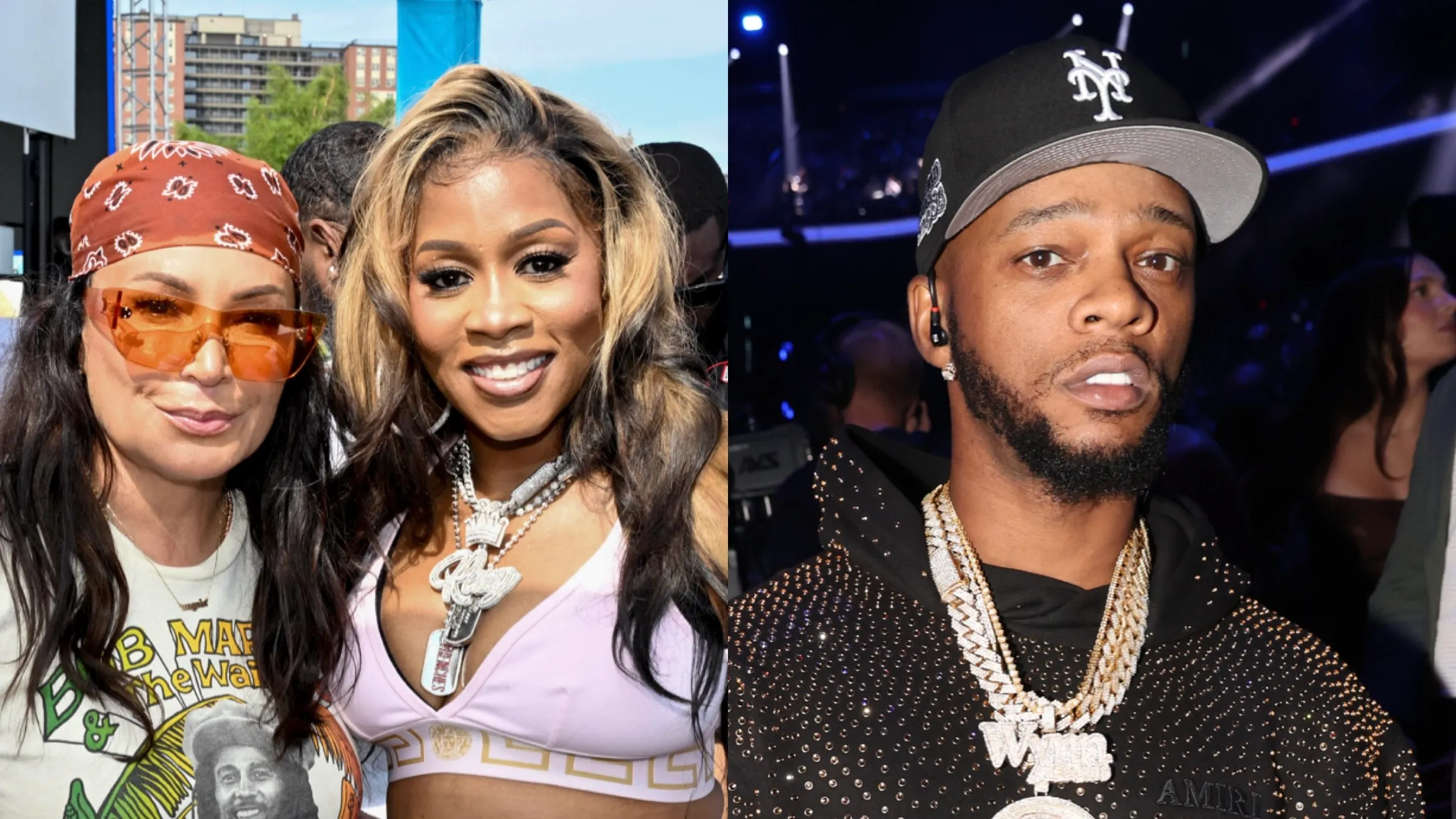
Internet users seem to believe that Remy Ma threw shots at Papoose during her recent performance at Angie Martinez‘s Summer BBQ.
RELATED: Recent Flicks Of Claressa Shields Have Internet Users Saying She’s “Copying” Remy Ma’s Aesthetic (PHOTOS)
More On Remy Ma’s Recent Performance At Angie Martinez’s Summer BBQ
Angie Martinez’s Summer BBQ went down at Paradise Coney Island on Sunday, August 2. Furthermore, the festival event was headlined by Buju Banton, French Montana, Coi Leray, Zeddy Will, and Remy Ma. Furthermore, when Remy took the stage, she performed her single, ‘W.Y.F.L.’ The song, in which she notably raps, “The nerve of n****s, claiming that they wrote those hits/ When they whole career they ain’t never ghost wrotе s**t/ Not for me or anybody else/ You always acting likе you help a n***a, go help yourself,” appeared to have a switch up when Remy rapped the lyrics on stage.
RELATED: You Good? Claressa Shields Speaks Out After Fans Question Why Papoose Wasn’t Smiling When They Walked Out At BET Awards (VIDEO)
Ultimately, social media users speculated that she inserted Papoose’s name, switching the lyrics to:
“You always acting likе you helped. Pap, n***a, go help yourself.”
Watch the NSFW clip by clicking here.
Internet Users Think Remy Ma Threw Shots At Papoose During Her Performance At Angie Martinez’s Summer BBQ
Social media users took their speculations to @livebitez’s comment section on Instagram.
Instagram user @vickiirvin wrote, “She said she was gonna drag him whenever ole girl talks about her. 💁🏽♀️”
While Instagram user @shesuskhrystfan added, “Y’all madddddd 🤣🤣🤣🤣🤣 Pap help yourself”
Instagram user @justm0nique wrote, “Yep sis said everything your current come up mention me… CS went on the interview talking about them ppl marriage, sis your married bf aint even talking about his marriage..”
While Instagram user @pureskin_raina added, “Well she did say every time his woman bring her name up she was going to drag him”
Instagram user @ravensoleil wrote, “Remy… you cheated…. Remy… you walked around around with that battle rapper dude proudly… now you back single… you going at Pap?!?! Girl just live ya life, and move on”
While Instagram user @halimah_sincerely added, “I’m sorry but trying to down your child father NOBODY WINS😢”
Instagram user @_thats_mel wrote, “That lady was quiet for months and they kept bringing her up so now it’s her turn it’s a problem!!! Drag on @remyma”
While Instagram user @_godzfavor_ added, “I like Remy, but what’s really going own, she acting like a bitter baby momma, they been separated a while now and I never hear Pap mentioning her. I’m sure she got a dude/man, so why she won’t let it go. She got clout she don’t need to do all this 🤦🏽♀️”
Instagram user @xhibit_a_ wrote, “Exactly. Papoose claims to be this great ghost writer, but doesn’t have not even one hit record under his belt.💯”
The Rapper Was Subtly Discussed During A Recent Claressa Shields Interview
At this time, Remy Ma has not publicly clarified if she indeed mentioned or referred to Papoose as many internet users think. But if she did, her mention of her ex appears to arrive on the heels of his current girlfriend, Claressa Shields, sitting down for a recent interview. As The Shade Room previously reported, Shields stopped by Streetz 94.5 FM in Atlanta last month. During the conversation, she was asked about being in a relationship with “somebody’s husband.”
In response, Shields noted that Papoose allegedly filed for divorce from Remy Ma. Additionally, she noted that Remy should also be held “accountable for what she’s doing in her life.”
Subsequently, Shields had apparent words to share for the interviewer and others criticizing her romance.
RELATED: Not The One! Claressa Shields Sends Heated Message After Interview Had Fans Side-Eyeing (PHOTO)
What Do You Think Roomies?
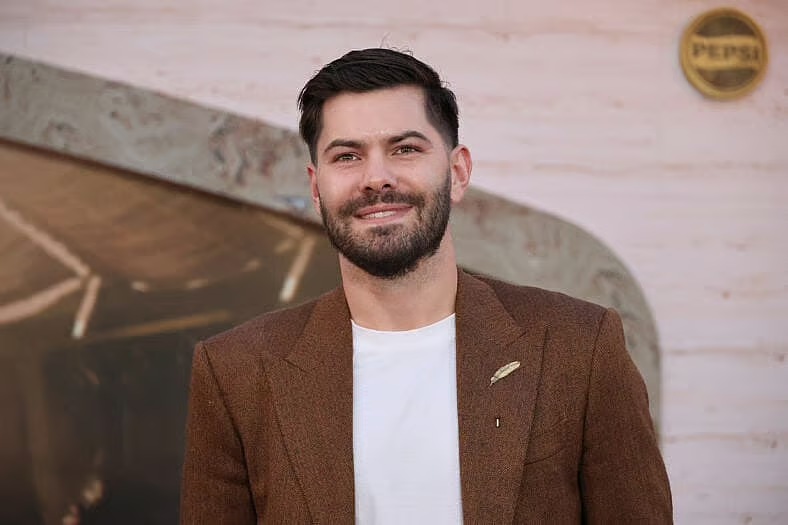
“Bachelor in Paradise” alum Joe Amabile is reportedly staying active and maintaining a positive outlook as he prepares to undergo brain surgery. The 40-year-old reality star revealed in July that doctors discovered a blueberry-sized lesion on his brain that appeared to be a glioma. He is now scheduled to have it removed and tested. As Joe Amabile’s surgery approaches, fellow Bachelor Nation star Dylan Barbour has offered an encouraging update about his close friend’s condition.

Barbour recently spent time with Amabile in the Hamptons and told Us Weekly that the “Click Bait” podcast alum appeared to be doing well despite the health ordeal. “I just saw Joe in the Hamptons,” Barbour shared, adding that “he’s doing well.”
“It’s good to see him. Good to spend time with him. I talk to him weekly,” the 32-year-old continued.
Although Amabile has been able to maintain his regular routine, Barbour acknowledged the uncertainty surrounding the upcoming operation. “Surgery is coming up, but we’re praying for him. Obviously, my whole family is thinking about him,” he said.
Barbour also reflected on the friendship their families have developed away from the cameras. “Joe’s the best. We spent summers together at our lake house. We went to the Hamptons. Him and Serena [Pitt] couldn’t be better people,” he said, referring to Joe’s wife, whom he met through Bachelor Nation. “I’m hoping for the best.”
Joe Amabile Revealed Doctors Found A Brain Lesion

Amabile disclosed his diagnosis to his nearly one million Instagram followers after undergoing a full-body Prenuvo scan. The television personality explained that the scan revealed something concerning, prompting doctors to order an MRI for a closer look. “I didn’t share my Prenuvo results because they ended up finding a lesion on my brain, so then I had to go get a brain MRI, and there was a blueberry-size lesion in my brain that looks to be a glioma, which is a tumor,” he said.
Amabile emphasized that the lesion still needs to be removed and tested before he knows more about his condition. “So I now need to get brain surgery to get it removed and get it tested, and then we’re gonna go from there. So it’s been a wild couple weeks. Definitely wasn’t expecting this,” he continued.
The unexpected discovery forced Amabile to confront a medical situation he never imagined experiencing himself. “I think it’s one of those things where you’re like, ‘Oh, something like this [will] never happen to me,’ and here I am,” he admitted.
‘Bachelor In Paradise’ Star Remains Hopeful

Despite the uncertainty, Amabile said doctors believe the tumor was found in its early stages. “They say it’s really early stages. I hope they are able to get it all, and I’m fine. But I will keep you updated,” he told his followers.
Barbour said Amabile has continued taking care of himself while waiting for the procedure. “He’s healthy, working out, eating well,” the reality star shared.
Amabile also acknowledged that he initially struggled with how much of the experience he wanted to discuss publicly. He ultimately decided to be open because the diagnosis had become an unavoidable part of his life.
“I’m doing my best to stay positive during this time and am lucky to have a lot of support from family and friends,” he wrote. “I’ve gone back and forth about what I wanted to share on social media, but ultimately this is now part of my life, so might as well. Onto a new journey.”
Serena Pitt Prepares For Her Husband’s Recovery

Amabile’s wife, Serena Pitt, has been preparing their home and gathering supplies to make his recovery as comfortable as possible. The couple met during the seventh season of “Bachelor in Paradise” and tied the knot in 2022.
With the surgery approaching, Pitt turned to her Instagram followers for advice from anyone who had either undergone brain surgery or cared for someone during recovery. “It’s hard to believe we’re only about a week away from Joe’s surgery. I’m in full prep mode, trying to think of everything that might make his recovery as comfortable as possible and help us feel a little more prepared for the weeks ahead,” she wrote.
Pitt admitted that she wanted to ensure she had considered anything her husband might need once he returned home. “If you’ve been through brain surgery yourself or cared for someone who has, I’d be so grateful for any recommendations, must-have recovery items, or things that made the recovery process a little easier,” she added.
Bachelor Nation Faced A Different Crisis Earlier This Year

Amabile’s health battle comes during an eventful year for Bachelor Nation, which also saw ABC abruptly cancel Taylor Frankie Paul’s fully filmed season of “The Bachelorette” just three days before its scheduled premiere.
The network pulled the season after TMZ published footage from a 2023 incident involving Paul and her former boyfriend, Dakota Mortensen. The video reportedly showed Paul punching and kicking Mortensen and throwing metal bar stools as a young child cried nearby.
Disney and ABC subsequently said their focus was on supporting the family. The cancellation marked a dramatic reversal for the franchise, as “The Secret Lives of Mormon Wives” star had been selected as its first Bachelorette from outside the traditional “Bachelor” universe.
Paul was arrested following the 2023 incident and later entered a plea in abeyance to aggravated assault. The remaining domestic violence and child presence charges were dismissed.
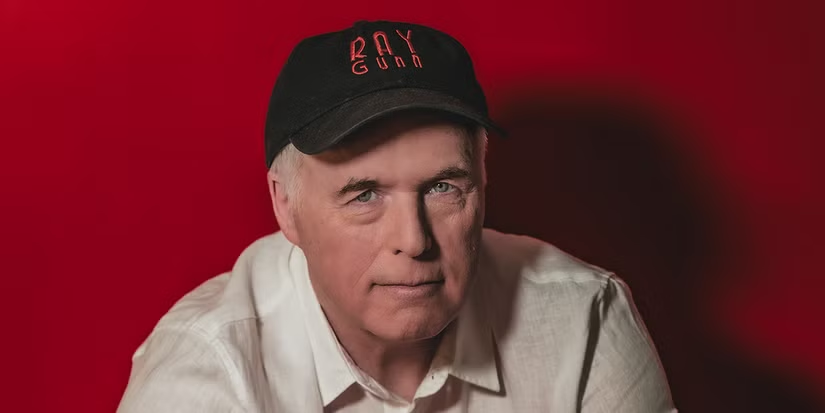
Summary
- Collider’s Steven Weintraub moderates “Brad Bird: My Cinematic Journey” panel at SDCC 2026.
- Brad Bird discusses his career over the years, working with Disney legends and sharing stories from past projects.
- He also discusses his newest upcoming movie on Netflix, Ray Gunn.
Brad Bird doesn’t make movies very often, which makes every new project feel like an event. Over the last three decades, Bird has built one of the most remarkable careers in Hollywood, directing classics like The Iron Giant, The Incredibles, Ratatouille, and Mission: Impossible – Ghost Protocol. Now, after years of false starts and development hurdles, he’s finally bringing one of his longest-gestating passion projects to the screen with Ray Gunn, a retro-futuristic sci-fi noir that premieres on Netflix later this year.
During Collider’s live panel at San Diego Comic-Con, Steve Weintraub sat down with Bird for a conversation where the two shared in discussing the amazing history of Bird’s achievements in cinema. Bird reflected on the advice Disney animation legend Milt Kahl gave him that still shapes every project he tackles, explained why The Iron Giant found its audience years after its theatrical release, shared the surprising way Syndrome emerged as the villain of The Incredibles, and looked back on taking over Ratatouille after Pixar asked him to step in midway through production.
Of course, Ray Gunn was never far from the conversation. Bird opened up about why the movie spent decades waiting for the right opportunity, how he and composer Michael Giacchino developed its emotional and musical identity, and why audiences should expect a world packed with enough visual detail to reward repeat viewings. He also offered updates on Incredibles 3, discussed the passion project he’s carried with him for decades, reflected on making the leap to live action with Mission: Impossible – Ghost Protocol, and teased what could be next after Ray Gunn.
Brad Bird Explains the Advice That Shaped His Career
“If you’re approaching something, explore the possibilities.”

COLLIDER: I have a million questions for you. I wish this panel could go three hours. Before we get started, thanks to my friend Jeff, who is an amazing editor, we have a little sizzle reel celebrating Brad’s career. I don’t think you’ve seen this, so let’s play it.
[Clips from Bird’s movies, including Tomorrowland, The Iron Giant, The Incredibles, Mission: Impossible – Ghost Protocol, Ratatouille, and other projects.]
I’m making sure you’re okay with that.
BRAD BIRD: Oh yeah. I’ve been… sizzled.
You were mentored by Disney Legend Milt Kahl. What’s one piece of advice from him that you still hear in your head whenever you’re working?
BIRD: He had this very intense kind of stammer that would happen, and he swore a little more than you’d probably expect from someone at Disney. He’d say, “Well… you didn’t even explore the possibilities.” That’s what it is. If you’re approaching something, explore the possibilities.
Family Dog felt radically different from a lot of the television animation being made at the time. What were you trying to prove with that project?
BIRD: Just that it wouldn’t be insane to let me make a film. That would’ve been nice. No, really, I always felt great sympathy for dogs because they don’t choose their family. They’re just kind of plopped down in the middle of one. I thought, “What if you had a family that was kind of a nightmare, and the dog was just wide open to all of it?” It seemed like a funny thing to do.
I’m sure a lot of you know this already, but Brad worked on The Simpsons early on. What did working on The Simpsons teach you about making a scene funny visually instead of relying entirely on dialogue?
BIRD: Well, it was interesting because the writers were the best. But sometimes they’d write things that made perfect sense on the page and were really difficult to convey visually. That became a real challenge. And in order to meet the schedule The Simpsons had, which was incredibly intense, you were always working on the next thing, and the next thing, and the next thing. You had to make decisions fast. If I hadn’t gone through that experience, I wouldn’t have been able to make the movies I eventually made, many of which were produced under a lot of pressure. Television doesn’t let you stop because there’s always another episode coming. It’s like that famous I Love Lucy scene with the conveyor belt full of candy. If you hesitate on one decision, a million more decisions start piling up behind it.
Why ‘The Iron Giant’ Became a Cult Classic Years After Release
“What if a gun had a soul… and didn’t want to be a gun?”
Let’s jump into something called The Iron Giant. The Iron Giant has become more beloved every single year. Why do you think it initially took audiences some time to discover it?
BIRD: I think there’s this thing called marketing that if you don’t do it… it really hurts your film. So I was very happy that my next project, The Incredibles, actually got marketed. It made a difference. But I can’t really complain because people eventually caught up with The Iron Giant. For a couple of years, they ran it on television all day around Thanksgiving, almost 24 hours straight, over and over again. And I think that that was the thing that kind of broke through is that people ran into it that hadn’t seen it before.
How difficult was it to persuade a studio that an animated movie could deal seriously with fear, death, weapons, and personal choice?
BIRD: Well, I would love to say, “They just didn’t get it, man.” But they did get the pitch when I came in there. I had read the book, which I thought was really poetic, but about halfway through the book, it becomes a contest between the Iron Giant and this space pack the size of Australia. And they fly back and forth into the sun, essentially.
I felt the real story was between the boy and the Giant. But when I came back and said, “I like this a lot, but I want to do something different.” I said, “What if a gun had a soul… and didn’t want to be a gun?” To their credit, the people running the studio at the time, that got them and they reacted to it and they were taken by it. That’s not exactly the usual subject matter for an animated film.
Brad Bird Reveals How Syndrome Changed ‘The Incredibles’ Forever
“That’s a good angle for a villain, to be kind of spurned at being a sidekick.”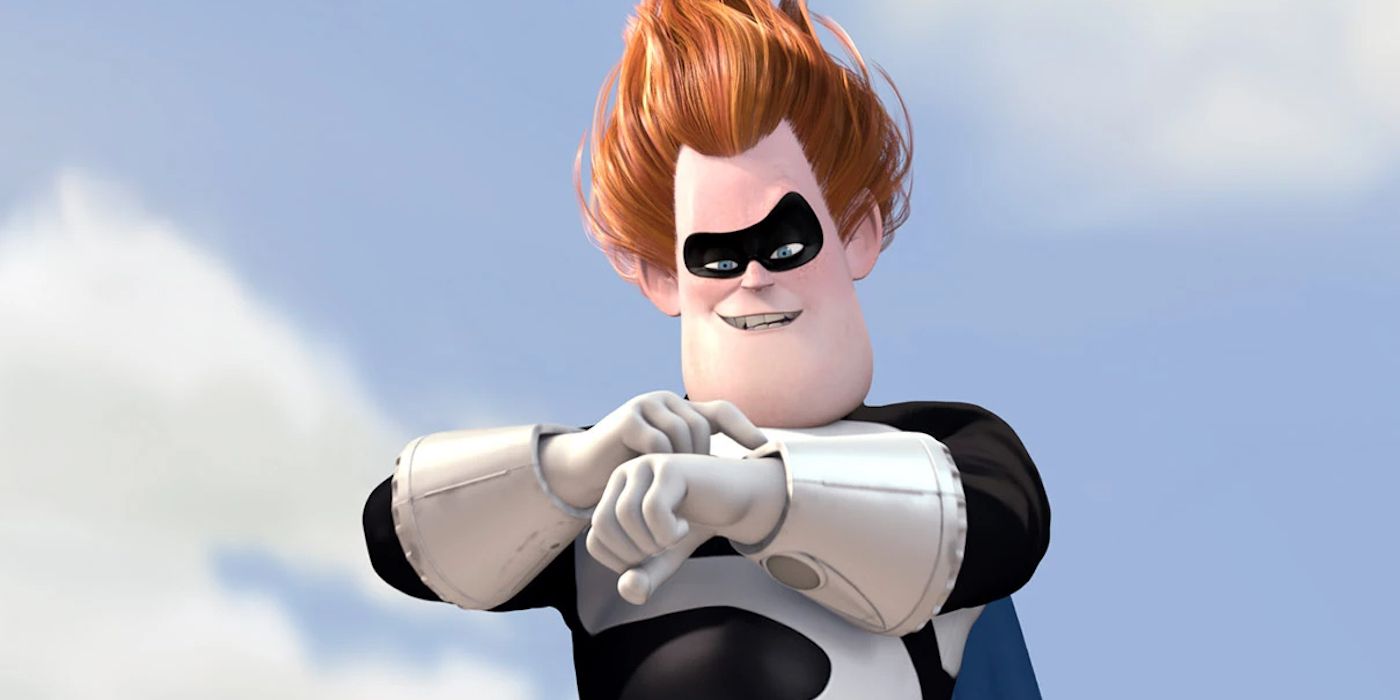
Jumping into The Incredibles… Pixar’s early films leaned on cute characters. The Incredibles was your first attempt at photorealistic human characters in CG. How much resistance did you get to making that pivot?
BIRD: Well, I wouldn’t call them photorealistic because Bob’s hands are the size of trees and his feet are tiny. They’re very caricatured. But there weren’t many successful examples of human characters in computer animation back then. There were a lot of… disturbing versions. Pixar even did a short called Tin Toy that had this nightmare baby in it. Everybody who worked on it agrees the baby was kind of terrifying. There was really only one great example at the time, and that was Jan Pinkava’s short Geri’s Game, which won the Academy Award.
I was convinced you could create compelling, stylized human characters and still make them very believable. His old man that plays chess against himself later showed up in Toy Story 2, and really worked well. So it made me feel assured that we weren’t insane to try to make a movie that only had humans in it.
When you think back on making The Incredibles, how radically did anything change in that film? Because I know that with animation and at Pixar, things can go through huge changes. Did the film go through any massive changes?
BIRD: Not massive. One thing that was an exercise that yielded good results was the studio asked, “What would happen if the audience met the family first in their civilian identities and only later discovered they were superheroes?” And I kind of argued with this a little bit. I said, “Look, you’re going to have ads at that point. Everyone knows that the characters are going to be superheroes. So what are we doing?” And they said, “No, it’s a good exercise. Try it.”
So I wrote an opening that had them just going underground. Violet was still a baby, and they were just going underground under the witness protection program. Then they’re discovered, and villains start tracking them down in their civilian lives to get revenge. And part of the thing is, villains were coming trying to find them in civilian, to wreak revenge on them. So I had this villain show up that was Syndrome, and he died in the opening sequence. Everyone, including me, liked him better than the villain I had. And so they went back to my original pitch, which was to show them in the golden era, and then jump 15 years and show them an unfulfilled child, but with that character driving the villain plot.
There was this autobiography of Burt Ward, who played Robin in the TV 60s version of Batman. And he kind of said, “I got more chicks than Adam West.” And I sensed some kind of dark resentment from the Boy Wonder, and I thought, “That’s a good angle for a villain, to be kind of spurned at being a sidekick.” So, even though I didn’t use that opening, I got the villain, and I got a good reason for the villain out of it. Everything else kind of stayed much the same. But the villain changed and he was a much better villain.
Coming from traditional animation and a feature like The Iron Giant, how did you adapt your directing style to Pixar’s more collaborative, Braintrust driven process?
BIRD: Well, you know… If you argue against notes all the time, you get a reputation as being difficult. And the thing is, they were shocked when I took notes. They were like, “He took the notes! He didn’t mind the notes!” I don’t mind notes if they’re not stupid. If you want me to do something that I think is stupid, I’m going to speak up. So, the notes that came out of the Braintrust. A lot of them were really smart notes by people who have been in my position or are writers or something and problem-solving in that arena. And so it was good to go through that process. And when I moved up to Pixar after Iron Giant, a lot of people on the crew were like, “Man, you’re selling out to computer animation,” and I said, “I’m not going up there to be part of computer animation. I’m going up there because they protect stories. They make an environment where you can grow a good story and they poke at it. They demand something out of it, but it’s good and healthy.”
Taking Over ‘Ratatouille’ and Rewriting Pixar History
“Is daddy going to lose his job?”

Now I want to bring up one of my all-time favorite films… Ratatouille. I heard a story from another reporter that after finishing The Incredibles, you were finally on vacation when Pixar asked you to come back and take over Ratatouille. Supposedly, they wanted you because you’d given the best notes during one of the story screenings. Is that true?
BIRD: Somewhat. I can’t say they were the best notes or not, but here’s what happened from my perspective. I’d gone to all of the Ratatouille Braintrust meetings while I was making The Incredibles. Then in the last six months to a year, they let you kind of step back from those meetings in order to finish a film. And so I stopped going to the Brain. I made my last notes on Ratatouille, and I stopped going to the Braintrust meetings to finish the film. And so you do the film, you get that released, then it’s award season. You do that whole thing and then it was a big deal back then to do the Blu-ray release. And so it was one thing after another. And you’re promoting, promoting, promoting, promoting. And I hadn’t seen the film in a while, so I came back into it, to my first note session, and I’ve been away from it for a year. So my mind was frozen in time for the solutions that were given at that thing.
And John was doing Cars, and right at the intense finishing point of Cars, and Andrew Stanton was doing the first boards for Wall-E. So they were both completely absorbed in that. So they were kind of a little more easygoing on it, and I was a fresh horse. So if something was not where I thought it was headed, I’d say, “Well, what happened to this and what happened to that?” And so I was a little more aggressive about what needed to happen. And, the next day, this film got screened within Pixar for the executive team, which was like Steve Jobs and some other people and their problems were the problems that I had enumerated the day before. So I think they felt like I was on some common ground with them.
And they did get me on vacation, and I really wanted that vacation. Steve called and we talked for a bit, and I had worked with them a couple of weeks on tweaking the story. And he said, “How’d it go? And I said, “I think it went kind of well, I think they’re in good shape.” And then the next day I got a call from Ed Catmull, and we were driving around with the family, and they said, “You can pull over.” And so we pulled over, the family gets out of the car. And apparently, my youngest son said, “Is daddy going to lose his job?” And my wife said, “I think it’s the opposite.” And so that’s what happened. They invited me on board and there it is.
What state was the movie actually in when you came aboard? How much of it had already been completed?
BIRD: Two complete versions, meaning the whole story beginning to end with storyboards and recorded sound.They had gone out to some actors and a lot of the choices that they had made, I agreed with. Ian Holm was in there, and I thought Ian Holm was perfect. Brian Dennehy was in there, and I thought Brian Dennehy was perfect. They used Lou Romano, he was a scratch voice that they all liked, and he was the art director on Incredibles. He played Linguini, and Pete Sohn did the voice of Emile, and he’s directing Incredibles 3, so… Anyway, those I agreed with.
They didn’t have a voice for Remy. They had another actor, I won’t say who it is, but they had recorded some stuff with him and I didn’t connect with that. And I pitched Patton, and I felt like Patton was perfect. And the other one was they had signed an actor that I think is very good, but he wasn’t what I pictured for Ego. When it became my problem to make the film, I heard Peter O’Toole, and it was just like nobody else. It’s got to be Peter O’Toole. And thankfully he said yes.
Bird’s Dream Project That Still Hasn’t Happened
“I’d buy popcorn to watch that.”

I think we actually have a video question that’s been sent in from a fan.
Patton Oswalt: I have a question for you, Brad. Have you ever thought of doing episodic TV, maybe even a mini series? Your worlds are so rich and so detailed, I would love to see how your storytelling would evolve and adapt to multi-episode form. That would be something to see. Is that in our future? And also… Ratatouille 2.
BIRD: Actually, yeah. I have a project that, it’s kind of it’s hard to explain, but it would lend itself to multiple episodes, and it has to do with the 1906 earthquake in San Francisco.
You’ve been talking about 1906 for a long time.
BIRD: Yeah. And there’s a lot of B.S. on that on the internet about the reasons it didn’t happen. They said that it was because the budget went out of control or something like that. We never got that far. I mean, the problem with it is the more you research that time, the more amazing it is. And the stories that are happening are insane. And the deeper I dug, the more stuff I was like, “This has to be in it.” And it has to be big, like a movie. It can’t just be this little thing. So, it was kind of like, you’re packing up stuff for a balloon, and you’ve got everything you want in the balloon, right? You now you got everything there, and you go, “Okay, let’s go.” And it doesn’t lift off. So you start chucking stuff out of the balloon and, “Oh. I love that. Oh no.”
And pretty soon you’re starting to get lift off. And now you’re getting lift off, but all the stuff that you love is on the ground. It’s not you’re going away from it you know. So that’s what it was like. And I still am very interested in that story, but it has to be in a way that simultaneously exploits the detail of successive episodes and the size of a giant movie.
If you were to make this on television, do you envision this as a limited series that’s six episodes, eight episodes? Or is this a few season type of story?
BIRD: It’s probably like eight episodes. It’s got the greatest build ever. I mean, it’s not just the earthquake, it’s the fire after the earthquake. People remember the earthquake, but the fire that followed was every bit as devastating. History books describe literal tornadoes of fire. The heat generated winds so powerful they reached gale force. I’d buy popcorn to watch that.
Anton Ego’s final review is one of Pixar’s most memorable scenes. How difficult was that speech to write, and when did you realize people absolutely loved that moment?
BIRD: Well, it was a really bizarre thing. I got to that point in the movie and we had to go. I mean, I didn’t even record that early on. I didn’t even go scratch. I just would write a line and give it to the actors, and we did it. I mean, there was no hesitation because it was so far behind. But when I got to that part of the movie, they had some stuff planned in earlier versions where all the critics of Paris are at this table and they’re all toasting Remy. And even though the movie is not remotely realistic, I didn’t believe that for a second. It seemed like, “No, he would ask to see the chef and they wouldn’t want to show him the chef, so maybe make everybody leave.” When I had the idea of the review, it was anti everything a summer movie is supposed to do and especially animation, you’re supposed to get faster and louder and I got slower and quieter. And when I pitched the idea to the powers that be, I said, “I don’t know why, but I think this should be the ending when he reads this review and it’s kind of soul searching.”
Again, it’s against everything that you’re supposed to do from the standard playbook. But they kind of went, “Yeah, that feels right.” And I had, really great secret weapon. And that’s when Michael was doing the music. He wrote a suite and he wrote it for the orchestra just to do one take so that he could hear it. It wasn’t the version that was going to be in the film. It was soaring, you know, dah dah dah dah dah dah dah dah dah, you know, and he did it. And it was big and it’s romantic. And he kind of goes, “It’s too romantic, you know what you need? We’ll do it, but we’ll play with it and tone it down a little bit.” But I had that on a recording. One take of that super romantic version, and I put on my voice with a bad British accent reading that scene and the secret weapon was his romantic music.
The romantic version of it was perfect, and it ended up being the thing. I think that helped sell the idea. And, I was rewriting it all the way up until the time recorded. I rewrote it on the plane like three times on the plane. Then I landed, went to the hotel and wrote it two more times. just trying to get it to be right. And, I couldn’t have asked for a better person to enact it than Peter O’Toole. I mean, you know, that was like fantasy stuff.
That scene is literally perfect.
BIRD: Oh, thanks.
Why Tom Cruise Convinced Brad Bird to Direct ‘Mission: Impossible – Ghost Protocol’
The fourth Mission: Impossible movie was Brad Bird’s live-action debut.
By the way, I’m not alone on this. That scene is amazing. So then you jumped into this, something called Mission Impossible: Ghost Protocol. What made Mission Impossible the right project for you for your live action debut?
BIRD: Well, again, I was trying to do 1906, and it just was… The more I tried to do it, the more it became too big. And finally I realized that I don’t want my headstone to be “He tried to make 1906,” so I looked around for things to do that were already ready to go. Tom Cruise had seen Incredibles and invited me over to his house, and we had this amazing two-hour, three-hour talk just about movies. And his knowledge is extensive, and we had a very good time. And he said, “Look, if you ever want to do live action, I’d love to do something with you.” So that popped up. And of all the things, you know, I love spy movies. And that was a chance to do a spy movie with Tom Cruise. So how do you say no to that?
What was your reaction when you’re filming, and Tom is doing the stunts? I mean, they’re insane. What was it like for you, though, when he’s doing some of that stuff? Because it has to be scary.
BIRD: Yeah. I mean, we were doing it, and we were prepping it, and he was practicing being on the building with this climbing expert who was out there. And we were just kind of hanging around and talking while he’s out there. And suddenly I hear, “Woo!” And I see him go outside the window swinging past, and then I hear a crash, and I’m like, “No, he’s dead. The star is dead.” And then I hear him laughing like, “I screwed that one up!”
So we were filming that stuff, and we were originally thinking we might only get a few shots in IMax, like maybe two or three, and we’d just do the rest with special effects. So we had to bash out these giant windows in double pane windows, and they were like, “Okay, but only three. And you got to put them back exactly like they were.” And we’re like, “Okay, we’ll do it.” So we start doing it, and we go, “Yeah, we could probably get that shot over here.” And pretty soon it’s 37 windows we’re shattering, and we shot everything on the building. The only ones we didn’t do on the buildings were ones that were looking up, because you can do that on a piece of anything, but anything that’s wide or looking down or anything like that. All that stuff is real.
There was one time when we were filming it, and I was dead asleep in my hotel, and it was like four in the morning, and suddenly I realized my star is swinging around on this little wire a mile up into the air. And what am I doing? This is insane. But, he’s the producer, so you can’t tell him no.
Brad Bird Explains Why ‘Ray Gunn’ Took More Than 30 Years to Reach the Screen
“I’ve been waiting for it for 30 years.”

Jumping into your newest project, Ray Gunn. For people who are just hearing about Ray Gunn for the first time here at Comic-Con, what do you want to tell people about the movie?
BIRD: Well, the elevator pitch would be it’s Buck Rogers meets the Maltese Falcon. So it’s desperate characters and sort of an alternate future. And it’s kind of hard to explain, especially because it’s a mystery. You don’t want to give anything up. Why don’t we just show the first seven minutes?
Yeah, okay! You’re the director, I guess. Let’s show the first seven minutes.
[Ray Gunn footage shows]
So, what do you want to tell more of about this scene or what? What else would you like to tell people about it? Because you’ve been working on this for, like, 30 years.
BIRD: Well, I haven’t been working on it for 30 years. I’ve been waiting for it for 30 years. There’s a difference. I would have happily made it a long time ago, but you have to have someone pay for it. So, this one was a hard one to get from being planned to actually being made. And, it sat for a long time. We joke that it’s kind of like the end of Raiders of the Lost Ark, where it’s like, “Where did projects go to?” Right? So it was in the filing cabinet. There wasn’t that much work done on it. There was a lot of artwork and stuff, but, you know, it sat for a long time, but I always liked the idea and always felt like it would be a really good movie. And I was able to get it out of the studio that had it and shop it around a bit.
How can I word this carefully? If hypothetically I’d seen this movie, and I don’t want to say too much more, I would just say that I wanted to push pause like, 30 times during it because of the level of detail. Hypothetically.
BIRD: Hypothetically?
Yeah. The level of detail that is on some of these shots is just, like, staggering. And I know how difficult it is on some of these wide city shots where everything is just so… I just want to see everything in the background. And that takes time and money. So how the f*** did you pull off what’s in some of this movie? Because it’s really unbelievable.
BIRD: One of the nicest things about making movies is you get to work with a lot of creative people. So when you had this premise, there were a lot of ideas about how to flesh out the city and the environment, because the whole movie pretty much takes place in the city. It’s an urban movie, even though it’s a sci-fi fantasy thing, it’s also urban. And, so, there were a lot of thoughts, and the amount of real estate you have in a movie is like this, but the world is like that. So you end up being able to populate all kinds of ideas. I think that you can look at the characters and where we want you to look, but you can also let your eye drift, and there’s going to be something for it.
Michael Giacchino and Brad Bird Break Down Their ‘Ray Gunn’ Collaboration
“And then I saw Jungle Book, and I realized people are being paid to figure out how a panther moves — a stuffy panther.”
-
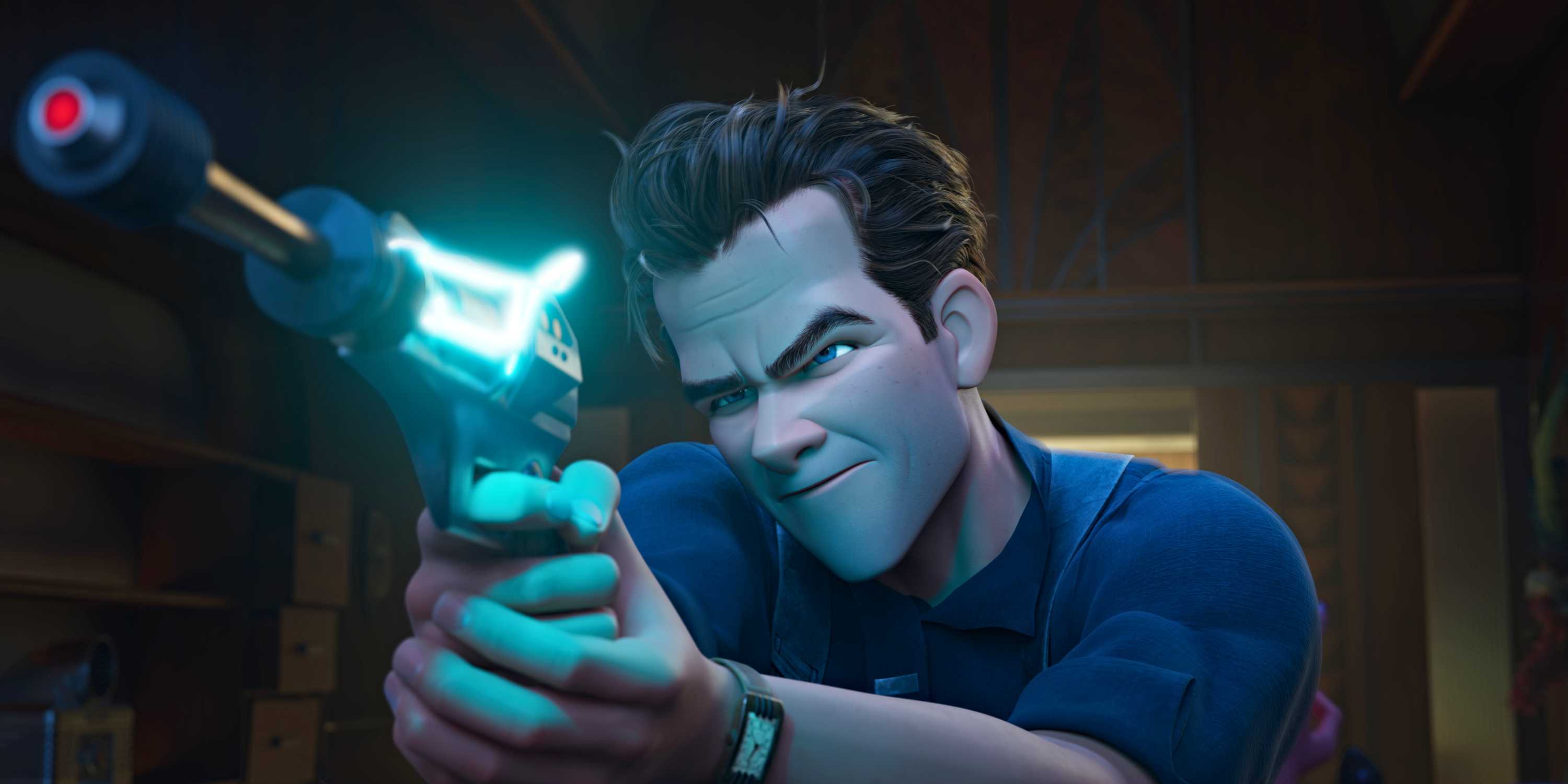 Image via Netflix
 -
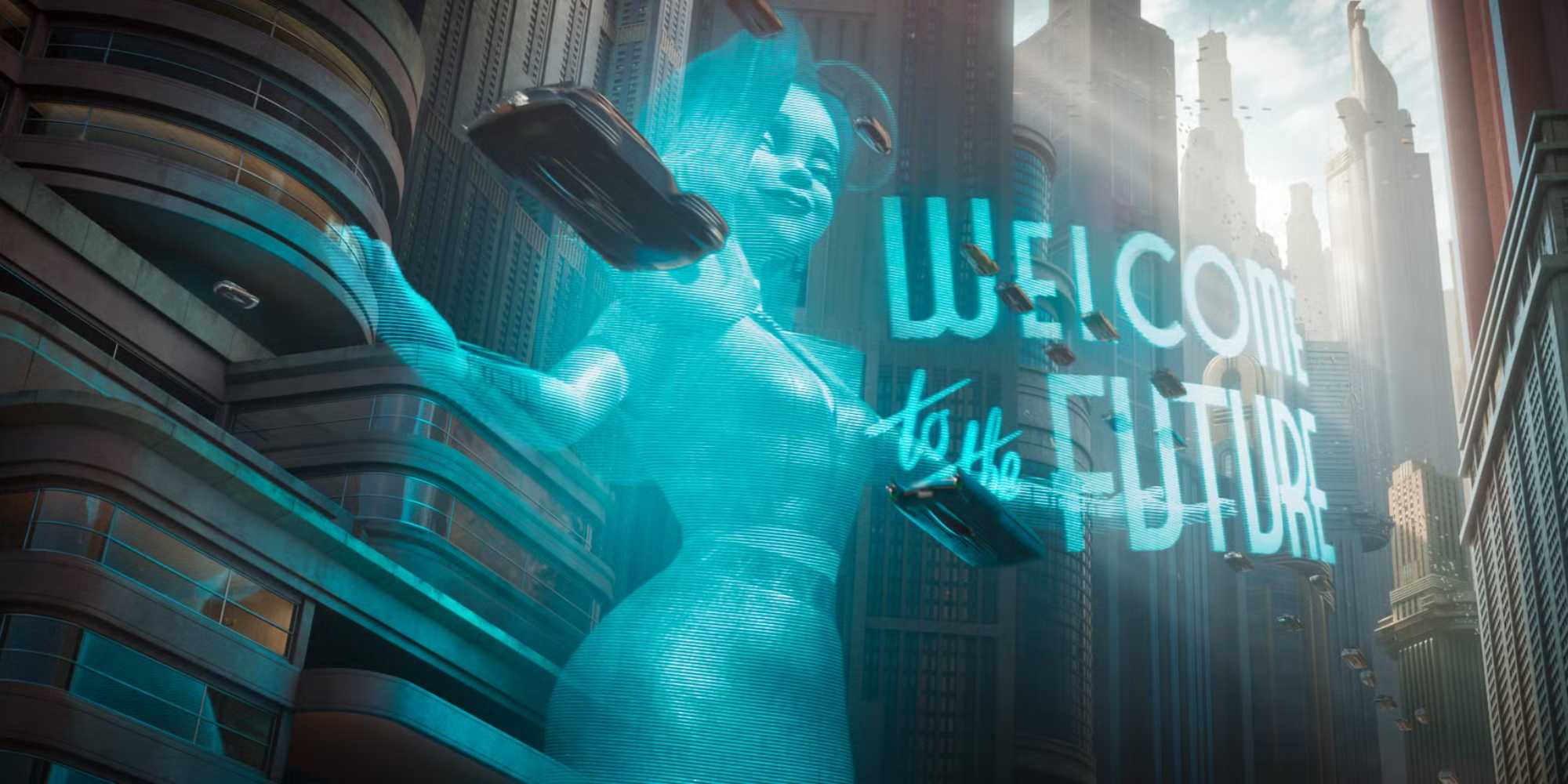 Image via Netflix
 -
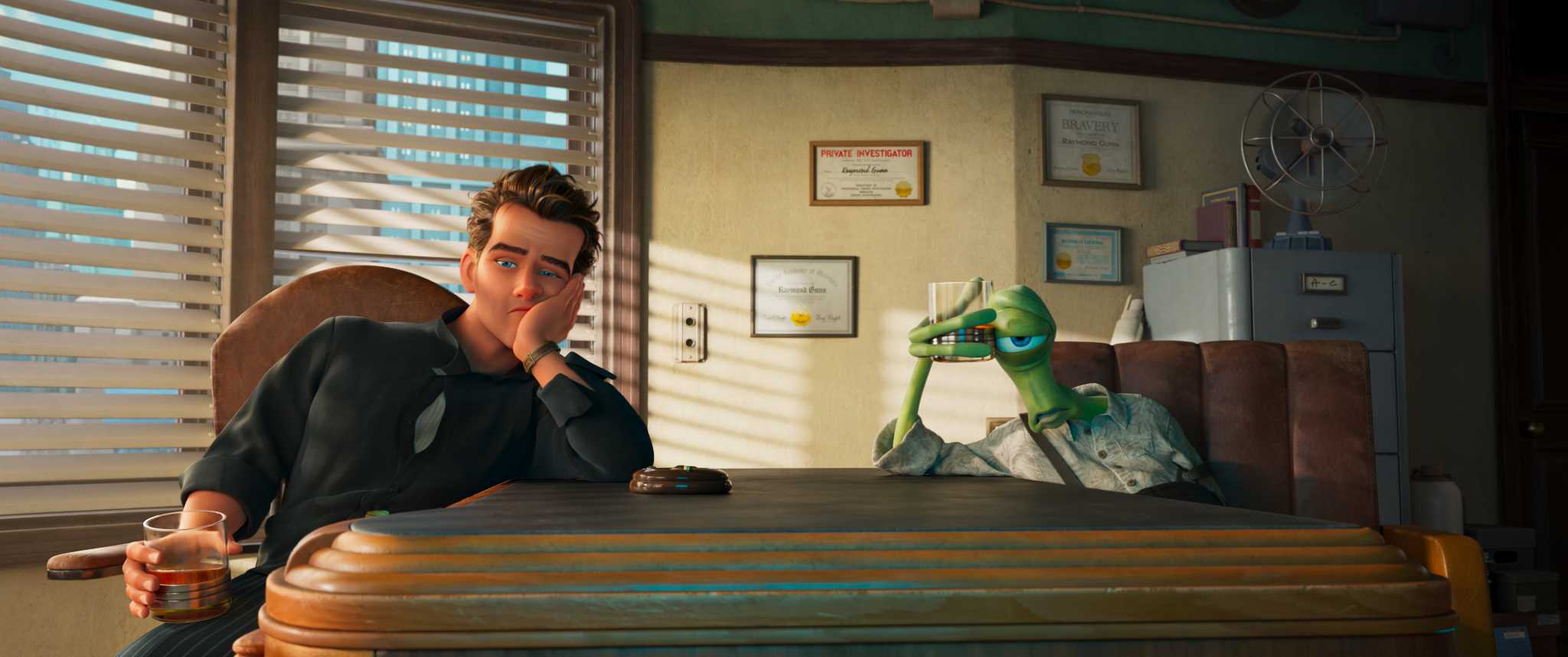 Image via Netflix
We do have another video question. It’s from, I believe, someone named Michael.
MICHAEL GIACCHINO: Hey, Brad, this is Michael Giacchino, first-time caller, but long-time listener. Big fan. And I had a couple of questions I wanted to ask you. Mainly, I wanted to know what was the first movie you saw that made you actually say to yourself that “I want to do that”? And how old were you when you first saw it, and did you have any idea even as to how you would do that? So that’s one question. The second question is, can you tell me what Incredibles 3 is about? Because apparently I hear you’re going to be making an Incredibles 3, which is very exciting. So let’s talk about that. What do you think?
BIRD: Oh boy. Well, the first one is, I think from the very beginning I was trying to make movies. I didn’t figure this out until much later, but…
Giacchino comes out and surprises the audience
GIACCHINO: Excuse me. I want to hear it from your mouth. I want to hear it right from your mouth. Hey, everyone.
BIRD: So the very first drawings I did were very crude, but they were meant to be viewed in order. And so I figured out much later that I was trying to make movies really early, and I just didn’t have the equipment or ability to do it, and, but my family was a movie going family. They like to go to movies and discuss movies afterwards. And I remember my parents talking about Hitchcock like, “Why were Hitchcock’s films better?” So that was the first time I’d heard a director discussed and… So, so anyway, we were a movie family. We saw movies, and I loved movies always.
GIACCHINO: So those drawings you did, where were they, like, storyboards, or was it actually an animated sequence?
BIRD: They were the crudest. They were not anything special drawing-wise. Circle for the head, line for my thoughts, for eyes. But the thing that was unique about them was they were meant to be seen in a certain order. And I would tell the story and I would pull the pages like that, you know, you go in that.
GIACCHINO: And it seems like, though the most important thing is that your parents encouraged you. Were you there was something you wanted.
BIRD: They took me to see the movie more than once, which my grandparents thought was really indulgent. But, my mom was like, “He’s getting something out of it.” And, when I was 11, I saw The Jungle Book here in San Diego, actually. And, that made me go, “How do I do that?” Because my parents would have parties, and I remember the forest of legs and people kind of going broader or bigger. It’s like I don’t want to become one of those lumbering things, you know? And then, I heard a comedy album, which was Jonathan Winters being funny, and here was an adult who was being completely bonkers and being accepted. And then I saw Jungle Book, and I realized people are being paid to figure out how a panther moves — a stuffy panther. And I went, “Wow, growing up is actually going to be really great. Let me at it.”
Bird Shares Details On ‘Incredibles 3’
Both Bird and Giacchino tease what’s next.

GIACCHINO: So now tell us about Incredibles 3.
Thank you for asking that.
BIRD: It’s directed by the guy who did the voice of Emile in Ratatouille, and he’s a super talented guy named Pete Sohn. And he’s going to do an amazing job, and I’m writing it, with a co-writer, and I’m also co-producing it. So I’m involved and I’m excited about it.
GIACCHINO: Who’s doing the music?
BIRD: It’s actually the ghost of Jerry Goldsmith.
GIACCHINO: We are in much better hands on that.
BIRD: Yeah, I don’t know. What are you doing?
GIACCHINO: I’m open. All right.
BIRD: Well, we’ll talk about it.
I am so curious about what your shorthand is between the two of you in terms of writing music and or in terms of music for a movie. So maybe you could talk about what it was like doing Ray Gunn. How early on did you hear about this project? How early on were you thinking about the score and what is that collaboration like?
GIACCHINO: Oh, man. I heard about this in 2003. So we were working on The Incredibles, and we were just talking about, “Oh, what are the things you want to work on? What do you got coming up?” this and that. And he ran down a litany of things, and one of them was Ray Gunn. I heard the story about how he tried to make it and it couldn’t get done. I just hoped one day that’s a movie that we’re going to be able to make.
And, so that’s been living in my head since then. So, so when you do that, your head is sort of like your brain just sort of slowly works on it in the background. But for me, when I come into a movie, and especially with Brad, what I love to do is just find out, okay, who are these characters? Who are these people? What do they need? What do they want? I don’t ever, for instance, for this movie, it wasn’t about sitting down and writing a detective score. It was about writing a score for Ray. Like, who’s Ray and what does he need? And what does he want? What does he not get? You know, he’s got this really kind of messed up life in a lot of ways. And how do we then reflect that? And then that’s how I begin writing music, understanding that. Because if I can get into the emotional space of a character and feel what it is that they’re feeling, then I can. I can do.
BIRD: Something. Yeah. And that’s how we talk about it. We talk about story. I want to talk about music, per se. I mean, I usually collect a bunch of things that that seem kind of like what I’m looking for, but it’s a variety of things, and I just kind of put the pile at him and he listens to it, and then he puts it away and, whatever residue sticks, sticks, and he goes into it and creates the soundscape, but we end up talking about story a lot. And and, his notes on story are always good notes. They’re they’re smart. so, I like talking to him about things early.
One of the things when I was looking through the credits of the film, I noticed Ben Burt’s name, which if anyone’s familiar with Star Wars, look him up. You have an all star lineup of people that worked on this movie. Can you sort of mention the various people that you pulled in to do this? It’s almost like they wanted to work with you.
BIRD: Well, a lot of them have worked on the other films. So, you know, when you when you do this stuff, you, you end up being really impressed by a lot of people, and those are the people you want to keep close and kind of keep adding to their numbers. So Pete Sohn, who, worked on his first film that he worked on was Iron Giant. And, he did a lot of storyboarding and animation and Incredibles. He did storyboarding and animation and, Incredibles two, he boarded the sequence with Jack-Jack chasing the raccoon. he did the kiss in Incredibles, where, Bob and Helen kissed, which was, believe it or not, technically really complicated at the time and made it this beautiful, emotional scene. So he’s a talent. He is one of the people, I had Tony Fusilli, who is who worked on everything, and design, ran animation in Iron Giant, Incredibles, blah, blah, blah. He’s involved in Ray and he’s involved in Incredibles three. And, you know, this guy and, we it’s a lot of people that have worked on other things and done amazing work.
And we had an amazing group of storyboard artist, some of which were now directing, but they wanted to do a sequence or something in the film. So they were constantly coming in, and I had this murderer’s row of storyboard artists doing this amazing work. Yeah. So it was really gratifying.
That’s what I’m trying to point out. It’s like I said, I think everyone wanted to work with you, because it’s been a little while since you’ve made a film. Too long.
GIACCHINO: Yeah, but whenever Brad makes a movie, there’s a line of people that want to make it with him. He is one of the best sort of leaders, one of the best creative leaders that I know that I’ve worked with. And there’s nobody like him, nobody I know that can just get an entire room full of people just like this, that charge up the hill right behind him without even. They just trust, okay? If that’s where he wants to go, we go. And that’s that’s everything. Let’s go. Everybody. Let’s go. Do it. We’re marching up the hill. What hill is this? I don’t know. Oh, okay. Turkey hill ice cream. I think.
Noir has such a specific musical vocabulary. How much did you want to honor that versus subvert it for a world with aliens and multimedia stars in it?
BIRD: I think we did both, didn’t we?
GIACCHINO: Yes, it’s it’s really mixed. It’s got everything. It’s got like 50 sci fi in it. It’s got very like 30s, 40s noir in it. It’s got, some slight jazz. And yet, you know, my biggest concern was like, I did not want it to feel like The Incredibles. I wanted it to be different, stand apart. That’s very important for me, working on things and again, why I love working with Brad because everything he does is like a hard left turn into some other area that he hasn’t explored yet. So that’s exciting for anyone who gets to work on the film, because then you’re trying out your new muscles. So I think that this film is really at its core, very emotional score, but it’s got a lot of action, a lot of fun, and hopefully it feels like its own thing.
One of the things that I’m so impressed by is your camera moves and just the way you direct, but especially the camera moves and the way you stage sequences in animation. Can you talk about that and the way it is behind the scenes, and how you figure out what it’s going to look like?
BIRD: Well, animation was sort of my gateway drug to live action. And once I had to make decisions for an animated film that I was making when I was 11. You have to decide you’re drawing it, but you still have to decide. Is this in a close up or a medium shot or whatever? And so you start to learn the language of film. And once you start to see it, you start to recognize it in other people’s work, and it becomes really inspiring. And you start heading towards certain filmmakers and, so I think that that’s one of the things, the weird thing was, is when I started doing animation, people kept saying, you know, you’ve kind of staged things like live action, and then I go and do a live action movie and they go, you kind of stage things like animation, and it’s like… It’s all film, man. It’s just film, you know? So it’s the same language. It’s just how you get there is a little different.
What technology did you use on this that perhaps you hadn’t used before, or is it the same software? How did you actually physically make it versus some of the others?
BIRD: Well, I mean, you know, Pixar was pretty cutting edge. So I can’t say that I’m using stuff that I’ve never used before. But the problems are always new. And so it’s the film itself. This had a much narrower range where you could be… I mean, it was really easy to do too little, and it was really easy to do too much. And the thing is, you want the characters to be hardy enough to go through action scenes and comedic scenes and get all the juice out of them. You don’t want them to be stiff, but at the same time, if the scene turns emotional, you want that to work too, so you can’t be so goofy that you become not believable.
And what you’re going for is creating. Whether it’s live action or animation, you want the audience to feel like there’s a whole life here and you’re only seeing a slice of it. But there’s stuff that happened to this character before, and there’s stuff that’s going to happen to him or her later. And it’s about making that believable.
You have a great voice cast in this, for people that don’t realize, maybe you can talk about them. But I’m always curious, did you do any sort of test where you were laying Sam Rockwell’s voice over something and just hearing it?
BIRD: Yeah, this is kind of true of all animated films. But if you have a voice that you think might work, you get clips of it from various things, and then you put it to images of the character, you have the character, and it’s not animation, it’s just still images. But you’re seeing how the voice plays with that face. And when I was pitching Paton for Ratatouille, he had this very funny thing where he goes to Outback Steakhouse and he was so completely emotional about food. And we had all these things of Remy gesturing and making faces from various storyboards, and we kind of cut them to generally fit the attitude that he had in the bit. So you were hearing him, you were seeing Remy and saying, “Does that voice sound good coming out of that body?” And it was perfect. So that’s what you do. And we had clips of Sam. I mean, we all loved Sam’s work. It’s not like he’s unknown. But the same with Scarlett. And it was just perfect.
When you finally saw the finished version of this, how did it compare to that thing that you’d been imagining for so long?
BIRD: Well, it was different, because for the longest time, I wanted to do it as a hand-drawn feature, and I still think it would have been great that way. But, I have no objection. I love working in CG as well, and there are things that you can do in CG that are more difficult in hand-drawn animation. But we had an aggressive schedule, the studio that was originally going to do it in Spain, but wasn’t able to do it because of pipeline issues. So we went to a studio in Montreal called Cinecitta. And we really put the bar pretty high and they were not intimidated by it. They did a great job, so I’m happy that it’s a big movie. It’s got size to it. A lot of choices had to be made and they had to be made pretty quickly, and it doesn’t look like we cut any corners. We worked our butts off to get it on the screen, but I’m really happy that it is big. And it’s unusual for animation, I think.
Could you talk about how you established the visual aesthetic that you wanted with the camera and the lighting choices, like the actual design?
BIRD: Well, I love the syntax of movies. It’s kind of a dream language. Moving the camera is one of the things I love best about CG. It was being able to move the camera rather than kind of look like you’re moving the camera, which is what it was in hand-drawn, but being able to follow things through a shot and have the equivalent of lens selection and all that, made it much easier for me to go, from incredible or rather twee and ghost protocol than it would have been if I went from Iron Giant to Ghost Protocol, because it was like working with real lenses and and being able to move the camera in space.
We’re basically at the end of the panel, so I have to ask. I’ll just ask both of you. Besides Incredibles 3, which you’re writing, do you know what the next thing you’re going to do is? And when are you directing again?
GIACCHINO: I will be. Thank you. Yes, there’s a few things. And one big thing that keeps getting closer and closer to that start line. It takes a long time to get these things up on their feet and going, but it keeps inching closer, and it’s getting so close. So hopefully very, very soon, hopefully very soon. But in the meantime you can go and see Spider-Man: Brand New Day, coming out soon.
BIRD: Yeah I know what I want to do, but I’m not ready to talk about it. And it’s a thing that we’ve talked about doing before and, it’s live action, but there’s animation in it.
This is the thing you’re writing right now?
BIRD: Yes.
GIACCHINO: Look at Steve’s putting it together.
We did an interview before, and he said to me he was writing something, and I’m just trying to figure out where that’s at, but…
BIRD: But I’m also working on Incredibles 3, so.
Ray Gunn will premiere on Netflix on December 18. Stay tuned to Collider for more updates.

- Release Date
-
December 18, 2026
- Director
-
Brad Bird
- Writers
-
Brad Bird, Matthew Robbins
- Producers
-
John Lasseter, Brad Bird, Lisa Beroud, David Ellison, Dana Goldberg

News Videos1 minute ago
Bitcoin: This Week Will Be Crazy

NewsBeat2 minutes ago
How mystery over Zoe Sugg and Alfie Deyes’ disappearance deepened over donkeys
Business3 minutes ago
US FAA approves 737 MAX-7 for production, sends Boeing shares up 5%


-

 Business5 days ago
Why Trees Belong on the Risk Register
-

 Fashion3 days ago
Weekend Open Thread: Wit & Wisdom
-

 Politics3 days ago
Meta enters AI-training agreement with far-right ‘propaganda rag’ Newsmax
-
 Entertainment6 days ago
‘Stargate’ Creator’s New Sci-Fi Series Returns for Season 3 Tomorrow
-

 Crypto World2 days ago
MicroStrategy Post-Earnings CLARITY Act Push Could Add New Catalyst for Its Stock
-

 Politics6 days ago
The Part of the Electric Transition Nobody Wants to Discuss
-

 Business5 days ago
Major shareholder moves on Canyon
-

 Crypto World2 days ago
XRP Ledger v3.3.0 brings five institutional features
-

 News Videos4 days ago
Bitcoin Enters the 3rd Stage of the Bear Market
-

 Crypto World6 days ago
Kraken Enables Retail Access to Jersey Mike’s IPO via Tokenized Shares
-

 Tech7 days ago
New macOS Sequoia & Sonoma security updates for older Macs
-

 Politics4 days ago
Luke Littler’s dominance sparks GOAT debate
-

 News Videos6 days ago
Claude: Build Financial Dashboards in Minutes (2026)
-

 Business6 days ago
Johnson & Johnson agrees to $5.5B settlement over talc cancer claims
-

 Sports4 days ago
Seema Kaliramna Wins Discus Throw Bronze, Takes India’s CWG Medals Tally To 17
-

 Crypto World1 day ago
Crypto PAC spending tops $2M in Michigan House race
-

 Business3 days ago
Trump Announces Hamas Disarmament Agreement as Iran Strikes Kuwait Air Base and US Attacks Pause Overnight
-

 Crypto World3 days ago
New York sues Kalshi over prediction market gambling
-

 Tech5 days ago
Gemini can now summarize the messiest comment threads in Google Docs
-

 Tech1 day ago
ESET tracks rise in malicious AI skills and adaptable malware
You must be logged in to post a comment Login