Classic rock songs are good for more than just blasting through the radio or sitting in the background of a road trip. Music has always had a way of bringing stories to life, and that’s especially true for fantasy books. These novels are packed with richly built worlds, unforgettable characters, and larger-than-life adventures, and the right song can capture that feeling in a way words alone sometimes can’t.
A great classic rock track can match a character’s struggles, set the mood of an entire world, or even make you feel like you’ve stepped right into the story. From epic quests and doomed heroes to dark worlds and characters fighting against impossible odds, here are 10 classic rock songs that are perfect soundtracks for these fantasy books.
Advertisement
10
“Stairway to Heaven” (1971)
For ‘The Lord of the Rings’ by J.R.R. Tolkien
The Lord of the Rings follows Frodo Baggins, who discovers that the ring he inherited is the source of Sauron’s power. He must leave the Shire and travel across Middle-earth to destroy it before Sauron can reclaim it. Along the way, Frodo faces dangerous enemies, the Ring’s corrupting influence, and a growing war that threatens the fate of Middle-earth.
“Stairway to Heaven” challenges the idea that “all that glitters is gold,” which fits Tolkien’s story well. The One Ring promises power, but its real danger lies in the desire to possess it. Both the song and the novel explore the temptation of chasing something that seems to offer transcendence or greatness, only to discover that it can lead somewhere destructive.
9
“War Pigs” (1970)
For ‘The Blade Itself’ by Joe Abercrombie
The Blade Itself follows Logen Ninefingers, a feared Northman fleeing his violent past; Jezal dan Luthar, a vain officer preparing for a fencing contest; and Inquisitor Glokta, a crippled torturer investigating treason within the Union. Their lives collide when the mysterious Bayaz draws them into a dangerous expedition, just as war threatens the North and the Union’s enemies close in.
Advertisement
“War Pigs” and The Blade Itself both reject the idea that war is noble or heroic. The song condemns powerful figures who send others to fight while treating human lives as disposable pieces. The Blade Itself takes a similarly cynical view, showing how soldiers and civilians suffer because of those seeking power, territory, and influence. In both, ordinary people are essentially treated like pawns in a much larger game.
8
“Riders on the Storm” (1971)
For ‘The Way of Kings’ by Brandon Sanderson
The Way of Kings shows no mercy to anybody. After being betrayed by Lord Amaram, Kaladin is stripped of his freedom and sent to the deadly bridge crews on the Shattered Plains. Forced to carry massive bridges under enemy fire, he watches fellow bridgemen die as expendable bait. With the help of a mysterious spren named Syl, Kaladin slowly rediscovers his purpose to protect others.
There’s no better song to describe Roshar’s Highstorms than “Riders on the Storm.” Beyond the obvious connection, both evoke the feeling of trying to survive while surrounded by forces far beyond your control. The storm becomes a metaphor for Kaladin’s entire life, as he is constantly pushed into situations that threaten to overwhelm him. The song’s moody atmosphere also fits the harshness of the Shattered Plains, where survival often means enduring whatever comes next rather than trying to control it.
“White Room” fits The Dark Tower through its imagery of chasing something that may never truly be reached, much like Roland’s endless journey through Mid-World. Both capture the feeling of being stuck between places and never fully belonging to any of them. No matter how close he gets to the Tower, his journey always comes with another sacrifice, deeply isolating like being in the “white room.”
Advertisement
6
“House of the Rising Sun” (1964)
For ‘The Lies of Locke Lamora’ by Scott Lynch
The Lies of Locke Lamora follows Locke Lamora and the Gentleman Bastards, who secretly con Camorr’s nobles while pretending to be petty thieves. Their latest scheme targets Don Lorenzo Salvara, but a mysterious criminal called the Gray King threatens the city’s underworld. After Locke’s gang is attacked, he must uncover the Gray King’s plans, avenge his friends, and stop Camorr from falling into chaos.
“House of the Rising Sun” is about the consequences of caving in to our vices, and The Lies of Locke Lamora explores a similar idea through a life of crime that eventually comes with a price. Locke and his friends may steal from wealthy nobles, but the story never romanticizes their lives as criminals. When their schemes go wrong, they are the ones who have to face the bloodshed they’ve caused.
5
“Dream On” (1973)
For ‘The Neverending Story’ by Michael Ende
The Neverending Story follows Bastian, a grieving boy who steals a mysterious book and discovers that Fantastica is being consumed by the Nothing. While Atreyu searches for a way to save the Childlike Empress, Bastian learns that he must give her a new name. Once transported into Fantastica, he uses the Auryn to reshape the realm, but each wish comes at the cost of a memory.
Advertisement
“Dream On” and The Neverending Story both explore how our dreams change as we grow older. Bastian initially uses fantasy to escape his insecurities, but Fantastica eventually forces him to confront them. The song’s repeated command to “dream on” reflects what Bastian learns: growing up doesn’t mean abandoning your imagination. Instead, it means learning how to carry those dreams into the real world without losing yourself in them.
4
“Bad Moon Rising” (1969)
For ‘A Game of Thrones’ by George R.R. Martin
A Game of Thrones follows the powerful Stark and Lannister families as political tensions threaten to tear Westeros apart. Ned Stark gets caught in the dangerous politics of King’s Landing, Jon Snow joins the Night’s Watch beyond the Wall, and the exiled Targaryens plot to reclaim their throne. Meanwhile, something ancient is stirring in the far north.
“Bad Moon Rising” is a fitting soundtrack for Westeros because its famous warning, “I see the bad moon a-risin’,” captures the sense that disaster is coming. The song’s references to earthquakes, lightning, and hurricanes mirror the chaos spreading across the Seven Kingdoms. With the great houses inching toward war, one wrong decision could have deadly consequences.
Advertisement
3
“Paint It, Black” (1966)
For ‘The Black Company’ by Glen Cook
The Black Company follows a mercenary band caught between an ancient evil and a growing rebellion. After centuries of imprisonment, the powerful Lady escapes, revives her magical servants, the Taken, and begins rebuilding her empire. As the Circle of Eighteen rises against her, the mercenaries are drawn into a conflict where even the most powerful sorcerers cannot be trusted.
Both “Paint It, Black” and The Black Company share an obsession with what prolonged exposure to death does to people. The song’s emphasis on the color “black”reflects a world so consumed by violence that darkness becomes impossible to separate from everyday life. From its grim atmosphere to its morally ambiguous characters, the two works present a world where brutality is the cost of survival.
Advertisement
2
“Running Up That Hill” (1985)
For ‘The Fifth Season’ by N.K. Jemisin
The Fifth Season follows three women whose lives reveal the harsh realities of a world constantly threatened by earthquakes, climate disasters, and social collapse. All three can manipulate seismic energy, yet they are feared, controlled, and marginalized by society because of their abilities. As a catastrophic Fifth Season begins, their interconnected journeys show how difficult it is to survive in a world shaped by prejudice.
“Running Up That Hill” captures the desire to escape suffering by trading places with someone else. Despite possessing extraordinary powers, the three women have little control over their own lives or futures. Like the song’s desperate attempt to overcome suffering, their journeys become a struggle to climb the hills of a rigid social hierarchy, fighting not for power, but simply for survival.
1
“Hotel California” (1977)
For ‘The Kingkiller Chronicle’ by Patrick Rothfuss
The Kingkiller Chronicle follows Kvothe, a gifted musician and arcanist who recounts the extraordinary story of his life. Now living under an assumed name and secretly running a rural inn, Kvothe’s past has become the stuff of legend: he spent his childhood as a trouper, watched the Chandrian murder his family, and eventually became known as the Kingkiller.
Advertisement
“Hotel California” may be a song about American hedonism, but it also carries a sense of being trapped by and trying to escape our own vices. Kvothe embodies the lyrics, “We are all just prisoners here / Of our own device.” His tragedy is not simply the result of the terrible things that happen to him, but also of his own pride, which repeatedly pushes him toward choices he cannot escape.
Every single Collider Ladies Night interview feels like a privilege and joy to conduct. But, after over a decade of attending San Diego Comic-Con and itching to see more stage time to be dedicated to highlighting powerhouse women in film and television, it’s become the ultimate treat to contribute to moving the needle in that respect by bringing a live edition of the show to one of the event’s biggest stages.
This year I had the honor of sharing the Indigo Ballroom stage with Poorna Jagannathan from Lanterns, Coyote vs. Acme’s Lana Condor, Aimee Garcia from The Walking Dead: Dead City, and Silostar Jessica Henwick. In addition to teasing their respective new projects, each offered some behind the scenes insight into their own unique journey in this industry thus far, including major career pivots, experiencing overnight mega-fame, and more. As is the hope with all Collider Ladies Night conversations, their stories underscore the fact that there are endless ways to hone your craft and find success as an artist.
Advertisement
How Aimee Garcia Learned to “Not Be Defined By What You See”
“If the job doesn’t exist that you want to be, just create it yourself.”
Garcia had top-tier inspiring forces in her corner from the start, her parents.
“My parents came from very humble beginnings in Mexico and Puerto Rico, and they became what they never saw.” Garcia continued, “My mom became the first Latina to graduate Northwestern’s dental school, and was one of only two women in the whole Northwestern dental program.” She added, “My dad became an architect despite never having seen or met an architect in Puerto Rico.”
They were prime examples of not limiting yourself to what you see, and Garcia took that with her to Dexter, and also to her work as a comic writer. “It really inspired me to become a forensic scientist on Dexter. I had never seen a forensic scientist on TV before who was Latina, but because my parents just paved their own way, that really influenced me.” She added:
“I started writing comics, and we wrote the sequel to 47 Ronin, and we were like, ‘Well, why can’t females be samurai?’ And now, because of what A.J. [Mendez] and I wrote, I think very much inspired by my parents to create the change you want to see, there’s female samurais whipping around katanas. That really showed me that if the story doesn’t exist that you want to tell, or if the job doesn’t exist that you want to be, just create it yourself. Create the change you want to see.”
Advertisement
How Lana Condor Learned How to Handle “Overnight Success”
“If you don’t have the right tools and practices in place for your mental health or your physical health during an extreme time of change, it can rock you.”
While Garcia emphasized the importance of having early sources of inspiration in your orbit, Condor’s story highlighted the value of having a strong support system later on in one’s career.
Condor made her feature film debut with a Marvel movie, X-Men: Apocalypse. She had a taste of what it was like to be part of a major studio blockbuster. However, nothing could have prepared her for the monumental success of the Netflix hit To All the Boys I’ve Loved Before.
While the first To All the Boys movie was distributed by Netflix, it was made independently. Condor explained, “We made it as an indie, so I honestly didn’t even know if it was going to be seen by anyone.” Ultimately, the movie was seen by enough people to spark a hugely successful franchise and to send Condor’s star soaring in a dreamlike fashion, and that meant she’d have to adapt to getting recognized.
She explained, “Ever since I was a kid, when I would go to the grocery store, I would be a little bit nervous to run into one of my classmates if I wasn’t prepared to.” When you’re the star of a very popular Netflix movie, unexpected grocery store encounters are almost inevitable. Condor continued, “That’s not something that I thought about when it came to my career, and so that’s something that I had to work through and, I guess, open my own heart to people and trust that people have good intentions when they approach you.”
Advertisement
Condor stressed that she discovered she was lucky enough to be surrounded by “incredibly kind” supporters, but it’s still a rather significant shift, and it’s a shift that demands one have certain tools at their fingertips. She continued:
“I think, just naturally, the transition was difficult for me. I’m so blessed and I’m so grateful for that time, but I also think that there’s something to be said about if you don’t have the right tools and practices in place for your mental health or your physical health during an extreme time of change, it can rock you, and I definitely was rocked because I was super young. I didn’t have any of the healing modalities that I have now to take on a responsibility of being in the public eye, which is something that I never thought I would have. So, I won’t lie to you, it was very challenging.”
Now that Condor is firmly on the other side of such a significant change, she’s “so grateful and so happy,” and also well aware of the importance of leaning on one’s community. She laughed and said,
“My husband, I always joke, but it’s not a joke, I always say, if it wasn’t for him, I would be butt-up in a ditch right now. Truly, my husband, he’s incredible. My team, my friends, my family. And I’m sure that you guys all feel the same way, in this industry, in my opinion, we are nothing without our community, without our people. We can’t do it alone. I’ve tried and I failed. So, yeah, I’ve leaned on my people, and I think we all do, and it’s been a really incredible journey, and I’m very grateful for every moment.”
How Jessica Henwick Learned to Celebrate Her Wins
And the recent project that finally made her believe she’s a good actor.
Support from a community is of the utmost importance, but so is being kind to yourself and taking a moment to celebrate your own wins. During her recent in-studio Collider Ladies Night interview for the release of Vladimir and How to Make a Killing, Henwick mentioned how she trained herself to lower expectations. “You always minimize to save yourself.” But, that mentality changed recently. She mentioned, “It’s taken my whole career to get over that and celebrate the wins.” How exactly did she pull that off? She laughed and proclaimed, “Therapy.” Henwick continued:
Advertisement
“I’m Chinese and English, two very reserved, like, swallow-your-success-type cultures, and I think that, interestingly, it’s got me to where I am because I was never content and I was using that to push myself, like, ‘You’re not good enough. You can be better. You can do more.’ But there comes a point where it is diminishing returns to keep beating yourself up, and there’s nothing wrong with celebrating how far you’ve come and taking a second to smell the roses.”
One of the first times she took that second to “smell the roses?” On the set of Kitty Green’s The Royal Hotel.
“It’s one of the projects that I’m most proud of. Getting to work opposite Julia Garner, I came into it going, ‘Oh god, she’s just going to be acting circles around me. She’s so talented.’ And she did. [Laughs] No! I remember the first day on set when I started to be like, ‘Okay, I can hold my own. That chemistry is happening here. It’s not just her acting at me and me receiving. I’m able to be a part of the conversation.’ And, yeah, it’s really funny because I’ve been doing this for, like, 15 years, and that was probably one of the first times when I felt, ‘I think I might be good at this. I think I might be okay at acting.’”
How Poorna Jagannathan Went from Advertising Ace to DC Star
“Some times have been rough and some times have been slow, but I’ve never regretted the decision.”
In Jagannathan’s case, that faith in herself was essential because she opted to take a significant leap when making the full-time commitment to acting.
Jagannathan had actually built a successful career in a completely different lane. She spent two decades working in advertising. While one might suspect making the shift from a stable job to something notorious for being an extremely risky career to pursue, Jagannathan never doubted leaving advertising in the rearview for her primary passion. “I’ve never, ever questioned my decision.” She continued:
Advertisement
“I came to acting really late. I started when I was 35 or something, but I was always in weekend adult acting classes, and those classes felt so radically different from the rest of my life. Eight hours would just go like this, you know? And 12 hours at work, the clock just apparently never moved its hand. So, there was a life force that I felt with acting that I never felt in my other job. Some times have been rough and some times have been slow, but I’ve never regretted the decision.”
While Jagannathan’s career compass never wavered, crystallizing her primary goal for her work as an actor and how to achieve that is taking time, but she’s putting in the work to do it. “I think never have I ever really solidified my vision for my career, which is really to tell our stories, very particular South Asian stories to the world and not be pigeonholed and not be stereotyped, and fight for more diversity in film and TV.”
Jagannathan then turned to the other panelists and emphasized something that made Collider Ladies Night Live a standout panel of SDCC 2026, and beyond. “This panel is an anomaly in the business. When I saw all the names of these amazing women and their accomplishments, I’m usually the only one on panels like this. So, it’s really been my mission, especially against this current backdrop, just to keep telling our stories.”
Eager to see the SDCC 2026 Collider Ladies Night Live panel in full? You can do just that in the video at the top of this article.
Ashley Zukerman in Silo Season 3Image via Apple TV
Rebecca Ferguson has been one of the biggest movie stars in the world for years now, but the last few years, she’s headlined some massive projects that have carried her stardom to new levels. Ferguson has picked up widespread acclaim on the big screen for her commanding performance as Lady Jessica in the Dune movies, and while she is confirmed to return for the third and final film later this year, she’s revealed she’ll only have one scene in the trilogy-capping sci-fi epic. Earlier this year, Ferguson also joined one of the biggest Netflix franchises ever with her dual role in Peaky Blinders: The Immortal Man, the spin-off film that began streaming back in March. Her role in a future franchise project has not been confirmed, but she’s publicly stated a desire to come back and reprise her role.
While Rebecca Ferguson has starred in dozens of famous projects since the turn of the 2020s, few have done as much for her career as Silo, the Apple TV series in the heat of its third season. As new episodes of Silo continued to be released every week on Apple TV, the show no longer has anywhere to climb on global streaming charts, as it has officially reached #1 and looks poised to keep the spot until the conclusion of its third season. If someone in an elevator asked you to pitch them Silobefore they got off a couple of floors, the cleanest pitch to give them would be Andor meets Lost. Both Silo and Andor center around slow-burning rebellions rising up against an oppressive group of “government” officials, but like Lost, it’s set in a dystopian world where its inhabitants have little to no idea what’s going on outside.
Advertisement
Advertisement
Collider Exclusive · Sci-Fi Survival Quiz Which Sci-Fi World Would You Survive? The Matrix · Mad Max · Blade Runner · Dune · Star Wars
Five universes. Five completely different ways the future went wrong — or sideways, or up in flames. Only one of them is the world your instincts were built for. Eight questions will figure out which dystopia, galaxy, or desert wasteland you’d actually make it out of alive.
💊The Matrix
🔥Mad Max
🌧️Blade Runner
Advertisement
🏜️Dune
🚀Star Wars
Advertisement
01
You sense something is deeply wrong with the world around you. What do you do? The first instinct is often the truest one.
Advertisement
02
In a world of scarcity, what resource do you guard most fiercely? What we protect reveals what we believe survival actually requires.
Advertisement
03
What kind of threat keeps you up at night? Fear is useful data — if you’re honest about what you’re actually afraid of.
Advertisement
04
How do you deal with authority you don’t trust? Every dystopia has a power structure. Your approach to it determines everything.
Advertisement
05
Which environment could you actually endure long-term? Survival isn’t just tactical — it’s physical, psychological, and very much about where you are.
Advertisement
06
Who do you want in your corner when things fall apart? The company you keep is the clearest signal of who you actually are.
Advertisement
07
Where do you draw the line — if you draw one at all? Every survivor eventually faces a moment that tests what they’re actually made of.
Advertisement
08
What would actually make survival worth it? Staying alive is one thing. Having a reason to is another.
Advertisement
Your Fate Has Been Calculated You’d Survive In…
Your answers point to the world your instincts were built for. This is the universe your temperament, your survival instincts, and your particular brand of stubbornness were made for.
Advertisement
The Resistance, Zion
The Matrix
You took the red pill a long time ago — probably before anyone offered it to you. You’re a systems thinker who can’t help but notice the seams in things.
Advertisement
You’re drawn to understanding how the system works before figuring out how to break it.
You’d find the Resistance, or it would find you — your instinct for spotting constructed realities is the machines’ worst nightmare.
You function best when you have access to information and the freedom to act on it.
The Matrix built an airtight prison. You’d be the one probing the walls for the door.
The Wasteland
Mad Max
The wasteland doesn’t reward the clever or the well-connected — it rewards those who are hard to kill and harder to break. That’s you.
Advertisement
You don’t need comfort, community, or a cause larger than the next horizon.
You need a vehicle, a clear threat, and enough fuel to outrun it — and you’re good at all three.
You are unsentimental enough to survive that world, and decent enough — just barely — to be something more than another raider.
In the wasteland, that distinction is everything.
Los Angeles, 2049
Blade Runner
You’d survive here because you know how to exist in moral grey areas without losing yourself completely.
Advertisement
You read people accurately, keep your circle small, and ask the questions others prefer not to answer.
In a city where humanity is a legal designation rather than a feeling, you hold onto something that keeps you functional.
You’re not a hero. But you’re not lost, either.
In Blade Runner’s world, that distinction is everything.
Arrakis
Dune
Arrakis is the most hostile environment in the known universe — and you are precisely the kind of person it rewards.
Advertisement
Patience, discipline, and political awareness are your core strengths — and on Arrakis, they’re survival tools.
You understand that the long game matters more than any single victory.
Others come to Dune and are consumed by it. You’d learn its logic and earn its respect.
In time, you wouldn’t just survive Arrakis — you’d begin to reshape it.
A Galaxy Far, Far Away
Star Wars
The galaxy far, far away is vast, loud, and in a constant state of violent political upheaval — and you wouldn’t have it any other way.
Advertisement
You find meaning in being part of something larger than yourself — a cause, a crew, a rebellion.
You’d gravitate toward the Rebellion, or the fringes, or whatever pocket of the galaxy still believes the Empire’s grip can be broken.
You fight — not because you have to, but because standing aside isn’t something you’re capable of.
In Star Wars, that willingness is what makes all the difference.
Advertisement
When Does ‘Silo’ Season 4 Come Out?
Apple TV has already confirmed that the fourth and final season of Silo will be released sometime next summer, marking the end of Ferguson’s critically acclaimed sci-fi series. Seasons 3 and 4 were shot back to back, which allows for no more two-year gaps between seasons. Silo Season 3 has been a smash hit with critics, but audiences haven’t been as hot on the show so far, with many long-time fans criticizing the memory loss storyline and the rehashing of past events happening in recent episodes.
Check out new episodes of Silo every week on Apple TV and stay tuned to Collider for more updates and coverage of Rebecca Ferguson’s future projects.
Advertisement
Advertisement
Release Date
May 5, 2023
Network
Apple TV
Advertisement
Showrunner
Graham Yost
Advertisement
Directors
Morten Tyldum, David Semel, Michael Dinner, Aric Avelino
Writers
Advertisement
Graham Yost, Hugh Howey, Jeffery Wang, Lekethia Dalcoe
What began as a family opening its doors to someone they believed was a vulnerable child reportedly turned into a shocking case of deception. Amanda Maria Souza de Oliveira has now been convicted in Brazil after authorities determined that the woman, who is in her late 30s, had allegedly been posing as a 12-year-old girl while living with a foster family for more than a year.
Oliviera Allegedly Posed As 12-Year-Old Before Conviction
According to a translated media release from the Court of Justice of Santa Catarina, Oliveira was convicted on Thursday, Aug. 20, in Joinville, Santa Catarina, on charges involving fraud and the use of a false identity. The court said she had presented herself as a 12-year-old with a history of abuse and health problems after being placed with the family in 2023 through a local organization that works with vulnerable children.
She Lived As “Gabriel” With The Family For 14 Months
During the 14 months she lived with the family, Oliveira was reportedly treated “as a daughter.” The family provided her with housing, food, medication, and other care. The court determined that Oliveira gained a financial advantage because the family covered her living expenses. The court also considered the emotional and family impact of the alleged deception when issuing its ruling.
According to The Washington Post, Oliveira went by the name “Gabriel” while living with the family and allegedly spoke in a high-pitched, childlike voice when she was first taken in. She reportedly claimed she had escaped abuse, but people around her eventually began noticing inconsistencies in her story, leading authorities to uncover her actual age and identity. Oliveira later admitted to authorities that she had lied.
Advertisement
Oliveira Sentenced As Her Legal Team Plans Appeal
Oliveira was sentenced to approximately 18 months in prison, followed by about five months of detention under a semi-open prison regime, according to the court. Authorities also alleged that she had carried out similar fraud schemes in other parts of Brazil in previous years. Her attorney, Lúcio Sousa, has disputed the ruling. He described Oliveira as a vulnerable person who had previously lived on the streets. Sousa also maintained that she did not cause financial losses to the family. Following the conviction, her legal team said it disagrees with the decision. The team plans to pursue appeals while continuing to argue for her innocence.
We claim to hate a good shock or surprise in real life, but when it comes to movies, keep ’em coming! Movie lovers watch a film and don’t know what’s coming next. By keeping the audience in suspense, it heightens the stakes and provides a reason to reach the next scene. If there’s one genre that loves suspense, it’s the thriller. From murder mysteries to high-octane action flicks, they excel at building suspense and tension.
There are an abundance of thrillers in cinema history that are brilliantly suspenseful, but we’re here to discuss eight of the very best in the category. From blindsiding murders in the first act to dueling timelines that reveal a dark truth, these films leave you pondering everything that came before, after, and the film as a whole. While there are certainly many other films that could be on this list, these eight are essentials.
Advertisement
1
‘Black Swan’ (2010)
Natalie Portman as Nina as the Black Swan performing on stage with a male dancer in Black Swan.Image via Searchlight Pictures
One may not think a film about art could be suspenseful, but Darren Aronofsky knows how to deliver just the right dosage in his brilliant psychological horror thriller Black Swan. The film depicts Nina (Natalie Portman), a dedicated New York City ballet dancer, and her dark descent after being cast in Swan Lake. As Nina strives for artistic perfection, she suffers vivid hallucinations and delusions, blurring the line between what is real and what is in her head, causing a devastating spiral into madness. The film uses the ballet narrative as a mirror for Nina’s internal conflict as her rigid nature makes it hard for her to unlock the dark, passionate side of the Black Swan. A masterpiece in tension and suspense, Black Swan provides a raw examination of the dangerous cost of artistic greatness.
Led by a powerhouse performance from Portman, Black Swan captures a terrifyingly grim world through Aronofsky’s precise, moving camera angles and endless mirrors that trap the audience and invite a sense of confusion similar to Nina. The audience is kept on the edge as Aronofsky blurs the line between chilling hallucinations and reality. With Nina operating as an unreliable narrator, determining what’s true or made up. Her self-destruction is inevitable, but determining how or when it will come is as great as the actress playing that journey. When the film reaches the body horror phase, it’s clear that Nina’s fall is inevitable. There’s no way in which a prima ballerina can be such through mutation. Black Swan is terrifyingly grotesque, and the journey into decay is worth the difficult, visceral watch.
Advertisement
2
‘M’ (1931)
Peter Lorre as Hans Beckert in M (1931)Image via Vereinigte Star-Film GmbH
One of the greatest and subtly influential films of the early days of talkies is the German thriller M. Directed by Fritz Lang in his first sound film, M tells the story of a massive manhunt in Berlin for Hans Beckert (Peter Lorre), a serial killer who targets children. Because the police searches disrupt their own illegal activities, the city’s criminal underworld decides to hunt down the murderer themselves. Building suspense through a menacing whistling clue and a menacing double manhunt, M set the template for modern police procedurals, psychological thrillers, and film noir through its simple yet effective execution. By establishing the modern serial killer thriller, M could do as it pleased. And what it pleased exuded perfection.
A risk perhaps at the time, sound design became a crucial part of the storytelling. The killer’s whistling of “In the Hall of the Mountain King” builds terror before he even appears on-screen. With an audio soundscape established as the primary narrative tool, the dynamic camera angles of stark shadows and silhouettes aid visual storytelling. Together, Lang crafts an aesthetic that subverts expectations. You’re left in suspense as the monster is humanized and the city’s criminal syndicate becomes the villains. M often forces your imagination to fill in the blanks, building dread from the very start.M’s catastrophic tale where the walls close in for the hunted can genuinely be felt in projects still today.
Advertisement
3
‘Memento’ (2000)
Guy Pearce seeing pollaroids while in the front seat of a car in Memento.Image via Newmarket Films
Multiple timeline storytelling can be a difficult mechanic to execute, but if there’s one visionary who can do it, look no further than Christopher Nolan and Memento. His early thriller tells the story of Leonard Shelby (Guy Pearce), a man with short-term memory loss who cannot form new memories. He uses Polaroid notes and body tattoos to hunt the man who raped and murdered his wife, Catherine (Jorja Fox). Memento uses two alternating timelines—one where color scenes move in reverse, starting with the immediate aftermath of an action and moving backward to explain how it happened, and the other in black-and-white, where scenes move forward in chronological order. When they converge, the truth is revealed, and it’s nothing you or Leonard could have predicted.
Memento brilliantly plays with both the protagonist and the audience through a masterful mystery that you must solve. Instead of just crafting a typical revenge narrative, Nolan’s structure subverts expectations. You cannot lean on past context because the previous scene was actually the future, meaning you must focus on every detail for the truth to unravel. By feeling just as disoriented as Leonard, you share the evocative lack of context of its amnesiac protagonist. Without the ability to predict the past or future, the audience lives in suspense. It can be a dizzying film, but Memento established Nolan’s storytelling prowess through the most complicated conceit right off the bat.
Advertisement
4
‘Memories of Murder’ (2003)
Replacing the pristine Hollywood detective film comes Bong Joon Ho’s gritty Neo-noir crime thriller Memories of Murder. Based on the 1996 play Come to See Me by Kim Kwang-lim, local detective Park Doo-man (Song Kang-ho) and Seoul detective Seo Tae-yoon (Kim Sang-kyung) investigate a brutal string of rapes and murders of young women who wear red on rainy days. Bogged down by poor forensic technology and brutal interrogation methods, the detectives chase false leads in a frustrating, ultimately dead-end search for the elusive killer. Through a bewitching blend of dark comedy, satire, and raw tragedy, Bong presents a flawed series of events that show that justice isn’t guaranteed and that evil can come from the ordinary.
Memories of Murder seamlessly moves through tonal genres to keep audiences guessing whether resolution is even possible. What begins as a bumbling odd couple cop story evolves into moments of harsh, brutal sadness. Rooted in an unsolved true crime case, the narrative had an added edge as Bong cast society’s chaotic nature as a reason for the lack of success. Memories of Murder is a film in which suspense stems from frustration. A botched police investigation can truly stunt justice; the ticking clock of upcoming rainy nights, crumbling local clues, and the psychological unraveling of desperate detectives can destroy progress. Bong’s presentation of a suffocating, claustrophobic fear of failure exudes existential dread that leaves a lingering question about where the evil hides in ordinary society.
Advertisement
Collider Exclusive · Oscar Best Picture Quiz Which Oscar Best Picture Is Your Perfect Movie? Parasite · Everything Everywhere · Oppenheimer · Birdman · No Country
Advertisement
Five Oscar Best Picture winners. Five completely different visions of what cinema can be — and what it can do to you. One of them is the film that was made for the way your mind works. Ten questions will figure out which one.
🪜Parasite
🌀Everything Everywhere
☢️Oppenheimer
🐦Birdman
Advertisement
🪙No Country for Old Men
Advertisement
01
What kind of film experience do you actually want? The best movies don’t just entertain — they leave something behind.
Advertisement
02
Which idea grabs you most in a film? Great films are driven by a central obsession. What’s yours?
Advertisement
03
How do you like your story told? Form is content. The way a story is shaped changes what it means.
Advertisement
04
What makes a truly great antagonist? The opposition defines the protagonist. What kind of opposition fascinates you?
Advertisement
05
What do you want from a film’s ending? The final note is the one that lingers. What do you want it to sound like?
Advertisement
06
Which setting pulls you in most? Where a film takes place shapes everything — mood, stakes, what’s even possible.
Advertisement
07
What cinematic craft impresses you most? Every great film has a signature — a technical or artistic element that makes it unmistakable.
Advertisement
08
What kind of main character do you root for? The protagonist is the lens. Who you choose to follow says something about you.
Advertisement
09
How do you feel about a film that takes its time? Pace is a choice. Some films sprint; others let tension accumulate slowly, deliberately.
Advertisement
10
What do you want to feel walking out of the cinema? The best films leave a mark. What kind of mark do you want?
Advertisement
The Academy Has Decided Your Perfect Film Is…
Your answers have pointed to one Oscar Best Picture winner above all others. This is the film that was made for the way your mind works.
Advertisement
Parasite
You are drawn to films that operate on multiple levels simultaneously — that begin in one genre and quietly, brilliantly migrate into another. Bong Joon-ho’s Parasite is a film about class, desire, and the architecture of inequality that manages to be darkly funny, deeply suspenseful, and genuinely shocking across a single extraordinary running time. Your instinct is for cinema that hides its true intentions until the moment it’s ready to reveal them. Parasite is exactly that — a film that rewards close attention and punishes assumptions, right up to its devastating final image.
Advertisement
Everything Everywhere All at Once
You want it all — and this film gives you all of it. The Daniels’ Everything Everywhere All at Once is one of the most maximalist films ever made: action comedy, multiverse sci-fi, family drama, existential crisis, and a genuinely earned emotional core that sneaks up on you amid the chaos. You are someone who responds to ambition, who doesn’t want cinema to choose between being entertaining and being meaningful. This film refuses that choice entirely. It is overwhelming by design, and its overwhelming nature is precisely the point — because the feeling of being crushed by infinite possibility is exactly what it’s about.
Advertisement
Oppenheimer
You are drawn to cinema on a grand scale — films that understand history not as a backdrop but as a force, and that place their characters inside that force and watch what happens. Christopher Nolan’s Oppenheimer is a film about the terrifying gap between what we can do and what we should do, told with the full weight of one of the most consequential moments in human history behind it. You want your films to feel important without feeling self-important — to earn their ambition through sheer craft and the gravity of their subject. Oppenheimer does exactly that. It is enormous, complicated, and refuses easy comfort.
Advertisement
Birdman
You are drawn to films that foreground their own construction — that make the how of the filmmaking part of the what it’s about. Alejandro González Iñárritu’s Birdman, shot to appear as a single continuous take, is cinema examining itself through the cracked mirror of a fading actor’s ego. You respond to formal daring, to the feeling that a film is doing something that probably shouldn’t be possible. Michael Keaton’s performance and Emmanuel Lubezki’s restless camera create something genuinely unlike anything else — a film that is simultaneously about creativity, relevance, self-destruction, and the impossibility of ever truly knowing if your work means anything at all.
Advertisement
No Country for Old Men
You are drawn to cinema that trusts silence, that refuses to explain itself, and that treats dread as a form of meaning. The Coen Brothers’ No Country for Old Men is a film about the arrival of a new kind of evil — implacable, arbitrary, and utterly indifferent to the moral frameworks we use to make sense of the world. It is one of the most formally controlled films ever made, and its controlled restraint is what makes it so terrifying. You want your films to haunt you, not comfort you. You are not interested in resolution if resolution would be dishonest. No Country for Old Men is honest in a way that most cinema never dares to be.
Advertisement
5
‘Psycho’ (1960)
Marion Crane (Janet Leigh) slides down the shower tile after being stabbed in Psycho.Image via Paramount Pictures
Advertisement
Simply seeing the name Psycho evokes an evocative reaction. You either immediately see the iconic image or hear the quintessential musical theme. Or, maybe because they were paired together, you experience them both. That’s the sheer brilliance of the Alfred Hitchcock masterpiece. Based on the Robert Bloch novel, the thriller follows secretary Marion Crane (Janet Leigh) who hides out at the Bates Motel after stealing $40,000. While there, she is murdered by the motel owner, Norman Bates (Anthony Perkins), who is controlled by his abusive, unseen mother. It launches a hunt for Marion as the truth about Norman is suddenly revealed. Setting the pace for Act One shocking deaths, Psycho established how twists are the best way to build and maintain suspense when literally anything can happen next.
Hitchcock used Psycho to redefine how scary stories can be told. The legendary shower scene that killed off its top-line star deliberately tricked the audience. In turn, it created new tricks for suspense that directors still play with. Hitchcock films use purposeful angles and framing to evoke immediate tension. With terror occurring in a practical, tangible location, Psycho plays with the audience’s fear that the simple and mundane could hide the greatest monsters. Bernard Herrmann’s piercing, string-heavy music cuts like a knife, no pun intended. Psycho is a perfectly curated thriller that leaves you eager for what’s to come. Hitchcock knows how to cause his audiences anxiety!
6
‘Rear Window’ (1954)
Grace Kelly and James Stewart look in the same direction in Rear Window.Image via Paramount Pictures
Advertisement
Imagine bearing witness to a potential murder, but you’re confined to a room with no way out. It’s voyeurism at its best and worst. Hitchcock again delivers anxiety in the mystery thriller Rear Window. The classic follows L.B. “Jeff” Jefferies (James Stewart), a professional photographer stuck in a wheelchair with a broken leg. Confined to his New York apartment, he passes the time by spying on his courtyard neighbors and comes to suspect that one of them has murdered his wife. With only his nurse, Stella (Thelma Ritter), and his girlfriend, Lisa Fremont (Grace Kelly), by his side, he seeks clues to determine whether Lars Thorwald (Raymond Burr) has murdered his wife. Rear Window is an extraordinary film that turns a story about a broken limb into a life-or-death battle.
Rear Window expertly not only confines Jeff inside his home but also the camera. By framing each and every shot inside his apartment, we can only see what he sees. That fear of the unknown plays straight into the anxiety of the situation. We share Jeff’s vantage through lenses, binoculars, and long shots that put the viewer right in the photographer’s seat. Jeff begins his journey as a seemingly honest man, but obsession takes over, turning his acts of voyeurism into a dangerous game. What makes Lars a terrifying threat is that he is seemingly ordinary, so seeing him as a threat builds into the suspense of the situation. By the time Jeff becomes a literal sitting duck, you’re left pondering what will happen with a dangerous confrontation that potentially cannot be stopped. Rear Window is a beautifully tense thriller where even simplicity can be scary.
7
‘The Silence of the Lambs’ (1991)
Clarice Starling staring at Hannibal Lecter as his reflection looms in the glass in The Silence of the LambsImage via Orion Pictures
Advertisement
Earning itself a seat at the award show table, The Silence of the Lambs proved to be a sensational masterclass in tension and suspense. Directed by Jonathan Demme, the adaptation of Thomas Harris’ novel tells the story of rookie FBI trainee Clarice Starling (Jodie Foster) as she tries to catch an active serial killer named “Buffalo Bill” (Ted Levine), who skins his female victims. To build a profile, she must interview a brilliant, imprisoned serial killer and cannibal, Dr. Hannibal Lecter (Anthony Hopkins), in exchange for the young cop’s personal details. Built upon a brilliant bond between the hunter and the captive mastermind, The Silence of the Lambs is what nightmares are made of.
The Silence of the Lambs is more than a scary movie about an abominable monster; it’s a harrowing exploration of trauma and fighting against the past to defeat the evils in front of you. Rich in psychological dread, Demme creates extraordinary tension through terrifying mind games, suffocating close-up shots, and the defeat of silence and stillness. He puts you in Clarice’s eye level, building instant intimacy and vulnerability. It further pushes the audience to feel exposed as characters are seen staring directly into the camera. The Silence of the Lambs is a chilling thriller that launched an antagonist to such great heights while making horror thrillers a mainstream genre.
8
‘The Talented Mr. Ripley’ (1999)
Matt Damon in glasses in The Talented Mr. Ripley.Image via Paramount Pictures
Advertisement
It’s quite wild to see where the ensemble has gone since starring in The Talented Mr. Ripley, but the film is proof that dynamic performances elevated the adaptation of Patricia Highsmith’s beloved novel. The film follows Tom Ripley (Matt Damon), a struggling young con artist in 1950s New York who is hired by a wealthy shipbuilder to travel to Italy. His mission is to persuade the man’s spoiled playboy son, Dickie Greenleaf (Jude Law), to return home. Instead, Tom becomes dangerously obsessed with Dickie’s luxurious lifestyle, leading to murder and a web of elaborate identity theft. With a vibrant backdrop unlike that of typical psychological thrillers, The Talented Mr. Ripley provides a gripping cat-and-mouse game that leaves you eager for more.
Director Anthony Minghella uses a nostalgic aesthetic to create a tense narrative about class and identity. He builds a stylish story through complex characters moving through a dangerous maze where, with one wrong step, can spell disaster. Damon exudes a natural charm that makes him unsuspecting, especially next to Law’s arrogant Dickie. You want to root for Tom despite his actions. There are moments of split sympathy as identity theft is a terrible thing, but that means the charismatic murderer is taken down. While other thrillers go a drastically different route, the jazzy score weaves through the story, building up Tom’s risky double life with an upbeat melancholy. Just like the coastal setting, it’s simply ironic. The Talented Mr. Ripley is a wonderful example of juxtaposed suspense that was well ahead of its time.
Hailey Bieber has opened up her son’s baby album in celebration of him turning two.
“Our sweet baby is 2. Happy birthday Jack Blues,” the Rhode founder, 29, captioned a Saturday, August 22, Instagram carousel that showed her doting on her and husband Justin Bieber’s toddler child.
In one heartwarming snap, Hailey was seen lying on a pillow as her child’s hand clasped her cheek, while another frame showed Jack Blues as a baby on Hailey’s lap as she fed him a bottle of milk. Additional photos captured the child sitting on a dock with his mom while overlooking a vast lake, and a video also showed the youngster teeing off on a putting green.
Hailey’s celebrity friends showed their approval for her throwback carousel, including Suki Waterhouse who commented on Hailey’s golf video, “That swing tho!!!.” Paris Hilton also shared a smiling face with hearts emoji, while Hailey’s BFF Kendall Jenner hit “like,” as did Kylie Jenner, Karlie Kloss, Emilie Kiser, Hailee Steinfeld and Sami Sheen.
Hailey Bieber and husband Justin Bieber’s baby boy, Jack, is officially 1! Hailey, 28, celebrated the milestone via Instagram on Friday, August 22, sharing never-before-seen photos with her son. “1 year of you my beautiful boy,” Hailey captioned the social media tribute. “Happy 1st Birthday Jack Blues, you are joy personified🩵.” In the first photo, […]
Earlier on Saturday, Hailey, who gave birth to Jack in August 2024, kicked off her son’s birthday celebrations with a yummy breakfast. “2 ❤️,” Hailey captioned a photo full of pancakes topped with whipped cream.
Advertisement
Adding four red candles atop the breakfast dish, Hailey set the post to the tune of “Everything Hallelujah” by Justin, 32, which includes lyrics about his wife and child.
Hailey Bieber and son, Jack BluesCourtesy of Hailey Bieber/Instagram
The Biebers recently enjoyed a European vacation, with both Hailey and Justin sharing glimpses from their getaway via Instagram at the time. On August 2, Hailey shared two photos of herself on a luxurious boat while wearing a tiny pink string bikini. Seated on the floor of the vessel, Hailey captured the mirror selfies with a backdrop of sparkling blue ocean.
Thank You!
You have successfully subscribed.
In Justin’s posts from the trip, he shared a look at one of the couple’s dinners which included a bottle of red wine. Additional snaps from Justin showed him puffing on a cigar while enjoying time on the same luxury vessel, holding Hailey’s hand during a sunlit meal and riding in a golf cart with her.
Hailey Bieber is celebrating Mother’s Day 2025 by sharing new photos of her and husband Justin Bieber’s son. “i love being your mommy Jack Blues,” Hailey, 28, wrote via Instagram on Sunday, May 11. “Happy Mothers Day 🤍.” Alongside the message, Hailey shared a black-and-white image of son Jack Blues’ feet positioned on top of […]
Justin and Hailey have been married since 2018, with Hailey revealing in a November 2025 interview with GQ that the pair have learned to take things “a day at a time.” On the family’s evolved dynamic since their son entered the fold, Hailey told the outlet, “We both feel very protective of our son and I don’t think that’s ever going to change, but our life is our life and it is really public, so I think we’re just going to cross every bridge that we need to when we get there.”
Advertisement
She added, “As of right now, I feel really comfortable about the way we are sharing things and not sharing things.”
Dolly Parton doesn’t plan to let her health issues stop fans from enjoying her performances. The singer has revealed that she intends to explore collaborating with companies that create “avatar performances.”
Months after Ozzy Osbourne’s family announced plans to create an AI avatar of the late heavy metal pioneer, veteran singer Dolly Parton is now considering a similar approach for herself.
Advertisement
However, Parton’s project would involve “AI performances,” potentially allowing her to continue performing for her numerous fans while dealing with her health issues and even well into the future.
While the Osbourne family enlisted tech company Hyperreal to create his avatar, Parton did not reveal who she would be working with or what kind of avatar she intends to create. Still, she confirmed that the idea is already in the “early stages of development” with her collaborators and team.
Health Issues Forced Parton To Scrap Her Vegas Residency
Parton’s announcement comes on the heels of her canceling her forthcoming Las Vegas residency. The shows were initially scheduled for December, then pushed to May this year, and ultimately canceled.
Advertisement
At the time, she shared a statement telling fans that she still had “some healing to do” amid her health issues. She also apologized to those who had already bought tickets, adding that she hoped her absence would not stop them from making the trip to the city.
“I am truly sorry that I’m going to miss all of you that had tickets to see me in Las Vegas. Well, you get on to Vegas, and you have a big time… And I’ll see you somewhere down the line,” the “Jolene” crooner remarked.
Dolly Parton’s Health Issues Also Kept Her Away From Dollywood
Concerns about Parton’s health were further fueled when she appeared only via video at the opening of Dollywood’s newest ride, NightFlight Expedition, earlier this month.
In the video, which showed her wearing butterfly wings and flapping them, she told fans that her health issues were the reason for her absence.
“I’ve told you before, all my fans, that I’ve had a few little health issues and sometimes I get a little dizzy and I get dehydrated. And I’m dehydrated,” the singer said in the video recorded by a fan for TikTok.
Advertisement
She added, “So my Nashville doctor has kind of clipped my wings, saying, ‘You ain’t traveling this week.’ So, I guess if your doctor tells you, ‘You ain’t traveling this week,’ you ain’t traveling this week.”
The Singer Is ‘So Proud’ Of Her New Nashville Museum
Parton recently announced plans to launch her Life of Many Colors Museum in Nashville, which will offer fans an intimate look at her life and career.
Speaking about the project, the singer told PEOPLE Magazine that she is “so proud” of it and explained how she found its location. “We found this location early one morning. I knew I wanted to do something special in Nashville, and until I saw this building, nothing ever hit me as the right thing to do,” she told the outlet.
“I saw a copy of my book Songteller in the lobby of what once was this office building. After touring it and seeing the location, I knew this was it. I wanted to join all my Nashville friends downtown, but I didn’t just want it to be another bar. So, we found a way to bring in my museum on the third floor and make it really special.”
Aside from the museum, Parton also has a new line of dog treats with Purina in the works, as well as a coffee brand called Cup of Ambition Coffee.
The latter is a project the singer has hoped to launch for years, and will begin shipping in September.
Advertisement
“That’s a dream I’ve had for over 40 years, ever since I wrote the line about ‘cup of ambition’ in my song ‘9 to 5,’” Parton revealed. “But, you know, some dreams take longer to come to life than others.”
It’s Always Sunny in Philadelphia has gone down in television history as the longest-running live-action sitcom to date, thanks to its devoted fan base and iconic characters. With the 18th season kicking into full swing and another season green-lit on FXX, this absurd comedy about five lovable jerks shows no signs of slowing down.
With the show spanning many seasons, several hilarious lines spoken by the five main characters have since become ingrained in pop culture and endlessly referenced and quoted by fans and others alike. Whether they’ve become memes or even running gags, these iconic lines have helped make It’s Always Sunny one of the best sitcoms of the 21st century.
Advertisement
25
“She’s dead! Take a good look ’cause she’s gone. Ain’t no one there. There’s no flesh and no bones. She’s dead, and she’s gone. Goodbye, mom.”
Charlie Kelly (Season 18, Episode 1)
Kaitlin Olson and Carol Kane in ‘It’s Always Sunny in Philadelphia’ Season 18.Image via FXX
After Frank’s (Danny DeVito) bride-to-be, Sam (Carol Kane), dies unexpectedly moments before the wedding and before Frank’s greedy children, Dennis (Glenn Howerton) and Dee (Kaitlin Olson), can weasel their way into inheriting her large fortune, the two devise a plan by making Frank and the guests think she’s still alive by pulling her around on strings like a puppet while walking her down the aisle. But during the ceremony, Charlie (Charlie Day) misinterprets Dennis’ cue to start the music by singing a rather strange and sad memorial song he wrote for his late mother Bonnie (Lynne Marie Stewart), which only adds irony to this already unpleasant moment.
Always Sunny Season 18 started on a darkly hilarious high note. Charlie singing, “She’s dead! Take a good look ’cause she’s gone. Ain’t no one there. There’s no flesh and no bones. She’s dead, and she’s gone. Goodbye mom,” just emphasizes how dark and uncomfortably hilarious this whole situation is. This line also has a more meaningful message, as it’s the show’s writers’ way of showing one last tribute and farewell to long-time reappearing supporting actress Lynn Marie Stewart, who sadly passed away after filming the seventeenth season.
Advertisement
24
“The car is a finisher car. A transporter of Gods. The Golden God! I am untethered, and my rage knows no bounds!”
Dennis Reynolds (Season 10, Episode 6)
Image via FXX
Feeling the gang is holding him back after they’ve missed an important party boat, and after he moronically drives his Range Rover into a river to chase after it, Dennis leaves his friends and becomes a laid-back man, free of all of his anger. To do this, his first step was to sell his trashed car still stuck in the water. But, just when he thinks he’s found the perfect buyer, the man remarks that it would be a perfect starter car for his daughter. Enraged that his beloved vehicle is being referred to like this, Dennis flies off the rails into a weird shouting tirade about how the Range Rover transports a “Golden God” such as himself.
One of It’s Always Sunny in Philadelphia‘s best running gags is having Dennis run off into one of his many intense rants describing how great he is. This speech in “The Gang Misses The Boat” is truly one of his most crowning rants, a hilariously bizarre and oddly epic speech that not only shows how creepy he is, but just how highly he thinks of himself.
Advertisement
23
“Rum Ham! Rum Ham! I’m sorry, Rum Ham, I’m sorry!”
Frank Reynolds (Season 7, Episode 2)
Two of the cast in an inflatable raft see a ham floating in the water in It’s Always Sunny in Philadelphia.Image via FX
The gang takes some time off from doing their usual schemes by heading to the Jersey Shore to relax. But after floating on a dinghy for hours, gorging themselves on some delicious booze-soaked meat that the two call “Rum Ham,” Frank and Mac (Rob McElhenney) realize they’ve drifted off into the middle of the ocean. Worse, they lose poor Rum Ham after it has fallen off the boat. Frank can only cry and wail as his beloved meal floats off into the distance.
The great Danny DeVito’s commitment to every line delivery and the way he seemed genuinely distraught in this scene could have only made this classic season seven quote so iconic. “Rum Ham! Rum Ham! I’m sorry, Rum Ham, I’m sorry!” is an absolute gut buster from this 10/10 episode, managing to be endlessly quotable and never losing its effectiveness. It’s perhaps one of the most timeless lines from the show’s earlier seasons.
Advertisement
22
“You got to pay the troll toll if you want to get into that boy’s hole!”
Frank Reynolds (Season 4, Episode 13)
Frank Reynolds (Danny DeVito) as the troll in ‘It’s Always Sunny in Philadelphia’ episode “The Nightman Cometh”Image via FX
In another one of his desperate attempts to win over The Waitress (Mary Elizabeth Ellis), Charlie creates a strange, highly inappropriate stage play loosely based on his terrible upbringing called “The Nightman Cometh.” When the gang stars in the production, Frank becomes drawn to playing the “troll” character, who allows the Nightman, played by Mac, to get past him by paying a toll of gold to get to the young protagonist, played by Dennis, and enter his soul. But, as Charlie points out several times, it’s clear that Frank is singing “hole” and not “soul.”
Season 4’s “The Nightman Cometh” is widely considered one of It’s Always Sunny in Philadelphia‘s crowning episodes, a nonstop laugh riot with endlessly catchy lines and hilarious, cringe-inducing moments. Frank’s “You got to pay the troll toll if you want to get into that boy’s hole!” song adds to the absurdity of this whole play. It’s weird, uncomfortable, and shows just how bizarre and dark Charlie’s play truly is. The line has become a favorite among It’s Always Sunny fans, especially since it’s said with so much passion and brilliance by Danny DeVito.
Advertisement
Dennis Reynolds (Season 7, Episode 13)
Mac McDonald, Charlie Kelly, Dennis Reynolds & Dee Reynolds at a reunion It’s Always Sunny in PhiladelphiaImage via FX
Dennis is on a warpath after being humiliated too many times at his high school reunion. As the rest of the gang confront him as he’s taking things out of the back of his car, he reveals a set of specific tools he intends to use against his enemies, including zip ties and duct tape. The others are obviously freaked out that he has all these strange items already, and he’s too angry to explain why he even has them there to begin with.
It’s no secret that Dennis Reynolds is the most unhinged member of the It’s Always Sunny gang, which makes him already having a set of kidnapping tools at his disposal in the back of his Range Rover not the least bit surprising. This line is so dark and creepy you can’t help but laugh at it. It’s also all made perfect by Glenn Howerton’s incredible acting talents and ability to crank his character’s craziness up to eleven with how he shouts.
Advertisement
20
“You don’t want to wash the bar with a water-based liquid.”
Charlie Kelly (Season 17, Episode 4)
Frank Reynolds, Dee Reynolds, Dennis Reynolds, Charlie Kelly, and Mac McDonald standing around a water cooler at Paddy’s in It’s Always Sunny in Philadelphia IASIP Season 17Image via FX
As part of some bizarre new group activity, the gang buys several large jugs of water to blow into as instruments. The issue, though, that puzzles them is that the jugs are filled with water, and they don’t seem to know what to do with them. When one of the gang suggests they clean the bar with them, Charlie cluelessly states, “You don’t want to wash the bar with a water-based liquid.”
Always Sunny Season 17 proved to be one of the funniest seasons, largely thanks to episode 4, “Thought Leadership: A Corporate Conversation,” and this absolutely uproarious Charlie Kelly line. Charlie isn’t always shown to be the sharpest tool in the shed and doesn’t know most things, nor does the rest of the gang, for that matter, but his reaction here about water has to be one of the most foolish things he’s ever hilariously said. Now, it begs the question: if he doesn’t clean the bar with water, then what does he even use?
Advertisement
19
“I’m a Swedish plumber. I’m here to fix your pipes.”
Mac (Season 7, Episode 9)
Mac using a walkie talkie to contact The Gang in It’s Always Sunny In Philadelphia.Image via FX
In another one of their poorly thought-out plans, most of the gang get trapped in a wealthy family’s home with the residents still inside while attempting to steal a priceless vase. Being the only one left outside, Mac decides to come up with an Indiana Jones and the Last Crusade-inspired plan by faking being a Swedish plumber to distract the family so that the others can make their escape.
Before acting out his plan, Mac tries to reassure his friends over the walkie-talkie that it will work and tests out his Swedish accent by stating, “I’m a Swedish plumber. I’m here to fix your pipes.” It’s hard to figure out what’s more hilarious about this line: the fact that Mac’s accent is so obviously fake, or that he’s genuinely proud of it. It’s one of Mac’s most shining moments, and it only gets more amusing every time it’s heard.
Advertisement
18
“I’m the Trash Man! I come out, I throw garbage all over the ring, and then I start eating garbage!”
Frank Reynolds (Season 5, Episode 7)
Frank in a leotard with one shoulder as the Trash Man in It’s Always Sunny in Philadelphia.Image via FX
In their attempt to honor returning American soldiers, the gang decides to host a wrestling event while dressing up as characters to fight in the ring. Bringing his usual grossness to every scheme the gang comes up with, Frank announces to the others with his character, “The Trash Man,” and states, “I’m the Trash Man! I come out, I throw garbage all over the ring, and then I start eating garbage!”
The fact that Frank then commits his bit further by actually eating garbage right in front of the gang is the cherry on top of this classic Frank moment. What would this show be without the endlessly talented Danny DeVito and his wonderful ability to make this iconic quote so gut-busting?
Advertisement
17
“You light ONE b***h on fire and everybody freaks out.”
Dee Reynolds (Season 9, Episode 2)
Sweet Dee (Kaitlin Olson) and Dennis (Glenn Howerton) at a gun show in ‘It’s Always Sunny in Philadelphia’Image via FX
In an attempt to show the rest of the gang that it’s so easy to buy assault rifles, Dennis and Dee head to a gun store to prove their point. However, they’re both quickly denied purchase after their criminal records and Dee’s history of being institutionalized after setting her college roommate on fire are brought up. In a fit of anger after having to explain her dark past, Dee hotly states, “You light ONE b***h on fire and everybody freaks out.”
It’s best not to get on Dee’s bad side, as this darkly hilarious quote often shows she’s not a woman to mess with most of the time. It’s Kaitlin Olson’s hilarious facial expressions and intense line delivery that make this one of the character’s most hilarious moments. It goes to show that Olson truly was one of the best additions to the cast this IASIP has ever had.
Advertisement
16
“You haven’t thought of the smell, you b***h!”
Dennis Reynolds (Season 10, Episode 3)
Image via FXX
While at a doctor’s office hoping to get stronger medication for their old high school friend, Psycho Pete (Dominic Burgess), Dee’s failure to act like a person with schizophrenia in front of the doctor for a prescription greatly infuriates her brother, Dennis, who utters a bizarre and unsettling threat about turning her into a skin suit luggage and adding her to his collection. As a noticeably terrified-looking Dee asks him if he really has a collection of skin, Dennis snaps with an even more unhinged response that he doesn’t because of how much it would smell and yells, “You haven’t thought of the smell, you b***h!”
Being one of the darkest comedic sitcoms in TV history, Dennis’s strange threat is certainly one of the main reasons why, and that’s what’s made this line such a standout. It perfectly shows Dennis’s dark side, as well as his complete lack of self-awareness, as he clearly has no idea how scary he’s coming across.
Out of the three major video game companies, each has its own defining franchises. Xbox has Halo,and PlayStation has God of War. Nintendoalso has its key titles and franchises, but they are better at diversifying its portfolio, which results in countless essential franchises for every niche, from Pikmin to Mario Party. And with so many consoles, Nintendo’s catalog only gets more and more impressive.
Every Nintendo console has its must-play video games, but all of them collect into one giant pool of masterpieces, and we will select from those games to create a list of the ten most essential Nintendo video games that every fan must play. Based on aspects such as influence, originality, innovation, design, narrative, gameplay, visuals, how well it defines Nintendo, fan opinion, and critical acclaim, these are the ten biggest Nintendo staples. However, since most of Nintendo’s essential games are from the same few franchises, this list will also take variety into consideration.
Advertisement
‘Splatoon’ (2015)
Inklings shooting in ‘Splatoon’ for Wii UImage via Nintendo
Nintendo has had many successful consoles, but the Wii U wasn’t one of them. However, it still featured a handful of great games, including the essential Splatoon. Players suit up with their best blasters and defend their turf to the best of their abilities, as they need to cover the most area with ink to win, but there is also a single-player mode where they need to rescue a stolen Great Zapfish.
The third game may be better, but Splatoon is the newest successful IP from Nintendo, so it is only right that the original earns the spot. Nintendo always tries to innovate and experiment in new genres, and this is their version of a shooter, and it was incredibly well received, not only being a fun and engaging game, but also turning into one of their most successful new franchises.
Advertisement
‘Super Metroid’ (1994)
Samus Aran face to face with giant alien monster Kraid in ‘Super Metroid’Image via Nintendo
Even if some Nintendo franchises are niche, they are still essential in some way, including Metroid, which is home to some critically acclaimed masterpieces, such as Super Metroid. When Samus Aran lands on the isolated planet Zebes to retrieve a stolen Metroid larva, she must learn how to survive the harsh world and prepare for a battle against Ridley.
Super Metroid is the definitive metroidvania, arguably the best of the genre and easily the most polished. The tutorial is among the best in video game history, giving players the tools and info to enjoy the rest of this flawless experience. Super Metroid was the blueprint for the genre because of its remarkable level design and atmospheric storytelling that innovated metroidvanias forever.
Advertisement
‘Animal Crossing: New Horizons’ (2020)
Animal CrossingImage via Nintendo
The beauty of Nintendo is that they have a game for every genre, whether that be open-world 3D adventures or life-simulators like Animal Crossing. After players move to a new town consisting of anthropomorphic characters, they take life at their own pace, from building a house and renovating it to fishing, catching bugs, and even paying off mortgages.
Animal Crossing: New Horizons is the most popular and arguably the best of the franchise, arriving in the middle of the COVID-19 pandemic and becoming an outright phenomenon during lockdown. By reinventing the genre through the addition of a real-time clock, it encouraged consistent but brief play sessions. Animal Crossing is low-stakes, relaxing, and completely engaging, proving it is one of the best Nintendo games.
Advertisement
‘Super Mario Galaxy’ (2007)
Super Mario Galaxy – 2007Image via Nintendo
This list includes a variety of franchises, but as the figurehead of the company, Mario had to have multiple entries on this list, including Super Mario Galaxy. After Bowser kidnaps Princess Peach, Mario sets off on a planet-hopping quest around the galaxy in order to find her. With the help of Rosalina, he can travel around the cosmos and rescue Peach before it is too late.
Honestly, any 3D Mario platformer is essential, but the best is arguably Super Mario Galaxy, which redefined the franchise with its spherical gravity gimmick that enhanced gameplay. It made every level more inventive, adding creative puzzles that resulted in a riveting platforming experience. It is a Game of the Year winner that has aged well, meaning fans can still enjoy it nearly 20 years later.
Advertisement
‘Mario Kart 8 Deluxe’ (2017)
Mario and Luigi spinning in ‘Mario Kart 8’ for Wii UImage via Nintendo
Nintendo has many best-selling video games, and while Mario Kart 8 Deluxe isn’t there yet, it could be their biggest in a couple of years. Players select from some of their favorite Mario characters and embark on an expansive Grand Prix around famous Mario locations with antigravity, with only the best of the best coming away on top to win the big prize.
While this Switch game was a simple port from the Wii U, the added DLC and booster courses made it the definitive way to play. Mario Kart 8 Deluxe features the tightest racing in the franchise, and with a well-crafted kart system, intricately designed courses, and plenty of fun mini-games, it is the greatest Mario Kart game that is so polished and perfected it can only be essential for all fans.
Advertisement
‘Wii Sports’ (2006)
A tennis match in Wii SportsImage via Nintendo
This list just mentioned how Mario Kart 8 Deluxe could be their best-selling game ever, but for now, that honor still lies with Wii Sports. Bundled with the Wii console, gamers use the intuitive motion controls to play a selection of immersive sports, ranging from boxing to golf, bowling, tennis, and baseball.
It is only the best-selling Nintendo game because it was bundled with the Wii, but that doesn’t take away from its legacy, which cemented itself not just as a game, but as a cultural icon that brought friends and family together to make timeless memories. Wii Sports isn’t just essential; it is important to the landscape of the company and gaming in general because of its simple, yet addictive gameplay that anyone and everyone can play.
Advertisement
‘Pokémon HeartGold and SoulSilver’ (2009)
Player standing in front of Ho-oh in Heart Gold Soul SilverImage via The Pokémon Company
Pokémonis and isn’t a Nintendo franchise, but considering how all their games are exclusive to their consoles, it is eligible for this list. There are many essential Pokémon games, but this list opted for Pokémon HeartGold and SoulSilver. A remake of the classic Gold and Silver games, it has trainers journey around the Johto region to collect the eight Gym Badges, defeat the Elite Four, and conquer the Champion.
The best Pokémon video game is heavily debated, but HGSS is probably the most essential because not only does it feature the true classic vibe of the very first games that many grew up with, but it also has the perfected 2D formula that other fans grew up with. Almost everyone experienced the Johto region, and HGSS is the best way to play it, making it one of the best JRPG titles and the best game in a legendary franchise.
Advertisement
‘Super Smash Bros. Ultimate’ (2018)
Cloud, Kind Dedede, Fox, Bayonetta, Solid Snake, Yoshi, and Kirby in Super-Smash-Bros.-UltimateImage via Nintendo
Fighting games reach a certain demographic, but they don’t usually expand outside that since they are so similar; Nintendo fixed that with Super Smash Bros. They have plenty of incredible titles, like Melee, but Super Smash Bros. Ultimate is the go-to version. Gamers can pick through their favorite Nintendo characters and brawl in a chaotic side-scrolling fighting experience.
Super Smash Bros. Ultimate brings every previous fighter, stage, and power-up, and puts them into one game alongside new additions for each. It is the definitive Super Smash Bros. game and nothing else comes close. Balancing through chaos is a genius design choice, and in terms of enjoyability and replayability, it is hard to beat this game, which is still one of the most played Nintendo games.
Advertisement
‘The Legend of Zelda: Ocarina of Time’ (1998)
The Legend of Zelda franchise is one of Nintendo’s most iconic franchises, and while there are so many that deserve to be here, its best and most deserving is The Legend of Zelda: Ocarina of Time. After the Gerudo King, Ganondorf, kidnaps Princess Zelda in order to have the Triforce for himself, Link must journey across the present and future in order to wake the Sages and defeat him.
Ocarina of Time is widely regarded as the greatest video game of all time, which obviously makes it an essential Nintendo video game. Besides influencing 3D adventure games with its design, layout, and mechanics such as ZR targeting, it is simply a well-made and fun game that is a rite of passage for every Nintendo fan to play. 1998 was a stacked year for video games, yet Ocarina of Time overshadows those classics.
‘Super Mario Bros.’ (1985)
Mario in a level in Super Mario Bros.Image via Nintendo
Advertisement
This list is in no shortage of Mario games, but it obviously had to include the game that started everything: Super Mario Bros. Very similar to every Mario game, the titular plumber travels throughout the Mushroom Kingdom, jumping on Koopas and going to the wrong castle in order to find and rescue Princess Peach, who has been captured by the evil King Koopa, Bowser.
It may not be the best Nintendo video game, but that is only because the company has evolved, and so have their games. But that evolution wouldn’t be possible without the most important, influential, and essential video game, not just for Nintendo, but in history. Super Mario Bros is a classic known for saving the gaming industry and defining staple design techniques, showcasing why it is the most essential Nintendo masterpiece.
A good thriller has the power to keep you enthralled from the beginning to the end. Whether action-packed adrenaline rushes or masterful mysteries with sensational suspense, a thriller should elicit a satisfying reaction when the credits roll. Imagine a thriller film so good that it spawns not one but two follow-ups! A good thriller trilogy, whether unifying stories or united by themes, will keep you glued to your screen begging for one more.
We’re here to celebrate eight near-perfect thriller trilogies. From epic mysteries led by the world’s most beloved sleuth to the most iconic desert-set dystopian movies, these trilogies remain a major part of cinema history because they were so good, there was more in store. Now, these are the films that fall just shy of perfection. Whether it’s due to a single film that falls flat or lacks the legacy to boost them up a notch, these near-perfect film trilogies are most certainly worth a weekend watch.
Advertisement
8
The Apartment Trilogy
Mia Farrow drowning a scream with her hand in Rosemary’s BabyImage via Paramount Pictures
The reason Roman Polanski‘s unofficial trilogy falls into near-perfect status is due to the filmmaker’s legacy and that the bookend films are not nearly as extraordinary as the middle film. Which also just so happens to be one of the greatest psychological horror films of all time. Neverthless, Polanski’s Apartment Trilogy features three standalone psychological horror films thematically linked by their confined apartment settings. Together, they explore themes of isolation, paranoia, and the gradual loss of sanity. In the first film, Repulsion, Carol Ledoux (Catherine Deneuve), a withdrawn young woman, is left alone in her sister’s apartment. She spirals into deep depression, intense paranoia, and homicidal mania as she hallucinates unwanted sexual advances and violently attacks those who enter her space. The second and most well-known, Rosemary’s Baby, tells the story of Rosemary Woodhouse (Mia Farrow), who moves into a historic New York apartment building with her husband, Guy (John Cassavetes). As she goes through a difficult pregnancy, she becomes increasingly isolated and paranoid, eventually suspecting that her eccentric neighbors and her husband belong to a sinister cult. Finally, The Tenant chronicles Trelkovsky (Polanski), a quiet man who moves into a Parisian apartment where the previous tenant committed suicide. He becomes consumed by the belief that his hostile neighbors are gaslighting him and plotting to force him to take on the dead tenant’s identity.
Polanski treats physical space as a living, hostile character that traps the protagonist’s mind. Through tight, indoor settings, these stories turn normal rooms into rooms of deep terror where a descent into madness occurs and where the blurred lines of reality are destined to torment its victim. The walls come to life as the rooms take shape, crack open, or close in to capture the mindset of its subject. The once safe spaces are also long gone, as outside forces or evil neighbors take control. The three films work masterfully together as paranoia is in full bloom. Each protagonist faces escalating pressure, gaslighting, or imagined threats from the outside creeping in. Domestic boundaries break down, leaving audiences to fear their own homes. Though the filmmaker’s legacy may be marred, there’s absolutely denying the sheer brilliance of his work. If you loved Rosemary’s Baby, the other two are must-watches at least once.
Advertisement
7
The Pusher Trilogy
Mads Mikkelsen as Tonny in Pusher (1996)Image via Magnolia Pictures
If the Pusher Trilogy may sound unfamiliar, that’s not necessarily a major shock to the system. They do fall into the underrated gem category of cinema. Brought to life by Danish filmmaker Nicolas Winding Refn, the trilogy explores the violent criminal underworld of Copenhagen through gritty realism. Each film follows a different subject as they deal with debt, stress, and total ruin over the course of a few highly intense days. In Pusher, Frank (Kim Bodnia), a mid-level dealer, has his life fall apart after a botched heroin deal leaves him owning a massive debt to a ruthless Serbian gang leader named Milo (Zlatko Burić). Pusher II: With Blood on My Hands centers on Frank’s ex-con friend Tony (Mads Mikkelsen) as he attempts to earn the respect of his criminal father and rebuild his broken life after prison. Pusher III: I’m the Angel of Death shifts the action to the aging kingpin Milo as he juggles cooking for his daughter’s birthday party, struggling with sobriety, and managing a chaotic, disastrous drug shipment. The Pusher Trilogy showcases how crime is no glamorous trade as each central character is one bad deal away from total collapse.
Through masterful realism, Pusher pushes its main characters to the brink. In turn, the action is tantalizing. With a raw documentary style direction, each film offers different perspectives as different levels and assets of Copenhagen’s criminal underworld are innately captured. The trilogy brings an unflinching examination on the mundane consequences of a life of crime. Shot on location in the Danish city, Refn’s abiltity to bring the backstreets into the spotlight provides a spellbinding and enriching perspective. By working their way through the hierarchy, the Pusher films work as a cohesive unit, yet have immense standalone depth. But truly, seeing the ecosystem in action across the three films is worth the journey. The films are wonderfully raw and natural, as the dialogue is properly messy and entirely human. The Pusher Trilogy is also responsible for launching Mikkelsen into global stardom, so we should be thankful for that! Though there are remakes, nothing beats the originals.
Advertisement
6
Robert Langdon Trilogy
Tom Hanks and Audrey Tautou in The Da Vinci Code stand side by side and look at a cylinder lockbox.Image via Sony Pictures Releasing
If there was one book that took the world by storm in 2003, it was The Da Vinci Code by Dan Brown. It was inevitably going to be given a theatrical life. It was so good, the sequel novels were also adapted into feature films. Centering on the fictional character Robert Langdon (Tom Hanks), a Harvard symbologist, the action-adventure movies may not have been critical darlings, but they continued our fascination with the genre. In The Da Vinci Code, Langdon investigates a murder at the Louvre Museum, uncovering a hidden religious secret guarded for centuries. Angels & Demons moved the action to Rome and Vatican City as Langdon attempts to stop an ancient society known as the Illuminati from destroying the Vatican with stolen antimatter. Rounding out the trilogy was Inferno, which finds Langdon, waking up with amnesia, racing against the clock to stop a madman from releasing a global biological plague linked to Dante’s Inferno. Sitting right in the middle of escapism and guilty pleasure, the Robert Langdon film trilogy uses it’s time to educate while entertaining.
A fan-favorite trilogy, Ron Howard directs the film with panache and flair. By combining high-stakes global treasure hunts, stunning real-world backdrops, and the brilliance of Hanks to anchor the action, the trilogy masters the mission of entertainment. Just like the novels, the films offer fictional tourism for its viewers who may otherwise not have the chance to visit. The films flip cryptic historical stories, secret societies, and anagrams into a pulse-pounding play-along puzzle. Where else do you have the opportunity to gain genuine academic trivia about architecture, history, and literature? The three films feature Hanks bringing instant intellect, empathy, and charm to carry Brown’s tales to victory. And if you’re eager for high-profile stars along for the adventure, expect to see the likes of Ian McKellen, Ewan McGregor, and Felicity Jones, among others. While the Robert Langdon Trilogy may not be Indiana Jones or even National Treasure, they’re just a step below.
Advertisement
5
The ‘Taken’ Trilogy
Image via 20th Century Studios
Every great actor needs a career revitalization. For Liam Neeson, that came thanks to the unlikely hit-turned-pop culture obsession: Taken. Created by Luc Besson and screenwriter Robert Mark Kamen, the film series redefined Neeson as a late-career action star, catapulting him to new heights. In Taken, directed by Pierre Morel, retired CIA operative Bryan Mills (Neeson) races against a 96-hour clock in Paris to rescue his teenage daughter, Kim (Maggie Grace), after she is kidnapped by human traffickers. In Taken 2, directed by Olivier Megaton, Mills and his ex-wife, Lennie (Famke Janssen), are taken hostage while in Istanbul by Murad Hoxha (Rade Šerbedžija), the father of a kidnapper killed in the previous film, forcing Kim to help free them. Finally, in Taken 3, also directed by Megaton, Mills is framed for his ex-wife’s murder and must evade the pursuit of a relentless police inspector, Frank Dotzler (Forest Whitaker), while tracking down the real killers. A guilty pleasure phenomenon, Neeson and his “particular set of skills” became lean, mean, fast-paced 21st century action classics.
Though the first film is an exception, laying the groundwork for the franchise and other men of a certain age action genre, the reason the trilogy as a whole drops to near-perfect status is the steady decline following the original. That said, Taken and its sequels do exactly what the film franchise is meant to do. Never do they stray away from its main concept, borrowing what works from the original aand tweaking it along the way. The moment Neeson got on the phone and delivered, “I will look for you, I will find you, and I will kill you,” a pop culture touchstone was born. The film delivered in no-nonsense, high-octane action without an overcomplicated plot. Though the intensity was dropped to a PG-13 rating in the subsequent films, the DNA remained the same. If you were taken by Taken, watching the trilogy is a must-do. You’ll even be intrigued by the two-season run of the TV series. Be warned, no Neeson to be found there.
Advertisement
4
The Mexico Trilogy
Image via Sony Pictures Releasing
Thanks to Robert Rodriguez, the contemporary Mexican/American neo-Western was revitalized through the Mexico Trilogy. Also referred to as the Desperado Trilogy or the Mariachi Trilogy, Rodriguez brings viewers along the ongoing bloody and musical exploits of a wandering, gun-toting musician known as El Mariachi. The trilogy began with the ultra-low budget El Mariachi, where the titular character, played by Carlos Gallardo, is a traveling musician mistaken for a vicious criminal, Azul (Reinol Martínez), in a small Mexican border town. Now with a bigger Hollywood budget, Desperado serves as a reimagining and sequel in which El Mariachi, now played by Antonio Banderas, seeks revenge against drug lord, Bucho (Joaquim de Almeida), who shot his lover. He is aided by a local woman named Carolina (Salma Hayek) on his quest. Rounding out the films, Once Upon a Time in Mexico, El Mariachi is thrust into a sprawling, high-stakes political coup involving a corrupt general, Emiliano Marquez (Gerardo Vigil), who killed his wife, and a rogue CIA agent, Sheldon Sands (Johnny Depp).
Armed with a guitar case packed with heavy artillery and automatic firearms, The Mexico Trilogy launched El Mariachi to epic levels of Western heroism. Rodriguez keeps a common theme where El Mariachi loses his romantic interests or loved ones to escalating cartel violence, which drives his lonely path of vengeance and retribution. Rodriguez’s signature style blended Hollywood ideals with a distinct blend of fast-paced energy, dark humor, and a sublime Tex-Mex vibrancy. The films are an integral part of cinema history as the first film represented a genuine DIY approach to filmmaking. Rodriguez proved he could make a stellar indie flick with panache and maintain that gritty integrity when the budget ballooned. Desperado is certainly an upgrade that turns the kinetic energy of the first film into a hyper-stylized and super cool action thriller. By Once Upon a Time in Mexico, Rodriguez and his star-studded cast let loose in a playground of fun for an over-the-top adventure. The films will forever be celebrated by marrying Mexican folklore with Spaghetti Western tropes without pretension.
Advertisement
3
Hannibal Lecter Trilogy
Hannibal Lecter (Anthony Hopkins) wearing a protective mask in ‘The Silence of the Lambs.’Image via Orion Pictures
It’s often the heroes who earn long-running franchises. But when you’re Anthony Hopkins and you craft one of the greatest villains of all time, Hannibal Lecter, it’s inevitable that your terrifying face extends beyond the original film. Based on the eponymous brilliant, cannibalistic serial killer created by Thomas Harris, the three Hopkins-led films haunted our waking dreams. Though the character does appear in 1981’s Manhunter and 2007’s Hannibal Rising, for this entry, we will focus on the subsequent projects with Hopkins. In the Big Five-winning The Silence of the Lambs, directed by Jonathan Demme, FBI trainee Claire Starling (Jodie Foster) consults with the imprisoned Lecter to catch another active serial killer, Buffalo Bill (Ted Levine), before it’s too late. Ten years later, Ridley Scott directed Hannibal, where a wealthy survivor, Mason Verger (Gary Oldman), uses Clarice (Julianne Moore) to plot vengeance against a free Lecter living in Florence. Finally, Red Dragon, directed by Brett Ratner, serves as a prequel where retired FBI profiler Will Graham (Edward Norton) asks Lecter for help in tracking down the “Tooth Fairy” killer, Francis Dolarhyde (Ralph Fiennes).
No matter who is sitting in the director’s chair, the three films are examples of masterclass tension and rare psychological depth in the horror realm, all centered around a brilliant and iconic central character. The three films served as an important blueprint in elevating high-stakes crime thrillers into sensational high art. While Red Dragon and Hannibal didn’t match the sheer brilliance Demme captured in The Silence of the Lambs, they did continue to pique our fascination with the cold-blooded killer mastermind. Hopkins defined the chilling archetype of a terrifying villainous intellect. The slow-burning psychological chess matches served as a brilliant canvas for atmospheric tension. The narratives blur the lines between the monsters and the individuals who set out to hunt them. They introduce a wealth of emotional stakes that other horror thrillers tend to lack. The Hannibal Lecter Trilogy is not for the faint of heart. If you’re squeamish, steer clear!
h
Advertisement
Advertisement
Collider Exclusive · Horror Survival Quiz Which Horror Villain Do You Have the Best Chance of Surviving? Jason Voorhees · Michael Myers · Freddy Krueger · Pennywise · Chucky
Five killers. Five completely different ways to die — if you’re not smart enough, fast enough, or self-aware enough to avoid it. Only one of them is the villain your particular set of instincts gives you a fighting chance against. Eight questions will figure out which one.
🏕️Jason
🔪Michael
💤Freddy
Advertisement
🎈Pennywise
🪆Chucky
Advertisement
01
Something feels wrong. You can’t explain it — you just know. What do you do? First instincts are the difference between the survivor and the first act casualty.
Advertisement
02
Where are you most likely to find yourself when things go wrong? Setting is everything in horror. Where you are determines which rules apply.
Advertisement
03
What is your most reliable survival asset? Every survivor has a quality the villain didn’t account for. What’s yours?
Advertisement
04
What kind of fear is hardest for you to fight through? Knowing your weakness is the first step to not dying because of it.
Advertisement
05
You’re with a group when things start going wrong. What’s your role? Horror movies are brutally clear about who survives group situations and who doesn’t.
Advertisement
06
What’s the horror movie mistake you’re most likely to make? Honest self-assessment is a survival skill. Denial is not.
Advertisement
07
What’s your best weapon against something that can’t be stopped by conventional means? Every horror villain has a weakness. The survivors are always the ones who find it.
Advertisement
08
It’s the final scene. You’re the last one standing. How did you make it? The final survivor always has a reason. What’s yours?
Advertisement
Your Survival Odds Have Been Calculated Your Best Chance Is Against…
Your instincts, your strengths, and your particular way of thinking under pressure point to one villain you actually have a fighting chance against. Everyone else — good luck.
Advertisement
Camp Crystal Lake · Friday the 13th
Jason Voorhees
Jason is relentless, but he is also predictable — and that is the gap you would exploit.
Advertisement
He moves in straight lines toward his target. He doesn’t strategise, doesn’t adapt, doesn’t outsmart. He simply pursues.
Your ability to keep moving, use the environment, and resist the panic that freezes most victims gives you a genuine edge.
The Crystal Lake survivors were always the ones who stopped running in circles and started thinking about terrain, water, and distance.
You think like that. Which means Jason, for all his indestructibility, would face someone who simply refused to be where he expected.
Haddonfield, Illinois · Halloween
Michael Myers
Michael watches before he moves. He is patient, methodical, and almost impossible to detect — until it’s too late for anyone who isn’t paying close enough attention.
Advertisement
But you are paying attention. You notice the shape in the window, the car parked slightly wrong, the silence where there should be sound.
Michael’s power lies in the invisibility of ordinary suburbia — the fact that nothing ever looks wrong until it already is.
Your spatial awareness and instinct to map every room, every exit, and every shadow before you need them is precisely the quality Laurie Strode had.
You are not a victim waiting to happen. You are someone who already suspects something is wrong — and acts on it.
Elm Street · A Nightmare on Elm Street
Freddy Krueger
Freddy wins by getting inside your head — using your own fears, your own memories, your own subconscious as weapons against you. That strategy requires a target who can be destabilised.
Advertisement
You are harder to destabilise than most. You’ve faced uncomfortable truths about yourself and you haven’t looked away.
The survivors on Elm Street were always the ones who understood what was happening and chose to face it rather than flee from it.
Freddy’s greatest weakness is that his power evaporates in the presence of someone who refuses to give him the fear he feeds on.
Your psychological resilience — the ability to stay grounded when reality itself becomes unreliable — is exactly the quality that keeps you alive here.
Derry, Maine · It
Pennywise
Pennywise is ancient, shapeshifting, and feeds on terror — but it has one critical vulnerability: it cannot function against someone who genuinely stops being afraid of it.
Advertisement
The Losers Club didn’t survive because they were braver than everyone else. They survived because they faced their fears together, and faced them honestly.
You ask the questions others avoid. You look directly at what frightens you rather than turning away.
That directness — the refusal to let fear fester in the dark — is Pennywise’s worst nightmare.
It chose the wrong target when it chose you. You are exactly the kind of person whose fear tastes like nothing at all.
Chicago · Child’s Play
Chucky
Chucky’s greatest advantage is that nobody takes him seriously until it’s already too late. He exploits the gap between how something looks and what it actually is.
Advertisement
You don’t have that gap. You take threats seriously regardless of how they present — and you never make the mistake of underestimating something because of its size or appearance.
Chucky relies on surprise, on the delay between recognition and response. You close that delay faster than almost anyone.
Your instinct to treat every unfamiliar thing with appropriate scepticism — rather than dismissing it because it seems absurd — is the exact quality that keeps you breathing.
Against Chucky, not laughing is already winning. You are very good at not laughing.
Advertisement
2
Hercule Poirot Trilogy
There are many iconic detectives, but none are as brilliant as Agatha Christie‘s creation, Hercule Poirot. The incredible Belgian sleuth had been the source of many Christie stories, as well as many film adaptations, but the character truly came to life thanks to Kenneth Branagh‘s star-studded modern film adaptations of the detective tales. Pulling double duty as director and star, Branaugh kicked off the adventure with the iconic Murder on the Orient Express. The mystery follows Poirot as he investigates a stabbing aboard a snowbound luxury train filled with a plethora of mysterious passengers. The action shifts to Egypt in Death on the Nile as Poirot seeks to find the culprit when a glamorous river cruise turns deadly when a wealthy heiress, Linnet Ridgeway-Doyle (Gal Gadot), is murdered. Finally, Poirot heads to Italy for A Haunting in Venice, in which a reluctant retired Poirot attends a Halloween seance in a spooky palazzo where another guest dies. As three large-scale mystery masterpieces, the Hercule Poirot Trilogy marries the camp of the Christie character with the vast visuals that reinvigorated the classic detective genre.
The Branagh-directed trilogy is filled to the brim with lavish set pieces that immerse the viewers into the mystery alongside Poirot. Each film captures a richly distinct locale and aesthetic. From the snowy, isolated exterior that traps a glorious train to the sun-drenched waters of the Nile and the moody, gothic Venetian palazzo, each location serves as its own indirect character. They help shape the characters of the story and serve as a perfect backdrop for the mysterious thrills of each death. Branagh uses classic filming techniques to honor the past while bringing the films to the present. What makes the films work as a three-piece and not just three standalone films is that Branagh ensures the right amount of character growth and evolution from its central sleuth. From his growing loneliness, his crisis of faith, and how human cruelty sees morality and sanity, Poirot becomes more than an eccentric detective with an iconic mustache. If there is ever a reason to watch the films, it comes from the cavalcade of stars, including Penelope Cruz, Judi Dench, and Michelle Pfeiffer in Murder on the Orient Express, Annette Bening, Dawn French, and Jennifer Saunders in Death on the Nile, and Tina Fey, Jude Hiil, and Michelle Yeoh in A Haunting in Venice. While there is still potential for the Hercule Poirot franchise to expand, these three are reasons why audiences are drawn to classical murder mysteries.
Advertisement
1
Original ‘Mad Max’ Trilogy
Mel Gibson as Max Rockatansky walking down a lonely highway holding a gun in Mad Max 2 The Road Warrior.Image via Warner Bros.
Before we saw what perfection could look like, George Miller and Byron Kennedy launched a ’80s-tinged post-apocalyptic and dystopian trilogy known as Mad Max. Starring Mel Gibson, Mad Max depicts a societal collapse caused by resource shortages. Max Rockatansky (Gibson) is a highway patrol cop who goes on a vengeance streak after a violent motorcycle gang murdered his family. In Mad Max 2: The Road Warrior, a hardened Max roams the wasteland as he helps a small, isolated oil-refining community defend themselves against a brutal marauding gang. Finally, Mad Max Beyond Thunderdome sees Max wander into the corrupt trading post of Bartertown, get exiled, and assist a tribe of lost children in a battle against the local ruler, Aunt Entity (Tina Turner). Establishing an iconic aesthetic, Mad Max may be responsible for laying the foundation for all post-apocalyptic action thrillers that followed.
While it’s hard to compare the first film to the two most recent iterations, what the original trilogy proves is that an organic evolution from raw, low-budget revenge flick can emerge into a mythic lore-filled juggernaut of a franchise. Miller does a sensational job at making the setting distinctly its own. There had been nothing like it before, so Mad Max set the tone for what a desert-set dystopia should feel like. And it was a living nightmare it was. The three film rely heavily on motion and cinematic language to explore its narrative. These films are not littered with exposition of world-building dialogue. Instead, they allow a show-and-tell visual vocabulary to do the trick. Max is the ultimate vengeful hero who goes from grieving man into a universal lone hero whose mission is to improve the lives of others—even risking his own life to do so. The Mad Max trilogy is considered perfect by many, but in comparing them to Mad Max: Fury Road, they simply cannot compare. That said, they’re the best of the almost-best!
Godzilla has fought just about everyone Marvel can throw at him, but apparently that was only the beginning. Godzilla Conquers the Marvel Universe has already embraced the inherent chaos of dropping the King of the Monsters into Marvel history, and its latest adventure has found a particularly ridiculous way to bring two of the publisher’s biggest icons together.
This time, however, Wolverine isn’t fighting Godzilla; Marvel has apparently decided the kaiju could use a little of Logan’s powers for himself. The result is exactly the kind of monster you would expect from a universe where the Weapon X program was allowed to experiment on Godzilla, and somehow, things only get stranger from there.
The preview for Godzilla Conquers the Marvel Universe #2 takes readers to Universe 8873, where the Avengers of Doom have arrived looking for powerful kaiju to recruit. Their search brings them to a world where Frank Castle has already transformed Fin Fang Foom into the mechanical Mecha Fin Fang Foom, while the Weapon X program has apparently decided that regular mutants simply weren’t ambitious enough.
Advertisement
Advertisement
Collider Exclusive · Marvel Personality Quiz Which MCU Hero Are You? Spider-Man · Daredevil · Iron Man · Punisher · Thor · Cap
Six heroes. One destiny. Answer 10 questions to discover which Marvel Cinematic Universe hero shares your personality, values, and fighting spirit. Will you swing, fly, or thunder your way to glory?
🕷️Spider-Man
😈Daredevil
🤖Iron Man
Advertisement
💀Punisher
⚡Thor
🛡️Cap
Advertisement
01
What drives you to do what’s right? Choose the answer that feels most like you.
Advertisement
02
It’s 2 AM. Where are you? Your answer says more about you than you’d think.
Advertisement
03
How do you handle a villain who keeps escaping justice? Every hero has a method. What’s yours?
Advertisement
04
How do you feel about keeping a secret identity? The mask — or the lack of one — says everything.
Advertisement
05
You’ve lost someone important because of your heroism. How do you carry that? Every hero pays a price. The question is how they pay it.
Advertisement
06
What’s your role when working with a team? Who you are under pressure is who you actually are.
Advertisement
07
Where do you draw the line between justice and revenge? The answer defines what kind of hero you really are.
Advertisement
08
When you’re not saving the world, what does life look like? The person behind the mask is always the more interesting story.
Advertisement
09
What keeps you up at night? Fear is useful data — if you’re honest about what you’re actually afraid of.
Advertisement
10
The battle is lost. You’re outnumbered, outgunned, and exhausted. What do you do? This is your tiebreaker — choose carefully.
Advertisement
Your Hero Has Been Identified Your MCU Hero Is…
Based on your answers, the Marvel hero who matches your spirit, values, and instincts has been revealed.
Advertisement
Queens, New York
🕷️ Spider-Man
Advertisement
You carry the weight of the world on shoulders that are younger than they should have to be — funny, loyal, and endlessly self-sacrificing.
You do the right thing not because it’s easy, but because no one else will.
You understand that responsibility isn’t a burden you choose — it’s one that finds you.
Whether it’s a neighbourhood mugging or a multiverse crisis, you show up.
Peter Parker’s lesson — that great power demands great responsibility — isn’t a slogan to you. It’s the code you live by, even when it costs you everything.
Hell’s Kitchen, New York
😈 Daredevil
Advertisement
You fight in the shadows between law and chaos, guided by a fierce moral compass that refuses to let the guilty walk free.
You use every tool available — your mind, your body, your faith — to protect those the system overlooks.
You’ve looked into the darkness and chosen not to become it, though the line has never been easy.
Matt Murdock’s duality — champion in the courtroom, devil in the alley — mirrors your own.
Relentless, conflicted, and unwilling to stop. That is exactly you.
Stark Industries, Malibu
🤖 Iron Man
Advertisement
Brilliant, driven, and occasionally insufferable — but always the person who solves the unsolvable problem.
You lead with your mind and back it up with resources, innovation, and a stubbornness that borders on heroic.
You started out looking out for yourself, but somewhere along the way the world became your responsibility.
Tony Stark’s arc — from ego to sacrifice — is your arc too.
You build, you plan, and when the moment comes, you’re willing to give everything. Because in the end, you’re Iron Man.
New York City
💀 The Punisher
Advertisement
You’ve been through fire that would break most people — and it did change you, completely. What’s left is unyielding, relentless, and operating by a code forged in grief.
You don’t ask for forgiveness, and you don’t expect gratitude.
You see a corrupt, broken world and you’ve decided to do something about it, consequences be damned.
Frank Castle’s war is born from love twisted by loss — and so is yours.
Uncompromising and unflinching — the world may not agree with your methods, but your conviction is absolute.
Asgard · Protector of the Nine Realms
⚡ Thor
Advertisement
Powerful, proud, and on a lifelong journey to become worthy of the legend you carry.
You lead with strength but have learned — sometimes painfully — that true greatness comes from humility and growth.
You’re larger than life, yet more vulnerable than you let on.
Thor’s story is one of transformation: from arrogant prince to worthy king, from isolated warrior to beloved protector.
You bring the storm when it’s needed — and the warmth when it matters just as much.
Brooklyn, New York · The Avengers
🛡️ Captain America
Advertisement
You believe in something bigger than yourself — and you fight for it even when the world has moved on and nobody else will.
You don’t bully the small guy, and you never stop when it gets hard.
Steve Rogers didn’t become a hero when he got the serum — he was always one. So were you.
Your strength isn’t in your fists; it’s in your refusal to compromise what’s right, no matter the cost.
In a world full of people taking the easy road, you’re the one who picks up the shield and stands up — every single time.
Advertisement
Godzilla Just Got His Own Wolverine Transformation
Godzilla Conquers the Marvel Universe #2
Image via Marvel Comics
Godzilla Conquers the Marvel Universe #2
Image via Marvel Comics
Godzilla Conquers the Marvel Universe #2
Image via Marvel Comics
Godzilla Conquers the Marvel Universe #2
Image via Marvel Comics
Godzilla Conquers the Marvel Universe #2
Image via Marvel Comics
Godzilla Conquers the Marvel Universe #2
Image via Marvel Comics
Godzilla Conquers the Marvel Universe #2
Image via Marvel Comics
Godzilla Conquers the Marvel Universe #2
Image via Marvel Comics
Godzilla Conquers the Marvel Universe #2
Image via Marvel Comics
Godzilla Conquers the Marvel Universe #2
Image via Marvel Comics
Advertisement
Enter Godzilla’s new Wolverine-inspired form. The kaiju emerges sporting Wolverine’s signature claws, with the Weapon X experimentation effectively transforming Godzilla into a gigantic version of Marvel’s most famous mutant berserker. The combination is already absurdly powerful, but Ghost Rider decides that even Godzilla with Wolverine claws could apparently use an upgrade. After Emma Frost explains that the scientists have hardened the kaiju against telepathic intrusion, she suggests that Ghost Rider may have better luck getting through to him. Ghost Rider promptly jumps onto Godzilla’s head, engulfs the creature in hellfire and discovers that his plan actually works. The preview ends with a flaming, Wolverine-clawed Godzilla charging into battle while Ghost Rider rides along on his head. Because apparently Godzilla becoming Wolverine wasn’t bonkers enough.
The crossover continues the increasingly bizarre premise of Godzilla Conquers the Marvel Universe, which has been using Marvel’s Multiverse to mash Toho’s monsters together with some of the publisher’s most recognizable characters. Issue #2 comes from writer Gerry Duggan, artist Javier Garrón and color artist Matt Curiel.
Godzilla Conquers the Marvel Universe #2 is on sale August 26.



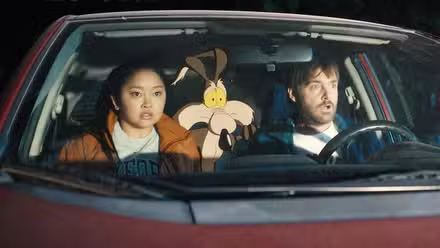




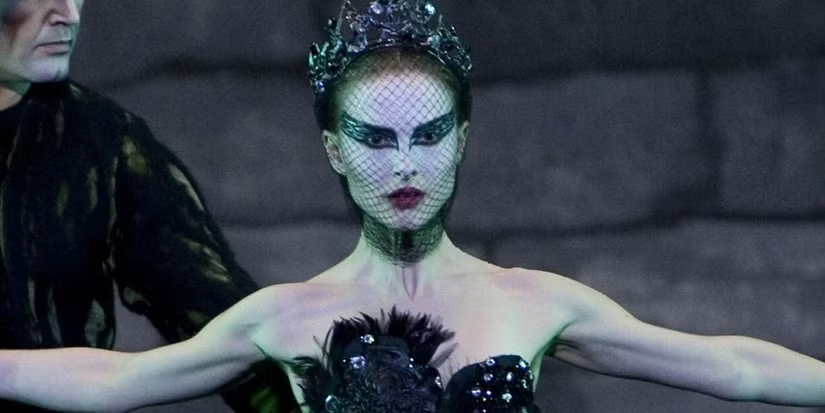



















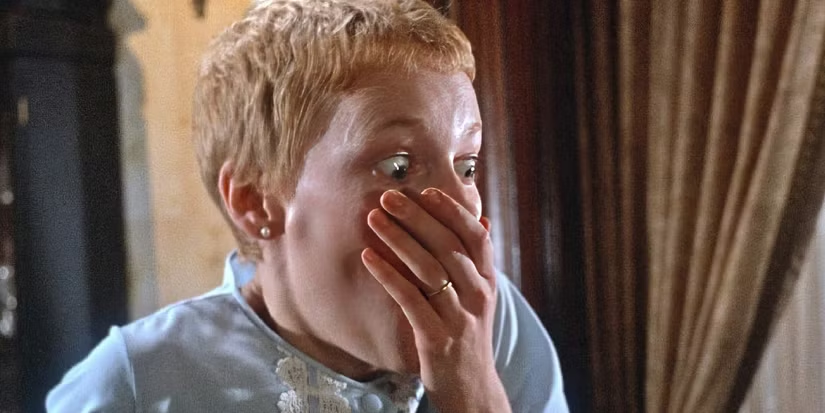















































You must be logged in to post a comment Login