Related: Actress Janel Parrish Dances With Sasha Farber After Chris Long Split
Advertisement




Janel Parrish and ex-husband Chris Long have finalized their divorce — but neither will legally be considered single for months.
Parrish, 37, and Long revealed in a Monday, June 1, filing obtained by Us Weekly that “unhappy differences have arisen” between that pair that make it “impossible to live together as spouses.”
As such, the estranged couple separated on April 4, officially filing for divorce on April 28.
A judge ruled on Monday that Parrish and Long’s “dissolution of marriage” has been entered into the Superior Court of California County Los Angeles records.
The marital status will be “terminated” and Parrish and Long will be “restored” to single status on October 29, 2026, per the filing.
The exes’ divorce agreement revealed that “spousal support is waived by both parties.”
When it comes to marital assets, both Parrish and Long were awarded “all household furniture, furnishings, artwork, appliances, clothing, jewelry, personal effects, and personal property in [their] physical possession and control,” according to the court docs.

Janel Parrish and Chris Long. Courtesy of Janel Parrish/Instagram
The Pretty Little Liars alum was also awarded her 2019 Audio SQ7, the checking and savings accounts in her name, as well as a pension, retirement and 401K listed in her name.
The exes agreed that Parrish will receive “any and all interests” in the project Sydney vs. Sean.
Long was awarded the checking and savings accounts in his name, pension, retirement and 401K in his name and “any and all equity interest in Apex Water and Process Inc.,” per the docs.
Parrish and Long, who wed in September 2018, will also keep “half interest” in their joint Los Angeles home and half of their Chase Joint Checking Account, which will be “divided” upon the sale of the California property.

Actress Janel Parrish is dancing up a storm with Sasha Farber after her split from husband Chris Long. In a clip posted via Farber’s Instagram on Thursday, April 9, the Pretty Little Liars alum, 37, appeared with the Dancing With the Stars pro, 41, as they danced in a parking lot. “She’s still got it @janelparrish […]
The agreement confirmed that Long is currently living in the L.A. home, but plans to move out this month.
The former spouses agreed to list their shared residence by no later than June 19, which Us can confirm is listed as “coming soon” on Redfin for $3.299 million. The house has four bedrooms, five bathrooms, a pool and two-car garage.
Parrish and Long were married for seven years before news broke of their split. The actress broke her silence on the breakup on April 10.

“Thank you all for the incredibly kind and supportive messages, they’ve truly meant the world,” she wrote via Instagram. “After 10 beautiful years together, including seven years of marriage, Chris and I made the difficult decision to end our marriage.”


The Hallmark actress added, “There is still so much love and respect between us, and I’m deeply grateful for everything we built together. This chapter of my life, and Chris, will always mean so much to me. Thank you all again for the messages of love and support.”
Parrish has since moved on romantically with Dancing With the Stars pro Sasha Farber.
Us Weekly has reached out to Parrish’s attorney for comment.

Everyone knows Spock (Leonard Nimoy) as probably the most influential character in science fiction. Whenever you mention the genre to people who aren’t that familiar with it, everyone tends to know at least the Vulcan salute or “Live long and prosper.” As iconic as those are, however, they are far from being the finest our favorite half-Vulcan has to offer. With so much of him on Star Trek, from The Original Series to the movies, it might seem difficult to pinpoint Spock’s best moment, but look no further than Star Trek II: The Wrath of Khan and his iconic line: “The needs of the many outweigh the needs of the few.” It captures his essence perfectly, and is definitely among pop culture’s most misquoted and misunderstood lines.
There are certain quotes that break the barriers of genre and media to reach even those who are oblivious to where it comes from, often resulting in them being delivered out of context or with completely different intentions than what they are really about. Spock’s “The needs of the many” is one such case. He says it not once, but twice in The Wrath of Khan, and both are all about his arc in the movie, but barely anyone outside the Star Trek fandom remembers or even knows the context.
First, he says it to his old pal, Admiral James T. Kirk (William Shatner), when what starts as a training course for cadets aboard the Enterprise suddenly becomes an actual high-stakes mission. Spock is the ship’s captain, but tells Jim that he should take command, since he is the senior officer and the regulation commands it. Jim repeatedly refuses, but Spock reaffirms it as a must for that mission, given the circumstances, stating that “the needs of the many outweigh the needs of the few,” to which Jim completes: “Or the one.”
Later, after Khan (Ricardo Montalbán) attempts to deliver his final blow against the Enterprise, the ship’s warp drive is damaged, making it impossible for them to escape. Spock then decides to go into the radiation-flooded engine room to restore power, sacrificing himself while locking his friends out. In his final moments, he and Jim recite the “needs of the many” quote again, but with the deliveries reversed, and Spock finishes it with “The one.” So, in the movie, it’s all about Vulcan logic and sacrifice.
Thankfully, situations like the one that requires Spock’s sacrifice aren’t that common in the real world, but his “The needs of the many” line is still delivered quite often, and in contexts where it doesn’t apply at all. It’s usually taken as a way to justify unfair decisions based on a simplistic calculation of cost over consequence, where benefiting the majority is worth overlooking the needs of minorities, often going so far as the majority imposing their will on the minorities, and that’s not what it is about at all.
To fully understand it, we need to look at why it exists. “The needs of the many” goes back to utilitarianism, an ethical theory which states that the most moral course of action is always the one that achieves the greatest good for the greatest number of individuals, and this is intrinsically tied to Vulcan nature. They are known for their sometimes annoying predilection for logical reasoning over anything else; so, when Spock says that to Jim in both circumstances, he is taking a selfless stance, as he understands himself to be the minority.

This Forgotten 5-Part Sci-Fi Series From ‘Star Trek’s Creator Is the Perfect Late-Night Binge
Gene Roddenberry’s other sci-fi series is a fantastic 5-season adventure.
However, utilitarian ethics is favored by the Vulcans for a very good reason. As distant genetic “cousins” to the vicious Romulans, they are actually deeply emotional individuals, and had to learn over millennia how to coexist amongst themselves. For Vulcans, “the needs of the many outweigh the needs of the few” is about survival of the species, not intellectual or moral high ground. Otherwise, a single individual may lead to a crisis that puts the collective in danger because of individual wills.

You may tell yourself you would also sacrifice yourself if you were in Spock’s shoes in that scene in The Wrath of Khan, but the truth is that most of us wouldn’t. He does what he does because, despite being half-human, he was raised Vulcan, so Spock understands what true selflessness demands when the need arises, and understands that such decisions aren’t available to everyone. Kirk, for example, never once considers it, because his goal has always been to save everyone, not the majority.
People also forget (or simply don’t know) that the very next movie, Star Trek III: The Search for Spock, actually reverses the “Needs of the many” line to great effect, as Jim and his crew figure out how to bring Spock back once they learn how. Spock even left a “fail-safe” of sorts behind, too, because he knew that the truth of his sacrifice was purely circumstantial, not a fail-proof ethical truth. Deep down, we all know that saving everyone is the only objectively right thing to do, and Spock would kind of agree, too.
All these reflections are what make “The needs of the many” the greatest quote in science fiction. It’s a simple and rather straightforward line, but one that evokes the kind of moral questioning that’s typical of the best works of the genre. Star Trek particularly excels at this kind of provocation, turning human ethics and morals into poignant moments that really put them into perspective. So, next time someone pulls out the trolley problem and delivers this banger, feel free to let them know that this isn’t what the line is about at all.
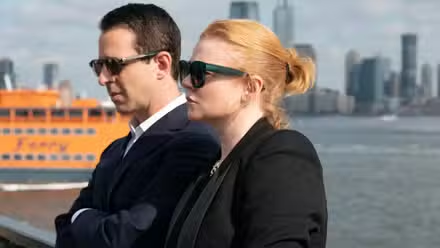
HBO developed its reputation for television excellence by making gritty, mature shows that included the sort of graphic content that would never be permitted on a network program. While the best shows in HBO history offered more than just shock value, the transgressive nature of the material suggested that it was “dangerous” in a way that was enticing to audiences. Compared to its contemporaries, Six Feet Under was a fairly traditional family drama that didn’t necessarily require a prestige distributor. However, Six Feet Under distinguished itself as a probing exploration of life, relationships, and death that was as artful as it was authentic. The series managed to turn its dark subject matter into a poignant, occasionally funny encapsulation of the totality of human existence, and it still holds up just as well 25 years later.
Six Feet Under is the story of the Fisher family, who own and operate a funeral home. After the family patriarch Nathaniel Sr. (Richard Jenkins) dies, control of the business is passed along to his sons David (Michael C. Hall) and Nate (Peter Krause), who are also tasked with caring for their mother Ruth (Frances Conroy) as their sister Claire (Lauren Ambrose) prepares to graduate from high school. Six Feet Under is both a workplace drama and a family story, exploring how one business interacts with the partners, loved ones, and acquaintances of the recently deceased. While Six Feet Under never chose sentimentality when it could provide a more honest outlook, it did celebrate the profundity of life’s most minor moments in a way that most television shows wouldn’t think to portray.
The framing device of Six Feet Under is quite clever, as each episode opens by showing how someone died before they were prepared by the Fishers, who are also tasked with planning the funeral. These introductions can be darkly funny, tragic, or unexpected, but they play an important role in showing how precious life is and how quickly it can be taken for granted. What distinguishes the Fisher family’s practices from other funerary businesses is that they make efforts to understand someone’s last wishes and honor their life, despite not always being prepared to support the bereaved. Although it seems like the characters might be hardened by their experiences, the Fishers only become more involved with the entire community through their business. By offering insights into people who have no control over how they will be remembered, Six Feet Under explores the realistic ways grief can emerge and how it doesn’t always occur in the way that one might expect.
The commentary on death is fascinating because Six Feet Under opened itself up to conversations about the meaning of life and offered interesting perspectives on faith, forgiveness, and human frailty. However, the HBO series has endured as a great drama because of its well-defined characters, each of whom evolves immensely over the course of five seasons. Nate begins the story as a somewhat reckless, uninvolved participant in the family who ends up having one of the most complicated arcs as he searches for what he wants in life. David offers the most grounded perspective because he is the closest thing to his father’s heir apparent, but Six Feet Under was also trailblazing in its nonjudgmental depiction of a gay character, as well as the difficulties he faced coming out. Claire’s journey is perhaps the most fascinating because she has an opportunity to grow up over the course of the show and often has a perspective that grounds her brothers; although both Nate and David are essentially in the shadow of their father, Claire is willing to diverge from the family path, often resulting in intense standoffs with their mother.
Six Feet Under still feels like a high-quality HBO show today because the series was artful with its visual inventiveness and found a way to explore subconscious desires and anxieties in a way that hadn’t been seen before. Dreams rarely feel surreal when they are occurring, and Six Feet Under was able to walk in its characters’ shoes as they had their reality reconstructed in response to trauma. Although the show never ascribed to a single religion, spiritual undertones are present throughout, particularly in the way that characters communicate with loved ones who have departed. One of the best framing devices that Six Feet Under developed was bringing back Jenkins as a ghostly version of Nathaniel Sr., who looms so large in his children’s memory that they are able to visualize him.
Six Feet Under is the rare show that retained a consistent level of quality throughout without ever having a “jump the shark” moment; even the fourth-season episode where David is kidnapped, which could have felt completely ridiculous, is well-handled because of its stunning real-time execution. The greatest legacy of Six Feet Under is that it has what may be the best series finale of all time in “Everybody’s Waiting,” which wraps up every character’s fate with just the right amount of gravity and ambiguity. Although it is an emotionally involving show that is often quite harrowing, Six Feet Under remains a masterpiece that demonstrates how empathetic great television can be.
Dark fantasy is a genre that incorporates elements of both fantasy and horror and is not exclusive to any age range; it can be made for kids while still incorporating things that are eerie, uncanny, or disturbing (think Coraline). It’s sort of a fringe genre, not quite horror, but also kind of horror at the same time. It’s important not to confuse the genre with grimdark fantasy, which is about moral ambiguity, cynicism, and brutal violence (think Game of Thrones), although there is often plenty of overlap.
Dark fantasy books, speaking strictly in the traditional sense, have been around for centuries, with some appearing as early as the Middle Ages. Not all of these books are novels, either. Some are artbooks, some are epic poems, and some are fictitious accounts of history with no clear narrative. However, the truly marvellous do tend to stand out. These are the best dark fantasy books of all time, masterpieces of literature that are as haunting as they are fascinating.

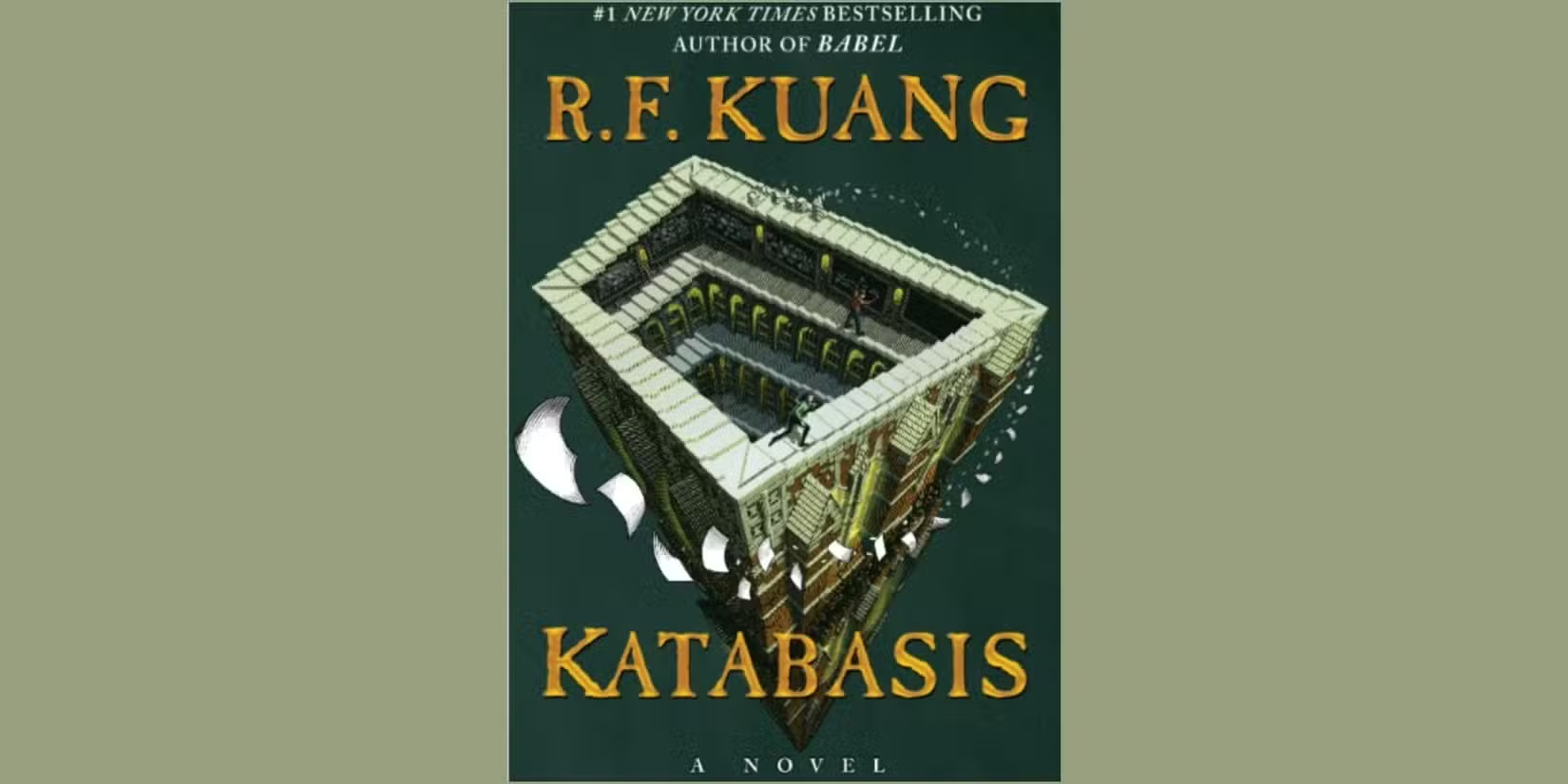
Author R. F. Kuang has been seeing a lot of publicity lately. While she is a student of academia, working on a post-graduate degree, she has received more attention for her popular fantasy novels, which have been absolutely blowing up in recent years. Her most recent effort is Katabasis, a standalone work that feels true to herself. The story follows two PhD students at Cambridge University who descend into the depths of Hell to rescue their professor.
In this story, academia is Hell… literally. While critical reviews have been mixed, many casual readers have absolutely loved this novel. It started simple, but became wonderfully complex, addressing philosophical concepts, important social commentaries, and raising a lot of questions. Some people don’t like the book because they think it isn’t very subtle with what it’s trying to say, but whatever you personally may think about it, Katabasis has been exceptionally popular, winning numerous awards and selling millions of copies.

The Vagrant is the first in a series of the same name, which follows a mute, lone wandered who travels across a war-torn, deserted landscape. This world is populated by terrifying demons (which is where the horror aspects come in), which have forced humanity to take refuge in the distant Shining City. Though it is not initially revealed why, the Vagrant carries a sword and must deliver it to the Shining City before it’s too late.
With this book having a silent protagonist, it has to rely on a lot more than dialogue to tell its story. For that reason, it’s not for everyone, especially if you don’t like long blocks of prose. But for those who are into that sort of thing, it feels like an experiment in storytelling that ultimately works pretty well. If anyone ever feels lost in life or aimless, The Vagrant is a great book to turn to. Even if you don’t feel this way, it’s a unique story that demands more attention.

Between Two Fires is a historical fantasy novel set in the Middle Ages. The plot begins when angels and demons go to war once again, causing the Black Plague to sweep across Europe. In plague-torn France, a disgraced knight rescues a young girl from danger and tries to escort her across the land to a safe place. It’s no easy feat, however, as the Plague isn’t the only thing they have to worry about. In this version of history, horrifying demons roam the landscape and serve as the biggest obstacle in the way of the pair.
The book isn’t just an entertaining novel; it also addresses themes of theology and morality, prompting important questions in the reader. It might be a bit cynical, but hey, that’s the genre, right? The demons and the way they are described definitely evoke horror vibes, so it’s certainly a dark fantasy novel. In fact, it’s one of the best dark fantasy novels ever, receiving critical acclaim and stellar reviews all around.

Vermis I: Lost Dungeons and Forbidden Woods is a really interesting book. It’s not particularly long, but its concept is something unlike anything you’ve ever read before, guaranteed. The artist Plastiboo, whose real name is unknown, created this book as a video game strategy guide for a game that doesn’t even exist. It’s more of an art book than a novel, yet it works so well.
As such, there isn’t really a whole lot of story to this book; it’s purely an exercise in worldbuilding, creating a disturbing and uncanny world for a video game that doesn’t exist, but really should. Despite the fact that there’s no proper narrative, it’s an intriguing concept with an even more intriguing setting, both of which are executed brilliantly. Vermis I is a reading experience that is totally fresh, and that easily sinks its claws in, never letting go of its reader until the end.

Shadows for Silence: In the Forests of Hell is a novella by Brandon Sanderson initially published in a multi-author anthology called Dangerous Women, which also included works from George R. R. Martin and Gardner Dozois. Later, the novella was published as a standalone work and was republished in the author’s personal anthology of short stories, Arcanum Unbounded: The Cosmere Collection. The story is part of Sanderson’s Cosmere universe, which features numerous different series and standalones. The Cosmere itself is a galaxy, with each solar system having a unique magic system.
Shadows for Silence is set on Threnody, a world overcome with a dark force known simply as “the Evil.” Anyone who dies here becomes a Shade, a wandering, ghostly spirit that comes out at night, looking to feed on the living. In the forests of Threnody, Silence Montane works as an innkeeper and mother by day, and a bounty hunter by night. One evening, she gets an offer that she cannot refuse, causing her to make the dangerous voyage out into the woods at night. This story might be short, but it’s a great adventure, and one of the eeriest works in the Cosmere. In fact, it’s the only Cosmere work that is dark fantasy. It’s an absolutely fantastic story about a dark and oppressive world that readers are dying to see more of.

Prince of Thorns is the first of the Broken Empire trilogy, which is set on Earth, centuries after a nuclear apocalypse reverted humanity back to the Dark Ages. Europe, along with parts of Asia and Africa, makes up the eponymous Broken Empire, a land full of feuding royals. Ghosts roam the wastelands at night and necromancers hide in the mountains. In the midst of it all is Prince Jorg Ancrath, a self-professed sociopath who intends to overthrow his father, become king, and eventually Emperor.
Everything about this world is bleak and depressing; there is just no hope to be found anywhere, and only the strong survive, while the merciful meet horrible ends. Not only is it a grimdark story, but it also fits into dark fantasy because there are horror elements, including horrifying nuclear mutants, the undead, and vampiric sorcerers who can raise the dead. It’s one of the rare cases where real life actually looks more appealing than a fantasy world, because living in the Broken Empire world really would suck. Still, the story is great, and it’s refreshing (yet also disheartening) to have such a morally reprehensible protagonist.

The Blade Itself is a novel that is the first of a series, set in a morose world previously inhabited by both demons and humans. Though the demons have long since been banished, their power is still drawn upon by wizards and sorcerers, who reach through to the Other Side and use the power beyond to cast their spells. This first novel establishes this setting, and the characters contained therein, which are a pretty diverse and mostly despicable cast. They’re horrible by design, however, which makes them that much more entertaining.
This book was received very well by critics, many of whom acknowledged that it not only delivered on what it promised, but definitely lived up to its hype. The eclectic, colorful characters received particular acclaim, as they are all engaging and greatly enhance the narrative. The fact that demons and other entities associated with horror are such a major part of this story nestles this book firmly within the dark fantasy genre. Truthfully, it’s one of the best examples of it.

The Dark Tower has become a bit of a household name at this point, almost as much as its author, Stephen King. Infamously, it received an awful film adaptation of the books, which didn’t represent the source material at all. Out of all The Dark Tower books, the second one, The Drawing of the Three, is often considered to be one of the best, if not the absolute best.
The story of The Dark Tower is about a world that is splitting apart at the seams, prompting a knight to search out the mythical titular structure, said to be a gateway to other universes and possibly humanity’s last hope. Being a Stephen King book, of course there are going to be horror elements, which is why it’s dark fantasy. However, the setting is also really unique, as it feels like the Wild West meets steampunk fantasy and horror. It’s a great book series — one of the finest ever conceived, in fact.

The Last Wish is a collection of short stories that serves as one of the prequels to Andrzej Sapkowski‘s The Witcher series, which famously became a video game series and a Netflix series. The Last Wish is mostly a bunch of disconnected stories with no overarching narrative, which is more of a help than a hindrance. The stories, like the rest of the series, feature Geralt of Rivia, a partially undead being known as a Witcher, who is trained in magic and combat to hunt monsters across the countryside.
Most of the monsters featured in the series are largely based on folklore and mythology from all around the world, which includes a lot of ghostly spirits or werewolf-like beings, hence why it’s considered dark fantasy. While this anthology isn’t particularly long, it’s a wild ride from start to finish. It’s also a crucial piece of The Witcher story, as it’s where Geralt meets many of his most trusted allies. The Last Wish serves as the perfect introductory piece for Sapkowski’s works, and also as one of the greatest dark fantasy books ever made.

Divine Comedy is an epic narrative poem written by Florentine poet Dante Alighieri way back in the 14th Century. Though it wasn’t written as such at the time, the story became one of the most impactful and influential works in the entirety of dark fantasy. In fact, it’s a foundational entry, and while it lacks many of the qualities that distinguish dark fantasy, it’s impossible to separate it from the genre. Do note, however, that “comedy” didn’t mean the same thing in the Middle Ages as it does now. Back then, it didn’t mean the story was funny; it just meant that it had a happy ending. The book is actually a deeply serious religious narrative split into three distinct parts.
The first and most famous part is Inferno, about a man travelling through the Nine Circles of Hell to rescue his lover, who has been captured by Satan. The other two parts are called Purgatorio and Paradiso, which dive more into politics and philosophy, a stark departure from the more gripping first part. In any event, the whole poem is one of the greatest pieces of text ever produced, with a legacy spanning centuries and many adaptations across all forms of media. It’s hard to say if dark fantasy would ever even exist without the Divine Comedy, which is why it’s the best dark fantasy book of all time, hands down.

Us Weekly has affiliate partnerships. We receive compensation when you click on a link and make a purchase. Learn more!
Kate Middleton has a way of making even the simplest accessories feel like the must-have items of the season. And this summer, it’s all about raffia clutches. The woven bags are popping up everywhere, thanks to their ability to instantly add a vacation-ready feel to everything from sundresses to wedding guest outfits.
On June 6, the Princess of Wales stepped out for a wedding carrying a chic woven clutch that instantly caught our attention. She paired the woven bag with a beige tweed dress, pointed-toe stilettos and a wide-brim straw hat, proving the summer staple works just as well for special occasions as it does for beach getaways. Unsurprisingly, her exact Forever New bag sold out quickly.
Get the Freie Liebe Raffia Crossbody Clutch for $22 at Amazon! Please note, prices are accurate as of the publishing date but are subject to change.
The good news? You don’t need a royal budget to recreate the look. We found the Freie Liebe Raffia Crossbody Clutch at Amazon, and it’s just $22. The straw construction gives it that breezy, sunny look that’s synonymous with summer, while the gold-tone closure adds a polished touch. Available in natural straw, black and white, it’s the kind of accessory that works just as easily for seaside dinners and weekend brunches as it does for weddings and special events.

Jessica Alba just proved that denim can actually be comfortable. The actress recently stepped out wearing a pair of light-wash ‘sweatpant jeans’ styled with a pink off-the-shoulder sweatshirt, pointed-toe stilettos, oversized sunglasses and a floral handbag. The look struck the perfect balance between casual and polished — and made a strong case for the comfy […]
The purse is also surprisingly versatile. While you can carry it in your hand like a classic clutch, the bag also has a removable chain strap that lets you wear it as a crossbody. That style comes in handy when you want to go hands-free while grabbing drinks during cocktail hour or dancing post wedding ceremony. No matter how you style it, the bag delivers effortless warm-weather appeal that makes raffia accessories a seasonal favorite year after year.
Shoppers are equally impressed. One reviewer who praised its “high-end look” said, “[It] goes with so many different outfits and occasions.” Another loved the woven design for adding a “touch of elegance,” noting the size is “just right for carrying essentials,” like your cell phone, keys and more.
Whether you’re headed to a summer wedding, brunch with friends or a vacation by the water, this raffia clutch purse delivers the same vacation-ready feel as Middleton’s sold-out style for just $22.
Get the Freie Liebe Raffia Crossbody Clutch Purse for $22 at Amazon! Please note, prices are accurate as of the publishing date but are subject to change.
Looking for something else? Explore more from Freie Liebe here and don’t forget to check out all of Amazon’s Daily Deals for more great finds!

Jennifer Lawrence has a knack for making practical pieces feel instantly cool, and her latest summer shoe choice is proof. While flip-flops tend to dominate warm-weather wardrobes, the actress is making a strong case for something a little more unexpected: jelly sandals. Playful, comfortable and surprisingly chic, the nostalgic style is quickly becoming one of […]

John Fogerty’s life is getting turned into a movie and he already has an idea of who could play him in the “amazing” biopic.
“Whoever that Bob Dylan guy was. That would be great,” Fogerty, 81, exclusively told Us Weekly at the 2026 Songwriters Hall of Fame ceremony on Thursday, June 11, of his dream casting scenario.
While the Creedence Clearwater Revival singer couldn’t remember his name, he appeared to be referring to Timothée Chalamet.
Chalamet, 30, transformed into the iconic singer-songwriter Dylan, 85, in 2024’s A Complete Unknown, which was nominated for eight Oscars including Best Actor for his portrayal of the “Mr. Tambourine Man” singer.

Fogerty, for his part, exclusively told Us that a biopic about his career — he cofounded Creedence Clearwater Revival and has had a decades-long solo career — is officially in the works but not much has been revealed about the project.
“That’s going to be a thrill,” the musician teased of the upcoming film. “We are well into this thing. That is about all I can say about it.”
While Fogerty remained tight-lipped about when fans will get to see his world come to life on the big screen, he shared his hopes for the story line with Us.

This weekend, the Boss himself, Bruce Springsteen, gets his own music biopic with Springsteen: Deliver Me from Nowhere. The Bear‘s Jeremy Allen White plays Springsteen at a pivotal point in the musician’s career, and this film is already generating awards buzz. In honor of Springsteen: Deliver Me from Nowhere‘s theatrical debut, Watch With Us has […]
“There have been some twists and turns in my career,” Fogerty explained. “I think the most important thing is what really happened in my life — I actually fell right into a love story that’s true.”
The “Born on the Bayou” singer, who has been married to Julie Lebiedzinski since 1991, noted that his music isn’t the only thing he hopes viewers see play out on screen.
“I’m the most grateful and appreciative man for [Julie] because the whole rest of my life has been a dream,” Fogerty gushed.

John, a California native, rose to fame in the ‘60s after cofounding Creedence Clearwater Revival or CCR with his late brother, Tom Fogerty, Stu Cook and Doug Clifford in 1959. The band was originally named Blue Velvets before being changed to the Golliwogs and finally settling on CCR in 1967.
Once CCR was officially the name, the band released seven studio albums between 1968 and 1972.
The group, which performed at 1969’s Woodstock, churned out chart-topping hits such as “Proud Mary” and “Fortunate Son” before disbanding in 1972.
John, for his part, has continued to sing the band’s songs on his solo tours. (He is currently on his Legacy Tour with his Travelin’ Band.)
On Thursday, John was honored with the Songwriters Hall of Fame’s highest honor, the Johnny Mercer Award, after being inducted into the organization years prior.
“I love music! It’s supposed to be about joy. It’s supposed to be about fun,” John said during his acceptance speech.
He went on to explain that the “concept of taste” in music comes down to, “Why do some songs suck and some songs are great?”
John mused, “It seems like the great ones just flow effortlessly. There’s no wasted moments. … I wanted to reach that very high bar. I think that’s something everybody in this room understands.”

By Robert Scucci
| Published

If there’s anything I love more than a solid thriller, it’s one that makes me laugh. If it makes me laugh at things I shouldn’t be laughing at, even better. Which is why I’m ashamed to admit that I’d never even heard of 1996’s Freeway until I scrolled past it on Tubi and saw that Reese Witherspoon and Kiefer Sutherland share top billing, and that the film has an agreeable 76 percent score between critics and audiences on Rotten Tomatoes. I loved Election (1999), but admittedly I’m not fully versed in Witherspoon’s filmography. What I do know, though, is that when she’s given an opportunity to go nuts, she knows how to deliver.
I’m happy to say that Freeway is not only solid for its time, but actually holds up remarkably well today because it operates in a lane far enough removed from polite society to feel universal. Its characterization is also so strong that you’re not even thinking about what year it is.

The less you know about Freeway, the better, because the whole film is a slow crescendo of insanity.
The surface-level plot is simple enough. 14-year-old and illiterate Vanessa Lutz (Reese Witherspoon) runs away from her abusive and neglectful family to start a new life. When her car breaks down, she’s picked up by a charming and unassuming man named Bob Wolverton (Kiefer Sutherland), who she quickly bonds with through conversation, revealing more than she probably should about her questionable upbringing.

Once Vanessa appears comfortable enough around Bob, he reveals that he’s a serial killer known as the I-5 killer, and that she’s about to become his next victim. Vanessa manages to overpower him with the gun her boyfriend gave her before she left home, leaves him for dead, and flees to a diner, where she’s subsequently arrested for shooting the man. Bob survives but suffers permanent disfigurement, and now denies any connection to the I-5 killer whatsoever.
The film quickly transitions from a story of survival to one of revenge. Now trapped in prison and facing the possibility of being tried as an adult, Vanessa needs to figure out how to survive her new surroundings, clear her name, and somehow kill Bob, who thinks he’ll never have to answer for his crimes.

Freeway is one of Witherspoon’s best early performances, and she fully commits to Vanessa’s insane adventure. She convincingly portrays a young woman who’s wise beyond her years despite her illiteracy, in the sense that her survival instincts are more evolved than those of somebody 20 years her senior. She hams it up with the officers when she knows she’s in trouble, but she also knows when to show her teeth when her safety is compromised, whether she’s in a holding cell, on the streets, in prison, or back at home.
Remember how I said this movie is funny? It comes from how terrifying she is when in a state of shock or self-defense. When she walks into that diner to gather her senses, she calmly sits down and orders food, completely unaware that she’s pretty much covered in Bob’s blood until the waitress points it out.

Kiefer Sutherland is an absolute menace, and his straight-faced intensity is brilliantly offset by Witherspoon’s confrontations when the timing is just right. It’s one of those dynamics that makes you wish they’d worked together on more projects. I don’t think we’d get the same performance out of Witherspoon if Sutherland weren’t so perfectly cast as Bob Wolverton. He toes the line between charming and creepy flawlessly, which is exactly how I imagine a serial killer living a double life would act when his old ball and chain isn’t around, or even aware of his whereabouts for that matter.
Freeway never wears out its welcome, and I strongly recommend it to anybody looking for a solid, straight-up thriller. Just when you think it can’t escalate any further, it finds a way. While there’s no real moral ambiguity here, it’s a raw and exciting take on the kinds of true crime stories that are all over your Netflix feed.


As of this writing, you can stream Freeway for free on Tubi.

By Jonathan Klotz
| Updated

Disney has been around for a long, long time now, and over the decades, the company has wiped a movie from the timeline, Song of the South, and oddly, an episode of Darkwing Duck. The first is because of the racism, but the second is a little surprising. What could be in the Ducktales spin-off that was so horrible Disney pulled it from airing and has never made it available on Disney+? It’s Satan. Turns out, parents weren’t fond of a cartoon including a plot about the Devil making a deal with one of the main characters.

Darkwing Duck was always a darker series than Ducktales but the banned episode, “Hot Spells,” goes a little further than the color palette and the Batman-style rogue’s gallery. Goslyn, Darkwing’s daughter, is bored when she goes to a magical school alongside Darkwing and Morgana, finding that magic isn’t as fun as it sounds. It’s a lot of math. The Janitor, Beezelbub in disguise, takes advantage of the opportunity to trick her into a deal that gives her magic, but allows him to take Darkwing Duck’s soul.

Together, Morgana and Goslyn are able to trick Beezelbub into releasing Darkwing Duck. It’s still a Disney afternoon cartoon after all. By then though, the damage was done, and parents lit up the switchboards at ABC with complaints that their child watched the Devil himself. The odd thing is, it wasn’t Beezelbub’s first appearance.
Beezelbub, or The Devil, or Satan, depending on how you want to refer to him, appeared in the episode “Dead Duck” when Darkwing passed away (temporarily). Meeting the Masked Mallard at the Pearly Gates, Beezelbub tried to convince St. Peter that the hero should be in Hell. At the end of the episode, Darkwing wakes up with a bump on his head, thinking it was all a dream.

More Darkwing Duck episodes wound up being banned, including “Tiff of the Titans,” which included a cameo from Gizmo Duck. That one was banned due to a terrorism plot. Around September 11, 2001, it was caught up in the rush of entertainment banned, albiet briefly, due to sensitivity. “Bearskin Thug” was pulled in 2001 as well after complaints that the bear was too scary. The best banning though was “Aduckyphobia,” pulled because the character Arachno-Duck was too similar to a certain wall-crawling Marvel superhero.
With the exception of “Hot Spells,” the banned episodes have been restored on Disney+. Internationally, “Hot Spells” is available for streaming, but within the U.S., it’s been banned for over 30 years and counting. A character giving into temptation and making a deal with the devil is pretty common in shows like Supernatural, or well, Lucifer, but the afternoon cartoon was a bridge too far.
Darkwing Duck is one of the many shows that Disney hasn’t done much with over the years. For a decade, there have been rumors of a legacy sequel featuring a grown-up Goslyn and an older Drake Mallard, produced by Seth Rogen. A few months ago, the original voice for D.W., Jim Cummings, said he had recorded a scene, so fans can cautiously look forward to more news about the return of Darkwing Duck in the near future. This time, Satan won’t be included.

“Real Housewives of New York City“ alum Luann de Lesseps is gearing up for the premiere of her new show, “The Golden Life.” Now, ahead of the series, she’s reacting to her costars, Ramona Singer and Sonja Morgan, having recently reunited with Bethenny Frankel.
This comes weeks after E! released the trailer for the series, which is slated to premiere this fall.

De Lesseps was featured on Page Six’s Virtual Reali-Tea podcast in June 2026. During her interview, the “Real Housewives of New York City” alum was asked about the RoC ad Morgan and Singer recently shot with Frankel in Paris.
In reacting to it, she began, “Good for them. I think they needed a little cash, so, perfect.” After joking with the podcast hosts, the Cabaret performer added, “It’s a cash grab, what do you want?” Then, De Lesseps was asked if she believes the three ladies still speak after shooting the ad.
She responded, “I’m sure they do. They can have their relationships. They can be friends with whoever they want.” She then added, “They went very quickly, and then they came back very quickly because we had our own show to do.”
During the interview, she was also asked if she’d rather go ziplining or do the ad with her co-star. She said, “Oh, girl, give me a zip line any day. So I can zip on out of there.”

De Lesseps has had a contentious relationship with Frankel for several years. Their last big clash came during the “RHONY” episode from season 11 titled “Life is not a Cabaret.” Years later, in 2024, the two reunited and took a photo in the Hamptons.
However, the reunion was short-lived as De Lesseps accused her former co-star of posting the photo for clout and using her daughter in the process. She told Us Weekly in July of that year, “After watching Bethenny’s video and still being blocked by her on social media, I realize she just used her daughter to get to me.”
She continued, claiming the photo opp “wasn’t a genuine reconnection.” She added, “To watch the video, it hurt my feelings.”
Before her change of heart about Frankel’s motivations for the photo, De Lesseps told the outlet, “I’ve been through a lot with Bethenny, but I am not the person who hangs on to the past. We are moving through it in a positive way. Because life is a cabaret.”

The ups and downs of De Lesseps’ friendship with Frankel have been well documented on and off of “The Real Housewives of New York City.” Because of this, De Lesseps’ most recent comments about her former costar have caused varying reactions from fans. Overall, social media users think the “RHONY” alum was only having fun.”
One person said, “Luann’s ability to always drag Bethenny is beyond funny to me.” Another person wrote, “I think Luann and B are going to come together again. Just wait and see.” After that, someone else pointed out that she shaded her “Golden Life” costars, saying, “I think this new show is going to be more drama than we thought.”

E! announced “The Golden Life” in February 2026. In addition to De Lesseps, Singer, and Morgan, the original cast of the show included Jill Zarin and Kelly Bensimon. However, Zarin was fired before production began over her comments about the most recent Super Bowl halftime performance. Following the change, Dorinda Medley was added to the cast.
Then, in May, the first official trailer was released. The teaser featured each of the ladies giving a summary of their time in Florida, with moments of drama and laughs from the show sprinkled between.

De Lesseps was interviewed by PedestrianTV in February 2026, shortly after Zarin was confirmed to have been fired from “The Golden Life.” When asked for her thoughts on the matter and what her former costar had said, she stated, “My reaction was: ‘tone-deaf.’”
She continued, “I’ve known Jill for a long time, and I’m just surprised by the whole thing.” The “RHONY” alum then called the situation “unfortunate” before saying, “But the show must go on.”
Y’all! Rihanna and A$AP Rocky are no strangers to serving couple goals, but this time, it was RiRi’s candid commentary that had social media doing a double-take. While celebrating a major moment tied to the New York Knicks and showing love to Rocky’s latest accomplishment, the singer and business mogul couldn’t resist sharing a few unfiltered thoughts about her man, her man, her man.
In a video making rounds online, Rihanna appeared in a coordinated denim look featuring a red belt, beige heels, and a wet-look curly hairstyle that practically screamed confidence. With her flawless glam and undeniable presence, the Fenty founder gave fans a reminder that her face card remains undefeated as she flipped through a magazine featuring Rocky on the cover.
While holding the magazine, Rihanna proudly showed off the cover and praised Rocky’s involvement in bringing the iconic brand back into the spotlight. “And this is my n***a,” she said while making sure the magazine was front and center. “My baby daddy brought Vibe back. You know, the vibe has been lost. The vibe has been brought back. Oh my god, look. Right there.”
What Do You Think Roomies?
By Jonathan Klotz
| Published

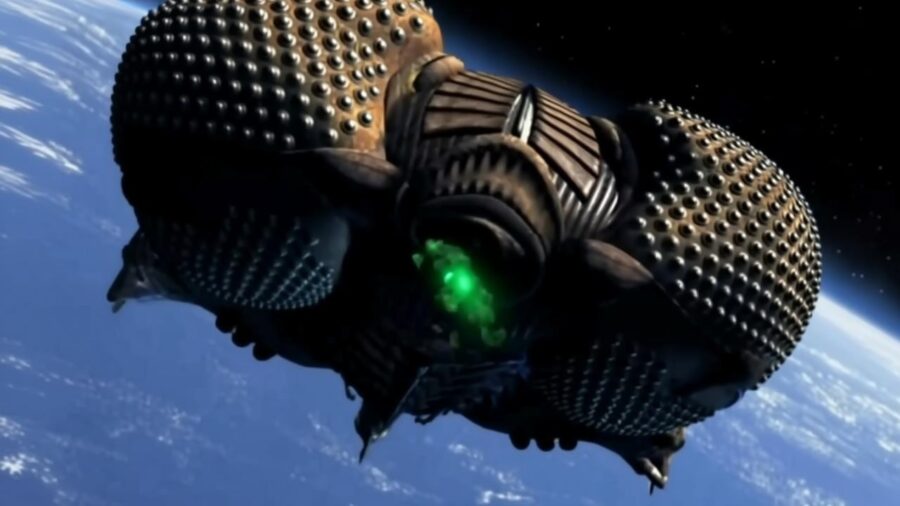
There’s nothing quite like low-budget Canadian sci-fi. Budget constraints don’t hinder the creativity of the cast and crew. Instead, the limitations let them run with whatever wild idea comes to mind, so long as it’s cheap. A sign this has happened is when a sci-fi series suddenly has most of the stories taking place on contemporary Earth. When Lexx Season 4 revealed it was going to do just that, fans wondered what to expect. How could the budget be less? After the oddly dark third season, what would the writers do to top themselves? The answer: Everything they could think of.

Lexx Season 4 feels like no idea was deemed too dumb to make it to air. Stanley Tweedle is the one who initiates alien first contact, Lexx eats part of the Amazon Rainforest, Kai learns the Earth is doomed to destroy itself, 790 turns traitor and sides with Prince, reincarnated as a human, who manages to get his lieutenant, Priest, elected as President of the United States. And then there’s what Xev is up to.
After the wild season premiere, Xev winds up in Texas, with predictable results. A local boy become sobsessed with her, but so do his friends, so he kills them. Xev is in jail, where the Sherrif’s goth daughter, a reincarnated Lomea from back in Season 2, takes a liking to Xev. Naturally, that means Xev is forced to be the star of her internet show. You saw that twist coming, right?

The show does find a groove. It’s insane, but it’s a groove. There’s an episode based on A Midsummer Night’s Dream that involves Stanley realizing what 1500 years of marriage to Oberon would entail, carrot probes overrun the country, the crew decides to live in the suburbs in the most delirious episode of the season that ends in a massive shootout. Oh, and Lexx, running out of power, eats the country of Holland for fuel. All very normal things.

Even at its very best, Season 2, Lexx was a bizarre show. Season 4 goes so far that some fans bail after the Season 3 finale. It’s understandable. The change of setting, the concept of past villains reincarnating as Humans, 790 going full evil, it feels like a different series. That feeling is on purpose. Lexx never embraced concepts like narrative cohesion. Every season is wildly different from the one that came before. It’s messy, it’s chaotic, and it’s incredibly creative.
You can say a lot about Lexx. It embraces low-brow humor, and there are sex references everywhere, but it’s not boring. The cast and crew take major swings in every episode, including a musical episode, making it the perfect binge for anyone bored with every modern sci-fi series playing it safe. Season 4 is bizarre. It makes very little sense, and it might turn Lexx into your favorite show.
Lexx is now streaming on Tubi.




Alexander Zverev wins the French Open to finally earn a 1st Grand Slam title

The Best Mystery Series of All Time Is Surging on Streaming 30 Years After It Ended


Anatomy of the June crypto crash: Fed, Iran, Saylor


Oppenheimer backs SpaceX as $70 billion retail frenzy builds


Markets Rally as SpaceX IPO Looms Amid Iran Tensions and Inflation Surge

Senator Cynthia Lummis Calls CLARITY Act the Most Consequential Financial Legislation of This Generation

Alexander Zverev conquers demons and outlasts Flavio Cobolli to win French Open for first major title


Microsoft unveils seven homegrown AI models in new bid for ‘long term self-sufficiency’


Hackers now exploit SolarWinds Serv-U flaw to crash servers


High Stakes for Wembanyama as New York Pushes for 3-0 Lead

The Pain Points Taking a Fragile Tech Rally Down a Notch


Notion restores access to Anthropic after service disruption

Eli Lilly (LLY) Stock Surges 4% Following Breakthrough Sleep Apnea Trial Results


Trump’s AI Ownership Plan Could Benefit Anthropic at OpenAI’s Expense

The investment to transform historic St Helen’s ground in Swansea

Bangladesh beat Australia after 20 years in ODIs, register only their second win over six-time world champions | Cricket News


Forensic Expert Floats Handyman Theory in Disappearance of Savannah Guthrie’s Mother


NanoClaw integrates JFrog registries to secure AI agent downloads


This Week In Security: Microsoft On Microsoft, Register Your Domains, Linux On ARM, And FreeBSD Joins The File Cache Club


Politics Home | Healey Resignation Is “Colossal Failure Of Government”, Says Former Labour Defence Secretary


You must be logged in to post a comment Login