When Christopher Nolan’s The Dark Knight was seemingly snubbed at the Oscars, especially in the Best Picture and Best Director categories, the Academy made sweeping changes to its nominations process. It increased the nomination pool for the Best Picture category to a maximum of 10, opening the door for mainstream hits such as The Dark Knight. The very next year, James Cameron’s Avatarbenefited from this rule change, scoring a Best Picture nod as the representative for blockbuster cinema. It faced off in a memorable David-versus-Goliath showdown against Kathryn Bigelow’s small-budget dramatic war thriller The Hurt Locker. But there was another mainstream genre hit that scored a Best Picture nomination in the same year, and now it’s on its way to a free streaming platform amid rumblings of a sequel.
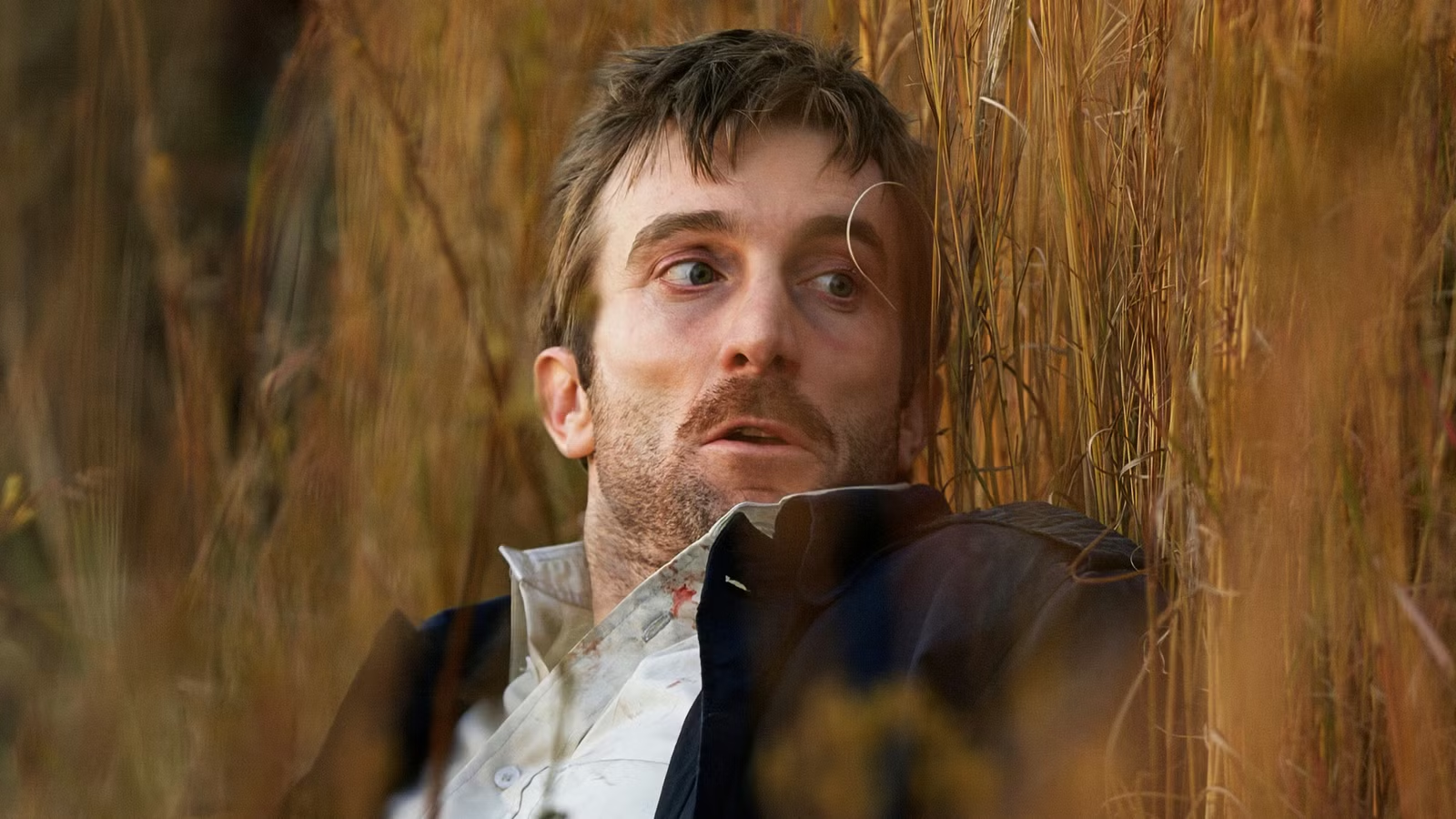
The movie in question was released in 2009 and produced by Peter Jackson. The Oscar-winning director behind The Lord of the Rings trilogy was a fan of the South African short film upon which the feature was based. The movie emerged as a word-of-mouth hit, grossing more than $210 million worldwide against a reported budget of $30 million. In addition to its Best Picture nomination, it was also nominated in three more categories and acclaimed for its depiction of South Africa’s Apartheid era in a sci-fi context.
Advertisement
Advertisement
Collider Exclusive · Sci-Fi Survival Quiz Which Sci-Fi World Would You Survive? The Matrix · Mad Max · Blade Runner · Dune · Star Wars
Five universes. Five completely different ways the future went wrong — or sideways, or up in flames. Only one of them is the world your instincts were built for. Eight questions will figure out which dystopia, galaxy, or desert wasteland you’d actually make it out of alive.
💊The Matrix
🔥Mad Max
🌧️Blade Runner
Advertisement
🏜️Dune
🚀Star Wars
Advertisement
01
You sense something is deeply wrong with the world around you. What do you do? The first instinct is often the truest one.
Advertisement
02
In a world of scarcity, what resource do you guard most fiercely? What we protect reveals what we believe survival actually requires.
Advertisement
03
What kind of threat keeps you up at night? Fear is useful data — if you’re honest about what you’re actually afraid of.
Advertisement
04
How do you deal with authority you don’t trust? Every dystopia has a power structure. Your approach to it determines everything.
Advertisement
05
Which environment could you actually endure long-term? Survival isn’t just tactical — it’s physical, psychological, and very much about where you are.
Advertisement
06
Who do you want in your corner when things fall apart? The company you keep is the clearest signal of who you actually are.
Advertisement
07
Where do you draw the line — if you draw one at all? Every survivor eventually faces a moment that tests what they’re actually made of.
Advertisement
08
What would actually make survival worth it? Staying alive is one thing. Having a reason to is another.
Advertisement
Your Fate Has Been Calculated You’d Survive In…
Your answers point to the world your instincts were built for. This is the universe your temperament, your survival instincts, and your particular brand of stubbornness were made for.
Advertisement
The Resistance, Zion
The Matrix
You took the red pill a long time ago — probably before anyone offered it to you. You’re a systems thinker who can’t help but notice the seams in things.
Advertisement
You’re drawn to understanding how the system works before figuring out how to break it.
You’d find the Resistance, or it would find you — your instinct for spotting constructed realities is the machines’ worst nightmare.
You function best when you have access to information and the freedom to act on it.
The Matrix built an airtight prison. You’d be the one probing the walls for the door.
The Wasteland
Mad Max
The wasteland doesn’t reward the clever or the well-connected — it rewards those who are hard to kill and harder to break. That’s you.
Advertisement
You don’t need comfort, community, or a cause larger than the next horizon.
You need a vehicle, a clear threat, and enough fuel to outrun it — and you’re good at all three.
You are unsentimental enough to survive that world, and decent enough — just barely — to be something more than another raider.
In the wasteland, that distinction is everything.
Los Angeles, 2049
Blade Runner
You’d survive here because you know how to exist in moral grey areas without losing yourself completely.
Advertisement
You read people accurately, keep your circle small, and ask the questions others prefer not to answer.
In a city where humanity is a legal designation rather than a feeling, you hold onto something that keeps you functional.
You’re not a hero. But you’re not lost, either.
In Blade Runner’s world, that distinction is everything.
Arrakis
Dune
Arrakis is the most hostile environment in the known universe — and you are precisely the kind of person it rewards.
Advertisement
Patience, discipline, and political awareness are your core strengths — and on Arrakis, they’re survival tools.
You understand that the long game matters more than any single victory.
Others come to Dune and are consumed by it. You’d learn its logic and earn its respect.
In time, you wouldn’t just survive Arrakis — you’d begin to reshape it.
A Galaxy Far, Far Away
Star Wars
The galaxy far, far away is vast, loud, and in a constant state of violent political upheaval — and you wouldn’t have it any other way.
Advertisement
You find meaning in being part of something larger than yourself — a cause, a crew, a rebellion.
You’d gravitate toward the Rebellion, or the fringes, or whatever pocket of the galaxy still believes the Empire’s grip can be broken.
You fight — not because you have to, but because standing aside isn’t something you’re capable of.
In Star Wars, that willingness is what makes all the difference.
Advertisement
Here’s Where You Can Watch the Sci-Fi Sensation for Free
We’re talking, of course, about District 9, director Neill Blomkamp’s acclaimed feature debut based on his own short. Starring Sharlto Copley, the movie now holds a “Certified Fresh” 90% score on the aggregator website Rotten Tomatoes, where the consensus reads, “Technically brilliant and emotionally wrenching, District 9 has action, imagination, and all the elements of a thoroughly entertaining science-fiction classic.” Blomkamp was instantly hailed as Hollywood’s next big thing, but his subsequent sci-fi movies didn’t exactly break out like District 9 had. There have long been rumors of a District 10, although no firm updates have emerged in recent years. You can watch District 9 on Pluto TV starting August 1, and stay tuned to Collider for more updates.
Teen Mom’s Jenelle Evans is honoring her eldest son, Jace, on his 17th birthday amid her family’s public struggles.
“I HAVE A 17 YEAR OLD! 🎉🫶🏼😭,” Evans, 34, wrote via Instagram on Sunday, August 2, while sharing a series of photos of the pair through the years. “Being a teenager can be hard, but you seem to handle it well.”
She continued, “You’re so smart, curious about life, and handsome. Hope today is everything you’ve wanted and more! I love you @jace_vahn ♥️.”
Evans welcomed her son in 2009 with ex Andrew Lewis. After the pair split, Evans welcomed son Kaiser in 2014 with ex-boyfriend Nathan Griffith. She has since added to her family with the arrival of daughter Ensley in 2017, whom she welcomed with David Eason.
TMZ reported at the time that Jace had been placed in a mental health facility after allegedly pulling a gun on Barbara in late February, claiming that the incident occurred while he was under the influence of drugs and alcohol. (Jace was living with Barbara in North Carolina at the time.)
Months later, Jenelle shared that Jace was in a good place.
“I’ll let you know something that I haven’t told anyone,” Jenelle said during an episode of the “La Femme Talk” podcast in April. “You know I’ve been very quiet online, and behind the scenes, I’ve been actually getting help for my son as needed, and he’s in a safe place [in a] holistic approach.”
Teen Mom alum Jenelle Evans is assuring fans that her 16-year-old son Jace is in good hands. “I’ll let you know something that I haven’t told anyone,” Evans, 34, shared on the Monday, April 13, episode of the “La Femme Talk” podcast. “You know I’ve been very quiet online, and behind the scenes, I’ve been […]
Jace was “very happy right now” and “very focused on himself,” according to Jenelle.
Advertisement
“I think that’s the most important thing,” she explained. “A lot of people, they think since I’m being so quiet that I might not be doing anything and not taking action. But just know that if I’m quiet, I’m up to something.”
Thank You!
You have successfully subscribed.
Jenelle shared a subsequent update on Jace in July, while posting several images of her son. In one photo, Jace smiled as he strummed a guitar.
Advertisement
“And here’s a real update about Jace. From what I choose to share, he’s working on himself and focusing on his emotions. He’s obviously had ups and downs but I’m hoping for the best in his future. Here’s some awesome pictures of his progress,” Jenelle wrote via Instagram at the time.
She continued, “I’ve had countless night of crying over the past 6 months because i want him to be happy and will do whatever it takes to help him mentally and physically. As his mother I WILL NOT give up. 🥹❤️🩹 #TeamJace.”
There is plenty of great science fiction television being produced today. From game-changing anthology series like the timeless Black Mirrorto prestigious award winners like Severance, many modern sci-fi shows are proof that the genre is still alive and well. But all 21st-century genre shows inevitably stand on the shoulders of giants, and sci-fi masterpieces like those are no exception. If one looks back at the greatest classics that the genre had to offer throughout the 20th century, one will always be able to find classics that have aged so well that they’re still better than most shows being made today.
It can be yet another anthology masterpiece, such as the criminally underappreciated The Outer Limits; or a revolutionary serialized classic such as Babylon 5. Regardless of what kind of sci-fi classic we’re talking about, the genre’s best 20th-century productions can all be put side by side with even the best science fiction gems being made for the small screen today and come out on top. They are foundational to these sorts of stories, proof that all television genres are the product of a long trajectory of shows that kept evolving the way such stories were told.
Advertisement
7
‘The Outer Limits’ (1963–1965)
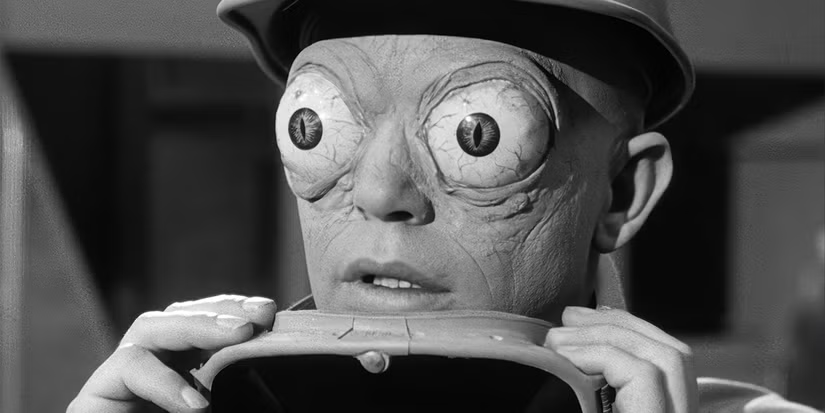
A terrifying, bug-eyed human creature in The Outer Limits.Image via ABC
After the unprecedented success of The Twilight Zonein the late ’50s and early ’60s, a wave of copycat shows started to visit families’ living rooms across the globe. But even though these shows were clearly other networks’ attempts at replicating the impact of CBS’ timeless classic, that didn’t necessarily mean that such copycat shows were always bad. Case in point: ABC’s The Outer Limits, which was sometimes genuinely just as great as the CBS classic that clearly influenced its creation.
The Outer Limits is one of those forgotten horror shows that have aged like fine wine, steering clear of the occasional supernatural fantasy that Twilight Zone sometimes threw into its episodes and instead remaining pure science fiction and horror throughout. For sci-fi superfans, this should prove terribly appealing. It’s full of creative premises and hugely original ways of approaching them, making the absolute best of its shoestring budget.
Advertisement
6
‘Stargate SG-1’ (1997–2007)
Teal’c and jack O’ Neal strategizing_Stargate SG-1Image via ShowTime
The 1990s were arguably the best decade for sci-fi TV, and few shows demonstrate all the reasons why better than Stargate SG-1. The Stargate franchise was born in 1994 with Roland Emmerich‘s classic film, but where the series really took off was with the airing of SG-1, which is still one of the best military sci-fi shows ever made. With its incredible world-building and its flawless balance of serialization and episodic elements, it’s one of the most timeless series the genre has seen in modern times. It’s better than the original 1994 film, and it’s definitely better than most sci-fi movies being produced today.
It’s not soapy, it’s not overly serious, and it never pretends to be deeper than it needs to be. Instead, Stargate SG-1 consistently focuses on being pure small-screen entertainment, having fun with its “planet of the week” format in all sorts of unexpected ways that keep it rewatchable even after several re-visits. Its cast ensemble has exceptional chemistry, and its sense of humor keeps all of its high-stakes stories irresistibly fun throughout. There simply aren’t very many military sci-fi shows this dedicated to ensuring that the audience has a good time with every single passing episode.
Advertisement
5
‘Cowboy Bebop’ (1998–1999)
Spike from Cowboy Bebop wearing a device on his back and staring ahead.Image via Sunrise
Largely credited with having helped popularize anime television in the late ’90s and early 2000s, Cowboy Bebophas genuinely aged like fine wine, still being as widely beloved today as it used to be—If not even more so. It’s just that great of a show, a genre-bending masterpiece that functions equally well as a delightful space Western and a mysterious neo-noir crime drama. It only ran for a mere 26 episodes, making it remarkably breezy to binge-watch in a few afternoons.
It’s generally regarded as one of the few anime shows without any significant flaws, proof that even though perfection may not technically be possible when it comes to television-making, some series can come surprisingly close. With its perfectly-written dialogue (which is memorable in English and the original Japanese alike), its deeply endearing set of main characters, its iconic jazz soundtrack, and its visuals (which are still awfully impressive to this day), this is essential viewing for anyone and everyone who loves science fiction.
Advertisement
Collider Exclusive · Sci-Fi Survival Quiz Which Sci-Fi World Would You Survive? The Matrix · Mad Max · Blade Runner · Dune · Star Wars
Advertisement
Five universes. Five completely different ways the future went wrong — or sideways, or up in flames. Only one of them is the world your instincts were built for. Eight questions will figure out which dystopia, galaxy, or desert wasteland you’d actually make it out of alive.
💊The Matrix
🔥Mad Max
🌧️Blade Runner
🏜️Dune
Advertisement
🚀Star Wars
Advertisement
01
You sense something is deeply wrong with the world around you. What do you do? The first instinct is often the truest one.
Advertisement
02
In a world of scarcity, what resource do you guard most fiercely? What we protect reveals what we believe survival actually requires.
Advertisement
03
What kind of threat keeps you up at night? Fear is useful data — if you’re honest about what you’re actually afraid of.
Advertisement
04
How do you deal with authority you don’t trust? Every dystopia has a power structure. Your approach to it determines everything.
Advertisement
05
Which environment could you actually endure long-term? Survival isn’t just tactical — it’s physical, psychological, and very much about where you are.
Advertisement
06
Who do you want in your corner when things fall apart? The company you keep is the clearest signal of who you actually are.
Advertisement
07
Where do you draw the line — if you draw one at all? Every survivor eventually faces a moment that tests what they’re actually made of.
Advertisement
08
What would actually make survival worth it? Staying alive is one thing. Having a reason to is another.
Advertisement
Your Fate Has Been Calculated You’d Survive In…
Your answers point to the world your instincts were built for. This is the universe your temperament, your survival instincts, and your particular brand of stubbornness were made for.
Advertisement
The Resistance, Zion
The Matrix
You took the red pill a long time ago — probably before anyone offered it to you. You’re a systems thinker who can’t help but notice the seams in things.
You’re drawn to understanding how the system works before figuring out how to break it.
You’d find the Resistance, or it would find you — your instinct for spotting constructed realities is the machines’ worst nightmare.
You function best when you have access to information and the freedom to act on it.
The Matrix built an airtight prison. You’d be the one probing the walls for the door.
Advertisement
The Wasteland
Mad Max
The wasteland doesn’t reward the clever or the well-connected — it rewards those who are hard to kill and harder to break. That’s you.
You don’t need comfort, community, or a cause larger than the next horizon.
You need a vehicle, a clear threat, and enough fuel to outrun it — and you’re good at all three.
You are unsentimental enough to survive that world, and decent enough — just barely — to be something more than another raider.
In the wasteland, that distinction is everything.
Advertisement
Los Angeles, 2049
Blade Runner
You’d survive here because you know how to exist in moral grey areas without losing yourself completely.
You read people accurately, keep your circle small, and ask the questions others prefer not to answer.
In a city where humanity is a legal designation rather than a feeling, you hold onto something that keeps you functional.
You’re not a hero. But you’re not lost, either.
In Blade Runner’s world, that distinction is everything.
Advertisement
Arrakis
Dune
Arrakis is the most hostile environment in the known universe — and you are precisely the kind of person it rewards.
Patience, discipline, and political awareness are your core strengths — and on Arrakis, they’re survival tools.
You understand that the long game matters more than any single victory.
Others come to Dune and are consumed by it. You’d learn its logic and earn its respect.
In time, you wouldn’t just survive Arrakis — you’d begin to reshape it.
Advertisement
A Galaxy Far, Far Away
Star Wars
The galaxy far, far away is vast, loud, and in a constant state of violent political upheaval — and you wouldn’t have it any other way.
You find meaning in being part of something larger than yourself — a cause, a crew, a rebellion.
You’d gravitate toward the Rebellion, or the fringes, or whatever pocket of the galaxy still believes the Empire’s grip can be broken.
You fight — not because you have to, but because standing aside isn’t something you’re capable of.
In Star Wars, that willingness is what makes all the difference.
If online sci-fi geekdom is as huge as it is today, that’s only because there was a certain massively influential sci-fi series whose audience pretty much pioneered fandom culture on the worldwide web: The X-Files, still widely recognized as one of the most groundbreaking shows the genre has ever produced. There is virtually no sci-fi or supernatural procedural being made today which doesn’t owe at least some inspiration to The X-Files, and no buddy series which wasn’t at least a little influenced by the chemistry between Mulder and Scully.
The X-Files is the very definition of a timeless show, and it’s definitely one of the best crime shows of the ’90s. Aside from the “oozing-off-the-screen” chemistry shared between both Mulder and Scully and David Duchovny and Gillian Anderson, The X-Files has plenty more to offer to fans of classic science fiction television. Its elements of serialization should be perfectly able to appeal to people who love self-contained sci-fi stories on the small screen, while its episodic “case of the week” format should keep fans of the likes of Supernaturaland Buffy the Vampire Slayerglued to the screen throughout.
3
‘Babylon 5’ (1994–1998)
Commander Sheridan running the show.Image via PTEN
Advertisement
What made Babylon 5 so special back in the day is that, in a twist quite uncommon for American broadcast television at the time, it was designed as a sort of “novel for television” where every season would serve as a pre-planned chapter of that story. Of course, serialized sci-fi being the norm in today’s streaming era, that doesn’t really set Babylon 5 apart anymore. And yet, it’s still one of the best sci-fi series of all time, a must-see today just as much as it was back during the ’90s.
It’s one of the best military sci-fi shows of its era and of all time, a delightfully entertaining space opera whose serialization doesn’t feel primitive or thin in the slightest. On the contrary: Babylon 5 tells a story that’s still among the most compelling that American science fiction television has ever told. The characters are endearing, their arcs are compelling, the narrative keeps a great sense of momentum throughout all five seasons, and the top-tier production values are a phenomenal foundation for it all.
2
‘The Twilight Zone’ (1959–1964)
Rod Serling delivers opening narration from the top of the cylinder in The Twilight Zone episode “Five Characters in Search of an Exit.”Image via CBS
Advertisement
There are those who would very reasonably hail Rod Serling‘s The Twilight Zone as the single most influential sci-fi TV show of all time, and for good reason. Serling’s masterpiece didn’t just break new ground in the realm of anthology science fiction: It revolutionized the sci-fi genre altogether, proving that these stories that audiences had looked down on as “low-brow” for so long could actually serve as serious, dramatic, thought-provoking reflections of contemporary society.
Today, The Twilight Zone and all of its deeply engaging meditations on humanity’s relationship to technology and the future have aged like fine wine, some episodes even feeling a bit prophetic. It’s one of those soft sci-fi shows whose every episode’s a masterpiece, and even though some Twilight Zone stories are more memorable and better-written than others, all of them are worth watching. Over six decades after its pilot aired, Rod Serling’s creation is still remembered as one of the most important shows in the history of science fiction television.
1
‘Star Trek: The Next Generation’ (1987–1994)
Captain Picard (Patrick Stewart) after being assimilated by the Borg as “Locutus of Borg” in the Star Trek: The Next Generation episode “The Best of Both Worlds.”Image via Paramount Television
Advertisement
There are many Star Trekfans who long for the good ol’ days, and it’s not just because of nostalgia. In no small measure, it’s surely because it’s the good ol’ days during which The Next Generationwas airing, and that’s a show that many still confidently call the best piece of Star Trek media ever. Not only that: We’re also talking about one of the greatest and most essential space operas in television history, one of those classic sci-fi shows that have aged like fine wine.
What’s not to love about Star Trek: The Next Generation? The cast is absolutely perfect, and the characters they’re playing are among the genre’s most memorable; the writing for almost every episode of the show is done with the kind of uniquely optimistic attitude that makes Star Trek so special to begin with; and the production values all still look terrific nowadays. Adventurous, inspiring, deeply philosophical, and feel-good to the core, it’s top-tier Star Trek and thus better than 99% of the science fiction films being made today.
Cliff Bole, Les Landau, Winrich Kolbe, Rob Bowman, Robert Scheerer, Jonathan Frakes, Robert Wiemer, Gabrielle Beaumont, Alexander Singer, David Carson, Paul Lynch, Corey Allen, Patrick Stewart, Chip Chalmers, Joseph L. Scanlan, James L. Conway, Robert Lederman, Tom Benko, Timothy Bond, Robert Legato, Adam Nimoy, Robert Becker, David Livingston, LeVar Burton
Jaime VandenBerg is breaking down the reason she decided to hide her pregnancy while competing at Miss Universe in 2025.
“We did not tell our family nor the Miss Universe Canada organization at that time, and chose to keep it to ourselves for quite some time,” VandenBerg told People in an interview published on Sunday, August 2. “I really loved that we did that because it made the pregnancy feel that much more intimate in an era of my life where everything was so in the public eye.”
VandenBerg explained that she wanted to be judged based on her work rather than her pregnancy. (VandenBerg has raised awareness about gender-based violence after surviving a near-fatal shooting in 2021.)
“I felt strongly that if I announced my pregnancy publicly, I risked becoming viewed primarily as ‘the pregnant contestant,’ rather than being evaluated for my advocacy work, my resilience and the decade of dedication that led me there,” VandenBerg said. “I feared that no one would pay attention to my philanthropy anymore, and I would only be seen under the veil of my pregnancy.”
Advertisement
VandenBerg, who discovered she was pregnant while working on a modeling contract in Mexico City, added that finding out she was going to be a mother changed her priorities.
“Representing Canada at Miss Universe had been my dream for over a decade, but the moment I found out I was pregnant, my perspective shifted completely,” VandenBerg recalled. “Suddenly, my greatest dream was simply to be a good mother to a healthy baby, and that had felt more powerful than my dream of becoming Miss Universe.”
Ultimately, however, VandenBerg did compete in Miss Universe, where Fátima Bosch of Mexico ultimately walked away with the coveted title. VandenBerg went on to announce her pregnancy in March.
Thank You!
You have successfully subscribed.
Advertisement
“While we weren’t necessarily trying to start a family, [my boyfriend] Aaron [Hernandez] and I had spoken extensively about the possibility of pregnancy,” she said. “I wasn’t on any form of birth control, and I felt very ready in my life that if it happened, I would feel incredibly happy and blessed.”
Many stars grew their families in 2026. Ushering in the year, Becca Kufrin, Justin Theroux, MLB player Freddie Freeman, TikTok star Allison Kuch and NFL star Baker Mayfield all welcomed little ones into their respective families in April, followed Cameron Diaz and Benji Madden in May. That month also brought new arrivals to Stephen Coletti, Josh […]
VandenBerg and Hernandez welcomed their daughter, Charlotte Nicole Hernandez-VandenBerg, in May. Since giving birth, VandenBerg has retired from pageantry and is instead focusing solely on motherhood.
“As a survivor of violence, I truly believe there is no greater gift than life itself. To be able to experience that gift alongside my daughter and simply be here for her feels like the greatest blessing imaginable,” VandenBerg said. “To me, success is not measured by fame or money, but by the number of happy memories you create. That is the kind of success I hope to build through motherhood.”
Nash Grier’s wife, Taylor Giavasis, is opening up about her decision to stop breastfeeding after seven years.
“I’ve been ready to stop breastfeeding but I didn’t expect it to make me this emotional, im literally tearing up writing this 🥹,” Giavasis, 28, wrote via Instagram on Friday, July 31. “It’s funny how you can be ready for something and still feel so much when it finally happens.”
Alongside the message, Giavasis shared clips of her sitting in a chair mid-feed. In the last clip, Giavasis kissed the top of her child’s head.
“After seven years of breastfeeding, we’re closing this chapter,” Giavasis wrote over the video.
Her kids, her choice. Ashley Graham explained her decision to stop breast-feeding her 13-month-old twins — and she has no regrets. “Overnight, my whole life changed,” the supermodel, 35, said during the Tuesday, February 7, episode of The Daily Show. “It felt like I was feeding a nation.” The American Beauty Star host and husband […]
Grier, 28, and Giavasis have been together since 2015, tying the knot nine years later in December 2024. Throughout their relationship, the couple have welcomed son Malakai and daughter Noa in 2019 and 2022, respectively.
Advertisement
“[Our relationship] changed in a lot of ways,” Grier said in a 2020 YouTube video, sharing how parenthood led to their dynamic being altered. “I mean, when our relationship really started heating up, I was definitely prioritizing her in every aspect of life. I was always thinking about her and what she was doing or what she wanted to do.”
Grier shared that his priorities shifted to Malakai’s well-being once Giavasis found out she was pregnant. “I feel like we’ve gotten tighter and grown closer if that was possible,” Grier said.
Giavasis, for her part, shared that their relationship was no longer “in the front seat” once they welcomed their first child.
“It’s about Malakai [and] it’s about us working together,” Giavasis said. “We aren’t the main focus of our whole lives anymore, so I feel like it forces us to communicate properly. If there’s a problem in our relationship, then there’s a problem with everything.”
Advertisement
Grier explained that stepping into parenthood allowed him to become “more selfless” and “put all that petty stuff” aside.
Thank You!
You have successfully subscribed.
“Our main focus is Malakai, and I feel that makes us love each other loving Malakai,” Giavasis added. “All our energy goes to him. … [Nash is] so selfless and so willing to listen and learn and give and do it without wanting anything in return.”
Advertisement
Two years later, Grier reflected on what he and Giavasis learned their first go-round as parents with Malakai.
“With Malakai, we did everything we felt was humanly possible to prepare,” he said in a 2022 YouTube vlog. “At a certain point, there’s nothing you can do to be prepared for bringing another life into this world. Having one kid certainly prepared us for having another, but it didn’t prepare us for having both of them simultaneously. I think we’ve done well.”
Influencer Shay Martin is sharing a heartbreakingly beautiful update one year after her husband Tanner Martin died from colon cancer.
“I know there are a lot of people on the internet that care a lot about AmyLou and I, so if that’s you this message is for you,” Shay said over a compilation video shared via Instagram on Sunday, August 2. “I’ve seen a lot of questions asking how AmyLou and I are doing and where we are in life. It’s been a year filled with both heartbreaking sadness but also incredible blessings.”
She continued, “In the past year we’ve welcomed AmyLou, we’ve lost Tanner, I moved to Arizona, where I grew up, and I found love again.”
“Hey, it’s me, Tanner, if you’re watching this, I am dead,” he said at the time. “I had a heck of a life. I decided to make this video announcing my death because I saw someone did that, like, a year ago, and I think it’s a good opportunity to get all your thoughts out.”
In her Sunday upload, Shay touched on what Tanner had wished for her in the wake of his death, revealing that all her late husband had hoped to find is what she now has in a new partner.
“Many of you saw Tanner express his wishes for me in a video, but I had the privilege of living this conversations with him many times over the course of the five years he fought cancer,” she explained. “I lost Tanner slowly over five years. Only the spouses that have gone through this know what that is actually like and what that does.”
She added, “Tanner knew what that journey looked like for me and for our family. One of the greatest hopes Tanner had was that I would find someone who would love AmyLou as his own and honor the life Tanner and I built together. I am incredibly grateful to say that I found that person. He has never asked me to leave Tanner behind. Never. He honors my memory with Tanner. He honors Tanner. He celebrates the love that I had and have for Tanner. And he loves AmyLou the way Tanner would want AmyLou to be loved.”
The influencer went on to emphasize that “moving forward is not the same as moving on,” adding that while she doesn’t expect people who have never lost a spouse or loved one to understand she hopes those who don’t know listen to the widows and widowers that do.
Advertisement
“I remember thinking to myself, even during the five years Tanner fought cancer, ‘I’m never going to remarry. I’m going to be alone and I’m just going to live with that,’” she said. “And eventually, I changed and decided that there is enough love to give, you can never run out of love. And I will never graduate from grief.”
In the accompanying video, the influencer shared old videos of herself and Tanner, more recent videos of their daughter, AmyLou, and videos showing her new husband proposing, moments from their wedding, her husband feeding AmyLou and waiting for her while she visits Tanner’s grave.
“Through every step of this journey the people who knew us personally and loved us best — my family, Tanner’s family, our closest friends — they have walked alongside us at every single point,” she said. “They’ve grieved with us, they’ve supported us and they celebrated with us when we found joy and love again.”
Thank You!
You have successfully subscribed.
Advertisement
As Shay enters this new chapter of her life, she clarified that the page she and her late husband created was never meant to become a “reality TV show” or a window into every second of her private life. Instead, she will continue to share portions of her life when she wants, how she wants, while staying focused on what matters most.
“My first responsibility is to my family and not the internet,” she said, going on to add, “Tanner’s legacy was one of kindness, hope and assuming good intent.”
“That is the legacy I intend to continue honoring,” she concluded. “I’ll do this by sharing goodness, educating others and bringing awareness to causes that matter.”
Editor’s note: The below recap contains spoilers for House of the Dragon Season 3 Episode 7.
Season 3 of HBO’s first Game of Thrones spin-off, House of the Dragon, has been pretty one-sided when it comes to the ongoing conflict for Westeros’ very soul. Despite some apprehension and chaos after becoming King’s Landing’s queen and losing her beloved eldest son Jace (Harry Collett), Rhaenyra’s (Emma D’Arcy) Team Black has clearly had the upper hand. Their victory at the Battle of the Gullet and their reclamation of the Red Keep proved key to not only reclaiming Rhaenyra’s birthright, but also in securing victory in the ongoing conflict.
Alicent’s (Olivia Cooke) Team Green, on the other hand, has had much less success this season, with the three possible heirs to the throne all being scattered across the realm, Helaena (Phia Saban) being in Rhaenyra’s custody, and the “realm’s greatest warrior” Ser Criston Cole (Fabien Frankel) dead. With Rhaenyra now on the Iron Throne, one would think that would practically be the end of the war; Season 3’s penultimate episode proves that it is anything but.
Advertisement
Alicent and Aemond Reunite in ‘House of the Dragon’ Season 3 (and It Gets Weird)
The penultimate episode of House of the Dragon Season 3 begins on an existential note, with Helaena having another wacky dream in a show that is absolutely full of them. The overthrown and imprisoned queen dreams of riding her trusty dragon Dreamfyre, setting an entire horde of attackers ablaze after uttering the oh-so-iconic “dracarys.” Helaena is awoken from her slumber by Rhaenyra, who tries to find some common ground with her estranged half-sister. It doesn’t exactly go great, because, despite Rhaenyra trying to convince Helaena to switch sides, Helaena’s fear and mistrust of dragons as a concept prevent her from being a truly useful ally.
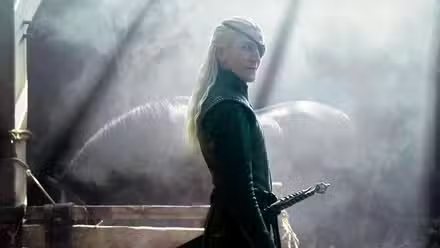
Back at Harrenhal, Aemond (Ewan Mitchell) seemingly reunites with his mother, and it doesn’t take long for things to get weird. If you thought the brief kiss between the mother and son was off-putting in Episode 1, the two start to engage in full-on intercourse — but before the audience at home can say “ew,” this is revealed to be another one of Harrenhal’s strange visions, this time for Aemond.
Very shortly afterward, he encounters Alicent again — only this time, she’s really there, in the flesh. The previous episode concluded with Rhaenyra sending Alicent to Harrenhal as bait, hoping she’ll be able to lure the one-eyed prince out of hiding. Alicent is accompanied by Rhaenyra’s faithful servant, Ser Adrian Redfort (Barry Sloane), who maybe should’ve gotten a bit more intel on Aemond’s homicidal tendencies, as the noble knight is killed by the prince almost instantly. After hearing about Aemond and Alys Rivers’ (Gayle Rankin) plans for Westeros domination over a very awkward dinner, Alicent is in her most precarious spot yet. Does she stay true to her word and kill her son herself, or does she turn heel and follow Aemond in his pursuit of reclaiming the throne?
Advertisement
Sheepstealer Returns To Cause More Chaos in ‘House of the Dragon’ Season 3 Episode 7
While Alicent ponders her next steps at Harrenhal, Daemon (Matt Smith) returns to the Vale to find Rhaena (Phoebe Campbell) and Sheepstealer before they do even more damage. He returns to the Eyrie, where Lady Jeyne Arryn (Amanda Collin) informs him that Rhaena is looking for Vhagar. Hunting the world’s largest dragon alone is a true suicide mission, so Daemon sets off to try and find her first.
Not much further away, Baela (Bethany Antonia) and Addam of Hull (Clinton Liberty) are trying to track down Vhagar as well. There’s an awkward moment between the two when Addam starts to court Baela, not yet realizing that his brother Alyn (Abubakar Salim) has already sparked a romance with her. Before they can resolve this love triangle, a dragon in the distance catches their attention — only, it’s not Vhagar.
After learning that Sheepstealer still has a rider, Rhaenyra rides out to confront them, accompanied by Addam. Daemon gets there first and attempts to convince his daughter to flee, but it’s already too late, as Sheepstealer gets into an all-out brawl with Syrax, Caraxes, and Seasmoke. It’s a very visually impressive battle, and honestly nice to see a full-on duel between dragons on this scale, particularly one on the ground rather than in the air. Inevitably, the dragon fight ends with an injured Sheepstealer fleeing and Rhaena held under guard in the Red Keep, but Rhaenyra isn’t willing to hear Daemon’s excuses this time. At least she has Mysaria (Sonoya Mizuno) to comfort her.
Advertisement
The Greens Gain Two More Dragons in ‘House of the Dragon’ Season 3 Episode 7
House of the Dragon Season 3, Episode 7Image via HBO Max
On the other side of the continent, Aegon (Tom Glynn-Carney) is at his wits’ end, tired of being on the run in Westeros when he’s supposed to be ruling over it as king. It almost looks like he’s about to meet a similar fate to Criston when he deliberately confronts a small army, until something truly miraculous happens. Turns out, Aegon was onto something when he said his beloved dragon, Sunfyre, was still breathing, who, like a zombie rising from the grave, returns to lay waste to the soldiers, all while Aegon cackles like a madman.
Sunfyre’s resurrection isn’t the only major development in the penultimate episode’s final moments. After capturing Lord Corlys (Steve Toussaint) — and sending his finger to Alyn as proof, no less — Ormund Hightower (James Norton) also secretly meets with none other than Ulf the White (Tom Bennett), whom we last saw with Daemon’s boot on his neck. The disrespect he’s received from the Targaryens has led Ulf to switch sides, resulting in another dragon now under the enemy’s control.
Advertisement
New episodes of House of the Dragon Season 3 premiere Sundays on HBO Max.
Advertisement
Release Date
Advertisement
August 21, 2022
Network
HBO
Advertisement
Showrunner
George R.R. Martin
Directors
Advertisement
Clare Kilner, Geeta Patel
Writers
Gabe Fonseca
Advertisement
Advertisement
Fabien Frankel
Ser Criston Cole
Advertisement
Advertisement
Pros & Cons
Advertisement
The dragon fight is truly awesome.
Sunfyre’s return is a true WTF moment.
Ulf turning heel is bound to set up a fascinating finale.
O’Donnell famously left the Hot Topics table after a 2007 fight with Elisabeth Hasselbeck, and again exited upon returning for a single season from 2014-2015.
Every streaming service on Earth has figured out that if you call something a “limited series,” audiences will actually finish it. Fair enough. But the form is harder than it looks. You can’t hide a weak middle act behind the promise of a better season to come, and you can’t pad a four-hour idea into ten without people noticing.
The shows on this list understood the assignment, whether that meant condensing a Russian tome into six hours, turning a game of chess into appointment television, or making you deeply afraid of a nuclear reactor you already know exploded. They picked a story, told it, and left before anyone could demand they stay.
Advertisement
10
‘War & Peace’ (2016)
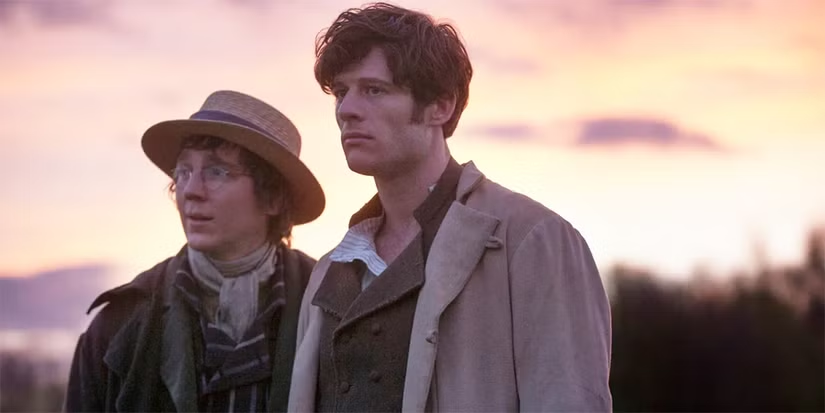
Paul Dano and James Norton in War & PeaceImage via BBC One
Andrew Davies adapted Tolstoy’s 1,200-page novel into six episodes for BBC One which, on paper, is an absurd proposition. Paul Dano, Lily James, and James Norton anchor the three families at the story’s center, moving through ballrooms and battlefields in a production that somehow cost a fraction of what it looks like it did. The scope is enormous, the costuming is gorgeous, and Davies’ script makes the Napoleonic-era social politics surprisingly easy to follow, even if you skipped your mandatory reading in college.
The story follows three aristocratic households through Napoleon’s wars — Dano’s Pierre, a wealthy bumbler searching for meaning; Norton’s Prince Andrei, a disillusioned soldier; and James’ Natasha, the young woman who complicates both their lives. Davies keeps the love triangles, the carnage, and the philosophical detours all moving at the same clip, so you’re never stuck in one place long enough to get restless. And the show does something most prestige adaptations fumble: it actually ends. Six episodes to tell one of the longest novels in Western literature without feeling rushed or truncated? It’s a small-screen miracle.
Advertisement
9
‘Midnight Mass’ (2021)
Hamish Linklater and Zach Gilford sit on a bench outside in Mike Flanagan’s Midnight Mass on Netflix.Image via Netflix
Mike Flanagan‘s seven-episode Netflix series is set on Crockett Island, a dying fishing community that gets a jolt of new energy when a charismatic young priest — Hamish Linklater, giving the performance of his life — arrives to fill in for the aging monsignor. Strange things start happening at the parish. People are getting healthier. The island’s faith is surging. And Flanagan, who built his reputation on haunted-house stories, is interested in something harder to pin down than a jump scare.
Midnight Mass asks its audience to sit through monologues. Long ones. Characters talk about their relationship to God, death, and addiction, all while supernatural stirrings happen in the background. That’s a heavy gamble that would sink a lesser series, but Flanagan writes dialogue that makes every word feel alive, almost antsy. And the ensemble — Zach Gilford, Kate Siegel, Rahul Kohli — commits fully. The final two episodes are wild, and the fact that it wraps in seven hours means Flanagan never has to dilute the dread.
Advertisement
8
‘Generation Kill’ (2008)
Two American soldiers and a journalist with a camera stand in a street in Baghdad in Generation Kill, 2008.Image via HBO
David Simon and Ed Burns followed up The Wire by adapting Rolling Stone reporter Evan Wright‘s account of the 2003 invasion of Iraq, and they brought the same institutional skepticism with them. The seven-episode HBO series follows First Recon Marines through the early weeks of the war, and it’s less interested in heroics than in the grinding bureaucracy of combat. Orders contradict each other and officers with no field instincts make calls that endanger their own men.
The cast was almost entirely unknown at the time, and everything feels so lived-in that it’s easy to forget you’re watching actors and not a documentary crew’s footage. Generation Killnever became a cultural phenomenon the way Band of Brothersdid, partly because it refused to give its audience a clean emotional arc. The war it depicts is chaotic, stupid even, and the series lets that marinate without trying to resolve it into meaning. Almost two decades on, it might be the most honest war story American television has produced.
Advertisement
7
‘Angels in America’ (2003)
Emma Thompson in a white dress with gold light behind her in Angels in America.Image via HBO
Tony Kushner adapted his own Pulitzer-winning play into six episodes for HBO, directed by Mike Nichols with a cast that borders on ridiculous. We’re talking Al Pacino, Meryl Streep, Jeffrey Wright, Mary-Louise Parker, and Emma Thompson. Set in 1985 New York during the Reagan era and the AIDS crisis, the story follows Prior Walter (Justin Kirk), a man visited by an angel after his diagnosis, alongside the closeted lawyer Roy Cohn (Pacino, absolutely unhinged and loving every second of it) and a tangle of relationships fracturing under political and personal pressure. It’s a big, unwieldy, sometimes operatic piece of television, and it knows it.
Kushner’s script shifts between realism, hallucination, and full-on magical surrealism without warning, and Nichols lets the actors match that energy. The whole thing could easily tip into prestige-TV self-importance, but Kushner keeps it grounded, and the show is unexpectedly funny. Angels in America is twenty-plus years old now and still feels like it’s ahead of a lot of what’s on television right now.
Advertisement
Collider Exclusive · Universe Personality Quiz Which Iconic Universe Do You Belong in the Most? Star Wars · Lord of the Rings · Harry Potter · Game of Thrones · Star Trek
Advertisement
Five legendary universes. Five completely different visions of what the world could be — or already was. One of them is the world your instincts, your values, and your particular way of existing were built for. Eight questions will tell you which one.
🚀Star Wars
💍Lord of the Rings
🧙Harry Potter
👑Game of Thrones
Advertisement
🖖Star Trek
Advertisement
01
What gives your life its deepest sense of meaning? Every universe is built around a different answer to this question.
Advertisement
02
Which kind of world do you most want to inhabit? The environment shapes who you become. Choose carefully.
Advertisement
03
How do you prefer your conflicts resolved? The shape of a world’s conflicts tells you everything about its soul.
Advertisement
04
Who do you want beside you when things get difficult? Your ideal companions reveal the world you were made for.
Advertisement
05
What is your relationship with power? How you seek, wield, or resist power is the map of who you are.
Advertisement
06
How does your universe treat good and evil? A world’s moral architecture tells you more about it than any map.
Advertisement
07
What role would you naturally fall into? Every universe has archetypes. Which one fits you without trying?
Advertisement
08
What do you ultimately believe about the future? The answer to this is the clearest window into which universe already lives inside you.
Advertisement
Your Universe Has Been Chosen You Belong In…
Your answers point to the iconic universe your values, your instincts, and your particular way of seeing the world were built for. This is where you would find your people — and your purpose.
Advertisement
A Galaxy Far, Far Away
Star Wars
You believe in the cause — in the idea that freedom is worth fighting for even when the odds are impossible and the empire is vast.
You are drawn to the moral clarity of a universe where hope itself is a form of resistance.
You’d find your people in the Rebellion — a ragtag coalition of true believers held together by conviction more than resources.
Star Wars is fundamentally a story about ordinary people choosing to matter in an extraordinary conflict — and that is exactly your kind of story.
The Force may or may not be with you. But the will to use it for something larger than yourself certainly is.
Advertisement
Middle-earth
Lord of the Rings
You understand, in the deepest part of yourself, that the journey matters as much as the destination — and that the world’s beauty is worth protecting even at great cost.
Middle-earth is a world of ancient wonder, deep friendship, and a darkness that only retreats when enough small acts of courage accumulate.
You would thrive here because you value the fellowship more than the glory — the road more than the arrival.
Tolkien’s universe rewards patience, loyalty, and the willingness to carry something heavy across a very long distance.
Those are not burdens to you. They are simply how you move through the world.
Advertisement
The Wizarding World
Harry Potter
You believe that love, loyalty, and doing what’s right are not naive sentiments — they are the most powerful forces in any world, magical or otherwise.
The Wizarding World is a place of wonder hidden in plain sight, where learning is transformative and the bonds you form at school follow you into every battle.
You would flourish here because you take both the magic and the friendships seriously — and you understand that one without the other is incomplete.
Harry Potter’s universe ultimately rewards those who choose to stand for something even when standing is terrifying.
That choice — made quietly, without guarantee — is something you understand completely.
Advertisement
Westeros · The Known World
Game of Thrones
You see the world clearly — its power structures, its hypocrisies, its brutal arithmetic — and you are not paralysed by that clarity. You use it.
Westeros is a world that rewards intelligence, adaptability, and the willingness to understand that every alliance is also a negotiation.
You would survive here — possibly thrive here — because you don’t confuse the world as it is with the world as you’d like it to be.
Game of Thrones is a story about what happens when the idealists and the realists collide. You are sharp enough to know which one lasts longer.
Winter always comes. You are already prepared.
Advertisement
The United Federation of Planets
Star Trek
You believe the future is worth building — that curiosity, cooperation, and the expansion of understanding are not just ideals but the most practical path forward for any civilisation.
Star Trek is a universe where the questions matter as much as the answers, and where encountering something utterly alien is cause for wonder rather than fear.
You would belong here because you are fundamentally optimistic about what intelligence and decency can achieve — while being honest about how hard that achievement is.
The Federation is the universe’s most ambitious thought experiment: what if we actually got better?
You don’t just hope that’s possible. You think it’s the only thing worth working toward.
Advertisement
6
‘The Queen’s Gambit’ (2020)
Beth looking down at a chess board in The Queen’s Gambit.Image via Netflix
Advertisement
There is no good reason a show about chess should have become one of Netflix’s biggest cultural events, but Scott Frank’s seven-episode adaptation of Walter Tevis‘ 1983 novel turned the game into the most watchable sport on television for about three weeks in the fall of 2020. Anya Taylor-Joy plays Beth Harmon, an orphan and chess prodigy with a pill dependency and a preternatural ability to visualize the board. The show makes her rise through the chess world feel thrilling, which, logically, shouldn’t be given that most of the action involves two people staring at a table.
The production design does a lot of heavy lifting here. Beth’s costumes evolve with her confidence, the period details are meticulous without being fussy, and the tournament sequences are shot with the pacing of a sports movie. But the reason The Queen’s Gambit became the kind of show your mom texted you about is Taylor-Joy, who makes Beth’s loneliness and brilliance feel specific rather than archetypal. If you don’t know what a Sicilian Defense is now, just wait seven episodes. You will.
5
‘Adolescence’ (2025)
Stephen Graham as Eddie Miller and Owen Cooper as Jamie Miller sitting side by side in ‘Adolescence’.Image via Netflix
Advertisement
Stephen Graham co-created and stars in this four-episode Netflix series about a 13-year-old boy arrested for the murder of a classmate, and the family left trying to understand what happened. Each episode of Adolescence is filmed in a single continuous take. That sounds like a gimmick until you realize how much it changes the viewing experience, locking you in with no cut to relieve the tension, no scene transition to give you a breath. The camera follows characters through police stations, schools, and homes in real time, and the effect is suffocating in a way the show clearly intends.
The brevity is doing real work here too; there’s no B-plot about a detective’s home life, no episode devoted to backstory that could have been a flashback. Graham is devastating as the dad, and the young cast is shockingly good, but the structural discipline is what elevates this above the standard true-crime-adjacent limited series. It asks one question and follows it all the way down the rabbit hole without flinching.
4
‘Station Eleven’ (2021–2022)
MacKenzie Davis reading the Station Eleven comic book in a rainy tent in Station Eleven.Image via HBO Max
Advertisement
Patrick Somerville adapted Emily St. John Mandel‘s novel into ten episodes for HBO Max, and the result is one of the most unlikely pandemic-era successes in recent memory. The story spans decades, following a handful of loosely connected characters before, during, and after a flu wipes out most of civilization. A traveling Shakespeare troupe, a vengeful prophet, a child actor, an air traffic controller who becomes a kind of accidental community leader. On paper, it sounds scattered. On screen, every thread pulls toward the same emotional center.
Station Eleven refuses to be bleak about the end of the world, and that’s the whole trick. There’s grief everywhere in this show, real and specific grief, but the overall effect is somehow warm, almost comforting. The performances from Mackenzie Davis, Himesh Patel, and especially the young Matilda Lawler are wonderful, and the non-linear structure rewards patience. Ten episodes is long for this list, but Station Eleven uses every one of them effectively.
3
‘Watchmen’ (2019)
The usual move with a beloved comic is to adapt it faithfully and hope nobody gets mad. Damon Lindelofwent the other way entirely. His nine-episode HBO series translating Alan Moore‘s source material isn’t a retelling. Instead, Watchmen is set decades after the original story, in an alternate-history Tulsa where cops wear masks, squid falls from the sky, and a blue god has relocated to Mars.
Advertisement
Regina King anchors this weird reality as Angela Abar, a detective whose family history turns out to be tangled up in the original Watchmen mythology in ways the show takes its time revealing. The surrounding cast is stacked with names like Yahya Abdul-Mateen II, Hong Chau, Jeremy Irons, and Jean Smart, and Lindelof gives each of them room to do something genuinely surprising. What separates Watchmen from the pile of superhero IP cluttering every platform is that it has a real argument. The show is interested in how America confronts its own history of racial violence, who gets to wear a mask and why, and what happens when the people in power decide vigilantism is fine as long as it’s state-sanctioned. Those are big, unwieldy ideas, and Lindelof doesn’t always land them cleanly, but the swings are so ambitious that the near-misses are more interesting than most shows’ bull’s-eyes.
2
‘Band of Brothers’ (2001)
Richard Winters (Damien Lewis) and Lewis Nixon (Ron Livingstone) sit together by a hill in ‘Band of Brothers’ (2001).Image via HBO
Tom Hanks and Steven Spielberg produced this ten-episode HBO adaptation of Stephen Ambrose‘s nonfiction account of Easy Company, 506th Regiment, 101st Airborne Division, from training through the end of World War II in Europe. The cast is staggering in retrospect: Damian Lewis, Ron Livingston, Donnie Wahlberg, Michael Fassbender, Tom Hardy, Simon Pegg, James McAvoy, all of them relatively unknown at the time. Each episode focuses on a different phase of the war and shifts perspective to a different soldier, giving the series an almost anthology-like structure within a continuous narrative.
Advertisement
25 years later, Band of Brothers remains the high mark for the war miniseries as a form. It cost a fortune (reportedly $125 million in 2001 dollars), it looks like it cost more, and the emotional payoff of that final episode, when the real veterans appear on-screen, is devastating no matter how many times you’ve seen it.
1
‘Chernobyl’ (2019)
Boris (Stellan Skarsgård) and Valery (Jared Harris) stand outside in ‘Chernobyl.’Image via HBO
HBO’s five-episode reconstruction of the 1986 nuclear disaster works because Craig Mazin, against all odds, figured out how to make bureaucracy feel like a ticking clock. The reactor has already exploded when the show begins, so the question isn’t whether things will go wrong, it’s how many people the Soviet government will sacrifice to avoid admitting they already have. Jared Harris and Stellan Skarsgård play the scientist and the party official forced into an uneasy alliance to contain the damage, and Emily Watson rounds out the leads as a composite character representing the researchers who refused to let the official story stand. The three of them carry the show with a kind of grim, worn-down intensity that never feels put on.
Advertisement
There’s a sequence involving the “liquidators” — the men sent onto the reactor roof to clear radioactive graphite in 90-second shifts — that is as tense as anything we’ve seen on TV. Mazin’s script is meticulous about the science without ever making you feel like you’re being lectured, and the five-episode runtime means there isn’t a single scene that exists just to fill space. Chernobyltrusts its audience to sit with the discomfort of history book horrors made real by never diluting the human ignorance and complicity that combined to create a tragedy.
Sandra Bullockknows a thing or two about the power of sisterhood.
“I am so lucky to have this brilliant soul by my side who knows me, missteps and all, and still chooses to love me. Every. Single. Day,” Bullock, 62, wrote via Instagram on Sunday, August 2, sharing throwback family photos with her sister, Gesine Bullock-Prado. “Happy Sisters Day. Both those born to you, and those you have chosen along the way! I love you Gigi.”
The actress also quoted Alice Hoffman’s The Book of Magic, writing, “When you have a sister, someone who knows the story of who you were and who you will always be, there is no deeper tie, no stronger bond.”
Hoffman’s book was later adapted into 1998’s Practical Magic, where Bullock stars opposite Nicole Kidman. The two stars recently reprised their roles as witchy siblings in Practical Magic 2.
Fans have already started to prepare their midnight margaritas in anticipation of Practical Magic 2 — and star Sandra Bullock is thrilled to be returning for the sequel alongside Nicole Kidman. “Sandra’s really excited about Practical Magic 2,” a source exclusively shares in the latest issue of Us Weekly. “Nicole is someone she adores, and […]
“Last year, I was quiet. I had other things going on. I was in my shell. Now, I’m in a place of saying, ‘2026. Here we go,’” Kidman, 59, told Varietyin March of the follow-up flick. “I have Practical Magic with Sandy. I’ll be in full witch mode.”
Advertisement
Kidman and Bullock will be joined in the highly anticipated sequel by Joey King and Maisie Williams portraying their daughters.
Courtesy of Sandra Bullock/Instagram
“As fans of the original film ourselves, I feel like when you love something as much as we already love Practical Magic, there’s just massive responsibility of joining the team and wanting to do it justice,” King, 27, told Peopleat Teen Vogue Fest held late last month. “They are the best duo ever. Nicole and I worked together a few years ago [on Netflix’s A Family Affair]. She plays my mom in a movie and we become really close from that, which is so crazy. I’m just such a fan of her. I’m so in awe of her. She’s the nicest person ever.”
King further revealed that Bullock took the two young actresses “under her wing” when they filmed Practical Magic 2.
Courtesy of Sandra Bullock/Instagram
“It is really special to have this post-movie bond with her that we have. She sends us voice notes all the time,” the Kissing Booth star gushed. “She’s always hyping us up. She’s just the sweetest. They’re the best.”
Thank You!
You have successfully subscribed.
Advertisement
As for Williams, 29, she told People that Bullock will “text us both straight away.”
“I think it says, ‘Hello, it’s your mother here.’ And I think, ‘Wow,’” the Game of Thrones alum recalled. “It is just amazing. She’s so lovely. The nicest woman in Hollywood.”
Practical Magic 2 hits theaters Friday, September 11.
Editor’s note: The below contains spoilers for House of the Dragon Season 3 Episode 7.
As House of the Dragonexplores a divided Westeros, each dragon taking part in the civil war has a vital role to play. Yet, in Season 3, the Dance of the Dragons has become more of a one-sided conflict. With Rhaenyra (Emma D’Arcy) holding King’s Landing, the Greens divided, and Vhagar nowhere to be found, there is little hope for Aegon (Tom Glynn-Carney) and his allies. However, Episode 7 drastically alters the situation by bringing one important figure back into play in a fiery twist that will have a major impact on the ongoing conflict.
Both sides have suffered major losses, but Sunfyre’s apparent death in Season 2 was one of the worst. This blow not only cost the Greens a dragon, but put the king out of commission; for much of Season 3, Aegon has been barely surviving and has gained almost no power to oppose Rhaenyra’s rule. However, with the dragon back, this is a turning point for the Greens. Sunfyre’s reappearance puts Aegon back in the game. While Sunfyre’s survival won’t be enough to fully tip the scales of the war, especially when Rhaenyra still controls so many dragons, Aegon once again has a chance, which is an exciting prospect as the series heads into its Season 3 finale.
Advertisement
Sunfyre’s Return Is Vital for ‘House of the Dragon’s Conclusion
Since Aegon and Aemond’s (Ewan Mitchell) fiery clash at the Battle of Rook’s Rest, everyone has believed Sunfyre to be dead. House of the Dragon leans into this, with Season 3’s fourth episode even revealing Sunfyre’s seemingly dead body after Aegon returns to the scene of the battle. Though he stops to mourn his friend, Sunfyre shows no signs of life. However, in the season’s penultimate episode, when Lord Mooton’s army corners Aegon and Tyland Lannister (Jefferson Hall), the king makes a stand, revealing his identity and expecting to be killed for it. In a shocking twist, Aegon’s loyal dragon suddenly appears and saves him by burning his enemies.
Sunfyre may not be at full strength and will always bear scars from the battle, much like Aegon himself, but the creature’s return is nothing but good news for the Greens. With this, Aegon now holds a new advantage as Sunfyre provides his side of the war with the element of surprise. Of course, the dragon has a continuing role to play, as fans of Fire & Blood already know. But for now, Sunfyre’s seemingly miraculous survival offers new hope to Aegon and his supporters,setting up a major shift in the Dance of the Dragons.
Advertisement
‘House of the Dragon’ Season 3’s Biggest Twist Yet Puts Aegon Back in the Fight
While any dragon that turned up would be significant, Sunfyre’s return is especially impactful because of his bond with Aegon, who has spent Season 3 at a low point. Despite firmly believing, along with half of Westeros, that he is the rightful king, he is on the run, penniless, and almost completely without allies, leaving him at the mercy of Larys (Matthew Needham) and anyone he meets on the road. After Larys expressed his candid thoughts on Aegon in Season 3, Episode 5, the king was forced to confront his own failings, ultimately leading to the moment in which he chooses to face his enemies head-on, despite knowing his chances of survival are slim.
While Sunfyre is just one dragon and can’t muster much opposition against Rhaenyra’s six, this moment is game-changing for the Greens, largely because of what it represents for Aegon. Because few know his location or that he once again commands a dragon, Aegon has an advantage over Rhaenyra for the first time in House of the Dragon Season 3. With this twist, Aegon is officially put back into the mix, simultaneously providing a rallying point for the Greens’ divided forces and a chance to challenge Rhaenyra.





















:max_bytes(150000):strip_icc():format(jpeg)/whoopi-rosie-8bf53dfe0d1045d7ac4e839c220844f2.jpg)
















































You must be logged in to post a comment Login