After a nearly decade-long detour, director Ridley Scott is returning to the sci-fi genre this week. The filmmaker has spent the last several years making period epics of different scales, from the character-focused drama The Last Duelto the sword-and-sandals sequel Gladiator II. None of them, however, was able to break out at the box office. Scott’s last major hit came in 2015, when The Martian grossed more than $600 million worldwide and scored several Oscar nominations. It was followed by what would become his last sci-fi feature in quite some time: a franchise entry that was released to mixed reviews and an underwhelming box-office response in 2017. The movie in question, Alien: Covenant, has its fans, but its divisive reception forced the long-running franchise into hibernation for several years while Scott moved on to other projects.
He’s now back with a new film in a genre synonymous with him. Scott broke out with the landmark hits Alien and Blade Runner, and over the course of his career, has remained attached to both properties in some fashion. He produced Blade Runner 2049, the critically acclaimed legacy sequel directed by Denis Villeneuve, and directed the two Alien prequels, Alien: Covenant and Prometheus. He also executive-produced the franchise’s latest installment, Alien: Romulus, and the television spin-off Alien: Earth. His new movie doesn’t have the legacy of a decades-old franchise to live up to; it isn’t, however, an original film. Scott’s upcoming sci-fi movie is based on a 2012 post-apocalyptic novel by Peter Heller.
Advertisement
Collider Exclusive · Sci-Fi Survival Quiz Which Sci-Fi World Would You Survive? The Matrix · Mad Max · Blade Runner · Dune · Star Wars
Advertisement
Five universes. Five completely different ways the future went wrong — or sideways, or up in flames. Only one of them is the world your instincts were built for. Eight questions will figure out which dystopia, galaxy, or desert wasteland you’d actually make it out of alive.
💊The Matrix
🔥Mad Max
🌧️Blade Runner
🏜️Dune
Advertisement
🚀Star Wars
Advertisement
01
You sense something is deeply wrong with the world around you. What do you do? The first instinct is often the truest one.
Advertisement
02
In a world of scarcity, what resource do you guard most fiercely? What we protect reveals what we believe survival actually requires.
Advertisement
03
What kind of threat keeps you up at night? Fear is useful data — if you’re honest about what you’re actually afraid of.
Advertisement
04
How do you deal with authority you don’t trust? Every dystopia has a power structure. Your approach to it determines everything.
Advertisement
05
Which environment could you actually endure long-term? Survival isn’t just tactical — it’s physical, psychological, and very much about where you are.
Advertisement
06
Who do you want in your corner when things fall apart? The company you keep is the clearest signal of who you actually are.
Advertisement
07
Where do you draw the line — if you draw one at all? Every survivor eventually faces a moment that tests what they’re actually made of.
Advertisement
08
What would actually make survival worth it? Staying alive is one thing. Having a reason to is another.
Advertisement
Your Fate Has Been Calculated You’d Survive In…
Your answers point to the world your instincts were built for. This is the universe your temperament, your survival instincts, and your particular brand of stubbornness were made for.
Advertisement
The Resistance, Zion
The Matrix
You took the red pill a long time ago — probably before anyone offered it to you. You’re a systems thinker who can’t help but notice the seams in things.
You’re drawn to understanding how the system works before figuring out how to break it.
You’d find the Resistance, or it would find you — your instinct for spotting constructed realities is the machines’ worst nightmare.
You function best when you have access to information and the freedom to act on it.
The Matrix built an airtight prison. You’d be the one probing the walls for the door.
Advertisement
The Wasteland
Mad Max
The wasteland doesn’t reward the clever or the well-connected — it rewards those who are hard to kill and harder to break. That’s you.
You don’t need comfort, community, or a cause larger than the next horizon.
You need a vehicle, a clear threat, and enough fuel to outrun it — and you’re good at all three.
You are unsentimental enough to survive that world, and decent enough — just barely — to be something more than another raider.
In the wasteland, that distinction is everything.
Advertisement
Los Angeles, 2049
Blade Runner
You’d survive here because you know how to exist in moral grey areas without losing yourself completely.
You read people accurately, keep your circle small, and ask the questions others prefer not to answer.
In a city where humanity is a legal designation rather than a feeling, you hold onto something that keeps you functional.
You’re not a hero. But you’re not lost, either.
In Blade Runner’s world, that distinction is everything.
Advertisement
Arrakis
Dune
Arrakis is the most hostile environment in the known universe — and you are precisely the kind of person it rewards.
Patience, discipline, and political awareness are your core strengths — and on Arrakis, they’re survival tools.
You understand that the long game matters more than any single victory.
Others come to Dune and are consumed by it. You’d learn its logic and earn its respect.
In time, you wouldn’t just survive Arrakis — you’d begin to reshape it.
Advertisement
A Galaxy Far, Far Away
Star Wars
The galaxy far, far away is vast, loud, and in a constant state of violent political upheaval — and you wouldn’t have it any other way.
You find meaning in being part of something larger than yourself — a cause, a crew, a rebellion.
You’d gravitate toward the Rebellion, or the fringes, or whatever pocket of the galaxy still believes the Empire’s grip can be broken.
You fight — not because you have to, but because standing aside isn’t something you’re capable of.
In Star Wars, that willingness is what makes all the difference.
Advertisement
Here’s When Ridley Scott’s New Sci-Fi Movie Will Be Released in Theaters
This week, the legendary filmmaker will finally debut The Dog Stars, featuring Jacob Elordiin the lead role. The movie also features Josh Brolin, Margaret Qualley, Benedict Wong, Allison Janney, and Guy Pearce. The Dog Stars was adapted by Mark L. Smith, the co-writer of the Oscar-winning epic The Revenant. The movie has been produced on a reported budget of $110 million, which is roughly the same budget-range that The Martian and Alien: Covenant occupied as well. Scott is well-known for juggling multiple projects at the same time, and in recent years, has divided his collaborators for orchestrating fast-paced productions using multiple cameras and rapid turnarounds. The Dog Stars will be released theatrically on August 28. Stay tuned to Collider for more updates.
Khloé Kardashian launched her weekly video podcast “Khloé in Wonder Land” in January 2025. The podcast featured unfiltered conversations with special guests, from famous family members to Hollywood stars. She also shared personal stories and candid reflections on her life, career, and high-profile relationships. Ahead of the show’s season 3 release, she revealed her future career plans and whether or not she would ever return to acting.
4Greg Swales/It’s a 10 Haircare/M / MEGA
In a candid conversation with The Hollywood Reporter about her future career plans, the “Keeping Up With The Kardashians” reality star revealed that she is excited for this new season “because it’s going to be longer” than the first two.
“I have more room to diversify a bit and see what has stuck with my audience versus what has not,” she said. “The biggest thing that I want to do is branch out a little bit more.”
Although she said that she enjoyed filming the family episodes, and they were a big hit with her audience, she wanted to branch into “different genres.”
Khloé Wants To Explore Conspiracy Theories And ‘Crazy Stuff’
She said she wants her podcast to focus more on conspiracy theories and other “crazy stuff.” She also wants to try to cover “self-help-type things,” which she thinks will be a big hit with her viewers.
“Other doctors that know how to break down whatever issues are so fascinating. I did something with Dr. Amen, and the amount of people that got all this positive knowledge from him made me feel so good because it’s almost like I was giving back to people that couldn’t afford to see him themselves or didn’t have access to his clinics,” she said. “So that makes me feel good when I’m able to provide real information to people where they have a takeaway.”
Advertisement
“I could go from a celebrity to a doctor to a conspiracy theorist, and I have more room to play,” she continued. “I love how all over the place it is, but that’s why it’s Khloé in Wonder Land because my brain is fascinated by anything and everything.”
Although some fans want to see her star in a big project alongside her sister, Kim Kardashian, Khloé said she isn’t looking to return to acting in the near future.
“I get asked to act all the time and to do these roles. I’m never gonna say never, but currently it’s not something I feel like makes my heart happy,” she said. “It’s not like where my passion is with anything.”
Although she wouldn’t name any specific projects, she did say that she gets asked to star in a movie “all the time.”
“People will say someone wants you for a movie, and I’m like, no, no, no. I have taken meetings with people who wanted to do a scripted series with me, and I just don’t know if it’s my thing,” she added.
Advertisement
Khloé Kardashian Might Embrace A Career Behind The Camera
Khloé currently serves as executive producer for “The Girls,” a reality show that features her famous friends: Nicole Williams English, Olivia Pierson, Khadijah Haqq-McCray, Natalie Halcro, Malika Haqq and Yris Palmer.
“I really do enjoy it. I think with your friends, it’s a different level of work involved because it does get very personal. But I still really enjoy it,” she said of producing more reality shows with people outside of her famous family.
“I like being a therapist in a way to people,” she continued. “But businessly, I find it really cool, really creative. I like the ins and outs of it all. So yeah, I could see myself doing more.”
All six episodes of her unscripted series, “The Girls: A Khloé Kardashian Project,” are now available to stream on Disney+ and Hulu.
Hayao Miyazaki is the guy, if you’re talking Japanese filmmakers who work within the animation field. There are significant directors who are – or have been – his contemporaries, like Isao Takahata (best known for Grave of the Fireflies, who co-founded Studio Ghibli alongside Miyazaki and producer Toshio Suzuki), and some animators/directors who worked before Miyazaki are also noteworthy. There’s Osamu Tezuka, and though he’s best known for being the godfather of manga, he did also direct some works, and had his manga be adapted on a great many other occasions, too. For what it’s worth, Hayao Miyazaki has also worked as a manga artist, with one of his first movies, Nausicaä of the Valley of the Wind, being an adaptation of his manga series of the same name (the manga technically ending some years after the movie came out).
Alongside Nausicaä of the Valley of the Wind, there were some other great movies Miyazaki directed in the 20th century, including what was technically his first feature film, 1979’s Lupin III: The Castle of Cagliostro, and Princess Mononoke (1997), which could well be his masterpiece. No, okay, there are lots of movies that Miyazaki made that can compete for that top spot, since he’s so consistent and, of his 12 feature films, not one comes anywhere remotely close to being bad. He’s made five movies in the 21st century so far, and though he has talked about retiring at multiple points, no retirement plans have ever stuck, so the possibility of there being a 13th Hayao Miyazaki movie technically isn’t impossible. Still, his most recent one is a great swansong, and the oldest movie here is also considered a magnum opus for Miyazaki in the eyes of many. It has to be stressed, again, that ranking Hayao Miyazaki’s 21st-century movies is hard, since the “worst” one is still very good (and then the best ones are outright masterpieces).
Advertisement
5
‘Ponyo’ (2008)
Ponyo floats in the air and looks at Sōsuke in Ponyo.Image via Studio Ghibli
Ponyo would make for a nice double feature with My Neighbor Totoro. That one was probably the gentlest movie Miyazaki directed in the 20th century, and then Ponyo’s the calmest and most peaceful he’s done in the 21st century. Put another way, it’s particularly family-friendly, perhaps being the most suitable movie for all ages that Miyazaki has directed, with that target audience maybe reflected by the fact that the protagonist here – a five-year-old boy – is especially young.
The story concerns him finding a creature named Ponyo who looks a bit like a goldfish, but she also yearns to be a human. Further, she has a magical father who doesn’t want her to remain on land, and that’s about as intense as things get, conflict-wise. Ponyo is just a nice and fairly relaxing movie, albeit one that might be a little more enjoyable for younger viewers than those who are teens or older. There’s still a lot to like and appreciate, even if you’re an adult, but debatably a little less than what you might find in some of Hayao Miyazaki’s (even better) films.
Advertisement
4
‘Howl’s Moving Castle’ (2004)
Image via Studio Ghibli
Even vaguely having to suggest Ponyo was the “worst” of Miyazaki’s 21st century movies didn’t feel as awful as putting a classic like Howl’s Moving Castle here, as the “second-worst.” Again, it’s still great. It is another excellently made fantasy movie directed by Miyazaki, and contains more by way of imaginative sights and ideas than you’ll find in some directors’ entire filmographies. And that he did this one only a few years after what many consider to be his best and most complete film is all the more impressive.
Though there is a sense of comparing it to that one, and feeling like Howl’s Moving Castle just isn’t as great, and that it’s possibly the closest Miyazaki came to giving the people what they wanted (not selling out, mind you, nor anything even close). If you watched Howl’s Moving Castle before all the other fantasy movies Miyazaki did that preceded it, it’d probably feel more surprising and grand, but still, Miyazaki doing his Miyazaki thing remains worth celebrating regardless. Nothing here rings of being an outright retread in any sense, either, so maybe that’s the main thing. Howl’s Moving Castle remains a vital part of a fantastic filmography, make no mistake, even if there are a few Hayao Miyazaki movies that are even stronger.
Advertisement
3
‘The Wind Rises’ (2013)
Image via Toho
The Wind Rises is unusual, as far as Hayao Miyazaki movies go, because there isn’t anything by way of fantastical or sci-fi elements here. You can say that about Lupin III: The Castle of Cagliostro, though that film is still heightened, and certainly contains strong adventure and comedic elements. The Wind Rises, though, is a more grounded affair, and sees Miyazaki doing a biopic of sorts. Well, it is about Jiro Horikoshi, who really existed, but some liberties are taken with certain parts of the real-life story. Horikoshi was an aeronautical engineer who did design planes that ended up being used by Japan during World War II, though the focus of The Wind Rises isn’t really on the war, with most of it taking place in the 1920s and 1930s (some things regarding the war are touched upon near the end).
It would’ve made for an interesting and quite fitting swansong, but stands now as his penultimate film.
Advertisement
It’s hard to recommend in the same way you might be able to recommend other Hayao Miyazaki movies, since The Wind Rises isn’t technically as conventionally fun/entertaining. No one goes on an adventure, and there aren’t any creatures or examples of sci-fi technology that stand in for other things, but the film still proves compelling as a historical drama and a romance film. It’s Miyazaki doing something a bit different and unexpected, and doing it really well. It would’ve made for an interesting and quite fitting swansong, but stands now as his penultimate film… and then might slip back further if Miyazaki’s “current” swansong doesn’t actually end up being his last movie.
2
‘The Boy and the Heron’ (2023)
That swansong, for now, is The Boy and the Heron. This one is all about legacy, and a fair bit of it thematically deals with growing old, so reading into it that way, as a particularly personal film on Hayao Miyazaki’s part, does prove enriching. It’s also something that visually seems willing to reference every past Miyazaki film in one way or another, but not really in a greatest hits sort of way, since it’s not literally revisiting old characters or settings directly. You more just feel like Miyazaki is thinking back on all the art he has created, and then reckoning with what might happen in the future, when that work exists but he no longer does.
Advertisement
If that sounds a bit emotionally intense, that’s because The Boy and the Heron kind of is. It’s the darkest Miyazaki film that isn’t Princess Mononoke, and it honestly gives that one a run for its money, in any event. Technically, The Boy and the Heron does astound, looking especially visually grand and creative with all the sights it depicts throughout. The core story, about a young person discovering some sort of strange world, might seem familiar at first, but it’s where The Boy and the Heron goes thematically that ends up making it not just compelling, but genuinely up there as one of the very best Hayao Miyazaki films (time will likely be kind to it, too).
1
‘Spirited Away’ (2001)
Chihiro and No-Face on a train during a scene from Spirited Away (2001)Image via Toho
So, Spirited Away has the reputation it does for good reason. It’s a perfect entry point into Japanese animation, if you’ve not already watched something kid-friendly that’s a series (the way a lot of people growing up over the last couple of decades seem to have done). Spirited Away is also mostly kid-friendly, for what it’s worth, but not to the extent of My Neighbor Totoro or Ponyo. It’s a bit darker, and definitely creepy at times, even if most of it can probably be handled by younger viewers. It’s about how the world is vast, confusing, and overwhelming, especially when you’re young, which is what the fantasy world here represents (and then some). And it is all animated and executed in a way that proves sometimes frightening and confounding if you’re an older viewer, too.
Advertisement
Maybe that’s the thing about Spirited Away resonating and being suitable for all ages without necessarily feeling like a kid’s movie. Anyone can relate to feeling lost in some way, and having to scrape by with the help of others, or just make the best of a bad situation. The specific bad situation in Spirited Away is getting stuck in an otherworldly realm and having your parents turn into pigs, which isn’t literally relatable, but the emotions are still there, and what the whole journey stands in for is what counts. It’s a bit like not being able to relate to being a witch, like the titular character in Kiki’s Delivery Service, but still being able to relate to having to go somewhere and effectively be an independent adult for the very first time. All these are obvious observations, but Spirited Away is about as discussed as animated movies get, so what else can you do? Oh, you can technically do one other thing: gush about how good it looks. Even by the high standards of Studio Ghibli, Spirited Away really does look absolutely phenomenal.
In 1968, the Motion Picture Association of America introduced the R rating, replacing the old censorial Hays Code with a system to more effectively let parents know about a film’s mature contents. Over the course of the past 50 years in particular, the R rating has given us several of the greatest science fiction movies ever made. They may not be for kids, but they sure are essential viewing for any sci-fi fan old enough to experience them.
Whether it’s a brutal post-apocalyptic action movie like Mad Max: Fury Road, a space exploration horror thriller like Alien, or any other sort of sci-fi gem that the MPA deemed worthy of an R rating, these truly are some of the greatest movies that the genre has ever produced. They may be bloody, sexually graphic, or simply too dark to be family-friendly; but in any case, they’re absolutely legendary.
Advertisement
10
‘Donnie Darko’ (2001)
Donnie Darko sitting in a movie theaterImage via Newmarket Films
The 1990s were deeply transformative for cult cinema, shifting away from midnight theater screenings while taking advantage of the booming popularity and democratization of home video. It was thanks to masterpieces as iconic asDonnie Darko, one of the biggest sci-fi cult classics of the 21st century, that the midnight circuit of cult cinema regained its popularity throughout the 2000s.
Much like a lot of the best cult classics of all time, Donnie Darko was an all-around failure upon release, only growing in popularity as the years went on. Today, it’s widely recognized as one of those sci-fi movies that get better with every rewatch, a genre-blending masterpiece that’s as thought-provoking as it is delightfully bizarre. In spite of its R rating, it’s one of the most essential coming-of-age teen sci-fi movies ever made.
Advertisement
9
‘Mad Max: Fury Road’ (2015)
Furiosa, played by Charlize Theron, screams after falling to her knees on sand dunes in Mad Max: Fury Road.Image via Warner Bros. Pictures
After the tragic passing of his close friend and producing partner Byron Kennedy, George Miller distanced himself from the world of Mad Max following the critical disappointment that was Beyond Thunderdome. He came up with ideas for a fourth installment in the late ’90s, but it wouldn’t be until 2015—a whopping 30 years after the release of its predecessor—that Mad Max: Fury Road would finally see the light of day.
In the end, Fury Road turned out to be not only the best Mad Max installment to date, but even one of the best sci-fi action movies in film history. Full of delectably over-the-top action and world-building that only a director as masterful as Miller could have possibly gotten away with, it’s a perfectly-shot, perfectly-edited, and perfectly-paced two-hour chase scene that doesn’t lose any of its punch on rewatch.
Advertisement
8
‘The Matrix’ (1999)
Neo, played by Keanu Reeves, freezes flying bullets with his hand outstretched in The Matrix.Image via Warner Bros. Pictures
Back in 1999, the Wachowskis‘ The Matrixproved downright revolutionary in several senses. Its visual effects broke new ground in the industry, its highly philosophical story and trans allegory showed a new face of what Hollywood sci-fi action was capable of, and its pastiche action scenes inspired by anime and martial arts films changed the face of Hollywood action.
It’s still widely remembered as one of the best sci-fi movies since 1990, a modern classic that has become one of the most essential cornerstones of sci-fi pop culture. Incredibly entertaining, incredibly thought-provoking, and incredibly stunning in terms of its timeless production values, it’s the sort of R-rated sci-fi gem that simply doesn’t get old.
Advertisement
7
‘The Terminator’ (1984)
Image via Orion Pictures
Canadian visionary James Cameron is nowadays well-known as a master of pushing boundaries and breaking new ground in Hollywood, but that wasn’t always the case. Rolling into 1984, the only feature under his belt was Piranha II: The Spawning. He needed a genuine hit in order to establish himself as a respectable filmmaker, and The Terminatorended up being exactly what he needed—and then some.
Where can one even begin singing the praises of this essential ’80s classic? It’s one of the most perfectly-plotted sci-fi movies ever made, full of iconic characters and unforgettable moments, and the masterpiece that further propelled Arnold Schwarzenegger into international superstardom. The ’80s are full of foundational sci-fi classics, and this is undoubtedly one of the best and most important.
Advertisement
6
‘The Thing’ (1982)
Image via Universal Pictures
If there were a hypothetical Mount Rushmore of horror filmmakers, then John Carpenter would definitely need to be right up there as one of the most important, subversive, and groundbreaking directors that the genre has ever seen. For proof, one needn’t look much further than The Thing, which is far and away one of the scariest sci-fi movies of all time.
Carpenter designed the film to be a more faithful adaptation of John W. Campbell Jr.‘s novella Who Goes There? than 1951’s The Thing from Another World. In the end, he succeeded not only at that, but also in making one of the most powerfully atmospheric, visually striking, and perfectly-acted sci-fi horror movies the big screen has ever seen. Carpenter’s filmography is packed with gems that could very reasonably be considered his magnum opus, and this is one of the strongest contenders.
Advertisement
Collider Exclusive · Sci-Fi Survival Quiz Which Sci-Fi World Would You Survive? The Matrix · Mad Max · Blade Runner · Dune · Star Wars
Advertisement
Five universes. Five completely different ways the future went wrong — or sideways, or up in flames. Only one of them is the world your instincts were built for. Eight questions will figure out which dystopia, galaxy, or desert wasteland you’d actually make it out of alive.
💊The Matrix
🔥Mad Max
🌧️Blade Runner
🏜️Dune
Advertisement
🚀Star Wars
Advertisement
01
You sense something is deeply wrong with the world around you. What do you do? The first instinct is often the truest one.
Advertisement
02
In a world of scarcity, what resource do you guard most fiercely? What we protect reveals what we believe survival actually requires.
Advertisement
03
What kind of threat keeps you up at night? Fear is useful data — if you’re honest about what you’re actually afraid of.
Advertisement
04
How do you deal with authority you don’t trust? Every dystopia has a power structure. Your approach to it determines everything.
Advertisement
05
Which environment could you actually endure long-term? Survival isn’t just tactical — it’s physical, psychological, and very much about where you are.
Advertisement
06
Who do you want in your corner when things fall apart? The company you keep is the clearest signal of who you actually are.
Advertisement
07
Where do you draw the line — if you draw one at all? Every survivor eventually faces a moment that tests what they’re actually made of.
Advertisement
08
What would actually make survival worth it? Staying alive is one thing. Having a reason to is another.
Advertisement
Your Fate Has Been Calculated You’d Survive In…
Your answers point to the world your instincts were built for. This is the universe your temperament, your survival instincts, and your particular brand of stubbornness were made for.
Advertisement
The Resistance, Zion
The Matrix
You took the red pill a long time ago — probably before anyone offered it to you. You’re a systems thinker who can’t help but notice the seams in things.
You’re drawn to understanding how the system works before figuring out how to break it.
You’d find the Resistance, or it would find you — your instinct for spotting constructed realities is the machines’ worst nightmare.
You function best when you have access to information and the freedom to act on it.
The Matrix built an airtight prison. You’d be the one probing the walls for the door.
Advertisement
The Wasteland
Mad Max
The wasteland doesn’t reward the clever or the well-connected — it rewards those who are hard to kill and harder to break. That’s you.
You don’t need comfort, community, or a cause larger than the next horizon.
You need a vehicle, a clear threat, and enough fuel to outrun it — and you’re good at all three.
You are unsentimental enough to survive that world, and decent enough — just barely — to be something more than another raider.
In the wasteland, that distinction is everything.
Advertisement
Los Angeles, 2049
Blade Runner
You’d survive here because you know how to exist in moral grey areas without losing yourself completely.
You read people accurately, keep your circle small, and ask the questions others prefer not to answer.
In a city where humanity is a legal designation rather than a feeling, you hold onto something that keeps you functional.
You’re not a hero. But you’re not lost, either.
In Blade Runner’s world, that distinction is everything.
Advertisement
Arrakis
Dune
Arrakis is the most hostile environment in the known universe — and you are precisely the kind of person it rewards.
Patience, discipline, and political awareness are your core strengths — and on Arrakis, they’re survival tools.
You understand that the long game matters more than any single victory.
Others come to Dune and are consumed by it. You’d learn its logic and earn its respect.
In time, you wouldn’t just survive Arrakis — you’d begin to reshape it.
Advertisement
A Galaxy Far, Far Away
Star Wars
The galaxy far, far away is vast, loud, and in a constant state of violent political upheaval — and you wouldn’t have it any other way.
You find meaning in being part of something larger than yourself — a cause, a crew, a rebellion.
You’d gravitate toward the Rebellion, or the fringes, or whatever pocket of the galaxy still believes the Empire’s grip can be broken.
You fight — not because you have to, but because standing aside isn’t something you’re capable of.
In Star Wars, that willingness is what makes all the difference.
Advertisement
5
‘Eternal Sunshine of the Spotless Mind’ (2004)
There’s a very strong argument to be made that Charlie Kaufman is the single greatest screenwriter currently working in Hollywood, and there’s probably no better proof of that than the movie that earned him his first and only Best Screenplay Oscar: Michel Gondry‘s Eternal Sunshine of the Spotless Mind. Starring Jim Carrey and Kate Winslet, both delivering some of the strongest work of their careers, it’s built on one of the best screenplays in film history.
Advertisement
Its science fiction elements are relatively subtle, and all in perfect service of a poignantly raw, realistic, and emotionally riveting exploration of love, connection, and the power of memories. Kaufman and Gondry flawlessly balance surrealism and character-driven drama in such a way that Eternal Sunshine has aged wonderfully as the greatest R-rated sci-fi film of the 21st century so far.
4
‘Blade Runner’ (1982)
Harrison Ford sitting at a desk and looking ahead in Blade Runner, 1982.Image via Warner Bros. Pictures
Back in 1982, Ridley Scott‘s Blade Runnerwas nothing short of a catastrophic failure both commercially and critically. Little did anyone know, home video would eventually allow it to become a cult classic of such a tremendous caliber that today, it’s a sci-fi classic that’s just about as mainstream as they come. Today, one could point at it as one of the most massively influential films the genre has ever produced.
Advertisement
Blade Runner is, indeed, one of the best sci-fi movies in film history. Based on the dystopian novel Do Androids Dream of Electric Sheep? by Philip K. Dick, it’s one of the most essential and special neo-noir movies of the latter half of the 20th century. Wonderfully directed, written with the utmost patience and intelligence, and bolstered by Vangelis‘ flawless score, it really is one of the greatest Hollywood masterpieces of the ’80s.
3
‘Children of Men’ (2006)
Image via Universal Pictures
Alfonso Cuarón has spent his entire career enshrining himself as one of the most incredible filmmakers in both Mexico and Hollywood, but well before he was an Oscar-winning auteur, he made Children of Men. This is one of those sci-fi movies that are definitely not for kids, a dystopian action thriller based on P. D. James‘ 1992 novel of the same title.
Advertisement
It’s one of the sci-fi movies from the past couple of decades that have aged the best, its messages on the importance of compassion, the collapse of human civilization, and the treatment of refugees around the world still being awfully timely in 2026. With its incredible cast, its perfect script, and Cuarón’s airtight and technically masterful direction, it’s a must-see for anyone who loves dystopian sci-fi and bleak action thrillers.
2
‘Terminator 2: Judgment Day’ (1991)
Image via Tri-Star Pictures
As fantastic as The Terminator was, it would be an understatement to say that James Cameron one-upped himself in virtually every sense imaginable with the film’s sequel, Terminator 2: Judgment Day. At the time of its release, this action epic was the single most expensive movie ever made. Every single one of those pennies went exactly where they needed to go, because Terminator 2 still feels like a refreshingly modern action thriller over three decades after its release.
Advertisement
There are only a few R-rated action movies that can be called masterpieces from top to bottom, and it’s pretty much beyond any sort of debate that Terminator 2 is one of them. The way it blends jaw-dropping action sequences with a surprisingly emotional story full of compelling character dynamics has aged like fine wine, resulting in a gem that’s an absolute masterclass in how to make a timeless R-rated sci-fi movie.
1
‘Alien’ (1979)
Image via 20th Century Fox
Before Blade Runner flopped, Ridley Scott’s Alienwas a major R-rated sci-fi hit. Today, it’s still widely remembered as both one of the greatest sci-fi films and one of the greatest horror films of all time. It altogether revolutionized sci-fi horror, proving that a slow-burning atmosphere and a character-driven approach could make the genre far scarier and more emotionally compelling than it ever had been before.
Advertisement
What’s not to love about Alien if you love either science fiction or horror? It contains some of the strongest visuals either genre has ever seen, some of the most iconic scenes in all of New Hollywood cinema, and one of the best final girls in horror movie history, in the form of Sigourney Weaver‘s legendary Ellen Ripley. It’s pretty much the perfect R-rated sci-fi masterpiece, and a must-see for sci-fi lovers.
Quentin Tarantino is one of the greatest filmmakers in Hollywood today, having made a name for himself with modern classics such as Jackie Brown, Kill Bill: Vol. 1, and Django Unchained, and is universally known for his unique style of storytelling, intense action, and intriguing characters. Born in Knoxville, Tennessee, Tarantino grew up in Los Angeles and spent most of his time at a nearby movie theater where his love for film and storytelling flourished into an undeniable passion, leading him to write one of his earliest screenplays at the age of fourteen.
In 1992, Tarantino made his feature-length directorial debut with his crime thriller, Reservoir Dogs, but two years later, the young filmmaker’s career officially took off with his 1994 Oscar-winning classic, Pulp Fiction. Over the years, the writer and director has become a defining figure in modern cinema and continues to captivate audiences with his artistic ambition and unpredictability. Tarantino has delivered a collection of notable flicks, including Inglourious Basterds and Once Upon a Time…in Hollywood, with many of them being credited as some of the finest films to grace the silver screen in years.
Advertisement
10
‘Death Proof’ (2007)
Rose McGowan and Kurt Russell in Quentin Tarantino’s Death ProofImage via Troublemaker Studios
Kurt Russell stars in the 2007 slasher movie, Death Proof, as a stuntman, Mike, who cruises around picking up young women only to murder them with modified cars that he believes to be “death-proof.” The movie was originally released as part of Robert Rodriguez‘s Grindhouse, which flopped at the box office, leading Tarantino to release Death Proof as a standalone movie. The film’s combination of sharp dialogue, memorable characters, dark humor, and brutal suspense showcases Tarantino’s distinctive filmmaking style, while Russell gives one of his most entertaining performances as a charismatic madman that varies from his traditional good-guy roles.
While Tarantino has cited Death Proof as the worst film he’s ever made, the movie still has several strengths, notably the contrast between its relaxed, conversational first half and its increasingly intense second half, which culminates in a thrilling car chase and a satisfying reversal of power. Tarantino also fills the film with references to 1970s exploitation movies, complete with deliberately rough visual touches that give it an authentic grindhouse feel, effectively immersing audiences in a nostalgic movie-going experience.
Advertisement
9
‘Jackie Brown’ (1997)
Pam Grier in Jackie Brown (1997)Image via Miramax Films
Jackie Brown is a thrilling homage to blaxploitation films based on the 1992 novel Rum Punch, written by Elmore Leonard, and stars Pam Grier as the titular character, a clever flight attendant who, after being caught by the authorities trying to smuggle money for her arms dealer boss (Samuel L. Jackson), decides to play both sides against each other and take off with the money herself. The movie was both a critical and commercial success and earned praise from critics, notably Roger Ebert, who gave the movie four out of four stars, citing it as one of his favorite movies of the year.
Unlike some of Tarantino’s more explosive movies, Jackie Brown is a hangout movie that takes its time, allowing the characters and shifting alliances to develop naturally, which essentially sets it apart from other crime films of its time. The movie earned several award nominations, including an Oscar nomination for Best Supporting Actor for Robert Forster and two Golden Globe Award nominations for Grier and Jackson. Its stylish 1970s atmosphere, excellent soundtrack, intricate plot, and emphasis on character over spectacle are just a few qualities that make Jackie Brown one of Tarantino’s most rewarding and underrated films.
Advertisement
8
‘The Hateful Eight’ (2015)
Samuel L. Jackson and Walton Goggins in western attire firing weapons in The Hateful Eight.Image via The Weinstein Company
Tarantino’s The Hateful Eight combines his trademark dialogue, dark humor, brutal violence, and morally complex characters with the traditional tropes of the Western genre, delivering a tense mystery that would impress Agatha Christie herself. Set in Wyoming after the Civil War, the movie follows several strangers who all seek shelter from a blizzard in a remote cabin and are forced to confront one another while suspicion and paranoia steadily build around them. The movie features an ensemble cast including Kurt Russell, Samuel L. Jackson, Walton Goggins, and Tim Roth, as well as a haunting musical score composed by the legendary Ennio Morricone.
The gorgeous 70mm cinematography, razor-sharp dialogue, and unpredictable twists give The Hateful Eight the feel of a classic Western mixed with a locked-room murder mystery, making it one of Tarantino’s most ambitious and memorable films. The Hateful Eight received three Oscar nominations, including Best Cinematography and Best Supporting Actress for Jennifer Jason Leigh, and went on to win Best Original Musical Score for Morricone.
Advertisement
7
‘Once Upon a Time…in Hollywood’ (2019)
Leonardo DiCaprio stars in Once Upon a Time…in Hollywood as a former Western TV star, Rick Dalton, who, along with his stunt double and best friend, Cliff Booth (Brad Pitt), tries to find their place in the rapidly changing film industry while the chaos and increasing violence of society begin to creep towards the doorstep of Hollywood’s rising star, Sharon Tate (Margot Robbie). DiCaprio and Pitt give outstanding performances, with their chemistry providing much of the film’s heart and humor, while Robbie shines as the lovely and bubbly Tate.
Tarantino creates an incredibly detailed recreation of late-1960s Hollywood that makes the backdrop and its culture feel like characters themselves, while the alternate-history approach to the Manson murders turns real-world tragedy into a violent, darkly comic fantasy. Once Upon a Time…in Hollywood earned ten Oscar nominations, including Best Picture and Best Director, and ended up winning for Best Production Design and Best Supporting Actor for Pitt. With its fantastic performances, authentic atmosphere, and unforgettable finale, Once Upon a Time… in Hollywood is easily one of Tarantino’s most entertaining and emotionally satisfying films to date.
Advertisement
Collider Exclusive · Oscar Best Picture Quiz Which Oscar Best Picture Is Your Perfect Movie? Parasite · Everything Everywhere · Oppenheimer · Birdman · No Country
Five Oscar Best Picture winners. Five completely different visions of what cinema can be — and what it can do to you. One of them is the film that was made for the way your mind works. Ten questions will figure out which one.
🪜Parasite
Advertisement
🌀Everything Everywhere
☢️Oppenheimer
🐦Birdman
🪙No Country for Old Men
Advertisement
01
Advertisement
What kind of film experience do you actually want? The best movies don’t just entertain — they leave something behind.
02
Advertisement
Which idea grabs you most in a film? Great films are driven by a central obsession. What’s yours?
03
Advertisement
How do you like your story told? Form is content. The way a story is shaped changes what it means.
04
Advertisement
What makes a truly great antagonist? The opposition defines the protagonist. What kind of opposition fascinates you?
05
Advertisement
What do you want from a film’s ending? The final note is the one that lingers. What do you want it to sound like?
06
Advertisement
Which setting pulls you in most? Where a film takes place shapes everything — mood, stakes, what’s even possible.
07
Advertisement
What cinematic craft impresses you most? Every great film has a signature — a technical or artistic element that makes it unmistakable.
08
Advertisement
What kind of main character do you root for? The protagonist is the lens. Who you choose to follow says something about you.
09
Advertisement
How do you feel about a film that takes its time? Pace is a choice. Some films sprint; others let tension accumulate slowly, deliberately.
10
Advertisement
What do you want to feel walking out of the cinema? The best films leave a mark. What kind of mark do you want?
The Academy Has Decided Your Perfect Film Is…
Advertisement
Your answers have pointed to one Oscar Best Picture winner above all others. This is the film that was made for the way your mind works.
Parasite
Advertisement
You are drawn to films that operate on multiple levels simultaneously — that begin in one genre and quietly, brilliantly migrate into another. Bong Joon-ho’s Parasite is a film about class, desire, and the architecture of inequality that manages to be darkly funny, deeply suspenseful, and genuinely shocking across a single extraordinary running time. Your instinct is for cinema that hides its true intentions until the moment it’s ready to reveal them. Parasite is exactly that — a film that rewards close attention and punishes assumptions, right up to its devastating final image.
Everything Everywhere All at Once
Advertisement
You want it all — and this film gives you all of it. The Daniels’ Everything Everywhere All at Once is one of the most maximalist films ever made: action comedy, multiverse sci-fi, family drama, existential crisis, and a genuinely earned emotional core that sneaks up on you amid the chaos. You are someone who responds to ambition, who doesn’t want cinema to choose between being entertaining and being meaningful. This film refuses that choice entirely. It is overwhelming by design, and its overwhelming nature is precisely the point — because the feeling of being crushed by infinite possibility is exactly what it’s about.
Oppenheimer
Advertisement
You are drawn to cinema on a grand scale — films that understand history not as a backdrop but as a force, and that place their characters inside that force and watch what happens. Christopher Nolan’s Oppenheimer is a film about the terrifying gap between what we can do and what we should do, told with the full weight of one of the most consequential moments in human history behind it. You want your films to feel important without feeling self-important — to earn their ambition through sheer craft and the gravity of their subject. Oppenheimer does exactly that. It is enormous, complicated, and refuses easy comfort.
Birdman
Advertisement
You are drawn to films that foreground their own construction — that make the how of the filmmaking part of the what it’s about. Alejandro González Iñárritu’s Birdman, shot to appear as a single continuous take, is cinema examining itself through the cracked mirror of a fading actor’s ego. You respond to formal daring, to the feeling that a film is doing something that probably shouldn’t be possible. Michael Keaton’s performance and Emmanuel Lubezki’s restless camera create something genuinely unlike anything else — a film that is simultaneously about creativity, relevance, self-destruction, and the impossibility of ever truly knowing if your work means anything at all.
No Country for Old Men
Advertisement
You are drawn to cinema that trusts silence, that refuses to explain itself, and that treats dread as a form of meaning. The Coen Brothers’ No Country for Old Men is a film about the arrival of a new kind of evil — implacable, arbitrary, and utterly indifferent to the moral frameworks we use to make sense of the world. It is one of the most formally controlled films ever made, and its controlled restraint is what makes it so terrifying. You want your films to haunt you, not comfort you. You are not interested in resolution if resolution would be dishonest. No Country for Old Men is honest in a way that most cinema never dares to be.
Advertisement
6
‘Kill Bill: Volume 2’ (2004)
Uma Thurman in Kill Bill Vol. 2Image via Miramax Films
Uma Thurman returns in Kill Bill: Vol. 2 as the fierce assassin, Beatrix, A.K.A. the Bride, who, after leaving a slew of bodies behind her, continues to cross off the names on a list she compiled of those who tried to kill her four years ago before her wedding, including her former boss and boyfriend, Bill (David Carradine). While Kill Bill: Vol. 1 focuses heavily on action and revenge, Vol. 2 slows down to explore Beatrix’s relationships, her past, and her complicated connection with Bill, exposing a more humanizing side to the vengeful heroine without downplaying her physicality and purpose.
Advertisement
The dialogue is sharp and memorable, especially during the long conversations between Beatrix and Bill, while the action sequences feel meaningful because they reflect Beatrix’s growth and determination. The movie also blends martial arts, Western, romance, and drama in a way that only a filmmaker of Tarantino’s caliber could pull off with such precision and originality. The emotional depth, combined with Tarantino’s incredible dialogue, fascinating characters, cinematography, and vivid storytelling, makes Kill Bill: Vol. 2 one of his finest films of all time.
5
‘Inglourious Basterds’ (2009)
Christoph Waltz in Inglourious BasterdsImage via The Weinstein Company
Brad Pitt stars in Inglourious Basterds as an Allied officer, Lieutenant Aldo Raine, who, along with a group of American soldiers, join forces with a German actress (Diane Kruger) to take down the leaders of the Third Reich at the premiere of their latest propaganda film, while the owner of the theater, Shosanna Dreyfus (Mélanie Laurent), has a plan of her own hidden up her sleeve. As Raine and everyone else prepare for their plan, they are unaware that the fearsome SS colonel, Hans Landa (Christoph Waltz), has caught on to their elaborate plot, raising the already high stakes to unforeseen heights for everyone involved.
Advertisement
Inglourious Basterds keeps audiences engaged through long, tense conversations, with the opening scene immediately establishing Tarantino’s ability to build suspense with little to no dialogue, cementing it as one of his most distinctive and impressive movies. While the overall cast delivers exceptional performances, Waltz undoubtedly steals the show, conveying his character with charm and intimidation in a way that is both alluring and unsettling. Inglourious Basterds received eight Academy Award nominations, including Best Picture, Best Director, and Best Original Screenplay, and went on to win for Best Supporting Actor for Waltz’s tremendous performance.
4
‘Django Unchained’ (2012)
Django lights a cigarette and stands among the ruins of the Candyland mansion in Django Unchained.
Image via The Weinstein Company
Advertisement
Tarantino’s revisionist Western, Django Unchained, is a gripping tribute to the spaghetti Western starring Jamie Foxx as a slave, Django, who, with the help of a German bounty hunter, Dr. King Shutlz (Christoph Waltz), sets out to rescue his wife (Kerry Washington) from a ruthless plantation owner, Calvin Candie (Leonardo DiCaprio). The title refers to the 1966 spaghetti Western, Django, starring Franco Nero, who also has a brief cameo in Django Unchained, which provides a bit of comic relief to the extreme intensity of the scene.
The film’s greatest strength is Tarantino’s ability to rawly explore the brutality of slavery while also creating an entertaining and unpredictable revenge story, making it one of the best Westerns in movie history. Foxx gives a tour de force performance as Django, and effectively uses his character’s quiet and reserved demeanor to conceal his wrath until the perfect moment. With its stylish visuals, edgy dialogue, emotional moments, and satisfying action sequences, Django Unchained shows how Tarantino can take a serious subject and turn it into an innovative and unforgettable film. Out of its five Oscar nominations, including Best Picture, Django Unchained won for Best Original Screenplay for Tarantino and Best Supporting Actor for Waltz.
3
‘Kill Bill: Volume 1’ (2003)
Uma Thurman in Kill Bill: Volume 1Image via Miramax Films
Advertisement
Tarantino’s action-packed hit, Kill Bill: Vol. 1, is a love letter to the Kung Fu and Western genres, celebrated for its vibrant visuals, catchy soundtrack, and creative camerawork. Uma Thurman stars as a former assassin, Beatrix, who hunts down her former boss and boyfriend, Bill (David Carradine), and the people responsible for nearly killing her four years ago. Tarantino had originally planned on releasing both volumes together, but with a runtime of over four hours, he was forced to split the project into two separate films while also cutting several vital scenes.
While both movies are genuine masterpieces, Tarantino’s full vision came to fruition with Kill Bill: The Whole Bloody Affair, which is simply a sight to behold and a must-see for any diehard Tarantino fan. What makes Kill Bill: Vol 1 stand out is how Tarantino brilliantly combines elements of martial arts films, samurai movies, and classic revenge stories to create something that feels both familiar and original. Between its brutal action, Thurman’s powerhouse performance, and distinctive style, Kill Bill: Vol. 1 shows Tarantino at his most energetic and visually creative and is hands down one of his all-time best contributions to contemporary cinema.
2
‘Reservoir Dogs’ (1992)
The cast of ‘Reservoir Dogs’ wearing black suits and walking down the street.Image via Miramax Films
Advertisement
Reservoir Dogs is a vital Tarantino movie that not only led to the director making his first major mark on the big screen but also embodies many of the elements that would go on to define the director’s signature style of filmmaking. The movie follows six criminals, all with pseudonyms, who are hired to carry out a robbery, but when things go horribly wrong, the surviving culprits realize that they were set up by someone in the group, forcing them to smoke the traitor out at any cost.
Reservoir Dogs is a simple but ingenious crime thriller that stands out for its quick-witted dialogue, non-linear storytelling, menacing humor, and intense violence. The characters, played by an ensemble cast of stars including Harvey Keitel, MichaelMadsen, andSteve Buscemi, are especially memorable and, despite a lack of backstory and details, are incredibly detailed. While the movie takes off running and quickly comes to a slow pace, the tension constantly rising between the criminals manages to maintain and even build up the intensity, showcasing Tarantino’s uncanny ability to create suspense through conversations and character interactions rather than relying only on action.
1
‘Pulp Fiction’ (1994)
Uma Thurman as Mia Wallace wearing a white top smoking a cigarette in ‘Pulp Fiction’Image via Miramax Films
Advertisement
Tarantino’s legendary neo-noir thriller, Pulp Fiction, is an iconic throwback to hardboiled crime fiction and is often considered to be Tarantino’s best movie, mainly because it perfectly captures everything that makes his filmmaking so unique and distinct. The movie follows a non-linear narrative about several different characters whose storylines eventually become intertwined, making the plot unpredictable and engaging from beginning to end. The movie was a massive success, earning praise for its original story and string of compelling performances by an all-star cast including John Travolta,Bruce Willis, and Uma Thurman, and has since been credited as one of the most significant movies of its era.
Tarantino’s rich dialogue turns ordinary conversations into some of the most memorable scenes in the movie, while moments of over-the-top action and unexpected plot twists effectively keep audiences on their toes at all times. Pulp Fiction received seven Oscar nominations, including Best Picture, Best Director, and Best Actor, and went on to win Best Original Screenplay for Tarantino, marking his first of two wins in the prestigious category. While Tarantino has delivered an array of notable modern classics, the combination of strong characters, clever storytelling, and unforgettable scenes in Pulp Fiction is what ultimately makes it not only an influential masterpiece but also Tarantino’s greatest cinematic achievement (so far).
Over halfway through 2026, and it’s clear that this has been an incredibly successful year for horror, with standalone stories like Obsession debuting to commercial and critical success alongside new installments of beloved series like 28 Years Later: The Bone Temple. Bridging the subsections of this year’s original and franchise horror releases is Ready or Not 2: Here I Come, a sequel to the 2019 horror-thriller Ready or Not, a relatively young franchise in the landscape of horror film series. Directors Matt Bettinelli-Olpin and Tyler Gillet returned to helm the second film, with Samara Weaving once again trying to survive a murderous game of hide-and-seek.
Much like its predecessor, Ready or Not 2 is a bloody and entertaining experience that received generally positive reviews and achieved moderate success at the box office upon its release in March 2026. As of this writing, Ready or Not 3 is not currently in the works, but fans needn’t worry: there’s a similar film that’s available to watch for free that can fill the void. You’re Next, an American horror film directed by Adam Winguard, premiered at the 2011 Toronto International Film Festival and received a theatrical run in August 2013. While it may have missed out on some “best films of 2013” lists, it made $27 million at the box office against a budget of $1 million and left a positive impression on audiences — for good reason.
Advertisement
‘You’re Next’ is a Must-See Entry in the Slasher Genre
Image credit via Lionsgate.
The story of You’re Next instantly hooks the viewer: A young woman, Erin (Sharni Vinson), is at her boyfriend Cristian’s family reunion (A.J. Bowen) when she finds herself fighting for her life as the group is suddenly attacked by sadistic killers wearing animal masks. As the family is picked off one by one, Erin must turn to her bravery and her survivalist background to get through the night. While the set-up may lean on some tropes from other slasher and horror films, You’re Next quickly distinguishes itself thanks to Winguard’s keen direction and strong performances from the cast.
Before the killers even start picking people off, the tension is already high in the opening scenes. During dinner, family members trade passive-aggressive remarks across the table with dialogue and delivery so authentic that it could double as footage of a real family’s worst Thanksgiving dinner. Coupled with occasional handheld angles and shadowy lighting, it’s almost a relief when the killers do begin their murder spree, delivering violence that feels like it was inevitable with this group of volatile personalities. Even when the first relative is taken out by a crossbow bolt through the window, the dysfunctional family can’t stop verbally sniping at each other, weaving in moments of dark humor that continue throughout the film.
And when the violence does get going, it doesn’t let up. In less than a hundred minutes, nails, hammers, axes, crossbows, and even a blender come into play as Erin, Cristian, and the rest of the family go up against the masked killers. Without spoiling the film, it’s safe to say no one walks away unscathed, and looking away from You’re Next risks missing the moment in which the next relative meets their horrific end. The use of practical special effects, as can be seen on some of the gruesome close-ups, means that every blow, cut, and kill looks painfully real and keeps us watching until the jaw-dropping final shot.
Advertisement
Why Fans of ‘Ready or Not’ Will Love ‘You’re Next’
The elements cited in positive praise for the Ready or Not films can also be applied to You’re Next. Winguard’s film is highly entertaining just like Ready or Not and Ready or Not 2, moving at an equally fast clip with a blend of black comedy and delightfully bloody violence. For the viewers who enjoyed the set-up of Ready or Not,You’re Next has a similar premise, as the protagonist is also stuck in a remote location with the family of her significant other (in this case, her boyfriend, not her new husband). And also like Ready or Not, Erin is a worthy “final girl” as she and Grace both carry their films across the finish line with their inspiring and unbreakable determination to live.
That being said, You’re Next is very much its own film and worthy of praise in its own right. It may be similar to Ready or Not, but it is by no means the same experience. For instance, Grace knows who her assailants are, as her in-laws clearly reveal their murderous intentions to her, and their ritualistic game of hide-and-seek leans into the world of the supernatural. However, in You’re Next, the killers targeting Erin, Cristian, and Cristian’s family are strangers hidden behind masks (or are they?), which lands the story closer to the mystery genre and always firmly grounded in reality.
Advertisement
Furthermore, Erin and Grace are not the same person. Erin is as strong of a “final girl” as Grace, just in a different way. The fun of Ready or Not comes from watching Grace start off unassuming and unprepared, but eventually triumphing against the odds over her more experienced pursuers. Meanwhile, You’re Next provides the satisfaction of an already very capable Erin dominating her attackers with years of survivalist experience and her overall grit, all the while staying cool, calm, and collected. The audience likely recognizes before the killers do that they chose the wrong would-be victim when they put Erin in their crosshairs — and it’s so much fun to watch her prove that she is not, in fact, next.
You’re Next is currently streaming for free on Philo, Plex, Pluto TV, and the Roku Channel.
Quentin Tarantino on the set of Jackie BrownImage via Miramax Films
It’s been a while since fans trekked to the theater to see a new Quentin Tarantino movie, but that’s all going to change later this year when he returns for The Adventures of Cliff Booth. Tarantino did not direct the film, but he did write the script for the Brad Pitt-led sequel, which is coming to IMAX in November before it debuts on Netflix around the world in December. Tarantino enlisted David Fincher to direct the film, but with Tarantino’s script, it’s set to be one of the best movies of the year. The movie is a direct sequel to Once Upon a Time… in Hollywood, but only Pitt is returning as Cliff Booth in the film — Leonardo DiCaprio is not expected to reprise his role as Rick Dalton.
Quentin Tarantino has directed so many iconic movies over the years that it’s almost impossible to pick his most famous feature film. Many fans would vote for Pulp Fiction while others would vote for newer classics like Django Unchained or Inglourious Basterds. One movie that may not get a lot of votes but still deserves some love is Jackie Brown, the 1997 caper crime thriller starring Pam Grier and Samuel L. Jackson. Michael Keaton also has a role in the film, which earned only $39 million at the box office — this was enough to turn a profit, though, thanks to its modest $12 million budget. Nearly 30 years after Jackie Brown hit theaters, fans are discovering a new way to watch the film via the free streaming service, Fawesome TV. Fawesome TV contains a massive library of some of the best old movies and TV shows, all available to stream for only the cost of a few ads.
Advertisement
Advertisement
Collider Exclusive · Oscar Best Picture Quiz Which Oscar Best Picture Is Your Perfect Movie? Parasite · Everything Everywhere · Oppenheimer · Birdman · No Country
Five Oscar Best Picture winners. Five completely different visions of what cinema can be — and what it can do to you. One of them is the film that was made for the way your mind works. Ten questions will figure out which one.
🪜Parasite
🌀Everything Everywhere
☢️Oppenheimer
Advertisement
🐦Birdman
🪙No Country for Old Men
Advertisement
01
What kind of film experience do you actually want? The best movies don’t just entertain — they leave something behind.
Advertisement
02
Which idea grabs you most in a film? Great films are driven by a central obsession. What’s yours?
Advertisement
03
How do you like your story told? Form is content. The way a story is shaped changes what it means.
Advertisement
04
What makes a truly great antagonist? The opposition defines the protagonist. What kind of opposition fascinates you?
Advertisement
05
What do you want from a film’s ending? The final note is the one that lingers. What do you want it to sound like?
Advertisement
06
Which setting pulls you in most? Where a film takes place shapes everything — mood, stakes, what’s even possible.
Advertisement
07
What cinematic craft impresses you most? Every great film has a signature — a technical or artistic element that makes it unmistakable.
Advertisement
08
What kind of main character do you root for? The protagonist is the lens. Who you choose to follow says something about you.
Advertisement
09
How do you feel about a film that takes its time? Pace is a choice. Some films sprint; others let tension accumulate slowly, deliberately.
Advertisement
10
What do you want to feel walking out of the cinema? The best films leave a mark. What kind of mark do you want?
Advertisement
The Academy Has Decided Your Perfect Film Is…
Your answers have pointed to one Oscar Best Picture winner above all others. This is the film that was made for the way your mind works.
Advertisement
Parasite
You are drawn to films that operate on multiple levels simultaneously — that begin in one genre and quietly, brilliantly migrate into another. Bong Joon-ho’s Parasite is a film about class, desire, and the architecture of inequality that manages to be darkly funny, deeply suspenseful, and genuinely shocking across a single extraordinary running time. Your instinct is for cinema that hides its true intentions until the moment it’s ready to reveal them. Parasite is exactly that — a film that rewards close attention and punishes assumptions, right up to its devastating final image.
Advertisement
Everything Everywhere All at Once
You want it all — and this film gives you all of it. The Daniels’ Everything Everywhere All at Once is one of the most maximalist films ever made: action comedy, multiverse sci-fi, family drama, existential crisis, and a genuinely earned emotional core that sneaks up on you amid the chaos. You are someone who responds to ambition, who doesn’t want cinema to choose between being entertaining and being meaningful. This film refuses that choice entirely. It is overwhelming by design, and its overwhelming nature is precisely the point — because the feeling of being crushed by infinite possibility is exactly what it’s about.
Advertisement
Oppenheimer
You are drawn to cinema on a grand scale — films that understand history not as a backdrop but as a force, and that place their characters inside that force and watch what happens. Christopher Nolan’s Oppenheimer is a film about the terrifying gap between what we can do and what we should do, told with the full weight of one of the most consequential moments in human history behind it. You want your films to feel important without feeling self-important — to earn their ambition through sheer craft and the gravity of their subject. Oppenheimer does exactly that. It is enormous, complicated, and refuses easy comfort.
Advertisement
Birdman
You are drawn to films that foreground their own construction — that make the how of the filmmaking part of the what it’s about. Alejandro González Iñárritu’s Birdman, shot to appear as a single continuous take, is cinema examining itself through the cracked mirror of a fading actor’s ego. You respond to formal daring, to the feeling that a film is doing something that probably shouldn’t be possible. Michael Keaton’s performance and Emmanuel Lubezki’s restless camera create something genuinely unlike anything else — a film that is simultaneously about creativity, relevance, self-destruction, and the impossibility of ever truly knowing if your work means anything at all.
Advertisement
No Country for Old Men
You are drawn to cinema that trusts silence, that refuses to explain itself, and that treats dread as a form of meaning. The Coen Brothers’ No Country for Old Men is a film about the arrival of a new kind of evil — implacable, arbitrary, and utterly indifferent to the moral frameworks we use to make sense of the world. It is one of the most formally controlled films ever made, and its controlled restraint is what makes it so terrifying. You want your films to haunt you, not comfort you. You are not interested in resolution if resolution would be dishonest. No Country for Old Men is honest in a way that most cinema never dares to be.
Advertisement
Advertisement
What Is ‘Jackie Brown’ About?
The official synopsis for Quentin Tarantino’s Jackie Brown, which also stars Robert Forster and Robert De Niro, reads as follows: “Jackie Brown (Pam Grier) is a flight attendant caught smuggling cash for gunrunner Ordell Robbie (Samuel L. Jackson) when federal agents close in. Facing serious prison time, she strikes a dangerous double game — playing Ordell against the ATF while teaming with worn-down bail bondsman Max Cherry (Robert Forster) — to walk away with the money and her freedom intact.” The crime caper is perfect for fans of Heat and The Thomas Crown Affair, as it centers around a woman under intense pressure to secure her future while also being caught in the middle of some dangerous and illegal activities.
Check out Jackie Brown streaming for free on Fawesome TV and stay tuned to Collider for more updates and coverage of Quentin Tarantino’s future projects.
After a 10-year gap during which he experimented with long-form streaming and glamorous advertisements, director Nicolas Winding Refn made his long-awaited return to feature filmmaking with Her Private Hell. Starring Sophie Thatcher and Charles Melton, the movie divided critics and audiences and grossed $1 million at the box office. Refn’s last film was the 2016 thriller The Neon Demon, which made around $3.5 million; before that, he directed Only God Forgives, which ended its run with $10 million. All of this is to say that Refn hasn’t replicated, nor shown particular interest in replicating, the box-office success of 2011’s Drive. The movie took a decidedly arthouse approach to mainstream entertainment, and grossed more than $80 million at the box office. Drive remains one of the most acclaimed cult classics of the 2010s, and now, the movie that it was modeled on is available to stream on HBO Max for its fans.
However, the film won’t be around for much longer, as it’s slated to be removed from the platform next month. The movie was originally released in 1967, which makes it nearly 60 years old. It follows a silent assassin who must uncover why he’s being targeted. The classic film was directed by Jean-Pierre Melville, and has influenced everything from Refn’s Drive, the John Wick franchise, and Frederick Forsyth’s bestselling novelThe Day of the Jackal, which inspired a 1973 movie and a 2024 series. Defined by its cool aesthetic and Alain Delon’s central performance as the suave assassin, the film also influenced Martin Scorsese’s Taxi Driver, Luc Besson’sLéon: The Professional, and the Star Wars series The Mandalorian.
Advertisement
Collider Exclusive · Taylor Sheridan Universe Quiz Which Taylor Sheridan Show Do You Belong In? Yellowstone · Landman · Tulsa King · Mayor of Kingstown
Advertisement
Four worlds. All of them brutal, complicated, and built on power, loyalty, and the price of survival. Taylor Sheridan doesn’t write heroes — he writes people who do what they have to do and live with the cost. Ten questions will reveal which one of his worlds you were made for.
🤠Yellowstone
🛢️Landman
👑Tulsa King
⚖️Mayor of Kingstown
Advertisement
01
Advertisement
Where does your power come from? In Sheridan’s world, everyone has leverage. The question is what kind.
02
Advertisement
Who do you put first, no matter what? Loyalty in Sheridan’s universe is always absolute — and always costly.
03
Advertisement
Someone crosses a line. How do you respond? Every Sheridan protagonist has a line. What matters is what happens after it’s crossed.
04
Advertisement
Where do you feel most in your element? Sheridan’s worlds are as much about place as they are about people.
05
Advertisement
How do you feel about operating in the grey? Nobody in a Sheridan show has clean hands. The question is how they carry the dirt.
06
Advertisement
What are you actually fighting to hold onto? Every Sheridan character is fighting a war. The real question is what they’re defending.
07
Advertisement
How do you lead? Authority in Sheridan’s world is never given — it’s established, maintained, and constantly tested.
08
Advertisement
Someone new arrives and tries to change how things work. Your reaction? Every Sheridan show has an outsider disrupting an established order. Sometimes that outsider is you.
09
Advertisement
What has your position cost you? Nobody gets to where these characters are without paying for it. The bill is always personal.
10
Advertisement
When it’s over, what do you want people to say? Sheridan’s characters all know the ending is coming. The question is what they leave behind.
Sheridan Has Spoken You Belong In…
Advertisement
The show that claimed the most of your answers is the world you were built for. If two tied, both are shown — you’re complicated enough to straddle two Sheridan universes.
🤠 Yellowstone
Advertisement
🛢️ Landman
👑 Tulsa King
⚖️ Mayor of Kingstown
Advertisement
You are a Dutton — or you might as well be. You understand that some things are worth protecting at any cost, and that the modern world’s indifference to history, to land, to legacy, is not something you’re willing to accept quietly. You lead from the front, you carry your family’s weight without complaint, and when someone threatens what’s yours, you don’t escalate — you finish it. You’re not cruel. But you are absolute. In Yellowstone’s world, that combination of ferocity and loyalty doesn’t make you a villain. It makes you the only thing standing between everything that matters and everyone who wants to take it.
You thrive in the chaos of high-stakes negotiation, where the money is enormous, the margins are thin, and the wrong word in the wrong room can cost everyone everything. You’re a fixer — the person called when a situation is already on fire and needs someone with the nerve to walk into it. West Texas oil country rewards exactly what you are: sharp, adaptable, unsentimental, and absolutely clear-eyed about what people want and what they’ll do to get it. You’re not naive enough to think this world is fair. You’re smart enough to be the one deciding who it’s fair to.
Advertisement
You are a Dwight Manfredi — someone who has served their time, paid their dues, and arrived somewhere unexpected with nothing but their reputation and their wits. You adapt without losing yourself. You build loyalty through respect rather than fear, though you’re not above reminding people that the two aren’t mutually exclusive. Tulsa King is for people who are still standing when everyone assumed they’d be finished — who find, in an unfamiliar place, that they’re more capable than the world gave them credit for. You don’t need a throne. You build one, wherever you happen to land.
You carry the weight of a system that is broken by design, and you do it anyway — because someone has to, and because you’re the only one positioned to do it without the whole thing collapsing. Mike McLusky’s world is for people who are comfortable operating where there are no good options, only less catastrophic ones. You speak every language: law enforcement, criminal, political, human. That fluency makes you invaluable and it makes you a target. You’ve made your peace with both. Mayor of Kingstown belongs to people who understand that keeping the peace is not the same as being at peace — and who do the job regardless.
Advertisement
Advertisement
Here’s How Long You Have Left to Watch the Influential Assassin Movie on HBO Max
We’re talking, of course, about the landmark neo-noir thriller Le Samouraï. The movie now holds a “Certified Fresh” 92% score on the aggregator website Rotten Tomatoes, where the consensus reads, “Le Samouraï makes the most of its spare aesthetic, using stylish — and influential — direction, solid performances, and thick atmosphere to weave an absorbing story.” Quentin Tarantino has spoken about the movie’s impact on fashion, while Variety critic Peter Debruge hailed it as “the coolest film ever made.” You can watch Le Samouraï on HBO Max until September 30, and stay tuned to Collider for more updates.
This week began on a sad note. On Sunday, August 16, actress Hayden Panettiere passed away at the age of 36. Many former co-stars have spoken out about her passing, which came a few months after the release of her memoir. In addition, Prince Harry and Meghan Markle have announced plans to move back to the U.K., drawing mixed reactions. There have been a few more updates in the political world, and The Blast has exclusives ranging from “The Secret Lives of Mormon Wives” to a legal expert weighing in on the “completely different” strategy playing out in the Tupac murder trial. Check out the latest news and updates in another edition of The Weekly Blast.
According to the autopsy report, no signs of trauma were found that would have contributed to her death, although 911 dispatch audio said a female was in “cardiac arrest.” The dispatch audio reportedly referenced a possible overdose.
Anya Taylor-Joy is on top of the world right now after the release of The Super Mario Galaxy Movie, which was the first feature film of 2026 to reach $1 billion at the global box office. Other movies such as Michael, Toy Story, The Odyssey, and Spider-Man: Brand New Day have also reached the milestone. Taylor-Joy can also be seen on Apple TV starring in one of the most underrated crime thrillers of the year, Lucky, with Timothy Olyphant. Later this year, she’s confirmed to return and reprise her role as Alia Atreides in Dune: Part Three, which opens in theaters on December 18. Her wacky thriller with Chris Evans, Sacrifice, has been acquired by Netflix for release later this year — safe to say ATJ is as booked and busy as any star in 2026.
One of the most underrated movies of Anya Taylor-Joy’s career came back in 2022 when she teamed up with director Robert Eggers for The Northman. Taylor-Joy previously starred in The Witch for Eggers, who has gone on to direct other hits like Nosferatu. The Northman infamously bombed at the box office due to its bloated $90 million budget — the film grossed only $75 million, but it’s become one of the most popular movies in the world on streaming over the last few years. Right now, it’s available to stream on Netflix, and the streamer has not announced any plans for it to depart the platform anytime soon. Alexander Skarsgård, Nicole Kidman, Claes Bang, and Ethan Hawke all have key roles in The Northman, which was co-written by Sjón and director Robert Eggers.
Advertisement
Collider Exclusive · Universe Personality Quiz Which Iconic Universe Do You Belong in the Most? Star Wars · Lord of the Rings · Harry Potter · Game of Thrones · Star Trek
Advertisement
Five legendary universes. Five completely different visions of what the world could be — or already was. One of them is the world your instincts, your values, and your particular way of existing were built for. Eight questions will tell you which one.
🚀Star Wars
💍Lord of the Rings
🧙Harry Potter
👑Game of Thrones
Advertisement
🖖Star Trek
Advertisement
01
What gives your life its deepest sense of meaning? Every universe is built around a different answer to this question.
Advertisement
02
Which kind of world do you most want to inhabit? The environment shapes who you become. Choose carefully.
Advertisement
03
How do you prefer your conflicts resolved? The shape of a world’s conflicts tells you everything about its soul.
Advertisement
04
Who do you want beside you when things get difficult? Your ideal companions reveal the world you were made for.
Advertisement
05
What is your relationship with power? How you seek, wield, or resist power is the map of who you are.
Advertisement
06
How does your universe treat good and evil? A world’s moral architecture tells you more about it than any map.
Advertisement
07
What role would you naturally fall into? Every universe has archetypes. Which one fits you without trying?
Advertisement
08
What do you ultimately believe about the future? The answer to this is the clearest window into which universe already lives inside you.
Advertisement
Your Universe Has Been Chosen You Belong In…
Your answers point to the iconic universe your values, your instincts, and your particular way of seeing the world were built for. This is where you would find your people — and your purpose.
Advertisement
A Galaxy Far, Far Away
Star Wars
You believe in the cause — in the idea that freedom is worth fighting for even when the odds are impossible and the empire is vast.
You are drawn to the moral clarity of a universe where hope itself is a form of resistance.
You’d find your people in the Rebellion — a ragtag coalition of true believers held together by conviction more than resources.
Star Wars is fundamentally a story about ordinary people choosing to matter in an extraordinary conflict — and that is exactly your kind of story.
The Force may or may not be with you. But the will to use it for something larger than yourself certainly is.
Advertisement
Middle-earth
Lord of the Rings
You understand, in the deepest part of yourself, that the journey matters as much as the destination — and that the world’s beauty is worth protecting even at great cost.
Middle-earth is a world of ancient wonder, deep friendship, and a darkness that only retreats when enough small acts of courage accumulate.
You would thrive here because you value the fellowship more than the glory — the road more than the arrival.
Tolkien’s universe rewards patience, loyalty, and the willingness to carry something heavy across a very long distance.
Those are not burdens to you. They are simply how you move through the world.
Advertisement
The Wizarding World
Harry Potter
You believe that love, loyalty, and doing what’s right are not naive sentiments — they are the most powerful forces in any world, magical or otherwise.
The Wizarding World is a place of wonder hidden in plain sight, where learning is transformative and the bonds you form at school follow you into every battle.
You would flourish here because you take both the magic and the friendships seriously — and you understand that one without the other is incomplete.
Harry Potter’s universe ultimately rewards those who choose to stand for something even when standing is terrifying.
That choice — made quietly, without guarantee — is something you understand completely.
Advertisement
Westeros · The Known World
Game of Thrones
You see the world clearly — its power structures, its hypocrisies, its brutal arithmetic — and you are not paralysed by that clarity. You use it.
Westeros is a world that rewards intelligence, adaptability, and the willingness to understand that every alliance is also a negotiation.
You would survive here — possibly thrive here — because you don’t confuse the world as it is with the world as you’d like it to be.
Game of Thrones is a story about what happens when the idealists and the realists collide. You are sharp enough to know which one lasts longer.
Winter always comes. You are already prepared.
Advertisement
The United Federation of Planets
Star Trek
You believe the future is worth building — that curiosity, cooperation, and the expansion of understanding are not just ideals but the most practical path forward for any civilisation.
Star Trek is a universe where the questions matter as much as the answers, and where encountering something utterly alien is cause for wonder rather than fear.
You would belong here because you are fundamentally optimistic about what intelligence and decency can achieve — while being honest about how hard that achievement is.
The Federation is the universe’s most ambitious thought experiment: what if we actually got better?
You don’t just hope that’s possible. You think it’s the only thing worth working toward.
Advertisement
What Is ‘The Northman’ About?
The official synopsis for The Northman, which earned scores of 90% from critics and 64% from audiences on Rotten Tomatoes, reads as follows: “Prince Amleth watches his father slain and his mother stolen away, escaping with one vow burning in his heart: avenge his father, save his mother, kill his uncle. Years later, grown into a fearsome Viking warrior, Alexander Skarsgård’s Amleth infiltrates his uncle’s (Claes Bang) fortress in disguise, aided by a mysterious sorceress (Anya Taylor-Joy), as fate drives him toward a brutal reckoning.” The Northman is the perfect mash-up of Gladiator and Vikings, as it features some all-time great historical action scenes set against the backdrop of a world steeped in immersive Norse lore.
Advertisement
Check out The Northman before it’s removed from Netflix and stay tuned to Collider for more updates and coverage of Anya Taylor-Joy’s future projects.
Superheroes are inescapable nowadays, but there was once a time when they were actually a novelty, especially on live-action TV. Although DC and Marvel now dominate even prestige television programming, it was NBC’s Heroes that reintroduced the genre to larger audiences back in 2006, when most people thought about it only as Saturday morning cartoons. Created by Tim Kring, it imagined a world where some individuals suddenly found themselves dealing with newfound superpowers, and it even introduced traditional comic book structures and narrative formats before they became a thing on visual media. With one of the best first seasons on 2000s TV and three competent following installments, now is the perfect time to binge or revisit Heroes, as it has just arrived on Netflix, too.
‘Heroes’ Told an Original Superhero Story on TV Before the Rise of Marvel and DC
When Heroes first premiered in 2006, “Save the cheerleader, save the world” was repeated ad nauseam among viewers and in marketing pieces, making it one of the most celebrated phrases in 2000s pop culture. It was one of the many things about the series that stuck with the audience, one of the first things people usually remember about it, and the simplest way to describe the story, really, as the cheerleader in question, Claire Bennet (played by the late and greatHayden Panettiere), plays a pivotal role.
Advertisement
Advertisement
Collider Exclusive · Sci-Fi Personality Quiz Which Sci-Fi Hero Are You Most Like? Paul Atreides · Captain Kirk · Princess Leia · Ellen Ripley · Max Rockatansky
Five iconic heroes. Five completely different ways of facing an impossible universe. One of them shares your instincts, your values, and your particular way of refusing to back down. Eight questions will tell you which one.
🏜️Paul Atreides
🖖Capt. Kirk
✊Princess Leia
Advertisement
🔦Ellen Ripley
🔥Max Rockatansky
Advertisement
01
How do you lead when the stakes couldn’t be higher? The way you lead under pressure is the most honest thing about you.
Advertisement
02
What is your greatest strength in a crisis? The quality that keeps you alive when everything else fails.
Advertisement
03
What is the thing you’d sacrifice everything else for? Your deepest motivation is your truest compass.
Advertisement
04
How do you relate to the people around you? Who you are to others under pressure is who you really are.
Advertisement
05
You’re facing a threat that no one else believes is real. What do you do? How you respond when you’re the only one who sees it defines everything.
Advertisement
06
What has your heroism cost you personally? Every hero pays. The question is what — and whether they’d pay it again.
Advertisement
07
How do you feel about the rules of the world you’re in? Every hero has a relationship with the system. What’s yours?
Advertisement
08
When everything is on the line, what keeps you going? The answer is the most honest thing about you.
Advertisement
Your Hero Has Been Identified Your Sci-Fi Hero Is…
Your answers point to the iconic sci-fi hero who shares your instincts, your values, and your particular way of facing the impossible.
Advertisement
Arrakis · Dune
Paul Atreides
You carry a weight most people would crumble under — the knowledge of what you’re capable of, and the burden of what you might have to become.
Advertisement
You see further ahead than others and you plan accordingly, even when the vision frightens you.
You are driven by loyalty to your people and a sense of destiny you didn’t ask for but can’t escape.
Paul Atreides is not simply a hero — he is someone who understands the cost of power and chooses to bear it anyway.
That gravity, that willingness to carry what others won’t, is exactly you.
USS Enterprise · Star Trek
Captain Kirk
You lead with instinct, warmth, and an absolute refusal to accept a no-win scenario — because you’ve always believed there’s a third option nobody else has thought of yet.
Advertisement
You take the mission seriously without ever taking yourself too seriously.
Your crew would follow you anywhere, not because you demand it, but because you’ve earned it.
Kirk’s genius isn’t tactical — it’s human. He reads people, bends rules with purpose, and wills outcomes into existence through sheer conviction.
That combination of warmth, audacity, and relentless optimism is unmistakably yours.
The Rebellion · Star Wars
Princess Leia
You are the kind of person who holds the line when everyone else is losing faith — not because you’re fearless, but because giving up simply isn’t something you’re capable of.
Advertisement
You lead through conviction. Your voice carries because your belief is unshakeable.
You gave up everything ordinary the moment you chose the cause, and you’ve never looked back.
Leia is not a supporting character in her own story — she is the moral centre of the entire rebellion.
That same fierce, principled, unbreakable core is what defines you.
The Nostromo · Alien
Ellen Ripley
You are not reckless, not grandiose, and not particularly interested in being anyone’s hero — you just refuse to stop when it matters.
Advertisement
You see threats clearly, you document the truth even when no one listens, and when the time comes you handle it yourself.
Ripley’s heroism is earned, not performed. She doesn’t have a speech — she has a flamethrower and a plan.
You share her composure under the worst possible pressure, and her refusal to pretend the monster isn’t there.
When it counts, you don’t flinch. That’s everything.
The Wasteland · Mad Max
Max Rockatansky
You have been through fire that would break most people — and what came out the other side is something the world underestimates at its peril.
Advertisement
You don’t ask for help, don’t need validation, and don’t wait for anyone to tell you the rules no longer apply.
Your loyalty, when it finally arrives, is absolute — but it’s earned in silence and tested in action, not in words.
Max is not a nihilist. He is someone who lost everything and found, against his will, that he still has something worth protecting.
That bruised, stubborn, ultimately human core is exactly yours.
It all begins when, after a solar eclipse, seemingly random people around the world discover that they now have superpowers. Claire has superhuman fast healing, Japanese office worker Hiro Nakamura (Masi Oka) controls space-time, New York nurse Peter Petrelli (Milo Ventimiglia) can mimic other powered individuals’ abilities, and so on. The scope of their powers varies between each person, but, in general, they try to keep their abilities concealed — until a common threat brings them together to prevent a catastrophe in New York.
Advertisement
Of course, not every superhuman intends to use their powers for good. The story is put into motion when Claire, the cheerleader, is targeted by a serial killer who has been killing superhumans with particular cruelty. Soon, the few non-powered humans who are aware of this new reality start organizing, too, and what starts as a collection of individual stories about destiny and responsibility quickly grows into a larger conspiracy with stakes being constantly raised for everyone.
‘Heroes’ Also Introduced Typical Comic Book Structure and Devices Into Live-Action Television
Claire Bennet (Hayden Panettiere), Matt Parkman (Greg Grunberg), and Noah Bennet (Jack Coleman) in the ‘Heroes’ episode “Company Man.”Image via NBC
If Heroes sounds too similar to superhero comic book stories, that’s entirely by design. Tim Kring conceived the story to be relatable to the larger audience, but still rooted in a typical comic book structure. The biggest difference from other regular series of that time is that, although Heroes does have four seasons, the story is actually divided into volumes; Seasons 1 and 2 are one volume each, while Seasons 3 and 4 are two volumes a piece, each with its own conflict, dynamics, and looming threat.
Advertisement
Besides structure, Heroes also draws from the storytelling language, framing each episode as if it were an actual comic book issue. They end in cliffhangers more often than not and work like pages in a larger, overarching story where different storylines converge. The same goes for the visual language of the series; the most obvious nod is the in-universe 9th Wonders! comics, but even the framing in most shots feels as if they were taken straight from a comic book. It’s no surprise, then, to learn that big names from the comic book industry also worked on Heroes, like writer Jeph Loeb and artist Tim Sale.
Nowadays, this is all easy to spot in Marvel movies and series, but it was Heroes that blazed a trail for these tools to be incorporated into live-action. Two years before the MCU even began with Iron Man and its crossovers and event-based storytelling filled with post-credits scenes as cliffhangers, the NBC series was already keeping audiences hooked for the following week, excited to see who could even save the proverbial cheerleader. No multiversal shenanigans here, just good old-fashioned character-driven storytelling.
‘Heroes’ Well-Built Mythology Helped Launch and Consolidate Many Acting Careers
Saving the cheerleader to save the world might be the entry point, but as it gets there (and, eventually, past it, too), Heroes builds one of the best and most elaborate mythologies on 2000s television, and that’s saying something considering it aired at the same time as Lost. Besides learning how to control and conceal their powers, each character also has to understand their place among the other superpowered individuals, and that usually comes at a high price in terms of personal sacrifice.
Advertisement
Building mythologies from the ground up often requires sprawling ensemble casts, too, and, luckily, Heroes has that, too. The undeniable best, Zachary Quinto‘s Sylar, easily remains among the best villains in the superhero genre. His polar opposite, Milo Ventimiglia’s Peter Petrelli, brought the actor to a wider audience between his works on Gilmore Girls and This Is Us. And, of course, Hayden Panettiere will always be remembered for her standout roles in Scream and Nashville, among many others, but for some of us, she will always, always be the most important cheerleader in the world.
So, watching Heroes nowadays has an interesting double effect. First, it’s about how superhero stories were told on TV before they became a huge cultural phenomenon, and how much of what made the genre so big was already making Heroes special. Second, it’s like watching a time capsule of actors before they became the stars everyone knows them as today, and not just limited to Quinto, Ventimiglia, and Panettiere, of course. Considering this legacy, there’s just no better weekend binge than Heroes right now.


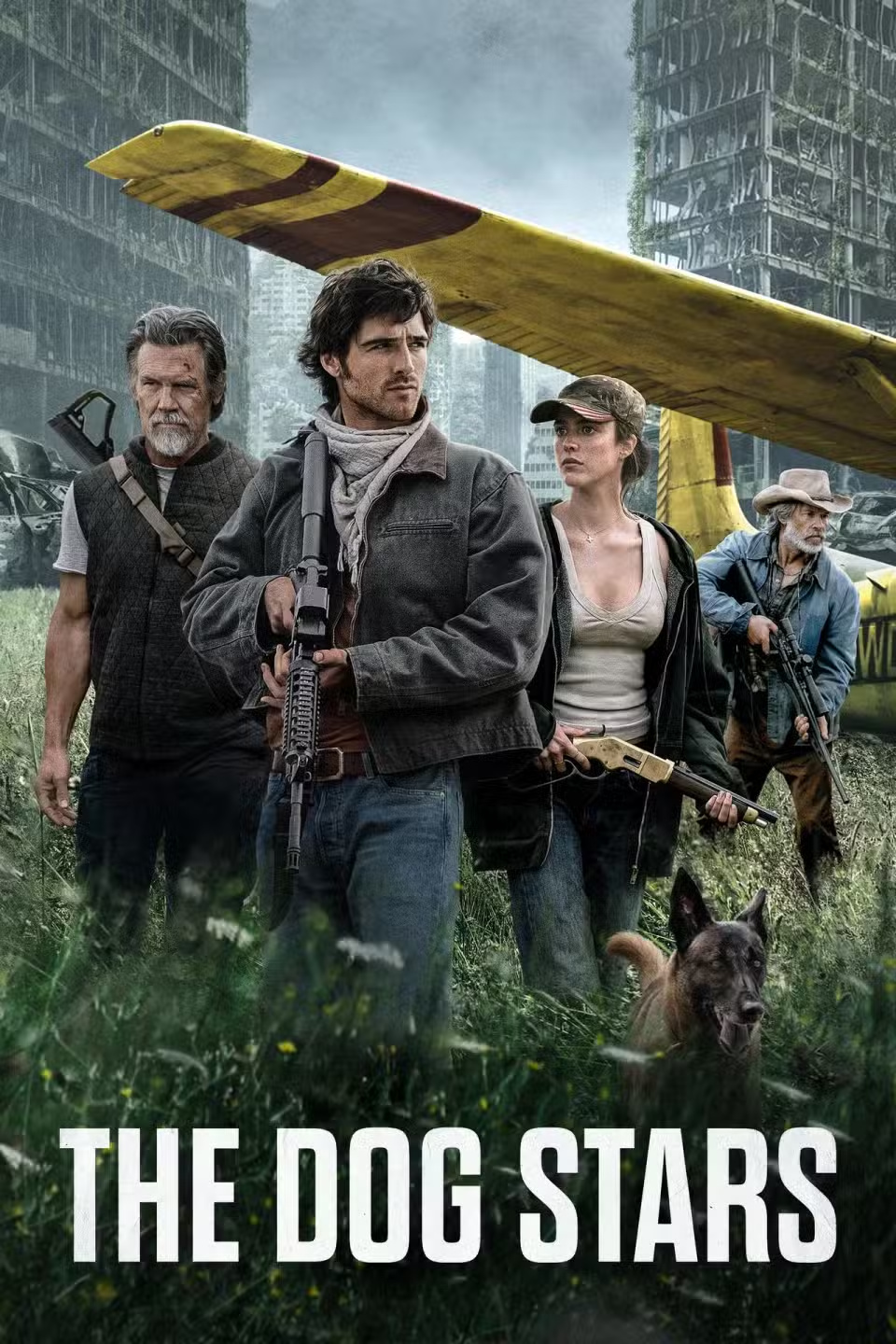





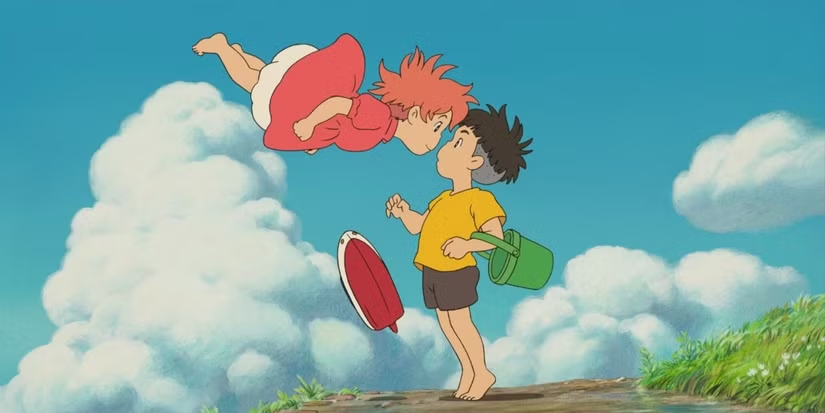



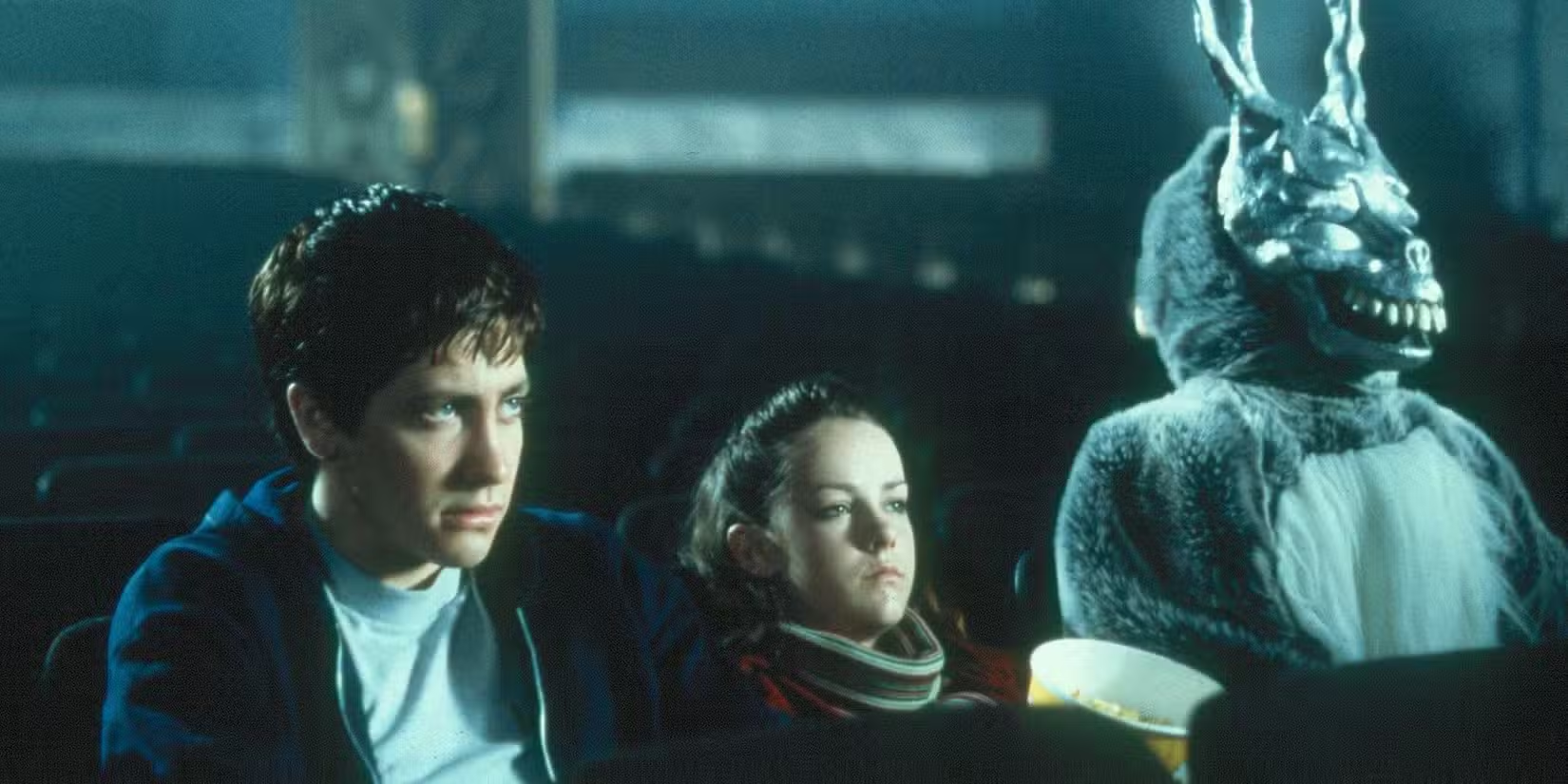


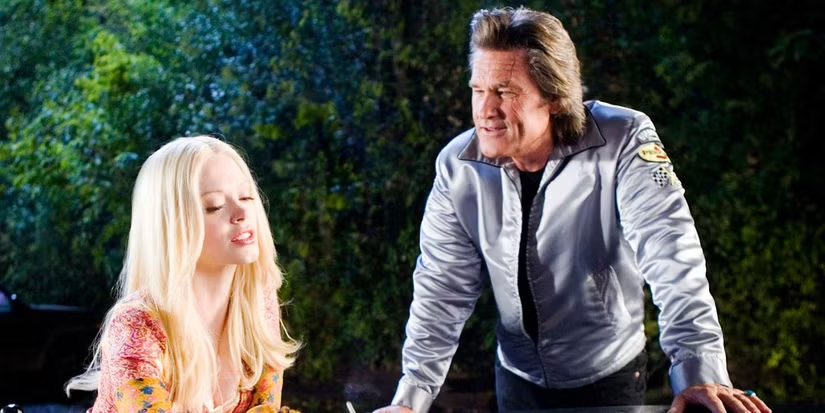


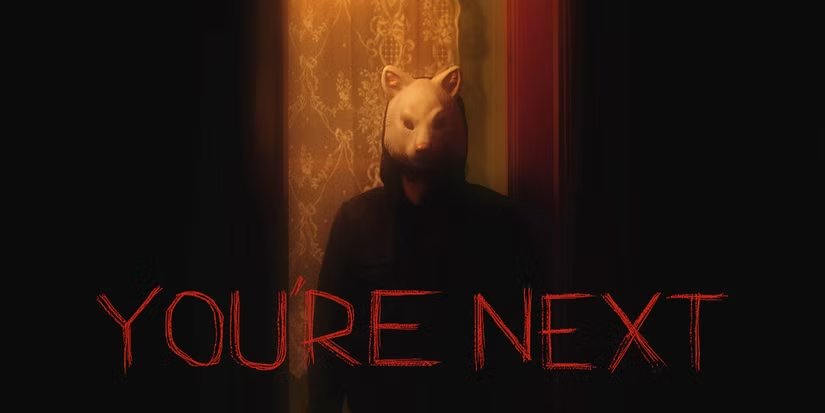


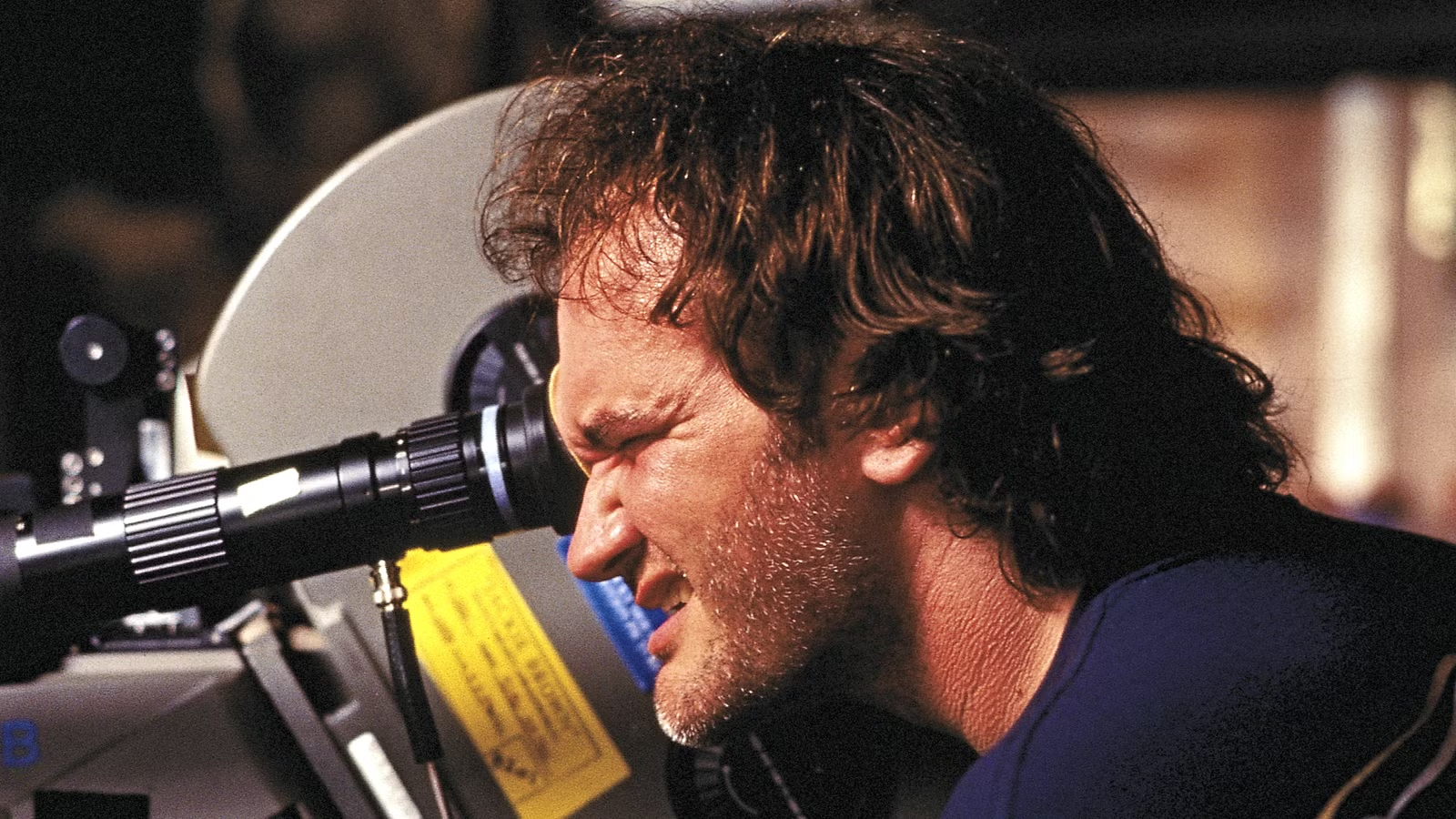

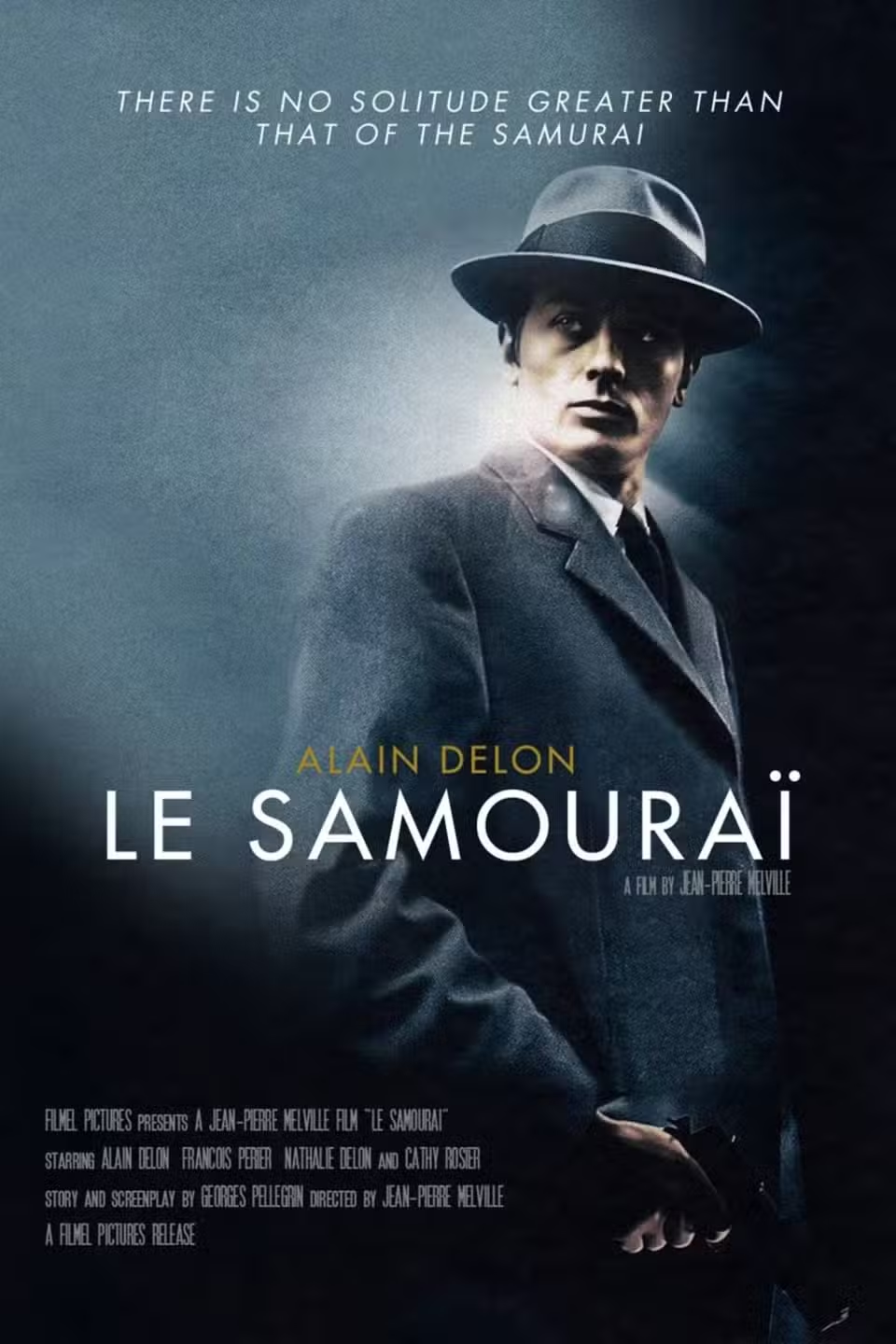





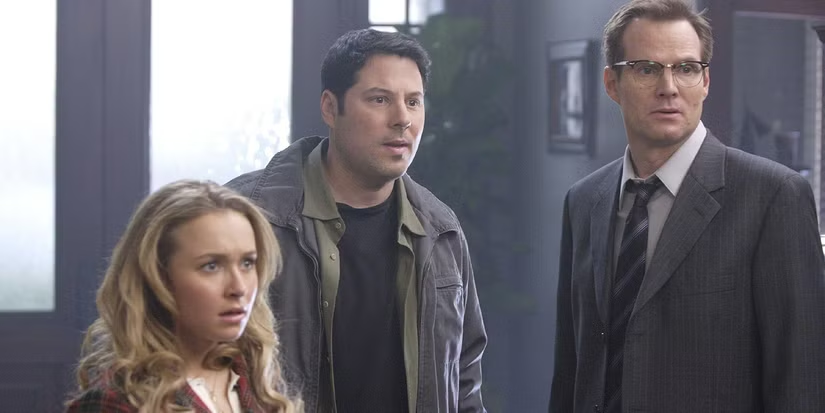













































You must be logged in to post a comment Login