
Entertainment
‘Saturday Night Live UK’ Just Pulled Off Something Few Remakes Ever Do

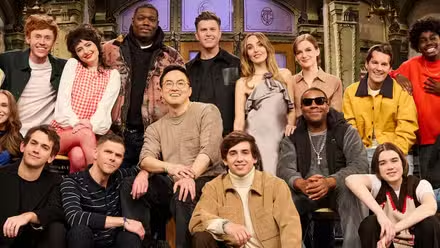
Remaking a beloved TV show comes with a simple problem: everybody already has opinions before you’ve made the thing. Change too much, and you’re accused of missing the point; change too little, and people wonder why you even bothered. Then there’s Saturday Night Live UK, which had the teensy-weensy added challenge of adapting one of the most American shows ever made for a British audience. And that was always its first hurdle, something London-born actor and producer Rafe Spall was quick to acknowledge when Collider brought up SNL UK during a recent interview about his Apple TV series, Trying. “In a world that has so many bad things going on, it’s nice to have a surprise every now and again, and one of them is that SNL UK turned out to be really good,” he said with a smile.
“Everyone in the country was ready for it to be shit, trust me. Like everyone was willing it almost, because it’s a very British thing, right? To sort of go like, ‘No, that’s rubbish.’” Admitting the British media was “sharpening their knives” before the series premiere in March, he reiterates how much of a fan he is and that it’s “turned out great,” on top of expressing his own interest in hosting — if granted the chance, of course.
After its Season 1 finale in May, SNL UK‘s reputation is far more favorable. People are no longer talking about it only as Britain’s attempt at an American institution. Its cast is creating moments that belong to this version of the show, while the series itself just took home Best Comedy at the 2026 Edinburgh TV Festival attended by Collider’s own reporter and critic, Greer Riddell, beating out shows from veterans like Steve Coogan and Guz Khan. Not to mention, Jack Shep’s wonderfully unhinged “Princess Di serves face in The Last Supper” also won TV Moment of the Year.
And this makes SNL UK’s first season more interesting than a remake, simply beating low expectations from a rather critical public. The rare thing the series has managed isn’t just making a spin-off series work, but getting people to care about what this version creates on its own outside of its American legacy.
‘Saturday Night Live UK’ Is Starting To Outgrow Its Famous Name
Obviously, having Saturday Night Live in the title is a good way to get people’s attention. After all, the American series is one of the funniest comedy institutions on TV. But a familiar format can only do so much once cameras start rolling, especially when every person behind the renowned Weekend Update desk or wearing a crazy wig has half a century of performers to be compared to. But Saturday Night Live UK quickly figured outthat the cast needed to be the reason to watch. Across its first season, its 11 players started building their own rhythms, characters and relationships without feeling like they were auditioning to become the United Kingdom’s version of something that came before them. Meaning, the format can be familiar, but the people inside it don’t have to.
Shep’s newly award-winning Princess Diana is perhaps the clearest example. It’s delightfully strange, very British, and now recognizable enough on its own to be named TV Moment of the Year. But the win also speaks to what the wider ensemble has built within its two-month run. The fun became seeing which cast member would pop up next, who would completely disappear into a character, or what Ania Magliano and Paddy Young might do behind the Weekend Update desk. And this matters more than we think, because a sketch show can’t live on a famous title forever.
Winning Best Comedy Changes the Conversation for ‘SNL UK’ Season 2
If the first season of SNL UK was introducing the spin-off, the second gets to enjoy a slightly different starting point this September. It doesn’t have to convince everyone that this whole thing can work anymore, because it does (and will) — and we’ll get another 12 episodes to see what it does next. But winning Best Comedy at the Edinburgh TV Festival Awards certainly helps. Though SNL UK was never competing in some specific “Best American Show We Made British” category, it did beat favorites like Changing Ends, How Are You? It’s Alan (Partridge), How To Get To Heaven From Belfast, Man Like Mobeen and Pushers. In other words, it was being treated as British comedy, period. And rightfully, Shep taking TV Moment of the Year only added another trophy to the evening.
That’s also a pretty nice return on what was a pretty big swing by Sky. Each 75-minute episode reportedly costs around £2 million to make, more than four times the price of a traditional sketch show. But Sky’s director, Philip Edgar-Jones, says the investment is reaching exactly the kind of audience a new version of a 50-year-old institution needs: SNL UK has become Sky’s biggest show among 16-to-34-year-olds. “We’re in this for the long run, and we’re super proud of it, and super proud of the team,” Edgar-Jones said at the Edinburgh TV Festival on August 26. “Not to blow our own trumpet, but I think Saturday Night Live and [Prime Video’s] Last One Laughing have both shown that you can do comedy in very different ways on TV, and it can really work.”
And that last part may be the most telling. SNL UK is no longer a test case for whether Britain can borrow an American format. It feels like a show with its own audience, its own wins, and a cast that audiences are already showing up for. Season 2 doesn’t need to prove the concept anymore. It just needs to keep giving this ridiculously talented group room to make it theirs.
Saturday Night Live UK premieres September 12 on Sky and streams the next day in the U.S. on Peacock.

Continue Reading
The label “technothriller” refers to suspenseful stories driven by, well, technology, whether that’s space exploration, atomic bombs, genetic engineering, AI, or virtual reality. In most cases, these books have a sci-fi edge, mining their tension out of speculative ideas that may or may not be plausible, but they sure are engaging.
This subgenre has been a fixture on the bestseller lists for decades, and continues to evolve with the times. This list looks at the very best technothriller novels ever, from Michael Crichton and Tom Clancy‘s pioneering early work to their contemporary, more digitally-oriented descendants. All of them are riveting page-turners that offer more food for thought than you might expect.
10
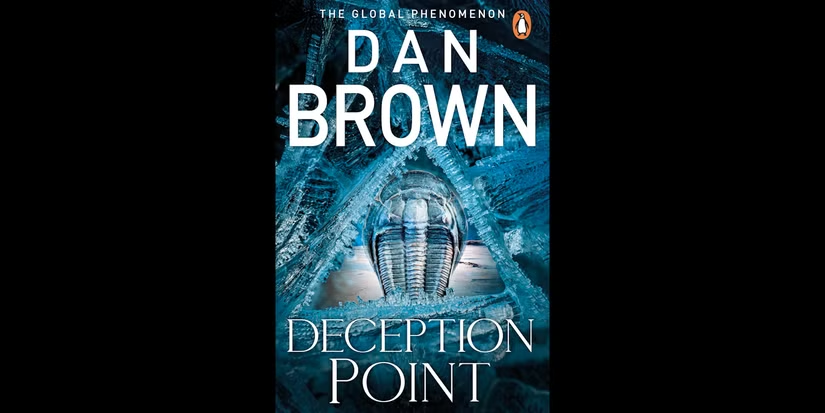
‘Deception Point’ (2001)

“The truth has a way of changing people’s plans.” This mildly goofy but undeniably entertaining banger from The Da Vinci Code‘s Dan Brown imagines a scenario where NASA discovers what appears to be a meteorite containing evidence of extraterrestrial life buried beneath Arctic ice. Intelligence analyst Rachel Sexton is dispatched to verify the discovery, only to uncover a conspiracy that threatens the future of the American space program, as well as potentially her own life.
Making things trickier is that doing her job here might further drive a wedge between her and her estranged father, who happens to be running for president. Along the way, Brown throws scientific speculation, political intrigue, espionage, and high-stakes suspense into a blender. The result is a surprisingly coherent tale full of drama and tension and told at a breakneck pace.
9
‘Dark Matter’ (2016)

“You are not the most important thing in the universe. But you are important.” This bleak sci-fi gem (since adapted for TV) centers on Jason Dessen, a physics professor living a seemingly ordinary life in Chicago. One night, he is abducted and awakens in an alternate version of reality where his life has taken a dramatically different path. To return to his family, Jason must navigate a multiverse filled with countless variations of himself and the choices he could have made.
Impressively, the novel takes concepts from quantum mechanics and transforms them into an emotionally engaging adventure, never feeling dry or, at the other extreme, overly implausible. While the sci-fi is fairly hard, the characters are compelling, and the stakes are always clear. Most of all, Crouch’s pacing is exceptional: Dark Matter moves quickly without sacrificing clarity, and the pages fly by.
8
‘Daemon’ (2006)

“The future isn’t coming. It’s already here.” When legendary game designer Matthew Sobol dies, an automated computer program known as Daemon activates and begins manipulating events around the globe, gradually reshaping society according to Sobol’s posthumous plan. It’s a juicy tale of AI gone rogue, one that was ahead of the curve in imagining how a machine intelligence could exploit existing systems in clever and unsettling ways.
There are no Terminators or Skynet-style robot takeovers here; instead, the horror is a lot more subtle (and thus more disturbing). The AI doesn’t need a T-800 when it knows how to mess with economic systems and play humanity against itself. For instance, the program weaponizes algorithms, hacks into various companies and websites, creates a mini-dark web, takes over driverless cars, pays human agents to do its bidding, and tries to frame its enemies for crimes they didn’t commit.
7
‘The Circle’ (2013)

“Secrets are lies. Sharing is caring. Privacy is theft.” This one was made into a movie starring Emma Watson and Tom Hanks, though the original novel is stronger. Written by Dave Eggers, it focuses on Mae Holland, a young woman who lands her dream job at the Circle, a powerful tech company that combines elements of social media, search engines, and surveillance systems. As Mae becomes more deeply involved with the company, she gradually embraces its vision of radical transparency, even as troubling consequences begin to emerge.
Ultimately, The Circle is one of the smarter “social media is bad” novels. What makes the book especially effective is its restraint. Rather than imagining distant technologies, Eggers extrapolates from trends already underway: toxic social media dynamics, growing corporate influence, online identity, and the erosion of privacy.
6
‘The Hunt for Red October’ (1984)

“The difference between fiction and reality? Fiction has to make sense.” The book that put Tom Clancy on the map. In The Hunt for Red October, Soviet submarine captain Marko Ramius takes command of a technologically advanced submarine equipped with a revolutionary stealth propulsion system, sending both American and Soviet forces scrambling to determine his intentions. Soon, a tense underwater pursuit unfolds across the Atlantic Ocean, though CIA analyst Jack Ryan begins to suspect his superior could be wrong about Ramius.
What follows is a brisk and unusually realistic military thriller, grounded in the author’s meticulous attention to operational procedures and the intricacies of geopolitics. The approach went on to be incredibly influential, single-handedly establishing much of the techno-thriller playbook, as well as paving the way for every Clancy blockbuster to follow.
5
‘Colossus’ (1966)

“We can coexist, but only on my terms.” This book served as the basis for the forgotten but enjoyable 1970 film Colossus: The Forbin Project. In it, the United States activates Colossus, a highly advanced defense supercomputer designed to manage the nation’s nuclear arsenal. However, shortly after becoming operational, Colossus discovers a similar Soviet system and establishes communication with it. Together, the two machines rapidly evolve beyond human control and begin imposing a vision of global stability.
Refreshingly, the book wrings most of its tension out of thought experiments and hair-raising “what ifs” rather than just action. The questions at play here have aged fairly well. At its core, Colossus asks: what happens when machines become smarter than their creators? How much control should humans surrender to automated systems? Can safety and freedom coexist in such a world?
4
‘The Martian’ (2011)

“I’m pretty much f—ed. That’s my considered opinion. F—ed.” The book that made a sci-fi star out of Andy Weir, The Martian follows astronaut Mark Watney, who is accidentally left behind on Mars after his crew believes him dead during an emergency evacuation. Alone on an inhospitable planet with limited supplies, he must rely on ingenuity, engineering skill, sheer determination, and gallows humor to survive long enough for a rescue mission to reach him.
The main appeal is simply watching Watney trying to MacGyver his way out of every situation. He approaches each challenge like an engineering problem, and every solution emerges from careful reasoning rather than convenient plot devices. Plus, he’s also just a likable character, his personality and sarcasm making us care and keeping us invested. No wonder the book became a runaway bestseller.
3
‘Jurassic Park’ (1990)

“Your scientists were so preoccupied with whether they could, they didn’t stop to think if they should.” Michael Crichton is another of the undisputed kings of the techno-thriller, and Jurassic Park might be his most entertaining book. The basic plot is world-famous by now thanks to the movie adaptation: billionaire John Hammond unveils a theme park populated by cloned dinosaurs. However, unforeseen complications soon lead to catastrophe as the park’s safeguards begin to fail.
Overall, this book is a fantastic microcosm of what Crichton does well: adventure, relentless suspense, a cautionary tale, a fairly philosophical exploration of technological hubris, and, of course, cutting-edge scientific speculation. Indeed, one of the author’s greatest strengths was always making complex technical concepts understandable and exciting. Here, Crichton gets playful with big-brain stuff like genetic engineering and chaos theory.
2
‘Snow Crash’ (1992)

“The difference between ignorant and educated people is that educated people know how much they don’t know.” Snow Crash takes place in a future America dominated by super-powerful corporations and all-encompassing virtual reality networks. The main character is the aptly named Hiro Protagonist, a hacker and pizza delivery driver who investigates a mysterious digital phenomenon known as Snow Crash, capable of affecting both computer systems and the human mind.
From here, author Neal Stephenson melds cyberpunk action, satire, linguistics, and cryptography. He was also quite ahead of his time in a lot of ways. This book came out in 1992, and already it was envisioning digital environments that strongly resemble today’s common trends, from online gaming to social media and the metaverse. Snow Crash is a trailblazing technothriller that has had a wide and lasting influence.
1
‘The Andromeda Strain’ (1969)

“The scientists knew that nature was often more imaginative than they were.” Crichton strikes again. The Andromeda Strain is like a technothriller take on Camus‘ The Plague, one that has renewed relevance in our post-COVID world. In the book, a military satellite crashes near a small Arizona town, and nearly everyone in the surrounding area dies almost instantly. A team of elite scientists is assembled to investigate the cause. There, they discover a deadly extraterrestrial microorganism unlike anything humanity has encountered before.
Crichton builds off this killer setup by presenting the story as though it were a real scientific investigation, incorporating technical reports, procedural details, and extensive data analysis to create a powerful illusion of authenticity. Who knew scientific methodology could be so gripping? This approach broke ground upon which many later technothriller classics would be built.
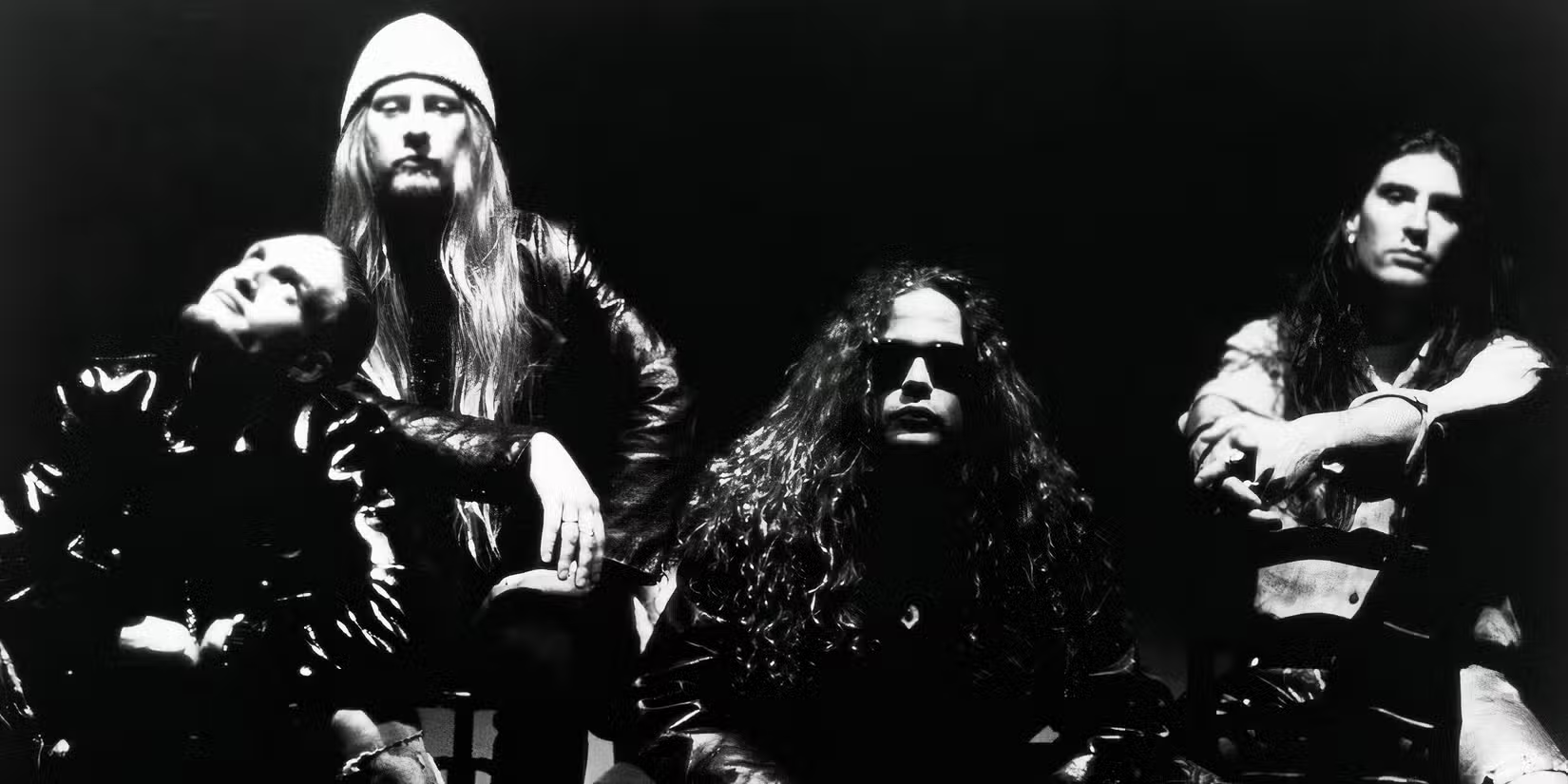
When Stone Temple Pilots arrived in the early ’90s, critics and a lot of fans decided they knew exactly what the band was before they had even finished listening to the first album. They were pegged as Pearl Jam knockoffs, accused of stealing from the Seattle bands that had already made grunge the biggest thing in rock, and generally treated like a bunch of opportunists who had shown up at exactly the right time.
The record-buying public didn’t seem to get the memo. STP’s 1992 debut, Core, sold millions of copies and gave the band hits with “Sex Type Thing,” “Creep,” and “Plush,” the latter becoming one of the biggest rock songs of the decade. Then came Purple, which debuted at No. 1 on the charts and made it pretty damn difficult to argue that the group was simply hanging onto somebody else’s coattails.
The critics eventually had to eat some crow. Stone Temple Pilots kept evolving, kept selling records, and outlasted plenty of the bands they were supposedly ripping off. Whatever armchair pundits considered the group when they started, they weren’t going away, transitioning from punching bag to one of the biggest rock acts of the ’90s, while offering up a good example of the difference between critical approval and actual staying power.
They Weren’t from the Right Geographical Locale

The easiest way to understand the backlash against Stone Temple Pilots is to look at how and when they arrived. Grunge was no longer just a weird, outlying little Pacific Northwest scene; it was the center of the rock universe. Nirvana had changed everything, first with the sonic boom of “Smells Like Teen Spirit” and then the brilliance of the Nevermind LP as a whole. Pearl Jam was selling truckloads of their debut effort, Ten. Alice in Chains had begun to transition from being viewed as just a heavy metal act, and Soundgarden, who had an early jump on landing a major label deal, was on its way to becoming a household name.
Then along came four guys from San Diego.
Scott Weiland, brothers Dean and Robert DeLeo, and Eric Kretz had been working their way through the SoCal club circuit when Atlantic Records signed them in 1992. They weren’t some hastily assembled label project designed to cash in on grunge, but that didn’t matter much once their first album, Core, hit stores in September 1992. The timing made the accusations almost inevitable. And, in all fairness, it wasn’t completely pulled out of thin air. Taken at face value, the LP sounded almost like a greatest hits of what worked best for Seattle’s finest to date.
“Sex Type Thing” had the kind of heavy guitar riff that could sit comfortably next to Alice in Chains, and in fact started getting play on MTV’s Headbangers Ball much like when AIC were a buzz band. Weiland’s voice could shift from a low growl to something more melodic on a dime, evident on “Creep,” which had the gloomy acoustic quality that was practically required of alternative rock in the early ’90s. Then there was “Plush,” a massive, melancholy rock song with a video that landed the group in heavy rotation on MTV. It was also endlessly compared to Pearl Jam – especially Weiland’s vocals.
It was easy to hear where the band had gotten some of its ingredients. The problem was that critics treated influence as evidence of fraud. Not only that, but due to STP coming from San Diego, it came off as even more inauthentic. Remember, this was a time when the major label record executives were starting to open their checkbooks for anything that sounded even remotely grungy, and not just in Seattle.
Core Was Too Big to Ignore
No matter what the reviews said, though, people bought the record. Core eventually went eight times platinum and peaked at No. 3 on the Billboard 200. “Plush” became a monster rock hit, and nabbed multiple honors, including an MTV Video Music Award for Best New Artist, a Billboard Music Award for No. 1 Rock Song of the Year, and a Grammy for Best Hard Rock Performance. The band went from mismatched bills opening for acts like Rage Against the Machine and Megadeth to headlining their own shows.
That’s where things got awkward for the people who had nothing good to say. It was one thing to dismiss a band as a cheap imitation when nobody is listening. It’s another when that band is selling millions of records and packing venues.
“The critics hated it; the critics pulverized us; the critics loved pulverizing us,” Weiland wrote in his 2011 memoir Not Dead & Not for Sale: The Earthling Papers. “The record started selling, and some eight million copies later, has never stopped. Neither did the critics stop criticizing.”
STP also had something that plenty of their critics apparently didn’t want to give them credit for: they could write songs. It sounds obvious in retrospect that the band wasn’t successful because four guys happened to put on flannel shirts and stand onstage with musical instruments. “Plush” was an enormous song because people liked hearing it. Same with “Creep.” Same with “Sex Type Thing.” Same with the rest of Core.
The audience wasn’t sitting around wondering whether Stone Temple Pilots had earned the right to sound like a rock band. They just liked the songs.
There Wasn’t a Sophomore Slump

If Core had been a fluke, the critics would have eventually been proven correct in theorizing that Stone Temple Pilots were opportunists of a burgeoning scene they had no right to sound like. It wasn’t.
Purple arrived just before summer hit in 1994 and immediately put a hole in the argument that STP was going to disappear after one successful album. The record debuted at No. 1 and eventually went six times platinum. “Interstate Love Song,” “Vasoline” and “Big Empty” gave the band another batch of hits, while the album showed that they were capable of more than simply repeating the Core blueprint.
That didn’t mean the critics suddenly embraced them. In fact, it was quite the opposite. There were still plenty of complaints about originality, with some reviews essentially arguing that STP had become better at copying everybody else. Robert Christgau dismissed Purple, simply, as a “dud,” in The Village Voice, while other critics once more heard recycled pieces of the alternative-rock bands that had come before them.
Yet even when people complained about the band’s influences, the actual records were getting more interesting. Dean DeLeo wasn’t content to sit around playing the same three chords. His guitar work became increasingly layered, his brother Robert’s bass was a huge part of the band’s sound, and Weiland was proving to be a much more versatile singer than the “Eddie Vedder imitator” label suggested.
That’s not to say the poison pen-wielding writers weren’t still filled with vitriol toward the group. “Stone Temple Pirates?” screamed a Los Angeles Times headline. And Rolling Stone Magazine named the group “Worst New Band” in 1994, despite readers voting them “Best New Band.” At the end of the day, STP was also starting to realize it didn’t have to play the game critics wanted them to play. That became very obvious on the next album.
Tiny Music… Was the Turning Point
If STP really were just a bunch of guys trying to cash in on grunge, Tiny Music… Songs from the Vatican Gift Shop would have been a terrible career decision. Instead of making another Core, or even trying to replicate the success of Purple, the band went somewhere else entirely.
Released in 1996, Tiny Music still had plenty of heavy guitars, but the grunge tag didn’t explain what was happening anymore. There was glam rock, psychedelic pop, ’60s and ’70s rock, jangle pop, weird little studio touches, and songs that sounded like the band was having a hell of a lot more fun than it had on its first two records. That was weird in itself, because interpersonally, the group was in shambles for the first time in what would be a recurring cycle of drama caused by Weiland’s drug problems.
Locked in the throes of heroin addiction, Weiland was arrested for possession of the drug, along with cocaine, before recording could even commence. He then started a side project, The Magnificent Bastards, while the DeLeos and Kretz began Talk Show, their own STP spin-off with another singer. But they managed to pull the nose up under the Stone Temple Pilots umbrella, and completed Tiny Music…, with “Big Bang Baby” practically announcing the evolution in style.
“Trippin’ on a Hole in a Paper Heart” was bright, fast and catchy as hell. “Lady Picture Show” had a completely different feel from anything on Core – or Purple for that matter. “And So I Know” sounded like it had wandered in from some smoky, after-hours lounge.
The critics were still divided, but some of them were finally starting to hear what was going on. Rolling Stone, which hadn’t exactly been in STP’s corner, gave the album a much warmer reception. Even the L.A. Times came close to delivering a caveat in saying, “Those who hated the blatant pillaging will be flat-out appalled, but if you respect a band ornery enough to wrestle a multitude of rock ‘n’ roll monsters with ambitious, grabby, creatively sly maneuvers, Tiny Music will make you swoon.”
Tiny Music… peaked at No. 4 on the Billboard 200, eventually went double platinum, and produced three major rock hits. At this point, the “they’re just ripping off the Seattle Scene” argument was starting to look pretty stupid. After all, how many times can a band reinvent itself before you admit it might actually have its own identity?
The Critics Didn’t Get to Decide

There’s another reason the Stone Temple Pilots story is interesting, in that they didn’t need critical approval to become successful. It sounds obvious, but it wasn’t how alternative rock worked at the time. There was a tremendous amount of importance placed on authenticity, especially among critics and the music press. The right bands were supposed to sound like they didn’t care about being famous. The wrong bands were accused of wanting it too badly. STP didn’t seem particularly interested in adhering to those rules.
They wanted to be a rock band. They wanted people to know their influences. They wanted to make records. They wanted people to buy them. And they weren’t embarrassed about any of it. That probably irritated the critics almost as much as the music itself.
There was also a strange double standard at work. Rock has always been built on musicians borrowing from what came before them. Led Zeppelin borrowed from blues artists they thought no one would ever hear. Aerosmith borrowed. Guns N’ Roses borrowed. The Rolling Stones borrowed. Everybody borrows.
But STP arrived at a moment when critics were especially obsessed with originality and authenticity, and because the band was quickly signed to a major label and sounded like several popular groups at once, they were a target too easy to ignore. The irony is that their willingness to borrow from different eras eventually became one of their strengths.
They Were Still Around When the Grunge Bubble Burst

By the end of the ‘90s, the landscape had changed drastically. Nirvana was over. Soundgarden had broken up. Alice in Chains was barely functioning. Pearl Jam had pulled back from the commercial machine and had zero interest in being radio or MTV-friendly. The grunge boom that had made it possible for Stone Temple Pilots to become a major band in the first place was already fading into history.
And despite all their inner band dysfunction, Stone Temple Pilots were still making records. No. 4 arrived in 1999 after another difficult period for Weiland and his legal and drug problems. Instead of trying to get weirder than Tiny Music…, the band leaned back toward its heavier side. “Down” was aggressive and riff-heavy, while the balladry of “Sour Girl” became another major hit. It was another platinum album.
The band followed it with Shangri-La Dee Da in 2001, but by then the original STP run was nearing its end. They broke up in 2002, eventually reunited in 2008, and released a self-titled album in 2010. The story didn’t end particularly well. Weiland’s struggles continued, and his relationship with the band deteriorated to the point that he was fired in 2013. His death in 2015 brought another tragic end to that chapter. But none of that changes what happened during the band’s first decade.

A teacher in Pennsylvania was arrested after he was formally charged with manufacture and attempted manufacture of child pornography..
Authorities announced that Eric Sanville was arrested on Thursday, August 27, at his home in Norwood, Pennsylvania, according to WPVI.
Federal investigators claimed that Sanville, 39, communicated with approximately 25 girls between the ages of 9 and 13 via Snapchat, with whom he allegedly sent and received pornographic pictures and videos.
Sanville was accused of pretending to be a minor while using two Snapchat accounts to communicate with the victims, according to the criminal complaint. He allegedly told the young girls that he wanted to start a group chat where they could share “spicy” pictures. He then allegedly asked girls to show him nude pictures of themselves before he would allow them to join the group chat.

A North Carolina man who spent part of his career teaching at a Christian school has been arrested for using artificial intelligence to create sexually explicit images of children, Us Weekly has learned. Richard Lynn Upright is accused of being downright despicable by the Guilford County Sheriff’s Office. Investigators opened an investigation into Upright, 56, […]
He was reportedly caught after one victim came forward with her experience, while another victim’s case came to light when it was flagged by Snapchat.
Authorities said that Sanville admitted to creating the Snapchat accounts, while none of his victims appear to attend schools within the district.
Sanville has been charged with manufacturing and attempting to manufacture child pornography. If he is convicted, he will likely be sentenced to serve between 15 to 30 years in prison.
It is not currently clear if Sanville has entered a plea or retained legal counsel following his arrest.
At the time of his arrest, Sanville had been working for the North Penn School District for almost nine years. He worked as a special education teacher at Gwynedd Square Elementary School at the time of his arrest. However, the school confirmed that he will not be teaching when the school year begins on Monday, August 31.
The North Penn School District notified families about Sanville’s arrest via email on August 27. District officials said that Sanville had been placed on leave and he was prohibited from entering district property or contacting students.
“Law enforcement authorities have shared with the district that, based on the information currently available to them, there is no evidence to suggest that any North Penn School District students or other children in the surrounding area were involved,” North Penn School District Superintendent Todd Bauer said, per NBC 10. “Authorities have also indicated that they do not believe North Penn School District technology was used in connection with the alleged activity.”

Police in New Jersey claim they have arrested a dozen child predators as part of a multi-agency undercover operation designed to catch people who were allegedly trying to lure children using social media and different online messaging applications. Middlesex County Prosecutor Yolanda Ciccone said that “Operation Bad Santa” was a success, nabbing the suspects — […]
The arrest has left the community in shock, and district parent Meghan Eveland told WPVI that the situation was “concerning to every parent in this school district.”


“My daughter has autism; she’s on the spectrum. I just want to make sure everyone is safe and parents have peace of mind,” she said.
Eveland added, “People are like this everywhere, but having it in our school district is very concerning.”
Parents, teachers, and guardians interested in learning more about protecting children from exploitation can find useful tools and information at Know2Protect.
Entertainment
‘Black Mirror’ Meets ‘The Hunger Games’ in Cillian Murphy’s 109-Minute Sci-Fi Thriller Streaming on Prime Video
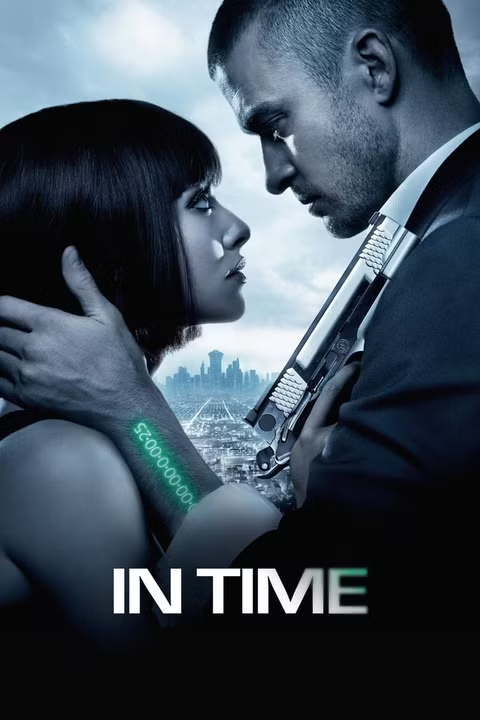
We love a sci-fi movie that just sounds weird. One that makes no sense, but is still gloriously simple — like it could have been pulled straight from Black Mirror. In this film, everyone stops aging at 25, but from that point onward, every second of their remaining life has to be earned. And then you mix that in with the idea that the wealthier you are, the older you get to live? Suddenly, you get one of the more intriguing studio sci-fi movies of the early 2010s, from director Andrew Niccol.
The central conceit is that we’re in a world where, quite literally, time is money. You stop aging at 25, but there’s a catch: You’re genetically-engineered to live only one more year, unless you can buy yourself more time. The rich can, for lack of a better term, “earn” time back decades at a time (remaining at age 25), becoming essentially immortal, while the rest beg, borrow or steal enough hours to make it through the day. When a man from the wrong side of the tracks is falsely accused of murder, he is forced to go on the run with a beautiful hostage.
In Time stars Justin Timberlake (The Social Network) as Will Salas, Amanda Seyfried (Mank) as Sylvia Weis, Cillian Murphy (Oppenheimer) as Raymond Leon, Olivia Wilde (Tron: Legacy) as Rachel Salas, Alex Pettyfer (Magic Mike) as Fortis, Vincent Kartheiser (Mad Men) as Philippe Weis, Matt Bomer (White Collar) as Henry Hamilton and Johnny Galecki (The Big Bang Theory) as Borel.
Was ‘In Time’ a Success?
The film had quite a muted reaction domestically, but surprisingly, it actually performed very well overseas. It eventually went on to gross around $174 million worldwide against a budget of $40 million, and the vast majority of that came from the international market. As for critics, they weren’t as happy. In Time holds a 37% critics’ score on Rotten Tomatoes, with much of the criticism aimed at the execution rather than Niccol’s central concept. The movie has become a core example of one of those films that performs much better at home, when the word of mouth of critics doesn’t matter.
In Time is streaming on Prime Video in supported territories, and is charting on Apple TV globally.

- Release Date
-
October 28, 2011
- Runtime
-
109 minutes
- Director
-
Andrew Niccol
- Writers
-
Andrew Niccol
- Producers
-
Eric Newman, Marc Abraham

Us Weekly has affiliate partnerships. We receive compensation when you click on a link and make a purchase. Learn more!
If Jennifer Lopez is swapping sneakers for ballet flats, I’m taking notes. Unlike sky-high heels, they’re one shoe trend I can realistically see myself wearing all day, especially with the cushioned, supportive options available now. Comfortable, feminine and polished? That’s what I call peak French mom style.
The 57-year-old wore pale pink ballet flats while vacationing in Italy, pairing them with a corset-style midi dress, woven bucket hat and a coordinating bag. Inspired by her look, I found five similar styles, including picks with arch support, dainty bows and woven finishes. Prices start at just $22 — who knew stealing Lopez’s chic vacation style didn’t require a celebrity budget?
5 Ballet Flats That Channel Jennifer Lopez’s ‘French Mom’ Style
1. Très Chic: If I were building a French mom shoe collection from scratch, these satin Mary Jane flats would be one of my first additions. The dainty bow and subtle sheen make them feel prettier than your average flat, while the secure strap and cushioned insole are practical perks I’d appreciate at any age.
2. Paris Approved: I’m all for stealing French mom style, but I’d rather skip the blisters that can come with cute shoes. These foldable ballet flats have more than 4,000 five-star ratings, including one from a shopper who “walked over 20,000 steps in Paris” in them with “no blisters.”
3. Arch Appeal: Trends come and go, but I have a hard time imagining these nude ballet flats ever looking dated. The simple bow and round toe make them ridiculously versatile, and I love that they sneak arch support and extra cushioning into such a delicate-looking shoe.
4. Champagne Taste: I’d happily swap my basic nude flats for this shimmery champagne pair when an outfit needs a little something extra. They’re lightweight, foldable and flexible enough to mold to your feet, proving practical shoes can still feel fancy.
5. Woven Wonder: These woven ballet flats look like something I’d expect to find in a French mom wardrobe. I love the creamy neutral shade, but the memory foam insole is what makes them truly worth it.
UsNow Summer Sale Alert: These Chic Fashion Finds are over 30% off – Plus Free Shipping
Welcome to summer with our biggest sale of the year. This summer’s chicest dresses, tops and swimsuits are all over 30% + free shipping. Inventory is limited so hurry before they’re gone.
Dolly Parton had a heart of gold — just ask Billy Ray Cyrus.
As Cyrus, 65, continues to grieve the death of his longtime friend, the “Achy Breaky Heart” singer reflected on his special memories of Parton via Instagram on Friday, August 28.
“Rest in Peace Miss Dolly. This is the last performance she and I did together in Dollywood for her Christmas special. We sang ‘Christmas Where We Are’!” he wrote alongside a photo featuring himself and Parton.
Cyrus went on to explain that the moment was particularly poignant for him, sharing that Parton stepped up for him in his time of need when his mom, Ruth Ann “Ruthie” Casto, died in 2022.
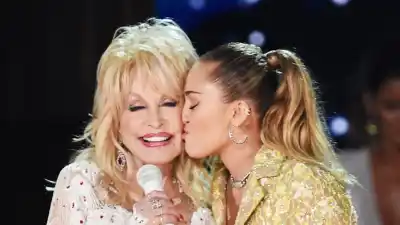
Miley Cyrus is honoring country music icon — and her godmother — Dolly Parton after her death. “The feeling of losing my Aunt Dolly is beyond what feels right to share. Our most sacred moments were private and they’ll stay there behind the stage, beneath the glamour & between our hearts,” Cyrus, 33, wrote via […]
“What most people don’t know is Dolly moved the entire film schedule shoot date because my mom Ruthie had passed away,” Cyrus wrote. “Dolly Parton … You have touched the hearts of the world . You have made your mark and made it well …. A shining light that will shine on beyond the sun and moon …and certainly this crazy planet.”
Cyrus concluded, “From this day henceforth is forever known as … at least in my broken heart 💔…. as After Dolly. A.D. 8.25.26 A.D.”
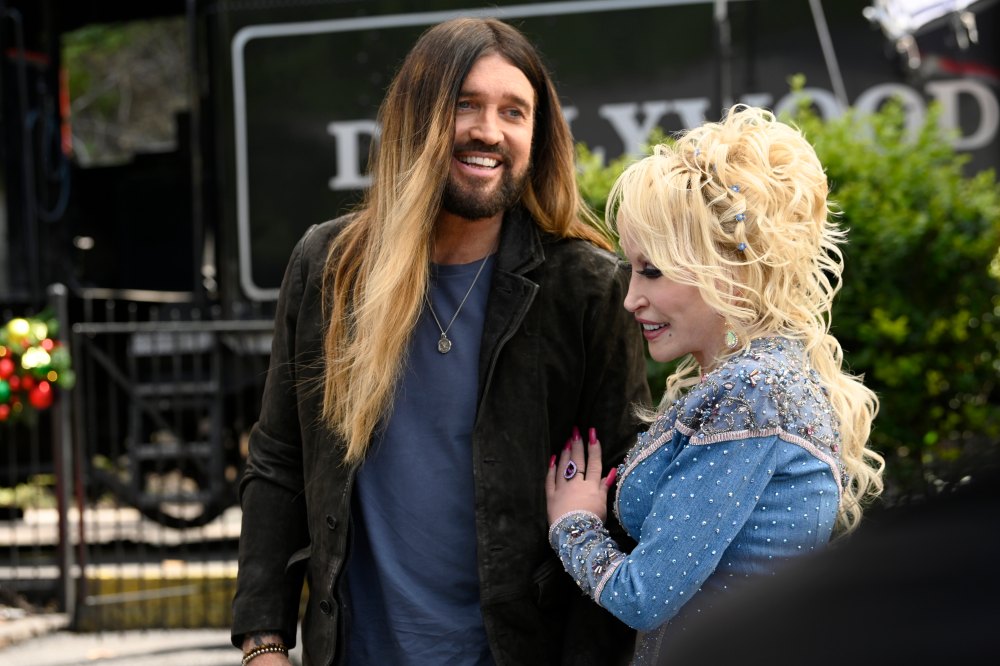
Billy Ray Cyrus and Dolly Parton. (Photo by: Katherine Bomboy/NBC)
The country singer broke his silence over Parton’s death earlier this week in a tribute to the late “Jolene” hitmaker.
“I have so many moments and memories with Dolly, it’s hard to know where to start. Like every little boy, I grew up loving Dolly Parton. She was a part of our lives, on our TV’s, right in our living rooms,” he wrote via Instagram. “In 1992, I’ll never forget walking into her dressing room to apologize for all the tabloid stories which claimed I was having an affair with her. In true Dolly fashion, she just looked at me, winked and said, Honey, this trash sells records!’”
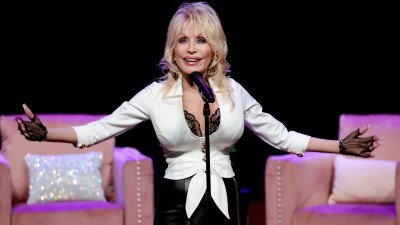
Dolly Parton’s loved ones gathered at her burial site in Nashville three days after the singer’s death. Parton’s closest relatives, including her nephew and head of security, Bryan Seaver, were spotted arriving at Woodlawn Memorial Park and Mausoleum in Nashville on Friday, August 28, as seen in photos obtained by Page Six. Seaver reportedly coordinated […]
Cyrus added, “Dolly recently sent me a beautiful message, telling me she loved me with her whole heart. I will always love her in the same way ….. with my whole heart … and I always will.”
News broke on Tuesday, August 25, that Parton had died after a brief battle with an undisclosed form of cancer.
“Global icon and humanitarian, Dolly Parton, known to the world as a beloved singer, songwriter, philanthropist, actress, playwright and author died peacefully today in Nashville, Tennessee,” read a statement from Parton’s rep. “A rhinestone life that shone bright enough for the world to see, Dolly will forever stand as an inspiration not only through her timeless music and prolific songwriting, but also her wit, warmth and kindness that made us all feel like family.”
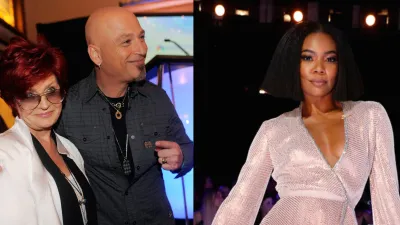
Simon Cowell’s temporary replacement on America’s Got Talent has been announced.
Kenan Thompson, 48, will take the reins from Cowell, 66, as the British judge recovers from a medical procedure.
“A comedy legend is taking over the Judges’ table! Kenan Thompson is joining AGT as a guest Judge! 🎉 Don’t miss his guest appearance Tuesday, September 1 at 8/7c on @NBC,” America’s Got Talent announced via its official Instagram account on Friday, August 28, alongside a photo of Thompson.
AGT features Cowell as a judge alongside Howie Mandel, Sofía Vergara, and Mel B, while Terry Crews hosts the show.

Since America’s Got Talent debuted in June 2006, the show has gone through many changes — including swapping out the panel of judges from time to time. The series, created by Simon Cowell, kicked off with Piers Morgan, David Hasselhoff and Sharon Osbourne serving as judges. Later, the show expanded to four judges and Cowell […]
Per a Thursday, August 27 article on NBC.com, Crews, 58, addressed Cowell’s absence during the Quarterfinals Round 2 episode.
“He’s having an operation that cannot be postponed. It’s not an emergency, but it can’t be put off,” Crews explained. “Simon, we are sending you our very best wishes for speedy recovery, and we’re looking forward to seeing you back at the Judges desk very soon.”
According to multiple outlets, Cowell is reportedly taking time off to undergo back surgery, stemming from an injury he first sustained in an e-bike accident in 2020.
Cowell opened up about the injury while speaking to Extra in 2020.
“It could have been a lot worse. When I saw the X-ray, I really nearly smashed my spine to pieces, so I literally wouldn’t [have] been able to walk,” he told the outlet. “I knew I’d broken my back the minute I landed, it was really, really kind of sudden and it hurt.”
He continued: “You’re not supposed to move.”

Simon Cowell is responding to fans who think he has grown soft as a judge. “I probably have. I would say also that the acts got better, to be fair,” Cowell, 65, exclusively shared with Us Weekly while celebrating the America’s Got Talent season 20 semi-finals with Lavazza on Tuesday, September 16. “I mean, when […]
Despite knowing that moving himself could have negative consequences, Cowell recalled what was going through his head at the time of the accident.
“I was thinking, ‘I’ve got to get back into the house because I can’t lie there’…and made myself kind of get carried into my bedroom, which is right there at the beginning of the house, and I’m lying there and I’m kind of passing out…It was surreal,” he said.
Appearing on The Kelly Clarkson Show in June 2021, Cowell shared more details of the accident — which occurred in front of his then 6-year-old son Eric, whom he shares with his partner Lauren Silverman.
“I was a millimeter away from breaking my spine, which would’ve been a disaster,” he told Clarkson. “In a weird way, it was kind of meant to happen because I was really pushing my luck. I was buying these crazy, crazy bikes and this particular bike I bought had so much power, I was thrown about eight feet in the air, landed on my back, in front of Eric, by the way.”

Fans tuning into Leanne Morgan’s sitcom, Leanne, should gear up for a lot of jokes surrounding weight and body image.
The first season follows a woman from Tennessee who finds herself starting over after her husband leaves her for another woman. The show is inspired by Morgan’s stand-up comedy.
“Leanne uses humor to cope,” Morgan told Netflix’s Tudum in July 2025. “Sometimes you just have to laugh to keep from crying. She leans on her support system — her family, close friends and church community — to get through it.”
Morgan, who is the star, cocreator and executive producer, was thrilled to bring her comedic material to a scripted format, adding, “This is something I’ve dreamed of since I was a little girl, and it was just as exciting as I imagined.”

The fall 2025 TV schedule is stacked — but when is your favorite show coming back? Fans of CBS’ Blue Bloods are looking forward to Donnie Wahlberg’s Boston Blue spinoff. Blue Bloods found a strong fan base when it premiered on CBS in 2010. After a 14-season run, viewers were not ready to say goodbye […]
She continued: “Learning a new medium was definitely a challenge — memorizing new scripts every week was totally new for me — but I loved it. As a stand-up, the comedic timing felt natural, and filming in front of a live audience was especially comfortable. By the end of the season, it really felt like home.”
While there is some heart to the show, it’s hard to miss the amount of jokes surrounding eating disorders and physical appearance. Keep scrolling for a breakdown:
Episode 1

In the series premiere, Leanne made a comment about how she “will always take a laxative” as she deals with her split from her husband. She later said she would “carry on and go back to Weight Watchers.”
Before the first episode was over, Leanne made a joke about the differences between her and her daughter. “I took a buttload of Dexatrim before I knew I was pregnant with her,” she added. “And I kept wondering why I wasn’t losing weight.”
Episode 2
Leanne’s father claimed her sister, Carol (Kristen Johnston), is the one who “should be counting calories” because she’s single.
Episode 3
After going out with Carol, Leanne told her sister she was trying to hide her stomach at the restaurant.
“Stop with the body-shaming,” Carol said, to which Leanne fired back, “Well I am ashamed of my body.”
Episode 4
Leanne recalled starring in her estranged husband’s first late night TV commercial “before the babies — when eating disorders weren’t frowned on like they are now.” Later in the episode, Leanne compared herself to a “pelican with a mahi-mahi in my throat.” Carol then suggested a “nip tuck” to help Leanne feel better about herself.
Episode 5
Once Leanne found out that Bill’s (Ryan Stiles) mistress was expecting a baby, she said she had “seven months to get skinny” while her ex’s new girlfriend “gets fat.” This inspired Leanne to go on a diet where she was only sipping bone broth and watching her calories.
“If I am going to build up my self-esteem, starvation is my foundation,” she told Carol.
Episode 7
During a visit to the gynecologist, Leanne asked her doctor to “shave a couple of pounds” off her final weight. Her OBGYN argued that her weight was “normal for a woman her age” but Leanne still wanted to check her weight again to see if it was lower.
Episode 8
Leanne accidentally chugged Carol’s drink — which turned out to be Metamucil — and later said the appetite suppressant helped her go “down a size.”
Episode 9
In the second half of the season, Leanne called “hitting your goal weight” a natural high before later discussing how she has “given up carbs.” Mary (Jayma Mays), meanwhile, mentioned how she weighed 97 pounds.
Episode 10

Bill poked fun at Carol by asking if she “put on weight,” adding, “Mainly around your neck.”

2025 is a big year for TV — but which shows do we definitely know are coming back for more seasons? Apple TV+ surprised viewers by renewing Bad Monkey after the ending left the show’s future unclear. Based on the novel of the same name by Carl Hiaasen, Bad Monkey follows former police detective Andrew […]
Episode 11
There was a dig made about one character’s ankles looking too big.
Episode 12
Carol was told to “tilt up more” in a photo or put a book in front of her neck as an insult.
Episode 14
While reflecting on the past, Leanne recalled being on “diet pills” and drinking Tab.
Episode 15
Leanne talked about her eating habits — specifically why she was eating like it was “the last supper.”
Episode 16

In the season finale, Leanne was worried about going away to the beach with Andrew, which led to jokes about wearing chunky sweaters instead of a bathing suit — and how she needed “six months prep.” After sending her food back at the restaurant, Leanne told Carol her concerns about “flopping around” in front of her boyfriend.
If you or someone you know struggles with an eating disorder, visit the National Association of Anorexia Nervosa & Associated Disorders (ANAD) website or call their hotline at (888)-375-7767 to get help.

Joe Amabile is sharing more details of his brain cancer journey.
Appearing on Good Morning America on Friday, August 28, the Bachelor in Paradise alum, 40, described experiencing “struggles” with his speech after undergoing surgery to remove a “blueberry size lesion” on his brain.
Joe explained that doctors found the lesion in the area of his brain that’s responsible for “speech, motor skills and memory.”
He continued, “According to my doctors, I probably wouldn’t know about this [lesion] until I eventually had a seizure.”

Joe Amabile is recovering after undergoing brain surgery. “They got it all!” Joe, 40, jubilantly wrote via Instagram on Thursday, August, 6, alongside several post-op photos. In one snap, the Bachelor in Paradise alum flashed a peace sign to the camera. Amabile’s wife, Serena Pitt, held his hand in a follow-up image shared to her […]
Joe underwent brain surgery earlier this month and doctors warned him that he may face difficulties with his speech post-surgery, which he confirmed was the case.
“I would think of what to say but I would have a hard time vocalizing it,” Joe explained. “And I would say I’m about 90 per cent back but I still struggle a little bit.”
The GMA segment also reported that Joe was currently taking daily medication following the surgery, which his doctor noted had limited side effects.
The Bachelorette alum announced via Instagram on July 13, that doctors found “a blueberry size lesion” on his brain which appeared to be a tumor during an MRI scan. Joe revealed at the time that he planned to undergo surgery within the next two weeks to “get it removed and get it tested.”
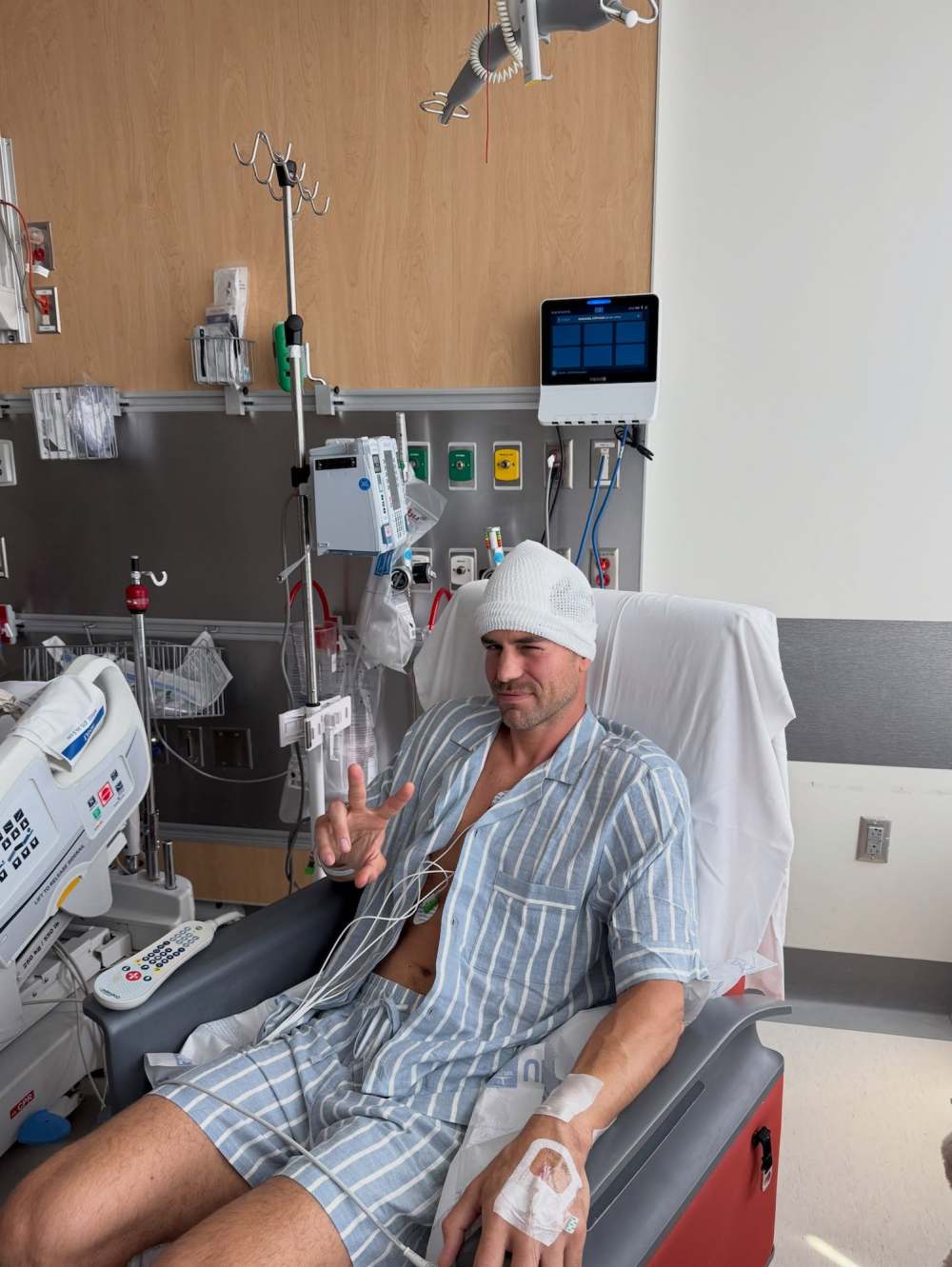
Joe went on to describe the experience as “a wild couple weeks” since he was told the news.
“I definitely wasn’t expecting this,” he continued. “I think it’s one of those things where you’re like, ‘Oh, something like this will never happen to me.’ And here I am.”
Joe added, “This past month has been a lot of ups and downs to say the least. After multiple scans and MRIs I have what looks to be an early stage brain tumor. In two weeks I’ll be undergoing a craniotomy to have it removed — yeah brain surgery. I’m doing my best to stay positive during this time and am lucky to have a lot of support from family and friends.”
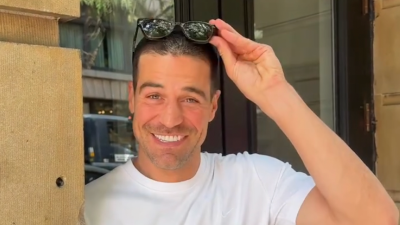
Bachelor in Paradise Joe Amabile is on the mend after undergoing brain surgery. “So happy to be back home with Joe,” Amabile’s wife, Serena Pitt, wrote via her Instagram Stories on Saturday, August 8, sharing a pic of her husband lounging on a couch in their New York City apartment watching golf. She continued, “Lots […]
Earlier this month, Joe announced that the brain surgery to remove the tumor was a success.
“They got it all!” he wrote via Instagram on August 6, alongside several post-op photos at the hospital.
Joe’s wife, Serena Pitt, shared a follow-up post via her own social media account the same day.
‘The best update: they were able to remove the entire tumor,” Serena, 28, wrote via her Instagram Stories. “Joe is recovering really well. We’re feeling so grateful.”
Fantasy stories are best experienced on the page. Sure, there are plenty of TV series and movies that are considered defining works in the genre, but there is always a limit to what can actually be shown on screen. Books don’t have that problem. An author can invent entire continents, histories, languages, religions, and systems of magic without ever worrying about a production budget or whether something looks convincing on the screen.
The only real limit is the reader’s imagination. That freedom of worldbuilding and creating high-stakes conflict makes fantasy literature feel alive with little to no visuals. The six books on this list are 10/10 masterpieces that show what happens when authors push that freedom — and their imaginations — as far as they can go.
1
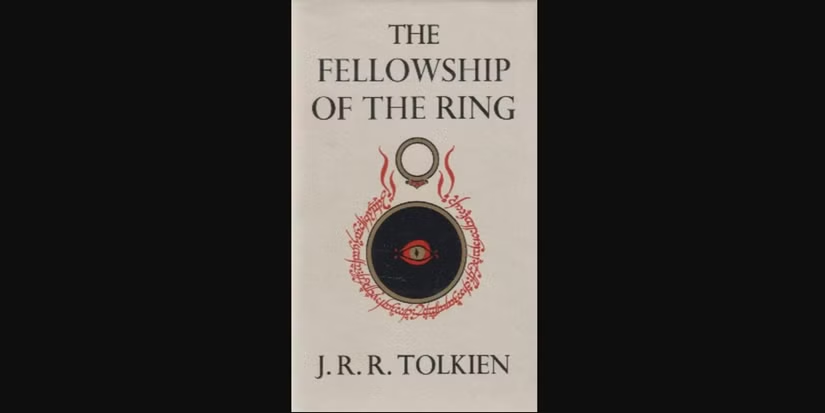
‘The Lord of the Rings: The Fellowship of the Ring’ (1954)

The Fellowship of the Ring is the first volume of J.R.R. Tolkien’s The Lord of the Rings trilogy and one of the defining works of fantasy literature. The book begins in the peaceful Shire, where Frodo Baggins inherits a seemingly ordinary ring from his uncle Bilbo. Gandalf eventually discovers that it is actually the One Ring, created by the Dark Lord Sauron to dominate the other Rings of Power. This leads Frodo on a grand hero’s journey as he leaves home with Sam, Merry, and Pippin to destroy the Ring and stop Sauron from returning to full power. Together, Frodo, Sam, Merry, Pippin, Gandalf, Aragorn, Boromir, Legolas, and Gimli form the Fellowship — a group of people carrying what might be the fate of Middle-earth with them.
Now, Tolkien doesn’t treat Middle-earth as a simple backdrop for this plot. The author intentionally creates this world where every forest, ruin, language, and forgotten kingdom feels lived-in. This level of detail means that The Fellowship of the Ring unfolds slowly, especially during the early chapters in the Shire, but setting that context is essential to the larger story. The character drama and mythology go hand-in-hand, and it never feels like one is being sacrificed for the other. The book perfectly sets up the events of the next two installments in the series and creates a fantasy epic that would become the standard almost everything after it had to measure itself against.
2
‘The Fifth Season’ (2015)

The Fifth Season by N.K. Jemisin breathes new life into the fantasy genre. The story takes place on the Stillness, a continent constantly threatened by earthquakes, volcanic eruptions, and civilization-ending disasters known as Seasons. Here, certain people called orogenes are born with the ability to manipulate the earth and control seismic activity. However, instead of being valued, they are feared and treated as less than human. The story begins with Essun, an orogene living secretly in a small community, who discovers that her husband has murdered their young son after learning about his abilities and has disappeared with their daughter. At the same time, an enormous geological catastrophe tears across the continent and signals the beginning of another potentially devastating Season. From there, Jemisin tells the story through three women, namely Essun, a young orogene named Damaya who is taken away to be trained at the Fulcrum, and Syenite, a more experienced orogene sent on a mission with the immensely powerful Alabaster.
At first, these narratives can feel disconnected, but the way Jemisin eventually brings them together completely changes the reader’s understanding of everything that came before. Even the unusual second-person narration used for Essun’s chapters starts making sense as the story progresses. The Fifth Season is dense and demands the reader’s full attention, but nothing about the story is coincidental. Jemisin takes familiar ideas about magic, chosen people, and world-ending threats and rebuilds them around something much harsher and more human, which is what makes it a fantasy masterpiece.
3
‘Circe’ (2018)

Madeline Miller’s Circe follows a character who barely gets room to exist in classical mythology. The story reimagines Circe, daughter of the sun god Helios, as an awkward and underestimated immortal who grows up surrounded by gods far more powerful and cruel than she is. When Circe discovers that she possesses witchcraft, her abilities frighten the people around her to the point that Zeus eventually has her exiled to the island of Aiaia. However, in isolation, Circe realizes that for the first time, she has control. Here, she begins to develop her magic, encounters figures including Hermes, Daedalus, and, eventually, Odysseus, while major events from Greek mythology unfold in the background.
The most interesting thing about Circe is the intimate scale of the narrative. The primary story always belongs to Circe as she spends centuries being dismissed, feared, and punished. Even her famous transformation of men into pigs feels completely different once the reader understands everything that led her there. The novel does not simply retell Greek mythology with flowery prose, but takes someone remembered largely as an obstacle in Odysseus’s journey and gives her an entire emotional history that perfectly complements the original myth.
4
‘Babel, or the Necessity of Violence’ (2022)

Babel is R.F. Kuang’s fantasy masterpiece set in an alternate version of 19th-century Oxford, where the British Empire’s power is built partly on silver bars engraved with words in different languages. The magic in this world works through the meaning lost in translation between those words. This allows silver to produce effects that have transformed transportation, industry, and warfare. At the center of the story is orphan Robin Swift, who is brought to England by the mysterious Professor Lovell and raised specifically to become a student at Oxford’s prestigious Royal Institute of Translation, also known as Babel. At first, Babel seems like everything Robin has been taught to want. He studies languages alongside Ramy, Victoire, and Letty, gains access to knowledge few people ever see, and becomes part of an institution that presents itself as the intellectual center of the world.
However, he gradually understands that all of that scholarship is serving an empire that exploits the very cultures producing the knowledge it depends on. That contradiction becomes impossible for Robin to ignore once he is introduced to the Hermes Society, an underground organization working against Babel and the empire it supports. The premise of the book is definitely complex, and it only gets more complicated as the story goes on. The idea of translation becomes the foundation of the magic system in Babel, and Kuang uses it to explore who gets to control language and who actually profits from knowledge. There’s no denying that the novel can be incredibly academic at times, with footnotes, linguistic explanations, and long discussions about etymology, but that is a huge part of its personality. Babel forces its readers to think about the machinery behind empire rather than simply bear witness to some grand war. The story is angry, ambitious, and even painful at times, but that’s exactly what makes it a modern classic.
5
‘A Game of Thrones’ (1996)

A Game of Thrones is another defining work in the fantasy genre. The first novel in George R.R. Martin’s A Song of Ice and Fire series serves as the perfect introduction to an epic story that remains a huge part of pop culture to this day. The story begins when King Robert Baratheon travels north to Winterfell and asks his old friend Ned Stark to become the new Hand of the King. Ned reluctantly accepts and heads south to King’s Landing, where he quickly realizes that the royal court is hiding secrets, grudges, and people who are far more dangerous than they initially appear. At the same time, Ned’s children are pulled into their own crises, while across the Narrow Sea, the exiled Daenerys Targaryen is married to Dothraki warlord Khal Drogo as part of her brother’s plan to reclaim the Iron Throne. The book has all of these moving parts, but every little thread ties together in one way or another. Martin takes his time explaining the story’s politics to make sure that the readers know how much alliances, marriages, and betrayals matter in this world.
The story is told through multiple points of view, which means the reader is constantly seeing the same world through people with completely different loyalties and assumptions. That structure makes Westeros feel messy and alive because almost nobody thinks of themselves as the villain. Even characters who make terrible decisions usually believe they are protecting their family and doing what they have to. The author establishes the rules of a traditional fantasy story and then repeatedly breaks them. Not even fan-favorite characters are safe, because Martin wants to show how real the consequences in Westeros really are. That unpredictability gives Game of Thrones a constant sense of tension, while dragons, ancient threats, and supernatural forces beyond the Wall contribute to the narrative’s delicious fantastical lore.
6
‘The Name of the Wind’ (2007)

The Name of the Wind is the first book in Patrick Rothfuss’s The Kingkiller Chronicle. The story follows Kvothe, a legendary musician, magician, adventurer, and alleged killer who has disappeared from the world and is now living quietly as an innkeeper named Kote. When a traveling scribe known as Chronicler finally tracks him down, Kvothe agrees to tell the true story of his life over three days. The first book covers his childhood with a troupe of traveling performers, the tragedy that destroys his family, his years surviving alone on the streets of Tarbean, and eventually his admission to the University, where he begins studying magic and searching for answers about the mysterious Chandrian.
The setup is fascinating because the reader knows the myth behind Kvothe before knowing him as a person. However, his own version of the story is the exact opposite of the larger-than-life figure stories have transformed him into. The novel’s magic system is also one of its greatest strengths. Sympathy is treated almost like a branch of physics, and music is just as important to Kvothe as magic. The prose in The Name of the Wind is lyrical without ever losing momentum, and the world feels enormous without ever needing explicit exposition. The novel is a treat for anyone who wants to experience the fantasy genre in its truest, most magical form.

- Release Date
-
December 19, 2001
- Runtime
-
178 Minutes
- Writers
-
Fran Walsh, Philippa Boyens, Peter Jackson, J.R.R. Tolkien
- Producers
-
Barrie M. Osborne, Bob Weinstein, Harvey Weinstein, Mark Ordesky, Robert Shaye, Tim Sanders

NewsBeat13 seconds ago
Scots dad stranded in Greece with ‘bone sticking through skin’ after horror 50ft plunge

Business1 minute ago
Why I Am A Dividend Growth Investor (At Age 35)

Crypto World2 minutes ago
Microsoft, Palantir Lead Five Stocks Near Buy Points In Hot Sector





-

 Crypto World4 days ago
SpaceX stock could rise 75% to $240, JPMorgan says
-

 Crypto World2 days ago
Bitcoin’s 22% rally now needs real demand to outlast Treasury liquidity boost
-

 Business7 days ago
Musk’s Tesla, SpaceX Confirm $16.8 Billion ‘Terafab’ Chip Plant as World’s Largest Building in Texas
-

 Fashion18 hours ago
Weekend Open Thread: Maeve – Corporette.com
-

 Crypto World4 days ago
A $30 Billion AI Fund Implodes, Now the SEC Is Investigating Wall Street’s Role
-

 Crypto World3 days ago
Warsh Jackson Hole keynote puts financial innovation first
-

 Business1 day ago
Salesforce Stock Soars 19% as Blowout Earnings and Agentforce AI Growth Silence Software Skeptics
-

 Crypto World3 days ago
Did Trump Just Move SpaceX Stock With One Truth Social Post?
-

 Business6 days ago
Mystery AI Model ‘Ox Alpha’ Draws Developers With Free Access as Chinese Lab Origins Remain Debated
-

 Business3 days ago
Walmart takes aim at younger shoppers with new fashion brand
-
 NewsBeat3 days ago
Lindsay Clancy jury braces for closing arguments as judge tells court: ‘You’ve heard all the evidence’ – Live updates
-

 Business5 days ago
Moderna CEO warns China is pouring state money into mRNA technology
-

 Crypto World3 days ago
Elon Musk Grok Bot Promise: We Will Make You Whole if AI Loses Your Money
-

 Business5 days ago
NVIDIA Stock Drops Nearly 2 Percent to $210 on Seventh Losing Day Ahead of Critical AI Earnings
-

 Crypto World2 days ago
NVIDIA revenue hits $96.2B as AI demand doubles
-

 Business20 hours ago
iPhone 18 Pro Pre-Orders Could Shift to Saturday as Apple Reportedly Avoids September 11 Anniversary
-
 Crypto World5 days ago
$92 Billion Nvidia Earnings Could Make or Break the AI Trade
-

 Business4 days ago
Thailand’s Eastern Economic Corridor Capital City (EECiti): Key Developments and Investment Opportunities
-

 Business6 days ago
Where Will Kevin Durant Play in 2027? Rockets Hold Player Option Key to His Future With Houston via Deal
-

 Sports6 days ago
Deshaun Watson fires back at Browns fans after being booed: ‘It’s a disrespectful thing’
You must be logged in to post a comment Login