Related: Rory McIlroy Shows Heartfelt Gesture Towards High Schooler at Masters
Advertisement


Before Rory McIlroy became a back-to-back Masters champion, he handed his golf bag to a pop star — and the internet got one of its favorite sports crossover moments.
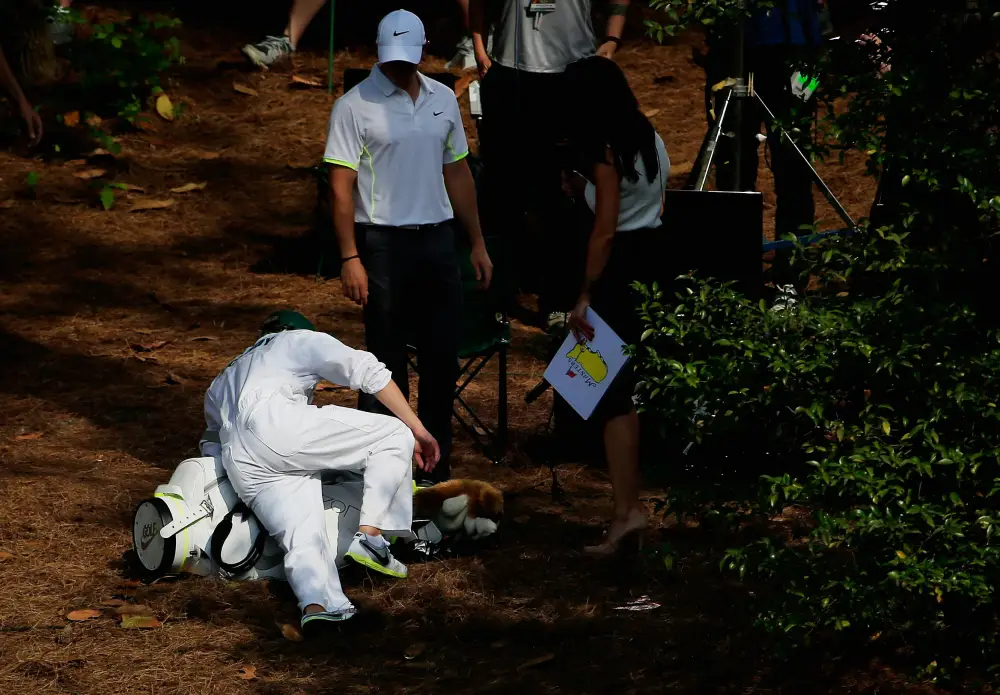
At the 2015 Masters Par-3 Contest, One Direction’s Niall Horan served as McIlroy’s celebrity caddie at Augusta National. The pairing of a global music star and the world No. 1 golfer was already drawing cameras. Then Horan slipped on pine straw, right before an on-camera interview, and the moment became a widely shared clip that fans still revisit more than a decade later.
Broadcaster Kirsty Gallacher, who was about to interview the pair, reacted in real time: “Oh no, Niall.”
The story behind the unlikely pairing is almost as good as the stumble itself. Horan later revealed that McIlroy personally reached out to him just days before the event.
Speaking on the “Fore Play Podcast” in 2023, Horan said, “He just texted me like a week before. He said do you fancy carrying the bag for the Par-3. I was like, let me start crying. The old Irish thing has this connection. I guess, sure, and we have got a lot of mutual friends beforehand and we knew each other quite well.”
Despite the on-air wipeout, Horan was nothing but thrilled to be there.
“It’s just great to be at Augusta,” Horan told Sky Sports 4 in 2015. “I knew about a year ago I had the time off to come to the Masters. Then I met this man (McIlroy) and he asked me, ‘did I want to carry the bag on Wednesday?’ Of course, if the world No 1 asks you to carry his bag, you carry it!”

The Masters reigning champion Rory McIlroy spent the first two rounds of the 2026 tournament paired with 18-year-old Mason Howell — and left the young golfer with some sound advice. “Hopefully he saw that you don’t have to be perfect to shoot good scores,” McIlroy said to reporters after the second round of The Masters […]
McIlroy, for his part, revealed the arrangement came with strings attached — for him.
“The deal was if I made him hit a shot here, they’re playing in Boston when I’m there at the end of summer and I’ll have to go up on stage and maybe sing a few lines, so (I’m) not looking forward to that! It has been a great afternoon and he’s a great sport for doing it.”
The 2015 clip has resurfaced following McIlroy’s 2026 Masters victory, where he completed the career Grand Slam and successfully defended his title.
He became just the fourth golfer in Masters history to win back-to-back titles, joining Jack Nicklaus, Nick Faldo and Tiger Woods. That historic achievement has sent fans digging back through McIlroy’s greatest Augusta moments — and the Horan caddying clip sits near the top of the list.


Rory McIlroy had two sweet caddies by his side during the Par 3 Contest ahead of the 2026 Masters Tournament. McIlroy, 36, was joined by his wife, Erica Stoll, and their 5-year-old daughter, Poppy, at the Augusta National Golf Club on Wednesday, April 8. Stoll, 38, and Poppy twinned in caddie uniforms that featured McIlroy’s […]
Horan isn’t just a celebrity who showed up for a photo op. He carries an approximate 8-9 handicap and is a regular at pro-ams. In 2016, he founded Modest! Golf Management to support young talent, growing it into a successful firm with clients on major tours.
The 2015 Par-3 Contest endures as a fan-favorite moment because it delivered something rare: two huge names from completely different worlds, genuine friendship, a live TV blooper and a story that only got better with time.
Now that McIlroy has cemented himself among golf’s all-time greats, the clip of his famous caddie eating it on pine straw hits a little differently.
The Jurassic Park franchise built its legacy on spectacle, but its best modern installment succeeds by doing something the more recent Jurassic World films keep avoiding. That difference becomes impossible to ignore once you watch Jurassic World: Camp Cretaceous. The Netflix series fixes a core problem that has defined the franchise for years, and it does so while quietly setting a new benchmark for the series. With a 92% critics score on Rotten Tomatoes, it stands as the highest-rated entry in the entire franchise, surpassing even the original film.
While the films continue to escalate in scale, destruction, and visual intensity, the series commits to something far more foundational. It gives its characters the time and space to evolve. That focus changes everything. It reshapes tension, strengthens emotional stakes, and finally makes the survival of these characters feel like it matters beyond the next action set piece. The dinosaurs still impress. The difference is that now, so do the people running from them.

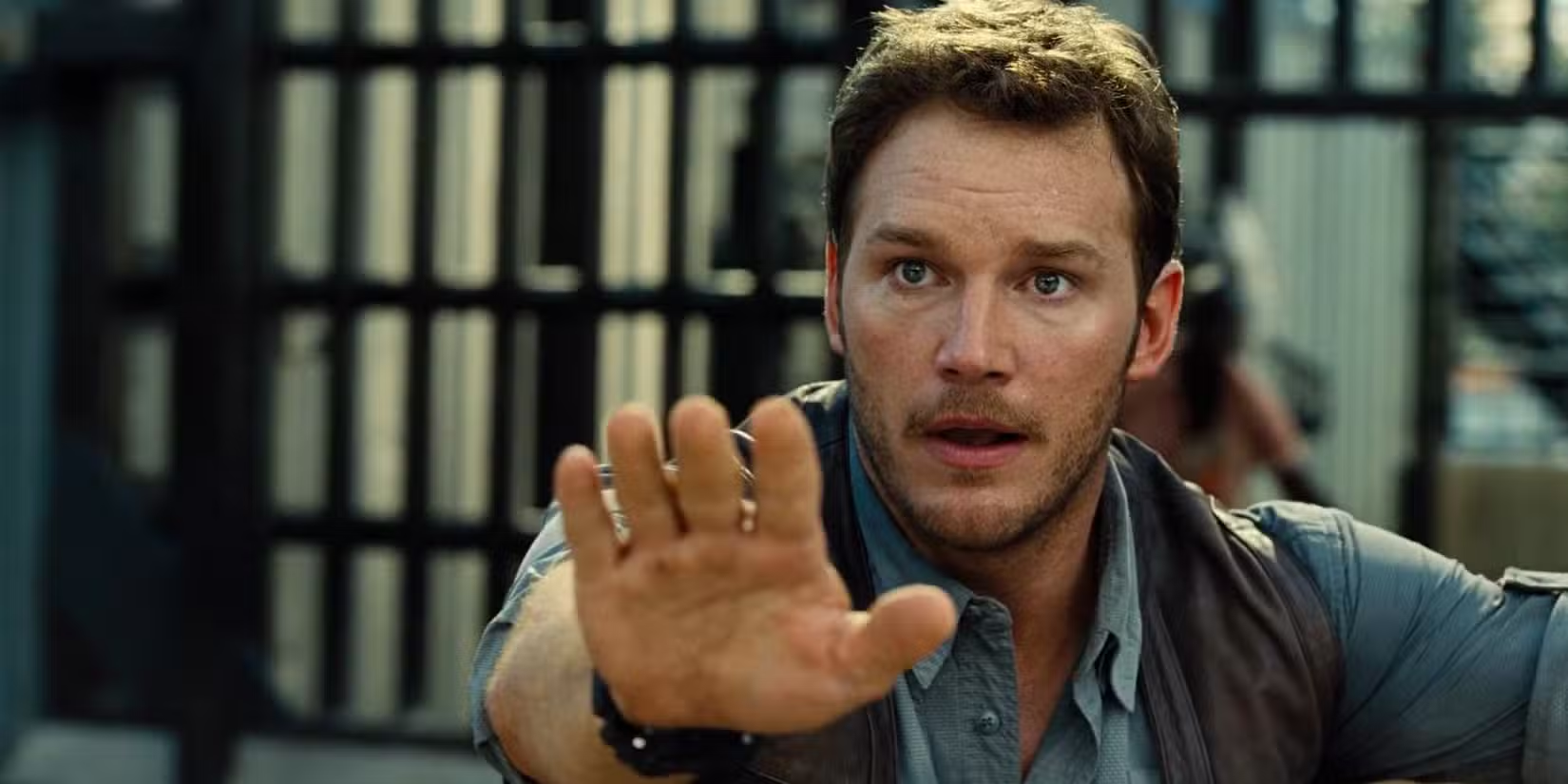
From Jurassic World onward, the franchise has leaned harder into escalation. Bigger parks, bigger threats, and bigger consequences. Each installment pushes further into chaos, but that constant expansion comes at a cost. The human element struggles to keep up. Characters, like Chris Pratt’s Owen, often enter the story with clear archetypes and leave without meaningful transformation. Their roles stay fixed even as the world around them collapses. The films deliver momentum, but they rarely build lasting emotional investment because the characters do not meaningfully change in response to what they experience.
That approach works in short bursts. It creates immediate tension and delivers crowd-pleasing moments. Over time, though, it limits the impact of the story. When characters remain static, survival stops feeling like an obligation. The franchise did not always operate this way. The original Jurassic Park grounds its spectacle in perspective and lets its characters react, process, and adjust. That grounding gives the danger weight. As the series expanded, that balance shifted. The films became faster, louder, and more focused on escalation than evolution.
Camp Cretaceous takes the opposite approach. Instead of treating characters as vehicles for action, it treats action as a catalyst for change. Across multiple seasons, the series tracks how its core group of teenagers adapts to survival. Fear shifts into resilience, trust fractures and rebuilds, and leadership emerges in unexpected places in ways the characters in the more recent films are never given the chance to. Every major event leaves a mark, and those marks are carried forward into future decisions. That long-form structure gives the show an advantage the films rarely use. Time allows consequences to matter. Characters make mistakes that shape who they become later. Relationships evolve under pressure instead of resetting between set pieces. The result creates continuity in both emotion and behavior.
This is where the series quietly outperforms the films. It understands that survival stories only work when survival changes the people living through them. Dinosaurs create danger, but human characters create meaning. The show prioritizes both, and that balance makes its stakes feel sharper and more personal.

The success of Camp Cretaceous highlights something the films keep circling without fully committing to. The Jurassic formula does not need to be reinvented, it needs to be rebalanced. Spectacle has never been the problem, because the franchise consistently delivers some of the most recognizable imagery in blockbuster filmmaking. The issue is what happens around that spectacle. When characters remain static, even the most impressive sequences lose impact over time. The Netflix series proves that the solution is not scaling back the dinosaurs or the action, it is investing in the people experiencing them. Give characters room to grow, and the danger feels more immediate. Let relationships evolve, and every close call carries more weight. Build continuity across decisions, and survival starts to mean something beyond the moment. That is what the movies keep missing: not scale, ambition, or even originality. They are missing meaningful character evolution. And until the films start treating character growth as essential instead of optional, the franchise will keep delivering bigger moments without ever making them hit harder.

2020 – 2022
Netflix
Scott Kreamer



Kausar Mohammed
Yasmina ‘Yaz’ Fadoula (voice)

Sean Giambrone
Ben Pincus (voice)
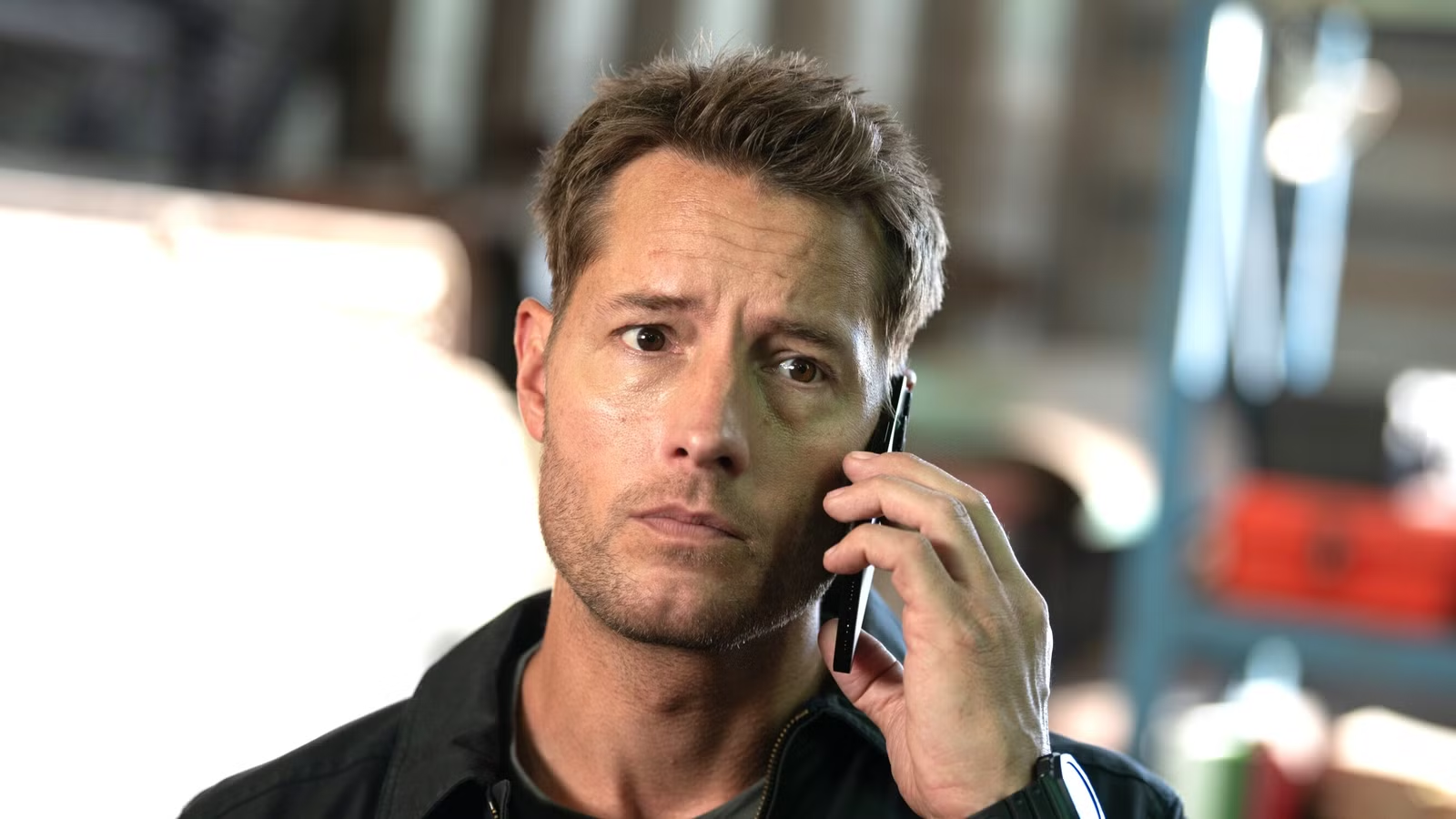

Paramount+ is the home for all of Taylor Sheridan’s shows, but the platform has plenty of other hit series to dive into, such as the CBS thriller series Tracker. The Justin Hartley-led crime thriller show premiered back in 2024, and while it flew relatively under the radar in the months leading up to its worldwide debut, it’s quietly become one of CBS’ most important shows in the last two years. The first season of Tracker went off the air in May 2024, and the series returned mere months later with its second season, which ran from October 2024 to May 2025. In keeping with tradition, Tracker Season 3 arrived last year in October, and there are now only a few episodes remaining in Season 3, which will conclude with a finale on May 24. It’s already been renewed for Season 4, which will almost certainly be back before the end of 2026.
For three full seasons now, most of Tracker has been filmed in Vancouver, Canada, despite the show taking place in various locations around the United States. However, news broke this afternoon that Tracker is making a huge change in Season 4 that’s going to rock the series to its core. It’s been reported that Tracker is officially packing up and leaving Vancouver and relocating to Los Angeles for production on Season 4, which will begin in June. This comes with the help of a $48 million tax credit to shoot in California, which will certainly help the series find its roots once it’s ready to begin production on its next season. This is an even bigger tax credit than the popular Prime Video sci-fi series Fallout ($42 million) received to shoot in Los Angeles.
Tracker is an unconventional procedural that follows Colter Shaw (played by Justin Hartley), who travels the country in his old-school RV, helping police and private citizens solve crimes and locate missing citizens. The show also briefly features The Boys Season 5 star Jensen Ackles as Colter’s brother, Russell Shaw, but it’s unclear at this time if he will be back in Season 4. Tracker was written and created for TV by Ben H. Winters, who previously worked as a writer on the popular FX series, Legion.
Check out the first three seasons of Tracker on CBS and Paramount+ and stay tuned to Collider for more updates and coverage of Season 4.

February 11, 2024
Elwood Reid
Ben H. Winters, Hilary Weisman Graham

Justin Hartley
Colter Shaw

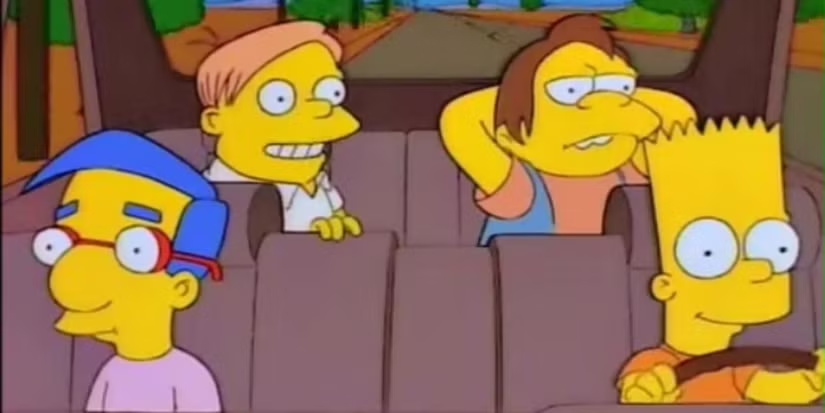
The Simpsons Movie 2 is slated for next year. Can you believe it? This is exciting for fans of The Simpsons, and yet one can’t help but have concerns, too. The Simpsons Movie came out all the way back in 2007, and it’s not often sequels that arrive so long after the original are good. Even the first movie didn’t quite reach the comedic and dramatic heights of the beloved show in its prime, but even being as fun as the 2007 movie would be impressive at this point. Along with such unavoidable issues as the cast’s inevitable voice changes, many fewer choices for original storylines after 37 seasons, and certain characters no longer appearing on the sitcom, there are definitely some obstacles to overcome for this sequel to live up to its franchise.
This is far from a simple task, but hey—it’s not impossible! Meanwhile, the prospect of a Simpsons movie makes you wonder how certain episodes could have played on the big screen if the team had embraced the movie format in the ’90s. “Who Shot Mr. Burns” shows the writers could handle a longer narrative as early as Season 6, but that does work best as a two-parter. It would be fascinating to watch Homer hallucinate from chilis à la “The Mysterious Voyage of Our Homer,” like an irreverent Fantasia, but that would be way too niche to draw a wide theatrical crowd. Some of the series’ most memorable storylines, however, do seem like they could have been stretched out to fit a commercially viable feature film. They would need action, unique settings, high-stakes, narratives that foster meaningful character arcs, and obviously some room to goof around. When you take a closer look, some episodes might have even been improved with a longer runtime. The following episodes aren’t the only ones, but they may be the best examples of squandered opportunities at cinema gold (or cinema yellow, if you will).

The first film showed the family on a road trip for a little while, so why couldn’t the whole thing be a road movie? An underrated gem from Season 7, “Bart on the Road” would serve as an excellent vehicle (pun intended) for a feature-length narrative. Having Milhouse (Pamela Hayden), Martin (Russi Taylor), Nelson (Nancy Cartwright), and Bart (Cartwright) as the main group might have been a little off-beat, but in the refreshing way you might expect from the big screen.
Imagine all the places these kids could go and the shenanigans they would get into. The plot line where Bart gets a job as a flight attendant is definitely fun, so what if the three other boys got jobs in the hopes of finally getting home without getting caught? Meanwhile, the whole dynamic with Lisa (Yeardley Smith) and Homer (Dan Castellaneta) developing a closer bond would be a terrific storyline to explore further. Plenty of room for action, pathos, and parodies here.

“Deep Space Homer” is pretty overrated, but that doesn’t mean its premise couldn’t be re-worked into a dazzling zero-gravity screenplay. After all, The Simpsons in space? That certainly sounds like a movie, and Homer munching on floating potato chips would do wonders in the theater. But a few things would have to change, and the first would be Barney (Dan Castellaneta). The character just feels overused when he’s in a larger role.
Also, this may sound weird to say about a Simpsons plot thread, but NASA taking Homer into space sounds way too implausible to suspend disbelief. It would feel more believable if a space program with no bona fides whatsoever sent Homer into space instead. Mr. Burns (Harry Shearer) could easily fill that role, since he’s rich enough to do almost anything and evil enough to have his own reasons for exploring space without anyone else’s authority. Like traveling through space, the writers could go in as many directions as they could with this premise.

Unlike South Park, The Simpsons usually doesn’t have exaggerated large-scale conflicts where the town, the country, or the world is in imminent danger. However, a notable exception would be Season 6’s “Bart’s Comet,” which sees Bart discover a comet that’s headed straight for Springfield. The attempts to stop it are futile, and even make it impossible to leave town. All funny stuff, creating a scenario where everyone just accepts their fate.
With the scramble to get into Flanders’ bunker, there is a psychological focus on this that reminds us of one of The Twilight Zone‘s most intriguing conflicts. Insulating Springfield from the rest of the world, this story of impending doom could mirror The Simpsons Movie‘s societal breakdown—only accelerated and tense with the hope that they’ll figure out a way to stop it. The episode resolves amusingly enough, but maybe the movie would have done something that gives the characters more agency.

Admittedly, “Mr. Lisa Goes to Washington” is already such a masterful entry that the prospect of changing anything about it feels a bit like heresy. But this is all hypothetical anyway. Lisa doing so well in an essay contest that she gets to recite a speech in Washington D.C. is an excellent excuse for a fresh setting that’s just begging for political satire.
Corruption is represented by a single politician and lobbyist about to destroy a forest. But what if there were more, and what if the stakes were higher? The contest could be taking place during the general election race, for instance, and Lisa could be at the heart of a Watergate-esque scandal. That montage of people at the end who quickly learn about Lisa’s speech and promptly oust that corrupt congressman from power is incredibly swift, so that process could be longer and more complex. Meanwhile, the other Simpsons don’t do much here, so they could have subplots and arcs of their own.

Season 5’s “Boy-Scoutz ‘n the Hood” could make a great story about chaos in the wilderness: two different sets of people in two different parts of the woods. When Homer and Flanders go down one path while Ernest Borgnine‘s group head down another, they encounter totally different problems. With one group lost at sea and another in constant backwoods danger, this conflict could last weeks.
Which would provide enough time for the campers’ families to realize they’re missing and start searching for them. Since there’s nothing for Marge (Julie Kavner) and Lisa to do in that episode, they can go on their own journey to help look for the lost campers. In the meantime, that hilariously random location for that unsuccessful Krusty Burger can be merely one pit-stop on Homer’s journey home. Best of all, the writers would have to appeal to a mass audience and therefore give poor Borgnine and those campers a happy ending. The current one just doesn’t feel right.

Season 8’s “The Springfield Files” is one of The Simpsons‘s greatest mysteries. It doesn’t even have a subplot, as there is so much emphasis on the green alien that Homer supposedly encountered in the woods. After he and Bart capture the creature on video, Homer sparks a cultural phenomenon in Springfield. With all the conspiracy theories about governments covering up the existence of aliens for a long time, this could definitely be explored further in a movie.
The FBI coming to help investigate can further complicate things. Maybe they help, maybe they make things worse, maybe they have an ulterior motive. If they believe the alien theory is real and try to cover up the story, lots can be done there. Various subplots can arise from this, and Homer can have more of a character arc than the episode allows. For instance, he could become so obsessed with re-discovering or capturing the alien that he becomes isolated from his family. In any case, the eerie atmosphere and endless movie references would shore up whatever the creative team decided to do.

Season 4’s classic debut, “Kamp Krusty” was such a promising setting for a film that executive producer James L. Brooks actually wanted to make it into the first Simpsons movie. So, how did that not happen? Well, there were scheduling issues, and the writers somehow didn’t think they could come up with enough material for this. But if they had been pressed to think about it more, “Kamp Krusty” the film could have been a masterpiece.
Bart’s psychological descent is one of the things that makes this episode shine, and that process could be more gradual in a screenplay. Also, his takeover of the camp could last for a longer period before Krusty’s (Dan Castellaneta) arrival—during which the young Simpson’s fractured psyche could ironically lead him to be just as tyrannical as his predecessors. The Apocalypse Now allusions could abound here, and Lisa’s escape attempts could be expanded upon as well. Maybe Krusty hears about the uprising before the news does, and has to clandestinely restore the camp before the end of summer to save his reputation. So much potential here.

Many fans would say “You Only Move Twice” is perfect as is, and sure, they’re not wrong. But when you think about it, this actually could have been an incredible premise for a film. The Simpsons leave Springfield and move away for a new start—sound familiar? But Cypress Creek would be a better payoff than Alaska. Imagine another hour of Albert Brooks‘ hilarious dialogue as supervillain Hank Scorpio, instead of his amusing but inferior turn as the head of the EPA. Imagine another hour of James Bond parodies!
And consider this: Homer’s the only one in the family who really does something. Marge has zilch to do around the house (which is the gag, but still), Bart has no influence in the remedial class, and Lisa just gets ill. It’s concise enough for the show, but it also means they could have had much more complicated conflicts and interesting character arcs in a feature-length film. This combination of large-scale action and intimate moments of home-sickness could have struck the perfect balance of spectacle, humor, and heart that the ultimate Simpsons movie would need.

December 17, 1989
FOX
Steven Dean Moore, Mark Kirkland, Rob Oliver, Michael Polcino, Mike B. Anderson, Chris Clements, Wes Archer, Timothy Bailey, Lance Kramer, Nancy Kruse, Matthew Faughnan, Chuck Sheetz, Rich Moore, Jeffrey Lynch, Pete Michels, Susie Dietter, Raymond S. Persi, Carlos Baeza, Dominic Polcino, Lauren MacMullan, Michael Marcantel, Neil Affleck, Swinton O. Scott III, Jennifer Moeller

Homer Simpson / Abe Simpson / Barney Gumble / Krusty (voice)

Julie Kavner
Marge Simpson / Patty Bouvier / Selma Bouvier (voice)
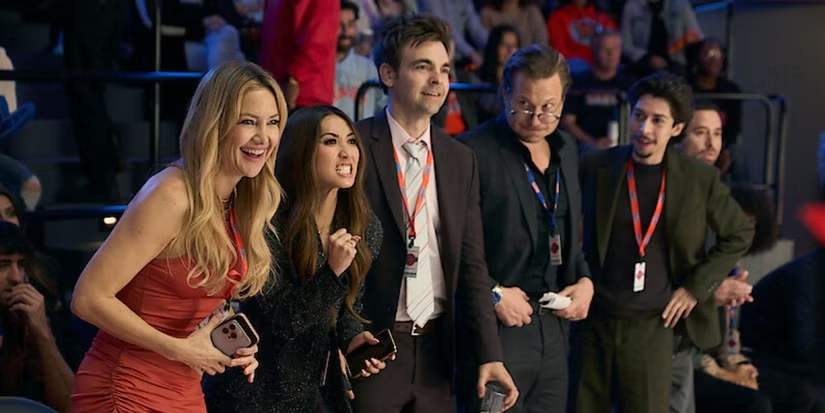
Running Point‘s second season has seen an impressive increase in audience size, and its success is evident in its having now reached over 25 million hours viewed (in total) on Netflix, according to the streamer. This growth has affected the tempo of the show and allowed it to establish a pattern for itself, a velocity that works for a nicely patterned series that knows how to build on this momentum.
The first season was a very fast-paced workplace comedy set in a professional basketball organization, largely thanks to Kate Hudson‘s portrayal of Isla Gordon. The second season has maintained the same base as season one while adjusting the storyline’s overall direction. In addition to being funny, the overall story is becoming more structured, character arcs are getting stronger, and the show is developing a clearer direction. The outcome of these changes has been an overall better-prepared, more mature second season with sharper comedy and deeper character development.

While the show’s premise is set against the backdrop of professional sports, it places more emphasis on how the team’s internal workings affect one another than on the actual athletic action. The core theme of season two is the shift from Isla proving her capability to maintaining her authority as an owner. Isla is now an owner, managing expectations for continued success while contending with the competing interests of her extended family and the organization as a whole.
This change gives the writers the ability to develop more realistic, relatable conflicts because the gravity of your decisions as a leader has a much greater impact on the overall organization (and on the series) than it did in the previous season. The added ability to create a series of events that extend beyond individual episodes has significantly assisted the writers in developing the story for Season 2.

While Hudson remains the focal point, Season 2 places greater emphasis on its ensemble. The series has improved by giving the supporting characters fully developed arcs, making it feel like a more even playing field. Ali (Brenda Song) now has her own ambitions and frustrations to pursue in this year’s series, and as a result, she becomes an integral part of several storylines that help develop her character. The added development for Jackie (Fabrizio Guido) and Ness (Scott MacArthur) also helps the series build both comedic and narrative momentum throughout the season.
Cam’s (Justin Theroux) expanded presence in the Gordon household has created a new source of tension/volatility within the family unit, with his presence on-screen providing consistent tension throughout the entire season, thereby adding to the dysfunctionality aspect of the show’s primary narrative source(s) of conflict.
The addition of newcomer Ray Romano (as Coach Norm Stinson) to the supporting cast has brought another layer of tonal complexity to the ensemble. Norm’s storyline has been seamlessly integrated into the overall narrative without disrupting the series’ pacing.

Season two focuses on situational comedy and the fast-paced dialogue typically associated with Running Point. However, what is most notable about season two is the connection between the comedy and the character development. Comedy is more frequently connected to the characters themselves and their motivations than ever before, rather than being separate moments of comedy. The result is that both the comedy and the storytelling have a greater impact on the audience as a whole, creating a more unified experience throughout the series.
There is also a deeper emotional connection between the characters, particularly around work-related issues and personal relationships. Isla’s place in a male-dominated industry has continued to affect her decision-making and interactions with others throughout the season, creating a subtle yet very effective tension. The combination of these aspects has been executed without affecting the series’ pace, making it more accessible while adding more depth than the previous season.

The increase to 25.2 million hours viewed reflects the series’ improved execution. Running Point benefits from a structure that supports consistent engagement, with tightly paced episodes and interconnected storylines that encourage continued viewing. Its blend of workplace comedy and family drama remains accessible, while the added depth in Season 2 gives audiences a stronger reason to stay invested. The series does not attempt to shift genres or significantly alter its format. Instead, it refines its existing strengths.
Running Point may not prioritize realism in its portrayal of professional basketball, but its focus on character dynamics and organizational chaos continues to resonate. Season 2 demonstrates a clearer understanding of those strengths, resulting in a more cohesive and engaging series. As it continues to grow its audience, the show’s upward trajectory suggests it is well-positioned to maintain its momentum.
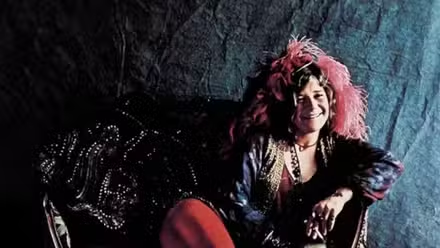
Today, California-born ska punk band Sublime is remembered as one of the most defining—and most influential—acts of the genre. Headed by singer-songwriter Bradley Nowell, the band helped define the sound of the 1990s and even maintained close relationships with other blossoming acts of the decade such as No Doubt, Slightly Stoopid, The Butthole Surfers, and The Minutemen.
While the band had been prolific since its inception in 1988, its most popular song to date was released after Nowell’s untimely death. Indeed, “Santeria” remains a crowd favorite to generations of listeners, with its irreverent lyrics and catchy guitar riff. Nowell, unfortunately, never had the chance to witness the song’s popularity, nor did his bandmates anticipate that the track would double as a tribute.
Sublime was formed in 1988 by Nowell, Eric Wilson, and Bud Gaugh. The group’s sound initially skewed toward garage punk, but the members gradually infused elements of reggae and ska into their work. This original combination set them apart, gave their music a distinct Southern California sound (they were based in Long Beach, California), and set a template for the genre for decades to come.
Who’s Your Perfect Classic Rock Band?
After finding their original sound, Sublime released their debut, 40 Oz. to Freedom, in 1992, finding moderate commercial success (as well as controversy for their song “Date Rape”) along with a strong cult following. The album also spurred a record deal with MCA, enabling Sublime’s second album, Robbin’ the Hood, to be released in 1994. But in spite of how successful the band appeared, all was not well among its members: Nowell was quickly developing a heroin addiction that often left him unable to continue live performances. While the singer made ardent efforts to quit—particularly before the birth of his son—he ultimately overdosed on May 25, 1996, just two months before the release of the band’s third album, Sublime.
Sublime was the band’s most commercially successful album, marked by successful singles like “What I Got,” “Wrong Way,” “Doin’ Time,” and, of course, “Santeria.” The latter, in particular, is one of the band’s signature songs. The track gets its name from the Afro-Cuban religion, Santería, and its lyrics are filled with Chicano slang such as “Sancho” and “Heina.” While Nowell was white, these elements read more as nods to diversity and cultural appreciation than appropriation. Furthermore, the single’s rhythms were inspired by Jamaican reggae, though its bass line and guitar riff were lifted from the Robbin’ the Hood deep-cut “Lincoln Highway Dub.”
However, the joy of Sublime’s success was tempered by Nowell’s death—even more so because Gaugh woke from his own drug-induced stupor to find Nowell’s corpse lying beside him on that fateful day in May. In a gesture of love, grief, and appreciation, the video heavily features Nowell’s beloved Dalmatian, Lou Dog, in the video, along with Nowell’s widow, Troy Dendekker, who he married just a week before his death. Finally, and most poignantly, the video includes stock footage of Nowell himself as an angelic presence singing, playing music, and watching over the loved ones who survived him.

Kris Kristofferson Wrote This Classic Song Before Janis Joplin Made It a No. 1 Hit
Janis Joplin’s haunting rendition captured the essence of the song like no other.
During its time, “Santeria” was a crossover hit, peaking at number three on the Billboard US Alternative Airplay chart and number 43 on Hot 100 Airplay. It also did well abroad, charting in Canada while it received gold, silver, and six-time platinum certifications in Brazil, the United Kingdom, and New Zealand, respectively. Its renown has only grown since then, with the song finding its way onto popular movie soundtracks and countless playlists defining the 1990s.
In many ways, “Santeria” perfectly epitomizes Sublime’s musical style: Global, genre-defying, and tongue-in-cheek yet unexpectedly sincere, “Santeria” is just as much a summer anthem as it was when it first came out. In fact, it’s hard to even discuss Sublime without acknowledging “Santeria,” its beloved status, and its role in thrusting ska into mainstream music. One can only wish that Nowell had survived to see the song’s success.
:max_bytes(150000):strip_icc():format(jpeg)/The-Night-Agent-Gabriel-Basso-050426-f4331ac7446b4f5293c0aa107a5752d6.jpg)
Titus Welliver, Trevante Rhodes, Li Jun Li, and Elizabeth Lail have joined the show for what will be the final season.
By Charlene Badasie
| Published
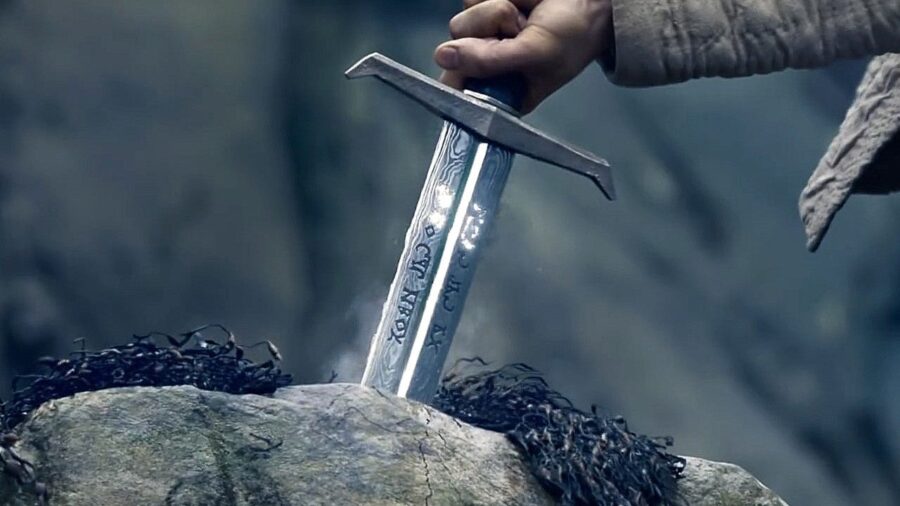
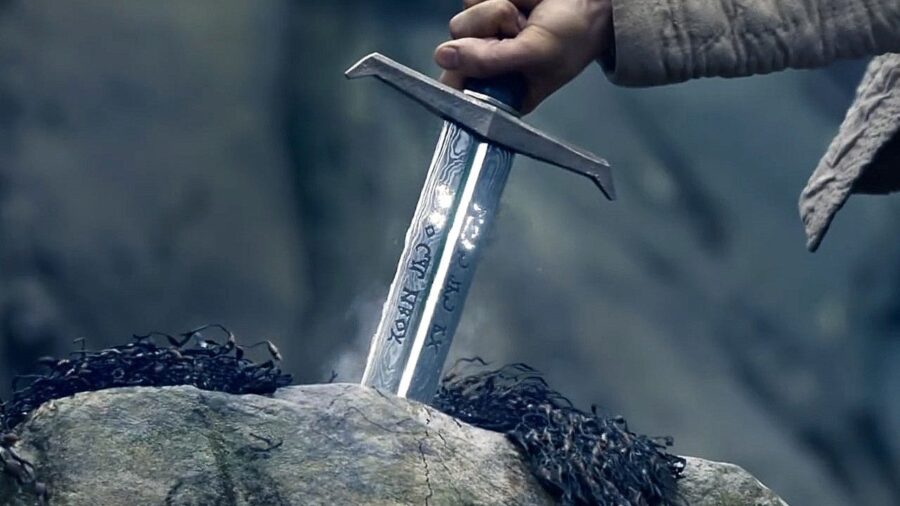
When an iron sword was found upright in the ground near an archaeological site in Spain in 1994, researchers bestowed it with the name “Excalibur” after the legendary sword from the King Arthur stories. This was largely due to its position to the north of the ancient Roman Forum in the old city of Valencia.
After years of uncertainty, researchers from the Archeology Service (SIAM) of the Valencia City Council have determined that the Excalibur sword dates back to the 10th century. This places it within the period of Islamic rule in Spain known as Al-Andalus. If one does the math, the sword is over 1,000 years old.

The Excalibur sword is approximately 18 inches long and has a curved blade, which initially caused confusion about its age since it resembled Visigothic swords from an earlier period. However, the researchers were able to accurately date it based on the sediment layers in which it was found. It is the first Islamic-era sword discovered in Valencia, making it a rare archaeological find.
The Excalibur sword’s hilt is adorned with bronze plates, and its size and lack of a hand guard suggest a horseman may have wielded it. “This sword has a unique design that gives it great archaeological and heritage value,” Valencia councilor for cultural action, heritage and cultural resources, Jose Luis Moreno, said in a press release.

In fiction, the Excalibur sword in is a legendary weapon associated with King Arthur in Arthurian legend. The sword possesses magical powers and is often linked to the rightful sovereignty of Britain. In various versions of the legend, Excalibur is depicted as the sword in the stone, which only the true king can withdraw, proving his divine right to rule.
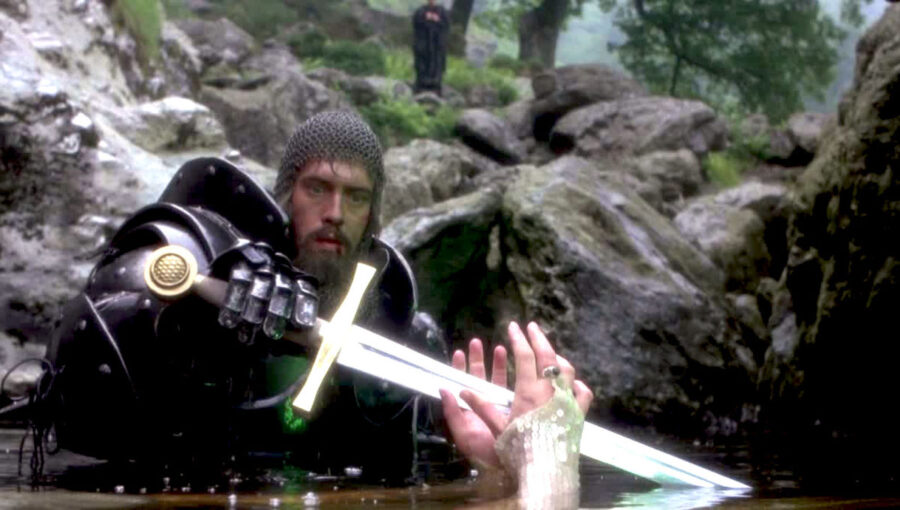
There is also a story where the Lady of the Lake gives Excalibur to Arthur, and he later returns it to her before his death. Over time, different adaptations have combined these two stories, leading to confusion about the origin of Excalibur. The sword is the ultimate symbol of power, with its name derived from Welsh and Middle Cornish roots, meaning “hard” and “breach, cleft.”
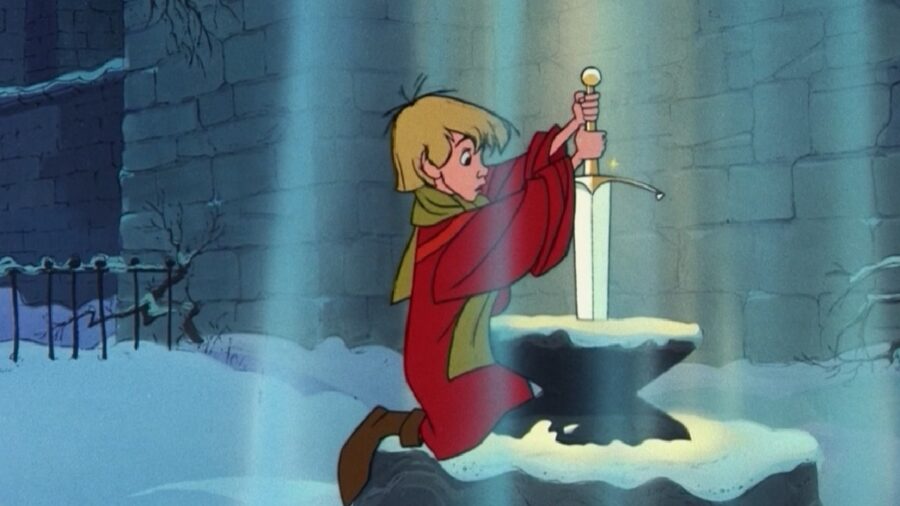
The Excalibur sword’s significance lies not only in its magical properties but also in its role as a ritual item, a symbol of Arthur’s authority, and a powerful weapon in his battles. Some popular works of fiction that feature the sword include The Camelot Rising Trilogy by Kiersten White. The story puts a new spin on the Arthurian legends and is aimed at young adult readers.
The Excalibur sword also appears in various movies and television shows. Released in 1981, this epic medieval fantasy film Excalibur details the legend of King Arthur and the Knights of the Round Table. It stars Nigel Terry as Arthur, Nicol Williamson as Merlin, Nicholas Clay as Lancelot, Cherie Lunghi as Guenevere, Helen Mirren as Morgana Le Fay, and Liam Neeson as Gawain.
The 2007 film The Last Legion blends Arthurian legend with Roman history. The story follows Romulus Augustus, who asks Merlin to help him find the legendary Excalibur sword. The 2011 Starz series Camelot offers a grounded, gritty take on the Arthurian legend, focusing on the power struggles and politics of Arthur’s rise.
Are Offset and Quavo working on new music? That’s the question fans want answers to after a new photo sparked speculation. Set posted the image just weeks after he was shot outside of a casino in early April.
It’s unclear whether the former Migos groupmates hopped in the booth together. However, the image Offset shared on Instagram Stories shows Quavo in front of a computer screen, seemingly looking at an audio file. There’s a man sitting at a table near him, but his face isn’t visible in the photo. He hasn’t shared any other updates about the studio link-up.
Seeing Offset in the studio, especially with Quavo, is drawing reactions from fans because a few weeks ago there were concerns about his health. Set was shot outside of the Seminole Hard Rock Hotel and Casino in Hollywood, Florida at around 7 p.m. His injuries were allegedly non-life threatening. Soon after his hospitalization, TMZ shared photos of him smoking outside the hospital. Amid the news, Quavo shared praying hands on his Instagram Stories.
On April 10, Set shared a statement on IG saying he’s locked in on his family, recovery and “getting back to music.” He said, “…Realizing that life is made up of quiet wins and loud losses…Life’s a gamble and I’m still playing to win.” The rapper has also performed live.
What Do You Think Roomies?
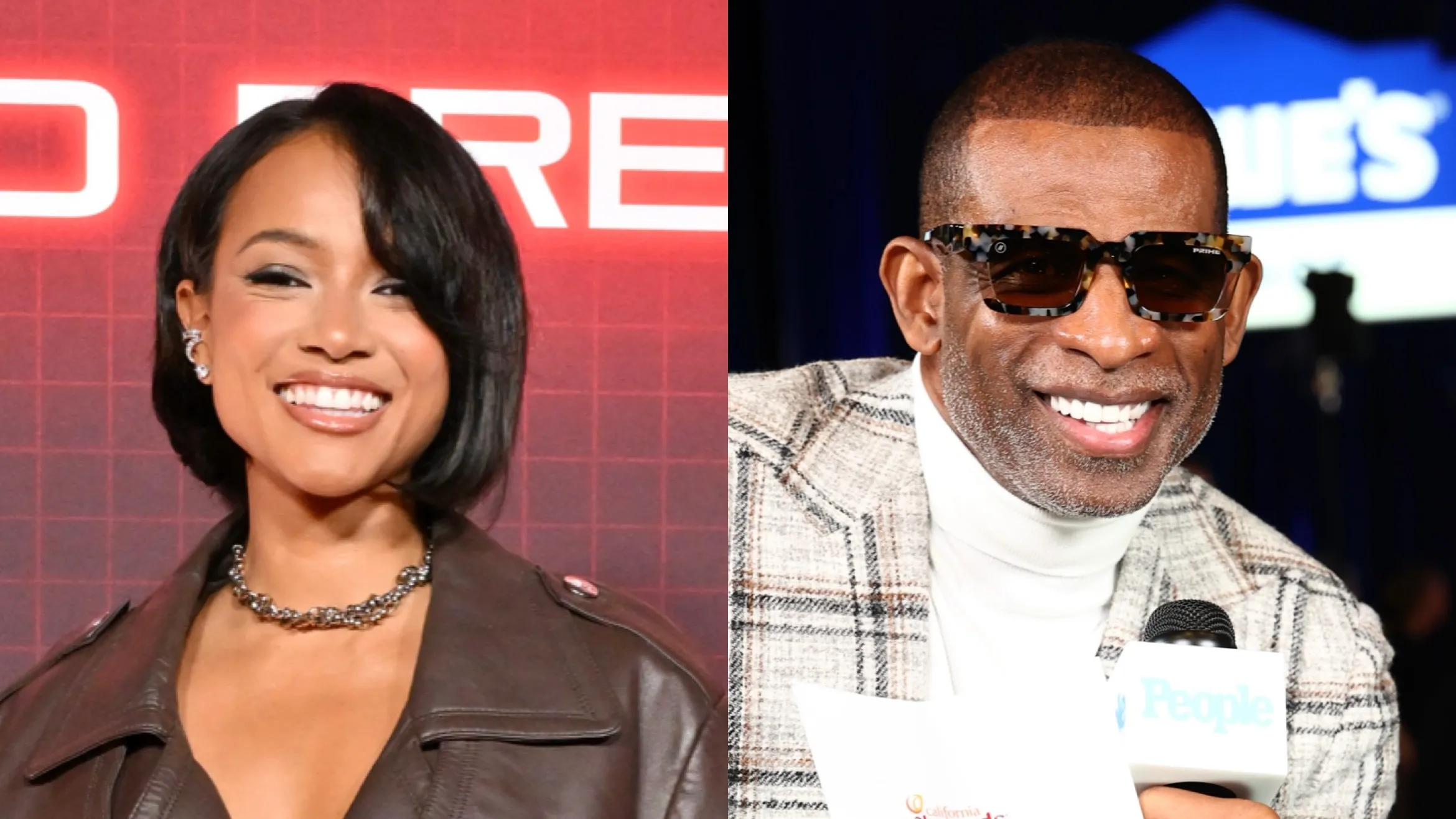
Social media users are crackin’ UP at Karrueche Tran‘s facial expressions while shopping overseas with Deion Sanders.
On Sunday, May 3, Deion Sanders took to Instagram to share a clip from his and Karrueche Tran’s recent time in the Virgin Islands. Furthermore, the clip showed the pair in a shopping area as Sanders ushered Tran into one particular boutique. Then, as the pair walked in, it became clear that the store was apparently selling knock-off designer goods.
As they browsed the store, Tran walked in smiling but was noticeably hesitant to truly browse the shelves. Ultimately, her facial expressions while walking through said it all.
Check out the clip below.
Social media users are crackin’ UP at Karrueche Tran’s facial expressions in TSR’s comment section.
Instagram user @really_bigmomma wrote, “She just seems so much happier with this family ❤️”
While Instagram user @liittlebiit added, “She like’ I know you lying’ the way her eyes popping out her head😂😂😂”
Instagram user @tynicolle wrote, “‘Get what you want’ my love language 😂”
While Instagram user @phynixx_rysen added, “Lil grandma looks sooo happy & healthy these days! I love this for her”
Instagram user @hood_hippie0587 wrote, “Her eyes popped out of her head like, ‘IKYFL, KNOCK it off 👀!’ 😩”
While Instagram user @daddieimhome added, “I’m so happy for her but what I love more is that his kids love her as well🫶🏾🙏🏾”
Instagram user @br1an02 wrote, “Whole time they made in the same factory by the same people 🤦🏽♂️😂😂”
While Instagram user @iamcoachhoney added, “Mayyy a good nice generous love find us alll one day 😂🤭💗💯”
Instagram user @elle_jmonroe wrote, “He plays too much 😂 I can tell she love it there ❤️”
While Instagram user @a.com__________ added, “Lmao she tripping i would got me 3 bucket hats 😂😂”
Instagram user @delphine_na18 wrote, “Can’t believe she’s dating that old man 🤣😂🤣”
While Instagram user @keepingupwithbreanna added, “😂😂😂 her face saying it all, omg she’s so funny lol”
Instagram user @theforeverfaves wrote, “😭😭😭 not the knock off store look at her face 😭😭😭”
As The Shade Room previously reported, Karrueche Tran and Deion Sanders also made headlines during their trip to the Virgin Islands with footage of their time on the beach. Elsewhere during their longer YouTube vlog, Tran and Sanders got cozy on the beach and shared a few loving smooches, which got the internet in its feels.
What Do You Think Roomies?
By Chris Snellgrove
| Published

Strange New Worlds is a Star Trek show that some fans think started falling off after Season 1. While the first season primarily delivered the same kind of episodic exploration that made fans fall in love with The Original Series, season 2 began taking some big, creative swings. The biggest swing of all was most definitely “Subspace Rhapsody,” better known in the fandom as “the musical episode.” While the episode has its defenders, much of the fandom has criticized this episode for a musical myriad of reasons.
Here’s the thing, though: pretty much all of this episode’s biggest critics hate it for the wrong reason. The biggest problem with “Subspace Rhapsody” isn’t that it’s “not Star Trek” or that its premise is wonky or that it’s too silly. No, the major issue here is that the music just isn’t very good, especially when you compare it to “Once More With Feeling,” the Buffy the Vampire Slayer episode that is still the gold standard for musical television.

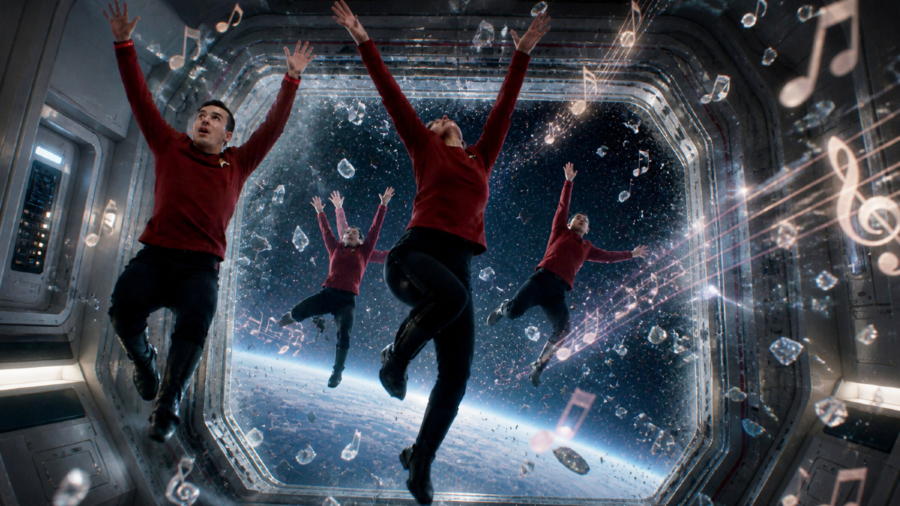
To bring you up to (warp) speed, “Subspace Rhapsody” is a Strange New Worlds episode where they encounter a very unique cosmic phenomenon: an “improbability fold.” After Uhura broadcasts a song into it (because why not, right?), the crew of the Enterprise suddenly start singing and dancing on a whim. Just like that, everyone is stuck inside a musical, and they can’t help but sing their feelings at the drop of a hat. But unless this intrepid crew can figure out what is happening to them before some bad guys show up, they’ll all have a front-row seat to the day the music died!
Relatively speaking, “Subspace Rhapsody” is considered a middle-of-the-road episode. It has a 6.8 rating on IMDB, which may not sound that bad, but it was the lowest-rated episode of the entire season. Even when you account for Season 3 (which had more stinkers than the previous season), Star Trek’s first foray into musical shenanigans is one of the five worst episodes of the entire series (“Subspace Rhapsody” is tied with “Four-and-a-Half Vulcans,” another overtly silly episode).

What do people actually dislike about “Subspace Rhapsody,” though? The classic criticism is that it doesn’t feel like a Star Trek episode, which isn’t entirely true. Sure, the franchise had never gone musical before, but Trek is filled with crazy cosmic crap. If you can believe that going Warp 10 turns humans into lizard people, that transporters can de-age people, and that candles can contain impossibly horny, DTF Scottish ghosts, then let’s be real. You can believe some weird space widget forces people to sing.
Others complained that “Subspace Rhapsody” was too silly, but that’s something of a cop-out. Star Trek has always had silly episodes. Kirk encounters a giant bunny in “Shore Leave,” for example, and Picard has to literally play Robin Hood in “Qpid.” Heck, Sisko fights racism with baseball in “Take Me Out to the Holosuite.” It’s not a problem to have an occasional silly episode here and there. As Season 3 of Strange New Worlds later demonstrated, it’s a big problem when a noticeably large chunk of your 10-episode season is dedicated to pure silliness.

The final major complaint about “Subspace Rhapsody” is that the stakes are low, which is true. But to these haters, I say you can’t have it both ways. One of the biggest criticisms of NuTrek is that every major plot ends up becoming a super-serious race to save the entire galaxy, and fans eventually got catastrophe fatigue from the whole thing. Strange New Worlds was created in large part as a silly palate cleanser after the heaviness of Discovery and Picard. Given that, it seems silly to complain that an episode of SNW finally delivered the low-stakes storytelling we’d been asking for.
So, given all of that, why do I hate “Subspace Rhapsody”? Simple: the songs stink! For context, I’m a huge fan of Buffy the Vampire Slayer, and that show’s musical episode, “Once More With Feeling,” is filled with wall-to-wall bangers. The songs have infectiously catchy beats and impossibly clever lyrics. Not only are these songs I happily jam out to outside of the episode, but they are songs I frequently sing out loud to the shock (and occasional delight, damn it!) of the people around me. As for “Subspace Rhapsody,” I don’t think I could hum a single note if you had a phaser up to my head.

The songs just aren’t memorable, either in terms of music or lyrics. They’re serviceable to the plot, of course, and they do a decent job of advancing plots like the endless romantic drama between Spock and Chapel. Part of the problem is, unlike the writers of the episode, the songs of “Subspace Rhapsody” don’t take any big, creative swings. Nothing stands out because no creative risks are taken, and it simply feels like a bunch of lyrics were just jammed into a musical AI with the prompt “make it sound like off, off-Broadway.”
It doesn’t help that some cast members can clearly sing better than others, and even the ones who can seemingly carry a tune were helped out with pitch correction, better known as autotune. With Buffy, the cast practiced until they could all confidently lead a song, with the exception of poor, tone-deaf Alyson Hannigan. Rather than forcing her to deliver a subpar melody, Joss Whedon simply honored her request to bow out and didn’t give her any songs of her own (which is why one of her only contributions is the cheeky “I think this line’s mostly filler”).

The result is the worst of both worlds. Not only does the premise and tone of “Subspace Rhapsody” set older fans’ teeth on edge, but the songs are a disappointment to those of us who were looking forward to a musical episode. Why do something so unprecedented if you’re going to do it in such a half-assed way? Unfortunately, it’s not clear that Star Trek’s powers that be ever learned their lesson from this, and with our luck, Season 4 will give Muppet Captain Pike one goofy, autotuned song after another!







Drax board avoid their own AGM, accused of greenwashing & environmental racism


Kylie Jenner’s KHY Enters a New Era with ‘Born in LA’


Channel 5 – All Creatures Great and Small series 7 new post


Images of Samsung’s rumored smart glasses have leaked

Trump’s 25% EU auto tariff breaches Turnberry Agreement that also covers semiconductors and digital trade


Most Commercial Energy Audits Miss the Real Losses


CFTC’s AI will review U.S. crypto registration applications, chairman tells CoinDesk

Paul Scholes issues Marcus Rashford reality check as agreement emerges over Man United star


Barclay Brothers Avoid Bankruptcy: HSBC Drops High Court Petitions After IVA Deal

Tesla Officially Registers Elon Musk’s Stock: What Investors Need to Know


Get Ready for More Brain-Scanning Consumer Gadgets

Robinhood Phishing Scam Exploits Gmail Dot Feature to Bypass Security


Gmail Dot Trick Underpins Robinhood Phishing, Sending Real-Looking Emails

Sister Wives: Janelle Posts New Scary Warning

Michael Jackson’s Biopic Excluded Abuse Allegations For $25M


Two Powerball Tickets Split $143 Million Jackpot in Indiana and Kansas

Superdry co-founder accused of raping woman

Meme Coin Based on White House Shooter Conspiracy Rallies 320%


YouTube TV’s Multiview Feature Just Got A Game-Changing Upgrade
Opus Genetics president Benjamin Yerxa sells $39,121 in stock



You must be logged in to post a comment Login