

NewsBeat
a guide to finding love later in life


Whether you’re a widow, widower or divorcee, the thought of online dating can feel daunting. However, more and more people are turning to the internet to find romance. Roughly 16 per cent of UK adults met their long-term partner online, according to Statista. Among them, there are lots of singles over 50 using dating sites to find a companion.
So here’s how to navigate your online dating life with expert advice from psychologist and dating coach Dr Pam Spurr, and sex and relationship coach Angela Vossen.
How do I know if I’m ready to date again?
Coming out of any relationship is hard. If you’re hoping to date after a divorce, bereavement or break up, it can take a long time to feel ready to date again. Dr Spurr advises taking your time.
“Many people feel bruised, even traumatised, after coming out of a long-term relationship or having been bereaved,” she explains. “Your feelings naturally vary from day to day about whether you’re ready to get back out to look for love – or even for fun. A crucial factor is if you’ve come to the point where you have more good days compared to bad days”.
Dr Spurr explains that good days are the days on which you feel more optimistic about life generally, and you find your thoughts turning to meeting someone new. “That’s an important sign that you are healing,” she says. “However, if you’re still feeling deeply insecure or are riddled with self-doubt about your worthiness, take your time. When you feel worthy, you will find someone worthy of you”.
Feeling heartbroken? Learn how to get over a break up
How to start dating online for seniors
If you’re new to online dating, it can feel intimidating at first. The secret is taking things step by step so that you do things at your own pace. The first step, however, should be choosing a senior dating site that will help match you with like-minded people. This will narrow your search and ensure your dating experience is more successful.
Step 1: Create an online profile
Once you’ve decided on a dating service and signed up, you’ll be asked to write a dating profile. This should reflect who you are along with your passions, values and what you seek in a partner.
Try to be authentic rather than creating a fantasy version of yourself. If you exaggerate your accomplishments, your date will only feel deceived once they get to know you. Likewise, don’t be tempted to use a photo of yourself from 10 years ago.
Step 2: Spark meaningful chats with potential dates
Once you have signed up to a senior dating site and created a profile, you will be free to start looking at other people’s profiles and sending messages to anyone that catches your attention. But how can you initiate a conversation after an introduction?
“When messaging people on dating sites, ask open-ended questions to spark meaningful chats,” says Angela. A good example would be, ‘I can see you enjoy travel. What place have you always wanted to visit but haven’t yet?’ or “tell me more about your love of tennis? Did you watch the US Open?” If things go really well and the chat seems to flow naturally, you may decide to organise a phone chat or ask them out on a date. An initial chat over the phone can help gauge how well you get on and how easily the conversation flows. If this goes well, meeting in person may feel less nerve wracking and a little less ‘blind’.
Step 3: Prioritise your safety
“While most people are well intentioned online, it’s important to protect your safety,” advises Ms Vossen. “Keep personal details private (like where you live or your social media profiles) until you’ve met in person and built trust”. You should also arrange first dates in public places, share your plans with a friend, and trust your instincts if something feels off.
If the first date or two doesn’t quite hit the mark, try not to be too disappointed and remember that you can say no to another date. Ms Vossen says: “Be patient – online dating takes time, but with practice, you’ll gain confidence and enjoy the journey”.
Traditional ways to meet senior singles
Of course, couples continue to meet in a manner that predates online dating sites. If you’re keen to join the dating scene but find the online world overwhelming, there are plenty of ways to meet people in real life.
1. Holidays and group trips
We are often our best selves on holiday, so it’s the ideal place to find a single senior woman or to meet men if the opportunity presents itself. Why not organise a trip on which you meet new people while doing what you love, whether that’s cycling, walking, sightseeing or just travelling around a new part of the world. There are many escorted tours that cater to specific age groups and interests. They also take away the stress of organising a trip yourself.

“An organised holiday or trip can be a great place to meet someone new and there are many organisations offering these for the over 50s,” says Dr Spur. “A word of caution though, you can spend a lot of money and there’s no guarantee that you will meet that special person. However, if it’s a place you’ve wanted to travel to then go with the mindset that you’re going to have a great trip. If you meet someone, that’s an added bonus”.
2. Activities and social groups
Whether you enjoy walking, reading or volunteering, taking up a new hobby or joining a social group is a great way to enhance your social life and increase your chances of meeting a new romantic interest.
“Joining a club or taking up a hobby can be a fantastic way of meeting singles who enjoy the same pastimes,” says Dr Spur. “You’re doing an activity you enjoy knowing that there might also be someone there that will catch your eye”.
If you do meet someone that you’re interested in at a social event, Dr Spur advises starting with a simple ‘hello’ and an easy question such as how long they’ve been doing that particular activity or hobby. “This can open-up a friendly conversation that might lead to flirting down the line,” she says.
Whichever way you decide to start looking for love, approach it in a way that you feel comfortable with. Whether you sign up to a dating service, book a group trip, or join a club, it’s never too late to begin a new chapter.
FAQs
If you are single and interested in meeting like-minded people, join Telegraph Dating. With more than 220,000 single people, Telegraph Dating is the perfect place to find romance.

Continue Reading
It might be April Fools’ Day, but Carol Kirkwood has left the BBC after almost 30 years – and it’s no prank.
Kirkwood, 63, hosted her final weather update on BBC Breakfast on Wednesday morning (1 April), much to the sadness of viewers and hosts Jon Kay and Sally Nugent – and she broke down in tears while thanking viewers for “letting me be a part of your lives”.
The special celebratory episode saw Kirkwood receive messages from a flurry of recognisable faces, including singer Bryan Adams, Prime Minister Keir Starmer and former BBC Breakfast host Susanna Reid. She was also reunited with the dog that famously pulled off screen while she hosted the weather from the Chelsea Flower Show in 2021.
She was also presented with several gifts, including a special painting from Mr Men illustrator Adam Hargreaves depciting her as “Little Miss Sunshine” and a bunch of flowers from her husband Steve Randall. “You told me you weren’t coming in! You’re in trouble,” Kirkwood joked as Randall joined her on the sofa.
Kirkwood joined the BBC Weather Centre in April 1998 and began broadcasting on the BBC News channel, before making regular appearances on BBC One. She has been BBC Breakfast’s main weather presenter since 2010.
Find updates from Kirkwood’s final weather broadcast below.
‘Thank you for letting me a part of your lives’
Carol Kirkwood fought back tears while addressing the nation before retiring from the BBC.
“This is a forecast I’ve known for quite a while was coming, but that doesn’t make it easier to present because after 28 years as s a BBC weather presenter, tracking storms, chasing sunshine and occasionally getting it completely wrong, I’m saying goodbye. When I first walked into this studio, I could never have imagined the journey ahead.
“Back then, the graphics were simpler, the maps were clunkier and I had a lot less grey hair than I do, but one thing has never changed, and that is the privilege and honour of being welcomed into your homes. Thank you for trusting me – you’ve been the constant in all of this and I’ve never taken that for granted. I’m really going to miss you.
“As for what comes next, for once I don’t have a detailed forecast – but I do know this: it’s time for a new chapter and perhaps the luxury of watching the weather instead of presenting it. Thank you for letting me be a part of your lives.”
Jacob Stolworthy1 April 2026 09:32
Carol surprised by husband Steve
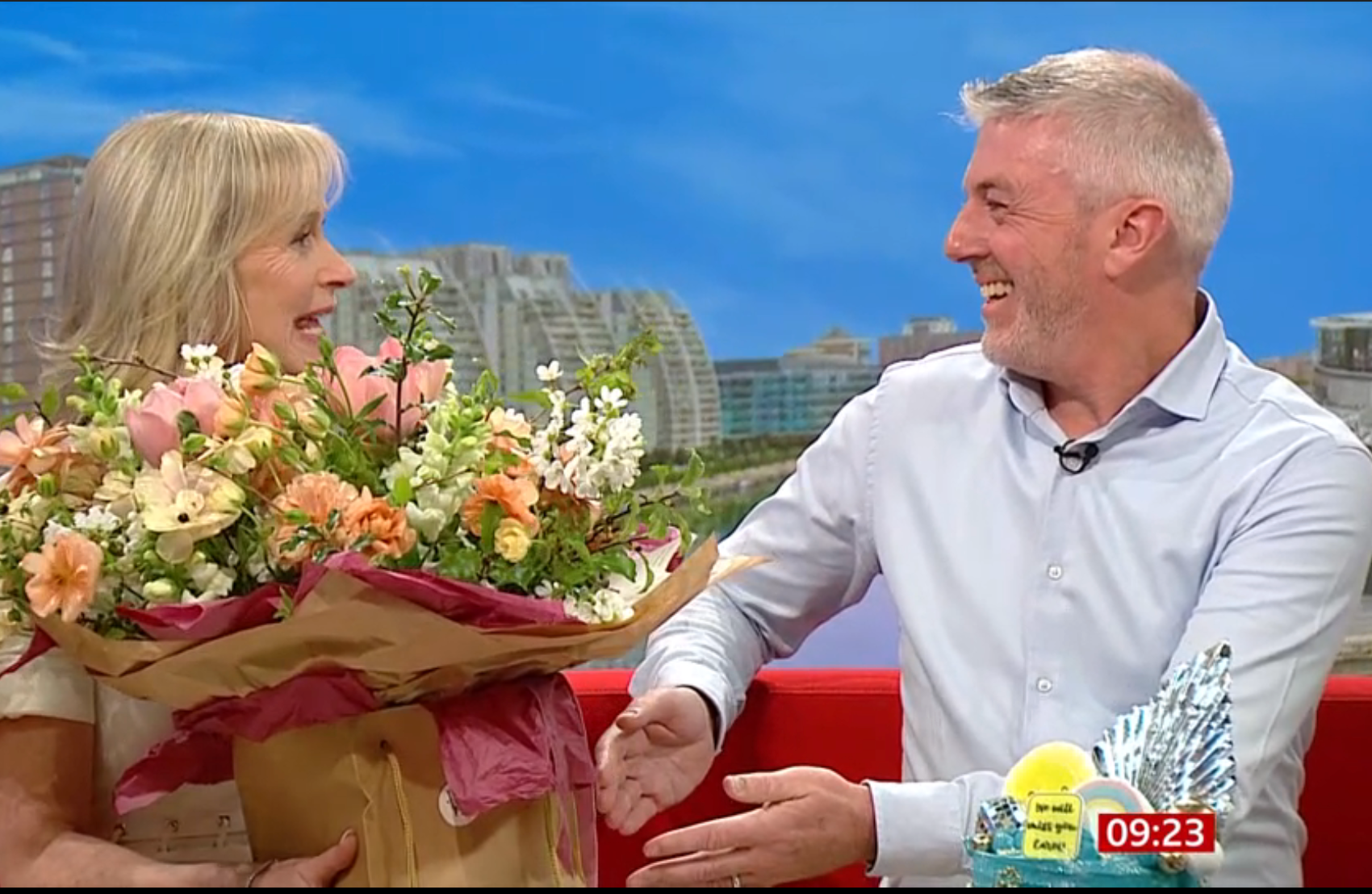
“You told me you weren’t coming in! You’re in trouble,” Carol jokes while being presented with a huge bunch of flowers from her husband, police officer Steve Randall.
Steve says it’s going to be “the best thing ever” to have Carol at home more – and not just because he also wakes up at 2.45am to make his wife a cuppa while she gets ready to go into the studio.
Jacob Stolworthy1 April 2026 09:26
Naga Munchetty keeps things ‘grounded’
Naga Munchetty swings by to say goodbye to Carol – and deploys her usual wry tone when celebrating the weather host.
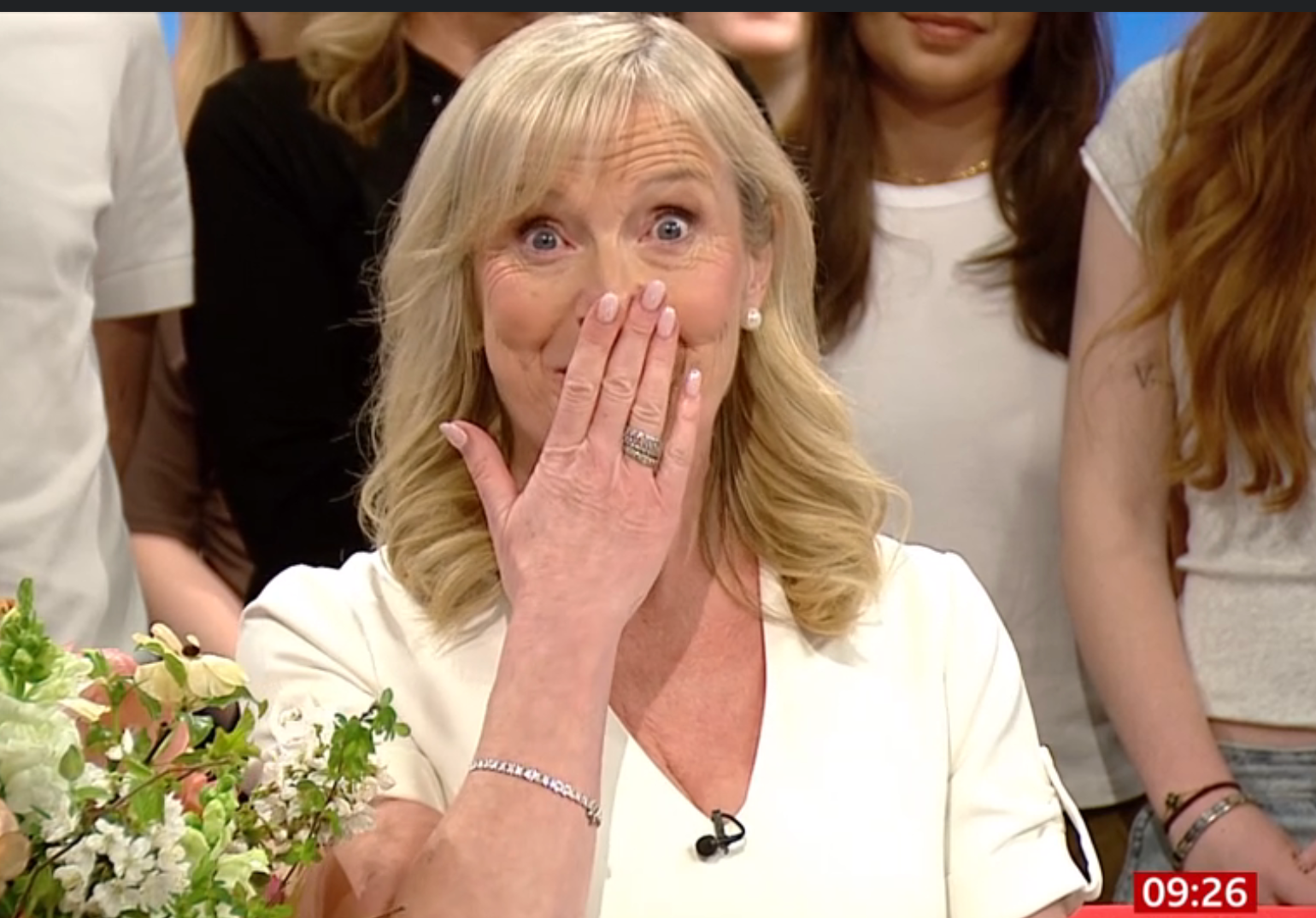
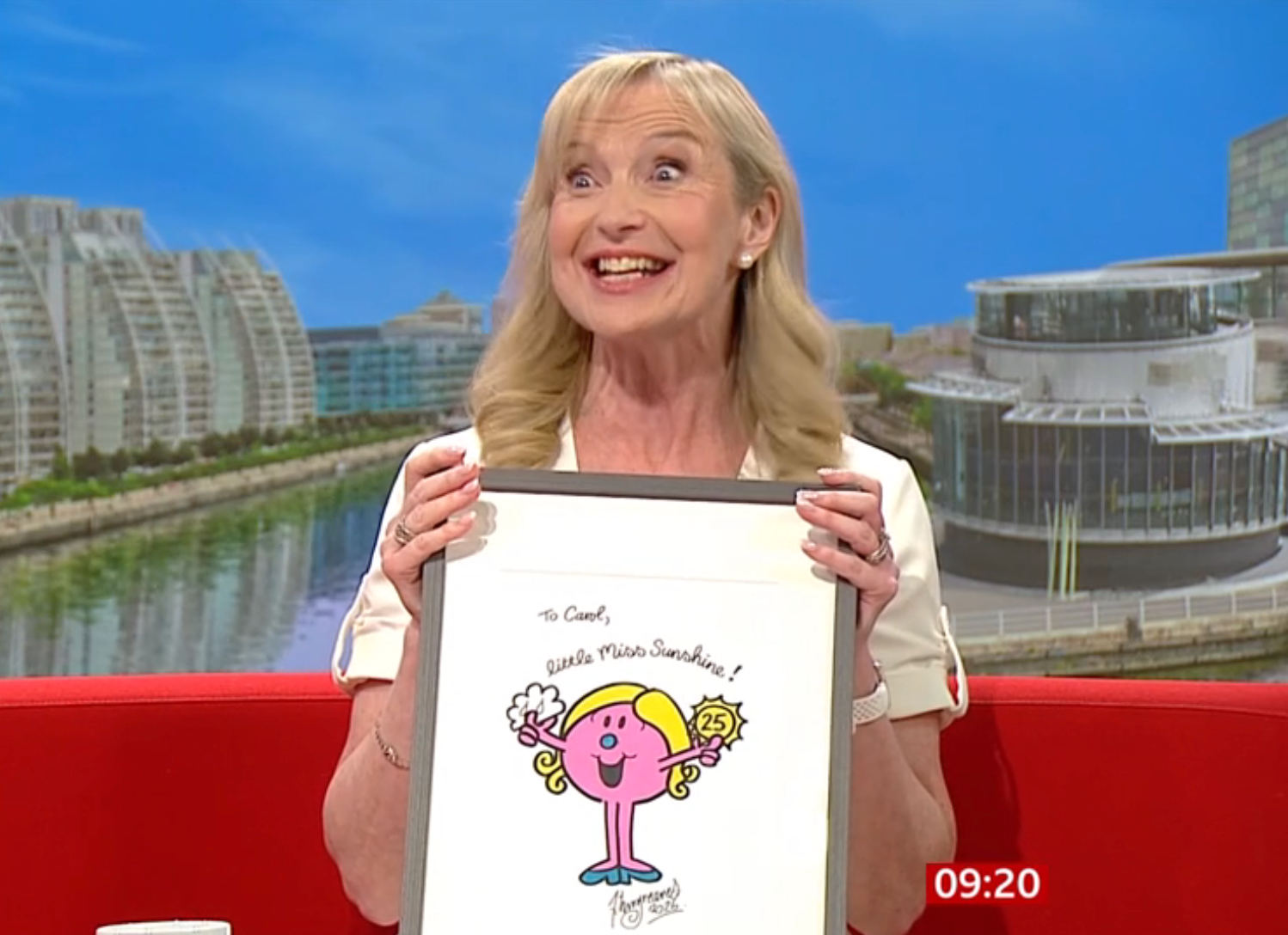
“I’m just waiting for the countdown for you to go!” she quips before presenting her with a painting by Mr Men’s illustrator Adam Hargreaves, depicting Carol as – you guessed it – Little Miss Sunshine.
“I will treasure this!” she says, holding back tears.
Jacob Stolworthy1 April 2026 09:22
Brian Cox reads poem written by BBC colleague
In what could be the most random celebration yet, Scottish actor Brian Cox is reading a poem written by Carol’s BBC colleague Patrick Gearey.
I’d personally give the poem a solid three out of five.
Jacob Stolworthy1 April 2026 09:18
Keir Starmer calls Carol Kirkwood ‘staple’ of TV
Prime Minister Keir Starmer sent Carol Kirkwood “best wishes for the next chapter” and praised her “sunny disposition” in a video message (that she definitely didn’t enjoy as much as the one she got from Bryan Adams earlier in the episode).
Jacob Stolworthy1 April 2026 09:15
The ‘celebrity’ that’s eluded Carol Kirkwood over the years
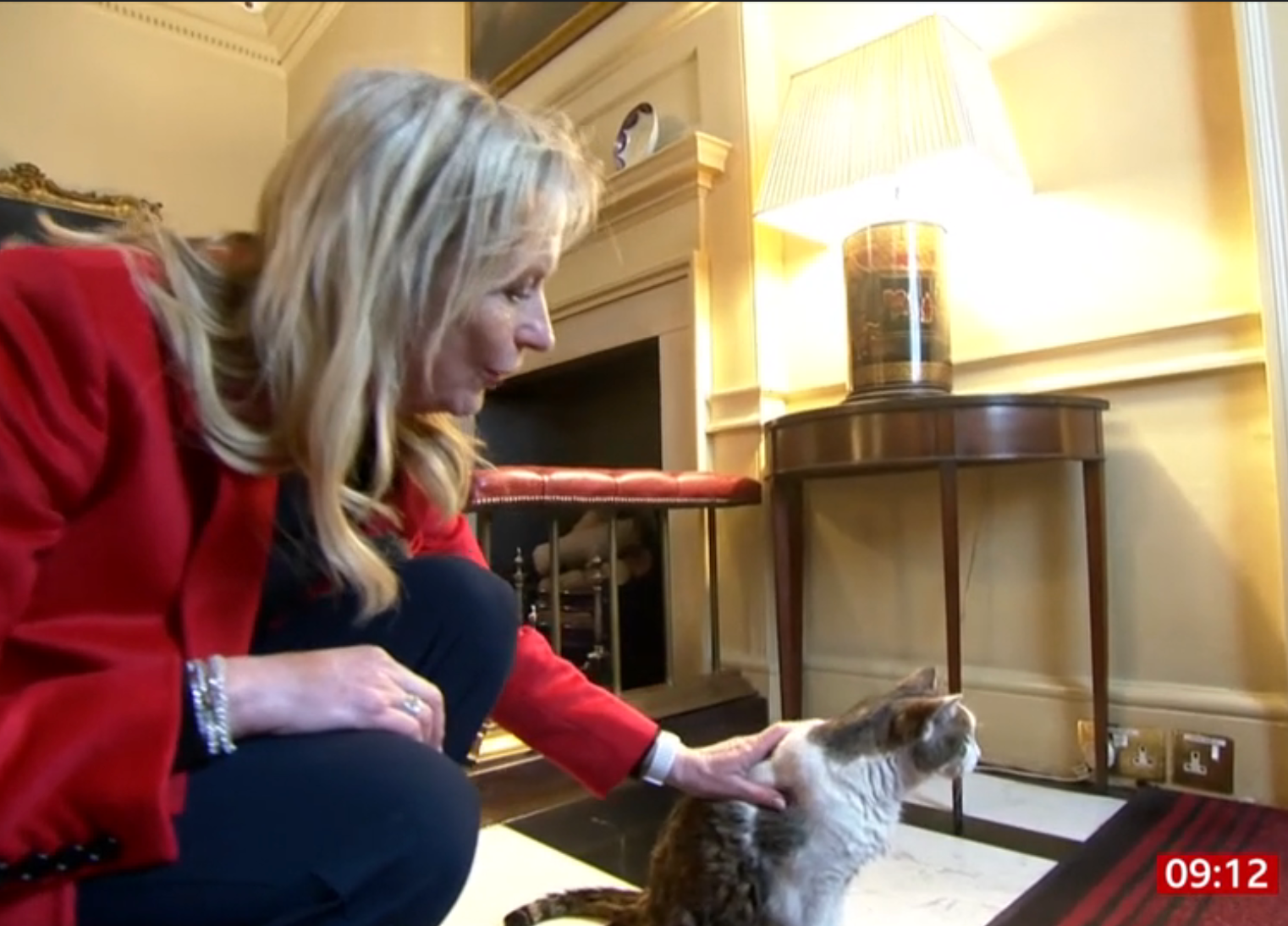
She’s met high-profile stars over the years, but one star that she’s failed to meet is, um… Larry the Cat, the tabby cat residing at 10 Downing Street. But this was rectified earlier this week.
“I’m in love!” she declared. “What a lovely wee man. He was a delight. He’s so soft. He’s the perfect gentleman.”
Jacob Stolworthy1 April 2026 09:14
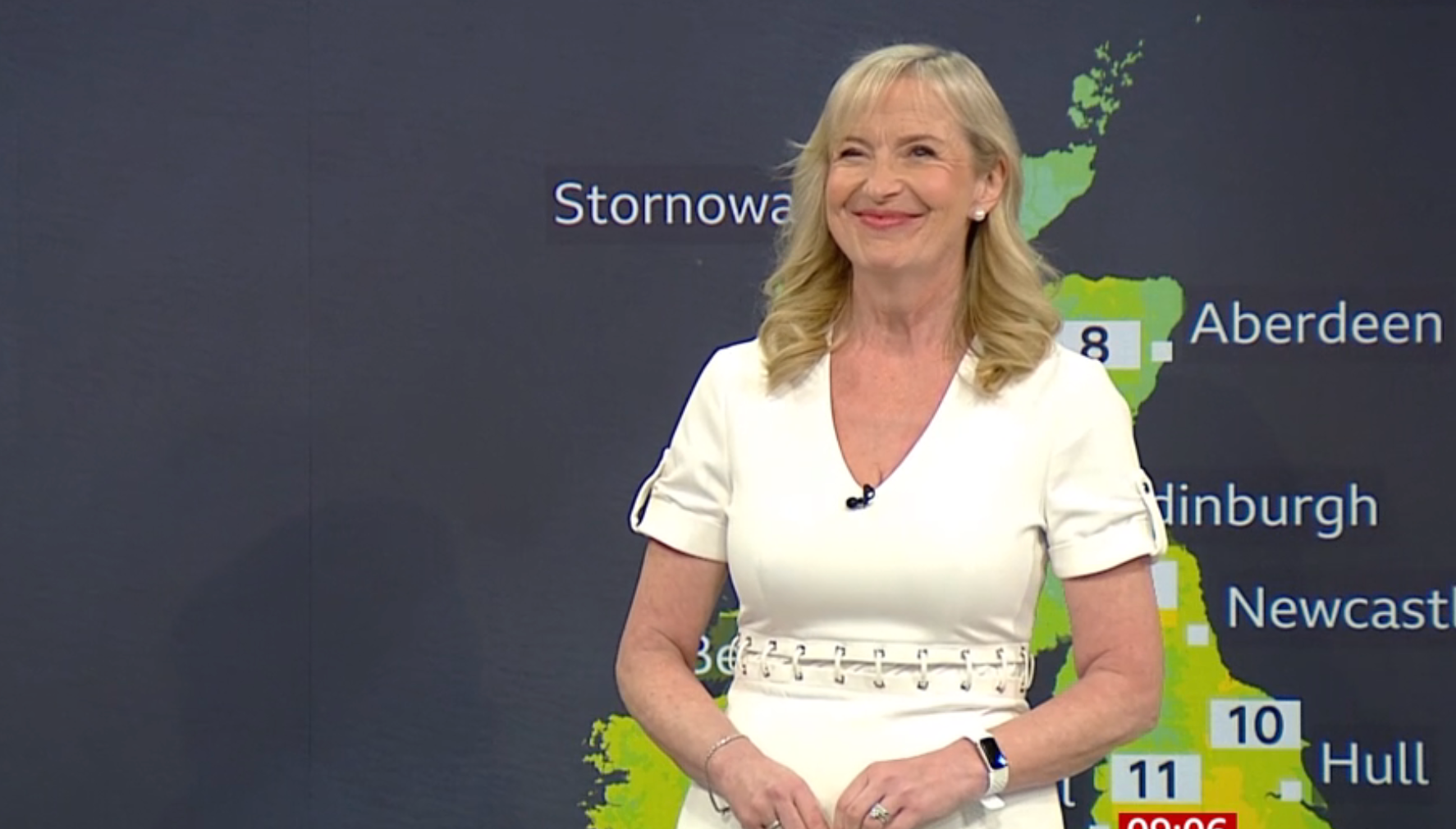
Carol presents final BBC weather segment
…and it played out like any other segment she’s presented for the last 28 years. After telling the UK to prepare for cold and windy weather, hosts Sally Nugent and Jon Kay applauded her, telling her it was “perfect”.
“Shame about the weather, though,” Kay added.
Jacob Stolworthy1 April 2026 09:08
Carol is reunited with dog that pulled her off screen
It’s the moment we’ve all been waiting for. Flash, the dog that famously yanked Carol out of shot at Chelsea Flower Show in 2021, was brought into the studio for the outgoing weather presenter’s final show – and proceeded to whip her with her wagging tail.
“I’m gonna have a bruise,” Carol quipped. “Again!” host Sally Nugent replied.

Jacob Stolworthy1 April 2026 08:57
‘You’ve set the tone’
Moving words from host Jon Kay:
“There are dozens and dozens of people in the gallery on the studio floor, in the newsroom, and you mean just as much to all of them. You’ve set the tone, you really have, for all of us on this programme over the years. Your legacy will continue. We will be more Carol.”
Jacob Stolworthy1 April 2026 08:56
Rival breakfast shows merge with Susanna Reid tribute
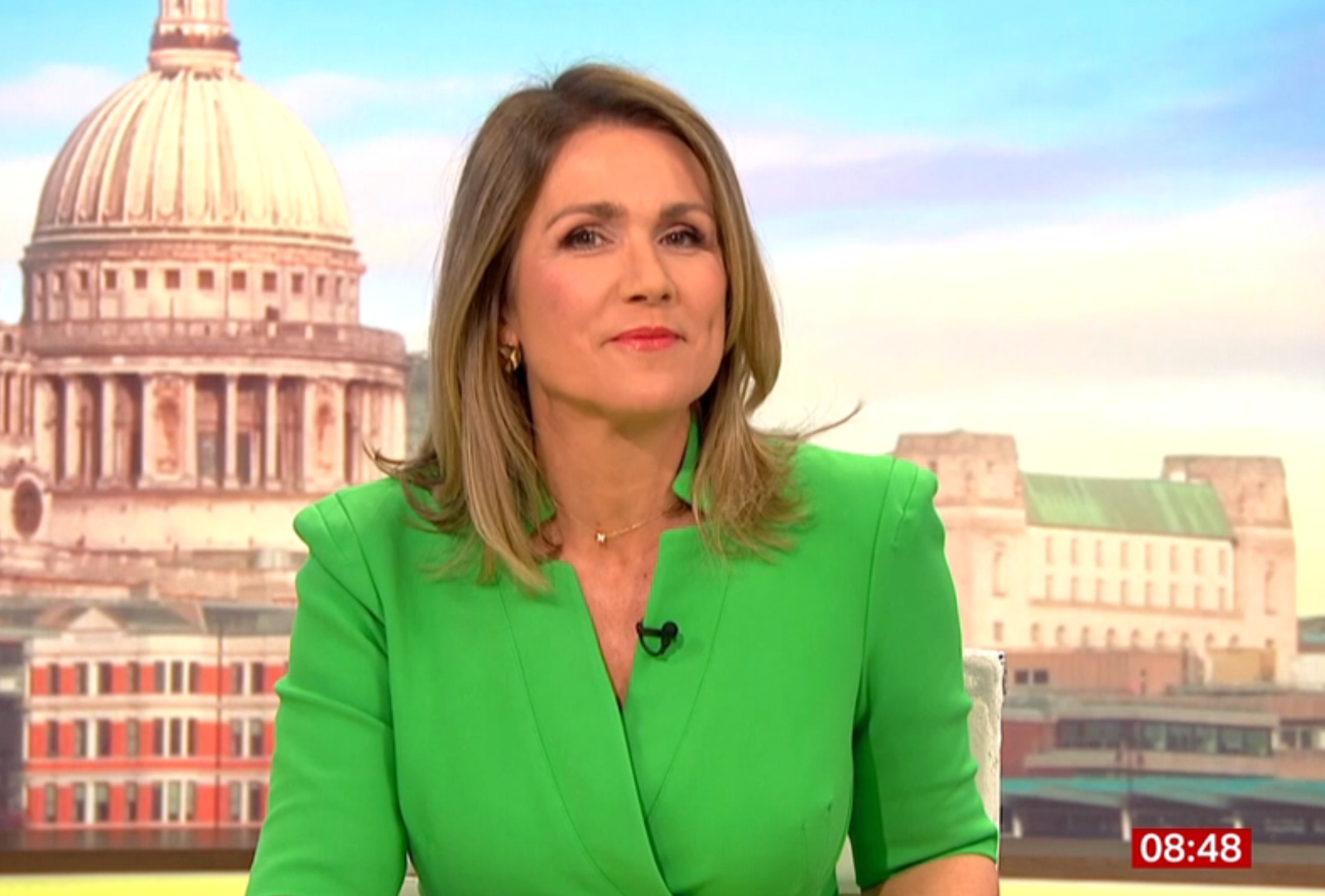
It’s a very special occasion when ITV and BBC coalesce – and that happened for Carol’s final episode. Former BBC Breakfast host Susanna Reid sent a tribute from the studio where she films rival breakfast show Good Morning Britain.
“Remember the time I was sitting alongside Bill Turnbull and you told us we were going to experience temperatures of 99 degrees celsius across the UK, causing a slightly bemused nation to wonder how to dress for the day ahead!”
Jacob Stolworthy1 April 2026 08:53
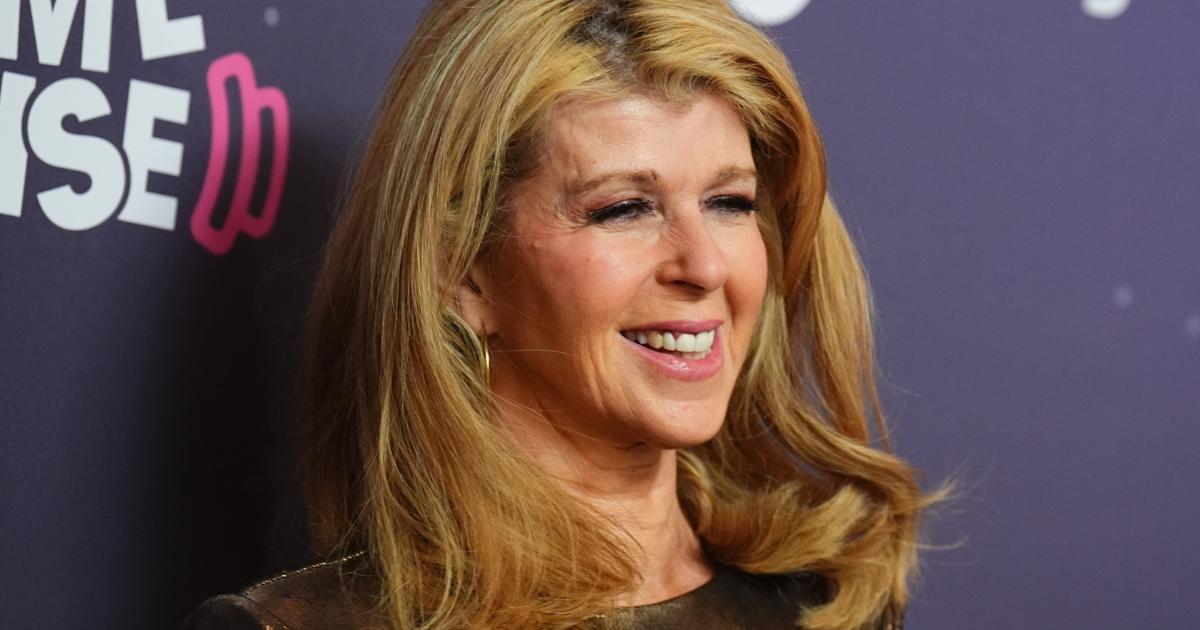
Dame Esther was discussing assisted dying on the show, something she is passionate about as she believes people should be given an option to end their suffering with medical help when they are ill.
The Childline founder and former broadcaster was diagnosed with terminal lung cancer in January 2023, and has since been a leading voice in the campaign to legalise assisted dying in England and Wales.
While speaking over the phone and during her response, she used the word ‘crap’, which Kate apologised for.
Good Morning Britain presenters over the years
Although she acknowledged the blunder, Kate found the humour in it and said that she forgave Dame Esther for the language used.
GMB rounded up the conversation in a video on X, leaving out the blunder from Dame Esther, commenting: “Dame Esther Rantzen has claimed that most people in Britain “want and need” the assisted dying bill and has spent the last few years campaigning for the bill.”
Before Rantzen spoke over the phone, Baroness Tanni Grey-Thompson, who opposes the assisted dying bill, had her say.
The GMB coverage this morning comes as “supporters and opponents of the Assisted Dying Bill have now acknowledged that the legislation will not become law in the current session of Parliament”, it explained in a post on X.
She said at the moment, there are still lots of amendments that haven’t been debated.
Recommended reading:
What is the assisted dying bill?
The assisted dying bill is being campaigned for by people who believe that when people are ill, they should have a choice to medically end their life to stop suffering from an illness.
Do you think the assisted dying bill should be passed? Let us know in the comments below.
A whopping £5000 was raised to be split between the DreamMaker Foundation, who helps kids with life-limiting illnesses and Children’s Hospices Across Scotland (CHAS).
Anglers from across Lanarkshire gathered in the Clyde Valley to mark the start of this year’s salmon season.
Wishaw charity king Les Hoey, from the DreamMaker Foundation, was delighted to be part of the ceremony with the Clyde Valley of the United Clyde Angling Protective Association (UCAPA) members.
On the day a whopping £5000 was raised to be split between the DreamMaker Foundation, who helps kids with life-limiting illnesses and Children’s Hospices Across Scotland (CHAS) which provides the country’s only hospice services for children and young people with life-shortening conditions, and services across children’s homes and hospitals.
Brian Pender, from the United Clyde Angling Protective Association (UCAPA), said: “I have known Les for over 30 years and the work he does for the charity is fantastic.
“UCAPA raised £5,000 with our raffle and auction at our salmon open day which we held at the Popinjay Hotel with half going to Les and the other half going to CHAS.
“The day itself was excellent with a large number of people attending.”
Les and the DreamMaker team were absolutely delighted with the bumper donation from the anglers.
He said: “We are very grateful for this huge amount at the opening of the salmon season on the Clyde.
READ MORE: Nearly 160,000 employees on payroll in North Lanarkshire
“It’s a great amount and we really appreciate it.”
Meanwhile, Les and the team are on the hunt for businesses across Lanarkshire to help raise funds for the charity by placing a donation tin in their shop or store.
In a statement on its website, the DreamMaker Foundation state: “We’re reaching out to businesses across Scotland to help us raise vital funds for our wee DreamMakers.
“By placing one of our donation tins at your till, you can make a real impact in your community and help those in need all across Scotland.
“Simply allow us to place a donation tin at your checkout. Your customers will have the opportunity to contribute while they shop.
READ MORE: Wishaw Post Office opens at new location in the town’s Main Street
“It’s easy, effective, and a small gesture that can make a BIG difference. Every penny counts in supporting families all across mainland Scotland and the Isles!
“If you would like to take a tin in your business please call DreamHQ at 01698 372052 or message our Facebook page. Thank you for your support!”
Tickets are also available for the DreamMaker Foundation Ball on September 12. You can reserve your tickets by calling 01698 372052.
*Don’t miss the latest headlines from around Lanarkshire. Sign up to our newsletters here.
And did you know Lanarkshire Live had its own app? Download yours for free here.
READ MORE: Wishaw MSP welcomes new funding to support Scottish-based musicians

The housing construction company is looking to submit a planning application soon
A housing construction company is looking to submit a planning application to use farmland on the edge a Cambridgeshire town for a new housing development. Bellway Strategic Land wants to use Dexter’s Farm, which can be found along the A1198 just outside Godmanchester, to create a residential development of up to 260 new homes.
Bellway’s proposal says the area would feature up to 260 new homes with around 80 of them being affordable to help people “get onto the housing ladder”. In its proposal, Bellway said: “In the East of England, Huntingdonshire has the fifth highest number of people on the housing waiting list register and therefore has some of the most acute need in terms of affordable housing.”
Huntingdonshire District Council has identified the area as a potential site for new homes. The site has been described as “well-located” with a primary school close by, local facilities including a Co-op food store, and good transport links.
As well as homes, the site will also features green spaces including habitats for wildlife and play areas for children. A new roundabout would be created on the A1198 and the 30mph speed limit will be extended to slow traffic around the area.
Bellway ran a public consultation period from Friday, February 13, until Friday, February 27, to allow residents to share their opinions on the possible new development. The company is planning to submit its application by the end of spring.
Residents will then be notified by Huntingdonshire District Council and will have the opportunity to provide feedback on the plans.
To get more news and top stories delivered directly to your phone, join our new WhatsApp community. Click this link to receive your daily dose of CambridgeshireLive content.
We also treat our community members to special offers, promotions, and adverts from us and our partners. If you don’t like our community, you can check out any time you like. If you’re curious, you can read our Privacy Notice.

Dinsdale Spa, off Neasham Road, announced earlier this year that it would be closing its greens on April 1 after more than a century.
The news came as a major shock to the region’s golfing community – with a letter from the owners, who took over in 2018, saying it was an “incredibly difficult decision”.
Since the announcement to members, questions have remained over the future of the 18-hole course and what will become of the site.
Speculation has been rife over what could become of the land – with some fearing it could be used to facilitate new housing developments.

But Darlington Borough Council has now confirmed that no planning applications have been made in relation to the site.
A council spokesperson said: “We have not received any planning applications in relation to the golf club.”
It comes after Cllr Colin Pease, independent ward councillor for Sadberge and Middleton St George, said last week that he was told no enquiries had been made about the land.
Dinsdale Spa is now the third course near or in Darlington to close in recent times after the original Blackwell Grange course in 2013 and Hallgarth Hotel’s nine holes in 2025.
The owners of the Dinsdale Golf Club have not issued a public statement on the closure, but did send a letter to members confirming the news.
The letter said: “There is never a perfect way to make these announcements, however, we wanted to write to you personally to let you know that Dinsdale Golf Club will be closing from April 1.

“This has been an incredibly difficult decision and not one we have taken lightly.
“Since arriving in 2018, we have poured our hearts into the club, improving the course, enhancing the facilities and rebuilding Dinsdale.
“The club has been far more than a business to us, it’s been a central part of our lives.
“However, after dedicating ourselves fully to the day-to-day demands, we have come to the decision that now is the right time to step away and prioritise our families and other parts of life that have taken a back seat for far too long.”
Many have voiced their sadness over the closure of the club, including Hurworth Councillor Lorraine Tostevin, who said it was a “real shame”.
The Northern Echo has attempted to contact the club owners on several occasions but has yet to receive any correspondence.
I’ve spent a lot of time with Derek over the years. We did plenty of sparring very early on in my career. Since then, I see him around all the time because Derek is absolutely everywhere – at every show and every event.
He has always been congratulatory of me, almost proud of me in a sense. I remember when I won my British title, he was one of the first people to FaceTime me the next morning to say well done.
Derek was also one of the only people, aside from my own team, who backed me going into both the Joseph Parker and Daniel Dubois fights. He’s always been on my side, so I’ve got a lot of love and respect for him.
When I first heard about him taking on Wilder – I have to be honest, it was quite a surprise.
It seemed like both guys had bigger fish to fry – there was talk of Derek getting a world-title shot against me, and Wilder was being lined up by Oleksandr Usyk.
Pulling away from those possibilities to fight each other was random, but the more I thought about it, the more it made sense.
This has that intriguing dynamic of two guys with 50 fights each. For me, it’s really a question of who’s still got what in the tank.
The momentum is with Derek. He’s been in with more lively opponents, proving himself better. He’s still got the energy, the durability and the power to deal with opponents and give them problems.

As a subscriber, you are shown 80% less display advertising when reading our
articles.
Those ads you do see are predominantly from local businesses promoting local
services.
These adverts enable local businesses to get in front of their target audience – the local
community.

It is important that we continue to promote these adverts as our local businesses need
as much support as possible during these challenging times.
Pedro Pascal worked in the entertainment industry for decades before being catapulted to worldwide fame after appearances in hit shows like Game of Thrones, The Mandalorian and many more
Pedro Pascal’s coffee order caused a flurry of division among fans. The beloved actor, who turns 51 this week, has enjoyed a surge in popularity in recent years, after decades of work which went relatively unnoticed to wider audiences.
The Mandalorian star had worked for around 20 years in the industry, taking small bit parts on television shows – including a one episode stint in the season four premiere of the cult classic series Buffy the Vampire Slayer – as well on stage, before finally getting his big break when he was cast as the swashbuckling, quick-witted Oberyn Martell on HBO’s Game of Thrones in 2014.
He followed this with a lead role in Netflix’s crime series, Narcos, before being catapulted to global superstardom by playing Din Djarin in the Disney+ science fiction series, The Mandalorian, which ran from 2019 until 2023.
In 2023, Pascal was cast as Joel Miller in HBO’s post-apocalyptic drama, The Last of Us, opposite Bella Ramsey, and he has acted in a string of film roles.
His celebrity status has come with major internet fame, with countless fans playfully branding him “daddy” thanks, in part, to his many father figure roles and his charming, affable nature in real life.
The acclaimed actor’s Starbucks order drew major attention when it was shared online. Originally, a fan filmed a lucky chance-meeting with the star on the streets of New York, where he signed a Mandalorian doll for her.
In the footage, he was seen dressed in a Canada Goose jacket and jeans, while holding a bottle of water and a clear Starbucks takeaway cup, with his order ticket still attached.
Eagle-eyed fans were quick to decipher exactly what he’d ordered from the renowned coffee shop chain – an “ice [quadruple] espresso in a Venti cup, extra ice, six shots”.
A screenshot of the fan video was shared on Reddit, where someone wrote: “I’m not a coffee drinker but according to the Internet that is A LOT of caffeine. I just thought this might be interesting to y’all since Starbucks orders are always fun intel!”
In the comments section, fellow Reddit users were keen to share their thoughts. One person said: “Lol I just watched his Hot Ones interview where he says he can’t get a good night’s sleep…”
Another quipped: “Dude definitely has manic highly caffeinated vibes lmao.”
Some theorised his Chilean-American roots may have something to do with his preference for stronger coffee.
One said: “Coffee in the US is not at all as strong as it is in Latin America so I get him.”
Another agreed: “I know people who get this, it’s basically a strong iced Americano. The point is to get extra ice and a bigger cup so that the ice melts and dilutes the espresso but the drink stays cool.
“It’s popular with people who come from places where the coffee is stronger than standard US or Canadian coffee.”
Someone else said: “His order is not nearly as bad as the coffee wannabe drinks people have created for them at Starbucks with 1,000,000 grams of sugar and milk.”
Many fans were adamant his order wasn’t weird or unusual.
On the original TikTok video, one social media user said: “How the hell he be drinking that?? I would stay awake for an entire week.”
Another said: “BRO GETS SIX SHOTS???” And another added: “I love that he drinks a 6 shotter over some ice.”
Indian consumers could soon face higher beer prices and potential supply disruptions as global brewers operating in the country grapple with escalating costs driven by a gas shortage linked to the Iran war.
The conflict has led to a surge in the price of glass bottles and significant shipping delays for aluminium, crucial for can production.
India, the world’s fourth-largest importer of natural gas, is particularly susceptible to fuel availability issues, relying heavily on the Middle East for its supply, with approximately 40 per cent sourced from Qatar.
Iranian attacks have partially hampered Qatar’s export capacity, tightening gas availability for Indian manufacturers.

The Brewers Association of India, representing major players such as Heineken, Anheuser-Busch InBev, and Carlsberg, informed Reuters that glass bottle prices have soared by around 20 per cent. Additionally, paper carton rates have doubled, alongside increases for other essential packaging materials like labels and tape.
Gas is essential to keeping furnaces and production lines running, and shortages have forced several glass bottle makers to partially or fully halt operations.
Aluminium can suppliers have also warned of possible reductions just as India heads into its peak summer season, when beer sales typically rise.
“We are asking for price increases in the range of 12-15 per cent,” the association’s director general Vinod Giri told Reuters. “We have advised our member companies to individually approach states.”
The rising cost of production is making some operations unsustainable, he added.
Heineken’s India unit United Breweries UBBW.NS, Anheuser-Busch InBev and Carlsberg did not respond to Reuters queries.
The market was worth $7.8 billion in 2024, and is expected to double by 2030, Grand View Research says. Heineken alone accounts for roughly half the market, while AB InBev and Carlsberg each account for 19 per cent, the association said.
While the three companies dominate India’s beer sector, many smaller players such as Bira and Simba also operate in the market.
Glass and plastics industry crisis
Beer and liquor sales in India have grown steadily alongside rising urbanisation and a young, increasingly affluent population.
The Confederation of Indian Alcoholic Beverage Companies, which represents many domestic companies, said it has written to several states seeking price adjustments to offset rising freight, logistics and input costs.
India’s alcohol sector is tightly regulated, and raising retail prices typically requires approval. Around two-thirds of India’s 28 states must authorise changes.
“Brewers may find it difficult to maintain supplies in states that do not allow price increases,” the association said.
Some glass bottle vendors are warning their clients of reduced supplies and have increased their prices.
Nitin Agarwal, CEO of Fine Art Glass Works in Firozabad, a glass-making hub in northern Uttar Pradesh state, said he has cut production by 40 per cent at his glass bottle making factory due to gas shortages. His customers include many liquor companies as well as producers of juice and ketchup bottles.
“We’ve cut production and increased prices by 17-18 per cent,” Agarwal said.
The shortages have already affected India’s $5 billion bottled water market with some producers increasing prices by 11 per cent due to rising rates of plastic bottles and caps.
And there are signs the crisis is spreading.
An executive at Lotte Chilsung Beverage, one of the leading South Korean soft drinks companies, told Reuters that it has up to three months of inventory for plastic bottles and plastic materials.
“The situation is serious,” he said.
Dr Emily Leeming says we are consuming ‘only about 60 per cent of the essential nutrient for heart health, blood sugar balance and gut health
A health expert has called on Brits to boost their consumption of a particular nutrient renowned for lowering cholesterol, managing blood sugar, and keeping you feeling fuller for longer. According to the National Diet and Nutrition Survey, more than 90 per cent of adults in the UK aren’t getting enough fibre.
Dr Emily Leeming, a scientist, dietician and author, describes it as the ‘forgotten nutrient’, observing that the average British person consumes just around 60 per cent of the recommended daily intake. The NHS highlights that a diet rich in fibre is associated with a lower risk of heart disease, stroke, type 2 diabetes and bowel cancer, reports Surrey Live.
Yet, targeting roughly 30g daily can help maintain a healthy, balanced diet. To put this into context, half a cup of porridge oats delivers 9g of fibre, while two carrots provide 6g. An apple offers approximately 5g, and a pear adds 6g.
Dr Leeming explained: “We’re missing about 40 per cent of that recommended 30 grammes of fibre that we need a day.”
She went on to stress the significance of this neglected nutrient: “This forgotten nutrient that we need to be paying attention to. It helps with your heart health, it helps to soak up bad cholesterol for that to be removed from your body as waste, it helps to balance your blood sugar levels, giving you longer-lasting energy, so it’s not only just helping with your gut microbiome, it’s having many other benefits in your body too.”
Why fibre matters
Fibre is a plant-based carbohydrate found in foods such as wholegrains and vegetables, commonly referred to as roughage. It’s essential for keeping your digestive system working properly.
By feeding the good bacteria in the large intestine, it helps create a varied and healthy microbiome (the community of gut bacteria). This can reduce inflammation in the intestines while potentially lowering the risk of both diverticulitis and bowel cancer, reports the Express.
Studies show that eating fibre-rich foods can support weight management by keeping you feeling fuller for longer. Choosing high-fibre options increases satiety, while a diet rich in fibre can improve digestion and prevent constipation.
Research indicates that people who eat more fibre typically have lower body weight, reduced blood pressure and lower cholesterol levels – all positive factors for heart health. Fibre-rich foods also help control blood sugar levels, as they don’t trigger the same sharp spikes as their low-fibre equivalents.
Different types of fibre
Heart UK explains that you may have come across the terms ‘soluble fibre’ and ‘insoluble fibre’. These phrases are frequently used to categorise the different types of fibre in our diets.
Soluble fibre absorbs water in the gut. It’s found in:
- oats
- barley
- pulses (such as beans, peas and lentils)
- some fruits and vegetables
Insoluble fibres do not dissolve in water. They are primarily found in:
- wholegrains, especially the bran part of the grain
- vegetables
- the seeds and skin of fruits
How can I eat more fibre?
To boost your fibre consumption, you could: Dr Leeming concluded: “When I talk about fibre, the key foods that I really want to talk about are what I call the BGBGs.
“That’s beans, greens, berries, grains, and nuts and seeds. What might surprise people is that the highest-fibre foods are whole grains, nuts and seeds, and beans – much more so than most fruits and vegetables, which I think is quite counter-intuitive for some people.”
According to the NHS, children require lower amounts of fibre in their diet. Those between the ages of 2 and 5 should consume approximately 15g of fibre daily. Children aged 5 to 11 require around 20g, while those aged 11 to 16 need roughly 25g per day.

Politics6 minutes ago
What does the UN Declaration on the slave trade mean for Western legitimacy and the Global South?

Sports7 minutes ago
Filip Hrgovic ‘guaranteed’ fight with top heavyweight if he beats Dave Allen: “We have a contract”

Tech9 minutes ago
How to Integrate AI APIs Into Existing Software Applications: A Developer’s Guide


-

 News Videos6 days ago
Parliament publishes latest register of MPs’ financial interests
-
 Tech6 days ago
Intercom’s new post-trained Fin Apex 1.0 beats GPT-5.4 and Claude Sonnet 4.6 at customer service resolutions
-

 NewsBeat4 days ago
The Story hosts event on Durham’s historic registers
-

 Business6 days ago
Instagram, YouTube Found Responsible for Teen’s Mental Health Struggle in Historic Ruling
-

 Sports4 days ago
Sweet Sixteen Game Thread: Tide vs Michigan
-
 NewsBeat7 days ago
Tesco is selling new Cadbury Dairy Milk bar and people can’t wait to try it
-
 Entertainment3 days ago
Lana Del Rey Celebrates Her Husband’s 51st Birthday In New Post
-
Entertainment2 days ago
Fans slam 'heartbreaking' Barbie Dream Fest convention debacle with 'cardboard cutout' experience
-
Crypto World21 hours ago
Dems press CFTC, ethics board on prediction-market insider trades
-

 Sports16 hours ago
Tallest college basketball player ever, standing at 7-foot-9, entering transfer portal
-
 Fashion7 days ago
How to Style Spring Like WeWoreWhat: Easy Outfit Ideas for 2026
-

 Entertainment6 days ago
HBO’s Harry Potter Series Will Definitely Fail For One Big Reason, And It’s Not J.K. Rowling Or Snape
-

 Tech2 days ago
The Pixel 10a doesn’t have a camera bump, and it’s great
-

 Fashion6 days ago
En Vogue in Brown Leather and Tailored Neutrals by Atelier Savoir, Styled by J Bolin
-

 Crypto World1 day ago
U.S. rule change may open trillions in 401(k) funds to crypto
-

 Fashion6 days ago
What Are Your Favorite T-Shirts for the Weekend?
-

 Fashion5 days ago
Weekly News Update, 3.27.26 – Corporette.com
-

 Sports1 day ago
Women’s hockey camp eyes fitness boost, tactics ahead of WC 2026 campaign | Other Sports News
-
 Sports6 days ago
Lewis Hall hopes to miss another summer of village cricket due to World Cup call
-

 Tech3 days ago
Elon Musk’s last co-founder reportedly leaves xAI
You must be logged in to post a comment Login