A mid-air crash erupted above a military site in Idaho with emergency crews rushing to the scene and a massive plume of smoke seen hovering over the area
20:40, 17 May 2026Updated 20:46, 17 May 2026
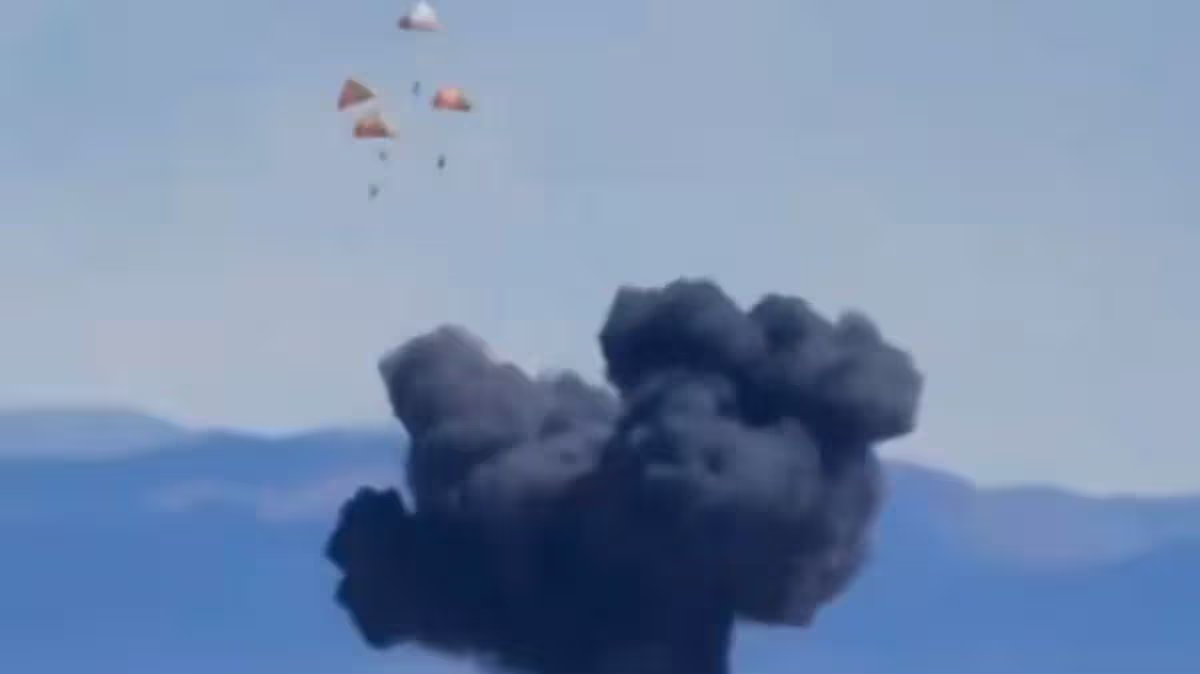
A mid-air crash at a US air show has sent a huge plume of black smoke billowing into the sky, with witnesses reporting seeing four parachutes moments after the incident.
The collision happened during the Gunfighter Skies Air Show near Mountain Home Air Force Base in Idaho. The event sees military and civilian aircraft perform flying displays and demonstrations.
Officials said the crash took place around two miles north-west of the base, where emergency crews rushed to the scene.
Advertisement
Base spokesperson Antwain Hanks confirmed the crash to the Idaho Statesman.
An air show announcer told the crews were able to eject, the publication added. “We had four good parachutes,” the announcer told the crowd.
“The crews were able to eject. They’re located one mile south of where the smoke is. The parachutes came down.”
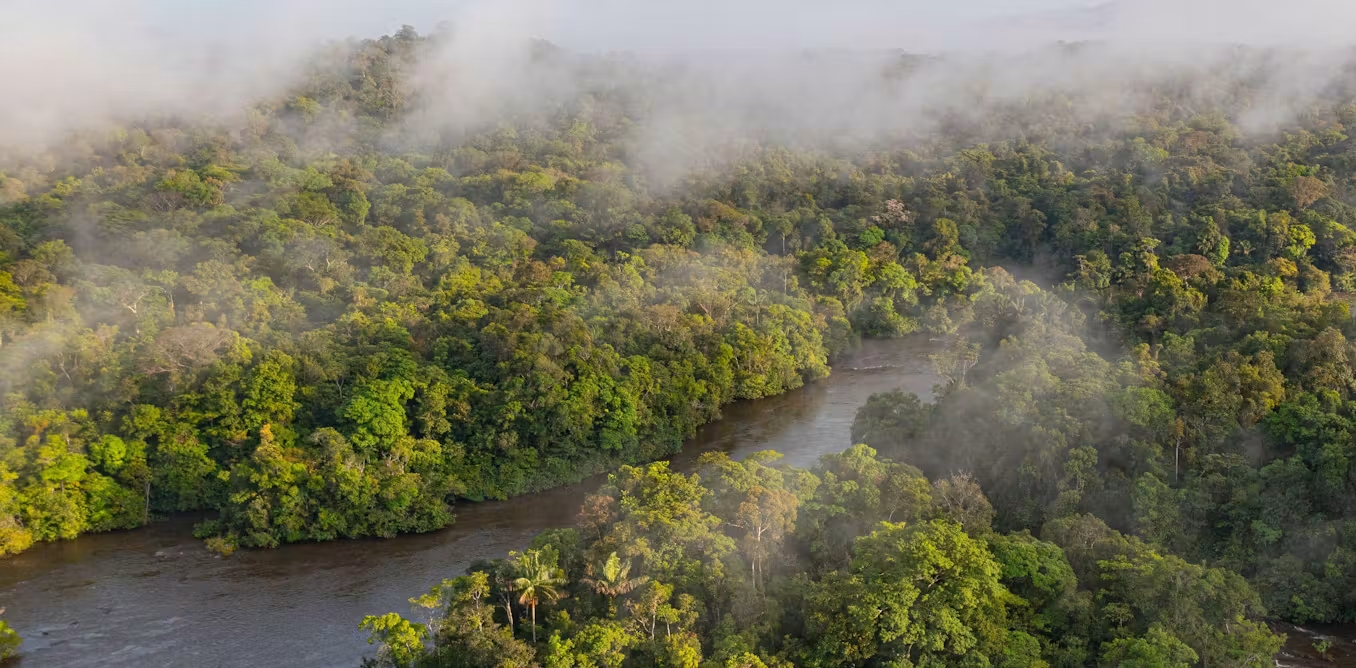
From the air, you see it only through the constant jolt, tilt and shudder of the low-flying Cessna aircraft. The landscape of the Llanos de Moxos, northern Bolivia, appears as a disconnected patchwork of open grassland savannahs, forest islands and lakes.
It feels random, almost unreadable. Only gradually does the pattern resolve itself: raised causeways or paths fanning out to link the forest islands, and a dense, scattered web of canals threading the terrain. Slowly you realise it’s a structured network of intersecting lines, enclosures and roads – the imprint of past human design.
Aerial view of Llanos de Moxos. Jose Iriarte, CC BY-SA
If you stand on the open savannah, there is almost nothing to see of this ancient network. The horizon feels open, with fires in the distance from local people burning pastures and clearing forest as dry season begins. The old geometry is still faintly perceptible, but you have to know how to look.
Advertisement
Step into the patches of forest and the canopy closes in. The earth softens underfoot and mosquitoes descend in relentless swarms. The sweat on your neck thickens into a humid film, carrying the familiar scent of suncream and the sharper, chemical note of DEET.
In the uneven light between the trees, the landscape dissolves into subtle rises and depressions. Against the rhythmic swish of machetes as our guides cut through the vegetation, your mind tries to piece together the fragments of structures into something coherent. Flying overhead doesn’t reveal anything about this forest area in the way that it does with the savannah. But fortunately recent advances in technology have transformed what we are able to see.
Surveying in the dense Amazon rainforest. Jose Iriarte, CC BY-SA
Archaeological explorations in this part of the world have been completely changed by lidar in the past couple of decades. Lidar maps an area from a plane or drone by bouncing rapid laser pulses off the Earth’s surface. Some of these pulses penetrate the forest canopy, reach the ground and reflect back to the sensor.
By measuring the return time, the system can generate highly precise three-dimensional models of the terrain. This allows you to strip away the camouflage of vegetation, making it possible to see what lies below the Amazonian forest for the first time.
Advertisement
It reveals the ancient Llanos de Moxos as not simply a collection of settlements, but an entire urbanised landscape. A large part in the south-east of this region belonged to the Casarabe culture, which dominated between around AD500 and 1400. It extends across 20,000km², which is roughly the size of New Jersey in the US.
The Casarabe organised into a hierarchy of four different sizes of settlements (those forest islands mentioned above). The biggest ones – the primary settlements – were as large as 3km² or 300 hectares. That’s enough space for over 400 football pitches, suggesting that they could have accommodated substantial numbers of people.
Welcome to our series on the great mysteries of archaeology. Viking explorers, Amazonian cities, artefacts from before civilisation. Archaeology may be all about the past, but it’s constantly shifting with every scientific discovery. This series will dig into some of the most fascinating debates in the field today.
Advertisement
These settlements connect along the raised causeways to smaller secondary and tertiary sites a number of kilometres away, all of which were permanently inhabited as opposed to empty ceremonial hubs. A fourth tier consists of groups of isolated mounds located out in the pampas, which likely correspond to dwelling areas occupied by farmers who would have worked the fields.
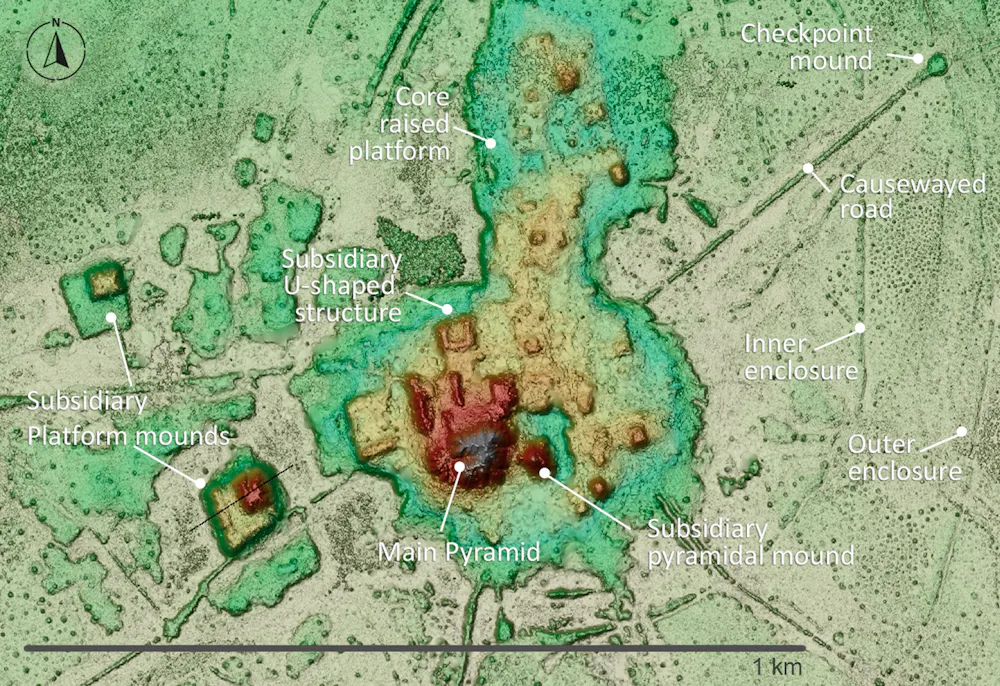
It’s not possible to show a lidar image of these four different types of sites interconnecting because they are too far apart for the resolution available, but the image below of a primary settlement known as Loma Cotoca shows the kinds of things we are now documenting.
It features some very impressive civic-ceremonial architecture: conical pyramids over 20 metres tall and U-shaped structures that may have acted as areas for public gatherings for speeches or ceremonies. These were built on top of man-made platforms rising as much as five metres off the ground and extending over 20 hectares. To be clear, this is all still hiding under the forest, but the lidar data reveals the shape, height and layout of what lies below.
The volume of earth moved to create this architecture would have rivalled – and in some cases exceeded – that of well known Andean monuments such as Akapana a few hundred miles to the south-west on the other side of the Andes. Akapana was the epicentre of the Tiwanaku empire that dominated the southern Andes between about AD600 and 1000.
Advertisement
Akapana pyramid in Tiahuanaco o Tiwanaku, Bolivia. Wikimedia, CC BY-SA
Yet where monuments like Akapana were surrounded by classic, compact bounded cities with thousands of inhabitants, the Casarabe equivalent was completely different. This was dispersed, low-density living amid extensive green space – a form of tropical urbanism that challenges longstanding assumptions about this area as sparsely populated and only lightly modified. It invites comparison with other low-density tropical urban landscapes such as the Maya in central America and the Angkor in latter day Cambodia.
Equally important is the coherence of the Casarabe system. The settlements are rarely isolated, part of a tightly connected network with shared water-management systems. It was clearly all planned and coordinated, designed not only as living spaces but for integrating the population across the region.
We can see that the Casarabe were sustained by drained-field agriculture: the canals were dug to make the land viable for planting during the wet season. The most prominent crop was maize, but there was a remarkable diversity of other produce. This was all embedded within a landscape that was engineered through reservoirs and farm ponds, which helped the Casarabe sustain cultivation and maintain access to water through the dry season in this extremely seasonal environment.
Also very noticeable is the fact that all the major architectural features and burial sites are oriented north-north-west. This suggests these people may have been led by cosmology, with important celestial bodies or regions of the night sky serving as symbolic reference points – hinting at a world where infrastructure, settlement and belief were inseparable.
Advertisement
Rethinking the Amazon
The Casarabe culture covered much less than 1% of Amazonia, which is the whole tropical interior of South America, spanning close to half of the entire continent. For much of the 20th century, this vast area was viewed by archaeologists as an environment that was limiting for human existence.
Poor soils, scarce game, extreme El Niño floods and droughts, and the challenges of tropical disease were all thought to constrain human populations to small, wandering groups living off the land as best they could. Large, settled societies – let alone towns or cities – were considered unlikely, if not impossible.
This view began to shift in the late 20th century for several reasons. Archaeologists realised that Amazonian people had been domesticating a diversity of plants since the end of the Ice Age. They manufactured some of the earliest ceramics in the Americas, and also devised soils known as Amazonian Dark Earths, which combined charcoal, bone and waste materials with the existing poor-quality soil to make it fertile enough for widespread farming.
Specially engineered Amazonian soils unlocked widespread farming. Carlos Mora
It also became apparent that just like the Casarabe people, many other cultures across Amazonia had reclaimed vast expanses of seasonally flooded savannahs over several thousand years to create raised and drained field systems.
These discoveries were evidence of long-term settlement and landscape management far beyond what was previously thought possible. It meant Amazonia was not simply a backdrop to human activity; much of the landscape was shaped over the last 13 millennia by the people who lived there.
Enter lidar
Like lasers in the sky, lidar technology has accelerated this transformation in our understanding. The digital process feels near-magical, a “vegetation removal algorithm” that reveals the secrets below.
In practice, however, working with lidar in Amazonia is anything but straightforward. Running such a project here, as I have done, can feel like one of the greatest emotional rollercoasters in field archaeology. It’s all anticipation, frustration and sudden revelation – only comparable, perhaps, with shipwreck exploration.
Depending on what technology is available and most suitable for exploring a particular area, I’ve worked with lidar attached to drones, aeroplanes and helicopters. I’ve learned through trial and error that the technology is only as effective as the logistics and personalities behind it – above all on one occasion when we were trying to integrate a Hungarian lidar sensor with a Brazilian drone.
Advertisement
Above: the ‘Experimental’ drone; below: the moment it finally worked – the smiles in the control station say it all. Jose Iriarte, CC BY-SA
Lidar can perform beautifully one day and fail the next, depending on the equipment, weather, terrain, batteries, communications and the sheer difficulty of operating in remote Amazonian conditions.
Flights must be carefully planned in remote areas with limited infrastructure, where convective clouds, smoke from fires, wind and even vultures riding thermals can disrupt data acquisition. You have to arrange fuel in advance and improvise landings wherever a safe clearing can be found. Here’s our team refuelling a lidar helicopter in the football field of a small village in Acre state, western Brazil:
You also have to do constant troubleshooting with the technology, such as making sure it’s calibrated correctly and that the data from different flight paths all aligns. What appears in the final images as a seamless “removal” of the forest is, in reality, the product of improvisation, negotiation and persistence.
But given all these challenges, it makes the first successful images all the more powerful when they finally appear. The reward is that we’re finally finding the “lost civilisation” that explorers like Percy Fawcett were searching for a century ago, but by cajoling a drone rather than battering through jungle.
Incidentally, this technology also has important uses beyond archaeology. It can help people to locate and harvest crops like rubber or açaí palm fruits without having to clear so much rainforest. It is also used by pioneering projects such as Amazonia Revelada, which helps Indigenous and traditional people of the Amazon to prove their historic presence within an area to ward off modern commercial interests like loggers or farmers, while also protecting the living history and nature embedded in these landscapes.
Other lidar discoveries
Lidar surveys by French and Ecuadorian archaeologists have revealed that the Llanos de Moxos was certainly not the only example of large-scale, highly integrated society in Amazonia. The Upano Valley, which covers some 300-600km² on the mountainous forest of the Ecuadorian eastern flanks of the Andes, offers another striking example – this time from between about 500BC and AD600–700.
In Upano, archaeologists have been able to map a vast network of settlements connected by extensive road systems, with large platforms and clusters of buildings arranged in organised layouts across a broad area.
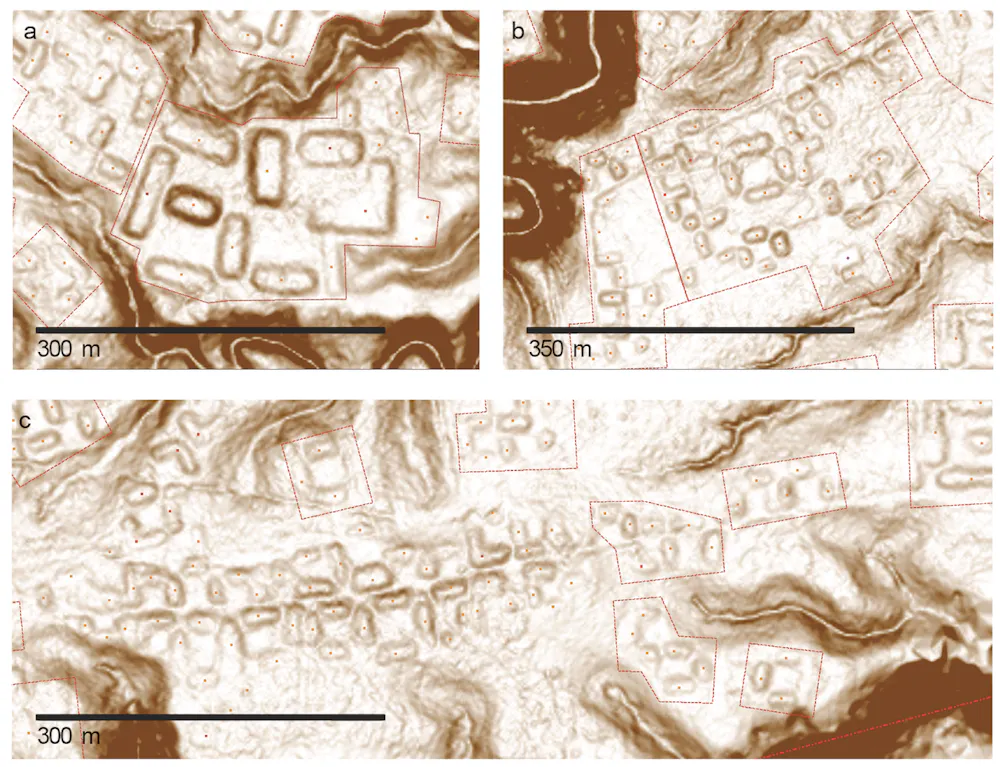
What stands out is not just the scale – thousands of structures – but the rigour of the planning. The settlements didn’t just grow randomly, but as part of a deliberate design: we see straight lines of flat-topped platforms laid out in repeating rows and connected by straight paths that cut cleanly across the landscape, as you can see below.
Lidar footage of settlements in the Upano Valley. Jose Iriarte, CC BY-SA
Again, this is not urbanism in the conventional sense of dense, continuous occupation. There would have been none of the vertical stacking of buildings that you’d get in European settlements, and there were also green spaces between platform complexes – much more like a forest city.
Like the Casarabe region, this is a distributed settlement pattern that is both open and highly structured, but the arrangement is much more compact. This reflects the limited flat space available on the upper terraces of the Upano River, which rise up to 100 metres above the surrounding landscape.
Advertisement
Elsewhere in Amazonia, we see more variations. In the Upper Xingu of central Brazil, interconnected settlements were arranged around a shared ceremonial and road network, again suggesting a regionally coordinated social world.
Further north, the Tairona people of the Sierra Nevada de Santa Marta in present-day Colombia built terraced stone towns in the mountains, linked by paved paths. This was a form of urbanism shaped entirely by the demands of steep, high-altitude terrain. Below is a lidar image of one area in this region, with the platforms that would have housed the settlements marked in yellow. Below that, you can see what the platforms look like.
Above: lidar image of settlements at Teyuna-Ciudad Perdida in yellow; below: an actual shot of the platforms that housed the settlements. Daniel Osorio, CC BY-SA
In western Amazonia, Acre adds another important variation. From around AD1–1000, people built large ditched enclosures, or geoglyphs, mainly in the south-eastern part of this region along the upper Purus River. These were square, circular, hexagonal or octagonal mounds, often 1-3 hectares in size, with ditches up to four metres deep. These were probably used as ceremonial gathering places rather than permanent settlements.
After about AD1000, these were followed by what we call circular mound villages, occupied until around AD 1650–1700. They featured rings of mounds around central plazas and straight roads radiating out like the rays of the Sun, often built to align with the four main compass points. These “Sun villages” were true settlements, and formed interconnected networks across the southern rim of Amazonia. You can see an example in the lidar image below.
Advertisement
Lidar image of circular mound village Dona Maria at Acre, Brazil. Jose Iriarte, CC BY-SA
Taken together, these discoveries fundamentally reshape our understanding of Amazonia. We now see a mosaic of managed landscapes, engineered environments and, in some cases, city-scale societies. What unites them is not a shared blueprint but a shared impulse: the organisation of people, space and movement across large landscapes in ways that were deliberate, durable and distinctly their own.
To stress, Amazonia was not uniformly dense or urban. It supported a diversity of types of settlements, from dispersed networks like Moxos to tighter grids like Upano, each of them adapted to local ecological conditions. They shared a low-density urbanism, in the sense of large, interconnected populations without the density of classic cities.
What we still don’t know
How were these societies organised politically and socially? How did they interact with variations in the climate and environment, ranging from the heavy rainfalls and droughts caused by El Niño to rivers forging new routes that could move them away from a settlement within a few generations?
What, if any, connections existed with mountain societies in the Andes? And perhaps most importantly, since both the Casarabe and Upano ceased to build monuments after 1492, what led to their transformation or decline before the arrival of Europeans?
Advertisement
There is active debate between archaeologists over whether these societies transformed because of environmental stress, internal political change, or shifts in things like trade routes or migration.
In the Llanos de Moxos, one possibility is that a prolonged period of climate change affected the Casarabe water-management systems that were so critical to feeding this thriving society. In the Upano Valley, volcanic eruptions and earthquakes may have disrupted settlements and agriculture, although it’s unclear whether that could have led to the area being abandoned.
It seems likely that as we uncover new things, it will reveal more and more integration between different societies. What we are seeing now in Amazonia is much like looking at a satellite image of a country at night: bright, isolated clusters of light – cities that appear disconnected. But as we continue to expand our coverage and fill in the gaps, I think this will change.
What now appear as isolated clusters may also resolve into extensive networks. For example a study across the southern rim of Amazonia has predicted that the kinds of settlement mounds that have been identified so far are likely to occur across about 400,000km², supporting an estimated regional population of roughly 500,000 to 1 million people in the era before the Europeans arrived.
Advertisement
Entire regions may emerge as previously unrecognised centres of population and landscape management. This could be particularly so for the Llanos de Moxos. The whole area covers as much as 200,000km², depending on where you draw the boundaries, stretching into Brazil and even Peru. It is often divided into several apparently distinct cultural regions — the Casarabe (aka the monumental mound region), and then two others called the platform ridge and zanjas (ditches) regions.
As lidar coverage expands and more archaeological work is conducted, we may begin to understand how these societies were economically specialised. We know, for example, that the fortified villages of the zanjas region had fish weirs spanning hundreds of miles that were capable of capturing vast quantities of migratory fish. The platform ridge region consisted of large drained fields, which could potentially produce surpluses of maize. It is conceivable that these belonged to a broader network that supported the more complex Casarabe centres.
Or perhaps – who knows – the relationships were more fluid and reciprocal. For now, the question remains open. But it is precisely this possibility of deep regional integration that lidar is beginning to bring into view. In time, we may even begin to identify Casarabe outposts scattered across the Llanos de Moxos.
What happens next
There’s still a huge amount to be done with lidar. Vast areas, particularly in the Ecuadorian and Peruvian Amazon – remain unexplored. One recent study suggested that there could be more than 10,000 more urban structures of the kind I’ve been describing still hidden throughout Amazonia, all of them dating from pre-European times.
Advertisement
Looking ahead 20 years, it is likely that our map of Amazonia will look very different. One promising technology is satellite-based lidar systems, which could provide broader, though less detailed, datasets across large areas. Advances in machine learning are also beginning to help us identify archaeological features within massive datasets, speeding up a labour-intensive process.
Against this, there are time pressures in some places. Llanos de Moxos, for instance, is unfortunately in rapid transition. The very ground that holds the traces of ancient networks is being transformed by mechanised agriculture and large-scale terraforming for rice cultivation and pastures.
We also need to keep reminding ourselves that lidar is only the first step. What really matters is how it’s brought together with other lines of evidence. Most sites discovered by lidar have yet to be excavated, so we’ll have to do much of that, looking for everything from bones and plants to ceramics and weapons.
So far, most excavation has been in the Casarabe area of the Llanos de Moxos. The reason, for instance, that we know the culture lived primarily on maize was through the discovery of over 60 human skeletons, which underwent carbon isotope analysis. The same research paper also analysed excavated duck bones to show that the Casarabe were feeding them maize too, suggesting animal domestication in a continent that was not generally known for it.
Advertisement
Another fascinating Casarabe find is a single buried skeleton who may have been a leader, because he had a collar of jaguar teeth around his neck. He was also wearing ear pieces made of armadillo shell, studded with mottled blue stones called sodalite – it’s not clear what these were for.
Male burial in Loma Salvatierra, Llanos de Moxos, shows: a) plate of cooper; b) earpieces with pearls of sodalite and armadillo shell; c) a collar of jaguar teeth; d) shell beads; e) bracelet of shell. Heiko Prümers/Jose Iriarte, CC BY-SA
We’ll also need to obtain more precise dates for key events using techniques like radiocarbon dating, and more pinpoint accurate environmental data to help support theories about ancient changes to the climate – as opposed to the wider regional information we’ve tended to rely on until now. Lake sediments are great environmental archives, preserving evidence of things like vegetation change and landscape disturbance.
Also important is comparing genetic data from excavated bones with people who live in these areas today – in dialogue and collaboration with local communities whose histories, memories and knowledge are essential to understanding these landscapes.
It’s all a question of how lidar is brought together with all this other evidence. The most convincing reconstructions will come from the convergence of all of these. One further major challenge ahead, however, will be to bridge the gap between scientific reconstructions and how past peoples understood and inhabited their world. Archaeology is increasingly rich in data, but we have to relate it to lived experience.
Advertisement
That is no easy feat, but it is essential if we are to move from mapping past worlds to understanding them. Crucially, Amazonia – with its rich, still-vibrant Indigenous societies and ethnographic record – offers an exceptional opportunity to do this, providing rare continuities through which to anchor and critically engage our interpretations of the past.
Lessons for today
My own sense is that we will move towards a view of Amazonia not as an exception, in line with the old view that the people lived within an untouched paradise, but as part of a broader pattern of human-environment interaction. The rainforest will be understood not only as a biological system, but as a historical one – shaped, in part, by the people who lived within it.
This does not mean the Amazonian people who simply lived “in harmony” with nature; the evidence points to something more interesting. Although Amazonian societies developed complex, and at times intensive, forms of land use, the evidence consistently shows that they often did so while maintaining continuous forest cover. Far from the large-scale deforestation that we might assume was necessary for such elaborate forms of human life, their practices created mosaics of managed forest, gardens, orchards, wetlands and settlement areas.
We know partly from lake sediment data that people enriched the forests with species that provided food, building materials, medicines and other resources, from açaí and cacao to palms, cinchona and copaiba. The fact that some of these species endure today suggests that past land use left lasting ecological legacies.
Advertisement
Amazonian açaí is one of numerous species that are not prevalent by accident. Guentermanaus
In the context of today’s climate crisis, the long-term balance that these people achieved offers a powerful lesson: it is possible to sustain complex societies without destroying the forest, if land use is guided by principles that integrate ecological knowledge, cultural values and a commitment to the continuity of the living landscape.
What lies beneath the Amazon is not just a hidden past. It is a reminder that even the most seemingly untouched landscapes can carry deep histories, waiting – sometimes just beneath our feet – to be revealed.
This article features references to books that have been included for editorial reasons, and may contain links to bookshop.org. If you click on one of the links and go on to buy something from bookshop.org The Conversation UK may earn a commission.
To hear about new Insights articles, join the hundreds of thousands of people who value The Conversation’s evidence-based news. Subscribe to our newsletter.
The professional dancer recently announced his plans to leave the hit BBC One dance show after 10 years
Gorka Marquez has shared the reason he turned down getting a chance to say his own goodbye to Strictly Come Dancing while on a UK tour linked to the popular programme.
Advertisement
The professional dancer recently announced his plans to leave the hit BBC One dance show after 10 years. He made the announcement on Instagram at the end of April, saying he will “forever be thankful” for his time on the dancing competition, but it is time to “hang up my dance shoes”.
The news came after Gorka stepped back from competing in Strictly’s 2025 series with a celebrity dance partner and instead returned to a judging role on the Spanish version of Strictly, Bailando con las Estrellas, a position he first took on in 2024.
But before his official exit, Gorka joined fellow pro Luba Mushtuk, who is also leaving the beloved show after 10 years, and a number of their fellow Strictly stars on the Strictly The Professionals tour, which headed to Salford’s Lowry last month, before finishing in Blackpool on May 30.
During their last show, tears flowed as Gorka and Luba shared an emotional embrace on stage, marking the end of their time on Strictly. Fans shared clips on social media from the final performance, which saw the pair being supported by their co-stars as they shed tears.
Advertisement
But Gorka has now been asked why he didn’t get his own moment in the live show to say goodbye, while Luba gave a tear-jerking speech. Speaking on their podcast, Lost in Translation, Gorka’s fiancée Gemma Atkinson read out a message from a listener which said: “Great show! I’m gutted they didn’t allow you to say goodbye like Luba, but I want to wish you all the best for the future.”
Gemma then commented: “That’s funny you’ve said that because you [Gorka] said to me before the tour started, ‘They’ve asked me if I want to do a goodbye thing…’” Gorka then interjected: “I said no!” Gemma continued: “He said no. He said, ‘I’m not dying! I’m just not coming back.’ You chose not to do that.”
Gorka then explained: “I’m not saying goodbye because I don’t want to say goodbye, I just want to celebrate. For me, I put it this way, Strictly doesn’t start until August, I’m still in Strictly. I’m still part of the team so I just want to celebrate and dance like one of the team. I don’t want to make it about me and be like, ‘Oh, I’m leaving… be sad!’”
Advertisement
Gemma commented: “Goodbye for me solidifies it. It’s just see you soon.” Gorka then cheekily teased: “Who knows, you might be getting sat in that chair in a couple of years!”
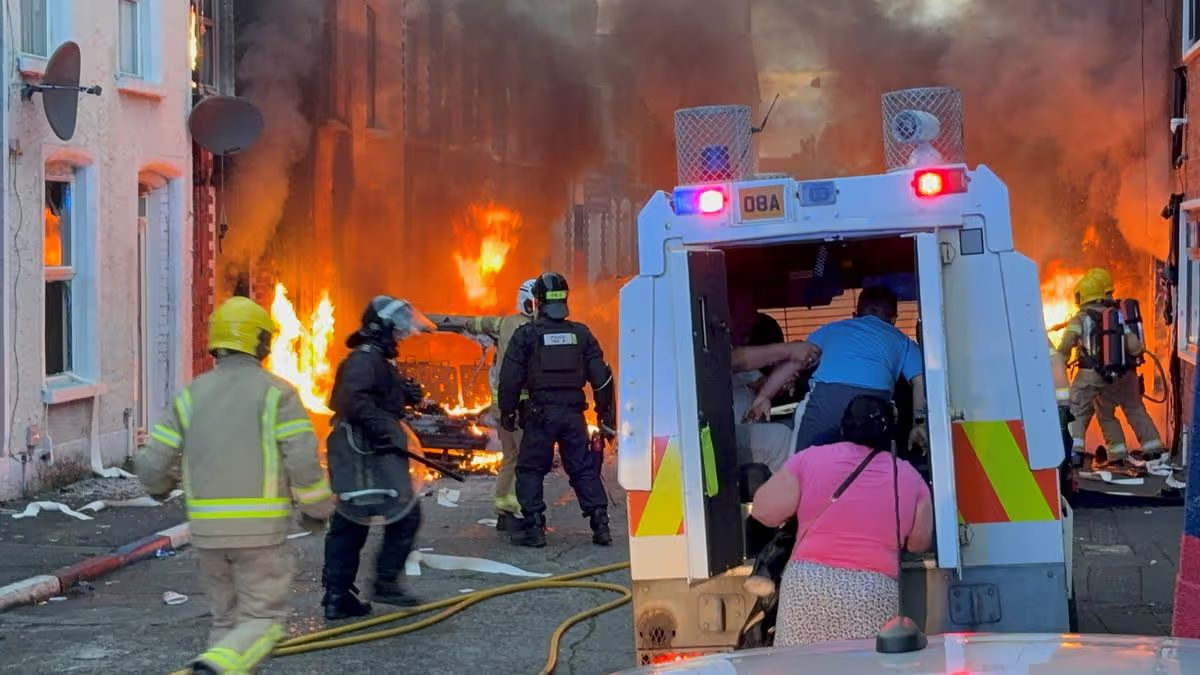
Northern Ireland’s Justice Minister Naomi Long said some people had ignored calls for calm.
“They are intent on wreaking destruction on the very communities they claim they are trying to protect,” Long said.
“They are weaponising the genuine hurt, concern and anger that people are feeling for their own misguided purposes.”
“There is no place for masked thugs to take to the streets and threaten, intimidate, disrupt and cause wanton damage – it is simply disingenuous to claim this is being carried out for the good of Northern Ireland.”
Advertisement
Long said she would again appeal to communities “not to allow themselves to be used and abused in this manner.”
“Disorder on the streets, such as we are seeing tonight, is diverting valuable police resources away from those who genuinely need them,” she said.
“These are not the actions of people who genuinely care about their communities.”
“While I recognise and understand the concerns following on from the attack in north Belfast, hate cannot be allowed to win.”
Connor Reilly, 32, of Dundyvan Road, Coatbridge, was handed a 28-month stretch at Hamilton Sheriff Court.
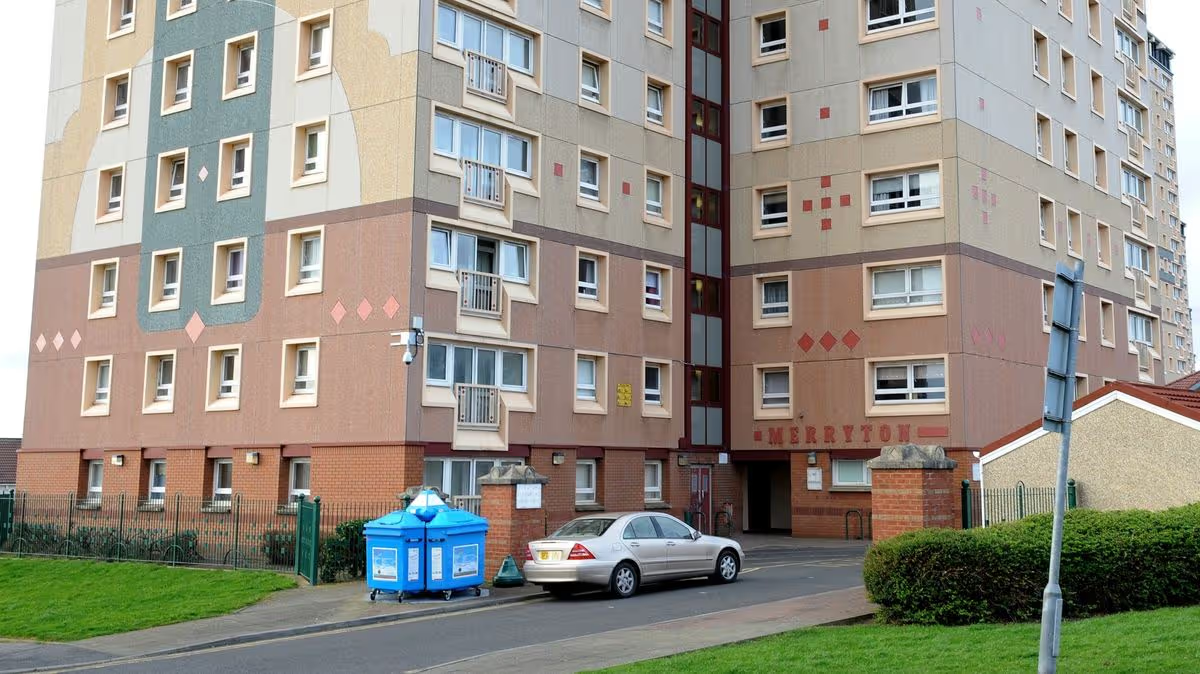
A second thug has been jailed after a man was attacked with a bottle and a machete outside a Motherwell tower block
Advertisement
Connor Reilly, 32, of Dundyvan Road, Coatbridge, was handed a 28-month stretch at Hamilton Sheriff Court.
He will be under supervision for a year after his release from prison
Reilly admitted assaulting the victim to his severe injury and permanent disfigurement at Merryton Tower on May 27 last year.
Earlier this year Dean Markson, 27, was jailed for 32 months when he admitted taking part in the attack.
Advertisement
Reilly failed to attend court on that occasion.
The victim was walking home from the shops about 3.25pm when he was attacked.
Markson ran towards him and struck him on the head with an Eldorado wine bottle, knocking him to the ground.
He continued to inflict blows until the bottle slipped out of his hand and smashed.
Advertisement
Reilly then ran towards the victim, who was still on the ground, and struck him repeatedly on the head and back with a machete.
The pair left the scene in a car but police officers identified them from CCTV images.
The victim’s partner returned home to find him injured. Worried about the amount of blood he had lost, she called an ambulance.
He had a number of cuts, the most serious of which was a 5cm wound to his back that was closed with stitches.
Advertisement
Reilly admitted previous convictions and solicitor Rowan Myles said the fear of going back to prison had prompted him to miss the court hearing in February.
*Don’t miss the latest headlines from around Lanarkshire. Sign up to our newsletters here.
And did you know Lanarkshire Live had its own app? Download yours for free here.
The Financial Conduct Authority (FCA) has admitted a series of legal challenges threatens to delay its planned compensation scheme, which could see motorists receive an average payout of £829.
The watchdog estimates around 12.1 million car finance agreements could be eligible for compensation under the proposals.
Why payouts are being delayed
The compensation scheme centres on controversial “hidden commission” arrangements, formally known as discretionary commission arrangements (DCAs).
Advertisement
The FCA believes many drivers were not given a fair deal because dealers and brokers could earn more commission by increasing the interest rate charged on finance agreements.
The regulator had hoped to begin compensation payments much sooner, but court action from several firms has thrown the timetable into doubt.
Sarah Pritchard, the FCA’s deputy chief executive, told MPs that legal challenges would increase costs and significantly delay payouts.
“I want to be straightforward that the legal challenge will add delay and extra costs to the scheme as a whole,” she said.
Advertisement
“If the scheme goes ahead, the delay, we believe, will result in payments not before 2027.”
Who is challenging the compensation scheme?
Four separate legal challenges have been launched against the FCA’s plans.
Among those seeking to block or alter the scheme are finance businesses linked to major car manufacturers including Volkswagen and Mercedes-Benz, as well as a consumer group.
The firms argue that aspects of the FCA’s proposed redress scheme are unlawful.
Advertisement
The compensation programme is expected to cost the motor finance industry around £9.1 billion.
Could drivers face even longer waits?
The FCA has also warned there is a possibility that parts of the compensation scheme could be struck down by the courts.
If that happens, the regulator may be forced to abandon its planned mass compensation approach and instead deal with complaints individually.
That could create a huge administrative burden.
According to FCA estimates, up to 19 million complaints could need to be handled separately if no redress scheme is available.
Advertisement
The watchdog believes that approach would add around £6 billion in costs for lenders and could take another three years to complete.
Hope for some drivers
Despite the delays, the FCA says it is exploring whether some consumers could receive compensation earlier.
Ms Pritchard told MPs the regulator is considering options for people who would prefer to receive money sooner rather than wait for the full scheme to be finalised.
“Consumers have been waiting a very long time to be compensated and, one way or the other, they need to be compensated,” she said.
Advertisement
The FCA has already spent more than £20 million developing the compensation programme and expects legal costs to continue rising as the court challenges progress.
For now, motorists who believe they were affected by hidden commission arrangements may have to wait until the outcome of the legal battles becomes clearer before finding out when compensation will arrive.
Members of the health centre steering committee met with the head of the Salford Integrated Care Board on Friday to discuss the future of the plans.
The steering committee attended the event with Salford Mayor Paul Dennett, as well as the campaign’s new ambassador, MP Yasmin Qureshi.
Paul Whitelegg with residents at a previous discussion group for the plans (Image: Dan Dougherty)
Campaign leader Paul Whitelegg said: “On Friday, your 24/7 Walk-In Medical Centre Steering Group came together armed with raw data, facts, figures, your experiences, and your ideas.
“We presented our case directly to the stakeholders who have the power to make real change happen.
Advertisement
“A special thank you to our fantastic ambassador Yasmin Qureshi MP, Mayor Paul Dennett, and all local councillors who attended, including our newly elected councillors for Walkden North, Walkden South and Little Hulton.
“Our case is now heading straight to Westminster and will be put before the Secretary of State for Health! Thanks to Yasmin Qureshi, letters are already being drafted as we speak.
“We will be arranging a follow-up meeting with stakeholders to discuss the possibility of launching a pilot scheme for a Walk-In Centre right here in our area!”
“A special thank you also goes to James Jordan-Tkocz, whose research uncovered valuable information about successful Walk-In Centres operating in Scotland. His work has provided a potential model that stakeholders are now willing to explore.”
Advertisement
Paul began work on the scheme in late 2025 after speaking with residents, many of whom were unhappy with medical provision in the area.
One resident – Sandra Mazutaviciene – told of an incident involving her six-year-old son Theo, who’s hand became infected due to eczema.
Paul Whitelegg (right) with Walkden residents (Image: Paul Whitelegg)
She had to get a £20 taxi to Leigh in the middle of the night due to a lack of nearby health provision.
She also spoke of the difficulties of registering with a dentist in the area.
Advertisement
Several ideas have been proposed for the new health centre, including GP access, dentistry, opticians, and an ambulance bay.
A pilot-scheme will now allow the team to get real-world data on how the proposed walk-in centre would impact the Walkden and Little Hulton community.
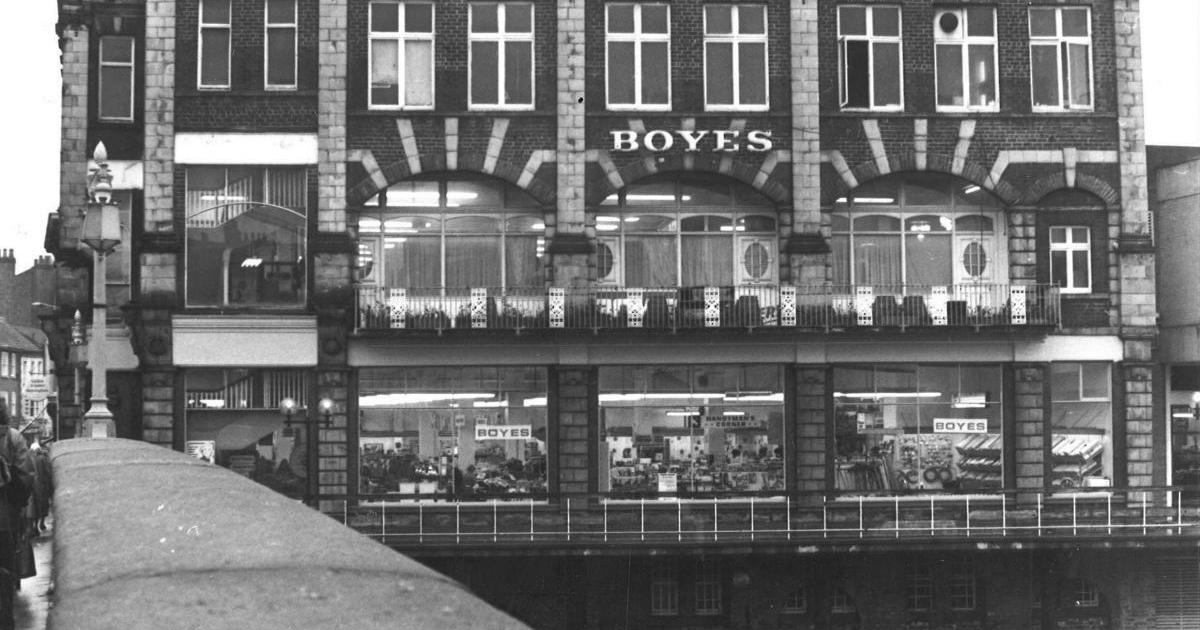
YORK store Boyes was renowned for its Christmas displays.
In the 1920s and 30s, children went on rides through the store with themes such as ‘A trip to the Moon’ or’ A journey below the sea’.
And today, we share precious memories of working at this iconic shop, Boyes in Bridge Street.
After the Second World War, children walked rather than rode, passing a series of tableaux, before meeting Father Christmas in his grotto.
Advertisement
The grotto was quite a remarkable affair – a series of scenes depicting Santa Claus’ journey from the Arctic to the home of an English boy and girl.
With his reindeer and a train of other faithful friends, Santa Claus travelled from one little scene to another and eventually descended a chimney.
Boyes by Ouse Bridge in York in the 1960s or 1970s
The mechanism behind this panorama was a complicated arrangement, consisting of a bicycle chain driven by an electric motor, and was constructed from ‘odds and ends’ by the store’s engineer.
Similarly, the shop windows were always dressed for Christmas with impressive displays, including model railways, waterfalls and Alpine scenes.
Advertisement
Dougie Weake has vivid memories of working at Boyes in Micklegate. He started in the tools department on the first floor in 1965 at the age of 15.
“We had everything that you would expect – wallpaper, paint, brushes, screwdrivers, screws, you name it – on these old, rickety, wooden counters, that must have been there since the store opened in 1912. The staff were amazing. It became a very, very close-knit family. Boyes was a family department store and we were all part of this family.
Shoppers queue outside Wright’s pork butchers and pie shop in Bridge Street next to Boyes.
“The Bargain Basement was probably the busiest of all the departments in the store. People would go down for the bits of cloth, which they made into a fancy dress or curtains or whatever. It was a rummage and there were people fighting over the same cloth. On the top floor, we had the staff canteen, segregated, with girls at one side, boys the other. You could see each other through the serving hatches.”
Boyes always went big at sales. They had, for example, the ‘red-hot sale’, when they hired a fire engine and drove around the streets of York with big signs.
Advertisement
Read more:
Or the ‘monster sale’ with a flatbed truck and a big papier mâché monster on the back, with staff throwing sweets to passers-by and attracting people to come to the sales.
Dougie continued: “Christmas was massive. Before I started in the display department, Bob [Gibson] built a cowboy village in the new part of the store – saloon bar, jail, etc. George Boyes said: ‘We need an actor to play a cowboy’. So of course muggins here got the job!
“I was tall and thin as a bean pole. They hired a costume – six guns, hat, boots, the whole thing – and I walked around the store inviting people with children to go up and see Father Christmas in the jail and have an orange juice or sarsaparilla in the saloon bar.
Advertisement
“They also hired a horse which I rode around town as Hank Beanpole, to attract people to come and see Father Christmas. I’m still called ‘Hank Beanpole’ by people who knew me then.”
Susan Major is part of the Clements Hall Local History Group’ in York.
For more stories and photos of this area of York, the Clements Hall Local History Group’s latest book Micklegate, The Great Street of York, is out now. It costs £15, and is available at Waterstones in the city centre and at Monks Cross; the Amnesty bookshop on Micklegate; Pextons Hardware, and Frankie & Johnny’s Cookshop on Bishopthorpe Road.
The announcement came after a number of clues that sparked rumours, including a series of “TS” billboards – a play on Toy Story and Swift’s shared initials – appearing in various cities including London, Mexico City and Los Angeles, featuring the same blue and white cloud imagery that is synonymous with the film.
Have you ever stayed in the bath or swimming pool for ages and noticed that your fingers and toes went all wrinkly? Well, 11-year-old Maya from London wanted to know why that happens.
She joins our host Eloise to get the answer from biologist Tom Smulders on the first episode of season two of The Conversation’s Curious Kids podcast.
Advertisement
In each episode of The Conversation’s Curious Kids, a curious kid joins host Eloise to ask a top researcher their burning question. There’s an experiment in this episode which you can try out too while you listen. If you want to join in, prepare a bowl of warm water.
To listen to season two, follow us wherever you get your podcasts, or listen on the Yoto Player via the Discover section on the Yoto interactive audio platform for kids.
You can also listen back to season one and read lots of answers to questions sent in by children around the world in our Curious Kids series.
Got a question? Pop it in an email, or record it and send us the audio to curiouskids@theconversation.com.
Advertisement
This season of The Conversation’s Curious Kids is supported by the University of Southampton in the UK, a world-leading research-intensive university with a global network of international students and campuses in Malaysia and Delhi.
Disclosure statement
Tom Smulders does not work for, consult, own shares in or receive funding from any company or organisation that would benefit from this article, and has disclosed no relevant affiliations beyond their academic appointment.
Credits
This episode of The Conversation’s Curious Kids was hosted and mixed by Eloise Stevens. The producer was Katie Flood and the executive producer was Gemma Ware. Sounds of Marlin and Dory getting eaten by, and being inside a whale from Finding Nemo.
Love Island’s Molly-Mae Hague and Tommy Fury are keeping fans waiting on the name of their son (Picture: Instagram/@mollymae)
As Molly-Mae Hague and Tommy Fury settle into life as a family of four, fans remain curious as to what their newborn son will be called.
The reality royalty couple, who first met on Love Island in 2019, welcomed their second baby last week, after three-year-old daughter Bambi’s birth in January 2023.
Molly-Mae kept her new son’s gender private throughout her pregnancy, only revealing it after the initial post announcing his birth.
Speculation has since been rife about his name, following the stir that Bambi’s caused last time – and the fact that Molly-Mae has already warned everyone is going to ‘hate’ their choice.
Advertisement
And now it’s being reported that their new baby’s name will be revealed for the first time on Tommy’s shorts this weekend when he boxes Eddie Hall in their pay-per-view match on Saturday.
A source told The Sun: ‘The little man’s name will be on Tommy’s shorts at his fight along with Bambi’s. That’s how they are going to announce it to the world.
They’re a family of four now, after introducing daughter Bambi to her new brother in hospital last week (Picture: Instagram/@mollymae)
‘The shorts will be two-toned colour. It was Tommy’s idea and Molly was very open to it.’
The insider continued: ‘Now the little fella is here it’s a no-brainer — what better way to announce his name than on his dad’s boxing shorts.’
They also said that Molly-Mae was ‘now obsessed with it’ and hoping to be there at the match, with plans for Tommy’s walk out to include music and blue fireworks.
Advertisement
After the new mum returned home from the Portland Hospital, she shared a black and white photo of her family all cuddled up on the sofa.
‘I can’t believe I have two children,’ she wrote on Instagram stories alongside the picture, which showed Bambi sat on her dad’s lap while Molly-Mae held their newborn in her arms, covering his face with a small heart emoji.
Her cosy updates from home have continued, with the influencer and entrepreneur also getting candid about how different her experience as a mother had been this time around.
‘Thank you for healing so many of my newborn fears little one,’ she wrote on a photo of her new son resting asleep on a blue blanket.
Advertisement
‘The peace and happiness I feel this time around is something I wished for but didn’t know would come.
‘The difference compared to this stage with Bambi is indescribable.’
Got a story?
If you’ve got a celebrity story, video or pictures get in touch with the Metro.co.uk entertainment team by emailing us celebtips@metro.co.uk, calling 020 3615 2145 or by visiting our Submit Stuff page – we’d love to hear from you.


























































You must be logged in to post a comment Login