Officials have suggested airlines have just weeks of fuel left (Picture: Getty Images)
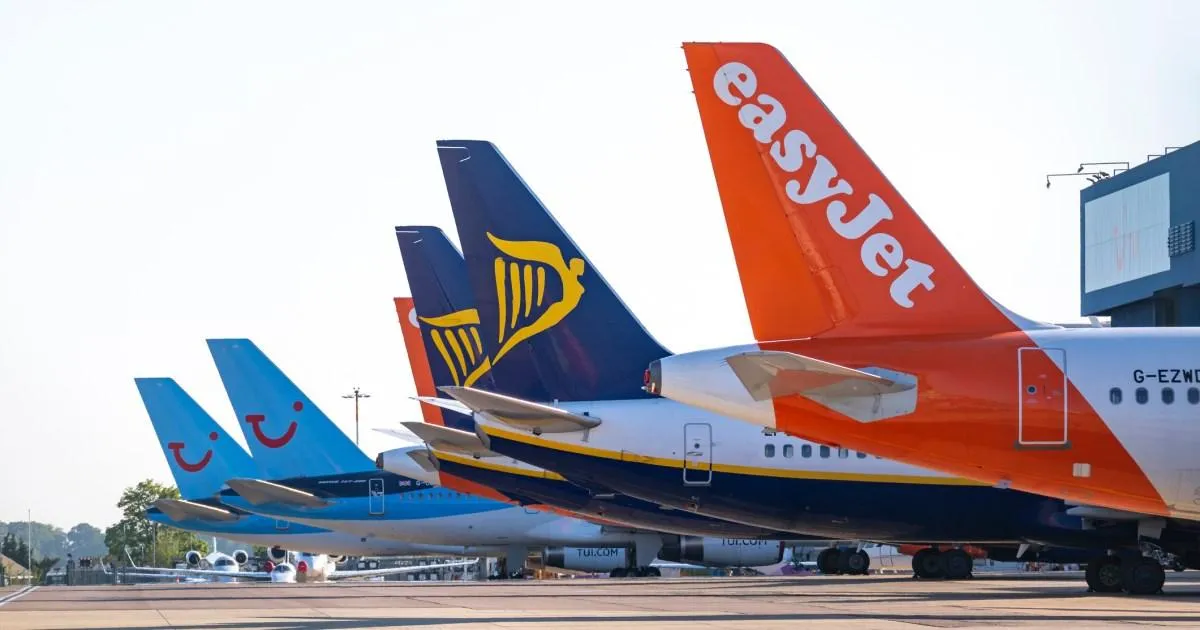
As airlines grapple with an ongoing jet fuel crisis, passengers are being hit from both sides: more cancelled flights and higher travel costs.
Carriers around the world are cutting routes and introducing extra charges in an effort to manage soaring fuel prices driven by ongoing conflict in the Middle East.
The Strait of Hormuz, which has effectively been blocked by Iran since February, carries up to 75% of plane fuel exports from the Gulf to Europe.
However, with this route disrupted and supplies running low, costs have skyrocketed from around $85 to $90 (£63 to £67) to as much as $200 (£148) per barrel over the past few weeks.
Advertisement
What is the Strait of Hormuz?
The Strait of Hormuz is 60-mile-wide section of waterway that connects the Gulf with the Arabian Sea, making it one of the most important shipping lanes in the world. With Iran to the north and Oman to the south, during peace time, around 20% of the world’s oil and gas passes through it.
The UN allows countries to exercise control of their territorial seas up to 13.8 miles from their coastlines, and since some portions of the Strait lie entirely in Iran and Oman’s territorial waters, they are allowed to ‘defend’ their countries if needed.
Along with the geography allowing Iran to exert control on the waterway, at its narrowest point, the Strait is just 24 miles across, making it easy for Iran to target vessels passing by.
Advertisement
Last week, head of the International Energy Agency (IEA), Fatih Birol, said Europe has ‘maybe six weeks or so [of] jet fuel left,’ warning passengers to expect cancellations into the summer months.
Best of Metro Deals
Get exclusive discounts with Metro Deals – save on getaways and spa days. Powered by Wowcher
Bannatyne Spa: Spa day for two with treatments, lunch & prosecco — save up to 57% off.
Some airlines have already reduced schedules due to the shortage, while others are increasing fares or hiking baggage fees.
Advertisement
How major airlines operating in the UK have responded
Aegean Airlines
The Greek airline said this week it would raise ticket prices as a result of the spike, although hikes would be limited to around 7% to 8%.
The change will impact new bookings, but the 3.6 million passengers already scheduled to fly over the coming months, and those who hold an Aegean Pass and have bought early-bird packages, will be unaffected.
Like many other carriers, the company has also suspended flights to affected regions until the end of April, including Iraq, Israel, Lebanon, Saudi Arabia, and the UAE.
Aer Lingus
Over 500 flights have been dropped from Aer Lingus’s schedule, although it claims this is due to ‘mandatory maintenance’ on aircraft rather than the fuel crisis.
Advertisement
Air France-KLM
The airline group said it has made ‘price adjustments’ to long-haul ticket prices to address surging costs, with return fares rising by €50 euros (£44) per round trip, while short and medium-haul round trips in economy increasing by €10 (£9).
Last week, the group’s Dutch arm KLM also said it would cancel 160 flights in Europe over the coming month as a result of the fuel shortages.
Customers may face disruption (Picture: Getty Images)
Air India
In March, the Indian carrier began a phased expansion of a fuel surcharge on its domestic and international routes ‘necessitated by the steep rise in jet fuel prices arising from the geopolitical situation in the Gulf.’
All new bookings for flights to and from Europe now incur a $125 (£92) fee, up from $100 (£74) before the conflict began. However, the company noted it will be reviewing surcharges periodically, and may ‘make appropriate adjustments’ as required.
Alaska Airlines
The US airline, which is due to launch its first UK service between Heathrow and Seattle in May, increased checked bag fees for most customers earlier this month.
Advertisement
As of April 11, charges went up by $5 (£3.70) for the first bag and by $10 (£7.40) for the second, while a third piece of luggage will now cost $200 (£148), up from the previous $50 (£37).
American Airlines
Although checked baggage fees have been hiked up to $150 (£111) per bag — meaning the first costs $50 (£37), the second $60 (£44), and the third $200 (£148) — these increased charges only apply to domestic and short-haul international flights, so won’t impact travellers to or from the UK.
British Airways
British Airways owner IAG said in March it did not plan to increase ticket prices in the short to medium-term, as it was well hedged for upcoming shortages, but warned it was still ‘not immune’ to the fuel crisis.
British Airways specifically, however, has made changes to its schedule due to the ‘continuing uncertainty’, and is ‘directly in touch with affected customers to offer them a range of options’.
Advertisement
BA has made changes to its schedule (Picture: Getty Images)
Cathay Pacific
The Hong Kong airline plans to cut about 2% of its scheduled passenger flights from mid-May to late June, while its budget subsidiary HK Express is dropping around 6% of flights.
However, more flights were actually added to London, Paris, and Zurich in March, as airspace closures led to an ‘upsurge’ in demand as passengers ‘prioritised alternative routings’.
In terms of pricing, the carrier said it would hike fuel surcharge by 34% across routes from April 1 and review them every two weeks.
China Eastern Airlines
While the Chinese airline, which offers multiple daily flights between London and Shanghai, has raised fuel surcharges, these currently only apply for domestic trips.
Passengers travelling within China currently face a 60 yuan fee (£6.50) for journeys under 800km, or 120 yuan (£13) for those over 800km.
Advertisement
Delta Air Lines
Delta said at the start of April it would cut capacity by around 3.5% from its original plan, although this would be targeted on red-eye and mid-week flights to ‘reduce unprofitable flying’.
Fees for checked luggage also increased by $10 (£7.40) for first and second bags and a $50 (£37) for the third, with bosses reported to be looking at increasing airfares in the months ahead.
EasyJet
In a recent statement, EasyJet boss Kenton Jarvis said the airline had ‘no concerns’, as it has ‘visibility to the middle of May’ in terms of fuel supply.
But with £25 million in extra fuel costs in March, the CEO added that European consumers should expect higher ticket prices around summer, when existing fuel hedges come to an end.
Advertisement
EasyJet’s fuel costs were up £25 million for March (Picture: Getty Images)
Emirates
Capacity was slashed by Emirates in late February, following widespread regional airspace restrictions impacting its Dubai hub.
The world’s largest long-haul airline and the largest in the Middle East, normally operates more than 3,600 flights per week, but is currently operating to ‘more than 100 destinations’ on a skeleton timetable — roughly 70% of its normal capacity.
Bosses have said it will only ramp up operations when over-flight corridors over Iraq and Iran are reliably reopened, and will ‘develop [its] operational schedule accordingly’.
Fare prices have reportedly gone up too, with a $226 (£167) economy class surcharge added to European trips from April 1, and $623 (£461)for premium cabins
IndiGo
India’s biggest airline — which flies from London and Manchester to destinations across India — introduced new fuel charges on domestic and international flights from March 14.
Advertisement
These fees initially ranged from 425 rupees (£3.35) for domestic flights to 2,300 rupees (£18) for flights to Europe, but have since been pushed up to as much as 10,000 rupees (£79).
IndiGo bosses claimed these surcharges would be monitored and adjusted where necessary, but it aimed to limit the impact on passengers where possible.
Jet2
Following the IEA announcement about impending fuel shortage disruption, a number of Jet2 passengers reached out to the airline for clarity ahead of their bookings.
In response, representatives confirmed ‘all flights are planned to go ahead as normal’, and customers would be contacted directly should this change. To be on the safe side, passengers are advised to check their flight status via the Jet2 website at least 12 hours before departure for the latest updates.
Advertisement
What aspect of the jet fuel crisis affecting airlines concerns you the most?
Increased ticket prices
Flight cancellations
Added fees for baggage and services
Environmental impact of fuel shortages
Advertisement
Sign up to The Getaway Expert, your exclusive seven-day guide to travelling with confidence from Metro’s travel editor, Alice Murphy.
JetBlue Airways
Citing ‘rising operating costs’, the US-based carrier recently hiked baggage prices by between $4 (£3) and $59 (£44) depending on the type of flight and number of checked items.
Advertisement
While JetBlue hasn’t made a statement regarding fare increases, analysis by Deutsche Bank revealed its ticket prices jumped 16% in one week at the start of the month, potentially due to ‘panic buying’ for summer ahead of a predicted surge.
Lufthansa
Earlier this week, Lufthansa released a statement saying 20,000 short-haul flights were being cut from its schedule this summer, blaming the move on the jet fuel crisis and ongoing labour disputes.
The majority of this would be from the airline group’s loss-making short-haul CityLine subsidiary fleet, which was already due to be grounded later in the year.
Lufthansa will also withdraw four older Airbus A340-600 long-haul aircraft at the end of the summer, and reduce short and medium-haul offerings by five aircraft this coming winter, with the cuts representing 1% of the German carrier’s ‘available seat kilometres’ yet saving 40,000 tonnes of fuel between now and October.
Advertisement
Norse Atlantic UK
Low-cost Norwegian airline Norse Atlantic axes its flight route between London Gatwick and Los Angeles this week, citing the ‘global fuel crisis’.
‘We are truly sorry for the inconvenience, and apologise to passengers who have [had] their travel plans changed,’ a spokesperson commented. ‘We will assist disrupted passengers as best we can.’
Qantas
Despite cutting domestic flights, strong interest in Europe-bound travel led the Australian airline to redeploy capacity to hotspots like Paris and Rome.
Ticket prices have also increased in recent weeks, and it warned it may need to take ‘further action’ as the situation unfolds.
Advertisement
Ryanair
At the start of April, a spokesperson for the budget carrier told Metro it could ‘guarantee supply to mid-end May’, although if the conflict continues beyond this date, disruption due to fuel shortages couldn’t be ruled out.
This bolsters previous claims from Ryanair boss Michael O’Leary, who stated the company would likely be forced to cancel between 5% to 10% of its scheduled flights through May, June, and July.
With the airline operateing over 3,600 flights per day, this means approximately 360 daily trips could be impacted if the fuel crisis doesn’t resolve itself.
Ryanair expects fuel supplies to last until mid-May (Picture: Getty Images)
Scandinavian Airlines (SAS)
At least 1,000 flights are expected to have been cancelled by SAS in April, up from a ‘few hundred’ in March.
The majority of journeys affected are domestic routes within Norway however, with CEO Anko van der Werff highlighting that given the airline runs over 800 flights per day, cuts are limited in scale.
Advertisement
SAS, which had already increased flight prices, said that even if it tried to absorb the rising fuel costs, the surge was still ‘a shock that directly hits the airline industry’.
TAP Portugal
Last week, the CEO of the Portuguese Airlines Association (RENA), António Moura Portugal, said the country’s flag carrier, TAP, may ‘need to reduce operations and, eventually, raise prices’.
While analysis claims TAP only has 40% fuel coverage for 2026 (compared to between 62% and 84% for other major airlines) Portugal stressed that it was continuing to monitor the conflict, and is yet to make any ‘definitive statements’.
TUI
TUI Airways — the world’s largest charter airline, flies to over 100 destinations from 17 bases across the UK and Ireland — said it is ‘monitoring’ jet fuel shortages, but is ‘not anticipating any immediate disruption to flight schedules or holiday programmes’ at present.
Advertisement
Turkish Airlines-SunExpress
SunExpress, a joint venture between Turkish Airlines and Lufthansa, is set to impose a temporary fuel surcharge of €10 (£8.69) per passenger.
This will apply to booking for flights between Turkey and Europe, made on or after April 1. for departures on or after May 1
United Airlines
In March, United Airlines’ CEO Scott Kirby said the firm would begin ‘tactically pruning flying that’s temporarily unprofitable in the face of high oil prices’.
The 5% capacity reduction will be focused on less-popular timings like overnight, Tuesdays, Wednesdays and Saturdays, and is expected to extend through at least the second and third quarters of 2026.
Advertisement
United also increased first and second checked bag fees by $10 (£7.40) for customers travelling in the US, Mexico and Canada and Latin America, but international flights are believed to be unaffected.
Virgin Atlantic
The airline is adding fuel surcharges to fares but will still struggle to return to profitability this year, its CEO Corneel Koster told the Financial Times.
Sir Richard Branson’s airline added a fuel surcharge of £50 to economy class tickets, with premium economy increasing by £180 and business class by £360.
Advertisement
‘If the fuel price goes much higher, I think the surcharges may go higher,’ commented CEO Corneel Koster. ‘If they go up in a week and you book in two weeks’ time, you’ll be paying higher.’
The company also recently scrapped flights from London to Riyadh, just a year after the route was launched, citing ‘the latest intelligence, regulatory guidance, demand and operating costs’.
Fuel shortages have led to surcharges for Virgin Atlantic passengers (Picture: Getty Images)
WestJet
In a series of ‘near-team measures’, the Canadian airline this week added a C$60 ($32.50) fuel surcharge to some bookings, and will be consolidating flights on lower-demand routes as well as ‘adjusting the travel period for seasonal offerings’.
A statement on Westjet’s website said capacity was expected to reduce by 1% April, 3% in May and 5.5%t in June, and impacted customers would be provided with reaccommodation options, most within the same day as their original departure.
Wizz Air
Hungarian carrier Wizz Air reported issues due to shortages in three airports in Italy last week, but chief Jozsef Varadi claimed these were ‘all resolved within a day and in some cases within hours.’
Advertisement
A spokesperson for the company, the third-largest European budget airline (after Ryanair and easyJet), stated it was ‘actively monitoring fuel supply,’ and ‘will work with its suppliers to secure the jet fuel available in line with its needs’, keeping customers informed and providing updates as needed.
What to do if your flights are cancelled or disrupted
Chris Harrington, managing director of travel firm hoppa, says the first port of call if your flight is cancelled is to contact the airline.
‘If you are already at the airport, head for the airline’s customer service desk to speak to a member of staff,’ he tells Metro.
‘Acting quickly is essential, as available seats on alternative flights may be limited and only available for a short time. However, other people will be in the same position as you, so if you’re met with long queues, try using the airline’s app or ring the customer service team to find out next steps.’
Advertisement
In most cases, the airline will have to make an alternative plan for you, so ask them to rebook you on a later flight, and let them know if there’s an alternative route (or flight using another airline) that works.
Chris also highlights the importance of buying travel insurance as soon as you book, to ‘protect yourself from circumstances such as cancelled flights’.
Some policies will cover the cost of hotels, airport transfers, alternative flights, and food, which is essential since cancellations due to external factors, such as fuel shortages, are typically classed as ‘extraordinary circumstances’, meaning airlines don’t necessarily have to reimburse directly.
‘If the flight cancellation is due to the actions of the airline, then it’s likely you’ll be entitled to compensation as per ABTA guidelines,’ Chris continues, noting that this amounts to £220 for journeys of 1,500;m or less, and up to £520 for anything over this distance.
Advertisement
‘However, in this case, because the cancellation is caused by extraordinary circumstances outside of the airline’s control, compensation is unlikely to apply.’
Brew York, in Walmgate, marked its tenth anniversary with its annual Birthday Bash – a now firm fixture on beer-lovers’ calendars.
Visitors – some of whom travelled from northern Scotland to attend the event – were treated to a selection of over 130 beers.
Recommended reading:
Among the highlights were a series of special drinks created in collaboration with ten European breweries.
Advertisement
More than 2,000 people attended the event (Image: Brew York)
These included Velvet Starfall, a Pastéis de Nata Imperial Stout brewed in collaboration with Frontaal Brewery from the Netherlands, and Tropic Touch, a guava, mango and apricot pastry sour produced alongside Prizm Brewing of France.
They were complimented by three additional exclusive beers – Rum & Bourbon BA Imperial Stout, Satuernes BA Golden Sour and Brandy & Bourbon Barley Wine.
Lee Grabham, Brew York’s co-founder and production director, said the weekend was a proud moment for the team.
A selection of more than 130 beers were on offer (Image: Brew York)
He added: “From the moment we welcomed our guests into this wonderful city we call home we’ve been non-stop.
Advertisement
“Full credit goes to not only the Brew York team, but also the volunteers who really enable us to put the event on.
“A mammoth task by anyone’s standards – and we all did it! Thank you, thank you, thank you.”
The event is now an annual one, with plans already in place for the 11th birthday celebrations (Image: Brew York)
Brew York transformed its space in its Osbaldwick brewery site to accommodate the crowds at the event.
All available space was converted to make room for eight additional bars, a beer van, two marquees hosting special tastings and live music, and four food vendors.
Advertisement
The company said: “Demand was high throughout the weekend, with visitors queuing hours before the doors opened at 5pm on Friday, and again ahead of both Saturday sessions.”
Organisers have already pencilled in a date for the 11th birthday celebrations, which will take place on Friday (April 16) and Saturday (April 17).
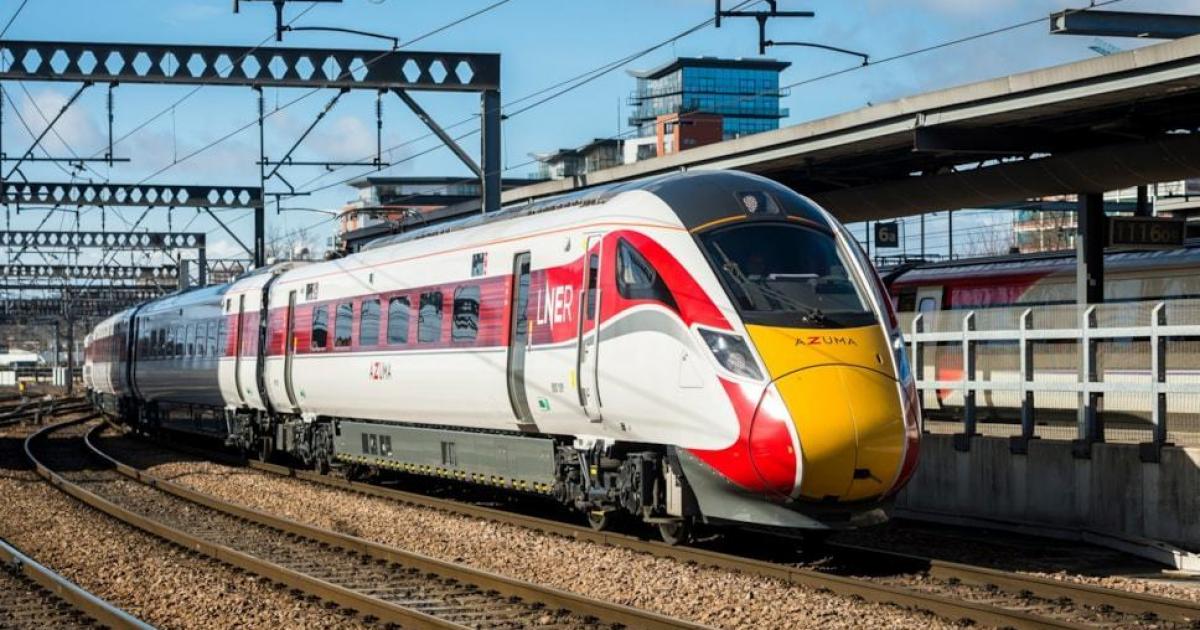
More than 2,000 extra seats have been added for LNER services between Leeds and London King’s Cross in both directions on Sunday, with a limited amount remaining.
Leeds United fans are preparing for their first FA Cup Semi Final in close to 40 years.
To help as many Whites fans as possible get to Wembley to watch Leeds United play Chelsea for a place in the FA Cup Final, LNER has added extra trains and seats throughout the day.
As the fixture coincides with the London Marathon on Sunday, the train operator has also issued some key travel tips to help keep travelling supporters smoothly on the move.
Colette Casey, customer experience director at LNER, said: “We’re looking forward to welcoming thousands of Leeds United fans onboard LNER services this coming weekend as they travel to Wembley.
“A lot of hard work has gone on behind the scenes at LNER to allow us to safely transport thousands of Whites fans to and from London for this exciting fixture.
“As trains are expected to be very busy, these travel tips will help all our customers to enjoy a comfortable journey. Everyone at LNER sends their best wishes to Leeds United and we hope that they all have a great journey with us.”
Advertisement
With trains expected to be very busy, fans are encouraged to:
Check before you travel: Be sure to regularly check the Travel Alerts page on the LNER website for the latest information on train services.
Arrive in plenty of time: With many thousands of fans expected to travel, please arrive at your departure station in good time to get to the correct platform.
Travel on your booked service: Services are expected to be very busy, so please travel on your booked train and only occupy your reserved seat. If you haven’t got a seat reservation, you may have to stand for some, or all, of your journey.
Advertisement
Be aware of those around you: While many customers will be travelling to Wembley, there will also be customers who are travelling for other reasons, including the London Marathon which is taking place on Sunday. Please be aware of and considerate to all customers while onboard and at stations and give up seats for those who have reservations.
Be kind: LNER and other rail industry colleagues will be working hard throughout the day to keep fans safely on the move. Please be kind and respectful to all colleagues.
NCL’s Open Days offer the chance to explore a wide range of courses, meet staff, and find a path that fits around real life.
New College Lanarkshire is inviting anyone that is considering a fresh start to attend it’s May Open Days with events taking place in Coatbridge, Cumbernauld and Motherwell.
Advertisement
NCL’s Open Days offer the chance to explore a wide range of courses, meet staff, and find a path that fits around real life.
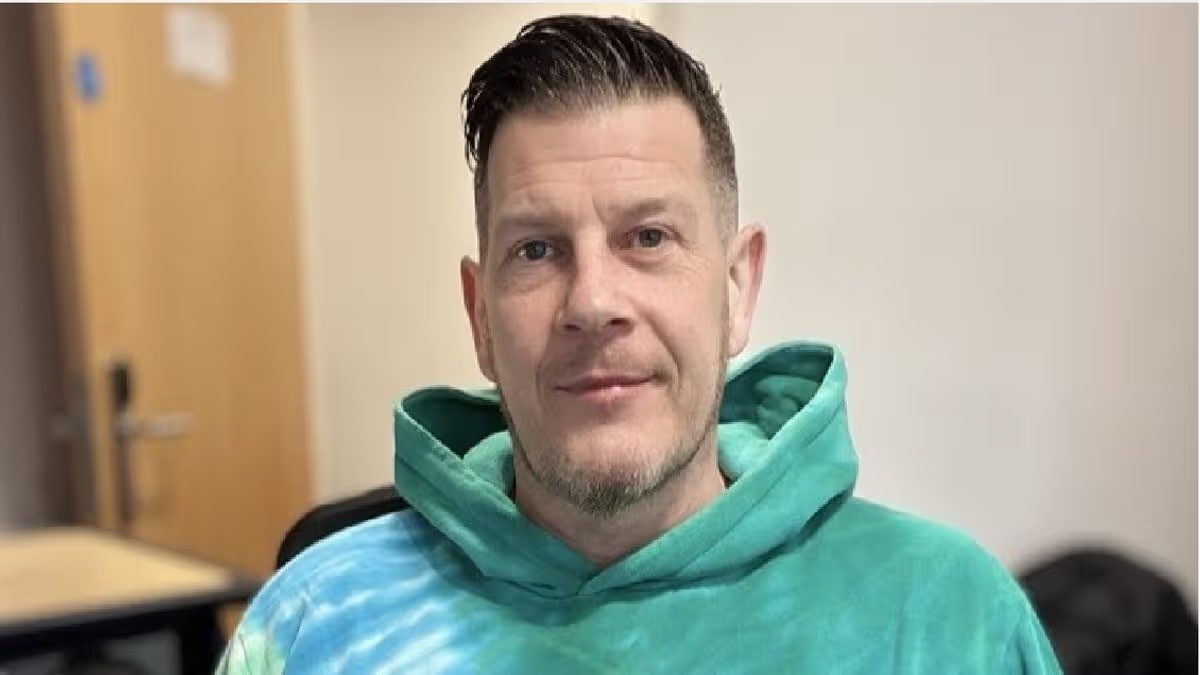
Iain McMillan, 50, from Wishaw, enrolled into NCL’s NQ Sound Production course last year.
Iain had spent years working in HMV, doing what he loved – surrounded by music. Learning the back catalogues of every artist on the shelves, knowing who produced what and why, but then everything changed.
What he had put down to tiredness and a chest infection turned out to be something far more serious. After struggling through Christmas shifts at HMV, barely able to breathe, his GP took one look at him and knew something was wrong.
Advertisement
Within weeks, Iain had been diagnosed with non-Hodgkin’s lymphoma, and was facing six months of intensive chemotherapy.
Thankfully as recovery began and the fog of recovery began to lift, something else took over a restlessness need for purpose. Sitting at home on sick pay, Iain knew he needed something to aim for.
He always had a small home studio. Samplers, hardware equipment, the lot and it had kept him company through the thick of it.
He had always been curious about what went into making music, not just listening to it.
So, he Googled sound production courses and saw NCL did one.
Iain said: “The course lecturer James [Savage] has been great – really supportive, he understands my circumstances. It’s creative but professional at the same time.”
What surprised Iain most was how much the course changed the way he thinks about music, not just makes it.
Advertisement
He said: “I’d worked in a record shop, and I liked what I liked. But the course gets you critically thinking.
“What went into that music, the politics, the ideologies behind it, who was in the studio, who influenced it.
“What instrumentation was used, what recording techniques. You learn about how drums were recorded in Stairway to Heaven. It’s very nerdy but it’s good.”
Advertisement
Now 50, ‘getting into the golden years,’ as he puts it, Iain is planning to continue into the HNC/D.
He has gone from a man who could barely walk through a door to someone who can professionally present his work, build beats, and network with labels and artists.
He added: “I can now present myself professionally and send examples of my work. The course got me to that stage.”
“If you’ve got a genuine interest in music and want to learn it, the pieces will fall into place.
“Everything on the course is there for a reason. They’ve thought it out very well. And it’s what I feel I’ve always wanted. The stars aligned for me.”
The open days will take place at the Motherwell campus on Monday, May 12; at the Cumbernauld campus on Wednesday, May 14, and in Coatbridge on Tuesday, March 20. All events run from 2pm to 5pm.
Klaudia’s mum told followers ‘she is my angel, my world, my everything’
A mother has spoken publicly for the first time after her influencer daughter was left in a critical condition following a collision outside a Soho nightclub.
For the first time since the incident, Klaudia’s mother has provided a heartbreaking update, calling for the 30-year-old influencer’s followers to pray for her daughter after false rumours claimed she had died.
Advertisement
“There is hope still, we pray. My dear family and friends. I’m asking from the deepest place in my heart — please keep my beautiful daughter Klaudia in your prayers right now,” she said, writing on Klaudiaglam’s Instragram story.
“She is my angel, my world, my everything, and she needs all the love, strength, and healing we can send her.
“Please lift her in your prayers—for comfort, protection, and strength during this difficult time. Your love and support mean more to me than words can express. Thank you from the bottom of my heart.”
Polish-born Klaudia, who boasts more than 258,000 followers on Instagram, had been at the Inca nightclub with friends on the night of the crash. She remained in hospital today in a critical condition. A security guard stood close to Klaudia at the time has been left with “life-changing injuries” after the incident.
Advertisement
Anoosh Chaichy, 56, from Edgware, in north London, was injured as tried to move his e-scooter from the scene. Carrington appeared at Westminster Magistrates’ Court on Tuesday, raising questions online as she made a heart gesture from the dock.
Dressed in grey, she stood with her hands on her hips as District Judge Nina Tempia remanded her in custody, where she will be kept until the next court hearing at the Old Bailey on May 19.
“A woman has been charged with attempted murder following a serious collision in Westminster,” a statement made by the Met Police confirmed on Tuesday.
Advertisement
“At around 04:30hrs on Sunday, 19 April, officers were called to Argyll Street following reports that a car had been involved in a collision with pedestrians. Police attended with the London Ambulance Service, a woman in her 30’s remains in a life-threatening condition.
“In the same collision, a man in his 50s sustained life-changing injuries and was taken to hospital. A third woman, aged in her 30s, was treated for minor injuries.
“Gabrielle Carrington, 29 (06.11.96), of Manchester, has been charged with attempted murder, grievous bodily harm with intent, actual bodily harm, dangerous driving and drink driving. She has been remanded in custody ahead of her first appearance at Westminster Magistrates’ Court on Tuesday, 21 April. The incident is not being treated as terrorism-related.”
Ensure our latest stories always appear at the top of your Google Search by making us a Preferred Source. Click here to activate or add us as your Preferred Source in your Google search settings.
City of York Council’s executive has approved a new strategy to move forward with plans to build 315 affordable homes across five sites, but highly energy-efficient Passivhaus standards have been ditched.
Cllr Michael Pavlovic, the council’s Labour housing spokesperson, said they were taking a prudent approach which recognised the current realities of the construction sector.
But Liberal Democrat opposition leader Cllr Nigel Ayre said the stubborn insistence on only building affordable homes on council sites meant none would be built during the administration’s current term.
The new strategy approved on Tuesday, April 14 is set to see affordable homes planned for council-owned sites built to Homes England’s Healthy Homes Standards going forward.
Advertisement
RECOMMENDED READING:
It comes after a council report on the plans stated current requirements to build them to Passivhaus standards had struggled to attract interest from construction firms.
The report added the lack of interest was due to current market conditions in the industry and the complexity of building homes to Passivhaus standards.
Homes built in line with Passivhaus codes consume up to 90 per cent less energy than typical houses.
Advertisement
Recent procurement efforts to build 101 affordable homes in Ordnance Lane, Fulford failed to award a contract almost two years after plans for the site were approved in August 2024.
Ordnance Lane is among the sites where 315 affordable homes are planned, with the other four at Castle Mills, Lowfield, Manor School and Willow House.
An impression showing how homes planned at Ordnance Lane, off Fulford Road in York, could look. (Image: City of York Council)
Plans approved at the executive meeting are set to see the council appoint a commercial Strategic Delivery Partner to get homes on the sites built.
The meeting heard the model, which would see the council keep control of over the schemes on each site, aimed to reduce risk and provide more certainty to developers.
Advertisement
Estimated timescales for work on council-owned sites would see preparatory work at the Ordnance Lane and Willow House sites start in spring next year, with local elections set for May.
Cllr Pavlovic said the administration recognised that previous procurement efforts had failed and that a new approach was needed.
The executive member said: “This isn’t just paying lip service to social housing, this is the biggest council house building programme for a generation.
“The best way of doing that is to have a strategic partner that works alongside us to deliver genuinely affordable, warm and healthy homes that meet the needs of York’s growing population and hard-pressed residents.”
Advertisement
Cllr Ayre said the council was further away from building homes than it had been when Labour took office in 2023.
He said: “This executive’s reverse Midas touch has brought delivery to a crushing halt.
“The shift away from Passivhaus to the weaker Healthy Homes standards is a direct result of the insistence on 100 per cent of homes of council-owned sites being affordable.”
Call the Midwife star Jessica Raine leads the cast of BBC’s new eight-part drama Two Weeks in August
Olivia Wheeler Content Editor Screen Time
18:18, 22 Apr 2026
The BBC has released a first glimpse at a Call the Midwife actress’ thrilling new eight-part series.
Written and created by Sally4Ever’s Catherine Shepherd, the new ‘witty and painfully relatable’ series Two Weeks in August boasts an all-star cast and follows a group of friends who reunite for a summer getaway.
Advertisement
Headlining the cast is Call the Midwife’s Jessica Raine, who portrayed Nurse Jennifer Lee in the beloved BBC medical drama, as she steps into the role of Zoe. The 43 year old actress has previously appeared in Patrick Melrose and The Devil’s Hour.
Joining Jessica is Brassic and Bergerac star Damien Molony, who takes on the role of Dan. Further cast members include The Good Doctor and Misfits actress Antonia Thomas as Jess, Marcella’s Nicholas Pinnock as Solomon, I Hate Suzie’s Leila Farzad as Nat and Fleabag’s Hugh Skinner as Jacob.
Rounding out the impressive ensemble are Dracula’s Dolly Wells, Baby Reindeer’s Tom Goodman-Hill, Mary and George’s Dylan Brady, Gangs of London’s Maria Almeida, The Lost Boys’ Khalil Gharbia, The New Look’s Florence Banks, Industry’s Sonny Poon Tip and Doctor Who’s Cassius Hackforth, reports the Mirror.
Advertisement
In the newly released images from Two Weeks in August, Zoe and Dan are pictured on an afternoon stroll, while Zoe is also seen contemplating life from atop a rocky outcrop.
Elsewhere, Jess lounges poolside as Solomon takes a swim. Additional shots capture Nat and Jacob soaking up the villa’s views, while the group of friends head to a party “they’ll never forget”.
A synopsis for the new series reveals: “Set in Greece, Two Weeks in August tells the story of a woman who goes on holiday with her family and friends to rediscover joy in her life. But, here in paradise, what starts with an illicit kiss quickly turns the dream vacation into a nightmare.
Advertisement
“Zoe begins to act on her deepest desires and the holiday she hoped for becomes a reckoning for a group of adults who refuse to grow up.
“When they discover they are trapped on the island, and become faced with real life-or-death situations, the group soon turn on each other to find out who is to blame.
“Is Zoe responsible for the drama and destruction around her or, as heaven turns to hell, are bigger forces at play? We are in Greece after all, the land of the ancient Gods…”
Advertisement
Tom George, known for his work on This Country and Sherwood, serves as lead director for Two Weeks in August, helming episodes one through four. Matthew Moore from Colin from Accounts directed episodes five through eight. Production took place in Malta and Gozo last year.
All episodes of Two Weeks in August will be available on BBC iPlayer next month and will air at 9pm on BBC One.
Elsewhere, England are down to a near fourth-choice second row combination, with Lilli Ives Campion, who has suffered a knee injury, becoming the latest lock to be sidelined.
Zoe Stratford, Abbie Ward and Rosie Galligan are all pregnant, while Morwenna Talling has been ruled out of the tournament with a leg injury sustained in the opening-weekend win over Ireland.
Abi Burton, a back row, and Delaney Burns, who won the most recent of her three previous caps back in 2023, will be paired in the engine room.
The fly-half shirt changes hands once more with Holly Aitchison back in at 10 in place of rival Zoe Harrison.
Advertisement
Props MacKenzie Carson and Sarah Bern are promoted off the bench and into the starting line-up along with 113-cap flanker Marlie Packer.
Despite the disruption and debuts, England’s strength in depth is likely to be enough to see off a Wales side who have finished bottom of the table in the past two Six Nations campaigns.
England: Kildunne; David, Jones (capt), Rowland, Moloney-MacDonald; Aitchison, L Packer; Carson, Cokayne, Bern, Burton, Burns, Kabeya, M Packer, Feaunati.
Chelsea fans may opt for perspective for their own sanity. Unlike their north London rivals Tottenham, their club is not facing the real prospect of relegation – things could always be worse. But the reality is Tuesday night’s spineless display at Brighton took Chelsea to a low not suffered since the sinking of the Titanic. This is a club in crisis.
Anguish at the Amex was only the latest blow in a cataclysmic run of form, one that has occurred at the most important stage of the season. A run of five league losses on the bounce, all without scoring a goal, has all but ended the Blues’ hopes of finishing inside the top five.
The drop-off under Liam Rosenior, dismissed from his role on Wednesday, in recent weeks has coincided with the ramping up of fan protests against Chelsea’s ownership. “This is not about short-term results,” a Chelsea Supporters’ Trust spokesperson said. “It is about trust, and at this moment in time, that trust has not been earned.”
There are now more fractures than ever within a team that has had £1.87bn pumped into it since the arrival of BlueCo four years ago. A second manager this season has been moved on. Top players are opening the door to moves away as the club nears another dismal finish in this maligned era, which has only delivered Champions League qualification once. So who is to blame?
Advertisement
When assessing Chelsea’s failings of recent years, most will point the finger straight to the top.
BlueCo’s strategy has been nothing short of disastrous since taking over, as first evidenced solely by performance. A team that was once branded the “blue billion-pound bottle jobs” are close to becoming the two-billion-pound bottle jobs. For all their investment in players, Chelsea should now be fighting for the title – but after four years, they still can’t safely secure a place at Europe’s top table.
Central to their transfer shortcomings is the heavy emphasis on acquiring young talent. More than £1bn has been spent on players 24 and under, having splashed out more on teenagers than the rest of the Premier League’s “big six” combined. It’s a strategy harnessed by many a Fifa Career Mode player over the years – buying footballers with high potential under the assumption it will be reached – but in the real game, BlueCo has proved it as largely ineffective.
Chelsea owner Todd Boehly has come under fire from supporters (PA Wire)
Of the 52 signings sanctioned by Todd Boehly since the summer of 2022, just four have gone on to become indispensable: Moises Caicedo, Enzo Fernandez, Marc Cucurella and Cole Palmer. Brazilian sensation Estevao looks set to become a fifth rare success story for the ownership once he’s fully unleashed – the 18-year-old is still currently having his minutes managed. This hit rate does not justify the five sporting directors – primarily Paul Winstanley and Laurence Stewart, supported by Joe Shields, Sam Jewell and Dave Fallows – that formulate the club’s recruitment.
And from the wheat, there’s a whole lot of chaff. A raft of big-money signings have simply gone on to become fringe players; a trend that again shows issues with recruitment rather than the players themselves. The likes of Wesley Fofana and Romeo Lavia – signed for a combined £124m – almost instantly became glued to the treatment table, raising questions about how either of them passed their medicals. And when it comes to all that youth investment, the majority are shipped out without making a dent on the team; their only real impact being a collective one, as managers have wrapped their heads around an unbelievably bloated squad. It’s something that Enzo Maresca was vocal about, leading to the creation of a “bomb squad”.
Advertisement
Some of these youngsters are admittedly sold for a profit despite barely playing, which you could call good business. But when taking a glance at the books, you can’t really give BlueCo much credit in that regard.
Chelsea fans protest their owners BlueCo (PA)
A report by The Athletic highlights that Chelsea’s operating losses under BlueCo over the past three years total £689m – or £692,000 every single day. BlueCo has taken on £1.39bn in debt to fund its activities. Crucially, the return on investment just doesn’t seem to be there, either on or off the pitch – Chelsea’s commercial income of £200.9m trails their nearest “big six” rival by over £60m. Behdad Eghbali has previously made the point that the club were poorly managed from a commercial point of view under Roman Abramovich. Stones in glass houses.
The pitfalls of Chelsea’s operation warrant the protests that have intensified in recent weeks. It is undeniable that this is the root cause of their long-term problems. But for this particular crisis in performance, other individuals must be subject to accountability.
Some of the club’s top stars have not exactly helped the cause with their off-field antics. Fernandez wound up with a two-match internal ban for courting Real Madrid in an interview. The Argentinian, who cost Chelsea £106.8m and could very well leave for significantly less than that in the summer, is back with the squad but looked despondent with the club’s state of affairs after full-time against Brighton. He was shrugging his shoulders to the away fans, almost as if to ask: “What more can I do?” BlueCo may argue that toeing the line would have helped.
Enzo Fernandez shrugs his shoulders at the away fans after defeat to Brighton (Reuters)
Cucurella, meanwhile, has publicly questioned the project, namely the club’s decision to fire Maresca mid-season, and is this week facing further scrutiny after reports that his barber leaked the team news for the Brighton trip. “[Cole] Palmer and Joao Pedro injured tonight. There’s your exclusive,” he posted on X, accompanied by an image of the left-back getting his hair cut.
Blame also must lie in the dugout. Rosenior is a young manager at 41 and feels a victim of being groomed for this role by BlueCo – from the outset, it seemed this step up had come way too soon. He was thrown into the deep end thanks to the petulance of his predecessor, with Maresca’s press conference rants putting his bosses in a very difficult position. For all his managerial prowess, the Italian left having created instability.
Advertisement
But despite a promising start in the hot seat, Rosenior’s inexperience has been shown by how his team have responded to adversity. Past weeks have been defined by muddled tactics and a lack of fight. There had been speculation, denied by the club, that he has lost the dressing room, something which may have coincided with him ditching his policy of defending his players no matter what. “To be even accused of throwing the towel in is unacceptable,” he fumed after the fateful Brighton loss.
Liam Rosenior fumed at his players after an ‘indefensible’ display against Brighton (PA Wire)
The decision of Chelsea’s hierarchy to part ways with Rosenior just four months after he was brought in as BlueCo’s own pet project was, in a way, understandable. But that’s inherently what it comes down to – Chelsea are in this mess because of the decisions of their owners.
This is their making, this is their fault – and the project has reached breaking point. BlueCo is already fighting a civil war against an enraged fanbase in Strasbourg, whose supporters loathe their perceived “pawn of Chelsea” status under multi-club ownership. A similar mutiny is brewing at Stamford Bridge.
During pregnancy, a mother’s body undergoes vast structural and functional changes. But what many might not know is that the after-effects of these changes can last long after giving birth – and can even result in the development of new health conditions.
Here are just a few of the common conditions a mother can develop after giving birth:
1. Gallstones
One common condition that arises after pregnancy is gallstones. Approximately 12% of women are affected.
Gallstones are hard deposits commonly made of cholesterol that form in the gallbladder (an organ that releases bile to help the body digest fats). If these stones leave the gallbladder and become stuck in the ducts connecting the gallbladder and intestines, they can cause intense, sharp pain under the ribs (usually on the right-hand side) which may radiate into the back and shoulder. Gallstones can also cause vomiting and darkened urine.
Advertisement
During pregnancy, a mother’s gastrointestinal system slows down so that as many nutrients as possible can be delivered to the developing baby.
This gastrointestinal slowdown also slows bile leaving the gallbladder. Combined with the increase in cholesterol that happens in order to support foetal tissue development, this creates the perfect environment for gallstones to form.
But after giving birth, digestive motility increases again. This can sometimes force any stones that have formed to be flushed out the gallbladder.
Stones may need to be dissolved or the gallbladder removed in cases of severe symptoms.
Advertisement
2. Vision changes
The eyes can also be affected after pregnancy. The most common issues are blurry vision and dry eyes. These problems are caused by hormonal changes in the immediate period after delivery – namely the sharp drop in the hormones oestrogen and progesterone.
During pregnancy, changing oestrogen and progesterone levels cause fluid retention. This causes many tissues to swell – including the eyes. It also causes the eyes to gradually change shape.
But when hormones levels return to normal after pregnancy, any visual changes that have occurred can become more noticeable. Usually, these self-resolve – though for some the vision changes can remain as near- and far-sightedness.
In very rare cases, sight loss can even occur post-pregnancy – something which recently happened to one British mum. This was probably caused by optic neuritis, a condition where the protective layer of the optic nerve is attacked by the body’s own immune system.
Advertisement
During pregnancy, the maternal immune system is modified so it doesn’t attack and reject the foetus. But once the baby is born, mum’s immune system goes back to its pre-pregnancy state. In some, this results in the immune system over-reacting and attacking its own tissues.
Optic neuritis can be treated using corticosteroids which can restore vision. But in this mum’s recent case, these didn’t work.
She ended up having a plasma exchange – a procedure where the body’s plasma (the blood’s liquid component which carries hormones, nutrients and blood cells) is removed and replaced with donor plasma. Once she recieved the new plasma, her vision was mostly restored.
This condition affects the thyroid. This gland produces hormones that help control metabolism, growth, energy levels and development. The thyroid is affected by the immune system’s postpartum rebound.
The thyroid gland controls many important processes. Explode/ Shutterstock
Postpartum thyroiditis first causes the thyroid to become overactive (hyperthyroidism), leading to weight loss, anxiety, heat intolerance and tremors due to the thyroid hormones’ overstimulating effect on the nervous system.
The reason the thyroid is initially overactive is because it releases the hormonal stores it has built up. Once these stores are depleted, it’s function is reduced.
Advertisement
Both conditions can be treated with prescription drugs. Many mums can stop taking these after a few months, once inflammation in the thyroid has decreased.
4. Postpartum pre-eclampsia
One of the more life-threatening post-pregnancy conditions is postpartum pre-eclampsia. This condition can affect as many as 27% of mums and is characterised by high blood pressure after birth. It can happen anytime from hours after birth to six weeks after delivery.
For many, symptoms are mild and may even be unnoticed. But it can also present as severe headaches, shortness of breath, abdominal pain and vision changes, which represent the more severe symptoms.
The condition can happen both in mums who had pre-eclampsia during pregnancy and those that didn’t. If left untreated, it can lead to brain damage, stroke or even death.
Pulmonary embolism (a blood clot in a major artery in the lungs) is a rare but dangerous postpartum condition. It’s one of the leading overall causes of maternal death and has a sixty-fold increase in risk compared to non-pregnant women.
During and after pregnancy, a mother’s body is in a “hyperclotting” state to reduce blood loss after delivery. This hyperclotting state can subsequently cause blood clots to form elsewhere in the body, such as veins in the legs. These clots can become dislodged, travelling to the major arteries in the lungs and blocking them.
Pregnancy makes large-scale changes to a mother’s body. But as soon as the baby is delivered, these changes usually reverse back to baseline – often quicker than they happened during pregnancy. This sometimes means the body fails to adapt, leading to various health conditions.
If you’re a mother who has recently given birth and feel something isn’t right, it’s best to see your GP.
Jay Jones was found dead in his bedroom at the Roseberry Park Hospital in Middlesbrough, run by the Tees, Esk and Wear Valleys NHS Trust, on December 27, 2022.
Teesside Coroners’ Court heard on Tuesday (April 21) how an independent review into Jay’s care was requested by TEWV workers to determine what more could be done to help him.
A jury was told the TEWV commissioned an independent review of Jay’s care shortly before his death.
Dr Sagarika Nag said a multidisciplinary meeting concluded clinicians were struggling to find further ways to help him. Specialist Anna Hay carried out the review on December 15 and notes were recorded on December 21, days before he died.
Advertisement
The review examined whether Jay’s care plan was meeting his needs, and, the inquest was told, concluded his original diagnosis of autism may have been overlooked and masked by mental health issues.
But Dr Nag told the hearing she did not believe the diagnosis had been ignored, and the jury was told a plan had also been created to support Jay’s care, setting out his preferences and aversions to help staff better support him, as they attempted to navigate his autism and other diagnoses.
Despite that, the jury heard Jay posed a “chronic and constant” risk to himself through repeated instances of self-harm.
Dr Nashwa Dandash, a community consultant psychiatrist responsible for Jay when he was not in hospital, said there were major concerns about him being both in and out of the mental health unit. She explained that while he faced a significant risk of death due to his behaviour in the community, there were also fears his behaviour could escalate if he was admitted to hospital.
Advertisement
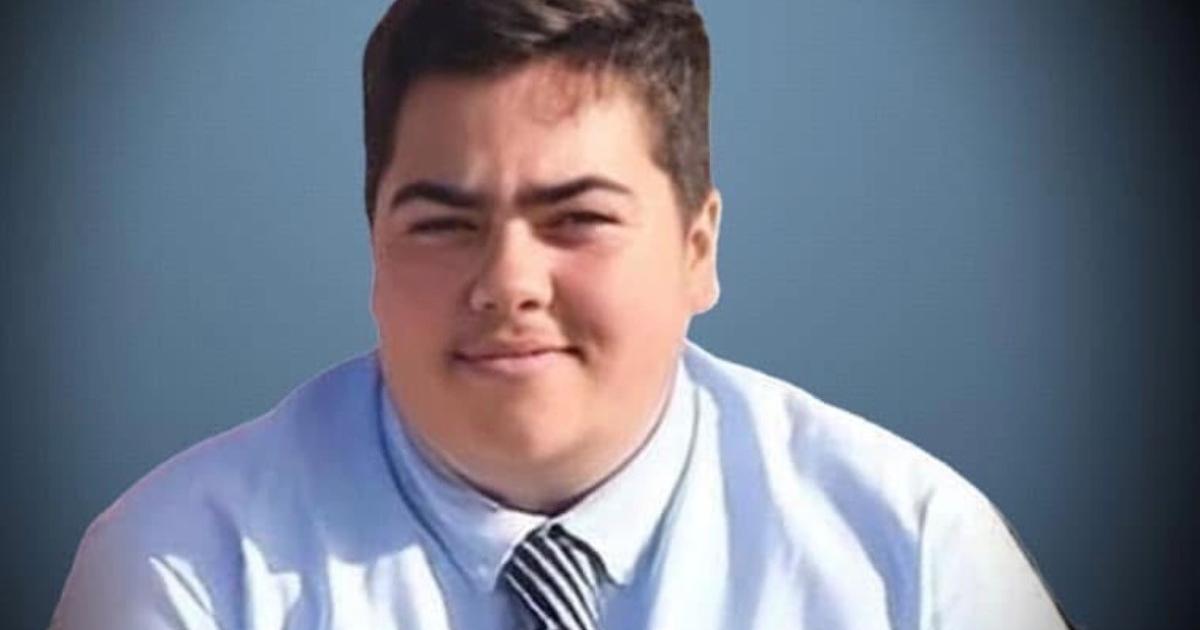
23-year-old trans man Jay Jones who died in his room at Roseberry Park, Middlesbrough (Image: FAMILY)
Emma Broughton, a mental health nurse, said records showed the risks Jay posed to himself increased during hospital admissions and because of this the admissions were often kept short.
Emma’s evidence also noted a significant escalation in the level of risk he posed to himself during the period leading up to his death.
The court then heard from Nicola Willis, a care coordinator and community psychiatric nurse with the Middlesbrough Effective Outreach Team, whose role included coordinating Jay’s care while he was in the community.
She said it was often difficult to maintain regular engagement with him, adding: “At times Jay would say that he did not wish to work with me and at other times he was happy to engage.”
Advertisement
Roseberry Park Hospital in Middlesbrough. (Image: NORTHERN ECHO)
Jay was born as Tia Hope Jones, in Northallerton in December 1999 and later moved to Middlesbrough at the start of Covid in 2020. The court heard he had hoped to train as a paramedic.
He had a long history of self-harm and suicide attempts and had been admitted to hospital 26 times in the 34 months before his death.
On the afternoon of December 27, 2022 staff saw him at around 3pm sitting on a sofa in a communal lounge speaking with others before he returned to his bedroom.
During a routine patrol at about 4pm he was found unresponsive in his room. Staff began CPR and an emergency response team arrived about ten minutes later and continued resuscitation efforts for around twenty minutes before he was pronounced dead.
Advertisement
A postmortem examination carried out at James Cook University Hospital found cocaine and other drugs in his system. The cause of death was recorded as a method commonly associated with suicide, with multiple other injuries consistent with self harm.
In a video tribute shown to jurors, his mother Donna Watson said he was one of six siblings and was always “fighting for attention”, but remembered him as the “funniest person” and a “ball of energy”.
She added that he was “so caring behind all his mental health problems”.


























































You must be logged in to post a comment Login