


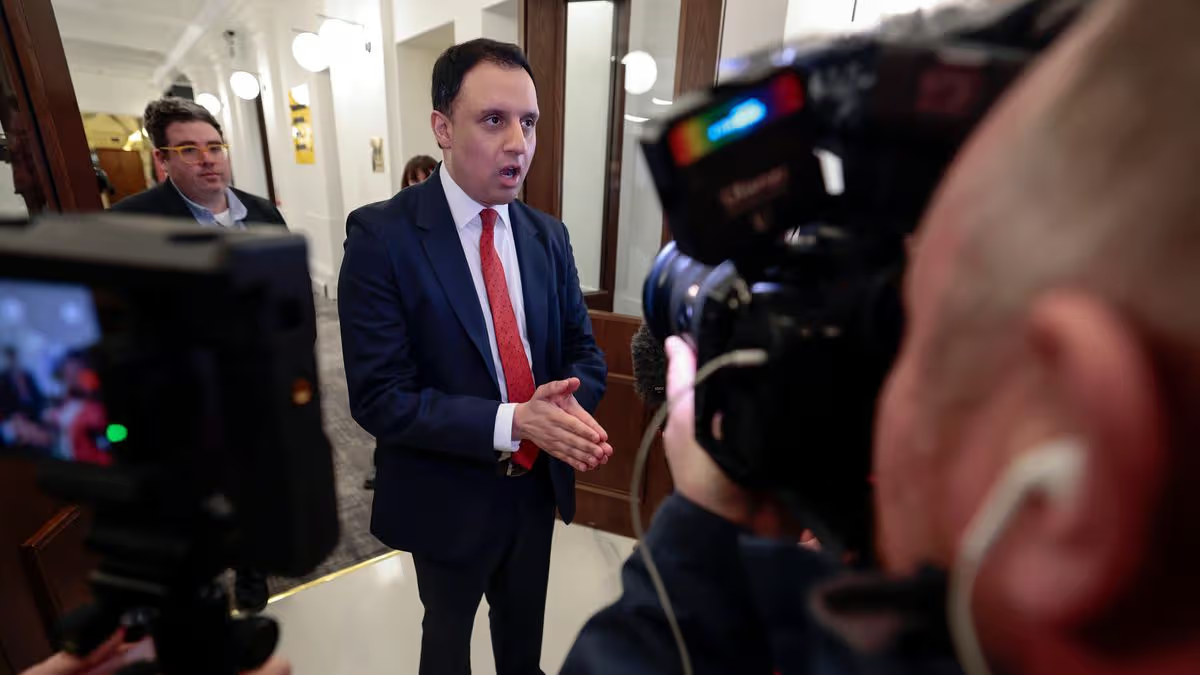
Daily Record Political Editor Paul Hutcheon says the bold move may be the only way for Scottish Labour to win another Holyrood election.
Scottish Labour leader Anas Sarwar should heed the adage of never letting a good crisis go to waste.
Sarwar’s party is in a slumber after recording its worst election result since the creation of the Parliament.
They have gone backwards at every election since 1999 and polled a pitiful 16% on the regional List vote.
Friday’s humbling was Labour’s fifth loss to the SNP in row and they look to be in terminal decline.
Despite running a poor campaign, Sarwar is correct in his assessment that Keir Starmer’s hapless premiership was the key factor in the result.
Voters were furious with the Prime Minister and they took it out on Sarwar.
Scottish Labour was judged in relation to the UK party and a crushing loss was baked in months ago.
So what are Sarwar’s options for a rethink of this toxic relationship as he edges towards the end of his five year spell as leader?
READ MORE: Susan Aitken to stand down as Glasgow City Council leader after nine yearsREAD MORE: Top Scottish Labour MP urges Keir Starmer to quit as Prime Minister
With no leadership contest in sight, he has a degree of political space to bequeath a positive political legacy to his successor.
He could – although this would be inadvisable – maintain the status quo.
This would mean depending on UK Labour for cash, data and staff, as well as Scottish MPs being part of a wider group in the Commons.
It would also mean continuing to take the political flak in Scotland for decisions made hundreds of miles away in London.
Scottish Labour’s chances of winning the Holyrood election in 2031 would be linked to a more favourable political climate emerging at Westminster.
This “fingers crossed” strategy would outsource the party’s chances in Scotland to a failing UK party.
The next Scottish Labour leader could produce the best manifesto ever written, but success would be determined by events outwith their control.
Another option would be to seek greater autonomy from Labour south of the border.
But this has been tried before and voters make no distinction between Labour at Holyrood or Westminster.
A more credible option – if Scottish Labour wants to stand or fall on its own merits – may be to become an independent party, even with a new name.
This would involve becoming financially self-sufficient and having full control over policy and personnel.
Scottish Labour would be a separate party at Westminster with their own whipping arrangement.
They could break sharply with UK Labour on welfare or oil and gas jobs without facing any consequences.
Lord Haughey, who has helped bankroll Labour for years, recently outed himself as a supporter of the plan.
He said: “I’ve said for years and years and years that maybe we should look at an independent Labour Party in Scotland.”
Former party MP Brian Wilson, never an enthusiast for devolution, also wrote recently about a much looser arrangement between Scottish and UK Labour:
“This re-setting of the relationship would strengthen rather than weaken devolution because it would transcend the dividing line between what is reserved and what is devolved.
“It should be perfectly natural for Scottish Labour to take a different line from Westminster Labour on either side of that distinction, without childish charges of it being a “split”.”
And Monica Lennon, who lost out at the Holyrood election, wrote in 2020:
“We either continue at the mercy of the UK party’s distant structures or we become a party in our own right.”
She added: “If we look like a pressure group within a UK party structure, we will continue to be rejected.”
Becoming a separate party could be followed by producing a policy platform that chimes with voters.
Some Scottish Labour figures will inevitably counter that severing ties would be too difficult and result in the loss of shared resources.
But holding on to shared spreadsheets seems trivial compared to winning elections at Holyrood.
Twenty seven years of devolution have resulted in Scottish Labour collapsing from 56 MSPs to 17.
They have fallen from 908,346 constituency votes in 1999 to 440,708 last week.
Sarwar will not lead his party into the next Holyrood election and will likely be gone by the end of the year.
He has racked up two defeats in a row and will be wondering if he has any sort of legacy.
Creating a party that will be given a hearing by voters would fit the bill.




















































You must be logged in to post a comment Login