

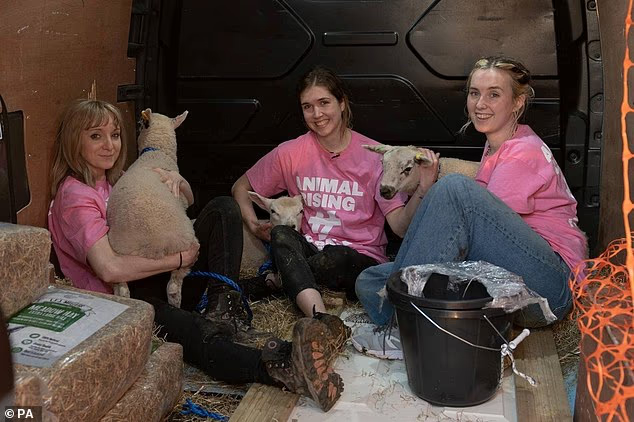
Three animal rights activists who took lambs from the King’s estate in Sandringham and claimed Charles would have approved were convicted of theft today.
Rose Patterson, 37, along with Rosa Sharkey and Sarah Foy, both 26, spirited away three lambs during an early morning visit to Appleton Farm in Norfolk.
Footage of the women, who wore pink t-shirts bearing the name of pressure group Animal Rising, was released online afterwards by the organisation.
They were also shown brazenly standing outside Windsor Castle with signs stating they had taken the sheep before handing themselves in to police.
During their trial, they said they wanted to provoke a ‘discussion’ about animal farming and its impact on the environment, while the monarch was targeted because he ‘says he’s an environmentalist and an animal lover’.
Their defence rested on the claim that they had saved the animals from poor welfare conditions and slaughter and there was no ‘dishonesty’ in what they did as the so-called ‘open rescue’ was the morally right thing to do – and the King would have ‘consented’.
Prior to the hearing, Animal Rising said: ‘The open rescue tactic is an attempt to create strong case law foundations to give a legal basis for the rescue of animals from animal testing, farms or other industries.’
Rose Patterson, 37, along with Rosa Sharkey and Sarah Foy, both 26, spirited away three lambs during an early morning visit to Appleton Farm in Norfolk
The case follows other trials where activists have been cleared of alleged offences, leading MPs to warn such verdicts provide a ‘green light’ for people to commit crime.
But a jury took just three hours and 48 minutes to find the defendants guilty of the charge.
Judge Anthony Bate told the defendants, who showed no emotion as the verdict was returned, that he hoped to sentence them later today.
He indicated he was thinking of imposing a community order with unpaid work.
Conservative MP Sir John Hayes, the founder of the Common Sense Group of parliamentarians, condemned the defendants’ actions, telling the Mail: ‘Anyone who keeps animals needs the protection of the law.
‘The distorted understanding of the relationship between humans and animals is evident in the fact that they carelessly took these babies from their mothers.’
He also branded the claim that Charles would have supported the lambs’ ‘rescue’ as ‘impertinent’, adding: ‘It’s hard to think the King would want anyone to steal animals.’
Immediately after the theft on May 24, 2023, livestock experts and farmers condemned the stunt.
A National Sheep Association spokeswoman said the distressed ewes would have been ‘scouring the field for their lambs, bleating endlessly with no hope of finding them’.

The activists said they target the King because he said he was ‘an environmentalist and an animal lover’
Gareth Wyn Jones, a sheep farmer for over five decades, added: ‘These people are absolutely bonkers.
‘It’s distressing for these animals to be handled wrongly by amateur strangers.’
The lambs have never been recovered as they were taken to an undisclosed sanctuary where, Norwich Crown Court was told, they had begun ‘socialising with other animals and had made friends with goats’.
Animal Rising director Ms Patterson said outside court: ‘We are of course disappointed by the verdict today but it doesn’t change how I feel about rescuing Sammy, Sunny and Sooty.
‘We rescued them because we believed they deserved the chance of a long life, rather than having their lives cut short simply because they were being farmed for food. I don’t regret for a moment giving them that chance.’
Ms Sharkey added: ‘I hope that the rescue of these lambs helps open the King’s eyes to the reality of farming sheep.’
During the trial, jurors were told that the King was the official owner of the lambs, which were worth £400-500, but they were in the care of head stockman Gordon Robinson.

Charles, who was then the Prince of Wales, admires sheep being judged at The Great Yorkshire SHow in July 2021
Giving evidence, the defendants said the farming of livestock was having a devastating impact on the environment.
Food distribution worker Ms Sharkey, of Brighton, said: ‘We discussed wanting to save sheep and the best way to do that.
‘One of the things we were considering was the impact it would have on the farmer and knowing that farming lives are not easy.
‘That was the key reason why we went for the King’s farm as it’s not his primary source of income.
‘And we wanted to do it in a way that would have a wider impact and produce a discussion in the country.
‘The King says he is an environmentalist and an animal lover and I do think that the reality of sheep farming is quite hidden away, and what they face in the slaughterhouse and the impact on the land are not actually things that he’d agree with.’
Prosecutor Dingle Clark posed a hypothetical situation where someone ‘comes into a coffee shop and walks out with a cake’ and suggested: ‘That would be wrong’.
Ms Sharkey told him: ‘It would depend on the context.’
Ms Patterson, of north London, claimed electrodes that stun lambs at abattoirs were often used incorrectly, leaving them ‘paralysed while going to slaughter fully awake’.
The defendant – who was previously arrested on suspicion of conspiracy to cause a public nuisance after being flagged in the group’s plot to sabotage the Grand National – also claimed the ‘scale’ of the animal industry meant there were frequent violations of standards, yet there were ‘very few prosecutions’.

The defendants stood outside Windsor Castle with signs admitting what they had done before handing themselves in to police
Ms Foy, an Animal Rising volunteer support co-ordinator from South Normanton, Derbyshire, told jurors the lambs were taken on a hot day and there had been no water for them.
‘We rescued them from neglect or from being killed,’ she said.
She also argued that ‘no aspect of the farm system actually makes sense. Every part of it needs change’.
But Mr Robinson said in a statement read to the court: ‘We unapologetically rear forest-fed lambs to sell for consumption.’
And Mr Clark told the jury in his closing speech: ‘One might have sympathy with the views of some of the defendants but they are all controversial views.’
It might be that farming practices should change, he added, but there are ‘plenty of ways to change the law [and] plenty of ways to campaign lawfully’.
What the defendants didn’t have, he concluded, was permission to ‘take property that belongs to other people’.
Defence barrister Sarah-Jane Ewart, for Sharkey, said in her closing speech: ‘The three women sat behind me took three sheep. Those sheep, there’s no dispute, belonged to the King.
‘There’s no suggestion they planned to give them back … but they didn’t do it dishonestly and so the law says that’s not theft.’
She explained that ‘someone isn’t dishonest if they believe the owner would consent to the appropriation of the property if they knew of it and its circumstances’.
‘They genuinely believed King Charles would be open to this,’ added Ms Ewart.
So-called Open Rescue, where activists use ‘non-violent and transparent’ tactics to ‘rescue’ animals in captivity, was first used by protesters in Victoria, Australia.
Earlier this year, four defendants were unanimously acquitted of burglary after a jury heard they had taken 18 beagle puppies in an ‘open rescue’ at an animal testing site in Cambridgeshire in December 2022.
Other activists cleared of alleged offences include three Extinction Rebellion members who were accused of obstructing the railway after climbing onto a Docklands Light Railway train in East London in 2022.
The Sandringham Estate consists of 2,400 hectares of farmland, with an additional 4,000 hectares rented by tenant farmers. There are around 3,000 royal sheep present.

















































You must be logged in to post a comment Login