MELBOURNE, Australia. (AP) — Australian police said they believe they shot dead a suspect Monday accused of killing two police officers and seriously wounding a third in a remote forest region seven months ago.
There had been no confirmed sightings of Dezi Freeman, 56, since he allegedly opened fire on police officers who came to serve a warrant at his home near Porepunkah in Victoria state northeast of Melbourne on Aug. 26 last year, Victoria’s Chief Commissioner of Police Mike Bush said on Monday.
A man believed to be Freeman was fatally shot by police on Monday at a remote location near Thologolong, around two hours’ drive north of Porepunkah, a police statement said.
“We believe it is Freeman, but we have to go through a formal identification process,” Bush told reporters in Melbourne. Identification could take up to 48 hours through processes including fingerprinting.
Advertisement
Heavily armed Special Operations Group tactical police were involved in a standoff for three hours before the suspect was shot. He had been inside a shelter like a shipping container and did take up a police offer to surrender, Bush said.
“This was all about bringing this to a conclusion as safely as possible. Our ultimate goal was to arrest the person there … as peacefully as possible,” Bush said.
Bush said he “strongly believed” the suspect was armed. Bush could not say whether the suspect fired at police.
Australian news outlets widely reported that Freeman espoused co-called sovereign citizen beliefs and had grievances with police. He had wilderness survival skills that police feared could sustain him living in the open indefinitely.
Advertisement
The shooting of three police officers led to a massive search across Victoria’s heavily forested alpine region. In recent months, police said they suspected Freedman had killed himself.
“We have to follow every avenue of inquiry and there was a lot to suggest that Freedman had taken his own life,” Bush said.
Bush would not say whether a tipoff led police to the suspect on Monday. Police had offered a 1 million Australian dollar ($678,000) reward for information.
Police said they continue to investigate whether others had helped the suspect avoid arrest.
Manchester United have ruled out another loan move to Barcelona for Marcus Rashford after the forward spent the 2025/26 season at the Camp Nou, according to former scout Mick Brown.
Barca have a £26million option to buy Rashford but the Catalan side are trying to get him “on the cheap”, according to Brown, and hope United buckle amid the player’s desire to move back to Spain.
“Barcelona have been trying to get Rashford on the cheap,” Brown told Football Insider. “From Man United’s point of view, £26million is already cheap, but they want to either lower that price or sign him on another loan deal.
“That’s not going to work, so as things stand, that deal is off because Barcelona won’t come up with the money that United are asking for. It’s even more frustrating for the club seeing them go out and spend on Anthony Gordon, because the money has obviously been there for them to spend.
Advertisement
“In hindsight, Man United should have included an obligation to buy rather than an option, but that isn’t the case so they’ve gone right back to square one.
“It will be a test of their strength in negotiations, because they’re planning to stick to their price tag and then see who moves first, with Rashford now set to return.”
PARIS (AP) — The French Navy, with support from the United Kingdom, has intercepted an oil tanker under international sanctions that was traveling from Russia, the most recent effort by nations that support Ukraine to target Russian oil exports helping to finance President Vladimir Putin’s war.
French President Emmanuel Macron announced the interception in a post Monday on X, saying the Tagor was boarded on Sunday in the Atlantic. Soldiers descended on a rope one after another from a French navy helicopter, video released to The Associated Press by the French military showed. It is the latest in a series of French naval interceptions of tankers suspected of links to Russia.
“It is unacceptable that boats skirt international sanctions, violate the law of the sea and finance the war that Russia has been waging for more than 4 years against Ukraine,” Macron wrote. “These ships, that don’t respect the most elementary rules of maritime navigation, are also a threat to the environment and everyone’s security.”
Oil revenue is a key part of Russia’s economy, allowing Putin to pour money into the war effort against Ukraine without worsening inflation for everyday people and avoiding a currency collapse.
Advertisement
Russia is believed to be using a fleet of hundreds of ships to evade international sanctions imposed over the war. France and other countries have vowed to crack down on the sanction-busting so-called “shadow fleet.”
Responding to the latest French interception, Kremlin spokesman Dmitry Peskov said Monday that Russia “considers such actions illegal.”
“They border on piracy,” he said Monday. “We absolutely disagree that they are being carried out in full compliance with international law.”
French maritime authorities said the tanker was intercepted more than 400 nautical miles west of France, in international waters in the Atlantic. It was traveling from the northwestern Russian port of Murmansk, according to the authorities’ statement.
Advertisement
It said the tanker is suspected of operating under a false flag and that the French navy is now escorting it to an anchorage for more checks.
The captain says he is Russian, French prosecutor Stéphane Kellenberger, overseeing the investigation from Brest in western France, said in a statement to AP.
The captain repeatedly refused to comply with French navy instructions, “making it necessary to take control of the vessel,” Kellenberger said.
He said his office has opened a criminal investigation on charges of failure to provide proof of a vessel’s nationality, navigating without a flag and refusal to comply with orders.
Lemons have a variety of uses in the kitchen, and if you don’t store them correctly, they’ll go mouldy – but one trick could help them last for months at a time
Altering how you store lemons could extend their lifespan to “months” instead of mere weeks. Lemons are incredibly useful, and many households keep them readily available for use in various ways – from incorporating them into baked goods, elevating the taste of seafood and poultry, to adding them to water for a revitalising beverage.
Advertisement
Indeed, this citrus fruit can also serve as an effective cleaning agent. Placing lemon slices in water within your microwave, oven, or kettle can help break down accumulated dirt inside these appliances, enabling you to clean them without spending hours scrubbing away limescale deposits or dried-on food remnants.
But because lemons aren’t typically peeled and consumed whole, it’s remarkably common to purchase a pack with good intentions of using them, only to find they’ve shrivelled and begun developing mould before you’ve had the chance.
Like most produce, they won’t last particularly long if left in a fruit bowl on your kitchen worktop. There is, however, a food storage technique you can employ to maximise your lemons’ potential.
Kate Lewis demonstrated the tip on TikTok, describing it as “so simple” that she was astonished she’d only just discovered it. The solution merely requires moving them from your usual fruit bowl location to somewhere rather unexpected.
Advertisement
Content cannot be displayed without consent
In her video, she revealed: “There is a way to keep your lemons and limes from going bad so fast. And it’s simply storing them in water in the fridge.” Kate always washes her lemons in a water-and-white-vinegar solution prior to storing them in order to remove the “artificial wax” layer.
However, in UK supermarkets, unwaxed lemons are readily available, meaning you may be able to skip this step depending on the variety you’ve purchased.
Once her lemons are cleaned, Kate fills a glass jar with water, places them inside, seals it tightly, and puts it in the fridge. She claims the lemons will last “up to four weeks” this way.
Viewers commenting on the video were astounded by the tip, with many admitting they had no idea lemons could be stored in this manner.
Advertisement
One person said: “I do this after seeing it on this app!” Another added: “Wow, I did not know! Brilliant.”
Nevertheless, there are some words of caution to bear in mind before attempting the hack yourself. Storing lemons in water can potentially cause food poisoning if the storage conditions are not properly managed.
While lemon juice is highly acidic and naturally inhibits many bacteria, submerging whole or cut lemons in water introduces a risk of bacterial contamination (such as Salmonella or Listeria) if basic hygiene is neglected.
To minimise these risks, thoroughly wash the lemons and store them in clean, filtered water in the fridge. Replace the water every few days to prevent it from stagnating, and always discard any fruit that smells unpleasant. Avoid placing bare hands into the water. Instead, use clean tongs or utensils to retrieve a lemon when needed.
Advertisement
More ways to properly store lemons
Short-term storage (1 to 2 weeks):
Store lemons at room temperature in a bowl or fruit basket on the kitchen counter. They may lose moisture and turn hard after a few days when stored this way, so they must be used quickly.
Alternatively, you can place your lemons directly in the salad drawer of your fridge. This can help them stay fresh for around 2 to 3 weeks.
Long-term storage:
Refrigerate in a sealed plastic or silicone zip-top bag, pressing out as much air as possible before sealing. This method can help your lemons last up to four weeks.
You can also freeze whole lemons, lemon juice or lemon zest, making your fruit last for several months.
The second tranche of documents relating to Sir Keir Starmer’s decision to give the prestigious Washington job to Lord Mandelson rather than a career diplomat were released by the Government, with thousands of private WhatsApp messages now made public
Emma O’Neill Content Editor, David Lynch David Hughes and Christopher McKeon and Press Association
15:25, 01 Jun 2026Updated 15:25, 01 Jun 2026
Lord Peter Mandelson told the Government it would “never regret” naming him as Britain’s ambassador to the US, according to a memo released among thousands of documents concerning the appointment.
The second batch of files relating to Sir Keir Starmer’s decision to hand the coveted Washington role to Lord Mandelson instead of a career diplomat was made public by the Government on Monday afternoon.
Lord Mandelson also seemingly “declined to comply” with a request to surrender his personal phone and permit the Government to release WhatsApp messages and other material connected to his appointment, the documents revealed.
Advertisement
Before their release, the Prime Minister’s official spokesman characterised the extensive Whitehall-wide push to publish the documents as an “unprecedented piece of Government transparency”.
Ministers were preparing for potentially embarrassing disclosures ahead of the files being made public, which contain thousands of previously private WhatsApp exchanges between senior Government figures.
The memo, dated November 18 2024, seems to have been drafted while Lord Mandelson was awaiting the outcome of a ballot to determine Oxford University’s next chancellor, a position for which he was reportedly among the leading candidates at that time.
Advertisement
The letter, composed in blue ink on headed notepaper bearing Lord Mandelson’s name and a House of Lords seal, stated: “Dear David, As today (and all week) is polling day in Oxford and I am returning to London, I wanted to drop you a line, personally, about Washington.
“Thankfully, the media speculation has gone away and I hope this was not too irritating to you. I just wanted you to know that if you were minded to appoint me I would make sure you never regret it.”
Steering Britain’s affairs “through the Trump administration will require super-human skills and luck and a massive team effort”, he noted, before adding: “For me it would be the last thing I do in public life and it would be a huge honour to serve you and the Government in this role. So if you are up for it, so am I.”
The disclosure revealed that Lord Mandelson had exchanged WhatsApp messages with a number of senior government ministers.
Advertisement
On 20 July 2025, he informed pensions minister Torsten Bell that “the government doesn’t do policy, generally speaking, well enough”.
Mr Bell responded: “That is definitely true – everyone seems to think it’s someone else’s job to get the policy right… Which is very odd.”
Lord Mandelson fired back: “As the saying goes, rubbish in rubbish out…”
Advertisement
Separately, he described former transport secretary Louise Haigh’s departure from government as “harsh” following her resignation over a fraud offence. In a communication addressed to her on 29 November 2024, he wrote: “Lou, I am very sorry about this. You have been brave and loyal in your decision but it seems harsh given you were appointed in full knowledge.
“But you have acted in a way that enables you to come back later and everything you say and do now should be done with that in mind. Strong and honourable.”
An improved visitor centre, glamping site and activity centre are all part of the plans
15:21, 01 Jun 2026Updated 15:24, 01 Jun 2026
These images show what an upgrade to a visitor attraction would look under multi-million pound plans. The Elan Valley Lakes project will see a redeveloped visitor centre, including new exhibition and planetarium, café extension to provide views of the dam, outdoor seating and car park improvements, all designed to deal with overcrowding.
In March 2025, the project received £565,500 of funding from the Mid Wales Growth Deal to fund initial work on the three phase plan.
The first phase is to expand the Celtic Rainforest area, create a film and a forest bathing trail. For our free daily briefing on the biggest issues facing the nation sign up to the Wales Matters newsletter here.
Advertisement
The second is to redesign the visitor centre, and the third is to redevelop the sawmill, making a new activity centre, small glamping site, upgrade footpaths and bike trails and retreat accommodation as well as EV charging points.
In total the scheme will cost £21m.
In May, further funding for the project was approved by the Growing Mid Wales Board. It means Dŵr Cymru will receive a further £3.81m to progress delivery of the full project.
Advertisement
Those behind the scheme say it will create a flagship visitor destination for Mid Wales, building on the area’s natural, cultural and heritage assets.
The project aims to create year-round tourism opportunities, increase visitor spend, support jobs and apprenticeships, and strengthen the regional economy, while also supporting Welsh Water’s journey towards net zero.
The original visitor centre will have to close during construction but temporary facilities will be provided.
Leader of Ceredigion council Councillor Bryan Davies and leader of Powys council, Jake Berriman, said: “We’re pleased to see the Elan Valley Lakes project progress into delivery. This investment reflects our shared ambition to unlock the potential of Mid Wales—supporting sustainable tourism, creating jobs and showcasing the region’s unique strengths.”
Kit Wilson from Dŵr Cymru said: “This investment marks an important milestone for the Elan Valley, Mid Wales and Welsh Water. By expanding facilities, creating new educational and community spaces, improving accessibility and enhancing the overall visitor experience, the project will help ensure that future generations can continue to enjoy and learn from this unique environment.
“It will also provide a valuable boost to the local economy, supporting sustainable tourism and growth while protecting and celebrating one of Wales’ most iconic landscapes.”
Residents say ‘multiple’ caravans have arrived at a site with permission for only one added pitch
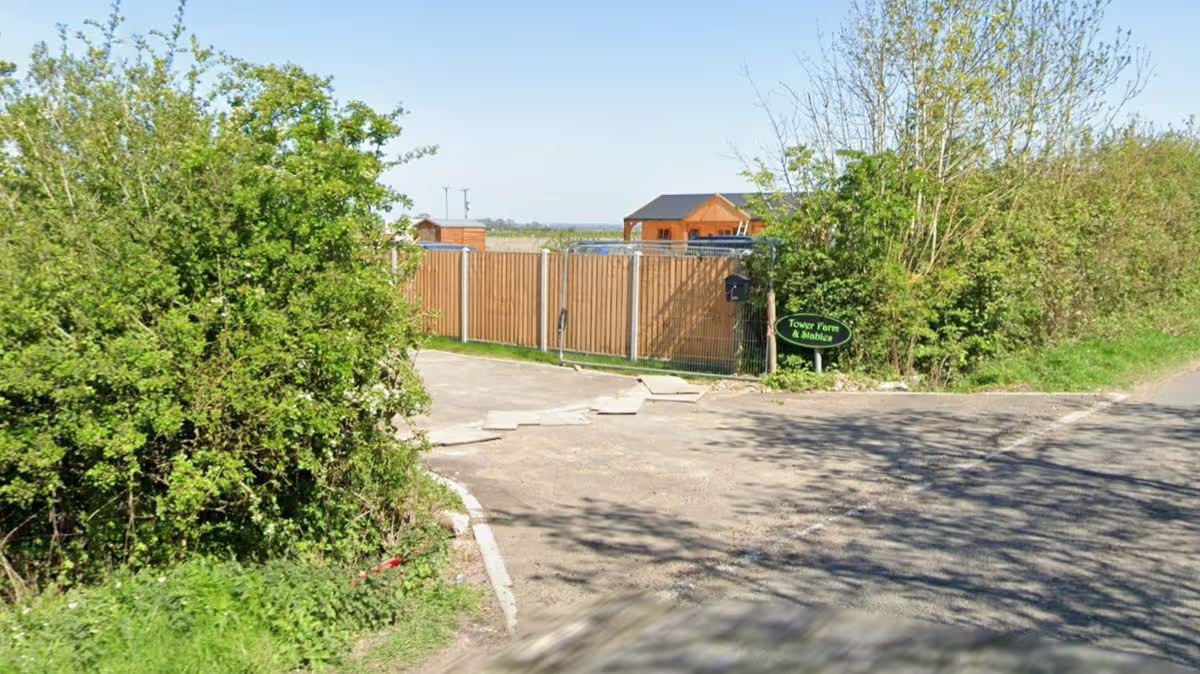
Huntingdonshire District Council are investigating complaints that “multiple caravans” have been pitched at a traveller site without permission. Plans for one new pitch were approved at Tower Farm and Stables off Toseland Road last year, but residents of nearby Yelling said many more have arrived in recent days.
Advertisement
They said that “multiple traveller caravans” started to arrive on the site “overnight” around a week ago, adding, “now we face years of legal wrangling at massive taxpayer expense”.
A resident who asked to remain anonymous said: “Part of the site has recently been fenced off into ‘plots’ and then last week multiple lorries arrived carrying hardcore or gravel shortly followed by several caravans. It’s difficult to see exactly the extent of the site due to the high hedgerow and fencing.”
He expressed concern that nothing would be done about it and said residents have been reporting “various planning non-compliances” to the council without any action being taken.
He said: “In our conservation village of Yelling, we must obtain permission to trim a branch off of a tree, yet questionable developments such as Tower Farm are seemingly waved through.”
Advertisement
Huntingdonshire District Council said they are investigating the complaints and are unable to comment at this time.
A spokesperson said: “The council has been made aware of the concerns raised. As this matter is actively being investigated it would not be appropriate to comment at this time.”
Honey has been used by humans as a natural sweetener and energy source to sustain work and physical performance for thousands of years. Recently, it has re-emerged as a natural option for fuelling exercise, with some social media users claiming it’s the perfect thing to eat before a workout if you need an energy boost.
Interestingly, Sebastian Sawe, the first man to run a sub two-hour marathon, fuelled up before his race with bread and honey.
Research actually does suggest honey can work comparably to commercial products such as energy drinks and gels. But where it may be most beneficial is when it’s used as a recovery tool.
Our bodies store carbohydrate as glycogen in the muscles and liver. These stores are depleted during moderate‑to‑high intensity exercise – especially during prolonged bouts of physical activity lasting longer than 60 minutes. When glycogen levels fall, fatigue increases and performance declines.
Consuming carbohydrates before or during exercise ensures energy is available, allowing us to sustain exercise for longer.
The science behind honey’s role in exercise is therefore straightforward: it supplies fast‑acting energy when needed. However, what is more interesting is that honey contains a natural combination of both glucose and fructose.
These sugars are absorbed through different pathways in the gut, allowing them to be used simultaneously. This increases the amount of carbohydrates absorbed, puts less strain on the gut, and helps sustain the amount of energy being delivered to working muscles during workouts. This may also potentially delay fatigue.
Advertisement
This science is also behind why many sports drinks and energy gels contain multiple carbohydrate sources to maximise fuelling efficiency.
Research has shown that consuming both glucose and fructose together enhances the amount of carbohydrate your body is able to use for energy compared to a single sugar source. Honey therefore represents a natural version of this evidence‑based approach.
In practical terms, one generous tablespoon of honey provides around 20 grams of carbohydrate. This is comparable to the amount of carbs found in a commercial energy gel.
Consuming around 1tbsp or 1.5tbsp of honey before training can top up glycogen stores, particularly in the liver. This can be important if training in the morning when liver glycogen stores are lower from an overnight fasting period.
Advertisement
But while honey can help provide the body with the energy it needs during a workout, whether honey actually boosts performance is less certain.
Previous research found that using honey as a drink given before and during 75 minutes of football training (a total of around four heaped tablespoons per participant) was not found to have improved performance.
A commercial sports drink containing the same amount of carbohydrates was also tested. Neither the sports drink nor the honey proved to have any performance benefit over the placebo (water only) – showing that both carb drinks had no effect.
However, other studies have shown that honey does perform similarly to other carbohydrate sources and may improve performance.
Advertisement
For instance, a study which gave cyclists 15g of honey every 16km over a 64km time trial resulted in cyclists having greater power output in the final 16km compared to those who were given a placebo.
Honey may be as good as sport gels for providing quick energy. ZeiMomArt/ Shutterstock
Additionally, a recent study in trained cyclists who were given 90g of honey per hour over three hours of cycling found that performance was comparable to traditional sports gels.
So while honey might not boost your performance over other types of carbs, it may work just as well.
Additional benefits
Where honey shines may well be in its role in recovery. Research has shown that consuming a honey‑based drink after exercise helps maintain higher blood glucose levels, which can affect subsequent performance – particularly when the body is under extra stress (such as when it’s hot).
Advertisement
In one study, ten recreational runners performed two one-hour runs in the heat, with a two-hour rest in between. After the first run, they were given a drink containing honey. The researchers found that the runners were able to run around 10% further in the second trial after consuming honey than they had run during the first trial.
This suggests that honey may be particularly effective at restoring energy between bouts of exercise. As honey contains both glucose and fructose, this can help replenish the body’s energy stores quickly.
Beyond its carbohydrate content, honey also contains small amounts of vitamins, minerals, amino acids and important plant compounds such as flavonoids and phenolic acids. These compounds may have antioxidant, antimicrobial and potentially antiviral effects, which may be particularly beneficial for athletes during stressful training periods.
However, not all honeys are the same. Their taste, texture, sugar composition and contents vary depending on factors such as flower source, climate and processing methods. For instance, Malaysian and Manuka honey contain higher levels of anti-bacterial and anti‑inflammatory compounds, which could better support recovery and immune function.
Advertisement
Some research also indicates certain types of honey can influence inflammatory signalling pathways, potentially helping regulate the response. This means honey may reduce muscle soreness and improve recovery, offering more than just a source of energy.
However, there’s currently little evidence to suggest that one type of honey is significantly superior to another as an exercise fuel.
Based on current evidence, honey does appear to be comparable to other sports products such as energy gels. This makes honey an effective, low cost, natural alternative to commercial sports fuels for athletes.
For more than 30 years he was a cherished member of the BBC radio and TV commentary team. His knowledge was unsurpassed, his humour never diminished.
We gave him the tag of ‘Tight Yorkshireman’ – always the last to get to the bar to buy a drink, we’d joke, and he’d play up to that role.
But, that was a myth. He was the most generous fella you could meet.
And, he was certainly always the last to leave the bar once the drinks were in because he loved the stories, the memories and the opinions we’d all share about our great game.
Advertisement
“Of course I love calling games with him because he’s so enthusiastic,” said BBC rugby league commentator Matt Newsum, my former colleague.
“But away from the mic I love hearing his life stories, getting him carried away on his favourite Led Zeppelin songs, and introducing him to the delights of halloumi after his initial scepticism. I can’t publish what he said at first.
“The biggest compliment I can give is that when my dad died last year, John became the next best thing to me – he was much, much more than a colleague.”
We sat beside each other for so many memorable matches – from Paris to Sydney, from Castleford to Catalans. He was such a cherished friend.
Advertisement
JK loved being part of the game, whatever the role. So, it is consolation, though barely, that one of his greatest thrills was being part of the BBC’s Challenge Cup final team.
That’s a role he once again fulfilled the day before his unexpected and devastating passing.
He had one passion greater than rugby league and that was his family.
Anyone who met JK knew how much his wife Dawn and all their kids meant to him. As much as we are hurting that he’s gone, their pain will be infinitely greater and they are so much in our thoughts.
Advertisement
Good night Keary, from Paris and Sheffield, and all those other places you left your lasting legacy.
Ainsley Boothe, 33, had been in an “on/off” relationship with the woman before demanding entry to a house in Bolton where she had been staying with a friend on January 2 this year.
Bolton Crown Court heard how he came into a bedroom at around 8am while the woman was asleep.
Emily Wilson, prosecuting, said: “Her first response on waking up and seeing the defendant was to say ‘don’t hit me.’”
She added: “The crown would say that’s a sad indictment of their relationship.”
Advertisement
The case was heard at Bolton Crown Court (Image: Phil Taylor)
Boothe listed from the dock as Ms Wilson told the court how he kicked the woman to the head and then to her back and side, breaking her ribs and puncturing a lung.
His victim was able to get to a neighbour’s house to call the police where she was taken to hospital and discharged four days later.
Ms Wilson said that Boothe, of no fixed abode, was arrested after police raided a house and found him “hiding in the kitchen”.
Boothe, who has 12 previous convictions for 22 offences including possession with intent to supply Class A drugs and a previous assault case, gave no comment when interviewed.
Advertisement
But brought before the courts he confessed to causing grievous bodily harm.
Amy Weir, defending, said Boothe had earned credit for his guilty plea and said that while in custody he now had a job at HMP Altcourse.
She said that he hoped to avoid drug use once eventually out of prison but that “the real test of course will be when he is released”.
But Recorder Ben Lawrence reminded the court of Boothe’s vicious assault on his victim.
Advertisement
He said: “She immediately said ‘don’t hit me’, a reflection of past events between you.”
Recorder Lawrence also noted that Boothe had been on bail when he attacked the woman.
He jailed Boothe for 22 months and made him subject to a five-year restraining order forbidding from contacting the woman or going near any address where she may have been staying.
Boothe, who had been watching in silence up to that point, appeared to quietly nod and say “OK”.















































You must be logged in to post a comment Login