BBC news anchor Jane Hill has become an internet sensation among Aussie football fans who cannot get over the way she pronounced ‘Socceroos‘ after the Australians’ World Cup defeat on Saturday.
The 57-year-old newsreader and journalist was informing viewers of the team’s loss to Egypt in a penalty shootout when she stunned supporters by pronouncing the name ‘Sioh-key-roos’ instead of ‘Soh-kerr-roos’.
Advertisement
‘No goals in extra time took it to penalties, but then Socceroos missed two spot kicks, allowing Egypt’s Hossam Abdelmaguid to slot home the winning spot kick,’ Hill said.
Aussies who saw the clip were flabbergasted and highly amused by Hill’s take on the word, with some saying it sounded like she was saying the name of a Greek soccer team.
Others believed Hill mistakenly believed ‘Socceroos’ referred to the surname of one of the Australian players who attempted a penalty.
‘She pronounced that so crazy I didn’t even hear it the first time,’ one wrote on X in response to a clip of the moment that has been viewed 2.9 million times.
Advertisement
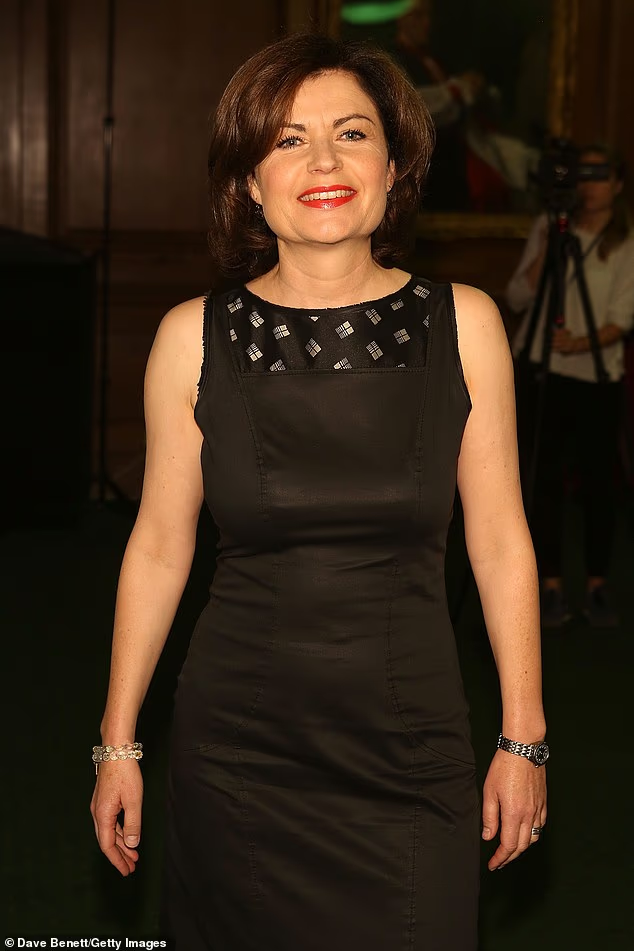
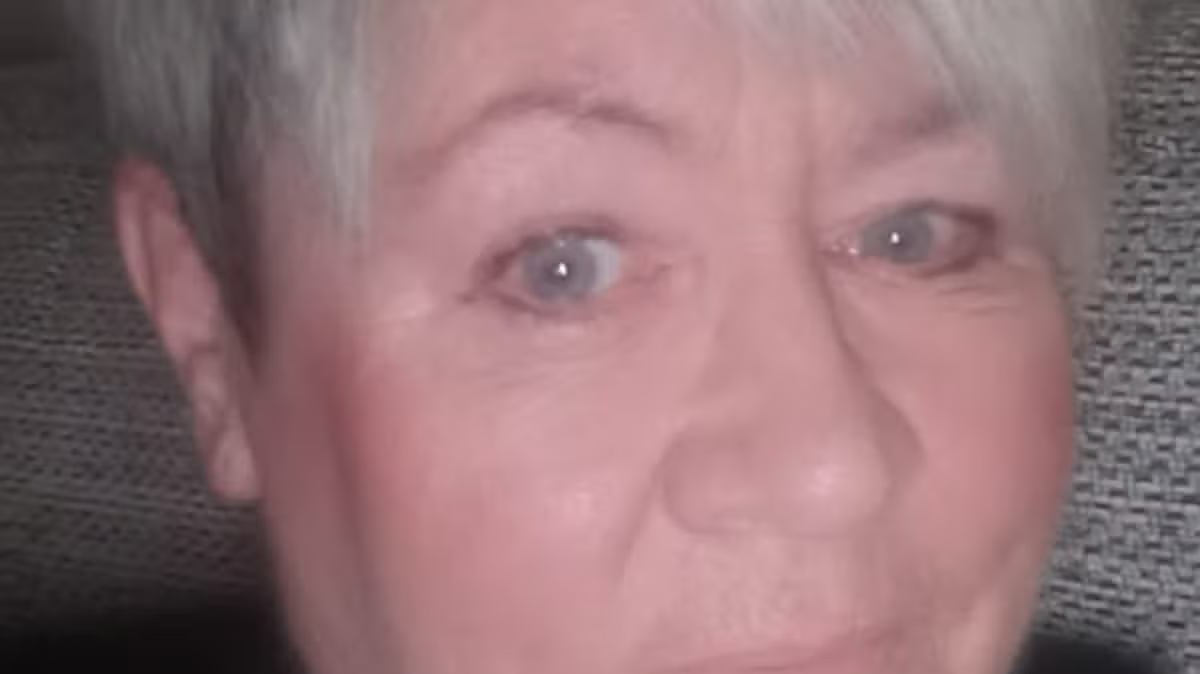
Pictured: BBC news anchor Jane Hill, who has become a viral sensation with Aussie World Cup fans due to the way she said ‘Socceroos’ after their loss to Egypt
Several fans thought Hill mistakenly believed ‘Socceroos’ referred to a player who missed a penalty during the shootout in Dallas (pictured, Harry Souttar after missing his spot kick)
‘Sokiros skies the penalty,’ another said, referring to Aussie star Harry Souttar sending his shootout attempt over the crossbar.
Advertisement
‘Who is Sokirous? Some Greek footballer?’ asked a third.
‘You really have to feel for Sokiros. Missing one penalty in a shootout is bad but to miss two? You can’t come back from that,’ another comment read.
‘I don’t think she realised what she was saying – clearly reading off the autocues and not a football fan!’ said a fifth response.
Other comments included ‘She said Socceroos like a Greek player Brighton just signed’; ‘Hell, let’s start calling them that!’; ‘That autocue programmer owes her a beer’; and ‘I had to watch that three times to even recognize the word.’
Advertisement
One of the Aussie players who missed a spot kick in the shootout, 18-year-old Lucas Herrington, has since been supported by two of the most famous names in the sport.
The centre-back was left devastated after crashing his penalty against the crossbar in Australia’s Round of 32 shootout defeat in Dallas, with fellow defender Harry Souttar also missing as Egypt progressed to the last 16.
Herrington, who became the youngest Australian to start a World Cup match earlier in the tournament, was immediately consoled by teammates after the final whistle.
Lucas Herrington (pictured) also missed from the spot against Egypt but received support from two of the biggest names in football in Thierry Henry and Zlatan Ibrahimovic
Advertisement
His courage in volunteering to take one of Australia’s spot-kicks has since earned widespread praise from across the football world.
Among those to reach out was Swedish great Zlatan Ibrahimovic, who delivered an emotional message directly to the Colorado Rapids defender during Fox Sports’ World Cup coverage.
‘Penalty is like lottery. You score, you become a hero, you don’t score, sadly you become zero,’ Ibrahimovic said.
French football legend Thierry Henry echoed those sentiments, while questioning why such responsibility had fallen on an 18-year-old defender.
Advertisement
‘Don’t be upset; you go there taking it, you miss. I feel for you, but keep your head up,’ Henry said.
‘I’m thinking about the guy that allowed him to go. You should (say), “No, this is not on you. We’re going.”‘
Share or comment on this article:
BBC newsreader goes viral for the unbelievable way she pronounces ‘Socceroos’: ‘Said it like the team is a Greek player’
If you visit Scandinavia you are likely to find yourself at an exhibition about Vikings. There are many to choose from.
The National History Museum in Denmark’s capital, Copenhagen, houses a major permanent exhibition on Viking. The Swedish History Museum in Stockholm boasts the largest Viking Age exhibition in the world. And the new Norwegian Museum of the Viking Age in Oslo, set to open in 2027, promises to be the world’s leading Viking museum. In the meantime, a temporary exhibition displays highlights of Viking Age archaeological finds at the Museum of Cultural History.
Obviously, Scandinavian national museums expect that audiences, domestic and international, visit their museums to see objects from and hear stories about the Vikings. But there’s more to the national museums’ obsession with vikings than simply wanting to meet demand. National museums use history to help shape ideas about national identity and Vikings are often used to reflect current values and needs.
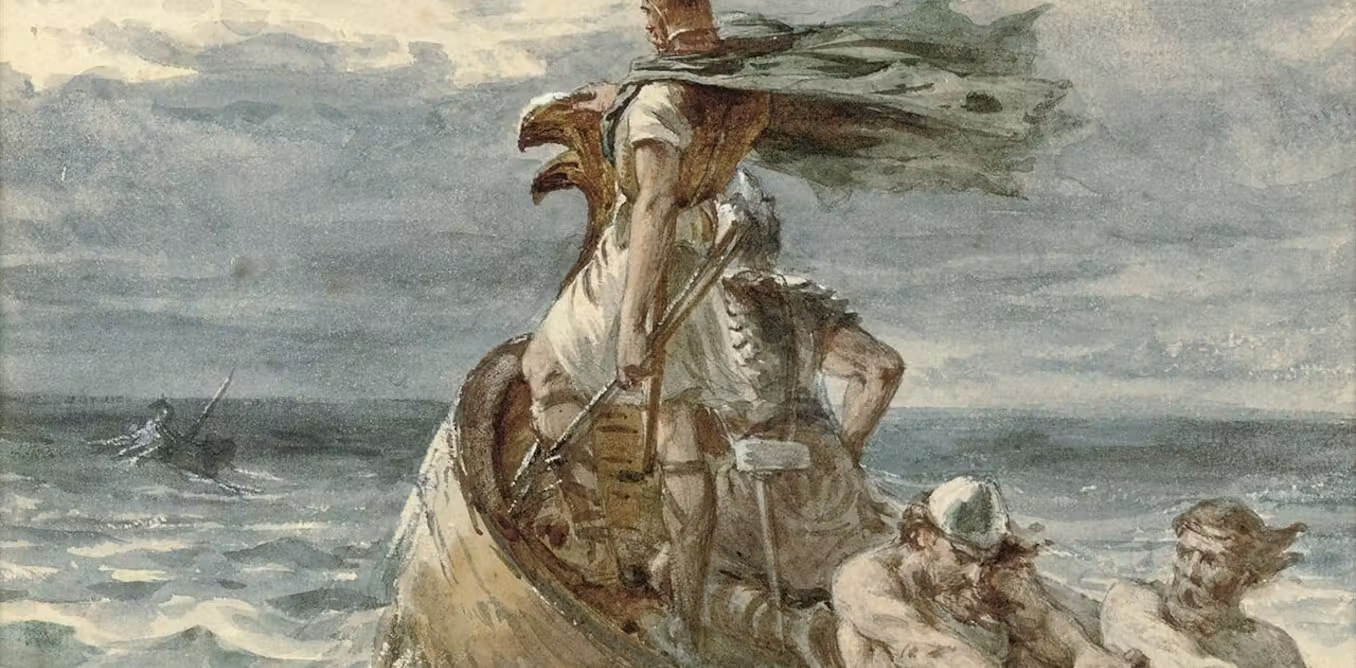
During the 1800s, when national projects were popular, the Viking Age became a key part of the construction of national identity in Scandinavia. Since then, the Vikings have become such well-known symbols that they are now recognised around the world. In the popular imagination, a Viking is tall, broad-shouldered man who wields a sword, and might have a modern haircut like a skin fade or lots of tattoos. However, this picture is mostly a made up one.
Advertisement
Experts at Scandinavian national museums know that Vikings were a diverse group, far from the all-male warrior myth. Yet the image of the male Viking warrior stubbornly lingers, drawing crowds while also haunting the galleries like a restless spectre.
Across three of the exhibitions, the male Viking emerges as a warrior, a seafarer, and a merchant. He is also repeatedly depicted as a farmer, his days spent working the land. The agricultural portrayals add depth but the curation of exhibitions tends to foreground the more popular image than this more complex one
One glimpse of this can be seen in the Swedish exhibition, which notes that many free men and women owned weapons, but only a few truly saw themselves as warriors. Still, the exhibitions spotlight ships, swords and artefacts of trade and travel, placing them front and centre.
Viking attire and jewellery at the National Museum of Denmark. The National Museum of Denmark, CC BY
In Copenhagen, visitors to The National Museum are told to see “our Viking exhibition, where we’ll explore a world more than 1,000 years old – shaped by a warrior culture and the gods Odin, Thor, and Freyja”. Here we see the real history butting up against the expected fantasy of norse legends, warriors and gods.
Advertisement
There seems to be a tension that curators feel in giving audiences what they are looking for while also presenting real history.
Another place this tension can be seen is in their depiction of female vikings. While these intuitions are attempting to insert women into the male-dominated picture of the Viking age, descriptions of women’s lives and their social or cultural influence tend to be limited.
There is a tradition of only showing Viking Age women who were exceptional figures, such as noble mistresses or shieldmaidens (female warriors), making ordinary women less visible. Elsewhere representations of women cleave to gender stereotypes focusing on their roles in home and their clothing. Take this example from the Danish exhibition, where it is stated that “guests were received by the lady of the house, who managed everything to ensure the occasion was a success. Women played an active role in running the farm, and also travelled widely.” Another caption explains that: “Jewellery and equipment in the graves of many wealthy and aristocratic women reflect the complex roles these women had.”
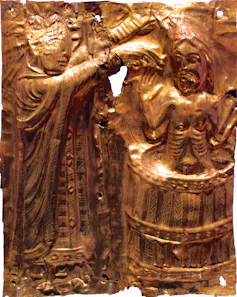
Harald Bluetooth being baptised around 960 by Bishop Poppo the missionary. Anagoria, CC BY-SA
The curation is also concerned with the national founding narratives of Scandinavia.
The story that the Viking age was a pivotal moment in the birth of nations and culture is seen in various forms across all three exhibitions. The story is that in this period Scandinavia became distinct unified Christian kingdoms from a series of disparate and decentralised pagan tribes. Today, Scandinavians differ in their enthusiasm for this narrative. But it still looms over the storytelling of the period’s history.
Advertisement
In Denmark, history blends seamlessly with national identity. This has been bolstered by the nation-building legend of Harald Bluetooth. Bluetooth was the father of Sweyn Forkbeard and grandfather to Canute the Great – who converted to Christianity after witnessing the miracle of the monk Poppo carrying a piece of burning coal without burning his hands.
Several researchers have observed that, since the 1980s, the Viking Age has been used to create convenient contemporary narratives. For instance, those narratives suggesting successful cultural encounters between Scandinavians and Muslims in the past by highlighting archaeological finds) that testify to these encounters. This stems from a contemporary desire in Sweden and Norway to create a counterweight to the nationalistic use of the Viking Age that is often directed against Muslims.
As these examples show, creating a museum exhibition is a delicate balance between handling traditional narratives rooted in popular imagination and presenting accurate representations of the past. Still, the Scandinavian national museums’ obsession with the Vikings may be explained by their eagerness to present representations of the past that have more to do with the present state of society than what is known about the Viking world.
“At first it was agony, but after a couple of weeks you get into it and it becomes routine.”
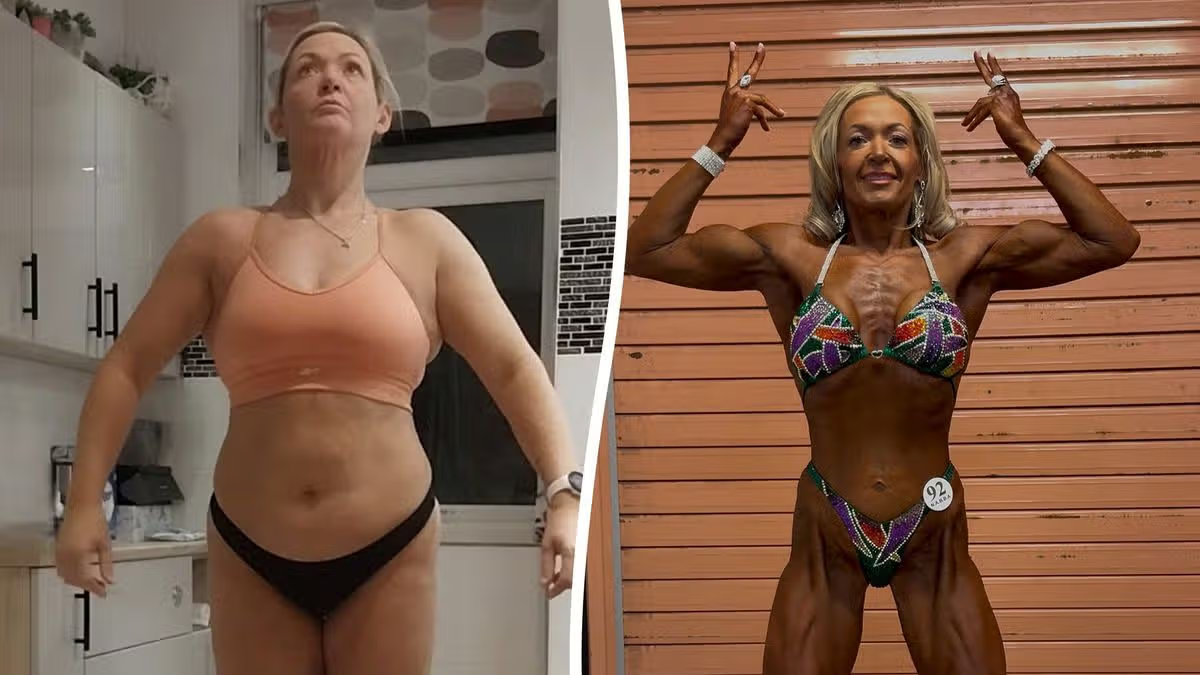
A Bolton mum has revealed her routine that saw her go from a ‘couch potato’ to competitive body builder. Before her extraordinary transformation, Lyndsey Kelly would eat takeaways at least once a week, drink every weekend and rarely exercise.
Advertisement
But when the mum-of-one reached her mid 40s, she decided it was time to turn her life around. The 47-year-old hired a personal trainer and started waking up as early as 4am for workouts before heading off for 12-shifts as a machine operator.
Click here to get the biggest stories straight to your inbox in our Daily Newsletter
Now, Lyndsey has lost nearly five stone by doing 40 minutes of fasted cardio at 4am five times a week and eating the same meals every single day.
She has found a love for weightlifting and now at 8st 8lbs she competes in bodybuilding competition.
Advertisement
“I work 12 hour shifts so I get up at 4am and do 40 minutes of fasted cardio, then I walk to work and do a weights session in the gym after my shift finishes,” she said.
“At first it was agony, but after a couple of weeks you get into it and it becomes routine. I quite enjoy it now because I like the structure and the discipline but that only comes with time.
“I’m not killing myself with cardio, it’s just consistency.” Lyndsey says she was previously a “couch potato” who did no cardio and sat around drinking every weekend.
She said: “I was eating too much, drinking too much, having takeaways and doing no exercise. I’d just had enough.
Advertisement
“I changed for my son. I wanted to be a role model and show him what you can achieve.”
In January 2024, Lyndsey decided to make a change and entered an online competition to win three months of coaching with a personal trainer.
Although she didn’t win, the coach contacted her afterwards to ask if she still wanted to work together.
Advertisement
Lyndsey told Talk to the Press: “I thought the money I’d spend on coaching was the money I’d been spending on alcohol and takeaways anyway.
“I pay for three months coaching at a time which costs me £350, which is cheap compared to some coaches out there, but it’s a lifestyle choice.
“I yo-yo’d with my weight over the years, particularly when my son was young as he was my priority and I would put myself on the backburner.
“But he is 16 now so I’ve got so much more time. I signed up with Craig two and a half years ago and I still check in with him every Sunday. I know I can’t get away with anything.”
Advertisement
Lyndsey swapped chicken kebabs for five meals a day which are carefully weighed out.
Every single day, Lyndsey’s menu includes oats and yoghurt, chicken and rice, chicken wraps, mince meat with potatoes and vegetables, and sourdough bread with peanut butter.
Her coach was a bodybuilding specialist so got into bodybuilding straight away, eventually building up to enter the 2026 NABBA North West bodybuilding competition.
Now her cardio work typically involves time on a static bike or on the Stairmaster, and most of her weight work focuses on heavy dumbbells.
Lyndsey said: “Women always say that they don’t want to get too bulky and that they just want to tone up, but toning up comes from building muscle.
“You’re not going to turn into a man overnight by lifting weights. It’s actually very hard for women to build muscle because we don’t naturally have the same testosterone levels, so its all about what we eat.”
On June 13, the mum finished second in the NABBA North West bodybuilding finals. She initially entered in the toned category but judges moved her into the athletic class because of her muscle definition and conditioning.
Advertisement
She said: “I was really nervous, but what I’ve taken away is to just have fun, don’t take it too seriously.
“Everybody is so lovely and puts you at ease. You’ve worked hard so it’s time to show it off.”
Lyndsey now shares her fitness journey with her 11,000 followers on Instagram @lynds.lifts.
For anyone considering starting their own fitness journey later in life, she advises: “You’ve got to get used to it and give it time. It can be a bit boring at first, but once you start seeing results, you realise it works. Trust the process.”
Kelly Faiers, 61, died at the Somerset home of predator Richard Scatchard, 70, before he mysteriously disappeared and was later found dead in a caravan miles away
A woman was found dead from a cocktail of sleeping tablets and alcohol inside the home of her sex‑offender boyfriend, who had a chilling history of drugging women, sparking a murder probe, an inquest heard.
Advertisement
Kelly Faiers, 61, died at the Somerset home of predator Richard Scatchard, 70, before he mysteriously disappeared and was later found dead in a caravan miles away. Her death was initially treated as non-suspicious, but a murder probe was later launched by police when other evidence came to light about his previous convictions.
Somerset Coroner’s Court heard Scatchard had a long history of sexual offending dating back to the 1980s, which included attempted rape, sexual assault and administering drugs, such as chloroform, to obtain sex, according to Somerset Live.
He was jailed for life in 2000 and told to serve a minimum of five years and four months’ imprisonment before he could be considered for parole.
Advertisement
“His modus operandi was to meet a female, usually by a dating website or equivalent, and given we are talking about offences in the late 1980s or 1990s it was a lonely hearts advert,” Samantha Marsh, senior coroner for Somerset, described when referencing the four women Scatchard had drugged and sexually assaulted.
“He would administer unknown drugs to women, causing the woman to lose consciousness, and while she was unconscious, he would commit sexual acts upon her without her knowledge or consent. He would photograph or video his committal of these acts.”
Scatchard was released from prison in April 2013 and later moved to Minehead in 2020, the inquest heard. Ms Faiers, who was single and worked at Bristol Airport, had met Scatchard on a dating website, and they had been in a relationship for around six months before she died.
For years she had been a “high-functioning” alcoholic, her family said, while co-workers described a “fantasy” Scatchard had of having sex with her while unconscious through drugs and alcohol. The sex offender was also said to be “controlling”, often criticising Ms Faiers’ appearance.
Advertisement
“I told Kelly she needed to get out of that relationship. Kelly replied saying she would never take anything without knowing what was going to happen,” said Claire Blick, Ms Faiers’ work supervisor.
“On one occasion, Kelly mentioned during a conversation that Scatchard had tried to raise his hand at her, and she told him that would never happen again.
“About a week later, Kelly turned up to work with a black eye and told me she had fallen down and hit her head on the table. She wore sunglasses at work to cover the injury.”
Another colleague said he had “alarm bells” when Ms Faiers told him about text messages Scatchard sent her.
“Kelly told me Scatchard had asked her what flowers she would like to have at a funeral, and she was his sex slave and that she belonged to him,” Daniel Cepek said, adding, “When she told me these things, I said to her that’s just weird.
“The alarm bells continued to ring when another time Kelly told me that Scatchard had asked her to take some tablets so that he could have sexual relations with her while she was unconscious.
“After all these things that Kelly would disclose to the team, the team and I would tell Kelly she needed to get rid of him.”
Advertisement
Another colleague Jason Hemmings said: “Kelly expressed to me that Scatchard had a fantasy about her taking enough drugs and alcohol to the point of being unconscious and him having sex with her.
“I immediately told her it was not normal, and she needed to leave. She laughed it off, and it wasn’t spoken about again.”
A post-mortem examination found Ms Faiers, from Weston-super-Mare, had died from the combined effects of alcohol and sleeping tablets, pathologist Dr Amanda Jeffery concluded.
The mother-of-four was just under three times the drink-drive limit, and the concentration of the sleeping tablets would support the taking of “an excess number of tablets”.
Advertisement
Ensure our latest stories always appear at the top of your Google Search by making us a Preferred Source. Click here to activate or add us as your Preferred Source in your Google search settings.
“It is not possible from the toxicology results to confirm the exact number of tablets that were taken,” Dr Jeffery said.
“The effects of alcohol and the tablets would provide an explanation for the death. It should be noted that it is not possible to determine from the pathology or the toxicology whether Kelly took the tablets willingly or knowingly. It cannot exclude spiking.”
Empty blister packets of sleeping tablets and Viagra were recovered from Scatchard’s home, the pathologist added.
Advertisement
“I was provided with a schedule of messages that were shared between Richard Scatchard and Kelly in the days prior to her death. These were highly sexualised on the part of Richard Scatchard and dismissive on the part of Kelly.
“It was clear sexual activity was planned or expected by Richard Scatchard on the weekend. He made sexually explicit comments about her including bondage, rough sex, anal penetration by objects, comments were also made to her that she should do as she was told.
“She does not appear to engage with these messages and attempts to brush them off. Her messages suggest she would not engage in any further activity with him.
“In the messages, he indicates he has explicit photographs of her. He describes wanting to throw her on the floor and have sex, including anal sex with her, and comments about her lying there naked while unconscious.
Advertisement
“She responds that she doesn’t particularly like that, and she hates loss of control. He says they had agreed to compromise on six tablets, and she tells him it is what he said.”
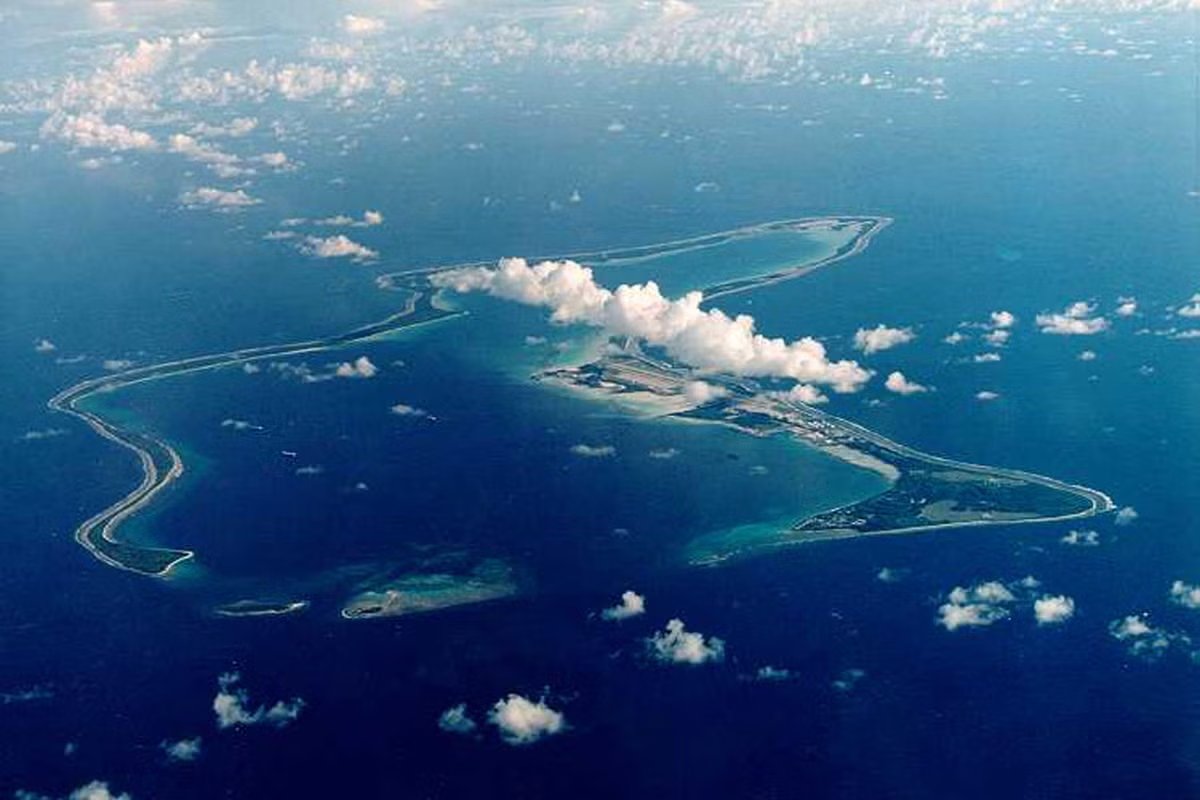
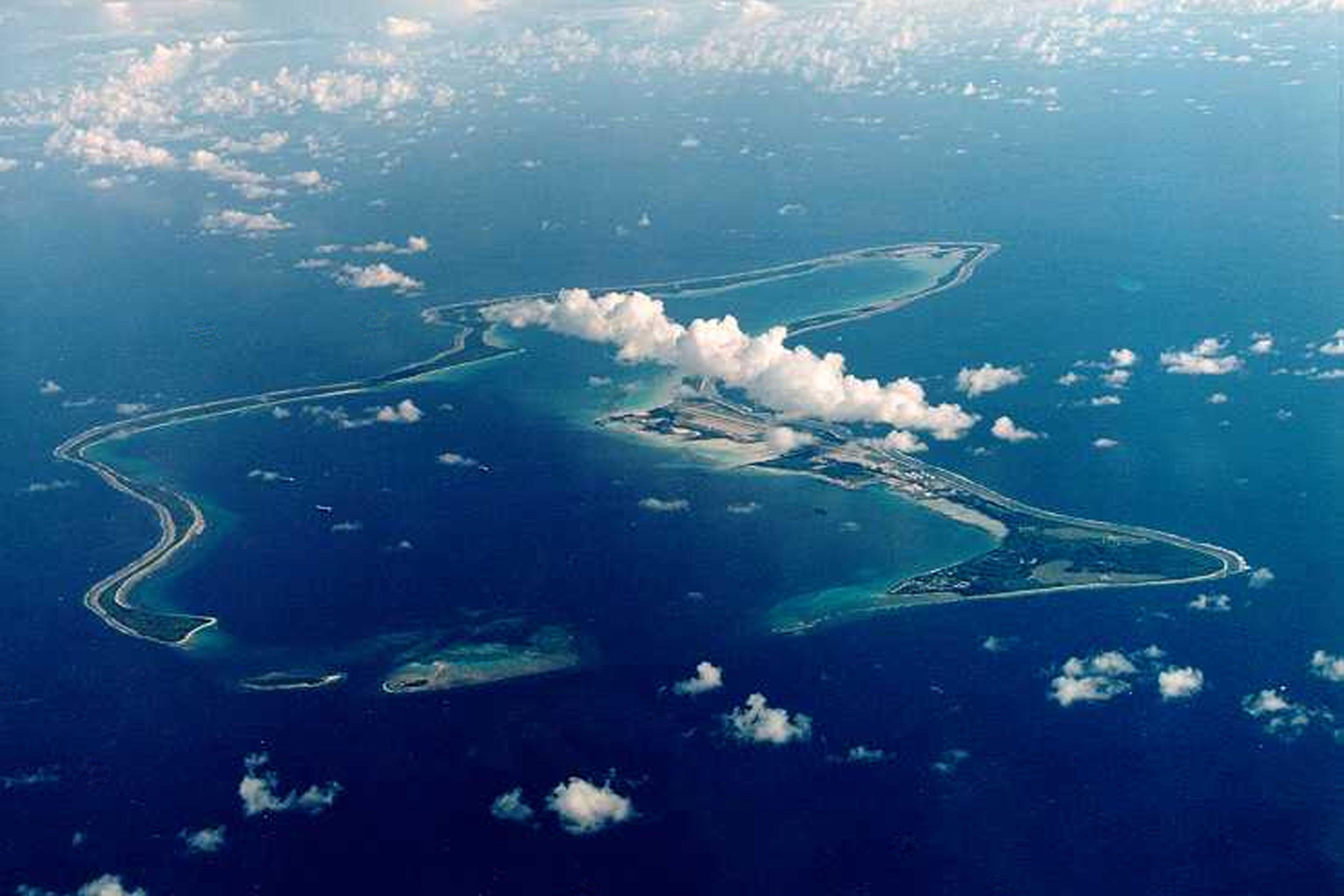
Dan Jarvis indicated he was “looking very closely at the detail” when questioned about the Government’s plans to cede sovereignty over the British Indian Ocean Territory (BIOT) while retaining control of a military base on Diego Garcia.
Mr Jarvis did not deny that funds previously earmarked for Mauritius, intended for the lease-back of the base, could now be redirected to defence spending, describing it as a “fair question”.
This contrasts with previous statements from Downing Street, which insisted that handing sovereignty to Mauritius was “the best way to protect a vital” military base on Diego Garcia.
Advertisement
An agreement between the UK and Mauritius was signed in May last year, and the Bill to conclude London’s control over the islands has since been debated in both Houses of Parliament.
However, a final draft of the Diego Garcia Military Base and British Indian Ocean Territory Bill stalled in the last parliamentary session amid objections from the United States president, Donald Trump (CPA Media Pte Ltd/Alamy/PA)
Speaking in defence questions in the Commons on Monday, Tory MP Dr Luke Evans said clarity was needed on the Chagos deal.
He said: “Could (the Defence Secretary) confirm it has been cancelled, and the billions that was going to go to Mauritius has now been transferred to defence spending?”
Responding, Mr Jarvis said: “That’s a fair question.
Advertisement
“I’m looking very closely at the detail, and I will discuss it with our American allies.”
Under the terms of the deal agreed last year, Britain would hand sovereignty over the Indian Ocean archipelago to Mauritius but lease back the Diego Garcia base for 99 years.
The deal would also see the UK pay an average of £101 million a year to Mauritius over that period, totalling about £3.4 billion according to official figures.
But opponents of the deal have said the real cost could amount to about £35 billion, adjusting for inflation, and said it puts the base at risk and could open the door to China establishing a presence on the archipelago.
Advertisement
Although the agreement has been signed by both the UK and Mauritius, it has not yet been ratified and no payments have been made.
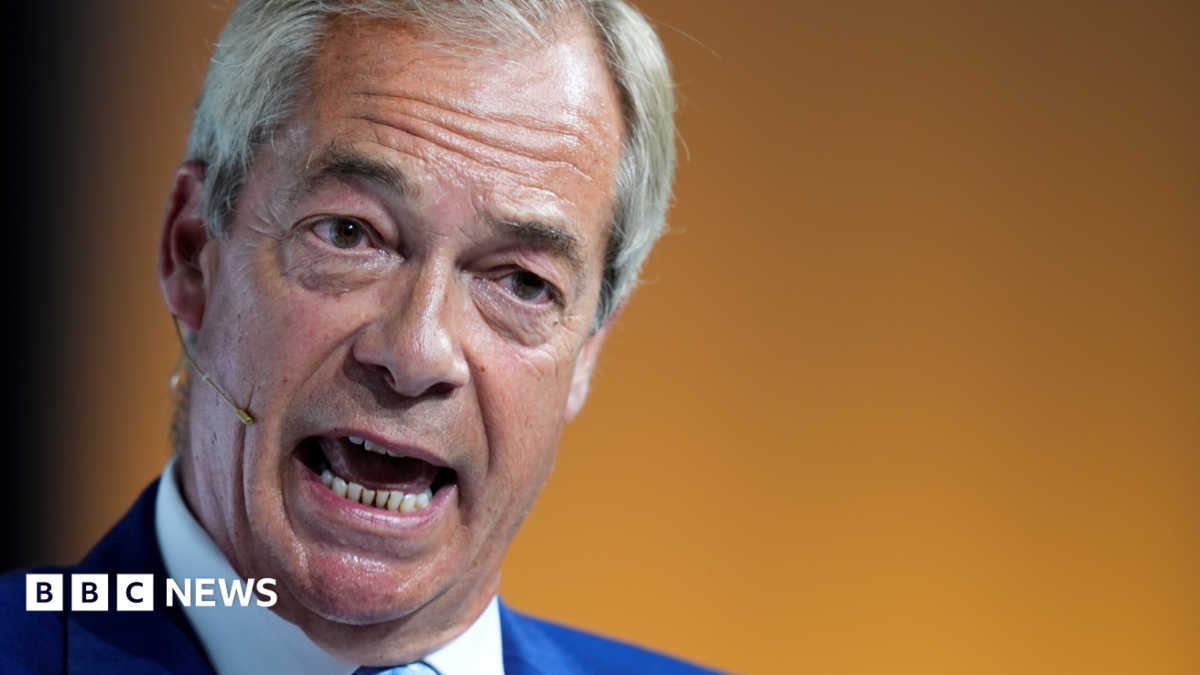
When he became an MP, Farage registered a £9,253 trip to Belgium donated by Cottrell in April 2024, before the election. He went on to register a £15,276 donation from Cottrell for a US domestic flight in December 2024.
However, he has not declared any further support from Cottrell, or the £5m he received from Harborne, arguing he was not required to do so under the rules.
In interviews towards the end of June, the Reform UK leader said he had chosen to earmark the £5m sum from Harborne for his future security costs, arguing he would require protection “for the rest of my life”.
However, he stressed the gift was “unconditional” and how he spends it was “entirely up to me”. Speaking to ITV, he said he was yet to spend the money.
Advertisement
In an interview after the Sunday Times story was published, Reform Treasury spokesman Robert Jenrick said Cottrell had contributed towards Farage’s staffing and security costs before he was an MP.
“You’re allowed to accept a gift, support, whatever you want to call it, from a personal friend before you’re a Member of Parliament if it’s in a purely personal capacity,” he added.
Farage is yet to face media questions about support provided by Cottrell detailed in the Sunday Times report. In a statement, he said he had “followed the rules” and was the victim of an “establishment hit job”.
Lawyers for Cottrell say he disputes “allegations and assertions” in the Sunday Times report, and he was reviewing the matter with legal representatives.
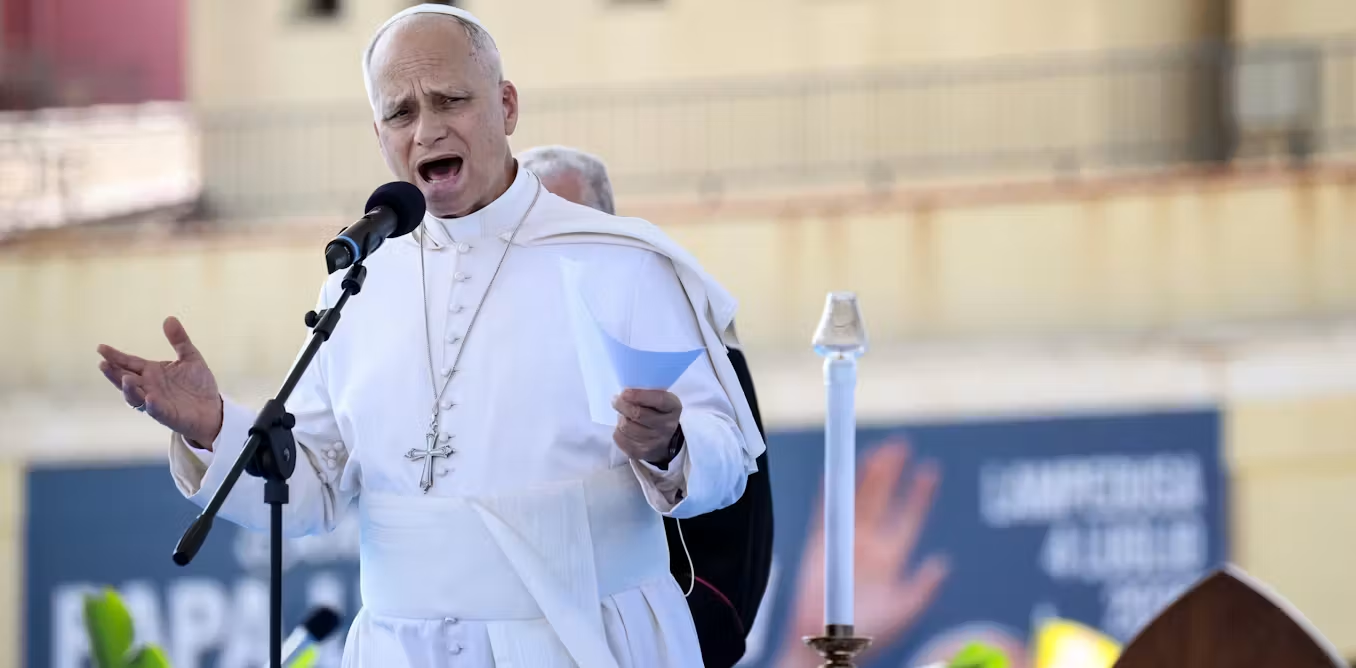
As the US celebrated its 250th anniversary, Pope Leo XIV decided instead to visit the Sicilian island of Lampedusa.
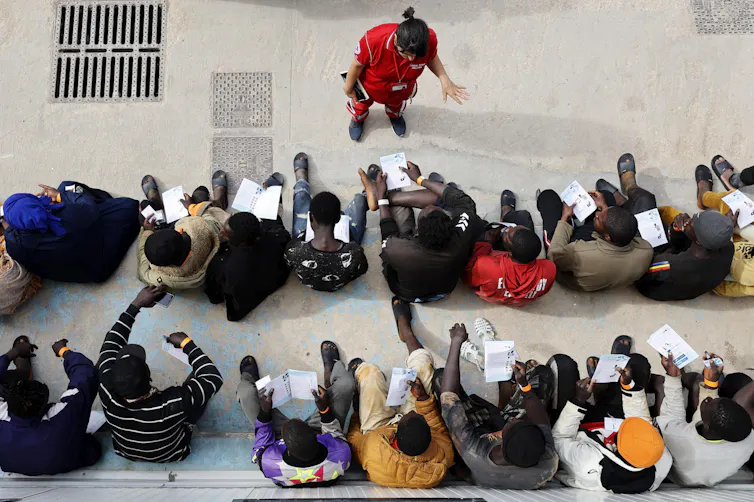
Closer to Africa geographically than to Italy, the island is known as a place of sbarchi (sea landings) for thousands immigrants and asylum seekers journeying from Africa to Europe, and a place where thousands of others have died. While there, the pope visited the Door of Europe memorial for migrants who have died on the journey, and prayed at some of their graves.
His homily called on European leaders to rise to the “momentous challenge” of addressing migration. This, he said, should include “receiving, protecting, supporting and integrating migrants” and a move away from “emergency” policies.
Many anticipated the visit would further sour the already tense diplomatic relations between the Trump administration and the Holy See. Leo has already called Trump’s treatment of immigrants “inhuman”.
Advertisement
In June, the pontiff visited the Canary Islands, where he spoke to migrants, telling them “You are not numbers or files, you are people”. Migration and human dignity were also central to his message to Americans on receiving the National Constitution Center’s Liberty Medal: “The moral greatness of a nation is manifested, above all, in its capacity to support, protect and cherish the lives of all, especially the most vulnerable and those whose worth is questioned.”
His letter to Americans on the 250th anniversary of the US said that the Catholic principle of “defending human life also includes welcoming, protecting and assisting immigrants”.
In visiting Lampedusa, Pope Leo explicitly signalled the continuity of his pontificate with that of Pope Francis. Although Lampedusa is in Italy, Pope Francis’ visit to the island in 2013 was regarded as his first “international” trip. The flow of people, cultures and religions traversing this tiny piece of land is truly global, and so are the policy responses that are needed to address it.
Pope Francis made a series of visits to borderlands and areas of crossing and displacement along the Mediterranean. This included trips to migrant and refugee reception and identification centres in Lesbos (2016 and 2021) and to the busy multicultural port-city of Marseille, in 2023.
Advertisement
As Francis pointed out on a 2014 visit to the European parliament, the Mediterranean – once the cradle of civilisation – has become a massive graveyard. According to the Missing Migrants Project, more than 35,000 people have died or been recorded missing attempting to cross the Mediterranean since 2014.
The pope prayed at the graves of migrants who had died on the journey to Lampedusa. Ciro Fusco/EPA-EFE
Throughout his pontificate, Francis insisted on the need to overcome divisions, othering, tribalism and the “globalisation of indifference” around human life.
The parable of the Good Samaritan, the stranger who tended the wounds of the traveller mugged on the road, featured prominently throughout Francis’s pontificate. Francis also hosted 12 Syrian refugees in the Vatican after his Lesbos visit in 2016.
Popes and migration
Catholic and other faith traditions have a long history of assisting those on the move, whether war refugees, slaves, economic migrants. Francis’s novelty was twofold: the frequency and emphasis of his appeals for the dignity of migrants, and the approach of visiting those on the margins while also speaking up in the international diplomatic context.
Advertisement
Leo XIV has continued Francis’s approach of standing with those on the margins and discarded from society. This is typical of the personalist Catholic tradition that emphasises the importance of human relations.
Leo signalled the centrality of migration to his pontificate when he visited Spain in June, meeting migrants, activists and professionals in Tenerife. He condemned human trafficking and appealed to “human conscience” and “responsibility” to respond from all sectors of society – not just religious or humanitarian bodies.
Pope Leo has also expressed his support for the rights of migrants in relation to US domestic politics. He appointed several bishops who came to the US as migrants, and backed the US bishops who stood up against round-ups by Immigration and Customs Enforcement.
His speech in Lampedusa made reference not just to the dignity of migrants, but also the potential of international economic, political and diplomatic solutions: “Europe is capable of addressing the crisis — in this region — in a comprehensive manner … This is a task not only for public institutions but also for civil society as a whole and for the Church.”
Migration is a global issue, intertwined with conflict, politics and climate change, that cannot be solved by countries individually. The pope’s visit to Lampedusa is therefore not just an example of “compassion” towards others at a time of emergency. It is a message of “serving together” for our common human family, in the imperfect reality of the present.
“God needs no passport”, wrote American sociologist Peggy Levitt in a pioneering book on religion and migration in America. By wearing his hat as head of a global universal faith (and the largest religious institution in the world) and by going to meet those that have crossed perilous waters and borders fleeing violence and insecurity, Leo is bypassing – not countering – the logic of diplomacy and of the state system. When popes go to Lampedusa, the international community should heed the message.
Balogun was shown a straight red card during the United States’ last-32 victory over Bosnia and Herzegovina for a challenge on Tarik Muharemovic in which he appeared to scrape his studs down the calf of the defender before landing on, and twisting, his ankle.
The forward has been an influential player for the World Cup 2026 co-hosts and would have missed the last-16 clash with Belgium due to a one-match ban following his dismissal.
But it came as a surprise to see the independent Fifa Disciplinary Committee invoke Article 27 of the disciplinary code – which states: “The judicial body may decide to fully or partially suspend the implementation of a disciplinary measure” – and suspend Balogun’s red card penalty for a year meaning he can play in the game.
Advertisement
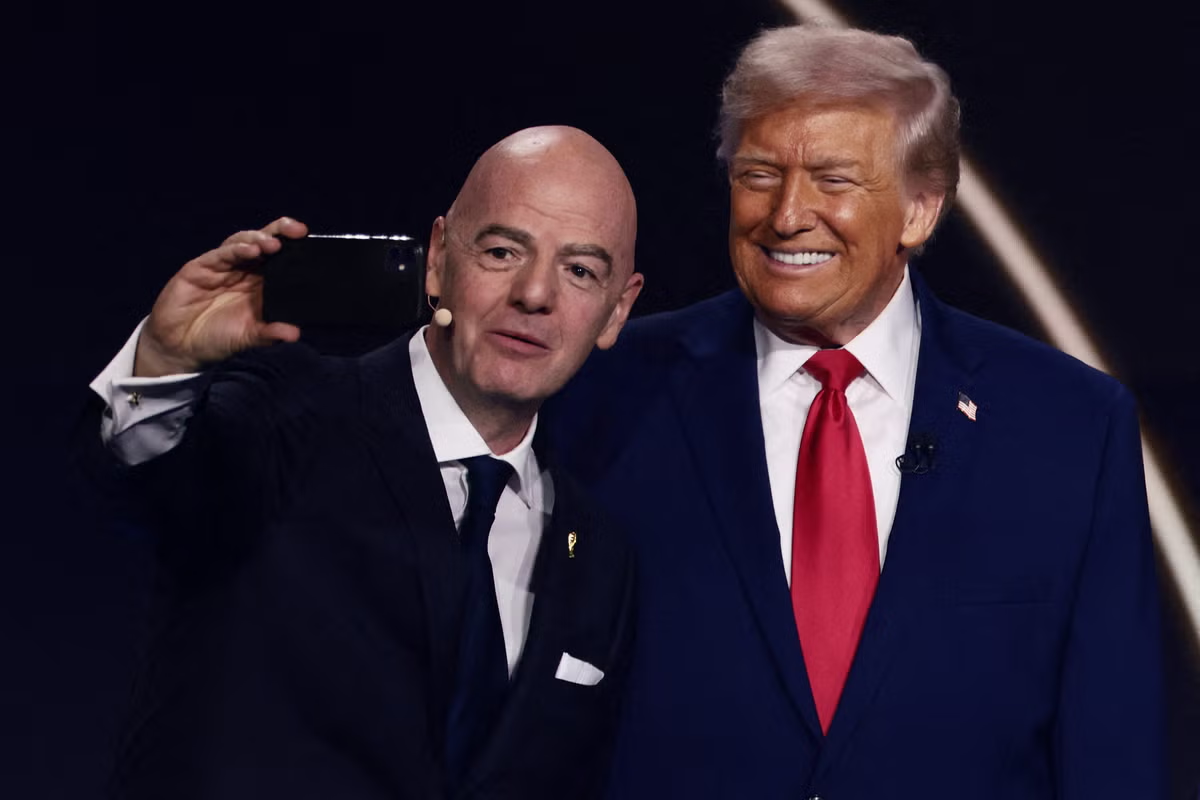
That decision followed a conversation between Trump and Infantino leading to widespread rumours of the US president influencing and impacting on the World Cup.
However, Infantino defended his conversation with Trump and explained how the process had remained an independent judgement.
On Monday he released a statement which reads: “I have seen the public comments regarding the decision of the independent FIFA Disciplinary Committee related to the suspension of Folarin Balogun, and I would like to reiterate a fundamental principle of FIFA’s governance.
“FIFA’s judicial bodies are independent. They operate autonomously, apply the FIFA Disciplinary Code, and decide cases based on the applicable regulations and the specific facts before them. Their independence is essential to the credibility and integrity of football, and this must always be respected.
Advertisement
Folarin Balogun has had his red card suspended and will be able to play for the United States against Belgium (Getty)
“Yes, I regularly discuss matters related to the FIFA World Cup with the President of the United States, and on this matter, I did receive a call from President Donald Trump, just as I receive calls from heads of state, government officials, football stakeholders and business executives from around the world on many different issues. During our conversation, I explained that there was an ongoing legal process involving FIFA’s independent judicial bodies and that the case would be decided in due course by the competent bodies. That is how FIFA’s system works, and it is a principle that I will always uphold.
“I read the decisions of the FIFA Disciplinary Committee when they are issued. Sometimes I am surprised by them. Sometimes I agree with them, and sometimes I disagree.
“What I always do, however, is respect those decisions and the autonomy of the bodies that make them. Whether we personally like a decision or not is irrelevant. Respect for independent institutions and the rule of law is what protects the integrity of our competitions and the credibility of FIFA at all times.”
President Donald Trump‘s trip to a NATO summit in Ankara, Turkey, this week has European allies scrambling to keep him happy.
But the United Kingdom is showing up without a definite plan for reaching an important defense spending benchmark, according to Politico, who wrote that European leaders were desperate to avoid a Trump ‘blow-up.’
The US President is expected to leave Monday evening for the two-day summit, where leaders from all 32 member countries will be there.
He is expected to meet with Turkish President Tayyip Erdogan, Ukrainian President Volodymyr Zelensky, and Syrian President Ahmad al-Sharaa during the summit.
Advertisement
Trump will also be looking to evaluate NATO’s progress on defense spending goals, a point of long-standing friction between Trump and Europe.
NATO countries have committed to spending 3.5 percent of GDP on defense by 2035.
UK Defense Secretary Dan Jarvis told Politico that making a plan for the benchmark was ‘mission critical,’ adding that while in Ankara he would emphasize his desire to make a plan.
Advertisement
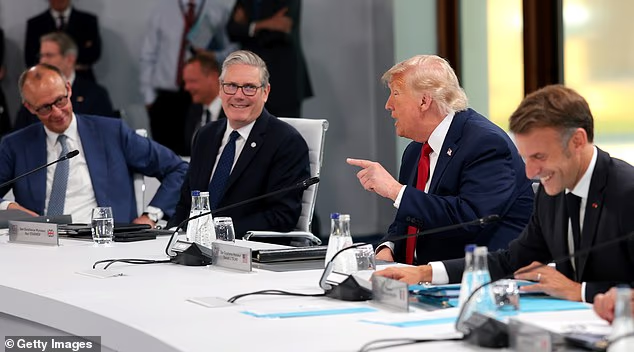
(L-R) German Chancellor Friedrich Merz, UK Prime Minister Keir Starmer, US President Donald Trump and French President Emmanuel Macron during theJune G7 Summit in France
NATO Secretary General Mark Rutte (L) meets with US President Donald Trump in the Oval Office in June
Starmer, who is about to leave office, handed down a difficult defense spending situation to his successor
Advertisement
But a research fellow at King’s College London was unimpressed by Jarvis’s assurances.
‘Our allies want us to have fully funded, accelerated plans to reach the 3.5 percent commitment,’ Sophia Gaston told Politico of the NATO summit. ‘They also want consistency and clarity of leadership. We will be bringing neither.’
Just last week, the President renewed his criticisms of Europe’s defense spending when he posted a chart comparing several countries’ defense budgets to that of the US.
‘Ridiculous for the USA to continue along this one sided path when the relationship is not reciprocal,’ he captioned the post.
Advertisement
The spending numbers in his chart appeared similar to those in a NATO release based on data through last June that projected 2025 defense spending by NATO countries.
Total US defense spending dwarfs that of NATO allies, though it is not the largest as a percentage of GDP.
The President has also sharply criticized the alliance for its relatively hands-off approach to the war in Iran, telling multiple news outlets earlier this year that he was considering withdrawing the US from the alliance.
NATO Secretary General Mark Rutte has flattered Trump in an effort to preserve US involvement with the alliance while touting progress towards NATO spending goals.
Advertisement
Rutte arrives at Ankara Airport on Monday ahead of the summit
The President also suggested that he had seriously considered not attending this week’s summit.
He credited Turkey’s President Tayyip Erdogan with getting him to come.
‘Except for the fact that [the summit] was being held in Turkey by President Erdogan,’ Trump told reporters before a June meeting with Rutte, ‘I don’t think I would have gone to it.’
Advertisement
Share or comment on this article:
Panicked European leaders scramble to stop Trump ‘blow-up’ as one big NATO ally turns up without a plan
Scots deserve clarity on the SNP’s currency plans now if the party is serious about an IndyRef2, says Chris McCall
17:02, 06 Jul 2026Updated 17:15, 06 Jul 2026
Advertisement
Cash may no longer be king in the age of banking apps on smartphones, but coins and banknotes still grip the imagination when it comes to the debate over Scottish independence.
Last year, it was reported Kate Forbes had told SNP members not to talk about the party’s currency policy.
The then deputy first minister’s comments were found in minutes of a summer meeting of the SNP’s Skye branch, leaked by a party activist, in which she was recorded as saying “we must avoid publicly talking about currency”.
So why the reluctance?
Advertisement
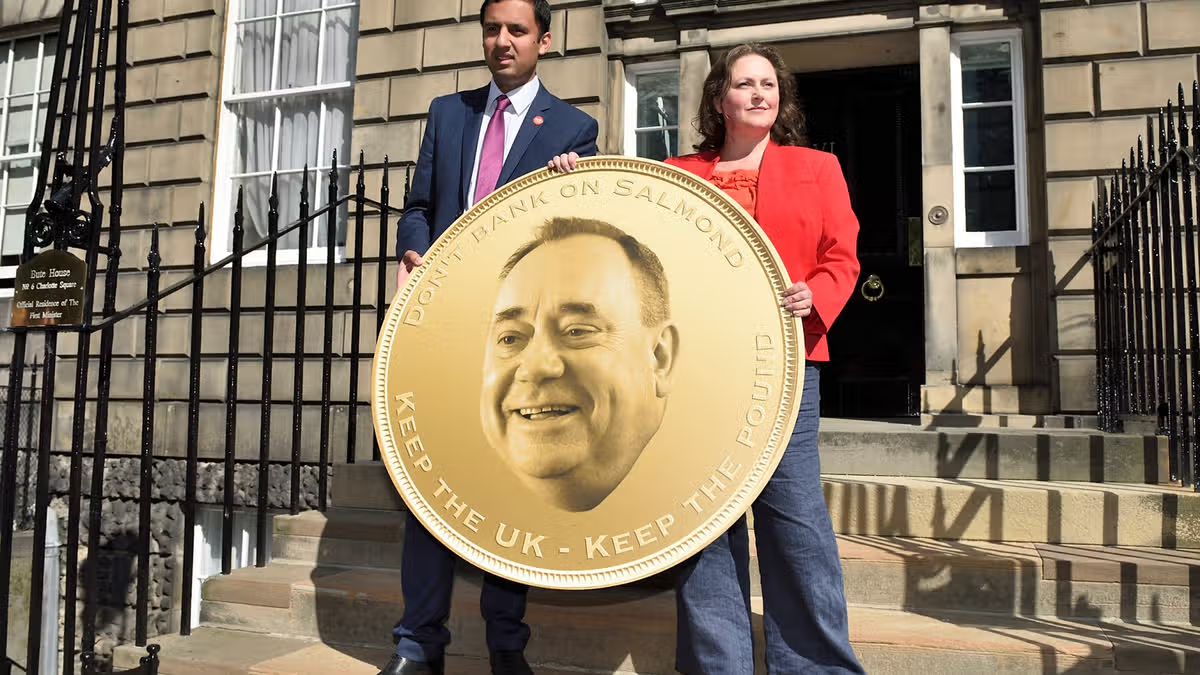
You may recall that during the run-up to the 2014 referendum, Anas Sarwar stood outside Bute House with a large mock-up of a pound coin with Alex Salmond’s face emblazoned on it.
The not-so-subtle point was the Yes campaign was perceived to be struggling to convince voters on what currency would be used in the event of independence.
Salmond, the then first minister, had called for Scotland to enter into a formal currency union with the remainder of the UK. This would mean Scots would continue to use the pound sterling, with Holyrood having a say on monetary policy set by the Bank of England.
He told MSPs at the time: “It’s Scotland’s pound and we are keeping it.”
Advertisement
But George Osborne, the then Tory Chancellor, effectively told Salmond to take a hike. The UK Government would not agree to a currency union, under any circumstance, he said. Osborne insisted independence would mean Scotland “walking out of the UK pound”.
It wasn’t the most memorable line of the campaign, but enough voters understood the gist. And they didn’t like the sound of it.
Salmond then floated the idea of sterlingisation. This means Scotland would carry on using the pound regardless, in the same way many smaller nations use the US dollar as their official currency.
Other prominent independence campaigners were openly hostile to the idea, Jim Sillars among them. He argued forcefully that an independent Scotland should launch its own curency.
Advertisement
He said in 2014: “We have a viable alternative, and it’s a Scottish currency with our own central bank, printing Scottish notes which we will peg one-to-one with Sterling, so there’s no difference whatsoever.”
But that was then. So what’s the position now?
In one of its many white papers on independence, the Scottish Government explained in 2022: “We propose that, on independence, Scotland would continue to use the pound sterling for a period before moving to our policy of adopting a Scottish pound.
“The change would take place as soon as practicable through a careful, managed and responsible transition, guided by criteria and economic conditions rather than a fixed timetable.
Advertisement
“While Scotland is still using sterling, many aspects of monetary policy would continue to be set by the Bank of England.”
How long is “a period”? It’s one of several unanswered questions. Another might be, is Scotland really achieving independence if the Bank of England is still calling the shots, potentially for years?
Steringisation would also present other issues, many of them complex but worth repeating. The Economics Observatory has a detailed run-down of the currency options available to an independent Scotland.
It noted: “The continued use of sterling post-independence – either under a monetary union or sterlingisation – would require a strict macroeconomic regime be put in place. This would demand short-term adjustments to Scotland’s fiscal and balance of payments position. If not, retaining sterling would be a poor anchor for an independent Scotland.”
Advertisement
It also warned: “A second challenge with sterlingisation is that any balance of payments deficit would see sterling reserves draining out of the system, along with the deflationary consequences of this.
“But with limited – and finite – inherited reserves, an independent Scottish central bank under sterlingisation would be constrained in how much leeway it would have to combat this.”
A core foundation of the SNP’s independence plan is Scotland being admitted to the European Union as quickly as possible. But it’s a well-known condition of EU membership that member states commit themselves to joining the Euro.
Sweden joined the EU in 1995 – four years before the Eurozone was launched – and is legally committed to joining the single currency. But in reality, it has no plans to do so.
Advertisement
Independence supporters believe this sets a precedent which Scotland could follow. But the reality might be different.
Alyn Smith, a former SNP MEP and now MSP, said as much in an interview with BBC Scotland today. He said: “There is a commitment to participate in economic and monetary union, yes, but there is no timescale attached to that.”
Smith also suggested a referendum would be required on whether Scots wanted to join the Euro at all.
So that’s three currency options already – the pound, controlled by the Bank of England; a new Scottish pound, which could be pegged to sterling; or the Euro, which may require a referendum.
Advertisement
If the SNP is serious about staging an IndyRef2 in the coming years, it must offer a clear answer on what it considers the best way forward and the costs involved.
Korcula island in the Adriatic Sea in Croatia (Picture: Getty Images)
Ask Metro
Use AI to go deeper into the stories you care about – powered by Metro and trusted publications.
A spokesperson for Saga Holidays said the factors were weighted to create the final ranking, ‘with green space accounting for 45%, weather 35% and food and drink availability 20%’.
Advertisement
Archipelago scores were calculated using the average score of the islands within each group, they added.
The largest of the eight Canary Islands, Tenerife is home the volcano Tedie, over 3,000 meters above sea level. Tedie National Park is a UNESCO World Heritage Site.
Due to its colossal size, Mount Teide is known to cast the largest sea shadow in the world.
The clock tower of Nossa Senhora de Fatima chapel in Sao Vicente, Madeira (Picture: Getty Images)
It is home to the world’s largest telescope, the Gran Telescopio Canarias and to Spain’s first airport powered entirely by wind energy.
It should be noted that both of these destinations – but particularly Tenerife – struggle with overtourism.
The Canary Islands received over 7.8 million international visitors in the first half of 2025, leading to it being named on Fodor’s ‘No List’ this year.
The Canaries have seen massive protests from locals, who say that unregulated mass tourism and the spread of short-term holiday lets are making life unaffordable.
Advertisement
Zlatni rat (Golden horn) on Brač, Croatia (Picture: Shutterstock / Dreamer4787)
Further down the list in third position is Madeira in Portugal.
Rounding out the top five are two Islands in Croatia: Korčula and Mljet.
The central Dalmatian island of Korčula is the sixth-largest island in the Adriactic sea with a population of less than 15,000.
Advertisement
It has been inhabited since the prehistoric times, and was later settled by the Greeks in 6th century BC, before later being conquered by the Romans in 1st century BC.
Known as ‘Croatia’s greenest island’, 70% of Mljet is pine and oak forests. In the middle of Veliko Jezero lake is a tiny islet, home to an ancient 12th-century Benedictine monastery.
Like Korčula, Mljet has ties to classical history. Legend has it that it was the island where the nymph Calypso lived and held Odysseus for seven years.
Advertisement
This has led to a local cave being nicknamed ‘Odysseus Cave,’ where boat companies offer trips.
Mljet is ‘relatively under the radar’ compared to Dubrovnik and Split, Saga said, making it a ‘great addition to your Croatian holiday.’
The St.Mary benedictine monastery on the Mljet island (Picture: Shutterstock / Renata Sedmakova)
In sixth place, it’s back to Spain, but the Balearic Islands this time, to Majorca.
Like Tenerife, this island has a a museum dedicated to its greatest sporting hero, 22 time grand-slam winner, tennis icon Rafael Nadal.
In seventh place is the island of Losinji, part of the Kvarner Islands in Croatia.
Kvarner is a European Region of Gastronomy for 2026, so Losinji is a great place to visit if your a foodie. The Museum of Apoxymenos is another draw, showcasing the islands’ ancient Greek history.
Advertisement
Cathedral of Santa Maria in Palma, Majorca’s capital, features the world’s second-largest Gothic rose window (Picture: Getty Images)
It also has a natural harbour and is popular for nearby dolphin watching and hiking trails.
Known as ‘The Island of Vitality’, Losinji is a popular wellness destination thanks to its rich biodiversity and being home to over 1,200 therapeutic herbs.
Next on the ranking is Brač in Croatia (you might be sensing a pattern here).
It is also one of the sunniest Dalmatian Island with 2,700 hours of sun annually, and home to more than 100 churches despite only having a population of 13,900.
Brac Island is the longest and most elevated island in central Dalmatia, 48km long, 14 km wide, covering 394 square kilometres. Despite its proximity to Split, Brac is less touristed than the glittering islands of Hvar and Korcula further south. No celebrities or tycoons glide their yachts into Brac harbors nor do politicians stroll village steets. For that reason, it provides an excellent window into authentic island life, particularly in the interior. Brac also has an extensive and fascinating history as it has been inhabited since Neolithic times. The olives are of a rare variety called buhavica and there’s over a half-million trees. Olive cultivation dates back to the Venetian years. Back in 1655 the Venetian senate insisted that the island be carpeted with olive trees and imposed fines upon anyone with the temerity to damage the trees. The highest peak on Brac Island is Vidova Gora at 778m which is the highest peak on the Adriatic islands. The interior of Brac is mostly small valleys and fields while on higher ground, north of Vidova Gora you’ll find an endemic species of pine. Along the coast the woods are mainly Aleppo pine. Bol is a small village that hosts a big, beautiful beach. Zlatni Rat or Golden Beach is one of Croatia’s best beaches. It’s a beach that changes from shallow and shady to sunny and deep, depending on the time of day and the wind. #croatia#croatia🇭🇷#croatiatiktok#brac#island#islandlife#holiday#summer#summervibes#travel#traveltiktok#travellife#traveltok#traveling#traveltips#travelbucketlist#fyp#foryou
One of its most striking geological features is the Caldera de Bandama, a volcanic crater measuring 1,000 meters in diameter and 200 meters deep.
Advertisement
It is a popular golfing destination, and holds seven different courses, with its year round warm weather making it ideal for the outdoor sport.
Aguimes town in Gran Canaria, Canary Islands, Spain (Picture: Shutterstock / DaLiu)
Compared to the other Canary Islands, La Gomera is quiet and unspoilt. You would be hard pressed to find a British pub or bar strip.
Rather than huge resort hotels, hotels are more boutique and locally run. This lesser known Canary Island is a short ferry trip from Tenerife, as it does not have an airport. It is known for its scenic hiking trails, rain forests, and tiny villages.
La Gomera earned the nickname ‘la Isla Colombina’ because it was Christopher Columbus’s final port of call in Europe before setting out across the Atlantic in 1492.
Marina at Valle Gran Rey, La Gomera, Canary Islands, Spain (Picture: Shutterstock / trabantos)
What were the other categories?
Europe’s top three islands for sunny weather
1. Tenerife, Canary Islands, Spain: 88/100
2. La Gomera, Canary Islands, Spain: 86/100
3. Gran Canaria, Canary Islands, Spain: 85/100
Saga Holidays called the Canary Islands the best ‘all-rounder.’
Europe’s top three islands for food
Advertisement
1. Capri, Italy: 75/100
2. Sardinia, Italy: 66/100
3. Santorini, Greece: 65/100
Europe’s top three islands for greenery and nature
1. Mljet, Croatia: 86/100
2. Madeira, Portugal: 85/100
3. Korčula, Croatia: 83/100
Alternative islands for you to explore
Need more European island inspo? Metro‘s got you covered.

















































You must be logged in to post a comment Login