

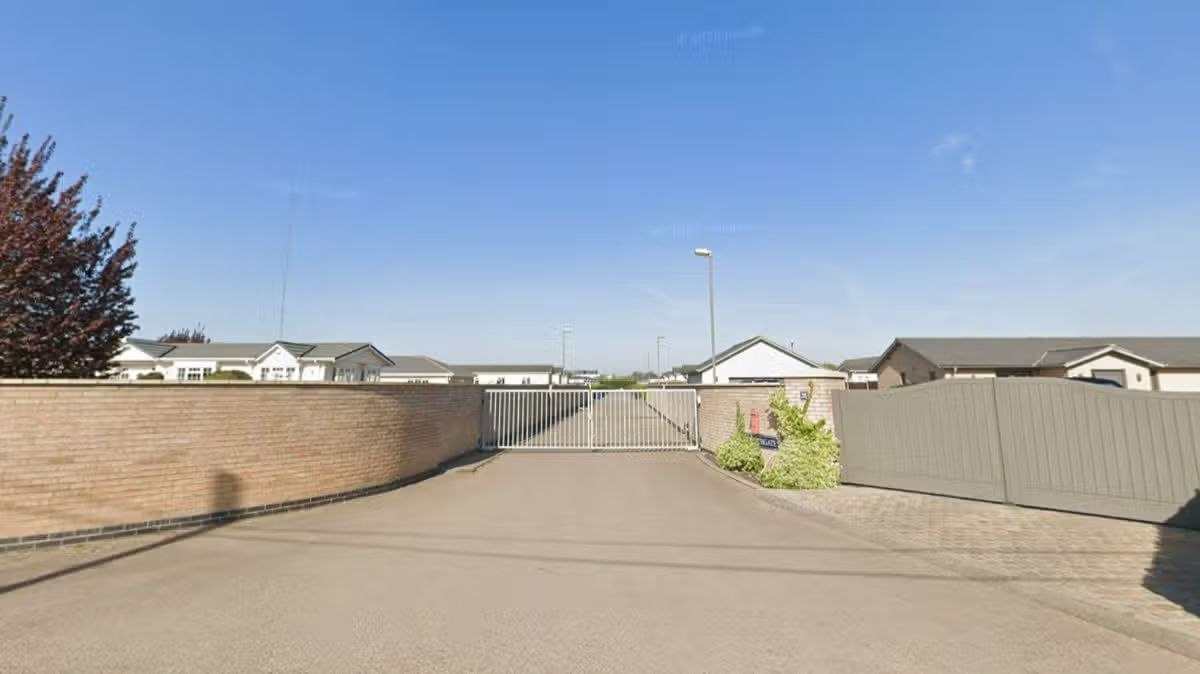
South Cambridgeshire District Council ordered the unapproved mobile homes at Southgate Caravan Park to be removed – but a government inspector sided with the site owner
An inspector has allowed the owner of a Cambridge Traveller site to keep extra mobile homes put up without permission after an appeal against the council.
Planning permission was granted in 2008 for 24 mobile homes and two chalets to be sited at Southgate Caravan Park off Fen Road for use solely by Travellers.
South Cambridgeshire District Council issued an enforcement notice in February alleging that more mobile homes had been added and others subdivided. Amos Webb appealed to the Planning Inspectorate with a hearing held on July 14.
The council also said that nine of the mobile homes were “used by persons of several ethnicities and did not identify as Gypsies or Travellers”.
Mr Webb disputed this and said he had made sure all residents were from the Gypsy or Traveller community by checking they “could speak Roma”.
Inspector M Madge said there was no “substantive evidence” to show that only Gypsies or Travellers have used the site.
Mr Webb also appealed on the grounds that the “time that action could be taken had passed”. This was accepted for two of the mobile buildings as they could be shown to have been there for 10 years or more “without significant interruption”.
A building alleged by the council to be an “additional unit of accommodation” was found by the inspector to instead be used as a garage. It can be seen in aerial photographs dating back as far as April 2015.
Another mobile unit was also in photographs from this period. Mr Webb said it was used to provide “additional sleeping and showering facilities”. The council argued this was used as a separate home as it was fenced off from the surrounding pitches.
Inspector Madge said it was “not clear what purpose this mobile home serves” but “it would not be unreasonable to conclude it contains all the required facilities for day-to-day domestic existence”.
There were multiple mobile homes “substantially larger” than the others which the council alleged were sub-divided. The inspector said Mr Webb did not provide any “substantive evidence” to disprove this.
The inspector said these larger units were only visible in aerial images as far back as May 2017, less than the 10-year cutoff. Three more mobile homes were seen to have been placed on the land somewhere between June 2023 and March 2025.
The inspector said that the extra units do not “significantly reduce” outside space and, “seen against a backdrop of mobile homes”, do not “have any adverse effect on the character and appearance of the countryside”.
Though planning permission was only given for 26 homes, they said each pitch “is of a sufficient size to accommodate a mobile home along with associated vehicles, touring caravans and outside amenity space for residents.”
Inspector Madge accepted Mr Webb’s argument that, “as families grow”, residents on the pitches needed extra accommodation or dayrooms and that these extra units “would make a positive contribution” to “facilitating the traditional lifestyle of the authorised users of the caravan site”.
They granted planning permission for the additional mobile home units – under the condition they cannot be used as independent homes “to prevent overcrowding”.






















































You must be logged in to post a comment Login