Connect with us

NewsBeat

Can Britain’s railways cope with ever-more extreme heat? An expert Q&A

Published

on

Can Britain’s railways cope with ever-more extreme heat? An expert Q&A

On August 14, the hottest day of an exceptionally hot summer, a train derailed near Lewes in East Sussex, England. Three carriages tipped over and two people were seriously injured. The following day, another train derailed in Essex.

We don’t yet know what caused either derailment, and the UK’s Rail Accident Investigation Branch is still gathering evidence. Network Rail – the public body that owns and manages most of Britain’s railway network – said in response that this summer’s repeated heatwaves have “presented exceptional challenges to the railway”. We do know that heat poses particular problems for railways, and that heat-related failure is an increasing risk in the UK as temperatures rise.

Xueyu Geng is a Professor in Ground Engineering at the University of Warwick, and an expert in railway track design and embankment stability. The Conversation asked her about the key challenges for a rail network in heatwaves, and how trains can stay safe and efficient in ever more extreme heat.

What happens to railways in extreme heat?

Steel expands when heated. Most of the network uses continuously welded rail: long lengths that are effectively restrained by the sleepers, fastenings and ballast, rather than jointed sections that can expand freely. When the rail heats up it wants to get longer but can’t, so it builds up substantial compressive stress instead.

Advertisement

If that stress exceeds the track’s resistance to sideways movement, the track can shift sideways, causing a thermal buckle. That’s why extreme heat is a genuine safety issue, not just a comfort-and-delays problem.

Rail temperature and air temperature are also two different things. Direct sunshine matters a lot: a stretch of track in full sun can run considerably hotter than a shaded section experiencing the same air temperature.

Temperature is only half the story, though. Ballast – the layer of crushed stones beneath the tracks – along with sleepers, fastenings and the condition of the track and ground all affect how much sideways movement it can withstand.

So there’s an important distinction between a “hot rail” and an “unstable track”. A railway can run a high rail temperature safely if the track system as a whole has enough resistance in reserve.

Advertisement

Is this a particular problem for Britain? Do hotter countries manage it better?

I wouldn’t say British infrastructure was simply designed for the “wrong” temperature; British engineers have always had to design for thermal expansion and contraction. The more fundamental issue is that the climate is shifting during the working life of the infrastructure.

Historically, the extreme temperatures built into design and operational planning reflected a climate where very high temperatures were rare. We’re now seeing heatwaves that are more frequent and that push into a temperature range many existing assets simply didn’t experience for most of their service life.

There are already examples of heat causing derailments. For instance, in 2015 a freight train derailed near Langton, Lincolnshire, on the hottest day of the year to that point. An investigation found the track had buckled in the heat.

The risk is now being managed at increasingly high temperatures. On July 19 2022, the UK’s first day over 40°C and still its hottest ever day, operators shut down one of the main lines linking London to northern England and Scotland. The closure was a precaution: rather than risk trains encountering buckled track, operators stopped services during the hottest part of the day.

Advertisement

Extreme heat is especially awkward for a railway specifically, because the infrastructure is so tightly constrained, you can’t let a track drift sideways even slightly, since wheel-rail interaction depends on very tight tolerances. Two adjacent stretches of track exposed to identical weather can have very different resistance to buckling, depending on their stressing history, ballast condition, fastenings, geometry and the ground underneath.

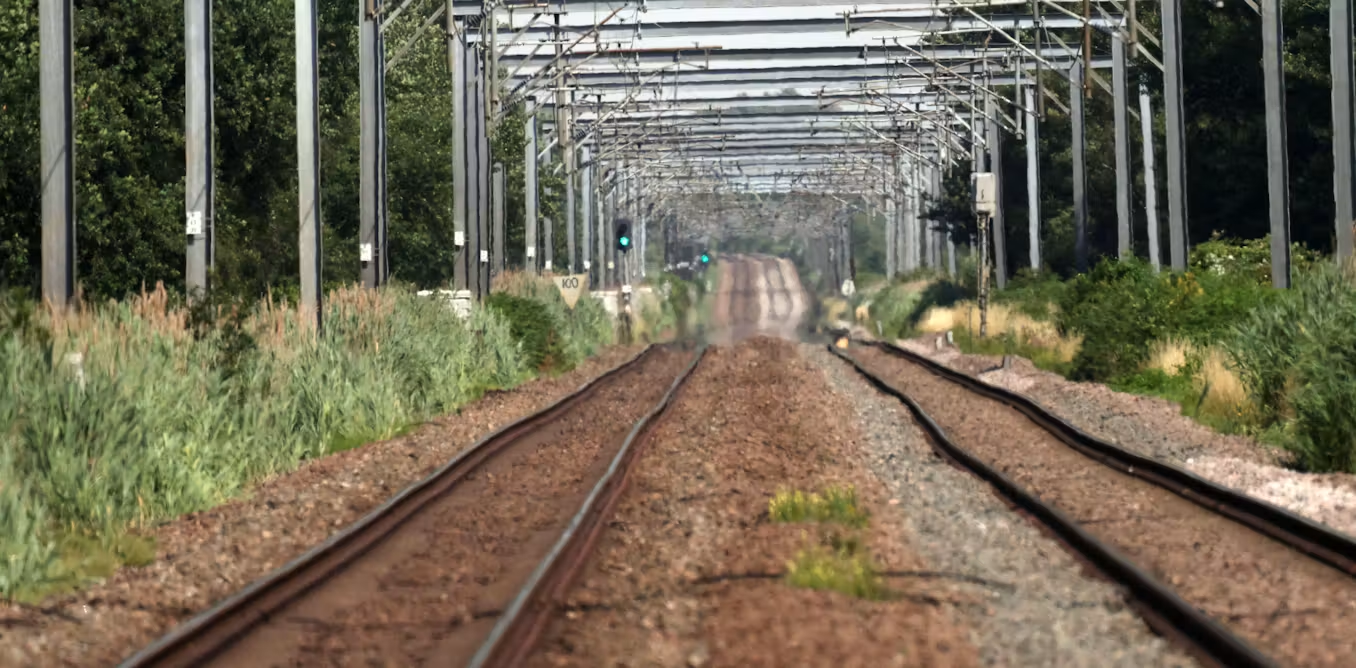
Trains and their tracks must be perfectly aligned.
omegamezle / unsplash, CC BY-SA

There’s no single “heat-proof” railway technology to copy from hotter countries. What they have is the advantage of treating high heat as a normal design condition rather than an exceptional one, with track designed, maintained and operated accordingly.

Our design assumptions and maintenance strategies need to reflect the climate the railway will actually experience going forward, not the climate it was built for.

Advertisement

How have railways adapted, and what would a truly climate-proof railway involve?

The biggest shift needed is from a “reactive” to a “predictive” approach. At the moment, when extreme heat is forecast, operators step up inspections, monitor rail temperature, and impose speed restrictions where needed. Useful, but it’s responding to immediate risk rather than anticipating it.

The next generation of railway management should bring together weather and solar radiation forecasts, actual rail temperature, track geometry, rail stressing history, ballast and fastening condition, drainage, ground and embankment condition, and train speed and traffic loading. Put those together and you can identify which specific sections of track are vulnerable, rather than treating an entire route as uniformly at risk.

This is where new technologies have a strong role to play. Remote sensors, “digital twins” (computer models of a train system that can be updated with real-world data) and modern data science can all help spot a section approaching a critical condition before it becomes unsafe.

A truly climate-resilient railway isn’t just “stronger rails in the ground”. Prolonged hot, dry weather can change ground moisture and affect earthworks at the same time as thermal stress is building in the rail itself. That’s why resilience has to cover everything from train tracks and drainage to signalling and power systems, all together, not rail steel in isolation.

Advertisement

Should we design new tracks, or retrofit old track, for the heatwaves of the future?

Railway assets have very long lives: a track, bridge or embankment built or substantially renewed today could still be in service in 50 or 100 years. That creates a fundamental mismatch between the current design life and a climate that keeps changing within that lifetime.

The right question isn’t “can this new track cope with today’s hottest day?” It’s “what climate will this asset have to withstand across its whole life?”

This hits railways harder than most other transport modes, for a specific reason: the track has to stay precisely aligned. Roads suffer in heat too – asphalt softens, concrete expansion joints get stressed – but a road vehicle has rubber tyres and steering, giving it some lateral tolerance for minor surface movement. A railway wheel and its raised inner lip – the flange – don’t have that margin. Continuously welded rail has to stay within millimetre-scale geometric tolerance over very long, continuous lengths, with compressive stress building as temperatures rise.

For new infrastructure, climate projections for the middle and later parts of this century should be part of engineering decisions now, because that infrastructure will still be in service then. But I wouldn’t design every component to withstand an extreme 2100 temperature outright: that risks enormous, unnecessary cost for conditions that may not materialise for decades.

Advertisement

The better approach is risk-based adaptation: build appropriate resilience into new infrastructure from the outset, and for the existing network, identify the specific sections where future climate creates unacceptable risk and progressively retrofit those. That might mean improving ballast resistance, drainage, embankment stability, monitoring or thermal management, depending on what the local vulnerability actually is.


Source link

Advertisement
Continue Reading
Click to comment

You must be logged in to post a comment Login

Leave a Reply

NewsBeat

Zero-hours contracts are about to change in the UK

Published

on

Zero-hours contracts are about to change in the UK

Employers in certain sectors will have been concerned to read reports from the UK government that the costs of promised reforms to “zero hours contracts” under the Employment Rights Act 2025 may be anything up to £2.9 billion.

The changes, due to be implemented in early 2027, are designed to redress what are seen as “one-sided” working arrangements under which workers bear all the financial risk of fluctuations in demand for their labour.

In December 2025, the number of people working under zero hours contracts as their only or main employment was 1.23 million, with young workers and all workers in the retail and hospitality sectors being disproportionately represented in those figures.

The term “zero hours contract” first appeared in academic literature in 1997, but even then, it was still seen as a shorthand description for a collection of employment practices that had been developing from the 1980s onward.

Advertisement

The term was not used or defined in UK legislation until 2015. The use of zero hours contracts expanded significantly after 2008, as businesses sought flexible ways to manage employment arrangements in the aftermath of the global financial crisis. The flexibility offered to both employers and workers to plan for fluctuations in demand for and supply of labour is still seen as the primary advantage of zero hours contracts.

Controversial from the start

Zero hours contracts have been controversial from the outset. Worker representatives view “flexibility” as synonymous with “exploitation” of vulnerable and low-income workers, who are said to be disadvantaged by the lack of job security and guaranteed stable income levels. They bear the cost of last-minute changes or cancellations of shifts.

The changes in the Employment Rights Act 2025 represent a watering down of the 2024 Labour general election manifesto pledge to “ban” zero hours contracts. But nevertheless, the new statutory provisions represent the most radical change to this form of working arrangement since its inception.

The provisions are mindbogglingly complex, and the fine details are still to be worked out through ministerial regulation.

Advertisement

The main changes to zero hours contracts are the introduction of:

  1. a duty on employers to offer guaranteed hours to workers, based on the average number of hours the worker regularly works over a “reference period” – yet to be defined, but there is a general view that this may be 12 weeks

  2. a duty on employers to give “reasonable” notice of shifts and shift changes or cancellations, with compensatory payments to be made to workers in the absence of such notice

  3. a right for workers not to suffer detriment or be dismissed for accepting or rejecting an offer of guaranteed hours, with any dismissal primarily for this reason being deemed automatically unfair

The duty to offer guaranteed hours would only apply to workers on contracts where the existing contractual hours were below a (yet to be decided) threshold.

Similarly, there would be no obligation to offer guaranteed hours to workers on short-term contracts which were shorter than the reference period. It must also be borne in mind that workers who are content with the zero hours contracts arrangement are under no obligation to accept an employer’s offer.

Many workers in hospitality are employed on zero hours contracts.
BearFotos

It is difficult to judge whether the costs estimate provided by the government is accurate in the absence of clear information on how notions of threshold hours, reference periods and reasonable notice are defined and measured. The higher the number of threshold hours – the government has indicated that this could be anywhere between 8-20 hours per week – the greater will be the costs to employers of the duty to offer guaranteed hours of at least that number.

Advertisement

Attempts to avoid triggering the duty by agreeing contractual hours just above the threshold are likely to backfire if the threshold is set at a level that is unsustainable during quiet periods of work. Employers will need to exercise caution when identifying the reference period, as calculating regular hours over a busy period may result in guaranteed hours that are unaffordable during the quieter periods that follow.

The use of contracts which are of shorter duration than the reference period may represent a cost saving, but this may be outweighed by the cost of having to prove that the use of such a contract was reasonable.

Payments of salary or compensation for last minute changes to or cancellations of shifts is likely to represent a significant cost to employers, but this is likely to be borne disproportionately by employers in sectors where such events are common but unpredictable.

Unwanted costs

For businesses which currently use zero hours contracts, some costs, such as the administrative costs of calculating regular hours of workers and the need to update payroll systems, are going to be inevitable. Other potential costs, which may not be so obvious, could include termination payments to workers by employers unable to sustain current workforce levels, or legal fees to explain the impact of the changes.

Advertisement

The statutory changes will impose additional unwanted costs on employers. How much those costs are likely to be can only be guesswork in the absence of further government regulation.

Employers will have to weigh up the continued advantages of flexibility against these additional costs in deciding whether zero hours contracts still meet the requirements of their business models.

This is likely to produce a different answer in different sectors of the economy. The changes also raise the question whether they will achieve the certainty of work hours and stable incomes for workers when the cost to employers may be too much to be sustainable.

Advertisement

Source link

Continue Reading

NewsBeat

How Prince Harry and Meghan Markle’s American dreams failed as family leave California after tanked million-dollar Hollywood deals

Published

on

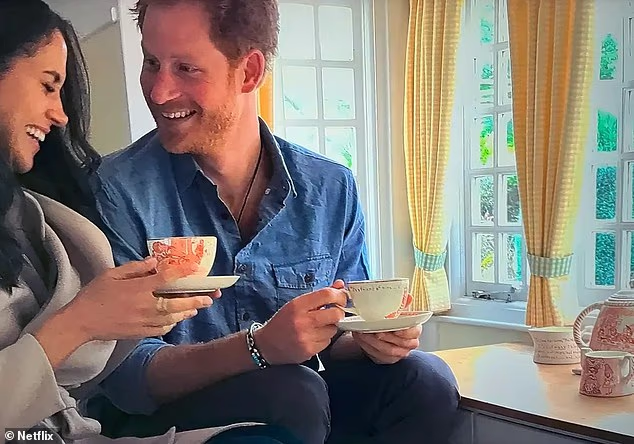
Harry and Meghan laid bare their grievances with the Royal Family in their explosive six-part Netflix docuseries Harry & Meghan, released in 2022

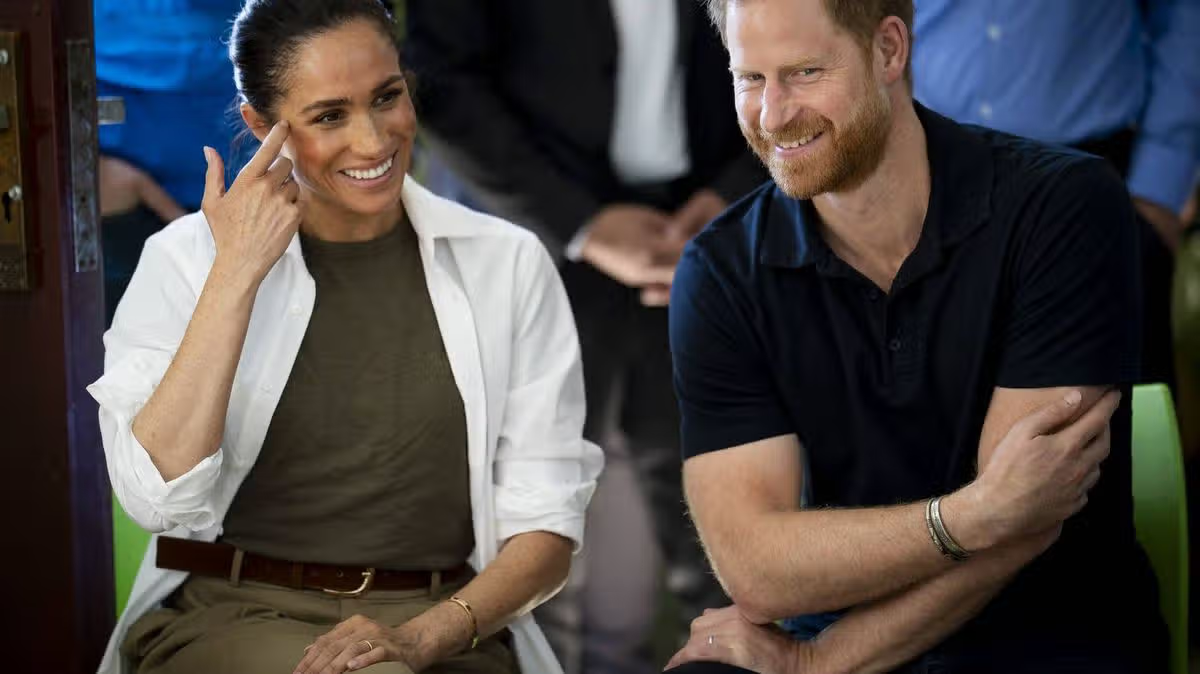
Prince Harry and Meghan Markle’s bombshell decision to move their family back to Britain six years after fleeing royal life is likely to be seen as the most dramatic admission yet that their grand plans to conquer America have failed.

The Duke and Duchess of Sussex swept into California in 2020 with Hollywood seemingly at their feet, armed with their royal titles, global fame and blockbuster deals worth tens of millions of dollars.

There was a reported $100 million Netflix agreement. A $20 million Spotify contract. Podcasts, documentaries and television shows were promised. 

Archewell Productions was supposed to turn the Sussexes into serious Hollywood power players, while Meghan later attempted to reinvent herself as a lifestyle entrepreneur.

Advertisement

They settled into a $15 million mansion in sun-kissed Montecito, surrounded by billionaires and A-list celebrities, as they embarked on what was supposed to be an extraordinarily lucrative second act.

But six turbulent years later, the couple are heading back across the Atlantic.

News that Harry and Meghan plan to return to Britain for an extended period and enroll Archie, seven, and Lilibet, five, in an English school suggests the couple have accepted that their American adventure has not delivered the glittering commercial empire once envisaged.

The Spotify deal is long gone. Their original Netflix contract has ended. The duchess’s With Love, Meghan lasted two seasons. 

Advertisement

Harry and Meghan laid bare their grievances with the Royal Family in their explosive six-part Netflix docuseries Harry & Meghan, released in 2022

In 2021, to mark her 40th birthday, Meghan Markle launched the 40x40 initiative on Zoom

In 2021, to mark her 40th birthday, Meghan Markle launched the 40×40 initiative on Zoom

A string of heavily promoted projects either struggled to find audiences or never materialized at all.

Advertisement

Even the couple’s first jointly produced feature documentary, Cookie Queens, endured a humiliating opening weekend this month when it was beaten at the US box office by a compilation of internet cat videos.

And their difficulties have stretched far beyond television.

Meghan’s lifestyle business endured an embarrassing start when American Riviera Orchard, a name unveiled with enormous fanfare in 2024, was eventually abandoned and replaced with the considerably shorter As Ever.

Her first Spotify series, Archetypes, ended along with the couple’s lucrative deal with the streaming giant, while her subsequent Confessions of a Female Founder podcast failed to generate anything approaching the cultural impact of the couple’s earliest post-royal ventures.

Advertisement

There have also been repeated reports of staff upheaval, including the departure of senior communications executives, while critics have questioned whether Meghan has managed to secure a place among America’s celebrity elite that once appeared to be hers for the taking.

The Duchess was absent from the Met Gala this year and reports have even claimed she was attempting to secure invitations to Paris Fashion Week events as her standing in the fashion world came under scrutiny.

Against that bruising backdrop, the timing of the Sussexes’ return to Britain is remarkable.

Woman of Vision Meghan, The Duchess of Sussex speaks onstage with Gloria Steinem and Teresa Younger during the Ms. Foundation Women of Vision Awards in May 2023

Woman of Vision Meghan, The Duchess of Sussex speaks onstage with Gloria Steinem and Teresa Younger during the Ms. Foundation Women of Vision Awards in May 2023

Advertisement
Meghan Markle launched her lifestyle brand As Ever in March 2024

Meghan Markle launched her lifestyle brand As Ever in March 2024

Sources close to Harry briefed at the weekend that his family reunion with King Charles last month left the Duke feeling ‘buoyed,’ ‘very happy’ and ‘really energized.’

Crucially, they added: ‘He wants to spend more time in the UK with his family.’

He will now get his wish.

Advertisement

Harry, 41, and Meghan, 45, are understood to be returning to Britain before the end of August for an ‘extended period,’ with their two children believed to have already been enrolled at a British school.

The family are expected to establish themselves in a private, non-royal residence and could remain in Britain while Archie and Lilibet complete their education.

But there will be no return to life as working royals.

The King, who is understood to have been informed of Harry’s plans only on Sunday, is said to welcome the opportunity to spend more time privately with his younger son and grandchildren.

Advertisement

But Buckingham Palace’s position on Harry and Meghan’s official status is understood to be unchanged.

There will be ‘no alteration’ to their roles as private individuals and non-working members of the Royal Family, in keeping with the arrangements established after their sensational departure in 2020.

The Netflix documentary also showed the couple in deeply difficult moments, with Meghan seen in tears and Harry describing the intense media scrutiny, family tensions and emotional turmoil they said ultimately drove them from royal life

The Netflix documentary also showed the couple in deeply difficult moments, with Meghan seen in tears and Harry describing the intense media scrutiny, family tensions and emotional turmoil they said ultimately drove them from royal life

Sources have also insisted that the Sussexes are not plotting a return to the royal fold.

Advertisement

The Sussexes are expected to retain their sprawling Montecito estate, meaning their return is not a clean break with California. They also have a residence in Portugal.

When Harry and Meghan arrived in America, they were among the hottest properties in global entertainment and the money followed almost immediately. 

For the couple, America represented freedom.

The move offered financial independence, privacy, sunshine and the chance to build a global media empire free from palace courtiers and the constraints of royal protocol.

Advertisement

In September 2020, the couple signed their enormous Netflix agreement through Archewell Productions, promising documentaries, films, children’s shows and scripted entertainment that would ‘inform’ and ‘give hope.’

Three months later came their lucrative Spotify deal.

It appeared that Harry and Meghan had achieved precisely what they had wanted when they left royal life: independence, enormous earning potential and control over their own global platform.

Initially, the strategy appeared to work as their explosive Oprah Winfrey interview in 2021 became a global television event, although it was not part of either streaming deal.

Advertisement
Meghan also tried her hand at publishing with her 2021 children’s book The Bench, inspired by Harry’s relationship with Archie, which topped the New York Times children’s picture-book bestseller list but received scathing reviews from some critics

Meghan also tried her hand at publishing with her 2021 children’s book The Bench, inspired by Harry’s relationship with Archie, which topped the New York Times children’s picture-book bestseller list but received scathing reviews from some critics 

Then came Netflix’s Harry & Meghan in 2022. It was a ratings success in a six-part documentary series, packed with deeply personal claims about their experiences inside the monarchy.

Harry followed it in January 2023 with Spare, his candid memoir detailing everything from fights with Prince William to tensions with Charles and his experiences growing up inside the Royal Family. It made more than 6 million global sales.

The problem for the Sussexes was what happened when the royal revelations began to run out.

Advertisement

The audience appeared far less interested when Harry and Meghan were no longer the subject.

Netflix’s Live to Lead made little cultural impact.

Heart of Invictus, centered on competitors preparing for Harry’s Invictus Games, failed to approach the same attention generated by Harry & Meghan.

Then came Polo, a five-part series about the elite equestrian sport beloved by the Duke.

Advertisement

It failed to crack Netflix’s global top ten and received a dismal 25 percent critics’ score on Rotten Tomatoes.

Other grandly announced projects disappeared before audiences ever had the chance to judge them.

Meghan and Harry's docuseries 'Polo' on Netflix, failed to make an impact

Meghan and Harry’s docuseries ‘Polo’ on Netflix, failed to make an impact

Pearl, an animated children’s series being developed by Archewell, was scrapped by Netflix in 2022.

Advertisement

A planned adaptation of Carley Fortune’s bestselling romance novel Meet Me at the Lake was announced with considerable excitement but failed to materialize during the Sussexes’ original Netflix deal.

Spotify proved even more disastrous.

Harry and Meghan signed their reported $20 million agreement with the audio giant in late 2020, with enormous expectations surrounding the kind of programming two of the world’s most famous people might produce.

Yet Meghan’s Archetypes ultimately ran for just 12 full episodes in 2022, plus a Christmas special released under the couple’s earlier Archewell Audio banner.

Advertisement

By June 2023, Spotify and Archewell Audio announced that they had ‘mutually agreed to part ways’.

Then came a brutal public broadside from Spotify executive Bill Simmons.

On his own podcast, Simmons notoriously branded the couple ‘f***ing grifters’ and mocked his experience of attempting to develop ideas with Harry.

‘I have got to get drunk one night and tell the story of the Zoom I had with Harry to try and help him with a podcast idea,’ he said.

Advertisement

‘It’s one of my best stories… F*** them.’

Meghan eventually returned to podcasting with Confessions of a Female Founder, this time through Lemonada Media.

Meghan eventually returned to podcasting with Confessions of a Female Founder, this time through Lemonada Media

Meghan eventually returned to podcasting with Confessions of a Female Founder, this time through Lemonada Media

But by then the dizzying excitement surrounding the Sussexes’ arrival in America had faded.

Advertisement

The Duchess also attempted to establish herself as a lifestyle mogul.

American Riviera Orchard was unveiled in March 2024 with a hazy Instagram video showing Meghan arranging flowers and cooking in a kitchen.

The name appeared to be a nod to Santa Barbara, the wealthy coastal region that encompasses Montecito and is sometimes dubbed the American Riviera.

What followed was a painfully drawn-out rollout.

Advertisement

Jars of numbered strawberry jam were dispatched to celebrity friends and photographed on social media, but months passed without the anticipated full-scale launch.

Then, in February 2025, American Riviera Orchard abruptly became As Ever.

Meghan acknowledged the original name had limited what she could sell, saying she had secured the As Ever name in 2022 and was now returning to it.

As Ever subsequently launched products including preserves, flower sprinkles, teas and other lifestyle goods, with some releases selling out.

Advertisement

But the brand has not yet transformed Meghan into the Martha Stewart-style commercial force her most enthusiastic supporters once envisioned.

Other ventures have similarly vanished.

When Harry and Meghan arrived in California in 2020, they appeared to have the world at their feet - armed with global fame and multimillion-dollar deals with Netflix and Spotify - but over the years the seemingly golden promise of their post-royal life began to lose its shine

When Harry and Meghan arrived in California in 2020, they appeared to have the world at their feet – armed with global fame and multimillion-dollar deals with Netflix and Spotify – but over the years the seemingly golden promise of their post-royal life began to lose its shine

Meghan’s 40×40 initiative was launched with celebrity backing on her 40th birthday in 2021, asking 40 friends to spend 40 minutes mentoring women returning to work.

Advertisement

The Duchess predicted the initiative could create a global ‘ripple effect.’ Instead, it also quietly disappeared from public view.

Her children’s book, The Bench, became a New York Times bestseller in the United States but received savage reviews from some British critics and failed to become the beginning of a broader children’s publishing empire.

Meanwhile, Meghan’s attempts to establish herself as a television personality culminated in With Love, Meghan, the glossy Netflix lifestyle series featuring the Duchess cooking, entertaining and dispensing hosting tips from a rented California home.

It survived two seasons but was not renewed for a third.

Advertisement

In yet another flop, Cookie Queens, executive produced by Harry and Meghan through Archewell Productions, follows four Girl Scouts as they compete in the high-pressure world of cookie selling.

Meghan personally helped promote the documentary, discussing her own childhood experiences as a Girl Scout before its theatrical release.

Yet according to reported Box Office Mojo figures, the film managed approximately $354,000 from 446 theaters on its opening weekend.

CatVideoFest 2026, essentially 70 minutes of viral cat footage, took approximately $569,000 despite playing on just 255 screens.

Advertisement

The royal couple had been beaten by skateboarding cats.

Whatever the quality or commercial success of their output, Harry and Meghan have never struggled to generate publicity - their every project still attracts global headlines, even when audiences have proved far less enthusiastic about the content itself

Whatever the quality or commercial success of their output, Harry and Meghan have never struggled to generate publicity – their every project still attracts global headlines, even when audiences have proved far less enthusiastic about the content itself

‘There’s no getting around the optics of finishing five places behind a 70-minute compilation of internet cat videos,’ royal commentator Kinsey Schofield told Fox News.

‘Hollywood can forgive a lot, but being beaten by CatVideoFest is the sort of indignity that writes its own punchline. 

Advertisement

‘Harry and Meghan remain extraordinarily effective at generating headlines, but headlines and paying customers are two very different things,’ she said.

‘There was a period when simply attaching their names to something guaranteed enormous curiosity. I’m not convinced that’s true anymore.’

Royal commentator Richard Fitzwilliams similarly pointed to the Oprah interview, Harry & Meghan and Spare as the couple’s genuine blockbusters.

‘What is undoubted is the publicity that accompanies everything they do,’ he said.

Advertisement

But he claimed audiences had proved less interested in projects including With Love, Meghan, Heart of Invictus, Polo and now Cookie Queens.

‘So it’s all about buzz and nothing else, save their link with real royalty,’ he suggested. 

The couple have also cycled through a striking number of employees since their relationship began, including repeated changes among senior communications staff.

Commentator Fitzwilliams claimed earlier this year that she had developed a ‘disastrous habit of falling out with Hollywood’s top power brokers’.

Advertisement

Her absence from the Met Gala became another talking point.

So too did reports about her relationships with figures including Lauren Sánchez Bezos, the Kardashians and Vogue’s Anna Wintour.

The Sussexes unquestionably remain famous.

Their every move still generates headlines across the world, Meghan continues to operate As Ever and Archewell Productions remains active. 

Advertisement

They will also retain their Montecito mansion, leaving open the possibility of continuing to work in America.

But their return to Britain represents a remarkable full-circle moment.

In 2020, Harry and Meghan left the monarchy believing their future lay 5,000 miles away in California.

They had royal fame, Hollywood money and almost unlimited curiosity on their side.

Advertisement

Six years on and a string of abandoned projects later, they are coming home.

Source link

Continue Reading

NewsBeat

Prince Harry and Meghan Markle ‘moving back to UK’

Published

on

Belfast Live

The Duke and Duchess of Sussex are reportedly planning to move back to the UK later this month

Prince Harry and Meghan Markle are reportedly planning a return to the UK, more than six years after their departure to California, according to the Press Association.

The Daily Telegraph reports that the Duke and Duchess of Sussex will be relocating to Britain later this month, settling into a non-royal property outside the capital.

Advertisement

Sources indicate there will be no alteration to Harry and Meghan’s current standing as private citizens and non-working royals.

The King was reportedly informed of the decision on Sunday and is said to be pleased at the prospect of spending more time with the family in both private and personal settings.

However, their official position remains unchanged, with no possibility of a “half-in-half-out” arrangement regarding their royal duties, PA reports, reports the Irish Mirror.

The Telegraph, which first revealed the news, states that the couple’s children, Prince Archie, seven, and Princess Lilibet, five, are due to begin attending British schools in September.

Advertisement

Source link

Continue Reading

NewsBeat

Invited media briefly detained at California Space Force base

Published

on

Invited media briefly detained at California Space Force base

VANDENBERG SPACE FORCE BASE, Calif. (AP) — Five news reporters and two members of the military who were invited to an event at Vandenberg Space Force Base in California were briefly detained at gunpoint by security officers who thought they were gate crashers, according to local news reports.

The incident happened Monday ahead of an invitation-only groundbreaking for a new training facility for missile operators at the federal airfield near Santa Barbara, California. Reporters from Noozhawk and KEYT were among those detained, and both outlets published articles detailing the detainment.

In a statement to Noozhawk, a Space Launch Delta 30 Public Affairs spokesperson called the incident a breakdown in communication.

“Vandenberg Space Force Base is experiencing an increased number of unauthorized entry attempts,” the statement said. “Every potential unauthorized presence must be treated as a legitimate threat until proven otherwise. While we recognize this may have been unsettling, the security of the base and its personnel is our priority.”

Advertisement

The reporters and military members were part of a convoy being escorted onto the base by uniformed public affairs staff in a government minivan when they were suddenly ordered out of their vehicles with their hands up, according to news reports.

Officers pointed guns, sirens were sounded, and barricades went up at the gate entrance, KEYT reported.

The two military members assigned to the base — one enlisted and one a junior officer — were handcuffed and placed in base vehicles, while the civilians were ordered to sit on a curb, Noozhawk reported.

The reporters for outlets also including KSBY-TV and the Santa Maria Times/Lompoc Record were held for more than 30 minutes, causing them to miss the event. All were let go without further incident.

Advertisement

“We respect the military’s need to provide security for the base,” Tom Bolton, Noozhawk’s editor in chief, said in a statement Wednesday. “But clearly what occurred was unfortunate and unnecessary, and potentially dangerous, as firearms were drawn.”

Bolton said he hopes to have a conversation with base leadership later this week to review what happened in the hopes of preventing a similar occurrence in the future.

Advertisement

Source link

Continue Reading

NewsBeat

Second Ukrainian suspect arrested over Nord Stream pipeline blasts | World News

Published

on

The gas leak, seen from a Danish jet on 27 September 2022. Pic: Reuters

A second Ukrainian suspect has been arrested over an attack on the Nord Stream pipelines that were built to carry gas from Russia to Europe, German prosecutors say.

The man, identified as Vladimir Z, was arrested in Pula, Croatia, by local police acting on a European arrest warrant.

Ukraine latest: Zelenskyy faces ‘most dangerous day’

Prosecutors said the suspect was a trained scuba diver and part of a group led by a former Ukrainian army officer, Serhii K – who in July became the first person charged over the 2022 underwater blasts.

Advertisement

Serhii K was charged with orchestrating the attacks on the Nord Stream pipelines while acting on behalf of Ukrainian state entities.

He has denied involvement, while authorities in Kyiv said they did not have enough information to respond in detail to the German allegations.

Explosive devices were planted on the gas pipelines near the Danish island of Bornholm in September 2022.

Serhii K and his accomplices allegedly set off from Rostock on Germany’s northeastern coast in a sailing yacht to carry out the attack.

Advertisement
Image:
The Nord Stream pipeline finishes in Lubmin, Germany. Pic: Reuters

The Croatian justice ministry said in a statement that it had not received official information on the latest arrest.

It added that under EU law, authorised bodies speak to each other about extradition matters – and in this case, a Pula court will decide if Vladimir Z is extradited to Germany, as Serhii K was last November.

Serhii K was detained in August 2025 after officers raided a bungalow in an Italian village where he was staying with his family. Police said he surrendered without resistance.


Advertisement

August 2025: Man arrested over Nord Stream attacks

Russia and Western countries described the September 2022 explosions as sabotage.

The attacks, which came after Moscow’s full-scale invasion of Ukraine, damaged the Nord Stream 1 pipeline – a vital route for Russian gas exports to Europe – as well as the Nord Stream 2, which had yet to be used.

Advertisement

Read more from Sky News:
Track ‘irregularity’ found at site of train derailment
Mad Cow Disease identified at Scottish farm

German prosecutors have said the alleged attackers aimed to permanently halt gas deliveries through the pipelines – which would, in turn, stop Russia from using natural gas trade revenue to fund its war effort.

Advertisement

German courts have treated the case as falling within their jurisdiction because the damaged pipelines end in the German state of Mecklenburg-Vorpommern, and the incident affected Germany’s energy security and internal safety.

Source link

Advertisement
Continue Reading

NewsBeat

Farm where Tony Martin shot and killed teenage burglar given green light to develop four new homes

Published

on

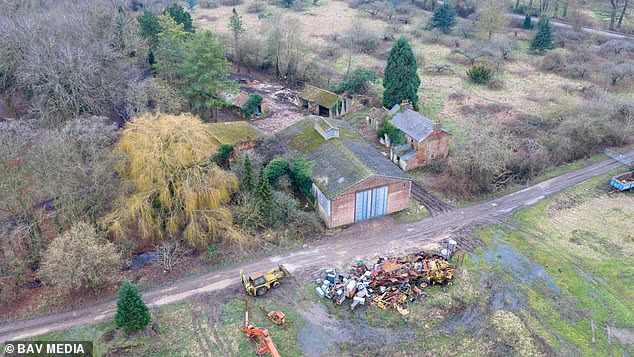
Two barns at the farm once owned by Tony Martin are to be converted into four homes

Dilapidated barns on the farm where Tony Martin shot and killed a teenage burglar have been given permission to be converted into homes, a council has ruled.

West Norfolk Council has given permission for two buildings in Emneth Hungate to be remodelled into four properties.

These will consist of two four-bedroom homes, a three-bedroom property and a five-bedroom house.

Jacqueline Wadsley, 52 – named as the sole beneficiary of Mr Martin’s £2.5 million estate in February after she befriended him when he began drinking in a pub she ran – withdrew plans for another scheme in May.

Advertisement

That involved five run-down barns being renovated to created ten new houses but raised concerns about the damage to wildlife.

The council’s ecology officer, Claire Wiggs, reported that ‘no ecological information’ had been included in the proposal and called for ‘preliminary’ assessments on wildlife to be carried out.

Two barns at the farm once owned by Tony Martin are to be converted into four homes

Advertisement

‘It is possible that protected species are present on the site including breeding birds, reptiles and roosting bats and could be impacted by the proposals,’ she wrote.

‘There are known records of roosting pipistrelle within 1km and badgers within 2km of the site.’

Further issues were raised by Norfolk County Council’s highways development management officer, Richard Smith, who described the single carriageway road leading to the farm as ‘inadequate’ as it featured no footway or dedicated cycle links and had poor visibility

He also suggested that ten homes on the site would produce 60 vehicle movements a day, which would be to ‘the detriment of highway safety’.

Advertisement

The plans should be scaled down to ‘no more than four homes’ to create a ‘more proportional development’, Mr Smith added.

The new, smaller scheme qualified for permitted development rights which allow the conversions to take place without going through the full planning process.

An ecological survey said it would have a negligible effect on wildlife, while the application stated adding four homes would not lead to an increase in traffic compared to those needed previously for agricultural purposes.

A total of 164 acres of land around the farm is already up for sale in two lots for £1.37 million.

Advertisement
Mr Martin was jailed for life in April 2000 after being convicted of murder and wounding but his sentence was reduced on appeal to five years for manslaughter

Mr Martin was jailed for life in April 2000 after being convicted of murder and wounding but his sentence was reduced on appeal to five years for manslaughter

Jacqueline Wadsley, 52, was named as the sole beneficiary of Mr Martin¿s £2.5 million estate in February after she befriended him when he began drinking in a pub she ran

Jacqueline Wadsley, 52, was named as the sole beneficiary of Mr Martin’s £2.5 million estate in February after she befriended him when he began drinking in a pub she ran

The building conversions do not involve Bleak House, the now derelict farmhouse where Mr Martin used an unlicensed shotgun in 1999 to shoot dead intruder Fred Barras, 16, and injure accomplice Brendan Fearon, then aged 29.

The eccentric bachelor was jailed for life in April 2000 after being convicted of murder and wounding at Norwich Crown Court but his sentence was reduced on appeal to five years for manslaughter.

Advertisement

The case sparked a national debate about the rights of householders to protect themselves and their property from intruders.

Mr Martin never set foot again in Bleak House following his release from prison, instead often preferring to sleep in his car parked in one of his barns.

He became friends with Mrs Wadsley while drinking in the Hare and Hounds which she ran in Wisbech, Cambridgeshire, following his release from Highpoint Prison, Suffolk, in 2003.

The pair were said to have formed a relationship akin to ‘a father and daughter’, with Mrs Wadsley often cooking him Sunday lunches, while he did odd jobs for her family to keep himself busy.

Advertisement
Fred Barras, 16, was shot dead by Mr Martin with an unlicensed shotgun

Fred Barras, 16, was shot dead by Mr Martin with an unlicensed shotgun

Brendan Fearon, aged 29 at the time of the raid, was injured

Brendan Fearon, aged 29 at the time of the raid, was injured

The farmer, who died aged 80 in February last year after a stroke, made her and her husband David, 45, executors of his will in 2013.

She reportedly had no idea before his death that he was leaving everything to her.

Advertisement

Source link

Continue Reading

NewsBeat

Aerosmith’s Steven Tyler pays tribute to his late Nashville co-star and ‘dear friend’ Hayden Panettiere

Published

on

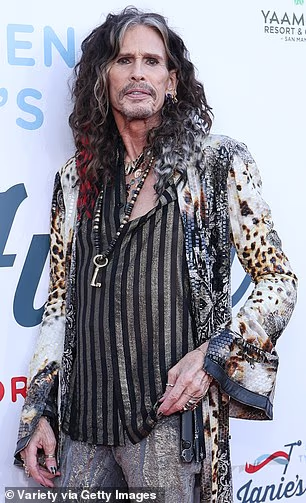
Aerosmith lead singer Steven Tyler, 78, is the latest star to pay memorial to the late Hayden Panettiere following her tragic passing at the age of 36 on Sunday

Advertisement

Aerosmith lead singer Steven Tyler is the latest star to pay tribute to the late Hayden Panettiere following her tragic passing at the age of 36 on Sunday.

‘She was a dear friend of mine, I loved her dearly and I feel bad for her mom – big love to her,’ Tyler, 78, told TMZ on Tuesday.

Tyler had worked with Panettiere on a September 2015 episode of her ABC series Nashville, as the pair sang a duet of the Patsy Cline song Crazy.

In the storyline of the season four opener, Panettiere’s character Juliette Barnes was playing Cline in a biopic, leading to the collaboration with the rock icon.

Advertisement

The Daily Mail has reached out to representatives for Tyler for further comment on the story.

Tyler previously spoke about his working experience with Panettiere in a 2015 interview with Entertainment Weekly, praising her talents.

Panettiere pictured in 2022 in LA

Aerosmith lead singer Steven Tyler, 78, is the latest star to pay memorial to the late Hayden Panettiere following her tragic passing at the age of 36 on Sunday 

Advertisement
Tyler had worked with Panettiere on a September 2015 episode of her ABC series Nashville, as the pair sang a duet of the Patsy Cline song Crazy

Tyler had worked with Panettiere on a September 2015 episode of her ABC series Nashville, as the pair sang a duet of the Patsy Cline song Crazy 

‘Hayden is a peach,’ Tyler told the outlet. ‘She’s a seasoned pro, from her success on NBC’s Heroes.’

The Dream On vocalist said of Panettiere, who starred on the show for six seasons: ‘She’s a true professional both while filming, recording and off set as well.’

Asked about the song selection on their duet, Tyler said that ‘it only made sense that we would sing the most recognizable Patsy Cline song ever’ with the plot of the series in mind.

Advertisement

Tyler said that Panettiere showed off her skills as a singer in the outing, when asked if the performance had been lip synced.

‘Why lip sync when you can sing live? And yes – she is that good!’ Tyler said. ‘We had to give the audience a performance.

‘My favorite thing about filming is that I can yell, “CUT!” and have a do-over if I want. There are no cuts in rock n’ roll.’

While primarily known for her acting skills, Panettiere had also displayed her musical talents on Nashville as well as a number of Disney projects.

Advertisement

They included 2004’s Tiger Cruise, 2005’s Ice Princess, and 2007’s Cinderella III: A Twist in Time.

Tyler had worked with Panettiere on a September 2015 episode of her ABC series Nashville, as the pair sang a duet of the Patsy Cline song Crazy

Tyler had worked with Panettiere on a September 2015 episode of her ABC series Nashville, as the pair sang a duet of the Patsy Cline song Crazy 

The Dream On vocalist said of Panettiere, 'She¿s a true professional both while filming, recording and off set as well'

The Dream On vocalist said of Panettiere, ‘She’s a true professional both while filming, recording and off set as well’

Tyler said that Panettiere showed off her skills as a singer in the outing

Tyler said that Panettiere showed off her skills as a singer in the outing

Advertisement

Panettiere’s passing was announced Sunday by her father Skip Panettiere, who said in a statement: ‘It is with profound sadness that we share the tragic passing of our beloved Hayden.

‘She was an incredible light and a force of nature who brought immeasurable love and joy to all who knew her – and to the millions who watched her onscreen. We ask for privacy as our family takes time to process this unimaginable loss.’

Authorities in Greenville, South Carolina, subsequently said that officials responded to an apartment in the area after receiving a report of an ‘unresponsive female’ via a possible ‘drug overdose,’ subsequently determined to be Panettiere.

Officials, who attempted lifesaving measures prior to declaring the actress deceased, said that no signs of trauma or foul play were evident in their probe into Panettiere’s death, which remains ongoing.

Advertisement

Advertisement

Source link

Continue Reading

NewsBeat

Why does Salmonella cause serious illness in some people but not others?

Published

on

Why does Salmonella cause serious illness in some people but not others?

For most people, a Salmonella infection causes gastroenteritis, an inflammation of the stomach and intestines that can mean several miserable days of diarrhoea, cramps, fever or vomiting. Most people recover within a week. But severe diarrhoea and dehydration can still be dangerous, even while the bacteria remain confined to the gut.

In a small minority of patients, however, Salmonella crosses the gut lining and enters the blood. In the current UK outbreak, seemingly caused by eggs imported from abroad,
two people have developed bloodstream infections and one death has been associated with the outbreak. How does a familiar cause of food poisoning escape the gut, and why does this only happen to some people?

By August 13 2026, the UK Health Security Agency had identified 207 confirmed cases of a closely related strain of Salmonella Enteritidis. Among patients for whom the relevant information was available, 38% had been admitted to hospital because of their symptoms.

Egg consumption is investigators’ strongest lead, although the source remains unconfirmed. Several affected people ate egg dishes at food businesses supplied by several sources, including importers. Investigators also identified possible opportunities for cross-contamination, in which bacteria are transferred between foods or surfaces, at two premises. They have found no link to UK-produced eggs or poultry.

Advertisement

Salmonella Enteritidis belongs to a broad group called non-typhoidal Salmonella, which is distinct from the bacteria that cause typhoid and paratyphoid fever. Doctors describe an infection as invasive when Salmonella reaches the blood or another part of the body that is normally free of bacteria. A bloodstream infection can lead to sepsis, a life-threatening reaction in which the immune system begins damaging the body’s organs and tissues.

How Salmonella escapes the gut

Genes, which are sections of DNA containing biological instructions, allow Salmonella to build tiny injection systems that work like molecular syringes. One injects proteins into cells lining the gut, causing them to engulf the bacterium. These injection systems are found in many Salmonella bacteria , so their presence cannot explain why one patient develops a bloodstream infection while another has relatively mild diarrhoea. In most people, several layers of immune defence contain the infection in the gut.

A second helps Salmonella alter the membrane-wrapped compartment that forms around it after an immune cell swallows it, allowing some bacteria to survive and multiply. Macrophages are immune cells that engulf and usually destroy microbes. Some Salmonella can survive inside them. This sheltered position is one way the bacteria may move into deeper tissues and the bloodstream, although other routes may contribute.

Advertisement

Why some people become more seriously ill

Scientists have identified more than 2,600 types of Salmonella, known as serovars, although fewer than 100 cause most human illness. A strain is a more closely related genetic branch within one of these types. Both types and strains vary in their tendency to spread.

Nontyphoidal Salmonella that can invade blood are known as invasive serovars and the most predominant serovars associated with blood infections are Typhimurium,Enteritidis, Choleraesuis and Dublin

Records from routine testing in England illustrate the difference. Among more than 116,000 bacterial samples collected between 2004 and 2015, about 2% of Enteritidis samples came from blood, compared with 35% of Salmonella Dublin samples. Testing patterns affect the figures, but the difference indicates that some types spread beyond the gut much more readily than others.

Strains within the same type can also behave differently. Laboratory experiments on two Enteritidis strains, conducted using mouse immune cells, identified genes that help the bacteria survive and multiply inside macrophages. Such experiments identify mechanisms for further study but cannot predict how ill a patient will become.

Advertisement

Age and health also shape the outcome. In the English study, Salmonella was found in blood in 6.5% of samples from adults over 65, compared with 1.9% from adults aged 18 to 64. Newborn babies also had an elevated risk. Weakened immune systems and certain long-term health conditions can make an infection harder to contain.

The number of bacteria swallowed affects the likelihood of becoming ill. Outbreak-based models suggest that heavier contamination increases the risk, although researchers do not know how strongly the amount swallowed affects the likelihood of an infection reaching the blood.

What the current outbreak can tell us

The hospital admission figure deserves attention, but it does not establish that this strain has an unusual ability to cause severe disease. The 38% applies only to patients for whom information was available. Official counts also miss many people whose illness clears before testing, so those with more serious symptoms can be overrepresented. Scientists commenting on the outbreak have urged caution when interpreting the figure.

The UK Health Security Agency used whole-genome sequencing, which involves reading and comparing all or nearly all of the bacteria’s genetic code. Bacteria recovered from patients were very closely related and genetically linked to a 2025 outbreak associated with imported eggs. Sequencing can connect cases and help investigators trace their source. Genetic similarity alone cannot reveal how likely a strain is to cause severe illness.

Advertisement

The Food Standards Agency says pregnant women, babies, young children and older people should eat raw or runny hen eggs only if they carry the British Lion mark or come from the Laid in Britain scheme. These schemes require safety measures including vaccinating hens and additional testing.

Anyone who keeps being sick and cannot retain fluids, has bloody diarrhoea or continues to show signs of dehydration after using rehydration sachets should call NHS 111. The NHS provides further advice on when to seek urgent help.

Investigators will need to combine the bacteria’s genetic code with information about the patients’ health, what and where they ate, and laboratory evidence. Only then can they begin to explain why the infection spread beyond the gut in two patients while most cases caused gastrointestinal illness.

Advertisement

Source link

Continue Reading

NewsBeat

Belfast university research finds AI, deepfakes, and ticket bots ‘ruining’ UK music industry

Published

on

Belfast Live

It highlights the UK music regulatory framework is “woefully lagging behind” that of the EU and US

Research from a Belfast university is shining a light on the role of AI and bots in the music industry, warning that consumers and musicians are being shortchanged due to technology that’s out of control.

Advertisement

Dr Katherine Pittalis at Queen’s University Belfast used her PhD to examine the fast-changing technology used in music-streaming platforms, online retail for concert tickets, and music-related content on social media. She is currently developing her thesis into a book in the hope it will act as a wake-up call to industry.

As music-lovers continue to enjoy a summer of outdoor festivals and concerts, Dr Pittalis argues that the UK music regulatory framework is “woefully lagging behind” that of the EU and US in terms transparency around malicious actors’ use of bot technologies.

Her research examines phenomena including ‘metric bots’, which can inflate ‘likes’ and ‘follows’ on social media, along with ‘Artificial Musicians’ – the combination of deepfake technology with bots to create an AI ‘influencer’. This has the effect of creating a ‘buzz’ and boosting algorithms around certain musicians.

The research highlights that the malicious use of technology is increasingly sophisticated, with bots ever-evolving to circumvent the rules laid down by the social-media, music streaming and primary ticketing platforms.

Advertisement

Scams are an obvious example of the increasing exploitation of technology, particularly on ‘secondary market platforms’, where tickets for high-demand concerts are sold on at hugely inflated prices. The research identified multiple instances where consumers handed over large sums of money only to find the tickets never existed.

The research also found that more informal ‘buy and sell’ groups, such as those individuals can set up on Facebook, are “highly unregulated” and even, on occasion, moderated by bots.

Elsewhere, it found instances of bots moderating ‘community notes’ sections on social media – despite the fact that community notes were established explicitly to combat misinformation and fake news.

“It’s quite a depressing picture,” Dr Pittalis said.

Advertisement

“Social-media platforms are incredibly secretive about the use of bots. One study I consulted even found that X (formerly Twitter) has more bots now than when Elon Musk took it over and promised to get rid of them.

“From my research, the bots I discovered look more authentic in how they behave and interact with organic users. Even with protocols and safety measures in place, bots are continuing to thrive in these online environments and distort organic users’ perception of what is real and what is misleading content that has the potential to cause harm.”

For her book, Dr Pittalis is also investigating the use of social bots to spread malicious information designed to damage a musician’s reputation, such as the spread of explicit deepfake images of the pop star Taylor Swift on social-media platforms in 2024.

Advertisement

As well as this, the book will look at music ticketing platforms’ use of dynamic pricing, fuelled by AI, when price fluctates according to demand, as with tickets for Oasis’ UK and Ireland tour last year.

The book also highlights the use of AI-generated music, with a growing demand for entire songs generated by AI to carry a transparency label.

Dr Pittalis’ PhD was carried out between the School of Electronics, Electrical Engineering and Computer Science (EEECS) and the School of Law, both at Queen’s. Dr Pittalis has an undergraduate degree in Music and an MSc in Law and Technology, also from Queen’s.

The research was supervised by Professor Giancarlo Frosio from the School of Law and Professor Hans Vandierendonck from the School of EEECS at Queen’s.

Advertisement

Prof Frosio said: “This research makes an original and timely contribution to our understanding of how malicious automation is reshaping the music ecosystem.

“Its central insight is that this is neither simply a platform problem nor a state problem; effective regulation requires clearer legal duties and enforcement alongside much stronger platform-level detection, transparency and accountability.”

In her book, Dr Pittalis will be calling for the UK’s music industry, social media companies and policy makers to urgently tighten up cyber-security to ensure a better deal for consumers and artists.

“It’s not fair,” she concludes. “Consumers and authentic musicians are being squeezed out, marginalised by the very industry meant to support them.

Advertisement

“It might sound apocalyptic, but the truth is the bots are running amok – UK legislation has fallen behind. There’s no anticipation of future trends; instead, it’s reacting to what’s already happened.

“It needs to be future-proofed which includes more oversight into how social media and other online platforms control breaches and uphold user-safety from bots. The industry needs to take this seriously before it’s too late.”

The research was supported by a LINAS (Leverhulme Interdisciplinary Network on Algorithmic Solutions) doctoral scholarship.

For all the latest news, visit the Belfast Live homepage here and sign up to our daily newsletter here.

Advertisement

Source link

Continue Reading

NewsBeat

Hundreds of overdue fire safety actions at Darlington flats

Published

on

New Darlington Council powers to control HMOs in borough

A total of 151 fire safety actions were overdue as of March 31, 2026 including one classed as an urgent priority.

The urgent action has since been completed, while five short-term actions and 145 medium-term actions were being resolved, according to a report to Darlington’s Health and Housing Scrutiny Committee.

All 67 fire risk assessments due for blocks of flats during 2025-26 were completed within the required timescale, the council confirmed. 

Advertisement

Fire risk assessments cover 199 blocks of flats and operate on a three-year cycle.

Fire doors

The report also highlighted progress on a three-year programme to replace fire doors in communal areas.

A total of 842 doors require replacement, with 560 completed by the end of March 2026 – 66.5 per cent of the programme.

The council said the work was on track to be completed by 31 March 2027.

Advertisement

However, only 175 of 336 fire doors due for their annual inspection during 2025-26 had been checked – 52.1 per cent.

The report said staffing resources and problems accessing properties had affected performance. It added that compliance had since improved to 85 per cent, with the council expecting to achieve full compliance during 2026-27.

Awaab’s Law

The report also examined the council’s response to Awaab’s Law, which came into force on 27 October 2025.

Between October 2025 and March 2026, 2,714 emergency hazards were reported. Damp and mould accounted for 1.69 per cent of those cases, with most emergency hazards relating to heating and electrical problems.

Advertisement

By March 31, 86.79 per cent of emergency hazards had been resolved within 24 hours, while 81 cases were recorded as overdue. A further 856 significant hazards were reported, with 94.39% resolved within the required timescale.

The council said it had strengthened its processes and IT systems to ensure emergency hazards were identified, responded to and monitored appropriately.

Stock condition

The report said 4,138 council properties had undergone a stock condition survey within the previous five years, representing 77.8 per cent compliance.

There were 962 outstanding surveys that had been scheduled for completion during 2026-27.

Advertisement

The council said it had “well-established and robust processes” for monitoring health and safety compliance, with checks carried out quarterly and areas of non-compliance addressed as a priority.

Source link

Advertisement
Continue Reading

Trending

Copyright © 2025