Connect with us

NewsBeat

Celtic FC player ratings v Dundee as new man misfires and Engels struggles continue

Published

on

Belfast Live

Celtic secured a narrow 1-0 victory over Dundee at Celtic Park, with Benjamin Nygren’s second-half header proving the difference

Celtic manager Martin O’Neill is known for his cautious approach.

His pre-match worries ahead of his side’s 1-0 victory over Dundee proved well-founded, as the flag night celebrations were followed by a hard-fought win courtesy of Benjamin Nygren’s second-half header.

Heaping praise on the opposition is a tried-and-tested tactic the experienced Irishman has employed throughout a managerial career spanning 39 years.

Advertisement

His compliments towards Dundee seemed sincere and warranted. Steven Pressley’s squad exemplify sides who no longer roll over when up against the Premiership champions.

Celtic, despite the slender margin of victory, displayed numerous encouraging signs. We assesses how the Hoops performed.

VILJAMI SINISALO 7.

Dependable once more, producing an excellent stop to deny Ashley Hay late on. Sinisalo knows a new goalkeeper could arrive to compete with him, yet his leadership skills are hard to top.

Advertisement

A vocal leader between the sticks.

ALISTAIR JOHNSTON 7.

Everton scouts were present but Johnston must have felt transported back to 2024 as he combined effectively with Camilo Duran, reminiscent of his partnership with Nicolas Kuhn. The Canada international – who is craved by the Toffees – was able to showcase his trademark ‘underlap’ runs as he linked up impressively with the Colombian on the right flank.

CAMERON CARTER-VICKERS 7.

Advertisement

The Fridge was match-ready from kick-off. Following last season’s Achilles tendon rupture, he’s gradually returning to peak fitness.

His defensive work was solid and he showed ambition in his distribution.

AUSTON TRUSTY 8.

The American defender can struggle in routine domestic fixtures, but he was impressively focused on his comeback. From ceremonial duties stateside to dispossessing Dundee attackers – the commanding centre-back remains crucial.

Advertisement

KIERAN TIERNEY 8.

Tierney delivered an early cross to demonstrate his ambitions. A low delivery found Nygren whose effort was then turned wide by Kasper Hogh.

The left-back looked set for an attacking performance down his flank but, in truth, Celtic created more openings down the opposite wing throughout the opening period. Goodman made a fine save from his strike before he provided the ideal delivery for Nygren’s decisive goal.

ARNE ENGELS 6.

Advertisement

A reverse ball to find Tierney with his less favoured left foot was perfectly weighted, though beyond that moment, the Belgian didn’t produce his best performance. His delivery from wide areas was inconsistent and Engels’ renowned energy levels weren’t evident as he arrived late to multiple challenges.

Could potentially be his final appearance in the Hoops should West Ham increase their bid.

CALLUM MCGREGOR 7.

Turned back the clock with a threatening surge in the second period which resulted in him striking the woodwork. The captain was active and forward-thinking, though he requires support in midfield with Engels seemingly heading for the exit.

Advertisement

The skipper looked to be running at maximum capacity having nursed knocks throughout last campaign.

BENJAMIN NYGREN 8.

While it’s tempting to boost a match-winner’s rating, the Swedish forward demonstrated composure in possession from kick-off and posed a constant threat. His header found the back of the net with precision and was fully merited.

Celtic supporters have speculated about his potential departure this summer, though replacing his goals would prove challenging.

Advertisement

YANG 6.

The wide man appeared quicker and more powerful in the early stages but his influence diminished as proceedings continued. Celtic are aware he’ll be absent for some crucial fixtures ahead and his willingness to cover defensively and put in a shift deserves credit.

There were several instances in the latter stages where his decision-making let him down.

KASPER HOGH 6.

Advertisement

The towering Dane spurned numerous opportunities but O’Neill will take encouragement from the club’s record acquisition being well-positioned.

Celtic’s new number nine is evidently reliant on confidence, though no forward would prosper with the quality of delivery available during the second period. Hogh thrives on balls delivered into the penalty area and will net regularly.

CAMILO DURAN 7.

Celtic supporters are well aware the Colombian can perform centrally, but his deployment on the flank produced some promising moments. While he appears ready to flourish operating just behind Hogh, he maintained the width that enabled Johnstone to surge beyond him.

Advertisement

Clever touches and skills, plus a sharp turn inside the penalty area, suggest a player with considerable potential.

SUBS.

JAMES FORREST (YANG 79) 2.

Missed a trivela off of McGregor’s strike which cracked the post.

Advertisement

SEBASTIAN TOUNEKTI (DURAN 79) 3.

Lively after coming on, though his decision-making let him down at times. There’s a player there – he just might not show it every week.

LUKE MCCOWAN (NYGREN 83) 2.

Injected some vitality in the final moments.

Advertisement

COLBY DONOVAN (TIERNEY 83) 2.

Showed good commitment as Johnston moved across to left-back.

Unused subs: Doohan, Hatate, Osmand, Murray, Oxlade Chamberlain.

Sign up to our free sports newsletter to get the latest headlines to your inbox

Advertisement

Source link

Continue Reading
Click to comment

You must be logged in to post a comment Login

Leave a Reply

NewsBeat

Danny Dyer says ‘I’m still not over it’ in explicit rant at King Charles

Published

on

Cambridgeshire Live

Rivals actor Danny Dyer made his views on King Charles III clear during an episode of his podcast, years after joking that the pair were “related”.

Danny Dyer has never been one to mince his words, as a resurfaced clip from his podcast has reminded fans this week. Appearing alongside his daughter Dani Dyer on their Live and Let Dyers podcast, the actor launched into a tirade about the monarchy, urging King Charles III to “sell some of his palaces” in order to address the homelessness crisis.

He fumed: “Why don’t you sell one of your palaces? I’m sure he lives in a f*****g 25-bedroom f*****g palace. Why don’t you give some rooms to some of the homeless? And why don’t you sell some of your palaces to raise some money to f*****g end homelessness.”

Advertisement

While Charles has no influence over government policy and many royal residences are not his personal possessions, he has been actively engaged in efforts to combat homelessness for decades, both prior to and since ascending to the throne.

During the podcast, Danny, 49, also took aim at the cost of Charles’ Coronation, which was held in May 2023. “I’m still not over the fact that Prince Charles threw a £250 million party for himself when he had a crown put on his f*****g nut and there’s old ladies dying,” he continued.

Official Government figures reveal that taxpayers contributed £72 million towards the ceremony. Reports indicated that £21.7 million of the total was allocated by the Home Office to cover policing, while the remaining £50.3 million was spent by the Department for Culture, Media and Sport (DCMS), funded by the Treasury.

Advertisement

The figures were released in the department’s annual report. The Rival actor’s remarks came years after he enjoyed a humorous exchange with the then-Prince Charles at the Prince’s Trust Awards in 2019.

At the event, he joked they were having a “family reunion” after genealogists on Who Do You Think You Are? traced his family tree back to King Edward III.

He subsequently presented the two-part documentary Danny Dyer’s Right Royal Family, which delved into his royal lineage and examined how his ancestors lived.

According to reports, Danny told the Prince: “I’m in EastEnders. Just wanted to let you know we’re related as well. King Edward III is my grandfather – but I won’t go into it. No he is, on my life,” to which Charles replied: “A very long way away.”

Later during the occasion, the royal informed the audience he had “discovered a long-lost relation with Daniel Dyer”.

“He told me he was descended from Edward III, which is interesting. I must do some research when I get back,” he added.

Speaking to the audience, Danny added: “When your cousin Charlie makes the call, you’ve got to help your family out, you know what I mean?”.

Advertisement

He also quipped that his mention of their familial link had sailed over the Prince’s head.

Source link

Continue Reading

NewsBeat

M67 remains closed after ‘human remains’ found near motorway

Published

on

Manchester Evening News

The M67 will remain closed throughout the night

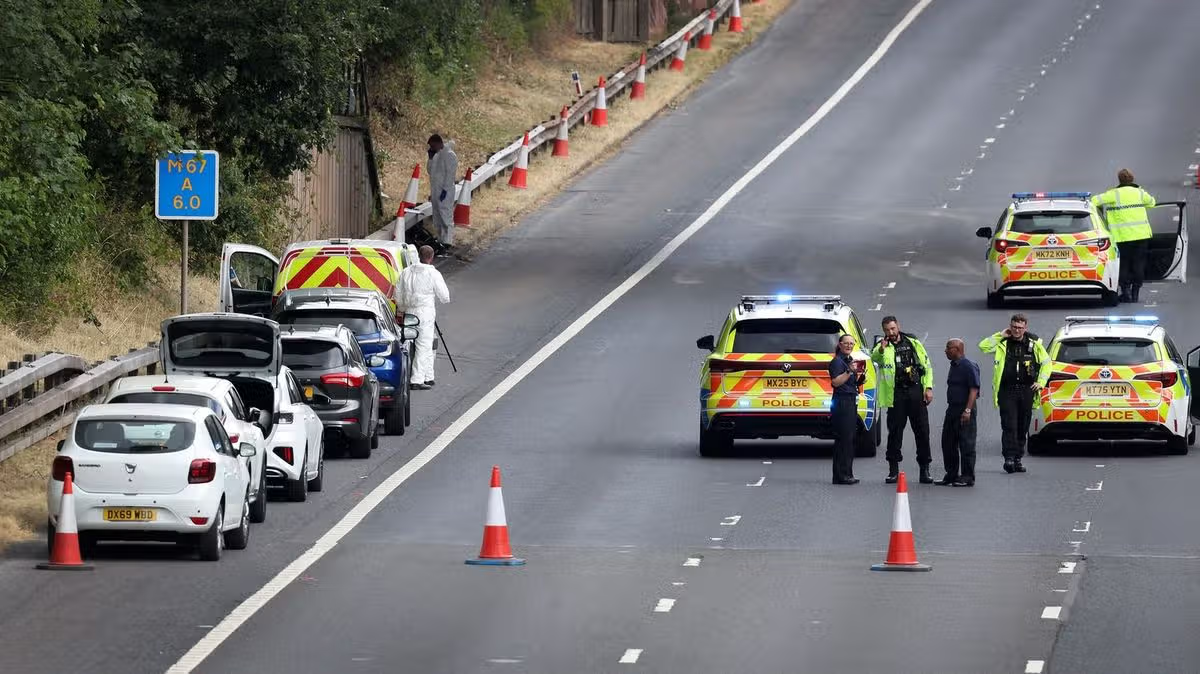
The M67 will remain closed overnight as planned roadworks get underway after ‘human remains’ were found near the motorway.

Forensics officers were at the scene on the M67 throughout the day on Tuesday (August 4) after ‘human remains’ were found.

Greater Manchester Police said they were called to a stretch of the motorway after road workers made the discovery ‘close to a bridge between junctions three and four’ – between Hyde and Hattersley – shortly after 11pm on Monday.

Advertisement

Detectives now believe they have identified suspected human remains at the scene, with a large police presence and multiple vehicles at the scene this afternoon.

Click here to get the biggest stories straight to your inbox in our Daily Newsletter

In an update issued on Tuesday evening, National Highways said that the police incident has now concluded but that the M67 will remain closed overnight for planned overnight roadworks as part of the A57 link roads scheme.

Advertisement

It said: “The police incident on the M67 east between J3 Hyde & J4 WoolleyBridge have now concluded.

“The road will remain closed both ways for planned overnight roadworks as part of the A57 link roads scheme. There are no delays on approach.”

Throughout the day, the East bound carriageway was shut ‘due to the nature of the incident’, National Highways said in an earlier statement.

Forensics officers in white suits and masks have been pictured working close to a bridge on the Eastbound carriageway.

Advertisement

In an earlier update a force spokesperson said: “Officers were called shortly after 11pm on Monday, August 3 2026, by road workers who made the discovery close to a bridge between junctions three and four.

“We are working with specialist teams to understand the circumstances behind this incident. The road will be closed between junctions three and four while detectives carry out their investigation.

“Please continue to avoid the area and we will provide updates when we have them.”

Source link

Advertisement
Continue Reading

NewsBeat

Today’s arguments about disability benefits have been raging for 500 years

Published

on

Today’s arguments about disability benefits have been raging for 500 years

When politicians debate disability benefits today, the arguments can sound distinctly modern. Concerns about rising welfare costs, accusations of fraud and disputes over who deserves support often dominate headlines and political discussions.

But as my new book on 500 years of disability history in Britain shows, these debates are far older than many people realise. Since the first welfare systems emerged under the Tudors, disabled people have faced suspicion, bureaucratic hurdles and repeated battles to secure the support they needed.

Understanding this history helps explain why many disabled people in the UK feel anxious about the future despite major advances in rights, healthcare and accessibility.

For many disabled people, obtaining state support is getting harder rather than easier. The number of successful claims for personal independence payment (Pip) has fallen since 2024, while thousands of people face repeated reassessments, including those with lifelong conditions. Politicians, thinktanks and commentators frequently question rising disability spending, while many claimants worry about losing support they depend on.

Advertisement

But disabled people faced remarkably similar challenges centuries ago. One of the clearest examples comes from the Elizabethan Poor Law of 1601, which was England’s first organised welfare system. It required parishes to support people who couldn’t earn a living because of age, illness or impairment. In practice, however, access to assistance was often contested.

Tudor writers spread stories about supposedly fake disabled beggars who tricked the public by covering themselves in artificial sores or pretending to have seizures. At the same time, local officials worried about the cost of supporting people who might need help for years. Claims could be rejected because an applicant was considered of poor moral character or because they were new to the parish.

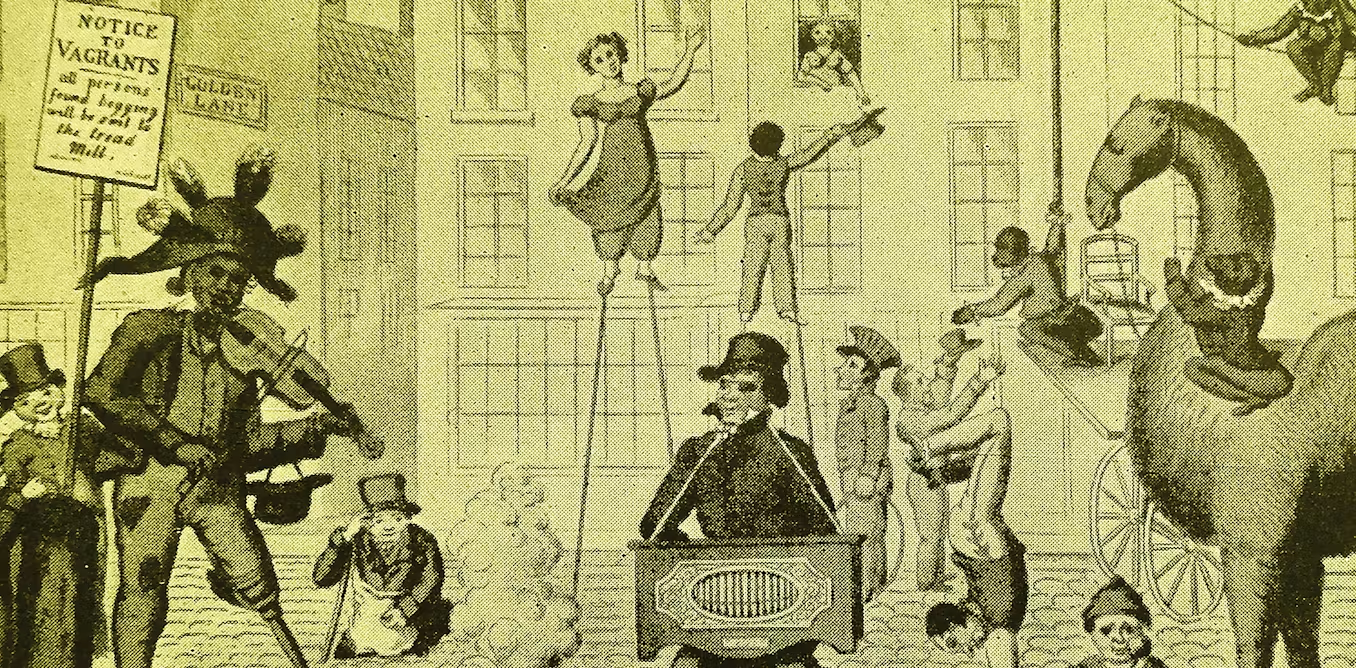
19th-century engraving depicting a woman sitting in a wheelchair.
World History Archive/Alamy

The records suggest that decisions about who deserved support were often shaped as much by social attitudes and local politics as by an individual’s actual condition. The phrase “genuine need”, still common in modern welfare debates, has always been open to interpretation.

Disabled people did not simply accept these decisions. Many challenged them by submitting petitions to magistrates. Written in deferential language, these appeals nevertheless represent some of the earliest surviving examples of disabled people defending their right to support that was legally theirs.

Advertisement

These disputes reveal striking continuities with the present day. They show that disabled people have long faced suspicion when seeking assistance. But they also demonstrate a history of resistance and self-advocacy that is often overlooked.

Work

Welfare was not the only area in which disabled people faced barriers. Work has long been another battleground.

Today, applicants for access to work – the UK government scheme that funds workplace support such as specialist equipment and assistance – face lengthy delays. Recent reports suggest there is now a backlog of more than 60,000 applications.

Even as the government seeks to move more people into employment, many disabled people struggle to obtain the support that would allow them to do so. History suggests these tensions are nothing new.

Advertisement


À lire aussi :
What early modern literature can teach us about neurodivergence


Disabled people have always worked, but from the time of the Industrial Revolution they have faced increasing challenges. Mechanisation increased the pace of production and often favoured those able to work faster and for longer hours. As a result, many disabled workers found it harder to secure employment or faced worsening conditions. But they continued to organise and demand change.

In May 1833, hundreds of disabled child workers marched through the streets of Manchester demanding shorter working days in the city’s cotton mills. Their protest challenges the common assumption that disability history is simply a story of welfare and care. Disabled people were also workers, campaigners and activists.

One important figure was William Dodd, an amputee former factory worker who toured the manufacturing towns of northern England during the 1840s. Gathering evidence about workplace injuries, he exposed the devastating human cost of industrial production and campaigned for compensation for injured workers.

Advertisement

Dodd’s reports show the horrendous effects of industrial work before modern health and safety. His work also shows how disabled activists helped drive reforms that benefited society as a whole.

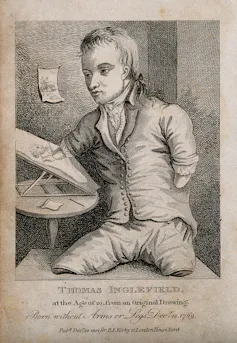
An engraving of a young man without limbs sitting at an artist's easel.
Thomas Inglefield, an artist born without limbs, aged twenty. Engraving, 1804.
Wellcome Collection

Looking back at five centuries of history reveals both remarkable progress and striking continuities. Disabled people today enjoy rights, protections and opportunities that would have been unimaginable to earlier generations. But many of the debates around welfare, employment and support remain surprisingly familiar.

Perhaps the most important lesson from the past is that change rarely came from above. The support services, legal protections and opportunities available today were not simply gifts from an increasingly enlightened society. They were won through campaigns, protests and persistent challenges to exclusion.

Disability history largely remains a missing part of the UK’s story. Understanding it helps explain why contemporary debates often feel so fraught.

More importantly, it reminds us that disabled people have never been passive recipients of care. They have long been active participants in shaping society, and their demands for equality and recognition are still far from fully realised.

Advertisement

This article features references to books that have been included for editorial reasons, and may contain links to bookshop.org. If you click on one of the links and go on to buy something, The Conversation UK may earn a commission.

Source link

Advertisement
Continue Reading

NewsBeat

‘Gaslighting’ by council leads to investigation call over ‘scandalous claims’

Published

on

Belfast Live

“My complaint is solely on what that officer did with that information.”

A NI council official is to face an investigation into alleged misconduct on “scandalous” claims about a councillor amid a judicial review process.

Advertisement

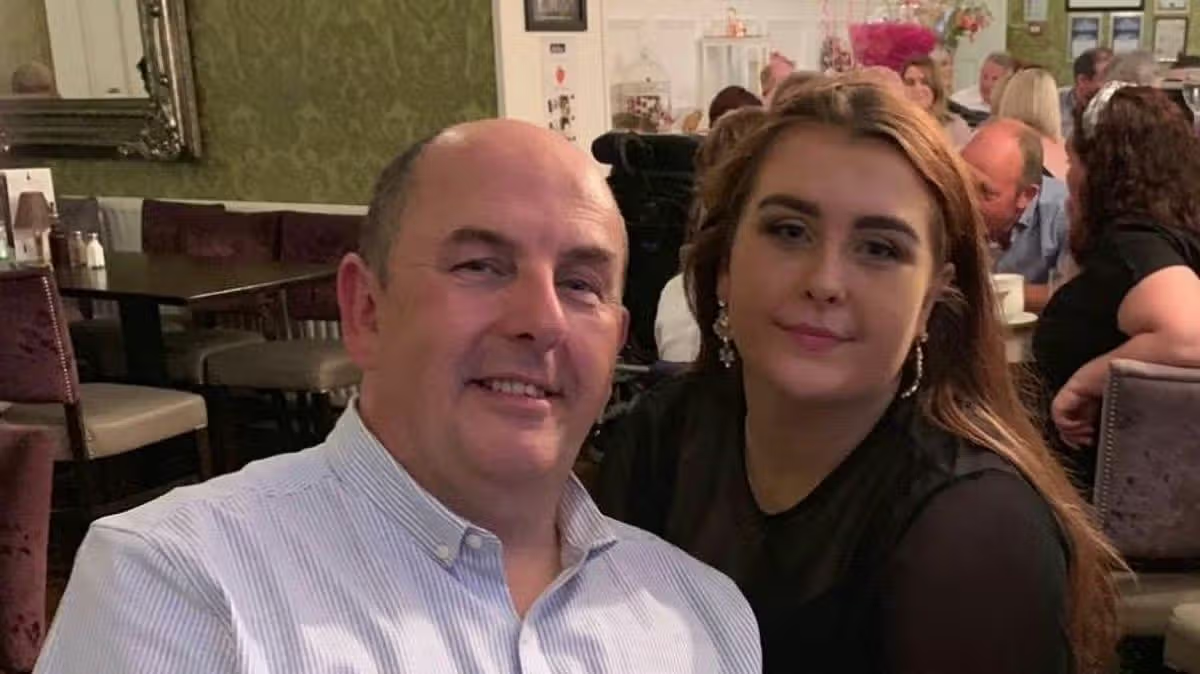
A Co Down elected member made a proposal in chambers after allowing time for the official to apologise for their conduct following the tragic death of is daughter.

Newry, Mourne and Down District Council had released a statement publicly acknowledging the “heartbreak caused” to independent councillor Jarlath Tinnelly, but he says the official has yet to contact him directly.

READ MORE: DUP councillors could appeal sentence of man convicted of ‘serious threats’.

READ MORE: Deadline for councillors to join Co Down harbour board after ‘stink’ resignations.

Advertisement

In chambers this week, Councillor Tinnelly said: “I’ve had no correspondence or word from that officer since, so I’m happy enough, chairman, as I indicated last month, to allow this to play out via a formal investigation.”

“I’ve seen a lot of gaslighting going on here this evening, and it has very quickly come into play.

“I want to be absolutely certain about something here. The judicial review and the contents of the legal correspondence were nothing to do with my complaint.

“My complaint is solely on what that officer did with that information.”

Advertisement

In July, the independent councillor said he was “crushed and broken” after his daughter Aoife Tinnelly, 24, tragically died in a fatal road traffic collision in Kilkeel on April 20.

He went on to slam an unidentified council official in chambers for allegedly making “scandalous” claims about him at the family wake.

The Mournes elected members says “serious allegations” linked him to an “affidavit” causing delays to the council’s new £17million civic centre.

Advertisement

But he told the Local Democracry Reporting Service that he was never asked for an affidavit and would not have given one.

The council had voted through designs for its new HQ in the city centre in June 2025.

The significantly delayed project has proved deeply divisive with more than 2,500 objections submitted by parishioners of Newry Cathedral mainly over car parking concerns for Mass goers.

Advertisement

A Newry resident has now cleared the first stage of a high court challenge to the council’s controversial civic centre.

In chambers, Councillor Tinnelly said:”The two issues cannot be conflated, and I will be seeking a formal investigation to begin into the matter that I’m raising here, which is what that officer did with that information.

“So, I wish to make a formal proposal that an investigation be launched into this matter through the appropriate avenue.”

The proposal was seconded by Mournes DUP councillor Alan Lewis.

Advertisement

A legal adviser alluded to the matter requiring the council’s human resources department to become involved.

For all the latest news, visit the Belfast Live homepage here and sign up to our daily newsletter here.

Source link

Advertisement
Continue Reading

NewsBeat

Unexpected Coronation Street legend vows to expose evil Ross | Soaps

Published

on

Unexpected Coronation Street legend vows to expose evil Ross | Soaps
Someone has seen through Ross Wilkes’ charm… (Picture: ITV)

Ross Wilkes (Ian Burfield) may have fooled Tyrone Dobbs (Alan Halsall) and Tracy Barlow (Kate Ford) with his charm, but there is one Coronation Street legend who refuses to buy his act.

Cassie Plummer (Claire Sweeney) tried to warn her family about Ross’ true colours from the moment he arrived on the cobbles, but he has a knack for talking his way out of trouble.

This caused Cassie to resort to more extreme levels to get him out of her life, but her plan backfired when Tracy ended up in hospital after drinking a smoothie Cassie had drugged.

Devastatingly, this destroyed Cassie and Tyrone’s relationship, as well as her relationship with Steve McDonald (Simon Gregson), and Cassie ended up accepting a job on a cruise ship to get away from Coronation Street.

Advertisement

‘She feels she has absolutely no choice,’ actress Claire Sweeney said.

Ask Metro


Use AI to go deeper into the stories you care about – powered by Metro and trusted publications.

Advertisement

‘She has been rejected by the love of her life, Steve, and everyone else has turned their backs on her. She feels her life there has been destroyed.

Cassie stood next to the open passenger door of Ross' car in Corrie
Cassie Plummer was last seen being driven off by Ross (Picture: ITV)

‘The only option left is to take that job on the cruise ship.’

However, whether she made it to the ship remains a mystery, as she was last seen being driven off in Ross’ car

In tonight’s episode, Steve lamented about missing his chance to make amends with Cassie, revealing that it looked like she’d blocked him. When Ross arrived in the pub, he asked where he’d taken Cassie, hoping he could track her down.

Though Ross initially denied having taken her anywhere, when Steve pointed out that he’d watched them drive away from the precinct, he backtracked and told him he’d dropped her off at Manchester Piccadilly station.

Advertisement
Steve, Ross and Fiz leaning on the Rovers' bar in Corrie
Fiz Dobbs isn’t fooled by Ross (Picture: ITV)

Later, when Ross found himself alone with Fiz Dobbs (Jennie McAlpine), the atmosphere darkened, as she dropped her friendly pretence and made it clear that she didn’t trust him.

She highlighted how his lying to Steve hadn’t slipped her notice, nor had the fact that he seemed surprised that Cassie had left the previous day.

Fiz was willing to let the inconsistencies slide for now, but warned Ross that if he put a toe out of line, she would make sure he was cast out for good.

Will Fiz be the one to finally expose Ross for who he really is?

Advertisement

Source link

Advertisement
Continue Reading

NewsBeat

Gianni Infantino chairs crisis talks with FIFA staff in Morocco as pressure mounts on embattled president after being accused of BLACKMAIL by head of Jordan FA

Published

on

Gianni Infantino has been accused of blackmail by Jordan FA president Prince Ali bin Hussein

Advertisement

Gianni Infantino has summoned senior FIFA officials to a hotel in Morocco for crisis talks as pressure continues to mount on the FIFA president. 

It comes after Jordan FA president Prince Ali bin Hussein accused him of blackmail.

Infantino has come under intense scrutiny since plans to sell £3.1billion in World Cup stakes leaked last week.

The Swiss football administrator has since scrapped the proposals after widespread opposition – including an internal rebellion at FIFA.

Advertisement

UEFA and CONCACAF – the body for North and Central America and the Caribbean – are both calling for Infantino to step down, with Europe declaring a lack of confidence in the FIFA president.

Jordan, meanwhile, are the first Asian nation to rebel against Infantino – taking the total to 91, assuming all UEFA and CONCACAF nations follow the stance set by their continental bodies. 106 nations are needed to depose Infantino as president.

In a statement Hussein ripped into Infantino, accusing him of delaying prize money payments and refusing to address the problem unless Jordan endorsed him for a fourth term at the helm of world football.

Advertisement

 Gianni Infantino has summoned senior FIFA officials to a hotel in Morocco for crisis talks

Infantino has been accused of blackmail by Jordan FA president Prince Ali bin Hussein

Infantino has been accused of blackmail by Jordan FA president Prince Ali bin Hussein 

‘There is no shortage of issues regarding FIFA. Let me start by clarifying what some of these are from an FA perspective, in particular that of Jordan going into a World Cup for the first time,’ Hussein said.

Advertisement

‘We are a small country with a minimal budget for our FA and had to deal with enormous hurdles.

‘First, getting our fans into the USA: not all were granted visas, even though they had tickets – which we also know were sold at exorbitant prices.

‘Secondly, we are being taxed by the US government through FIFA for our participation. Money that should go to players and staff.

‘This was not the case for those who played and set up camp in Canada and Mexico. But we happened to be in the USA so now we face these huge costs in taxes for having participated.

Advertisement

‘Thirdly we have been waiting for reward money for our players since December for the Arab Cup in Qatar, which is a FIFA event.

‘The money our team should receive for having reached the final has not been delivered yet, while at the same time FIFA brags about how many billions they have in reserve.

‘It is clear the problem really is with leadership. For months, FIFA has been refusing to help us on any of these or other matters – until it was verbally communicated to me during the World Cup that if I endorsed Infantino it would go a long way to helping our FA out.

‘We pride ourselves in Jordan in upholding ethical values. We did not endorse him before and certainly will not now.

Advertisement

‘But the whole situation amounts to blackmail and we refuse to give in to that.’

Daily Mail Sport have contacted FIFA for comment.

Advertisement

Source link

Advertisement
Continue Reading

NewsBeat

How rewilding could help stop the spread of Britain’s wildfires

Published

on

How rewilding could help stop the spread of Britain’s wildfires

Fire is natural in some ecosystems, but almost all British “wildfires” are started by people. Whether they become catastrophic increasingly depends on the landscapes they burn through. That’s why wildfire policy can’t only focus on preventing ignitions – it must go hand in hand with rebuilding landscapes that resist fire.

Rewilding is often presented as a wildfire problem; when you stop grazing, cutting or burning, vegetation accumulates and there is more fuel for fires.

But this is not the full story. Carefully planned rewilding that focuses on restoring functioning ecosystems can make landscapes wetter, patchier and more fire resistant.

Fire-prone landscapes often look ‘natural’

The purple, treeless moors found across Britain’s uplands can look timeless and wild. In Jane Eyre, Charlotte Brontë described “the purple moors” as “a wilderness of heath”. Yet these moors have been shaped by clearance, drainage, grazing, pollution and burning.

Advertisement

Flammable and unnatural: the purple heather of Hathersage Moor, the inspiration for Jane Eyre.
Matthew Taylor / Alamy

Peat records from Keighley Moor in West Yorkshire, not far from Brontë country, reveal a longer story. For most of the past 1,000 years, this landscape would have been much wetter, with abundant peat-forming Sphagnum moss, rather than today’s extensive heather-dominated vegetation created through rotational burning.

Seeing today’s moors as timeless and natural obscures how changes made relatively recently – the past 150 years or so – has made the uplands increasingly fire prone. Data shows that nearly 80% of England’s peatlands are dry and degraded, while just 1% are dominated by water-retaining species such as Sphagnum mosses. Dry heather, for instance, can act as a fuse, carrying fire across the surface and, if peat soils are exceptionally dry, into the carbon-rich peat below.

How to rebuild nature’s fire defences

Rewilding is not land abandonment; it requires carefully considered action to restore natural processes and functions. We must learn from the complex habitat mosaics that once characterised Britain’s uplands, while preparing them for a climate with no historical equivalent.

Advertisement

The task is to manage short-term transition risks while allowing ecosystems to reorganise into functional, climate-resilient states. Here are a few suggestions:

1. Bring back the bog

This starts by making fire-prone landscapes much wetter. Blocking drains, covering bare peat and restoring Sphagnum keeps water in the ground and reduces deep peat combustion. After a wildfire in Scotland in 2019, analysis showed degraded peat burned most severely, while vegetation in restored, wetter peatlands was far more resilient.

Research across Canada and northern Europe shows that rewetting and moss restoration can reduce the risk of deep, carbon-rich peat catching fire. But, choosing the right species for the right places under future climates is critical, and we’ll have to accept that fire-resilient uplands may look very different from those we know today.

2. Restore wet riverscapes and ponds

Upland headwaters and valleys have been drained and straightened, speeding water out of these landscapes. Emerging science suggests that re-meandering streams, reconnecting floodplains and recovering wetlands can act as firebreaks. During dry weather, wetter and more varied river corridors could interrupt continuous fuels and provide refuges for wildlife.

Advertisement

In the North York Moors, six beaver dams increased water storage and dry-weather flows. Beaver-dammed rivers also burned less severely during three North American megafires. Ponds could also add another layer of defence, as open water can reduce the spread of fires , while accessible ponds provide water for wetting firebreaks and suppressing spot fires.

3. Bring back missing giants

Cattle, horses, deer and bison create patchier vegetation by grazing, browsing and trampling in different ways. Instead of continuous areas of flammable vegetation, they produce a landscape with natural breaks that slow the spread of fire.

Deer in thick vegetation

Red deer browsing in Scotland. In a natural ecosystem, animals that graze (eat from the ground) and browse (from higher up leaves and branches) complement each other.
jonathan hunter / Alamy

But the diverse communities of large herbivores that once shaped Britain’s uplands have been replaced by managed livestock – mostly sheep – often at high densities. This creates even-aged vegetation that can become dense and fire-prone when the animals aren’t grazing.

In Portugal’s Côa Valley, semi-wild horse grazing has become a rewilding strategy to counter the impacts of land abandonment. This is consistent with a wider systematic review which found that herbivores reduce fuel effectively when grazers and browsers complement one another.

Advertisement

4. Recover broadleaf woodland

Evidence from more than 26,000 wildfires in Spain shows broadleaf woodland had the lowest ignition risk, while pine and shrublands were among the most fire-prone habitats. Even under extreme fire weather modelling, broadleaf woodland reduced fire intensity fivefold.

Yet Britain has lost the vast majority of its native woodlands. Today, only 14% of the UK is wooded, and about half of that is coniferous woodland – mostly in managed plantations.

The ecologist Oliver Rackham wrote that “English native woods burn like wet asbestos” – that is, hardly at all. It’s time these woods were restored to the parts of the British uplands they once covered.

5. Rewild with people

Our research shows rewilding must include support from communities learning to coexist with more unpredictable landscapes. In the short term, prevention, intensified monitoring, early detection and professional response must manage the risks of transition. Better warnings, rapid reporting and early detection can make visitors and residents part of the defence.

Advertisement

Britain won’t prevent every wildfire, but it can do something about the sorts of landscapes those fires burn through. Climate-smart rewilding should be treated as national resilience infrastructure: restoring bogs, rivers, woodlands and wild animals, so fires are less likely to become landscape-scale disasters.

Source link

Advertisement
Continue Reading

NewsBeat

North Yorkshire deputy mayor aware of HMO concerns in Scarborough

Published

on

North Yorkshire deputy mayor aware of HMO concerns in Scarborough

​Jo Coles, the deputy mayor for crime and policing, has proposed convening a meeting with partners to “understand how to improve the experience for all residents of Scarborough”.

​It follows concerns from residents, the town council, and councillors about how HMO conversions and emergency accommodation sites in the North Yorkshire town are impacting neighbours.

​Cllr Janet Jefferson, who represents Castle ward, said: “The coastal area of North Yorkshire is seeing an increasing number of applications for conversions of hotels and other buildings into emergency accommodation, proportionally much higher than other parts of the country.

​“Due to concerns from residents about disturbances, there are frequent call-outs to police officers. However, they advise that issues around disturbances and security are the domain of the agency/owners.”

Advertisement

​Speaking at a recent meeting of the North Yorkshire Police, Fire and Crime Panel, she added: “People have a right to accommodation, but there has to be some clear accountability around how best to support such circumstances.

​“Given the increase in such situations, is the deputy mayor concerned by the ongoing frequent use of police resources and is there a better way forward to ensure situations are approached in a legal and respectful manner with clear accountability?”

Jo Coles, the deputy mayor for York and North Yorkshire, said she was aware of the issue and had already provided a written answer.

​Speaking at the meeting, she added that Alison Hume, the MP for Scarborough and Whitby, had also raised concerns with her “about the number of HMO applications coming through, especially on the coast, and I think it is particularly Scarborough”.

Advertisement

​Ms Coles said: “We’ve provided a written update and the police will always be there to respond based on the threat risk and harm to the community, and they will make those decisions operationally.”

​However, she added that some responses should come from a partnership approach.

​The deputy mayor said she would be “very happy to convene a meeting of partners, including housing partners and commissioned service providers”.

​She said: “We have our wonderful women’s centre in Scarborough, but given the nature of the response, we would also want to better understand what is happening for men in some of those accommodations in terms of drug and alcohol services being made available to vulnerable residents on the coast.”

Advertisement

North Yorkshire Police, Fire And Crime Panel, July 2026. NYC

Responding to a question about how North Yorkshire Police responds to planning applications, Ms Coles added: “It is certainly not for the police to decide where people are accommodated; that’s a matter for the council to oversee.

“It’s absolutely vital that we are alive and alert to particular community problems when they are emerging, which they appear to be around these HMO properties on the coast.

​“I will take that away and liaise with Cllr Jefferson to convene something with partners so we can understand how to improve the experience for all residents of Scarborough.”

Advertisement

(Image: Newsquest)

Source link

Continue Reading

NewsBeat

Life-saving defibrillators rolled out to 14 new public sites in Northern Ireland council area

Published

on

Belfast Live

Each device is in a public access cabinet, ensuring the lifesaving equipment is available at any time, day or night, when every second count

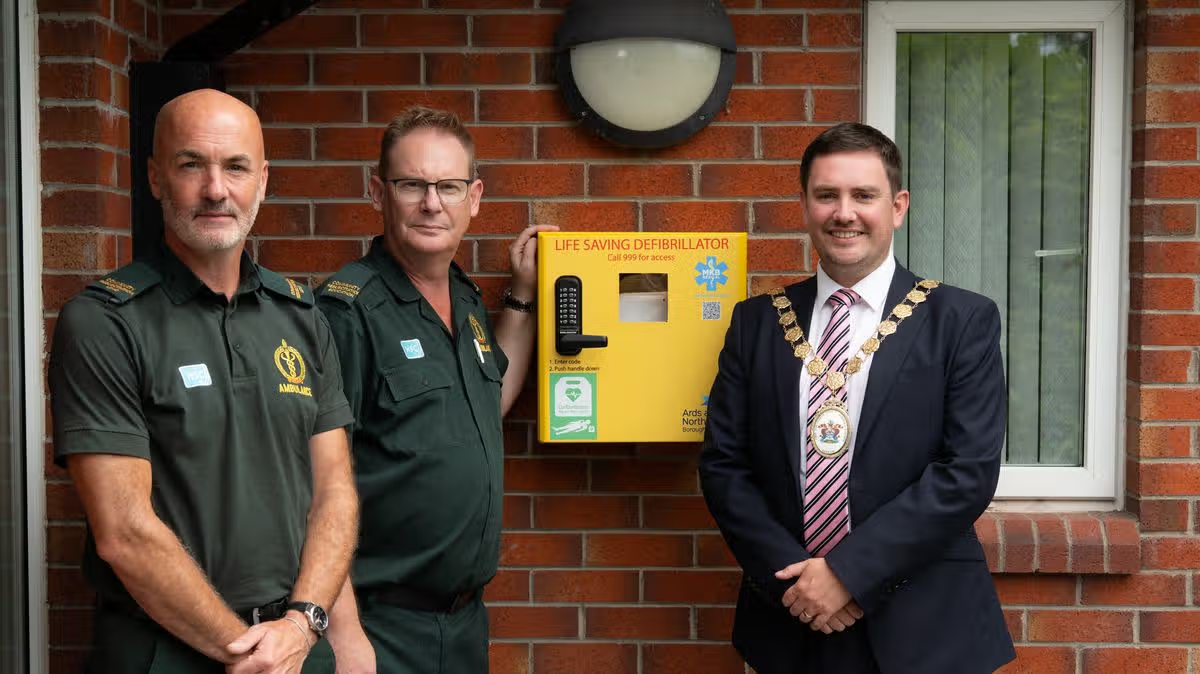
A local council has announced the installation of 14 new automated external defibrillators at its public buildings across the borough.

Advertisement

Each device is in a public access cabinet, ensuring the lifesaving equipment is available at any time, day or night, when every second counts. Two of the council’s existing AEDs have been relocated to external cabinets, improving public access to these devices outside normal opening hours. Each of the defibrillators have been added to “The Circuit,” the national defibrillator network.

In Northern Ireland, more than 1,400 people experience an out-of-hospital cardiac arrest each year, with fewer than 10 percent surviving to hospital discharge. However, early intervention can dramatically increase survival rates.

READ MORE: Key moments from Ards and North Down Borough Council in July

READ MORE: Fleadh Cheoil na hÉireann to kick off in Bangor, not Belfast

Advertisement

Ards and North Down Borough Council’s rollout supports the internationally recognised “Chain of Survival,” which outlines four essential steps proven to improve outcomes. The first is early recognition of cardiac arrest and calling 999, the second is early cardiopulmonary resuscitation, or CPR, to maintain blood circulation, the third is early defibrillation using an AED, and lastly, early advanced care provided by emergency medical services.

CPR is an emergency life-saving procedure performed when someone’s breathing or heartbeat has stopped. It combines chest compressions and rescue breaths to keep oxygen-rich blood flowing to the brain and vital organs. It is used if a person is unresponsive and not breathing normally or only gasping in emergencies like cardiac arrest, drowning, or a severe drug overdose.

Survival chances decrease by approximately 10 percent for every minute without CPR and defibrillation, highlighting the importance of quick action and community access to AEDs. In a life-threatening emergency, members of the public should always dial 999 immediately. Emergency medical dispatchers can provide CPR instructions and direct callers to the nearest available AED.

The council will be facilitating a series of free community defibrillator and CPR workshops, which will be delivered by the Northern Ireland Ambulance Service. The workshops are open to all and will include a practical CPR training element, giving attendees the opportunity to develop hands-on lifesaving skills.

Advertisement

Sessions will take place on Monday August 10, 7pm to 8.30pm at the Alderman George Green Community Centre, 1 Rathgill Parade, Bangor,Thursday September 3, 12 noon to 1.30pm, at Manor Court Community Centre, Mill Street, Newtownards, Friday October 2, 1.30pm to 3pm at Kircubbin Community Centre, 4 Church Grove, Kircubbin, and Wednesday November 4, 7pm to 8.30pm at Donaghadee Community Centre, the Parade, Donaghadee.

Mayor of Ards and North Down, Councillor Craig Blaney said: “It is great to see this life-saving equipment being installed across the borough, helping to ensure that more people have access to a defibrillator in an emergency. These devices have the potential to save lives, and I encourage everyone to take advantage of the free awareness training available so they can feel prepared and confident to act when it matters most.

“This initiative also reflects the council’s commitment to building and strengthening a community of lifesavers across the Ards and North Down area, empowering residents with the skills and confidence to respond effectively in an emergency and help save lives.”

To register your interest in attending any of these training sessions, email communityhalls@ardsandnorthdown.gov.uk

Advertisement

For all the latest news, visit the Belfast Live homepage here and sign up to our daily newsletter here.

Source link

Continue Reading

NewsBeat

Prisoner who ran off from outside courtroom now back behind bars

Published

on

Daily Record

Stephen Grzyb disappeared on Saturday, prompting a major manhunt

A prisoner who fled from the police after he was dropped outside a court is now back in custody, police said.

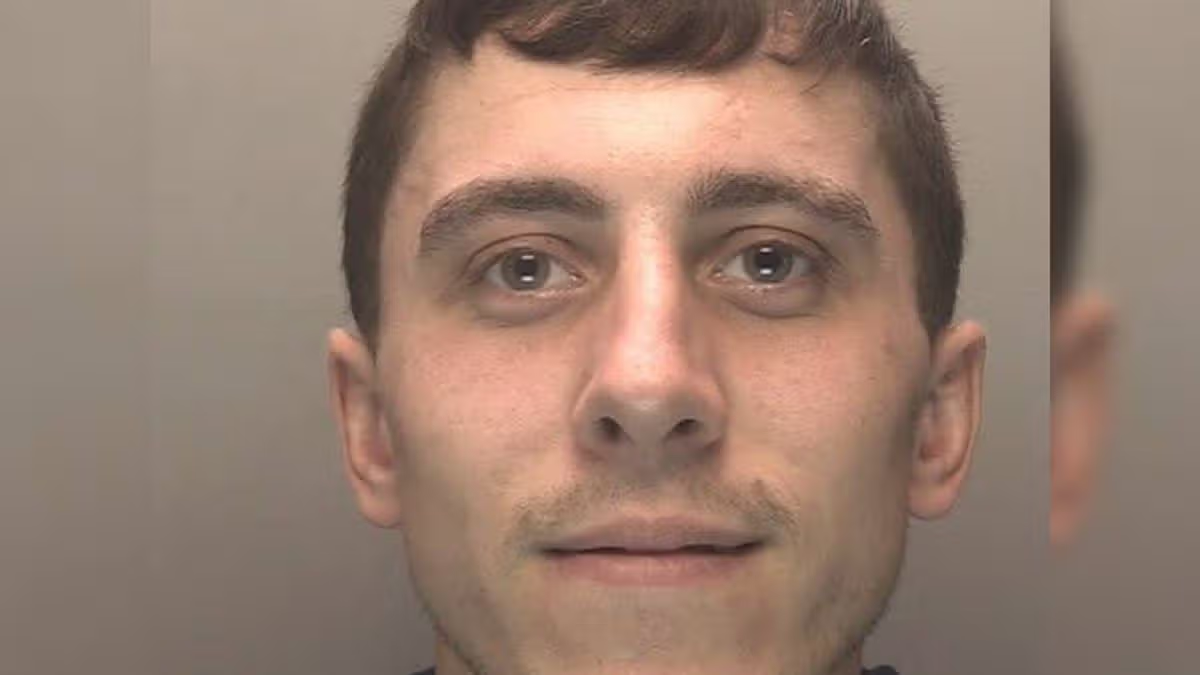
A manhunt was launched after Stephen Grzyb, 22, ran off after being taken to Liverpool Magistrates’ Court on Saturday, Merseyside Police said.

Advertisement

Grzyb, of Princess Drive, Liverpool, was due to appear in court charged with a domestic burglary.

Police said he fled down Red Cross Street in the direction of The Strand just after 10am.

He had been taken to the court from a police custody suite by security firm GeoAmey, which is contracted by the Ministry of Justice to transport prisoners.

READ MORE: Suspect in murder of woman found dead in suitcase spouted hate for Christian aid workers online

Advertisement

READ MORE: Ex-Celtic star’s wife begged for her life as machete thugs broke into her home

According to its website, the firm oversees more than 8,500 prisoner movements every week.

In a statement on Tuesday, Merseyside Police said: “An escaped prisoner who absconded outside Liverpool Magistrates’ Court after being transported from Belle Vale custody suite by GeoAmey has been arrested and is in custody.”

Ensure our latest stories always appear at the top of your Google Search by making us a Preferred Source. Click here to activate or add us as your Preferred Source in your Google search settings.

Advertisement

Source link

Continue Reading

Trending

Copyright © 2025