Previews of every single World Cup team in your inbox, featuring the players to look out for, games you shouldn’t miss and Metro’s big England predictions.
Mourners also heard how Mr Keeley had an extraordinary ability to connect with people and make them feel part of his extended family
Family and friends have gathered to say their final farewell to scratchcard millionaire Shawn Keeley, who was remembered as a generous, loyal and deeply caring man whose impact on those around him was “immeasurable”.
Advertisement
Mr Keeley’s funeral took place at St Patrick’s Church in Dungiven on Thursday morning following his sudden death in the Philippines.
The 33-year-old became an instant millionaire in 2020 after winning £1 million on a National Lottery scratchcard purchased at the local shop in Dungiven, where he worked as a manager.
During a moving homily, the celebrant described Mr Keeley as a man whose kindness, generosity and loyalty touched countless lives, telling mourners that although they were grieving his loss, “this is not the end of Shawn, but the beginning of his new life with God”.
Drawing on stories provided by family and friends, the priest painted a picture of a man who consistently put others before himself.
Advertisement
“Shawn loved a good night out,” he said. “Many of us will remember ending a night with Shawn, somehow walking home barefoot. Not because he had lost his shoes, but because he’d usually given them away to a girl whose feet were hurting so bad.
“It seems that going barefoot was nothing new to Shawn. Whether by choice or by generosity, shoes never seemed that important to him. What was important to Shawn was people.”
The priest recalled how, during the Covid pandemic, Mr Keeley moved out of the family home to help protect his brother Christopher.
“It wasn’t always easy, but that’s who Shawn was,” he said. “He put others before himself.”
Advertisement
Mourners also heard how Mr Keeley had an extraordinary ability to connect with people and make them feel part of his extended family.
“You could be talking to Shawn for five minutes, and before long he had worked out that your cousin knew his aunt, whose neighbour was somehow related to someone else in the family,” the priest said.
“Shawn wasn’t just related to everyone. He genuinely made everyone feel like his family.”
The homily highlighted Mr Keeley’s love of travel and adventure, with the priest recalling his trademark response whenever people complained while on holiday.
“If someone started complaining, Shawn had the perfect response: ‘Sure, look where we are,” he said.
“It was his way of reminding us to appreciate the moment, to enjoy life, and not to take things for granted.”
Friends and family also shared humorous stories from his childhood and younger years, including attempts to hide cigarette smoking from his parents and family anecdotes about his distinctive fashion sense.
Advertisement
The priest said the stories being told at the funeral revealed “something much deeper” about Mr Keeley’s character.
“They reveal a man who was generous without thinking twice, loyal without conditions and kind without expecting anything in return,” he said.
“A man who made people feel welcome, cared for and loved.
“Shawn’s life may have been far too short, but the impact he had on those around him is immeasurable. His stories will continue to be told, his laughter will continue to be remembered, and the love he gave so freely will continue to live on in all of us.”
Advertisement
The congregation heard of Mr Keeley’s devotion to his nieces Lexi and Olivia, his goddaughter Ava, and the close bond he shared with his brothers.
Addressing his family directly, the priest said mourners’ thoughts were centred on his parents, Tiney and Noel, brothers Christopher, Paul and Gavin, and his partner EJ.
“It is difficult to come to terms with the void in their lives from the loss of such a special person,” he said.
“Everyone who knew Shawn loved him, and he could see no wrong in anyone.”
Advertisement
The priest also noted Mr Keeley’s involvement with the Society of St Vincent de Paul in Dungiven from a young age and his commitment to charitable work both at home and in the Philippines.
He told mourners that a Mass had already been celebrated for Mr Keeley in the Philippines before his remains were returned home.
The priest said Mr Keeley had “left an indelible imprint” on both communities and quoted the Prophet Micah as a reflection of the life he had lived.
“This is what the Lord asks of you, only this: to act justly, to love tenderly and to walk humbly with your God.”
Advertisement
Shawn Keeley is survived by his parents Tiney and Noel, brothers Christopher, Paul and Gavin, and his partner EJ.
The new exhibition of British landscapes at Pallant House Gallery in Chichester features 160 works by some 60 artists. These span from Thomas Gainsborough and the local Smith brothers in the 18th century to the inner-city wastelands of Prunella Clough in the 1990s.
Yet, in an exhibition drawn entirely drawn from Pallant House’s own collections, there are inevitable emphases and gaps. Scottish and Welsh artists are probably better represented than Scottish and Welsh landscapes.
Apart from a collage of Bolton in 1937 by Julian Trevelyan, made while assisting the early work of Mass Observation – a social research initiative that documented everyday life in British towns through writing, photography and visual records – the north of England is largely represented by wintry views of Wharfedale. The Midlands and East Anglia are equally underrepresented.
This exhibition is not about British, or even English landscapes, but about how a broad range of British artists responded to the landscapes they chose to depict.
Advertisement
The spirit of place
Entering the exhibition, I passed some striking works by Graham Sutherland and Edward Bawden. Bawden and Eric Ravilious are unsurprisingly well-represented in this show. Yet it jarred to be told that they moved into nearby Great Bardfield in 1932 “with their wives”. After all, Charlotte Bawden and Tirzah Garwood were themselves significant artists, albeit not of landscapes.
Disused Land by Prunella Clough (1999). Pallant House Gallery
Happily, the same room includes Cumberland Landscape (Boothby) (1926) by Winifred Nicholson. She, alongside others including Barbara Hepworth and the Scottish artist Wilhelmina Barns-Graham, ensure that women’s contributions are represented.
Yet the star of that room, and of the show, is Paul Nash. Nash’s intense relationship to landscape informs the subtitle to this exhibition (A Sense of Place), exploring as it does artistic endeavours to capture what Nash referred to as the genius loci (or the spirit of place).
Advertisement
That intensity had a more sombre side. A whole room is devoted to wood engraving and printmaking – an artform Nash and many of his contemporaries turned to after the first world war. The stark lines and contrasts of light and shade evoked the sense of place felt by Nash after his harrowing experiences as a war artist.
His powerful study of the battlefield, Void (1918), which depicts a battlefield stripped bare except for the debris of war, is displayed alongside his dark and shadowy Path into the Wood (1921). Nash’s accompanying text observes: “Before light came, black was. The void was darkness … Without hot shafts of sun or the moon’s radiance the world is not seen.”
What artists saw was a country transformed by war. They turned to the countryside for comfort, trying to capture its disappearing character and preserve a sense of what was being lost.
Six years after the founding of the Council for the Preservation of Rural England in 1926, Clare Leighton produced her homage to vanishing rural crafts in The Farmer’s Year: A Calendar of English Husbandry (1932). This took a society already becoming estranged from the land through the various seasonal activities of farming communities in exquisite detail. For me, her powerfully built ploughman was one of the highlights of the exhibition, conveying in his posture an intimate relationship with the land that we have increasingly lost.
Advertisement
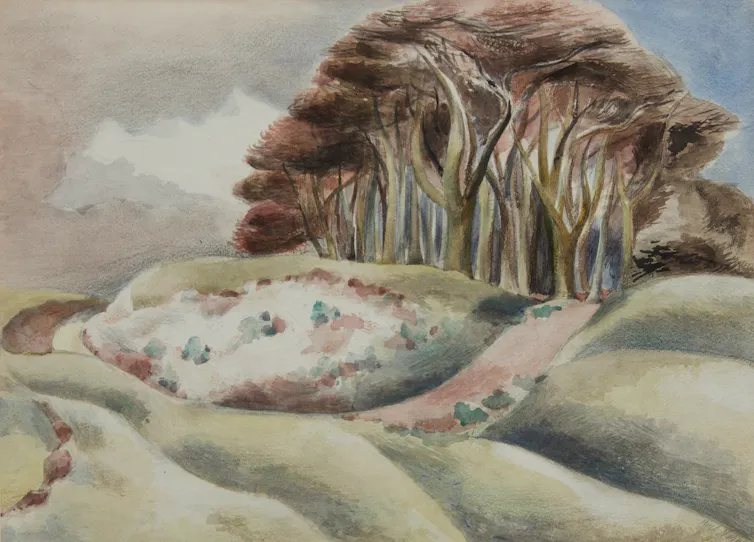
Wittenham by Paul Nash (1935). Pallant House Gallery
Tellingly, Edward Wadsworth’s Ladle Slag: Old Hill 1 (1919) is almost the only depiction of the industrial Midlands. Before 1914, Wadsworth had been part of Vorticism – a movement that celebrated the energy, speed, and mechanical power of the modern industrial world. After the war, however, this enthusiasm gave way to a greater sensitivity to the human and environmental costs of industry.
Ironically, commerce was one of the drivers of this shift. Some of the most iconic of English scenes created by Bawden and others were book dust jackets. Even more significant in conveying an imaginary of a rural England well-stocked with beauty spots were the Shell Guides for the growing army of middle-class motorists. Nash was acutely aware of the tension between the tourism he, Sutherland and others encouraged by their contributions to these and the conservation of the England they valued.
Arguably it was in responding to these tensions and postwar uncertainties that a distinctive approach to landscape emerged.
Landscapes and national identity
Interwar British art continued to be influenced by Continental movements, such as surrealism, which Nash was drawn to in the 1930s. Yet it was a modernism tempered by a poignant and affectionate attempt to capture the essence of landscapes that seemed under threat. With few exceptions, capturing these landscapes required a muted palette, maybe because of the rainy weather of these islands.
In general, these landscapes all almost invariably reflected human presence. A staple of the English country scene is often a steeple, such as that seen in Walter Sickert’s Chagford Across Fields (1916), an unsettlingly peaceful scene contrasting with the contemporary slaughter on the Somme.
Advertisement
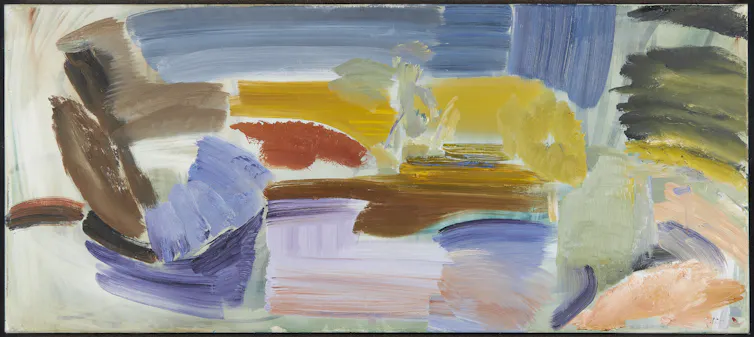
Sussex River, near Midhurst by Ivon Hitchens (1965). Pallant House Gallery/The Estate of Ivon Hitchens
The works by Ravilious, in whom there has been such an upsurge in interest in recent years, include even more ancient evidence of human activity. His Cerne Abbas Giant (1939) is seen through barbed wire. It’s rendered in earth browns to reflect the way it was turfed over to prevent it acting as a landmark for the Luftwaffe.
Capturing the man-made nature of the English landscape means the term is interpreted elastically here to incorporate seascapes, skyscapes, gardens and what Clough called “urbscapes”. It is taken to include activities such as those illustrated in Edward Bouverie-Hoyton’s Hedging and Ditching (1926). While this shows how much of the landscape of southern England was manufactured, the paucity of postwar material means that the grubbing out of thousands of miles of hedgerows since 1945 goes unrecorded here.
Instead, the exhibition suggests that there was a shift towards abstraction. All landscapes are abstract collages of light, shade, form and colour from a distance. The particularities of a scene that had moved Ravilious became the blocks of pigment used by Ivon Hitchens in works such as Distant Light on Dark & Dark through Light (1968). This was not the depiction of a vista, but an emotional response to it.
In painting in this way, Hitchens was nonetheless still seeking to express the spirit of place that is the defining theme of this engrossing exhibition.
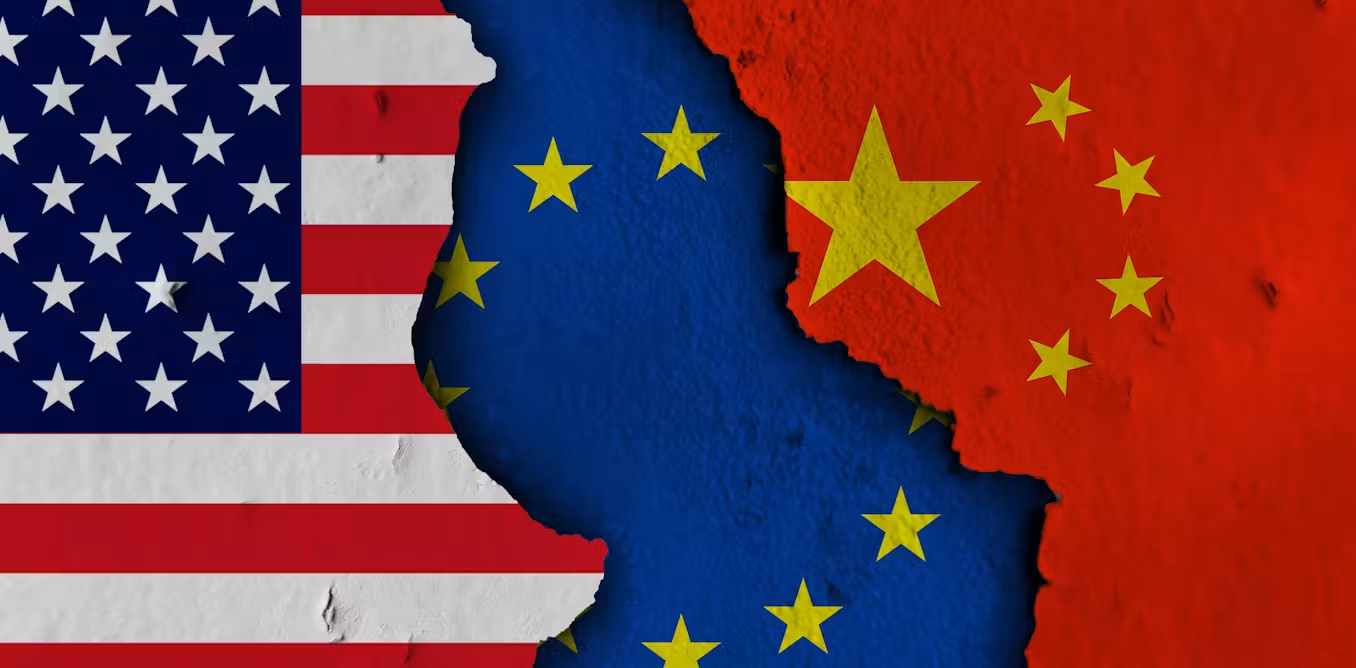
The European Union (EU), along with the other major countries in Europe, should be a geopolitical force to be reckoned with. In 2024, the EU was the second-largest economy in the world after the US and before China.
There is also nothing comparable to the trading links between these three players. In 2025, bilateral trade in goods between the US and China was US$414 billion (£307 billion). The EU and US, meanwhile, constitute a staggering third of global trade – with trade between them coming in at €1.77 trillion (£1.53 trillion) that same year.
These figures show that, far from the often-floated idea of a “Group of Two” (G2) where the US and China act as the joint steering committee for the planet, there really needs to be talk of a G3 that includes Europe.
My research has dealt with the relationship between China, Europe and the US for over 30 years. These three powers tend to silo and segregate their relations, which almost always comes at the expense of Europe. This is a phenomenon that has intensified under the US president, Donald Trump, in his two terms in office.
Advertisement
When the US and China meet, the Europeans tend to be outside the room with everyone else, trying to listen in. There is dialogue between China and the EU. There was even, briefly under President Joe Biden, an EU-US dialogue to coordinate their approach to China and the Indo-Pacific. This was mothballed when Trump returned to office in 2025.
However, what there has never been is a proper high-level Europe, China and US trilateral summit. And that situation is unlikely to change. When the British prime minister, Keir Starmer, visited China in January 2026, Trump criticised the trip. He said it was “very dangerous” for the UK to do business with Beijing.
Despite this, when Trump himself visited China in May, the sizeable technology delegation that accompanied him and the agreement for Beijing to buy 200 Boeing aircraft showed dealmaking was absolutely fine for the US. The mindset is clear enough. China and the US as superpowers have the right to deal with each other however they feel fit. No one else gets a look in.
Apple CEO Tim Cook (left) and Nvidia CEO Jensen Huang (right) accompanied Donald Trump on his recent visit to Beijing. Go Nakamura / EPA
Europe’s default position has been to accept this situation and sit between its two most important relationships, trying to balance. This has been demonstrated by the EU’s various high-level iterations of a policy approach towards China over the past 15 years. The most recent, in 2019, ended up balancing China between collaborator, adversary and competitor – illustrating Europe’s ruminative and indecisive mindset.
Advertisement
In terms of collaboration, Europe’s most obvious area of recent engagement with China has been in trade and investment. There has been technology transfer in automotives and manufacturing, and acceptance of Chinese tech company Huawei in European telecoms systems. But here, too, Europe has been cautious, with Huawei’s access to European markets heavily restricted from 2020 after American pressure.
The ways in which Trump has turned on his friends – demanding control of Greenland early in 2026 and criticising Nato and defence spending levels by longstanding allies – has created solid grounds for a rethink. Europe needs to acknowledge that working out its own policy on China means producing not just detailed plans (Europe is pretty good at that), but politically committed ones that place its own interests first.
Europe’s interests first
Brussels and other European capitals are dealing with a harsh emerging reality. Their key security relationship with the US is undergoing profound change and China is becoming a totally different kind of potential partner as it emerges as an innovator and a technology and research powerhouse.
Both phenomenon change the fundamental paradigm in which the EU now sits, and call for a different policy response – one that recognises more overtly that, for many areas and for many reasons, China is a partner and not a straightforward, unambiguous threat.
Advertisement
If we look at vastly consequential global issues, we can see this clearly. Europe is more aligned with China than the US on the threat of global warming from human activity and the need to use alternatives to fossil fuels.
Beijing and Brussels are also on the same page about the benefits and threats from AI, where China is now overtly stipulating the need to manage the effects of this new technology on jobs. And China, like Europe, views Trump’s attack on Iran with misgivings.
At the same time, Europe also worries about the real depth of Trump’s commitments – not just to Nato where his scepticism is well established, but in terms of standing by Taiwan were it ever to be attacked.
Realignment will not happen overnight, nor is there an easy destination. Trump’s White House successor, for example, may well be more into multilateralism. Even the current administration is talking about expanding its nuclear commitments in Europe. But the central reality is clear enough.
Advertisement
At a fifth of global GDP, and with a population of almost half a billion, Europe cannot continue to have a deferential, largely passive posture – and certainly not one where its largest and second-largest economic partners, the US and China, are involved.
At the very least, next time these two superpowers sneak into a room to continue their conversations, Europe should work out good arguments to join them, and not sit outside anxiously eavesdropping alongside everyone else.
In a post on Truth Social, the president wrote: “Yesterday, in a meaningless vote, the House voted, 4 bad Republicans and all of the Dumocrats, to limit my War Powers, right in the middle of my final negotiations to end the War with the Islamic Republic of Iran. Who would do such an unpatriotic thing.”
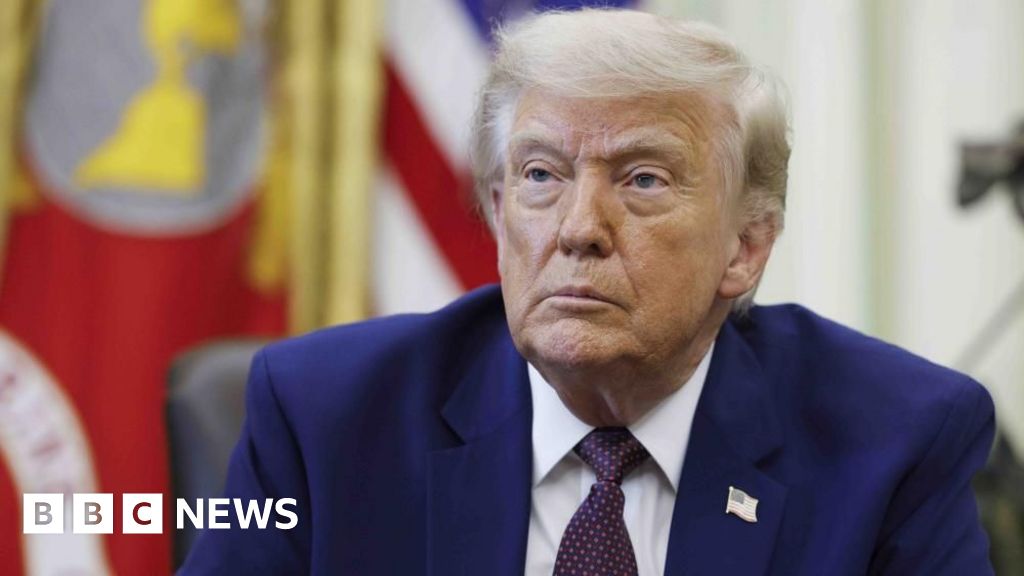
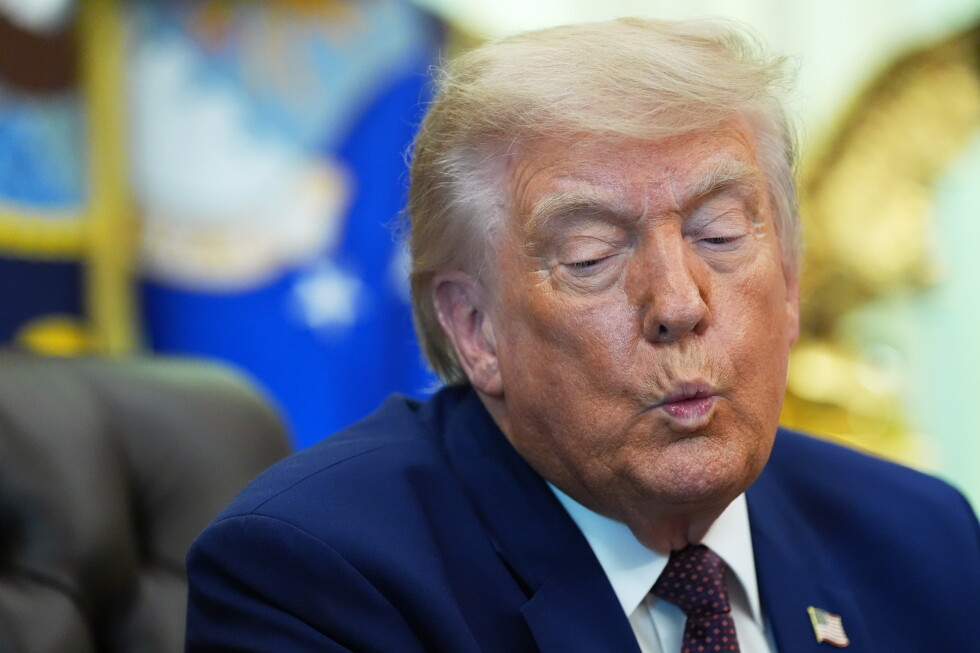
WASHINGTON (AP) — President Donald Trump is facing warnings from foes and allies alike that he’s getting boxed in on the Iran war, a conflict he sold as a brief military incursion but that has since settled into a holding pattern.
But Trump has called for unspecified changes to the agreement and Iranian officials — perhaps calculating that the Republican president is reluctant to restart the bombardment after burning through key weapons systems — are showing no signs they’ll give in to new demands.
A series of strikes by the U.S. and Iran this week has raised fresh concern that the ceasefire could collapse. Trump on Wednesday downplayed the significance.
Advertisement
“It’s a different part of the world,” Trump told reporters in the Oval Office. “You know, I’d say in that part of the world, a ceasefire is when you’re shooting in a more moderate manner.”
The shaky moment follows repeated claims by Trump since a 14-day ceasefire was agreed to on April 7 — following 38 days of U.S. and Israel bombing of Iran — that a deal is just days away and the Iranian side is begging to come to a settlement. Trump on Wednesday said it was possible something could come together “over the weekend.”
Without an interim settlement in place to reopen the Strait of Hormuz,global energy prices remain elevated and are adding to anxieties around the world about the impact of rising costs spurred by the three-month conflict on the cost of food, fuel and other goods.
After a string of reports this week that Iran was shutting down talks, Trump told CNBC he “couldn’t care less” if the negotiations had bogged down and even mused they had become “boring.”
Advertisement
There’s anxiety Trump is getting boxed in
There’s growing concern inside the administration and among key advisers and allies that Trump now finds himself in a bind, according to a U.S. official and another person familiar with the administration’s internal deliberations, both of whom spoke to The Associated Press on condition of anonymity to discuss private conversations.
Trump is privately hearing from other Republican lawmakers as well as Pentagon officials and Gulf allies that a return to the bombing campaign is a bad idea.
Those advising against returning to military action note that the U.S. has burned through munitions at too fast of a rate. It could take three years to replenish some key weapons systems.
Advertisement
Meanwhile, Gulf allies are worried that Iran will retaliate against them and their critical infrastructure and energy interests and further set back their economies.
At the same time, Trump has bristled at the idea of accepting a deal that resembles the 2015 nuclear agreement brokered by Democrat Barack Obama’s administration, which restricted Iran’s nuclear program in exchange for lifting international economic sanctions.
Trump during his first term abandoned the pact that he said had failed to permanently stop Iran’s nuclear program, ignored Iran’s ballistic missile development, and did not penalize Iran for supporting militant proxy groups across the Middle East.
Now, Trump, according to those familiar with internal deliberations, has made clear he feels strongly he can’t make “a bad deal” and is acutely aware that he’s at a moment where he’s at risk of tarnishing his legacy if he missteps.
Advertisement
White House spokeswoman Anna Kelly dismissed the notion that Trump has been boxed in or that there’s any concern within the administration about the pace of talks.
“These mysterious so-called ‘administration officials’ have no idea what they’re talking about — those actually involved in sensitive discussions know to trust in President Trump, who will always do what is best for U.S. national security,” Kelly said in a statement.
Trump resisted Israel push for Lebanon bombings
Israeli and hawkish allies in Washington have made the case to Trump that a deal at this point would amount to unconditional surrender, urging him to ratchet up economic pressure on Iran and back Israel’s assault on the Hezbollah militant group in Lebanon.
But Trump earlier this week in a heated call with Israeli Prime Minister Benjamin Netanyahu demanded Israel stand down, and on Wednesday, Israel and Lebanon said they agreed to renew a ceasefire. Hezbollah was not part of the Israel-Lebanon talks, which have been held at the ambassadorial level in Washington since the beginning of last month.
Advertisement
Remaining in the current status quo with Tehran — neither a full resumption of hostilities nor sealing an interim agreement to restart nuclear talks — is a situation that Iran appears better poised to exploit, argues Behnam Ben Taleblu, a senior fellow at the hawkish Washington think tank Foundation for Defense of Democracies.
Despite being the weaker party, Iran appears to be calculating that the longer the holding pattern lasts, the better the chances are they can “box in” Trump, he added.
“Either way, Tehran appears more resolute than ever to not provide Trump with a victory image, hence why it isn’t budging on the battlefield or negotiating table,” Taleblu said.
Holding pattern isn’t helpful for Republicans on the ballot
At the same time, Democrats are trying to capitalize on Trump’s handling of the unpopular war ahead of November’s midterm elections. The House of Representatives on Wednesday for the first time passed a symbolic resolution calling for a halt in military action against Iran, with four Republican lawmakers joining Democrats in the rebuke of Trump’s war.
Advertisement
During hours of hearings on Capitol Hill on Tuesday and Wednesday with Secretary of State Marco Rubio, Democrats laced into Trump for discounting the economic impact of the conflict on Americans and for failing to anticipate that Iran would shutter the Strait.
In one tense exchange, New Jersey Democratic Sen. Cory Booker pointed to the unsteady ceasefire as a sign that Iran has the upper hand.
“We are the strongest nation on the planet Earth, and we’re in a stalemate with Iran,” Booker said. “And now we’re begging to get back into a deal that you all trashed in the first place.”
Rubio dismissed the criticism, underscoring that Iran has been placed on its heels with the strikes that have taken out multiple layers of senior leadership and left Iran’s economy in shambles.
Advertisement
“There’s no one begging,” Rubio responded. “I don’t know where you’re getting this perception that Iran is stronger.”
Another Democrat, Sen. Chris Van Hollen of Maryland, homed in on Trump’s comments last month that voter anxiety about the cost of living was “not even a little bit” of a motivating factor for him to reach a deal to end the war.
The president continues to downplay the rising costs for Americans at the pump and predict that gas prices would fall sharply after the conflict ends.
Christopher Borick, the director of the Muhlenberg College Institute of Public Opinion in Pennsylvania, said that Democrats running in swing districts around the country are already zeroing in on Trump’s rhetoric on the war’s impact on Americans’ pocketbooks.
Advertisement
“There’s significant risk in having this thing drag on for Republicans,” Borick said. “It’s certainly going to hurt if Trump ends up in a place where the war ends and Iran’s nuclear program is in the same place. But for Republicans in some of these tough swing districts, there’s a case to be made to rip the bandage off now, get some easing in the oil markets and hope there’s enough time for voters to turn the page.”
___ Associated Press writers Farnoush Amiri in New York and Lisa Mascaro contributed to this report.
HAVANA (AP) — On a recent afternoon in Cuba, the temperature climbed and anxiety grew among the residents of a Havana street.
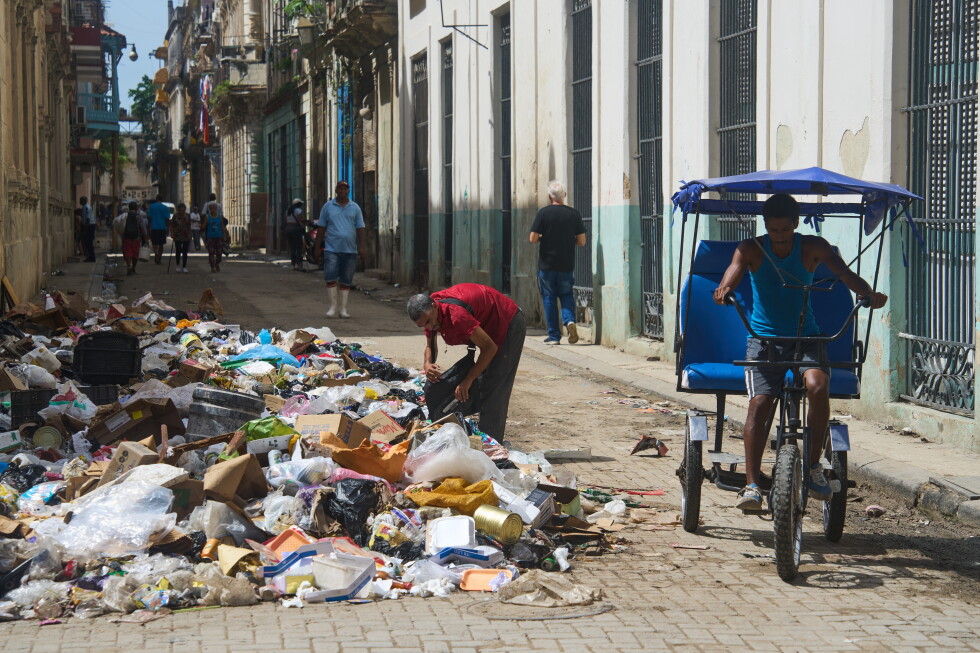
Their focus was an improvised dump site on the sidewalk with rotting food scraps, torn bags, cardboard and rubble. Swarms of flies and stray cats gathered around the trash whose stench wafted on the breeze from the nearby sea.
“What you’re looking at is depressing,” lamented María Odalys Ramírez, a 63-year-old who lives across the street from the capital’s iconic Hermanos Ameijeiras hospital. “The trash in this area, the flies, the rats, the filth — it’s completely unsanitary.”
For months, residents of Havana — home to 2 million of Cuba’s almost 10 million residents — have lived with piles of garbage accumulating on almost every street corner. The situation deteriorated after a U.S. energy blockade triggered power outages, water shortages and a fuel crisis that brought state-run garbage trucks to a standstill.
Advertisement
Without garbage collection, residents have begun burning waste in the streets, raising alarm among health officials over potentially toxic smoke.
Residents fear the coming months will bring worse conditions as summer heat intensifies and hurricane season begins.
A citywide tour by The Associated Press revealed identical scenes across Havana neighborhoods where locals said garbage trucks pass only irregularly.
In the city center and on the outskirts, cars, bicycles and pedestrians weave around the trash piles. Others pick through it, hoping to salvage something useful.
Advertisement
Havana as of last July was producing the equivalent of about 12 Olympic-sized swimming pools of solid waste every day, according the latest municipal figures available. Even then, municipal services collected just 57%.
The “improper management of urban solid waste” has been identified as a primary environmental challenge in Cuba’s national strategy, said Odalys Goicochea, an official at the ministry of science, technology and the environment.
Now, Goicochea warned, the current garbage collection situation, combined with rising temperatures and impending rains, could worsen the situation. The heat and moisture threaten to trigger a proliferation of disease-carrying flies and mosquitoes.
The crisis has sparked citizen initiatives to clean up neighborhoods.
Advertisement
One is El Batazo, an initiative operating across eight Havana blocks. A collector rings a bell twice daily to pick up pre-sorted household trash, while other project members sweep the streets.
Members then sell recyclable raw materials like aluminum and glass, repurpose food scraps to feed livestock and place the remaining trash into a container for later transport to a landfill.
“The fundamental impact of this project is proving to the community that it can be done,” said Evelyn Martínez, a collaborator at El Batazo. “It is entirely possible to live in a cleaner environment, give value to what we call ‘trash’ and put it to good use.”
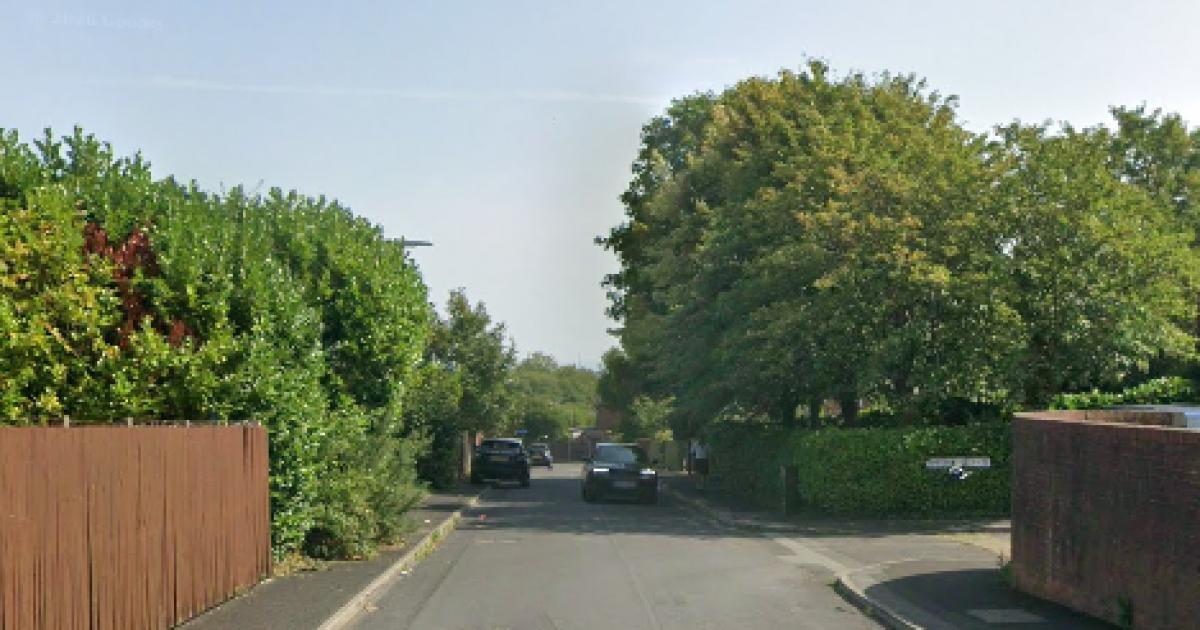
Timothy James David Coleman, 66, was found dead in Bredbury Drive, Farnworth, on 2 June.
There are believed to be no suspicious circumstances surrounding his death.
A spokesman for Greater Manchester Police said: “Anyone with information about Timothy’s next of kin should contact the Police Coroner’s Office in Bolton on 0161 856 4687.”
Advertisement
Officers are asking anyone who may have information about Mr Coleman’s next of kin or family members to come forward.
The Police Coroner’s Office in Bolton can be contacted on 0161 856 4687.
In UK law, there is no definition of next of kin, but it is understood to be the closest relative, whether a partner, parent, child or sibling.
Tyne Grange, located in Grainger Park Road and part of Exemplar Health Care, supports up to 21 adults with complex mental and physical health needs.
Following an inspection in February 2026, the CQC praised the home’s “exceptional” care and upgraded its rating for responsiveness from “good” to “outstanding.”
Katherine Swainston, home manager at Tyne Grange, said: “We’re absolutely delighted to have retained our ‘outstanding’ rating and to have improved our responsive rating to ‘outstanding’ as well.
Advertisement
“Our team puts so much care and compassion into supporting the people who live here, so it means a lot to see that recognised by CQC.
“What makes me most proud is the feedback from the people who live at Tyne Grange.
“Hearing that they feel safe, listened to, and happy in their home is what really matters.”
Residents told inspectors they felt safe, valued, and listened to.
Advertisement
One resident said: “I feel comfortable talking to staff because they know me well and I feel safe.”
Another resident added: “The best thing about living here is the amount of stuff you can do, there isn’t anything I would change.”
Karen, the home’s Service User Ambassador, said: “Every few months, I meet with Ambassadors from other Exemplar Health Care homes, and we make decisions about the way the company is run.
“I enjoy being an ambassador because I feel like I make a difference.”
The biscuit has an interesting bit of history behind its ‘ornate’ pattern
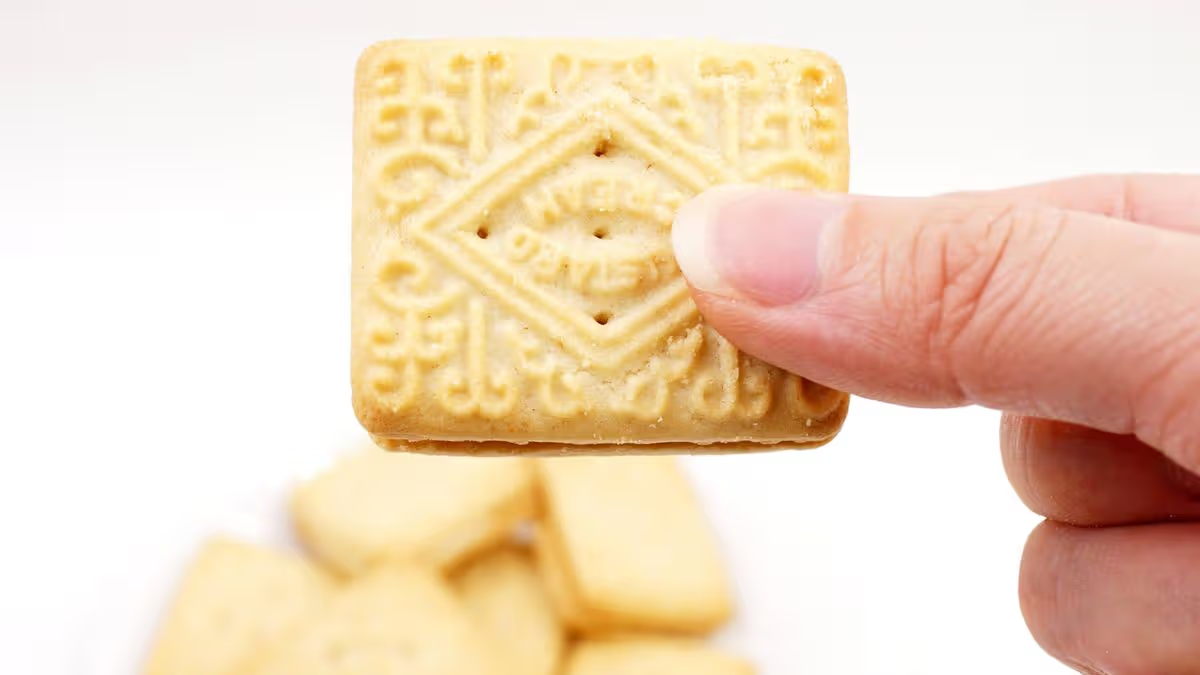
One of Britain’s most iconic treats, available for under £1 in most supermarkets, has kept a distinctive piece of history to this day. Few people actually understand why the beloved Custard Cream features such an “ornate” pattern compared to other biscuits.
Advertisement
On Instagram (@Theotherbritishmusuem), radio presenter Annabel Port delves into unusual aspects of British heritage, uncovering entertaining ‘did you know’ facts. In a viral video viewed by over 612,000 people, she examined the reason behind one of Britain’s most recognisable biscuits having its “over the top” design, reports the Mirror.
She said: “You will not believe what the swirls on a custard cream are supposed to be. These are one of the UK’s favourite biscuits and also one of the cheapest.
“It’s a very bog standard food with an incredibly over-the-top, ornate decoration – like a semi in Swindon with a recreation of the Sistine Chapel inside.” Custard cream biscuits have been savoured in Britain since 1908, Annabel revealed, with the Victorians responsible for the biscuit’s “ornate” appearance.
She continued: “[The Victorians] were mad for ferns. They were so obsessed that they held fern-hunting parties and collected them to the point that some species became extinct.”
Advertisement
Content cannot be displayed without consent
“The reason ferns got so massive was [because of] George Loddiges. He built the largest greenhouse in the world in Hackney, East London, and it was really expensive – so he needed people to visit.” More powerful than sticking an advert somewhere, Loddiges spread a rumour that an appreciation for ferns showed a sign of intelligence.
“Somehow, this actually worked,” Annabel joked. She added: “There was such a craze for them that they put a fern-like decoration on this biscuit. That’s what those swirls are supposed to be.
“Not sure they did the greatest job. At least now I can think ‘Oh this makes me look more intelligent’ – even though they are a little bit boring.”
To this day, Custard Creams remain a British favourite that millions enjoy nationwide every day. Retailers stock these baked goods for as little as 45p per pack.
Previously, Annabel revealed the “rule” that prompted nearly all UK washing-up liquids to choose the exact same colour – green – despite only one having a logical explanation. People were fascinated to discover that another slice of Victorian-era history has shaped major brands to this day, including Asda, Tesco, Morrisons, Sainsbury’s, Aldi and Lidl.
Annabel explained: “Back in 1898, Fairy Soap was launched and was used for everything – clothes, dishes, skin, whatever. It was made in Newcastle by Thomas Hedley and Co, and early ads show that the soap was also green, olive green, and for a reason, it contained olive oil.
“The olive oil is gone now, probably as it’s more expensive than gold or printer ink. This was their brand colour and they stuck with it, even if it got more lurid over the years and other companies blindly followed.”
Who are the best young talents on the baize? (Picture: Getty Images)
Snooker’s top stars are lasting longer than ever, with some of the best in the world now in their 50s and still competing for titles.
The legendary trio of Ronnie O’Sullivan, Mark Williams and John Higgins have all passed the half-century and all remain in the top 16 in the world rankings.
Then come the 40-somethings who are also as good as ever: Mark Selby, Neil Robertson, Shaun Murphy, Mark Allen and Barry Hawkins among them.
30 years old used to be seen as the beginning of the end on the baize, but now it seems unlikely to even be the halfway mark of a career.
Advertisement
That is not to say there aren’t young talents around, as we have seen at the Crucible of late, with the last two world champions lifting the trophy in their twenties.
It is as difficult as ever for youngsters to make the breakthrough, with legendary names somehow still producing brilliance for at lot longer than they ever did in the past.
Are you snooker loopy?
You’re in the right place. I’m Phil Haigh, and I cover the game we all love for Metro.
In my newsletter, The Table, I analyse the biggest talking points, pull back the curtain on the sport and crown the biggest winners and losers every week.
Phil has been reporting on snooker for over a decade
There are bright young things around on the professional tour, though, and here are the 30 youngsters shining brightest, ranked by both what they have done so far and what they are likely to achieve in the future.
Liam Davies has long been one of the UK’s brightest prospects (Picture: Getty Images)
29. Iulian Boiko – 20 – Ukraine
Still just 20, it feels that Iulian Boiko has been around a while since first turning pro at 14. Progress has not been rapid since then, but has been noticeable, looking more comfortable on tour last season.
28. Wang Xinbo 18 – China
Only just turning pro this season, but Wang Xinbo could make quick strides up the rankings. Won his first ranking match three years ago as a wildcard and won two World Championship qualifiers comfortably in April. Looks great.
Advertisement
27. Michal Szubarczyk – 15 – Poland
Michal Szubarczyk is gaining experience on tour at an incredibly young age (Picture: Getty Images)
The youngest ever professional could easily have gone his whole first season winless, but picked up some impressive victories. Notably two of those came in World Championship qualifying. He doesn’t turn 16 till January.
26. Lan Yuhao – 17 – China
It was just the odd win here and there in his first season on tour, but Lan Yuhao passes the eye test and looks to have a lot of potential. Mark Selby, Matthew Stevens and Michael Holt have all noted how good the teenager looks.
Artemijs Zizins has picked up some impressive wins over higher-ranked players (Picture: Getty Images)
Some big wins at key times last season over the likes of Ali Carter and Luca Brecel saw the Latvian cling onto his tour card. Isn’t delivering consistently yet, but progress continues.
24. Gao Yang – 21 – China
WSF Championship winner last year, Gao Yang is in his second stint on tour and is looking more the part. Two years on the spin he has won three matches in World Championship qualifying, but just missed out on the Crucible both times.
23. Long Zehuang – 29 – China
Quickly established himself as a solid mid-ranker since turning pro in 2023, but more steady than spectacular. A very good player, but not with the potential of some on this list.
22. Ben Mertens – 21 – Belgium
It’s been very under-the-radar progress from Ben Mertens, but into the top 64 in the world rankings at 21 is impressive. Still waiting for a deep run outside the Shootout, but it is coming.
Advertisement
21. Julien Leclercq – 23 – Belgium
Julien Leclercq made it to the Barbican at the UK Championship this season (Picture: Getty Images)
The Belgian Beast has shown flashes, with a run to the Shootout final in 2023 and qualifying for the UK Championship last season, but it feels like there is plenty more to come from the 6’6″ giant.
20. Antoni Kowalski – 22 – Poland
Needed to win three World Championship qualifiers to save his tour card in April and he did just that, with impressive victories over Joe O’Connor and Jamie Jones. A confident character, he’s capable of kicking on now.
19. Jiang Jun – 20 – China
Jiang Jun plays at his own pace but it works for him (Picture: Getty Images)
One frame away from a Crucible debut in April after beating Elliot Slessor in the penultimate round. A slightly odd player to watch, Jiang downed the likes of Mark Selby, Barry Hawkins, Dave Gilbert, Thepchaiya Un-Nooh, Chris Wakelin and Hossein Vafaei last season.
18. Louis Heathcote – 28 – England
Two of his three ranking quarter-finals have come in the last two seasons, so progress continues, but we are still waiting for a big breakthrough for the Hoover. The talent is there, but one thing he must start doing is win more matches on the road as Chinese events are a huge help on the rankings.
17. Liam Pullen – 20 – England
Liam Pullen had a great run to the Crucible this year (Picture: Getty Images)
The Yorkshireman’s first two years on tour were tough, as you’d expect them to be, but last season he started showing what he’s got. Wins over the likes of John Higgins and Chris Wakelin, a first ranking quarter-final and winning four matches to make a Crucible debut.
16. He Guoqiang – 25 – China
A Crucible debut this year – beating Jack Lisowski in qualifying – continued He’s rapid progress since turning pro in 2023. He has two wins under his belt over Ronnie O’Sullivan, plus victories over the likes of Neil Robertson, Wu Yize, Kyren Wilson and Barry Hawkins.
15. Liu Hongyu – 22 – China
Made a splash in his first season by making the semi-finals of the 2023 English Open, beating Shaun Murphy, Chris Wakelin, Mark Williams and Ding Junhui en route. That remains his most impressive performance, but he has been steady in climbing the rankings.
Advertisement
14. Lyu Haotian – 28 – China
One ranking final, four more semis and four trips to the Crucible, it’s a very decent return, but Lyu Haotian’s progress has stalled. He sits at number 61 in the world rankings, having reached 24 at one stage, but there is clearly great talent in there.
13. Jackson Page – 24 – Wales
Action Jackson is becoming a more regular face at the business end of events, with a ranking final and four quarter-finals over the last two seasons but consistency is still evading him. Progress seemed to stall a bit over the last campaign, but is devastating when he hits form.
12. Xu Si – 28 – China
Xu Si is yet to fulfil his potential (Picture: Getty Images)
The 2024/25 season was Xu Si’s best of his career, but the last campaign saw him return to the unspectacular results of previous years. He looks great at times, making three maximums, but consistency is still lacking after nine years on tour.
11. Yuan Sijun – 26 – China
Turning pro in 2017, Yuan Sijun has been a coming man for nearly a decade but he is still yet to arrive. There’s still plenty of time and is impressively ranked 30 in the world, but he is still to fulfil the potential he was showing a few years ago.
10. Aaron Hill – 24 – Ireland
Two 147s last season and a third ranking quarter-final continued the Irishman’s march up the world rankings to well inside the top 50. Improvements are clear and the next step seems imminent, perhaps semi-finals Triple Crown qualification.
Advertisement
9. Fan Zhengyi – 25 – China
Out of nowhere Fan Zhengyi beat a load of top players including Ronnie O’Sullivan in the final to win the 2022 European Masters. He hasn’t really seemed like repeating that since, but three wins in World Championship qualifying this year and then an epic 10-9 loss to Shaun Murphy saw him looking good again.
8. Stan Moody – 19 – England
Stan Moody had a thrilling Crucible debut this year (Picture: Getty Images)
The teenager reached his first two ranking quarter-finals last season and is up to a career high ranking of 40 after making a Crucible debut in April. He may have lost that World Championship opener to Kyren Wilson, but a thrilling opening session showed what a danger he is to anyone. He beat Wilson, John Higgins, Ali Carter (twice), Barry Hawkins, Ding Junhui and Zhou Yuelong (twice) last season.
7. Lei Peifan – 23 – China
The 2024 Scottish Open victory was entirely out of the blue but was a stunning win. He has backed it up to an extent, qualifying for the Crucible twice since and beating defending champion Kyren Wilson there last year. He came through UK Championship qualifying in each of the last two seasons as well, so is racking up serious experience for his age.
6. Pang Junxu – 26 – China
One of the least flashy youngsters to emerge from China in recent years but one of the more effective. He has a ranking final and two semis to his name and has reached the Crucible four years on the bounce. Wins a lot of games and looks a pain to play, which is a compliment.
5. Si Jiahui – 23 – China
Si Jiahui’s progress has stalled but is still a great talent (Picture: Getty Images)
After his incredible World Championship semi-final run in 2023 it looked like Si Jiahui was the next big star. It continued to look like that when he reached the German Masters and Wuhan Open finals, while he also beat Ronnie O’Sullivan and Judd Trump in spectacular fashion in big events. Last season saw him stall and drop behind a couple of compatriots on this list, but clearly the game is in there.
4. Chang Bingyu – 23 – China
Back on tour last season after a ban, it was an eye-catching return and there is a lot of excitement about what Chang Bingyu can produce in the coming campaign. A ranking final, two 147s and a whitewash win over Shaun Murphy with 100 per cent pot success were notable highlights of the 2025-26 season. On his way to the Scottish Open final he beat Stephen Maguire, Si Jiahui, Kyren Wilson, Mark Selby and Mark Allen.
Advertisement
3. Zhou Yuelong – 28 – China
Turning professional in 2014 with a huge amount of expectation, it is surprising Zhou Yuelong is yet to land a ranking title, but he has come close, with four finals to his name. Because we have seen so much of him it is tempting to think he may have peaked, but he could easily replicate thetitle-winning success of the likes of Xiao Guodong and Zhang Anda. In fact, his ceiling is probably higher.
Wu Yize conquered the Crucible in May (Picture: Getty Images)
Crucible success in May turned Wu Yize into a superstar as he became the second youngest world champion ever. It was just his second ranking title, but he could rack up a huge amount over the next 20 years.
Zhao Xintong became China’s first world champion in 2025 (Picture: Getty Images)
Wu Yize has pushed hard for top spot, but Zhao Xintong still holds on for now after a brilliant season as world champion saw him add three more ranking titles to his collection.
He doesn’t turn 30 until April next year and we can expect a few more trophies on the mantlepiece by then.
What does it all mean?
Nationalities of snooker’s 30 under 30
China – 18 England – 3 Belgium – 2 Poland – 2 Wales – 2 Ireland – 1 Latvia – 1 Ukraine – 1
Advertisement
As we have known for some time, the top young talent is overwhelmingly coming from China more than anywhere else.
Britain is lagging behind, with more coming from mainland Europe than the UK right now.






































You must be logged in to post a comment Login