


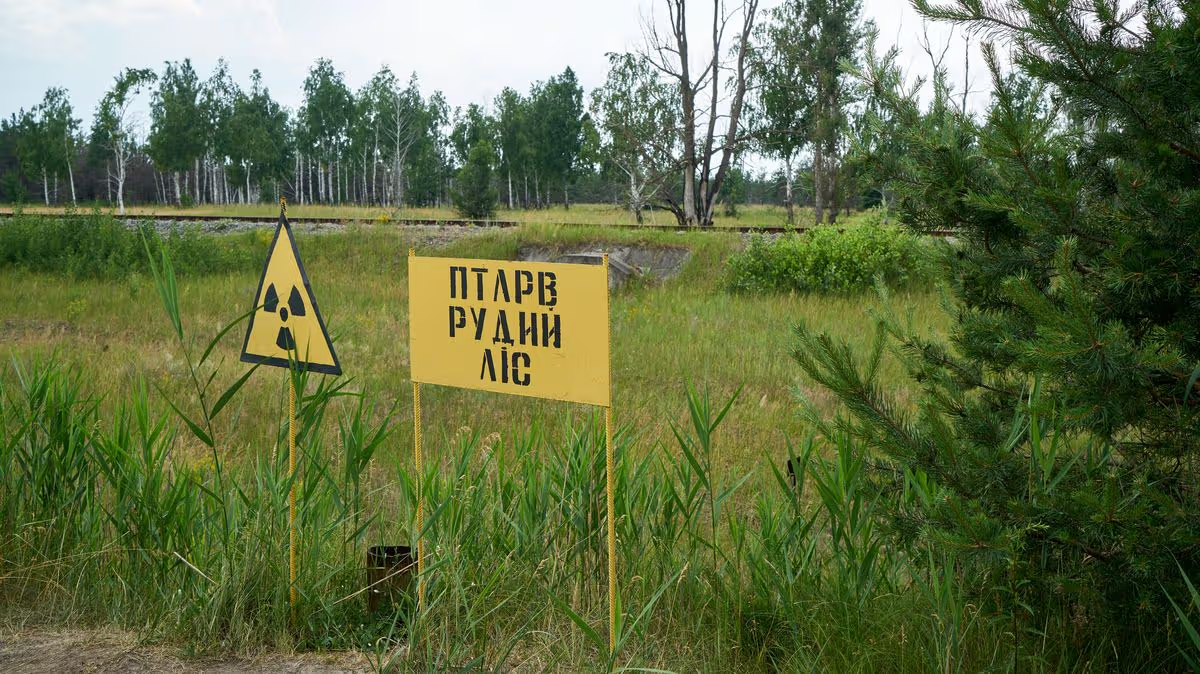
The worst nuclear accident in history happened at the Chernobyl Nuclear Power Plant 40 years ago this month.
There aren’t many single words that conjure up as much horror and emotion as ‘Chernobyl’. The name of the ill-fated nuclear power plant will live long in the memory – though perhaps the estimated 20,000 years of radiation damage it did to its surrounding area will be a touch longer.
The Chernobyl disaster, which occurred 40 years ago this month, was sparked with a simple push of a button. A power plant operator pressed a switch marked AZ-5 as part of a standard safety test – and created some very unwanted history.
Igor Kirshenbaum, one of the Soviet operators working in reactor number 4 of the Chernobyl Nuclear Power Plant on that fateful day of April 26, 1986, described the moment everything changed. “There was silence for a few seconds,” he said. “Then there was a rumble. Thunder. Dust falling from the ceiling.”
At 1.23am, the reactor went into meltdown and caused an explosion and fire which spread radiation across much of the Soviet Union and Europe, even reaching as far as Scotland. It is reckoned that the disaster released 400 times more radioactive material than the atomic bombings of Hiroshima and Nagasaki combined.
Two workers died instantly and 28 more passed away in the weeks that followed from radiation. It is unlikely the full scale of the damage will ever be known, but thousands of people have suffered long-term health effects, especially thyroid cancer, and many believe it caused birth defects for years to come.
Soviet authorities initially tried to blame the disaster on human error, but it was proved to be a design fault in the control rods for the reactor core that led to the meltdown – and it was triggered by that push of the AZ-5 button.
As reported by The Express, National Geographic is broadcasting a four-part series called Chernobyl: Inside the Meltdown to mark the 40th anniversary. The powerful exposé starts this Sunday, April 19, tells the story from the moment the reactor exploded up to the present day, with the site once again becoming geopolitically sensitive as the war in Ukraine wages on.
After the explosion, local firemen were the first on the scene, bravely charging into the disaster with little in the way of protective equipment or the true danger they were putting themselves in. Most of them died in the ensuing weeks, having been doused in lethal radiation.
In the nearby city of Pripyat, life continued as normal, with authorities refusing to acknowledge the scale of the deadly risk. Olena Mokhnyk was a young girl living close by. She said: “I remember there was an unusual view on the power plant. I said, ‘Mum, is it on fire?’ But we just went to bed like it was a normal Saturday night.”
Wyatt Andrews, Moscow correspondent for US TV network CBS, told the documentary: “This was a global disaster with global implications – a threat to the entire planet. But secrecy was baked into the Soviet soul.”
It was only the following afternoon that locals were evacuated, with more than 200,000 people taken away from their homes, never to return. The area immediately around Chernobyl is expected to be uninhabitable for at least 20,000 years, even with the power plant now being entombed in something known as New Safe Confinement.
The decision to seal the reactor in steel and concrete came five months after the disaster, in September 1986. To do this, they first needed to clear all the radioactive debris – and one of the volunteers for this unappealing task was Sergei Belyakov, a 30-year-old army reservist and chemical technologist who lived nearby.
Wearing lead breastplates and respirators, he and others scrambled onto the roof of the neighbouring reactor and used shovels to scoop up the material and chuck it into the damaged reactor. They should have been in that environment for no more than 45 seconds each time.
But, as Belyakov explains, this wasn’t always the case. “I will never forget it until my deathbed,” he says. “The terrible images I have in my mind.
“I felt incredible rage to the point that I wanted literally to fall down and tear it apart with my teeth because it was such an intense desire to do what they were asking us to do.”
Desperate to clear the debris, he spent 23 days cleaning up Chernobyl that summer, to get it ready for its huge sarcophagus. In the years since, the now-70-year-old has experienced a vast array of health issues, including to his kidneys, liver, eyesight, circulation and immune system.
Mentally, he has been haunted by nightmares and once suffered a nervous breakdown. But Belyakov, who now lives in Singapore, would do the same again. “Absolutely. Yes, no question,” he says.
In the UK, Tim Eggar was a 34-year-old minister at the Foreign Office in London and the man responsible for nuclear matters. He was asleep in the early hours when his landline rang.
He heard the word “nuclear” and feared the Soviet Union had launched a missile attack. He said: “I thought, ‘Oh s***, it’s a nuclear attack!’ Just for a nanosecond. Remember, this was the Cold War.”
Eggar, now 74, was particularly concerned with the dozens of Brits, mostly students, living in Kyiv and Minsk, and he also had to consider how the radiation would affect the UK. Thousands of sheep in Scotland, Wales, and Cumbria, were slaughtered to prevent contaminated meat from entering the food chain.
Some historians claim the accident – and the resulting cover-up by Moscow – accelerated the downfall of the Soviet Union a few years later. Fast forward four decades and the war in Ukraine has brought Chernobyl into sharp focus again.
As part of their invasion in 2022, Russian forces briefly captured the site. They disturbed nearby soil and released radioactive dust. Even more worryingly, a Russian drone strike hit the New Safe Confinement in 2025, with Ukrainian president, Volodymyr Zelensky, accusing his enemies of deliberately trying to trigger a nuclear incident.
But, 40 years on, the last word should go to the human victims whose lives have been so disrupted by Chernobyl. Olena Mokhnyk was forced to flee her home twice – once in 1986, as a little child, because of the nuclear accident and again in 2022, as a parent, when the Russians invaded Ukraine.
Living with her children in Luxembourg, she said: “It feels as if the situation repeats itself. I hoped for better for my kids but it didn’t happen. I always teach my children to be adaptable and be resilient. And Ukrainians are proved to be resilient.”
Chernobyl: Inside the Meltdown airs Sunday and Monday at 9pm exclusively on National Geographic



















































You must be logged in to post a comment Login